


Does Agglomeration Enhance Property Value?
Abstract
Does agglomeration within a building and/or neighborhood enhance or weaken property value? The valuation impact is unclear ex ante, given that agglomeration tradesoff enhanced productivity at the expense of a more concentrated tenant base. We find that a value premium exists only when agglomeration at both the building and neighborhood levels consists of firms in the same industry. This premium represents capitalized knowledge spillover externalities. Additionally, we show the stock market rewards real estate investment trusts that transact specialized buildings. The valuation consequences arising from agglomeration in the underlying real estate market are thus consistent with the public real estate market.
This paper was accepted by Tomasz Piskorski, finance.
Funding: This work was supported by the Real Estate Research Institute.
Supplemental Material: The online appendix is available at https://doi.org/10.1287/mnsc.2023.02773.
1. Introduction
“Cities thrive because of their ability to spread knowledge.”
—Glaeser and Gottlieb (2009, p. 1012)
“If firms are paying higher rents in a particular location, all else equal, then the location must have some compensating productivity differential” (Rosenthal and Strange 2004, p. 2131). Consequently, rents should reflect the presence of agglomeration economies in addition to high productivity, employment, and wages. However, testing this proposition proved challenging due to the unavailability of quality rent data until very recently. Consequently, only a few studies show that agglomeration effects are manifested in rent (Arzaghi and Henderson 2008, Drennan and Kelly 2011, Koster et al. 2014). None of these prior studies focuses on the complementary issue of whether agglomeration economies result in a value premium or discount. This is the purpose of our research. Are agglomeration economies accretive or dilutive with respect to property values? Unlike rents, transaction prices reflect a forward-looking assessment of a building’s value. Prices incorporate both current and expected future cash flows and perceived risk. Therefore, transaction prices reflect the long-term implications of agglomeration, which rent per se does not fully capture.
Ex ante, it is unclear whether a building value premium (or discount), if any, should exist, given that a highly concentrated, undiversified intraindustry tenant base could potentially offset productivity gains that arise from spillover externalities. The former subjects the building to adverse industry shocks, for example, the dot-com bubble burst.
If a value premium (discount) does exist, what is the primary agglomeration channel that acts as the value catalyst? Is it the pooling of labor, sharing inputs and outputs, or knowledge spillovers1 that acts as the primary valuation driver? Ciccone and Hall (1996) show that firms are willing to pay a premium for a location that offers positive externalities arising from these agglomeration channels, ceteris paribus.2 The fact that the sources and magnitude of agglomeration economies vary across different sectors makes ascertaining which is the pertinent agglomeration channel a challenge. For example, a manufacturing firm might value sharing inputs and outputs with other manufacturing firms more than knowledge spillovers. That manufacturing firm is willing to pay a premium for a location that offers such benefits. We posit that the knowledge spillover externality is the pertinent valuation catalyst, the relevant agglomeration channel. Our hypothesis pivots on the portability of the argument of Glaeser and Gottlieb (2009) that cities thrive because they facilitate the flow of knowledge among people and organizations to office buildings. Office buildings predominantly accommodate idea-oriented and service-oriented industries, that is, immaterial producers (Leamer and Storper 2001, Drennan and Kelly 2011). These industries tend to cluster in urban centers, whereas goods-oriented industries relocate to peripheral areas (Drennan 1989, 2002; Glaeser and Gottlieb 2009). Therefore, we posit that it is the ability to spread knowledge that makes an office building desirable.
To test our proposition, we focus on office buildings that U.S. real estate investment trusts (REITs) own. For these buildings, we obtain building-level tenant information at the time a transaction occurs. We also collect geocoded employment data at a very granular geographic level (150 m). Employing REIT transactions enables us to formulate an identification strategy for disentangling the knowledge spillover channel. We use an instrumental variable approach to address the endogeneity concern and observe the stock price reaction when these REITs acquire or dispose of office buildings that have varying degrees of agglomeration economies. To understand how agglomeration affects the two components of valuation, rental income and risk perceptions, we analyze the net operating income (NOI) and the capitalization rate (cap rate) separately in addition to the manually collected lease data. We find that agglomeration enhances the income-generating potential of a property without significantly affecting its perceived investment risk.
We are thus able to determine the valuation consequences arising from agglomeration in both the private and public real estate market. In testing our hypothesis, we address several related questions. (1) Does office price reflect agglomeration economies both within a building (vertical) and in its neighborhood (horizontal)? (2) Does the value of a building benefit from neighborhood specialization if the concentration of the tenants in the same industry within a given building is distinct from the dominant industry(ies) in a neighborhood? In other words, what are the property value implications (if any) if the vertical building specialization does not match the horizontal neighborhood specialization? (3) How do investors in the stock market react when a publicly traded real estate investment firm buys or sells an office building that has a high degree of vertical and/or horizontal sectoral specialization?
We find that a significant agglomeration (price) premium exists for an office building only when the vertical specialization of a building matches the horizontal specialization of the neighborhood. From a locational perspective, the incremental value premium of an office building is contingent on whether its specialized tenant mix benefits from knowledge spillovers that arise from a neighborhood that also specializes in its industry. By analyzing newly signed leases within three years of the transaction year, we find that tenants are willing to pay higher rents for buildings that are more specialized in their industry sectors and for buildings that are associated with higher knowledge spillover effects. We also find that investors in the stock market react positively to transactions of office buildings whose building specialization matches its neighborhood specialization. This suggests that when the tenant mix of a building is tilted toward a particular industry, a higher price premium is obtained for that building when the same industry is concentrated in the neighborhood, even though higher risk is obtained due to nondiversification of its tenant base.
Our study contributes to the literature in several ways. First, we can directly quantify and test the extent to which spatial sectoral specialization impacts the value of office buildings via the knowledge spillover channel by linking the vertical and horizontal specialization. We provide additional evidence that service industries benefit from the spatial concentration of same-industry firms due to enhanced information and knowledge spillovers; such benefits should, in turn, be reflected in the rent and values (Arzaghi and Henderson 2008, Drennan and Kelly 2011, Rosenthal and Strange 2020). Our study is also related to the literature on the location choices of firms. We provide some support to the argument that a firm’s choice of location may be endogenous to knowledge spillovers. Although previous research indicates that a rent premium is associated with specialization, it is unclear whether this leads to higher building values because specialization could also result in a higher cap rate due to reduced diversification. By bifurcating value into NOI and cap rate, our study provides new insights into this relationship, offering an additional contribution to the literature. Another distinguishing feature of our study is that we provide initial evidence of the stock market’s reaction to localization economies. Intuitively, it is natural to expect that stock market investors should reward positive agglomeration gains. Empirically, however, it is difficult to estimate the real effects. Using office transactions of U.S. REITs, we conduct an event study that allows us to identify investors’ reactions via the stock price around the transaction of an office building with varying degrees of knowledge spillover benefits. Finally, our use of disaggregated specialization measures allows us to address several unaddressed empirical issues at a much more granular level. In particular, the results of prior studies, such as Drennan and Kelly (2011) and Koster et al. (2014), are based on the pooled effects of agglomeration, for example, all buildings are treated as if they are homogenous, using average rent over a wide geographical area or over a long time period. This assumption overlooks the heterogeneity of individual buildings and their location-specific attributes. Furthermore, it fails to acknowledge that knowledge spillovers only operate at very narrow spatial levels (Rosenthal and Strange 2001, 2003; Charlot and Duranton 2004; Moretti 2004; Arzaghi and Henderson 2008; Bayer et al. 2008; Rosenthal and Strange 2008; Briant et al. 2010; Hellerstein et al. 2011; Li 2014; Kerr and Kominers 2015; Baum-Snow et al. 2024). Recent studies show that agglomeration economies could also exist within a building (Liu et al. 2018, 2020, 2024; Rosenthal and Strange 2020). Although these studies capture the vertical spatial distribution of tenants, we go a step further to examine the impact of this vertical sectoral specialization on building values using manually collected data on tenants who occupy the building at the time of acquisition or disposition and also newly signed leases that occur around the building transaction. Our study also adds to the limited understanding of how economic activities within a building, in addition to its surrounding neighborhood, impact a building’s value.
The remainder of the paper is organized as follows. Section 2 reviews the relevant literature and includes a discussion of how the agglomeration channel affects building values. The data, variables, and empirical strategy are described in Section 3. Section 4 discusses our main estimation results and robustness tests, whereas Section 5 presents our findings on the stock market’s reactions to the transactions of properties with varying degrees of intraindustry specialization. Section 6 concludes.
2. How Does Spatial Sectoral Specialization Affect Office Price?
2.1. Specialization and Knowledge Spillovers
A large amount of literature confirms the existence of positive externalities that arise from agglomeration: that firms benefit from choosing to locate in clusters of economic activities. Although empirical studies across different countries have substantiated all three agglomeration mechanisms that Marshall proposed, labor market pooling, input sharing, and knowledge spillovers, many of these studies focus on manufacturing industries.3 Although agglomeration economies also exist in other industry sectors, such as retail4 and services sectors,5 the source and magnitude are likely to vary depending on the industry characteristics.
One of the forms of agglomeration economies (localization or specialization) that traces back to the Marshall-Arrow-Romer (MAR) model (Marshall 1890, Arrow 1962, Romer 1986) argues that spillover externalities are created via a spatial concentration of same-industry firms, which ultimately improve these firms’ productivity. The following empirical studies widely support MAR spillovers. They document various positive externalities associated with spatial sectoral specialization. Rosenthal and Strange (2001) explore specialization across various industries to understand the microfoundations of agglomeration economies. They find that labor pooling, input sharing, and knowledge spillovers in a given industry are all significantly related to the spatial concentration of this industry. Rosenthal and Strange (2003) investigate how specialization and diversity affect the birth and employment of new establishments. The authors conclude that localization effects are stronger and more consistent than urbanization effects. In particular, they find that the spatial concentration of an industry has a positive effect on the regional formation of new establishments. Rosenthal and Strange (2005) extend Rosenthal and Strange (2003) and find that industry specialization has a positive effect on entrepreneurship for every industry in their sample. In contrast to this, the diversity effect is much smaller in magnitude and is sometimes even negative for some industries such as wholesale trade, services, and business services, further supporting localization economies. Moretti (2004) also provides support for localization economies finding larger spillovers among common industries. Grieser et al. (2022) find that other than location choices, agglomeration externalities also influence investment decisions, financial policies, and the performance of the firm. Their findings suggest that these externalities are most prominent within the same industries. Bustamante and Frésard (2020) examine the peer effects on firms’ investments and find that firms exhibit a stronger reaction to the investments of their product market peers when peers are located in areas fostering knowledge spillovers. Kanellopoulos and Fotopoulos (2019) document that geographic sectoral specialization has a positive effect on regional new firm formation.
The knowledge spillover premise derived from the MAR model involves the hypothesis that a spatial concentration of same-industry firms should increase the flow of knowledge, known as intrasectoral knowledge spillovers. Despite the difficulty in measuring knowledge spillovers, this hypothesis has received substantial empirical support. Prior researchers have used patents or research and development (R&D) data as proxies for knowledge spillovers.6 Jaffe et al. (1993) represent one of the first studies to utilize patent citations in conjunction with the geography of knowledge spillovers. The authors find that knowledge spillovers are localized. However, Almeida and Kogut (1999) find that this localization of knowledge may vary across regions. Keller (2002) finds similar results using R&D expenditures. Knowledge spillovers are prominent within the technology sector. Moretti (2021) finds that locating in a city that has a high-tech cluster increases the productivity of individual inventors (both in quantity and quality). Figueiredo et al. (2015) test the Marshallian hypothesis directly. They find that spatial sectoral specialization is positively correlated with knowledge spillovers. A higher spatial concentration of an industry’s establishments or employment is associated with an increase in an industry’s patent production.
In reviewing a range of research, Rosenthal and Strange (2020) conclude that agglomeration economies decay with distance regardless of the industries, geographical scales, and mechanisms. They point out that knowledge spillovers attenuate the most rapidly among Marshall’s trinity. Knowledge spillovers function at a narrow spatial level because these effects largely depend on human interactions and communications. Charlot and Duranton (2004) find that agglomeration effects are largely transmitted via communication externalities arising from in-person interaction within close proximity. Matray (2021) provides evidence that local innovation spillovers decline rapidly with distance. A recent study by Baum-Snow et al. (2024) finds strong spillovers exist among firms within the same industry in a 500-m area. They argue that the primary mechanism facilitating spillovers at microgeographic spatial levels is the exchange of learning or knowledge between neighboring firms. The localized nature of Marshallian knowledge spillovers is also evidenced in many other empirical studies, such as Rosenthal and Strange (2001, 2003, 2005), Arzaghi and Henderson (2008), Ellison et al. (2010), Greenstone et al. (2010), and Billings and Johnson (2016).
2.2. Measuring Agglomeration Economies with Rents
Rents reflect agglomeration economies; locations with positive externalities are more sought after (Roback 1982; Rosenthal and Strange 2004, 2020). Until recently, however, empirical studies were unable to test this proposition due to the difficulty in obtaining rent data. The few studies that do support this conjecture have used either aggregated rents applied to agglomeration economies at the city or Central Business District (CBD) level, or coarse measures of agglomeration without testing the agglomeration mechanism (Jennen and Brounen 2009, Drennan and Kelly 2011, Van Der Vlist et al. 2025). Arzaghi and Henderson (2008) argue that knowledge spillovers drive the advertising industry’s clustering in Manhattan. They also find that the benefits of an advertising agency located closer to the center of the advertising industry are capitalized in rents. Drennan and Kelly (2011) find that average CBD rents are significantly higher than average suburban rents in 120 primary real estate markets. This difference is attributed to the employment density of service industries, ceteris paribus. Koster et al. (2014) find that a spatial concentration of general economic activities enhances a firm’s willingness to pay a higher rent. The findings of Arzaghi and Henderson (2008) and Drennan and Kelly (2011) provide evidence that knowledge spillovers are the most important agglomeration externalities to the idea- and service-oriented industries. Because these industries rely heavily on information, knowledge, and networks, they benefit from the exchange of knowledge that in-person interactions facilitate (Storper and Venables 2004). Acs et al. (2007) find that intrasectoral knowledge spillovers have a positive effect on the formation of new firms in the service sectors.
In the commercial real estate literature, Jennen and Brounen (2009) find that rental rates are higher when office buildings are located in office clusters. However, they do not measure whether these higher rental rates are attributable to the agglomeration of economic activities. Although Liu et al. (2018, 2020) look at building specialization using rents that individual tenants pay, the authors do not consider whether higher rents associated with building specialization necessarily translate into a higher building value premium. The authors also do not investigate the economic activities in the building’s neighborhood. Ling et al. (2022) investigate the impact of spatial proximity to Internet exchange points on property transaction prices, rents, and tenant concentration. Their study provides evidence that agglomeration effects arise from the geographic location of Internet infrastructure.
2.3. Spatial Sectoral Specialization, Spillovers, and Office Price
Based on the preceding discussion, knowledge spillovers (1) are the most prominent among firms within the same industry; (2) attenuate rapidly and operate at a very narrow spatial level; and (3) are the driving source of agglomeration in the idea- and service-oriented industries. Because our study focuses on office buildings primarily occupied by firms in the idea- and service-oriented industries, we hypothesize that the knowledge spillover agglomeration channel is the catalyst that links the value of a building to industry sector specialization.
There are two agents to consider: tenants who decide which building to occupy and property managers who decide the appropriate tenant mix for a building. Tenants from various industries occupy an office building. Each tenant is a firm that could benefit from vertical and/or horizontal agglomeration. Because a building is analogous to a vertical city, a concentration of firms in the same industry could result in vertical agglomeration. A building can also be viewed as a unit in the neighborhood, where its tenant could benefit from a concentration of same-industry firms in the neighborhood. To understand the effects of specialization on office values, we therefore need to explore the economic activities across industries at both the horizontal (neighborhood) and vertical (specific building) levels.
Knowledge spillovers are closely linked to the literature on a firm’s location decision (Figueiredo et al. 2002). Knowledge quickly disseminates among neighboring firms in industry clusters through spying, imitation, and the rapid interfirm movement of highly skilled labor (Glaeser et al. 1992, Glascock et al. 1998, Aharonson et al. 2007). Consequently, the choice of location may be endogenous to knowledge spillovers; that is, firms are motivated to choose a location that maximizes their positive spillover externalities (Barrios et al. 2006, Alcácer and Chung 2007, Devereux et al. 2007, Chidlow et al. 2009). Francis et al. (2016) find that chief executive officer (CEO) compensation is significantly higher for urban agglomerate firms, suggesting that firms are willing to pay a premium for knowledge spillovers and highly skilled labor associated with spatial clustering. Kedia and Rajgopal (2009) argue that one reason why location matters is the networking and social interaction with neighboring firms. Arzaghi and Henderson (2008) study the cluster of advertising agencies on Madison Avenue and point out that wage equations only partially capture the agglomeration economies, especially at microgeographic spatial scales. With spatial levels spanning from a 250-m to a 1,250-m ring, they find that the benefits of increased spillovers or networking opportunities predominantly translate into higher rental values rather than increased wages.
In essence, the effects of knowledge spillovers on individual office buildings are more discernible in our study for two reasons. First, as discussed above, knowledge spillovers operate better within close spatial proximity, as well as within the same industry. Using the Geographic Information System (GIS), we can capture the industry composition around individual buildings at a more granular geographical level (150 m). Therefore, the benefits of near-neighbor clustering should be largely capitalized into office rents. Second, the knowledge spillovers externality is the dominant source of agglomeration in the service and retail industries (Arzaghi and Henderson 2008, Drennan and Kelly 2011, Koster et al. 2014, Billings and Johnson 2016, Rosenthal and Strange 2020), in addition to the innovative sectors (Matray 2021), given the centrality of networking, information, and education in these industries. Because most tenants in our sample are precisely from these industries, these tenants should be willing to pay a rent premium for spillover benefits that arise from spatial sectoral specialization based on this line of literature. In addition to the horizontal specialization, Liu et al. (2018, 2024) find that agglomeration economies also exist within individual buildings. A tenant should benefit from locating in a building that is mostly occupied by its industry, consequently leading to higher rents.
The positive effect of spatial concentration on office values is also transmissible via property management in several ways. First, the literature has documented positive agglomeration externalities in human capital. Managers increase their human capital in denser areas through interactions and networking with other managers (Francis et al. 2016). The skills of property managers could benefit from knowledge spillovers, resulting in better property operation. Second, when tenants are attracted to business locations with agglomeration benefits, this creates tenant pooling. Tenant pooling makes it easier for property managers to attract and maintain a good tenant base, leading to a lower vacancy rate and higher rental income (van der Vlist et al. 2025) . For example, Jennen and Brounen (2009) find that office clustering generates higher rental incomes. Third, from an investor’s perspective, Ling et al. (2022) argue that the liquidity risk of a property is lower when it is located in an area with a high level of industry specialization. For example, a building hosting mainly tenants in the information technology (IT) service sector can be easily occupied or redeployed by other IT tenants if the building is located in a neighborhood with a high specialization in the IT sector.
Although price should reflect positive agglomeration externalities on rents (valuation numerator), we acknowledge that it also incorporates risk via the discount rate (valuation denominator). Ex ante, it is unclear whether spatial concentration impacts the discount rate in a positive or negative manner. It is also unclear whether the cash flow or the discount rate exerts a stronger influence on price. As such, it is not evident whether a price premium or discount exists when agglomeration economies are present. This leads to four related testable questions given our preceding literature review. (1) Is a price premium or discount associated with office buildings that have a vertical or horizontal sector specialization? (2) Is the valuation consequence from agglomeration driven by the rental income, the perceived risk, or both? (3) Is knowledge spillovers the pertinent agglomeration channel through which intraindustry specialization impacts prices? (4) Do investors in the stock market reward REITs who transact office buildings associated with specialization externalities?
3. Measuring Spatial Sectoral Specialization
3.1. Sample
Our sample includes office building transactions of U.S. REITs from 2006 to 2020. This allows us to estimate the stock price reactions when REITs buy and/or sell their office buildings. The data on REIT stock prices and the transaction price of a property at the time of acquisition and/or disposition are collected from S&P Market Intelligence and CoStar, respectively. A challenge in estimating the effect of specialization on the transaction price of a building is knowing the exact tenant mix at the time of the transaction. We manually collect the building-level tenant information at the time of transactions, including the total space occupied, tenant name, tenant industry sector, and building characteristics from CoStar and CompStak. Our final sample includes 1,100 office transactions from 112 REITs, with complete information on all control variables. In total, 10,924 tenants occupied these 1,100 buildings.7 Table 1 presents the industry distribution of the tenants in our sample based on their occupied space. Our sample covers tenants from 21 industry sectors, with Professional, Scientific, and Technical Services and Finance and Insurance occupying most of the rentable areas (25.91% and 22.22%, respectively). Except for manufacturing tenants (8.42%), the other tenants are also from innovative or service-related industries, including Information (10.01%), Publication Administration (6.11%), Retail and Wholesale Trade (5.56%), and Social Work (3.92%). These summary statistics support our key assumption that idea- and service-oriented industries are the primary occupants of office buildings. As such, this provides an ideal setting to test intrasectoral knowledge spillovers.8
|

Table 1. Distribution of Tenant Industry Sector
| Sector | Description | Occupied area (1,000 m2) | Share |
|---|---|---|---|
| 11 | Agriculture, Forestry, Fishing, and Hunting | 242 | 0.09% |
| 21 | Mining, Quarrying, and Oil and Gas Extraction | 2,578 | 0.91% |
| 22 | Utilities | 5,067 | 1.78% |
| 23 | Construction | 3,440 | 1.21% |
| 31–33 | Manufacturing | 23,918 | 8.42% |
| 41/42 | Wholesale Trade | 5,539 | 1.95% |
| 44–45 | Retail Trade | 10,245 | 3.61% |
| 48–49 | Transportation and Warehousing | 4,159 | 1.46% |
| 51 | Information | 28,411 | 10.01% |
| 52 | Finance and Insurance | 63,096 | 22.22% |
| 53 | Real Estate and Rental and Leasing | 8,155 | 2.87% |
| 54 | Professional, Scientific, and Technical Services | 73,573 | 25.91% |
| 55 | Management of Companies and Enterprises | 743 | 0.26% |
| 56 | Administrative and Support and Waste Management and Remediation Services | 6,593 | 2.32% |
| 61 | Educational Services | 5,324 | 1.88% |
| 62 | Healthcare and Social Assistance | 11,121 | 3.92% |
| 71 | Arts, Entertainment, and Recreation | 1,880 | 0.66% |
| 72 | Accommodation and Food Services | 5,089 | 1.79% |
| 81 | Other Services | 7,220 | 2.54% |
| 91/92 | Public Administration | 17,346 | 6.11% |
| 99 | No classifiable Establishments | 184 | 0.06% |
| Sum | 283,923 | 100% |
Note. This table presents the industry distribution of the tenants in our sample based on their occupied floor size.
3.2. Measuring Neighborhood and Within-Building Specialization
The MAR (Marshall 1890, Arrow 1962, Romer 1986) externality suggests that the close proximity of firms in the same industry helps to facilitate the flow of knowledge. Most of these knowledge spillovers are unplanned synergies that arise from in-person interactions. This indicates that knowledge externalities are very localized. They operate at a zip code or narrower spatial level and they attenuate rapidly.9 In contrast to this, the labor market pooling and inputs/outputs sharing agglomeration channels tend to function at a broader spatial level, for example, the city, county, or state level.10
However, the problem with using a zip code to delineate a given building’s neighborhood is that some buildings may be located near or at the border of a zip code (as shown in Figure 1). Therefore, the economic activities in the zip code where the building is located may not reflect the actual degree of agglomeration surrounding the building. Following this line of reasoning, we define our “neighborhood” as a 150-m radius surrounding a given building using GIS. Baum-Snow et al. (2024) find that a typical firm is influenced by its peers within a 75-m radius covering an area of 0.04 km2, whereas the average firm is exposed to a 150-m radius peer group: approximately 2.3 times larger. The effects are highly localized, diminishing beyond roughly 250 m. By layering the 150-m radius over the zip code map, we can work out the exact industry composition of a building’s neighborhood. Specifically, we first calculate the areas of various zip codes covered within a 150-m radius. Next, we assume that a uniform distribution of employment exists across zip codes to construct the spatial neighborhood using the weighted data from these zip codes.11 Following are the detailed steps:
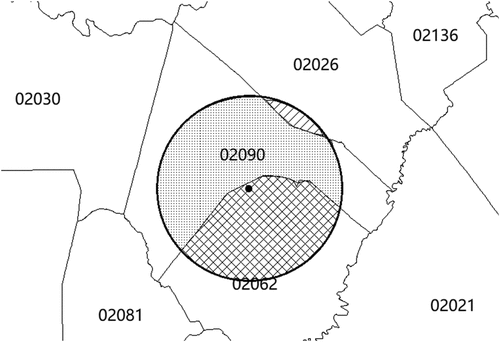
Notes. This figure presents an example of a building located near or at the border of a zip code. We define the neighborhood of a building as a 150-m radius surrounding it using GIS. By layering the 150-m radius over the zip code map, we can determine the exact industry composition of a building’s neighborhood. Specifically, we calculate the areas of various zip codes covered within a 150-m radius and use the weighted data from these zip codes by assuming a uniform distribution of employment across zip codes.
For each segment (e.g., the dotted area in Figure 1), we divide the total employment figure for the corresponding zip code (e.g., zip code 02090) by its total area to calculate the employment density.
Next, we multiply the employment density by the size of the segment (e.g., the area of the dotted region) to estimate the employment contribution from that segment; this process is repeated for all segments of the ring.
The total employment within the ring is obtained by summing the employment contributions from all segments.
Using such a microgeographic spatial scale limits the potential unobserved characteristics that would obfuscate the estimation results. Defining granularity as within walking distance of the building also implies that any variation in the externality observed is more likely to be knowledge spillovers rather than other externalities that are driven by local attributes such as amenities and transportation.
The classic measure of spatial sectoral specialization is the location quotient, which originally “measures how specialized a city is in a given industry relative to what one would expect if employment in that industry was scattered randomly across the United States. The variable corrects for situations in which a city-industry is large only because the city is large” (Glaeser et al. 1992, p. 1141). In short, the location quotient measures the spatial concentration of firms in a given industry relative to this industry’s concentration nationally. To capture neighborhood specialization (NSpec), we use the average location quotient of all the industries (two-digit North American Industry Classification System (NAICS)) present in the neighborhood, similar to the production structure specialization index used by van der Panne (2004) and Tao et al. (2019), as Equation (1)12:
Although the common measure of the building-level specialization is the share of the largest tenant, that is, the anchor tenant, it does not consider the industry specialization of a building relative to its neighborhood. Therefore, we extend the location quotient index to measure the building’s specialization (BSpec) as Equation (2):
We impute employment data based on the Zip Code Business Patterns (ZCBP) database for local job distributions. Although the ZCBP database is reported at the NAICS level, ZCBP only reports the number of establishments at the zip code level instead of the exact employment number. Notably, there are no missing values prior to 2017. After 2017, however, when the number of establishments in certain industry sectors is fewer than three, the data are treated as zero for 2017 and 2018, and as missing (NA) for 2019 and 2020. For data before 2017, each establishment is categorized into nine groups based on the employment size, for example, less than 4 employees, between 5 and 9 employees, between 10 and 19 employees, between 20 and 49 employees, and so on. To impute total employment, we multiply the number of establishments in each group by the median employee count for that group (for example, 2 for group 1, 7 for group 2, and 2,500 for the group with establishments of more than 1,000 employees).13
To validate this calculation, we adjust the employment figures using county-level employment data for each six-digit industry sector as published by Eckert et al. (2021). We calculate an adjustment ratio for each county to ensure that the imputed employment figures match the county-level employment figures reported by Eckert et al. (2021) for each six-digit industry sector.
For the period from 2017 to 2020, where missing value exists, we impute the establishment counts based on the method by Eckert et al. (2021), using the previous year’s data (2016) as a reference for interpolation. We also account for “parent” and “child” relationships within the County Business Patterns industrial hierarchies.14 A detailed discussion of our imputation method is included in the Online Appendix.
3.3. Proxy for Spillovers
Under the MAR model, knowledge is predominantly industry specific. Consequently, regional sectoral specialization is often utilized as a proxy for intrasectoral spillovers (Van Stel and Nieuwenhuijsen 2004, Kanellopoulos and Fotopoulos 2019). However, without considering the industry composition within a building, neighborhood specialization does not precisely capture the impact of spillover externalities on the value of a building. As discussed in Section 2, existing evidence suggests that knowledge spillovers are the driving force underlying agglomeration benefits in the idea- and service-oriented sectors (Acs and Armington 2004, Storper and Venables 2004, Acs et al. 2007, Arzaghi and Henderson 2008, Drennan and Kelly 2011, Kanellopoulos and Fotopoulos 2019). These sectors are what we refer to as the traditional office employment sectors; for example, firms in service-related industries occupy more than 90% of the office space in our sample. Therefore, we argue that any value premium should only occur when the largest industry concentration of tenants in a building matches the predominant (or high level of) industry concentration of firms in the neighborhood surrounding this building. Knowledge spillovers are the most conducive under this scenario. For example, a building that is mostly occupied by information technology (IT) tenants enjoys only limited spillover benefits if it is located in a neighborhood that is known for advertising agencies. The constraints of office markets in CBDs or urban centers mean that, within 150 m, there are limited options for commercial space with like-for-like features. This minimizes the firms’ sorting bias (Baum-Snow et al. 2024), which further supports our identification method.
Consequently, we are able to disentangle knowledge spillovers by matching the vertical building specialization with the horizontal neighborhood specialization at a granular spatial scale (150 m). To construct our spillover proxy (BNSpillover), we calculate the location quotient of the largest sector inside a building in its neighborhood, as shown in Equation (3):
3.4. Building Transaction Information, Building Characteristics, and REITs
Our dependent variable is the natural log of the transaction price per square meter (psm). To estimate the effect of specialization on building value, it is important to account for sorting patterns of firms across office buildings and locations. We do so by controlling for a large number of building and locational attributes. Specifically, building characteristics include the occupancy rate at the time of the transaction, property size, age, number of stories, the quality rating of the property, and green building certification (Leadership in Energy and Environmental Design (LEED) or Energy Star label). Neighborhood characteristics include transportation quality, walkability15 to various amenities, whether it is an urban or a suburban area, and whether it is located in a core real estate market. To account for local economic conditions, we also include county-level per capita income and dummy variables for MSA locations. Finally, we include dummies for transaction years and REIT firms. Detailed definitions and summary statistics of all the variables are reported in Tables 2 and 3, respectively. In our sample, the office buildings have an average occupancy rate of 92%, an average transaction price of $2,916 psm (per square meter), an average size of 24,982 m2 or nine floors, an average age of 27 years, and an average quality rating of four stars. Around 28% of the buildings have a LEED and/or Energy Star label. Approximately 43% (57%) of the buildings are located in suburban (urban) areas. Following Drennan and Kelly (2011), if a building is located in either a Tier 1 or 2 market, we define it as located in a core real estate market. A total of 141 office buildings in our sample are in core real estate markets.
|
Table 2. Variable Definitions
| Variable | Definition |
|---|---|
| Dependent variables | |
| Price | Property purchase price per square meter at the time of transaction |
| NOI | Net operating income at the time of building transaction |
| Cap Rate | Capitalization rate at the time of building transaction |
| Specialization measures | |
| NSpec | The location quotient of the employment industry in its 150 m neighborhood relative to the nation. |
| BSpec | The location quotient of the tenant’s industry sector in the building relative to its 150 m neighborhood. |
| BNSpillover | The location quotient of the building’s largest industry sector in its 150 m neighborhood relative to the nation. |
| Building characteristics | |
| Occupancy | The percentage of the building’s total rentable area occupied by tenants at the time of sale |
| Size | Property size in m2. Log-transformed value is used in regressions. |
| Age | Property age in years. Log-transformed value is used in regressions. |
| Storey | Number of stories in a building. Log-transformed value is used in regressions. |
| Quality | Quality rating of the property |
| Eco | Dummy that equals one if the building has LEED or Energy Star label |
| Location characteristics | |
| Transport | Transportation quality in the building area, measured as the sum of dummy variables for bus line, car charging, commuter rail and metro/subway |
| Walkability | The walkability score of a given building reported by Walk Score@. Log of the value plus one is used in regressions. |
| Suburb | Dummy that equals one if the property is located in suburban areas |
| Core Market | Dummy that equals one if the property is located in Tier 1 markets as classified by Drennan and Kelly (2011): Tier 1markets are defined as primary, strong core markets which are above 70 million square feet, and the ratio of CBD space to total, 33.8%. Seven MSAs comprise this subset. |
| County PCI | County per capita income. Log-transformed value is used in regressions. |
|
Table 3. Summary Statistics
| Mean | Standard deviation | Maximum | Minimum | |
|---|---|---|---|---|
| Building specialization | ||||
| NSpec | 1.55 | 0.86 | 12.55 | 0.56 |
| BSpec | 1.41 | 1.13 | 15.85 | 0.00 |
| BNSpillover | 0.19 | 1.09 | 24.85 | 0.00 |
| Building specialization at lease level | ||||
| Nspec_L | 1.50 | 0.80 | 10.24 | 0.73 |
| Bspec_L | 1.26 | 0.83 | 11.00 | 0 |
| BNSpillover_L | 1.09 | 1.84 | 18.45 | 0 |
| Building transaction information | ||||
| Price (USD/m2) | 2,915.87 | 132.70 | 1,002.31 | 50.00 |
| Rent transaction information | ||||
| Rent (USD/m2) | 319.51 | 189.79 | 3,928.83 | 20.56 |
| Building characteristics | ||||
| Occupancy | 0.92 | 0.13 | 1.00 | 0.05 |
| Size (m2) | 24,982 | 26,000 | 254,351 | 232 |
| Age | 27 | 20.49 | 123 | 1 |
| Storey | 9.376 | 10.743 | 83 | 1 |
| Quality | 3.627 | 0.73 | 5 | 1.21 |
| Eco | 0.280 | 0.44 | 1 | 0 |
| Transport | 0.433 | 0.72 | 3 | 0 |
| Walkability | 53.94 | 30.74 | 100 | 0 |
| Core Market | 0.128 | 0 | 1 | 0 |
| Suburban Dummy | 0.426 | 0.49 | 1 | 0 |
| County income per capita | 41,262 | 15,910 | 142,708 | 6,073 |
| Lease characteristics | ||||
| Lease Size Ratio | 0.07 | 0.17 | 1 | 0.00 |
| Lease Term (Months) | 74.53 | 40.39 | 313 | 2 |
| Full Service Leases | 0.52 | 0.50 | 1 | 0 |
| New Leases | 0.47 | 0.50 | 1 | 0 |
| Owners’ information | ||||
| Daily return | −0.02% | 8.46% | 907.68% | −909.38% |
4. Empirical Analysis
4.1. Baseline Results
4.1.1. Specialization and Transaction Price.
Equation (4) presents the full model specification for estimating the impact of horizontal and vertical specialization, as well as spillovers externality, on the transaction price of an office building:
The main results are reported in Table 4: Our baseline model does not include any specialization measures; Models (1)–(3) estimate separately the impact of horizontal and vertical specialization, as well as the spillover proxy on transaction prices; Model (4) includes both horizontal and vertical specialization; and Model (5) estimates Equation (4), the full model. We find that building specialization (BSpec) exerts a positive effect, significant at the 1% level, on transaction prices consistently across all models. A one-standard-deviation increase in building specialization is associated with an 8% increase in the transaction price per square meter (based on Model (5)). This finding provides empirical support on the economics of skyscrapers that agglomeration also exists in vertical space.
|
Table 4. Building, Neighborhood Specialization and Spillover Effect
| Dependent variable: Price | Baseline | (1) | (2) | (3) | (4) | (5) |
|---|---|---|---|---|---|---|
| NSpec | 0.0147 | 0.0249 | 0.0252 | |||
| (0.0322) | (0.0309) | (0.0305) | ||||
| BSpec | 0.0765*** | 0.0764*** | 0.0732*** | |||
| (0.0173) | (0.0174) | (0.0172) | ||||
| BNSpillover | 0.0535*** | 0.0496*** | ||||
| (0.0189) | (0.0166) | |||||
| Occupancy | 0.8680*** | 0.8751*** | 1.1050*** | 1.0877*** | 1.1060*** | 1.1126*** |
| (0.1219) | (0.1331) | (0.1485) | (0.1462) | (0.1491) | (0.1481) | |
| Size | −0.0645 | −0.0739* | −0.0161 | −0.0573 | −0.0166 | −0.0160 |
| (0.0450) | (0.0445) | (0.0422) | (0.0474) | (0.0421) | (0.0425) | |
| Age | −0.0951** | −0.1239*** | −0.1366*** | −0.1334*** | −0.1361*** | −0.1441*** |
| (0.0415) | (0.0408) | (0.0398) | (0.0399) | (0.0397) | (0.0396) | |
| Story | 0.0876** | 0.0748** | 0.0706* | 0.0811** | 0.0698* | 0.0703* |
| (0.0365) | (0.0367) | (0.0397) | (0.0397) | (0.0399) | (0.0400) | |
| Quality | 0.0154 | 0.0254 | 0.0176 | 0.0103 | 0.0162 | 0.0132 |
| (0.0440) | (0.0437) | (0.0439) | (0.0439) | (0.0434) | (0.0429) | |
| Eco | 0.1412** | 0.1436** | 0.1284** | 0.1382** | 0.1280** | 0.1394** |
| (0.0578) | (0.0589) | (0.0560) | (0.0573) | (0.0559) | (0.0574) | |
| Transport | 0.1384*** | 0.1328*** | 0.1045*** | 0.1046*** | 0.1050*** | 0.0973*** |
| (0.0354) | (0.0362) | (0.0345) | (0.0338) | (0.0344) | (0.0340) | |
| Walkability | 0.0882** | 0.0907** | 0.0940** | 0.0948** | 0.0957** | 0.0908** |
| (0.0401) | (0.0392) | (0.0393) | (0.0393) | (0.0389) | (0.0385) | |
| Suburb | −0.1465*** | −0.1585*** | −0.1063* | −0.1296** | −0.1055* | −0.1026* |
| (0.0557) | (0.0558) | (0.0543) | (0.0550) | (0.0542) | (0.0542) | |
| Core Market | 0.0773 | 0.0530 | 0.0202 | 0.0342 | 0.0192 | 0.0066 |
| (0.0920) | (0.0977) | (0.1014) | (0.1025) | (0.1012) | (0.1016) | |
| County PCI | 0.4483*** | 0.4449*** | 0.3636*** | 0.4306*** | 0.3738*** | 0.3704*** |
| (0.1120) | (0.1135) | (0.1126) | (0.1133) | (0.1115) | (0.1139) | |
| Year dummy | Yes | Yes | Yes | Yes | Yes | Yes |
| MSA dummy | Yes | Yes | Yes | Yes | Yes | Yes |
| Firm dummy | Yes | Yes | Yes | Yes | Yes | Yes |
| No. of observations | 1,166 | 1,136 | 1,100 | 1,100 | 1,100 | 1,100 |
| Adjusted R2 | 0.4615 | 0.4644 | 0.4784 | 0.4747 | 0.4781 | 0.4821 |
Notes. This table reports the results of cross-sectional regressions. The dependent variable is the log of the transaction price (Price). NSpec is the neighborhood specialization measured by the location quotient of industries in a 150-m neighborhood of a given building relative to the nation. BSpec is the building specialization measured by the location quotient of the tenant’s industry sectors in the building relative to its 150-m neighborhood. BNSpillover is the knowledge spillovers proxied by the location quotient of the building’s largest industry sector in its 150-m neighborhood relative to the nation. Other control variables are as defined in Table 2. Transaction year, REIT firm, and MSA dummies are included. Standard errors are reported in parentheses.
***, ** and *Significance at the 1%, 5% and 10% levels, respectively.
Interestingly, we find no significant result on the average neighborhood specialization (NSpec). In contrast, the coefficient for our knowledge spillovers proxy (BNSpillover) is positive and significant at the 1% level in Model (5). A one-standard-deviation increase in the knowledge spillovers proxy results in approximately a 5% increase in the transaction price per square meter. Given that our spillovers proxy is the location quotient of a building’s largest tenant sector in its neighborhood, this finding suggests that merely locating in a neighborhood with a clustering of general economic activities does not enhance office values. Incremental building value occurs when the intraindustry concentration of tenants in a building is in the same industry as the cluster of firms that are within a 150-m radius of the building. These tenants benefit from the exchange of knowledge and networking opportunities. In turn, such spillover externalities are capitalized in transaction prices, supporting our knowledge spillovers channel. This finding provides support to Arzaghi and Henderson (2008) and Drennan and Kelly (2011) who imply but do not test empirically that knowledge spillovers are the source of agglomeration economies that is reflected in rent premiums. Given that more than 87% of the tenants in our sample are from the idea- or service-oriented industries, our results also provide empirical support for studies arguing that knowledge spillovers drive agglomeration in the idea- and service-oriented industries (Arzaghi and Henderson 2008, Drennan and Kelly 2011, Billings and Johnson 2016, Rosenthal and Strange 2020). Overall, our findings support localization economies and Marshallian knowledge spillovers.
The coefficients of other control variables are generally consistent with our expectations. Older buildings tend to have a lower transaction price psm. Green building certifications add value, as documented in Fuerst and McAllister (2011) and Holtermans and Kok (2019). As expected, we find that more local amenities, such as good public transportation and greater walkability, also lead to a higher transaction price per square meter. Consistent with Drennan and Kelly (2011), we also find that buildings in urban areas enjoy a value premium compared with those located in suburban areas.
4.1.2. NOI and Capitalization Rate.
Transaction prices should reflect the impact of agglomeration externalities on rents, as documented in the previous literature. However, they may also reflect perceived risk and growth expectations. This raises the question of whether spatial concentration has a positive or negative effect on the discount rate. A related question is whether the rental income or the discount rate is the primary driver of transaction prices. Consequently, it is unclear ex ante what impact agglomeration externalities have on transaction prices.
To address this, we manually collect NOI (defined as net rent) and cap rates mainly from CoStar and CompStak. In a few cases, this data are obtained from MSCI-Real Capital Analytics (RCA) and/or Trepp. We run regressions on a reduced sample of 738 buildings, using NOI and cap rates as our dependent variables. This allows us to disentangle the price premium arising from rental incomes from potential effects on risk perception and growth expectations. The results reported in Table 5 indicate that net rent rather than the discount rate is the primary driver of the price premium. This finding clarifies the role of agglomeration externalities in shaping real estate values.
|
Table 5. NOI and Capitalization Rate
| Dependent variable | ||
|---|---|---|
| (1) NOI | (2) Cap Rate | |
| NSpec | −0.0464 | 0.0038 |
| (0.0516) | (0.0034) | |
| BSpec | 0.0655*** | −0.0032 |
| (0.0185) | (0.0023) | |
| BNSpillover | 0.0492*** | −0.0002 |
| (0.0161) | (0.0005) | |
| Control variables | Yes | Yes |
| Year dummy | Yes | Yes |
| MSA dummy | Yes | Yes |
| Firm dummy | Yes | Yes |
| No. of observations | 738 | 738 |
| Adjusted R2 | 0.3823 | 0.2621 |
Notes. This table reports the results of cross-sectional regressions. The dependent variables are the log of the net operating income (NOI) and the capitalization rate (Cap Rate) in Models (1) and (2), respectively. NSpec is the neighborhood specialization measured by the location quotient of industries in a 150-m neighborhood of a given building relative to the nation. BSpec is the building specialization measured by the location quotient of the tenant’s industry sectors in the building relative to its 150-m neighborhood. BNSpillover is the knowledge spillovers proxied by the location quotient of the building’s largest industry sector in its 150-m neighborhood relative to the nation. Other control variables used in Table 4 are also included and as defined in Table 2. Transaction year, REIT firm, and MSA dummies are included. Standard errors are reported in parentheses.
***, ** and *Significance at the 1%, 5%, and 10% levels, respectively.
4.1.3. Lease-Level Analysis.
To further confirm that the price premium originates from agglomerative effects on rental incomes, we manually collect 2,498 newly signed leases16 three years around the transaction year. To differentiate from our building-level specialization measures (NSpec, BSpec, and BNSpillover), we construct neighborhood specialization (NSpec_L), building specialization (BSpec_L), and building-neighborhood spillovers (BNSpillover_L) based on the industry sector of the tenant in the new lease and the year of the lease transaction. Consequently, even for tenants within the same building, their BSpec_L and BNSpillover_L values may differ because they are now calculated based on the specific industry sector of each tenant.
Additionally, tenant-level neighborhood specialization (NSpec_L) is identical to its building-level neighborhood specialization (NSpec). However, lease-level building specialization (BSpec_L) and building-neighborhood spillovers (BNSpillover_L) may differ from aggregated building-level specialization (BSpec) and spillovers (BNSpillover), respectively. At the building level, BSpec represents the average specialization quotient of all tenants’ industry sectors within the building relative to its surrounding neighborhood, whereas BNSpillover reflects the specialization quotient of the building’s largest industry sector in the neighborhood relative to national employment. At the lease level, both variables are defined based on the industry sector of the individual tenant. If a new lease is signed by a tenant in the same sector as the building’s largest tenant industry sector, or by the largest tenant in the building, its lease-level spillover measure (BNSpillover_L) will be identical to the building-level measure (BNSpillover). Otherwise, lease-level building specialization (BSpec_L) and spillover proxy (BNSpillover_L) will differ from the building-level measures (BSpec and BNSpillover).
Regarding the control variables, at the lease level, we control for the occupancy rate, the large tenant using a dummy variable that equals one when a tenant occupies more than a third of the building’s space, the lease term, the type of lease using a dummy variable to distinguish full service leases from triple-net leases, and new leases versus renewals or expansions using a dummy variable. We also include building dummies to account for building-level characteristics and lease transaction year dummies. The lease-level results are reported in Table 6.
|
Table 6. Lease-Level Analysis
| Dependent variable: Effective Rent of Newly Signed Leases | (1) | (2) |
|---|---|---|
| NSpec_L | 0.0062 | 0.0076 |
| (0.0155) | (0.0166) | |
| BSpec_L | 0.0794** | 0.1048*** |
| (0.0332) | (0.0398) | |
| BNSpillover_L | 0.0094** | 0.0090** |
| (0.0039) | (0.0039) | |
| NSpec_L × Large Tenant | 0.0542 | |
| (0.0557) | ||
| BSpec_L × Large Tenant | −0.0687 | |
| (0.0434) | ||
| BNSpillover_L × Large Tenant | 0.1219** | |
| (0.0484) | ||
| Occupancy | 0.1974* | 0.2211* |
| (0.1129) | (0.1146) | |
| Large Tenant | −0.2011*** | −0.1984* |
| (0.0579) | (0.1199) | |
| Lease Term | 0.0490*** | 0.0500*** |
| (0.0119) | (0.0119) | |
| Fully Service Lease | 0.1092*** | 0.1074*** |
| (0.0278) | (0.0279) | |
| New Leases | −0.0860*** | −0.0857*** |
| (0.0125) | (0.0125) | |
| Year dummy | Yes | Yes |
| Building dummy | Yes | Yes |
| No. of observations | 2,498 | 2,498 |
| Adjusted R2 | 0.6951 | 0.6966 |
Notes. This table reports the results of cross-sectional regressions. The dependent variable is the log of the effective rent of newly signed leases. NSpec_L is the neighborhood specialization measured by the location quotient of industries in a 150-m neighborhood of a given building relative to the nation. BSpec_L is the building specialization measured by the location quotient of the tenant’s industry sectors relative to its 150-m neighborhood. BNSpillover_L is the knowledge spillovers proxied by the location quotient of the tenant’s industry sector in its 150-m neighborhood relative to the nation. Control variables include occupancy rate, the large tenant dummy that equals one when a tenant occupies more than a third of the building’s space, the lease term, a dummy variable distinguishing fully serviced leases from triple-net leases, and a dummy variable for new leases vs. renewals or expansions. Lease transaction year and building dummies are included. Standard errors are reported in parentheses.
***, ** and *Significance at the 1%, 5% and 10% levels, respectively.
In Model (1), we find that a one-standard-deviation increase in lease-level building specialization (BSpec_L) is associated with a 6.6% rent increase. This suggests that tenants are willing to pay higher rents when the concentration of same-industry employment among other tenants in the building increases. Meanwhile, a one-standard-deviation increase in the lease-level spillover proxy (BNSpillover_L) results in a 1.7% rent increase. This suggests that tenants also pay higher rents for stronger spillover effects, that is, when there is an increase in the concentration of same-industry employment in the building’s neighborhood.
When we interact the large tenant dummy with the three specialization measures in Model (2), we find that large tenants are more likely to pay a higher premium for building-neighborhood spillover effects. Specifically, for large tenants, a one-standard-deviation increase in building-neighborhood spillovers (BNSpillover_L) leads to a 23.5% increase in rent, surpassing their willingness to pay for within-building specialization (BSpec_L). These results provide direct evidence that agglomeration effects are manifested in rents, which ultimately drive the price premium.
The coefficients for the control variables are consistent with our expectations. Specifically, rents increase significantly with higher building occupancy rates. Larger tenants receive a rent discount, which aligns with previous literature showing that anchor tenants typically negotiate lower rents (Liu et al. 2024). Longer lease terms are associated with higher rents. Full-service leases command a premium compared with triple-net leases. Moreover, new leases are discounted relative to renewal or expansion leases, which suggests that new tenants possess greater bargaining power.
4.2. Endogeneity
In this section, we address the endogeneity concern using three approaches. First, we use a Bartik-type instrument for the neighborhood employment data. Next, repeat sales are used to explore the variation in the building-level tenant mix over time. Lastly, we account for the sorting effect where firms self-select into certain locations.
4.2.1. Instrumental Variable Approach.
An endogeneity concern exists that arises from confounding locational factors that correspond to the knowledge spillover agglomeration channel. The narrow spatial scale we use (a 150-m radius) should largely mitigate this concern. As Rosenthal and Strange (2020) point out, at microgeographic scales, it is unlikely that other local attributes, such as transportation, drive the spillover effect. To reinforce our estimation, we also address the endogeneity issue around the neighborhood specialization using an instrumental variable approach. In short, we need instruments that are correlated with agglomeration but uncorrelated with the error term, or relevant unobservable locational attributes. Arzaghi and Henderson (2008) argue that the relevant unobservable attributes often change over time. The relevant attributes today are largely uncorrelated with those in prior years. Therefore, historical attributes such as population and employment can be a valid instrument (Ciccone and Hall 1996, Koster et al. 2014). Using historical employment as an instrument can also address the concern that the anchor tenant in the building might affect neighborhood employment. However, historical employment volume may impact current building values through historical land prices. Therefore, we use a Bartik-type instrument (Bartik 1991), a product of the historical employment and the national inward foreign direct investment (FDI), for the zip code level industry sector employment. Specifically, this instrumental variable combines industry-specific employment shares at the zip code level with national inward foreign direct investment (FDI) in those sectors.
We argue that using historical employment shares captures the historical concentration of certain sectors at specific locations without directly affecting land value. Extensive literature documents that FDI leads to substantial productivity gains for domestic firms (Keller and Yeaple 2009). Nationwide FDI in specific industry sectors is unlikely to have a direct impact on land or building values at the local level for two reasons. First, nationwide sectoral FDI inflows represent aggregated capital flows dispersed across a wide range of regions, making it improbable that they would directly influence local amenities. Second, although nationwide sectoral FDI shocks in geographically concentrated industries, such as the IT sector in Silicon Valley, could, in theory, stimulate the local economic activities and eventually increase demand for local amenities, such effects typically unfold over extended periods, often taking years or even decades to materialize. However, FDI is strongly associated with employment growth and sectoral development. Certain industries, such as new technology sectors, have undergone rapid transformation since 1998. We capture sector-level development through nationwide FDI in these industries. This approach enables us to account for the historical concentration of specific sectors while isolating sectoral growth at the local level that arises purely from localized factors. The instrumented zip code level sector-specific employment is calculated as follows:
Using estimated zip code level employment , we calculate the employment in a given industry sector in the 150-m ring surrounding a specific building (). Based on the estimated employment in the 150-m radius, we construct the instrumented neighborhood (NSpecTrue) and within-building specialization (BSpecTrue) in addition to the instrumented measure of knowledge spillovers (BNSpilloverTrue), following Equations (1), (2), and (3). The results are reported in Table 7. The coefficient of the instrument is positive and significant at the 1% level, with an F-statistic well above 10, confirming the validity of our instrument.17 The effects of building specialization and the building-neighborhood spillovers remain positive and significant. The estimated coefficients obtained with the instrument are smaller than those in our baseline results.18 This result suggests that firms’ location choices may lead to an overestimation of the effect.
|
Table 7. Instrumental Variable Approach
| Dependent variable: Price | Second stage |
|---|---|
| NSpecTrue | 0.0037 |
| (0.0033) | |
| BSpecTrue | 0.0026*** |
| (0.0009) | |
| BNSpilloverTrue | 0.0124** |
| (0.0060) | |
| Control variables | Yes |
| Year fixed effects | Yes |
| MSA fixed effects | Yes |
| Firm fixed effects | Yes |
| No. of observations | 1,100 |
| R2 | 0.4752 |
| Dependent variable: Employment | First stage |
| Instrumental variable | 1.7459*** |
| (0.1828) | |
| F-statistic | 8,361,666*** |
Notes. This table reports the results of cross-sectional regressions using instrumented variables. The dependent variable is the natural log of the transaction price (Price). NSpecTrue is the instrumented neighborhood specialization measured by the location quotient of industries in a 150-m neighborhood of a given building relative to the nation. BSpecTrue is the instrumented building specialization measured by the location quotient of the tenant’s industry sectors in the building relative to its 150-m neighborhood. BN_SpilloverTrue is the instrumented proxy for knowledge spillovers, measured by the location quotient of the building’s largest industry sector in its 150-m neighborhood relative to the nation. The zip code level employment is instrumented by the product of industry-specific employment shares at the zip code level with national inward foreign direct investment (FDI) in those sectors. Other control variables used in Table 4 are also included and as defined in Table 2. Transaction year, REIT firm, and MSA dummies are included. Standard errors are reported in parentheses. The standard errors of the instrumented variables are corrected using bootstrapping.
***, ** and *Significance at the 1%, 5% and 10% levels, respectively.
4.2.2. Repeat Sales.
There are 275 repeat sales in our sample, enabling us to exploit the time series variation in building-level tenancy composition and to estimate the effect of changes in tenant mix on building values. This helps to address the endogeneity concern at the building level, as the previous instrument is only for the neighborhood employment. Specifically, we estimate the effects of changes in the building-level specialization (ΔBSpec), neighborhood specialization (ΔNSpec), and the spillover proxy (ΔBNSpillover) on the changes in building values (ΔPrice). Because we use value differences, time-invariant building characteristics are excluded from the regressions, leaving only changes in occupancy rates (ΔOccupancy) and county-level income (ΔCountyIncome) as control variables. We retain year and MSA dummies in our models, with MSA dummies capturing various development trends across MSAs. Our results are reported in Table 8. We find that tenant composition changes within the building do not lead to changes in building transaction prices.
|
Table 8. Repeat Sales
| Dependent variable: ΔPrice | (1) |
|---|---|
| ΔNSpec | −0.0602 |
| (0.1070) | |
| ΔBSpec | −0.0362 |
| (0.0638) | |
| ΔBNSpillover | 0.2981** |
| (0.1505) | |
| ΔOccupancy | 3.8333*** |
| (0.9598) | |
| ΔCounty PCI | −0.6782* |
| (0.4012) | |
| Year dummy | Yes |
| MSA dummy | Yes |
| No. of observations | 275 |
| Adjusted R2 | 0.0826 |
Notes. This table reports the regression results based on repeat sales. The dependent variable is the difference in the transaction prices of a repeat sale (ΔPrice). Independent variables include the differences in NSpec, BSpec, BNSpillover, Occupancy, and County PCI, as defined in Table 2. Repeat sale year and MSA dummies are included. Standard errors are reported in parentheses.
***, ** and *Significance at the 1%, 5% and 10% levels, respectively.
In contrast, the coefficient of changes in the spillover proxy is positive and significant at the 5% level. This result suggests that building value increases when the building-neighborhood spillover effects are strengthened, that is, when building specialization aligns more closely with neighborhood specialization. This analysis provides further evidence of the presence of building-neighborhood spillover effects.
4.2.3. Sorting.
Firms could self-select into office buildings with attractive building qualities or local amenities. These attributes could also exert a positive effect on building value in the absence of knowledge spillover externalities. To address this concern, we include a variety of building and locational attributes, as well as dummy variables for MSA locations and transaction years as control variables in all specifications. Liu et al. (2024) find that specialization still occurs even after controlling for building quality. Building quality is one of the main reasons why firms sort. Features of commercial real estate markets largely mitigate the sorting concern in our study. Office leases are often set between five to ten years, smoothing out the tenant turnover. Office supply is relatively inelastic in the short run making it difficult for tenants to find substitute space with similar qualities, especially within a 150-m radius. Consequently, the likelihood of firms sorting into spaces based on changes in the building or local attributes is extremely low at narrow spatial scales.19 In line with this argument, we observe a high average occupancy rate of 92% in our sample. To gain a better insight into this issue, we remove all the building and locational attributes as control variables. In addition, to control for unobserved amenities, other than our transportation and walkability variables, we substitute the current neighborhood specialization measure (NSpec) with the location quotient of the largest industry sector (NSpec_largest) in the 150-, 250-, 500-, and 1,500-m neighborhood and add them as an additional control variable one at a time. The results are reported in Table 9. We note that in Model (1) when building and location controls are removed, the magnitude of the effect of spillovers on building prices does not change much compared with our baseline results in Table 4, offering no support for sorting within such a granular spatial scale. Meanwhile, the coefficient of BNSpillover remains positive and significant in all models, reinforcing our argument that spillover externalities are capitalized into building value on top of potential sorting characteristics.
|
Table 9. Sorting
| Dependent variable: Price | (1) | (2) | (3) | (4) | (5) |
|---|---|---|---|---|---|
| Specialization of the largest industry sector in a radius of | |||||
| 150 m | 250 m | 500 m | 1,500 m | ||
| NSpec | 0.0175 | ||||
| (0.0452) | |||||
| BSpec | 0.0809*** | 0.0756*** | 0.0757*** | 0.0758*** | 0.0757*** |
| (0.0230) | (0.0175) | (0.0176) | (0.0176) | (0.0176) | |
| BN_Spillover | 0.0525** | 0.0507*** | 0.0506*** | 0.0504*** | 0.0501*** |
| (0.0217) | (0.0160) | (0.0161) | (0.0161) | (0.0161) | |
| NSpec_largest | 0.0046 | 0.0141 | 0.0211 | 0.0418 | |
| (0.0312) | (0.0336) | (0.0350) | (0.0467) | ||
| Control variables | No | Yes | Yes | Yes | Yes |
| Year dummy | Yes | Yes | Yes | Yes | Yes |
| MSA dummy | Yes | Yes | Yes | Yes | Yes |
| Firm dummy | Yes | Yes | Yes | Yes | Yes |
| No. of observations | 1,100 | 1,100 | 1,100 | 1,100 | 1,100 |
| Adjusted R2 | 0.3891 | 0.4756 | 0.4756 | 0.4757 | 0.4759 |
Notes. This table reports the results of cross-sectional regressions. The dependent variable is the log of the transaction price (Price). BSpec is the building specialization measured by the location quotient of the tenant’s industry sectors in the building relative to its 150-m neighborhood. BNSpillover is the knowledge spillovers proxied by the location quotient of the building’s largest industry sector in its 150-m neighborhood relative to the nation. In Model (1), NSpec is the neighborhood specialization measured by the location quotient of industries in a 150 m neighborhood of a given building relative to the nation. In Models (2)–(5), NSpec_largest is the specialization of the largest industry in the neighborhood of 150, 250, 500, and 1,500 m, respectively. Other control variables used in Table 4 are also included and as defined in Table 2. Transaction year, REIT firm and MSA dummies are included. Standard errors are reported in parentheses.
***, ** and *Significance at the 1%, 5% and 10% levels, respectively.
4.3. Alternative Theories
In this section, we test three alternative theories that might drive our main results including diversity, colocation, and urbanization.
4.3.1. Specialization vs. Diversity.
Jacobs (1969) argues that diversity rather than specialization creates positive externalities. The Jacobian model suggests that the diversity of industries induces cross-fertilization of ideas among firms, leading to increased productivity in a city. In other words, urban diversity and city size give rise to agglomeration economies, known as urbanization economies (Glaeser et al. 1992, Autant-Bernard and LeSage 2011, Bishop 2012, Liang and Goetz 2018, Bishop 2019).
The purpose of this paper is not to compare the localization and urbanization economies, and our identification strategy is designed to detect Marshallian knowledge spillovers at microgeographic scales. Although our results cannot reject the Jacobian externalities, our propositions are based on Marshallian knowledge spillovers. The reason for this is that Jacobian externalities tend to operate at longer distances, that is, region or city level. Our use of a microgeographic spatial scale means that in-person networking and communications play a central role, similar to Arzaghi and Henderson (2008). Nonetheless, we include control variables for diversity to support this argument in this section.
Porter (2003) points out that the potential gains of Jacobs spillovers arise from the diversity of linked industries rather than an absolute diversification of industries. Following Porter (2003), Frenken et al. (2007) propose related variety as a better measure for Jacobs spillovers. This metric essentially captures the concentrations of linked industries as intersectoral spillovers are the most pronounced among different but related industries.20 Therefore, we use related variety based on industries at a more disaggregated level (three-digit NAICS sectors here) to measure the diversity within a neighborhood and within a building in addition to the building-neighborhood-linked diversity.
The neighborhood-level related variety is calculated as follows:
Similarly, the related variety within a building is calculated as follows:
The building-neighborhood linked diversity is simply the neighborhood-level related variety of subindustries that fall under the two-digit NAICS sector of the largest tenant industry inside the building as follows:
We also construct two Herfindahl indices to capture the unrelated variety in a neighborhood and within a building based on two-digit NAICS sectors, as follows:
Finally, because the related variety measure is based on three-digit NAICS sectors, we also calculate our specialization variables based on three-digit NAICS sectors for like-for-like comparison, following Equations (1), (2), and (3). In addition to using three-digit NACIS, we further define specialization variables (NSpec, BSpec, BNSpillover) at four-digit NAICS levels with 150- and 500-m rings, respectively. We do this to address the concern that the two-digit NAICS codes are too coarse to capture MAR spillovers within the same industry. The results are reported in Table 10. We find a negative effect of the building-neighborhood diversity and the neighborhood unrelated variety on prices. In contrast, the effects of within-building specialization and spillovers remain significantly positive at three-digit NAICS level and four-digit NAICS level within a 500-m radius. Specialization is favored over diversity at more granular spatial levels. Our finding is consistent with the argument that in-person interactions facilitated by close spatial proximity are key to the Marshallian spillovers (Rosenthal and Strange 2020). Jacobian spillovers function at a more macro spatial level (i.e., cities) and rely on facilities such as transportation.
|
Table 10. Specialization vs. Diversity
| Dependent variable: Price | (1) Three-digit NAICS | (2) Two-digit NAICS | (3) Three-digit NAICS | (4) Three-digit NAICS | (5) Four-digit NAICS | (6) Four-digit NAICS (500 m) |
|---|---|---|---|---|---|---|
| NSpec | 0.0182 | 0.0198 | 0.0026** | 0.0026** | ||
| (0.0235) | (0.0235) | (0.0012) | (0.0012) | |||
| BSpec | 0.0908*** | 0.0890*** | 0.0838*** | 0.0094*** | ||
| (0.0188) | (0.0191) | (0.0170) | (0.0019) | |||
| BNSpillover | 0.0117*** | 0.0116*** | 0.0040 | 0.0050** | ||
| (0.0042) | (0.0042) | (0.0029) | (0.0022) | |||
| N_RV | −0.0026 | |||||
| (0.0045) | ||||||
| B_RV | −0.1628 | |||||
| (0.3825) | ||||||
| BN_RV | −0.0003 | −0.0005*** | ||||
| (0.0003) | (0.0001) | |||||
| N_HHI | −0.7167*** | |||||
| (0.2714) | ||||||
| B_HHI | −0.1209 | |||||
| (0.0934) | ||||||
| Control variables | Yes | Yes | Yes | Yes | Yes | Yes |
| Year dummy | Yes | Yes | Yes | Yes | Yes | Yes |
| MSA dummy | Yes | Yes | Yes | Yes | Yes | Yes |
| Firm dummy | Yes | Yes | Yes | Yes | Yes | Yes |
| No. of observations | 842 | 1,033 | 842 | 842 | 833 | 833 |
| Adjusted R2 | 0.4371 | 0.4492 | 0.4552 | 0.4536 | 0.4514 | 0.4491 |
Notes. This table reports the results of cross-sectional regressions. The dependent variable is the log of the transaction price (Price). In Model (1), N_RV is the neighborhood diversity measured by the averaged related variety of industries in a 150-m neighborhood; B_RV is the within-building diversity measured by the averaged related variety of industries inside a building; BN_RV is the diversity of subgroup industries under the building’s largest industry sector in its 150-m neighborhood. In Model (2), N_HHI is the neighborhood diversity measured by unrelated variety based on the Herfindahl index; B_HHI is the within-building diversity measured by unrelated variety based on the Herfindahl index. In Models (3) and (4), NSpec is the neighborhood specialization measured by the location quotient of three-digit industries in a 150-m neighborhood of a given building relative to the nation; BSpec is the building specialization measured by the location quotient of the tenant’s three-digit industry sectors in the building relative to its 150-m neighborhood; BNSpillover is the knowledge spillovers proxied by the location quotient of the building’s largest industry sector (three-digit) in its 150-m neighborhood relative to the nation. In Models (5) and (6), specialization is measured based on four-digit NAICS within 150- and 500-m radiuses, respectively. Other control variables used in Table 4 are also included and as defined in Table 2. Transaction year, REIT firm, and MSA dummies are included. Standard errors are reported in parentheses.
***, ** and *Significance at the 1%, 5%, and 10% levels, respectively.
4.3.2. Colocation Theory.
To test the extent to which colocation theory drives our results, we control for spillovers between suppliers and customers. Specifically, based on the input-output linkages, we use the location quotient to separately measure the specialization of the direct supplier and customer industries for a building’s largest industry in its 150-m neighborhood. Alternatively, we measure the average specialization of all supplier and customer industries for a building’s largest industry in its 150-m neighborhood using the location quotient. This method is identical to the proxy for knowledge spillovers in Equation (3). The results are reported in Table 11. The effects of within-building specialization (BSpec) and spillovers (BNSpillover) remain consistent and robust. Interestingly, we find that Customer_Spec exerts a positive effect on transaction price. This indicates that tenants pay higher rents for a location that has a concentration of direct customers, supporting the colocation theory.
|
Table 11. Colocation Theory
| Dependent variable: Price | (1) | (2) |
|---|---|---|
| NSpec | −0.0317 | −0.0278 |
| (0.0368) | (0.0419) | |
| BSpec | 0.0755*** | 0.0752*** |
| (0.0176) | (0.0177) | |
| BNSpillover | 0.0529*** | 0.0536*** |
| (0.0162) | (0.0159) | |
| Supplier_Spec | −0.0108 | |
| (0.0089) | ||
| Customer_Spec | 0.0206*** | |
| (0.0049) | ||
| Supplier_Spec_Avg | 0.0107 | |
| (0.0339) | ||
| Customer_Spec_Avg | 0.0134 | |
| (0.0108) | ||
| Control variables | Yes | Yes |
| Year dummy | Yes | Yes |
| MSA dummy | Yes | Yes |
| Firm dummy | Yes | Yes |
| No. of observations | 1,100 | 1,100 |
| Adjusted R2 | 0.4790 | 0.4774 |
Notes. This table reports the results of cross-sectional regressions. The dependent variable is the log of the transaction price (Price). NSpec is the neighborhood specialization measured by the location quotient of industries in a 150-m neighborhood of a given building relative to the nation. BSpec is the building specialization measured by the location quotient of the tenant’s industry sectors in the building relative to its 150-m neighborhood. BNSpillover is the knowledge spillovers proxied by the location quotient of the building’s largest industry sector in its 150-m neighborhood relative to the nation. Supplier_Spec is the location quotient of the direct supplier industry for the building’s largest industry in its 150-m neighborhood relative to the nation. Customer_Spec is the location quotient of the direct customer industry of the building’s largest industry in its 150-m neighborhood relative to the nation. Supplier_Spec_Avg is the average location quotient of all the supplier industries for the building’s largest industry. Customer_Spec_Avg is the average location quotient of all the customer industries of the building’s largest industry. Other control variables used in Table 4 are also included and as defined in Table 2. Transaction year, REIT firm, and MSA dummies are included. Standard errors are reported in parentheses.
***, ** and *Significance at the 1%, 5%, and 10% levels, respectively.
4.3.3. Urbanization Effects.
We further control for the specialization levels of different industries in the neighborhood and test whether urbanization drives our main results. Specifically, we include the location quotients for each of the four key service sectors in a building’s neighborhood as extra controls, including Business Service, Retail Service, Travel and Entertainment Service, and Education and Health Service.21 The results reported in Table 12 show that the effects of within-building specialization and building-neighborhood spillovers on building transaction prices remain constant after controlling for urbanization effects.
|
Table 12. Controlling for Urbanization
| Dependent variable: Price | (1) | (2) | (3) | (4) | (5) |
|---|---|---|---|---|---|
| NSpec | 0.0026 | 0.0088 | 0.0067 | 0.0013 | 0.0051 |
| (0.0312) | (0.0308) | (0.0315) | (0.0312) | (0.0314) | |
| BSpec | 0.0741*** | 0.0764*** | 0.0774*** | 0.0732*** | 0.0746*** |
| (0.0178) | (0.0173) | (0.0174) | (0.0178) | (0.0178) | |
| BNSpillover | 0.0498*** | 0.0515*** | 0.0528*** | 0.0481*** | 0.0502*** |
| (0.0159) | (0.0161) | (0.0164) | (0.0155) | (0.0157) | |
| S_Business | 0.0109 | 0.0097 | |||
| (0.0175) | (0.0214) | ||||
| S_Retail | 0.0233 | 0.0182 | |||
| (0.0318) | (0.0363) | ||||
| S_Travel and Entertainment | 0.0261 | 0.0264 | |||
| (0.0199) | (0.0214) | ||||
| S_Education and Health | −0.0465 | −0.0425 | |||
| (0.0324) | (0.0343) | ||||
| Control variables | Yes | Yes | Yes | Yes | Yes |
| Year dummy | Yes | Yes | Yes | Yes | Yes |
| MSA dummy | Yes | Yes | Yes | Yes | Yes |
| Firm dummy | Yes | Yes | Yes | Yes | Yes |
| No. of observations | 1,100 | 1,100 | 1,100 | 1,100 | 1,100 |
| Adjusted R2 | 0.4751 | 0.4752 | 0.4755 | 0.4764 | 0.4754 |
Notes. This table reports the results of cross-sectional regressions. NSpec is the neighborhood specialization measured by the location quotient of industries in a 150-m neighborhood of a given building relative to the nation. BSpec is the building specialization measured by the location quotient of the tenant’s industry sectors in the building relative to its 150-m neighborhood. BNSpillover is the knowledge spillovers proxied by the location quotient of the building’s largest industry sector in its 150-m neighborhood relative to the nation. Models (1)–(4) use the location quotient of one of the four key service sectors in a building’s neighborhood, including Business Service, Retail, Travel and Entertainment Service, and Education and Health Service. Model (5) includes the location quotient indexes of all four sectors. Other control variables used in Table 4 are also included and as defined in Table 2. Transaction year, REIT firm, and MSA dummies are included. Standard errors are reported in parentheses.
***, ** and *Significance at the 1%, 5%, and 10% levels, respectively.
4.4. Attenuation of Spillovers
As discussed in Section 2, agglomeration externalities attenuate, with knowledge spillovers diminishing most rapidly (Rosenthal and Strange 2003, 2005, 2020). Using a narrower geographic granularity, for example, a 150-m neighborhood, we can deduce the advantages of close in-person interactions. To understand how quickly such spillovers, and hence the effect on building value, attenuate, we perform three spatial analyses starting from 75, 150, and 500. The definitions of all variables remain the same. The results are reported in Table 13. Model (1) includes three radiuses including smaller than 75 m, between 75 and 150 m, and between 150 and 500 m; Model (2) includes three radiuses including smaller than 150 m, between 150 and 250 m, and between 250 and 500 m; Model (3) includes three radiuses including smaller than 500 m, between 500 and 750 m, and between 750 and 1,500 m.
|
Table 13. Attenuation of Knowledge Spillovers
| Dependent variable: Price | (1) | (2) | (3) |
|---|---|---|---|
| Radius 1 | <75 m | <150 m | <500 m |
| Radius 2 | 75–150 m | 150–250 m | 500–750 m |
| Radius 3 | 150–500 m | 250–500 m | 750–1,500 m |
| NSpec (Radius 1) | 0.0342 | 0.0322 | 0.0566 |
| (0.0349) | (0.0359) | (0.0504) | |
| NSpec (Radius 2) | 0.0075 | 0.2341 | 0.0324 |
| (0.0864) | (0.3440) | (0.2352) | |
| NSpec (Radius 3) | 0.1310 | 0.0734 | 0.2311 |
| (0.1332) | (0.2186) | (0.1772) | |
| BSpec | 0.1621*** | 0.0771*** | 0.0750*** |
| (0.0566) | (0.0180) | (0.0174) | |
| BNSpillover (Radius 1) | 0.1519*** | 0.0516*** | 0.0541*** |
| (0.0583) | (0.0158) | (0.0164) | |
| BNSpillover (Radius 2) | 0.0392*** | −0.0290 | 0.0058 |
| (0.0119) | (0.0346) | (0.0148) | |
| BNSpillover (Radius 3) | 0.0023 | 0.0207 | 0.0252 |
| (0.0174) | (0.0238) | (0.0166) | |
| Control variables | Yes | Yes | Yes |
| Year dummy | Yes | Yes | Yes |
| MSA dummy | Yes | Yes | Yes |
| Firm dummy | Yes | Yes | Yes |
| No. of observations | 1,100 | 1,100 | 1,100 |
| Adjusted R2 | 0.4734 | 0.4747 | 0.4749 |
Notes. This table reports the results of cross-sectional regressions. The dependent variable is the log of the transaction price (Price). NSpec, BSpec, and BNSpillove are the neighborhood specialization, building specialization, and knowledge spillover proxy based on various radiuses in three models, respectively. Other control variables used in Table 4 are also included and as defined in Table 2. Transaction year, REIT firm, and MSA dummies are included. Standard errors are reported in parentheses.
***, ** and *Significance at the 1%, 5%, and 10% levels, respectively.
Our results indicate that the spillover effect occurs primarily within 150 m. As shown in Model (1), we observe significant coefficients of the spillover measure (BNSpillover) for both the range under 75 m and between 75 and 150 m. In Model (2), we find that the effect within the 500-m range is primarily driven by the spillover effect within the 150-m radius. In Model (3), we find that the 1.5-km range is largely influenced by spillover within the 500-m range. Taken together, our results suggest that the spillover effect is predominantly concentrated within the 150-m range. Our finding is consistent with Arzaghi and Henderson (2008) and Rosenthal and Strange (2020), who argue that knowledge spillovers decay rapidly. Our finding also aligns with the Marshallian knowledge externalities that are likely unplanned and highly local.
4.5. Heterogeneous Effects
4.5.1. Industry and Location.
To further test whether a difference exists in the specialization effect on building value across tenants’ industries or buildings’ locations, we conduct a series of subsample analyses. Not all services sectors value knowledge in the same way. Because the flow and exchange of information are particularly important to services sectors that rely heavily on professional or specialized knowledge, it is reasonable to expect that stronger spillover externalities exist among these sectors. To test this, we divide our sample into buildings primarily occupied by Knowledge Intensive Business Services (KIBS) sectors and others. Because the spatial concentration of economic activities primarily exists in urban areas, it is reasonable to argue that suburban buildings experience relatively less, if any, agglomeration benefits. To test this conjecture, we divide our sample according to whether a building is in an urban or suburban area. Finally, agglomeration economies are expected to have a stronger effect in regions with higher supply constraints. Therefore, we divide our sample into buildings located in inelastic versus elastic MSAs. The results are reported in Table 14. As expected, we find that our proxy for knowledge spillovers (BNSpillover) is positive and significant at the 1% level only for KIBS-occupied offices, urban offices, and offices located in inelastic MSAs. Meanwhile, within-building specialization exerts a positive effect on prices across all samples.
|
Table 14. Subsample Analysis: Industry and Location Effects
| Dependent variable: Price | (1) | (2) | (3) | (4) | (5) | (6) |
|---|---|---|---|---|---|---|
| KIBS sectors | Non-KIBS sectors | Urban | Suburb | Inelastic MSAs | Elastic MSAs | |
| NSpec | −0.0157 | −0.0385 | −0.0283 | 0.0524 | −0.0342 | 0.0422 |
| (0.0413) | (0.0572) | (0.0565) | (0.0445) | (0.0302) | (0.0558) | |
| BSpec | 0.0763*** | 0.1025*** | 0.0490** | 0.1411** | 0.0608*** | 0.1033** |
| (0.0163) | (0.0341) | (0.0200) | (0.0556) | (0.0170) | (0.0456) | |
| BNSpillover | 0.0854*** | 0.0314 | 0.0509*** | −0.0921 | 0.0545*** | −0.0062 |
| (0.0250) | (0.0191) | (0.0161) | (0.8171) | (0.0195) | (0.0404) | |
| Control variables | Yes | Yes | Yes | Yes | Yes | Yes |
| Year dummy | Yes | Yes | Yes | Yes | Yes | Yes |
| MSA dummy | Yes | Yes | Yes | Yes | Yes | Yes |
| Firm dummy | Yes | Yes | Yes | Yes | Yes | Yes |
| No. of observations | 646 | 454 | 628 | 472 | 615 | 485 |
| Adjusted R2 | 0.4808 | 0.3781 | 0.4384 | 0.2328 | 0.5001 | 0.3546 |
Notes. This table reports the results of cross-sectional regressions. The dependent variable is the log of the transaction price (Price). Models (1) and (2) divides the sample into Knowledge Intensive Business Services sectors and others; Models (3) and (4) divides the sample into buildings located in urban and suburban areas; and Models (5) and (6) divides the sample into buildings located in inelastic and elastic MSAs. NSpec is the neighborhood specialization measured by the location quotient of industries in a 150-m neighborhood of a given building relative to the nation. BSpec is the building specialization measured by the location quotient of the tenant’s industry sectors in the building relative to its 150-m neighborhood. BNSpillover is the knowledge spillovers proxied by the location quotient of the building’s largest industry sector in its 150-m neighborhood relative to the nation. Other control variables used in Table 4 are also included and as defined in Table 2. Transaction year, REIT firm, and MSA dummies are included. Standard errors are reported in parentheses.
***, ** and *Significance at the 1%, 5%, and 10% levels, respectively.
4.5.2. Multitenant Buildings.
For multitenant buildings, the extant real estate literature notes the prominent role of the anchor tenants. To test if the result on within-building specialization differs when there is a presence of an anchor tenant, we include three location quotient indices to account for the anchor tenant effect: BSpec_Anchor is the quotient based on the employment of the anchor tenant in the building; BSpec_AnchorSector is the quotient based on the employment of all other tenants in the building who are in the same sector as the anchor tenant; and BSpec_OtherSectors is the quotient based on the employment of all other sectors excluding the anchor tenant’s sector.
The results are reported in Table 15. Model (1) is based on the full sample with a dummy added to account for single-tenant buildings; Model (2) is based on a subsample of multitenant buildings; and Models (3) and (4) are based on the full sample and subsample of multitenant buildings, respectively, while controlling for the anchor tenant effects. In Models (1) and (2), the coefficients of within-building specialization (BSpec) and spillovers (BNSpillover) remain similar, both in size and significance levels, to those reported for our baseline models in Table 4. Although we find no significant effect of anchor tenants on building prices, the results of BNSpillover remain robust, suggesting that the agglomeration benefits stem not from the presence of anchor tenants but from hosting tenants from a specialized industry in its neighborhood.
|
Table 15. Subsample Analysis: Multitenant Buildings
| Dependent variable: Price | (1) | (2) | (3) | (4) |
|---|---|---|---|---|
| All | Multitenant | All | Multitenant | |
| (4) | (4) | |||
| NSpec | 0.0056 | 0.0100 | 0.0064 | 0.0102 |
| (0.0323) | (0.0353) | (0.0319) | (0.0353) | |
| BSpec | 0.0807*** | 0.0902*** | ||
| (0.0179) | (0.0149) | |||
| BSpec_Anchor | 0.0094 | 0.0053 | ||
| (0.0140) | (0.0148) | |||
| BSpec_AnchorSector | 0.0024 | 0.0000 | ||
| (0.0028) | (0.0028) | |||
| BSpec_OtherSectors | 0.0369* | 0.0313 | ||
| (0.0207) | (0.0218) | |||
| BNSpillover | 0.0515*** | 0.0615** | 0.0503*** | 0.0666** |
| (0.0172) | (0.0257) | (0.0188) | (0.0266) | |
| Single Tenant Dummy | −0.0774 | |||
| (0.0586) | ||||
| Control variables | Yes | Yes | Yes | Yes |
| Year dummy | Yes | Yes | Yes | Yes |
| MSA dummy | Yes | Yes | Yes | Yes |
| Firm dummy | Yes | Yes | Yes | Yes |
| No. of observations | 1,100 | 886 | 1,100 | 886 |
| Adjusted R2 | 0.4734 | 0.4839 | 0.4649 | 0.4735 |
Notes. This table reports the results of cross-sectional regressions. The dependent variable is the log of the transaction price (Price). NSpec is the neighborhood specialization measured by the location quotient of industries in a 150-m neighborhood of a given building relative to the nation. BSpec is the building specialization measured by the location quotient of the tenant’s industry sectors in the building relative to its 150-m neighborhood. BNSpillover is the knowledge spillover proxied by the location quotient of the building’s largest industry sector in its 150-m neighborhood relative to the nation. Model (1) we add a single-tenant dummy that equals 1 if the building is occupied by a single tenant and 0 otherwise. In Model (2), we run the regressions based on a subsample of multitenant buildings. In Models (3) and (4), instead of the average location quotient of all the tenant industries in the building, we include three specific quotient indexes to account for the anchor tenant effect: BSpec_Anchor is the quotient based on the employment of the anchor tenant in the building; BSpec_AnchorSector is the quotient based on the employment of all the other tenants who are in the same sector as the anchor tenant; and BSpec_OtherSectors is the quotient based on all the other sectors excluding the sector of the anchor tenant. Model (3) is based on the full sample, whereas Model (4) is based on a subsample of multitenant buildings. Other control variables used in Table 4 are also included and as defined in Table 2. Transaction year, REIT firm, and MSA dummies are included. Standard errors are reported in parentheses.
***, ** and *Significance at the 1%, 5%, and 10% levels, respectively.
4.6. Robustness Tests
4.6.1. Alternative Measures of Knowledge Spillovers.
We construct three alternative measures of building-neighborhood knowledge spillovers. First, we constructed BNSpillover as the logarithm of the Euclidean distance between the employment shares in the building and those in the surrounding neighborhood across all industry sectors. This approach is analogous to the spatial “G” statistic for building specialization applied by Krugman (1991), Audretsch and Feldman (1996), and Liu et al. (2024), as follows:
Second, we construct the BNSpillover variable using an EG coagglomeration index (Ellison and Glaeser 1997, Billings and Johnson 2016), as follows:
Finally, we construct the BNSpillover variable using the Excess Colocation (XCL) Index Howard et al. (2016) proposed to measure the coagglomeration of industries in a building and its surrounding neighborhood, as follows:
The second term in Equation (13) accounts for the density of industries in the area, thereby mitigating the potential confounding effect between the general tendency of specific industries and overall economic activity to cluster with the tendency of certain industries to colocate. To achieve this, we construct a counterfactual using a bootstrap procedure. For each building and its surrounding neighborhood, we randomly sample employment data from within the building and its neighborhood. We then calculate the XCL index for each building and neighborhood based on these random samples. This procedure is repeated 50 times, allowing us to calculate the mean XCL index from the bootstrapped samples. We then subtract this mean random XCL index from the actual XCL index for each building and its neighborhood. This adjusted colocation measure controls for the existing spatial distribution of firms and captures the extent to which firms from different industries colocate in the same area while accounting for inherent locational advantages and the overall tendency for economic activity to agglomerate; increases when employment in a building and its neighborhood is concentrated in the same industry sector.
The results are reported in Table 16 with Models (1), (2), and (3) including BNSpillover measured using the G, EG, and XCL index, respectively. As expected, the coefficient of the Euclidean distance-based measure is negative, and the coefficients of the EG and XCL index-based measures are positive. All these coefficients are significant at the 1% level, reinforcing our main results.
|
Table 16. Alternative Measures of Building-Neighborhood Knowledge Spillovers
| Dependent variable: Price | (1) G | (2) EG | (3) XCL |
|---|---|---|---|
| NSpec | 0.0103 | 0.0086 | 0.0115 |
| (0.0308) | (0.0307) | (0.0305) | |
| BSpec | 0.0794*** | 0.0716*** | 0.0747*** |
| (0.0176) | (0.0175) | (0.0175) | |
| BNSpillover | −0.1373*** | 1.6166*** | 0.4171*** |
| (0.0483) | (0.4504) | (0.1439) | |
| Control variables | Yes | Yes | Yes |
| Year dummy | Yes | Yes | Yes |
| MSA dummy | Yes | Yes | Yes |
| Firm dummy | Yes | Yes | Yes |
| No. of observations | 1,100 | 1,100 | 1,100 |
| Adjusted R2 | 0.4768 | 0.4781 | 0.4766 |
Notes. This table reports the results of cross-sectional regressions. The dependent variable is the log of the transaction price (Price). NSpec is the neighborhood specialization measured by the location quotient of industries in a 150-m neighborhood of a given building relative to the nation. BSpec is the building specialization measured by the location quotient of the tenant’s industry sectors in the building relative to its 150-m neighborhood. BNSpillover is the knowledge spillovers measured by the Euclidean distance (G) index, Coagglomeration (EG) Index, and Excess Colocation (XCL) Index. Other control variables used in Table 4 are also included and as defined in Table 2. Transaction year, REIT firm, and MSA dummies are included. Standard errors are reported in parentheses.
***, ** and *Significance at the 1%, 5%, and 10% levels, respectively.
4.6.2. Other Robustness Tests.
We also conduct a series of other robustness tests. Because our employment data are imputed, we also use the number of establishments to measure specialization. Although the coefficient of BNSpillover is similar to our main results in Table 4, BSpec is no longer significant. As knowledge spillovers are largely dependent on human interactions (Marshall 1890, Rosenthal and Strange 2020), employment counts (Arzaghi and Henderson 2008) should better capture the information flow, exchange of ideas, or networking. We also include tenant employment size and profitability to control for tenant quality. We find that both BSpec and BNSpillover remain significantly positive. Next, we find that the result of spillover effects is much weaker when the zip code area is used as the neighborhood unit. This finding lends credence to our use of GIS mapping to delineate a neighborhood. We also include tenant concentration at the REIT level to account for any potential influence that arises from a different firm-level tenant strategy. The coefficient of BNSpillover remains positive and significant at the 1% level. Additionally, we include a firm-year paired dummy and an MSA-year paired dummy to account for fundamental changes over time. Because transaction prices might be affected by how active and liquid the local market is, we also control for real estate market conditions in addition to the MSA-year paired dummy, including the RCA regional liquidity,22 MSA-level property turnover based on the transactions of National Council of Real Estate Investment Fiduciaries (NCREIF) members,23 and the year-over-year house price change at the zip code level recorded in the Zillow database.24 Our results on with-building specialization (BSpec) and the proxy for knowledge spillovers (BNSpillover) remain robust.25 Overall, our main results remain robust in these alternative tests. The results on all the other robustness tests are available in the Online Appendix.
5. Market’s Perception
5.1. Cumulative Abnormal Return
Our final empirical analysis investigates how the stock market reacts to a REIT’s acquisition or disposition of office buildings with positive externalities. These externalities arise from a building’s vertical and horizontal specialization. Among the 112 REITs in our sample, 56 are listed REITs. We use abnormal returns of these REITs as our risk-adjusted performance criterion. We use the Fama-French (FF) three-factor26 model to estimate the expected return for each REIT i, using Equation (14):
Alternatively, we use the FF three-factor model in addition to a REIT market factor (European Public Real Estate Association (EPRA) REIT return minus risk-free rate), to estimate the expected return for each REIT i using Equation (15):
The risk-adjusted abnormal return () is estimated for each REIT I in each day t within the event (transaction) window of day D1 through to D2, where D1 and D2 are the beginning and ending days of the event window.27 Two hundred fifty trading days prior to the beginning day of the event window is used estimate and . The risk-adjusted abnormal return is based on the out-of-sample prediction. Next, we aggregate the individual daily abnormal returns over the event window (D1 to D2) to calculate the cumulative abnormal returns for each REIT i as follows:
To illustrate the dynamics of abnormal returns around sales events, we first split the firms into those with above- and below-median asset-level agglomeration and then compare the abnormal return around the transaction days for these two groups of REITs. Our event windows include 21 trading days (D1 = −10, D2 = 10), 11 trading days [−5, +5], 7 trading days [−3, +3], 3 trading days [−1, +1], 2 trading days [0, +1], 4 trading days [0, +3], 6 trading days [0, +5], and 11 trading days [0, +10].
Figure 2 illustrates abnormal returns around office building transactions based on the FF three-factor model. Figure 2, (a)–(c) represent neighborhood specialization, building specialization, and building-neighborhood spillovers, respectively. In each panel, dots (squares) represent abnormal returns within the event window (x axis) for transactions of buildings with above-median (below-median) specialization or spillover effects. Gray (black) dots and squares indicate that the difference in abnormal returns between the two groups is statistically insignificant (significant) at the 10% level. The graph shows that when REITs trade buildings that have higher levels of building specialization or spillover effects, their stock performance tends to be positive and generally higher than when trading buildings with lower specialization or spillover effects. As shown in Figure 2(c), when REITs trade buildings with above- (below-) median BNSpillover, the cumulative abnormal return is 0.86% (−0.04%) during the window [−1,1] and 0.55% (−0.10%) during the window [0,1]. The difference in abnormal returns between trading buildings with high and low BNSpillover is statistically significant at the 10% level for both event windows. Apart from these two windows, we do not observe a statistically significant difference in abnormal returns when REITs trade buildings with high versus low BNSpillover.
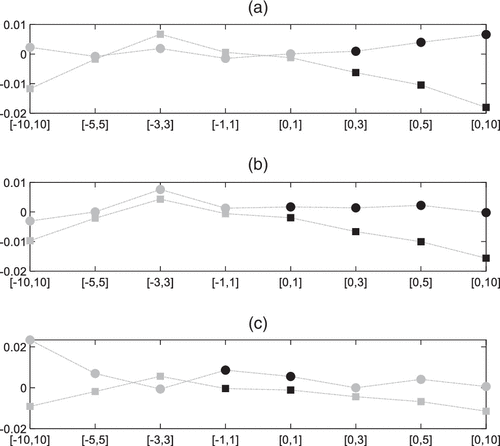
Notes. This graph illustrates abnormal returns around office building transactions based on the FF three-factor model. (a) Neighborhood specialization. (b) Building specialization. (c) Building-neighborhood spillovers. Dots represent abnormal returns within the event window (x axis) for transactions of buildings with above-median specialization or spillover effects, whereas squares represent abnormal returns for transactions of buildings with below-median specialization or spillover effects. Gray dots and squares indicate that the difference in abnormal returns between the two groups is statistically insignificant, whereas black dots and squares indicate that the difference is statistically significant at the 10% level.
When we calculate abnormal returns using the FF three-factor plus EPRA model, we find significantly higher abnormal returns when REITs trade buildings with a higher level of BNSpillover during the event windows [−1,1], [0,1], [0,5], and [0,10]. The highest abnormal return occurs in the [0,10] window, amounting to 0.81% over 11 days. The difference is also largest in this window, reaching 1.75%, as the abnormal return for REITs trading buildings with lower BNSpillover is −0.94%. The figure presenting the abnormal returns by using the FF three-factor plus EPRA model is available in the Online Appendix.
However, the effect estimated by comparing abnormal returns of REITs that trade buildings with high and low levels of BNSpillover may be biased due to other confounding factors that simultaneously influence abnormal returns. We next estimate the effects of neighborhood specialization (NSpec), within-building specialization (BSpec), and knowledge spillovers (BNSpillover) on cumulative abnormal returns as follows:
Table 17 reports our results using the cumulative abnormal returns over various event windows as the dependent variable. Panels A and B report our results based on using the FF three-factor model and the FF three-factor plus EPRA return model, respectively.28
|
Table 17. Cumulative Abnormal Returns Around Building Transactions
| Acquisition plus disposition | ||||||
|---|---|---|---|---|---|---|
| Panel A: Fama-French three factors | Panel B: Fama-French three factors + EPRA | |||||
| NSpec | BSpec | BNSpillover | NSpec | BSpec | BNSpillover | |
| −10; +10 | 0.0097 | 0.0024 | 0.0061* | 0.0214 | 0.0035 | 0.0073** |
| (0.0160) | (0.0046) | (0.0032) | (0.0158) | (0.0042) | (0.0029) | |
| −5; +5 | 0.0167 | −0.0034 | 0.0046*** | 0.0255* | −0.0033 | 0.0039** |
| (0.0146) | (0.0037) | (0.0017) | (0.0146) | (0.0030) | (0.0017) | |
| −3; +3 | 0.0016 | 0.0008 | −0.0010 | 0.0027 | 0.0013 | −0.0008 |
| (0.0063) | (0.0024) | (0.0010) | (0.0071) | (0.0025) | (0.0008) | |
| −1; +1 | −0.0053 | 0.0022 | 0.0004 | −0.0057 | 0.0011 | 0.0002 |
| (0.0050) | (0.0014) | (0.0008) | (0.0053) | (0.0014) | (0.0007) | |
| 0; +1 | −0.0055 | 0.0004 | 0.0003 | −0.0060 | 0.0003 | 0.0004 |
| (0.0047) | (0.0012) | (0.0005) | (0.0050) | (0.0012) | (0.0004) | |
| 0; +3 | −0.0083 | 0.0003 | 0.0015 | −0.0090 | 0.0001 | 0.0014* |
| (0.0116) | (0.0021) | (0.0009) | (0.0126) | (0.0020) | (0.0009) | |
| 0; +5 | −0.0068 | 0.0004 | 0.0026** | −0.0062 | 0.0005 | 0.0026** |
| (0.0125) | (0.0026) | (0.0012) | (0.0132) | (0.0025) | (0.0011) | |
| 0; +10 | −0.0080 | 0.0008 | 0.0032** | −0.0092 | 0.0007 | 0.0033** |
| (0.0144) | (0.0030) | (0.0016) | (0.0166) | (0.0029) | (0.0013) | |
Notes. This table reports abnormal returns over various event windows, including 21 trading days (D1 = −10, D2 = 10), 11 trading days (−5, +5), 7 trading days (−3, +3), 3 trading days (−1, +1), 2 trading day (= 0, +1), 4 trading days (0, +3), 6 trading days (0, +5), and 11 trading days (0, +10). Panel A uses the Fama-French three-factor model, and Panel B uses the Fama-French three-factor model plus the REIT market factor (EPRA REIT return). The same control variables and fixed effects included in Table 4 are included here. All the variables are as defined in Table 2.
Although we do not find any significant results on general neighborhood agglomeration (NSpec) and within-building specialization (BSpec), we do find that REIT stocks react positively around transactions of buildings associated with higher building-neighborhood spillover effects. In both models, this effect is statistically significant within 6-, 11-, and 21-day windows around the event. Our findings indicate that the stock market values a building with sectoral specialization. However, this valuation is significant only if this specialization contributes to the creation of knowledge spillovers.29
One possible explanation is that the market interprets transactions of buildings with strong neighborhood spillover effects as informative signals about the broader area’s fundamentals. Such properties generate positive externalities through increased foot traffic, amenity value, and complementary local investment that enhance nearby asset values and stabilize income streams. The sale of such a building, therefore, conveys confidence in local growth prospects and suggests that capital is being reallocated strategically rather than liquidated under distress. For REITs, these transactions further signal effective asset management and reinforce investor expectations of sustained value creation, as the transaction reveals favorable information about both the asset’s intrinsic productivity and the vitality of the surrounding urban micromarket.
5.2. Event Study Based on Two-Way Fixed Effects Model
In addition to the analyses based on cumulative abnormal returns, we also estimate a dynamic two-way fixed effects model to illustrate the impact on REITs’ returns in the days before and after the event, using the following specification:
The coefficients, , , and , are plotted in Figure 3. First, in all three graphs, there is no pretrend, indicating that the parallel trend assumption is satisfied. Second, Figure 3(b) shows a significant positive return of 0.58% and 0.52% on the fourth and seventh days after the transaction of buildings with a high level of BSpec, respectively. This confirms that a positive market reaction exists when REITs trade buildings with higher within-building agglomeration. Third, as shown in Figure 3(c), we observe a significant positive return (0.94%) on the day of the transaction when a firm trades a building with a high level of BNSpillover. This further confirms the stock market premium of trading buildings with positive externalities. However, we do not observe any positive return after the transaction of buildings with a high level of NSpec, which is consistent with our previous findings.
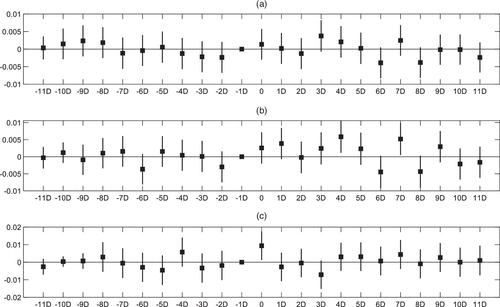
Notes. This graph illustrates the change in REITs’ returns in the days (x axis) before and after their transactions of buildings with different agglomeration levels using the specification of Equation (19). (a) Coefficients for NSpec. (b) Coefficients for BSpec. (c) Coefficients for BNSpillover.
These results are consistent with the above- and below-median analyses, where trading buildings with above- (below-) median BNSpillover leads to a cumulative abnormal return of 0.86% (−0.04%) during the [−1,1] window. This implies a positive return of 0.92% when using below-median BNSpillover as the baseline. As shown in our two-way fixed effects model, the return increases by 0.94% when trading a building with an above-median level of BNSpillover on the transaction day. Given that the base date is one day prior to the transaction (−1), this corresponds to a cumulative return of 0.94% over the [−1,0] and [−1,1] windows, as the return on day 1 is insignificant.
6. Conclusion
Is agglomeration valued? Does an agglomeration (price) premium exist if a concentration of intraindustry firms occupy an office building that results in an undiversified tenant mix? We find that a significant agglomeration premium exists only if building specialization (vertical agglomeration) is consistent with neighborhood specialization (horizontal agglomeration), for example, consists of firms in the same industry sector. For example, if finance firms are the primary occupants of a building and finance firms are also the predominant industry in the neighborhood surrounding the building, then investors are willing to pay a premium to buy the building. Consistent with the MAR externality (Marshall-Arrow-Romer) model, our finding implies that an agglomeration premium arises from the knowledge spillovers that tenants enjoy if they choose a location that caters to their sector. Industry clientele effects do appear to matter. Our findings provide additional support to the literature that contends agglomeration economies attenuate; knowledge spillovers are highly local; and productivity gains from knowledge spillovers are most prominent within the same industries. Our findings are also consistent with the argument that knowledge externality is the driving force of agglomeration in idea- and service-oriented industries. As such, our study offers a greater insight into the microfoundations of agglomeration and the trend that services are dominating urban centers. Our finding also supports recent developments in skyscraper economics that argue agglomeration also exists in the vertical space (Liu et al. 2018, 2020, 2024; Rosenthal and Strange 2020). As the anchor tenant occupies more space in the building, the more positive the value impact on the building is. By using a reduced sample with complete information on NOI and cap rate and a manually collected data set of newly signed leases, we provide evidence that the price premium essentially originates from the agglomerative effects on rents.
Our use of REIT transaction data allows us to study how the stock market reacts to a REIT’s acquisition and/or disposition of an office building that is subjected to varying degrees of horizontal and vertical specialization. We find that the market rewards a REIT when it transacts buildings that facilitate strong spillover benefits. Specifically, a positive stock price reaction occurs when the transacted building primarily hosts tenants from an industry sector that is also highly concentrated in the immediate neighborhood surrounding the building. We add to the finance literature on firms’ choices of locations. What makes a location valuable are positive knowledge spillover externalities. In summary, the stock market appears to view a specialized building as a value-add proposition. The public market thus validates our private underlying real estate market findings.
1 See also Duranton and Puga (2004) and Rosenthal and Strange (2004, 2020) for a detailed literature review.
2 See, for example, the technology sector in Silicon Valley, the financial sector on Wall Street, and the clusters of advertising agents on Madison Avenue in Manhattan.
3 See Audretsch and Feldman (1996), Duranton and Overman (2005), Ellison and Glaeser (1997), Ellison et al. (2010), Greenstone et al. (2010), Rosenthal and Strange (2001), Jofre-Monseny et al. (2011), Martin et al. (2011), and Moretti (2004).
4 See Charlot and Duranton (2004), Eberts and McMillen (1999), Guven et al. (2019), and Rosenthal and Strange (2005).
5 See Arzaghi and Henderson (2008), Dekle and Eaton (1999), Drennan and Kelly (2011), Kerr and Kominers (2015), Koster et al. (2014), and Morikawa (2011).
6 See Jaffe et al. (1993), Audretsch and Feldman (1996), Keller (2002), Moretti (2004), Singh and Marx (2013), Figueiredo et al. (2015), Moretti (2021), and Kim et al. (2022).
7 In our sample, there are only a limited number of mixed-use office buildings. Of the 1,100 properties in our data set, 1,024 are exclusively office buildings. Among the remaining 76 properties, the office space constitutes 96.04% of the total space on average. To address this point, we conduct two robustness checks: (1) including the office area share as a control variable and (2) excluding the 76 buildings with mixed usage. Our results remain robust. For parsimonious reasons, the results are not reported here.
8 We compared the total space occupied by all tenants as recorded in CoStar and/or CompStak to the reported occupancy rate from CoStar at the time of sale. We find that in most cases, the cumulative tenant space occupied matches the reported occupancy rate, validating the reliability of our data. However, discrepancies were identified in a small number of cases due to CoStar and CompStak missing occupancy information. Specifically, we excluded 35 observations where discrepancies exceeded 40% from the analysis to minimize the impact of measurement error. In three cases, the space occupied by tenants reported in the CoStar or Compstak database is over 20% higher than the occupancy rate reported in CoStar. Our results remain robust if we exclude these three observations. The results are not reported here for parsimonious reasons.
9 For example, Arzaghi and Henderson (2008) find that spillovers among advertising agencies attenuate away in just 750 m.
10 See Rosenthal and Strange (2020) for a detailed review of studies supporting this argument.
11 Ideally, building density offers a more precise weighting approach. However, the CoStar database may not capture all types of buildings, therefore not representing the entire building stock across all zip codes in the country. Still, as a robustness check, we use office stock recorded by CoStar as the weighting factor. We calculate employment within a 150-m ring by scaling zip code employment based on the proportion of office space in that ring. For multiple zip code segments covered by a 150-m ring, we determine employment per segment using building size shares, then sum across segments. The results remain robust. Please note that this method may be subject to bias due to incomplete data coverage by CoStar. For parsimonious reasons, the results are not reported here.
12 We acknowledge that computing employment within a 150-mr ring using ZIP code–level employment data may be subject to potential attenuation bias. As a result, the true effect might be stronger than our estimated effect. Additionally, in the IV estimation, we derive the standard errors using bootstrapping, which also help mitigate the inefficiency in the estimates caused by measurement errors.
13 As a robustness test, we also use different employee sizes for each group as the multiplier. Specifically, we use the maximum size, randomly generated size, and the minimum size within each category. The results are not reported here but remain robust.
14 Because we must randomly impute some numbers, we generate three independent imputed samples to check the robustness. The results are not reported here for parsimonious reasons but remain robust.
15 We use the Walk Score (https://www.walkscore.com/), a number between 0 and 100, to measure how walkable any address is. A Walk Score between 90 and 100 (0 and 24) indicates that daily errands do not (do) require a car. For every address, Walk Score examines numerous walking paths to nearby amenities. Points are granted according to the distance to amenities in each category. Amenities within a five-minute walk (0.25 miles) receive the highest possible points.
16 The majority of these lease transactions are sourced from Compstak, with a small number obtained from CoStar, which occasionally reports effective rents.
17 The large F-statistic is caused by the substantial sample size of 742,179 observations. In the first-stage regression, varies across approximately 30,000 zip codes, 19 industry sectors, and a time span of more than 14 years.
18 It should be noted that, although building employment itself is independent of neighborhood employment, BSpecTrue is constructed using neighborhood employment as the denominator. Consequently, the value BSpecTrue changes when instrumented neighborhood employment is applied. As a result, the coefficient for BSpecTrue also becomes smaller.
19 See Baum-Snow et al. (2024) for a detailed discussion on firms’ sorting pattern.
20 Other studies using the related variety measure include Bishop (2012), Castaldi et al. (2015), and Liang and Goetz (2018).
21 Business Service includes the following: 52, Finance and Insurance; 53, Real Estate and Rental and Leasing; 54, Professional, Scientific, and Technical Services; 55, Management of Companies and Enterprises. Retail Service includes the following: 44–45, Retail Trade. Travel, Entertainment Service includes the following: 71, Arts, Entertainment, and Recreation; 72, Accommodation and Food Services. Education and Health Service includes the following: 61, Educational Services; 62, Health Care and Social Assistance.
22 RCA Liquidity: Based on property transaction data provided by Real Capital Analytics (RCA) since 2005, Van Dijk and Francke (2025) estimate liquidity indices based on demand and supply reservation prices for 31 U.S. regions. Specifically, liquidity is calculated as the difference between demand and supply reservation prices.
23 Property turnover in each MSA is calculated as the number of properties sold by NCREIF members in a given year divided by the total number of properties owned by NCREIF members (Downs and Zhu 2022).
24 Gyourko (2009) argues that the commercial real estate and housing markets are driven by common fundamentals, which could make them perform similarly. Therefore, we use the zip code level house price changes to control for the local market conditions.
25 We also use the rent and cap rate of the office building at the time of transaction as an alternative dependent variable to the price. This results in a large reduction to our sample because the cap rate is not reported for the majority of our transactions. We find that within-building specialization (BSpec) and the proxy for knowledge spillovers (BNSpillover) have a significant positive effect on building rent. In contrast, no significant impact is found on cap rates. For parsimonious reasons, the results are not reported here. Given the small sample size, we are only able to offer some preliminary evidence that the value premium is reflected in the rent component (income) rather than the cap rate (risk), Our finding is consistent with the previous studies that contends rents reflect agglomeration economies.
26 The data are obtained from Ken French’s website. The factors comprise the market factor (MKT), the difference between the returns on diversified portfolios of small stocks and big stocks (SMB), and the difference between the returns on portfolios of high (value) and low (growth) book-to-market stocks (HML).
27 SEC rules require that “a company must file Form 8-K within four business days after a material event occurs.” In practice, when 8-Ks are filed, they typically announce the transaction on the same day or within one day. However, because most property sales are not disclosed through 8-Ks, the announcement date cannot be identified consistently. Moreover, key asset details such as tenant composition and building agglomeration are often unknown at the announcement date, especially for smaller office properties. We therefore use the transaction date, the only uniformly observable event, to capture the market’s response, as agglomeration-related attributes generally become observable only once the sale is finalized.
28 A potential issue with event studies is event-date clustering, as noted by Kolari and Pynnönen (2010). As a robustness check, we employ the event-day clustered standard errors. The results remain robust and are available upon request.
29 For robustness checks, we add a single-tenant building dummy as well as the tenant concentration at the REIT level as extra control variables; we also use the winsorized abnormal return as the dependent variable. The results are similar to those reported in Table 17. For parsimonious reasons, we do not report the results.
References
- (2004) The impact of geographic differences in human capital on service firm formation rates. J. Urban Econom. 56(2):244–278. Crossref, Google Scholar
- (2007) The determinants of new-firm survival across regional economies: The role of human capital stock and knowledge spillover. Papers Regional Sci. 86(3):367–391.Crossref, Google Scholar
- (2007) Desperately seeking spillovers? Increasing returns, industrial organization and the location of new entrants in geographic and technological space. Indust. Corporate Change 16(1):89–130.Crossref, Google Scholar
- (2007) Location strategies and knowledge spillovers. Management Sci. 53(5):760–776.Google Scholar
- (1999) Localization of knowledge and the mobility of engineers in regional networks. Management Sci. 45(7):905–917.Google Scholar
- (1962) The economic implications of learning by doing. Rev. Econom. Stud. 29(3):155–173.Crossref, Google Scholar
- (2008) Networking off Madison Avenue. Rev. Econom. Stud. 75(4):1011–1038.Crossref, Google Scholar
- (1996) R&D spillovers and the geography of innovation and production. Amer. Econom. Rev. 86(3):630–640.Google Scholar
- (2011) Quantifying knowledge spillovers using spatial econometric models. J. Regional Sci. 51(3):471–496.Crossref, Google Scholar
- (2006) Multinationals’ location choice, agglomeration economies, and public incentives. Internat. Regional. Sci. Rev. 29(1):81–107.Crossref, Google Scholar
- (1991) Who Benefits from State and Local Economic Development Policies? (W.E. Upjohn Institute, Kalamazoo, MI), 354.Google Scholar
- (2024) Local productivity spillovers. Amer. Econom. Rev. 114(4):1030–1069.Google Scholar
- (2008) Place of work and place of residence: Informal hiring networks and labor market outcomes. J. Political Econom. 116(6):1150–1196.Crossref, Google Scholar
- (2016) Agglomeration within an urban area. J. Urban Econom. 91(C):13–25.Google Scholar
- (2012) Knowledge, diversity and entrepreneurship: A spatial analysis of new firm formation in Great Britain. Entrepreneurship & Regional Development 24(7–8):641–660.Crossref, Google Scholar
- (2019) Knowledge diversity and entrepreneurship following an economic crisis: An empirical study of regional resilience in Great Britain. Entrepreneurship & Regional Development 31(5–6):496–515.Crossref, Google Scholar
- (2010) Dots to boxes: Do the size and shape of spatial units jeopardize economic geography estimations? J. Urban Econom. 67(3):287–302.Crossref, Google Scholar
- (2020) Does firm investment respond to peers’ investment? Management Sci. 67(8):4703–4724.Google Scholar
- (2015) Related variety, unrelated variety and technological breakthroughs: An analysis of US state-level patenting. Regional Stud. 49(5):767–781.Crossref, Google Scholar
- (2004) Communication externalities in cities. J. Urban Econom. 56(3):581–613.Crossref, Google Scholar
- (2009) Regional determinants of inward FDI distribution in Poland. Internat. Bus. Rev. 18(2):119–133.Crossref, Google Scholar
- (1996) Productivity and the density of economic activity. Amer. Econom. Rev. 86(1):54–70.Google Scholar
- (1999) Agglomeration and land tents: Evidence from the prefectures. J. Urban Econom. 46(2):200–214.Crossref, Google Scholar
- (2007) Firm location decisions, regional grants and agglomeration externalities. J. Public Econom. 91(3):413–435.Google Scholar
- (2022) Property market liquidity and REIT liquidity. Real Estate Econom. 50(6):1462–1491. Crossref, Google Scholar
- (1989) Information intensive industries in metropolitan areas of the United States of America. Environ. Planning A: Econom. & Space 21(12):1603–1618.Crossref, Google Scholar
- (2002) The Information Economy and American Cities (Johns Hopkins University Press, Baltimore, MD).Crossref, Google Scholar
- (2011) Measuring urban agglomeration economies with office rents. J. Econom. Geography 11(3):481–507.Google Scholar
- (2005) Testing for localization using micro-geographic data. Rev. Econom. Stud. 72(4):1077–1106.Crossref, Google Scholar
- (2004)
Micro-foundations of urban agglomeration economies . Henderson JV, Thisse J, eds. Handbook of Regional and Urban Economics, vol. 4 (Elsevier, Baltimore, MD), 2063–2117.Google Scholar - (1999)
Agglomeration economies and urban public infrastructure . Eberts R and McMillen D, eds. Handbook of Regional and Urban Economics, vol. 3 (Elsevier, Amsterdam), 1455–1495.Crossref, Google Scholar - (2021) Imputing missing values in the U.S. Census Bureau’s county business patterns. NBER Working Paper No. 26632, National Bureau of Economic Research, Cambridge, MA.Google Scholar
- (1997) Geographic concentration in U.S. manufacturing industries: A dartboard approach. J. Political Econom. 105(5):889–927.Crossref, Google Scholar
- (2010) What causes industry agglomeration? Evidence from coagglomeration oatterns. Amer. Econom. Rev. 100(3):1195–1213.Google Scholar
- (2002) Home-field advantage: Location decisions of Portuguese entrepreneurs. J. Urban Econom. 52(2):341–361.Crossref, Google Scholar
- (2015) Industry localization, distance decay, and knowledge spillovers: Following the patent paper trail. J. Urban Econom. 89(C):21–31.Google Scholar
- (2016) Urban agglomeration and CEO compensation. J. Financial Quant. Anal. 51(6):1925–1953.Crossref, Google Scholar
- (2007) Related variety, unrelated variety and regional economic growth. Regional Stud. 41(5):685–697.Crossref, Google Scholar
- (2011) Green noise or green value? Measuring the effects of environmental certification on office values. Real Estate Econom. 39(1):45–69.Google Scholar
- (2009) The wealth of cities: Agglomeration economies and spatial equilibrium in the United States. J. Econom. Literature 47(4):983–1028.Crossref, Google Scholar
- (1992) Growth in cities. J. Political Econom. 100(6):1126–1152.Crossref, Google Scholar
- (1998) Analysis of REIT IPOs using a market microstructure approach: Anomalous behavior or asset structure. J. Real Estate Financial Econom. 16(3):243–256.Google Scholar
- (2010) Identifying agglomeration spillovers: Evidence from winners and losers of large plant openings. J. Political Econom. 118(3):536–598.Crossref, Google Scholar
- (2022) Industry networks and the geography of firm behavior. Management Sci. 68(8):6163–6183.Google Scholar
- (2019) Competition, concentration and percentage rent in retail leasing. Real Estate Econom. 50(2):401–430.Google Scholar
- (2009) Understanding commercial real estate: How different from housing is it? J. Portfolio Management 35(5):23-37.Crossref, Google Scholar
- (2011) Neighbors and coworkers: The importance of residential labor market networks. J. Labor Econom. 29(4):659–695.Crossref, Google Scholar
- (2019) On the value of environmental certification in the commercial real estate market. Real Estate Econom. 47(3):685–722.Google Scholar
- (2016) Measuring industry coagglomeration and identifying the driving forces. J. Econom. Geography 16(5):1055–1078.Google Scholar
- (1969) The Economy of Cities (Random House, New York).Google Scholar
- (1993) Geographic localization of knowledge spillovers as evidenced by patent citations. Quart. J. Econom. 108(3):577–598.Crossref, Google Scholar
- (2009) The effect of clustering on office rents: Evidence from the Amsterdam market. Real Estate Econom. 37(2):185–208.Google Scholar
- (2011) The mechanisms of agglomeration: Evidence from the effect of inter-industry relations on the location of new firms. J. Urban Econom. 70(2):61–74.Google Scholar
- (2019) The effect of knowledge spillovers on regional new firm formation: The Greek manufacturing case. Environ. Planning A: Economy & Space 51(4):1005–1030.Crossref, Google Scholar
- (2009) Neighborhood matters: The impact of location on broad based stock option plans. J. Financial Econom. 92(1): 109–127.Crossref, Google Scholar
- (2002) Geographic localization of international technology diffusion. Amer. Econom. Rev. 92(1):120–142.Google Scholar
- (2009) Multinational enterprises, international trade, and productivity growth: Firm-level evidence from the United States. Rev. Econom. Statist. 91(4):821–831.Crossref, Google Scholar
- (2015) Agglomerative forces and cluster shapes. Rev. Econom. Statist. 97(4):877–899.Crossref, Google Scholar
- (2022) Does local technological specialisation, diversity and dynamic competition enhance firm creation? Res. Policy 51(7):104557.Crossref, Google Scholar
- (2010) Event study testing with cross-sectional correlation of abnormal returns. Rev. Financial Stud. 23(11):3996–4025.Crossref, Google Scholar
- (2014) Agglomeration economies and productivity: A structural estimation approach using commercial rents. Economica 81(321):63–85.Crossref, Google Scholar
- (1991)
Localization . Geography and Trade (MIT Press, Cambridge, MA), 33–67.Google Scholar - (2001) The economic geography of the internet age. J. Internat. Bus. Stud. 32(4):641–665.Crossref, Google Scholar
- (2014) The influence of state policy and proximity to medical services on health outcomes. J. Urban Econom. 80(C):97–109.Google Scholar
- (2018) Technology intensity and agglomeration economies. Res. Policy 47(10):1990–1995.Crossref, Google Scholar
- (2022) The need for speed: Internet infrastructure location and real asset values. Preprint, submitted September 29, http://dx.doi.org/10.2139/ssrn.4228044.Google Scholar
- (2018) The vertical city: Rent gradients, spatial structure, and agglomeration economies. J. Urban Econom. 106(C):101–122.Google Scholar
- (2020) Employment density and agglomeration economies in tall buildings. Regional Sci. Urban Econom. 84(C):103–555.Google Scholar
- (2024) Agglomeration economies and the built environment: Evidence from specialized buildings and anchor tenants. J. Urban Econom. 142(C):103655.Google Scholar
- (1890) Principles of Economics (Macmillan, London).Google Scholar
- (2011) Spatial concentration and plant-level productivity in France. J. Urban Econom. 69(2):182–195.Crossref, Google Scholar
- (2021) The local innovation spillovers of listed firms. J. Financial Econom. 141(2):395–412.Crossref, Google Scholar
- (2004) Workers’ education, spillovers, and productivity: Evidence from plant-level production functions. Amer. Econom. Rev. 94(3): 656–690.Google Scholar
- (2021) The effect of high-tech clusters on the productivity of top inventors. Amer. Econom. Rev. 111(10):3328–3375.Google Scholar
- (2011) Economies of density and productivity in service industries: An analysis of personal service industries based on establishment-level data. Rev. Econom. Statist. 93(1):179–192.Crossref, Google Scholar
- (2003) The economic performance of regions. Regional Stud. 37(6–7):549–578.Crossref, Google Scholar
- (1982) Wages, rents, and the quality of life. J. Political Econom. 90(6):1257–1278.Crossref, Google Scholar
- (1986) Increasing returns and long-run growth. J. Political Econom. 94(5):1002–1037.Crossref, Google Scholar
- (2001) The determinants of agglomeration. J. Urban Econom. 50(2):191–229.Crossref, Google Scholar
- (2003) Geography, industrial organization, and agglomeration. Rev. Econom. Statist. 85(2):377–393.Crossref, Google Scholar
- (2004)
Evidence on the nature and sources of agglomeration economies . Henderson JV, Thisse J, eds. Handbook of Regional and Urban Economics, vol. 4 (Elsevier, Amsterdam), 2119–2171.Google Scholar - (2005) The geography of entrepreneurship in the New York metropolitan area. Econom. Policy Rev., Federal Reserve Bank of New York. 11(2):29–53.Google Scholar
- (2008) The attenuation of human capital spillovers. J. Urban Econom. 64(2):373–389.Google Scholar
- (2020) How close is close? The spatial reach of agglomeration economies. J. Econom. Perspect. 34(3):27–49.Google Scholar
- (2013) Geographic constraints on knowledge spillovers: Political borders vs. spatial proximity. Management Sci. 59(9):2056–2078.Google Scholar
- (2004) Buzz: Face-to-face contact and the urban economy. J. Econom. Geography 4(4):351–370.Google Scholar
- (2019) Agglomeration economies in creative industries. Regional Sci. Urban Econom. 77(C):141–154.Google Scholar
- (2004) Agglomeration externalities: Marshall versus Jacobs. J. Evolutionary Econom. 14(5):593–604.Google Scholar
- (2025) Agglomeration economies and capitalization rates: Evidence from the dutch real estate office market. J. Real Estate Finance Econom. 71(1):95–117. Crossref, Google Scholar
- (2025) Commonalities in private commercial real estate market liquidity and price index returns. J. Real Estate Finance Econom. 71(2):141–177.Crossref, Google Scholar
- (2004) Knowledge spillovers and economic growth: An analysis using data of Dutch regions in the period 1987–1995. Regional Stud. 38(4):393–407.Crossref, Google Scholar

