


The Use of Credit Ratings in the Delegated Management of Fixed Income Assets
Abstract
Investment mandates of fixed income funds constrain managers’ portfolio decisions, often employing credit ratings to classify asset risk. We categorize U.S. and European fixed income funds’ mandates using textual analysis and measure the use of ratings. Over the past two decades, despite the weaknesses of ratings revealed in the global financial crisis, ratings use has increased significantly. Since 2010, the fraction of funds not using ratings in any way has fallen by almost half in both the United States and Europe. By 2020, 94% of U.S. funds and 65% of European funds used ratings. These patterns fit agency-based models of investment mandates and point to a lack of practically useful alternatives.
This paper was accepted by Tomasz Piskorski, finance.
Funding: This work was supported by the Nasdaq Nordic Foundation.
Supplemental Material: The data files and e-companion are available at https://doi.org/10.1287/mnsc.2023.4848.
Fixed income markets are large and of central importance to the financial system, providing much of the external financing of corporations, financial institutions, and the public sector.1 Most investment decisions in fixed income markets are not made by the ultimate asset owners (e.g., households and governments) but by agents such as mutual funds, insurance companies, and pension funds. Together, bond mutual funds and money market mutual funds managed $13.7 trillion worldwide in 2021 (Investment Company Institute 2022). The interaction between such asset managers and the ultimate asset owners is key to understanding fixed income markets. An important determinant of the relationship between owners and managers is the investment mandate, which stipulates how assets are to be managed and with which restrictions. For example, a mandate may define a fund’s broad investment strategy or dictate which types of assets a fund manager can purchase. In particular, investment mandates often restrict the risk of portfolio assets (Almazan et al. 2004, He and Xiong 2013). In this paper, we examine the structure of such investment mandates for fixed income asset managers and the role that credit ratings play in restricting risk taking by funds.
Using regulatory filings in the United States and Europe for the last 20 (United States) and 10 (Europe) years, we perform a textual analysis on investment mandates (contained in the filings) to classify how portfolio risk is characterized and constrained in these mandates. Most mandates limit the set of investable assets using credit ratings. In all, 60% of European funds and 93% of U.S. fund mandates refer to credit ratings in some way.2 This is in line with earlier survey-based findings by Cantor et al. (2007) that credit ratings are used in the guidelines of some of the largest asset managers working with pension plans.3 References to credit ratings are implemented in different ways; some mandates specify that assets will be invested “primarily” in investment grade securities, and others determine that most funds will be invested in high-yield assets; some require ratings from a particular agency, whereas others allow the ratings of any agency certified by regulators. Mandates also differ in their amount of leeway (e.g., allowing 10% of assets to be outside the target rating range).
We collect data on security holdings of funds to establish that portfolios conform to mandates; the credit ratings of fund assets closely match mandates. For example, examining corporate bond portfolios of investment grade (“IG”) funds, we document that 96% of assets are IG. In contrast, high-yield (“HY”) funds hold 7% IG assets. Funds without ratings references of any kind hold 60% IG assets. The close match between mandates and holdings may reflect legal and commercial risks associated with deviations from investment mandates. Examples of lawsuits about this include a 2008 case in which investors in Schwab’s YieldPlus Fund filed a class action suit against Schwab for deviating from investment and concentration policies. The defendant paid $119 million to settle the charges (Laisse 2011). Similarly, in 2012, Evergreen Investment Management Company paid $25 million to settle a class action claiming that it misled investors about one of its fund’s exposures to mortgage-backed securities (Reuters 2012).4
The use of ratings in mandates extends to funds marketed to retail as well as to institutional investors (as in the Cantor et al. 2007 study), to ETFs as well as open-ended mutual funds, and across all large categories of fixed income funds (e.g., municipal bond funds and corporate bond funds). Younger funds, funds with more assets under management, corporate bond funds, and ETFs are more likely to use ratings, whereas index funds are less likely to do so. Broad-based use of ratings is consistent with an agency-based view of asset management (see, e.g., Admati and Pfleiderer 1997, He and Xiong 2013), whereby constraints on risk-taking are required to convince investors to invest with a manager.
Not only is ratings use frequent, but it has also been increasing. In our U.S. sample, a broad measure of ratings use in mandates increased from 90.0% of funds in 2010 to 94.4% in 2020. This implies that nonuse has been cut almost in half and suggests a net increase in ratings use by 0.4% of the fund stock annually (this net reflects both changes in mandates and turnover in the fund universe). In Europe, ratings use increased from 46.8% to 65.8% between 2012 and 2021, suggesting that nonuse has been reduced by one-third (equivalent to an annual increase in ratings use by 2.1% of the European fund universe). Increases in ratings references in mandates are observed after controlling for fund characteristics such as assets under management and asset class (corporate, municipal, etc.) and within individual funds over time. The pattern of increasing ratings use holds for the period after the global financial crisis in 2008 as well as in the decade preceding it.
This broad-based trend might seem puzzling given the widespread criticism of credit ratings following the financial crisis.5 There are at least three possible explanations (not mutually exclusive). First, despite the popular and regulatory backlash against credit rating agencies, the financial crisis may not have changed sophisticated investors’ perceptions of ratings quality much, at least for asset classes not associated with major losses during the financial crisis. The most significant losses were sustained in structured assets, which most funds do not hold; fixed income mutual funds largely invest in corporate and municipal bonds and in Treasury securities. European mandates most often use ratings when investing in U.S. assets, where coverage is deepest and where the history is the longest. Perhaps ratings are perceived as reliable metrics in this area and have no viable alternatives. Under this view, low quality ratings generate a negative externality on the financial system, given that they are effectively irreplaceable.6
Second, competition between asset managers for funds may force increased use of ratings. As Stein (2005) pointed out for open-ended fund structures and Donaldson and Piacentino (2018) for references to credit ratings, competition for funds under management accelerates the adoption of contractual commitments that reduce agency problems.7 Competition has been increasing in asset management (see, e.g., Khorana and Servaes 2012 and Gârleanu and Pedersen 2018), and this trend fits increasing ratings use in mandates.8
Third, ratings use in fixed income mandates and other private, nonregulatory settings may be “sticky,” so that the use of ratings remains the market convention even if better alternatives exist. For example, contracting conventions may lead to the ubiquity of ratings.9 Furthermore, network externalities may result in persistent and increasing use of ratings through market participants’ desire for consistency and comparability of credit risk metrics; thus, increasing ratings use may increase the utility of ratings to investors, issuers, and intermediaries.10 This view implies that there may be multiple equilibria (e.g., all funds use ratings or all funds use market prices to measure credit risk) and raises the possibility of welfare losses associated with the current equilibrium.
The widespread and increasing use of ratings in private contracting has implications for financial regulation. Credit ratings fulfill the same function in regulation as in private contracting: measuring credit risk. They have well-understood scales (especially the investment grade and high-yield categories), they have a long track record, and they are available for many securities free of charge to investors. Having a well-understood risk measure available broadly and at zero marginal cost to contracting parties allows regulators to make capital requirements of financial institutions dependent on the risk of their assets in a transparent manner, just as it allows mutual fund clients to allocate funds across risk categories.11 Given this similarity between the various private and public uses of ratings, a lack of alternatives for one is likely informative about a lack of alternatives for the other. Among recent rulemaking in the United States, the Dodd-Frank Act instructed federal agencies to remove references to ratings wherever possible.12 Our findings suggest that contracting on credit risk without ratings may be infeasible and replacing them difficult. In countries with less developed fixed income markets (such as those in Europe), formal contracting is used less by fixed income funds. Our results suggest that increased reliance on credit ratings may be unavoidable in these markets, because delegated asset management with formal mandates and competition for funds are likely to increase.
1. Data and Main Samples
1.1. General Aspects of the Textual Analysis
We construct a data set that quantifies textual information related to investment mandates in both U.S. and European fixed income mutual funds. For U.S. funds, this information is extracted from archived prospectuses of U.S. investment companies. The source of these documents is the EDGAR database of the SEC. Our primary sample comprises fund-specific summary prospectuses (filing type 497K) filed between 2010 and 2020 pursuant to rule 497(k) of the Securities Act of 1933.13 Summary prospectuses are typically short (2–3 pages), have standardized headings, and were specifically designed by the SEC with retail investors in mind. Because these documents describe specific funds, we can link them to observable portfolio characteristics from the CRSP Mutual Fund Database such as investment style classifications and holdings.
In addition to fund-specific summary prospectuses, we also consider prospectuses filed at the level of fund groups (filing types 485APOS and 485BPOS) between 1999 and 2020.14 Such groups of funds are typically a subset of an investment company’s funds that were launched on the same date. Although most of these fund group prospectuses encompass more than one fund, making cross-sectional comparisons across funds less clear-cut, they allow for an analysis of trends over a longer sample that covers both the pre- and post-financial crisis periods.
We remove filings that contain no text that is useful for our analysis.15 We use Series IDs in the case of 497K filings and Central Index Keys (CIKs) in the case of 485 filings to identify funds and fund groups, respectively. The CIK is a unique identifier for fund groups, and the Series ID is the unique identifier at the fund level. Each filing is associated with the date on which it was filed with the SEC. Whenever we are left with more than one filing at the CIK or Series ID level in a given year, we use the one that contains the largest number of sentences.
To construct text-based variables from the prospectuses, we first perform some basic cleaning steps and remove formatting and HTML code. Next, we identify and extract text passages that explicitly describe the reporting funds’ investment mandates. Finally, using dictionaries that we develop for this purpose, we perform text searches that capture references to credit ratings and several related concepts. For example, we record whether a given fund’s mandate explicitly refers to specific agencies and whether it mentions the terms “investment grade” and “high yield”.
In the case of 497K filings, we identify the relevant passages by focusing on the mandatory section “Principal Investment Strategies”. Following SEC regulation, this section contains the rules according to which the reporting funds invest.16 Fund group filings of the types 485APOS and 485BPOS tend to have a more idiosyncratic structure than 497K summary prospectuses, which are standardized. However, we can extract the same type of information from group prospectus filings by focusing on sentences that contain the following elements: (i) a relevant fund word (e.g., “we,” “fund,” “portfolio”), (ii) a relevant action word (e.g., “invest,” “hold,” “purchase”), and (iii) a mandate phrase (e.g., “we may,” “up to XX% of the portfolio”).17
For both U.S. filing types, we also exclude examples and consider only statements about credit quality.18 This ensures that we do not capture references that are unrelated to credit ratings (for example, references to S&P indices). Given the selected passages and the dictionaries we develop, we can run fully automatic searches that achieve a high classification accuracy and yield all the main text-based variables employed in the analysis of Section 2.19 We report these variables together with the corresponding dictionaries and exclusion lists in Table 1.
|

Table 1. Descriptions of the Main Text-Based Variables
| Variable name | Search terms | Excluded search terms |
|---|---|---|
| S&P | S&P, Standard & Poor, Standard and Poor | S&P 100, S&P 400, S&P 500, S&P 600, S&P Composite, S&P Index, S&P Target, S&P Small Cap, S&P Mid Cap, S&P Large Cap |
| Fitch | Fitch | — |
| Moody’s | Moody’s | — |
| Duff & Phelps | Duff and Phelps, Duff & Phelps, D&P | — |
| Dominion | Dominion, DBRS | — |
| Kroll | Kroll, KBRA | — |
| Big 3 | Search terms listed for the variables S&P, Fitch, and Moody’s | Exclusion terms as listed for the variable S&P |
| NRSRO | NRSRA, NRSRO, [nationally] recognized statistical rating agency, [nationally] recognized statistical rating organization | — |
| Letter rating | Aaa, Aa1, Aa2, Aa3, A1, A2, A3, Baa1, Baa2, Baa3, Ba1, Ba2, Ba3, B1, B2, B3, Caa1, Caa2, Caa3, Ca, C, P1, P2, P3, Not Prime, NP, AAA, AA+, AA, AA-, A+, A, A-, BBB+, BBB, BBB-, BB+, BB, BB-, B+, B, B-, CCC+, CCC, CCC-, CC, C, RD, SD, D, A1+, A1, A2, A3, B, C, D, F1+, F1, F2, F3, SG, SP1+, SP1, SP2, SP3, VMIG1, VMIG2, VMIG3, VMIG4, MIG1, MIG2, MIG3, MIG4 | Part A, Part B, Part C, Part D, Class A, Class B, Class C, Class D, Investor A, Investor B, Investor C, Investor D, Fund(s) A, Fund(s) B, Funds(s) C, Fund(s) D, Appendix A, Appendix B, Appendix C, Appendix D, Schedule(s) A, Schedule(s) B, Schedule(s) C, Schedule(s) D, A fund, A maximum, A minimum, A bond, A financial, A wide, A security, A core, A financed, A basket, A composite, A portfolio, A fundamental, A nonfundamental, A broadly, A diversified, A subadvisor, A shares, B shares, C shares, D shares, (A), (B), (C), (D) |
| Direct ratings reference | Search terms listed for the variables S&P, Fitch, Moody’s, Duff & Phelps, Dominion, Kroll, NRSRO, and letter rating. Additional search terms: rating agency, rating agencies, rating organization(s) | Exclusion terms as listed for the variables S&P and Letter rating. |
| HY/IG | Investment grade, high yield, speculative grade, junk, below investment grade, noninvestment grade | — |
| All ratings references | Search terms listed for the variables Direct ratings reference and HY/IG | Exclusion terms as listed for the variable Direct ratings reference |
Notes. This table reports the main text-based variables together with the corresponding dictionaries in the column “Search terms”. The column “Excluded search terms” shows several expressions that are not considered to be matches because they do not capture the desired concepts. Minor variations in terms of spelling and capitalization are also included in the searches but are not separately designated in the table. Parentheses denote optional elements. All variables are indicator variables that take the value of one if the relevant investment mandate passage of the prospectus includes one of the search terms; for further details, see Section 1.
For the analysis of European fixed income fund investment mandates, we use Key Investor Information Documents (“KIIDs”) that we obtain in PDF format from the Morningstar Direct database. KIIDs are two-page documents that are similar in nature to the 497K summary prospectuses used for the analysis of U.S. mutual funds. KIIDs are prepared according to the UCITS IV Directive of the European Parliament, implemented in January of 2009. We consider all European open-end fixed income funds that are domiciled in Luxembourg and which are available in Morningstar Direct as of mid-2021. Morningstar Direct publishes the latest KIID for each share class of a fund; in some cases, a limited set of historical KIIDs can also be retrieved. For each fund with nonmissing information on net assets and nonmissing ISIN (International Securities Identification Number, a unique share-class level identifier), we collect English-language KIID filings of the fund’s largest share class. We consider KIIDs from 2012 (there are few filings for prior years on Morningstar) to 2021.20
In the KIIDs, the mandatory section that contains the funds’ investment mandates is typically entitled “Objectives and Investment Policy.” We extract these sections from the PDFs and convert them to machine-readable texts using optical character recognition. To construct the variables that we use in the empirical analysis, we then implement the same filters and definitions as in the case of the U.S. 497K summary prospectuses.
1.2. Sample of U.S. Summary Prospectuses
Our main sample consists of fund-specific summary prospectuses of U.S. funds (filing type 497K). Using the EDGAR-CRSP linking file, we combine information from the CRSP mutual fund database with information from funds’ SEC filings on EDGAR. Using this link, we add the funds’ Lipper objective codes from CRSP to the funds’ summary prospectuses. In our main tests, we retain the 497K filings of fixed income mutual funds according to the Lipper classification. We exclude from our main sample filings of money market mutual funds, because the investment opportunity set of such funds was circumscribed by ratings-based regulation until the end of 2016 (Rule 2a-7 of the Investment Company Act of 1940). We also exclude fixed income funds that invest only in U.S. government securities, because those assets de facto all carry the highest credit ratings. The fund categories in the sample thus comprise municipal debt funds, fixed income funds focusing on debt from international issuers, corporate debt funds, funds investing in mortgage-backed securities, and “other” fixed income funds. Table A.4 in the online Appendix lists the main fixed income categories examined by us, along with the constitutive Lipper objective codes.
Table 2 reports the number of summary prospectus filings by fund category; a given fund is represented at most once per year. The sample includes 19,304 filings by 2,642 fixed income mutual funds. The number of summary prospectus filings has increased over time, reflecting a rising number of reporting funds. The two largest fund categories in terms of filing volume are corporate debt funds (7,463 filings) and municipal debt funds (5,601), followed by “other” fixed income mutual funds (4,064). Fixed income funds primarily investing in foreign debt securities and those primarily investing in MBS contribute 2,011 and 165 filings, respectively.
|
Table 2. Summary Statistics: No. of Summary Prospectus Filings by Fund Type (U.S. Sample), 2010–2020
| Year | Foreign | Corporate | Municipal | MBS | Other fixed income |
|---|---|---|---|---|---|
| 2010 | 87 | 401 | 388 | 13 | 131 |
| 2011 | 104 | 425 | 377 | 15 | 186 |
| 2012 | 152 | 538 | 464 | 17 | 249 |
| 2013 | 177 | 627 | 507 | 16 | 329 |
| 2014 | 197 | 691 | 528 | 16 | 391 |
| 2015 | 204 | 746 | 557 | 16 | 435 |
| 2016 | 219 | 810 | 573 | 16 | 456 |
| 2017 | 205 | 742 | 479 | 16 | 413 |
| 2018 | 229 | 855 | 578 | 14 | 495 |
| 2019 | 223 | 829 | 581 | 13 | 498 |
| 2020 | 214 | 799 | 569 | 13 | 481 |
| Sum | 2,011 | 7,463 | 5,601 | 165 | 4,064 |
Notes. No. of summary prospectus filings (form 497K) over the period 2010–2020. Fund type classifications are based on Lipper objective codes (from the CRSP Mutual Fund database); see Table A.4 in the Online Appendix for details.
Since 2010, funds have been required to include a separate summary section in their fund group prospectuses (filing type 485). However, they can also release these summary sections as separate filings (497K). Therefore, the number of 497K filings in any given year does not necessarily reflect the number of active U.S. funds. In fact, based on our analysis of CRSP data, the number of fixed income mutual funds (defined using Lipper objective codes, excluding government and money market funds) with at least $1million in total net assets was 2,026 in 2011, increasing almost monotonically to 2,388 funds in 2020 (there were 3,352 unique funds over that period). In contrast, the number of fixed income funds filing summary prospectuses increased from 1,020 in 2010 to 2,076 in 2020. We control for possible changes in the composition of the sample by including fund fixed effects in some regressions (see Section 2).
Table 3 reports summary statistics for both the variables constructed using the mandate texts and the data from the CRSP Mutual Fund database.
|
Table 3. Variables From the U.S. Sample of 497K Filings, 2010–2020
| Obs. | Mean | SD | Minimum | Maximum | |
|---|---|---|---|---|---|
| S&P | 19,304 | 0.301 | 0.459 | ||
| Fitch | 19,304 | 0.175 | 0.380 | ||
| Moody’s | 19,304 | 0.291 | 0.454 | ||
| Big 3 | 19,304 | 0.309 | 0.462 | ||
| Nb. agencies | 19,304 | 0.768 | 1.204 | 0.000 | 5.000 |
| NRSRO | 19,304 | 0.226 | 0.418 | ||
| Letter rating | 19,304 | 0.425 | 0.494 | ||
| Direct rating reference | 19,304 | 0.600 | 0.490 | ||
| Rating agency | 19,304 | 0.361 | 0.480 | ||
| HY/IG | 19,304 | 0.884 | 0.320 | ||
| All ratings references | 19,304 | 0.932 | 0.251 | ||
| Category – foreign | 19,304 | 0.104 | 0.305 | ||
| Category – municipal | 19,304 | 0.290 | 0.454 | ||
| Category – MBS | 19,304 | 0.009 | 0.092 | ||
| Category – corporate | 19,304 | 0.387 | 0.487 | ||
| Category – other | 19,304 | 0.211 | 0.408 | ||
| Ln(Assets) | 18,739 | 5.724 | 2.026 | −2.303 | 12.533 |
| Ln(Fund age) | 18,739 | 2.400 | 0.993 | 0.000 | 4.575 |
| Retail | 18,739 | 0.686 | 0.464 | ||
| Institutional | 18,739 | 0.771 | 0.420 | ||
| Index fund | 18,739 | 0.117 | 0.322 | ||
| ETF | 18,739 | 0.122 | 0.327 | ||
| Expense ratio | 16,287 | 0.008 | 0.004 | 0.000 | 0.044 |
| Fraction (All ratings references) | 16,656 | 0.896 | 0.222 | ||
| Fraction (Big 3) | 16,656 | 0.286 | 0.338 | ||
| Fraction (Letter rating) | 16,656 | 0.405 | 0.342 | ||
| Fraction (HY/IG) | 16,656 | 0.846 | 0.251 | ||
| Fraction (NRSRO) | 16,656 | 0.229 | 0.314 |
Notes. Variables constructed using text from the fund-specific summary prospectuses (filing type 497K); the sample period is 2010–2020. Table 1 provides a detailed definition of the text-based variables together with the corresponding dictionaries. Nb. agencies is the sum of the variables S&P, Moody’s, Fitch, Dominion, Duff & Phelps, and Kroll. Fraction (all ratings references) is the fraction of other funds of the same management company that refer to ratings in their mandates (that is, funds for which All ratings references takes the value of one). Fraction (HY/IG), Fraction (NRSRO), Fraction (Big 3), and Fraction (letter rating) are defined analogously. Category – foreign to Category – other are indicator variables for the fixed income fund types; these categories are based on Lipper objective codes from the CRSP Mutual Fund database (see Table A.4 in the Online Appendix for details). Additionally reported are the following variables, which are based on data from the CRSP Mutual Fund database. Ln(Assets) is the natural logarithm of the fund portfolio’s total net assets in the quarter of the prospectus filing. Ln(Fund age) is the natural logarithm of one plus the fund’s age (the difference between the prospectus-filing year and the initial offering year of the fund). Institutional (Retail) is a dummy variable for funds that have at least one share class that is marketed primarily to institutional (retail) investors each year. Index fund and ETF are, respectively, indicator variables for index funds and ETFs. Expense ratio is the fund’s expense ratio at fiscal year-end. Minima and maxima of dummy variables are not reported.
1.3. Sample of U.S. Fund Group Prospectuses
Filings of the types 485APOS and 485BPOS encompass entire fund groups (which can include both equity and fixed income funds), and they are available for a longer period than the 497K summary prospectuses, namely from 1999 to 2020. We match the fund group’s CIK from the 485 filing to the CRSP Mutual Fund database using the EDGAR-CRSP linking file. We then determine whether the fund group includes a fund that is classified as a debt fund using Lipper objective codes (see Table A.4 in the Online Appendix). We retain in the sample those 485 filings that contain at least one debt fund.21 The resulting sample contains 13,194 prospectuses filed by 758 different fund groups over the period 1999–2020. Table 4 reports summary statistics for this sample. It shows the variables derived from the extracted investment mandate passages.
|
Table 4. Variables From the U.S. Sample of 485 Filings, 1999–2020
| Obs. | Mean | SD | Minimum | Maximum | |
|---|---|---|---|---|---|
| S&P | 13,194 | 0.696 | 0.460 | ||
| Fitch | 13,194 | 0.324 | 0.468 | ||
| Moody’s | 13,194 | 0.685 | 0.464 | ||
| Big 3 | 13,194 | 0.704 | 0.456 | ||
| Nb. agencies | 13,194 | 1.728 | 1.234 | 0.000 | 5.000 |
| NRSRO | 13,194 | 0.558 | 0.497 | ||
| Letter rating | 13,194 | 0.738 | 0.440 | ||
| Direct rating reference | 13,194 | 0.901 | 0.298 | ||
| Rating agency | 13,194 | 0.691 | 0.462 | ||
| HY/IG | 13,194 | 0.920 | 0.271 | ||
| All ratings references | 13,194 | 0.970 | 0.170 |
Note. Variables constructed using text from prospectuses filed at the level of fund groups (filing types 485A and 485B); the sample period is 1999–2020. See Table 1 for details. Minima and maxima of dummy variables are not reported.
1.4. Sample of European Key Investor Information Documents
Table 5 reports the number of KIID filings by fund category (funds are grouped into five coarse categories using more detailed underlying information on fund types from Morningstar; for details on the grouping, please refer to Online Appendix Table A.5). The sample spans the years 2012 to 2021 and encompasses 12,382 KIIDs from 2,189 European fixed income funds.22 The KIIDs were downloaded from Morningstar Direct in August and September 2021. Because the database primarily covers recent filings and historical filings are not available for all funds, the sample size increases over time.23 Table 6 reports summary statistics for the variables used in the analysis of European fixed income funds. These comprise text-based variables (see Table 1 for details) as well as variables from Morningstar Direct, with values as of 2021.
|
Table 5. No. of KIID Filings by Fund Type (European Sample), 2012–2021
| Year | Corporate | Emerging markets | Government | Short-term | Other |
|---|---|---|---|---|---|
| 2012 | 67 | 51 | 41 | 9 | 311 |
| 2013 | 95 | 85 | 47 | 12 | 427 |
| 2014 | 108 | 113 | 48 | 14 | 513 |
| 2015 | 142 | 135 | 56 | 16 | 615 |
| 2016 | 167 | 150 | 58 | 20 | 735 |
| 2017 | 186 | 167 | 63 | 20 | 831 |
| 2018 | 209 | 197 | 67 | 25 | 1,004 |
| 2019 | 229 | 228 | 78 | 26 | 1,178 |
| 2020 | 240 | 245 | 85 | 27 | 1,268 |
| 2021 | 249 | 254 | 84 | 31 | 1,356 |
| Sum | 1,692 | 1,625 | 627 | 200 | 8,238 |
Notes. No. of KIID filings obtained from Morningstar Direct, by year and fund type; the sample period is 2012–2021. We consider all European open-end fixed income funds that are domiciled in Luxembourg and which are available in Morningstar Direct as of mid-2021. For each fund with nonmissing information on net assets and nonmissing ISIN, we collect English-language KIID filings of the fund’s largest share class. Fund type classifications are based on Morningstar categories; see Table A.5 for details.
|
Table 6. Variables From the Sample of KIID Filings (European Sample), 2012–2021
| Obs. | Mean | SD | Minimum | Maximum | |
|---|---|---|---|---|---|
| S&P | 12,382 | 0.153 | 0.360 | ||
| Fitch | 12,382 | 0.052 | 0.222 | ||
| Moody’s | 12,382 | 0.101 | 0.301 | ||
| Big 3 | 12,382 | 0.154 | 0.361 | ||
| Nb. agencies | 12,382 | 0.307 | 0.791 | 0 | 4 |
| Letter rating | 12,382 | 0.233 | 0.423 | ||
| Direct rating reference | 12,382 | 0.289 | 0.454 | ||
| HY/IG | 12,382 | 0.500 | 0.500 | ||
| All ratings references | 12,382 | 0.595 | 0.491 | ||
| Currency – euro | 12,382 | 0.601 | 0.490 | ||
| Currency – GBP | 12,382 | 0.037 | 0.189 | ||
| Currency – USD | 12,382 | 0.287 | 0.452 | ||
| Currency – other | 12,382 | 0.075 | 0.263 | ||
| Investment area – Europe | 12,382 | 0.297 | 0.457 | ||
| Investment area – Global | 12,382 | 0.421 | 0.494 | ||
| Investment area – Global emerging markets | 12,382 | 0.133 | 0.340 | ||
| Investment area – USA | 12,382 | 0.076 | 0.265 | ||
| Investment area – other | 12,382 | 0.073 | 0.259 | ||
| Sales region – Offshore | 12,382 | 0.098 | 0.297 | ||
| Sales region – Global | 12,382 | 0.218 | 0.413 | ||
| Sales region – Europe | 12,382 | 0.632 | 0.482 | ||
| Sales region – other | 12,382 | 0.053 | 0.224 | ||
| Fund category – corporate | 12,382 | 0.137 | 0.343 | ||
| Fund category – emerging markets | 12,382 | 0.131 | 0.338 | ||
| Fund category – government | 12,382 | 0.051 | 0.219 | ||
| Fund category – short-term | 12,382 | 0.016 | 0.126 | ||
| Fund category – other | 12,382 | 0.665 | 0.472 | ||
| Ln(Assets) | 12,327 | 7.543 | 1.851 | −4.539 | 12.361 |
| Ln(Fund age) | 12,262 | 1.712 | 0.886 | 0 | 3.871 |
Notes. Variables constructed using text in the “Objectives and Investment Policy” section contained in the KIID documents. Table 1 discusses the content of these variables in detail. Currency – …, Sales region – …, Investment area – …, and Fund category – … are indicator variables for various fund classifications according to Morningstar; see Table A.5 for details. Additionally reported are the following variables, which are based on information from the Morningstar Direct database as of mid-2021. Ln(Assets) is the natural logarithm of the fund portfolio’s total net assets (in million Swedish Kronor). Ln(Fund age) is the natural logarithm of one plus the fund’s age (the difference between the KIID-filing year and the inception year of the fund). Minima and maxima of dummy variables are not reported.
2. Empirical Analysis
2.1. Proof of Concept
Before we analyze in detail how portfolio risk is characterized and constrained in fixed income fund investment mandates, we verify that the textual data extracted from the regulatory filings accurately capture references to credit ratings both in the time series and the cross-section of funds. To conserve space, we report these checks in Section B of the Online Appendix.
We start by validating the time series properties of our measures. First, we consider a regulatory reform that affected money market mutual funds (MMMF). As discussed in Section 1.2, we exclude MMMF from our main sample because the investment opportunity set of such funds was circumscribed by ratings-based regulation until 2016 (Rule 2a-7 of the Investment Company Act of 1940); therefore, references to ratings in such funds’ mandates could differ in nature from nonregulated funds. Because regulation encouraged ratings references before 2016 and discouraged them afterward, any change in ratings use is likely a reflection of regulation, rather than a test of how funds evaluate credit ratings of their own choice. The event does allow us to test how well our text-based measures reflect expected changes in ratings use; we expect MMMF to be less likely to refer to credit ratings in their prospectuses after the rule change. Indeed, we observe that the fraction of MMMF that refer to credit ratings fell considerably following the implementation of the reform; for example, the share of MMMF referring to the term “NRSRO” dropped from 18% in 2015 to 1% in 2018. We report these results in Table B.1 in the Online Appendix, Section B.
For the second proof of concept examining the time series properties of our measures, we identify references to environmental, social, and governance (ESG) criteria in investment mandates. Given the rising interest in ESG issues in recent years, a positive trend would seem natural. Table B.2 in Online Appendix, Section B, reports the fraction of summary prospectus filings that mention ESG-related terms over the period 2010–2020. As expected, only a minority of fixed income funds discuss such matters. In addition to the modest overall level, we also observe the expected increase in ESG references over time (from 0.3% of fixed income funds in 2010 to 13.6% of funds in 2020). This provides additional evidence that the text-based analysis of mandates yields useful data on how fixed income funds operate.
Next, we consider the cross-sectional properties of the measures. We examine whether the text-based measures based on the investment mandates match the actual portfolio holdings of fixed income funds. We consider the ratings of corporate bonds held by three groups of fixed income funds, classified using a textual analysis of the investment mandates: high-yield (HY) funds, investment grade (IG) funds, and funds that do not have any investment restrictions based on credit ratings. We find that portfolios are very closely connected to investment mandates; assets of IG funds are 96% IG, 3% HY, and less than 1% unrated; assets of HY funds are 7% IG, 91% HY, and 1% unrated; and assets of funds with no ratings references are 60% IG, 37% HY, and 2% unrated. In other words, investment grade funds overwhelmingly hold high-rated securities, and funds classified as high yield hold a vast majority of lower-rated securities, whereas funds not restrained by rating-based mandates hold securities across the whole rating spectrum. This analysis, also reported in Online Appendix Section B (Figure B.1), illustrates that our text-based classification produces data with meaningful cross-sectional properties and that ratings-based investment restrictions are indeed reflected in the portfolios of fixed income funds.
Finally, in Online Appendix Section B, we perform an additional test to illustrate that the measures derived from the text analysis of fixed income fund investment mandates are reliable and are related to the portfolios of funds. We consider security sales and purchases by funds with different investment mandates. These tests show that high-yield funds are significantly more likely to buy newly issued high-yield securities, whereas investment grade funds are significantly less likely to do so. Furthermore, securities that are downgraded to high yield are less likely to be sold by high-yield funds and are more likely to be sold by investment grade funds. In summary, our analyses confirm that not only do funds refer to credit ratings in their investment mandates but that the ratings-based investment restrictions of the mandates are also reflected in funds’ actual portfolio holdings.
2.2. The Use of Credit Ratings in U.S. Investment Mandates, 2010–2020
Which types of U.S. fixed income funds use credit ratings in their mandates to delineate the investment opportunity set? Table 7 sheds light on this question. We report coefficients from OLS regression models of the following type, which can be interpreted as cross-sectional comparisons,
|
Table 7. Determinants of Ratings Use in U.S. Fixed Income Fund Mandates
| (1) | (2) | (3) | (4) | (5) | (6) | (7) | (8) | (9) | (10) | |
|---|---|---|---|---|---|---|---|---|---|---|
| All ratings references | HY/IG | Big 3 | NRSRO | Letter rating | ||||||
| Category - foreign | −0.063*** | −0.066*** | −0.064*** | −0.083*** | −0.099*** | −0.109*** | −0.057** | −0.046* | −0.069** | −0.068** |
| (0.014) | (0.015) | (0.018) | (0.020) | (0.033) | (0.028) | (0.027) | (0.024) | (0.035) | (0.033) | |
| Category - other | −0.100*** | −0.093*** | −0.099*** | −0.101*** | −0.116*** | −0.127*** | −0.032 | −0.004 | −0.109*** | −0.102*** |
| (0.013) | (0.014) | (0.016) | (0.017) | (0.025) | (0.023) | (0.021) | (0.020) | (0.026) | (0.025) | |
| Category - municipal | −0.053*** | −0.060*** | −0.112*** | −0.109*** | −0.137*** | −0.082*** | 0.029 | 0.008 | −0.026 | −0.034 |
| (0.011) | (0.011) | (0.017) | (0.016) | (0.024) | (0.019) | (0.024) | (0.018) | (0.027) | (0.021) | |
| Category - MBS | −0.773*** | −0.776*** | −0.869*** | −0.864*** | −0.278*** | −0.206*** | −0.252*** | −0.194*** | −0.244** | −0.217*** |
| (0.096) | (0.095) | (0.064) | (0.065) | (0.067) | (0.049) | (0.021) | (0.048) | (0.099) | (0.076) | |
| Ln(Assets) | 0.001 | −0.000 | −0.003 | 0.001 | 0.007 | 0.007* | 0.004 | 0.006* | 0.010** | 0.008* |
| (0.003) | (0.003) | (0.004) | (0.004) | (0.005) | (0.004) | (0.004) | (0.004) | (0.005) | (0.005) | |
| Ln(Fund age) | −0.021*** | −0.027*** | −0.025*** | −0.042*** | −0.038*** | −0.040*** | −0.018* | −0.019** | −0.042*** | −0.036*** |
| (0.005) | (0.005) | (0.007) | (0.007) | (0.011) | (0.009) | (0.010) | (0.009) | (0.012) | (0.011) | |
| Retail | 0.022** | 0.005 | 0.043*** | 0.012 | −0.042* | −0.041 | 0.097*** | 0.002 | −0.013 | −0.042 |
| (0.011) | (0.015) | (0.015) | (0.023) | (0.024) | (0.025) | (0.020) | (0.021) | (0.025) | (0.028) | |
| Institutional | 0.016 | −0.009 | 0.023 | −0.017 | 0.037* | −0.042** | −0.039* | −0.063*** | 0.024 | −0.039 |
| (0.011) | (0.013) | (0.015) | (0.017) | (0.021) | (0.021) | (0.020) | (0.019) | (0.023) | (0.024) | |
| Index fund | −0.207*** | −0.195*** | −0.198*** | −0.171*** | −0.055 | −0.087** | −0.201*** | −0.116*** | −0.157*** | −0.137*** |
| (0.031) | (0.032) | (0.032) | (0.034) | (0.039) | (0.035) | (0.028) | (0.029) | (0.038) | (0.036) | |
| ETF | 0.055** | 0.052* | 0.060** | 0.078** | 0.085* | 0.040 | 0.089*** | 0.035 | 0.009 | 0.024 |
| (0.027) | (0.028) | (0.030) | (0.033) | (0.045) | (0.038) | (0.034) | (0.034) | (0.044) | (0.041) | |
| Expense ratio | 1.760 | 9.382*** | 4.707* | −0.612 | 3.285 | |||||
| (1.960) | (2.262) | (2.601) | (2.139) | (2.784) | ||||||
| Fraction (All ratings references) | 0.255*** | |||||||||
| (0.034) | ||||||||||
| Fraction (HY/IG) | 0.420*** | |||||||||
| (0.036) | ||||||||||
| Fraction (Big 3) | 0.829*** | |||||||||
| (0.022) | ||||||||||
| Fraction (NRSRO) | 0.866*** | |||||||||
| (0.021) | ||||||||||
| Fraction (Letter rating) | 0.798*** | |||||||||
| (0.021) | ||||||||||
| Year F.E. | Yes | Yes | Yes | Yes | Yes | Yes | Yes | Yes | Yes | Yes |
| Observations | 18,739 | 16,284 | 18,739 | 16,284 | 18,739 | 16,284 | 18,739 | 16,284 | 18,739 | 16,284 |
| Adjusted R2 | 0.144 | 0.207 | 0.110 | 0.234 | 0.041 | 0.404 | 0.036 | 0.433 | 0.018 | 0.321 |
Notes. This table reports regression models documenting the characteristics associated with rating references in fixed income fund investment mandates. The sample consists of annual summary prospectuses (filing type 497K) of U.S. fixed income mutual funds over 2010–2020. All ratings references is one if the fund mandate makes any type of ratings reference (including, but not limited to, any rating agency, a letter rating, or the term NRSRO). HY/IG is a dummy variable that is one if the mandate refers to terms that denote the investment grade threshold (such as “high yield,” “speculative grade,” or “investment grade”). Big 3 is one if the mandate refers to S&P, Moody’s, or Fitch. NRSRO is one if the mandate refers to the term “nationally recognized statistical ratings organization.” Letter rating takes the value of one if the mandate refers to a specific alphanumeric credit rating, such as “A+.” Fraction (all ratings references) is the fraction of other funds of the same management company that refer to ratings in their mandates (i.e., funds for which All ratings references is one). Fraction (HY/IG), Fraction (Big 3), Fraction (NRSRO), and Fraction (Letter rating) are defined analogously. Category – foreign to Category – other are indicator variables for the fixed income types; fund type classifications are based on Lipper objective codes (see Table A.4 for details). Ln(Assets) is the natural logarithm of the fund’s total net assets in the quarter of the prospectus filing. Ln(Fund age) is the log of one plus the fund’s age (defined as the difference between the prospectus-filing year and the fund’s initial offering year). Institutional (Retail) is a dummy variable for funds that have institutional (retail) share classes. Index fund and ETF are, respectively, indicator variables for index funds and ETFs. Expense ratio is the fund’s expense ratio at fiscal year end. Heteroskedasticity-robust standard errors, clustered by fund, are reported below coefficients.
* Estimates that are significantly different from zero at the 10% level; **estimates that are significantly different from zero at the 5% level; ***estimates that are significantly different from zero at the 1% level.
where f denotes the fund and t the year. is a vector of year fixed effects. Because we are interested primarily in fund characteristics, we cluster standard errors at the fund level in these specifications. X denotes a set of fund characteristics. Y denotes the dependent variables: All ratings references (columns 1 and 2), which capture any type of reference to a credit rating in the mandate; HY/IG (columns 3 and 4), a dummy variable that is one if the mandate refers to terms that denote the investment grade threshold; Big 3, which is one if the mandate refers to S&P, Moody’s, or Fitch (columns 5 and 6); NRSRO, which captures references to the term “nationally recognized statistical ratings organization” (columns 7 and 8); and finally, Letter rating, which takes the value of one if the mandate refers to a specific alphanumeric credit rating, such as “A+” (columns 9 and 10).
Based on Table 7, we make several observations about the characteristics of funds that use ratings. First, fixed income funds investing primarily in corporate bonds (Category-corporate is the omitted fund category variable in the regressions and thus serves as the reference point) are significantly more likely to use ratings terms in the mandate than other types of fixed income funds. This is consistent with the fact that ratings for corporate bonds have historically been the most reliable measure of default risk compared with ratings for other asset classes (Cornaggia et al. 2017). Second, younger funds and ETFs are significantly more likely to use ratings, whereas index funds are less likely to do so. Third, the positive and significant coefficients on the variables Fraction (.) suggest that ratings use is strongly correlated across funds within management companies. These patterns are consistent across various measures of ratings use in mandates (different dependent variables). There is also some evidence that funds with more assets under management, funds that have retail share classes, and those charging higher fees tend to rely more on ratings than other funds, but the corresponding coefficients on these variables are not statistically significant in all specifications.
2.3. Trends in the Use of Credit Ratings in U.S. Investment Mandates, 2010–2020
How has the use of credit ratings in U.S. fixed income investment mandates evolved over time? Has the financial crisis affected the private use of ratings in financial markets, mirroring regulatory efforts to pull back on the reliance on ratings? Table 8 reports the annual fraction of funds that make ratings-related references in their investment mandates over the 2010–2020 period. Eighty-eight percent of fixed income mutual funds refer to the investment grade threshold (the mandates refer to “investment grade,” “high yield,” or both); this fraction has increased from 84% in 2010 to 90% in 2020. We consider the investment grade threshold as an indirect reference to credit ratings. About 23% of debt funds refer to the term “NRSRO.” Fifty-seven percent of funds refer to specific alphanumeric ratings or agencies (variable Direct ratings reference in the table) in 2010, rising to 62% in 2020. Overall, Table 8 suggests that both direct and indirect references to ratings in fixed income mandates have modestly increased over the 2010–2020 period from a high initial level.
|
Table 8. Annual Averages of Ratings Variables, United States (2010–2020)
| Year | S&P | Moody’s | Fitch | Nb. agencies | NRSRO | Letter rating | Direct ratings reference | HY/IG | All ratings references |
|---|---|---|---|---|---|---|---|---|---|
| 2010 | 0.257 | 0.251 | 0.125 | 0.632 | 0.225 | 0.380 | 0.565 | 0.836 | 0.900 |
| 2011 | 0.257 | 0.250 | 0.142 | 0.649 | 0.211 | 0.393 | 0.557 | 0.832 | 0.890 |
| 2012 | 0.270 | 0.260 | 0.147 | 0.677 | 0.215 | 0.412 | 0.579 | 0.853 | 0.915 |
| 2013 | 0.283 | 0.271 | 0.158 | 0.711 | 0.216 | 0.422 | 0.591 | 0.872 | 0.925 |
| 2014 | 0.285 | 0.274 | 0.160 | 0.719 | 0.216 | 0.421 | 0.591 | 0.882 | 0.929 |
| 2015 | 0.294 | 0.283 | 0.177 | 0.754 | 0.217 | 0.424 | 0.593 | 0.898 | 0.941 |
| 2016 | 0.303 | 0.293 | 0.176 | 0.772 | 0.228 | 0.425 | 0.601 | 0.899 | 0.942 |
| 2017 | 0.328 | 0.313 | 0.189 | 0.830 | 0.238 | 0.443 | 0.615 | 0.899 | 0.939 |
| 2018 | 0.320 | 0.307 | 0.188 | 0.819 | 0.225 | 0.432 | 0.611 | 0.896 | 0.941 |
| 2019 | 0.334 | 0.323 | 0.200 | 0.861 | 0.237 | 0.447 | 0.632 | 0.900 | 0.947 |
| 2020 | 0.326 | 0.320 | 0.206 | 0.856 | 0.242 | 0.437 | 0.622 | 0.897 | 0.944 |
| 2010–2020 | 0.301 | 0.291 | 0.175 | 0.768 | 0.226 | 0.425 | 0.600 | 0.884 | 0.932 |
Notes. This table reports annual averages of the variables referring to credit ratings, constructed using text from fund-specific summary prospectuses (filing type 497K); the sample period is 2010–2020. S&P, Moody’s, and Fitch take the value of one if the investment mandate refers to the respective credit rating agencies, zero otherwise. Nb. agencies is the no. of unique credit rating agencies mentioned by name in the mandate. NRSRO is one if the mandate refers to the term “nationally recognized statistical ratings organization.” Letter rating takes the value of one if the mandate refers to a specific alphanumeric credit rating, such as “A+.” Direct ratings reference is one if the mandate refers to the generic term “rating agency,” the name of a specific rating agency, an alphanumeric rating, or the term NRSRO. HY/IG is a dummy variable that is one if the mandate refers to terms that denote the investment grade threshold (such as “high yield,” “speculative grade,” or “investment grade”). Finally, All ratings references is the union of all other ratings-based indicator variables. Table 1 provides a more detailed definition of the text-based variables together with the corresponding dictionaries.
At the end of our sample, 94% of the fixed income funds contain a direct or indirect ratings reference (up from 90% in 2010). Given the near-universal use of ratings in U.S. investment mandates, this begs the question of which funds do not use ratings and why. Although a detailed investigation is beyond the scope of this paper, we have more closely analyzed U.S. funds that do not use ratings; 253 funds that belong to 133 fund groups do not reference ratings over the 2010–2020 period. Based on univariate comparisons, these funds are significantly more likely to be index funds (35% of ratings non-users vs. 10% of ratings users), more likely to be ETFs (26% vs. 11%), less likely to be mainly investing in corporate bonds (15% vs. 40%), and more likely to be investing primarily in MBS (10% vs. 0.2%); ratings non-users also have slightly lower expense ratios (0.7% vs. 0.8% on average) and tend to be larger (average TNA of $2.3 billion vs. $1.8 billion). Other differences in characteristics do not stand out as economically significant. In online Appendix Table A.1, we have reproduced investment mandates of three funds that refer to ratings and three funds that do not. The mandates that do not refer to ratings appear to be shorter and vaguer than other mandates based on this limited sample.
Investment mandates of fixed income funds regularly refer to specific rating agencies. Do trends differ across these different raters? Are there reversals in trends, perhaps because of reputational damage suffered by specific rating agencies in relation to the financial crisis? For example, in 2015 (2017), S&P (Moody’s) settled a collection of lawsuits filed by the U.S. government related to S&P’s (Moody’s) structured finance ratings prior to the financial crisis. S&P or Moody’s may have suffered reputational damage related to the quality of ratings produced in the run-up to the financial crisis. Consequently, fixed income funds may have switched to other raters for the purposes of defining their investment opportunity sets.
Table 8 also sheds light on this question. The table reports the unconditional averages of the variables S&P, Moody’s, and Fitch over the 2010–2020 period. S&P is referred to most often (on average, 30% of the funds refer to S&P), Moody’s only slightly less frequently. Fitch is mentioned by around 18% of the funds. Over the 2010–2020 period, the fraction of funds referring to Fitch has increased from 13% to 21%, a steeper increase than for the other two raters. The average of the variable Nb. agencies (number of unique credit rating agencies mentioned by name in the mandate) increased from 0.6 in 2010 to 0.9 in 2020, which suggests that funds have been adding Fitch as an additional rater in mandates rather than using it as a substitute for S&P or Moody’s.24 Overall, the table suggests that ratings use in mandates is widespread and that there has been no substantial negative revision of the view of individual agencies since the financial crisis.25
The aggregate time trends in the sample suggest a stable or somewhat increasing use of credit ratings in U.S. investment mandates. However, other variables may be changing over time, and this may make a clear interpretation of the findings in Table 8 difficult. To avoid drawing conclusions from time trends that may be affected by omitted variables bias, we introduce controls for key characteristics that are potentially related to ratings use. Perhaps most critical in this regard are entry and exit from the universe of reporting funds. The aggregate trend toward (moderately) increased use of ratings indicates some combination of (i) new funds using ratings more than the existing population, (ii) exiting funds using ratings less, and (iii) continuing funds changing their mandates from year to year.
To address these issues and to investigate trends in the use of ratings over time, we estimate OLS regression models of the following type:
|
Table 9. Trends in Rating References in the United States
| (1) | (2) | (3) | (4) | (5) | (6) | |
|---|---|---|---|---|---|---|
| All ratings references | Big 3 | |||||
| Linear trend | 0.005*** | 0.005*** | 0.002** | 0.008*** | 0.004*** | 0.002*** |
| (0.001) | (0.001) | (0.001) | (0.001) | (0.000) | (0.001) | |
| Category – foreign | −0.066*** | −0.109*** | ||||
| (0.009) | (0.008) | |||||
| Category – other | −0.093*** | −0.127*** | ||||
| (0.002) | (0.006) | |||||
| Category – municipal | −0.060*** | −0.082*** | ||||
| (0.003) | (0.005) | |||||
| Category – MBS | −0.776*** | −0.206*** | ||||
| (0.010) | (0.012) | |||||
| Ln(Fund age) | −0.027*** | −0.040*** | ||||
| (0.001) | (0.003) | |||||
| Retail | 0.005 | −0.041*** | ||||
| (0.005) | (0.008) | |||||
| Institutional | −0.008 | −0.042*** | ||||
| (0.006) | (0.005) | |||||
| Index fund | −0.194*** | −0.087*** | ||||
| (0.017) | (0.017) | |||||
| ETF | 0.052*** | 0.040** | ||||
| (0.015) | (0.017) | |||||
| Ln(Assets) | −0.000 | −0.002 | 0.007*** | −0.002* | ||
| (0.001) | (0.002) | (0.001) | (0.001) | |||
| Expense ratio | 1.815* | 1.627 | 4.709*** | −4.397* | ||
| (0.986) | (2.183) | (0.900) | (2.286) | |||
| Fraction (All ratings references) | 0.256*** | 0.181*** | ||||
| (0.015) | (0.027) | |||||
| Fraction (Big 3) | 0.829*** | 0.335*** | ||||
| (0.005) | (0.024) | |||||
| Constant | 0.906*** | 0.801*** | 0.755*** | 0.263*** | 0.200*** | 0.246*** |
| (0.006) | (0.011) | (0.037) | (0.003) | (0.013) | (0.019) | |
| Fund F.E. | No | No | Yes | No | No | Yes |
| Observations | 19,304 | 16,284 | 16,299 | 19,304 | 16,284 | 16,299 |
| Adjusted R2 | 0.003 | 0.207 | 0.850 | 0.003 | 0.405 | 0.912 |
Notes. This table reports regression models estimating trends in rating references in fixed income fund investment mandates. The sample consists of annual summary prospectuses (filing type 497K) of fixed income mutual funds over 2010–2020. Linear trend is 0 for the year 2010; it is 1 for 2011, 2 for 2012, etc. All ratings references is one if the fund mandate makes any type of ratings reference (including, but not limited to, any rating agency, a letter rating, or the term NRSRO). Big 3 is one if the mandate refers to S&P, Moody’s, or Fitch. Fraction (all ratings references) is the fraction of other funds of the same management company that refer to ratings in their mandates (i.e., funds for which all ratings references is one); Fraction (Big 3) is defined analogously. The following variables use data from the CRSP Mutual Fund database: Category – foreign to Category – other are indicator variables for the fixed income types; fund type classifications are based on Lipper objective codes (see Table A.4 in the Online Appendix for details). Ln(Assets) is the natural logarithm of the fund’s total net assets in the quarter of the prospectus filing. Ln(Fund age) is the log of one plus the fund’s age (defined as the difference between the prospectus-filing year and the fund’s initial offering year). Institutional (Retail) is a dummy variable for funds that have institutional (retail) share classes. Index fund and ETF are, respectively, indicator variables for index funds and ETFs. Expense ratio is the fund’s expense ratio at fiscal year end. Heteroskedasticity-robust standard errors, clustered by year, are reported below coefficients.
* Estimates that are significantly different from zero at the 10% level; **estimates that are significantly different from zero at the 5% level; ***estimates that are significantly different from zero at the 1% level.
Table 9, column 1, reports the coefficients on linear trend from regressions without controls and fixed effects. Table 9, column 2, reports coefficients from regressions that include various fund-level control variables: dummy variables for the fund type, assets under management, fund age, indicator variables for the existence of institutional or retail share classes, dummy variables for index funds and ETFs, the fund’s annual expense ratio, and a variable denoting the fraction of other funds of the same management company having the respective rating reference in their mandates. Finally, Table 9, column 3, reports a specification with fund fixed effects.26 Table 9, columns 4–6, reports coefficients from similar specifications studying the trend in references to the three big credit rating agencies (dependent variable Big 3).
Consistent with the simple averages reported in Table 8, the regressions reported in Table 9 suggest that there has been a moderate increase in various rating references in fixed income investment mandates between 2010 and 2020. For example, considering the variable All ratings references, the coefficients on linear trend range from 0.002 in column 3 to 0.005 in columns 1 and 2. This implies that the incidence of mandate use of ratings has increased by 0.2 to 0.5 percentage points per year over the period 2010–2020. A similar moderate, positive trend can be observed for the variable Big 3: up to 0.8 percentage points in specifications without fund fixed effects and 0.2 percentage points in regressions with fund fixed effects. These tests imply that about half of the increase is attributable to continuing funds adding references, the rest to entry and exit. In the Appendix (Table D.1), we report coefficients from regressions using three additional ratings-related dependent variables: NRSRO, HY/IG, and Letter rating. Consistent with the patterns documented in Table 9, we also observe a moderate but significant positive trend over the 2010–2020 period using those alternative ratings variables.
2.4. The Use of Ratings in U.S. Investment Mandates Over the 1999–2020 Period
The sample employed in Section 2.3 is based on annual summary prospectuses (filing type 497K). The advantage of this sample is that each filing is fund specific and that all filings contain standardized sections for funds’ investment mandates. Furthermore, using the unique Series ID identifier from the SEC for each fund, together with the EDGAR-CRSP linking file, we can match the summary prospectuses to the CRSP mutual fund database and retrieve additional information on the funds. This permits us, for example, to classify funds as fixed income funds using Lipper objective codes. A disadvantage is that 497K filings are available only from 2010 onward, the post-financial crisis period. However, it is conceivable that the use of ratings by mutual funds differed prior, during, or after the financial crisis. To shed light on this issue, we extend our analysis to the pre-2010 period using fund group prospectuses (filings of the type 485, see Section 1.3). Each of these filings typically encompasses a group of funds rather than a single fund, and each filing may contain various types of funds (fixed income, equity, etc.). Furthermore, given the lack of common structure of these documents, it is not always possible to link discussions of investment mandates to specific funds within the filing. We describe the construction of the sample of fund group prospectus filings in Section 1.3.
We first examine the annual averages of the ratings-based variables in Table 10 for this sample of fund group prospectuses, covering the period 1999–2020. The time series average of the variable All ratings references is 0.97. This implies that most fund groups that contain at least one fixed income mutual fund have at least one such fund that refers to credit ratings in its investment mandate. Most ratings terms became more widely used over the sample period. For example, references to the investment grade threshold (variable HY/IG) increased from being in 83% of the group prospectuses in 1999 to featuring in 96% in 2020, whereas references to the term “NRSRO” increased from 45% to 60% over the same period. The increase is almost monotonic in most variables. There are a few exceptions to this pattern, however. First, references to alphanumeric ratings (variable Letter rating) remained rather flat during the sample period. Second, it appears that there was a modest, temporary drop in references to S&P and Moody’s after 2009, whereas references to Fitch continued to increase during the same period. Although this hardly constitutes dramatic evidence, it is suggestive that there may have been some reputational repercussions for S&P and Moody’s after the financial crisis.
|
Table 10. Annual Averages of Ratings Variables, United States (1999–2020)
| Year | S&P | Moody’s | Fitch | Nb. agencies | NRSRO | Letter rating | Direct ratings reference | HY/IG | All ratings references |
|---|---|---|---|---|---|---|---|---|---|
| 1999 | 0.672 | 0.675 | 0.203 | 1.624 | 0.454 | 0.734 | 0.889 | 0.834 | 0.932 |
| 2000 | 0.666 | 0.658 | 0.204 | 1.607 | 0.436 | 0.735 | 0.872 | 0.843 | 0.925 |
| 2001 | 0.644 | 0.634 | 0.194 | 1.535 | 0.428 | 0.715 | 0.857 | 0.830 | 0.911 |
| 2002 | 0.676 | 0.673 | 0.206 | 1.588 | 0.461 | 0.745 | 0.908 | 0.859 | 0.953 |
| 2003 | 0.689 | 0.677 | 0.215 | 1.615 | 0.482 | 0.760 | 0.901 | 0.899 | 0.961 |
| 2004 | 0.697 | 0.684 | 0.217 | 1.627 | 0.496 | 0.766 | 0.876 | 0.895 | 0.961 |
| 2005 | 0.718 | 0.703 | 0.241 | 1.699 | 0.502 | 0.788 | 0.906 | 0.904 | 0.970 |
| 2006 | 0.702 | 0.686 | 0.268 | 1.684 | 0.518 | 0.796 | 0.910 | 0.911 | 0.973 |
| 2007 | 0.699 | 0.682 | 0.299 | 1.699 | 0.529 | 0.774 | 0.898 | 0.910 | 0.973 |
| 2008 | 0.713 | 0.692 | 0.315 | 1.736 | 0.549 | 0.752 | 0.900 | 0.925 | 0.974 |
| 2009 | 0.718 | 0.701 | 0.328 | 1.761 | 0.561 | 0.755 | 0.900 | 0.930 | 0.978 |
| 2010 | 0.686 | 0.678 | 0.340 | 1.720 | 0.565 | 0.733 | 0.910 | 0.933 | 0.977 |
| 2011 | 0.694 | 0.689 | 0.355 | 1.751 | 0.593 | 0.744 | 0.893 | 0.918 | 0.957 |
| 2012 | 0.700 | 0.692 | 0.365 | 1.767 | 0.609 | 0.747 | 0.913 | 0.944 | 0.978 |
| 2013 | 0.693 | 0.687 | 0.365 | 1.755 | 0.627 | 0.710 | 0.913 | 0.941 | 0.982 |
| 2014 | 0.689 | 0.686 | 0.371 | 1.754 | 0.635 | 0.706 | 0.908 | 0.948 | 0.983 |
| 2015 | 0.684 | 0.670 | 0.372 | 1.735 | 0.647 | 0.710 | 0.917 | 0.940 | 0.983 |
| 2016 | 0.708 | 0.698 | 0.390 | 1.805 | 0.631 | 0.708 | 0.913 | 0.949 | 0.986 |
| 2017 | 0.703 | 0.688 | 0.418 | 1.821 | 0.596 | 0.719 | 0.894 | 0.941 | 0.977 |
| 2018 | 0.716 | 0.707 | 0.424 | 1.861 | 0.594 | 0.731 | 0.915 | 0.960 | 0.986 |
| 2019 | 0.709 | 0.702 | 0.418 | 1.842 | 0.596 | 0.712 | 0.906 | 0.961 | 0.985 |
| 2020 | 0.700 | 0.694 | 0.416 | 1.821 | 0.596 | 0.731 | 0.904 | 0.963 | 0.987 |
| 1999–2020 | 0.696 | 0.685 | 0.324 | 1.728 | 0.558 | 0.738 | 0.901 | 0.920 | 0.970 |
Notes. This table reports annual averages of the variables referring to credit ratings, constructed using the group prospectuses (filing type 485A/B); the sample period is 1999–2020. All variables are indicator variables that take the value of one if the relevant investment mandate passage of the prospectus includes one of the search terms. S&P, Moody’s, and Fitch take the value of one if the investment mandate refers to the respective credit rating agencies, zero otherwise. Nb. agencies is the no. of unique credit rating agencies mentioned by name in the mandate sections of the group prospectus. NRSRO is one if the mandate refers to the term “nationally recognized statistical ratings organization.” Letter rating takes the value of one if the mandate refers to a specific alphanumeric credit rating, such as “A+.” Direct ratings reference is one if the mandate refers to the generic term “rating agency,” the name of a specific rating agency, an alphanumeric rating, or the term NRSRO. HY/IG is a dummy variable that is one if the mandate refers to terms that denote the investment grade threshold (such as “high yield,” “speculative grade,” or “investment grade”). Finally, All ratings references is the union of all other ratings-based indicator variables. Table 1 provides a more detailed definition of the text-based variables together with the corresponding dictionaries.
Table 11 reports regressions studying the trend in ratings references over the period 1999–2020 more systematically. We report coefficients from regression models of the following type:
|
Table 11. Trends in Rating References, 1999–2020, United States
| (1) | (2) | (3) | (4) | (5) | (6) | (7) | (8) | |
|---|---|---|---|---|---|---|---|---|
| All ratings references (columns 1–4) | Big 3 (columns 5–8) | |||||||
| Linear trend | 0.003*** | 0.003*** | 0.002*** | 0.003*** | ||||
| (0.000) | (0.000) | (0.000) | (0.000) | |||||
| Linear trend (1999–2007) | 0.005*** | 0.006*** | 0.004*** | 0.005*** | ||||
| (0.001) | (0.001) | (0.001) | (0.001) | |||||
| Linear trend (2008–2020) | 0.003*** | 0.003*** | 0.003*** | 0.003*** | ||||
| (0.000) | (0.000) | (0.001) | (0.000) | |||||
| Constant | 0.942*** | 0.936*** | 0.933*** | 0.927*** | 0.679*** | 0.670*** | 0.672*** | 0.662*** |
| (0.007) | (0.007) | (0.008) | (0.008) | (0.007) | (0.006) | (0.009) | (0.007) | |
| Fund group F.E. | No | Yes | No | Yes | No | Yes | No | Yes |
| Observations | 13,194 | 13,194 | 13,194 | 13,194 | 13,194 | 13,194 | 13,194 | 13,194 |
| Adjusted R2 | 0.008 | 0.390 | 0.009 | 0.391 | 0.001 | 0.663 | 0.001 | 0.663 |
Notes. This table reports the coefficients for regression models estimating trends in rating references in mutual fund investment mandates contained in fund group prospectuses (filing type 485A/B). The sample period is 1999–2020. Linear trend takes the value of 0 in the year 1999; it is 1 in 2000, 2 in 2001, 3 in 2002, etc. All ratings references and Big 3 are defined in Table 1. Linear trend (1999–2007) takes the value of 0 in the year 1999 and in the years 2008–2020; it is 1 in 2000, 2 in 2001, 3 in 2002, …, and 8 in 2007. Linear trend (2008–2020) takes the value of 0 in the years 1999–2007; it is 9 in 2008, 10 in 2009, 11 in 2010, etc. The sample is based on a match between a fund group’s CIK from the 485 filing to the CRSP Mutual Fund database using the CRSP-CIK linking file. The sample includes group prospectuses that contain at least one fund that is classified as a fixed income fund using Lipper objective codes. Heteroskedasticity-robust standard errors, clustered by year, are reported below coefficients.
* Estimates that are significantly different from zero at the 10% level; **estimates that are significantly different from zero at the 5% level; ***estimates that are significantly different from zero at the 1% level.
Based on the coefficient estimates on the variable Linear trend in columns 1 and 2, we infer that ratings references in fixed income investment mandates have increased by about 0.3 percentage points per year between 1999 and 2020. This trend estimate is comparable in size to the one based on summary prospectuses reported in Table 9. The regressions support the conclusion that ratings use has moderately increased over the 1999–2020 sample period from a high initial level.
We also investigate whether the rate of adopting ratings in investment mandates has changed since the global financial crisis (GFC) of 2008. During the GFC, banks and investors sustained large losses, in many cases on securities that had been rated in the highest categories.27 This resulted in widespread criticism of rating agencies’ methods, business models, and market power.28 Figure C.1 in the Online Appendix provides an illustration of this view based on the tone of news coverage of credit ratings and rating agencies in the financial press during the 2000–2019 period; the tone of news articles became significantly more negative following the GFC. Regulatory reforms after the crisis were aimed at reducing the risk of ratings inflation and limiting the impact of flawed ratings in the future. There was broad agreement that the financial system’s reliance on credit ratings should be reduced; references to credit ratings were removed from many regulations.29 Reforms included several provisions in the Dodd-Frank Wall Street Reform and Consumer Protection Act, approved by the U.S. Congress in 2010. Furthermore, in both the U.S. and Europe, new agencies were instituted: the European Securities and Markets Authority (ESMA) and the SEC’s Office of Credit Ratings. Given the backlash against rating agencies after the GFC, a drop in the use of credit ratings by private parties, including in mandates, could be expected.
To investigate whether the rate of adoption of ratings in mandates changed after the financial crisis, we modify regression model (3) by estimating separate trends for the 1999–2007 and the 2008–2020 periods, respectively. Results are reported in Table 11, columns 3 and 4. We find that the trend in ratings use has been positive both in the pre- as well as post-GFC period; however, the positive trend is flatter in the post-GFC period. According to Table 11, column 3, the time trend coefficient is 0.005 for the pre-GFC sample and 0.003 post-GFC. Both coefficients are significantly different from zero, and the difference between the two subsample coefficients is significant (the p value of that difference is 0.004). An examination of the trends in references to the big three credit rating agencies (specifications reported in Table 11, columns 5–8, using the dependent variable Big 3) leads to a similar observation.
What can one conclude from the reduced increase in the rate of adoption after the financial crisis? The patterns documented in Table 11 (columns 3, 4, 7, 8) need to be interpreted with caution. Whether the slowdown is driven by Dodd-Frank, the crisis itself, reputational damage suffered by the raters, or by some other event cannot be answered conclusively using these time series regressions. The slowdown in the increase of ratings use in mandates may be due to these factors, but they may also be a purely mechanical effect; the use of ratings is capped at 100%, so the rate of increase must slow down as the market approaches universal use of ratings. Given the very high level at the end of the sample (see Tables 8 and 10), this must happen soon.
Overall, our analysis suggests that, over the period from 1999 to 2020, the trend in the adoption of credit ratings in investment mandates has been positive, but the rate of increase has been slowing down over the past decade as the U.S. investment management industry approaches near-universal ratings use.
2.5. Changing Contract Terms: Adding or Removing Rating References in Investment Mandates
Asset managers may change the fund’s contract terms, including their investment strategies and how the investment opportunity set is demarcated. Funds that refer to ratings in their investment mandate in one year may cease to do so in the following year and vice versa.30
How persistent are contract terms in fixed income funds? Do funds frequently add and remove credit rating references in their investment mandates? Do new funds tend to use ratings? We examine these questions in Table 12, in which we report transition frequencies for funds with respect to their use of credit ratings. We classify funds into four mutually exclusive categories: (i) funds that do not refer to any ratings-related term in their investment mandate; (ii) funds that refer only to the investment grade threshold (i.e., the dummy variable Direct ratings reference is zero, whereas HY/IG takes the value of one); (iii) funds for which Direct ratings reference is one; or (iv) new funds, i.e., funds that file a summary prospectus (497K) for the first time. We observe that rating references are rather “sticky.” Funds that refer to ratings in a given year (either directly or indirectly by referring to the investment grade threshold) have a likelihood of more than 95% to do the same in the next year. Less than 0.5% of the funds that use ratings in their mandates in a given year stop doing so in the following year. We also find that more than 90% of the new funds make a direct or indirect credit ratings reference in their investment mandates.
|
Table 12. Transition Frequencies Between Rating References, United States
| No rating (t + 1) | HY/IG only (t + 1) | Direct ratings reference (t + 1) | Exit sample (t + 1) | |
|---|---|---|---|---|
| No rating (t) | 0.882 | 0.042 | 0.043 | 0.032 |
| (Obs. = 1,153) | ||||
| HY/IG only (t) | 0.003 | 0.938 | 0.027 | 0.032 |
| (Obs. = 5,572) | ||||
| Direct ratings reference (t) | 0.002 | 0.006 | 0.957 | 0.035 |
| (Obs. = 10,080) | ||||
| New fund (t) | 0.067 | 0.331 | 0.577 | 0.025 |
| (Obs. = 2,395) |
Notes. This table reports a transition matrix for fixed income mutual funds that pertain to either of four categories in any given year (2010–2019): (1) funds that do not refer to any ratings-related term in their investment mandate; (2) funds that refer only to the investment grade threshold (i.e., the dummy variable Direct ratings reference is zero, and HY/IG takes the value of one); (3) funds for which Direct ratings reference is one; or (4) funds that file a summary prospectus (497K) for the first time. Note that for each fund category (1–4) corresponding to a given line of the table, the transition frequencies reported in the columns sum to 100% (the categories into which the funds can transition in the following year are mutually exclusive). The sample consists of 497K filings of fixed income mutual funds (defined using Lipper objective codes), spanning the years 2010–2020.
2.6. The Use of Credit Ratings in Investment Mandates of European Fixed Income Funds
Does the use of ratings in mandates of European fixed income funds differ from the use by U.S. funds? There are notable differences between the bond, ratings, and mutual fund markets of the United States and Europe. For example, in the United States, publicly listed firms obtain a larger share of their financing from bonds than from loans, whereas for European listed companies, the amount of loans outstanding is twice the amount of bonds (Becker and Josephson 2016). Consequently, as a fraction of GDP, the European corporate bond market is significantly smaller than that of the United States (10% of GDP in 2017 compared with 31% in the United States). The European market is also more heterogeneous and fragmented along national lines. For example, whereas most European corporate bonds are rated, only about half of Nordic corporate bonds are rated.31 However, there are also similarities. As in the United States, S&P, Moody’s, and Fitch have more than 90% market share in the European ratings market (source: ESMA).
As discussed in Section 1.4, European UCITS-regulated investment funds must publish documents aimed at investors (so-called Key Investor Information Documents, or KIIDs) that are very similar in structure and content—including a discussion of the investment mandate—to the 497K summary prospectuses. This enables us to compare the use of ratings in fixed income mandates in Europe to that in the United States. We first ask which fund characteristics are associated with the use of ratings in European fixed income fund investment mandates. Table D.3 in Appendix Section D reports coefficients from regression model (1) estimated using the European fund data. Consistent with the evidence from the U.S. sample, European corporate fixed income funds are significantly more likely to refer to ratings in their investment mandates than other fixed income fund types. Furthermore, funds with more assets under management and younger funds are more likely to refer to ratings, which also mirrors the evidence from the U.S. sample. The specifications reported in Table D.3 also show that Luxembourg-domiciled funds that invest mainly in emerging market (U.S.) debt securities are significantly less (more) likely to refer to ratings in their mandates than funds that purchase mainly European debt securities. Regarding the region of sale, there does not appear to be any specific pattern.
Next, we shed light on the trend in the use of ratings in Europe. Table 13 reports annual averages of the text-based variables for the European mandate sample, which covers the years 2012–2021. Compared with the averages of ratings variables reported in Table 8 for the U.S. sample, there are many similarities but also several notable differences. First, as in the U.S. sample, there is a clear upward trend in the use of ratings over time. The trend appears to be steeper than in the United States (a more formal test follows in Table 14). Second, although ratings are commonly used in European mandates, they are still significantly less common than in the United States. For example, in 2020, 65% of the funds refer to any ratings (variable All ratings references), whereas the corresponding figure in the United States is 94%. This pattern can be observed for all ratings variables.
|
Table 13. Annual Averages of Ratings Variables, Europe
| Year | S&P | Fitch | Moody’s | Nb. agencies | Letter rating | Direct ratings reference | HY/IG | All ratings references |
|---|---|---|---|---|---|---|---|---|
| 2012 | 0.119 | 0.023 | 0.086 | 0.228 | 0.200 | 0.225 | 0.355 | 0.468 |
| 2013 | 0.113 | 0.027 | 0.081 | 0.221 | 0.195 | 0.222 | 0.386 | 0.489 |
| 2014 | 0.113 | 0.025 | 0.079 | 0.217 | 0.187 | 0.239 | 0.397 | 0.500 |
| 2015 | 0.146 | 0.046 | 0.104 | 0.296 | 0.219 | 0.271 | 0.426 | 0.532 |
| 2016 | 0.147 | 0.051 | 0.112 | 0.311 | 0.230 | 0.279 | 0.459 | 0.560 |
| 2017 | 0.165 | 0.052 | 0.109 | 0.326 | 0.240 | 0.299 | 0.483 | 0.588 |
| 2018 | 0.158 | 0.051 | 0.103 | 0.312 | 0.236 | 0.300 | 0.508 | 0.607 |
| 2019 | 0.168 | 0.060 | 0.106 | 0.336 | 0.240 | 0.308 | 0.543 | 0.634 |
| 2020 | 0.161 | 0.060 | 0.099 | 0.322 | 0.236 | 0.300 | 0.574 | 0.650 |
| 2021 | 0.168 | 0.068 | 0.105 | 0.343 | 0.264 | 0.323 | 0.573 | 0.658 |
| 2012–2021 | 0.153 | 0.052 | 0.101 | 0.307 | 0.233 | 0.289 | 0.500 | 0.595 |
Notes. This table reports annual averages of the variables referring to credit ratings. The sample consists of investment mandates contained in KIID filings collected from Morningstar Direct; the sample period is 2012–2021. We consider all European open-end fixed income funds that are domiciled in Luxembourg and which are available in Morningstar Direct as of mid-2021. For each fund with nonmissing information on net assets and nonmissing ISIN, we collect English-language KIID filings of the fund’s largest share class. The following text-based variables are constructed using text in the “Objectives and Investment Policy” section contained in the KIID documents. S&P, Moody’s, and Fitch take the value of one if the investment mandate refers to the respective credit rating agencies, zero otherwise. Nb. agencies is the no. of unique credit rating agencies mentioned by name in the mandate. Letter rating takes the value of one if the mandate refers to a specific alphanumeric credit rating, such as “A+.” Direct ratings reference is one if the mandate refers to the generic term “rating agency,” the name of a specific rating agency, or an alphanumeric rating. HY/IG is a dummy variable that is one if the mandate refers to terms that denote the investment grade threshold (such as “high yield,” “speculative grade,” or “investment grade”). Finally, All ratings references is the union of all other ratings-based indicator variables. Table 1 provides a more detailed definition of the text-based variables together with the corresponding dictionaries.
|
Table 14. Trends in Rating References, Europe
| (1) | (2) | (3) | (4) | (5) | (6) | |
|---|---|---|---|---|---|---|
| All ratings references | Big 3 | |||||
| Linear trend | 0.022*** | 0.027*** | 0.013*** | 0.006*** | 0.006*** | 0.005*** |
| (0.001) | (0.001) | (0.001) | (0.001) | (0.001) | (0.000) | |
| Constant | 0.469*** | 0.198*** | 0.520*** | 0.120*** | 0.218*** | 0.128*** |
| (0.005) | (0.027) | (0.005) | (0.007) | (0.014) | (0.003) | |
| Additional controls | No | Yes | No | No | Yes | No |
| Fund F.E. | No | No | Yes | No | No | Yes |
| Observations | 12,382 | 12,207 | 12,382 | 12,382 | 12,207 | 12,382 |
| Adjusted R2 | 0.014 | 0.115 | 0.835 | 0.002 | 0.016 | 0.852 |
Notes. This table reports regression models estimating trends in rating references in fixed income fund investment mandates of Luxembourg-domiciled funds. The sample consists of investment mandates contained in KIID filings collected from Morningstar Direct; the sample period is 2012–2021. We consider all European open-end fixed income funds that are domiciled in Luxembourg and that are available in Morningstar Direct as of mid-2021. For each fund with nonmissing information on net assets and nonmissing ISIN, we collect English-language KIID filings for the fund’s largest share class. The following text-based variables are constructed using text in the “Objectives and Investment Policy” section contained in the KIID documents. All ratings references is one if the fund mandate makes any type of ratings reference (including, but not limited to, any rating agency or a letter rating). Big 3 is one if the mandate refers to S&P, Moody’s, or Fitch. Linear trend is 0 for the year 2012; it is 1 for 2013, 2 for 2014, etc. Specifications 2 and 5 include the following additional control variables, the coefficients of which are not reported to conserve space. Ln(Assets) is the natural logarithm of the fund portfolio’s total net assets (in million Swedish Kronor). Ln(Fund age) is the natural logarithm of one plus the fund’s age (the difference between the KIID-filing year and the inception year of the fund). Currency – …, Sales region – …, Investment area – …, and Fund category – … are indicator variables for various fund classifications in Morningstar Direct; see Table 6 for details. These variables are based on information from the Morningstar Direct database as of mid-2021. Heteroskedasticity-robust standard errors, clustered by year, are reported below coefficients.
* Estimates that are significantly different from zero at the 10% level; **estimates that are significantly different from zero at the 5% level; ***estimates that are significantly different from zero at the 1% level.
Third, although references to S&P and Moody’s are equally common in U.S. mandates (see Tables 8 and 10), S&P is used more often in European mandates than Moody’s (e.g., 17% of the European funds refer to S&P in 2021, whereas only 11% refer to Moody’s). As in the United States, Fitch features considerably less often in European mandates, but it is on an upward trend (increasing from 2% of the mandates in 2012 to 7% in 2021). These patterns are qualitatively consistent with market share data from the European securities markets regulator, ESMA; in 2018, S&P had 42% market share in Europe compared with 33% for Moody’s and 17% for Fitch.32 This suggests that investor demand may be driving the use of ratings in mandates. Also, like the United States, other rating agencies are rarely mentioned in the mandates; whereas Kroll, Morningstar, and Duff & Phelps are never mentioned, Dominion is mentioned in only 10 out of 12,382 mandates during the sample period.
Table 14 examines trends systematically by estimating regression model (2) using the European sample. Specifications 1–3 employ the dependent variable All ratings references, whereas specifications 4–6 use the variable Big 3; we report similar regressions with the dependent variables HY/IG and Letter rating in Appendix Table D.4, which lead to the same conclusions. In Table 14, column 1 reports coefficients from a regression without control variables, specification 2 includes a set of control variables (in addition to the Linear trend variable),33 and column 3 reports a specification with fund fixed effects. We find that the use of ratings has been trending up over time. Considering the dependent variable All ratings references in Table 14, columns 1–3, we find that references to ratings have become more common over the 2012–2021 sample period by 1.3 to 2.7 percentage points per year. Regressions employing the dependent variable Big 3 show the same patterns, although the annual increase is more modest (between 0.5 and 0.6 percentage points per year, depending on the specification).
How do the trends in ratings use in Europe compare with those in the United States? To make a comparison, we pool the observations from both samples. The combined U.S. and European sample spans the years 2012–2020 (the years for which the two geographical samples overlap). To compare trends, we estimate the following regression model (separately for U.S. funds, for European funds, and in the pooled sample):
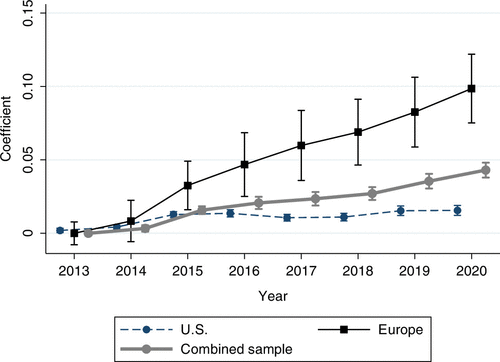
Notes. This figure shows trends in rating use in investment mandates over the period 2012–2020 (note that we use an overlapping sample period in this figure: U.S. data end in 2020, whereas European data start in 2012). We estimate the following regression model separately in three samples: U.S. fund-level sample (described in Section 1.2), European fund-level sample (as described in Section 1.4), and pooled European and U.S. sample. where f denotes the fund and t the year. is a vector of fund fixed effects. X is a vector of year fixed effects with corresponding regression coefficients ; we include dummy variables for the years 2013–2020, omitting the variable for the year 2012, which serves as the benchmark. We plot the coefficients , including 99% confidence intervals based on heteroskedasticity robust standard errors clustered at the year level.
Finally, Table 15 reports transition frequencies between rating references in investment mandates for the European sample. As in the U.S. sample, the probability of a fund exiting the sample (for example, because of closure of the fund) is around 2–4% per annum. Also, like in the United States, funds that refer to ratings in a given year have a likelihood of more than 95% to do the same in the next year. However, there are notable differences between the U.S. and European fixed income funds. In the U.S. sample, 8% of the funds that do not use ratings will use ratings in the subsequent year; in contrast, only 5% of the European funds that do not use ratings will do so in the next year. Furthermore, less than 0.5% of U.S. funds that use ratings will not use ratings in the subsequent year, whereas the corresponding fraction for European funds is around 1.5%.
|
Table 15. Transition Frequencies Between Rating References in Investment Mandates (Luxembourg-Domiciled Funds)
| No rating (t + 1) | HY/IG only (t + 1) | Direct ratings reference (t + 1) | Exit sample (t + 1) | |
|---|---|---|---|---|
| No rating (t) | 0.931 | 0.031 | 0.016 | 0.021 |
| (Obs. = 4,190) | ||||
| HY/IG only (t) | 0.018 | 0.927 | 0.028 | 0.026 |
| (Obs. = 3,000) | ||||
| Direct ratings reference (t) | 0.014 | 0.016 | 0.946 | 0.023 |
| (Obs. = 2,842) | ||||
| New fund (t) | 0.378 | 0.308 | 0.275 | 0.039 |
| (Obs. = 1,983) |
Notes. This table reports a transition matrix for fixed income mutual funds that pertain to either of four categories in any given year (2012–2020): (1) funds that do not refer to any ratings-related term in their investment mandate; (2) funds that refer only to the investment grade threshold (i.e., the dummy variable Direct ratings reference is zero, and HY/IG takes the value of one); (3) funds for which Direct ratings reference is one; or (4) funds whose KIID filing appears in our data set for the first time. Note that for a given fund category (1–4) corresponding to a given line of the table, the transition frequencies reported in the columns sum to 100% (the categories into which the funds can transition in the following year are mutually exclusive). The sample consists of investment mandates contained in KIID filings collected from Morningstar Direct; the sample period is 2012–2021. We consider all European open-end fixed income funds that are domiciled in Luxembourg and that are available in Morningstar Direct as of mid-2021. For each fund with nonmissing information on net assets and nonmissing ISIN, we collect English-language KIID filings of the fund’s largest share class.
In summary, ratings are widely used in both the European and the U.S. fixed income markets, but more so in the United States than in Europe. There is a modest but significant upward trend in ratings use by funds domiciled on both continents. S&P features most commonly in European mandates, with some distance to Moody’s and a large gap to Fitch; in the United States, S&P and Moody’s appear to be similarly widespread, with a large but less glaring distance to Fitch.
3. Conclusions
Fixed income securities constitute a large component of the financial system, of investor financial wealth, and of financial institutions’ assets. These markets are of critical importance to monetary policy and to the financing for governments and firms. Overwhelmingly, investment decisions for these assets are delegated to professional managers. How are principal-agent conflicts in this market overcome? We use textual analysis to classify the mandates of fixed income mutual funds in the United States and Europe to shed light on the features of the interaction between portfolio managers and investors.
We find that credit ratings are widely used in mandates. Ratings fulfill a unique role as ex ante constraints on the level of risk-taking by funds.34 The use of ratings is almost universal in U.S. fixed income funds; in Europe, about two-thirds of the funds refer to ratings in their mandates. Whereas credit ratings have been in use in the United States for more than a century, ratings are a more recent phenomenon in Europe; this may be part of the explanation why delegated asset management of fixed income assets in Europe is less reliant on ratings than in the United States.
Not only is the frequency of ratings references in mandates high throughout our sample, it has also increased over recent years in both the United States and Europe. In the United States, the use of ratings went from very common (9 in 10 funds in 2010) to almost universal (16 in 17 funds in 2020). In Europe, ratings use went from half of funds to two-thirds between 2012 and 2020. The steady increase in the use of ratings in delegated management of fixed income assets may be due to a variety of factors, including competition, which has steadily increased in the mutual fund sector.35 Ratings may be increasingly used by fund managers in their contracts with asset owners to attract investor capital in an increasingly competitive environment (consistent with Donaldson and Piacentino 2018).
The pattern of high and rising use of credit ratings contrasts with the negative view of ratings that emerged after the financial crisis. Even if credit ratings have important flaws, as the academic literature convincingly suggests,36 they remain critical to fixed income investors, to the health of financial markets, and to the funding that flows through these markets. The continued and widespread private use of credit ratings may reflect either that financial market participants find them reliable enough or that there is a lack of appropriate substitutes. This has important implications for the ability to replace ratings. Therefore, any regulatory effort to curb the usage of ratings needs to recognize as a first-order challenge the need for viable alternatives.
Given that European asset management is increasingly competitive, reflecting the common currency, regulatory harmonization such as the introduction of ESMA in 2012, and specific efforts to raise competition in asset management (European Commission 2020), we would hypothesize that the use of credit ratings will continue to rise in Europe.
The authors are grateful for comments and suggestions made by Richard Cantor, Jason Donaldson, Javier Gil-Bazo, Clifton Green, John Hund, Jens Josephson, Christian Leuz, Frank Partnoy, José-Luis Peydró, Giorgia Piacentino, Veronika Pool, Oliver Spalt, and Victoria Vanasco. The authors also thank conference and seminar participants at the 2020 GSU-RFS FinTech Conference, 10th Anniversary of Financial Crisis Conference at Chicago Booth, the 6th HEC Paris Workshop on Banking, Finance, Macroeconomics, and the Real Economy, the 7th Luxembourg Asset Management Summit, the 2019 Conference on Regulating Financial Markets at Goethe University, Kogod School of Business, Mannheim University, Pompeu Fabra University, Swedish House of Finance at the Stockholm School of Economics, Tilburg University, Uppsala University, and VU Amsterdam for helpful comments. The authors thank Mustafa Bulut, Ajitha Duvvuri, Ensari Eroglu, Anton Nartov, Katarina Warg, and Mengyu Yang for research assistance. This paper was previously circulated as “The Private Use of Credit Ratings: Evidence from Mutual Fund Investment Mandates” and “The Use of Credit Ratings in Financial Markets.”
1 The value of outstanding U.S. fixed income securities, for example, rose from 57% of GDP in 1980 to 182% of GDP in 2007 (Greenwood and Scharfstein 2013).
2 This count includes direct references (e.g., “assets rated BBB”) as well as related terms like “high yield” and “investment grade,” and it reflects the periods 2010–2020 for the United States and 2012–2021 for Europe.
3 Cantor et al. (2007) surveyed 50 fund managers and 50 trustees/pension plan sponsors in the United States and in Europe regarding the use of credit rating rules and guidelines in the conduct of their investment activities.
4 In contrast to our finding of a close match between mandates and portfolios, Chen et al. (2021) reported that some fixed income mutual funds strategically misreported key risk metrics (such as the fraction of AAA securities held) to private information intermediaries such as Morningstar. One potential difference between investment mandates and website descriptions of fund portfolios is the status of the fund prospectus as a legally binding document.
5 The literature pinpointing these issues is too long to do justice here, but see, for example, Skreta and Veldkamp (2009), Benmelech and Dlugosz (2009b), Becker and Milbourn (2011), Bolton et al. (2012), Gordy and Willeman (2012), Opp et al. (2013), and Partnoy (2017). Benmelech and Dlugosz (2009a), Griffin and Tang (2011), and deHaan (2017) pointed out that failures occurred in the context of credit ratings of structured assets.
6 Such externalities constitute a legitimate motivation for policies designed to improve the quality of ratings but not necessarily for policies that aim to limit the usage of ratings in general. Possible externalities include fire sales of illiquid assets (see Goldstein et al. 2017 and Ellul et al. 2011).
7 In the Donaldson and Piacentino (2018) model of asset management, a manager must commit to portfolio constraints to attract capital through lower fees. Competition forces this process even if these contracts do not reduce ex post agency problems but just expand the contracting space.
8 These arguments suggest that competition drives ratings use, but they are silent on the specific ways in which ratings use is expected to increase, such as references to specific agencies, to alphanumerical ratings, or more general references to the investment grade threshold.
9 The persistent use of simple, standardized, and potentially “suboptimal” (relative to the predictions of standard principal-agent models) contract terms across firms has been documented in a variety of settings, such as sharecropping and franchising (Bhattacharyya and Lafontaine 1995 reviewed some of the early literature). For example, Lafontaine and Shaw (1999) documented “stickiness” of franchise contract terms within firms over time.
10 Network externalities have been used to explain the establishment and persistence of inferior technologies in other contexts, such as the QWERTY keyboard (David 1985) and the VHS standard (Park 2004).
11 In the same way, ratings allow loan pricing to reflect changes in credit risk. Asquith et al. (2005) documented that performance pricing in corporate loans usually relies on various leverage ratios, but in a minority of cases, loan ratings are used. Even earlier, Cantor and Packer (1995) also discussed uses of ratings, including investment management and loan covenants.
12 Apart from removing references to ratings, rulemaking in Dodd-Frank related to credit ratings included sales and marketing practices of agencies and disclosure of performance statistics, as well as staff training and monitoring. As Partnoy (2017) points out, Dodd-Frank did not require removal of references to ratings in state legislation and regulation, much of which continues to reference credit ratings.
13 The Securities Act of 1933 was amended with rule 497(k) in early 2009, with mandatory compliance starting on January 1, 2010.
14 SEC Form N-1A is the registration form for investment companies, which is used for registering mutual funds and exchange-traded funds (ETFs). The form encompasses information from the prospectus as well as additional information. Form N-1A is used for both initial registration (first filing) and subsequent amendments (i.e., updates). A fund must update its Form N-1A registration statement annually. These filings appear in the EDGAR database as filing types 485APOS and 485BPOS, which are prepared according to SEC rules 485(a) and 485(b), respectively. The main difference between these two filing types is that 485APOS filings are used when the changes relative to the previous filing are more substantial. However, in terms of general structure and content, they are largely identical. Although these documents are in principle available on EDGAR from 1997 onward, the SEC made significant changes to the underlying Form N-1A that became effective in June 1998. Furthermore, Lipper objective codes, which we use to identify and categorize fixed income funds, were available starting in 1998. To ensure a consistent sample of filings with similar informational content over time, we thus start the sample in 1999.
15 First, we remove all filings that contain an XBRL attachment and fewer than 100 sentences; typically, they are filed for the sole purpose of submitting additional exhibits for a previously filed prospectus. We also remove supplements and incomplete filings. We remove 497K filings with fewer than 10 sentences as well as 485APOS and 485BPOS filings with fewer than 25 sentences. Supplements and incomplete 497K filings are identified using a list of supplement expressions as well as the absence of a mandatory disclaimer sentence required by rule 497(k).
16 Table A.1 in the Online Appendix shows several excerpts to illustrate the type of information these sections contain. We reproduce the entire mandate section, which is typically entitled “Principle Investment Strategies,” of six funds, three of which refer to ratings in the mandate, whereas the rest do not.
17 The full lists of expressions used for each of these three criteria are reported in Table A.2 in the Online Appendix. Sentence boundaries are discovered using the algorithm of Kiss and Strunk (2006), trained on texts from the Wall Street Journal.
18 These statements must contain at least one term directly related to the concept of credit quality, and they may not refer to equity indexes or ESG. Examples are defined as statements that follow “for example,” “e.g.,” and “such as” or that contain a boilerplate expression. The exact terms used for these filters are shown in Table A.3 of the Online Appendix.
19 We perform a manual validation exercise on the mandate passages of 100 randomly drawn debt fund summary prospectuses. For 97% of these documents, all of the rating variables used in the analysis are correctly classified. Thus, although some measurement error does exist in the data, its magnitude is small.
20 Although KIIDs are filed for each share class (ISIN), the portfolio holdings are identical for all share classes of a fund. The KIIDs were downloaded from Morningstar Direct in August and September 2021.
21 As in Section 1.2, debt funds comprise municipal debt funds, fixed income funds focusing on debt from international issuers, corporate debt funds, funds investing in mortgage-backed securities, and “other” fixed income mutual funds.
22 In the European sample, we include funds that invest predominantly in government securities, because such securities may have a wide range of ratings (several sovereign issuers in Europe have credit ratings below AA, according to S&P); European funds investing in government securities contribute only 627 of the 12,382 KIID filings. In contrast, in the U.S. setting, we exclude fixed income funds that only invest in U.S. government securities, because those assets de facto all carry the highest credit ratings.
23 To our knowledge, there exists no systematic repository of historical KIID filings for the European market.
24 The increase in references to the big three rating agencies may reflect their brand recognition among households, increasing regulatory barriers to entry, or some other factor increasing their market power or scale economies. Our results do not speak directly to which mechanism is at work.
25 In untabulated tests, we also analyze whether funds refer to other credit rating agencies such as Dominion, Duff & Phelps, Morningstar, or Kroll. During the 2010–2020 sample period, Kroll is mentioned in 15 filings, whereas Dominion is mentioned in 12 filings. Otherwise, only S&P, Moody’s, and Fitch are referenced in mandates.
26 In these specifications with fund fixed effects, we exclude some variables from the regression because they do not exhibit any within-fund variation (e.g., Index fund, ETF) or because the variation is not meaningful in these specifications (Ln(Fund age)). We note that our inference regarding the trend is unaffected by this cosmetic change in the specification.
27 See Benmelech and Dlugosz (2009a), Griffin and Tang (2011), and Gordy and Willeman (2012).
28 For example, on October 22, 2008, U.S. Congressman Henry Waxman stated (see, e.g., Morgenson 2008), “The story of the credit rating agencies is a story of colossal failure. [...] Millions of investors rely on them for independent, objective assessments. The rating agencies broke this bond of trust, and federal regulators ignored the warning signs and did nothing to protect the public.”
29 See, e.g., Opp et al. (2013), SEC (2013), Sangiorgi and Spatt (2017), FDIC (2018), and Becker et al. (2022).
30 For example, the Harbor Bond Fund referred to credit ratings in its 2016 summary prospectus filing when defining the type of securities it invests in: “The Fund invests primarily in investment-grade debt securities, but may invest up to 15% of its total assets in below investment-grade securities, commonly referred to as ‘high-yield’ or ‘junk’ bonds. For all securities other than mortgage-related securities, the Fund may invest in below investment-grade securities only if they are rated B or higher by Moody’s, S&P, or Fitch or, if unrated, determined to be of comparable quality. For mortgage-related securities, the Fund may invest in securities of any credit quality, including those rated below B.” In the following year, the same fund no longer used specific credit rating terms to define what it considers to be its investment opportunity set but rather, referred to the investment grade threshold in more general terms: “The Fund invests primarily in investment-grade debt securities, but may invest up to 20% of its total assets in below investment-grade securities, commonly referred to as ‘high-yield’ or ‘junk’ bonds. ‘” This change is captured via our text-based variables in the following way. The indicator variable HY/IG takes the value of one in both 2016 and 2017, whereas the variables Letter rating and Big 3 take the value of one in 2016 only (they are zero in 2017).
31 See European Commission (2017). In 2017, unrated corporate bonds represented only 13% of the outstanding total in the European Union as a whole. In the same year, more than 50% of the bonds issued in the Nordic countries were unrated (according to data obtained from the database Stamdata).
32 In accordance with Article 8d(3) of the CRA Regulation, the total market share for each registered rating agency is calculated with reference to annual turnover generated from credit rating activities and ancillary services at the group level in the European Union for that rating agency. Market share data are obtained from ESMA’s annual “Report on CRA Market Share Calculation.”
33 The following control variables are used: Ln(Assets), the natural logarithm of the fund portfolio’s total net assets (in million Swedish Kronor); Ln(Fund age), the natural logarithm of one plus the fund’s age (a fund’s age is the difference between the KIID-filing year and the inception year of the fund); and indicator variables for fund category, region of sale, principal investment area, and base currency (the dummy variables are based on the individual categories reported in Table A.5). These control variables are identical to those used in the regressions reported in Online Appendix Table D.3. Because we are interested primarily in the coefficient on Linear trend, and to conserve space, we do not report the coefficients on these variables.
34 This use is consistent with theoretical work by He and Xiong (2013) and Parlour and Rajan (2020), who point out that public signals of asset quality can help mitigate agency problems in the delegation of portfolio management.
35 See Khorana and Servaes (2012), Di Maggio and Kacperczyk (2017), Gârleanu and Pedersen (2018), and Investment Company Institute (2022).
36 See, for example, Benmelech and Dlugosz (2009a,b), Griffin and Tang (2011), Gordy and Willeman (2012), He et al. (2012), Baghai, Servaes, and Tamayo (2014), Cornaggia, Cornaggia, Hund (2017), Flynn and Ghent (2018), and Baghai and Becker (2020).
References
- (1997) Does It All Add Up? Benchmarks and the compensation of active portfolio managers. J. Bus. 70(3):323–350.Crossref, Google Scholar
- (2004) Why constrain your mutual fund manager? J. Financial Econom. 73:289–321.Crossref, Google Scholar
- (2005) Performance pricing in debt contracts. J. Accounting Econom. 2005:101–128.Crossref, Google Scholar
- (2020) Reputations and credit ratings—Evidence from commercial mortgage-backed securities. J. Financial Econom. 135(2):425–444.Crossref, Google Scholar
- (2014) Have rating agencies become more conservative? Implications for capital structure and debt pricing. J. Finance 69:1961–2005.Crossref, Google Scholar
- (2016) Insolvency resolution and the missing high-yield bond markets. Rev. Financial Stud. 29(10):2814–2849.Crossref, Google Scholar
- (2011) How did increased competition affect credit ratings? J. Financial Econom. 101:493–514.Crossref, Google Scholar
- (2022) Regulatory forbearance in the U.S. insurance industry: The effects of removing capital requirements for an asset class. Rev. Financial Stud. 35(12):5438–5482.Crossref, Google Scholar
- (2009a) The alchemy of CDO credit ratings. J. Monet. Econom. 56:617–634.Crossref, Google Scholar
- (2009b)
The credit rating crisis . In: Acemoglu D, Rogoff K, Woodford M, eds., NBER Macroeconomics Annual 2009, volume 24 (University of Chicago Press, Chicago), 161–207.Crossref, Google Scholar - (1995) Double-sided moral hazard and the nature of share contracts. RAND J. Econom. 26(4):761–781.Crossref, Google Scholar
- (2012) The credit ratings game. J. Finance 67(1):85–111.Crossref, Google Scholar
- (1995) The credit rating industry. J. Fixed Income 5(3):10–34.Crossref, Google Scholar
- (2007) The use of credit ratings in investment mandates in the US and Europe. J. Fixed Income 17(2):13–26.Crossref, Google Scholar
- (2021) Don’t take their word for it: The misclassification of bond mutual funds. J. Finance 76:1699–1730.Crossref, Google Scholar
- (2017) Credit ratings across asset classes: A long-term perspective. Rev. Finance 21(2):465–509.Crossref, Google Scholar
- (1985) Clio and the economics of QWERTY. Amer. Econom. Rev. 75(2):332–337.Google Scholar
- (2017) The financial crisis and corporate credit ratings. Accounting Rev. 92(4):161–189.Crossref, Google Scholar
- (2017) The unintended consequences of the zero lower bound policy. J. Finance Econom. 123:59–80.Crossref, Google Scholar
- (2018) Contracting to compete for flows. J. Econom. Theory. 173:289–319.Crossref, Google Scholar
- (2011) Regulatory pressure and fire sales in the corporate bond market. J. Finance Econom. 101:596–620.Crossref, Google Scholar
European Commission (2017) Analysis of European corporate bond markets—Analytical report supporting the main report from the Commission Expert Group on Corporate Bonds. European Commission, Brussels.Google ScholarEuropean Commission (2020) A capital markets union for people and businesses-new action plan. Document 52020DC0590, COM/2020/590 final. European Commission, Brussels.Google ScholarFederal Deposit Insurance Corporation (2018) Final rule to remove references to credit ratings from the FDIC’s international banking regulations. Federal Deposit Insurance Corporation, Arlington, VA.Google Scholar- (2018) Competition and credit ratings after the fall. Management Sci. 64(4):1672–1692.Link, Google Scholar
- (2018) Dynamic trading with predictable returns and transaction costs. J. Finance 68(86):2039–2340.Google Scholar
- (2017) Investor flows and fragility in corporate bond funds. J. Finance Econom. 126(3):592–613.Crossref, Google Scholar
- (2012) Constant proportion debt obligations: A postmortem analysis of rating models. Management Sci. 58(3):476–492.Link, Google Scholar
- (2013) The growth of finance. J. Econom. Perspect. 27(2):3–28.Crossref, Google Scholar
- (2011) Did credit rating agencies make unbiased assumptions on CDOs? Amer. Econom. Rev. 101(3):125–130.Crossref, Google Scholar
- (2012) Are all ratings created equal? The impact of issuer size on the pricing of mortgage-backed securities. J. Finance 47(6):2097–2137.Crossref, Google Scholar
- (2013) Delegated asset management, investment mandates, and capital immobility. J. Finance Econom. 107:239–258.Crossref, Google Scholar
Investment Company Institute (2022) Investment Company Fact Book. https://www.ici.org/system/files/2022-05/2022_factbook.pdf.Google Scholar- (2012) What drives market share in the mutual fund industry? Rev. Finance 16:81–113.Crossref, Google Scholar
- (2006) Unsupervised multilingual sentence boundary detection. Comput. Linguist. 32:485–525.Crossref, Google Scholar
- (1999) The dynamics of franchise contracting: Evidence from panel data. J. Political Econom. 107(5):1041–1080.Crossref, Google Scholar
- (2011) Schwab pays in YieldPlus settlement. Wall Street Journal (January 12), https://www.wsj.com/articles/SB10001424052748703791904576076041863179826?reflink=desktopwebshare_permalink.Google Scholar
- (2008) Credit rating agency heads grilled by lawmakers. New York Times (October 22), https://www.nytimes.com/2008/10/23/business/economy/23rating.html.Google Scholar
- (2013) Rating agencies in the face of regulation. J. Finance Econom. 108(1):46–61.Crossref, Google Scholar
- (2004) Quantitative analysis of network externalities in competing technologies: The VCR case. Rev. Econom. Stat. 86(4):937–945.Crossref, Google Scholar
- (2020) Contracting on credit ratings: Adding value to public information. Rev. Financial Stud. 33(4):1412–1444.Crossref, Google Scholar
- (2017) What’s (still) wrong with credit ratings? Washington Law Rev. 92(3):1407–1472.Google Scholar
Reuters (2012) Wells Fargo unit in $25 million settlement. Reuters Market News (July 2), https://www.reuters.com/article/wellsfargo-evergreen-idUSL2E8I2BYQ20120702.Google Scholar- (2017) The Economics of credit rating agencies. Foundations and Trends in Finance 12:1–116.Crossref, Google Scholar
Securities and Exchange Commission (2013) Removal Of Certain References To Credit Ratings Under The Securities Exchange Act Of 1934, Release No. 34-71194; File No. S7-15-11. Securities and Exchange Commission, Washington, DC.Google Scholar- (2009) Ratings shopping and asset complexity; a theory of ratings inflation. J. Monet. Econom. 56(5):678–695.Crossref, Google Scholar
- (2005) Why are most funds open-end? Competition and the limits of arbitrage. Quart. J. Econom. 120(1):247–272.Google Scholar

