


Evaluating Investments in Asteroid Detection Technologies to Prevent Catastrophic Impacts on Earth
Abstract
Asteroids and other near-Earth objects pose a significant ongoing threat to our planet with the potential for catastrophic effects on human life, the environment, and the global economy. Advance warning would be necessary to deflect any object on a collision course with Earth, but detection and tracking technologies require substantial financial commitments. This paper presents a multiattribute utility framework to analyze whether and which detection technologies are worthwhile. This approach provides a rigorous and systematic understanding of the uncertainties, multiple objectives, and tradeoffs inherent in decisions involving low-probability, high-consequence events. The model shows that the detection technology investment decision is driven more by the abundant population of smaller (<140 meters in diameter) undiscovered near-Earth objects than by any other size category. In addition, we find that the preferred investment alternative varies substantially over a range of plausible value tradeoffs that a decision maker might assign to each human fatality, a well-studied economic measure used by governments and policymakers that is called the value of a statistical life. The model we present allows a decision maker to jointly examine the role of risk and ambiguity preferences in determining the best alternative, and we further extend the framework to consider how a decision maker might evaluate alternatives when the threat affects a larger group of people while the economic cost of investment is borne by a smaller subset of stakeholders.
This paper was accepted by George Wu, behavioral economics and decision analysis.
Supplemental Material: The data files are available at https://doi.org/10.1287/mnsc.2024.04948.
1. Introduction
The potential collision of an asteroid or comet with our planet poses an ever-present threat to life on Earth. Scientists generally agree that an asteroid roughly 10 kilometers in diameter crashed into Earth near Mexico’s Yucatán Peninsula about 66 million years ago, causing the extinction of more than 75% of species living on Earth at that time (Alvarez et al. 1980, Hildebrand et al. 1991, Schulte et al. 2010). If a similar-sized asteroid was to collide with Earth today, it could cause more 1 billion human fatalities and result in catastrophic damage to the environment and global economy (Chapman and Morrison 1994, National Research Council 2010). Although near-Earth object (NEO) impacts of this magnitude are very rare, smaller impacts with subglobal effects are much more frequent occurrences on Earth. In 1908, an asteroid roughly 50 meters in diameter impacted a remote area in Siberia, leveling forest over an estimated 2,150 square kilometers (Longo 2007). The impact of such an event over a densely populated city would be devastating.
Fortunately, if an object on course to collide with Earth was detected ahead of time, there are actions that could be taken to alter its trajectory and potentially avert an impact entirely. Although the technologies are expensive and largely unproven, strategies have been proposed for preventing a catastrophic impact. Encouragingly, analysis of the recent double asteroid redirection test (DART) indicates that the National Aeronautics and Space Administration (NASA) mission had successfully altered the trajectory of an asteroid for the first time (Handal and Surowiec 2022). However, for such actions to be effective, it might be necessary to learn about the threat as many as 20 years ahead of a potential collision.
The estimated population of NEOs greater than 50 meters in diameter is approximately 150,000, fewer than 25,000 of which have been discovered and tracked (Harris and Chodas 2021, NASA 2023). Various detection technologies have been proposed to accelerate the rate of discovery, yet the considerable cost of new telescopes has been the source of inconsistent decision making over the past 13 years. Just a few weeks after the well-publicized 2013 Chelyabinsk meteor explosion over Russia, NASA Administrator Charles Bolden suggested that “The probability of any sizable NEO impacting Earth any time in the next 100 years is extremely remote,” and that “…to pour money into NEO detection…would not be the right thing to do” (Foust 2013). By April 2019, however, NASA had stated its commitment to building a space-based detection telescope, the most expensive option proposed in the past decade (Smith 2019). Yet just three years later, NASA’s 2023 budget request announced a delay of the space-based telescope until 2028 due to budget pressure (Foust 2023).
These conflicting policy decisions reflect different answers to the question of how much to invest in improved capabilities to detect and track potentially dangerous NEOs. This decision is complex because it involves many uncertainties and tradeoffs between multiple objectives for outcomes with very small probabilities but very serious consequences. Any time a government agency is considering spending significant funds—hundreds of millions or billions of dollars—it would be useful to have a logically sound, quality decision analysis to help understand whether such a project is worthwhile and which potential alternative is the best and why. Such a thorough analysis is relatively rare because the time required to do such analyses may not be available in most agencies and the relevant knowledge about all aspects of the decision is not available outside of those agencies. As a result, such critical decisions rarely have a logical analysis to inform intuitive thinking and the quality of many of the decisions is not as good as it could or should be.
This paper has two purposes. One is to demonstrate the value and insights of such an analysis on a significant government decision, namely if and how much it is worth spending to detect and potentially mitigate asteroids and other NEOs that may impact Earth. The other is to illustrate a general approach for future analyses of similar problems, namely those pertaining to costly, up-front commitments that have the potential to reduce the risk of low-probability, high-consequence events over long time horizons.
This article illustrates the foundational elements of any quality analysis of an important decision: unambiguously stating the decision to be faced, specifying all the objectives to be pursued in making that decision, and creating a robust set of potential alternatives. This foundation specifies the data and information that are needed for a quality analysis. It also illustrates the type of evaluation functions appropriate to address the essential value tradeoffs among the many objectives, as well as the decision maker’s preferences about risk and ambiguity.
A high-quality decision analysis requires significant personal interaction with key government employees of appropriate agencies responsible for key decisions. They are the individuals with the knowledge to identify the specific decision to be addressed, its relevant objectives, the appropriate set of realistic alternatives, and value tradeoffs indicating the desirability of various levels of contribution on the different objectives. Generally, the part of the analysis requiring the most time and effort is assessing the performance of each alternative in terms of how well it might achieve the various objectives, including describing uncertainties about the various possible consequences. Such an analysis may require many person-years of effort by the government agency and analysts working with them to appropriately describe potential consequences of each of the alternatives and assess the relevant probabilities. Analyses this thorough are not commonly done for critical government decisions, including even some multibillion dollar expenditures. Some analysis is usually done on components of the decision for which there is significant real data, such as economic consequences, but important components for which there exist little to no data must rely on the general knowledge, experience, and judgments of experts.
The model we develop is appropriate for use by a range of possible decision makers that may include a government agency, a single country, a collection of countries, or an international organization. It is a prescriptive model evaluating what should be done to thoroughly address the specific decision of concern. This model includes the decision maker’s multiple objectives, the set of available alternatives, the likelihoods of each of the possible outcomes for each alternative, and the relative desirability of each of the outcomes. Uncertainties about the consequences, as well as value tradeoffs between objectives, are explicitly addressed. Extensive sensitivity analyses are conducted to illustrate how changes in specific uncertainties and value judgments affect the relative desirability of various alternatives.
All the available alternatives involve, to varying degrees, an unavoidable long-tailed distribution of catastrophic outcomes with very small likelihoods—a fundamental characteristic of the NEO impact hazard that is likely to elevate risk preferences to a central role in the decision maker’s utility function. In addition, various aspects of the decision model may involve uncertain or unknown probabilities, necessitating further understanding of the role of ambiguity preferences and their interaction with risk preferences (Hogarth and Kunreuther 1989). We demonstrate how a multiattribute utility function that accommodates these considerations can be developed using the decision maker’s value tradeoffs between objectives along with a single parameter that describes their risk attitudes. Subsequently, we explain how this utility function can be centered within an ambiguity analysis.
The model is also useful to investigate the perspectives of different decision makers. If one country is bearing all the costs, it will be more expensive on a per-person basis than if the costs are shared with other countries. As we discuss, the relative desirability of alternatives depends on whom the decision maker is. A novel aspect of the problem we study is the multitude of potential decision makers who may approach this problem with overlapping yet distinct objectives and value tradeoffs.
The article is organized as follows. Section 2 provides background on the detection of NEOs and technologies to avoid a potential collision with Earth. Section 3 describes our decision model for protecting Earth from potential impactors. Analyses using the model are provided in Section 4, which also includes sensitivity analyses for many of the components of the model. Section 5 examines the role that ambiguity preferences have on the analysis. Section 6 compares the analysis of a global decision maker with that of an individual country or subset of countries. Finally, insights from the analyses and their uses are discussed in Section 7.
2. Background on NEO Detection and Management Strategies
Public interest in detecting and tracking NEOs began in earnest following the seminal publication of Alvarez et al. (1980), which posited that an asteroid approximately 10 kilometers in diameter was the cause for the mass extinction of species on Earth roughly 66 million years ago. This discovery naturally led scientists and policymakers to consider what might be done to assess the threat of future asteroid impacts and how to develop mitigation strategies. Chapman (1999) identifies the 1981 Spacewatch Workshop as a pivotal meeting in the planetary science community that served as a catalyst for detection efforts. The continued release of popular movies (e.g., Deep Impact and Armageddon in 1998 and Don’t Look Up in 2022) has increased awareness of the threat among the broader public.
News headlines in early 2025 furthered public attention to the threat of NEOs following the discovery of an asteroid identified as 2024 and its possible impact on Earth in 2032. Trajectory estimates for 2024 initially put the probability of impact at 1%, with subsequent updates briefly increasing to 3% before falling to near zero (Garcia 2025). This relatively high probability “…warrant[ed] formal notification of the object to other U.S. government agencies involved in planetary defense as well as to the Space Mission Planning Advisory Group and to the United Nations Office of Outer Space Affairs per the International Asteroid Warning Network’s notification charter” (NASA 2025).
Although various strategies and technologies have been considered to deflect or destroy an NEO on course to impact Earth (Sanchez et al. 2009, Paek et al. 2020), any mitigation effort requires sufficient advance warning about the existence, location, and impact timing of the threatening object. Ample time is also needed to assess the potential success of any specific deflection mission and to develop subsequent plans in case of failure. Some experts recommend that decisions about averting an impactor—a term used to describe an NEO of any type on course to hit Earth—be made 5 or 10 years ahead of time at minimum, with higher success rates as lead time increases (Gritzner and Kahle 2004, Schweickart et al. 2008, Reinhardt et al. 2014). More recent estimates suggest a minimum of three years to allow for a mitigation mission (Interagency Working Group on Near-Earth Object Impact Threat Emergency Protocols 2021).
In 1998, the U.S. Congress established the Spaceguard Survey, tasking NASA with discovering at least 90% of NEOs that are more than 1 kilometer in diameter by 2008. NEOs of this magnitude roughly correspond to impactors large enough to cause a global catastrophe (Chapman and Morrison 1994). Subsequently, Congress issued a new mandate in 2005 to find and catalogue 90% of NEOs 140 meters and larger within 15 years, consistent with the recommendations of a feasibility study (NASA 2003). It is currently estimated that there are approximately 25,000 NEOs of this size and that 10,484, or roughly 42% of these, have been catalogued as of January 2024 (Talbert 2017, NASA 2024), well short of the 90% goal.
The discovery of NEOs at present mostly occurs using observations made by a handful of land-based detection telescopes.1 In addition, there are several projects proposed or currently under construction that would significantly boost the rate at which NEOs are identified and tracked. The Vera Rubin Observatory Large Synoptic Survey Telescope (LSST) in Chile began operating in 2025, and the Near-Earth Object Surveyor space telescope is expected to launch into space by 2027 (Mainzer et al. 2015, Grav et al. 2020, Rubin Observatory 2024). Other efforts outside NASA have also recently been gaining traction in Russia, China, Japan, and the European Union (Jones 2021, Kilpatrick 2022, Ryall 2023, Duster 2024). Although the Vera Rubin Observatory includes asteroid detection and cataloguing as one of its goals, it will require balancing this effort with other scientific research conducted by the observatory. However, Jones et al. (2018) conclude that extending the funding for the Vera Rubin by two additional years—at an estimated cost of $120 million—would substantially increase the number of objects found.
Depending on the timing of construction and operations of the Vera Rubin LSST and NEO Surveyor, the rate of discovery of NEOs may change drastically. Jones et al. (2018) estimate that after 12 years of operations, the Vera Rubin LSST alone would approach 80% completion of the 2005 congressional mandate for finding NEOs greater than 140 meters. Others (National Research Council 2019, Taylor et al. 2021) have estimated the expected increase in catalogued NEOs that the combined efforts of both the NEO Surveyor and the Vera Rubin LSST would offer, highlighting the benefit of combining land-based and space-based assets.
Presently, NASA’s decision-making process is that individual projects, including telescopes, are reviewed by panels of experts with input from researchers at the Jet Propulsion Laboratory, whereas more expensive large strategic science missions with a wider set of scientific objectives are categorized under the Solar System Exploration Program. DART, for example, was one of three missions to fall under the latter classification. Ultimately, the NASA administrator serves as the decision maker and chooses missions to fund based on their relative ranking and budget constraints (Maue 2021, NASA 2021). Although we do not explicitly consider these broader sets of outside spending options in the primary decision model we present, such projects (and combinations thereof) could be included as additional investment alternatives when developing a funding decision model for a specific budget-constrained organization like NASA.
3. Decision Model for Protecting Earth from NEOs
Our model considers the sequence of decisions, uncertain events and their probabilities, and the associated consequences for multiple potential societal objectives related to an NEO threat. The resulting model allows us to evaluate each of the proposed detection technologies and identify the key parameters that determine the desirability of the alternative, thus informing policymakers about telescope decisions and mitigation strategies at both the national and international level.
Our decision analysis framework to analyze the problem of NEO detection and mitigation builds on previous work using decision models. Blair (2003) considered decisions made for a given NEO with a known probability of impacting Earth over an exact time frame, where possible options for the decision maker are two types of information gathering (via telescope or spacecraft mission) or a mitigation mission with nuclear weapons. There have also been several cost-benefit analyses that have been considered in the literature, focusing primarily on costs. Canavan (1994) discussed a single-objective economic analysis, and Friedman (1997) presented an extension with multiple objectives. Our work builds on the approach described in Lee et al. (2014) by specifying the elements of their general outline and parameterizing the model. In particular, we enumerate a set of alternatives based on proposed and current investments in detection strategies, parameterize valuations of chosen objectives, estimate impact probabilities based on work from recent NEO population estimates and discovery statistics, and evaluate the different decisions faced by national and international decision makers. In addition, we expand aspects of their discussion by considering risk and ambiguity preferences and the types of decision maker for which the problem is constructed. Our structure extends the two-stage decision model presented in Zhang and Bickel (2015), including an initial decision about which detection technologies to invest in and a potential subsequent decision about mitigation strategies if an object on course to impact the Earth is detected. More broadly, we also add to the growing research in the use of operations and decision analysis methodologies in novel applications such as large-scale project management, space missions, and near-miss events, including Dyer and Miles (1976), Fisher and Jaikumar (1978), Paté-Cornell and Fischbeck (1994), Parnell et al. (1998), Dillon et al. (2003), Gralla et al. (2006), Merrick and McLay (2010), and Borgonovo and Smith (2011).
We next describe the problem structuring and model development for investments in NEO detection technologies.
3.1. Problem Structuring
To assess potential impacts on Earth, we begin by grouping NEOs into four categories based on size. Table 1 provides a description of a population-weighted, prototypical example for each hazard type along with the impact likelihood and the scope of the hazard, each of which is determined using the most recent size-specific population estimates (Chapman and Morrison 1994, Harris and D’Abramo 2015, Harris and Chodas 2021). As one might expect, the damage associated with an NEO impact increases exponentially with its diameter. We note that an impactor’s velocity and impact angle would also significantly affect impact energy and crater size (Gritzner et al. 2006, Reinhardt et al. 2016).
|

Table 1. Representative NEOs by Size Category
| Relative size | Prototypical diameter (range in meters) | Impact energy (in megatons of TNT) | Average interval between impacts (in years) | Crater size diameter |
|---|---|---|---|---|
| Small | 60 m (50–140 m) | 20 MT | 2,000 | 1 km |
| Medium | 200 m (141–500 m) | 300 MT | 30,000 | 3 km |
| Large | 1 km (501 m–4 km) | 30,000 MT | 500,000 | 15 km |
| Very large | 5 km (4 km) | 5,000,000 MT | 20,000,000 | 100 km |
We next characterize the stages of decision making and components of the decision model, including initial telescope investments, possible subsequent mitigation, and evacuation decisions (provided sufficient lead time), and assumptions required to obtain a solution. The model presented in Figure 1 structures the decision as an investment in a detection technology, as we detail in Section 3.3, followed by a realization in the subsequent time horizon of whether an NEO is on course to impact Earth or not. The initial choice of detection technology affects the chances that any potential impactor is detected with sufficient advance warning to allow for mitigation efforts. In our base model, we consider an international entity or organization charged with making decisions for the benefit of all people on Earth. Later, in Section 6, we consider an individual country (or a subset of countries) that is focused on maximizing national welfare.
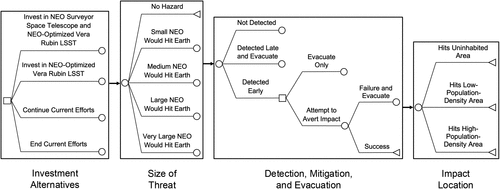
Following the tree branch for each investment alternative is a subsequent event node with five possible branches corresponding to each of the four possible categories of NEOs we consider, along with the possibility that no hazard appears. To obtain this simplified representation of the problem, we assume that within our chosen 50-year timeline, there will be either a single NEO on course to impact Earth or no hazard.2 If a threat emerges, an event node determines if it is detected with sufficient lead time for a mitigation mission to be undertaken, detected with sufficient lead time only for evacuation, or not detected at all. A mitigation mission may be undertaken to avert impact with Earth by potentially deflecting the impactor before collision, whereas evacuation can substantially reduce loss of life and economic damage—once the impact area is known—should the first mission fail or prove too costly. At this point, a decision maker might theoretically consider whether it would be worthwhile to evacuate the zone of immediate impact. However, given the small cost of evacuation relative to the cost of impact, we assume that the decision maker will always elect to evacuate the projected impact area. Lastly, an event node for branches with an undeflected impactor determines the population density of the impact location. Each terminal node of the tree determines the utility associated with the sequence of events and decisions. The optimal decision strategy and expected utilities are derived via backward induction.
3.2. Identifying Fundamental Objectives
The essential foundation for any important decision is the set of objectives to be achieved by that decision. By using a comprehensive list of objectives, we can appropriately describe the consequences of each alternative. Our model addresses six fundamental objectives of any mitigation plan: minimize the number of people killed by an NEO impact; minimize the economic damage of the NEO impact; minimize the economic cost of the strategy taken; minimize damage to the environment and preserve biodiversity; maximize contribution to scientific knowledge; and maximize development of new useful technologies. Table 2 lists performance measures to describe consequences for these six objectives and the potential ranges. Most existing studies have evaluated alternatives in terms of only one or two of the first four objectives (Canavan 1994, Friedman 1997).
|
Table 2. Fundamental Objectives with Performance Measures and Ranges
| Fundamental objectives | Performance measure | Lowest level | Highest level |
|---|---|---|---|
| Minimize the number of people killed by an NEO impact | Number of people killed | 0 | |
| Minimize economic damage from an NEO impact | Amount of economic damage (measured in millions of U.S. dollars) | 0 | |
| Minimize economic cost of strategy taken | Amount of money spent (measured in millions of U.S. dollars) | 200 | |
| Minimize damage to the environment and preserve biodiversity | Fraction of species extinguished following impact | 0 | 0.15 |
| Maximize contribution to scientific knowledge | Scientific knowledge generated (constructed scale) | 0 | 100 |
| Maximize development of new useful technology | Amount of new technology developed (constructed scale) | 0 | 100 |
The first objective of minimizing the number of people killed by an NEO impact is an essential goal of any policymaker. The second objective concerns protecting economic value by minimizing the economic damage of the NEO impact. Any NEO large enough to reach Earth’s surface could significantly damage infrastructure, financial markets, cultural and historic institutions, and other systems of economic value. The third objective accounts for the cost of undertaking the strategy to avert an impact, an essential consideration of any budget-constrained policymaker. Our fourth objective is concerned with minimizing damage to the environment and preserving biodiversity, adding to the quality of present and future life on Earth.
The fifth and sixth objectives in our model consider contributions to scientific knowledge and technological innovations. The novel infrastructure and scientific endeavors involved in each of the telescope investments would be expected to supply secondary benefits to humanity in terms of basic research and scientific development in addition to the value of advance warning about potential impactors. The technological innovations and positive economic benefits that come along with conducting space missions are well documented in NASA’s annual Spinoff reports (NASA 2024).
To analyze the decision using these six objectives, we must describe the consequences of each alternative in terms of each objective. The first three objectives have natural measures of their performance as indicated in Table 2. The last three objectives do not have an obvious measure. Following Keeney and Gregory (2005), we constructed measures for these. To evaluate the objective of minimizing damage to the environment, we consider limiting the permanent loss of species, a policy goal identified in the Endangered Species Act. We selected the fraction of species extinguished as our measure of this objective, noting that severe damage to air, water, and land environments could result in the death of many living things. Naturally, greater environmental damage from an NEO impact corresponds to the extinction of more species of life. Because there are no natural scales to evaluate contributions to scientific knowledge or technological innovations, we constructed scales to describe potential outcomes for these last two objectives, as detailed in Section 3.4.
Possible additional objectives that could be added to our model include the detection of new mineable asteroids composed of valuable rare-earth metals, namely gold, cobalt, nickel, and platinum group metals. Researchers have considered the technical and economic feasibility of asteroid mining and retrieval missions (Brophy and Muirhead 2013, Calla et al. 2018, Hein et al. 2020). We omit this objective because such a use is largely speculative at this point, although a decision maker may deem it significant enough to include. Another potential objective that a decision maker might consider is preventing the permanent loss of culture that might accompany the impact of a large NEO to a particular region of the world.
3.3. Detection Alternatives
We consider four NEO detection alternatives, which are described in Table 3. In general, increasing investment in additional telescopes results in greater expected discovery statistics across each of the NEO size categories, with detection probabilities for the Small size category of objects listed in the table for each alternative to illustrate these differences. Each of the successive alternatives (after the first) in Table 3 includes the previous alternatives. For example, the cost of continuing current efforts is included in the estimated cost for completion and NEO-optimized operation of the Vera Rubin LSST. Note that even ending funding of current efforts has a positive cost because some approved funding obligations are already in place for continuing operations and maintenance of existing telescopes and databases to track NEOs that have been already discovered.
|
Table 3. Detection Alternatives
| Alternatives | Estimated cost | Description |
|---|---|---|
| End funding of current efforts | $200 million | Cease funding all current NEO discovery operations. Would provide a minimal chance (3%) of detecting a Small-type NEO, if it were coming in the next 50 years. |
| Continue current efforts | $600 million | Current efforts include PanSTARRS and the Catalina Sky Survey, among others.1 Would provide a very low chance (14%) of detecting a Small-type NEO, if it were coming in the next 50 years. |
| Major investment in NEO-optimized Vera Rubin LSST | $1.24 billion | Additional investment in a large synoptic survey telescope (LSST) including a two-year extension dedicated to NEO discovery. Would provide a high chance (69%) of detecting a Small-type NEO, if it were coming in the next 50 years. |
| Major investment in NEO Surveyor Space Telescope and NEO-optimized Vera Rubin LSST | $2.04 billion | Additional investment in the NEO Surveyor infrared space telescope in addition to a NEO-optimized LSST. Would provide an excellent chance (86%) of detecting a Small-type NEO, if it were coming in the next 50 years. |
An important challenge of evaluating alternatives for this decision is the combination of low-probability, high-impact events (Camerer and Kunreuther 1989, Bussiere and Fratzscher 2008). Because of the uncertainties about both the occurrence and consequences of such events, it is important to estimate and incorporate uncertainties about the economic costs of alternatives, the likelihood that various NEOs will be threatening, and the potential catastrophic consequences of any alternative given each set of the potential events that could occur.
3.4. Model to Evaluate Alternatives
To evaluate alternatives, a decision maker must develop an objective function that allows for the comparison of any set of possible consequences. Because this function needs to account for all possible outcomes and the relative desirability of each possible consequence, it must be a multiattribute utility function (Keeney and Raiffa 1993), which allows the decision maker to calculate the expected utility of each alternative. A number of different potential functional forms for such a multiattribute utility function have been studied (Keeney 1971, Richard 1975, von Winterfeldt and Fischer 1975, von Winterfeldt 1980, Abbas 2010). Our model utilizes the value-based approach described in Matheson and Abbas (2005), which has several desirable properties for this context. Specifically, the value-based approach separates a decision maker’s preferences into two components: a multiattribute value function that describes tradeoffs between attributes (Dyer and Sarin 1979, Smith and Dyer 2021) and a univariate utility function over values that describes the decision maker’s risk preferences. This approach does not require the assumption of utility independence among attributes and effectively decomposes the potentially complicated interactions between value tradeoffs and risk preferences into separate functions that can be assessed one at a time.
We begin by characterizing the multiattribute value function. Because the six objectives we consider are each fundamental objectives and do not overlap in describing the consequences of concern, an additive form
To obtain an overall evaluation of each alternative, we first estimate the possible consequences of each investment decision on each performance measure. Then we combine the relative desirability of those estimated consequences using value judgments. The six performance measures used in the multiattribute utility analysis are listed in Table 4 and denoted by for measures . For each , the performance measure of each alternative for each objective will be a specific level , with the range of levels provided in Table 2. For the first four performance measures, the component value functions are simply given by . The component value functions for the fifth and sixth performance measures require a constructed scale.
|
Table 4. Valuation of Performance Measures
| Performance measure to indicate consequences | Component value function | Value tradeoff |
|---|---|---|
| number of people killed | 2.19 | |
| amount of economic damage (measured in millions of U.S. dollars) | 1 | |
| amount of money spent (measured in millions of U.S. dollars) | 1 | |
| fraction of species extinguished following impact | ||
| scientific knowledge generated (constructed scale from 0 to 100) | 700 | |
| amount of new technology developed (constructed scale from 0 to 100) | 500 |
Table 5 provides a description of the consequences of and for each of the decision alternatives and the constructed scales for these two measures. For each of these objectives, we describe what we considered the minimum and maximum possible consequences and assigned a percentage of contribution for a given alternative relative to the greatest contribution over all alternatives. Accordingly, a component value of zero is given to the lowest potential contribution and a value of one for the greatest potential contribution, with component values between zero and one for the two intermediate alternatives.
|
Table 5. Constructed Scale for Scientific Knowledge and Technology Objectives
| Alternatives | : New scientific knowledge created (description) | : Development of new technology (description) |
|---|---|---|
| NEO Surveyor Space Telescope and NEO-optimized Vera Rubin LSST | (Database of 70% of NEO population, very high amount of research generated, immense improvement in knowledge of NEO population dynamics) | (Major advancements in observatory technology and major advancement of space-based telescopes and satellite launching capabilities) |
| NEO-optimized Vera Rubin LSST | (Database of 30% of NEO population, high amount of research generated substantial improvement in knowledge of NEO population dynamics) | (Larger advancements in observatory technology) |
| Continue current efforts | (Database of 10% of NEO population, moderate amount of research generated some additional knowledge about the NEO population in the solar system) | (Minor advancements in observatory technology) |
| End funding of current efforts | (No new scientific knowledge created) | (No new technology developed) |
To illustrate potential outcomes using and , consider the following examples. The component value function for the number of people killed is simply , representing the number of associated fatalities. A value tradeoff of , for example, can then be interpreted as each expected fatality being valued equivalently to each additional cost of $2.19 million. Similarly, the component value function for economic damage is , so a value tradeoff of can be interpreted as each million dollars of economic damage being valued equivalently to an additional one million dollars spent on detection and mitigation efforts, and the value tradeoff indicates that each one percent of species lost is valued at $25.1 trillion.
In contrast, the value function for the development of new technologies can be interpreted as a fraction of the highest possible level of technology advancement that can be obtained from investments in these NEO detection alternatives. The highest level of this component value is set at when the decision maker makes the largest investment in both the NEO-optimized LSST and NEO Surveyor, whereas the lowest level of this component value occurs when the decision maker ends funding of all detection efforts. Descriptions of the intermediate values of are provided in Table 5. A value tradeoff of implies that an increase over the full range of possible consequences is valued at $500 million in additional cost, so each additional 1% increase in new useful technologies developed (within the range of technologies that are attainable) leads to an approximate value of $5 million. Likewise, the value tradeoff for scientific knowledge generated indicates that an increase from the lowest end of the range of knowledge generated, when , to the highest end of the range of knowledge generated, when , is equivalent in value to $700 million.
A decision maker must assess appropriate value tradeoffs for the scaling factors for each for . Previous work can provide some guidance in determining the value tradeoffs between the monetary and nonmonetary performance measures. Given the problem setting, determining the value tradeoff for each performance measure requires careful consideration of meta-analyses carried out by scholars in different fields of research. To assign a value tradeoff for from the perspective of a global decision maker, we take country-level value of a statistical life (VSL) estimates from Viscusi and Masterman (2017) and use population estimates for each country to get a weighted sum of $2.19 million, implying that . As we discuss, the choice of plays a critical role in the model’s prescribed investment decision. Scholars have estimated implicit VSL assumptions from government decision making ranging from tens of thousands of dollars to nearly $20 million, whereas some policymakers have chosen explicit values in policymaking—for example, the U.S. Department of Transportation (DOT) guidance sets a VSL of $13.2 million in 2023. To assign a value tradeoff for environmental damage for performance measure , we use ecosystem-specific valuations from a meta-analysis by de Groot et al. (2012). Determining appropriate values for and requires careful consideration of the decision maker’s willingness to pay to generate scientific knowledge and new technologies.
Because the component value functions are linear and the multiattribute value function is additive, each unit of in Equation (1) can be converted to a total equivalent consequence according to the units of one of the individual performance measures. Given the monetary units of the performance measures and , mapping each outcome to a total equivalent consequence measured in millions of U.S. dollars offers a natural interpretation for this problem. For example, if the decision maker was to continue current efforts and an undetected Small object subsequently impacted an uninhabited area, killing 10 people and causing 50 million U.S. dollars in economic damage, the value for that outcome could be mapped to a total equivalent consequence of million U.S. dollars. In contrast, if the decision maker was to end current efforts and an undetected Medium object subsequently impacted a low-population-density area, killing 855,940 people and causing 38.092 billion U.S. dollars in economic damage, the value for that outcome could be mapped to a total equivalent consequence of trillion U.S. dollars.
Once their multiattribute value function has been specified, the decision maker’s preferences over probability distributions of possible outcomes can be characterized through their univariate utility function over value (Abbas 2010). The composition of this univariate utility function and the multiattribute value function defines the decision maker’s multiattribute utility function. Some public sector applications have utilized a risk-neutral multiattribute utility function as a baseline assumption (Keeney and von Winterfeldt 2011, Fletcher and Abbas 2018), which would be consistent with a univariate utility function over value equal to the identity function. However, the existential nature of this problem wherein humanity faces very small probabilities of potentially catastrophic outcomes suggests that risk aversion may have a substantial effect on preferences. Loosely speaking, decision makers exhibit risk aversion if they are willing to trade off some of the quality of their expected outcome in order to reduce the probability of the most negative possible outcomes.
Although the univariate utility function could in theory take any shape, an exponential form is typically recommended as a starting point (Kirkwood, 2004). Exponential utility holds practical appeal because it can be fully characterized by a single risk aversion parameter and is consistent with natural properties of preference independence in a multiattribute setting (Abbas and Bell 2011, Abbas and Bell 2012, Tsetlin and Winkler 2012). Accordingly, we assume that the decision maker’s risk preferences are described by the univariate utility function and their multiattribute utility function is given by
In this specification, is a parameter that defines the decision maker’s degree of risk aversion—the higher the level of , the more risk-averse they are. When , the optimal decision strategy matches that of a risk-neutral decision maker who seeks only to maximize the expectation of the total equivalent consequence. The risk aversion parameter can vary depending on the identity of the decision maker, but previous research on risk preferences for this exponential form has found that a decision maker’s risk tolerance (the reciprocal of ) can be approximated as some fraction of their total wealth, book value, or total size (Walls et al. 1995). For example, Howard (1988) suggests that corporate risk tolerance equals roughly one-sixth of equity, whereas Bickel (2006) finds some support for a heuristic of roughly one-fifth of equity market value. Kirkwood (2004) conducts extensive sensitivity analyses on these assumptions and recommends setting risk tolerance equal to 10% of the planning asset position as a starting point for the decision maker’s risk tolerance. Based on this work, we assume a baseline risk tolerance equal to 10% of the total value indicated by the multiattribute value function—calculated by evaluating at the highest level of each of the six objectives, corresponding to .
Given this functional form, we evaluate any decision policy that induces probabilities of traveling down each possible tree branch with a vector of terminal performance measure outcomes according to its expected utility . This expected utility can be matched to its certainty equivalent
3.5. Estimating Model Parameters
Obtaining prescriptions from the model requires a careful synthesis of parameters collected from a variety of research areas (full details are provided in the data files available at https://bit.ly/NEOfiles).3 Our analysis of the impact hazard of NEO is dependent on probability estimates for a number of very unlikely events. This requires identifying the key uncertainties and structuring them within the context of the broader decision framework. In this problem, there are three main uncertainties that need to be carefully considered: the likelihood of impacts, the scope of the hazards, and the likelihood of successfully deflecting or ablating an impactor. In particular, the lattermost is dependent on the lead time before impact that is in turn dependent on the technologies in which society has invested. Several alternatives for deflection or ablation of an NEO may be available and have been proposed such as kinetic impact (e.g., impulsive techniques of explosion) and “slow-push” methods (e.g., pulsed laser or gravity tractor) (NASA 2007a, b, Reinhardt et al. 2014).
To calculate the probability that a given size category of NEO threat will emerge, we employ an exponential distribution of interarrival times, as in Friedman (1997):
|
Table 6. Base Case Parameters Used in the Model
| Parameter | Estimate |
|---|---|
| Panel A: General model parameters and estimates | |
| Time horizon considered | 50 years |
| Evacuation success rate (% of lives saved) | 80% |
| Contribution to scientific research from NEO Surveyor Space Telescope and NEO-optimized Vera Rubin LSST | $700 million |
| Contribution to scientific research from NEO-optimized Vera Rubin LSST | $420 million |
| Contribution to scientific research from continuing current efforts | $140 million |
| Contribution to development of new technology from NEO Surveyor Space Telescope and NEO-optimized Vera Rubin LSST | $500 million |
| Contribution to development of new technology from NEO-optimized Vera Rubin LSST | $175 million |
| Contribution to development of new technology from continuing current efforts | $25 million |
| Value of a statistical life (VSL) | $2.19 million per death |
| Environmental valuation | $25.1 trillion per 1% of species killed |
| Risk aversion | |
| Small | Medium | Large | Very large | |
|---|---|---|---|---|
| Panel B: Model parameter estimates based on NEO size | ||||
| Parameters contingent on NEO size | ||||
| (NEO would hit earth in next 50 years) | 0.0247 | 0.00167 | 0.0001 | 0.000002 |
| Cost of mitigation | $1 billion | $2.4 billion | $9 billion | $100 billion |
| Environmental damage (% of all species lost) | 0% | 0% | 0.5% | 15% |
| (successful mitigation | size, if detected early) | 90% | 97% | 78% | 75% |
| Percentage of NEOs detected | ||||
| NEO Surveyor Space Telescope and NEO-optimized Vera Rubin LSST | 86% | 97% | 99% | 99% |
| NEO-optimized Vera Rubin LSST | 69% | 92% | 99% | 99% |
| Continue current efforts | 14% | 83% | 99% | 99% |
| End funding for current efforts | 3% | 33% | 92% | 98% |
For each of the four alternatives considered, an increasing fraction of the population of NEOs will be discovered over time, albeit at different rates based on the detection technology. As a result, the probability that a potential impactor, if it appears during time horizon h, would be discovered with ample time for mitigation and/or evacuation before its arrival increases over time. Therefore, we average the detection probability of each particular NEO category across the time interval h based on the anticipated discovery rate under each detection technology to calculate the probability of having advance warning to be able to address the hazard (as shown in the third panel in the schematic structuring of events in Figure 1).
Previous work to catalog larger potentially hazardous objects suggests that within each category, larger NEOs are easier to find and tend to be discovered first, with the remaining ones requiring increased amounts of time to detect. Therefore, we model the proportion of NEOs in each category that remain undiscovered as an exponential function with constant decay rate r. This functional form offers a parsimonious match to the observed discovery process, and we can fit the two parameters that define the function using available data. Specifically, we use estimates of the fraction known based on the total population estimates in Harris and Chodas (2021), the number discovered as of February 2023 (NASA 2023), and the projected trajectories of the proportion discovered under various technologies (NRC 2010). Computational details are provided in the data files.
The mission success rate for smaller NEOs is based on discussion in Schweickart et al. (2008), and we reason that large increases in funding for mitigation of larger NEOs could increase the probability of success, albeit slightly. The baseline outcomes in our model for environmental damage, stated as percentages of species extinguished, are summarized in Table 6 and are based on Chapman (2004). A full list of baseline model parameters is presented in Tables 6 and 7.
|
Table 7. Base Case Parameters Contingent on Impact Location and NEO Size
| Parameter | Uninhabited | Low population density | High population density |
|---|---|---|---|
| Probability | 95.72% | 3.69% | 0.59% |
| People killed if not detected, small NEO | 10 | 140,730 | 1.08 million |
| People killed if not detected, medium NEO | 10,000 | 855,940 | 6.57 million |
| People killed if not detected, large NEO | 500,000 | 18.4 million | 141.6 million |
| People killed if not detected, very large NEO | 2 billion | 2 billion | 2 billion |
| Economic damage, small NEO | $50 million | $6.4 billion | $157 billion |
| Economic damage, medium NEO | $11.8 billion | $38.1 billion | $955 billion |
| Economic damage, large NEO | $2 trillion | $821 billion | $20.6 trillion |
| Economic damage, very large NEO | $200 trillion | $200 trillion | $200 trillion |
| Cost of evacuation, small NEO | 0 | $40 million | $400 million |
| Cost of evacuation, medium NEO | $1 billion | $85.6 billion | $657 billion |
| Cost of evacuation, large NEO | $50 billion | $1.84 trillion | $14.2 trillion |
| Cost of evacuation, very large NEO | $80 trillion | $80 trillion | $80 trillion |
3.6. Role of Expert Judgments in Our Model Development
Given the interdisciplinary nature of the asteroid detection and mitigation problem and the technical background needed to provide perspective on the strategies for counteracting the threat, our model development involved conversations with and feedback from a number of experts in different fields. Consultation of expert opinion is common in important practical decision analyses with a long history of successful applications (Dias et al. 2018, Dyer and Smith 2021). Over the course of our model development, we communicated with 15 experts in various disciplines—5 from the field of astronomy; 5 from public policy, economics, and risk analysis; and 5 with expertise in decision analysis. Collectively, these experts provided representation from an academic perspective (with 12 of the 15 having some university affiliations), as well as from a public policy and/or practitioner perspective (with 7 of the 15 having some affiliation to a government agency, nongovernmental organization, or consulting firm).
The nature of our interactions with each expert varied depending on their field of specialization and the relevant part(s) of our model. Communication formats included email exchanges, in-person and videoconference conversations, and shared written comments. The commentary and perspectives of these experts helped shape the details of our model structure, estimates of the model parameters, and our analysis of the results. The process of developing and refining the decision model and its assumptions was iterative, and we made several changes to the structure of the primary decision tree over the course of several years in response to specific feedback from these experts.
For example, our initial decision tree structure did not explicitly model the variability in potential NEO impact locations on Earth, calculating expected outcomes using population-level averages instead. When discussing this initial framework with several of our experts, they emphasized that the effects of an impact in an uninhabited area versus a densely populated area would differ substantially (potentially by several orders of magnitude), particularly for the smaller categories of objects whose primary consequences would be confined to the local region of impact. At the same time, two experts pointed out that, although the potential for an NEO impact with Earth can be assessed once detected, precise impact locations are difficult to predict years in advance when mitigation decisions must be made. These comments led to our inclusion of a chance node further down the tree which partitions the location of any NEO impact into three representative classes of population densities while moving the decision node for mitigation actions further up the tree—in between the detection of a threatening object and the resolution of its exact impact location. Given the uneven distribution of the human population across the Earth’s surface—especially the vast expanses of uninhabited ocean and remote land areas—distinguishing between types of potential impact locations (uninhabited, low-population-density, and high-population-density) highlights the nature of the NEO threat as a low-probability, very-high-consequence event (an object that strikes the Earth hits a densely populated area) embedded within a very-low-probability event (an object is on course to strike the Earth and cannot be successfully mitigated). This more granular decomposition of the possible outcomes allows for a deeper and more realistic analysis of the detection technology investment decision, especially when the decision maker has significant risk and ambiguity preferences.
The final decision tree structure in Figure 1 also reflects feedback from these experts about how many years of advance warning about a potential impactor would be required to attempt different mitigation missions for each NEO size category. As several experts pointed out, the feasibility and probability of success of various mitigation efforts is highly dependent on the amount of lead time available to plan and carry out the deflection strategy. Appreciating these technical constraints led us to partition the event node for detection of a potential impactor into two different scenarios: Either the NEO is discovered with sufficient lead time to attempt a mitigation mission to deflect the object or it is discovered with only enough time to evacuate the projected impact area. As a consequence, our model includes some benefits of NEO detection and tracking that result from potential evacuation decisions that can be made if an object is discovered with short notice, even if it is too late to try to avoid its impact.
The experts we consulted also played an important role in helping us determine appropriate numbers with which to calibrate the decision model by providing references to the latest academic literature, their personal subjective judgments, and suggestions of other individuals to contact. As we iterated through several versions of the decision tree, various experts also helped identify parameter assumptions that might need to be revised, including the probabilities of successful mitigation of impactors of various sizes, the value of a statistical life (VSL), and the risk aversion parameter in the utility function defined in Equation (3). This process helped us both refine our baseline assumptions for each model parameter and determine a range of uncertainty around each parameter estimate to perform sensitivity analyses in Section 4.1 and examine the effect of ambiguity preferences in Section 5.
Overall, feedback from these subject matter experts played a crucial role in refining the decision tree structure, specifying the decision maker’s multiattribute utility function and estimating and updating the parameters of the model. We next present the result of our analysis and discuss the implications for policy both globally and at a national level, including legislative actions and funding decisions by government agencies.
4. Results
After constructing the full decision model, we are able to characterize the NEO threat and evaluate tradeoffs between the four investment alternatives considered. We start by examining the risks posed by the entire NEO population in the absence of any mitigation and evacuation efforts. For each impactor category, we consider the probability of a hazard materializing from an undiscovered object, the total equivalent consequence identified by the multiattribute value function in Equation (1) for that hazard and the fraction of NEOs in that category that remain undiscovered. Figure 2 illustrates the differences in the nature of the threat posed by each category of impactors, with the larger circles scaled in proportion to the total equivalent consequence of all objects in that size category and the solid inner circles scaled in proportion to the total equivalent consequence of all undiscovered objects in that size category. For example, the population of small objects is much larger than the other sizes and remains almost entirely undiscovered, with a 2.4% chance of an impact with Earth over the next 50 years. However, the expected total equivalent consequence of $26.4 billion from such an impact is low relative to the other size categories. In contrast, the population of very large objects is small, and almost all these NEOs have already been discovered, but the results of an impact from such an object would be catastrophic, with total equivalent consequence measured in quadrillions of U.S. dollars.
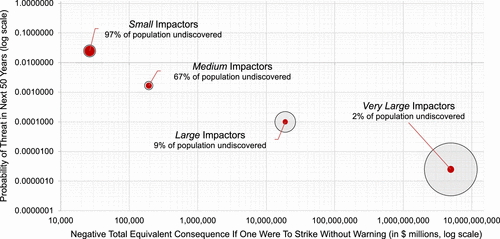
Note. The areas of the larger, larger circles are scaled in proportion to the total negative equivalent consequence of all objects in that size category, whereas the areas of the solid, inner circles are scaled in proportion to the total negative equivalent consequence of all undiscovered objects in that size category.
Using these probabilities and the multiattribute value function, we can assess the size and composition of the expected total equivalent consequence from undiscovered objects in each size category, as displayed in Figure 3. This assessment indicates that the small category of NEOs poses the largest current threat to humankind. This result is in part a reflection of the progress that has been made in cataloging the population of potential impactors over the last three decades following Congressional mandates that have been mostly completed for the large and very large size categories. Although the total damage from a small NEO impact is likely to be low relative to the other, larger size categories, impacts of this type are far more frequent and their population remains almost entirely undiscovered at present. The next-largest contribution to total equivalent consequence comes from objects in the very large size category. Very large NEOs are extremely rare and thus quite unlikely to impact Earth over the 50-year time horizon considered. However, analyses of previous events suggest that an impactor of this size would have catastrophic consequences (Morrison et al. 2004, Schulte et al. 2010). Population estimates and discovery statistics suggest that almost all these very large objects have already been discovered and are being tracked, but the immense scale of potential damage from the remaining few undiscovered objects still accounts for a substantial portion of the total NEO threat. Figure 3 also highlights the differences in the composition of total equivalent consequence contributed by each NEO size category. We see that loss of life accounts for most of the expected total equivalent consequence from small, medium, and very large objects, whereas environmental damage is the largest contributor to total equivalent consequence for large objects as a result of their significant global effects on Earth’s ecosystems (Toon et al. 1997).
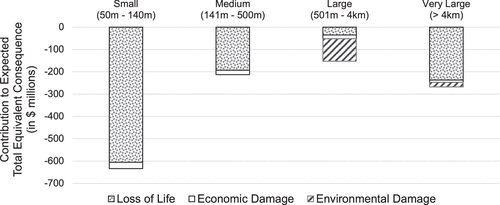
The detection technologies considered reduce the expected negative utility from potential impactors by increasing the rate at which undiscovered NEOs are cataloged. Congressional mandates for the cataloging of NEOs first targeted objects greater than one kilometer in diameter and then objects greater than 140 meters—corresponding to medium and larger NEOs in our framework. However, Figure 3 indicates that the largest current threat comes from objects in the small size category, which are not currently prioritized for discovery by any Congressional mandates.
We next examine how each investment alternative performs following an optimal decision strategy for the sequence of events in Figure 1. The last decision along each branch is whether to mitigate a potential impactor if it is detected. Although the exact location of impact will typically remain uncertain at the time that this decision is made, the decision model suggests that it is always preferable to attempt mitigation of a potential impactor of any size. Even small NEOs, which are most likely to innocuously impact an uninhabited area such as the ocean, could pose a significant threat if one was to impact a low- or high-population-density area. Thus, the decision to always attempt mitigation when a threat is detected in advance stems from the comparatively low cost of a deflection program relative to the expected damages of any size impact and the relatively high probability of success assigned to potential mitigation missions. If mitigation fails, or there is insufficient time to attempt a mission, the decision maker always evacuates the projected area of impact.
Given this mitigation and evacuation strategy, Figure 4 shows the risk profiles associated with each of the four investment alternatives. Each circle corresponds to one of the 212 terminal outcomes in the decision tree shown in Figure 1, with its probability plotted on the vertical axis and its negative total equivalent consequence indicated on the horizontal axis. The area of each circle is proportional to the probability of the outcome multiplied by the negative total equivalent consequence of that outcome, representing the contribution of that event to the expected total equivalent consequence for the associated investment alternative. Two prominent events in the lower right are labeled with text boxes and have outcomes and probabilities which are nearly identical across all four investment alternatives. We observe that the other catastrophic outcomes in Figure 4 are aligned vertically across the four alternatives at different locations along the horizontal axis, indicating the reductions in NEO impact risk that result from increased investment in detection technologies. The investment alternative that minimizes both negative total equivalent consequence (for a risk-neutral decision maker) and negative expected utility given our baseline parameter assumptions is the NEO-optimized Vera Rubin LSST.
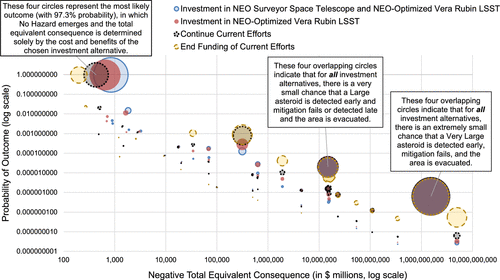
Note. Circle sizes are scaled in proportion to the contribution of each event to the expected negative total equivalent consequence for that investment alternative.
4.1. Sensitivity Analysis
Naturally, these results depend on a number of assumptions and judgments about the various parameters that serve as inputs to the decision model. Baum (2018) and Baum (2019) highlight the inherent uncertainty in many of these assumptions in the context of asteroid mitigation and emphasize the importance of considering a wide range of possible numbers. To better understand which assumptions are most critical to the results, we next examine whether the prescribed decision strategy is affected as each parameter is varied across a reasonable range of possible estimates, as described in the data files.
We find that varying the estimate of the VSL has the most substantial impact on the results, because it potentially changed the preferred decision from the most expensive alternative (investing in both NEO Surveyor and the NEO-optimized LSST) to the least expensive alternative (ending funding of current efforts) across a range of VSL estimates identified in public policy and economics literature. To understand the pivotal role that VSL plays in this investment decision, Figure 5 indicates when each of the four alternatives are optimal for different ranges of VSL assumptions, fixing our baseline assumptions for all other parameters. The optimal investment decision as a function of VSL is given by the upper envelope of the certainty equivalent for each alternative. At one extreme, any VSL assumption of $570,000 or less leads to a model prescription of discontinuing funding of current efforts. In contrast, a VSL between $580,000 and $1.17 million suggests that it would be optimal to continue current efforts, whereas a VSL of $1.18 million or more prescribes investing in the NEO-optimized Vera Rubin LSST. This latter VSL range is consistent with our baseline international VSL estimate of $2.19 million, derived using an inflation-adjusted, population-weighted average of the country-specific estimates provided by Viscusi and Masterman (2017). Any VSL assumption of $3 million or greater indicates that a global decision maker should invest in both the NEO Surveyor and the NEO-optimized LSST.
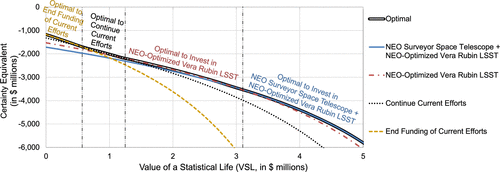
The sensitivity of results to this VSL assumption accentuates the challenge any policymaker will face in determining and effectively communicating an appropriate international valuation of a statistical life (Cameron 2010). By choosing any particular alternative, whether it be an investment in the most expensive detection technologies or a discontinuation of current spending, they are unavoidably making a decision that aligns with a particular range of implied tradeoffs between mortality risk and public spending (Jones-Lee 1974). Any such determination is likely to be difficult and may involve ethical dilemmas regarding the sanctity of human life, equitable treatment of people living around the world, and current outside options for spending to reduce extreme poverty, eliminate disease, mitigate the effects of climate change, and expand educational opportunities both domestically and abroad. These judgments are, by their nature, subjective and may differ substantially from person to person. Underscoring this lack of consensus, the public policy and economics literature offers a wide range of country-specific estimates (Mrozek and Taylor 2002, Lindhjem et al. 2011, Robinson and Hammitt 2015, Viscusi and Masterman 2017, Robinson et al. 2019), and the global nature of this problem further complicates any effort to assign a value across the entire world’s population.
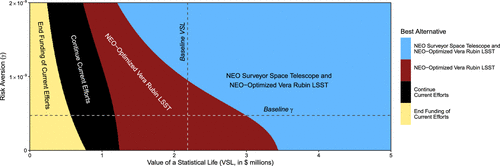
We also find that the level of risk aversion could also change the prescribed detection alternative across the range of plausible values we considered. To further understand the role of in our model, Figure 6 illustrates the effect of risk aversion on the prescribed investment alternative over a range of VSL assumptions. When VSL is greater than $3.44 million, it is optimal to invest in the most expensive detection alternative regardless of the level of risk aversion. For lower values of VSL, the optimal decision may change depending on the level of risk aversion, but the ordering of alternatives remains the same. This means that for a fixed value of VSL, the optimal decision moves toward more expensive detection technologies as the level of risk aversion increases. Similarly, we see that for any fixed level of risk aversion , the optimal decision also moves from the least expensive to the most expensive alternative as VSL increases. The decision maker may modify in accordance with their risk preferences. One approach would be to consider other risk reduction measures that have been deemed worthy or unworthy of funding by the government and use the exponential form described above to infer a range of risk aversion levels that are consistent with those decisions. For example, Stewart et al. (2011) provide a detailed illustration of such a calculation for an exponential utility function based on spending on other risk reduction measures by the U.S. Department of Homeland Security. Alternatively, a policymaker could elicit risk preferences directly from stakeholders by asking them about their willingness to pay to reduce or avoid other, real or hypothetical, risks with very small probabilities and very large consequences.
Our sensitivity analysis further indicates that several other parameter assumptions could plausibly affect which detection alternative is deemed superior. In particular, the costs of each investment, the valuations of scientific knowledge and contributions to the development of new technology for each alternative, the probability of a small impactor, the probabilities of detecting small and very large impactors with a NEO-optimized LSST, the amounts of environmental damage for small and medium impactors, and the number of people killed by a very large impactor in uninhabited and low-population-density areas were able to change the baseline investment decision across the range of possible values considered. This suggests that it would be worthwhile to invest more effort to narrow the estimates of these parameters as much as possible when making a final choice between detection alternatives. Carefully and accurately assessing these particular parameters should be a priority for any policymaker evaluating this investment decision.
4.2. Simulation over Parameter Uncertainties
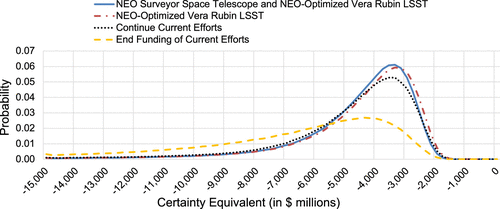
To further examine the sensitivity of the results to our baseline assumptions, we use a simulation analysis in which we simultaneously vary the parameters of the model. Specifically, we construct triangular distributions over the range of a low, base, and high estimate for each parameter and draw realizations independently from each of these distributions (Clemen and Reilly 2013). We then consider the optimal decision policy under that combination of parameters and compare the results over one million instances. In a majority (54%) of simulated cases, we find that the decision maker would maximize expected utility by investing in the NEO-optimized LSST. The alternatives of investing in a combination of the NEO-optimized LSST and NEO Surveyor and of continuing current efforts were optimal in almost all other scenarios, with the former favored in 40% of instances and the latter favored in 6% of instances. In contrast, ending funding of current efforts would be optimal in less than 0.01% of simulated parameter combinations.
Support for investment in the NEO-optimized LSST is bolstered by consideration of the distributions of certainty equivalents for each of the alternatives, displayed as probability density functions in Figure 7. Of note, a comparison of the empirical cumulative distribution functions (not displayed in Figure 7) of the certainty equivalent for each alternative reveals that investing in the NEO-optimized LSST first-order stochastically dominates both continuing current efforts and ending funding of current efforts in this simulation.
As might be expected, the range of uncertainty over the model parameters has a significant impact on the conclusions of these sensitivity analyses. To further understand how this parameter uncertainty may affect the decision maker’s preferences over alternatives, we next consider the role of ambiguity—the higher-order uncertainty resulting from a lack of knowledge of the exact probabilities within the decision problem.
5. Incorporating Ambiguity Preferences
Our analyses up to this point clearly indicate that, because of the very-low-probability, very-high-impact nature of the NEO threat, risk attitudes play a key role in the decision maker’s preferences over alternatives. However, these results are derived from an underlying decision model in which the probabilities of each event are fixed and assumed to be known. In many practical settings, it may be difficult for the decision maker to specify a single well-defined probability for all events. For example, even with an extensive lead time to attempt several types of deflection missions, the probability that a large asteroid on course to impact Earth could be successfully mitigated remains unknown, because none of these strategies have been tested on an object of this magnitude. Experts may find it difficult to provide a single probability estimate for such an event, preferring instead to describe their assessment of the uncertainty as an interval or set of potential probabilities depending on other assumptions about future technological developments and capabilities. Furthermore, different experts may disagree about what this successful mitigation probability would be, leaving the decision maker with a range of plausible probability estimates that cannot be conclusively narrowed down further.
In these situations, some degree of ambiguity remains inherent to the decision analysis and the way in which the decision maker evaluates this ambiguity may affect their preferences over alternatives. Traditionally, preference models incorporating ambiguity have not been frequently considered in decision analyses, with early foundational work favoring a Bayesian approach that describes any uncertainties about parameters in terms of specific probability distributions. However, more recent developments in behavioral economics have provided a bounty of alternative choice models that can take ambiguity preferences into account (Wakker 2010, Etner et al. 2012, Ilut and Schneider 2023).
Ambiguity may affect how a decision maker views the alternatives available to them, and models that explicitly incorporate ambiguity preferences can be used to supplement our understanding of decision problems in which some probabilities remain uncertain. The results of such an analysis can be used as both a robustness check—seeing whether a prescribed decision may potentially change when ambiguity preferences are included—and a behavioral explanation to reconcile any discrepancies between the alternative preferred by the decision maker and the alternative that a traditional decision analysis suggests would deliver greater expected utility. By identifying any such inconsistencies, the decision maker can gain a better understanding of the considerations that drive their decision process.
To demonstrate how such an ambiguity analysis can be readily integrated with the kind of expected utility model classically considered in a decision analysis, we apply the -max-min expected utility (-MEU) model (Hurwicz 1951, Ghirardato et al. 2004, Klibanoff et al. 2022) to the NEO detection and mitigation problem. The -MEU model evaluates any decision policy that leads to vectors of terminal performance measure outcomes along each of the possible tree branches according to the preference representation
When , ambiguity aversion is at its highest, and the decision is driven entirely by the worst-possible expected utility that could be induced by a given policy. In contrast, when ambiguity aversion is at its lowest and the decision maker focuses entirely on the best-case distribution of outcomes induced by each policy. A strength of this model is its ability to characterize ambiguity preferences using the same multiattribute utility function developed for the traditional expected utility analysis in Section 3 in conjunction with a single additional parameter . The -MEU model is also well connected to other prominent choice models such as rank-dependent utility (Jaffray and Philippe 1997) and multiple prior models (Abdellaoui et al. 2025). Conditions to verify whether choices made by individuals are consistent with an -MEU model are provided by Jaffray (1994) and Ghirardato et al. (2004).
Within the decision model for protecting Earth from NEOs, we study the implications of ambiguity over the two uncertainties that are located furthest down the branches of the decision tree—the probabilities of a successful mitigation effort for each NEO size category (given sufficient advance warning) and the probabilities that an unmitigated object would hit uninhabited, low-population-density, and high-population-density areas. We set minimum and maximum bounds for each of these probabilities according to the low and high estimates previously specified for our sensitivity analyses together with logical constraints, ensuring that the set of probabilities at every event node remain nonnegative and sum to one.
As we identified in Section 4.1, the decision maker’s choice of VSL has a pivotal role in the prescribed investment decision. We thus begin by examining the joint effect of the ambiguity aversion parameter and the VSL parameter on the optimal investment decision, with results displayed in Figure 8. At the baseline VSL of $2.19 million, the optimal investment alternative (the NEO-optimized LSST) remains the same for any level of ambiguity aversion. As expected, the optimal investment decision changes for different VSL assumptions and, for some ranges of VSL, also depends on the degree of ambiguity aversion . For example, at a VSL of $3 million, low levels of ambiguity aversion suggest investing in only the NEO-optimized LSST, whereas high levels of ambiguity aversion suggest additionally investing in the NEO Surveyor telescope. To understand why the preferred alternative changes, note that when is close to ONE, the decision maker focuses almost entirely on the expected utility for the worst-case set of probabilities, which assign lower chances to the success of any mitigation attempt and greater chances to the most catastrophic outcomes in which an object hits a high-population-density area. For this VSL, the cost of the additional detection technology is justified by the extent to which it reduces the risks of an NEO impact without advance warning because the decision maker’s focal scenario is driven by the highest probabilities of catastrophic outcomes in which an object hits a high-population-density area. The value of this increased detection comes notwithstanding the concomitant reductions in the chances of a successful mitigation mission in this focal scenario because the advance warning still gives the decision maker the chance to evacuate these heavily populated areas.
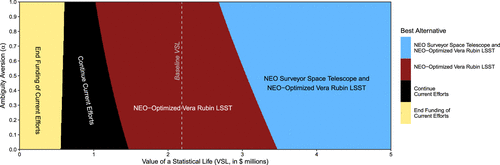
We observe such switching of the optimal investment decision as changes for three different ranges of VSL in this problem. Interestingly, for a small range of VSL between $555,000 and $605,000, the effect is reversed such that increasing ambiguity aversion can lead the decision maker to switch from continuing current efforts to ending funding of current efforts. This reversal emerges because the negative effects of the lower probabilities of successful mitigation in the worst-case set of probabilities outweigh the positive effects of potentially being able to evacuate heavily populated areas with such a low valuation for each statistical life, decreasing the value of advance detection of the remaining population of undiscovered objects. Differing levels of ambiguity aversion could thereby provide a potential explanation for any discrepancies between a decision maker’s preferred investment alternative and that which is prescribed by the expected utility model in Section 4. For example, if the VSL is $3 million, Figure 6 indicates that the decision maker is indifferent between investing in only the NEO-optimized LSST and additionally investing in the NEO Surveyor. If the decision maker in this scenario expresses an inclination toward investing in both NEO Surveyor and the NEO-optimized LSST (and remains in agreement with all the other model parameter assumptions), this preference may in fact reflect a high degree of ambiguity aversion, consistent with in Figure 8. Of course, this analysis cannot provide a conclusive explanation for any given choice but can be used to identify which numeric assumptions in the model are driving a decision.
Given the very low probabilities and potentially catastrophic outcomes inherent to the NEO threat, it is also natural to ask how risk aversion and ambiguity aversion interact in determining the decision maker’s preferred alternative and which consideration has a greater influence on the investment in detection technologies. For this analysis, we take the VSL as fixed at its baseline level of $2.19 million and solve for the best alternative as both and vary, with results displayed in Figure 9. For most fixed risk aversion levels, including the baseline parameter assumption of , the preferred investment alternative is invariant to the level of ambiguity aversion. In contrast, we see that for every fixed ambiguity aversion level , there is some level of risk aversion at which the optimal decision switches. Together these patterns indicate that the decision maker’s risk preferences have a much stronger effect on the preferred alternative than ambiguity preferences in this problem.
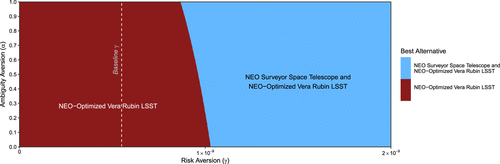
Although these analyses can offer additional insight into the decision problem, there are also some challenges to fully incorporating ambiguity preferences into a decision analysis (Heal and Millner 2014, Lemoine and Traeger 2016). First, the results may change depending on whether ambiguity is introduced over probabilities for some or all event nodes in the decision tree, as well as other model parameters that could be viewed as uncertainties. However, including every possible uncertainty in an -MEU model can introduce computational challenges because of the curse of dimensionality that develops as the complexity of the region of feasible probabilities over which the minimization and maximization problems embedded in (4) must be solved increases. Second, the bounds that define the set of possible probabilities for a given policy can also have a substantial influence on the preferred alternative, but these bounds themselves can be difficult to determine. In the extreme, if the decision maker is unable to place any firm lower and upper bounds on the possible probabilities, the ambiguity analysis will become degenerate in the sense that the worst- and best-case probabilities equal zero or one and preferences are determined entirely by the most extreme possible scenarios (e.g., certainty that an NEO will hit the Earth, the guaranteed failure of any mitigation attempt, the largest number of people being killed by an impact). Thus, striking a balance between trying to pin down a probability exactly and leaving open a full range of uncertainty over what probabilities are plausible is crucial for this kind of analysis. Efforts to extract as much information as possible from experts while accounting for any residual ambiguity that they may have for such events are likely to be challenging and finding ways to do this effectively in a consistent manner remains an open area of research.
6. Comparing National and Global Stakeholders
Many experts recommend international collaboration on management of NEO threats (Remo and Haubold 2001, Gritzner et al. 2006), and, although we initially considered the problem from the perspective of a global decision maker acting in the interest of all humanity, it is possible that an individual country or subset of countries may end up deciding whether it is worthwhile to invest in a detection effort based entirely on their own national interests. The United States, for example, may consider proactively addressing this potential threat on its own, as suggested by its decision to fund many related ongoing NEO detection and mitigation projects, including the Vera C. Rubin Observatory and planned NEO Surveyor mission.
As discussed in Section 4.1, a global decision maker faces an ethical dilemma when determining the VSL. When considering this decision from the perspective of either a single country or collection of countries, an additional ethical issue arises—should a country value a statistical life outside its national borders differently than a domestic statistical life? Legal scholars (Dana 2010, Rowell and Wexler 2014, Posner and Sunstein 2017) have considered this question, noting current guidance for policymakers in the United States and offering potential improvements. Rowell and Wexler (2014) discuss different approaches that might be taken to value nondomestic lives as part of cost-benefit analyses. As the authors discuss, the U.S. Office of Management and Budget has provided guidance for cost-benefit analysis for regulators in the United States to focus primarily on valuing domestic lives and provide a separate analysis for effects of a proposed regulation outside the borders of the United States, and previous cost-benefit analyses have shown no value assigned to nondomestic statistical lives. As a proxy for U.S. valuation of foreign lives, Rowell and Wexler note that the Foreign Claims Settlement Commission is authorized to pay between $15,000 and $50,000 for citizens killed in war. Additional approaches include using the current marginal cost of saving a statistical life in other countries through philanthropic means (GiveWell 2022). There may also be benefits for a national stakeholder to be in a position to protect another nation from an asteroid impact.
With this in mind, our value function for a national decision maker separately accounts for each of the components of the global decision maker’s objective function—one component that values the consequences that directly affect that nation and another component that values the consequences that affect other countries. The values assigned to each component may differ substantially. For example, a national decision maker may assign a primary VSL to its own citizens and a possibly lower VSL to residents of other countries. In addition, a national decision maker may care about potential economic damage to other countries because of spillover effects, but its importance is likely to be discounted relative to direct damage to the domestic economy. Furthermore, the collective benefits of technological and scientific advancement are likely to be less valuable from the perspective a national decision maker, who may instead evaluate these consequences in proportion to their country’s share of the global economy.
Given this partition of the value function into domestic and nondomestic consequences, we also need to add an additional chance node to the terminal branches of the decision tree which further split any NEO impact events into either a primary impact to the country (or group of countries) making the decision or a primary impact to territory outside of the country. The probabilities of each these impact location categories depend, of course, on the size of the country making the decision and its population density and distribution across its territory. Once this expanded tree and value function have been constructed, the decision maker again needs to specify their multiattribute utility function over consequences. As in the case of the global decision maker studied in Section 3.4, we assume an exponential form for the univariate utility function over value, which is determined by the national decision maker’s risk aversion parameter , and solve for the national decision maker’s optimal policy via standard backward induction by maximizing their expected utility at each decision node.
To explore the specific implications of taking such a national perspective, we use the consider the decision problem faced by the United States if it were to act independently. As a baseline domestic VSL, we use the U.S. Department of Transportation’s official guidance of $13.2 million for 2023, and we estimate the national decision maker’s risk aversion by setting their risk tolerance equal to 10% of the total value indicated by the multiattribute value function, yielding . We find that the optimal detection technology investment decision is highly dependent on how the national decision maker values each nondomestic statistical life, as illustrated in Figure 10. Most notably, if the national decision maker chooses a nondomestic VSL in the range of the Foreign Claims Commissions payments in the United States, our model suggests that continuing current efforts has the greatest expected utility. In contrast, if the national decision maker values each nondomestic statistical life at $800,000 or more, investing in both the NEO-optimized Vera Rubin LSST and the NEO Surveyor would maximize expected utility. These results highlight the potential for divergence between what an individual country may consider optimal and what may be preferred by humankind collectively, underscoring the importance of international cooperation in detection and mitigation of NEO hazards.
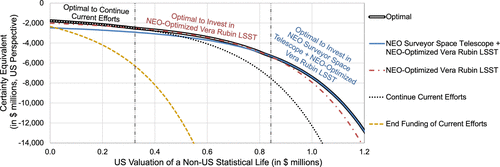
7. Discussion
Asteroids and other NEOs pose a grave risk to human life and livelihood on our planet. Investments in NEO detection and tracking technologies are costly but increase the chances of advance warning for any object on course to collide with Earth. This would give humanity a chance to try to avert an impact or lessen the damage by evacuating the projected impact area if mitigation attempts fail. In this paper, we presented a framework and detailed illustration of how to effectively evaluate such potential investments. The framework provides a systematic approach to making this decision and a tool that can generate practical insights for policymakers considering alternatives for NEO detection and mitigation.
Our results indicate that almost half of the current threat from undiscovered NEOs is driven by objects between 50 and 140 meters in diameter, smaller than those targeted by the still-incomplete U.S. Congressional mandate for NASA to discover 90% of objects with diameter greater than 140 meters. A clear policy implication is that future decision making by NASA and multinational space agencies should prioritize finding these smaller objects. Remarkably, this threat appears to be underappreciated by Congress and other decision makers at present. For example, the Jet Propulsion Laboratory specifically excludes objects under 140 meters from meeting the criteria of a “potentially hazardous object.” In addition, our analysis calls attention to the pivotal role of the valuation of statistical human life when comparing these alternatives. Furthermore, the highly skewed nature of the NEO hazard, involving very small probabilities of potentially catastrophic consequences, means that the decision maker’s risk preferences are critical in determining which technologies should be funded.
The potential involvement of multiple decision makers with varying objectives, values, and risk preferences complicates this decision problem. Thus far, nearly all the investment in land-based telescopes to detect and track asteroids has been funded by the United States. However, the priorities of an individual country may differ from those of an international body acting on behalf of all humanity. When considering the decision from the perspective of a national policymaker, an ethical dilemma emerges about whether human life and economic consequences beyond a nation’s borders should be valued differently. As a result, investments that are optimal from a global perspective may not appear worthwhile to a national decision maker. Our analysis in Section 6 clearly suggests a divergence between what an individual country may consider optimal and what may be best for humanity, underscoring the need for international cooperation in detection, tracking, and mitigation of NEO hazards.
Although we consider the NEO detection and mitigation problem in isolation from the many other decisions that a government or international organization may face, it should be acknowledged that policymakers typically operate in a budget-constrained environment and investments in NEO detection efforts may compete with other spending proposals. As a result, spending on any of the alternatives we consider comes with an implicit opportunity cost determined by the return that would have been available from investing additional funds in the best of these other foregone options. Although these spending alternatives have not been explicitly included in our model, we can use the value tradeoffs to account for outside options indirectly. Most notably, the VSL represents a key value tradeoff that is already used to help guide decision making within various agencies of the U.S. Government. For example, the Department of Transportation uses VSL to help determine whether various small risk reduction measures (such as adding or upgrading guardrails at key places along a road) are worthy of investment.
The framework we have presented can be useful in examining similar decision problems, especially those related to forestalling potentially devastating events that could emerge over long planning horizons and may require unproven mitigation technologies. The numerous effects of climate change are already forcing policymakers to wrestle with these kinds of dilemmas (Dodman et al. 2022). One such example is coastal preparedness for rising sea levels, the risk and extent of which is uncertain, with untested potential solutions to prevent catastrophic flooding events. New mitigation strategies and technologies related to these disaster management decisions are expensive and decision makers may struggle to evaluate such investments, particularly when the results are not immediately tangible (Hurlimann et al. 2021). More broadly, we demonstrate how thorough analysis of important decisions can be useful for a policymaker to both improve decision making and better understand the nature of the problem. Decision making in complex settings such as the one considered in this paper can be challenging in part because they may involve tradeoffs between multiple objectives and may require expert judgment to help inform the process of model structuring and synthesizing numerous model parameters. Furthermore, the alternatives may involve small probabilities of highly consequential outcomes, requiring a utility function that characterizes the decision maker’s risk preferences. There may also be uncertainty and/or disagreement among experts about key probabilities and outcomes, giving ambiguity preferences an important role in the decision. Our analysis illustrates how all these details can be considered jointly to gain insights into the decision problem, identify superior alternatives, and reach a defensible course of action.
The authors thank Ali Abbas, Seth Baum, Eric Bickel, Clark Chapman, Ryan Haberman, Robert Hammond, Catherine Pilachowski, Jason Reinhardt, Rusty Schweickart, Jay Simon, Carl Spetzler, John Tonry, Kip Viscusi, and Detlof von Winterfeldt for providing helpful feedback and commentary on earlier versions of this work and George Wu, an anonymous associate editor, and three anonymous reviewers for thoughtful comments and suggestions that greatly improved the paper.
1 The Lincoln Near-Earth Asteroid Research project (LINEAR) was responsible for many early discoveries of NEOs, whereas the three most prolific monitoring and discovery projects today are the Panoramic Survey Telescope and Rapid Response System (PanSTARRS), the Catalina Sky Survey, and the Asteroid Terrestrial-impact Last Alert System (ATLAS). Each of these is partially or fully funded by NASA (National Research Council 2010).
2 Multiple NEO impacts within this timeline are possible, of course, but extremely unlikely. Assuming that there will be at most one potential impactor significantly simplifies the analysis.
3 Parameterization of the model is based on a variety of data sources. Mitigation and lead time estimates are based on Reinhardt et al. (2014) and National Research Council (2010). Impact probabilities and their uncertainty ranges are estimated from Chapman (2004), Silber et al. (2009), Harris and D’Abramo (2015), and Harris and Chodas (2021). We estimate discovery rates each of the investment alternatives (apart from “end current efforts”) and each NEO size based on an exponential decay function with constant decay rate, calibrated with figures 3.6–3.10 in National Research Council (2010) and NEO discovery statistics (NASA 2023), with consideration of NASA (2017). Mitigation success probabilities by category are estimated from NASA (2007a), Schweickart et al. (2008), Reinhardt et al. (2014), and Jacklin (2019), with estimated cost of mitigation missions from NASA (2007b). Investment and operating costs are estimated based on Larson (2007), National Research Council (2010), and Voosen (2019) and Government Accountability Office (2020). Evacuation parameters are based on Baker (1991) and Gritzner et al. (2006). Value of a statistical life range is based on Viscusi and Masterman (2017), U.S. Department of Transportation (2023), Frakt (2020), and Palmer et al. (2021). Ecosystem valuation is based on Spalding and Grenfell (1997), Sala (2001), Downing et al. (2006), de Groot et al. (2012), Wang et al. (2019), Cochran et al. (2019), FAO (2020), UNEP (2022), and Woods Hole Oceanographic Institution (2024), with species impact estimates from Poag (1997) and Garshnek et al. (2000). Impact areas and damage estimates associated with different NEO size categories are based on Chapman and Morrison (1994) and potential energy transfer of associated tsunamis (National Research Council 2010, Rumpf et al. 2017, Robertson and Gisler 2019). Population density estimates are based on Liu et al. (2014) and Theobald et al. (2020). Population and economic damage estimates associated with NEO impacts are assumed to be fixed over the problem horizon.
References
- (2010) Constructing multiattribute utility functions for decision analysis. INFORMS Tutorials Oper. Res. 62–98.Google Scholar
- (2011) One-switch independence for multiattribute utility functions. Oper. Res. 59(3):764–771.Link, Google Scholar
- (2012) METHODS: One-switch conditions for multiattribute utility functions. Oper. Res. 60(5):1199–1212.Link, Google Scholar
- (2025) Eliciting multiple prior beliefs. Rev. Econom. Stud.Google Scholar
- (1980) Extraterrestrial cause for the Cretaceous-Tertiary extinction. Science (1979) 208(4448):1095–1108.Google Scholar
- (1991) Hurricane evacuation behavior. Internat. J. Mass Emerging Disasters 9(2):287–310.Crossref, Google Scholar
- (2018) Uncertain human consequences in asteroid risk analysis and the global catastrophe threshold. National Hazards 94(2):759–775.Crossref, Google Scholar
- (2019) Risk–risk tradeoff analysis of nuclear explosives for asteroid deflection. Risk Anal. 39(11):2427–2442.Crossref, Google Scholar
- (2006) Some determinants of corporate risk aversion. Decision Anal. 3(4):233–251.Link, Google Scholar
- (2003) Decision model for potential asteroid impacts. Research Paper EB560, Decision Analysis, Division of Economics and Business, Colorado School of Mines, Golden, CO.Google Scholar
- (2011) A study of interactions in the risk assessment of complex engineering systems: An application to space PSA. Oper. Res. 59(6):1461–1476.Link, Google Scholar
- (2013) Near-Earth asteroid retrieval mission (ARM) study. Proc. 33rd Internat. Electric Propulsion Conf. (Electric Rocket Propulsion Society, Washington, DC).Google Scholar
- (2008) Low probability, high impact: Policy making and extreme events. J. Policy Modeling 30(1):111–121.Crossref, Google Scholar
- (2018) Asteroid mining with small spacecraft and its economic feasibility. Preprint, submitted August 15, https://arxiv.org/abs/1808.05099.Google Scholar
- (1989) Decision processes for low probability events: Policy implications. J. Policy Anal. Management 8(4):565–592.Crossref, Google Scholar
- (2010) Euthanizing the value of a statistical life. Rev. Environment. Econom. Policy 4(2):161–178.Crossref, Google Scholar
- (1994)
Cost and benefit of near-Earth object detection and interception . Canavan GH, Solem JC, Rather JDG, eds. Hazards Due to Comets and Asteroids (University of Arizona Press, Tucson), 1157–1191.Google Scholar - (1999) History of the asteroid/comet impact hazard. Working paper, Southwest Research Institute, San Antonio, TX.Google Scholar
- (2004) The hazard of near-Earth asteroid impacts on Earth. Earth Planetary Sci. Lett. 222(1):1–15.Crossref, Google Scholar
- (1994) Impacts on the Earth by asteroids and comets: Assessing the hazard. Nature 367(6458):33–40.Crossref, Google Scholar
- (2013) Making Hard Decisions, 3rd ed. (Cengage Learning, Boston).Google Scholar
- (2019) Encyclopedia of Ocean Sciences (Elsevier Science, Amsterdam).Google Scholar
- (2010) Valuing foreign lives and settlements. J. Benefit Cost Anal. 1(1):1–26.Crossref, Google Scholar
- (2012) Global estimates of the value of ecosystems and their services in monetary units. Ecosystem Services 1(1):50–61.Crossref, Google Scholar
- (2018) Elicitation: The Science and Art of Structuring Judgment (Springer, Berlin).Crossref, Google Scholar
- (2003) Programmatic risk analysis for critical engineering systems under tight resource constraints. Oper. Res. 51(3):354–370.Link, Google Scholar
- (2022) Cities, settlements and key infrastructure. Climate change 2022: Impacts, adaptation, and vulnerability. Report, Intergovernmental Panel on Climate Change, Geneva, Switzerland.Google Scholar
- (2006) The global abundance and size distribution of lakes, ponds, and impoundments. Limnology Oceanography 51(5):2388–2397.Crossref, Google Scholar
- (2024) A European spacecraft launches to perform a crash scene investigation on an asteroid. National Public Radio (October 7), https://www.npr.org/2024/10/07/nx-s1-5144223/hera-spacex-asteroid-mission-dimorphos.Google Scholar
- (1976) An actual application of collective choice theory to the selection of trajectories for the Mariner Jupiter/Saturn 1977 project. Oper. Res. 24(2):220–244.Link, Google Scholar
- (1979) Measurable multiattribute value functions. Oper. Res. 27(4):810–822.Link, Google Scholar
- (2021) Innovations in the science and practice of decision analysis: The role of management science. Management Sci. 67(9):5364–5378.Link, Google Scholar
- (2012) Decision theory under ambiguity. J. Econom. Survey 26(2):234–270.Crossref, Google Scholar
- (1978) An algorithm for the space-shuttle scheduling problem. Oper. Res. 26(1):166–182.Link, Google Scholar
- (2018) A value measure for public-sector enterprise risk management: A TSA case study. Risk Anal. 38(5):991–1008.Crossref, Google Scholar
Food and Agricultural Organization of the United Nations (FAO) (2020) Global forest resources assessment 2020—key findings. Report, Food and Agricultural Organization of the United Nations, Rome.Google Scholar- (2013) NASA to Congress: Don’t ‘pour money’ into NEO programs. Space Politics (March 20), http://www.spacepolitics.com/2013/03/20/nasa-to-congress-dont-pour-money-into-neo-programs/.Google Scholar
- (2023) NEO Surveyor launch delayed despite funding boost. Space News (January 26), https://spacenews.com/neo-surveyor-launch-delayed-despite-funding-boost/.Google Scholar
- (2020) Putting a dollar value on life? Governments already do. New York Times (May 11), https://www.nytimes.com/2020/05/11/upshot/virus-price-human-life.html.Google Scholar
- (1997) Defense of Earth against large comets and asteroids. Proc. IEEE Aerospace Conf., vol. 4 (IEEE, Piscataway, NJ), 5–29.Google Scholar
- (2025) The chances of an asteroid hitting Earth in 2032 have changed. But what’s the risk, really? The Los Angeles Times (February 19), https://www.latimes.com/california/story/2025-02-19/the-chances-of-an-asteroid-hitting-earth-in-2032-have-changed-but-whats-the-risk-really.Google Scholar
- (2000) The mitigation, management, and survivability of asteroid/comet impact with Earth. Space Policy 16(3):213–222.Crossref, Google Scholar
- (2004) Differentiating ambiguity and ambiguity attitude. J. Econom. Theory 118(2):133–173.Crossref, Google Scholar
GiveWell (2022) GiveWell’s cost-effectiveness analyses. Accessed February 10, 2023, https://www.givewell.org/how-we-work/our-criteria/cost-effectiveness/cost-effectiveness-models.Google ScholarGovernment Accountability Office (2020) National Science Foundation: Cost and schedule performance of major facilities construction projects and progress on prior GAO recommendations. Accessed February 10, 2023, https://www.gao.gov/assets/gao-20-268-highlights.pdf.Google Scholar- (2006) A modeling framework for interplanetary supply chains. Space 2006 (American Institute of Aeronautics and Astronautics, Reston, VA), 2006–7229.Google Scholar
- (2020) The NEO surveillance mission (NEOSM) survey simulations. AAS/Division Planetary Sci. Meeting Abstracts 52(6):208–203.Google Scholar
- (2004)
Mitigation technologies and their requirements . Belton MJS, Morgan TH, Samarasinha NH, Yeomans DK, eds. Mitigation of Hazardous Comets and Asteroids (Cambridge University Press, Cambridge, UK), 167–200.Crossref, Google Scholar - (2006) The asteroid and comet impact hazard: Risk assessment and mitigation options. Sci. Nature 93(8):361–373.Crossref, Google Scholar
- (2022) NASA confirms DART mission impact changed asteroid’s motion in space. Accessed January 2, 2023, https://www.nasa.gov/press-release/nasa-confirms-dart-mission-impact-changed-asteroid-s-motion-in-space.Google Scholar
- (2021) The population of near-Earth asteroids revisited and updated. Icarus 365:114452.Crossref, Google Scholar
- (2015) The population of near-Earth asteroids. Icarus 257:302–312.Crossref, Google Scholar
- (2014) Reflections: Uncertainty and decision making in climate change economics. Rev. Environment. Econom. Policy 8(1):120–137.Crossref, Google Scholar
- (2020) A techno-economic analysis of asteroid mining. Acta Astronaut 168:104–115.Crossref, Google Scholar
- (1991) Chicxulub crater: A possible cretaceous/tertiary boundary impact crater on the Yucatan Peninsula, Mexico. Geology 19(9):867–871.Crossref, Google Scholar
- (1989) Risk, ambiguity, and insurance. J. Risk Uncertainty 2:5–35.Crossref, Google Scholar
- (1988) Decision analysis: Practice and promise. Management Sci. 34(6):679–695.Link, Google Scholar
- (2021) Urban planning policy must do more to integrate climate change adaptation and mitigation actions. Land Use Policy 101:105188.Crossref, Google Scholar
- (1951) Some specification problems and applications to econometric models. Econometrica 19(3):343–344.Google Scholar
- (2023)
Ambiguity . Bachmann R, Topa G, eds. Handbook of Economic Expectations (Elsevier, Amsterdam), 749–777.Crossref, Google Scholar Interagency Working Group on Near-Earth Object Impact Threat Emergency Protocols (2021) Report on near-earth object impact threat emergency protocols. Accessed February 10, 2023, https://trumpwhitehouse.archives.gov/wp-content/uploads/2021/01/NEO-Impact-Threat-Protocols-Jan2021.pdf.Google Scholar- (2019) Small-satellite mission failure rates. Technical Memorandum No. TM-2018-220034, National Aeronautics and Space Administration, Ames Research Center, Moffett Field, CA.Google Scholar
- (1994) Dynamic decision making with belief functions. Yager R, Fedrizzi M, Kacprzyk J, eds. Advances in the Dempster-Shafer Theory of Evidence (John Wiley, Hoboken, NJ), 331–352.Google Scholar
- (1997) On the existence of subjective upper and lower probabilities. Math. Oper. Res. 22(1):165–185.Link, Google Scholar
- (2021) Russia joins China’s mission to sample an asteroid and study a comet. Accessed January 1, 2025, https://www.space.com/russia-joins-china-asteroid-comet-mission.Google Scholar
- (2018) The large synoptic survey telescope as a near-Earth object discovery machine. Icarus 303:181–202.Crossref, Google Scholar
- (1974) The value of changes in the probability of death or injury. J. Political Econom. 82(4):835–849.Crossref, Google Scholar
- (1971) Utility independence and preferences for multiattributed consequences. Oper. Res. 19(4):875–893.Link, Google Scholar
- (1987) An analysis of portfolio of sites to characterize for selecting a nuclear repository. Risk Anal. 7(2):196–216.Crossref, Google Scholar
- (2005) Selecting attributes to measure the achievement of objectives. Oper. Res. 53(1):1–11.Link, Google Scholar
- (1993) Decisions with Multiple Objectives: Preferences and Value Trade-Offs (Cambridge University Press, Cambridge, UK). Crossref, Google Scholar
- (2011) A value model for evaluating homeland security decisions. Risk Anal. 31(9):1470–1487.Crossref, Google Scholar
- (2022) China to try and knock asteroid off path with new monitoring and defence system. Accessed Febuary 10, 2023, https://www.newshub.co.nz/home/technology/2022/04/china-to-try-and-knock-asteroid-off-path-with-new-monitoring-and-defence-system.html.Google Scholar
- (2004) Approximating risk aversion in decision analysis applications. Decision Anal. 1(1):51–67.Link, Google Scholar
- (2022) Foundations of ambiguity models under symmetry: α-MEU and smooth ambiguity. J. Econom. Theory 199:105202.Crossref, Google Scholar
- (2007) Current NEO surveys. Proc. Internat. Astronomical Union S236:323–328.Google Scholar
- (2014) A decision analysis approach for risk management of near-Earth objects. Acta Astronaut 103:362–369.Crossref, Google Scholar
- (2016) Economics of tipping the climate dominoes. Nature Climate Change 6(5):514–519.Crossref, Google Scholar
- (2011) Valuing mortality risk reductions from environmental, transport, and health policies: A global meta-analysis of stated preference studies. Risk Anal. 31(9):1381–1407.Crossref, Google Scholar
- (2014) How much of the world’s land has been urbanized, really? A hierarchical framework for avoiding confusion. Landscape Ecology 29:763–771.Crossref, Google Scholar
- (2007)
The Tunguska event . Bobrowsky P, Rickman H, eds. Comet/Asteroid Impacts and Human Society (Springer, Berlin), 369–382.Crossref, Google Scholar - (2015) Survey simulations of a new near-Earth asteroid detection system. Astronomy J. 149(5):172.Crossref, Google Scholar
- (2005) Utility transversality: A value‐based approach. J. Multi‐Criteria Decision Anal. (Oxford) 13(5–6):229–238.Crossref, Google Scholar
- (2021) How NASA chooses its missions (and how you can help). Accessed March 2, 2023, https://astrobites.org/2021/11/26/nasa-mission-selection/.Google Scholar
- (2010) Is screening cargo containers for smuggled nuclear threats worthwhile? Decision Anal. 7(2):155–171.Link, Google Scholar
- (2004)
Impacts and the public: Communicating the nature of the impact hazard . Belton MJS, Morgan TH, Samarasinha NH, Yeomans DK, eds. Mitigation of Hazardous Comets and Asteroids (Cambridge University Press, Cambridge, UK), 353–390.Crossref, Google Scholar - (2002) What determines the value of life? A meta‐analysis. J. Policy Anal. Management 21(2):253–270.Crossref, Google Scholar
NASA (2003) Study to determine the feasibility of extending the search for near Earth objects to smaller limiting diameters. Accessed February 10, 2023, https://cneos.jpl.nasa.gov/doc/neo_report2003.html.Google ScholarNASA (2007a) Near‐Earth object survey and deflection analysis of alternatives (Report to Congress). Accessed February 10, 2023, https://cneos.jpl.nasa.gov/doc/neo_report2007.html.Google ScholarNASA (2007b) Near-Earth object survey and deflection study. Accessed February 10, 2023, https://www.nasa.gov/pdf/171331main_NEO_report_march07.pdf.Google ScholarNASA (2017) Update to determine the feasibility of enhancing the search and characterization of NEOs. Accessed February 10, 2023, https://cneos.jpl.nasa.gov/doc/2017_neo_sdt_final_e-version.pdf.Google ScholarNASA (2021) Planetary Missions Program Office, solar system exploration program. Accessed March 2, 2023, https://www.nasa.gov/planetarymissions/solarsystemexploration.html.Google ScholarNASA (2023) Center for Near-Earth Object Studies, discovery statistics. Accessed February 10, 2023, https://cneos.jpl.nasa.gov/stats/totals.html.Google ScholarNASA (2024) NASA spinoff issue archive. Accessed January 19, 2025, https://spinoff.nasa.gov/spinoff/archives.Google ScholarNASA (2025) 2024 YR4 facts. Accessed August 1, 2025, https://science.nasa.gov/solar-system/asteroids/2024-yr4-facts.Google ScholarNational Research Council (2010) Defending Planet Earth: Near-Earth Object Surveys and Hazard Mitigation Strategies (National Academies Press, Washington, DC).Google ScholarNational Research Council (2019) Finding Hazardous Asteroids Using Infrared and Visible Wavelength Telescopes (National Academies Press, Washington, DC).Google Scholar- (2020) Optimization and decision-making framework for multi-staged asteroid deflection campaigns under epistemic uncertainties. Acta Astronaut 167:23–41.Crossref, Google Scholar
- (2021) Population norms for quality adjusted life years for the United States of America, China, the United Kingdom, and Australia. Health Econom. 30(8):1950–1977.Crossref, Google Scholar
- (1998) Foundations 2025: A value model for evaluating future air and space forces. Management Sci. 44(10):1336–1350.Link, Google Scholar
- (1994) Risk management for the tiles of the space shuttle. Interfaces (Providence) 24(1):64–86.Link, Google Scholar
- (1997) Roadblocks on the kill curve: Testing the Raup hypothesis. Palaios 12(6):582–590.Crossref, Google Scholar
- (2017) Moral commitments in cost-benefit analysis. Virginia Law Rev. 103:1809–1860.Google Scholar
- (2014) Probabilistic analysis of asteroid impact risk mitigation programs. Smith C, Paulos T, eds. Proc. Probabilistic Safety Management Conf. (International Association for Probabilistic Safety Assessment and Management, Honolulu), 1–12.Google Scholar
- (2016) Asteroid risk assessment: A probabilistic approach. Risk Anal. 36(2):244–261.Crossref, Google Scholar
- (2001) NEO scientific and policy developments, 1995–2000. Space Policy 17(3):213–218.Crossref, Google Scholar
- (1975) Multivariate risk aversion, utility independence and separable utility functions. Management Sci. 22(1):12–21.Link, Google Scholar
- (2019) Near and far-field hazards of asteroid impacts in oceans. Acta Astronaut 156:262–277.Crossref, Google Scholar
- (2015) Research synthesis and the value per statistical life. Risk Anal. 35(6):1086–1100.Crossref, Google Scholar
- (2019) Valuing mortality risk reductions in global benefit-cost analysis. J. Benefit Cost Anal. 10(S1):15–50.Crossref, Google Scholar
- (2014) Valuing foreign lives. Georgia Law Rev. 48(2):499–578.Google Scholar
Rubin Observatory (2024) Rubin observatory project schedule. Accessed January 23, 2025, https://www.lsst.org/about/timeline.Google Scholar- (2017) Asteroid impact effects and their immediate hazards for human populations. Geophys. Res. Lett. 44(8):3433–3440.Crossref, Google Scholar
- (2023) Japan to test technology to destroy ‘small and fast’ asteroid set to collide with Earth. South China Morning Post (December 21), https://www.scmp.com/week-asia/lifestyle-culture/article/3245767/japan-test-technology-destroy-small-and-fast-asteroid-set-collide-earth.Google Scholar
- (2001)
Temperate grasslands . Chapin FS, Sala OE, Huber-Sannwald E, eds. Global Biodiversity in a Changing Environment: Scenarios for the 21st Century (Springer, New York), 121–137.Crossref, Google Scholar - (2009) Multicriteria comparison among several mitigation strategies for dangerous near-Earth objects. J. Guided Control. Dynamics 32(1):121–142.Crossref, Google Scholar
- (2010) The Chicxulub asteroid impact and mass extinction at the Cretaceous-Paleogene boundary. Science (1979) 327(5970):1214–1218.Google Scholar
- (2008) Asteroid threats: A call for global response. Accessed February 10, 2023, https://www.space-explorers.org/resources/Pictures/photos/ATACGR.pdf.Google Scholar
- (2009) An estimate of the terrestrial influx of large meteoroids from infrasonic measurements. J. Geophys. Res. Planets 114(E8).Crossref, Google Scholar
- (2019) Bridenstine embraces planetary defense, endorses NEOCam. Space Policy (April 19), https://spacepolicyonline.com/news/bridenstine-embraces-planetary-defense-endorses-neocam/.Google Scholar
- (2021) On (measurable) multiattribute value functions: An expository argument. Decision Anal. (Oxford) 18(4):247–256.Link, Google Scholar
- (1997) New estimates of global and regional coral reef areas. Coral Reefs 16:225–230.Crossref, Google Scholar
- (2011) Homeland security: A case study in risk aversion for public decision-making. Internat. J. Risk Assessement Management 15(5–6):367–386.Crossref, Google Scholar
- (2017) New report assesses status of detecting near-Earth asteroids. Accessed Febuary 10, 2023, https://www.nasa.gov/feature/new-report-assesses-status-of-detecting-near-earth-asteroids.Google Scholar
- (2021) Ground-based radar for planetary science and planetary defense. Planetary science and astrobiology decadal survey 2023–2032. Bull. Amer. Astronomical Soc. 53(4):White Paper 239.Google Scholar
- (2020) Earth transformed: Detailed mapping of global human modification from 1990 to 2017. Earth Systems Sci. Data 12:1953–1972.Crossref, Google Scholar
- (1997) Environmental perturbations caused by the impacts of asteroids and comets. Rev. Geophys. 35(1):41–78.Crossref, Google Scholar
- (2012) Multiattribute one-switch utility. Management Sci. 58(3):602–605.Link, Google Scholar
U.S. Department of Transportation (2023) Departmental guidance on valuation of a statistical life in economic analysis. Accessed February 10, 2023, https://www.transportation.gov/office-policy/transportation-policy/revised-departmental-guidance-on-valuation-of-a-statistical-life-in-economic-analysis.Google ScholarUnited Nations Environment Programme (2022) Wetlands: The unsung heroes of the planet. Accessed February 14, 2024, https://www.unep.org/news-and-stories/story/wetlands-unsung-heroes-planet.Google Scholar- (2017) Income elasticities and global values of a statistical life. J. Benefit Cost Anal. 8(2):226–250.Crossref, Google Scholar
- (1975) Multi-attribute utility theory: Models and assessment procedures. Wendt D, Vlek C, eds. Utility Probability Human Decision Making: Selected Proc. Interdisciplinary Res. Conf. (Springer Netherlands, Dordrecht), 47–85.Google Scholar
- (1980) Additivity and expected utility in risky multiattribute preferences. J. Math. Psychol. 21(1):66–82.Crossref, Google Scholar
- (2019) NASA to build telescope for detecting asteroids that threaten Earth. ScienceInsider (September 23), https://www.science.org/content/article/nasa-build-telescope-detecting-asteroids-threaten-earth. Google Scholar
- (2010) Prospect Theory: For Risk and Ambiguity (Cambridge University Press, Cambridge, UK).Crossref, Google Scholar
- (1995) Decision analysis of exploration opportunities in the onshore US at Phillips Petroleum Company. Interfaces (Providence) 25(6):39–56.Link, Google Scholar
- (2019) Tidal wetland resilience to sea level rise increases their carbon sequestration capacity in United States. Nature Comm. 10(1):5434.Crossref, Google Scholar
Woods Hole Oceanographic Institution (2024) Know your ocean. Accessed February 14, 2024, https://www.whoi.edu/know-your-ocean/.Google Scholar- (2015) Near-earth asteroids and the value of search. Proc. Industrial Systems Engrg. Res. Conf. (Institute of Industrial and Systems Engineers, Norcross, Georgia).Google Scholar

