Foresee the Next Line: Customer Strategies and Information Disclosure in Tandem Queues
Abstract
Many services consist of multiple stages, where each stage requires some waiting before completion. For example, customers who visit the Apple Store join the check-in queue first and then wait in another queue to be served by the Genius Bar technician. In such settings, customers often see the queue directly ahead of them but not the one in the next stage. Our paper aims to examine the impact of queue-length information on customers’ strategic behavior in such systems. We assume a two-stage tandem queueing system, with an admission queue followed by a treatment queue. Customers observe the queue length at arrival to each queue; they may balk or join and might later renege. We first study the fully observable model, in which queue-length information of both queues is available to customers at the time they arrive to the system. We calculate the equilibrium strategy and show that it depends on the number of customers in each queue and not necessarily on their mere sum. Next, we study the partially observable model, in which customers cannot observe the second queue length before completing service in the first one. Although this is the common practice, it is analytically more challenging. We prove the existence of a threshold equilibrium strategy in this model. It is shown in both models that customers who join the system never renege while waiting, yet in the partially observable model, they may balk when transitioning from one queue to another. To study the value of information, we compare the system performance in the fully and partially observable models. Combining extensive numeric calculations and exact analysis of a limiting parameter regime, we find that in general, the partially observable model yields higher throughput but lower social welfare compared with the fully observable model.
Funding: This work was supported by the Shenzhen Research Institute of Big Data. This research was supported by the Jeremy Coller Foundation, the Henry Crown Institute of Business Research, and the Israeli Science Foundation [Grant 1361/23].
Supplemental Material: All supplemental materials, including the code, data, and files required to reproduce the results, are available at https://doi.org/10.1287/opre.2023.0320.
1. Introduction
1.1. Background and Motivation
Recent developments in information technology facilitate the sharing of real-time information between providers of different services and their customers, with the aim of improving system performance and the quality of service. In congestion-prone service systems, sharing wait times with customers has become a common practice—examples include border crossing time estimation (U.S. Border and Customs Protection 2023), fast food and coffee shops prep time estimation (Starbucks Stories and News 2020), and attraction wait times in amusement parks (planDisney 2022). These services mainly use their own websites or apps to convey real-time information to customers, whereas others, such as clinics and emergency departments (EDs), employ third-party queue-management solutions (Q-MATIC Group AB 2024, Qminder Ltd 2024) to broadcast the information on monitors or dashboards.
This practice has sparked interest among researchers in operations and service management, resulting in rapid expansion of the literature about the value of information. A significant portion of that literature focuses on the accuracy of wait time estimation and how sharing it potentially benefits the customer. Yet, in many settings, it remains unclear how customers react to this information, and how managers can leverage different information-disclosure policies to enhance the service experience and generate more value to customers and businesses.
In this paper, we study the impact of information disclosure on the behavior of customers in a service system arranged as queues in tandem. In this setting, the whole service experience consists of multiple sequential stages, where each stage requires waiting in a dedicated queue. This setting is common when each stage is handled by a different resource or employee. For example, customers who visit the Apple Store must first join a queue to check in and then wait in another queue to see a sales representative to purchase a product, or a technician at the Genius Bar. Another example is the popular tourist attraction “the Maid of the Mist,” a sightseeing boat tour in Niagara Falls, where customers wait first to purchase tickets at the ticket booth and then wait again in a line for the boat.
What these examples have in common is not only the two-stage service requirement, but also the fact that customers may choose to leave the system after the first stage (without completing their service) when they find that the second queue is exceedingly long. In the Apple Store example, checked-in customers might leave without seeing a technician when they realize how long they must wait at the Genius Bar. Similarly, tourists at the Maid of the Mist can request a refund and leave if the line for boats at the dock is packed.
Tandem queues are also common in healthcare systems. For example, when visiting an emergency department (ED) or an urgent care unit, patients first wait to be admitted by a nurse or go through a triage process, and after being admitted, they wait again to be seen by a physician. As in the previous examples, some patients may choose to leave after being admitted but before receiving medical treatment. According to Leviner (2015), from 1998 to 2006, 1.8 million patients, accounting for 1.7% of overall ED visits in the United States, had left EDs without treatment. This phenomenon, mainly driven by prolonged waiting, has attracted special attention in the healthcare literature under the term “left without being seen” (Green et al. 2006).
Typically, in services operating as queues in tandem, and specifically in the examples mentioned above, customers arriving at the system can observe the length of the first queue but are usually not provided with information about the length of the second queue. This discrepancy attracts notice especially when the latter stage of the service is predominant and takes more time than the first one. This raises a key managerial question: Should the length of the second queue be disclosed to customers? If so, what would be the impact of such disclosure policy on customer decisions and system performance?
Motivated by this question, we analyze a theoretic model of delay-sensitive strategic customers who arrive at a system comprised of two queues in tandem—an admission queue followed by a treatment queue. Both queues are first-come-first-served, with a dedicated server serving each queue, and the two servers may differ in their service rates. To complete the service process, the customer must go through both the admission queue and the treatment queue, in that order. Customers who arrive or wait at a certain queue have access to the length of that queue. Thus, customers decide whether to join or balk upon arrival as they face the admission queue, and if they join and complete the admission service, they once again can decide to balk when they face the treatment queue. In addition, we assume customers can further choose to renege, that is, abandon the queue while waiting. Hence, ours is one of the very few papers that study strategic reneging from a queue, and, to the best of our knowledge, the very first to study customer reneging in a tandem-queues system.
To understand the value of information, we compare two information disclosure policies, which we analyze as two strategic-queueing models: the fully observable model and the partially observable model. In the former model, all customers in the system can observe both queue lengths at any point in time, whereas in the latter, the length of the treatment queue is revealed to customers only after completing the admission service first.
For the fully observable model, we characterize the customer’s optimal decision rule. We prove that a customer’s “situation” improves as they wait, in the sense that the expected remaining utility of customers who joined the admission queue (net of sunk cost) constantly increases as they wait. This implies that no customer ever reneges while waiting in either queue. Moreover, we show that if a customer arrives and realizes there is a chance that the treatment queue would be too long for them to join by the time they transition to it, then they do not join the system in the first place. Hence, in equilibrium, joining is strategically irrevocable: once a customer decides to join the system, they will complete the whole service process in full.
We find that the unique optimal joining rule for customers in the fully observable model admits a two-dimensional threshold structure: For any given length of the admission queue, customers join the system if and only if the length of the treatment queue is below a certain threshold. In contrast to assumptions made in previous papers, we find that this optimal joining rule, in general, may depend not only on the total number of customers in the system, but also on how this number is split between the two different queues.
In the partially observable model, in order to decide whether to join or balk, a customer has to assess the system state based on incomplete information, hence equilibrium analysis is more intricate. According to our analysis, although customers might choose to balk when the treatment-queue length is revealed to them (upon completing the admission service), they will never renege while waiting. We prove that a symmetric equilibrium strategy exists and that it attains a general mixed-threshold structure; namely, if it is optimal to join the admission queue at a certain observed length, then it is also optimal to join when the admission queue is shorter.
We conduct an extensive numerical study to compare the equilibrium performance of the information disclosure policies. Naturally, we focus on the common scenario where the admission service is faster than the treatment service. In such settings, the fully observable model yields higher social welfare compared to the partially observable model, whereas the latter achieves greater throughput. However, when the admission service is slower, the performance advantage may shift, with either information model potentially outperforming the other. Analytic comparison of the policies becomes tractable when we consider the limit as the potential arrival rate grows to infinity—that is, when the demand for service is extremely high. In this limiting parameter regime, contrary to known results for single-server queues, we show that concealing the treatment-queue length yields higher system throughput. Considering the limiting social welfare, one policy may dominate the other and vice versa, depending on system parameters.
When service capacity is scarce, queue-length information is often used as a tool to coordinate queue admission, thereby increasing system throughput. For example, consider the classic single-server Markovian queue: If the queue is unobservable, the server spends a nonnegligible proportion of time idling even when potential demand is arbitrarily large (Edelson and Hilderbrand 1975), whereas if customers could observe the queue, they would have joined the moment it became short enough, keeping the server hardly ever idle (Naor 1969). By contrast, we compare our partially and fully observable models and prove that under high demand more customers complete service when the system is partially observable: In other words, more information decreases throughput. This is because the arrival rate into the treatment queue is already regulated by the service rate of the admission queue, and disclosing the treatment-queue length leads to overly conservative joining behavior. When only the length of the admission queue is disclosed, more customers are willing to take the risk and join the system, knowing they have the possibility to balk later. This reveals an interesting tradeoff from the manager’s perspective: Disclosing too much may discourage customers at the outset, whereas concealing information may encourage entry but lead to balking midprocess.
The rest of the paper is organized as follows. Below, we position our paper with respect to existing literature. Section 2 presents the basic features of our model. Section 3 studies the fully observable model, assuming both queue lengths are constantly accessible to customers. Section 4 concerns the partially observable model, in which queue-length information is revealed to the customer only upon arrival to that specific queue. In Section 5, we compare the two models based on numerical experiments and in a limiting parameter regime, and derive managerial insights. We conclude our results in Section 6. All proofs appear in the Online Appendix.
1.2. Existing Literature
In this work, we consider strategic customers making joining and reneging decisions in a tandem-queues system, where the system manager, aiming to optimize system performance, levers information disclosure to influence customers’ behavior. We therefore focus in this review on the stream of literature studying strategic and behavioral queueing models, dating back to the two seminal models of the observable (Naor 1969) and the unobservable (Edelson and Hilderbrand 1975) single-server queue. In fact, our model can be thought of as a generalization of Naor’s observable queue, in that, loosely speaking, by keeping the rate of one of the servers fixed and taking the rate of the other to infinity, our model converges to Naor’s. Below, we set out our contribution to the literature of strategic queueing models with respect to the study on queue-length information provisioning, customer behavior in tandem queues, and strategic reneging decisions. For comprehensive reviews on strategic behavior in queues, we refer the readers to Hassin and Haviv (2003) and Hassin (2016).
1.2.1. Queue-Length and Delay Information Provisioning.
One pivotal theme in our paper is the value of queue-length information (Economou 2021). Over the years, the value of queue-length information has gained increasing popularity in the research. Similarly to our paper, other papers compared the impact of queue-length information on customers’ joining behavior and on system performance in terms of throughput, revenue, and social welfare. As summarized in Ibrahim (2018), the main takeaway from those comparisons is that sharing more queue-length information with customers is not always better; it may increase or decrease system performance under different conditions.
Many papers studying the value of queue-length information focus on the classic M/M/1 queue setting. In this setting, assuming customers are homogeneous in their service valuation and time sensitivity, it is shown that throughput is maximized when queue-length information is accessible and congestion level is relatively high (Hassin 1986, Chen and Frank 2004, Hassin and Roet-Green 2020). Similar results were also observed in other queueing models, such as M/G/1 queues (Kerner 2011, Kerner et al. 2024), multiserver queues (Hassin and Roet-Green 2018, Yang et al. 2019, Li and Roet-Green 2025), queues with a call-back option (Armony and Maglaras 2004), and queues with setup times (Burnetas and Economou 2007). When customers differ in their delay sensitivity, queue-length information does not always improve revenue, even when congestion is high (Guo and Zipkin 2007, 2009).
Other papers consider information disclosure mechanisms different from up-front sharing of the queue length with the customer, such as signaling and intentional vagueness (Allon et al. 2011, Hassin and Koshman 2017, Lingenbrink and Iyer 2019, Anunrojwong et al. 2023), timing the delay announcements (Allon and Bassamboo 2011), alternating or varying-with-state disclosure policies (Kim and Kim 2016, Simhon et al. 2016, Naceur and Hayel 2020, Li et al. 2021, Dimitrakopoulos et al. 2021), and information acquisition at a cost (Hassin and Roet-Green 2017, 2018; Hassin and Snitkovsky 2017; Yang et al. 2019). The advantage of such mechanisms is their ability to balance either the granularity of the information, or the amount of informed versus uninformed customers, potentially yielding higher throughput and/or social welfare than either providing complete information or none at all (Hassin and Roet-Green 2017, Hu et al. 2017).
Unlike the above papers, our tandem-queues setting reveals that in-advance queue-length information (prior to joining the admission queue) decreases throughput regardless of congestion levels. Hence, in contrast to the common results, concealing such information from customers is optimal in terms of throughput even when customers are homogeneous and congestion is very high. With respect to social welfare maximization, our results agree with those in Hassin and Roet-Green (2017, 2020) and Li and Roet-Green (2025), broadly stating that social welfare is higher in observable queues than it is in unobservable queues, with exception for when congestion in the system is very low (Hassin 1986, Bountali and Economou 2017).
1.2.2. Strategic Behavior in Tandem Queues.
Several recent papers have considered the decision made by utility-maximizing customers in tandem-queues systems. Among these, some have studied threshold joining strategies, where joining customers cannot balk or renege later, and arriving customers are only informed of the total number of customers in the system. The customer’s optimal joining rule in this case is independent of other customers’ strategies. These papers include D’Auria and Kanta (2015) for systems of two queues and Kim and Kim (2016), who generalize D’Auria and Kanta (2015) to arbitrarily many queues. Hassin and Snitkovsky (2020) derive general comparison results for the monopoly-induced and socially optimal thresholds and apply them as a special case to the model of Kim and Kim (2016). Recently, Barbato et al. (2024) extended the results in Kim and Kim (2016) to the more general class of overtaking-free Jackson networks. Our work departs from this line of modeling in that we assume a more elaborate information structure and a richer description of customer strategies, indeed resulting in a significantly different equilibrium-behavior profile.
Other papers have considered models of strategic customers in tandem-queues systems, where queue-length information is concealed and arriving customers form wait time expectations based on their beliefs about the joining strategy of others. Burnetas (2013) calculates the equilibrium joining strategy of customers in a series of unobservable queues in tandem. Dvir et al. (2020) study how the switching policy of a server alternating between two unobservable tandem queues impacts customers’ joining decisions. Hassin and Roet-Green (2020) study a tandem-queues system, with a travel queue followed by a service queue, with customers deciding whether to travel to a service facility based on queue-length information they receive prior to traveling. Hanukov and Yechiali (2022) numerically calculate equilibrium in a model of customers visiting a tandem-queues system with server vacations. Dimitrakopoulos (2023) studies a model of heterogeneous customers that choose whether to join or balk an unobservable two-phase tandem queue with the possibility of only joining the first phase. A key assumption that facilitates the analysis in these models is that joining the queue is irrevocable. In contrast, our model does not restrict customers’ reneging decisions, as discussed below.
1.2.3. Strategic Reneging.
Reneging, also known as rational abandonment, is the action of leaving after joining, while waiting or while in service, before service completion. A rational customer will renege at some point if their assessment of their future waiting (ignoring sunk cost) yields a negative net value. This occurs when the customer, while waiting in the system, receives some new, adverse information about the realization of the process that was not known to them by the time they decided to join. Thus, studying a model of strategic reneging generally requires keeping track of the information accessible to each individual customer at any point in time, which can be analytically challenging. For tractability, most existing literature on strategic reneging have therefore resorted to simplifying assumptions. One such assumption is that customers, upon arriving to the queue, commit in advance to a strategy (either pure or mixed) determining their maximum length of stay, and renege when their realized wait time exceeds this number (Hassin and Haviv 1995, Mandelbaum and Shimkin 2000, Zohar et al. 2002, Shimkin and Mandelbaum 2004, Abouee-Mehrizi et al. 2022). Another related approach assumes a customer’s abandonment decision is triggered by idiosyncratic economic drivers external to the system process (Haviv and Ritov 2001, Ata et al. 2017, Ata and Peng 2018). The assumed reneging dynamics in these models are then plugged into the queueing process and the resulting reneging behavior is solved via imposing an equilibrium condition. However, in such models, customers do not receive, and therefore neither learn nor react to new state information acquired during their sojourn in the queue.
Other papers study how reneging emerges when spontaneous events in the system trigger the customer to update their posterior belief on the remaining wait time: Hassin (1985) shows that customers in a last-come-first-serve (LCFS) queue renege upon the arrival of another customer when the queue in front of them becomes too long; Assaf and Haviv (1990) study equilibrium reneging strategies in a processor-sharing queue, in which the joining of a new customer reduces the expected utility of all other customers present in the system; Afeche and Sarhangian (2015) show that in a queue with multiple priority classes, lower-class customers may renege if too many higher-priority customers join the queue; Sun et al. (2020) consider a model in which customers first choose to join an unobservable remote queue, and after time they observe it and may renege if the queue is too long; and Economou et al. (2022) show that customers may abandon when a server has a failure that requires a repair time before service can be resumed.
Adverse updating of customer beliefs can also occur when the customer’s elapsed waiting discloses a negative signal about the future wait. For example, when the service distribution is of decreasing failure rate, the longer a customer waits for the current service to end, the more pessimistic they get about its remaining time to completion. When customers can further observe and learn from the actions of others, such models often result in “waves” of abandonments, that is, batch reneging from the tail of the queue (Maglaras et al. 2017, Sherzer and Kerner 2018, Cripps and Thomas 2019). However, such models are usually difficult to solve; therefore, it is common to assume that joining is irrevocable (Kerner 2011, Boudali and Economou 2012, Kerner et al. 2024).
In our work, customers continuously update their estimate of their future payoff as they wait, as well as spontaneously when they gain access to new information. In the partially observable model, customers may leave the system instantaneously after completing service in the admission queue, because they get exposed to the length of the treatment queue. In this case, we say the customer balked after admission-service completion. Furthermore, the customer’s elapsed wait time in the admission queue impacts their posterior belief about the remaining wait in the treatment queue. However, we show that this effect is positive—namely, that the customer’s net remaining utility is increasing while they wait—thus, they do not renege while waiting. In our fully observable model, it turns out that the information provided to an arriving customer suffices for them to make optimal joining decisions that they would not wish to revoke as they advance in the service process. As a result, every joining customer in equilibrium completes the service process in full.
2. Model Preliminaries
We study the strategic behavior of customers choosing between joining or balking in a two-stage tandem-queueing system: an admission queue followed by a treatment queue. Each queue has unlimited waiting capacity, and servers serve customers on a first-come-first-served basis. Service times are independent and exponentially distributed with means at the admission server and at the treatment server. Customers arrive to the system, facing the admission queue first, according to a Poisson process with arrival rate . Customers are homogeneous and receive some positive reward, R, upon completing both service stages and incur positive delay cost C per unit of time in the system. To receive the reward R, customers have to complete both service phases, consecutively, with admission first and treatment second. When customers arrive, they choose whether to join the system or not, thus trading off their waiting cost and the value of the service. Queueing-game models typically assume that joining decisions are irrevocable. In contrast, our model allows joining customers to renege, that is, abandon the system while waiting, at any moment in time, based on their available information. If a customer leaves the system before completing the two service phases, either by balking or reneging, they receive no reward, yet they incur cost from waiting. All model primitives are assumed common knowledge. The queueing process is schematically visualized in Figure 1.

We begin the analysis with the fully observable model, where the lengths of both the admission and treatment queues are continuously available to every customer, from the moment this customer arrives at the system until they leave. We then turn to the partially observable model, where an arriving customer first observes the length of the admission queue, and the length of the treatment queue is revealed to them only after they complete the admission service. Later, in Section 5, we compare the equilibrium performance measures of these two models.
Under both information policies, a customer, after being served by the admission server, observes the treatment-queue length and decides whether to join it or not. One immediate observation is that this customer’s decision to join the treatment queue is similar to that in Naor’s model: Because the past wait time is considered sunk cost, the customer will join the treatment queue if and only if it is strictly shorter than a threshold N, where
Thus, after completing admission service, a customer balks if they observe N or more other customers in the treatment queue, otherwise they proceed and never renege. Consequently, the treatment-queue length never exceeds N. To avoid trivialities, we assume . Because the reward is earned only upon completing both stages, the latter assumption implies that customers’ expected utility from joining an empty system is positive, and in particular, .
3. Fully Observable Model
In this section, we first study customer equilibrium behavior in the fully observable model and then analyze two performance measures in equilibrium: throughput and social welfare.
3.1. Expected Utility and Equilibrium
An arriving customer’s decision depends on the observed system state, denoted by , where is the length of the admission queue and is the treatment queue length (bounded by N).
Consider a customer arriving at the system when the state is . In assessing their utility from joining, the customer takes into account that any other customer in the admission queue joins the treatment queue only if it is shorter than N at the moment of admission-service completion. Yet, the arriving customer also has to hold a belief about the reneging decisions of the other awaiting customers. Let be this customer’s expected utility from joining the system, under the assumption that all customers never renege, but only balk after completing the admission service when there are N customers in the treatment queue. Lemma 1 expresses as a solution to a recursive set of equations, which follows fundamental properties of Markov processes.
(
The right-hand side of Equation (2) consists of three summands. To interpret each term, we note that from the perspective of a tagged customer in the admission queue, there are two possible types of events that affect their utility: admission- or treatment-service completions. The first summand represents the cost associated with waiting until one of these two events occur. With probability , the event is treatment-service completion, depicted by the second summand, and with probability , the event is admission-service completion, depicted by the third summand. At the event of treatment-service completion, one customer leaves the treatment queue (assuming it is not empty); thus, the customer’s remaining expected utility is . Otherwise, at the event of admission-service completion, one of two scenarios plays out. If the service completion is of the tagged customer, then they would transition to the treatment queue only when their expected utility from joining it, , is positive. Otherwise, another customer completes the admission service and transitions to the treatment queue if its length is less than the threshold N, and the expected remaining utility is .
We utilize the recurrence relation presented in Lemma 1 to establish the following structural results.
For any , the utility function u is
Monotone decreasing in admission-queue length: , for ;
Monotone decreasing in treatment-queue length: , for ;
Monotone increasing on the (northwest) diagonal: , for .
Properties 1 and 2 of Proposition 1 are rather intuitive and state that the more customers one sees ahead of them, the less is their expected utility. Similarly to Ghoneim and Stidham (1985), this means that the balking region is an upper set (with respect to the product order on the state space). Put simply, if a customer wishes not to join at a certain system state, neither would they join if there were more customers at any queue. Property 3 is more subtle and further bears significant implications on customers’ reneging decisions in equilibrium: Note that represents not only the expected utility from joining at state , but also the expected remaining utility, net of sunk cost, of a customer waiting right behind preceding customers in the admission queue plus other customers in the treatment queue. Property 3 asserts that this customer’s net remaining utility does not deteriorate when the customer being served in admission completes service and transitions to the treatment queue. Thus, overall, Proposition 1 implies that customers in admission never transition to worse states and thus having no incentive to renege while waiting. Having established already that customers do not renege in the treatment queue, we conclude the following.
In the fully observable model, in equilibrium, customers in queue do not renege.
Although Corollary 1 establishes no reneging while waiting, by itself it does not rule out the possibility that a customer, upon completing the admission service, will balk if they find N customers in the treatment queue. We prove that in equilibrium, the latter scenario is impossible, as stated in the following lemma.
In the fully observable model, in equilibrium, the total number of customers in the system never exceeds N.
Lemma 2 implies that in equilibrium, when a customer commences service in admission, there can be no more than customers in the treatment queue; hence, this customer will not balk when they finish the admission service. If a customer arrives at the system and observes N or more other customers in total, this customer would not join the system in the first place, regardless of how these customers are split between the two queues. The intuition behind this result is as follows: Suppose a new customer joins the admission queue and there is a total of N customers in the system. The customers among these N that are still in admission will observe not more than other customers in treatment, thus, they will not balk, and all of them will be served in the treatment queue before the new customer will. Hence, in order to complete the service and receive the reward, the newly arrived customer would have to spend in total at least the amount of time needed to serve all of the existing N customers in the treatment queue. This, ex ante, makes joining not worthwhile in the first place. We conclude, therefore, with the following corollary.
In the fully observable model, in equilibrium, customers who join the system never leave before completing the treatment service.
Based on this, one might conjecture that the equilibrium strategy in the fully observable model is similar to that in Naor (1969), that is, join if and only if the total number of customers in the system is or less. However, this, in general, is not true. For example, if , then clearly a rational customer would not join at state , because their expected waiting cost in the admission queue alone would exceed R. In fact, as we demonstrate below, the equilibrium strategy may not at all be a sum strategy; that is, the joining of a customer may depend not only on the total number of customers in the system but also on how they are split between the admission and treatment queues. To adequately characterize the equilibrium strategy, we define next an adaptation of the concept of a two-dimensional threshold strategy, which is a natural extension of the standard threshold-strategy concept (Hassin and Haviv 2003, chapter 1.2).
(
In other words, a strategy is called a two-dimensional threshold if its balking region is an upper set with respect to the product order on the state space. Bearing in mind that waiting customers in equilibrium never leave the queue before completing both service stages (as implied by Corollary 2), we deduce that a customer’s optimal joining rule depends solely on the observed system state rather than on decisions made by other customers. Thus, from Proposition 1, it is straightforward that such an equilibrium joining strategy takes a two-dimensional threshold form. In equilibrium, every queue length in admission can be associated with a threshold on the treatment-queue length, , that is, customers balk from the system at state . More precisely, for each , we can define . Particularly, when , we have , and by diagonal monotonicty (Proposition 1, Item 3), for any . Thus, in equilibrium, is the longest the treatment queue can ever get, thereby constituting a tight upper bound on the total number of customers in the system. Our assumption that implies that . We emphasize that, in general, may be strictly smaller than N, which is the maximum number of treatment-service completions a customer is willing to wait for. This is because evaluating relies not only on the time a customer is willing to spend in the treatment queue but also on their admission service time. For instance, if , and , a customer is willing to wait in the treatment queue for a total of (at most) three treatment services (), but because this customer must go through admission service first, they will join the system only when it is completely empty, so that the total number of customers in the system is at most one, that is, .
Theorem 1 states that the equilibrium in the fully observable model is unique and admits a two-dimensional threshold structure. Moreover, it provides a necessary and sufficient condition, in terms of the quantity , under which this equilibrium strategy is a sum strategy.
In the fully observable model, there exists a unique equilibrium strategy that is of a two-dimensional threshold type. Furthermore, this equilibrium strategy is a sum strategy if and only if , in which case it admits the form: “join at if and only if .”
Sum strategies have been studied in the literature of tandem queues, for example, in D’Auria and Kanta (2015) and Kim and Kim (2016). However, we illustrate in Figure 2 that, in general, the equilibrium strategy may not be a sum strategy. The figure showcases two examples with , , and , that differ only in the admission service rate; in Figure 2(a) versus in Figure 2(b). It can be verified that, in both cases, . In each panel, the equilibrium strategy is depicted on the plane. In Figure 2(a), customers in equilibrium join at state , but balk at . By contrast, in Figure 2(b), the equilibrium strategy is a sum strategy: join if and only if . Indeed, the condition introduced in Theorem 1 is satisfied when as , but not when , for which .
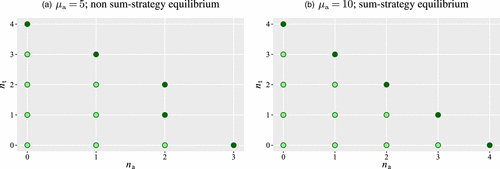
Notes. Parameters: . Dark circles represent the recurrent states under the equilibrium strategy, among which the light dots represent states at the joining region. In panel (b) the equilibrium strategy takes the form of a sum strategy (namely, join if and only if ), but not in panel (a).
Intuitively, the system has a stronger “tendency” to satisfy the sum-strategy-equilibrium criterion when is large relative to . Intuitively, when is extremely large, a customer’s wait time in admission becomes negligible. Moreover, upon joining, a customer can expect with very high certainty to have to wait in the treatment queue for all the other customers currently waiting in the system. Thus, this customer’s cost is primarily driven by the time spent waiting in the treatment queue, and similarly to Naor (1969), the customer will join as long as the total number of customers in the system is smaller than N. If, on the other extreme, is sufficiently smaller than , the equilibrium strategy is not a sum strategy. For example, when and , then a customer may not be willing to wait for even a single customer in admission (that is, they balk at state ), but would be willing to wait for one or more customers in treatment (that is, they join at state ).
3.2. Throughput and Social Welfare
Next, we study the system’s performance under customer equilibrium. Specifically, we focus on two performance measures: throughput and social welfare. To this aim, we derive the system’s steady-state distribution under customer equilibrium. Let be the stationary probability that the system is in state , assuming customers are in equilibrium. Similarly to the definition of , let denote the admission-queue-length threshold corresponding with a treatment-queue length of ; hence, the maximal admission-queue length in equilibrium is . Thus, for any recurrent state , the stationary probability can be found by solving the following balance equations:
The throughput (the subscript “” is mnemonic for “fully observable”) measures how much work per unit of time is processed by the treatment server, on average, in equilibrium. It can be expressed as
Note that the throughput is calculated based on the utilization of the treatment server because customers complete the service process and receive the reward only after they complete the treatment service.
Social welfare, denoted by , is defined as the aggregate customer utility generated in the system per unit of time in equilibrium. This is calculated by summing the product of arrival rate, steady-state probability, and customer utility at each joinable state:
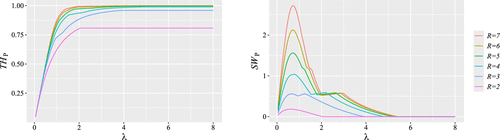
Figure 3 depicts numerical calculations of the throughput and social welfare for various values of and R, with fixed and normalized and . Noticeably, holding all other parameters fixed, the throughput is increasing in and converges to a constant. The monotonicity is intuitive: As arrivals become more frequent, the admission server, and therefore also the treatment server, idle less, leading to increased throughput. The convergence property, however, is more subtle, and we revisit it, as well as compute the limit, in Section 5.1. Yet, a brief inspection of Figure 3 already suggests that the limiting throughput is strictly smaller than both and (see, e.g., the curve corresponding with in the left panel). Unlike Naor (1969), where idleness is eliminated as arrival rate increases to infinity, our tandem structure introduces a second queue that may cause balking even when the admission server is idle.
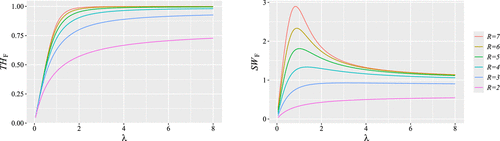
Notes. Parameters: . is increasing in ; is increasing in when R is small, and nonmonotone when R is large.
This is surprising, because it may seem at first glance that with extremely frequent arrivals, the admission queue never empties, thereby keeping the admission server busy indefinitely, akin to Naor (1969). However, in our fully observable model, customers may choose to balk even when the admission server is idle, provided that the treatment queue is sufficiently long. Thus, idleness in either server cannot be avoided.
As for social welfare, a higher arrival rate has two effects: On one hand, it increases the potential demand, but on the other hand, it makes the system more crowded, so that the average (ex ante) utility per customer becomes smaller. These two conflicting effects explain the nonmonotone dynamics of the social welfare when R is relatively large. When R is relatively small, our numerical experiments suggest that the increased demand factor takes a dominating role. These observations are in line with similar findings in Hassin (1986) and Hassin and Roet-Green (2020). Thus, social welfare may increase or decrease with depending on whether the marginal utility of new arrivals outweighs the congestion they introduce.
4. Partially Observable Model
In the partially observable model, each arriving customer sees only the admission queue. The treatment queue length becomes known only after completing admission service. Notably, because the treatment queue is concealed, arriving customers must form expectations about its length in order to estimate their utility from joining. This assessment is conditional on the observed queue length in admission, and further depends on the customer’s belief about the decisions of previously arriving customers, thereby significantly complicating the analysis compared with that of the fully observable case.
Despite these complexities, the model remains analytically tractable, thanks to the no-reneging property described below in Proposition 2.
In the partially observable model, in equilibrium, customers in queue do not renege.
To explain this result, consider a customer who joins the system after observing other customers in admission. Assume, for simplicity, that none of these customers renege while waiting, but will balk upon completing the admission service if they find N other customers in treatment. Then, at the moment of joining, the arriving customer’s net utility, ex ante, can be viewed as an expected value, , where the function u is defined in Lemma 1, and Y is a random variable representing the number of customers in treatment at that moment, conditioned on observing customers in admission. The distribution of Y is contingent on other customers’ joining strategies: Roughly speaking, as more customers join the admission queue, the congestion in the treatment queue increases. But regardless of that distribution, for each possible realization of Y, any admission-service completion improves this joining customer’s position in the queue, as well as their net value-to-go. This follows directly from the diagonal monotonicity of the function u (see Property 3 in Proposition 1). Moreover, even during time intervals with no admission-service completions, the length of the treatment queue potentially decreases. Thus, overall, the expected remaining utility from staying in the admission queue, net of sunk cost, increases while waiting; therefore, rational customers in equilibrium never renege, even without full information.
In the fully observable model, customers in equilibrium never join the system when the total number of customers is N and hence never leave the system after joining (see Corollary 2). Here, in contrast to the fully observable case, customers do not know the exact length of the treatment queue before they transition to it. Thus, despite not leaving while waiting, a customer cannot avoid the possibility of having to balk upon completing the admission service when finding N other customers in treatment.
A subtle yet important observation is that even though a customer’s situation improves as they wait, this alone does not imply that they are more inclined to join when the length of the admission queue is short. In fact, a short admission queue might suggest that many customers had just transitioned from the admission to the treatment queue, making the treatment queue relatively long. Thus, a customer’s joining decision entails an inherent tradeoff between waiting in the admission queue and waiting in the treatment queue, so it is not clear, a priori, that rational customers in equilibrium would join according to a threshold-like strategy.
We therefore describe a strategy in the partially observable model as a vector associating each admission-queue length with a joining probability. Recall from Section 3 that is the maximum possible queue length in admission, given that the treatment queue is empty. Thus, by Proposition 1, a rational customer balks when they observe customers in the admission queue, regardless of the treatment-queue length. We can therefore restrict the customers’ joining strategy to vectors of dimensions, , where is the probability of joining when observing customers in the admission queue.
Denote by the steady-state probability of state when customers all adopt the strategy . The balance equations for the underlying Markov chain (see Equation (17) in the Online Appendix) can be written and solved in the same fashion as those in the fully observable model (see Equation (3)). Although deriving closed-form workable expressions for is difficult in general, one can characterize the marginal distribution of the admission-queue length by noting that the process describing it is of a birth-and-death type. To formalize this result, we denote by the stationary (marginal) probability of finding customers in the admission queue under the strategy . Corollary 3 provides explicit expressions for this sequence of marginal probabilities.
Given a strategy , the marginal probability obeys the following recursive relation: For ,
Evidently, for any , if , then the number of customers in the admission queue can never exceed . With a slight abuse of notation, we let express the maximal number of customers in the admission queue when all customers join according to the strategy . For completeness, if for all , we define .
For , denote by the steady-state probability that the system is in state conditioned on customers in the admission queue, namely, . Also define as the expected utility from joining when there are customers in the admission queue and all other customers join according to . Unlike the fully observable model, where the information with which customers are provided is sufficient for utility assessment, the expected utility in the partially observable model, , is computed with respect to the steady-state distribution induced by the strategy . Thus, is, in essence, a weighted average of the expected utilities from joining in the fully observable model, namely,
Given a strategy , a best response for is a strategy such that for all , implies , and implies . In other words, given a strategy, a best response to it is a strategy that prescribes joining at any observed state if the utility from doing so is strictly positive and balking if it is strictly negative. However, if this utility is zero, a customer would be indifferent between joining and balking (as well as any lottery between them), so that any joining probability at such a state constitutes a best response. Because customers are homogeneous, we seek a symmetric Nash equilibrium, that is, a strategy that is a best response to itself. As it turns out, a consequence of Proposition 3 below is that best-response strategies in the partially observable model take a distinctive mixed-threshold form.
For any and ,
Proposition 3 suggests that for any , if a customer in response to is willing to join an admission queue of length , then they are also willing to join when the admission queue is of length . Strategies that exhibit this trait are called mixed-threshold strategies, and we define them in the same way as in Hassin and Haviv (1997).
(
In words, the -threshold strategy is such that customers join whenever the admission queue is shorter than , balk if it is longer than and otherwise mix between joining and balking with probabilities and , respectively. Thus, for being the -threshold strategy, is the maximum possible number of customers in the admission queue. When is an integer (), we further say that is a pure-threshold strategy.
As a direct consequence of Proposition 3, any equilibrium strategy in the partially observable model, if it indeed exists, must be of a -threshold type for some . The following theorem establishes the existence of such equilibrium strategy.
(
When , the analysis becomes simpler because it implies that the admission-queue length can be at most one. Under this condition, customers in equilibrium consider joining the admission queue only when it is empty, and reflects the equilibrium joining probability. Thus, the admission queue is simply an M/M/1/1 with arrival and service rates and , respectively. The output process in the admission queue, which is renewal with interarrival times distributed as the sum of two independent exponential random variables (with parameters and ), is then fed as input to the treatment queue, which is a G/M/1/N system with service rate . An arriving customer that finds the admission server idle can choose to join and go through admission service for the opportunity to observe the treatment queue and join it if (and only if) it is shorter than N. Hence, from that customer’s point of view, the decision is similar to that in Hassin and Roet-Green (2020), where a customer first spends an independent traveling time to arrive to the queue and then observes its length and decides whether to join. Our model’s analog to the travel time of Hassin and Roet-Green (2020) is the customer’s service time in admission.
Suppose customers join according to the -threshold strategy . When is noninteger, , namely, is the longest queue length that a customer would be willing to join, and if the customer is indifferent to joining at that queue length (i.e., if ), then is an equilibrium strategy. Otherwise, when is an integer, all customers join at any queue length and balk otherwise. In this case, constitutes an equilibrium only if . Figure 4 shows the value of as a function of , for varying from zero to six. The graph is piecewise continuous. Each curve segment corresponds to a different value of , for which is depicted over the interval . In Figure 4(a), the curve segments are all strictly positive for , whereas the segments corresponding to are strictly negative; hence, the equilibrium strategy is . In Figure 4(b), for , the curves are positive and negative for , whereas the curve corresponding to is the only one that intersects the zero line, with when ; therefore, this -threshold strategy is the equilibrium. Furthermore, we observe (in both panels) that as the threshold increases, the utility from joining an admission queue of length , , decreases. Hence, the threshold that represents the best response to the -threshold strategy is decreasing with . This suggests that the game between customers is of the avoid-the-crowd type, therefore supporting our conjecture that the equilibrium is unique.
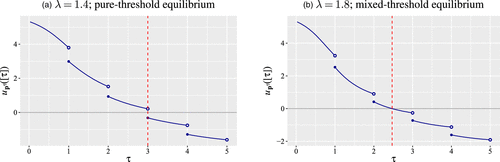
Notes. Parameters: . When , (a) the equilibrium is (pure), whereas with , (b) the equilibrium is (mixed).
In the numerical calculations reported hereafter, we used an iterative equilibrium approximation scheme based on Ravner and Snitkovsky (2023) in order to compute the equilibrium. An elaborate description of the iterative algorithm is provided in the Online Appendix (under “Equilibrium approximation scheme in the partially observable model”). Indeed, given any parameter set, the algorithm converges to a unique equilibrium, regardless of the initial strategy, in alignment with Observation 1 below.
In the partially observable model, over the space of -threshold strategies, decreases with the threshold for all . Hence, in accordance with Theorem 2, a unique threshold equilibrium strategy exists.
4.1. Throughput and Social Welfare
Similarly to the fully observable model, we evaluate system performance in the partially observable model by calculating the throughput and social welfare obtained in equilibrium.
Let be the equilibrium strategy. In analogy to the fully observable model, we define the equilibrium throughput in the partially observable model as
Similarly, the social welfare is defined as the product of and the customer’s (ex ante) expected utility,
Figure 5 depicts and as functions of . The left panel shows that is increasing in and converges to a constant as . In line with our observation in the fully observable model (see Section 3.2), the limiting throughput is strictly smaller than both and . In the fully observable model, this was because of unavoidable idleness in both servers. By contrast, in the partially observable model, infinitely frequent arrivals may indeed drive the admission server to work nonstop, although some customers may balk right after admission service if they find N other customers in the treatment queue. Hence, the effective arrival rate to the treatment queue is smaller than . We prove this result in Section 5.1. The right panel of Figure 5 illustrates , resembling in shape—despite there being some jagged parts. These “kinks” (i.e., nondifferentiable points) correspond to arrival rates where the equilibrium strategy switches from a mixed strategy to a pure strategy or vice versa.
Notes. Parameters: . is increasing in ; is nonmonotone.
In general, the social welfare is not necessarily monotone in R. This observation is easier to explain intuitively when we think about as being extremely large, so that the wait time in the treatment queue is negligible. In such a case, the admission queue resembles Naor’s model with service rate . Thus, when demand is high (), customers join at rate , the queue length is constantly kept at the threshold level, , and the social welfare is , which is nonmonotone in R.
We observe that both pure- and mixed-threshold strategies may remain an equilibrium over an interval of values of , as we illustrate in Figure 6. For example, in both panels, over region D (when ), the equilibrium strategy is of a noninteger threshold , in region E (), the (pure) equilibrium threshold is 3, and in region F (), the equilibrium’s threshold takes the form . The kinks in the social welfare function (see right panel) correspond to the transition between these regions.
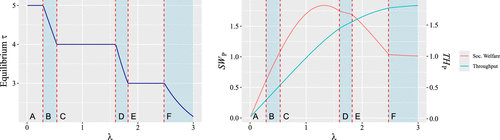
Notes. Parameters: . The shaded regions (B, D, F) correspond to mixed equilibrium strategies, and the nonshaded regions (A, C, E) to pure equilibrium strategies.
5. Comparison: Which Disclosure Policy Is Better?
We now compare the two information disclosure policies to identify when full or partial observability leads to better system performance in terms of throughput and social welfare. For conciseness, we report the results for several representative parameter sets. These results suggest that when the admission server is relatively fast, full observability improves social welfare but may reduce throughput. When admission is slow, the effect reverses or becomes ambiguous.
Figure 7 plots heatmaps of differences (in percentage) between throughput and social welfare for the two information models on grids of and , under different values of R. The more intense the color is, the stronger one model is dominating the other in magnitude.
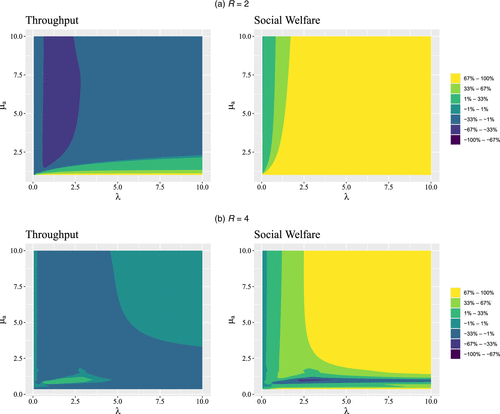
Notes. Parameters: . Broadly, the partially observable model outperforms the fully observable model in terms of throughput and underperforms in terms of social welfare.
In terms of social welfare, it can be seen for the two right panels of Figure 7 that the fully observable model tends to outperform the partially observable, specifically when and . This makes intuitive sense because queue-length information is useful for customers to make better decisions for themselves. Throughput comparison is depicted in the two left panels of Figure 7. Generally, it turns out that without knowing its length, customers tend to underestimate how crowded the treatment queue is, leading to a higher throughput in the partially observable model.
Close inspection of the numeric results reveals interesting behavior of the throughput and social welfare functions in the limit when arrivals become extremely intense (): We notice that, except for very specific choices of and R, as grows, the social welfare under the fully observable policy becomes infinitely many times larger than that under the partially observable; that is, the ratio approaches . Similarly to Edelson and Hilderbrand (1975), this is because in the partially observable system, customers in equilibrium can be indifferent between joining and balking, hence receiving zero utility irrespective of λ. However, in terms of throughput, the partially observable policy performs weakly better than the fully observable in the limit. The latter stands in complete contrast to known results in strategic-queueing literature, akin to Chen and Frank (2004), who show that when demand for service is high, hiding information from customers suppresses joining and thereby system throughput. In what follows, we address these numeric findings by analyzing the limit as .
5.1. High-Demand Limits
To better understand the system behavior under high demand, we analyze the asymptotic regime where the arrival rate , through which we gain insights into throughput and welfare performance under each information policy. A central insight is that when arrivals are extremely frequent, and customers never balk at the admission queue when empty, then the admission server becomes continuously busy. Hence, the potential arrival process to the treatment queue (namely, the departure process from the admission queue) approaches Poisson with rate . This implies that the treatment-queue process behaves similarly to an M/M/1/K queue process with arrival and service rates and , respectively, for some K determined by the customer joining strategy, which further depends on the information disclosure policy.
Recall our definitions and from Section 3. In the fully observable model, indicates the maximum length of the treatment queue in equilibrium. Also, let , thus, can be interpreted as a “load” parameter that controls the congestion in the treatment queue. The following lemma characterizes the limiting throughput and social welfare in the fully observable model.
Under the fully observable model, the following limits hold:
The intuition behind Lemma 3 comes from the fact that under the fully observable policy, with high demand, the treatment queue can be modeled as an M/M/1/, for which we employ known results (Kleinrock 1975, chapter 3.6) to establish the throughput and social welfare expressions. To see why the latter is true, recall that under this disclosure policy, the utility from joining each observed state is independent of and hence so is the equilibrium joining strategy. When is large and the system state is worth joining, a customer will join immediately, and the admission server will be busy, sending customers to the treatment queue at rate . But when the admission queue empties and the treatment queue is sufficiently long—namely, if the system reaches state —then the admission server will idle for a nonnegligible amount of time. This idleness will last until the moment a service completes in the treatment queue, causing its length to fall from to . Then, a customer instantaneously joins the admission queue, and the new system state becomes . From this point, the admission server will remain busy, and customers will continue to arrive to the treatment queue, until the next time the system reaches state .
Following this intuition, the effective (joining) customer arrival rate to the treatment queue, which is also the system throughput, can be computed either as the product of and the probability that the length of the treatment queue is , or as the service rate times the probability of the treatment queue being empty (see Equation (8)). Hence, in line with the discussion in Section 3, (as shown in Figure 3). Based on that, the limiting social welfare can be derived by multiplying the limiting throughput by R and subtracting the average waiting cost per unit of time in the queue. This latter cost is simply C times the expected sum of the lengths of the queues, where we note that each treatment-queue length is associated with an admission queue of length .
The analysis of the partially observable model with high demand is slightly more involved. To formulate expressions analogous to those of Lemma 3 for the partially observable model, we first define the following quantity:
It can be interpreted as the social welfare generated (per unit time) by an M/M/1/N queue with arrival rate , service rate , waiting cost C, and service reward R, similarly to the social welfare formula in Naor (1969) with threshold N. This expression, as before, is the difference between the product of R by the effective arrival rate and the product of C by the average queue length. Because customers arrive to the treatment queue at rate , is the expected net utility generated by this M/M/1/N system for each customer.
The expected waiting cost in the admission queue is at least , which is incurred when the queue is empty. Thus, expecting to receive in the treatment phase, a customer will commence service in admission only if , or, equivalently, if . To keep focused, we assume in what follows that ; hence, customers never balk at the admission queue if it is empty (regardless of other customers’ strategy and/or arrival rate). Similarly to Lemma 3, the next lemma characterizes the limiting throughput and social welfare for the partially observable policy.
Under the partially observable model, if , then
If, in addition, is noninteger, then
In the partially observable model, assuming customers do not balk at an empty admission queue, the admission server never idles. The resulting behavior of the treatment queue, similar to the fully observable model, is that of the finite-buffer, single-server Markovian queue with arrival rate and service rate . But, as opposed to the fully observable case, where the treatment queue is an M/M/1/, in the partially observable model, it is M/M/1/N. As discussed, the expected value for a customer from attempting to join the treatment queue is given by (independently of the observed length at admission), and similarly to Naor (1969), customers will join the admission queue up to a threshold . Once a customer leaves the admission queue, another customer immediately joins, and the admission queue is kept at constant length , hence inflicting social cost at rate . As the treatment queue generates welfare at rate , the social welfare in the system overall is given by .
For technical reasons, in introducing and proving Equation (9), we disregard knife-edge parameters (namely, when is divisible by C). Similarly to Naor (1969), when the reward parameter is divisible by the waiting cost parameter, the equilibrium joining strategy, and thereby also the social welfare in equilibrium, depend on a predetermined tie-breaking rule. However, when customers are restricted to a deterministic tie-breaking rule, an equilibrium in the partially observable model need not exist. Nevertheless, the set of all such points in the parameter space is negligible (in the sense that its interior is empty).
Assuming , with high demand, the (limiting) throughput under the partially observable model weakly dominates that under the fully observable, namely,
If, in addition, is noninteger, then
As explained earlier, with high demand and under the assumption , the treatment queue under both policies is a single-server, finite-buffer Markovian queue with arrival and service rates and , respectively. However, under fully observable information, the treatment queue’s buffer size is , whereas under partially observable information, it is N. Because , the throughput under the partially observable model can only be greater than that under the fully observable. This result is in sharp contrast to comparable previous results that show that disclosing information when demand is high yields higher throughput. For example, in the standard M/M/1 setting with arrival rate , service rate , reward R, and delay cost C, when the queue is observable (Naor 1969), the throughput approaches as , whereas in the unobservable case (Edelson and Hilderbrand 1975) it remains constant at () for any .
With regard to social welfare, we note that in the limit as , the social welfare in both the fully and partially observable models converges to a constant between zero and C. Moreover, it is easy to spot different parameter choices for which one regime outperforms the other (although by not more than C) and vice versa. To understand why, note in Equation (9) that in the partially observable case, the limit equates modulo C (which is periodic); hence, . Similarly, under the fully observable model, the system is kept constantly in a state where joining yields negative utility. In other words, if there was one more customer constantly waiting in the system, the social welfare would have been negative. Note that the cost of having one more customer waiting in the system is C per unit time; hence, . Thus, one regime cannot outperform the other by more than C.
Our analytic results in the high-demand setting provide further evidence to our previously discussed managerial implication: Concealing downstream queue-length information can surprisingly improve throughput by encouraging customers to enter and commit to the first stage, yet this may come at the cost of reduced individual efficiency and lower social welfare.
6. Concluding Remarks and Future Work
This paper examined how strategic customer behavior is shaped by information provisioning in tandem service systems, focusing on the interplay between observability, reneging, and system performance. We characterized equilibrium strategies under two disclosure policies—one in which customers observe both queues before joining, and another in which only the admission queue is visible. Our analysis shows that full disclosure typically improves social welfare but reduces throughput, as customers adopt more conservative entry behavior. Moreover, we prove that in the fully observable model, rational customers never renege after joining, whereas in the partially observable model, balking may occur upon learning the treatment queue length. These findings suggest that full information can help mitigate the phenomenon of admitted customers leaving without completing service.
The analytical framework developed here can be extended to settings in which customers derive partial value from completing the first stage of service. In such a model, customers may be willing to endure longer waits in the admission queue and intentionally balk at the treatment stage. Although the fully observable model would still admit a two-dimensional threshold strategy, some results would no longer hold—for instance, the total number of customers in the system may exceed the maximal treatment queue length, and balking could occur even under full observability.
In many service environments, the admission queue serves as a triage mechanism. In healthcare, admission nurses direct patients and prioritize them based on condition severity; in tech support, front-line representatives route customers based on service needs. These contexts motivate an extension of our model to include priority rules and dispatch policies, enriching the treatment phase beyond a simple single-server setup. Here, the admission stage plays a crucial role in regulating downstream congestion. A long admission queue may deter entry even when the relevant treatment queue is relatively empty—a phenomenon with potential implications for staffing and resource allocation.
Future research may further extend this framework to more complex service networks, incorporate customer heterogeneity, staffing decisions, or explore dynamic information design strategies. We believe that this growing line of research, to which our findings aim to contribute, can inform the design of service networks where transparency and efficiency must be carefully balanced.
References
- (2022) Pricing in service systems with rational balking and abandonment of time-sensitive customers. Production Oper. Management 31(2):495–510.Crossref, Google Scholar
- (2015) Rational abandonment from priority queues: Equilibrium strategy and pricing implications. Working paper, Columbia Business School, New York.Google Scholar
- (2011) The impact of delaying the delay announcements. Oper. Res. 59(5):1198–1210.Link, Google Scholar
- (2011) “we will be right with you”: Managing customer expectations with vague promises and cheap talk. Oper. Res. 59(6):1382–1394.Link, Google Scholar
- (2023) Information design for congested social services: Optimal need-based persuasion. Management Sci. 69(7):3778–3796.Link, Google Scholar
- (2004) Contact centers with a call-back option and real-time delay information. Oper. Res. 52(4):527–545.Link, Google Scholar
- (1990) Reneging from processor sharing systems and random queues. Math. Oper. Res. 15(1):129–138.Link, Google Scholar
- (2018) An equilibrium analysis of a multiclass queue with endogenous abandonments in heavy traffic. Oper. Res. 66(1):163–183.Link, Google Scholar
- (2017) An equilibrium analysis of a discrete-time Markovian queue with endogenous abandonments. Queueing Systems 86(1):141–212.Crossref, Google Scholar
- (2024) Equilibrium strategies for overtaking-free queueing networks under partial information. Math. 12(19):2987. Google Scholar
- (2012) Optimal and equilibrium balking strategies in the single server markovian queue with catastrophes. Eur. J. Oper. Res. 218(3):708–715.Crossref, Google Scholar
- (2017) Equilibrium joining strategies in batch service queueing systems. Eur. J. Oper. Res. 260(3):1142–1151.Crossref, Google Scholar
- (2013) Customer equilibrium and optimal strategies in Markovian queues in series. Ann. Oper. Res. 208:515–529.Crossref, Google Scholar
- (2007) Equilibrium customer strategies in a single server Markovian queue with setup times. Queueing Systems 56:213–228.Crossref, Google Scholar
- (2004) Monopoly pricing when customers queue. IIE Trans. 36(6):569–581.Crossref, Google Scholar
- (2019) Strategic experimentation in queues. Theoretical Econom. 14(2):647–708.Crossref, Google Scholar
- (2015) Pure threshold strategies for a two-node tandem network under partial information. Oper. Res. Lett. 43(5):467–470.Crossref, Google Scholar
- (2023) Equilibrium behavior in tandem Markovian queues with heterogeneous delay-sensitive customers. Oper. Res. Forum 4:80.Crossref, Google Scholar
- (2021) Strategic customer behavior in a queueing system with alternating information structure. Eur. J. Oper. Res. 291(3):1024–1040.Crossref, Google Scholar
- (2020) Strategic behaviour in a tandem queue with alternating server. Queueing Systems 96(3):205–244.Crossref, Google Scholar
- (2021)
The impact of information structure on strategic behavior in queueing systems . Queueing Theory 2, Advanced Trends (Wiley, Hoboken, NJ/ISTE, London).Crossref, Google Scholar - (2022) The value of reneging for strategic customers in queueing systems with server vacations/failures. Eur. J. Oper. Res. 299(3):960–976.Crossref, Google Scholar
- (1975) Congestion tolls for Poisson queuing processes. Econometrica 43(1):81–92.Crossref, Google Scholar
- (1985) Control of arrivals to two queues in series. Eur. J. Oper. Res. 21(3):399–409.Crossref, Google Scholar
- (2006) Using queueing theory to increase the effectiveness of emergency department provider staffing. Academic Emergency Medicine 13(1):61–68.Crossref, Google Scholar
- (2007) Analysis and comparison of queues with different levels of delay information. Management Sci. 53(6):962–970.Link, Google Scholar
- (2009) The effects of the availability of waiting-time information on a balking queue. Eur. J. Oper. Res. 198(1):199–209.Crossref, Google Scholar
- (2022) Individual and social customers’ joining strategies in a two-stage service system when discount is offered to users of smartphone application. Appl. Math. Modeling 105:355–374.Crossref, Google Scholar
- (1985) Notes and comments on the optimality of first come last served queues. Econometrica 53(1):201–202.Crossref, Google Scholar
- (1986) Consumer information in markets with random product quality: The case of queues and balking. Econometrica 54(5):1185–1195.Crossref, Google Scholar
- (2016) Rational Queueing. Chapman and Hall/CRC.Google Scholar
- (1995) Equilibrium strategies for queues with impatient customers. Oper. Res. Lett. 17(1):41–45.Crossref, Google Scholar
- (1997) Equilibrium threshold strategies: The case of queues with priorities. Oper. Res. 45(6):966–973.Link, Google Scholar
- (2003) To Queue or Not to Queue: Equilibrium Behavior in Queueing Systems (Springer Science & Business Media, New York).Crossref, Google Scholar
- (2017) Profit maximization in the m/m/1 queue. Oper. Res. Lett. 45(5):436–441.Crossref, Google Scholar
- (2017) The impact of inspection cost on equilibrium, revenue, and social welfare in a single-server queue. Oper. Res. 65(3):804–820.Link, Google Scholar
- (2018) Cascade equilibrium strategies in a two-server queueing system with inspection cost. Eur. J. Oper. Res. 267(3):1014–1026.Crossref, Google Scholar
- (2020) On queue-length information when customers travel to a queue. Manufacturing Service Oper. Management 23(4):989–1004.Link, Google Scholar
- (2001) Homogeneous customers renege from invisible queues at random times under deteriorating waiting conditions. Queueing Syst. 38:495–508.Crossref, Google Scholar
- (2017) Strategic customer behavior in a queueing system with a loss subsystem. Queueing Syst. 86(3):361–387.Crossref, Google Scholar
- (2020) Social and monopoly optimization in observable queues. Oper. Res. 68(4):1178–1198.Link, Google Scholar
- (2017) Efficient ignorance: Information heterogeneity in a queue. Management Sci. 64(6):2650–2671.Link, Google Scholar
- (2018) Sharing delay information in service systems: A literature survey. Queueing Systems 89(1):49–79.Crossref, Google Scholar
- (2011) Equilibrium joining probabilities for an m/g/1 queue. Games Econom. Behav. 71(2):521–526.Crossref, Google Scholar
- (2024) On the value of service age information. Preprint, submitted March 12, https://doi.org/10.2139/ssrn.4733565.Google Scholar
- (2016) Equilibrium strategies for a tandem network under partial information. Oper. Res. Lett. 44(4):532–534.Crossref, Google Scholar
- (1975) Queueing Systems: Theory (John Wiley, Hoboken, NJ).Google Scholar
- (2015) Going with the flow: Left without being seen in the emergency department. PhD thesis, University of North Carolina at Chapel Hill Graduate School, Chapel Hill.Google Scholar
- (2025) On the design of a shared waiting room. Production Oper. Management 34(8):2395–2412.Google Scholar
- (2021) On the optimal disclosure of queue length information. Naval Res. Logist. 68(5):615–630.Crossref, Google Scholar
- (2019) Optimal signaling mechanisms in unobservable queues. Oper. Res. 67(5):1397–1416.Link, Google Scholar
- (2017) Observational learning in queues with abandonments. Working paper, Columbia Business School, New York.Google Scholar
- (2000) A model for rational abandonments from invisible queues. Queueing Systems 36:141–173.Crossref, Google Scholar
- (2020) Deterministic state-based information disclosure policies and social welfare maximization in strategic queueing systems. Queueing Systems 96(3):303–328.Crossref, Google Scholar
- (1969) The regulation of queue size by levying tolls. Econometrica 37(1):15–24.Crossref, Google Scholar
planDisney (2022) How to find out wait times at parks on app. Accessed September 2024, https://plandisney.disney.go.com/question/find-wait-times-parks-app-483280/.Google ScholarQ-MATIC Group AB (2024) Qmatic webpage. Accessed September 2024, https://www.qminder.com/.Google ScholarQminder Ltd (2024) Qminder webpage. Accessed September 2024, https://www.qminder.com/.Google Scholar- (2023) Stochastic approximation of symmetric Nash equilibria in queueing games. Oper. Res. 72(6):2698–2725.Google Scholar
- (2018) Customers’ abandonment strategy in an m/g/1 queue. Queueing Systems 90:65–87.Crossref, Google Scholar
- (2004) Rational abandonment from tele-queues: Nonlinear waiting costs with heterogeneous preferences. Queueing Systems 47:117–146.Crossref, Google Scholar
- (2016) Optimal information disclosure policies in strategic queueing games. Oper. Res. Lett. 44(1):109–113.Crossref, Google Scholar
Starbucks Stories and News (2020) A how-to guide for digital ordering at Starbucks. Accessed September 2024, https://stories.starbucks.com/stories/2020/a-how-to-guide-for-digital-ordering-at-starbucks/.Google Scholar- (2020) Order ahead for pickup: Promise or peril? Preprint, submitted November 11, https://doi.org/10.2139/ssrn.3673617.Google Scholar
U.S. Border and Customs Protection (2023) Border wait times. Accessed September 2024, https://bwt.cbp.gov/.Google Scholar- (2019) Search among queues under quality differentiation. Management Sci. 65(8):3605–3623.Link, Google Scholar
- (2002) Adaptive behavior of impatient customers in tele-queues: Theory and empirical support. Management Sci. 48(4):566–583.Link, Google Scholar
Ran Snitkovsky is an assistant professor at the Coller School of Management, Tel Aviv University. His research revolves around the modeling and methodology of strategic, social, and behavioral interactions in congestion-prone systems, with emphasis on economic and managerial insights.
Ricky Roet-Green is an associate professor of operations management at Simon Business School, University of Rochester. Her research interests lie in modeling and analyzing the behavior of strategic customers in service systems, aiming to understand customers’ decisions and optimize system performance in terms of revenue and social welfare.
Jingwei Ji is a PhD student at Stanford University. His research centers on data-driven sequential decision making, with a particular emphasis on applications in finance and operations management, as well as other domains where data and optimization intersect.