Residential Battery Storage—Reshaping the Way We Do Electricity
Abstract
In this study, we investigate households’ investments in behind-the-meter battery storage alongside rooftop solar and examine the effects of these batteries on consumers, the power market, and environmental emissions. We develop a structural estimation model of residential electricity usage that separates observed demand and consumption preferences and lets us estimate a nonfinancial utility that households may have for using self-generated solar power over grid-procured electricity. We call this utility nonmarket valuation, provide evidence that it is driven by sustainability and autarky desires, and relate it to the early adoption of residential storage. Applying this model to a novel data set of German households, we find that the median household has a nonmarket valuation of 0.29€ per kilowatt hour (kWh). We then show that owning storage increases a household’s electricity demand (storage rebound) and marginally increases the emissions by 57 kg CO2/year/kWh of battery capacity. However, batteries may reduce emissions if solar penetration in the grid is sufficiently high. Lastly, we estimate that, at future technology costs, 2023 European electricity prices, and without subsidies, investing in storage is optimal for 54% of households, which would reduce the residential grid load by 38%, but, counterintuitively, also make it more variable.
Funding: Financial support from the Kleinman Center for Energy Policy, Mack Institute for Innovation Management, Wharton School, University of Pennsylvania is gratefully acknowledged.
Supplemental Material: All supplemental materials, including the code, data, and files required to reproduce the results, are available at https://doi.org/10.1287/opre.2024.1104.
1. Introduction
In the early 2000s, the first homeowners started installing solar panels on their roofs to produce their own electricity and sell excess generation back to the grid. At that time, such an investment was only profitable in countries with high subsidies and favorable net-metering regulation (Klein and Deissenroth 2017). Since then, solar panel prices have declined 85%, and, to date, more than 118 GW of residential capacity has been installed worldwide (Lazard 2020, Hemetsberger et al. 2023). More recently, some homeowners have started to install batteries to store excess generation and consume it at a later point. According to IEA (2024), these so-called behind-the-meter (BTM) battery investments totaled more than 14 GW in 2023 alone. Although storage is not yet a profitable investment for most private consumers, lithium ion costs continue to decrease year by year, feed-in tariffs1 are declining globally, and utilities are adapting their business models to stop decreasing revenues through behind-the-meter generation. Thus, it is a critical time to understand what drives homeowners to be early adopters of residential storage solutions and how the presence of these batteries affects consumer behavior and markets.
Four factors drive home storage investments: (1) technological progress, (2) changing consumer preferences, (3) evolving electricity tariffs, and (4) policy developments. With regard to technology, the attractiveness of the investment in so-called photovoltaic (PV) power increases as solar panels continue to get cheaper, and thus, the gap between the cost of electricity generated by the grid (e.g., provided by the utility) and self-generated energy widens. Lithium ion batteries have matured to be deployed on an industrial scale and have decreased in cost by 88% (BloombergNEF 2020) in the last decade. Although electric vehicles are the largest use case for lithium ion batteries, grid-level batteries are a rapidly growing market; Frazier et al. (2021) predict a 3,000-fold increase in the capacity of the U.S. grid battery from 2020 to 2050.
A second driver of residential storage investment is an increasing consumer desire not only to reduce electricity cost, but also to increase renewable consumption under sustainability considerations, or to improve energy autarky2 in the face of increasing reliability concerns (Müller et al. 2011).
A third driver is the change in electricity tariffs in many regions of the world. Behind-the-meter solar generation may pose a triple threat to the bottom line of utilities (Darghouth et al. 2016). First, it decreases the total grid electricity demand, as customers partially satisfy their own electricity needs. Second, many utilities are forced to buy back excess solar generation from households and preferentially feed it into the grid. Third, with increasing intermittent solar generation, the net demand of utilities (demand minus behind-the-meter generation) becomes more variable, requiring a more responsive and costlier plant portfolio. In response to these changes, utilities have raised prices and even started charging tiered tariffs, with higher prices in the evening, or tied customer charges to the energy spot market. Solar-coupled storage can help households avoid an increase in electricity bills.
Lastly, many policymakers around the world have lowered or phased out feed-in benefits, as unsubsidized renewables have become cost-competitive technologies (IEA 2020). Some jurisdictions have capped the amount of electricity a household may sell back to the grid in a given year or have employed net-metering strategies that potentially lead to situations where some of a household’s excess generation cannot be profitably used. A second policy trend is that after the Russian war on Ukraine, many countries try to become more independent of fossil fuel imports and focus heavily on the successful integration of intermittent sources, partially mandating some level of storage investments (NDRC 2019, EEG 2023). Both the lower subsidies for selling excess solar generation back to the grid and the energy independence policies aid the storage business case.
Taken together, these developments have caused strong interest in residential energy storage, particularly in markets with historically high electricity prices, such as Germany, where installations increased 20 times between 2015 and 2020 and 5 times between 2020 and today, reaching over 1 million residential storage systems installed in 2023 alone (Figgener et al. 2023). However, especially early on, many of these installations were unprofitable investments. To study why these investments were still made, we develop a structural model that combines a household’s solar and storage investments with its demand pattern to estimate two parameters: the households’ utility for energy at different times throughout the day and, more importantly, each household’s nonmarket valuation, a term we define as a nonfinancial cost the household incurs when purchasing energy from the grid. Using marketing and survey data, we show that this nonmarket valuation, in large part, captures sustainability and autarky desires to preferentially utilize one’s own solar energy over the grid’s electricity.
We use a large, proprietary data set of thousands of European households for which we observe PV generation and demand in 15-minute granularity from 2018 to 2020, as well as installed solar and storage capacities. We estimate the average German household’s nonmarket valuation to be 53 cents per kWh, with a median valuation of 29 cents. These valuations allow us to explain why the average household in the data set installed 5.69 kWh of battery storage, despite such an investment having been financially suboptimal. Households that have a nonfinancial desire to use their own solar power over the grid may add storage capacity beyond what would be optimal from a pure electricity cost-minimization perspective. This insight is relevant to understanding the motivations of early adopters of storage or other green technologies, which can help, for example, predict the timing of such technology adoption in different markets, where power prices may be lower.
We then combine these behaviorally driven nonmarket valuations with household-specific estimates of hourly electricity consumption preferences. This approach allows us to analyze how these early adopters of storage differ from regular households. We show, for example, that storage households increase their electricity consumption by 4% on average, which we call storage rebound. Counterintuitively, this increased consumption and the generation mix in Germany mean that during 2018–2020, the addition of batteries increased household emissions by 57 kg CO2/kWh/year. However, if the penetration of solar energy in a grid is sufficiently high, we find that batteries can indeed decrease emissions.
To understand what magnitude storage will have for a country, we turn from early adopters to the majority of the population and aim to understand what share of general households would adopt going forward. In a hypothetical future scenario with reduced technology costs, no subsidies, and moderately high electricity prices, we find that owning storage would be optimal for 54% of households, regardless of their nonmarket valuation, highlighting the importance of understanding the impact of storage on electricity markets.
According to our data set, households making these investments in solar and storage buy 38% less energy from the grid and, surprisingly, increase the variability of grid demand throughout the year. This happens because households are more dependent on their cheaper self-generation, but may experience consecutive days of low solar output and high grid dependency. Together, these changes in electricity consumption will likely require new policies and tariff structures to account for the strategic options that storage provides. Increasing residential storage capacity will likely also require utility companies to become more responsive—for example, by investing in gas-peaking plants or grid-scale batteries. However, we also find that the share of self-generated electricity for households with moderate (4.8 kWh) and large (12 kWh) batteries remains around 62%. This is mainly due to the seasonality in solar radiation and the resulting seasonality in storage utilization, meaning that becoming completely self-sufficient in solar and storage is not a likely prospect for homeowners.
In summary, our paper develops a structural model to understand residential households’ electricity consumption and storage-plus-solar investment behavior. We then apply the model to a large proprietary data set of German households to estimate individual consumption preferences and nonmarket valuations. Combining these two elements, we are able to (i) characterize the distribution of the nonmarket valuation in the studied population, which allows us to explain the early adoption of batteries before those investments become profit-optimal; (ii) show how the availability of solar and storage technology enables individuals to become strategic “prosumers” and quantify the effect this has on grid demand and its variability; and (iii) quantify under which circumstances solar and storage investments reduce carbon and find storage to currently increase emissions, but also show evidence that batteries will be vital to reduce emissions in high-solar grids of the future. Overall, our results provide theoretical and practical insights for companies working in energy technology, homeowners, utilities, and policymakers.
2. Literature Review
This paper combines a large, granular data set and structural modeling in the energy storage space, which relates to several streams of the (operations) literature, from investment decisions and behavioral aspects to estimation approaches. The households’ capacity and consumption decisions under sustainability considerations that we study closely relate to the empirical sustainability literature that has gained a lot of traction in recent years. A recent example includes Buell and Kalkanci (2021), who show through field experiments that customers are more likely to purchase products from a company engaging in responsible practices focused on internal stakeholders. For a more detailed review of the trajectory and trends in the field of sustainable operations, see Atasu et al. (2020). Beyond operations, this combination of personal beliefs and (investment) choices has been studied by behaviorists like Ferraro and Price (2013), showing that nonpecuniary benefits drive behavior, economists trying to trade off nonmarket benefits with the costs of environmental policy (Baker and Ruting 2014), and finance scholars like Baker et al. (2022) showing that individuals are willing to pay a premium for mutual funds that have an environmental, social, and governance mandate.
The specific field of renewable energy and storage that this paper aims to contribute to has seen a resurgence of research interest in recent years. The need to decarbonize the grid, coupled with the progression of solar, wind, and storage technologies, has created many avenues of ongoing exploration. One such avenue to which we relate is the study of self-generated electricity, which has spurred research such as Guajardo (2018) and Agrawal et al. (2022) looking at different ownership structures for solar generation; and Sunar and Swaminathan (2021) studying the impact of net-metering policies for solar producers on the profit of utilities. The works of Drake et al. (2016) and Eid et al. (2014) further investigate the interplay between policy decisions, renewable investment, and associated costs. Beyond these mentions, there exists an extensive literature on electricity tariffs and energy policy that analyzes the impact of decentralized solar (Alizamir et al. 2016, Babich et al. 2020, Singh and Scheller-Wolf 2022), as well as renewables in general (Wu and Kapuscinski 2013, Fattahi et al. 2023). Furthermore, our work links to several articles that study how to accommodate renewable’s intermittent generation and random demand, such as Pritchard et al. (2010), who propose a single-settlement market with nodal pricing to reach resource adequacy in markets with unpredictable market participants; Kök et al. (2020), who study investments in renewable and conventional generation under different pricing schemes; or Sioshansi et al. (2009), who estimate the various value streams that storage can create in wholesale market with increased volatility using data from the Pennsylvania–New Jersey–Maryland Interconnection grid operator.
Of particular relevance to this paper is the more nascent literature on energy storage operations. Kaps et al. (2023) and Peng et al. (2021) study the optimal investment in renewables and storage in the presence of intermittency and flexible generation, but both are modeling papers that look at the problem from the perspective of a central decision maker. They find storage and renewables to be strategic complements at low levels and substitutes at high levels. They also characterize when storage investment can be profitable. Wu et al. (2023) is also a modeling-based paper that investigates when to install grid storage at a central node or in a decentralized approach, depending on, among other things, demand profiles and line losses. Furthermore, Karaduman (2020) has looked at the economics of grid-level storage that acts as a strategic participant in a wholesale market. The author calibrates the model with Australian market data from 2016–2017 and concludes that storage investment is not profitable for a private investor but increases overall welfare. However, in the absence of detailed data sets on real-time storage operations, most of this work is modeling-focused, only with some empirical calibrations or numerical examples. In contrast, our work uses several thousand real-life residential storage units to derive insights into the operational value of this technology.
Because individual households are the focal unit in this paper, methodologically, our approach is based on work from the behavioral literature and is especially closely linked to articles that have used structural estimation as a means to uncover latent parameters in decision makers. A seminal paper in this field is Berry et al. (1995), in which the authors develop a random coefficient choice model of households’ (car) purchase choices, which they pair with product characteristics and then aggregate the observations to gain insight into the market equilibrium structure. In recent years, the availability of big data has advanced the field of structural estimation in many areas, to the point where individual customers can be analyzed. Examples of this are Uppari et al. (2024), who use individual-level data from light-bulb charging stations in Rwanda to estimate the inconvenience of travelers and suggest different policies to accommodate those preferences. Bollinger and Gillingham (2012) and Souyris et al. (2022) use a structural model to estimate households’ solar panel adoption decisions and show that peer effects are one of the drivers of technology adoption. Bollinger et al. (2022) expand on this view and argue that within a community, a large part of solar adoption is caused by the visibility of the panels to the neighbors. They argue that adoption is only plausibly driven through other channels, such as word of mouth, in the immediate vicinity (less than 100 meters) of a focal household. Our paper differs from this approach, as we focus on storage adoption, a technology that, when installed, is not visible to peers (neighbors). We thus do not model peer effects. In a related, but different, setting, Blair et al. (2022) study households’ thermostat setting behavior and resulting energy consumption effects. The multiperiod utility approach that Nevo et al. (2016) employs to derive population-level preferences for speed and data limits of residential internet customers is similar in spirit to our model setup. Other notable works in the empirical structural realm are Tan and Staats (2020) and Li et al. (2014).
To the best of our knowledge, there are currently no papers that derive specific insights for residential storage ownership, sustainable behavior of individual households, and the market/grid impact of such customers. However, some articles have studied related questions, such as Li (2019), who developed a genetic algorithm to optimize the capacity of residential solar and storage calibrated on a 2015 Australian household data set from the Smart-Grid, Smart-City project. Instead of estimating latent household preferences, the authors used historical data to optimize their capacity-sizing algorithm. Also relying on simulation, Babacan et al. (2018) show that residential batteries may increase carbon emissions under certain assumptions about the grid structure. Deng and Newton (2017) study residential energy consumption of households with solar panels and find a solar rebound effect—households consume more energy after installing solar panels than before. We expand upon these works by studying storage adoption in addition to solar and by using empirical data that allow us to model adoption and demand decisions. Closest in spirit to our manuscript is the recent work by Bollinger et al. (2024), who estimate how storage and solar adoption interact. They show complementarities between both technologies, as well as an increase in storage adoption after experiences of intense power outages using California data. However, the authors do not observe granular consumption or generation data of the household and can thus not analyze the demand or emission effects of the installations, which is where we aim to contribute to the literature. Additionally, their explanation of storage adoption does not apply to the observed installation in markets with more secure energy supply, like the one we study in Germany.
This paper thus expands on the existing literature by combining a novel, granular, large data set and a behavioral structural model to infer household electricity consumption preferences and the nonmarket valuation of the home that catalyzes storage investments. We then use these estimates of nonpecuniary benefits to analyze how the behavior of residential consumers with self-generation and storage impacts a grid provider and how it impacts the households’ response to changes in the tariff structure.
3. Data
We start by introducing the data set and point out some core dynamics to familiarize the reader with the information that will be utilized in the model later. Household consumption and solar generation have been generously provided by Solarwatt, a German company headquartered in Dresden with almost 30 years of industry experience. The company has been manufacturing and installing solar panels for decades and, in 2015, started offering storage. Today, Solarwatt offers residential and commercial customers a combined solar plus storage installation that is controlled by its proprietary software–hardware combination called energy manager. In this article, we use the energy manager data for 2018–2020 of more than 4,000 customers who use their products. Of the households in the data set, 99% are from Europe, and of those, 80% are from Germany. The data contain separate time-series of the solar generation, energy consumption, and storage usage of each household (if installed) in 15-minute increments from the household system installation date until December 31st 2020. Data have been appropriately masked and de-identified, following the European data privacy regulation. Based on the installation date, we also know what federal storage subsidies were available to the household and what feed-in subsidies the household receives. The data set also contains each household’s installed solar and storage capacity, and we know which prices Solarwatt charged for the storage capacity. We provide the descriptive statistics for the private German households in Table 1, which will be used to derive most of the results in Section 5 (please see Online Appendix EC.2 for the descriptive statistics for all households and an explanation on the households’ energy billing).3
|

Table 1. Data Set Descriptive Statistics—German Households
| n = 3,237 | Storage (kWh) | PV Power (kw) | #Observations | Daily PV Gen (kWh) | Daily Dem (kWh) |
|---|---|---|---|---|---|
| Min | 0.00 | 0.10 | 10,029 | 0.02 | 0.39 |
| Median | 4.80 | 6.00 | 62,973 | 15.05 | 13.54 |
| Average | 5.69 | 6.30 | 64,560 | 16.62 | 16.37 |
| Max | 28.80 | 33.60 | 105,119 | 111.25 | 99.68 |
| Std. dev. | 2.97 | 3.44 | 26,397 | 9.58 | 10.16 |
Some customers installed their solar (and storage) systems as early as 2015, whereas others joined the data set during the observation period (2018-2020). We only consider households for which we have at least 10,000 observations (over three months of data) to capture an informative amount of consumption and generation variation. For the average household, we have about two years worth of data (64,560 15-minute interval observations), excluding missing or corrupt data that have been deleted in the data cleaning process.4
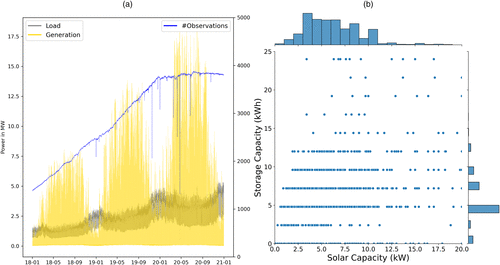
Figure 1(a) shows the combined demand and load profile of the households in the data across the observed horizon, while Figure 1(b) depicts the correlation between the installed solar capacity and the storage capacity in the data. Storage capacity is plotted in discrete steps as Solarwatt’s customers purchase storage in battery modules that each have a 2.4 kWh capacity.
How Households Use Storage. To the best of our knowledge, this data set is one of the first that allows a granular analysis of individual households with heterogeneous solar and storage installations. Therefore, we use it to document the variability in electricity use and the interaction of the grid of these households, stratified by storage investment in Table 2.
|
Table 2. Analysis of Average Household and Grid Interaction Stratified by Storage Capacity
| Storage Size (in kWh) | 0 | 2.4 | 4.8 | 7.2 | 9.6 | 12 |
|---|---|---|---|---|---|---|
| # Households | 248 | 103 | 1,804 | 632 | 285 | 125 |
| Daily Demand (in kWh) | 17.0 | 9.4 | 13.9 | 17.9 | 22.3 | 27.4 |
| % Self-Generated | 44% | 58% | 62% | 63% | 63% | 61% |
| Solar Power (in kWp) | 6.8 | 4.3 | 5.5 | 6.9 | 7.7 | 10.6 |
| Daily Feed-In (in kWh) | 13.6 | 7.7 | 9.2 | 11.2 | 11.6 | 17.1 |
| Ratio of Solar Generation/Demand | 125% | 140% | 128% | 126% | 115% | 123% |
Households with solar power but no storage are reasonably similar to the average household based on demand and solar generation. However, these households can only fulfill 44% of their demand themselves, despite producing, on average, 125% of their demand in solar power. Consequently, their feed-in of 13.6 kWh is larger than that of most households with storage.
Interestingly, most households opted to install multiple storage modules (i.e., more than 2.4 kWh of battery capacity). In comparison, the relatively few households that opted for a single storage module have much smaller demands (9.4 kWh) and solar installations (4.3 kWp—measured in kilowatt peak, the nameplate capacity of a solar installation) than a typical household, which allows even the small 2.4-kWh battery to increase their autarky (i.e., self-generated electricity) to 58%.
For households with two or more storage modules ( 4.8 kWh), demands, storage installations, and solar capacity increase proportionally. However, the share of demand that is self-generated stagnates beyond 4.8 kWh at around 62%–63%. One reason is the corresponding increase in demand, so that 12 kWh only stores 10 hours’ worth of energy for the average household, whereas 12 kWh would serve smaller households in the 2.4-kWh bracket for almost three times as long. The second reason is the seasonality of generation and demand. Consecutive low-generation days that may occur in the winter decrease the share of self-generated electricity, whereas summer days with long hours of sunshine increase it.
To gain a better understanding of how household storage affects the grid provider,5 we dive into intraday dynamics. In Figure 2, we compare the sources of electricity on an average day between the average household without storage versus the average household with a 4.8-kWh battery. Interestingly, the households differ in their demand patterns in a way that seems to be aligned with their investment decisions—a point we examine in more detail in Section 5.3 (please see Online Appendix EC.1 for a model-free analysis of the demand patterns). In particular, the households equipped with storage in Figure 2(a) have a more pronounced spike in evening demand, 45% of which is covered by storage, leading to much lower evening grid procurement than in the case without storage shown in Figure 2(b). At the same time, for households without storage, demand spikes during midday. On average, storage serves part of the demand in the late evening hours, and then it is almost always empty.
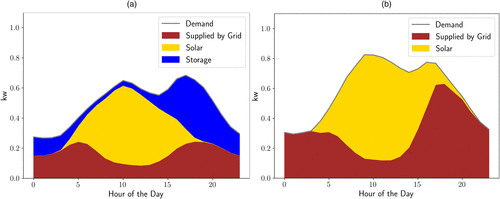
Notes. (a) Households with 4.8-kWh storage. (b) Households without storage.
Whether storage increases or reduces load variability also depends on the way storage is operated. For the households in this data set, storage is run myopically (i.e., charged and discharged whenever possible). There are three reasons for that: (i) very few households have time-of-use tariffs, so strategic discharge does not save more money; (ii) there is no incentive (yet) by the grid provider to reduce load variability; and (iii) customers prefer seeing their (expensive) batteries be utilized whenever possible. Anecdotally, when the company experimented with nonmyopic charging policies, customers complained, as they thought their devices were broken or mismanaged. With this summary of usage patterns out of the way, we proceed to the main model.
4. Model
4.1. Model Free And Reduced-Form Evidence
Before we introduce the main structural model, we explain why this approach is necessary. We observe three dynamics in the data that our model needs to accommodate: (1) storage seems to cost more money than it saves for virtually all households; (2) households’ investment in storage is discrete, not binary, and the storage benefit is realized over years; and (3) households’ electricity demands are correlated with the invested capacities. We detail each issue below and explain how we address it in our model.
In our data, batteries cost approximately 1,000€ per kWh and have a useful life of 15 years (based on current knowledge of technology degradation and product warranty). If a household manages to fully charge and discharge a battery once a day every year, which is higher than real-life utilization, each storage unit can perform a total of 5,475 cycles. Each such cycle saves the efficiency-adjusted electricity price and comes at the opportunity cost of the feed-in subsidy s. At German retail electricity prices during the observation period, this translates to cents of saving per kWh per cycle, which is equal to 821.25€/kWh throughout the battery life. Hence, even at Germany’s high electricity prices and with unrealistically high utilization, storage would not be profitable. Thus, if the investment decision was only about minimizing the electricity cost, one would expect to see no storage installations in the data set.6 In our main model, we thus introduce a nonmarket valuation to allow a household to value storage beyond its direct financial value, and we provide empirical and survey data in Section 4.3.4 to explain what drives this valuation. We also estimate in Online Appendix A.3.3 what optimal storage investments would look like without this component.
Second, among the households that invested in batteries, 97% opted to buy multiple modules (see Table 2), and the range of installed battery capacities spans more than an order of magnitude. Clearly, storage adoption is not a binary decision, but rather a deliberate choice across multiple options for a specific capacity—a choice that also costs several thousand dollars per storage module. Additionally, we know that battery utilization depends on demand and generation realizations over time. Combining many treatment levels, storage’s relation to demand, and solar generation, the variation across days and seasons is nontrivial in reduced form. For example, including fixed effects would remove a lot of the informative variation contained in the data. In our model, we account for capacity choice interacted with generation and demand by explicitly modeling the energy flows at each hour, which allows us to directly contrast the cumulative usage of a battery against its investment cost.
Third, household electricity consumption increases during the day, when their installed capacities partially provide them with electricity, as shown in Section 3 (and Online Appendix EC.1). Thus, any model must account for the correlation between capacity investment and energy consumption. In our model, we do so explicitly by specifying the household’s hourly utility of consuming electricity and by assuming that the households take into account their capacities when they make consumption decisions, but without knowing the exact solar generation or storage charge at each time (see Equation (3)). In Online Appendix EC.11, we show that not considering this endogenous demand underestimates the nonmarket valuation. We also provide the nonmarket valuation estimates if one were to treat demands as exogenous, which one can view as a lower bound of the structural model’s results.
4.2. Structural Model—Two-Stage Setup
After having explained why we opt for a structural model, we now introduce its elements. This main model will subsequently allow us to run counterfactual analyses.
We work with a two-stage model. In Stage 1, the household chooses the optimal investment in solar and storage capacity. In Stage 2, the household consumes the utility-maximizing amount of electricity in each hour. Using investment and consumption decisions, we will infer the parameters of the utility function that best fit the observed behavior. We solve the model backward, first by introducing the utility accumulated across periods in Stage 2, and then we show how this objective function and cost information are integrated to solve the investment decision in Stage 1. In our model, a household’s utility in Stage 2 comprises three parts: Part 1 is the benefit the household obtains from consuming electricity; Part 2 is the price it has to pay for energy from the grid, including the effect of its nonmarket valuation; and Part 3 is the money it receives for feeding electricity back to the grid.
4.3. Stage 2: Utility Function of Solar and Storage Usage
4.3.1. Part 1—Consumption Preference.
The household gains utility from the consumption of electricity, regardless of the source of said electricity (purchased from the grid, via own solar panels, or discharged from storage). For each household , we observe this consumption/energy demand for each hour of each day . Naturally, consumption preferences may change throughout the day; that is, on most days, a household likely values (and uses) electricity more during breakfast or dinner than at 3 a.m. We allow households’ consumption preferences to vary hourly to capture this. We make the structural assumption that this utility is logarithmic in the amount of consumption plus one , so that zero usage results in zero utility and that positive consumption creates a strictly increasing, but marginally decreasing, utility (see Online Appendix EC.14, where we estimate the model using a different parametric form for the consumption utility and show that the main effects are consistent across models). To translate this unitless utility term into a monetary equivalent, we use , which we will estimate (see Nevo et al. 2016 for a similar model to capture the utility of daily usage of broadband internet). Together, the terms in Equation (1) capture the inherent benefit of utilizing electricity (lighting, using appliances, etc.):
Estimating for each period, we can uncover the preferences that a household has to consume electricity at each hour of the day . A household may have some general preferences around energy consumption at, for example, 7 a.m., but those may vary across days, which is why we observe different demands during different periods. We will use to denote preferences in all periods.
4.3.2. Solar and Storage Capacity.
Before we introduce the remaining elements of the objective function, we want to be more explicit about how solar and storage affect the model. We observe the installed solar capacity per household (in kWp) and its cost of per unit of solar capacity. The cost varies among households according to the date and capacity of the installation. We also observe the solar output per household per hour , which is dependent on the solar panels’ capacity factor in each period . This capacity factor depends on the irradiation patterns of the sun at each household’s location— is zero at night but varies during the day. We denote by , and the vectors of observations.
Furthermore, we observe the installed storage capacity of each household (in kWh), which we denote by and whose unit cost we denote by . Importantly, is a discrete parameter, as Solarwatt’s customers purchase storage in battery modules that have a usable capacity of 2.4 kWh each.7 We use to denote the discrete set of possible storage capacity values—that is, . Installing solar also incurs a fixed cost that is not incurred when no modules are installed. Let denote the charge of this storage unit for the household i, in hour h, on day t, which we define in Equation (2). Storage technology has a round-trip efficiency of , so that for every unit of electricity charged, e units can be discharged. In the context of this paper, storage always refers to lithium ion batteries,8 and both terms are used interchangeably.
We expand on the existing literature by including storage in our structural model to allow for the shifting of energy across time. It will occasionally be helpful to use alternative indexing for the periods. We use subscript to index the chronological sequence of all hours in the model. This notation allows easier differentiation of all periods without the need to rely on dual indexing for hours and days. Taken together, we end up with the following storage balance condition that holds between all periods:
The storage charge at the beginning of a period equals the charge of the previous period plus any additional charge minus any discharge of the last period, while ensuring that the charge neither exceeds capacity nor drops below zero. Note that our model only allows charging or discharging to occur in a given period, which is not a restrictive assumption given our granular observations. We do not explicitly account for the charging speed limits of the batteries (each module can (dis)charge in 3 hours), as this seldom impacts the amount of energy the storage uses binding for storage operations in our setting (see Online Appendix EC.3 for a more detailed explanation and juxtaposition of the main results with and without such power limits).
4.3.3. Part 2—Cost of Purchasing Electricity.
Now that we have formally introduced solar and storage, we turn to Part 2 of the objective function; the disutility that households incur when they purchase electricity from the grid, as they have to pay price per kilowatt-hour procured. As most of the households in the data set are on fixed-price energy tariffs, for which prices change only every 6–18 months, the price is effectively constant throughout the day. The model could also accommodate hourly-varying prices, at the expense of considerably increased computational burden. When referring to electricity prices, we refer to retail, not wholesale market prices, as households pay the retail price, which includes transmission and distribution charges, as well as taxes.
4.3.4. Capturing Nonmarket Valuation.
Furthermore, we assume that each household incurs a nonfinancial disutility when purchasing from the grid. This parameter will be instrumental in explaining why households invest in storage, even if it is not the optimal financial choice. Before we explain how we integrate this nonpecuniary cost, we want to explain what this nonmarket valuation captures.
Anecdotally, our data provider told us that one of their customer’s core motivations was to increase the share of solar consumption at home. This tacit knowledge is reflected in the way that home energy companies market their product. In Online Appendix EC.4, we provide marketing materials of three firms for the (European) residential storage market to support this qualitatively. All three companies advertise their batteries using language such as clean energy and highlight the ability to store one’s own solar energy.
To better understand their reasoning, we first test-surveyed 107 Germans and asked, beyond sustainability concerns, which additional, nonfinancial reasons (we capture financial and subsidy/tax reasons in our model) households may have that might lead them to acquire storage. The responses included: (a) protection against reliability issues on the grid, (b) preference for novel technology, and (c) autarky/decreased reliance on the grid.
Although we cannot ask the households in our data set about their reasoning for purchasing storage, we expanded on our previous survey and asked 995 Germans (a) about the reasons they would consider when making a battery storage investment and (b) further asked them to rank each selected dimension from most to least important (see Online Appendix EC.5 for the survey). In Table 3, we show the share of participants selecting a given reason as relevant and its average ranking conditional on being selected.
|
Table 3. Survey Responses Indicating Which Dimension to Consider When Buying Storage and Ranking its Importance
| n = 995 | % Selected (%) | Avg. Ranking |
|---|---|---|
| Increased sustainability of own consumption | 75.0 | 1.46 |
| Less reliance on the grid | 66.0 | 1.72 |
| Protection against power-outages | 35.5 | 2.14 |
| Interest in technology | 22.5 | 2.23 |
The most frequently selected and highest-ranked reasons are increased sustainability (75%, Average (Avg) Rank 1.46) and grid independence/autarky (66%, Avg Rank 1.72). Although studying the behavioral mechanism behind, for example, the sustainability dimension is beyond the scope of this paper, one possible explanation could be the warm-glow effect that households feel when investing in something that is perceived to be good for society (Andreoni 1990). This motivated our choice of adding a nonfinancial disutility to every unit purchased from the grid to indicate a household’s preference to consume its own solar energy over energy from the grid.
In the market we study, the average German household experienced less than 14 minutes of power outage per year between 2010 and 2020 (BNetzA 2022). Importantly, to protect a home against short power outages, one storage module would be sufficient, but 97% of the households that invested in batteries opted to buy multiple modules (see Table 2). However, in other markets, reliability may be a greater concern.9 Similarly, if interest in technology was driving storage adoption, it is not clear why households would choose more than one module, but without a way to identify each household’s individual motivation, we opt to call the combined nonfinancial interest in storage nonmarket valuation.
We assume this nonmarket valuation to be constant for each household, yet one may also think of it as the average nonmarket valuation over the time frame for which we have observations. Conceptually, households with a high nonmarket valuation can invest more in solar and storage to try to avoid purchases from the grid. Conversely, it is possible for a household to have no nonmarket valuation, in which case this parameter does not impact the utility of purchasing from the grid, and the household may be less inclined to buy storage or increase solar capacity.
We now return to the model description: costs are incurred for every unit of electricity purchased from the grid. However, grid purchases occur only when demand is greater than solar generation and available charge combined. The term in Equation (3) represents the amount of energy purchased from the grid.
Multiplying the cost per kWh times the amount of energy purchased from the grid, we obtain the disutility for costly procurement of electricity from the grid:
Note that because generation is a function of solar irradiation and solar capacity choice , and storage capacity impacts the possible range for charge , both capacity choices impact this utility part.
4.3.5. Part 3—Benefit of Selling Electricity.
Part 3 of the objective function, denoted by , captures the utility of the remuneration that a household receives for selling excess solar electricity back to the grid. We denote this feed-in remuneration by , which captures the amount of money a household receives when it sells a unit of excess solar electricity back to the grid. This formulation applies to situations, as in our data set, where the government guarantees a constant feed-in subsidy over decades (e.g., 20 years from the PV installation date in Germany (Grösche and Schröder 2014)), but, in principle, could also be time-varying—for example, it could be coupled to the real-time wholesale market price.
As before, we multiply the per-unit benefit of selling energy by the expected amount of energy sold to the grid. This amount is equal to the excess solar power after meeting the demand minus fully charging the battery . In combination, Equation (4) captures the benefit of selling back to the grid:
We will use as a shorthand for several observables of a household and as a shorthand for the latent parameters of interest.
Combined Hourly Utility. In combination, a household’s utility per period is the sum of those three parts.10 Following Hortaçsu and Syverson (2004), we implicitly use a coefficient of −1 for the financial utility terms and , so the parameters we estimate ( and ) are expressed in the same unit (euros/cents):
Analogously, the daily and all-period utility are defined as follows:
The hourly utility is summed over all days t. The total utility of the household is the sum of the utility at all hours of the day. This is important because the investment costs in solar and storage are compared against the sum of the utility incurred over the lifetime of the technologies, which we assume to be 15 years. Because we only observe a part of the lifetime of the technologies, we assume that a household receives the same average utility (e.g., per day or year) during the unobserved remaining lifetime of the investment (see Online Appendix A.3.1, where we show the robustness of our model to this assumption).
4.4. Estimation of Consumption Preferences in Stage 2
To start, we assume that a household chooses its consumption to maximize the hourly utility, given its preferences , installed capacities , and observables :
Taking the derivative of the hourly utility with respect to (w.r.t.) demand in Equation (7), we see that the household balances the marginally decreasing utility of consumption with the cost of consuming electricity (see Equation (8)). If the household was omniscient—that is, always aware of all information, including the current charge of the battery, current solar generation, and its demand preferences —it would make the decision based on the cost of electricity, denoted by , as shown in Equation (8):
However, assuming that households are omniscient is not realistic, as households do not continuously check their solar panel and battery status. Rather, we assume that a household does not know its current solar output or battery charge, but can forecast its solar generation and demand patterns in the long term (i.e., what we observe as (which is ) and ). Using this information, we assume that a household forms an expectation for every hour of the day about the likelihood that the marginal unit of electricity is provided by solar power (costing ), the grid (costing ), or the battery (costing or ). We denote this probability-weighted cost by and call it shadow price, as shown in Equation (9). Conceptually, the shadow price links the solar output and the battery charge (analogous to an energy inventory) to the marginal cost of consumption. Although the purchase price of the grid is constant, the effective cost of consumption is lower during hours when the availability of solar and storage is higher.
We provide the mathematical derivation of these probabilities, as well as more details on the intuition and a graphical example of the shadow price across the hours of the day in Online Appendix A.2. The assumption that a household knows its demand and generation patterns is not overly restrictive because we evaluate the utility across periods for the investment decision. Thus, it is the distribution/magnitude of the demand and generation, not the exact sequence, that matters. We show in Online Appendix A.3.2 that we obtain qualitatively the same results when we bootstrap the data in random order or when we treat each hour’s utility as a random draw from a preference distribution that the household knows.
In sum, we assume that the household makes its consumption decisions during Stage 2, as shown in Equation (10):
Using Equation (10), we can derive the consumption preference for every hour. However, this expression is conditional on a parameter that we do not observe, the nonmarket valuation :
4.5. Stage 1: Utility Function of Solar and Storage Investment and Nonmarket Valuation
To estimate this key nonmarket parameter of interest, we relate the utility gained from daily use of solar and storage to installation costs, which is the decision that each household faces in Stage 1. We assume that households know their consumption preferences, the price of electricity, and the costs of solar and storage. Based on this knowledge, we assume that each household invests in solar generation and energy storage to maximize its expected utility (across all days). Formally, each household in Stage 1 solves the maximization problem shown in Equation (12):
Because storage capacity is a discrete choice (number of modules), we cannot estimate by taking the derivative of the objective function in Equation (12) w.r.t. , but rather, have to solve the discrete problem stated in Equation (13). This means that there is a range of values of that are consistent with the installed capacities observed. To be conservative, we estimate as the lowest value in that range (see Online Appendix A.1 for more details and Online Appendix EC.10 for a comparison of estimates under the alternative assumption of maximizing ). Formally, we estimate as follows:
The first two conditions in Equation (13) state that the utility of the household with the observed storage amount is weakly higher than the utility of having one less storage module or no storage at all when accounting for the cost differences. Think of these conditions as saying “ceteris paribus,” the household would not have been better off choosing a different number of storage modules. The cost term of the first condition indicates that a scenario with lower investment in capacity saves the cost of one storage module . The term in the second condition captures the fixed cost of storage installation that can be saved when no modules are installed. Generally, larger storage capacities require larger values of to be optimal (see Online Appendix A.1, where we show quasi-concavity of w.r.t. ). Because there is a fixed cost of installing a battery, we impose the second condition. For solar, the third condition of Equation (13) assumes that the marginal value of solar capacity is at least as large as its marginal cost, which allows for the case that a household may have wanted to install more solar but could not (e.g., roof space limitations, local regulation, permitting, etc.).
In short, we uncover the latent parameters by jointly estimating using Equation (11) and using Equation (13). Please see Online Appendix A.1, where we analytically show that, under a simplifying assumption, this model results in a unique solution of parameters for each household by leveraging the monotonicity of the utility function w.r.t. the latent parameters and the cost terms.
In our main specification, we use the observed changes in retail electricity prices and use national consumer price inflation as the discounting rate. To demonstrate the robustness of our estimates, we discuss several model specifications with alternative future electricity prices presented in Online Appendix A.3 and compare the resulting estimates. In particular, we show that our results are robust to a household using different discounting factors or having different assumptions about how future electricity prices will develop (Online Appendix A.3.1), bootstrapping the generation data (Online Appendix A.3.2), and lastly, that without the nonmarket valuation, one cannot predict the observed storage investments (Online Appendix A.3.3).
5. Results
5.1. Structural Estimation Results
We now turn to the results of the structural model and first present the estimates for the latent parameters. We then use these insights for counterfactual analyses in subsequent sections. For a model-free analysis of the data, refer to Sections 3 and Online Appendix EC.1. Using Equations (11) and (13), we estimate the hourly utility vector and the nonmarket valuation for each household. In Figure 3, we plot the mean estimates of the utility of consuming electricity in a given hour across the households. The shaded area is the 95% confidence interval.
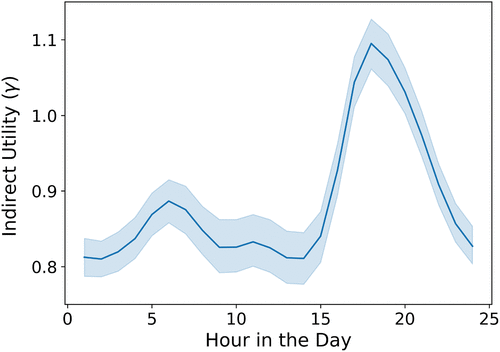
We want to point out two things about the hourly consumption preferences. First, we see a small peak in consumption preference in the morning and a larger peak in the evening. This is consistent with the typical pattern of electricity demand observed in residential electricity markets. It is reassuring that we can back out these behaviors from the data with our estimation and choice of utility model.
Second, there is substantial heterogeneity in these utility patterns between households, both in magnitude and in variability throughout the day. In Online Appendix EC.6, we present detailed statistics of the utilities across households, as well as an illustration of common variability within a household. For a given household, the utilities for an hour (e.g., 8–9 a.m.) are approximately log-shaped (across all observed days), with a bulk of utilities clustered around the modal value and a long tail of periods with higher utilities. Although data-privacy regulation prevents us from showing individual household results, it is the knowledge of these utility values that makes all counterfactual analysis possible. Because storage and solar investment change the consumption choices of households, we needed to first calculate these utilities to be able to update demands when we perform counterfactual analyses.
Nonmarket Valuation. The main latent parameter of interest is the nonmarket valuation. In Figure 4, we plot the histogram of this nonfinancial valuation of replacing grid-procured electricity with self-generated solar for all German households in our sample. The vertical line marks the average electricity price for 2020 in Germany as a reference point.
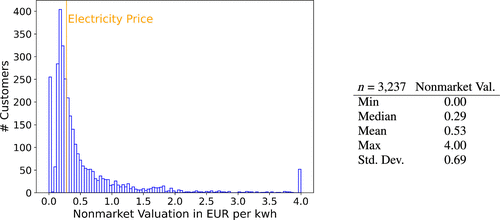
The median nonmarket valuation is 0.29€/kWh, the mean is 0.53€/kWh, and the standard deviation is 0.69€/kWh, driven mainly by the high dispersion on the right tail. We see a wide range of valuations (winsorized at 4€/kWh), with many households having a substantial nonmarket valuation, of the order of magnitude of the energy price. In Online Appendix EC.7, we show that we consistently estimate this distribution using separate years of the data. Because our sample contains 2020 data, we discuss in Online Appendix EC.8 how COVID impacts our estimates and that the main findings are consistent with either including or excluding part of the 2020 data.
Estimating this distribution is important, especially in the context of the green energy transition, where much research has studied the effect of taxes and subsidies on technology adoption. Although such regulation is important, we complement this picture by showing that a subset of the population has a substantial willingness to pay for storage technology beyond its financial value. Quantifying these effects matters because the households with the largest such valuations are likely the early adopters of new technologies, like, in this case, households getting storage before financial profitability is reached. This knowledge can help to inform the sustainable business strategy of firms—for example, to help decide which countries to enter—and may be helpful to predict the adoption of comparable technologies, like heat pumps, electric vehicles, fuel cells, etc., going forward.
This early adoption by a subset of the population also allows providers of such technology to improve their product, reduce cost, and scale their service offering, which can accelerate adoption and benefit future users. Because of the residential electricity context in which we derived the insights, our results are likely to translate best to technologies similar to energy storage and markets similar to Germany.
As our granular data allow us to estimate a distribution of valuation, we want to remark on three aspects that go beyond the average estimated effect.
First, there are households with zero nonmarket valuation. These are the households that have no storage but only have solar, which is profitable on its own. Because we estimate the minimum nonmarket valuation consistent with observed investments, if a household only bought solar panels, this need not be driven by nonmarket valuation, leading to a zero estimate for those households. Second, we did not observe any households with positive but small nonmarket valuations—this is because such low nonmarket valuations would not be sufficient to make a household invest in storage at 2018–2020 prices, and therefore, those households do not appear in our data set. Seeing the rest of the distribution, it is likely that many such households with small positive nonmarket valuations exist that will invest in storage when electricity prices increase or battery costs decrease. Third, the average nonmarket valuation is relatively constant during our sample, instead of declining as storage becomes cheaper. The average valuation for households with installation dates between 2016 and 2019 is 45, 52, 60, and 55 cents, respectively. However, in the same period of time, the federal storage subsidy in Germany was reduced from 25% in 2016% to 0% in 2019, keeping the subsidy-adjusted price approximately stable. In turn, this prevents us from seeing declining nonmarket valuations—studying this question with a longer panel data set would be an interesting avenue for future work.
5.2. Carbon Emission Reduction Through Solar and Storage
Having estimated consumption preferences and nonmarket valuations, our data set allows us to quantify how effective solar and storage are at reducing emissions. We observe for every household how much energy it buys and sells during every hour, and we pair this knowledge with historical merit order data from the German Federal Network Agency.11 These data allow us to calculate, for every hour in our sample, (i) the emissions of the marginal power plant technology (coal, gas, etc.) and (ii) the average emissions of all power plants operating in a given hour. Together, these data allow us to estimate the emissions effect of every household. We contrast this past emission estimate against a future grid scenario with high solar penetration, where excess solar is curtailed and any energy purchased from the grid is provided by gas plants.12 Although it is an admittedly crude proxy of the future, it serves as an upper bound on the emissions that storage can abate in a case of high solar penetration similar to California—penetration levels that Germany and other countries are targeting, for example, through mandatory solar installations in new construction.
We compare the emission results for each household in three settings: (1) the observed investment in solar and storage (), (2) a household with half the amount of solar (), and (3) a household with one storage module less (). Changing these capacities counterfactually in settings 2 and 3 changes the shadow prices for the household’s consumption decision making. Using our nonmarket and utility estimates for each household, we calculate the counterfactual demands, grid purchases, and resulting emissions for the latter two cases. We use the difference in emissions between settings 1 and 2 to quantify the marginal CO2 impact of solar and the difference between settings 1 and 3 to quantify the marginal impact of batteries. All subsequent results are presented in kilograms of CO2-equivalent per unit of capacity (kWp or kWh) per year.
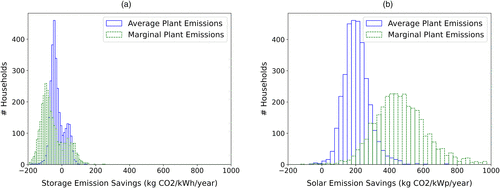
In Figure 5, we plot the emission reductions for a marginal unit of storage and solar that we observed during 2018–2020 (see Online Appendix EC.9 for the corresponding descriptive statistics). This analysis surfaces two results:
Notes. (a) Storage. (b) Solar.
First, the average battery in the German grid increased carbon emissions by 57 kg per year/kWh between 2018 and 2020 (26 kg based on average plant emissions).13 This happens because in the German grid between 2018 and 2020, almost every hour contained varying levels of fossil fuel plants, so average and marginal emissions are carbon-intensive. Thus, selling excess solar during the day can have a similar effect to putting the same electricity in storage to lower grid purchases later in the day, but without the efficiency loss incurred by storage. Even more importantly, storage installation increases electricity demand by, on average, 4% in our sample—we term this effect storage rebound, analogous to the solar rebound found in the solar panel literature (see, e.g., Deng and Newton 2017). This storage rebound occurs because batteries weakly decrease the marginal cost of consumption during, for example, evening hours, thereby increasing electricity demand and consequently increasing emissions.
Second, solar power substantially reduces carbon emissions for virtually all households, with an average reduction of 473 kg/kWp/year when considering marginal plant emissions (203 kg/kWp/year with average plant emissions). Our estimate of the solar rebound effect—that is, the increase in consumption for an increase in solar panels—is 20%, in line with the previous literature.
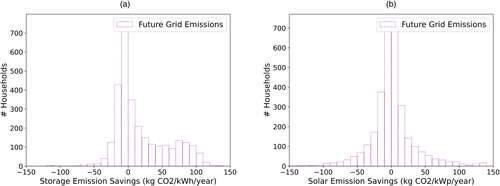
However, when analyzing the same dynamics for a hypothetical future grid with wide-scale solar penetration for which excess solar is curtailed and all fossil generation is from natural gas, this dynamic changes unexpectedly, as shown in Figure 6.
Notes. (a) Storage. (b) Solar.
In this future, solar panel emission savings are 8 kg/kWp/year —approximately an order of magnitude lower than the estimate for the 2018–2020 grid, as solar penetration is highly correlated, and excess solar generation occurs during periods of grid-wide solar curtailment. On the flip side, in this future grid, there is a large emissions difference between excess solar generation being curtailed during the day or combining it with storage to offset gas generation in the evening. We thus estimate batteries in this future case to reduce emissions by 18 kg per kWh per year, even while accounting for the storage rebound.
In combination, this analysis shows that the effect of solar and storage emissions highly depends on the grid to which they are connected and which technology is the marginal plant at what hour of the day. Although storage currently slightly increases emissions, in the high-solar future that many markets are moving toward, batteries may become an important driver of emission reduction, whereas adding solar panels may not decrease emissions any further.
5.3. Estimating Future Investments in Residential Storage
As residential storage installations are increasing rapidly, for example, in Western European countries where electricity prices have increased substantially in recent years (in Germany, installations have increased 10-fold from 2019 to 2023 (Figgener et al. 2023)), we want to study the adoption of batteries in a general population of households and its effect on the grid. Our data set contains the households in the population with the highest nonmarket valuations, which drives their observed early storage adoption (i.e., the right tail of the distribution). The general population likely has no/low nonmarket valuation, and thus has not yet invested in storage. But as electricity prices increase and battery prices fall, storage may become financially attractive, even without nonmarket valuation as a driver.14 We want to understand when this happens and what impact household storage may have, across the wider population, in such a future.
For our main hypothetical future scenario, we take the same 3,237 households (demand and generation) and simulate their investment choices under the following new parameters: (i) there are no subsidies;15 (ii) solar and storage technologies are 22% and 25% cheaper, respectively; (iii) the electricity price is 38 cents per kWh; and (iv) each household’s nonmarket valuation is zero (thus representing the current nonadopters). The technology cost reductions are based on the Fraunhofer projections for Germany in 2025 (Kost et al. 2021), whereas electricity prices in Germany are already at 38 cents and are expected to remain at these or higher levels going forward (Martin 2023). Combining these data, we estimate the counterfactual investment of households in this future setting.
We show in Table 4 how different assumptions on cost reductions and electricity price change the share of households that get storage and their investment capacities (see Online Appendix EC.12 for a more detailed breakdown of alternative storage capacity investments). We see large-scale adoption of storage by households without nonmarket valuation in all scenarios, suggesting that residential adoption of this technology in markets with expensive electricity is close to a technology tipping point. Investment decisions are more sensitive to assumptions on the decrease in storage cost, followed by a moderate sensitivity to the price of electricity. The solar cost assumption does not materially change investment capacities, as solar was already profitable in 2018. We limit solar capacities to be equal to or less than what we observe in the data, as roof space, and not profitability, often limits investment. Interestingly, in Alternative 3, we fix technology costs at 2020 prices but remove subsidies, which results in 15% storage adoption, even without nonmarket valuation, as selling to the grid becomes less attractive without feed-in subsidies. This highlights a tension between Germany’s past regulations, where feed-in tariffs and storage rebates have opposite effects on storage adoption. As recently as 2023, German regulators doubled down on providing feed-in subsidies to German households (EEG 2023), indicating that this tension between subsidies and storage adoption will likely remain relevant going forward.
|
Table 4. A Household’s Average Capacity Investment in Storage and Solar Given Different Cost Reductions
| n = 3,237 | Main scenario | Altern. 1 | Altern. 2 | Altern. 3 | Altern. 4 |
|---|---|---|---|---|---|
| Storage Cost Reduction | 25.0% | 12.5% | 25.0% | 0.0% | 25.0% |
| Solar Cost Reduction | 22.0% | 22.0% | 11.0% | 0.0% | 22.0% |
| Avg.Storage Capacity (kWh) | 3.5 | 2.1 | 3.5 | 1.0 | 3.0 |
| Avg. Solar Capacity (kWp) | 6.3 | 6.3 | 6.3 | 6.3 | 6.3 |
| % of Households With Storage | 54% | 32% | 54% | 15% | 40% |
| Electricity Price (in cents) | 38 | 38 | 38 | 38 | 33 |
Note. Altern., alternative.
We proceed with our primary analysis of the 2025 cost scenario without subsidies, for which we see a stark shift in investment behavior compared with today (see Figure 7). Whereas for 2018–2020 data, only households with high nonmarket valuations invest in storage, in this future scenario, more than half of households (54%) would choose to invest in some storage—conditional on installation, they have an average storage capacity of 6.5 kWh, a median of 4.8 kWh, and a standard deviation of 2.7 kWh. This shift occurs because, at those hypothetical 2025 costs, installing solar and storage is a cheaper source of electricity for households than buying electricity from the grid.
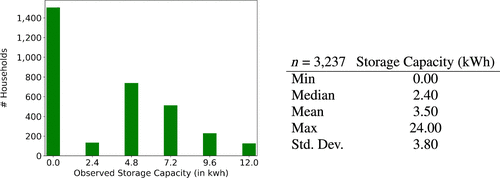
If we scaled our solar capacity results to the 16 million single-family homes in Germany, this would equal 101 GW of installed power, in line with the government’s ambitious target of 200 GW of solar installations across the country by 2030 (SPD 2021), for which many states mandate solar installations for newly constructed homes. The average household in our sample would invest in 6.3 kWp of solar energy and be able to sell 9.6 kWh back to the grid on an average day, while only procuring 5.8 kWh from the grid, changing a large fraction of households from net customers to net producers.
5.4. The Impact of Storage Adoption on the Grid Operator
Regardless of the driver behind the investment of households in batteries, the rapid increase in residential storage capacity warrants studying how these investments impact the grid and the utility. To analyze the effects, we contrast two scenarios: (a) the standard scenario, where households obtain all their demand from the grid; and (b) the adoption scenario, as introduced in Section 5.3, where all households invest in solar and half of them invest in batteries. For both scenarios, we plot the average demand for the grid by households throughout the day in Figure 8. The line with the higher peak in the evening shows the average daily grid load in the standard scenario. The other line shows the grid load in the adoption scenario. For both scenarios, the shaded areas indicate the variability of load throughout the year16 Two dynamics become apparent when we contrast the adoption scenario (with storage and solar investment) and the standard scenario (grid purchases only). First, when households own solar and storage, they demand 38% less energy from the grid, as indicated by the grid load line with solar and storage being mostly below the line that plots demand without solar and storage. For power providers, this means that a significant share of their residential revenue erodes. This reduction in grid demand occurs even though households consume more electricity when they own solar and storage, but rely more on self-generated solar, which is cheaper than the grid. The average day is shown in Figure 8, where early in the morning (5–6 a.m.) when storage is empty and no solar generation occurs, households with solar and storage installed briefly demand more power from the grid than they would if they had no solar and storage installed (gray line). As soon as solar generation starts (7–8 a.m.), the grid load with solar and storage drops below the load without installations and stays there until the batteries are discharged late at night.
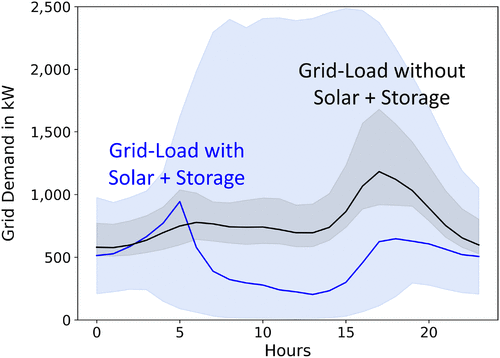
Second, and arguably even more important, when households invest in solar and storage, grid demand is close to zero for several hours on the lowest-load days of the year (shaded area close to zero), but 150% higher than in the standard case for the highest-load days. Low grid use occurs on summer days with high solar penetration, whereas high grid use occurs on winter days with low solar. Counterintuitively, batteries exacerbate the variability rather than reduce it. The intuition is that, although storage can reduce the variability of load on any given day, it increases the variability between the highest- and lowest-load days of the year.
For grid providers, the transition of households to buy residential storage means that they can sell less energy on average, but also have to keep more and more flexible capacity on hand, as they are typically mandated to serve all demands.
Note that both raising the electricity price and making tariffs time-variable make storage more attractive. Therefore, in the future, utilities will have to develop new pricing schemes to deal with customers who can strategically generate and store their own power. An option could be to rely on fixed connection fees or charge for maximum load as a way to compensate the grid provider for the increased operational costs, which, however, may have fairness implications. Prescriptions to address this problem are beyond the scope of this paper, but the design and regulation of the market for residential customers that, due to storage, can behave strategically could be a fruitful area for future research.
6. Discussion
Our paper contributes to the operations literature by providing the first large-sample empirical analysis of behind-the-meter storage adoption and its operational impact. We develop a structural model that captures a household’s utility from electricity consumption and pair it with the financial considerations of behind-the-meter solar and storage investments, as well as a latent, nonfinancial desire to be sustainable or autarkic, which we call nonmarket valuation.
We then use this model and a large data set of energy consumption, generation, and capacity investment decisions of thousands of German households to estimate two latent parameters for each customer—the aforementioned nonmarket valuation and the utility of consuming electricity for every hour of the day. In our data set of early storage-adoption households, we find nonmarket valuation to be substantial; on average, it is on the order of the electricity price. We are able to show that without such a nonpecuniary factor, households would not have made any storage investments at the prevalent battery prices. We juxtapose this early adoption with a study of a hypothetical future scenario at current European electricity prices, where, without subsidies and a moderate reduction in technology costs, storage investment becomes profit-optimal for over half of households. Based on this result, we discuss the impact that large-scale storage ownership may have on utilities and, in particular, on the load variability over a year.
Furthermore, we document a storage rebound effect, where households with batteries increase their consumption, which also affects the carbon emissions of batteries. In the studied German grid, during the observational period from 2018 to 2020, batteries actually increased emissions by incurring efficiency losses, increasing demand, and due to the fact that selling rather than storing excess solar would replace fossil fuel plants during the day. However, we contextualize this finding by showing that in a high-solar grid, this effect may be reversed, and storage may reduce emissions in the future, whereas solar panels without storage may not help to reduce emissions going forward.
Although this work is the first to study energy storage in this heterogeneous residential setting, there are several limitations to this paper. Firstly, it does not capture time-of-use electricity tariffs that are becoming popular in some parts of the world. Second, the empirical results focus on the German market, which leads in the adoption of residential batteries but may have specific local idiosyncrasies. Lastly, to generalize the structural model beyond residential users, implementing a dynamic programming approach to the model may be useful. At the same time, the topics of time variability, international heterogeneity of results, and extensions of the structural model provide ample opportunity for further research.
1 Feed-in energy is the electricity a household sells back to the grid or energy provider (see Online Appendix A.4.1).
2 In this paper, we use the term autarky to refer to the self-sufficiency of the household—that is, its independence from the grid.
3 The households in the data set are comparable to single-family homes in Germany. The median electricity demand of 13.54 kWh is close to the national average of 13.83 kWh for a household of three or more people (DESTATIS 2023). The annual generation per unit of installed solar capacity (measured in kWp, the nameplate capacity of a solar installation) of 962 kWh/kWp/year in our data set (16.62 kWh per day × 365 days per year/6.3 kWp) is representative of approximately 1,000 kWh/kWp/year for an average solar panel in Germany.
4 If any data field in any of the 96 intervals of a day for a household was missing, we deleted the entire day from the data set for that household. We handled the infrequent data blips we encountered (typically caused by voltage spikes) in the same manner. These voltage spikes result in demand or generation readings that are several thousand times the average. For the median household, even with this very conservative approach, we retain 97.9% of all observations.
5 We use the term grid provider to refer to any entity with which the household has a contractual relationship to procure electricity.
6 Even if households believe future savings to be higher, batteries are becoming cheaper over time, so one would expect customers to wait with their investment.
7 Note that this capacity of 2.4 kWh refers to the usable capacity that can be (dis)charged in every cycle. The physical capacity of the battery is somewhat larger than that, but only 2.4 kWh are usable to prevent deep discharging. If deep discharging occurred, it could reduce the lifetime of the battery.
8 At the time of writing, lithium ion batteries typically have round-trip efficiencies between 85% and 95%.
9 See, for example, Figure 19, (a) and (b) and Online Appendix EC.4, where we juxtapose Tesla’s U.S. and Germany landing pages for selling its home energy storage product Powerwall. Interestingly, the German homepage design centers around a pleasant sunset in the backyard, whereas the U.S. homepage depicts a dark, stormy day with a single house lit up.
10 The utility function of a household depends on observables and latent variables , which we omit occasionally for notational convenience—that is, we write as .
11 See https://www.smard.de, accessed May 12, 2023.
12 This is with an assumed emission intensity of 400 kg CO2/MWh.
13 Note that we ignore transmission losses and other effects like ramping rates on emissions and differential heat rates. As such, we focus our discussion on the direction and magnitude of the effects rather than on the specific point estimates.
14 Note that this is true in markets like Germany with some of the highest electricity prices in the world. In most markets, where electricity prices are lower, nonmarket valuation will still be required to drive storage adoption for the foreseeable future.
15 As of February 2024, Germany still has feed-in tariffs on the order of 8 cents/kWh.
16 We show the 2nd and 98th percentiles—that is, we exclude the seven days in the year with the least/most demand.
References
- (2022) Non-ownership business models for solar energy. Manufacturing Service Oper. Management 24(4):1887–2386.Link, Google Scholar
- (2016) Efficient feed-in-tariff policies for renewable energy technologies. Oper. Res. 64(1):52–66.Link, Google Scholar
- (1990) Impure altruism and donations to public goods: A theory of warm-glow giving. Econom. J. 100(401):464–477.Crossref, Google Scholar
- (2020) Sustainable operations management through the perspective of Manufacturing & Service Operations Management . Manufacturing Service Oper. Management 22(1):146–157.Link, Google Scholar
- (2018) Unintended effects of residential energy storage on emissions from the electric power system. Environ. Sci. Tech. 52(22):13600–13608.Crossref, Google Scholar
- (2020) Promoting solar panel investments: Feed-in-tariff vs. tax-rebate policies. Manufacturing Service Oper. Management 22(6):1148–1164.Link, Google Scholar
- (2014) Environmental policy analysis: A guide to non-market valuation. Technical report, Australian Government Productivity Commission, Canberra, Australia.Google Scholar
- (2022) How do investors value ESG? Technical report, National Bureau of Economic Research, Cambridge, MA.Google Scholar
- (1995) Automobile prices in market equilibrium. Econometrica 63(4):841–890.Crossref, Google Scholar
- (2022) The impact of climate change: An empirical analysis of smart thermostat data. Preprint, submitted November 22, https://doi.org/10.2139/ssrn.4282220.Google Scholar
-
BloombergNEF (2020) Battery pack prices cited below $100 per kwh for the first time in 2020, while market average sits at $137 per kWh. Technical report, BloombergNEF, London.Google Scholar -
BNetzA (2022) Duration of per capita electricity supply disruption in Germany from 2006 to 2021. Technical report, Bundesnetzagentur, Bonn, Germany.Google Scholar - (2012) Peer effects in the diffusion of solar photovoltaic panels. Marketing Sci. 31(6):900–912.Link, Google Scholar
- (2024) Valuing technology complementarities: Rooftop solar and energy storage. Technical report, National Bureau of Economic Research, Cambridge, MA.Google Scholar
- (2022) Visibility and peer influence in durable good adoption. Marketing Sci. 41(3):453–476.Link, Google Scholar
- (2021) How transparency into internal and external responsibility initiatives influences consumer choice. Management Sci. 67(2):932–950.Link, Google Scholar
- (2016) Net metering and market feedback loops: Exploring the impact of retail rate design on distributed PV deployment. Appl. Energy 162:713–722.Crossref, Google Scholar
- (2017) Assessing the impact of solar PV on domestic electricity consumption: Exploring the prospect of rebound effects. Energy Policy 110:313–324.Crossref, Google Scholar
-
DESTATIS (2023) Stromverbrauch der privaten haushalte nach haushaltsgrößenklassen. Technical report, DeStatis - Statistisches Bundesamt, Wiesbaden, Germany.Google Scholar - (2016) Technology choice and capacity portfolios under emissions regulation. Production Oper. Management 25(6):1006–1025.Crossref, Google Scholar
-
EEG (2023) Gesetz für den Ausbau erneuerbarer Energien (Erneuerbare-Energien-Gesetz - EEG 2023).Google Scholar - (2014) The economic effect of electricity net-metering with solar PV: Consequences for network cost recovery, cross subsidies and policy objectives. Energy Policy 75:244–254.Crossref, Google Scholar
- (2023) Peak-load energy management by direct load control contracts. Management Sci. 69(5):2788–2813.Link, Google Scholar
- (2013) Using nonpecuniary strategies to influence behavior: Evidence from a large-scale field experiment. Rev. Econom. Statist. 95(1):64–73.Crossref, Google Scholar
- (2023) The development of battery storage systems in Germany: A market review (status 2023). Preprint, submitted March 23, https://arxiv.org/abs/2203.06762.Google Scholar
- (2021) Storage futures study—Economic potential of diurnal storage in the US power sector. Technical report, NREL, Golden, CO.Google Scholar
- (2014) On the redistributive effects of Germany’s feed-in tariff. Empirical Econom. 46(4):1339–1383.Crossref, Google Scholar
- (2018) Third-party ownership business models and the operational performance of solar energy systems. Manufacturing Service Oper. Management 20(4):788–800.Link, Google Scholar
- (2023) Global market outlook for solar power 2023–2027. Report, SolarPower Europe, Brussels.Google Scholar
- (2004) Product differentiation, search costs, and competition in the mutual fund industry. Quart J. Econom. 119(2):403–456.Crossref, Google Scholar
-
IEA (2020) Renewables 2020. Technical Report, International Energy Agency (IEA), Paris.Google Scholar -
IEA (2024) Batteries and secure energy transitions. Technical report, International Energy Agency (IEA), Paris.Google Scholar - (2023) When should the off-grid sun shine at night? Optimum renewable generation and energy storage investments. Management Sci. 69(12):7633–7650.Link, Google Scholar
- (2020) Economics of grid-scale energy storage. Job market paper. Working paper, Department of Economics, Massachusetts Institute of Technology, Cambridge.Google Scholar
- (2017) When do households invest in solar photovoltaics? An application of prospect theory. Energy Policy 109:270–278.Crossref, Google Scholar
- (2020) Investments in renewable and conventional energy: The role of operational flexibility. Manufacturing Service Oper. Management 22(5):925–941.Link, Google Scholar
- (2021) Stromgestehungskosten erneuerbare energien (Levelized Cost of Electricity. Renewable Energy Technologies). Technical report, Fraunhofer Institute for Solar Energy Systems ISE, Freiburg, Germany.Google Scholar
-
Lazard (2020) Levelized cost of energy analysis - Version 14.0. Technical report, Lazard, New York.Google Scholar - (2019) Optimal sizing of grid-connected photovoltaic battery systems for residential houses in Australia. Renewable Energy 136:1245–1254.Crossref, Google Scholar
- (2014) Are consumers strategic? Structural estimation from the air-travel industry. Management Sci. 60(9):2114–2137.Link, Google Scholar
- (2023) Heizen mit 65 % erneuerbaren Energien – Begleitende Analysen zur Ausgestaltung der Regelung aus dem Koalitionsvertrag. Technical report, ifeu – Institut für Energie- und Umweltforschung, Heidelberg, Germany.Google Scholar
- (2011) Energy autarky: A conceptual framework for sustainable regional development. Energy Policy 39(10):5800–5810.Crossref, Google Scholar
-
NDRC (2019) Policy document no. 1701: Guiding opinion promoting energy storage technology and development action. Technical report, National Reform and Development Commission, Beijing, China.Google Scholar - (2016) Usage-based pricing and demand for residential broadband. Econometrica 84(2):411–443.Crossref, Google Scholar
- (2021) Renewable, flexible, and storage capacities: Friends or foes? Preprint, submitted December 15, https://doi.org/10.2139/ssrn.3983678.Google Scholar
- (2010) A single-settlement, energy-only electric power market for unpredictable and intermittent participants. Oper. Res. 58(4-part-2):1210–1219.Link, Google Scholar
- (2022) That’s not fair: Tariff structures for electric utilities with rooftop solar. Manufacturing Service Oper. Management 24(1):40–58.Link, Google Scholar
- (2009) Estimating the value of electricity storage in PJM: Arbitrage and some welfare effects. Energy Econom. 31(2):269–277.Crossref, Google Scholar
- (2022) Diffusion of residential solar power systems: A dynamic discrete choice approach. Preprint, submitted December 29, https://doi.org/10.2139/ssrn.4301666.Google Scholar
- (2021) Mehr Fortschritt Wagen: Buendnis fuer Freiheit, Gerechtigkeit und Nachhaltigkeit, Berlin.Google Scholar
- (2021) Net-metered distributed renewable energy: A peril for utilities? Management Sci. 67(11):6716–6733.Link, Google Scholar
- (2020) Behavioral drivers of routing decisions: Evidence from restaurant table assignment. Production Oper. Management 29(4):1050–1070.Crossref, Google Scholar
- (2024) Design of off-grid lighting business models to serve the poor: Field experiments and structural analysis. Management Sci. 70(5):3038–3058.Link, Google Scholar
- (2013) Curtailing intermittent generation in electrical systems. Manufacturing Service Oper. Management 15(4):578–595.Link, Google Scholar
- (2023) On the distributed energy storage investment and operations. Manufacturing Service Oper. Management 25(6):2277–2297.Abstract, Google Scholar
Christian Kaps is an assistant professor of business administration in the Technology and Operations Management Unit at Harvard Business School. His research focuses on emerging topics in renewable electricity generation and storage—notably, how new technologies, sustainability behavior, and policies shape the energy market of the future.
Serguei Netessine is senior vice dean for Innovation and Global Initiatives and Dhirubhai Ambani Professor of Innovation and Entrepreneurship at the Operations, Information and Decisions Department at the Wharton School, University of Pennsylvania. His current research focuses on artificial intelligence–enabled business models and business model innovation.