Living Up to Expectations: Corporate Reputation and Persistence of Firm Performance
Abstract
I develop a theory of corporate reputation as a source of persistence in firm performance. I show how a relatively simple and reasonable assumption regarding the dynamics of corporate reputation leads to a self-reinforcing process whereby cross-firm differences in corporate reputation (and performance) are significant and relatively permanent. Numerical simulations suggest that persistence in cross-firm differences is largely due to endogenous investment incentives: firms with higher corporate reputations invest more in corporate reputation. I provide a series of examples consistent with the model’s prediction.
1. Introduction
One of the central questions in strategy—arguably, the central question—is the origin and nature of persistence in firm performance (Rumelt 1984, Porter 1985). As Saloner et al. (2001, p. 40) aptly put it, this is “the field’s version of the search for the Holy Grail.” Empirical evidence suggests that the degree of persistence in firm performance varies from industry to industry (Mueller1977, Jacobsen1988, McGahan and Porter1999, Moskowitz and Grinblatt1999, Glen et al.2003). This leads to a natural research question: Are there mechanisms that explain persistence in firm performance and cut across different industries?
To address this question, I develop a theory of corporate reputation as a source of persistence in firm performance.1 I assume that a firm’s performance depends on its reputation and that reputation depends stochastically on the firm’s effort to improve its reputation. In other words, a firm that spends more resources in improving its reputation is more likely to obtain a positive reputation shock; but regardless of a firm’s investment, both positive and negative shocks are possible.
The model’s fundamental assumption is that, reputation-wise, a firm has more to lose from falling short of what is expected from it than it has to gain from exceeding expectations (an asymmetry reminiscent of prospect theory). I show that this assumption implies that a firm’s optimal strategy is to invest more when its reputation is higher: the firm must “live up to expectations.” It is not that higher-reputation firms have a better “technology” for investing in reputation; rather, the firm’s incentives to maximize value are such that, in equilibrium, higher-reputation firms want to invest more.
In this context, persistence of firm performance emerges not only because reputation itself is persistent but also because the incentives to invest in reputation are aligned with the level of reputation. In other words, it is not just a case of success breeding success but also a case of success breeding the incentive to invest in further success, or success breeding the drive to succeed.
I prove the “success breeds the drive to succeed” result analytically for the extreme case when there is very little or no uncertainty; and then, by means of numerical simulations, I extend it to the more realistic case when a firm’s reputation is subject to stochastic shocks. I also decompose persistence in firm performance into two components: one that results from a “sticky” reputation-updating process (“success breeds success”) and another that results from equilibrium firm strategy (“success breeds the drive to succeed”), showing that the latter may be quite important.
My theory implies various testable implications. The most obvious and direct one is a positive relationship between firm reputation and firm investment in reputation. Later in the paper, I present three “caselets” that seem broadly consistent with this prediction: eBay seller reputation, BP’s corporate social responsibility (CSR) efforts, and the demise of the Schlitz beer brand. However, except possibly for the eBay case, there are many confounding factors, so considerable additional research is required for a proper test of this prediction. We should also observe the relationship between reputation and reputation effort to be stronger in industries where corporate reputation is relatively more important. Similarly, all else being equal, the degree of persistence of firm performance should be greater the more important corporate reputation is for firm performance.
The managerial implications of my results stem directly from the central result that optimal reputation effort is increasing in reputation level. This can be understood in two different ways. First, a firm that enjoys a high level of reputation should invest heavily in maintaining that reputation, for it has a lot to lose from falling short of what is expected of it. Second, a firm that suffers from a low level of reputation should wait for a positive shock to reputation; at the current reputation level, investing in increasing reputation is a negative net present value endeavor.
1.1. Related Literature
There are now many different frameworks to classify the sources and explain the mechanisms leading to persistence in firm performance (sometimes referred to as “sustained competitive advantage”): some frameworks contrast internal and external factors (Wernerfelt1984), some contrast position and capabilities (Saloner et al.2001), some contrast static and dynamic differences (Teece et al.1997), and still others stress the routine nature of firm decisions (Nelson and Winter 1982). These and other frameworks are part substitutes, part complements; they frequently overlap and at times can be seen as different ways of explaining the same phenomenon.
One of the most common lines of argument for persistence of firm performance—the one that is the closest to that in this paper—is that firm success is based on resources that are both unique and difficult to transfer from firm to firm (Wernerfelt1984, Barney1986, Dierickx and Cool1989). Specifically, Dierickx and Cool (1989) state,
Sustainability will be enhanced to the extent that adding increments to an existing asset stock is facilitated by possessing high levels of that stock. The underlying notion is that “success breeds success”: historical success translates into favorable initial asset stock positions which in turn facilitate further asset accumulation. (p. 1507)
My contribution to this literature is twofold. First, I show how a relatively simple and reasonable assumption regarding the dynamics of corporate reputation leads to a self-reinforcing process whereby cross-firm differences in corporate reputation (and performance) are sticky. Second, in explaining the nature of persistence in firm performance, I make the distinction between “success breeds success” and “success breeds the drive to succeed.”
Considering the dynamics of firm advantage and firm investment in cementing its advantage, my paper is related to the literature on firm innovation and competitive advantage. In particular, Knott (2003) develops a theory of firm heterogeneity that is related to the main idea in this paper. She considers a model where a firm’s innovation effort is greater the greater the firm’s loss in innovation share.2 This results in persistent heterogeneity across firms. Unlike Knott, I derive the firm’s optimal investment policy: my “success breeds the drive to succeed” result follows from the nature of reputation updating rather than the behavioral rules considered by Knott. Having said that, her characterization of industry dynamics, whereby “firms expend considerable effort and financial resources merely to maintain the positions conferred by their initial endowments/strategic choices” (p. 703) bears some similarity to the idea that success breeds the drive to succeed.
Finally, I should mention the related literature on persistence of leadership in innovation races (Gilbert and Newbery1982, Cabral2002). These papers provide conditions under which a technology leader will invest more than a technology laggard, thus creating persistence in relative positioning (e.g., leaders remain as leaders with high probability). Similar to these papers, persistence in my model results from the firm’s strategy (higher-reputation firms invest more in reputation). The mechanism whereby this takes place, however, is different: in Gilbert and Newbery (1982), technology leaders invest more because they have more to lose from being caught up than laggards have to gain from catching up, and in Cabral (2002), laggards progress at a slower pace because they invest in inferior technologies with the sole purpose of differentiating their strategy form the leader’s; in the present paper, by contrast, leaders (that is, high-reputation firms) invest more because they stand to lose more from falling short of consumers’ expectations. Although there are similarities in the nature of dynamics, the mechanisms at work are quite different in the three cases. In fact, unlike Gilbert and Newbery and Cabral (2002), the idea that a firm can “live up to expectations” does not require a model of oligopoly competition (even though, as I will mention in §5, my model could be extended to allow for firm rivalry).
1.2. Roadmap
The rest of this paper is organized as follows. In §2 I present the model and assumptions formally. Section 3 includes the main results. In particular, I show that firms with higher levels of corporate reputation invest more in corporate reputation, which results in permanent differences in performance across firms. In §4 I present a series of examples that illustrate the paper’s central idea. Section 5 concludes.
2. Basic Model and Assumptions
I now present the model and results in a formal manner. I first introduce the model’s main components as well as my fundamental assumption (asymmetric reputation updating). Next I present a series of theoretical results pertaining to the firm’s optimal policy. The section concludes by relating the model and the results to the existing economics literature on reputation.
2.1. Main Components
The main components of the model are as follows. In each of an infinite number of periods, a firm is characterized by its reputation, rt. Current reputation is a function of the firm’s past reputation as well as the firm’s past performance. Specifically, rt+1 is given by R(qt, rt), where qt is the quality of the firm’s product in period t. I refer to R(q, r) as the reputation-updating mapping, a mapping from R2 into R that gives the next period’s reputation level as a function of the current period’s quality and reputation.
The quality of a firm’s product at time t, qt, is a stochastic function of the effort et that the firm puts into product quality: qt ∼ F(⋅ | et); that is, F(⋅) is the cumulative distribution function of qt for a given et. For simplicity, I assume that reputation and effort are measured in the same units as quality. In other words, rt is best thought of as the quality level that consumers expect from the firm and et as the quality level that the firm targets with its effort, E[qt] = et; that is, the expected value of quality equals the firm’s effort level.
In each period, a firm’s revenues are proportional to its reputation. Net revenues are obtained by subtracting the cost of investment in reputation. With no additional loss of generality, I assume period profits are given by rt − C(et), where C(e) is the cost of effort function. I assume C(e) satisfies the conditions C′(0) = 0, C′(x) > 0 for x > 0, and C″ > 0, where C′ and C″ denote the first and second derivatives, respectively.
Finally, I assume that the firm maximizes its discounted value, which is given by
2.2. Main Assumption
The central assumption of the paper is that negative surprises to a firm’s reputation are punished more severely than positive surprises are rewarded. Specifically, I consider a piecewise linear reputation-updating map.
The reputation-updating mapping is given by
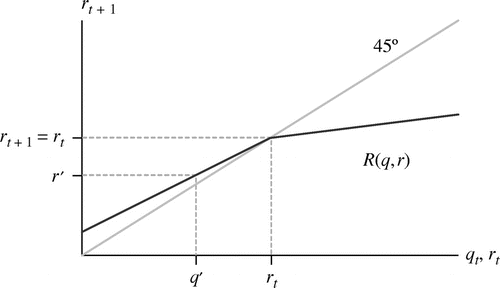
Figure 1 illustrates the reputation-updating process. Suppose that the firm’s reputation in period t is given by rt. If the quality of the firm’s product in that period is given by exactly qt = rt (that is, if the firm lives up to expectations), then firm reputation in the next period,3rt+1, remains at the same level; that is, rt+1 = rt. If the firm’s quality falls short of what is expected of it, then firm reputation in the next period drops to a lower level; that is, rt+1 < rt. For example, if qt = q′, then rt+1 = r′ = R(q′, rt) < rt. If the firm’s quality exceeds what is expected of it, then firm reputation in the next period jumps to a higher level; that is, rt+1 > rt. Finally, notice that the slope of R(q, r) is greater if q < r than if q > r.
Because this assumption plays such a central role in this paper, it is worth spending some time discussing it. The main idea underlying Assumption 1 is that reference points play an important role in consumer behavior. For example, prospect theory (Kahneman and Tversky1979) posits that consumers are more sensitive to losses than to gains, a hypothesis that has been confirmed repeatedly by experimental evidence. Similarly, the kinked demand curve theory (Hall and Hitch1939, Sweezy1939, Maskin and Tirole1988) posits that consumers react more negatively to price increases than to price decreases. Both these theories and Assumption 1 share the feature that consumers are more sensitive to “bad news” (losses, price increases, low quality) than to “good news” (gains, price decreases, high quality).4
Assumption 1 cannot be mapped exactly to any of the existing economic models of reputation. However, the spirit of the assumption and its implications are consistent with a series of economic theories of reputation. Broadly speaking, there are two economic models of reputation: one developed by Klein and Leffler (1981), among others, is based on a repeated game played between a firm and consumers; a second one, pioneered by Kreps et al. (1982), is based on a game between a privately informed player (e.g., a firm) and a Bayesian-updating audience (e.g., consumers). There are also many other variations, which typically combine aspects of the repeated-game and incomplete information approaches.5 My assumption and results are consistent—if trivially—with the repeated-game approach to reputation, and they are also consistent with some of the incomplete-information, Bayesian updating models. Whereas the repeated-game approach implies a multiplicity of equilibrium outcomes given a set of primitives, Bayesian games are greatly dependent on model primitives—and there does not seem to be a “natural” set of primitives. My defense of Assumption 1 is partly based on the fact that a consumer, faced with such variation of models and equilibrium implications, is likely to act according to a simple and robust rule for updating expectations regarding a seller; Assumption 1 is a particularly natural rule.
3. Results
In this section, I present the main results of the paper. First, I show that, in the limit case when there is no uncertainty in quality privation, firms enjoying a greater reputation make more effort to provide quality. Second, I show that the result holds if there is a small amount of noise, and that, as a result, there is persistence in firm performance (if firm a is better than firm b today, the same is true in the next period with high probability). Finally, I solve the model numerically. This allows me to confirm that the main results extend to less extreme parameter values. It also allows me to decompose the relative importance of reputation updating and quality provision in explaining firm persistence.
3.1. Main Result: Success Breeds the Drive to Succeed
Let e(r) be the optimal policy function—that is, the firm’s optimal level of effort given reputation level r. Before I present my first result, suppose that effort translates into quality in a deterministic way, q = e, and that r = q in every period. This is a very extreme set of assumptions that turns the problem into a static problem. Although unrealistic, it is useful to determine the firm’s static, full-information effort level as a reference point to be used later. Specifically, the values of e that maximize the firm value are given by
Convexity of the cost function implies that there exists a unique optimal solution, which I define by e*:
Suppose there is no uncertainty in quality provision: q = e. Then, for each r, there exists a value λ′ such that, if λL ≤ λ′, λH ≥ 1 − λ′, then
Intuitively, if the kink in the reputation-updating mapping is very sharp, then the incentives for investing in reputation are path dependent: the firm has little to gain from exceeding current expectations but a lot to lose from not corresponding to current expectations. As a result, e(r) is increasing in r: the greater a firm’s reputation, the greater the firm’s reputation effort. Naturally, given the convexity of the effort cost function C(e), there is a limit to success breeding the drive to succeed, and for sufficiently high values of r, the optimal level of effort is flat.
The proof of Proposition 1 may be found in the appendix. In essence, the idea is that, if r < e*, then for λ′ arbitrarily close to zero, the kink in the reputation-updating mapping is so sharp that the first-order condition for value maximization fails to apply. As a result, e = r is the optimal strategy: if e > r, then the marginal benefit from effort is close to 0, whereas the marginal cost is strictly positive; if e < r, then the marginal benefit is very close to 1, whereas the marginal cost is strictly less than 1 (by definition of e*).6
3.2. Uncertainty
The assumptions of Proposition 1 are obviously very extreme. In particular, it assumes no uncertainty in quality provision. In the remainder of the section, I address this limitation in two ways: First, I derive an analytical result for the case of a small amount of noise. Second, I compute the equilibrium numerically.
Define a problem Γ as the collection of the objects above: a reputation-updating mapping R(q, r), a cost of effort function C(e), and a cumulative distribution function describing the effort put into quality F(q | e). Next consider a series of problems with arbitrarily low levels of noise. Specifically, define a vanishing noise sequence (VNS) of problems that share the same reputation update function R(q, r) and cost function C(e) but correspond to a sequence of distribution functions with the property that
Proposition 1 provides conditions such that the optimal policy is strictly increasing in r. The next result develops implications of this fact for reputation dynamics—namely, for the persistence of firm reputation. In the following result, “” denotes convergence in probability; moreover, ri, t and rj, t represent the reputation paths of two different firms.
For every VNS sequence Γn, there exists λ′ such that, if λL ≤ λ′ and λH ≥ 1 − λ′, then as n → ∞,
The two parts of the proposition present the same idea in two different ways. In the limit when there is no noise in the mapping from e to q, a firm’s reputation level remains constant with probability 1 (first statement), whereas the probability that there is a change in firm ranking converges to 0 (second statement).
Although my basic model is cast in terms of an individual firm’s problem, Proposition 2 suggests that persistence of firm i’s reputation also implies persistence of the difference in reputation between firms i and j. However, Proposition 2 does not imply that the differences in reputation between firms i and j persist forever. I will return to this issue in §3.4.
3.3. Simulation
I now turn to the simulation of my theoretical model. This exercise has two goals in mind. First, I want to examine to what extent the monotonicity results of Proposition 1 extend beyond the conditions on which they are based. Second, by performing a series of counterfactuals, I can determine the importance of the idea that endogenous investment incentives lead to persistence in firm performance.
I now assume that λL = 0 and for simplicity denote λH by simply λ, where 0 < λ < 1. In words, I assume that consumers “punish” firms very severely for falling short of expectations: if delivered quality is lower, then this lower value becomes the new expectation. As for positive surprises, note that a higher value of λ corresponds to greater consumer “skepticism”: even though consumers are “surprised” by higher performance than expected, they hardly update their future expectations regarding firm performance. In the limit when λ = 1, positive surprises go unrewarded (as in Klein and Leffler 1981, for example).
Regarding the other model components, I assume that qt = et + 𝜖t, where 𝜖t is normally distributed with mean zero and standard deviation σ;7 I further assume that the effort cost function is given by C(e) = ϕe2, where ϕ is a scaling parameter.
The lines in Figure 2 plot the equilibrium level of effort for four values of λ (0, 0.2, 0.5, and 0.8), assuming that ϕ = 0.02, σ = 0.1, and δ = 0.9. The positive slope of the various e(r) lines with λ > 0 is consistent with the paper’s main result (Proposition 1): the higher a firm’s reputation, the more effort the firm will put into maintaining that reputation. The line corresponding to λ = 0, in turn, is consistent with the observation that, if the reputation-updating mapping is symmetric, then optimal effort is independent of the current reputation level.
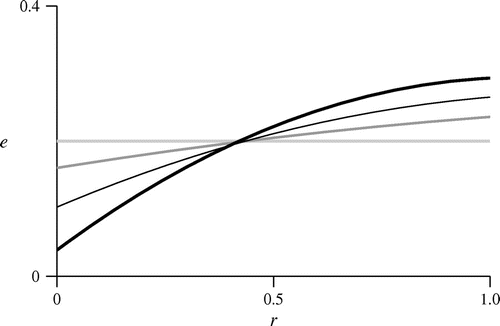
Whereas Figure 2 corresponds to a particular set of parameter values, the result that e(r) is increasing in r is obtained for a wide range of parameter values. In particular, lower values of ϕ lead to uniformly higher e(r) mappings, whereas higher values of σ lead to flatter e(r) mappings; but in all cases, e(r) is increasing, as predicted by Proposition 1.
3.4. Persistence of Firm Performance
To understand the importance of my fundamental assumption and result, I next consider a series of counterfactuals where the reputation-updating function is flat (no asymmetries) and firm effort is constant (no monotonicity). By forcing effort to be constant, I numerically measure the importance of the monotonicity result in Proposition 1; by forcing reputation updating to be symmetric, I eliminate the persistence effect underlying Assumption 1.
Figure 3 plots the serial correlation of three different simulations. The darkest line corresponds to the base case—that is, the model with reputation updating according to Assumption 1 and optimal firm policy e(r). Next, the medium dark line corresponds to the alternative solution where firm effort is fixed at e(r) = ē, where ē is the average effort level under the base case. Finally, the lightest line corresponds to the situation where reputation updating is symmetric—specifically, R(q, r) = q—so that Assumption 1 fails to hold.
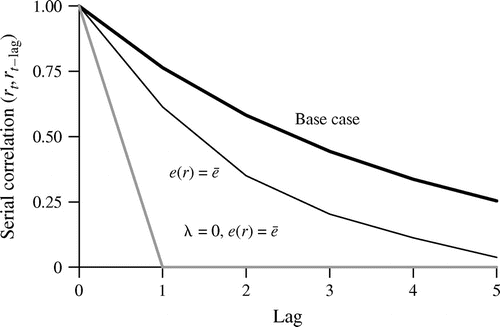
The difference between the lightest line and the medium dark line corresponds to the persistence created by sticky reputation updating. In a certain sense, this corresponds to the idea that success breeds success. The difference between the medium dark line and the dark line, in turn, corresponds to the endogeneity of firm effort—that is, the fact that e*(r) is increasing. In a certain sense, this corresponds to the idea that success breeds the drive to succeed.
As Figure 3 shows, the second effect—the paper’s main theoretical contribution—seems to explain a significant portion of serial correlation, especially for longer lags. Naturally, a more precise judgment must be based on an estimation of parameter values in particular industries. However, my simple numerical simulations suggest that monotonicity of the optimal effort policy plays an important role.
Persistence in firm performance corresponds to a low-decay correlogram C(l), where l = 0, 1,… is the lag. The extreme case of complete persistence in firms performance would correspond to C(l) = 1 for all l. At the opposite end, the absence of persistence in firm performance corresponds to the case when C(l) = 0 for all l > 0 (the case illustrated by the lightest line in Figure 3). Every real-world industry lies somewhere between these extremes. My analysis suggests that an important factor for slow decay may be the endogenous process of corporate reputation.
I should note that my results imply persistent differences in performance across firms but not permanent differences in performance across firms. Specifically, if the support of the reputation random shock has full support (that is, if 𝜖t ∈ ℝ, where ℝ is the set of real numbers), then the stochastic processes of firm reputation and performance is ergodic: the correlation between rt and r0 converges to zero as t → ∞. Some theories of permanent differences in firm performance rely on “historical small events” (Arthur1989, p. 117). These are nonergodic models; such is not the case with my model. In other words, nonergodicity is a sufficient but unnecessary condition for persistent differences in firm performance. Since my model dynamics are ergodic, the claim of persistence rests largely on the correlogram of firm reputation; that is, it becomes a matter of the size of effects. My theoretical results provide a theoretical foundation for the idea that the correlation between rt and rt−1 is strictly positive; my numerical simulations, in turn, suggest that this correlation may be considerably greater than zero.
The ergodic nature of my model follows from the assumption that the effort cost function C(e) is strictly increasing and strictly convex. This assumption implies a boundary condition: if reputation is sufficiently high, then the firm “gives up” on its effort to live up to expectations. This boundary condition also implies the empirical prediction that, for sufficiently high values of rt, we should expect a high rate of reversion to the mean—that is, a high drop in rt.
4. Examples
I now turn to a few examples that illustrate the central theoretical result in the paper—namely, that reputation investment incentives are increasing in reputation level.
4.1. eBay Seller Reputation
The first example looks at eBay sellers. Cabral and Hortaçsu (2010) examine a panel of eBay sellers’ histories and look at the impact of negative feedback given by buyers. They show that after a seller receives his first negative feedback rating, subsequent negative feedback ratings arrive 25% more rapidly. Moreover, Cabral and Hortaçsu perform various tests that suggest that buyer behavior does not play an important role in this pattern. Rather, they argue, the increase in the frequency of negative feedback is likely driven by seller behavior: a negative reputation shock implies lower effort, which in turn leads to more negative feedback. In this sense, the result is consistent with Propositions 1’s prediction that reputation-building effort is monotonic with respect to the level of reputation.
4.2. Big Oil CSR
A second example8 is given by CSR by big oil companies (the world’s “big five” oil companies are BP, Chevron, ExxonMobil, Shell, and Total). At the risk of oversimplifying the recent history of their relations to the environment, we may say that there have been two major reputation shocks: (a) the Exxon Valdez disaster in 1989 and (b) the Deepwater Horizon oil spill in 2010.
Consistent with Proposition 1, until recently, Exxon has had both (a) a worse reputation on environment matters and (b) a lower investment in environment protection, as the following observations show:
While Imperial Oil and its U.S. parent, Exxon Mobil Corp., have the worst reputation for environmental behaviour, other oil companies, such as British Petroleum and Royal Dutch/Shell, have a much better reputation. (Crane2001, p. E02)
In general, the company literature of TotalFinaElf and ExxonMobil pays less attention to CSR than does that of BP and Shell…. BP and Shell appear to be more “accepting” and “responsive” than TotalFinaElf and ExxonMobil, across all our indicators. (Skjærseth et al.2004, pp. 9, 18)
In this context, my model would predict BP’s environment commitment to decline post 2010: not only has the oil spill reduced BP’s environmental reputation, it has also decreased BP’s incentives to invest in this dimension of its corporate reputation.
These predictions are consistent with recent anecdotal and statistical evidence: aware of its poor reputational standing, BP’s most recent actions demonstrate the decreased value it places on an environmentally friendly reputation. Following the oil spill, BP began a steady withdrawal from alternative energy investments. In 2011, BP exited from solar power “after 40 years in the business,” marking a clear divergence from its pre-Deepwater Horizon rebranding tactic that centered on utilizing energy sources “beyond petroleum” (David2013). Solar investments were just the first of many alternative energy cutbacks, however, with BP swiftly “divesting of its wind power assets” in April 2013 as it strived to “become a more focused oil and gas company” (David2013). Should this pattern of investments continue, BP’s behavior would seem broadly consistent with my predictions of it becoming a less environmentally committed corporation as a result of its tarnished environmental reputation.
Recent research on the nature of CSR programs also supports this claim. Ferguson (2010) studies the effects of CSR programs in companies with varying reputations. She found that “CSR appears to work best for companies with already good reputations”; once a company’s name is sullied, CSR “tends to produce only skepticism” regarding the company’s real motivations. Therefore, a company such as BP will find its attempts at salvaging its reputation to be met with criticism rather than reinforcement, and it will eventually divert the funds to other avenues.
A different view on the role of CSR is given by Minor (2011), who suggests that CSR programs are a form of insurance against future accidents rather than a positive builder of reputation after a crisis. Minor also argues that prior to the Deepwater Horizon accident, BP was already demonstrating signs of “carelessness through outsourcing safety and cost cutting” (p. 3). This explains why BP’s stock market value dropped by $32 billion in 2010 despite the highest estimate of the spill’s costs rounding in at $12 billion (as cited in Minor 2011). However, an alternative interpretation for this divergence in values is precisely the kinked effect underlying Assumption 1.9
4.3. The Demise of Schlitz
Finally, another possible example of Proposition 1 at work is given by the demise of the Schlitz beer brand.10 In what follows I will stick to the basic facts that relate to the issues at hand; a fuller account may be found in Goldfarb (2007).
In 1976, without much prior testing, Schlitz changed the preservatives it used in its beer (until 1976, Schlitz had been using silica gel). A problem occurred in the form of small green flakes that appeared in the beer. Schlitz claimed that this was an isolated problem and delayed recalls for months. Not surprisingly, the incident had a major negative impact on Schlitz’s reputation. As Figure 4 shows, beginning in 1976, Schlitz’s market share declined steadily until the brand was finally discontinued in the early 1980s.
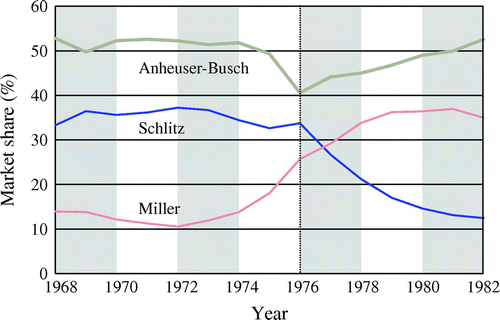
The “green flakes” incident was not the only event that adversely affected Schlitz’s brand image. In the early 1970s, the company introduced a process of accelerated batch fermentation, leading rivals to refer to Schlitz derogatorily as “green beer.” In the mid-1970s, Schlitz was involved in lengthy court litigation with the Department of Justice over alleged questionable sales practices (whereas the other breweries quickly settled their cases). During this period of declining market shares, Schlitz initiated an advertising campaign of dubious quality. Perhaps more important, during the 1970s, Schlitz suffered from the rapid growth of rival brand Miller.11
Whatever the main cause of the beginning of Schlitz’s decline, the data are consistent with the idea that as the brand’s performance worsened, the company’s investment in it declined. Figure 5 plots the advertising market shares for the 1974–1981 period and shows a decline in Schlitz’s share beginning precisely in 1976. Anecdotal evidence regarding Schlitz’s strategy seems consistent with this view: according to a former advertising manager at the failing beer company,
Schlitz sacrificed its reputation in its pursuit of bigger profits. (Neher 1981, as cited in Goldfarb 2007, p. 322)
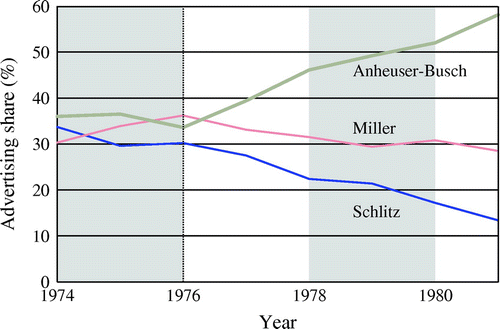
This is consistent with Proposition 1. In fact, the mapping e(r) suggests a trade-off between current profits and future reputation level: the higher the e(r), the lower the current profits but the higher the firm’s future reputation. In this context, an increasing e(r) mapping implies that firms with a lower reputation level will behave “as if” they were placing a greater weight on their current profits (as opposed to their future reputation).
5. Discussion and Conclusion
In this paper, I develop a theory of corporate reputation as a source of persistence in firm performance. A critical observation is that, when it comes to corporate reputation, “success breeds incentives to invest in success”; that is, the equilibrium leads to a self-reinforcing mechanism whereby firms with higher reputations continue as high-reputation firms for a long time, notwithstanding their rivals’ ability to imitate.
By means of model calibration and anecdotal examples, I argue that my central thesis—that success breeds the drive to succeed—has bite; it explains an important fraction of the observed persistence in firm performance. I suspect that many more examples follow the same pattern.
There are several directions in which the present framework can be extended. One is firm competition. Suppose that a firm’s revenue depends on its reputation as well as that of a rival.12 Specifically, suppose that payoff per period is given by B(ri, rj) − C(ei), where B: R2 → R is firm i’s benefit function, i and j denote firm identities, and ri and rj are updated as before. In the base model, B(ri, rj) = ri. A natural extension is to assume that ∂B/∂ri > 0 and ∂B/∂rj < 0; that is, a firm benefits from a higher reputation and from a decrease in rival’s reputation. If the cross-partial derivative ∂2B/∂ri∂rj is not different from zero, then I can show that the main results continue to hold. If, however, ∂2B/∂ri∂rj ≫ 0 or ≪ 0 (that is, there are considerable interaction effects in the firms’ reputation levels), then the analysis becomes considerably more complicated (and interesting).13
A second direction for extension is to consider multiple reputation dimensions. Suppose that a firm’s performance is additively separable in its various reputation dimensions; that is, r = f1(r1) + f2(r2) + …, where fi are real functions and ri the various dimensions of reputation. Then one implication of the paper’s results is that a firm should identify what dimension it has a good reputation for and then channel its reputation effort toward that dimension. There is a sort of conventional wisdom, probably influenced by the oft-trumpeted law of diminishing marginal returns, that a firm should make an effort to improve in the areas where it is lagging—not so when reputation is the issue in question. For example, if a consulting firm is reputed to have an expertise in telecommunications mergers, then it should invest in talent with an expertise in this area.
In this regard, one example that is close to home is business school reputation. A comment heard at a faculty meeting in business school X went to the effect that “because we have a reputation as a finance school, we should invest primarily in the finance department.” Not surprisingly, all other departments reacted by saying that precisely because their current reputation was below that of finance, a greater investment should be made to bring them to the same level. Although the latter argument certainly has value, my theory suggests that it may be optimal to follow the rule that “to all those who have, more will be given” (Matt. 25:29).14
The above remarks rely crucially on the assumption that performance is additively separable on the various reputation levels. If there are important interaction terms, then the problem is considerably more complicated—but also considerably more interesting: for example, a tantalizing possibility is that a firm with a high reputation level on various dimensions has a lot to lose from falling short of expectations in each and every one of those dimensions, thus magnifying the effects considered in this paper.
The author is grateful to Bruno Cassiman, David Collis, Avi Goldfarb, the editor, and three referees for extensive comments and suggestions. He is also grateful to seminar participants at Harvard Business School and New York University for comments on a preliminary draft. Clare Finnegan and Mary Finnegan provided excellent research assistance. The usual disclaimer applies.
Appendix
I first consider the extreme case when λ′ = 0 (that is, λL = 0, λH = 1); this implies that R(q, r) = q if q < r and R(q, r) = r if q ≥ r. The result then follows by a continuity argument, as explained below.
Since R(q, r) = r for q > r, it follows that e(r) ≤ r for all r ∈ ℝ, where e(r) is the optimal policy correspondence (that I assume, and later prove, to be single valued and so refer to as optimal policy function). To see this, suppose that e(r) > r. Then,
Since e(r) ≤ r, it follows that e(r) satisfies
Starting at r = e(r), the problem looks similar except that the constraint is x ≤ e(r). It follows that
By Proposition 1, we know that, if n is high enough, then
1 Although I motivate the paper in terms of firm reputation, there is nothing in the model that is distinctively about corporate reputation. In fact, one of the examples I present later shows that the argument applies to personal reputation as well.
2 In her model, if the firm’s innovation share increases, then the firm does not invest.
3 As in most dynamic models, the choice of a period is somewhat arbitrary. However, considering the particular context at hand, one might think of a period as corresponding to a quarter or a year.
4 Kőszegi and Rabin’s (2006) model of reference-dependent preferences provides a more recent instance of consumer behavior based on reference points.
5 In Cabral (2005), I argue that the Klein–Leffler approach is best described as a theory of trust, not reputation. However, the practice of most scholarly work seems to use the term “reputation” indistinctly.
6 I make a technical point here. Proposition 1 is about simple continuity, not uniform continuity: for each value of r, there exists a λ′ that implies the result; absolute continuity would require the value of λ′ to be valid for all values of r. Strengthening the result to uniform continuity would imply weakening its statement to e(r) ≈ r.
7 To be precise, I assume q and r belong to the interval , and I assume that 𝜖 is distributed according to a truncated normal, so that .
8 I am grateful to Bruno Cassiman for suggesting this example.
9 A referee rightly points out that examples of CSR may be subject to many alternative explanations. I make no claim that the reputation dynamics I consider in this paper provide the only or even the best explanation.
10 I am grateful to Avi Goldfarb for suggesting this example; he and David Collis generously shared data from the U.S. beer industry.
11 In fact, Goldfarb (2007) argues that ultimately this was the main cause of Schlitz’s demise.
12 The extension to more than one rival should be relatively trivial.
13 I should add that there does not seem to be an obvious assumption regarding the sign and value of ∂2B/∂ri∂rj: one can easily find reasons for either a positive or a negative derivative.
14 Although my theory and Merton’s (1968) “Matthew effect” theory share the same scripture verse, I note that the nature of the effect is rather different.
References
- (1989) Competing technologies, increasing returns, and lock-in by historical events. Econom. J. 99:116–131.Crossref, Google Scholar
- (1986) Strategic factor markets: Expectations, luck, and business strategy. Management Sci. 32:1231–1241.Link, Google Scholar
- (2002) Increasing dominance with no efficiency effect. J. Econom. Theory 102:471–479.Crossref, Google Scholar
- (2005) The economics of reputation and trust. Working paper, New York University, New York.Google Scholar
- (2010) The dynamics of seller reputation: Evidence from eBay. J. Indust. Econom. 58:54–78.Crossref, Google Scholar
- (1986) The value added structure and competition within industries. Unpublished Ph.D. dissertation, Harvard University, Cambridge, MA.Google Scholar
- (2001) Corporate responsibility good for business. Toronto Star (October 9) E02.Google Scholar
- (2013) “Beyond petroleum” no more? BP goes back to basics. CNBC.com (April 20), http://www.cnbc.com/id/100647034.Google Scholar
- (1989) Asset stock accumulation and sustainability of competitive advantage. Management Sci. 35:1504–1511.Link, Google Scholar
- (2010) Why CSR can’t help BP now. Forbes.com (June 25), http://www.forbes.com/2010/06/25/british-petroleum-bp-csr-leadership-citizenship-reputation.html.Google Scholar
- (1982) Preemptive patenting and the persistence of monopoly power. Amer. Econom. Rev. 72:514–526.Google Scholar
- (2003) Corporate profitability and the dynamics of competition in emerging markets: A time series analysis. Econom. J. 113:465–484.Google Scholar
- (2007) Why the Schlitz hit the fan. Tremblay VJ, Tremblay CH, eds. Industry and Firm Studies, 4th ed. (M.E. Sharpe, Armonk, NY), 321–341.Google Scholar
- (1939) Price theory and business behaviour. Oxford Econom. Papers 2:12–45.Crossref, Google Scholar
- (1988) The persistence of abnormal returns. Strategic Management J. 9:41–58.Crossref, Google Scholar
- (1979) Prospect theory: An analysis of decision under risk. Econometrica 47:263–291.Crossref, Google Scholar
- (1981) The role of market forces in assuring contractual performance. J. Political Econom. 89:615–641.Crossref, Google Scholar
- (2003) Persistent heterogeneity and sustainable innovation. Strategic Management J. 24:687–705.Crossref, Google Scholar
- (2006) A model of reference-dependent preferences. Quart. J. Econom. 121:1133–1165.Crossref, Google Scholar
- (1982) Reputation and imperfect information. J. Econom. Theory 27:253–279.Crossref, Google Scholar
- (1982) Rational cooperation in the finitely repeated prisoners’ dilemma. J. Econom. Theory 27:245–252.Crossref, Google Scholar
- (1988) A theory of dynamic oligopoly, II: Price competition, kinked demand curves, and Edgeworth cycles. Econometrica 56:571–599.Crossref, Google Scholar
- (1999) The persistence of shocks to profitability. Rev. Econom. Statist. 81:143–153.Crossref, Google Scholar
- (1968) The Matthew effect in science. Science 159:56–63.Crossref, Google Scholar
- (2011) Corporate citizenship as insurance: Theory and evidence. Working paper, University of California, Berkeley, Berkeley.Google Scholar
- (1999) Do industries explain momentum? J. Finance 54:1249–1290.Crossref, Google Scholar
- (1977) Profits in the Long Run (Cambridge University Press, Cambridge, UK).Google Scholar
- (1981) Schlitz: Lost at sea. Advertising Age (April 20) 49–52.Google Scholar
- (1982) An Evolutionary Theory of Economic Change (Belknap Press, Cambridge, MA).Google Scholar
- (1985) Competitive Advantage: Creating and Sustaining Superior Performance (Free Press, New York).Google Scholar
- (1984) Towards a strategic theory of the firm. Lamb RB, ed. Competitive Strategic Management (Prentice-Hall, Englewood Cliffs, NJ), 556–570.Google Scholar
- (2001) Strategic Management (John Wiley & Sons, New York).Google Scholar
- (2004) Limits to corporate social responsibility: A comparative study of four major oil companies. Report 7/2004, Fridtjof Nansen Institute, Lysaker, Norway.Google Scholar
- (1939) Demand under conditions of oligopoly. J. Political Econom. 47:568–573.Crossref, Google Scholar
- (1997) Dynamic capabilities and strategic management. Strategic Management J. 18:509–534.Crossref, Google Scholar
- (1984) A resource based view of the firm. Strategic Management J. 5:171–180.Crossref, Google Scholar
Luís Cabral is the Paganelli-Bull Professor of Economics and International Business at New York University’s Stern School of Business. He received his PhD from Stanford University. His research focuses on the dynamics of firm competition, from both the antitrust and strategy perspectives.