Industries’ Potential for Interdependency and Profitability: A Panel of 135 Industries, 1988–1996
Abstract
An industry’s potential for interdependency among productive activities is one of the central concepts in strategic management. Although theoretical models have clarified how and why industry average profitability should peak at moderate levels of interdependency, the empirical evidence so far has not supported the inverted-U-shaped relationship. By developing a measure that is based on how frequently pieces of knowledge are used jointly in technological inventions, we find strong support that confirms the predicted relationship between interdependency and industry average profitability. We also find evidence supporting an inverted-U-shaped relationship between interdependency and firm profitability. Moreover, our measure captures how the potential in interdependency may change over time within an industry. The temporal variation allows us to correct omitted variable biases, which poses concerns that weren’t raised in previous studies. The measure is created from more than 1.93 million technological patents that have been approved by the U.S. Patent and Trade Office between 1901 and 1996. Since patent data are available to the public, future studies can readily build on our measure of industries’ potential for interdependency.
Introduction
The interdependency among activities that comprise an industry’s production function has been advanced as an explanation for differences in profitability between firms and across industries.1 As a source of interindustry heterogeneity, interdependencies are high when the value of conducting one or more activities in a particular manner depends on how other activities are conducted (Lenox et al. 2006). Activities may interfere or complement one another in complex ways that are only partially known (Cyert and March 1963, Levinthal 1997, Rivkin 2000, Simon 1957). For instance, the technologies used to perform activities along the value chain may be interdependent.2 Interdependencies make it difficult to discover superior combinations of activities, even for managers who are not naïve, biased, or opportunistic (Rivkin 2000). While firms in the same industry may differ in their search for activity sets, industries vary in their potential for interdependency.3
Firm and industry average profitability are predicted to peak at moderate levels of such potential in industries where interdependencies are high enough that not all firms are efficient, but not so high that all firms are inefficient. The inverted-U-shaped relationship between profitability and interdependency is widely referenced and important for strategic management. The relationship is consistent with predictions made in Lenox et al. (2006), Lieberman (1987), Rivkin (2001) and Schoemaker (1990).
To date, there is only one empirical test of the concave relationship between profitability and industries’ potential for interdependency. Lenox et al. (2010, hereafter referred to as LRL) studied a panel of 109 industries and 3,452 firms from 1988 to 1996. They found that the effect of interdependency on firm profitability followed a concave relationship. However, they could not prove that the effect of interdependency on industry average profitability was concave at the standard statistical level of evidence. The lack of support for industry average profitability motivates us to solve the puzzle for such an important relationship in the field of strategy connecting industry characteristics and profitability.
We address this puzzle by replicating and extending the LRL study in two ways. First, we use a better measure to infer industries’ potential for interdependency. The measure used in LRL is created from survey responses; hence, it has two shortcomings: (1) range restriction and (2) time-invariance. Out of 218 total industries in the U.S. manufacturing sector, the LRL measure covers only 109.4 The LRL measure does not cover industries where no managerial perceptions of the complexity of their products and processes were available from the survey. And, since the survey was conducted only one time in 1994, the LRL measure is time-invariant (LRL: 125). In contrast, our measure addresses the two shortcomings of the survey-based one. Created from patent data, our measure has less range restriction because it covers all the industries in which technological patents are granted by the U.S. Patent and Trade Office (USPTO). It varies with time because patents continue to be granted. In addition, it encourages future replications and extensions because patent data are accessible to the general public.
More importantly, our time-varying measure enables us to analyze the panel data with fixed-effects estimations, while the LRL time-invariant measure allows only random-effects. If there are omitted variables, and these variables are correlated with the variables in the model, then fixed-effects estimations could provide a means for addressing omitted variable biases. So, in addition to replicating the random-effects estimations, we correct the biases that result from omitted industry effects and firm effects, by using fixed-effects estimations. Improving the model specification with our time-varying measure of interdependency is the second way in which our replication and extension address the puzzle.
Our study demonstrates empirical evidence that strongly supports the predicted concavity in the effect of industries’ potential for interdependency on industry average profitability. We also confirm the other concave relationship that is between industries’ potential for interdependency and firm profitability. Moreover, we show that both concave relationships remain robust after correcting omitted variable biases with improved model specification. Our results are also robust to using an alternate measure of industry average profitability, which allows us to examine LRL’s central notion in explaining industry average profitability about “a few large competitors who create and capture substantial value” (Lenox et al. 2006, p. 123). In summary, by using better measures and improved model specifications, we find strong support for an important relationship that is central to strategic management research.
Finally, we make conceptual contributions by explaining how profitability varies with temporal changes in the potential for interdependency within an industry. The potential for interdependency is an industry attribute exogenous to the actions of firms (Lenox et al. 2006, 2010). This underlying feature of an industry is largely determined by the fundamental human and physical factors at the time of industry birth, encapsulating a number of knowledge components with varying degrees of interdependency between the components. As scientific discovery achieves breakthroughs and the juxtaposition of disparate fields of thought or technology create new components and trigger new linkages between components, an industry’s potential for interdependency may possibly change over time. We illustrate how two mechanisms, namely, recombination and refinement, drive temporal changes in an industry’s potential for interdependency with a case of replacing aluminum with copper in semiconductor fabrication.
Focusing on the temporal change within an industry over time, we submit and find that the effect of an industry’s potential for interdependency on profitability follows a concave relationship. At a low level of interdependency, novel combinations can be found more easily, but competitors can also easily imitate, so no firm has any significant advantage. At a high level of interdependency, continuous efforts on refinement make the interdependency among existing components so severe that the search for a better solution becomes extremely difficult. Therefore, no firm has a significant advantage, either. Profitability peaks at a moderate level of interdependency because a balance between refinement and recombination provides the highest potential of finding solutions to the production decision problem.
Interdependency and Profitability
The inverted-U-shaped relationship between profitability and interdependency was studied by Lenox et al. (2006) with a formal model and computer simulations. As explained in LRL, the concave relationship occurs “because profits are highest when the production decision problem is difficult enough to generate heterogeneity among firms, but not so great as to dramatically reduce the average efficacy (efficiency or quality) of firms” (p. 123). At low levels of interdependency, “most competitions will be able to determine the most efficient way of operating. High efficiency creates value that could be captured, but competition among similar competitors eradicates profits. In other words, low variance in performance means that high average performance is not translated into high profits” (Lenox et al. 2010, p. 123). At high levels of interdependency, however, “it is rare for any firm to determine the most efficient ways of operating. Even though there is high variance in performance at high levels of interdependency […], poor average performance reduces the value available to be captured as profits.” Moderate levels of complexity, in comparison, “allow only a few firms to discover the most efficacious activity sets, leading to a few large competitors who create and capture substantial value” (ibid, 123). This is the logic behind the concave relationship between profitability and interdependency.
Industry Profitability
Despite the prediction, LRL’s empirical test does not show industry average profitability peaking at moderate levels of interdependency (Models 2 and 3, Table 3, LRL: 133). Model 2 shows that the effect of interdependency on industry average profitability is linear (the estimated coefficient is 0.421, p-value < 0.05). Model 3 shows that the estimated effect cannot be distinguished from a linear relationship at the normal standards of statistical proof (the estimated coefficient for the quadratic term is −0.633, p-value > 0.10). Therefore, LRL could not show that a concave relationship existed at the industry level. As such, the first hypothesis we examine is the predicted concave relationship between interdependency and industry average profitability.
Industry average profitability rises then falls with rising potential for interdependency in activities.
Firm Profitability
In contrast, LRL’s empirical test shows that firm profitability peaks at moderate levels of interdependency (Models 4–6, Table 3, LRL: 133; Figure 1, ibid: 134). This supports a concave relationship between interdependency and firm profitability, as hypothesized in LRL (p. 123) about how mean firm profitability would differ among industries with different latent potential for interdependency among activities. The relationship is concave because moderate levels of interdependency allow only a few firms to discover the most efficacious activity sets. The production decision problem is difficult enough to generate heterogeneity among firms. By contrast, the problem is too easy at low levels of interdependency. Most firms can find the most efficacious activity sets. However, competition among firms with equally efficacious activity sets eradicates profits. On the contrary, the problem is too difficult at high levels of interdependency. Most firms cannot find the most efficacious activity sets. When all firms perform poorly, little value is created to be captured as profits.
Mean firm profitability rises then falls with rising potential for interdependency in activities.
Methods and Measures
Omitted Variable Bias
In addition to replicating LRL, we extend their empirical test by considering the possibility of omitted variable bias. Their model of estimation is based on the random-effects specification. Omitted variables may produce biased estimates of the coefficients, although LRL finds the relationship between interdependency and firm profitability to follow an inverted-U shape. If there are omitted variables, and these variables are correlated with the observed explanatory variables, then the fixed-effects transformation can be applied to eliminate the unobserved firm-specific time-invariant effect, as explained in Wooldridge (2010, pp. 285–304, 328–334).
An example of omitted firm effect is a firm’s tendency to rely on heuristics, i.e., simplified and approximate rules of thumb (cf. Schoemaker 1990) that are a part of the firm’s decision-making routines. A firm’s tendency to rely on heuristics is likely to be correlated with an industry’s potential for interdependency. The use of heuristic solutions may be more prevalent in solving complex problems. Complex problems require managers to consider a wider range of alternative combinations of activities and examine how extensively the decisions about product configuration and process recipe are interconnected. In estimating firm profitability, the random-effects framework assumes zero correlation between the observed explanatory variables and the unobserved firm effect. Yet, a firm’s tendency to rely on heuristics could be a source of bias if it is omitted.
Similarly, in estimating industry average profitability, the random-effects framework assumes zero correlation between the observed explanatory variables and the unobserved industry effect. Yet, industry-specific time-invariant variables could be a source of bias, if they are omitted and correlated with the observed explanatory variables. An example of omitted industry effect is the geographical agglomeration of innovation and production activities by industry. The prevalence of Silicon Valley-style localizations of individual manufacturing industries in the United States as reported by Ellison and Glaeser (1997, 1999) raises a concern for omitted industry effect. As an example, the U.S. semiconductor industry has innovation and production activities localized in the Silicon Valley. The activities have high interdependency, i.e., parts of the product design and production process have rich interactions and technological components are linked together in a product’s architecture.5 In a given architecture, it is likely that activities with high interdependency tend to be geographically co-located, because co-location facilitates coordination and exchange of information. As such, an industry’s geographical localization is likely to be correlated with an industry’s potential for interdependency. If an industry’s geographical location is not specified in the random-effects model, the omitted variable may produce some bias in the estimates.
Measuring Interdependency
Measurement challenges have limited large-scale empirical tests. As noted in LRL, “[o]ne of the primary obstacles to large-scale empirical work has been the difficulty in measuring interdependency systematically across a wide number of industries…Measures of interdependency […] must reflect two basic premises that drive the theoretical results in the literature: interdependencies are industry-level characteristics; and (relevant) interdependencies are non-obvious to industry participants so that they present a barrier to optimization and imitation” (pp. 122, 124).
The measure used in LRL meets both premises by using responses to survey questions that elicit research & development (R&D) managers’ perceptions of the complexity of their products and processes.6 The survey-based measure is intended to assess the latent possibility of interdependencies at the product and process levels, among activities in the industry’s production function. At the product level, the survey item asked respondents to determine and report the percentage of their product innovations for which the “competitive advantage from those innovations” (Cohen et al. 2000, p. 5) had been protected by product complexity. At the process level, the same question and survey item was then repeated with respect to process innovations for which the competitive advantage from those innovations had been protected by process complexity (LRL: 125). The LRL measure was created from the product complexity and process complexity items, by averaging across all respondents in the same four-digit standard industrial classification (SIC) code.
A Better Measure of Interdependency Can Be Created with Patent Data
Following LRL, we create a measure that uses information associated with industrial R&D. Our measure also meets the two premises that pose stringent requirements on empirical work: interdependencies are industry-level characteristics; and (relevant) interdependencies are nonobvious to industry participants to present a barrier to optimization and imitation. Our measure is created from more than 1.93 million patents that have been approved by the USPTO since 1901, the earliest application year in the patents we use. Patterns of interdependency extracted from these many patents should be nonobvious to industry participants. These patents are accumulated over a long period of time, so the patterns we extract should be exogenous to the contemporaneous actions of firms. The patterns are aggregated at the industry level to represent industry-level characteristics, as we use a concordance that maps patent classifications to industry classifications.
The first step for constructing our measure of interdependency is to start with the level of interdependency in a technological patent. A measure of interdependency among the components of a technological patent has been developed and used by Fleming, Sorenson, and Rivkin (Fleming and Sorenson 2001, 2004; Sorenson et al. 2006; as a shorthand we refer to it as the FSR measure). The FSR measure of interdependency captures the historical difficulty of mixing and matching the components that constitute a technology. It draws from the intuition that “a technology whose components have, in the past, been mixed and matched readily with a wide variety of other components has exhibited few sensitive interdependencies” (Sorenson et al. 2006, p. 1002). As submitted by FSR, mixing and matching components that have sensitive interdependencies is more difficult than components that are relatively independent. “Suppose a patent embodies subclasses that have been combined with a variety of subclasses, even in a handful of previous patents. This indicates that the patent’s components do not have delicate interdependencies that prevent widespread recombination and the components can be mixed and matched independently…Suppose instead that a patent embodies subclasses that have been combined, again and again, with the same small set of other subclasses. We presume those subclasses to be highly interdependent; their repeated joint appearance in patents suggests that the presence of one requires the appearance of the others” (ibid, pp. 1002–1003).
Specifically, the FSR measure of interdependency for a patent is calculated in two stages (pp. 1002). The first stage measures the ease of recombination of subclass i. The measurement starts with identifying every use of the subclass i in a large sample of patents. The ease of recombination Ei, as shown in Equation (1), is the number of different subclasses that have been combined with subclass i, normalized by the number of patents in which subclass i has been used. That is, controlling for the total number of applications in which a particular knowledge component has been used, the ease of recombination increases as the focal component combines with a wider variety of components. The second stage measures the interdependence—the inverse of the ease of recombination—in patent j, as shown in Equation (2). To calculate the interdependence for an entire patent, FSR averaged the inverted ease of recombination scores for the subclasses in patent j.
Using the subclasses identified in a patent as proxies for technological components, the FSR measure not only has face validity, but also external validity. The external validity was reported in Fleming and Sorenson (2004) and Sorenson et al. (2006). A sample of patent holders were asked about their perceptions of how much change is required to make to the other module(s), when a change is made to one module in their invention. The patent holders’ responses were significantly correlated (the Pearson correlation coefficient is 0.30, p-value∼0.03) with the level of interdependence computed according to the FSR measure. The significant correlation suggests that the FSR measure is validated externally by patent holder perceptions.
An Industry-Level Interdependency
The second step for constructing our measure is to create an industry-level interdependency by taking the average of the FSR measure among the patents classified under the same four-digit SIC. We use Silverman’s concordance for the mapping between patent classifications and industry classifications.7 We assume that industries with technologies that exhibit higher interdependencies are likely to have higher potentials for interdependencies among the activities that are associated with making an industry’s output. While product configuration, process recipe, and organizational form may vary between firms, the industry-level interdependency captures a latent potential in the industry’s production function. The assumption about an industry’s potential for interdependency among activities is central to Lenox et al.’s conceptualization of the competitive environment (2006, 2010). The latent potential is “an industry attribute exogenous to the actions of [individual] firms” (LRL: 122). Building on Lenox et al.’s conceptualization, we submit that the FSR measure aggregated at the industry level can capture the potential interdependency in the technologies that are important to an industry’s production function. As a validation, the FSR patent-based measure that we aggregate at the industry level is correlated with the LRL survey-based measure of interdependency. As we will report in further detail, the Pearson correlation between the two is 0.26 (p-value = 0.04), across the 62 industries for which the LRL measure was reported (LRL: 129, Table 1, Column 4).
|

Table 1: Interdependency Measure for 109 Industries—A Comparison Between the LRL and Our Measure
| LRL | Our measure 1988–1996 | ||||
|---|---|---|---|---|---|
| 109 industries in the order as listed in the LRL Table 1 (pp. 129–131) | 1994 | Average across 9 years | Standard deviation | 1988 | |
| Maximum of 109 industries | 1.00 | 89 | 13.7 | 79 | |
| Minimum of 109 industries | 0.00 | 34 | 3.9 | 28 | |
| Mean of 109 industries | 0.38 | 54 | 7.4 | 44 | |
| SIC4 | Industry description | ||||
| 3679 | Electronic components, NEC | 0.67 | 54 | 7.9 | 44 |
| 3567 | Industrial process furnaces and ovens | 0.64 | 49 | 7.1 | 40 |
| 2052 | Cookies and crackers | 0.60 | 59 | 8.3 | 48 |
| 3663 | Radio and TV broadcasting and communications equipment | 0.57 | 51 | 7.4 | 42 |
| 3845 | Electromedical and electrotherapeutic apparatus | 0.54 | 55 | 8.0 | 45 |
| 2891 | Adhesives and sealants | 0.54 | 71 | 8.3 | 59 |
| 3674 | Semiconductors and related devices | 0.52 | 54 | 7.9 | 44 |
| 3827 | Optical instruments and lenses | 0.50 | 56 | 8.1 | 45 |
| 2835 | In vitro and in vivo diagnostic substances | 0.48 | 66 | 7.3 | 56 |
| 3443 | Fabricated plate work (boiler shops) | 0.48 | 38 | 6.4 | 30 |
| 3728 | Aircraft parts and auxiliary equipment, NEC | 0.47 | 44 | 7.7 | 34 |
| 3523 | Farm machinery and equipment | 0.47 | 37 | 6.3 | 29 |
| 3826 | Laboratory analytical instruments | 0.47 | 56 | 8.1 | 45 |
| 3577 | Computer peripheral equipment, NEC | 0.47 | 60 | 8.7 | 49 |
| 3572 | Computer storage devices | 0.46 | 60 | 8.7 | 49 |
| 3812 | Search, detection, navigation, guidance aeronautical, and nautical systems and Instruments | 0.45 | 54 | 7.8 | 43 |
| 2821 | Plastics material, synthetic resins and nonvulcanizable elastomers | 0.45 | 61 | 7.7 | 51 |
| 3672 | Printed circuit boards | 0.45 | 54 | 7.9 | 44 |
| 3841 | Surgical and medical instruments and apparatus | 0.44 | 55 | 8.0 | 45 |
| 3721 | Aircraft | 0.44 | 44 | 7.7 | 34 |
| 3714 | Motor vehicle parts and accessories | 0.44 | 45 | 6.9 | 36 |
| 3861 | Photographic equipment and supplies | 0.43 | 55 | 7.9 | 44 |
| 3661 | Telephone and telegraph apparatus | 0.43 | 51 | 7.4 | 41 |
| 2836 | Biological products, except diagnostic substances | 0.43 | 66 | 7.3 | 56 |
| 2834 | Pharmaceutical preparations | 0.43 | 66 | 7.3 | 56 |
| 3842 | Orthopedic, prosthetic, and surgical appliances and supplies | 0.41 | 51 | 7.4 | 41 |
| 2851 | Paints, varnishes, lacquers, enamels | 0.41 | 71 | 8.1 | 60 |
| 3571 | Electronic computers | 0.41 | 60 | 8.7 | 49 |
| 3089 | Plastics products, NEC | 0.41 | 51 | 7.2 | 42 |
| 3949 | Sporting and athletic goods, NEC | 0.41 | 53 | 7.6 | 44 |
| 3537 | Industrial trucks, tractors, trailers, and stackers | 0.40 | 49 | 7.1 | 40 |
| 3829 | Measuring and controlling devices, NEC | 0.40 | 50 | 7.4 | 41 |
| 2844 | Perfumes, cosmetics, and other toilet preparations | 0.39 | 74 | 7.5 | 64 |
| 3559 | Special industry machinery, NEC | 0.39 | 49 | 7.1 | 40 |
| 3651 | Household audio and video equipment | 0.38 | 49 | 7.9 | 39 |
| 3081 | Unsupported plastics film and sheet | 0.38 | 59 | 7.0 | 50 |
| 2086 | Bottled and canned soft drinks and carbonated waters | 0.38 | 64 | 9.2 | 52 |
| 3621 | Motors and generators | 0.37 | 48 | 7.7 | 38 |
| 3724 | Aircraft engines and engine parts | 0.37 | 44 | 7.7 | 34 |
| 3669 | Communications equipment, NEC | 0.35 | 47 | 7.6 | 37 |
| 2621 | Paper mills | 0.35 | 59 | 7.2 | 49 |
| 3312 | Steel works, blast furnaces (including coke ovens), and rolling mills | 0.35 | 37 | 4.9 | 30 |
| 3711 | Motor vehicles and passenger car bodies | 0.33 | 48 | 6.4 | 40 |
| 3823 | Industrial instruments for measurement, | 0.32 | 50 | 7.9 | 39 |
| 3825 | Instruments for measuring and testing electricity | 0.32 | 50 | 7.9 | 39 |
| 2911 | Petroleum refining | 0.31 | 77 | 9.7 | 64 |
| 3569 | General industrial machinery and equipment, NEC | 0.30 | 49 | 7.1 | 40 |
| 2082 | Malt beverages | 0.29 | 59 | 5.6 | 51 |
| 3011 | Tires and inner tubes | 0.28 | 63 | 6.9 | 53 |
| 3585 | AC and warm air heating equip and commercial and industrial refrig equip | 0.27 | 49 | 6.6 | 40 |
| 3433 | Heating equipment, except electric and warm air furnaces | 0.27 | 43 | 8.7 | 32 |
| 3612 | Power, distribution, and specialty transformers | 0.25 | 47 | 6.4 | 38 |
| 3541 | Machine tools, metal cutting type | 0.25 | 49 | 7.0 | 40 |
| 3532 | Mining machinery and equipment,(no oil/gas field machinery/equipment | 0.25 | 43 | 6.9 | 34 |
| 2033 | Canned fruits, vegetables, preserves, jams, and jellies | 0.25 | 59 | 5.6 | 51 |
| 3533 | Oil and gas field machinery and equipment | 0.23 | 43 | 6.9 | 34 |
| 3944 | Games, toys, and children\s vehicles, except dolls and bicycles | 0.22 | 51 | 7.3 | 42 |
| 3613 | Switchgear and switchboard apparatus | 0.21 | 46 | 8.0 | 36 |
| 3531 | Construction machinery and equipment | 0.17 | 43 | 6.9 | 34 |
| 3561 | Pumps and pumping equipment | 0.15 | 38 | 6.3 | 30 |
| 2842 | Specialty cleaning, polishing, and sanitation preparations | 0.13 | 56 | 7.3 | 46 |
| 3743 | Railroad equipment | 0.09 | 43 | 8.0 | 33 |
| 3211 | Flat glass | ∗ | 46 | 13.7 | 36 |
| 2273 | Carpets and rugs | ∗ | 69 | 5.9 | 60 |
| 3578 | Calculating and accounting machines, except electronic computers | ∗ | 58 | 9.4 | 46 |
| 2211 | Broadwoven fabric mills, cotton | ∗ | 42 | 6.5 | 33 |
| 3678 | Electronic connectors | ∗ | 54 | 7.9 | 44 |
| 3555 | Printing trades machinery and equipment | ∗ | 49 | 7.1 | 40 |
| 3357 | Drawing and insulating of nonferrous wire | ∗ | 55 | 8.3 | 45 |
| 2522 | Office furniture, except wood | ∗ | 41 | 5.3 | 34 |
| 2013 | Sausages and other prepared meats | ∗ | 68 | 7.4 | 58 |
| 3821 | Laboratory apparatus and furniture | ∗ | 55 | 8.0 | 45 |
| 2015 | Poultry slaughtering and processing | ∗ | 72 | 7.7 | 61 |
| 2531 | Public building and related furniture | ∗ | 43 | 7.9 | 33 |
| 2085 | Distilled and blended liquors | ∗ | 48 | 4.9 | 41b |
| 2011 | Meat packing plants | ∗ | 75 | 7.6 | 65 |
| 3843 | Dental equipment and supplies | ∗ | 51 | 7.3 | 41 |
| 3241 | Cement, hydraulic | ∗ | 49 | 6.0 | 41 |
| 3411 | Metal cans | ∗ | 40 | 7.3 | 31 |
| 2711 | Newspapers: publishing, or publishing and printing | ∗ | 57 | 12.5 | 41 |
| 3824 | Totalizing fluid meters and counting devices | ∗ | 50 | 7.9 | 39 |
| 3579 | Office machines, NEC | ∗ | 62 | 8.9 | 50 |
| 2721 | Periodicals: publishing, or publishing and printing | ∗ | 57 | 12.5 | 41 |
| 2024 | Ice cream and frozen desserts | ∗ | 77 | 8.6 | 66 |
| 3713 | Truck and bus bodies | ∗ | 57 | 6.6 | 48 |
| 3452 | Bolts, nuts, screws, rivets, and washers | ∗ | 34 | 4.6 | 28 |
| 3086 | Plastics foam products | ∗ | 48 | 5.2 | 41 |
| 3564 | Industrial and commercial fans blowers and air and purification equipment | ∗ | 49 | 7.0 | 40 |
| 3562 | Ball and roller bearings | ∗ | 49 | 7.1 | 40 |
| 3524 | Lawn and garden tractors and home lawn and | ∗ | 49 | 7.0 | 40 |
| 3444 | Sheet metal work | ∗ | 38 | 6.6 | 30 |
| 2221 | Broadwoven fabric mills, manmade fiber and silk | ∗ | 42 | 6.5 | 33 |
| 3715 | Truck trailers | ∗ | 41 | 3.9 | 36c |
| 3341 | Secondary smelting and refining of nonferrous metals | ∗ | 67 | 8.8 | 55 |
| 2673 | Plastics, foil, and coated paper bags | ∗ | 59 | 8.2 | 48 |
| 2631 | Paperboard mills | ∗ | 64 | 5.7 | 56 |
| 3851 | Ophthalmic goods | ∗ | 69 | 8.7 | 57 |
| 3272 | Concrete products, except block and brick | ∗ | 54 | 7.5 | 45 |
| 3221 | Glass containers | ∗ | 46 | 6.9 | 36 |
| 2511 | Wood household furniture, except upholstered | ∗ | 40 | 5.0 | 32 |
| 2111 | Cigarettes | ∗ | 89 | 6.6 | 79 |
| 3695 | Magnetic and optical recording media | ∗ | 62 | 7.7 | 52 |
| 2092 | Prepared fresh or frozen fish and seafood | ∗ | 58 | 5.3 | 50 |
| 3317 | Steel pipe and tubes | ∗ | 37 | 5.0 | 30 |
| 3281 | Cut stone and stone products | ∗ | 62 | a | 62d |
| 3677 | Electronic coils, transformers, and other inductors | ∗ | 54 | 7.9 | 44 |
| 3822 | Automatic controls for regulating residential and commercial environments appliances | ∗ | 50 | 7.9 | 39 |
| 2833 | Medicinal chemicals and botanical products | ∗ | 66 | 7.3 | 56 |
| 2611 | Pulp mills | ∗ | 59 | 5.5 | 51 |
Notes. Among the 62 industries where the LRL measure is reported (47 industries have less than four survey respondents so no measure is reported in column 3), the average of our measure (column 4) is correlated with the LRL measure (column 3) at 0.26 (p-value = 0.043). This suggests that the difficulty in mixing and matching technological components in patents to a certain extent is consistent with the managerial perception about product and process complexity.
∗To protect respondent confidentiality, CMS data have been excluded from the tables when there were less than four survey respondents.
aNo standard deviation can be reported because only one year of observation can be computed with the patent data. In a robustness check that confirms our results, the singletons are removed.
bThe observations for this industry are available for 1990–1996. The level in 1990 is reported here.
cThe observations for this industry are available for 1990–1996. The level in 1990 is reported here.
dThe level in 1995 is reported here.
Changes in Interdependency Potential Within an Industry Over Time
We submit that the changes in interdependency potential within an industry over time are driven by the relative accumulation rates between refinement—innovative efforts that focus on refining existing knowledge components—and recombination—innovative efforts that are dedicated to recombining existing knowledge components with new components. Refinement refers to the efforts that seek to better understand an existing knowledge component or combination of knowledge components. Successive patents that refine such understanding improve the solutions created with the existing components. As a result, the interdependency among the existing components deepens, reinforcing their linkages. Therefore, an industry’s potential for interdependency increases when refinement efforts accumulate.
However, increasing refinement makes recombination more difficult. Recombination refers to efforts that are dedicated to generating novel combinations by mixing and matching existing knowledge component(s) with other components. Through efforts dedicated to recombination, new linkages and new components including those that are recently invented or discovered are added to an existing component and combination. Severe interdependency among the existing components makes it difficult to add new linkages and components. Yet, as efforts dedicated to recombination accumulate, successive patents reveal novel solutions created with new linkages and new components. These patents show what constitutes the right combinations, thereby informing subsequent searches where potential solutions may locate in a high-dimensional combinatorial space.8 Successive patents that recombine existing components with new ones reduce an industry’s potential for interdependency. The potential is reduced because the new components used in creating novel solutions exhibit few sensitive interdependencies with the existing components. These new components function as modules that can be mixed and matched independently and used freely in creating novel combinations.
The mechanisms of recombination and refinement correspond to how the ease of recombination is measured, as shown in Equation (1). The numerator in Equation (1) is the number of components with which a focal component has jointly appeared, whereas the denominator is the cumulative amount of effort involving the focal component. Refinement efforts contribute to an increase in the denominator without changing the numerator. When the efforts focusing on refinement accumulate at a rate faster than the efforts dedicated to recombination, the ease of recombining the focal component with a wide variety of components decreases. Therefore, the interdependency of an industry changes with the relative accumulation rates of refinement and recombination. When more efforts focus on refinement (recombination), the interdependency increases (decreases) over time.
Profitability Measures
Following LRL, we measure profitability with Tobin’s q that controls for differences in the scale of investments needed across industries. Tobin’s q also has the advantage of reflecting market expectations of the discounted stream of future cash flows accruing to a firm and its industry. To calculate Tobin’s q, we assume that the market value (M) of firm (i) in time period (t) is a function of the scale of its tangible (Vp) and intangible (δVi) assets and of additional factors (α, Xit), such as an industry’s potential in interdependency among activities, that magnify or reduce the return that firms can generate with assets invested in the industries:
Next, we transform Equation (3) in the same way as LRL, by following Griliches (1981) to derive a profitability measure at the firm level:
Then we apply the same transformation and approximation as LRL for deriving an equation for the average Tobin’s q at the industry level, such that
Control Variables
We control for the same variables and use the same procedures as those in the LRL: firm-level R&D and advertising intensities, industry-level R&D and advertising intensities, and industry growth (change in industry sales over the prior year sales). Following LRL, we also control for potential sources of unobserved heterogeneity by including year-effect dummy variables, and dummy variables for the two-digit industry classification.
Data
To replicate the sample used in the LRL study, we used the same data sources other than the CMS. We extracted firm-level data from Standard & Poor’s Compustat North America industrial annual data set for the period from 1988 to 1996. For industry growth, the data source is the U.S. Census of Manufactures input-output tables at the four-digit SIC level. For our measure of interdependency, the data source is the U.S. patent database from the National Bureau of Economic Research.
Analyses and Results
To ensure that our test is not driven by an artifact of patent accumulation, we start with a set of analyses using a time-invariant level of interdependency that is set in 1988. Then, we conduct a separate set of analyses with a time-varying measure of interdependency that is updated annually as the patents accumulate over time. Replicating LRL, we use random-effects specification. Extending LRL, in our model specification we take advantage of the within-industry variation over time by using fixed-effects estimations to address omitted variable biases.
Table 1 shows a comparison between the LRL measure of interdependency and ours for each of the 109 industries in the LRL sample. While the managerial perception was surveyed in 1994, the average of our measure covers years 1988–1996. The mean of the nine-year average is 54 (minimum = 34, maximum = 89) among the 109 industries. Table 1 also reports the standard deviation of our measure across the years 1988-1996 and the level in year 1988, which is the first year for which profitability is measured in LRL.10
Table 2 presents the 26 additional industries covered in our sample, but not LRL’s. These industries are in the U.S. manufacturing sector, but are excluded from the LRL sample. We have computed an interdependency measure for these industries with the patent data, increasing the industry sample from 109 to 135. Among the 135 industries, the mean of the nine-year average is 54 (minimum = 33, maximum = 106). Compared to the 109 industries in Table 1, the difference in the maximum (89 versus 106) suggests that the subsample of 109 is more restricted in range than the full sample of 135 industries.
|
Table 2: Interdependency Measure for an Additional 26 Industries
| LRL measure | Our measure 1988–1996 | ||||
|---|---|---|---|---|---|
| 1994 | Average across 9 years | Standard deviation | 1988 | ||
| Maximum of 135 industries | n.a. | 106 | 13.7 | 97 | |
| Minimum of 135 industries | n.a. | 33 | 3.4 | 28 | |
| Mean of 135 industries | n.a. | 54 | 7.3 | 44 | |
| Additional 26 industries beyond the 109 in the LRL, listed by the average of our measure across 9 years (1988–1996) | |||||
| SIC4 | Industry description | ||||
| 3873 | Watches, clocks, clockwork operated devices, and parts | n.a. | 106 | 5.8 | 97 |
| 2761 | Manifold business forms | n.a. | 81 | 7.3 | 70 |
| 2731 | Books: Publishing, or publishing and printing | n.a. | 78 | 9.2 | 65 |
| 3334 | Primary production of aluminum | n.a. | 74 | 6.6 | 65 |
| 3931 | Musical instruments | n.a. | 73 | 6.4 | 64 |
| 2253 | Knit outerwear mills | n.a. | 68 | 6.8 | 59 |
| 3652 | Phonograph records and prerecorded audio tapes and disks | n.a. | 65 | 8.0 | 55 |
| 2732 | Book printing | n.a. | 62 | 7.9 | 51 |
| 2771 | Greeting Cards | n.a. | 62 | 7.9 | 51 |
| 3575 | Computer terminals | n.a. | 60 | 8.7 | 49 |
| 3844 | X-ray apparatus and tubes and related irradiation apparatus | n.a. | 55 | 8.0 | 45 |
| 3634 | Electric housewares and fans | n.a. | 51 | 9.3 | 40 |
| 3751 | Motorcycles, bicycles, and parts | n.a. | 50 | 6.9 | 41 |
| 3231 | Glass products, made of purchased glass | n.a. | 50 | 7.0 | 41 |
| 2741 | Miscellaneous publishing | n.a. | 50 | 7.7 | 40 |
| 3442 | Metal doors, sash, frames, molding, and trim manufacturing | n.a. | 48 | 4.9 | 41 |
| 2084 | Wines, brandy, and brandy spirits | n.a. | 46 | 6.3 | 37 |
| 3942 | Dolls and stuffed toys | n.a. | 46 | 8.7 | 35 |
| 2421 | Sawmills and planing mills, general | n.a. | 44 | 5.8 | 36 |
| 3911 | Jewelry, precious metal | n.a. | 43 | 6.2 | 34 |
| 3021 | Rubber and plastics footwear | n.a. | 43 | 5.7 | 35 |
| 2451 | Mobile homes | n.a. | 38 | 5.0 | 31 |
| 3716 | Motor homes | n.a. | 38 | 4.9 | 31 |
| 3448 | Prefabricated metal buildings and components | n.a. | 37 | 4.8 | 31 |
| 3451 | Screw machine products | n.a. | 35 | 3.4 | 31a |
| 2452 | Prefabricated wood buildings and components | n.a. | 33 | 3.5 | 28 |
aThe observations for this industry are available for 1990–1996. The level of interdependency in 1990 is reported here.
After comparing the measure of interdependency, we compare the descriptive statistics of the dependent and control variables between the LRL study and ours. Table 3 shows the sample size and descriptive statistics of the two studies. As shown in Table 3(a), our full sample covers 135 industries, including a total of 1,193 industry-year observations, 3,841 firms, and 17,955 firm-year observations in these industries. A subsample of 109 industries exactly matches with the ones examined in LRL. Although the match in industry is exact, we arrived at a total of 962 industry-year observations, 3,551 firms, and 16,579 firm-year observations, after following the methods documented in LRL (pp. 127–128) for computing the variables, interpolating missing values, and removing outliers.11
|
Table 3: Comparison Between Our Sample and the LRL Sample
| (a) Sample size | |||
|---|---|---|---|
| Size of our full sample | Size of our subsample that matches with the LRL | LRL sample size | |
| No. of industries | 135 | 109 | 109 |
| Industry-year observations | 1,193 | 962 | 953 |
| No. of firms | 3,841 | 3,551 | 3,452 |
| Firm-year observations | 17,955 | 16,579 | 16,501 |
| Time period of observations | 9 years, 1988–1996 | 9 years, 1988–1996 | 9 years, 1988–1996 |
| (b) Descriptive statistics | ||||||||
|---|---|---|---|---|---|---|---|---|
| Our subsample | Qit | LogQ | VarQ | SkewQ | R&D intensity | Advertising intensity | Industry growth | |
| Obs. | 962 | 16,579 | 16,579 | 16,562a | 16,562a | 16,579 | 16,579 | 16,579 |
| Mean | 1.25 | 1.65 | −0.05 | 1.61 | 1.84 | 0.09 | 0.01 | 0.06 |
| Std. dev. | 0.76 | 2.07 | 1.09 | 1.01 | 1.03 | 0.17 | 0.05 | 0.05 |
| Minimum | 0.05 | 0.0004 | −7.96 | 0.01 | −1.30 | 0 | 0 | −0.19 |
| Maximum | 4.44 | 16.6 | 2.81 | 5.40 | 4.95 | 3.84 | 2.13 | 0.33 |
| LRL sample | Qd | LogQ | VarQ | SkewQ | R&D intensity | Advertising intensity | Industry growth | |
|---|---|---|---|---|---|---|---|---|
| Obs. | 953 | 16,501 | 16,501 | 16,477b | 16,477b | 16,501 | 16,501 | 16,501 |
| Mean | 1.66 | 1.46 | 0.38 | 1.92 | 2.06 | 0.23 | 0.01 | 0.06 |
| Std. dev. | c | 2.25 | 0.81 | 1.34 | 1.22 | 0.5 | 0.05 | 0.09 |
| Minimum | 0.64 | 0.008 | −4.82 | 0.01 | −1.60 | 0 | 0 | −0.37 |
| Maximum | 4.49 | 27.9 | 3.33 | 8.96 | 6.52 | 13.21 | 2.13 | 0.48 |
aIn some years, industries have too few observations per year to calculate the variance and skew. As such, the number of observations used in calculating the variance and skew is smaller than 16,579.
bIn some years, industries have too few observations per year to calculate the variance and skew. As such, the number of observations used in calculating the variance and skew is smaller than 16,501.
cThe standard deviation of was not reported in LRL (pp. 131–132).
dThe descriptive statistics of Q as shown in this column are computed by taking the exponential of the LogQ distribution.
While the match is not exact, many variables show comparable descriptive statistics (see Table 3(b)). Advertising intensity has exactly the same distribution. Industry growth has the same mean. The standard deviation, the minimum, and the maximum between the two have a difference smaller than 50%. However, the maximum value of R&D intensity is very different between the two. The maximum value in our subsample is 3.84, whereas that in the LRL sample is 13.21. The minimum values of the two dependent variables, and LogQ, are also very different. The minimum values in our sample are 0.05 and −7.96, respectively, while LRL’s are 0.64 and −4.82. We made further comparisons by computing the second and third moments of firm profitability distribution. We found comparable distributions in higher moments. Both the variance in firm profitability within industries (VarQ) and the skew of firm profitability within industries (SkewQ) are comparable between the two samples, as shown in Table 3(b) (columns 5 and 6). Table 4 reports the descriptive statistics and pairwise correlations in our full sample, covering both industry and firm panel. Both panels are unbalanced.
|
Table 4: Descriptive Statistics and Pairwise Correlations—Our Full Sample
| 1 | 2 | 3 | 4 | 5 | 6 | 7 | |
|---|---|---|---|---|---|---|---|
| (a) Industry panel—1,193 industry-year observations | |||||||
| 1. | 1 | ||||||
| 2. VarQ | 0.80∗ | 1 | |||||
| 3. SkewQ | 0.37 ∗ | 0.52 ∗ | 1 | ||||
| 4. R&D intensity | 0.36∗ | 0.36∗ | 0.33∗ | 1 | |||
| 5. Advertising intensity | 0.17∗ | 0.13∗ | −0.03 | −0.08∗ | 1 | ||
| 6. Industry growth | 0.15∗ | 0.08∗ | 0.03 | 0.09∗ | −0.01 | 1 | |
| 7. Interdependency | 0.22∗ | 0.10∗ | −0.01 | 0.06∗ | 0.12∗ | 0.03 | 1 |
| Observations | 1,193 | 1,164a | 1,164a | 1,193 | 1,193 | 1,193 | 1,193 |
| Mean | 0.01 | 1.10 | 1.06 | 0.03 | 0.02 | 0.05 | 53.99 |
| Standard deviation | 0.63 | 0.99 | 1.01 | 0.04 | 0.03 | 0.06 | 13.64 |
| Minimum | −3.33 | 0.01 | −1.43 | 0 | 0 | −0.19 | 27.93 |
| Maximum | 1.49 | 5.74 | 4.95 | 0.27 | 0.20 | 0.33 | 115.00 |
| (b) Firm panel—17,955 firm-year observations | |||||||
| 1. LogQ | 1 | ||||||
| 2. VarQ | 0.34∗ | 1 | |||||
| 3. SkewQ | 0.05∗ | 0.42∗ | 1 | ||||
| 4. R&D intensity | 0.30∗ | 0.31∗ | 0.13∗ | 1 | |||
| 5. Advertising intensity | 0.02∗ | 0.04∗ | −0.03∗ | −0.04∗ | 1 | ||
| 6. Industry growth | 0.12∗ | 0.16∗ | 0.07∗ | 0.07∗ | −0.01 | 1 | |
| 7. Interdependency | 0.26∗ | 0.23∗ | −0.08∗ | 0.16∗ | 0.06∗ | 0.06∗ | 1 |
| Observations | 17,955 | 17,926b | 17,926b | 17,955 | 17,955 | 17,955 | 17,955 |
| Mean | −0.07 | 1.54 | 1.74 | 0.08 | 0.02 | 0.06 | 56.26 |
| Standard deviation | 1.09 | 1.00 | 1.05 | 0.17 | 0.05 | 0.05 | 12.36 |
| Minimum | −7.96 | 0.01 | −1.43 | 0 | 0 | −0.19 | 27.93 |
| Maximum | 2.77c | 5.74 | 4.95 | 4.98 | 2.13c | 0.33 | 115.00 |
∗p < 0.05.
aIn some years, industries have too few observations per year to calculate the variance and skew. As such, the number of observations used in calculating the variance and skew is smaller than 1,193.
bIn some years, industries have too few observations per year to calculate the variance and skew. As such, the number of observations used in calculating the variance and skew is smaller than 17,955.
cThe maximum values are different from the ones as shown in Table 3 for the subsample because a few observations are dropped as the mean, and the standard deviation in q became lower. LRL’s rule in removing outliers stipulates that q values greater than three standard deviations above the mean must be removed.
The Effect of Interdependency on MeanQ
Table 5 presents a comparison between the LRL regression results and ours in regard to the effect of interdependency on MeanQ. Models 5-1 through 5-3 are Models 1–3 reported in LRL’s Table 3 (pp. 133). Models 5-4 through 5-6 show our estimation with a time-invariant measure of interdependency set at its level in 1988. Models 5-7 through 5-9 extend the restricted sample of 109 industries to the full sample of 135 industries. In Tables 3–5, the numbers in bold are the key results.
|
Table 5: Regression Results: Interdependency and Industry Average Profitability—Using Time-Invariant Interdependency
| Dependent variable: MeanQ | |||||||||
|---|---|---|---|---|---|---|---|---|---|
| Industry-level estimation | Random effects (LRL) | Random effects (Restricted sample) | Random effects (Full sample) | ||||||
| Model | 5-1 | 5-2 | 5-3 | 5-4 | 5-5 | 5-6 | 5-7 | 5-8 | 5-9 |
| R&D intensity | 0.333∗ (0.169) | 0.337∗ (0.170) | 0.330+ (0.170) | 1.143 (1.010) | 1.067 (0.994) | 0.938 (0.996) | 1.995+ (1.036) | 1.990+ (1.029) | 1.732+ (1.016) |
| Advertising intensity | 1.049 (0.820) | 1.139 (0.805) | 1.130 (0.803) | 0.659 (1.322) | 0.504 (1.322) | 0.637 (1.311) | 2.743∗∗ (0.947) | 2.795∗∗ (0.967) | 3.017∗∗ (0.996) |
| Industry growth | 0.306∗∗ (0.116) | 0.304∗∗ (0.117) | 0.305∗∗ (0.116) | 0.760∗∗ (0.280) | 0.754∗∗ (0.280) | 0.759∗∗ (0.280) | 0.776∗∗ (0.247) | 0.778∗∗ (0.248) | 0.776∗∗ (0.248) |
| Interdependency (H1+) | 0.421∗ (0.183) | 0.934+ (0.511) | 0.013∗ (0.005) | 0.093∗ (0.0445) | −0.006 (0.005) | 0.052∗∗∗ (0.0140) | |||
| Interdependency, squared (H1−) | −0.633 (0.620) | −0.0009+ (0.0005) | −0.0005∗∗∗ (0.0001) | ||||||
| Year effects | x | x | x | x | x | x | x | x | x |
| Industry effects (two-digit SIC dummies) | x | x | x | x | x | x | x | x | x |
| Constant | 0.235∗ (0.106) | 0.085 (0.116) | −0.003 (0.134) | −0.0182 (0.191) | −0.555∗ (0.272) | −2.409∗ (1.047) | −0.511 (0.328) | −0.255 (0.286) | −1.716∗∗∗ (0.397) |
| Observations | 953 | 953 | 953 | 962 | 962 | 962 | 1,193 | 1,193 | 1,193 |
| Industries | 109 | 109 | 109 | 109 | 109 | 109 | 135 | 135 | 135 |
| R-squared | 0.379 | 0.403 | 0.406 | 0.355 | 0.367 | 0.377 | 0.339 | 0.347 | 0.371 |
| Wald test statistics | 366∗∗∗ | 378∗∗∗ | 380∗∗∗ | 553∗∗∗ | 1,199∗∗∗ | 901∗∗∗ | 311∗∗∗ | 1,059∗∗∗ | 905∗∗∗ |
Notes. Model 5-1 uses the same sample as Models 5-2 and 5-3, whereas Model 5-4 uses the same sample as Models 5-5 and 5-6. Robust standard errors in parentheses.
∗∗∗p < 0.001, ∗∗p < 0.01, ∗p < 0.05, +p < 0.01.
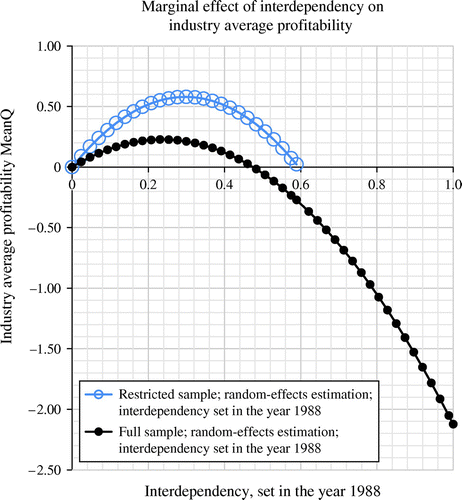
As reported by LRL, the effect of interdependency on MeanQ is not concave (as shown in Models 5-2 and 5-3). In contrast, the effect of interdependency we find is concave (as shown in Model 5-9), supporting Hypothesis 1. However, the concavity is not supported with a sample that has range restriction (as shown in Model 5-6). A comparison between the restricted sample and the full sample is presented graphically in Figure 1, which shows the marginal effect of interdependency on MeanQ. While both samples display inverted-U-shaped relationships as predicted, only the full sample satisfies the normal standards of statistical proof.12
The effect of interdependency is substantial in size. We estimate that the difference between a minimal and moderate level of interdependency corresponds to a rise of 0.22 in , from 0.84 to 1.06. And the difference between a moderate and maximal level of interdependency corresponds to a fall of 0.96 in , from 1.06 to 0.10. These magnitudes in the rise and fall in are 29% and 128% of the full sample’s standard deviation, which is 0.75.
Using Model 5-9, we compare the relative importance of interdependency with R&D intensity, advertising intensity, and industry growth. We find that a one-standard-deviation increase in interdependency from the minimum corresponds to an increase of 0.19 in (a change of 23% higher than the estimated with sample mean values, rising from 0.84 to 1.03). The respective increase in associated with a one-standard-deviation increase in R&D intensity, advertising intensity, and industry growth is 0.06, 0.08, and 0.04, respectively. Therefore, interdependency represents an important characteristic of the industry environment that affects profitability, more than R&D intensity, advertising intensity, and industry growth.
The Effect of Interdependency on Qjt
Table 6 shows the effects of interdependency on our alternate measure of industry average profitability, ln(Qjt). Models 6-1 through 6-6 are random-effects estimations with time invariant interdependency. Interdependency is found to have a concave relationship with ln(Qjt), but only for the full sample (Model 6-6). The relationship remains concave, as shown in Models 6-7 through 6-9, when interdependency changes over time. These findings suggest that, when industry sample has less range restriction, the concave relationship is confirmed with both measures of industry average profitability.
|
Table 6: Regression Results: Interdependency and Industry Average Profitability
| Dependent variable: ln Qjt | |||||||||
|---|---|---|---|---|---|---|---|---|---|
| Industry-level estimation | Random effects (Restricted sample) | Random effects (Full sample) | Random effects (Full sample) | ||||||
| Model | 6-1 | 6-2 | 6-3 | 6-4 | 6-6 | 6-6 | 6-7 | 6-8 | 6-9 |
| R&D intensity | 1.011 (0.918) | 0.943 (0.905) | 0.916 (0.923) | 1.987∗ (0.964) | 1.977∗ (0.960) | 1.813+ (0.968) | 1.987∗ (0.964) | 1.999∗ (0.968) | 1.791+ (0.952) |
| Advertising intensity | 1.690 (1.614) | 1.541 (1.638) | 1.556 (1.644) | 2.371∗ (0.935) | 2.403∗∗ (0.932) | 2.519∗∗ (0.947) | 2.371∗ (0.935) | 2.398∗∗ (0.931) | 2.784∗∗ (0.921) |
| Industry growth | 0.889∗∗ (0.314) | 0.884∗∗ (0.313) | 0.884∗∗ (0.313) | 0.947∗∗∗ (0.271) | 0.948∗∗∗ (0.272) | 0.946∗∗∗ (0.272) | 0.947∗∗∗ (0.271) | 0.943∗∗∗ (0.272) | 0.910∗∗∗ (0.261) |
| Interdependency (H1+) | 0.012∗∗ (0.004) | 0.021 (0.038) | −0.004 (0.005) | 0.031∗ (0.013) | −0.003 (0.004) | 0.033∗∗ (0.0123) | |||
| Interdependency, squared (H1−) | -9.67e−05 (0.0004) | −0.0003∗∗ (0.0001) | −0.0003∗∗ (8.53e−05) | ||||||
| Year effects | x | x | x | x | x | x | x | x | x |
| Industry effects (two-digit SIC dummies) | x | x | x | x | x | x | x | x | x |
| Constant | −0.301 (0.213) | −0.787∗∗ (0.252) | −0.994 (0.911) | −0.415 (0.337) | −0.242 (0.304) | −1.111∗ (0.440) | −0.415 (0.337) | −0.220 (0.358) | −1.395∗ (0.542) |
| Observations | 962 | 962 | 962 | 1,193 | 1,193 | 1,193 | 1,193 | 1,193 | 1,193 |
| Industries | 109 | 109 | 109 | 135 | 135 | 135 | 135 | 135 | 135 |
| R-squared | 0.371 | 0.383 | 0.383 | 0.338 | 0.343 | 0.353 | 0.338 | 0.341 | 0.355 |
| Wald test statistics | 640∗∗∗ | 485∗∗∗ | 489∗∗∗ | 305∗∗∗ | 375d∗∗∗ | 356∗∗∗ | 313∗∗∗ | 481∗∗∗ | 499∗∗∗ |
Notes. Models 6-1 through 6-6 use time-invariant interdependency; Models 6-7 through 6-9 use time-varying interdependency. Robust standard errors in parentheses.
∗∗∗p < 0.001, ∗∗p < 0.01, ∗p < 0.05, +p < 0.10.
Patent Effectiveness
Industries vary in the effectiveness of patents as a means of capturing and protecting the competitive advantages of new or improved processes and products. Patents are effective in only a few industries, as reported by Levin et al. (1987) with their survey data collected in 1983 from 650 R&D executives on the nature of appropriability in 130 industries defined at the Federal Trade Commission Line of Business level. The difference between industries on patent effectiveness persists over time, as reported by Cohen et al. (2000) with their survey data collected from 1,478 R&D labs in the U.S. manufacturing sector in 1994 covering 34 industries at the two- or three-digit ISIC level.13
We examine whether the effect of interdependency, which is informed with patent data, could be amplified in industries where patents are effective. We use the threshold established by Cohen et al. (2002, p. 9) to distinguish industries with greater patent effectiveness.14 Industries with effectiveness greater than 41% as shown in their Table 1 (ibid: 32) are coded as 1; 0 otherwise. The binary indicator of patent effectiveness is added to the model as a control variable. We find that patent effectiveness has a positive effect on industry profitability, consistent with previous research and LRL. Profitability is higher in industries in which patents can effectively protect the profits that are directly associated with the commercialization or sale (i.e., licensing) of patented inventions.
|
Table 7: Regression Results: Patent Effectiveness Added as a Control Variable and as a Moderating Variable
| Dependent variable: ln Qjt | ||||||||||
|---|---|---|---|---|---|---|---|---|---|---|
| Industry-level estimation | Random effects (restricted sample) | Random effects (full sample) | ||||||||
| Model | 7-1 | 7-2 | 7-3 | 7-4 | 7-5 | 7-6 | 7-7 | 7-8 | 7-9 | 7-10 |
| R&D intensity | 1.825 (1.122) | 1.799 (1.104) | 1.661+ (0.992) | 1.722 (1.196) | 1.526 (1.084) | 2.611∗ (1.326) | 2.607∗ (1.330) | 2.503+ (1.302) | 2.570+ (1.376) | 2.452+ (1.356) |
| Advertising intensity | 2.412 (1.520) | 2.376 (1.536) | 2.043 (1.430) | 2.429 (1.544) | 2.121 (1.416) | 3.352∗∗ (1.211) | 3.336∗∗ (1.212) | 3.323∗∗ (1.067) | 3.338∗∗ (1.216) | 3.363∗∗ (1.068) |
| Industry growth | 0.920∗ (0.374) | 0.932∗ (0.375) | 0.895∗ (0.352) | 0.960∗ (0.387) | 0.938∗ (0.376) | 1.033∗∗ (0.350) | 1.033∗∗ (0.349) | 0.983∗∗ (0.331) | 1.046∗∗ (0.357) | 1.016∗∗ (0.345) |
| Patent effectiveness | 0.456∗∗∗ (0.129) | 0.450∗∗∗ (0.127) | 0.432∗∗∗ (0.126) | 0.235 (0.317) | −0.132 (0.898) | 0.441∗∗∗ (0.127) | 0.440∗∗∗ (0.127) | 0.425∗∗∗ (0.125) | 0.324 (0.345) | 0.662 (1.143) |
| Interdependency (H1+) | 0.009 (0.006) | 0.055∗∗ (0.020) | 0.009 (0.006) | 0.056 ∗∗ (0.021) | 0.0004 (0.005) | 0.045∗∗ (0.015) | 0.0004 (0.005) | 0.046 ∗∗ (0.015) | ||
| Interdependency, squared (H1−) | −0.0004∗ (0.0002) | −0.0004∗ (0.0002) | −0.0004∗∗ (0.0001) | −0.0004∗∗ (0.0001) | ||||||
| Interdependency×patent effectiveness | 0.004 (0.006) | 0.013 (0.032) | 0.002 (0.006) | 0.012 (0.038) | ||||||
| Interdependency squared ×patent effectiveness | -5.62e–05 (0.0003) | 0.0001 (0.0003) | ||||||||
| Year effects | x | x | x | x | x | x | x | x | x | x |
| Industry effects (two-digit SIC dummies) | x | x | x | x | x | x | x | x | x | x |
| Constant | −0.420+ (0.216) | −1.011∗ (0.439) | −2.406∗∗ (0.735) | −1.022∗ (0.437) | −2.464∗∗ (0.756) | −0.731∗ (0.356) | −0.758∗ (0.377) | −2.142∗∗∗ (0.580) | −0.760∗ (0.378) | −2.188∗∗∗ (0.587) |
| Observations | 649 | 649 | 649 | 649 | 649 | 781 | 781 | 781 | 781 | 781 |
| Industries | 74 | 74 | 74 | 74 | 74 | 89 | 89 | 89 | 89 | 89 |
| R-squared | 0.466 | 0.470 | 0.465 | 0.470 | 0.466 | 0.446 | 0.446 | 0.441 | 0.446 | 0.441 |
| Wald test statistics | 632∗∗∗ | 674∗∗∗ | 710∗∗∗ | 687∗∗∗ | 721∗∗∗ | 501∗∗∗ | 524∗∗∗ | 609∗∗∗ | 534∗∗∗ | 635∗∗∗ |
Notes. All models in Table 7 use time-varying interdependency. Sample size changes as a result of the matching between ISIC (used in Cohen et al.) and SIC. Robust standard errors in parentheses.
∗∗∗p < 0.001, ∗∗p < 0.01, ∗p < 0.05, +p < 0.10.
The concave relationship remains significant, after controlling for patent effectiveness (Models 7-3 and 7-8).15 Further, we test whether the concave relationship might be moderated by patent effectiveness, by adding interaction terms between interdependency and patent effectiveness. As shown in Models 7-4, 7-5, 7-9, and 7-10, the interactions between interdependency and patent effectiveness are not statistically significant. That is, patent effectiveness does not moderate the effect of interdependency on industry average profitability. The concave relationships we find, therefore, do not vary with patent effectiveness.
Within-Industry Variation Over Time
Further, we examine potential biases that may result from omitted industry effects. Models 8-1 through 8-3 use the fixed-effects specification. The Sargan-Hansen test (Sargan 1958, Hansen 1982), which accommodates robust standard errors regression in comparing model specifications, suggests that the fixed-effects estimator should be used, as does the Hausman test (Hausman 1978).16
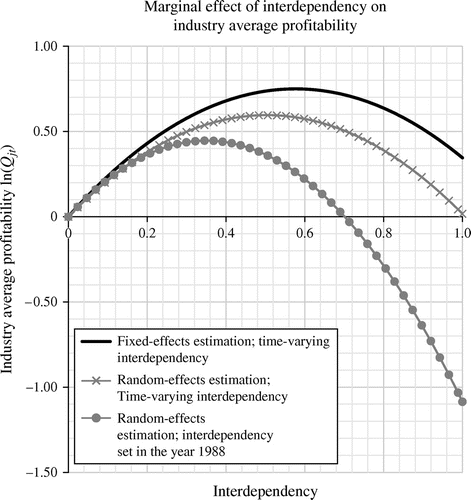
A comparison between random- and fixed-effects estimations is presented graphically in Figure 2, which shows the marginal effect of interdependency on ln(Qjt). Based on the fixed-effects estimation (black line with no markers), the marginal effect peaks at 0.75, corresponding to a moderate level of interdependency (78, which is equivalent to 0.58 as shown on the scale in Figure 2).17 The difference between the fixed-effects and the random-effects estimation (x markers) suggests that omitted industry-specific time-invariant variables shift the curve downward (21% off the peak marginal effects, reduced from 0.75 to 0.60).
|
Table 8: Regression Results: Fixed-Effects Estimations
| Dependent variable: ln Qjt | |||
|---|---|---|---|
| Industry-level estimation | Fixed effectsnote | ||
| Model | 8-1 | 8-2 | 8-3 |
| R&D intensity | 0.960 (1.284) | 0.959 (1.264) | 0.809 (1.215) |
| Advertising intensity | 1.842 (1.135) | 1.842 (1.136) | 2.303∗ (1.106) |
| Industry growth | 0.879∗∗ (0.268) | 0.879∗∗ (0.265) | 0.855∗∗ (0.254) |
| Interdependency (H1+) | 0.0001 (0.012) | 0.047+ (0.024) | |
| Interdependency, squared (H1−) | −0.0003∗ (0.0001) | ||
| Year effects | x | x | x |
| Industry effects (two-digit SIC dummies) | |||
| Constant | −0.449∗∗∗ (0.057) | −0.455 (0.543) | −1.889∗ (0.851) |
| Observations | 1,193 | 1,193 | 1,193 |
| Industries | 135 | 135 | 135 |
| R-squared | 0.176 | 0.177 | 0.224 |
| Adj. R-squared within | 0.219 | 0.218 | 0.231 |
| F test statistics | 16.45∗∗∗ | 15.13∗∗∗ | 14.47∗∗∗ |
Notes. All models in Table 8 use time-varying interdependency. Two-digit SIC dummies are time-invariant, so they are excluded from the fixed-effects estimation. Model 8-3 vs. Model 6-9. Hausman test: Use the fixed-effects estimator. Chi2: 64.02 (p < 0.001). Sargan-Hansen test: Use the fixed-effects estimator. Chi2: 265.79 (p < 0.001). Robust standard errors in parentheses.
∗∗∗p < 0.001, ∗∗p < 0.01, ∗p < 0.05, +p < 0.10.
The Effect of Interdependency on FirmQ
Table 9 presents a comparison between the LRL regression results and ours in regard to the effect of interdependency on firm profitability. Models 9-2 through 9-3 are Models 4–5 reported in LRL’s Table 3 (pp. 133).18 As shown in Models 9-2 and 9-3, LRL found the effect of interdependency on firm profitability to be concave. In comparison, Models 9-4 through 9-6 show our estimation with a time-invariant measure of interdependency set at its level in 1988. Following LRL, we estimate with the restricted sample using the random-effects specification and no industry dummies. Like LRL, we found the effect of interdependency on firm profitability to be concave. The concave relationship is also found with the full sample, as shown in Models 9-7 through 9-9.
|
Table 9: Regression Results: Interdependency and Firm Profitability—Using Time-Invariant Interdependency
| Dependent variable: LogQ | |||||||||
|---|---|---|---|---|---|---|---|---|---|
| Firm-level estimation | Random effects (LRL) | Random effects | Random effects | ||||||
| Model | 9-1 | 9-2 | 9-3 | 9-4 | 9-5 | 9-6 | 9-7 | 9-8 | 9-9 |
| R&D intensity | 0.174∗∗ (0.02) | 0.173∗∗ (0.02) | 1.258∗∗∗ (0.191) | 1.257∗∗∗ (0.192) | 1.254∗∗∗ (0.191) | 1.229∗∗∗ (0.177) | 1.227∗∗∗ (0.177) | 1.224∗∗∗ (0.177) | |
| Advertising intensity | 0.438∗∗ (0.161) | 0.429∗∗ (0.162) | 0.588+ (0.306) | 0.546+ (0.302) | 0.549+ (0.300) | 0.432+ (0.249) | 0.414+ (0.248) | 0.417+ (0.250) | |
| Industry growth | 0.377∗∗ (0.047) | 0.375∗∗ (0.047) | 1.199∗∗∗ (0.335) | 1.199∗∗∗ (0.333) | 1.194∗∗∗ (0.332) | 1.175∗∗∗ (0.309) | 1.175∗∗∗ (0.309) | 1.167∗∗∗ (0.307) | |
| Interdependency (H2+) | 0.45∗∗ (0.078) | 1.827∗∗ (0.251) | 0.018∗∗∗ (0.003) | 0.060∗∗∗ (0.017) | 0.009∗ (0.004) | 0.065∗∗∗ (0.011) | |||
| Interdependency, squared (H2−) | −1.693∗∗ (0.289) | −0.0004∗ (0.0002) | −0.0006∗∗∗ (9.14e–05) | ||||||
| Year effects | x | x | x | x | x | x | x | x | |
| Industry effects (two-digit SIC dummies) | |||||||||
| Constant | 0.156∗∗ (0.035) | −0.100+ (0.056) | −0.173∗∗∗ (0.038) | −0.961∗∗∗ (0.146) | −1.918∗∗∗ (0.425) | −0.200∗∗∗ (0.0365) | −0.580∗∗∗ (0.175) | −1.933∗∗∗ (0.278) | |
| Observations | 16,501 | 16,501 | 16,579 | 16,579 | 16,579 | 17,955 | 17,955 | 17,955 | |
| Industries | 109 | 109 | 109 | 109 | 109 | 135 | 135 | 135 | |
| Firms | 3,452 | 3,452 | 3,551 | 3,551 | 3,551 | 3,841 | 3,841 | 3,841 | |
| R-squared | 0.116 | 0.118 | 0.130 | 0.162 | 0.166 | 0.124 | 0.144 | 0.156 | |
| Wald test statistics | 969∗∗∗ | 1,016∗∗∗ | 694∗∗∗ | 723∗∗∗ | 715∗∗∗ | 615∗∗∗ | 628∗∗∗ | 669∗∗∗ | |
Note. Robust standard errors in parentheses.
∗∗∗p < 0.001, ∗∗p < 0.01, ∗p < 0.05, +p < 0.10.
Next, Table 10 shows estimates of models using a time-varying measure of interdependency. Models 10-1 through 10-3 use the restricted sample, while Models 10-4 through 10-6 use the full sample. These models suggest that the effect of interdependency on firm profitability also follows a concave relationship. Next, we examine potential biases that may result from omitted firm effects. Models 10-7 through 10-9 use the fixed-effects specification, and they also suggest a concave relationship, after correcting the omitted variable bias that results from firm effects. The Sargan-Hansen test (Sargan 1958, Hansen 1982) suggests that the fixed-effects estimator should be used, as does the Hausman test (Hausman 1978). Furthermore, we add industry fixed effects to Models 10-7 through 10-9 by using the technique of multilevel modeling that includes both firm and industry fixed effects in the same model. The results as reported in Supplemental Test A suggest a concave relationship.
|
Table 10: Regression Results: Interdependency and Firm Profitability—Using Time-Varying Interdependency
| Dependent variable: LogQ | |||||||||
|---|---|---|---|---|---|---|---|---|---|
| Firm-level estimation | Random effects | Random effects | Fixed effects | ||||||
| Model | 10-1 | 10-2 | 10-3 | 10-4 | 10-5 | 10-6 | 10-7 | 10-8 | 10-9 |
| R&D intensity | 0.975∗∗∗ (0.0781) | 0.925∗∗∗ (0.0756) | 0.921∗∗∗ (0.0744) | 0.974∗∗∗ (0.0777) | 0.937∗∗∗ (0.0756) | 0.927∗∗∗ (0.0741) | 0.565∗∗∗ (0.0802) | 0.565∗∗∗ (0.0803) | 0.569∗∗∗ (0.0795) |
| Advertising intensity | 0.570∗∗ (0.188) | 0.402∗ (0.187) | 0.372∗ (0.188) | 0.467∗∗ (0.168) | 0.345∗ (0.169) | 0.330+ (0.170) | 0.371+ (0.201) | 0.371+ (0.201) | 0.362+ (0.200) |
| Industry growth | 1.151∗∗∗ (0.147) | 1.143∗∗∗ (0.146) | 1.066∗∗∗ (0.144) | 1.192∗∗∗ (0.140) | 1.191∗∗∗ (0.140) | 1.100∗∗∗ (0.138) | 0.982∗∗∗ (0.143) | 0.980∗∗∗ (0.144) | 0.939∗∗∗ (0.142) |
| Interdependency (H2+) | 0.020∗∗∗ (0.002) | 0.055∗∗∗ (0.006) | 0.016∗∗∗ (0.001) | 0.057∗∗∗ (0.006) | −0.001 (0.004) | 0.027∗∗ (0.00915) | |||
| Interdependency, squared (H2−) | −0.0003∗∗∗ (5.05e−05) | −0.0003∗∗∗ (4.67e−05) | −0.0002∗∗∗ (5.77e−05) | ||||||
| Year effects | x | x | x | x | x | x | x | x | x |
| Industry effects (two-digit SIC dummies) | |||||||||
| Constant | −0.021 (0.022) | −1.379∗∗∗ (0.110) | −2.372∗∗∗ (0.214) | −0.043∗ (0.021) | −1.082∗∗∗ (0.101) | −2.298∗∗∗ (0.192) | −0.465∗∗∗ (0.021) | −0.207 (0.175) | −1.056∗∗∗ (0.309) |
| Observations | 16,579 | 16,579 | 16,579 | 17,955 | 17,955 | 17,955 | 17,955 | 17,955 | 17,955 |
| Industries | 109 | 109 | 109 | 135 | 135 | 135 | 135 | 135 | 135 |
| Firms | 3,551 | 3,551 | 3,551 | 3,841 | 3,841 | 3,841 | 3,841 | 3,841 | 3,841 |
| R-squared | 0.128 | 0.157 | 0.161 | 0.123 | 0.144 | 0.150 | 0.107 | 0.097 | 0.130 |
| Adj. R-squared within | 0.044 | 0.044 | 0.045 | ||||||
| Wald test statistics | 712∗∗∗ | 916∗∗∗ | 952∗∗∗ | 770∗∗∗ | 913∗∗∗ | 981∗∗∗ | |||
| F test statistics | 51.51∗∗∗ | 47.24∗∗∗ | 43.96∗∗∗ | ||||||
Notes. Model 10-9 vs. Model 10-6. Hausman test: Use the fixed-effects estimator. Chi2: 168.29 (p < 0.001). Sargan-Hansen Test: Use the fixed-effects estimator. Chi2: 233.36 (p < 0.001). Robust standard errors in parentheses.
∗∗∗p < 0.001, ∗∗p < 0.01, ∗p < 0.05, +p < 0.10.
The concave relationships are presented graphically in Figure 3, which shows the marginal effect of interdependency on LogQ. With the firm fixed-effects estimation (black line with no markers), the marginal effect peaks at 0.29, corresponding to a moderate level of interdependency (66, which is equivalent to 0.44 as shown on the scale in Figure 3).19 The difference between the fixed-effects estimation and the random-effects estimation (x markers) suggests that omitted firm-specific time-invariant variables shift the curve upward (270% above the peak marginal effects, raised from 0.29 to 1.07).

As for the economic importance of interdependency, we estimate that the difference between a minimal and moderate level of interdependency corresponds to a rise of 0.24 in Qit, increasing from 0.72 to 0.96. And the difference between a moderate and maximal level of interdependency corresponds to a drop of 0.39 in Qit, decreasing from 0.96 to 0.57. These magnitudes in the rise and fall in firm profitability correspond respectively to 12% and 19% of the standard deviation in the full sample, which is 2.01. Compared to our finding on industry profitability, interdependency explains a narrower range for Qit than for .
The concavity we find implies that higher moments of firm profitability distribution would also be the highest at a moderate level of interdependency. As reported in Supplemental Test B, we show evidence in support of a concave relationship between industries’ potential for interdependency and the second moment of firm profitability distribution as well as a concave relationship between industries’ potential for interdependency and the third moment of firm profitability distribution.
Industries with Incremental vs. Significant Changes in Interdependency Over Time
Based on the levels of interdependency that correspond to peak profitability (78 and 66 for industry and firm profitability, respectively), we examine the changes in interdependency year by year from 1988 through 1996. Figure 4 presents the annual levels of interdependency for four industries, and compares them to moderate interdependency as benchmarks. The line on the very top of the figure shows a consistently high interdependency, way above the benchmark corresponding to peak industry profitability. By contrast, the line at the bottom of the figure shows consistently low interdependency, way below the benchmark corresponding to peak firm profitability. These two relatively flat lines suggest that the effort at refinement was too much (for the top line) or too little (for the bottom line) compared to the effort at recombination. The two lines in the middle have changing levels in interdependency that cover a broad range, including moderate levels of interdependency. These two lines with steep slopes suggest that the effort at refinement was increasing at a rate faster than the effort at recombination, but not exceedingly so.
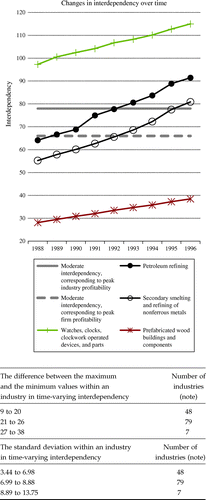
Below Figure 4, we present two histograms comparing the number of industries by the amount of temporal change. Seventy-nine industries (59% of 135 industries) have a medium amount of change, where the difference between the maximal and minimal interdependency is between 21 and 26, and the standard deviation is between 6.99 and 8.88. In comparison, 48 industries (36%) have a smaller amount of change, whereas seven industries (5%) have a larger amount of change.
Robustness Checks
As robustness checks, we examine how sensitive our results are to changes in model specifications. The first set of robustness checks is to remove the singletons from the panel in fixed-effects estimations. Our results are robust to the removal of one industry singleton and 698 firm singletons. The second set of robustness checks is to use balanced panels, which allows us to compare the profitability of the same firms over the same time period. Robust with two balanced panels of 1,272 firms (1992–1996) and 1,104 firms (1991–1996), our results consistently show concave relationships between an industry’s potential for interdependency and firm profitability.
Discussions
A key finding that our analyses and results contribute is that a change in an industry’s potential for interdependency over time has significant effects on industry and firm profitability. The underlying potential for interdependency as an industry-level characteristic has been assumed to be constant. However, our study uncovers the importance of within-industry changes in such potential over time.
Changes in an Industry’s Potential for Interdependency Over Time
What is driving an industry’s potential for interdependency to change over time? We propose that the change is driven by the relative accumulation rates between efforts that focus on refining existing knowledge components and efforts that are dedicated to recombining existing knowledge components with new ones. The interdependency increases over time when more efforts focus on refinement, and decreases when more efforts are dedicated to recombination. The search for a useful combination of components is akin to finding a peak on a performance landscape (Fleming and Sorenson 2001). The search is more successful at a moderate level of interdependency, when the relative rates of accumulation suggest a balance between refinement and recombination. The landscape has a large number of tall peaks and some peaks are clustered in a mountain range, providing the highest probability of finding useful combinations.
At a low level of interdependency, the search for useful combinations is efficient. The landscape is smooth with few peaks and those that do rise are comparable in their height. The search can be achieved by altering one component at a time, replacing it with a different component or redesigning the arrangement of it relative to other components. Although the search can be achieved through incremental improvements, competitors can easily arrive at similarly performing peaks, as suggested by Rivkin’s (2000) research on complexity and imitation. Since the competitors are equally efficient in their search, no firm has any significant advantage.
At a high level of interdependency, the search for useful combinations is difficult. The landscape is rugged with many low peaks scattered apart and separated by valleys (Rivkin 2000, p. 835). With low height, there is no assurance that useful combinations can be found. Scattered peaks separated by valleys suggest that local search makes slow progress. Little information is available to predict where the peaks may locate, since their locations are not systematically correlated. Moreover, the sides of the peaks are rough. The roughness means that there is little basin of attraction to reveal monotonic and incremental paths to the peaks. Furthermore, continuous efforts on refinement using the same combination repeatedly exhaust what can be discovered from the limited combinatorial possibilities restricted to the same components. As more efforts focus on refinement, competition in the search becomes more intense, since it is confined to the increasingly exhausted combinatorial possibilities. As a result, the outcomes of the search are equally poor and no firm has any significant advantage.
Limitations
Both the LRL measure and ours use information associated with industrial R&D. While industrial R&D meets the two premises required for qualifying a measure as an industry-level characteristic, an industry’s potential for interdependency may come from sources that are not captured by patent data or perceptions of R&D managers. For instance, complementarity in a business ecosystem suggests that the potential for interdependency of a device-making industry is linked to the potential of a content-providing industry, with which the two industries jointly create value on the same platform. Although the mixing and matching of technology subclasses may reflect the link between industries in some patents, our measure is, by design, a general one so that it broadly covers industries without considering complementarity in a business ecosystem for value creation.
Our measure of interdependency is constructed with patent data, so we must ask ourselves how the data generating process would affect result interpretation and generalization.20 Not all industries can use patents to codify their activities. Inventions that involve highly tacit, causally ambiguous and complex knowledge are likely to be under-represented. Consequently, our measure of interdependency is confined to industries where knowledge efforts are codified in the form of technological patents. For the knowledge that can be codified, inventors may restrict their patent applications to a subset of their discoveries, such as the most successful inventions. Less successful trial-and-error experimentations are less likely to be documented in the form of a patent. As a result, the topography of the underlying landscape are inferred from truncated data. Most importantly, inventors may choose to keep their discoveries secret.21 Knowledge efforts kept as secret are not reflected in patent data. Therefore, our measure of interdependency is only applicable to industries where knowledge efforts on refinement and recombination are disclosed in patents. Despite the data limitations, patents do offer a trail of innovative efforts for us to examine how frequently pieces of knowledge are used jointly in technological inventions. When aggregated over time, patents can inform the relative rates of knowledge accumulation between refinement and recombination, which are the mechanisms driving temporal changes in an industry’s potential for interdependency.
Another limitation is that we are not able to address omitted industry effects that vary with time. If some industry-specific time-varying variables are correlated with interdependency, our fixed-effects estimation is still biased. For instance, some industries have intensifying patent portfolio races, compared to other industries. Firms have felt increasingly compelled to apply for patents in the semiconductor (Hall and Ziedonis 2001) and electronics industry (Cohen et al. 2000).22 In the electronics industry, as an example, to become or remain a major competitor, firms use patents for blocking and negotiating with rivals. Patents are legal instruments for blocking rivals from imitation and forcing rivals to share their new technologies. Such use of patents ensures that firms can steadily improve and expand their product lines and processes, and appropriate a share of the oligopolistic rents accruing to the new technologies of all incumbents. Interindustry differences in how quickly patenting rates accelerate over time, however, are not time-invariant. We cannot rule out that the rates of refinement and recombination that we observe may reflect time-varying interindustry differences that are driven by patent portfolio races. Patent portfolio races generate a lot of knowledge accumulation, particularly efforts at refining the existing components in the portfolio. As such, an industry’s accelerating rate of patenting could be correlated with interdependency, resulting in an omitted variable bias in our fixed-effects estimations. Because of this limitation, our study provides only an intermediate piece of evidence about interdependency and profitability.
Conclusions
An industry’s potential for interdependency among productive activities is one of the central concepts in strategic management. It represents an important characteristic of the industry environment; we show that a change in an industry’s potential for interdependency has statistically significant and economically important effects on firm and industry profitability. While theoretical models have clarified how and why industry average profitability would peak at moderate levels of interdependency, the empirical evidence so far has not supported the inverted-U-shaped relationship.
By using a better measure of interdependency, we find empirical evidence that strongly supports the predicted relationship. We also confirm the other predicted concave relationship that is between interdependency and firm profitability. More importantly, we show that if industry-specific variables that correlate with interdependency are not addressed with fixed-effects estimations, the estimated curve would shift downward, reducing the peak marginal effect by 21%. Likewise, if firm-specific variables that correlate with interdependency are not addressed with fixed-effects estimations, the estimated curve would shift upward, raising the peak marginal effect by 270%.
An additional contribution we make is to facilitate a general implementation for quantifying an industry’s potential for interdependency. Our study is second to LRL in employing large-scale empirical analyses on interdependency, but the source of our data is in the public domain, so future studies can build on our measure of industries’ potential for interdependency.
The authors thank senior editor Michael Lenox and two anonymous referees. The research greatly benefited from their insightful guidance and suggestions. The authors also thank Editor-in-Chief Daniel Levinthal for creating a distinctive intellectual space with Strategy Science through which thoughtful and decisive feedback and evaluation nurture impactful scholarship.
Appendix A. A Case Study on How the Potential for Interdependency Changed Over Time in the Semiconductor Industry
The semiconductor industry (SIC code 3674) is engaged in manufacturing semiconductors and related solid-state devices such as semiconductor diodes and stacks, integrated microcircuits, and light sensing and emitting semiconductor devices. The purpose of this case study is to illustrate how two mechanisms—refinement and recombination—change the potential for interdependency in the industry over time. We illustrate the mechanisms by showing the classifications of patents about copper interconnect technology.
The Case of Copper Interconnect Technology: Replacing Aluminum Wiring with Copper Wiring
Copper interconnect technology is a significant development in the semiconductor industry that provides a suitable context for the illustration. Compared to aluminum, copper offers better electromigration properties to handle increasing current densities and lower resistivity to provide higher integrated circuit speed (Kapur et al. 2002). Aluminum, instead of copper, had been used for the interconnects in a semiconductor chip, because four technical challenges were difficult to overcome. For example, copper, unlike aluminum, has the tendency to contaminate silicon, thus destroying the very circuitry it is meant to interconnect (see Lim 2009 for a detailed description of the difficulties as well as the five R&D breakthroughs). To address the challenges, modifications to the manufacturing techniques, organizational processes, and production flow are required.
Refinement
Refinement refers to (1) tighter coupling among pieces of knowledge within a component; and (2) repeated coupling between components of an existing combination. The first type of refinement is within a subclass of technology, whereas the second type of refinement is within an existing combination of subclasses.
Successive refinement efforts improved the conventional processes of semiconductor fabrication such as metal deposition and plasma etching. The refinement, however, made it difficult to the switch from aluminum to copper. For plasma etching, aluminum is removed from areas where it is not desired. But the conventional etching method frequently used with aluminum cannot be practiced with copper, because copper is difficult to etch using plasma gases. For metal deposition, the conventional process of depositing a thin layer of aluminum over the surface of a substrate works poorly with copper, because copper suffers from the problems of oxidation and corrosion. Compared to aluminum, copper is more susceptible to high temperature oxidation and is more easily corroded in an environment that is typical of the conventional metal deposition process. Copper also suffers from the problems of diffusion and adhesion. Unlike aluminum, copper diffuses in materials commonly used in the fabrication processes such that the diffusion causes the metallization to degrade. Also unlike aluminum, copper adheres poorly to many other metals or insulators used in the conventional process of deposition.
Table A.1 shows examples of successive patents refining the conventional processes in semiconductor fabrication involving the use of aluminum. These refinement patents deepen the interdependencies among the existing set of fabrication activities by publicly revealing how to improve aluminum metallization with processes of metal deposition and plasma etching. The more refinement patents accumulate, the more is known about the interdependencies between aluminum and the conventional processes. The increase in interdependencies is problematic for any firm that might have considered switching to copper. Successive patents that refine the conventional processes make the replacement of aluminum by copper more difficult.
|
Table A.1: Patents on Metal Deposition and Plasma Etching for Semiconductor Fabrication
| IPC | Patent ID | Filing year | Patent title |
|---|---|---|---|
| H01L | US3654526 | 1970 | Metallization system for semiconductors |
| H01L | US4087367 | 1975 | Preferential etchant for aluminum oxide |
| H01L | US4307132 | 1979 | Method for fabricating a contact on a semiconductor substrate by depositing an aluminum oxide diffusion barrier layer |
| H01L | US4316209 | 1979 | Metal/silicon contact and methods of fabrication thereof |
| H01L | US4436582 | 1980 | Multilevel metallization process for integrated circuits |
| H01L | US4753709 | 1987 | Method for etching contact vias in a semiconductor device |
| H01L | US4933305 | 1988 | Process of wire bonding for semiconductor device |
| H01L | US4966865 | 1988 | Method for planarization of a semiconductor device prior to metallization |
| H01L | US5072282 | 1990 | Multilayer wirings on a semiconductor device and fabrication method |
| H01L | US5350484 | 1992 | Method for the anisotropic etching of metal films in the fabrication of interconnects |
| H01L | US5374592 | 1994 | Method for forming an aluminum metal contact |
| H01L | US5627106 | 1994 | Trench method for three dimensional chip connecting during IC fabrication |
| H01L | US6617242 | 1995 | Method for fabricating interlevel contacts of aluminum/refractory metal alloys |
Notes. IPC H01L is semiconductor devices that include semiconductor and electric solid-state devices. These patents have the same IPC as US2981877, which is a landmark patent created in 1959 by Robert Noyce, the co-founder of Fairchild Semiconductor, that improved structures for making electrical connections.
Recombination
Successive recombination efforts enabled the switch to copper by adding new processes to the conventional processes of semiconductor fabrication. New processes such as damascene, electroplating deposition technique, and chemical-mechanical planarization (CMP), opened up the possibility to more easily use copper. The damascene technique solved the problem of copper with plasma etching by reversing the sequence of steps from the conventional fabrication process, such that the dielectric layer is deposited and patterned before the metal deposition. Superfilling in the electroplating technique, in which higher deposition rates are achieved at the bottom of the trenches with respect to the sidewalls, solved the problem of copper with metal deposition. CMP solved the problem of copper being a soft metal thus subject to scratching and embedded particles during polishing. The CMP process polishes away excess material and leaves a flat surface upon which to build the next layer.
Table A.2 shows examples of successive patents recombining new and conventional processes in semiconductor fabrication. These recombination patents publicly reveal the right combination that would lead to easier use of copper. For instance, a polishing slurry is invented by combining IPC C09G—polishing compositions containing abrasives or grinding agents—with IPC H01L—semiconductor devices. A method of plasma etching for silicon is invented by combining IPC B81C—processes or apparatus specially adapted for the manufacture or treatment of microstructural devices or systems—with IPC H01L. A technique that increases the efficiency of plasma generation for use in semiconductor processing equipment is invented by combining IPC H05H—plasma technique—with IPC H01L. The more recombination patents accumulate, the more is known about what components must be included in the search for solving the problems involving copper. The patents publicly reveal which components work well together to firms that otherwise must explore a high-dimensional combinatorial space on their own. Successive patents that recombined new processes with the conventional processes of semiconductor fabrication make the replacement of aluminum by copper easier.
|
Table A.2: Patents on New Processes for Semiconductor Fabrication
| IPC | IPC description | Patent ID | Filing year | Patent title |
|---|---|---|---|---|
| C09G | Polishing compositions containing abrasives or grinding agents | US5527423 | 1994 | Chemical mechanical polishing slurry for metal layers |
| B81C | Processes or apparatus specially adapted for the manufacture or treatment of microstructural devices or systems | US5501893 | 1993 | Method of anisotropically etching silicon |
| H05H | Plasma technique | US4948458 | 1989 | Method and apparatus for producing magnetically-coupled planar plasma |
Note. In 1997, the copper interconnect technology matured into production (Lim 2009, p. 1263).
The Ease of Recombination
We submit that the ease of recombination is driven by the relative rates of accumulating patents focused on refinement and accumulating patents dedicated to recombination. The ease of recombination is calculated with Equation (1) in the main text.
As illustrated in Table A.3, prior to the appearance of H01L on patent 7,093,356, which was filed in the year 2003, H01L had been recombined 117,149 times with 449 other subclasses, indicating an ease of recombination of 449/117,149 = 0.004.23
|
Table A.3: Changes in the Ease of Recombination Over Time
| Ease of recombination as of the year | IPC H01L | IPC H05K |
|---|---|---|
| 1990 | ||
| 2003 | ||
Note. IPC H01L and IPC H05K (printed circuits and casting or constructional details of electric apparatus) are two main patent subclasses in the semiconductor industry.
In comparison, the ease of recombination of H01L EH01L was 0.012 in 1990. It decreased over time because the numerator, which is the number of subclasses with which H01L has jointly appeared, increased at a rate that is lower than the denominator, which is the number of patents in which H01L has appeared. Patents focused on H01L contribute to an increase in the denominator without changing the numerator. So do patents focused on refining the H01L and H05K pair. Hence, the difference in the relative rates of accumulation reflects that the patents dedicated to recombination grew at a slower rate than those focused on refinement. As shown by the changes in EH01L over time, the numerator barely doubled, while the denominator increased by more than five-fold.
What Drives Interdependency to Change Over Time? Inventors’ Efforts in Aggregate
As EH01L and EH05K both lowered their ease of recombination over time, a patent with two subclasses, H01L and H05K, would have a temporal increase in interdependency, as computed with Equation (2) in the main text. Such a patent’s interdependency in 1990 is 2/(0.012 + 0.037) ≈ 40, but increasing to 2/(0.004 + 0.014) ≈ 111 in 2003. The subclasses are the same, but the interdependency increased over time, because the ease of recombination decreased in each subclass. Therefore, we submit that inventors’ efforts in aggregate toward refinement and recombination drive interdependency to change over time.
Appendix B. Supplemental Tests
Supplemental Test A: Multilevel Modeling
We use multilevel modeling to estimate the effect of industries’ potential for interdependency on firm profitability. Multilevel modeling can include fixed effects at multiple levels of analysis, whereas the results we reported in estimating firm profitability addressed only firm-level fixed effect. In this supplemental test, we include both firm- and industry-level fixed effects in one model.
Specifically, we use a two-level model to test the effect of firms (level 1) nested within the effect of industries (level 2). Intercepts and slopes are allowed to vary across industries. The level 1 model corresponds to firm profitability as a function of the firm-level control variables, which are R&D intensity and advertising intensity. Level 1 regression model estimates LogQij, which is firm i’s natural log of Tobin’s q in industry j, as the following:
β0j intercept of LogQij in industry j;
β1j slope for the relationship in industry j between firm-level R&D intensity and LogQij;
β2j slope for the relationship in industry j between firm-level advertising intensity and LogQij;
rij random errors of prediction for the level 1 equation. It represents the within-industry variation, which in this case includes measurement error, natural variation in LogQij within a firm over time, and variation between firms (beyond what is explained by the firm’s R&D and advertising intensities).
Level 2 regression model estimates the intercept and slopes for the independent variables at level 1 in the groups of level 2. There are three level-2 equations:
γ00 overall intercept. This is the grand mean of LogQij across all the industries when all the predictors are equal to 0;
γ01 slope in the relationship between LogQij and industry growth;
γ02 slope in the relationship between LogQij and industry’s potential in interdependency;
γ03 slope in the relationship between LogQij and the square of industry’s potential in interdependency;
u0j random error component for the deviation of the intercept of an industry from the overall intercept, which is γ00;
γ10 slope in the relationship between LogQij and firm-level R&D intensity;
γ20 slope in the relationship between LogQij and firm-level advertising intensity;
u1j error component for the slope in the relationship between LogQij and firm-level R&D intensity (i.e., the deviation of the industry slopes from the overall slope);
u2j error component for the slope in the relationship between LogQij and firm-level advertising intensity (i.e., the deviation of the industry slopes from the overall slope).
Table B.1 shows the results of the multilevel analysis of the effect of industries’ potential for interdependency on firm profitability. The multilevel results confirm the finding we reported in Table 10. Having both firm- and industry-level fixed effects in one model, the estimated coefficients in Models B1-1 to B1-3 are comparable in size and statistical significance with those in Models 10-7 to 10-9. Within an industry, as an industry’s potential for interdependency increases, firm profitability rises and then falls.
|
Table B.1: Multilevel Analysis Estimating the Effect of Time-Varying Interdependency on Firm Profitability
| Model | B1-1 | B1-2 | B1-3 |
|---|---|---|---|
| Firm-level fixed effects | |||
| Intercept, the overall mean, γ00 | −0.254∗∗ (0.074) | −0.164 (0.118) | −1.253∗∗∗ (0.221) |
| R&D intensity, γ10 | 2.382∗∗∗ (0.159) | 2.401∗∗∗ (0.164) | 2.340∗∗∗ (0.156) |
| Advertising intensity, γ20 | 0.446∗ (0.201) | 0.432∗ (0.197) | 0.478∗ (0.209) |
| Industry-level fixed effects | |||
| Industry growth, γ01 | 1.169∗∗∗ (0.263) | 1.167∗∗∗ (0.264) | 1.112∗∗∗ (0.262) |
| Interdependency, γ02 | −0.002 (0.002) | 0.035∗∗∗ (0.006) | |
| Interdependency, squared, γ03 | −0.0003∗∗∗ (0.0001) | ||
| Variance components | |||
| Residual, rij | 0.886∗∗∗ (0.021) | 0.885∗∗∗ (0.021) | 0.885∗∗∗ (0.021) |
| Intercept, a random effect, u0j | 0.060∗∗∗ (0.006) | 0.060∗∗∗ (0.007) | 0.057∗∗∗ (0.006) |
| R&D intensity slope, varying by industry, u1j | 1.240∗∗∗ (0.269) | 1.274∗∗∗ (0.280) | 1.184∗∗∗ (0.257) |
| Advertising intensity slope, varying by industry, u2j | 0.457 (0.352) | 0.419 (0.332) | 0.528 (0.395) |
Notes. Robust standard errors in parentheses. Key results in bold.
∗∗∗p < 0.001, ∗∗p < 0.01, ∗p < 0.05.
In addition, we examine how much the variance in firm profitability is between versus within industries. We calculated the interclass correlation coefficient (ICC) for the full model B1-3 by dividing the between-industry variance by the total variance in firm profitability. The ICC indicates that 6.5% of firm profitability variance is between industries, suggesting that most of the variance is within industries.
Supplemental Test B: Industries’ Potential for Interdependency and Higher Moments of Firm Profitability Distribution
In this test, we show concave relationships between industries’ potential for interdependency and higher moments of firm profitability distribution. Figure B.1 presents the marginal effect of interdependency on the second and third moments of firm profitability distribution.
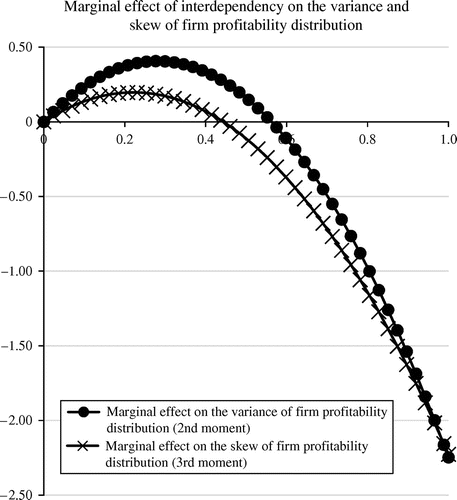
For the second moment of firm profitability distribution, we find evidence for a concave relationship between interdependency and the variance of firm profitability distribution. The variance is increasing with greater interdependency at a decreasing rate, and, at high levels of interdependency, the variance decreases with interdependency. The variance of firm profitability peaks at a moderate level of interdependency, where lots of heterogeneity in activity combinations that are locally optimal are associated with increased variance in firm profitability. The concave relationship we find is inconsistent with the linear relationship predicted and shown in LRL.
We submit that the concave relationship about the variance of firm profitability is consistent with an explanation based on performance landscape. At high levels of interdependency, there are multiple local peaks, but they are dispersed and spread apart. The dispersion, as suggested by prior research examining settings with high interdependency (e.g., Levinthal 1997, Rivkin 2000, Lenox et al. 2007), results from combinations associated with higher performance often being distinct from one another. As a result of the dispersion, search is difficult in that little information is available to predict where the peaks may locate, since their locations are not systematically correlated. Moreover, the sides of the peaks are rough. The roughness means that there is little basin of attraction to reveal monotonic and incremental paths to the peaks. More importantly, the height of the typical local peak falls (Rivkin 2000, pp. 835–836). As such, the firms are equally inefficient at high levels of interdependency, and the variance in firm profitability is low.
For the third moment of firm profitability distribution, we find strong statistical support for a concave relationship between interdependency and the skew of firm profitability distribution. At low levels of interdependency, we find that the right tail is longer than the left tail, showing that the mass of the distribution is concentrated on the left. This suggests that, in industries with low potential for interdependency, most firms have low performance. As the potential for interdependency increases, we find that the skew increases and then decreases, following a concave relationship. That is, the right tail grows longer and then shorter as interdependency increases. As the level of interdependency increases further, the skew reaches 0, suggesting that the tails become symmetric. At high levels of interdependency, the left tail is slightly longer than the right tail, showing that the mass of the distribution is concentrated more on the right. The number of firms with relatively higher profitability is slightly larger than the number of firms with relatively lower profitability, while the average firm profitability is low and the variance in firm profitability is low at high levels of interdependency.
1 We regard interdependency as a general attribute of systems with nearly complete decomposability, whether the system is a firm (e.g., Levinthal 1997, Rivkin 2000), a product (e.g., Eppinger et al. 1994, Baldwin and Clark 2000), or an industry (e.g., Lenox et al. 2006, 2007, 2010, 2011) when observed across levels of analysis. The focus of the current paper is at the industry level. Interdependencies exist when the components of a system interact richly in the Simonian sense: (a) A system consists of numerous components, and each of the components is, in turn, a system of finer components; and (b) the components richly interact with one another (Simon 1962).
2 As Porter (1985, p. 168) pointed out, “Moving to ceramic engine parts, for example, eliminates the need for machining and other manufacturing steps in addition to having other impacts on the value chain. Linkages with suppliers and channels also frequently involve interdependence in the technologies used to perform activities.”
3 Industries’ potential for interdependency is a latent construct, which is theoretical in nature; it cannot be directly observed. We infer such potential—the possibility of interdependency between activities in the industry’s production function—from variables that are observed and directly measured.
4 The U.S. Securities and Exchange Commission lists 218 four-digit SIC codes between 2000–3999 for manufacturing. http://www.sec.gov/info/edgar/siccodes.htm, accessed on September 30th, 2014.
5 For instance, the technology used to align the mask relative to the silicon wafer may improve or worsen the production performance of semiconductors because of component interactions (Henderson and Clark 1990, p. 23). A mask is a high-tech stencil with the pattern for the semiconductor. In the photolithographic alignment technology, a mechanical system that holds the mask and the wafer in place interacts richly with a lens to focus the image of the mask on the wafer.
6 The responses are from R&D managers and directors to the 1994 Carnegie Mellon Survey (CMS) of Industrial R&D (Cohen et al. 2000, p. 5) “the questionnaire also included complexity” but the data on complexity are not listed in the tables). The CMS was administered to a random sample of U.S. manufacturing R&D labs drawn from Bowker’s Directory of American Research and Technology (Bowker 1993). The survey had a response rate of 46 percent (see Cohen et al. 2002 for more survey details).
7 http://www-2.rotman.utoronto.ca/~silverman/ipcsic/documentation_ipc-sic_concordance.htm, accessed August 1, 2013.
8 We thank our anonymous reviewer for this insight.
9 The alternate measure emphasizes aggregation at the industry level (summing the elements before normalizing), instead of normalizing each element and then calculating the first moment of the ratios’ distribution. The difference between the two measures is easily seen with the following example. Consider an industry with two firms. One firm has a profitability of 1 = 10/10; the other firm has a profitability of 10 = 100/10. The industry-level profitability is the same using either measure. However, suppose the other firm’s ratio is 1,000/100. The LRL measure would remain the same, but the alternate measure would change from 5.5 to 9.18. The alternate measure can account for the increase in an industry’s total market value, for the same distribution of firm profitability. And it can account for differences in firm size, which are important in examining LRL’s central notion about “a few large competitors who create and capture substantial value” (Lenox et al. 2006, p. 123).
10 The patents used for calculating the 1988 level of interdependency have application years between 1901 and 1988.
11 Following LRL, we remove observations where advertising or R&D expenditures were more than five times the total reported book value of assets, as well as observations with negative estimated q values or q values greater than three standard deviations above the mean.
12 Referring to the concavity estimated with the full sample based on Model 5-9, the moderate level of interdependency corresponds to where MeanQ peaks at 0.06 and is associated with a peak marginal effect of 0.23. Interdependency is scaled with the maximum and minimum of the distribution, so the moderate level of 48 is equivalent to 0.23 in Figure 1.
13 Only five of the 34 industries surveyed by (Cohen et al. 2002: 9, 32 Table 1) are distinguished by greater reported patent effectiveness.
14 Industries with high patent effectiveness are drugs, toilet preparations, gum and wood chemicals, pipes/valves, oil field machinery, switchgear, autoparts, organic chemicals, fibers, turbines/generators, motors/industrial controls, and medical equipment (Cohen et al. 2000). As an example, in the drug industry, patents are used to protect the firms’ ability to license or commercialize a discrete number of patentable elements, thus defending rivals from imitation.
15 Patent effectiveness and interdependency are correlated. Their pairwise correlation is 0.13 (p-value = 0.001) and 0.09 (p-value = 0.011) for the restricted sample and the full sample, respectively.
16 Hausman test is limited to models where standard errors are nonrobust (Arellano 1993).
17 Referring to the concavity estimated with Model 8-3. As a point of reference, ln(Qjt) peaks at 0.09, which is equivalent to 1.09 in Qjt.
18 Model 7-1 is intentionally left blank, since LRL does not show a comparable model.
19 Referring to the concavity estimated with Model 10-9. As point of reference, LogQ peaks at −0.04, which is equivalent to 0.96 in Qit.
20 We thank our anonymous reviewer for pointing out this limitation.
21 The key reasons why firms do not apply for a patent are that patents can be invented around and that they disclose critical information (Cohen et al. 2000).
22 “Patenting per million real R&D dollars in the semiconductor industry doubled between 1982 and 1992” (Hall and Ziedonis 2001, p. 102). “Of the ten firms receiving the most patents in 1998, nine are in the electronics industries” (Cohen et al. 2000, p. 27).
23 The technology patent 7,093,356 is about a method for producing a wiring substrate provided with connecting bumps and wiring patterns by the use of a base made of a metal. The patent is classified under four IPC subclasses (H01L, H05K, B05D, and C25D).
References
- (1993) On the testing of correlated effects with panel data. J. Econometrics 59(1–2):87–97.Crossref, Google Scholar
- (2000) Design Rules: The Power of Modularity, Vol. 1 (MIT Press, Cambridge, MA).Crossref, Google Scholar
- (1993) Bowker’s Directory of American Research and Technology, 1994 (RR Bowker Publishing, New Providence, NJ).Google Scholar
- (2000) Protecting their intellectual assets: Appropriability conditions and why U.S. manufacturing firms patent (or not). NBER Working Paper 7552, National Bureau of Economic Research, Cambridge, MA.Crossref, Google Scholar
- (2002) Links and impacts: The influence of public research on industrial R&D. Management Sci. 48(1):1–23.Link, Google Scholar
- (1963) A Behavioral Theory of the Firm (Prentice-Hall, Englewood Cliffs, NJ).Google Scholar
- (2004) Value-enhancing capital budgeting and firm-specific stock return variation. J. Finance 59(1):65–105.Crossref, Google Scholar
- (1997) Geographic concentration in U.S. manufacturing industries: A dartboard approach. J. Political Econom. 105(5):889–927.Crossref, Google Scholar
- (1999) The geographic concentration of industry: Does natural advantage explain agglomeration? Amer. Econom. Rev. 82(2):311–316.Crossref, Google Scholar
- (1994) A model-based method for organizing tasks in product development. Res. Engrg. Design 6(1):1–13.Crossref, Google Scholar
- (2001) Technology as a complex adaptive system: Evidence from patent data. Res. Policy 30(7):1019–1039.Crossref, Google Scholar
- (2004) Science as a map in technological search. Strategic Management J. 25(8–9):909–928.Crossref, Google Scholar
- (1981) Market value, R&D, and patents. Econom. Lett. 7(2):183–187.Crossref, Google Scholar
- (2001) The patent paradox revisited: An empirical study of patenting in the US semiconductor industry, 1979–1995. RAND J. Econom. 32(1):101–128.Crossref, Google Scholar
- (1982) Large sample properties of generalized method of moments estimators. Econometrica 50:1029–1054.Crossref, Google Scholar
- (1978) Specification tests in econometrics. Econometrica 46:1251–1271.Crossref, Google Scholar
- (1990) Architectural innovation: The reconfiguration of existing product technologies and the failure of established firms. Admin. Sci. Quart. 35(1):9–30.Crossref, Google Scholar
- (2002) Technology and reliability constrained future copper interconnects. I. Resistance modeling. IEEE Trans. Electron Devices 49(4):590–597.Crossref, Google Scholar
- (1987) The learning curve, diffusion, and competitive strategy. Strategic Management J. 8(5):441–452.Crossref, Google Scholar
- (2009) The many faces of absorptive capacity: Spillovers of copper interconnect technology for semiconductor chips. Indust. Corporate Change 18(6):1249–1284.Crossref, Google Scholar
- (2006) Interdependency, competition, and the distribution of firm and industry profits. Management Sci. 52(5):757–772.Link, Google Scholar
- (2007) Interdependency, competition, and industry dynamics. Management Sci. 53(4):599–615.Link, Google Scholar
- (2010) Does interdependency affect industry profitability? An empirical test. Strategic Management J. 31(2):121–139.Crossref, Google Scholar
- (2011) A retrospective of interdependency, competition, and industry dynamics. Markman GD, Phan PH, eds. The Competitive Dynamics of Entrepreneurial Market Entry (Edward Elgar, Northampton, MA), 52–54.Crossref, Google Scholar
- (1987) Appropriating the returns from industrial research and development. Brookings Papers Econom. Activity 3: 783–831.Crossref, Google Scholar
- (1997) Adaptation on rugged landscapes. Management Sci. 43(7):934–950.Link, Google Scholar
- (1985) Competitive Advantages (Free Press, New York).Google Scholar
- (2000) Imitation of complex strategies. Management Sci. 46(6):824–844.Link, Google Scholar
- (2001) Reproducing knowledge: Replication without imitation at moderate complexity. Organ. Sci. 12(3):274–293.Link, Google Scholar
- (1958) The estimation of economic relationships using instrumental variables. Econometrica 26:393–415.Crossref, Google Scholar
- (1990) Strategy, complexity, and economic rent. Management Sci. 36(10):1178–1192.Link, Google Scholar
- (1957) Models of Man: Social and Rational (Wiley, New York).Google Scholar
- (1962) The architecture of complexity. Proc. Amer. Philosophical Soc. 106(6):467–482.Google Scholar
- (2006) Complexity, networks and knowledge flow. Res. Policy 35(7):994–1017.Crossref, Google Scholar
- (2010) Econometric Analysis of Cross Section and Panel Data (MIT Press, Cambridge, MA).Google Scholar
Gwendolyn K. Lee is the Chester C. Holloway Professor at the University of Florida, Warrington College of Business Administration. She holds a Ph.D. in business administration from the University of California, Berkeley, and M.S. and B.S. degrees in chemical engineering from the Massachusetts Institute of Technology. Focusing on entry and exit dynamics, her research examines strategies for competition, cooperation, innovation, and entrepreneurship. She is developing risk strategies for managing anomaly and externality. Gwen is on the Editorial Review Boards of the Academy of Management Journal and Strategic Management Journal. She has served on the advisory board of the National Science Foundation, program on Science of Organization.
Mishari A. Alnahedh is an assistant professor of strategy and entrepreneurship at the College of Business Administration at Kuwait University. He received his doctorate from the Warrington College of Business at the University of Florida. His research interests include complexity and interdependency in the firm’s activities, entrepreneurship, venture capital, mergers and acquisitions, and firm growth strategies.