How Commitment to Craftsmanship Leads to Unique Value: Steinway & Sons’ Differentiation Strategy
Abstract
The positioning perspective in strategic management suggests that successful differentiation results from a firm’s deliberate efforts to create something that is perceived as being unique. This usually involves looking beyond the proximate to pursue distant opportunities. However, a firm that pursues local opportunities eventually may be perceived as being unique especially when competitors decide to follow other strategic paths within the same industry. In the language of the NK modeling approach, a firm can attain successful differentiation by choosing to move to a different peak (i.e., pursue distant opportunities), or to stay on the same peak in which it is currently located (i.e., pursue local opportunities). While extant strategy research has expounded the first path to differentiation, the second path has remained underexplored. Relying on a data set that combines primary and secondary sources, we use an historical case study research design to explore how and why, over time, Steinway & Sons adhered to traditional craft manufacturing methods to develop pianos that most virtuoso concert pianists still prefer today. While this commitment to craft methods enhanced the perceived uniqueness of Steinway & Sons’ pianos, it also constrained ability to adopt mass-production technologies even as other firms introduced them to reduce production costs and target piano mass markets. The case offers a counterpoint to the view that a successful differentiation strategy requires a firm to pursue distant opportunities by moving away from its current position on the competitive landscape.
1. Introduction
An old adage in strategy research holds that firms can achieve superior performance if they successfully differentiate themselves from competitors by creating something that is perceived industry-wide as being unique (Porter 1980). As competition progressively erodes a firm’s differentiation advantage, the strategic positioning perspective (e.g., Porter 1980, 1985; Ghemawat and Rivkin 1999) emphasizes the need to create a defensible position by “deliberately choosing a different set of activities to deliver a unique mix of value” (Porter 1996, p. 64). In the language of the NK modeling tradition, successful differentiation ultimately requires a firm to identify a distinctive peak on a fitness landscape (i.e., a strategic opportunity) that is distant from the peak competitors currently occupy (Kauffman 1989, Levinthal 1997, Rivkin 2000). In the late 1980s, for instance, Dell Computer found a superior strategic opportunity by pioneering the “direct model” of sale to customers, which changed the rules of the game in the highly competitive and mature PC industry. Although competitors eventually tried to adopt the same model, Dell was able to differentiate itself by moving to a different peak of the PC competitive landscape (Ghemawat and Rivkin 1999). Often, untapped strategic opportunities are “cognitively distant” in that spotting them requires using cognitive representations other than the ones that are diffused in a particular competitive setting. For instance, in the mid-1930s Charles Merrill revolutionized Wall Street with the financial supermarket business model, i.e., a new representation of “the managed investment business in terms of the supermarket business” (Gavetti 2012, p. 272).
While the positioning perspective in strategic management highlights a firm’s intentional efforts to differentiate itself from competitors, successful differentiation may also stem from what other firms do or fail to do in advance of or in response to those efforts. In the piano making industry, for instance, pianos made by skilled craftsmen trained in cabinetmaking first emerged as recognizably different musical instruments in the late 18th century. By the early 19th century, several firms made pianos, competition had developed, and consumers could choose from a range of craft-made pianos. Over the next century, the technologies for manufacturing pianos evolved, improved, and diversified (Dolge 1911, Hoover 1981). By the time the industry had stabilized in the late 19th century, most firms had moved to mass production technologies in order to make and sell pianos in mass markets. Only a few firms, including Steinway & Sons, continued to use craft-based production methods to make and sell higher-priced pianos to virtuoso concert pianists and a wealthier clientele. A strategy based on craft-produced pianos and high prices remained viable because—unlike mass-produced pianos—the touch, feel, power, and sound of pianos made using craft methods are unique, and virtuoso pianists place high value on these distinctive characteristics.
A firm can be perceived as being unique not only because of what it does and how it does it, but also because of the other firms’ decision to embrace a different course of action—in this case, the adoption of mass production technologies. In fact, as more and more piano companies switched to using mass-production technologies to satisfy mass markets, virtuoso performers—for whom the key differentiating factor is how well a piano fits their playing style—valued even more the unique features that only craft-made pianos offered. In the NK language, successful differentiation may result from the focal firm (e.g., Dell) pursuing superior but distant opportunities relative to those pursued by competitors (i.e., moving toward a different peak); or the focal firm (e.g., Steinway & Sons) continuing to pursue local opportunities (i.e., remaining on the current peak). The perceived uniqueness of a firm that remains committed to a chosen course of action is further enhanced if competitors increasingly decide to move to a different peak of the competitive landscape. Successful differentiation, therefore, might stem from a firm’s behavioral consistency in the face of a changing competitive landscape. Exploring this path to differentiation adds to strategy research concerned with the origins of persistent heterogeneity in firm performance.1
To further explore this case, we consider how Steinway & Sons’ craft-based production methods initially were directed toward developing technical excellence in piano making, and then later catered directly to the specific needs of virtuoso pianists. In theorizing how Steinway & Sons established its craft-based production strategy, we build upon the conceptual framework of Argote et al. (2003). This framework describes how organizations manage knowledge, specifically highlighting the outcomes—i.e., the creation, retention, and transfer of knowledge—central to the knowledge development processes underlying craft production (Cattani et al. 2013) and, more generally, a firm’s technical core (Thompson 1967). We also describe how, over time, new criteria concerning which pianos were “good” or “right” for what (specific types of performance) and whom (a particular pianist’s playing style) emerged and became accepted in the cultural field that gradually developed around the piano. In art worlds (e.g., music, sculpture, painting, literature), reputations develop as the broader environment (critics, users, the public, etc.) favorably evaluates the products that craft knowledge enables and provides resources to support continuing knowledge development (e.g., Becker 1982, Bourdieu 1993, Csikszentmihályi 1996). At the same time, the use of craft methods to make products that have unique value for a particular group also limits a firm’s ability to choose production alternatives inconsistent with this commitment (Schelling 1956, Becker 1960). Accounting for the impact of these external pressures explains why Steinway & Sons remained on the same peak, where the emphasis was on craftsmanship and the uniqueness of each piano being made, rather than moving to a different peak where mass production and lower prices for broader markets were valued.
Relying on a data set that combines primary and secondary sources, we employ a historical case study research design to examine how Steinway & Sons grew from a start-up in New York City in 1853 to worldwide dominance in the high-end market segment of the piano industry. Despite facing several challenges over time, the longevity of Steinway & Sons’ dominance is exceptional both within and outside the piano industry. This paper makes at least three contributions to strategy research. First, we show that there is no single path to successful differentiation: a firm can be perceived as being unique by pursuing local rather than distant opportunities, and this uniqueness is further enhanced when competition moves in a different strategic direction. Second, we provide an in-depth analysis of how this alternative strategic path to differentiation can be pursued and some of the tradeoffs involved. In particular, we show how Steinway & Sons developed a unique identity as a craft piano maker and how this identity eventually constrained its ability to make decisions that external audiences (e.g., virtuoso performers, music critics, and the public) perceived as being inconsistent with such identity. Finally, thanks to the richness of our data set and the long time period the case analysis covers, this paper integrates both supply- and demand-driven explanations of how firms create unique value by looking at what a firm does and how it does it (e.g., the production methods being used), and considering how the assessment of external audiences shapes a firm’s strategic decisions and behavior over time.
In Section 2, we delineate the main features of the framework of Argote et al. (2003) and explain how it can be used to theorize about how Steinway & Sons established its craft-based differentiation strategy. Next, we describe our data and method of analysis. After providing some background information on the piano industry, we translate our historical data into an analytical explanation of how the original Steinway family members developed the firm’s technical core, gained a reputation for technical excellence by participating in international exhibitions and competitions with other piano makers, and eventually became the dominant high-end piano producer. Specifically, we examine the origins of this dominance by tracing Steinway & Sons’ decisions as the competitive landscape evolved, and the challenges it faced and resolved while maintaining its commitment to craft production methods. We conclude by discussing the main implications of the case analysis for strategy research.
2. Theory
The knowledge management framework of Argote et al. (2003) identifies some of the factors that shape a differentiation strategy, especially one that is based on craft production methods, as well as some of the challenges a firm is facing when it decides to pursue such a strategy. Specifically, the framework organizes the literature on knowledge management along two dimensions: knowledge management outcomes and elements of the knowledge management context. Knowledge outcomes refer to the creation, retention, or transfer of knowledge. The knowledge context refers to the properties of the units (individuals, groups, or firms) that use the knowledge, the properties of the relationships these units have with other units, and the properties of the knowledge base itself. The framework suggests that, over time, contextual factors interact with knowledge outcomes to affect how knowledge is accumulated, retained, and transferred.
Referring to the properties of a unit (an organization, an individual inside an organization, or a population of organizations), Argote et al. (2003) emphasize that effective knowledge management is often driven by a key unit characteristic such as its status, reputation, or identity. Knowledge management research, for instance, highlights how production unit reputation and status affect knowledge creation and transfer (Allison and Long 1990, Crane 1965, Merton 1968). In particular, firm identities are central and enduring aspects of organizations (Albert and Whetten 1985, Weick 1995, Hannan et al. 2007, He and Brown 2013) and, according to Whetten (2006, p. 220), identity claims signify a firm’s “self-determined (and “self”-defining) unique social space and are reflected in its unique pattern of binding commitments” that stabilize its behavior. So far as Steinway & Sons’ long-standing commitment to craftsmanship is concerned, the continued involvement of Steinway family members in the firm across several generations and the firm’s focus on piano performance are central and enduring attributes of its identity that have distinguished it from other firms. A stable configuration of attributes ultimately shapes knowledge creation, retention, and transfer processes because interested audiences (e.g., users, critics, the public) tend to favor and allocate more resources to producers with a clear and consistent identity (Zuckerman 1999).
Relationships between units also affect knowledge outcomes. Knowledge flow between individuals increases when they are embedded in densely connected networks (Reagans and McEvily 2003). If individual ties are critical conduits for knowledge transfer, and those ties dissolve, the transfer process may stop and the knowledge associated with the broken ties eventually may be lost (Cattani et al. 2013). As the Steinway & Sons’ story unfolds, it will become evident that relationships with virtuoso performers provided feedback to improve Steinway pianos, enhancing the firm’s reputation and high status among élite performers, but also constrained its ability to make strategic decisions that were perceived as being inconsistent with its chosen course of activity (Becker 1960).
Craft knowledge is largely tacit (Polanyi 1962, Winter 1987) and not written down; this increases the risk of a firm losing its accumulated tacit knowledge. Research also shows that tacit knowledge (Polanyi 1962, Winter 1987) and difficult-to-articulate knowledge are harder to transfer than explicit knowledge (Nonaka 1994) and are transferred most effectively through direct observation, participation, and close interaction (Nadler et al. 2003)—as in master-apprentice relationships (Lave and Wenger 1991, Cattani et al. 2013). Properties of the knowledge base significantly “affect the rate at which knowledge is accumulated, how much of it is retained, where it is retained, and how easily it diffuses within and across firm boundaries” (Argote et al. 2003, p. 574). When production involves high levels of craftsmanship, organization members learn craft skills as apprentices. Because tacit knowledge is not codified, however, organizations can still find its retention and transfer difficult (Zander and Kogut 1995, Winter and Szulanski 2001). Causal ambiguities in work processes hinder knowledge development (Szulanski 1996), and problems also arise if an organization lacks routines to handle either the loss or addition of organizational members using the tacit knowledge (Rao and Argote 2006). Unless tacit knowledge is continually used and supported in production processes, it cannot survive. This was seen in the mid-18th century: When violin making was no longer patronized by the wealthy (i.e., monarchs, noblemen, and clergy), the deaths of Cremonese masters like Antonio Stradivari and Guarneri del Gesù meant the loss of their tacit craft knowledge (Cattani et al. 2013).
By considering aspects of how knowledge is created, retained, and transferred, the framework by Argote et al. (2003) points to the role context plays in facilitating the generation of a novel object (e.g., an idea, artifact, product, or invention). It does not explain, however, how over time an object gains wider recognition or why its value might increase. While an individual actor may be a source of novel variation, recognition of this variation depends on others (Bourdieu 1993, Csikszentmihályi 1996). For example, a discussion of literary works, Bourdieu (1993) argues, requires that they are “reinserted in the system of social relations which sustain them” to be fully understood (p. 11). These social relationships affect how the interplay between novel variations and field participants play out, and how this process is intertwined with the ways audiences (e.g., publishers, critics, merchants, schools) produce social meaning and value by endorsing some variations and rejecting others (Cattani and Ferriani 2008, Cattani et al. 2014). Different worldviews, in turn, influence how new investment opportunities may “be resisted and not acted on and legitimized” (Gavetti 2012, p. 269).
Socially, mass-produced products are not recognized as unique. In contrast, because “traditional hand crafted methods and intuitive expertise help create a powerful image of commitment to past traditions” (Beverland 2005, p. 1023), there is a unique value associated with craft-made products as they are perceived as being more authentic. French luxury wine makers distinguish themselves from mass-market wine makers by emphasizing a commitment to tradition, and consumers often consider their wines to be unique. Restaurants, as Carroll and Wheaton (2009, p. 268) note, likewise emphasize how craftsmanship “celebrates the artistry and mastery of the chef, the cooking staff and the service staff. It recognizes that the knowledge, skills and techniques of the chefs and other staff are beyond the normal person’s reach, requiring special training and apprenticeships and a range of specialized experiences.” People value craft-produced products because they believe that consistent use of sophisticated craft techniques, tools, and processes makes these products more authentic and, therefore, unique and more valuable (e.g., Beverland 2005, Carroll and Wheaton 2009). As they allocate resources to favored producers and withhold them from others, audiences shape the conditions supporting knowledge outcomes.
Some craft-produced products have such value in our culture, that users regard them as “singular” or incommensurable (Karpik 2010, p. 3). As found in creative industries (e.g., Caves 2000, Lampel et al. 2000, Jones et al. 2015), singular products can refer to works of art, haute cuisine, movies, fine wines, recorded music, luxury goods and, of course, craft-produced products. These products “generally serve an aesthetic or expressive rather than a clearly utilitarian purpose” (Hirsch 1972, pp. 641–642). What makes a product singular lies in “the intrinsic value of the object, an individual’s pleasure and enjoyment in response to the artifact” (Townley and Gulledge 2015, p. 120). For instance, the pianist Glenn Gould had an obsessive devotion to a particular Steinway grand, CD 318, and it was the only piano he was willing to play or record on (Hafner 2009). Typically, virtuoso pianists choose to play the pianos that best fit their playing styles (Garvin 1990). This personal attachment to a piano or to other cultural products (e.g., a piece of art, a recorded musical performance, a book, etc.) suggests that it is primarily the user who determines whether a product is singularly valuable. But how do people who are not virtuoso pianists determine the value of a unique Steinway piano?
According to Karpik (2010, pp. 11–12), when faced with a singular product like a Steinway grand piano, buyers confront quality uncertainty and strategic uncertainty. Quality uncertainty stems from the mystery that always surrounds products made using craft methods. Lay (nonexpert) people do not usually know how to assess the quality of a craft-produced Steinway piano. Successful virtuoso pianists, in contrast, know how to choose the piano they like to play best and, as most choose to play pianos by one particular maker, this gives that maker high cultural status. Because lay people see virtuoso pianists as representatives of high status culture, if they admire this culture, they may choose to purchase the pianos that virtuoso pianists choose to play (Karpik 2010, Lamont 2012). Further, to the extent that virtuoso performers consistently choose a Steinway rather than competitors’ pianos, this suggests that the “promises of quality” made by Steinway & Sons have been fulfilled over time, establishing long-standing expectations about both the high quality and high cultural status associated with a Steinway piano. Lay people’s value assessments—and, therefore, willingness to pay—mainly depend on Steinway & Sons’ ability to meet the demands of virtuoso pianists, particularly their appreciation for the craftsmanship and distinct personality of each (grand) piano.
Strategic uncertainty, on the other hand, stems from the multidimensionality of singular products and, in particular, how users such as virtuoso pianists interpret the constellation of dimensions that distinguish each craft-produced piano. There is strategic uncertainty because craft-produced pianos vary on many dimensions, including their touch, the feel and weight of their keys, and the depth and volume of their sound. While even lay buyers would know that each Steinway piano is made using traditional craft-production, they may not understand why a musician would choose one piano over another—why, for example, neither Vladimir Horowitz nor Glenn Gould would play or record on anything other than their favorite Steinway pianos. Skilled pianists select a piano not just on quality, but on the constellation of dimensions they prefer. In the early 1900s, Steinway & Sons’ commitment to craftsmanship differentiated it from other U.S. firms, confirming the Steinway piano’s technical excellence. However, it was the Steinway piano’s performance abilities that led most virtuoso pianists to endorse it and prefer to use it for their concert performances. In fact, each Steinway grand concert piano expresses a different “personality” (Garvin 1990, p. 6)—an indication of “the richness of the materials and the craftsmanship that go into its products” (Hall and Johnson 2009, p. 3) to make the performance of each Steinway piano unique.
An historical case study is well suited to elucidate the steps that over time enabled Steinway & Sons to turn its pianos into unique (or “singular” in Karpik’s terms) products with high cultural status that most virtuoso pianists continue to endorse and play, and many wealthy buyers to purchase even today. By focusing on virtuoso performers, Steinway & Sons was able to secure sustained support from the cultural environment that, in turn, helped ensure continuity in the knowledge outcomes derived from its craft production processes. The case also explores how Steinway & Sons took steps to deal with several financial challenges in ways that enabled it to maintain its emphasis on craftsmanship even when some of its early competitors eventually chose to follow a different strategic path.
3. Method
3.1. Research Design and Data
We consider how Steinway & Sons’ craft-based strategy developed over time. From its founding, Steinway & Sons was a family firm committed to the use of craft techniques, tools, and processes for piano making (Ratcliffe and Isacoff 2002, Barron 2006). The long time period covered by the case enables a deeper understanding of the challenges Steinway & Sons faced and resolved while maintaining this commitment. Historical case study research is particularly appropriate when the phenomenon investigated displays complex dynamics and context-specific meanings. Here, we use an historical case research design to examine how Steinway & Sons built a technical core (Thompson 1967) based on craftsmanship. The purpose is not “to develop a set of general rules that apply across all cases but, instead, to look at the concrete details and actions of a particular situation to understand the larger systems of meaning reflected in them” (Hargadon and Douglas 2001, p. 480). An historical case analysis examines social processes, important events, and distinctions in ways that other methods, such as cross-sectional and large-sample longitudinal studies, cannot (Kieser 1994). As such, it raises awareness of how issues and their resolution developed and can indicate, for example, the specific meaning that firm commitment has in a particular context.
Few cases can draw on recorded history and data from more varied sources than Steinway & Sons. We relied on a unique data set comprised of primary and secondary sources, including the Steinway & Sons archives housed at LaGuardia Community College in New York, and articles about Steinway & Sons on the LexisNexis and Factiva databases. From the Steinway & Sons archives, we obtained copies of letters between family members (in particular The William Steinway Diary, 1861–1896), and directors’ meeting minutes and firm annual reports. Our data enabled us to establish how the firm’s technical core developed and how the firm managed its craft work commitments in the face of financial considerations, including the Great Depression, which led to a shutdown of piano production, and Steinway & Sons’ later efforts to seek out war work in order to survive. We reconstructed how Steinway & Sons reacted to these challenges by assembling and analyzing data in the Steinway & Sons’ archives and other sources such as The Music Trades review, several industry journals, books (e.g., Dolge 1911; Hoover 1976, 1981; Roell 1989; Fostle 1995; Lieberman 1995; Good 2001), case studies (Garvin 1990), firm patents, and other bibliographical sources.
In 1995, a co-author interviewed Henry Z. Steinway, the last family member to serve as president of the company. The interviewer’s extensive notes were double-checked with those of a research colleague at the interview.2 Henry Steinway’s discussion of the firm’s history, including its continuing emphasis on craftsmanship, shed light on the role the family saw itself as having in the firm, the importance of the production processes employed by Steinway & Sons, and how things changed after the company was sold to CBS in 1972. Our extensive use of Steinway & Sons’ archives enabled us to base our analysis on primary sources, examine decisions and initiatives when they were made, and “track down some of the uncertainty surrounding past events in their original form” (Fischhoff 1982, p. 1982)—thereby reducing the risk of retrospectively imposing meaning on historical events based on outcome knowledge (Yin 1994). By using several sources, we sought to identify congruence in our data and information, while the triangulation from multiple and distinct bibliographic sources reduced the risk of a biased point of view.
The piano was recognized as a socially desirable category of musical performance instrument in Europe in the late 1700s. Our case begins after this, once a piano-making industry based on craftsmanship had emerged, and there was competition between piano makers. We consider Steinway & Sons as a piano-making start-up, competing with other New York firms in the 1850s and part of a global industry dominated by European firms. We examine how Steinway & Sons built and extended its technical core through innovations, while also incorporating new ideas from other makers, university researchers, composers, and virtuoso pianists. However, it was only after Steinway & Sons embarked on a complete redesign of the grand piano and its manufacture in the late 1800s, and most other U.S. firms had abandoned craftsmanship to adopt mass production methods, that its emphasis on craftsmanship became a characteristic that differentiated Steinway & Sons.
We do not bracket our research case material into a chronological narrative of successive periods (Langley 1999), but we use the framework by Argote et al. (2003) to present and examine this material. However, studying knowledge outcomes and the properties of the context shaping those outcomes sometimes required us to present actions in chronological order. In discussing how properties of the context affect knowledge outcomes, therefore, our choice of a chronological account is premised on the notion of social temporality (Sewell 2005), e.g., how Steinway & Sons developed a differentiation strategy that was focused on improving piano performance and, eventually, serving primarily the specific needs of virtuoso performers.
4. Historical Case Study
4.1. Piano Industry Historical Background
In the early 19th century, London, Paris, and Vienna were the leading European piano making and performance centers.3 While piano makers at the time were making changes to improve piano performance, composers wanted pianos with more notes (i.e., beyond the five octaves of a harpsichord), and virtuoso pianists wanted more stable pianos with a louder sound that could more easily be heard in concert halls.4 At the time, what a piano should be was not yet fixed, and most pianists and makers were striving “for qualities inspired by the playing of Franz Liszt and his followers: strong, powerful, poetic, passionate, virtuosic, sensitive, orchestral. Thus, modifications to the piano of the 1830s and 1840s were primarily attempts to obtain the Lisztian ideal” (Hoover 1981, p. 63). The problem was that the improvements pianists and composers wanted imposed pressures on piano frames that went beyond what they could tolerate.
While American firms usually followed Europe’s lead in piano making, an exception was the full iron frame developed by Alpheus Babcock (1785–1842) of Boston that enabled louder sound and withstood the pressures caused by more notes on the piano keyboard. Babcock’s invention of a metal iron frame, patented on December 17, 1825, gave pianos stability they had not had before and allowed piano makers to use higher-quality, heavier strings to provide greater sonority and volume in performance. Being unaffected by changes in humidity, a metal frame also enabled stability and kept a piano in tune. After Babcock became an employee, Chickering & Sons began making pianos with iron frames in 1837. Through the 1850s, Babcock’s improvements (including those covered by his last patent—US Patent 1,389—granted on October 31, 1839) made Chickering & Sons the leading American piano maker. By contrast, European piano makers did not introduce iron frames because most were guild-trained cabinetmakers, and they believed wood was the only material that could enable subtle differences in how musical instruments sounded and felt. In particular, they believed a piano with a metal frame would sound “metallic.” By the mid-19th century, even as the piano was accepted as a musical performance instrument, their frames were weak relative to the pressures imposed on them and, often, they warped out-of-tune in performance (Good 2001, Hoover 1981).
4.2. Steinway & Sons: Establishing the Family Business
Heinrich E. Steinweg, patriarch of the Steinway family, was born in 1797 (Figure 1). In a disrupted early life that included fleeing Napoleon at the Battle of Austerlitz in 1806, and fighting him at Waterloo in 1815, Heinrich built and played several musical instruments. After military discharge, he was too old to be an apprentice with a member of the cabinetmaking guild and so he learned cabinetmaking from an organ builder outside of the guild’s jurisdiction who sped up the apprenticeship process. He married in 1825 and moved to Seesen, a village of 3,000 in Braunschweig. Seesen’s chief justice was familiar with Steinweg’s work and, after a fire destroyed much of the town, he invited him to open a workshop as a master cabinetmaker to help in the rebuilding. In 1829, Heinrich bought a house with a workshop attached. He taught himself piano making by copying the pianos owned by his friends, and he began building pianos in his home workshop in 1835. When his children visited his workshop, he taught each how to make a different piano component part (Fostle 1995, Lieberman 1995).
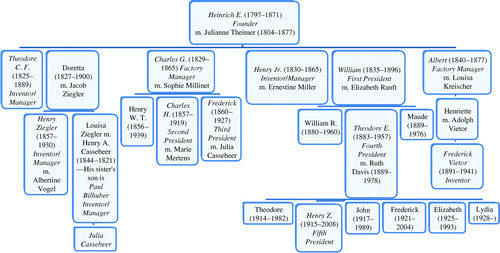
Note. Adapted from Lieberman (1995).
In Germany at the time, trade fairs and competitions showcased the best local products. In 1839, Steinweg exhibited three pianos at the Braunschweig state fair. He won the piano competition, and the Duke of Braunschweig bought his grand piano. These awards distinguished Steinweg from other local piano makers, and the purchase boosted his piano-making business. In the 1840s, however, famine and class tensions caused by troops suppressing revolts persuaded the Steinwegs to leave Germany. In 1849, their second son Karl arrived in New York to explore it as a place to settle. A year later, Heinrich Sr., his wife, Juliane, and seven of their children immigrated to New York. Theodore, the firstborn, remained in Germany and continued the firm his father had founded, eventually partnering with the Grotrian family in 1856. Heinrich Sr. (53) and his sons Karl (21), Heinrich Jr. (19), and Wilhelm (15) found work in several of New York’s leading piano making firms, e.g., Bacon & Raven and William Nunns & Company. In 1853, the Steinwegs resigned as employees, anglicized their names, and founded Steinway & Sons as a family partnership. In its first year, the firm made 12 pianos, in the next year, 49, and in 1855—with a staff of 55 people—that number jumped to 112.5 It sold a quarter of its production directly to the public and the rest to Thomas H. Chambers, a stenciller who put his name on the pianos; a traveling salesperson who sold to upstate New York buyers; and a teacher who sold to pupils and acquaintances (Fostle 1995, Lieberman 1995).
Building on the knowledge he had honed in his father’s workshop, from talks with other makers, and from insight his family members had gained working in New York’s leading piano-making firms, Heinrich Jr.—now known as Henry Jr.—led the piano design efforts of Steinway & Sons. His focus was on the “square” piano that sold well in America. The Steinways conformed to industry practice by emphasizing craftsmanship in building their pianos, but they also incorporated the iron frame used by Chickering & Sons, the Boston firm, to eliminate the stability problems associated with more notes and heavier strings. They used an overstrung design to enable a louder sound, an idea from Frederick Mathushek (1814–1891), a German who had immigrated to New York after having worked for Pape and Érard in Paris. Henry adopted Pape’s idea of covering the hammers with felt, inserted the agraffes in a way that improved sound quality, and used his own ideas to improve the actions (Crombie 1995).
The Steinways exhibited Henry Jr.’s new piano at the American Institute of the City of New York Fair in 1855. It was a square piano built on a heavy wooden frame using an iron frame to hold the overstrung strings. The judges agreed that the Steinway piano was more stable and produced a more powerful sound, and it was awarded first prize. Other American piano makers noted its construction (Dolge 1911, Fostle 1995). Meanwhile, William Steinway, a younger son, managed the firm’s marketing. He had Steinway & Sons loan its pianos to New York’s thought leaders (e.g., judges, politicians, churchmen, newspaper publishers) who in return wrote letters extolling the quality of Steinway’s services. The firm also loaned pianos to musicians who wrote letters endorsing the Steinway piano’s performance. As a result of competing successfully at technical fairs and obtaining endorsements from prominent New York citizens and musicians, Steinway & Sons rapidly gained recognition, and its sales grew. In 1860, the firm opened a Manhattan manufacturing plant capable of producing 1,250 square pianos a year. The plant combined mass-production techniques to manufacture standard parts with craft skills for the wooden components; craftsmen assembled, tested, and tuned the pianos. In seven years, the firm grew from being a start-up to being twice the size of its nearest New York rival, William Nunns & Company (Lieberman 1995). Fostle (1995, p. 78) summarized the accomplishment: “The Steinways had discovered a potent combination of concepts which had wide appeal: Family, Art, Music and Excellence.”
5. Analysis
5.1. Properties of Units
The conceptual framework of Argote et al. (2003) suggests how the properties of production units (here, piano makers) shape craft knowledge creation, retention, and transfer processes. Accordingly, we examine how Steinway & Sons innovated to develop and improve its technical core and participated successfully in competitions with other piano makers to rapidly build up an identity and a positive reputation.
5.1.1. How Steinway & Sons Established Its Identity as a Piano Maker.Initially, Steinway & Sons focused on selling square pianos for New York homes. It recognized early on, however, the potential of its pianos for excellence in concert performance. At the time, most European musicians played the Érard and neither recognized nor played Steinway concert grand pianos. Nevertheless, Henry Jr. designed and built several square grand pianos to seek European recognition. In 1862, the Steinways and 132 other piano makers exhibited at the International Exhibition held at the Crystal Palace, London. A third of the exhibitors—including Steinway & Sons—received medals, but the judges ignored the louder sound and greater stability of the Steinway pianos saying: “[…] we have not to record the introduction of any very important novelty” (reported in Fostle 1995, p. 250).
The year 1865 marked a turning point for Steinway & Sons: Henry Jr., the firm’s designer, and Charles, its factory manager, both died (Figure 1). The family asked C. F. Theodore, the eldest son who had remained in Germany managing his father’s original firm, to sell out to his Grotrian partners and become a member of the family’s New York partnership, leading its production and R&D. Theodore decided to target the 1867 Paris Universal Exposition as the place where the firm would exhibit and seek European recognition. William, meanwhile, continued to manage sales and promotions. In 1866, he directed the building of the Steinway Concert Hall, which held 2,500 people and was New York’s largest event venue, as well as an ideal place for virtuoso pianists to give concerts playing a Steinway grand piano.
The Paris Exposition was held in July 1867, and 178 firms exhibited. Because he believed European craftsmen incorrectly understood how piano sound was generated, Theodore arrived months in advance to give lectures describing the science underlying piano sound and why, in particular, a piano with an iron frame would not sound “metallic” as European craftsmen believed. He explained how selected woods and metals could complement one another when producing musical sound, and he distributed brochures in French, German, and English describing how Steinway pianos did this. In making the knowledge underlying Steinway’s technical core transparent, Theodore convinced the competition jurors that by using iron frames, American firms like Chickering & Sons and Steinway & Sons had developed a better way of making pianos, solving many of the stability and volume concerns associated with European pianos.
Due to Theodore’s efforts at the Paris exposition, industry understanding concerning the technical processes used to make pianos changed (Davis 1986). The majority of German makers adopted metal frames along with the aesthetics of the Steinway sound; however, most leading French and English makers did not, sticking instead with their established methods. The Paris exposition awarded gold medals to Steinway & Sons and Chickering & Sons, reflecting the judges’ new belief that pianos using iron frames were superior. The awards given to the leading London and Parisian piano makers, in contrast, demoted them from first to second rank producers. Given that French and English firms had up until this time dominated piano making, the expert jurors’ new rankings were sensational. In the United States, however, interest focused not on the recognition accorded American piano making, but on whether the judges thought Steinway & Sons or Chickering & Sons made the better pianos. This led to an advertising war between the two U.S. firms.
In 1873, Vienna hosted the next international exhibition for piano makers. To avoid new tensions, Steinway & Sons and Chickering & Sons agreed not to exhibit. Theodore nevertheless attended, visiting the judges who he knew well by then. After the competition, the 14 jurors wrote: “We regret that the celebrated inaugurators of the new system of piano-making, Messrs. Steinway & Sons, of New York, to whom the entire art of piano-making is so greatly indebted, have not exhibited” (Fostle 1995, p. 153). This note by Europe’s leading experts in piano technology provided affirmation that Steinway & Sons’ manufacturing approach was the superior way to build a piano.
By besting other piano makers at exhibitions, Steinway & Sons compiled evidence that critical and knowledgeable audiences, including judges in technical competitions, considered its pianos to be better than those of other firms. Yet cheaper mass-produced pianos had appeared in the United States in the 1860s, and their strategic approach constituted a new and direct competitive threat, particularly to Steinway & Sons. Joseph Hale contracted with factories to produce piano parts, with Albert Weber to assemble them, and Charles P. Kimball to sell them. Capitalizing on the Steinway reputation, Hale put names like Steinmay, Steinman, and Steinmetz on his pianos. The Steinways despised him and his associates, and when Weber claimed that his pianos were the equal of a Steinway, just a lot cheaper, William Steinway felt he had to respond. The confrontation occurred at the Philadelphia Centennial Exhibition in 1876 when elite U.S. firms like Steinway & Sons and Chickering & Sons competed with Weber and other firms that mass-produced pianos. The Steinways’ fear was that an award to a mass-market producer would raise questions about why their prices were so high. It was also well-known that all of the judges were financially allied to one or another exhibitor, and so this feared outcome seemed likely.6 The document the exhibitors wanted to influence was the judges’ report explaining which piano was best. Steinway & Sons sought the support of jury members; press rumors were that the relationships between several exhibitors and different judges were “peculiarly close” (Lieberman 1995, pp. 68–70). The jury issued a report, then edited it, then offered a new set of explanations, then recalled it to reconsider the arguments, and so on. These repeated changes and delays led to the gradual discounting of the jurors’ verdict (Hoover 1976, Fostle 1995). Around a year later, in October 1877, The New York Times released the following statement from the jurors, accompanied by a note titled “The Truth at Last”:
This is to certify that the piano-fortes of Messrs. Steinway & Sons, comprising Concert and Parlor Grand, Square and Upright, exhibited by them at the Centennial Exposition at Philadelphia in 1876, presented the greatest totality of excellent qualities and novelty of construction, and in all points of excellence they received our highest average of points, and accordingly our unanimous opinion concedes to Messrs. Steinway & Sons highest degree of excellence in all their styles (reported in Fostle 1995, p. 242; see also Hoover 1976, pp. 138–143).
Steinway’s superiority was thus reconfirmed.
In sum, Steinway & Sons’ differentiation strategy was based on innovating in its technical core, which led to success in prestigious competitions with other piano makers at industrial fairs in the United States and Europe. Experts on both sides of the Atlantic eventually agreed that Steinway & Sons had developed a superior technology for piano making that differentiated both the firm and its pianos.
5.1.2. Building, Improving, and Protecting the Firm’s Technical Core.In the second half of the nineteenth century, concert halls had become larger; composers’ works required larger orchestras; and composers and virtuoso pianists wanted grand pianos that had even more power, stability, reliability, and strength (Hoover 1981, pp. 50–51). In response, Theodore embarked upon a complete redesign of the Steinway grand piano and its manufacture. His underlying assumption in designing this concert grand piano was that if the piano strings could be stretched to their utmost, the piano would have not only the purest and most brilliant tone, but also the loudest possible sound. However, stretching strings to their utmost required an iron frame powerful enough to ensure a stable piano. Theodore searched all over Europe for ideas and materials to help him realize his vision. Dolge (1911), who knew Theodore personally, described his approach:
Step by step he invaded the fields of modern science, investigating and testing different kinds of wood in order to ascertain why one kind or another was best adapted for piano construction, then taking up the study of metallurgy, to find a proper alloy for casting iron plates which would stand the tremendous strain of 75,000 pounds of the new concert-grand piano that was already born in his mind, calling chemistry to his aid to establish the scientific basis for felts, glue, varnish oils—in short, nothing in the realm of science having any bearing on piano construction was overlooked.
(p. 303)
Through Theodore’s innovations and design efforts, Steinway & Sons was awarded 54 U.S. patents (Table 1). In the period 1868–1889, these inventions included 22 patents for piano actions (e.g., keys, hammers), 11 for the vibrator (e.g., strings, pins, plate), five for the resonator (e.g., soundboard, ribs), seven for the case and frame, four for the design, and five for manufacturing technology (Table 2). Of the fifteen patents granted before 1876, “thirteen related to grands. The 26 patents granted between 1878 and 1885 included eleven for grands, eleven for uprights, and four that were either for both or were improvements in manufacturing techniques” (Hoover 1981, p. 60). These efforts enabled a new “dominant design” to emerge for concert grand pianos (Chapin 2006). Steinway & Sons’ achievements were in contrast to those of its main U.S. rival, Chickering & Sons. Founded in 1823, Chickering & Sons for years was the largest U.S. piano manufacturer; but, by the 1860s, Steinway & Sons had surpassed them. After the death of the founding family members in the late 1890s, and with no heirs willing to continue the business, the American Piano Company took it over in 1908. During its 85-year history, Chickering & Sons was granted a total of just 20 patents.
|

Table 1: Main Inventors at Steinway & Sons
| Inventor name | No. of patents | Period |
|---|---|---|
| Henry Steinway Jr. | 10 | 1853–1862 |
| C. F. Theodore Steinway | 54 | 1868–1885 |
| Albert Steinway | 5 | 1874–1878 |
| Henry L. Ziegler | 11 | 1888–1908 |
| Paul H. Bilhuber | 19 | 1922–1953 |
| Frederick A. Vietor | 2 | 1931–1936 |
|
Table 2: Total Number of Patents by Piano Component over Time
| Year | Activator (keys, key bed, hammers, action, lyre, pedals) | Vibrator (strings, pins, pin block, capo tasto bar, graffe, plate) | Resonator (bridge, soundboard, ribs) | Case and frame | Designs | Manufacturing technology |
|---|---|---|---|---|---|---|
| Early experiments | ||||||
| 1853–1867 | 6 | 3 | 0 | 0 | 0 | 1 |
| Developing the technical core | ||||||
| 1868–1889 | 22 | 11 | 5 | 7 | 4 | 5 |
| Improving the technical core | ||||||
| 1890–1929 | 1 | 8 | 2 | 4 | 6 | 2 |
| 1930–1945 | 5 | 7 | 6 | 1 | 0 | 0 |
| 1946–1972 | 3 | 1 | 3 | 0 | 1 | 2 |
| 1973–2000 | 8 | 0 | 0 | 0 | 1 | 1 |
Theodore’s inventions reflected craft knowledge on the one hand, and acoustical theories such as those of the German physician and physicist Hermann von Helmholtz, on the other. Von Helmholtz studied string vibrations, and he tested the acoustical properties of the pianos Theodore sent him. In a letter to Theodore (June 9, 1871), he commented on a new Steinway grand piano: “I am astounded at the duration of the tone which makes the instrument almost resemble an organ and at the lightness and subtlety of the touch.” In a later letter (October 6, 1873), he noted how some of the technical solutions to enhance string sound were consistent with his studies of acoustics (Table 3). Theodore’s relationship with von Helmholtz led to the invention of the Duplex Scale (Patent 126,848, filed on May 14, 1872), which enabled the parts of the string directly in front of and behind the segment struck by the hammer to oscillate and resound freely. This resulted in a fullness of overtones that is a distinguishing characteristic of Steinway sound. Theodore’s absorption with “the prevailing notion of big sound for which a strong, more stable case and frame structure was needed” (Hoover 1981, p. 60) also facilitated the development of a better piano, an achievement that was recognized not only by von Helmholtz but also by composers and virtuoso pianists.7
|
Table 3: Excerpts from the Letters of Hermann von Helmholtz to Steinway & Sons
| Letter from Hermann von Helmholtz, Berlin (Germany), June 9, 1871 |
| “I would like to express my warmest thanks for the very excellent grand piano which you have sent me and which now has happily arrived at my house. I am astounded at the duration of the tone which makes the instrument almost resemble an organ and at the lightness and subtlety of the touch (action), despite the big volume, and at the complete obliteration of the sound by the damping mechanism which is such an essential element in the clarity of a piano performance. The musical audibility of the tones in the bass octaves is much improved by the length of the strings. The too short and too heavily used bass strings of the common instruments result in disharmonic overtone which makes the bass sound like emerging from a bottle and also makes the musical intervals unclear.” |
| Letter from Hermann von Helmholtz, Berlin (Germany), October 6, 1893 |
| “I have made use of your kind permission to view the line of completed grand pianos in Steinway Hall, as well as the factory in New York, where the separate parts are being assembled and adjusted. Two special points interested me particularly since they coincide with the results of my acoustic studies; that is to say the further development and appropriate division of aliquot parts of the length of the strings in order to achieve an amplification of individual harmonic overtones and by doing so enhancing the overall musical sound of the string. The present division through a connecting, slightly arched, firm bridge permits obviously an easier and slower transference of the mutual overtone, which is distinctly noticeable. I found it very interesting how you counteract the pressure of the strings by the arch of the sound board. I, myself, became aware of the particular effect on the resonating area by that arch only after I had completed my book on Sound-Sensations (Tonempfindungen) and have discussed the subject in a small essay On The Mechanics of Human Ear, contained in the collection of my scientific writings. There is in fact a similar device (Kunstgriff) in the ear at the tympanic membrane, where the vibrations of the air are being transferred to the small auditory bones and quite a similar arch of the area exists which you have found so useful in the pianos. That the pressure of the wood which conforms to the arch must influence the durability of the grand pianos in relationship to the fullness of the tone and its sound volume very favorably is evident …” |
Source. “Steinway Family Letters”—La Guardia & Wagner Archives.
The Steinway family sons had learned piano making in their father’s workshop, and their adult letters often featured exchanges about piano manufacturing. In a letter from Theodore to Charles in the early 1860s, for example, Theodore writes: “I have figured out a grand piano action in order to combine the practicality of the pianoforte action with the straight lifting of the hammer. I do not know whether yours is similar but so much is clear. I have made one the way Henry drafted it for me, but after one year I threw away the pegs which propelled the repetition.…” A later letter (February 17, 1877) from Theodore in Germany to Albert, the factory manager in New York at the time, indicates Theodore monitored Steinway’s finished pianos. His letter says, “I must ask you seriously not to use such wretched wood for the bottom of the grands … I could bring the bottom together only up to 1/8 inch, despite all of the hammer strokes which went into the wood like in pulp. So use only healthy firm pine, or better yet spruce and perhaps resonant wood as filling.” Other letters indicate that Theodore monitored technical core effectiveness and asked for adjustments when his standards were not met. After Theodore completed his redesign of the Steinway “D” concert grand piano in the 1880s, he retired to Braunschweig (Germany). By this time, virtuoso pianists had made the Steinway “D” grand the leading concert performance piano. To compete with Bechstein, Blüthner, and Ibach, German firms that had adopted Steinway’s manufacturing approach and were threatening to encroach on Steinway’s high-end, European sales, Steinway & Sons opened a new manufacturing facility in Hamburg in 1880.
While Theodore redesigned Steinway concert grand pianos, inventions by his nephew Henry Ziegler (1888–1908) improved Steinway’s upright pianos.8 When the firm stopped producing pianos during the Great Depression and World War II (1931–1946), other family members continued the firm’s emphasis on technical innovation. Specifically, Frederich A. Vietor obtained two patents for accelerated piano actions (U.S. Patent 1,826,848, “Piano Key Mounting for Accelerated Action,” filed on February 18, 1931 and granted on October 13, 1931; and U.S. Patent 2,031,748, “Piano Keyboard Balance Key Rail Pin for Accelerated Action,” filed on May 18, 1934 and granted on February 25, 1936), the essence of which “is still used in some American Steinways” (Fostle 1995, p. 468). The other inventor, Paul H. Bilhuber (a Steinway family member by marriage) (Figure 1), worked in the technical department before becoming vice president in 1941 (The Music Trade Review, September 1941, p. 10). One of his patents—“The Diaphragmatic Soundboard,” filed on August 18, 1936 and granted on February 9, 1937—was a breakthrough invention still used in Steinway pianos.9 Despite the firm’s financial difficulties at this time, the continuing importance of innovation is evident in the minutes of the June 16, 1943 Directors’ Regular Monthly Meeting:
A motion was made, seconded and passed: (1) to present Mr. George Beiter of the Riker Avenue Factory with a check of $300 with covering letter from Mr. Theodore E. Steinway, as a reward for his invention of a most practical gluing rail strip, and (2) that the patentability of this invention be investigated toward taking out a patent on it.10
Continuing innovation and improvement efforts took place (see Table 1) in a production context where master craftsmen played key roles across generations in the accumulation, retention, and transfer of craft-based, piano-making knowledge (Argote et al. 2003, Garud and Nayyar 1994). The Steinway & Sons factory relied on its apprenticeship system to teach piano making and ensure tacit knowledge was passed from masters to apprentices without written codification (Lenehan 1982). Ever since the 1840s when Henry Steinway Sr. had trained his children to build piano components in his home workshop, it had been customary for Steinway family members to apprentice in all firm departments and become acquainted with all aspects of piano making before becoming part of firm management (Lieberman 1995, Longenecker and Schoen 1978). Before becoming president, for example, Theodore E. Steinway had accumulated “an unusually sound scientific knowledge of piano construction” (The Music Trades, July 30, 1927). This proved important when piano production stopped, first due to a lack of sales in the Great Depression and then because of World War II war regulations. As the retained Steinway foremen had direct experience of most phases of piano making, their shared holistic knowledge reduced the risk of losing the firm’s tacit craft knowledge. Similarly, the decision to obtain war work and produce wooden glider components not only enabled Steinway & Sons to survive, but helped it retain its skilled workers and their tacit knowledge, another step that protected the firm’s technical core (Thompson 1967).
Theodore’s efforts in the 1870s led to a new dominant design for grand pianos and new craft-manufacturing processes. While at the turn of the century, many U.S. competitors opted to make cheaper pianos in larger volumes using automated production processes, Steinway & Sons stayed committed to its more expensive approach using craft techniques, tools, and processes.
Steinway & Sons’ efforts to build, improve, and protect its technical core not only led to investments in innovation and the establishment of an apprenticeship system, but also impacted decisions concerning the firm’s labor force. During the U.S. Civil War, William Steinway had seen labor unrest and violence threaten the firm’s New York City factory. To put physical distance between the firm and any future labor unrest, in 1873 Steinway & Sons purchased 400 acres in Astoria, Queens—an area distant from Manhattan. William’s diary entries indicate his pride in creating a new factory town where workers could own brick homes, drink fresh water, and stroll under the trees on Steinway Avenue—still a main thoroughfare in Queens. The new town included a school, a library, a church, and an amusement park. In establishing Steinway Village, William’s main goal was to increase control by separating his factory workers from other New York workers. As he was in the real estate business, William also saw an opportunity to make profits from real estate by renting and selling homes and land to workers and others (Fostle 1995, Lieberman 1995). Establishing Steinway Village also had two long-term strategic consequences that were not anticipated at the time (Mintzberg and Waters 1985).11 First, it strengthened employees’ identification with Steinway & Sons, for identification occurs as employees feel they belong to and perceive oneness with their employing organization (e.g., Ashforth and Mael 1989, Ashforth et al. 2008, He and Brown 2013). A distinguishing feature of Steinway & Sons has been its high employee retention and, to its workers, Steinway Village signaled the firm’s concern for the long-term satisfaction and well-being of its employees. Second, the village became an invaluable repository of technical skills and (tacit) knowledge since the long-tenured employees who continued to live there helped the firm preserve its knowledge base. Succeeding generations of employees often have come from families living in close proximity to the company, and this has helped preserve the integrity of the firm’s tacit knowledge. Although other considerations drove the original decision to establish Steinway Village, over the years it helped Steinway & Sons maintain its strategic commitment to craftsmanship.
5.2. Properties of Relationships with Others
Relationships with others also shape knowledge outcomes. In particular, Steinway & Sons’ relationships with virtuoso pianists have enhanced the firm’s reputation in musical and cultural circles, while serving as a valued feedback source that has improved its pianos.
5.2.1. Relationships with Artists.After the American success in Paris in 1867, European virtuoso pianists agreed for the first time to play and endorse Steinway pianos. Specifically, William persuaded Anton Rubinstein (1829–1894), at the time Europe’s leading concert pianist, to do an eight-month U.S. tour in 1872, comprised of 200 variety concerts played on a Steinway grand piano, which would start and end at Steinway Hall.12 A typical concert lasted four hours with Rubinstein as the star attraction. When it became clear that U.S. audiences wanted Rubinstein playing alone, the Steinways abandoned the variety format and adopted a concert format featuring the virtuoso pianist playing solo on a Steinway grand. The new format directly demonstrated the Steinway piano’s performance capabilities. In 1891, the year that Chicago held its World’s Fair, Steinway & Sons was sponsoring another highly successful concert tour by Polish virtuoso Ignace Jan Paderewsky (1860–1941). The Chicago Fair invited Paderewsky to inaugurate the fair, playing a piano entered in its competition. Paderewsky replied that he would play, but only if he could do so on a piano he was used to. After the organizers relented, Paderewsky played on a Steinway. His refusal to play on an exhibited piano and his insistence on a Steinway were widely reported, further confirming the reputation of Steinway & Sons.13
To extend the Steinway-sponsored relationships with virtuoso pianists, the firm established its Steinway Artists program in 1905. The Steinway Artists included the world’s best virtuoso pianists who agreed to endorse and play a Steinway D grand piano in their concerts. To support the Steinway Artists, the firm established piano banks in several U.S. cities. Steinway Artists visited the banks and chose the concert grand piano that they believed best fitted the sound and feel they wanted for their performance. Initially, the service was free and Steinway & Sons also paid artists $100 for using the Steinway piano and demonstrating its merits. When the firm faced financial difficulties in the 1930s and 1940s, however, the $100 fee was canceled, and the virtuoso was asked to cover the cost of hauling the piano to the recital hall where Steinway & Sons then tuned it. Virtuoso pianists value the right to choose a performance piano from an excellent selection since craft-made pianos have distinct “personalities” that make them more or less suited to different playing styles (Gourville and Lassiter 2000). As a result, several virtuoso pianists had favorite pianos in the Steinway piano banks, and advertising began to associate the Steinway name with specific virtuoso pianists. Paderewski featured in the first advertisement: “My joy in the grandeur, the power and the ideal beauty of the tone and perfect mechanism of the Steinway is unbounded” (The Saturday Review, August 7, 1897, p. 154).
In the early 1900s, the number of sponsored concert tours by Steinway Artists increased and the roster grew to around 600 virtuoso pianists. In 1920, Steinway & Sons described its piano as “The Instrument of the Immortals,” linked to the laudatory remarks of its virtuoso pianists (Table 4).14 The firm and the virtuosi both benefited from this close relationship: Being a Steinway Artist enhanced an artist’s prestige, and the associations with so many virtuoso artists enhanced the firm’s prestige. While competitors relied mainly on mass production technologies to build cheaper pianos to sell in larger numbers for home use, Steinway & Sons’ advertising reiterated its commitment to the more expensive, craft-based manufacturing process, the technical superiority of its pianos, and the endorsements of its grand piano for concert performances by many virtuosi. For instance, when Rachmaninoff selected a grand piano for his 1923 American tour, he said: “How can I know which one of your pianos I like best when you make them all so perfect!” (The Music Trades, June 9, 1923, Vol. 130, p. 105). Steinway advertising suggested that those who owned a Steinway signaled their appreciation for the highest artistic ideals, status, and piano technologies. Steinway & Sons’ marketing distinguished its pianos from those of competitors by emphasizing their technological excellence and high status.
|
Table 4: Example of a Steinway & Sons Advertisement in the 1920s
| STEINWAY |
| “The Instrument of the Immortals” |
| “STEINWAY” one the fall-board of a piano stamps its owner a competent judge of artistic worth. There is no question of choice once the Steinway is heard or played. It is the supreme achievement of art and craftsmanship. |
| STEINWAY & SONS |
| 109 West 57th Street (New Steinway Hall), New York |
Source. The Music Trades, November 20, 1926.
Steinway & Sons’ leaders also established friendships with virtuoso pianists and sought advice from them based on their playing experience. Often, these professional relationships became personal friendships with family members, e.g., between Jan Paderewski and William Steinway. The friends of Frederich A. Vietor, son of Adolf Vietor and Henrietta (Steinway), for example, included Paderewski, Rachmaninoff, and Hofmann. Josef Hofmann was not only a virtuoso but also an inventor with over 70 piano-related patents. Of particular interest is his improvement to the piano’s actions (U.S. Patent 2,263,088, filed on October 14, 1940 and issued on November 18, 1941) that Steinway & Sons adopted (Ratcliffe and Isacoff 2002). The letters in Tables 5 and 6 indicate the sorts of exchanges that occurred between Hofmann and Vietor. To accommodate his small hands, Hofmann persuaded Steinway & Sons to build a unique piano with keys that were slightly narrower than those of a regular piano, just for him.
|
Table 5: Letter from Josef Hofmann to Frederick A. Vietor
| The Rock Camden, Maine 23 July 1932 |
| Mr. Frederick Vietor Steinway & Sons 109 West 57th Street New York City |
| My dear Mr. Vietor: |
| Thank you for your letter of July 22nd informing me what Dr. White has said re the “Spectrograph.” You may be assured that I shall not make any use whatsoever of this information, as you request. The so called “scientific research” in tone production in order to ascertain whether or not a tone is perfect, is ridiculous because, tone production by musical instruments is for the ear and not for the purpose of furnishing a perfect diagram. Suppose, scientifically, a sound is perfect, but the piano or violin sound like Hell—what good is it? Of course it would be interesting to know why a Steinway sounds better than other pianos, but this is as far as one can reasonably go. All the rest is just an advertising stunt … My Concert Grand is rendering excellent service, and I find that my wrist work has improved because of the more rapid action of the keys. Hoping that you, also, are enjoying a pleasant summer, and with kindest greetings to all of our mutual friends, I am, |
| Most sincerely yours, Josef Hofmann |
Source. Files of Henry Z. Steinway “Joseph Hofmann, Book No. 6, 1932–1934,” July 23, 1932.
|
Table 6: Letter from Frederick A. Vietor to Josef Hofmann
| The Rock Camden, Maine 27 July 1932 |
| Dear Mr. Hofmann: |
| Thank you very much for your interesting letter of July 23rd. |
| In connection with “Scientific Research,” it might interest you to know that we made a very careful electrical study of the sounding board and learned that it vibrates like a diaphragm and not in sections as the old sand vibrations, (what is, putting sand on the sounding board, striking various notes, then watching the swirls) indicated. We also found out that the construction of the sounding board, which, as you know, was done merely in a trial and error method, is as near perfect as a board made of spruce with pine ribs can be constructed. We were also interested to learn where the center of vibration of the sounding board lies, but with all the scientific research we were not able to improve what long years of experience of practical piano making had built up. As you suggest, it might be very interesting to know from a scientific analysis of the tone, why the Steinway is better, but just at present we are not undertaking any work of this kind, except that which will bring us direct results in the building of Steinway pianos. Some time in the future, when I hope money will again be more plentiful, we will be most interested to undertake such a scientific analysis of the Steinway tone. |
| It pleases me greatly to hear what you said about your concert grand equipped with the new Balance Rail Bearing. I feel convinced that this is a step forward in construction and that strange as it may seem, it is most effective in the concert grand. I believe I told you that we are now building as a regular stock article all the concert grands with this device, as well as the graduated rebound of the key, the three steps being the bass at about 20 to 22, the middle 22 to 25 and the treble 25 to 28. In this connection we are also placing the leads in the keys as near the balance rail as possible so that less inertia has to be overcome in starting the key on its downward path … . |
| With kindest regards, Most sincerely yours, Frederick A. Vietor |
Source. Files of Henry Z. Steinway “Joseph Hofmann, Book No. 6, 1932–1934,” July 27, 1932.
In 1900, Steinway & Sons hired the advertising agency N. W. Ayer & Son to increase its sales to wealthy customers by building on the widely recognized craftsmanship and high status associated with the Steinway piano. The advertising message was that while musicians bought a Steinway piano because of its performance abilities, others bought one because of the high status and culture associated with the Steinway name (Roell 1989). Charles Steinway observed:
It was without doubt the most effective of all advertising methods we employed, since it not only made the piano and its maker widely known, but assisted in laying the foundation for a broad national culture.
(quoted in Lieberman 1995, p. 17)
Generally, the advertising discourse (Moeran 2005) held that one did not “buy” but “invested” in a Steinway. There was no such thing as a better Steinway, only a Steinway that was the best. It was more important to own than to play a Steinway. The Steinway piano established a center around which a family gathered. A large part of the Steinway advertising appeal was its emphasis on how, given its wide adoption by virtuoso performers, a Steinway piano generated cultural status for all who bought one. The firm also commissioned paintings of mythical scenes depicting performers and composers surrounding a Steinway grand piano, implying the Steinway had been a critical element in many artistic creations and represented “timeless” excellence (Roell 1989). The long-term effectiveness of this advertising was all premised on satisfying virtuoso pianists’ needs. This ability to consistently satisfy virtuoso performers’ demand cannot be explained without examining what Steinway & Sons did to retain its piano-making craft knowledge.
5.3. Properties of Knowledge: Avoiding the Loss of Tacit Knowledge
Previous empirical studies have shown that tacit knowledge does not accumulate and persist indefinitely (e.g., Cattani et al. 2013, Dutton and Thomas 1984, Yelle 1979, Argote et al. 1990). As skilled employees are the repositories of a firm’s tacit knowledge, if they leave, the firm’s organizational memory and production processes can be threatened (e.g., Engenström et al. 1990, Polanyi 1962, Nelson and Winter 1982, Walsh and Ungson 1991, Winter 1987, Cowan et al. 2000). As MacKenzie and Spinardi (1995, p. 46) describe the problem: explicit knowledge “if widely diffused and stored, cannot be lost. Tacit knowledge, however, can be lost. Skills, if not practiced, decay. If there is no new generation of practitioners to whom tacit knowledge can be transmitted it may die out altogether.” Tacit knowledge recovery is not a matter of copying the original, because “there is no sufficient set of explicit information or instructions to follow” (MacKenzie and Spinardi 1995, p. 46). Rather, resurrecting tacit knowledge usually means reinventing it. As the knowledge underlying craft techniques, tools, and processes is mostly tacit, retaining its craft knowledge for making pianos has been crucial to Steinway & Sons’ success.
Retaining craft knowledge was an ongoing concern for Steinway & Sons from the 1920s through the end of World War II. During this period, four events occurred that drastically reduced its sales and support for the firm’s accumulated craft knowledge: the introduction of radio, the Great Depression, World War II, and the introduction of television (Fostle 1995). After radio broadcasts began in 1920, the piano was no longer the center of the family home, and sales to middle-class homes declined rapidly (Lieberman 1995). Steinway piano sales to upscale markets, however, continued until 1926, when the firm sold an all-time annual high of 6,294 grand pianos (Table 7).15 In 1930, however, demand plummeted to 2,379 units and profits dropped—from a net profit of $580,000 in 1929 to a net loss of $265,000 in 1930 (Figure 2). As the accumulated stock of finished pianos grew, it became clear that the firm’s assumption that all the pianos built for inventory would eventually be sold was no longer valid. Management first slowed and then, in 1931, stopped production, firing hundreds of workers. They kept fifty or so highly skilled foremen to complete work in process, build special piano orders, and maintain firm access to the tacit knowledge for making craft-manufactured pianos. In his 1931 President’s Report, Theodore E. Steinway said:
It is hardly worthwhile to quote the usual statistics as to number of units manufactured during the year as we found our accumulated stock of finished goods so large that we ceased work in our factories toward the end of the year. Our stock is gradually being sold, however, and we hope that by September or August of this year, we will gradually take up production in our factories once more.
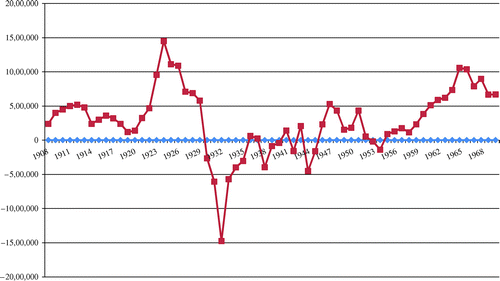
Source. Steinway & Sons Annual Reports.
|
Table 7: Sales of Grands and Uprights During the 1920s through 1940s
| Year | Grand | Upright |
|---|---|---|
| 1926 | 6,081 | 213 |
| 1930 | 2,379 | NA |
| 1932 | 888 | 12 |
| 1935 | 1,367 | NA |
| 1936 | 3,620 | 0 |
| 1937 | 3,061 | 0 |
| 1938 | 1,580 | 1,008 |
| 1939 | 1,913 | 2,175 |
| 1940 | NA | 2,231 |
| 1941 | 2,195 | 3,406 |
| 1942 | 1,411 | 1,454 |
| 1943 | 248 | 371 |
| 1944 | NA | 957 |
Source. Steinway & Sons Annual Reports.
To cut its financial losses, Steinway & Sons also slashed its marketing, concert promotion, and artist expenses. The Board of Directors’ Minutes reported, for example, the elimination of payments to Steinway Artists but also an unanticipated source of organizational slack:
Mr. Theodore E. Steinway further reported that Mr. Ignace Jan Paderewski had generously and graciously refused to accept his subsidy of eight thousand dollars due him for the season 1930–1931 from Steinway & Sons on account of the present depressed state of business.
(Meeting of the Board of Trustees of the Corporation of Steinway & Sons, held at its office, 109 West 57th Street, in the City of New York, on Monday, June 8, 1931, at 2:30 p.m.)
To improve relations with virtuoso pianists, Steinway & Sons also relaxed the restrictions it previously had placed on Steinway Artists’ use of non-Steinway pianos. Artur Schnabel (1882–1951) had complained that Steinway “refused to let me use their pianos unless I would give up playing the Bechstein piano—which I had used for so many years—in Europe. They insisted that I play on Steinway exclusively, everywhere in the world, otherwise they would not give me their pianos in the United States. That is the reason why from 1923 until 1930 I did not return to America” (Schnabel 1988, p. 84). In 1933, however, Steinway changed its rules and allowed Schnabel to play its pianos in the United States and a Bechstein elsewhere. From 1933 on, Schnabel again gave concerts in America.
Compared to its sales in the 1920s, Steinway & Sons’ sales in the 1930s and early 1940s were very low. After selling 3,620 grand pianos in 1936, for example, sales dropped to 248 units in 1943. New income-producing activities were needed, as was apparent at a Board of Directors’ meeting on August 20, 1941, at which vice president Paul H. Bilhuber spoke about
…the rumors of a possible curtailment of production to come and requested permission of the Board to judicially investigate the possibilities of war work for the factories through our contract. The Board agreed with Mr. Bilhuber …and authorized him to thoroughly investigate all war work possibilities through our various contacts.
In Spring 1942, the War Production Board of the United States declared piano manufacture “nonessential.” Piano production stopped because, with the exception of wood, the materials needed to make a piano, such as steel and copper, were vital for war efforts. Henry Z. Steinway recalled, “We were desperately looking around for something to do … and one day a procurement guy from the army says there’s an outfit that has a contract to make a glider but has no place, no staff, no nothing. So we got together with the company, which was called General Aviation … and we rented them a factory and took the contract to manufacture all the woodwork going into gliders, which was practically everything: the wings, the tail surface, there was a complicated floor, and the nose where the pilot and co-pilot sat” (Interview with Henry Z. Steinway, 1995). The wood for the gliders often had to be shaped, and General Aviation itself had no facilities, manpower, or know-how. But here Steinway’s skills in building piano rims came into play—-as Henry Z. said, “We knew how to do this” (Interview with Henry Z. Steinway, 1995). Between March 1942 and March 1944, Steinway & Sons obtained three subcontracts that provided “500 to 1,000 Steinway workers with something to do” (Lieberman 1995, p. 220). The December 16, 1942 Minutes from the Regular Monthly Meeting of the Directors reported 1,073 factory employees on the firm’s rolls, and those from October 21, 1942 reported that Justus Doane Anderson Jr., the new factory manager,
[…] handed a copy of our glider delivery schedule to each Director which showed that by February, 1943, we would be delivering 60 wings and ailerons, complete with empennage and fuselage parts, a month. Mr. Anderson also reported that we were achieving a straight line of production and that we were working day and night in two 10 hour shifts.
War work enabled Steinway & Sons to retain some of its workforce and continue operations. On February 24, 1943, the War Production Board gave Steinway & Sons relief from
[…] the provisions of the Limitation Order L-37-a of May 29, 1942, to complete the assembly of 162 grands within 30 days from date of authorization, etc.
(Minutes of the Regular Monthly Meeting of the Directors of Steinway & Sons held at its offices at 109 West 57th Street, New York City, at 10 a.m. March 17, 1943)
The same year, Steinway’s wholesale manager Roman de Majewski secured an order for upright pianos:
Mr. Roman de Majewski was asked to attend the meeting for the purpose of reporting on the progress made on the proposed making of wooden caskets. He also announced the good news that the Army had given us an order to make a further 405 Olive Drab Military Verticals, including packing cases and tuning kits.
(Minutes of the Regular Monthly Meeting of the Directors of Steinway & Sons held at its offices at 109 West 57th Street, New York City, at 10 a.m. June 16, 1943)
The October 18, 1944, Minutes of the Regular Monthly Directors’ Meeting reported that the War Production Board had given permission to manufacture an additional 2,850 pianos, 1,000 of which would be verticals.
After the war, Steinway & Sons still had a well-recognized name and associations with high culture, but its piano-making craft skills had been on hold for 15 years and had atrophied. The piano industry context had also changed with television as the new center of U.S. homes. Henry Z. Steinway, a fourth generation family member, had joined the firm in 1937 as an apprentice, became vice president in charge of factories in 1946 and president in 1955 (Figure 1). He saw his main task as reestablishing the firm’s manufacturing capabilities:
I did this by absolutely insisting that no changes were to be made in any of the traditional methods of making a Steinway piano. I depended on the older foremen still around to ensure this.
(Interview with Henry Z. Steinway, 1995)
He noted how the craft knowledge about how to build a piano had been handed down first from Theodore to the firm foremen and then from one generation of foremen to the next. Consistent with craft traditions, this knowledge was tacit and had never been written down, but instead had resided in the workforce the firm had disbanded 15 years earlier. It thus was critical for Steinway & Sons to find and work with the foremen who were key constituents of the technical core since they could explain and demonstrate Theodore’s manufacturing processes and procedures to new factory workers. Henry Z. found that many of the foremen still lived close by the factory in Steinway Village (Lieberman 1995). With the foremen’s help, Steinway & Sons re-identified and re-implemented its craft-based manufacturing processes for making pianos.
That Steinway & Sons had remained family-managed over four generations reinforced its craftsmanship emphasis. Succeeding generations also adopted the management pattern first established by Charles and Henry Steinway Jr. in the 1850s–1860s, and then continued by C. F. Theodore and William in the 1860s–1880s. As a result, Steinway family members understood the firm’s manufacturing operations and its promotion activities, and this involvement enabled each generation to keep the management of core activities in-house. In making employment decisions, they also selectively retained key knowledge workers, i.e., foremen who had the tacit knowledge needed to enable craft-based piano production. As Steinway & Sons had no codification of its production methods until after World War II, such individuals were critical for preserving and transferring the firm’s tacit production knowledge. John Bogyos, who retired in 1985 after working over fifty years in the engineering department, said:
[…] everything was more or less verbal—passed down from son to son, as far as the Steinway family was concerned, and from foreman to foreman. There was no such thing as specifications. There were some drawings, and where there weren’t drawings, they had patterns. And that’s why it was called the pattern shop. The major pattern was hanging on the wall or, if it was small, in some drawer. And if something had to be made, and something happened to the secondary pattern, which was in the factory, okay then they came here and we compared, or made a new one from this, etc. But there were very little drawings, as we know them today (quoted in Lenehan 1982).
Firms such as 3M or Corning, for instance, have been able to innovate and differentiate their product offerings by creating an environment that nurtures and retains key employees, ensuring there is continuity between past, current, and future research and development (Cattani 2006). For an organization committed to craftsmanship, the retention and transfer of tacit knowledge is even more critical because individuals are often “the sole storage point of knowledge that is both idiosyncratic and of great importance to the organization” (Nelson and Winter 1982, p. 115). This is also the way the Steinway family managed its company.
5.4. Balancing Commitments to Craft Production with Financial Performance
Steinway & Sons’ relationships with virtuoso piano performers are built on the superior performance of its craft-produced pianos. When Steinway & Sons faced financial difficulties, it was tempted to depart from its commitment to craft-produced, high cost pianos. We offer examples to illustrate the decisions Steinway & Sons made to gain financial benefits, while staying committed to craftsmanship.
Due to a series of investments in unrelated ventures made by William Steinway (see below) at the turn of the 19th century, Steinway & Sons was under financial stress as it transitioned to the new managerial direction of the next Steinway generation. At the time, other U.S. piano making firms were producing “player” pianos for U.S. homes; if Steinway & Sons also chose to do so, it would generate additional sales. Yet while Steinway management saw the profits the firm could make, they also realized that such mass-market participation was inconsistent with the prestige the firm had built up by serving the needs of concert pianists and wealthy buyers. Nevertheless, in 1909, Steinway & Sons made an agreement with the Aeolian Company, the leading player piano firm, to make Steinway uprights that would be ready for Aeolian to fit with player mechanisms and so generate sales for Steinway & Sons.16 Aeolian sold these player pianos under the label “Duo-Art”—i.e., the art of the piano maker and the art of the music reproducer—and the Steinway-made piano with Aeolian player mechanisms were called the “Steinway Pianola.” They were sold only by Aeolian and not at Steinway dealers. The agreement said:
Steinway & Sons agree to supply to the Aeolian companies a minimum of not less than six hundred new Steinway pianos per year, and the Aeolian companies agree to purchase these pianos and pay cash for them.… The Aeolian companies agree to handle, market, advertise, push and recommend the Steinway Pianola Piano as their unqualified leader, and to obligate their branches, dealers and representatives to do likewise, as well as to use their best endeavors at all times to maintain the standing of the Steinway Piano.
(Meeting of the Board of Directors of the Corporation of Steinway & Sons, held at its office, 107 East 14th Street, in the City of New York, on March 9, 1909)
The agreement further said:
The Aeolian companies agree to officially relegate their Weber Pianola Piano to second place under the Steinway Pianola Piano; and they further agree to withdraw from the artistic concert field and that they will exploit the Weber Piano in public only through such minor pianists as Steinway & Sons may permit.
(ibidem)17
As Aeolian concentrated on the home market and had no interest in the concert field, the agreement just reiterated it would not compete in Steinway’s targeted markets. However, because making and selling a player piano was inconsistent with Steinway’s focus on the high-end piano market, the agreement is interesting because of the conditions designed to clearly separate the Steinway & Sons and Aeolian products.
The Great Depression was another external event that imposed not only production disruptions but also generated financial stress for Steinway & Sons. Shortly after the Depression began, and even though it had not made vertical pianos for ten years, Steinway & Sons started making uprights targeted at middle-class families. The CEO at the time, Theodore Steinway Jr., initially opposed upright production, but in response to the firm’s losses in 1930–1936, with a peak loss of $1,475,000 in the 1932 fiscal year, he changed his mind. Recalling these events, Henry Z. Steinway said that the company did not build many uprights but they “kept us eating until the war” (reported in Lieberman 1995, p. 190). Extensive participation in lower end piano markets with the low prices competitors set would eventually have forced Steinway & Sons to adopt automated production to reduce its costs, challenging its commitment to the making of high-end pianos. On this occasion, Steinway flirted with this possibility but ultimately remained committed to the use of craftsmanship to make mainly grand pianos.
Maintaining this commitment also proved problematic after the Steinway family sold the company. In the 1960s, the Japanese firms Yamaha and Kawai exported thousands of pianos to the United States, with a Yamaha selling for half the price of a similarly sized Steinway piano. By the early 1970s, the Japanese presence raised questions about not just the future of Steinway & Sons but of the entire U.S. piano industry. In the final years of family ownership, Steinway & Sons had made little investment in equipment; when CBS “acquired Steinway & Sons, the factories in New York and Hamburg were in urgent need of millions of dollars’ worth of capital improvements” (Lieberman 1995, p. 306). Henry Z. said that the firm sold in 1972 because among “active family members, none were getting younger. And no young Steinways were interested in the firm” (Kotha and Dunbar 1997, p. 2).
To facilitate continuity, Henry Z. Steinway stayed on as titular president. He became concerned, however, when after it modernized the equipment and buildings, CBS announced that it “wanted a 10 percent return on their investment, counting on profits coming from increased efficiency and production” (Lieberman 1995, p. 306). Specifically, CBS sought to reduce costs and increase profits by standardizing production, a step that was completely inconsistent with the firm’s longstanding commitment to craftsmanship. Henry Z. Steinway reminded Robert G. Campbell, president of CBS Musical Instruments, that efforts to increase production, cut inventory, and reduce payroll might be “possible in broadcasting but not in pianos” (Lieberman 1995, p. 306).18 Nevertheless, the streamlined operations improved the firm’s bottom line—in 1974 sales were almost $10 million, the highest ever, yielding a pre-tax profit of $2.5 million. In November 1976, Henry Z. told Campbell, “the retail trade is weakening.” Part of the problem was that “the word going around in music lovers’ circles [was] that Steinway is not what it used to be before CBS” (Lieberman 1995, p. 307). At the same time, Steinway & Sons had a booming business repairing old and used Steinways. Even the Julliard School opted to repair its old Steinways. As CBS primarily used financial assessment criteria to manage Steinway & Sons, questions arose as to whether, given this emphasis, a new Steinway piano could be as good as an old one. Critics suggested that due to CBS’s efforts to enhance efficiency, increase production, and make profits, support for craftwork was suffering. In addition, some long-tenured employees left the firm. Al Daniels from the stringing department, for instance, thought that CBS had hurt the piano by rushing production and cutting back on people. He quit in 1978 because “it was not like a piano factory, it was not like Steinway” (Lieberman 1995, p. 308).
Although Steinway & Sons made money (1983 pre-tax profits were $7.5 million on about $50 million in sales), after 1980 the CBS Musical Instruments Division operated in the red, accumulating losses of more than $40 million. Henry Z. Steinway remained president of the CBS Musical Instruments Division to facilitate continuity, but after he stepped down in 1977, the Steinway division had three more presidents within the next eight years.19 Henry Z. Steinway noted:
Each new [CBS Musical Instruments Division] president wanted to do something different. It was like riding a different horse every six months—first it was quality, then it was volume, then it was automation. The firm was drifting from one program to another. I also got so many memos from the parent corporation that after a while, I simply ignored them.
(Interview with Henry Z. Steinway, 1995)
As these examples indicate, by establishing expectations that its pianos would be craft-produced, Steinway & Sons had constrained its ability to choose other production methods. When decisions appeared to be driven by commercial considerations, users and critics questioned whether Steinway pianos were of the same quality as older ones. As Becker (1960, p. 35) pointed out, once there is a commitment to a specific approach, the consequences of “inconsistency will be so expensive that inconsistency … is no longer a feasible alternative.”
6. Discussion
Steinway & Sons gained a reputation as a start-up by incorporating the best craftsmanship practices of the day, and by copying other firms’ innovations to create a more stable piano with a more powerful sound at a higher price point. The mass production methods introduced in the 1860s, however, reduced piano prices and made them accessible in mass markets. They opened up a new “peak” that firms could move to in order to build a strategy directed toward lowering piano prices and increasing sales volumes. The Steinways ignored this possibility and persisted with their emphasis on craftsmanship and high prices. Through the firm’s presentations at the 1867 Paris exposition, European piano makers became aware of the details of the Steinway piano and the distinctiveness of the firm’s manufacturing processes. Due to further innovative efforts in the 1870s, the firm developed a new, craft-based technical core leading to an even more stable and powerful sounding grand piano that satisfied the needs of classical composers and virtuoso concert performers, and established the firm’s identity. Indeed, as a result of the progress made, a symbiotic relationship was established between the firm and many virtuoso pianists who preferred to play a Steinway grand rather than any other piano in concert. As many virtuoso performers continue to endorse and play the Steinway grand piano, the firm continues today to enjoy high cultural status.
Steinway & Sons has consistently confirmed the high cultural status associated with its pianos. In the 19th century, it introduced classical piano music to the United States by sponsoring concert tours by well-known virtuoso performers playing a Steinway grand piano. In the early 1900s, it established the Steinway Artists program and sought to help their performances by providing a bank of pianos from which they could choose and making sure the piano they played was in tune and fully prepared for their performance. Steinway advertising also started to quote the many praiseworthy things the virtuosi said about the Steinway piano. The large number of Steinway Artists who endorsed the Steinway and the large number of concert halls equipped with a Steinway grand piano all testify to the Steinway piano’s high status. On a few occasions, however, the almost unanimous endorsements by virtuoso pianists and concert halls have been challenged. In 1968, for example, the virtuoso pianist Sviatoslav Richter claimed he preferred a Yamaha to other grand pianos.20 Several distinguished composers (e.g., Igor Stravinsky, Béla Bartók, Leonard Bernstein, and John Williams) and performers (e.g., Walter Gieseking, Claudio Arrau, Jorge Bolet, and Earl Wild) recorded using a Baldwin rather than a Steinway piano. In 1988, Yamaha challenged Steinway’s exclusive links to virtuoso pianists by signing André Watts to become a Yamaha rather than a Steinway Artist.21
Despite these challenges, Steinway & Sons’ high cultural status embodies long-term resilience. Virtuoso pianists have in fact continued to use and endorse the Steinway pianos for their concert performances. Today, Steinway pianos are still the choice of nine out of ten concert artists, most concert halls, and countless amateurs.22 The endorsement of virtuoso pianists reflects the success of Steinway & Sons’ differentiation strategy targeting the needs of virtuoso pianists. With almost 95% of high-status performance artists associated with Steinway & Sons, this is a distinguishing dimension that clearly sets Steinway & Sons apart from competing firms.
Over almost 150 years, Steinway & Sons incurred major financial losses in the aftermath of the Great Depression—a period when most other piano makers were driven out of business—and during World War II—when the U.S. government forced piano makers to stop producing pianos and instead do war-related work. These two events were exogenous shocks that hit all industry firms regardless of their strategy or how successful they were. Even a successful company, in fact, occasionally experiences periods of financial distress or incurs losses, particularly when these are caused by exogenous events. By contrast, the financial problems Steinway & Sons faced at the end of the nineteenth century were due to William’s investments in new transportation ventures rather than any decline in the demand for Steinway pianos. The point is that in regard to piano making, Steinway & Sons’ competitive advantage in the high-end market segments has endured.
6.1. Differentiation by Pursuing Local vs. Distant Opportunities
Steinway & Sons’ enduring success would be difficult to explain without considering the firm’s unrelenting commitment to quality and the decision by other firms to replace craft-based with mass-production methods in an effort to reduce manufacturing costs and cater to a broader, mass-market customer base. Being one of the only piano makers in the United States to have remained fully committed to craftsmanship since its founding, users and especially virtuoso performers have always valued the unique characteristics of Steinway pianos. Steinway & Sons never strayed from its craft-based manufacturing approach and consistently over time kept on improving its pianos and production methods. Steinway & Sons case thus suggests that a successful differentiation strategy may stem from a firm choosing to stay on the same peak where a firm can continue to use and further improve its current production methods even as competitors choose to move to other peaks.
The case offers a counterpoint to the strategic management perspective that a successful differentiation strategy involves identifying peaks or positions on the competitive landscape that sometimes may be cognitively distant from those competitors currently occupy (Kauffman 1989, Levinthal 1997, Rivkin 2000, Gavetti 2012). Examples that illustrate the logic underlying this type of differentiation strategy include, among others, Michael Dell, who revolutionized the PC industry with his “direct model” in the late 1980s (Ghemawat and Rivkin 1999), and Charlie Merrill, who redefined the managed investment business in terms of a “supermarket” in the mid-1930s (Gavetti 2012). Both Dell and Merrill realized that a successful differentiation strategy required a move towards a different peak because attractive opportunities were located away from their current position. By contrast, Steinway & Sons’ superior performance can be attributed to its pursuit of local opportunities—i.e., long-standing commitment to traditional craft production methods, from which it never strayed (i.e., staying on the same peak). By accumulating experience with these methods, Steinway & Sons gained reputational and informational advantages other firms have struggled to match.
6.2. The Role of Family Involvement
By consistently adhering to craft practices and primarily catering to virtuoso pianists, Steinway & Sons gained a worldwide reputation that was reinforced when, at the beginning of the 20th century, most U.S. firms (e.g., Baldwin) abandoned craftsmanship for mass production techniques to increase their piano sales in mass markets. As of today, the emphasis on craftsmanship at Steinway & Sons remains exceptional. While most piano makers buy ready-made piano actions, Steinway & Sons still manufactures them at its Astoria factory.23 Unlike industry practice, Steinway & Sons also makes its piano hammers in-house (for a detailed description, see Barron 2006). While these parts can be produced and assembled using machines, Steinway & Sons has “eschewed the assumption that piano pieces can be made to specifications and fitted together interchangeably. It is much more common for parts to be built originally to excess dimensions, so that they can be painstakingly matched one to the other by the same means used in the 1800s—human hands, eyes, and sweat” (Lenehan 1982, p. 25).
Especially in creative industries, strategic success is often measured by the symbolic capital and recognition that key audiences such as users and expert critics accord a firm’s products, rather than simply by the profits a firm generates. Indeed, the relationship between economic and symbolic success is often complex, and attainment of one can even work against the other (Bourdieu 1993). As Townley and Gulledge (2015) put it: “Distinguishing between financial return from creative endeavor and the commoditization process in the mass production of creative goods, for some ‘profit-seeking’ from cultural production is an anathema” (p. 123). To the extent that audiences perceive a firm’s long-term pursuit of economic performance is based on making “singular” products (Karpik 2010) using craft production methods, they may accept trade-offs to improve short-term financial performance if ongoing events could undermine the firm’s abilities to make such products in the future. However, as audiences perceive such decisions to be driven simply by financial considerations, a firm will suffer penalties—e.g., status loss and even performance decline. As we mentioned, maintaining this undiluted commitment to craft production was problematic after the family sold the firm to CBS in 1972; the transition brought a new emphasis on reducing costs and increasing profits by standardizing production that was inconsistent with the firm’s longstanding dedication to craftsmanship and opposed both within and outside the firm.
Involvement of the founding family in a firm’s management may help enhance the credibility of its self-determined binding commitments (Whetten 2006). Specifically, family member involvement across generations helps reinforce commitments to traditional production methods such as craftsmanship (Harris et al. 1994, Royer et al. 2008, Ward 1988). Indeed, families are often responsible “for transmitting values to succeeding generations” (Kets de Vries et al. 2007, p. 9). Claims that family-owned businesses make about their adherence to traditional methods are usually credible and accepted (Kovács et al. 2014, p. 462) because, in the long term, family owners are concerned not only with financial returns but also with the family’s socio-emotional wealth—i.e., non-financial aspects that “meet the family’s affective needs, such as identity, the ability to exercise family influence, and the perpetuation of the family dynasty” (Gómez-Mejía et al. 2007, p. 106). In this regard, the firm’s 1931 payroll decision is instructive. When the Great Depression affected Steinway & Sons and production almost stopped, factory-men’s salaries were cut by about 30% and clerks’ salaries by 40%; however, the biggest reductions were reserved for department heads and executives whose salaries were slashed by two-thirds, while bonuses became a thing of the past.24
Members of founding families often see themselves as “stewards of the family business for future generations” with “long-term horizons, often spanning multiple decades, sometimes even centuries” (Villalonga and Amit 2010, p. 879). One of the reasons Steinway & Sons survived the Great Depression was the decision of the Board of Directors to reinvest most of the earnings in the so-called “Surplus and Undivided Profit Account” rather than distribute them as dividends for most of the 1920s.25 This account strengthened the company’s financial structure and then buffered it against the consequences of the Great Depression (Lieberman 1995). Most members of the Board of Directors were family members and, as Steinway & Sons was privately held, this facilitated conservative decisions. This is not to say that only family-run firms have a long-term orientation. For companies such as those Collins and Porras (1994) called “visionary” (e.g., Sony, J&J, P&G), for example, profits are just one of a cluster of strategic objectives.
Although family involvement often contributes to establishing and maintaining a firm’s identity, some family members may exercise the power provided to them by a family firm to pursue other interests. William Steinway, who managed Steinway & Sons financially and became company head in 1889, was interested not only in pianos but also in new methods of transportation. He personally invested in, and had Steinway & Sons underwrite, a series of ventures involving ferries, streetcars, tunnels, powerboats, and motorcars—the latter a joint venture with Gottlieb Daimler—to connect Queens to Manhattan. When he died in 1896, William was not only chief executive of Steinway & Sons but also chairman of the Steinway Commission planning the NYC subway system. Audits at William’s death showed that due to his investments in transportation ventures, both he and Steinway & Sons were financially overextended. Unable to raise capital to keep the firm running, Charles and Frederick Steinway (William’s nephews) and another cousin, Henry L. Ziegler, decided to sell Steinway & Sons for $6,000,000 (Fostle 1995, p. 413) but remain firm employees and directors. Charles Steinway visited London in 1897 to sell the company as a going concern but did not find an interested buyer (Lieberman 1995). However, William never let his other interests affect the firm’s emphasis on craft production methods, the distinguishing feature of Steinway & Sons.
6.3. Firm Identity and Scope Decisions
As a firm pursues a differentiation strategy that satisfies the needs of the targeted customer group, its opportunities for growth may eventually become limited. In the case of Steinway & Sons, the number of virtuoso pianists is ultimately limited. Its commitment to the craft production that virtuoso pianists favor limits its ability to choose alternative production methods. A decision to enter a new market, for example, must be weighed against the possibility that audiences (including users, critics, and the public) may perceive such a move as inconsistent with the firm’s strategy of serving primarily virtuoso pianists. In fact, Steinway & Sons’ differentiation strategy encompasses more than one target segment, but all share an appreciation for piano quality and craftsmanship.
Over the years, Steinway & Sons has periodically faced growth issues, particularly after the family sold the company. In an effort to grow during the CBS years, for instance, the company considered reintroducing the model K upright piano. First introduced in 1903, the Model K was discontinued in the wake of the Great Depression but reappeared in 1982 (as Model K52). The question was whether the model should be viewed as a desirable but isolated product, or as a first step in a process of building up an expanded product line. In management’s eyes, the model would better position Steinway for the institutional market (e.g., music schools). Fairly small numbers were involved (200–250 units per year), but profits of several hundred thousand dollars would be generated annually. Bill Steinway, who at the time was director of R&D and had worked on the project from the outset, strongly supported the idea.26 The Model K52 is now at the top of Steinway & Sons’ vertical piano offering. The decision to reintroduce a model abandoned several decades earlier proved successful: Steinway & Sons targeted the high end of the uprights market, i.e., the institutional market, where craft-produced pianos were and still are today an important differentiating factor. In line with the company’s emphasis on craftsmanship, uprights were handcrafted in the same factory as the grand pianos, using the same techniques, conditioning processes, and craftsmen but without interfering in grand piano production. Steinway & Sons reassured audiences that its new model did not stray from its long-established commitments to quality and craft production.
Steinway & Sons made a similar decision in the mid-1980s. In 1985, a group of Boston-area investors led by brothers John P. and Robert M. Birmingham bought Steinway & Sons from CBS (Gilpin 1995) and re-established the emphasis on craft production (Kotha and Dunbar 1997). In 1992, the Birminghams introduced a mid-priced piano called the “Boston” and a lower-priced piano called the “Essex,” steps that the Steinway family had resisted because they wanted to stay focused on an exclusive, craft-based production process that made only top-of-the-line pianos. The Birminghams made this change in response to their dealers’ requests for a broader Steinway product line to increase sales. The dealers believed they could retain the high end market while providing a lower-priced Steinway-related piano that was made using lower cost components and labor, for “customers … not yet ready to acquire a Steinway” (Lieberman 1995, p. 309). The Boston is manufactured by Kawai in Japan and the Essex by Pearl River in China, with both factories using Steinway designs. The move has been a commercial success: in 2009–2013, for instance, sales of Boston and Essex pianos accounted for about 22% of Steinway piano revenues and 74% of piano unit sales (figures from “Steinway Musical Instruments Inc.”—Form 10-K).
These two examples highlight the challenges arising from scope decisions that might have deflected attention and resources away from the market segments that have always been Steinway & Sons’ main target. While Steinway & Sons produced a new Model K in its current facilities with the craft production methods it was committed to, keeping production of the Boston and Essex pianos in separate locations enabled Steinway & Sons to avoid diverting attention and resources from its craft production of higher-priced pianos. By making clear that its new Steinway-designed pianos are made in different production facilities, users have not questioned the credibility of Steinway & Sons’ continuing commitment to the making of craft-produced pianos.
In general, when firms develop unique identities, strategic decisions that are inconsistent with such identities engender internal and external resistance. As March (1981, p. 575) noted: “If a leader tries to march toward strange destinations, the organization is likely to deflect the effort.” As identities reflect a market actor’s central, enduring, and distinctive attributes (Albert and Whetten 1985) that lend stability to its behavior and character (Whetten 2006, p. 220), scope decisions that entail identity-violating changes tend to have destabilizing consequences, particularly when a firm’s identity has developed over the years. This is because a firm’s commitments to a specific identity engender expectations (Schelling 1956, Becker 1960) among internal and external audiences that it must adhere to in order to avoid questions about its credibility.
Conclusion
Strategy research emphasizes how a successful differentiation strategy usually entails pursuing superior—but distant—opportunities. A firm that over time continues to pursue local opportunities can be perceived as being unique, especially when competitors choose a different product market to target. The analysis of Steinway & Sons’ differentiation strategy exposes this alternative path to differentiation and its implications for strategy. As most of its competitors moved to mass production technologies to make and sell pianos in mass markets, Steinway & Sons continued to view virtuoso pianists as its primary target market and thus maintained craft-based production methods. Even though other competitors (e.g., Bechstein, Bosendorfer, Fazioli, Yamaha, etc.) emphasize the craftsmanship of their high-end pianos, Steinway & Sons’ consistent use of craft production methods over time is exceptional. While behavioral consistency is often viewed as a sign of organizational inertia (Hannan and Freeman 1984), extant research on authenticity (e.g., Beverland 2005, Carroll and Wheaton 2009, Kovács et al. 2014) emphasizes how the consistent use of craft production methods is in fact a critical source of competitive advantage in many creative industries, whereby unique or singular products are most valued (Karpik 2010). A key insight of tracing the origin of Steinway & Sons’ differentiation strategy and its evolution over time is to recognize the role that external audiences play in shaping the specific path to differentiation a firm chooses to follow. Considering the influence of these audiences contributes to strategy research by shedding further light on the origins of persistent heterogeneity in firm performance.
The credibility of a craft-based differentiation strategy demands an enduring commitment to craftsmanship even when this means incurring the higher costs of craft production methods. To the extent that firms are willing to incur these costs, claims about commitment to craftsmanship are more credible. Yet in most corporations, financial considerations drive strategic decisions and, in turn, this leads to doubts about whether most firms would persevere with expensive craft-based production methods. Indeed, as Davis (2013, p. 289) claims, the idea that corporations are prone to taking a long-term view “is demonstrably false today.” This may be in contrast with the reality of many family businesses where family involvement can and often does contribute to a long-term value-generating orientation (Villalonga and Amit 2010). Specifically, it may be that a differentiation strategy based on craftsmanship is more likely in a firm with family control traditions rather than in a corporation where shareholders exercise control and prioritize profits that are usually gained by targeting broad and growing markets.
An individual case study does not yield insights that generalize to other cases. Rather, it provides rich historical, organizational, and sociological material “through which to develop and articulate theoretical approaches contributing to improved social scientific explanation” (Johnson 2007, p. 122). In-depth historical studies are able to provide rich contextual evidence and fine-grained descriptions of microlevel decisions and actions, the actors involved in making them and their motivations, and the crucial distinctions and driving forces that lead to one choice rather than another (Tsoukas 2009). In the case of Steinway & Sons, the historical case study describes how over time this family firm committed itself to a differentiation strategy based on the use of craft production methods that eventually targeted the needs of virtuoso pianists, and how later generations preserved this strategy in the face of a variety of challenges. In general, conflicts stemming from periods of financial stress and a lack of growth may influence the strategic decisions such a firm must make. Future research can explore the extent to which the commitments and adjustment processes that constituted Steinway & Sons’ differentiation strategy may also occur in other businesses.
The authors thank Paul David, Raghu Garud, Deepak Hegde, Suresh Kotha, Jenny Kuan, Gwendolyn Lee, Giacomo Negro, Joe Porac, Yasuo Sugiyama and Ezra Zuckerman for insightful comments and discussion on previous versions of the manuscript. They acknowledge suggestions from seminar participants at Bocconi University, Boston University, Florida University, SIEPR (Stanford Institute for Economic Policy Research), Rutgers School of Business, and the Stern School of Business. An early version of the paper was presented at the 2013 Organization Studies Workshop (Mykonos) and the 2014 Mitsubishi Conference (Tokyo). The authors thank Ying Lin (Stern) for her help in collecting the data. They also thank Douglas Di Carlo for his kind assistance at the LaGuardia and Wagner Archives (CUNY), and finally, they thank Genever McBain for editorial assistance. The authors are responsible for any errors and omissions.
1 Extant strategic management research that builds on the theory of value creation and value capture under competition to explain persistent heterogeneity in firm performance does not consider the pursuit of “local opportunities” as a viable source of persistent heterogeneity in firm performance (for a recent comprehensive review, see Gans and Ryall 2016).
2 The interview was originally conducted for a different project, but some of the content was relevant to the issues discussed in this paper.
3 For instance, piano makers located in Paris included Sébastian Érard (1752–1831), Ignace Pleyel (1757–1831), and Jean-Henri Pape (1787–1875). Piano composers living in Paris included Pleyel, Frederic Chopin (1810–1849), and Franz Liszt (1811–1886). Virtuoso pianists living in Paris included Friedrich Kalkbrenner (1785–1849), Henri Herz (1803–1888), Marie Pleyel (1811–1875), Franz Lizst (1811–1886), Sigismond Thalberg (1812–1871), and Anton Rubinstein (1829–1894).
4 “By mid-nineteenth century, the musical repertory for the piano included works by leading composers: Mozart, Haydn, Beethoven, Mendelsohn, Chopin, Schumann, and Liszt. Especially with the last three, the repertory demanded a new piano technique: more singing qualities, refined pedal techniques, and bravura playing that sometimes required the piano to serve as an orchestra” (Hoover 1981, p. 49).
5 http://www.steinwaypianos.com/159-facts-about-steinway-and-the-pianos-they-build.
6 For an in-depth discussion of the managerial practice in the cultural industries of coopting gatekeepers (here, judges) using a wide variety of questionable practices, see Hirsch 1972.
7 For an equally revolutionary design, Henry Jr. had obtained a patent (U.S. Patent 26,532, filed on December 20, 1859) where the bass strings are “overstrung” above the treble strings to provide more length and better tonal quality.
8 Henry Ziegler (1857–1930) was the son of Doretta Steinway (1827–1900) and Jacob Ziegler (1825–1897), and the nephew of William Steinway.
9 The soundboard has a curved crown to provide the proper pressure against the string to facilitate maximum sound projection. Ribs are placed on the underside of the soundboard in order to maintain the crown, distribute tone along the soundboard, and provide strength. Modern Steinway soundboards are double-crowned, featuring the diaphragmatic design that creates a richer, more lasting tone.
10 The patent, “Securing Means for Adhesively Held Parts” (Patent 2345025), was granted on March 28, 1944.
11 The original documents do not mention these reasons as affecting the decision to establish the Steinway Village.
12 Steinway & Sons paid Rubinstein the then unheard-of per concert rate of 200 dollars in gold, plus all expenses paid. (Rubinstein distrusted both United States banks and United States paper money.) Rubinstein stayed in America 239 days, giving 215 concerts—sometimes two or three a day in as many cities. Rubinstein later wrote of his American experience: “May Heaven preserve us from such slavery! Under these conditions there is no chance for art—one simply grows into an automaton, performing mechanical work; no dignity remains to the artist; he is lost.… The receipts and the success were invariably gratifying, but it was all so tedious that I began to despise myself and my art. So profound was my dissatisfaction that when several years later I was asked to repeat my American tour, I refused pointblank …” (Rubinstein 1890, p. 115).
13 William Steinway, ailing at the time, wrote in his diary: “Paderewski played at the Chicago Fair on a Steinway Grand in spite of all opposition. I again walk a few steps on crutches” (May 2, 1893). The “William Steinway Diary, 1861–1896” is available at the LaGuardia Community College Archives in New York.
14 Some of the ads calling the Steinway piano “The Instrument of the Immortals” claimed that virtually every great musician since Liszt had preferred the Steinway: “The very progress of their careers was founded in large degree upon its exquisite sensitiveness to the exacting demands of genius, and upon its glorious and unfailing richness of tone. In the world’s homes of refinement, as well as on the concert stage with genius, the Steinway remains the beautifully appropriate instrument. A living work of art, it radiates an aura of cultured romance and traditional distinction” (The Music Trades, April 1933, Vol. 81, No. 4, p. 9).
15 “By 1929, advertising expenses reached almost $107 per piano, more than 10 percent of the average selling price” (Fostle 1995, p. 462).
16 A player piano (also known as pianola or autopiano) is a self-playing piano containing a pneumatic or electromechanical mechanism that operates the piano action via preprogrammed perforated paper or, in rare instances, metallic rolls (http://en.wikipedia.org/wiki/Player_piano).
17 Some concessions were made later: “Messrs. Steinway & Sons agree in the cases of first-class artists who are not playing Steinway pianos, or with whom Messrs. Steinway & Sons are not negotiating for that purpose, to consider any application from the Aeolian Co. Ltd. for permission for such artist to play the Weber piano, and Messrs. Steinway further agree that their consent shall not in such case be unreasonably withheld.” (Meeting of the Board of Directors of the Corporation of Steinway & Sons, held on Tuesday, October 10, 1922, at 2:15 p.m.)
18 “CBS cut inventory as a means of reducing its investment. It also accelerated the passage of lumber from the yards, cutting into the required one-year drying time. Henry tried to point out to Campbell that, unlike other industries, piano manufacturing did not have an inventory that would become worthless because of changes in product or consumer preference, and that it could not cut inventory and expect to increase production. It needed about three months of supplies on hand to run the factory at full speed” (Lieberman 1995, p. 306).
19 In succession, the presidents were: Robert Bull (May 1977–January 1979), Peter Perez (January 1979–May 1982), and Lloyd Meyer (May 1982–September 1985).
20 In an effort to catch up with Steinway & Sons, Yamaha had published claims attributed, not always accurately, to Steinway Artists such as Rudolf Serkin, Andor Foldes, Arthur Rubinstein, Wilhelm Kempff, and others. According to a Yamaha press release (Japan Music Trades, January 1968), for example, Wilhelm Kempff performed a concert program on the new Yamaha CF grand piano and made “a 10-minute voluntary speech, quite off the ceremony schedule, and acclaimed the piano as the ‘The world’s first-class concert grand.’ Kempff professed astonishment when he read this report. He insisted that on a tour of Japan he ‘found magnificent Steinway grands at all points. It was only at one lecture for students which was totally unadvertised that he had to play the Yamaha which was on hand.’ Yamaha derived the endorsement from statements he made at the lecture” (Lieberman 1995, pp. 294–295).
21 The reaction to this choice at a January 13, 1988 concert was, however, mixed: “Although the audience gave Mr. Watts a thunderous ovation after each concerto, the performances were weakened by the piano (a sleek, handsome-looking Yamaha), which frequently did not hold its own against the orchestra in fortissimo passages. Mr. Mehta, seemingly unaware of the problem, gave the orchestra its head and often left the piano to swim along unheard. The choice of instrument proved especially costly in the emotional outpourings of the Rachmaninoff, in which any piano and any pianist can have trouble cutting through the orchestral welter, but it also denatured Mr. Watts’s famously rich sonorities in some pages of the Liszt and the Beethoven. The piano, though sweet-toned enough when not pushed into louder regions and particularly clean in the upper octaves, could sound remarkably shallow and colorless under pressure. However, one suspects it might be a perfectly adequate recital instrument in the right repertory or in a different hall” (Donal Henahan, An André Watts Celebration, The New York Times, January 15, 1988).
23 For instance, Bechstein, one of the leading piano makers, has the basic manufacturing of its grands done by another European company to Bechstein’s specifications. After completion, the pianos “are sent to Bechstein for additional work, including regulating, voicing, and other final preparation” (Fine 2001, p. 101).
24 “Executive salaries were set, in Theodore E.’s words, ‘to a 1901 basis.’ The President of Steinway & Sons now drove a Dodge” (Fostle 1995, p. 464).
25 For instance, during the Board of Directors’ Meeting that took place on April 5, 1926, it was decided that of the total earnings of $1,112,000, the sum of $812,000 should be allocated to the Surplus and Undivided Profit Account, thus increasing this account to $2,450,000.
26 “I don’t think there’s any doubt that we will benefit from the Model K. It’s certain to do no damage to our sales of grand pianos, and can only help…we should be able to attract customers who wouldn’t buy Steinway grands because they are either too expensive or too large. Furthermore, introducing the Model K should have little impact on our existing production processes. Because grands and uprights are separated at the piano-making operations, the Model K should have no effect at all on our ability to produce grands. And since we presently have excess capacity in the upright department, we should have no trouble there either” (Reported in David A. Garvin (1990). Steinway & Sons, Harvard Business School, case 9-682-025).
References
- (1985) Organizational identity. Cummings LL, Staw BM, eds. Research in Organizational Behavior,
An Annual Series of Analytical Essays and Critical Reviews (JAI Press, Greenwich), 263–295.Google Scholar - (1990) Departmental effects on scientific productivity. Amer. Sociol. Rev. 55(4):469–478.Crossref, Google Scholar
- (1990) The persistence and transfer of learning in industrial settings. Management Sci. 36(2):140–154.Link, Google Scholar
- (2003) Managing knowledge in organizations: An integrative framework and review of emerging themes. Management Sci. 49(4):571–582.Link, Google Scholar
- (1989) Social identity theory and the organization. Acad. Management Rev. 14(1):20–39.Crossref, Google Scholar
- (2008) Identification in organizations: An examination of four fundamental questions. J. Management 34(3):325–374.Crossref, Google Scholar
- (2006) The Making of a Steinway Concert Grand (Henry Holt and Company, New York).Google Scholar
- (1960) Notes on the concept of commitment. Amer. J. Sociology 66(1):32–40.Crossref, Google Scholar
- (1982) Art Worlds (University of California Press, Berkeley, CA).Google Scholar
- (2005) Crafting brand authenticity: The case of luxury wines. J. Management Stud. 42(5):1003–1029.Crossref, Google Scholar
- (1993) The Field of Cultural Production (Columbia University Press, New York).Google Scholar
- (2009) The organizational construction of authenticity: An examination of contemporary food and dining in the U.S. Res. Organ. Behav. 29:255–282.Crossref, Google Scholar
- (2006) Technological pre-adaptation, speciation and emergence of new technologies: How Corning invented and developed fiber optics. Indust. Corporate Change 15(2):285–318.Crossref, Google Scholar
- (2008) A core/Periphery perspective on individual creative performance: Social networks and cinematic achievements in the Hollywood film industry. Organ. Sci. 19(6): 824–844.Link, Google Scholar
- (2013) Value creation and knowledge loss: The case of Cremonese stringed instruments. Organ. Sci. 24(3):813–830.Link, Google Scholar
- (2014) Insiders, outsiders and the struggle for consecration in cultural fields: A core-periphery perspective. Amer. Sociol. Rev. 78(3):417–447.Google Scholar
- (2000) Creative Industries: Contracts Between Art and Commerce (Harvard Business Press, Cambridge, MA).Google Scholar
- (2006) 88 Keys—The Making of a Steinway Piano (Amadeus Press, Pompton Plains, NJ).Google Scholar
- (1994) Built to last: Successful Habits of Visionary Companies (HarperBusiness, New York).Google Scholar
- (2000) The explicit economics of knowledge codification and tacitness. Indust. Corporate Change 9(2):211–253.Crossref, Google Scholar
- (1965) Scientists at major and minor universities: A study of productivity and recognition. Amer. Sociol. Rev. 30(5):699–714.Crossref, Google Scholar
- (1995) Piano: A Photographic History of the World’s Most Celebrated Instrument (Miller Freeman Books, San Francisco).Google Scholar
- (1996) Creativity, Flow and the Psychology of Discovery and Invention (Harper Collins, New York).Google Scholar
- (2013) After the corporation. Politics Soc. 41(2):283–308.Crossref, Google Scholar
- (1986) “That’s classic!” The phenomenology and rhetoric of successful social theories. Philosophy Soc. Sci. 16(3):285–301.Crossref, Google Scholar
- (1911) Pianos and Their Makers (Covina Publishing Company, Covina, CA).Google Scholar
- (1984) Treating progress functions as a managerial opportunity. Acad. Management Rev. 9(2):235–247.Crossref, Google Scholar
- (1990) Organizational forgetting: An activity-theoretical perspective. Middleton D, Edwards D, eds. Collective Remembering (Sage, London), 139–168.Google Scholar
- (2001) The Piano Book (Brookside Press, Boston).Google Scholar
- (1982) For those condemned to study the past: Heuristics and biases in hindsight. Kahneman D, Slovic P, Tversky A, eds. Judgment Under Uncertainty: Heuristics and Biases (Cambridge University Press, Cambridge, UK), 335–354.Crossref, Google Scholar
- (1995) The Steinway Saga: An American Dynasty (Scribner, New York).Google Scholar
- (2016) Value capture theory: A strategic management review. Strategic Management J. 38(1):17–41.Google Scholar
- (1994) Transformative capacity: Continual structuring by intertemporal technology transfer. Strategic Management J. 15(5):365–385.Crossref, Google Scholar
- (1990) Steinway & Sons. Teaching Note, Harvard Business School 9-682-073, Boston.Google Scholar
- (2012) Toward a behavioral theory of the firm. Organ. Sci. Perspect. 23(1):267–285.Link, Google Scholar
- (1999) Creating competitive advantage. Ghemawat P, ed. Strategy and the Business Landscape: Text and Cases (Prentice-Hall, Englewood Cliffs, NJ), 49–74.Google Scholar
- (1995) Steinway & Sons Is Sold for $100 Million. The New York Times (April 19), http://www.nytimes.com/1995/04/19/business/steinway-sons-is-sold-for-100-million.html.Google Scholar
- (2007) Source socioemotional wealth and business risks in family-controlled firms: Evidence from Spanish olive oil mills. Admin. Sci. Quart. 52(1):106–137.Crossref, Google Scholar
- (2001) Giraffes, Black Dragons and Other Pianos: A Technological History from Cristofori to the Modern Concert Grand (Stanford University Press, Stanford, CA).Google Scholar
- (2000) Steinway & Sons: Buying a Legend (A). Harvard Business School Case 9-500-028, Boston.Google Scholar
- (2009) A Romance on Three Legs: Glenn Gould’s Obsessive Quest for the Perfect Piano (Bloomsbury, New York).Google Scholar
- (2009) When should a process be art, not science? Harvard Bus. Rev. (March):1–8.Google Scholar
- (1984) Structural inertia and organizational change. Amer. Sociol. Rev. 49:149–164.Crossref, Google Scholar
- (2007) Logics of Organization Theory: Audiences, Codes, and Ecologies (Princeton University Press, Princeton, NJ).Crossref, Google Scholar
- (2001) When innovations meet institutions: Edison and the design of the electric light. Admin. Sci. Quart. 46(3):476–501.Crossref, Google Scholar
- (1994) Is strategy different from the family-owned business? Family Bus. Rev. 7(2):159–174.Crossref, Google Scholar
- (2013) Organizational identity and organizational identification: A review of the literature and suggestions for future research. Group Organ. Management 38(1):3–35.Crossref, Google Scholar
- (1972) Processing fads and fashions: An organization-set analysis of cultural industry systems. Amer. J. Sociology 77(4):639–659.Crossref, Google Scholar
- (1976) Music and musical instruments. Post RC, ed. 1876: A Centennial Exhibition (Smithsonian Institution, Washington, DC), 138–143.Google Scholar
- (1981) The Steinways and their pianos in the 19th century. J. Amer. Musical Instrument Soc. 7:47–89.Google Scholar
- (2007) What is organizational imprinting? Cultural entrepreneurship in the founding of Paris opera. Amer. J. Sociology 113(1):97–127.Crossref, Google Scholar
- (2015) The Oxford Handbook of Creative Industries (Oxford University Press, Oxford, UK).Crossref, Google Scholar
- (2010) Valuing the Unique (Princeton University Press, Princeton, NJ).Crossref, Google Scholar
- (1989) Adaptation on rugged fitness landscapes. Stein DL, ed. Lectures in the Sciences of Complexity: Proceedings of the 1988 Complex Systems Summer School (Addison-Wesley, Reading, MA), 517–618.Google Scholar
- (2007) Family Business on the Couch (John Wiley & Sons, Chichester, UK).Google Scholar
- (1994) Why organization theory needs historical analyses—And how this should be performed. Organ. Sci. 5(4):608–620.Link, Google Scholar
- (1997) Steinway & Sons. Hill C, Jones G, eds. Strategic Management: An Integrated Approach, 4th ed. (South-Western College Pub, Cincinnati, OH), 90–105.Google Scholar
- (2014) Authenticity and consumer value ratings: Empirical tests from the restaurant domain. Organ. Sci. 25(2):458–478.Link, Google Scholar
- (2012) Toward a comparative sociology of valuation and evaluation. Annual Rev. Sociol. 38(21):201–221.Crossref, Google Scholar
- (2000) Balancing act: Learning from organizing practices in cultural industries. Organ. Sci. 11(3):263–269.Link, Google Scholar
- (1999) Strategies for theorizing from process data. Acad. Management Rev. 24(4):691–710.Crossref, Google Scholar
- (1991) Situated Learning: Legitimate Peripheral Participation (Cambridge University Press, Cambridge, UK).Crossref, Google Scholar
- (1982) The making of a Steinway grand. Atlantic Monthly (August):32–54, http://www.sherwinbeach.com/lenehan/K2571.htm.Google Scholar
- (1997) Adaptation on rugged landscapes. Management Sci. 43(7):934–950.Link, Google Scholar
- (1995) Steinway & Sons (Yale University Press, New Haven, CT).Google Scholar
- (1978) Management of succession in the family business. J. Small Bus. Management 16(3):1–6.Google Scholar
- (1995) Tacit knowledge, weapons design, and the uninvention of nuclear weapons. Amer. J. Sociology 101(1):44–99.Crossref, Google Scholar
- (1981) Footnotes to organizational change. Admin. Sci. Quart. 26:563–577.Crossref, Google Scholar
- (1968) The Matthew effect in science. Science 159(3810): 56–63.Crossref, Google Scholar
- (1985) Of strategies, deliberate and emergent. Strategic Management J. 6(3):257–272.Crossref, Google Scholar
- (2005) Tricks of the trade: The performance and interpretation of authenticity. J. Management Stud. 42(5):901–922.Crossref, Google Scholar
- (2003) Learning negotiation skills: Four models of knowledge creation and transfer. Management Sci. 49(4):529–540.Link, Google Scholar
- (1982) An Evolutionary Theory of Economic Change (Belknap Press, Cambridge, MA).Google Scholar
- (1994) A dynamic theory of organizational knowledge creation. Organ. Sci. 5(1):14–37.Link, Google Scholar
- (1962) Personal Knowledge: Towards a Post-Critical Philosophy (Chicago University Press, Chicago).Google Scholar
- (1980) Competitive Strategy (Free Press, New York).Google Scholar
- (1985) Competitive Advantage (Free Press, New York).Google Scholar
- (1996) What is strategy? Harvard Bus. Rev. 74(November–December):61–78.Google Scholar
- (2006) Organizational learning and forgetting: The effects of turnover and structure. Eur. Management Rev. 3(2):77–85.Crossref, Google Scholar
- (2002) Steinway (Chronicle Books, San Francisco).Google Scholar
- (2003) Network structure and knowledge transfer: The effect of cohesion and range. Admin. Sci. Quart. 48(2):240–267.Crossref, Google Scholar
- (2000) Imitation of complex strategies. Management Sci. 46(6):824–844.Link, Google Scholar
- (1989) The Piano in America, 1890–1940 (University of North Carolina Press, Chapel Hill, NC).Google Scholar
- (2008) Promoting family: A contingency model of family business succession. Family Bus. Rev. 21(1):15–30.Crossref, Google Scholar
- (1890) Autobiography of Anton Rubinstein (Little, Brown, and Company, Boston) (translated from Russian by Aline Delano).Google Scholar
- (1956) An essay on bargaining. America Econom. Rev. 46(3):281–306.Google Scholar
- (1988) My Life and Music (Dover Publications, Inc., New York). Reprint.Google Scholar
- (2005) Logics of History: Social Theory and Social Transformation (University of Chicago Press, Chicago).Crossref, Google Scholar
- (1996) Exploring internal stickiness: Impediments to the transfer of best practice within the firm. Strategic Management J. 17(Winter Special Issue):27–43.Crossref, Google Scholar
- (1967) Organizations in Action: Social Science Bases of Administrative Theory (McGraw-Hill, New York).Google Scholar
- (2015) “The market for symbolic goods”: Translating economic and symbolic capitals in creative industries. Jones C, Lorenzen M, Sapsed J, eds. The Oxford Handbook of Creative Industries (Oxford University Press, Oxford, UK),119–135.Google Scholar
- (2009) Craving for generality with small N-studies: A Wittgenstein approach towards the epistemology of the particular in organization and management studies. Buchanan DA, Bryman A, eds. The Sage Handbook of Organizational Research Methods (Sage, Los Angeles), 285–301.Google Scholar
- (2010) Family control of firms and industries. Financial Management 39(3):863–904.Crossref, Google Scholar
- (1991) Organizational memory. Acad. Management Rev. 16(1):57–91.Crossref, Google Scholar
- (1988) The special role of strategic planning for family businesses. Family Bus. Rev. 1(2):105–117.Crossref, Google Scholar
- (1995) Sensemaking in Organizations (Sage, London).Google Scholar
- (2006) Strengthening the concept of organizational identity. J. Management Inquiry 15(3):219–234.Crossref, Google Scholar
- (1987) Knowledge and competence as strategic assets. Teece D, ed. The Competitive Challenge: Strategies for Industrial Innovation and Renewal (Ballinger, Cambridge, MA), 159–184.Google Scholar
- (2001) Replication as strategy. Organ. Sci. 12(6):730–743.Link, Google Scholar
- (1979) The learning curve: Historical review and comprehensive survey. Decision Sci. 10(2):302–328.Crossref, Google Scholar
- (1994) Case Study Research Design and Methods (Sage, Beverly Hills, CA).Google Scholar
- (1995) Knowledge and the speed of the transfer and imitation of organizational capabilities: An empirical test. Organ. Sci. 6(1):76–92.Link, Google Scholar
- (1999) The categorical imperative: Securities analysts and the legitimacy discount. Amer. J. Sociology 104(5):1398–1438.Crossref, Google Scholar
Gino Cattani is an associate professor of strategy and organizations at the Stern School of Business, New York University. He received his PhD in management from the Wharton School of Management, University of Pennsylvania. His research focuses on creativity and innovation, social network, categories and competition, and interfirm mobility.
Roger L. M. Dunbar is an emeritus professor of management and organizations at the Stern School of Business, New York University. He received his PhD from Cornell University, Ithaca, NY. His research focuses on sensemaking and, in particular, the use of narratives to determine meaning in organizational design processes.
Zur Shapira is the William R. Berkley Professor of Entrepreneurship and professor of management at the Stern School of Business, New York University. He is a student of managerial cognition, risk taking, and organizational decision making.