Secrecy and Patents: Theory and Evidence from the Uniform Trade Secrets Act
Abstract
How should firms use patents and secrecy as appropriability mechanisms? Consider technologies that differ in the likelihood of being invented around or reverse engineered. Here, I develop the profit-maximizing strategy: (i) on the internal margin, the marginal patent balances appropriability relative to cost of patents vis-a-vis secrecy, and (ii) on the external margin, commercialize products that yield non-negative profit. To test the theory, I exploit staggered enactment of the Uniform Trade Secrets Act (UTSA), using other uniform laws as instruments. The Act was associated with 38.6% fewer patents after one year, and smaller effects in later years. The Act was associated with larger effect on companies that earned higher margins, spent more on R&D, and faced weaker enforcement of covenants not to compete. The empirical findings are consistent with businesses actively choosing between patent and secrecy as appropriability mechanisms, and appropriability affecting the number of products commercialized.
The online supplement is available at https://doi.org/10.1287/stsc.2017.0035.
1. Introduction
A key issue in policy and strategy is how to appropriate the returns from innovations. Innovators can choose among various appropriability mechanisms—formal intellectual property (patents, trademark, copyright, and design), secrecy, complexity, lead time, and complementary assets (Teece 1986, Cohen et al. 2000, Hall et al. 2014). Importantly, these mechanisms need not be exclusive and may be used in combination (Jensen and Webster 2009, Fischer and Henkel 2013, Ceccagnoli and Rothaermel 2016).
Research across economics, finance, and strategy has emphasized patents (Hsu 2009, Somaya 2012, Galasso and Schankerman 2015, Cockburn et al. 2016). A patent provides the right to exclude others from using the invention for a limited duration and for which the owner must disclose the invention. The disclosure serves to inform others, so that they can avoid infringement, and approach the owner to license the invention. Disclosure provides the foundation for follow-on invention, but helps competitors to invent around the invention (Huang and Murray 2009). To qualify for a patent, the invention must be useful, novel, and not obvious (exceed a minimum inventive step).
However, businesses worldwide report secrecy to be more effective in appropriability than patents (Cohen et al. 2000, Arundel 2001, National Science Foundation 2008, Jensen and Webster 2009). In contrast to patents, trade secrets can be of unlimited duration. The only requirements for a trade secret are that it must have commercial value, not be generally known or readily ascertainable, and be protected against disclosure. The secret need not meet any threshold of inventive step. However, the law does not protect trade secrets against accidental disclosure, independent discovery, or reverse engineering (Lemley 2008).
Yet, strategy researchers have given relatively little attention to secrecy as an appropriability mechanism (exceptions include Liebeskind 1997, Hannah 2005, Jensen and Webster 2009, Ceccagnoli and Rothaermel 2016, Castellaneta et al. 2017). Moreover, other than Teece’s (1986) fundamental contribution, strategy researchers have not addressed how to choose between or combine patents and secrecy.
There has been some economic research on these issues (for instance, Anton and Yao 2004, Bhattacharya and Guriev 2006) but it is primarily theoretical and mostly focused on the choice between patents and secrecy. In the context of complex technology products (Cohen et al. 2000), Ottoz and Cugno (2008) and Belleflamme and Bloch (2013) analyze the combination of patents with secrecy. However, they assume that the probability of a patent being invented around or a secret being reverse engineered is identical for all technologies. Realistically, technologies differ in the ease of inventing around and reverse engineering (Arora 1997, Cohen et al. 2000).
By contrast with the substantial theorizing on patents and secrecy, empirical research is sparse and is mostly based on innovation surveys (Hall et al. 2014, Risch 2017). The major empirical work is a difference-in-differences analysis of patenting of chemicals relative to manufacturing machinery in the 19th century. Moser (2012) interpreted the increase in patenting of chemicals as a result of the publication of the periodic table and development of analytical chemistry. The periodic table facilitated reverse engineering and thus, reduced appropriability through secrecy. However, the periodic table also supported the codification and patenting of chemical inventions. To that extent, the effect of changes in the effectiveness of secrecy on patenting remains an open question.
Empirically, how important is secrecy? What is the role of secrecy relative to patents? How do changes in the effectiveness of secrecy affect patenting? Here, I address these questions with a model of the choice of patents and secrecy as appropriability mechanisms, and test the implications using changes in the law of trade secrets in the United States.
In the model, products combine multiple technologies that differ in the ease of inventing around and reverse engineering, and products will be commercialized if they yield positive expected profit. Under the profit-maximizing strategy, the marginal patent balances three factors—the appropriability provided by the patent (likelihood of not being invented around), appropriability provided by secrecy (likelihood of not being reverse engineered), and the cost of patenting relative to secrecy.1
If trade secrets law is stronger in the sense of reducing the likelihood of reverse engineering, then businesses should adjust by (i) patenting fewer technologies and keeping more of them secret, and (ii) commercializing more products. The net effect on patenting depends on the balance between the reduction in patenting due to substitution of secrecy for patents and increase in patenting due to commercialization of more products.
To test these propositions, I exploit differences in the timing of the Uniform Trade Secrets Act (UTSA) among U.S. states and in the impact on manufacturers with different geographic distribution of R&D. The states enacted the UTSA at various times from 1981 onward, and the statute increased the legal protection of trade secrets to varying degrees (Png 2017); thus, reducing the scope for reverse engineering of trade secrets. Manufacturers differ in their distribution of R&D, and their exposure to the UTSA, across the United States. To represent the effective legal protection of trade secrets for each company, I create an index that is an average of the state-level legal protection of trade secrets for the states in which the company carried out R&D. To account for the UTSA being possibly endogenous to patenting, I use three other uniform laws that were enacted around the same time as instruments for the UTSA.
Empirically, I find that the UTSA was associated with 38.6% fewer patents after one year, and smaller effects in later years. These findings are consistent with the theoretical propositions, and substitution between secrecy and patents being faster than increases in commercialization. Further, the UTSA was associated with relatively greater reduction in patenting among companies that earned higher margins, spent more on R&D, and faced weaker enforcement of covenants not to compete. The empirical results suggest that businesses take account of the legal protection of trade secrets in deciding on appropriability, and that they do so in nuanced ways, depending on circumstances of the business, industry, and legal environment.
My findings of a negative relation between the UTSA and patenting demonstrate, albeit indirectly, the practical importance of secrecy as a mechanism to appropriate the returns to innovation. The research here contributes to a better understanding of the combination of patents with secrecy. In related work, Png (2017) shows that the UTSA was associated with more R&D among larger companies and those in high-tech industries. R&D leads to the discovery of new technologies. The present study focuses on choice of appropriability mechanism, conditional on the success of R&D. In independent work focusing on the effect of trade secrets law on equity finance and disclosure respectively, Dass et al. (2014) and Glaeser et al. (2017) find that the UTSA was associated with less patenting. Contigiani et al. (2016), Liu (2016), and Huang and Png (2017) also investigate the effect of trade secrets law on patenting. They find that the doctrine of inevitable disclosure is associated with more or less patenting, depending on samples and representation of the law.
Next, Section 2 models the choice of patents and secrecy and commercialization of a product comprising multiple technologies. Section 3 presents the law of trade secrets, and Sections 4 and 5 explain the empirical strategy and data. Sections 6 and 7 report estimates of the effect of the UTSA on patenting, and Section 8 concludes with managerial implications, limitations, and directions for further work.
2. Theory
An incumbent firm produces an item that is based on N technologies. The firm can patent technology i ∈ {1, …, N}, but a competitor will invent around the technology with probability α(i) ∈ (0,1). Alternatively, the firm can keep technology i as a secret, but a competitor will reverse engineer the technology with probability ρ(i)λ, where ρ(i) ∈ (0,1) is specific to the technology and λ ∈ (0, 1) characterizes trade secrets law.
As detailed in Section 3, the law of trade secrets governs what information may be a trade secret, what constitutes misappropriation, and penalties for misappropriation. To the extent that the law defines trade secrets and misappropriation more broadly and stipulates tougher penalties, it provides stronger legal protection of trade secrets, and so, λ will be smaller and reverse engineering would be less likely.
Let the technologies be ordered such that: (i) the probability of being invented around increases with the index i; and (ii) patents are relatively more effective in appropriability than secrecy for smaller i, while patents are relatively less effective than secrecy for larger i (single crossing property). Formally, let α(·) and ρ(·) satisfy the following.
For all i, α(i) increases in i,
Suppose that, if a competitor invents around all of the patented technologies and reverse engineers all of the secret technologies, the competitor will develop a competing product and reduce the incumbent’s contribution margin (revenue minus variable cost) to zero. Otherwise, if the competitor cannot invent around one or more of the patented technologies or cannot reverse engineer one or more of the secret technologies, the incumbent will be the exclusive producer and earn margin M > 0.
Let the cost of patenting a technology, including fees to the national patent authority and cost of legal work, be cp, and the cost of keeping a technology secret, including cost of legal work and measures to maintain secrecy, be cs. For simplicity, assume that cp and cs are constants, cp > cs, and production involves zero fixed cost.2 Then, given that the firm patents k technologies, its profit from the product would be
In (1), [1 − τ]η is the probability that the competitor develops a competing product. This depends on the incumbent’s technology lead 1 − τ, with τ ∈ (0,1), and the probability η that the competitor invents around all of the patented technologies and reverse engineers all of the secret technologies. The larger is the incumbent’s technology lead, the smaller is the probability that the competitor will develop a competing product. The incumbent will be the exclusive producer with probability 1 − [1 − τ]η.
Profit MaximumThe following result provides the basis of characterizing the profit-maximizing patenting strategy.
The profit-maximizing strategy is a cut-off that patents technologies 1, …, k, where 1 ≤ k ≤ N, and keeps the remaining technologies k + 1, …, Na secret.
The proof of Lemma 1 shows that any non-cut-off strategy, which involves keeping some technology i secret and patenting some technology j > i, does not maximize profit. A variation that patents technology i and keeps technology j secret would increase appropriability and reduce costs. The variation would reduce the probability of inventing around (since α(i) increases with i). If the variation reduces the probability of reverse engineering, then it definitely increases profit. What if the variation raises the probability of reverse engineering? Owing to the single-crossing property, the reduction in the probability of inventing around exceeds the increase in the probability of reverse engineering.
For any cut-off strategy k, the probability that the competitor invents around all of the patented technologies and reverse engineers all of the secret technologies simplifies to
By (3), if the incumbent patents technologies 1, …, k − 1 and maintains the others as secret, its expected profit would be
To ensure nontrivial patenting and nontrivial secrecy, I impose the following regularity conditions.
There exists some i0 ≥ 2 such that ρ(i)λ > α(i) for i < i0, and α(i) ≥ max{ρ(i)λ, ρ(i + 1)λ} for i ≥ i0, and, further, Y(1) > c, where c = cp − cs > 0 is the cost of patenting relative to secrecy.
With this assumption, the following lemma further helps to characterize the profit maximum.
The marginal return from patenting relative to secrecy Y(i) decreases with i, and Y(i) > 0 for i < i0.
By Lemma 2, the incumbent should increase patenting up to the technology k, such that the marginal return from patenting relative to secrecy Y(k) just covers the cost of patenting relative to secrecy c. Proposition 1 characterizes the profit maximum. Intuitively, the profit maximizing strategy trades off among three factors: the appropriability provided by patents (protection against inventing around), appropriability provided by secrecy (protection against reverse engineering), and the cost of patenting relative to secrecy.
Provided that the profit Π(k) ≥ 0, the profit-maximizing strategy consists of patenting technologies {1, 2, …, k∗} where
If N ≥ i0, then the marginal patent is an interior solution, 1 ≤ k∗ < i0, and satisfies
(6)If N < i0, then the marginal patent is either an interior solution 1 ≤ k∗ < N, which satisfies (6), or a boundary solution k∗ = Nsuch that Y(N) > c.
How do changes in trade secrets law affect innovation strategy? The law possibly affects innovation on the intensive margin (choice between patent and secrecy), as well as the extensive margin (decision on which products to commercialize). The following result shows that stronger trade secrets law shifts the intensive margin toward fewer patents, but shifts the extensive margin toward more commercialization, which implies more patents. The net effect on patenting depends on a balance between the two effects.
Stronger trade secrets law will (i) for each product, reduce the marginal return to patenting relative to secrecy, and lead to patenting of (weakly) fewer technologies, i.e.k∗is (weakly) increasing in λ, and (ii) raise profit and lead to commercialization of more products.
To intuitively explain the effect on the intensive margin, consider the derivative of the marginal return to patenting, (5), with respect to the weakness of trade secrets law,
Hence, the derivative ∂Y(k∗)/∂λ ≥ 0. Intuitively, if trade secrets law is stronger (lower λ), then the competitor is less likely to succeed in reverse engineering all of the secret technologies and the marginal patented technology. Thus, the marginal return from patenting relative to secrecy would be lower, and so, on the intensive margin, patenting would decrease.
On the extensive margin, referring to (3), stronger trade secrets law (lower λ) would directly reduce the probability that a competitor would develop a competing product, and so, directly increase the profit. Further, the stronger trade secrets law might induce the firm to reduce patenting. The firm would only reduce patenting if doing so would further raise profit. Accordingly, the stronger trade secrets law increases the profit from the product, and so, increases commercialization. Each additional product that is commercialized includes one or more patented technologies. Hence, by increasing commercialization, stronger trade secrets law leads to more patenting.
Having characterized the effect of trade secrets law on the profit-maximizing appropriability strategy, it is useful to understand how the effect varies with contingencies of product, incumbent firm, and legal system. Of particular interest are how the effect of trade secrets law on the patent/secrecy choice and commercialization depend on the product margin, firm’s technology leadership, cost of patenting relative to secrecy, and laws regulating worker mobility.
The direction of these contingencies might seem obvious. Yet, even in this fairly simplified setting, it is not possible to get unambiguous results on either internal or external margin. Consider the internal margin—the patent/secrecy choice. Each of the contingencies affects the derivative of the marginal return to patenting with respect to the weakness of trade secrets law in a fairly intuitive way. However, each contingency also directly affects the marginal return to patenting, and so, the marginal patented technology, and the derivative of the marginal return to patenting with respect to the weakness of trade secrets law in a possibly conflicting way. In the online supplement, Remark 1 provides the details.
As for the external margin—whether to commercialize a product—a similar conflict arises. Each of the contingencies affects the profit in a fairly intuitive way. However, each contingency also affects patenting and the profit in a possibly conflicting way. Accordingly, the contingent effect of the product margin on the derivative of profit with respect to the weakness of trade secrets law is ambiguous.
3. Trade Secrets Law
Historically, in the United States, trade secrets were governed by common law. The law varied across the country and some states had little or no case law. In 1979, the National Conference of Commissioners on Uniform State Laws published and recommended the Uniform Trade Secrets Act (UTSA) for enactment by the United States.
Relative to the prevailing common law, the UTSA strengthened the protection of trade secrets by dropping the requirement that the information be business related and in continuous use, and defining misappropriation to include mere acquisition of the secret. The UTSA also stipulates civil procedure for claims, including time limitations, as well as injunctive and damages remedies for misappropriation (Pooley 1997).
Between 1979 and 2010, 44 states enacted the UTSA, while four states—Alabama, North Carolina, South Carolina, and Wisconsin—enacted trade secrets statutes that did not conform to the UTSA. Png (2017) develops a state-level index of the legal protection of trade secrets to compare the changes in protection before and after the statute and differences across states in the years 1980–1998.
Table 1 extends the trade secrets index up to the year 2010. The index is constructed as a simple average of scores for three items of substantive law (i–iii), one item of civil procedure (iv), and two items of remedies (v–vi): (i) Whether a trade secret must be in continuous business use; (ii) Whether the owner must take reasonable efforts to protect the secret; (iii) Whether mere acquisition of the secret constitutes misappropriation; (iv) The limitation on the time for the owner to take legal action for misappropriation; (v) Whether an injunction is limited to eliminating the advantage from misappropriation; and (vi) The multiple of actual damages available in punitive damages. The index is the sum of the scores for each of the six items divided by six, so it is scaled between 0 and 1. For each item, a higher score represents stronger legal protection of trade secrets based on milestones including both common law (decisions in cases that set legal precedent) and the UTSA taking effect.
|

Table 1: UTSA (Up to Year 2010)
| State | Year | Common law | UTSA |
|---|---|---|---|
| Alaska | 1988 | 0 | 0.47 |
| Arizona | 1990 | 0.25 | 0.22 |
| Arkansas | 1981 | 0.5 | −0.10 |
| California | 1985 | 0.22 | 0.25 |
| Colorado | 1986 | 0 | 0.77 |
| Connecticut | 1983 | 0 | 0.47 |
| Delaware | 1982 | 0 | 0.47 |
| District of Columbia | 1989 | 0 | 0.47 |
| Florida | 1988 | 0.1 | 0.37 |
| Georgia | 1990 | 0 | 0.70 |
| Hawaii | 1989 | 0 | 0.47 |
| Idaho | 1981 | 0 | 0.47 |
| Illinois | 1988 | 0 | 0.70 |
| Indiana | 1982 | 0 | 0.47 |
| Iowa | 1990 | 0 | 0.47 |
| Kansas | 1981 | 0 | 0.47 |
| Kentucky | 1990 | 0 | 0.47 |
| Louisiana | 1981 | 0 | 0.40 |
| Maine | 1987 | 0 | 0.50 |
| Maryland | 1989 | 0.22 | 0.25 |
| Michigan | 1998 | 0.25 | 0.15 |
| Minnesota | 1980 | 0 | 0.47 |
| Mississippi | 1990 | 0 | 0.57 |
| Missouri | 1995 | 0 | 0.63 |
| Montana | 1985 | 0 | 0.57 |
| Nebraska | 1988 | 0 | 0.43 |
| Nevada | 1987 | 0 | 0.47 |
| New Hampshire | 1990 | 0.025 | 0.44 |
| New Mexico | 1989 | 0 | 0.47 |
| North Dakota | 1983 | 0 | 0.47 |
| Ohio | 1994 | 0.25 | 0.28 |
| Oklahoma | 1986 | 0.025 | 0.44 |
| Oregon | 1988 | 0 | 0.47 |
| Pennsylvania | 2004 | 0.24 | −0.11 |
| Rhode Island | 1986 | 0 | 0.47 |
| South Carolina | 1992 | 0 | 0.47 |
| South Dakota | 1988 | 0 | 0.47 |
| Tennessee | 2000 | 0 | 0.63 |
| Utah | 1989 | 0 | 0.47 |
| Vermont | 1996 | 0 | 0.57 |
| Virginia | 1986 | 0.025 | 0.44 |
| Washington | 1982 | 0 | 0.47 |
| West Virginia | 1986 | 0 | 0.47 |
| Wyoming | 2006 | 0.5 | 0.00 |
Notes. Based on Png’s (2017) index of the legal protection of trade secrets, updated to 2010. Year: effective year of UTSA; Common law: Strength of legal protection of trade secrets prior to UTSA; Effective statute: Change in legal protection of trade secrets due to UTSA. South Carolina enacted UTSA in 1992 and then changed statute away from UTSA in 1997.
Let Lawst denote the index of the legal protection of trade secrets in state s and year t. Prior to the UTSA being in effect, the legal protection of trade secrets depended completely on common law,
Figure 1 depicts the evolution of the common law and the effect of the UTSA on the effective legal protection of trade secrets in the top six states in the sample of companies by location of R&D analyzed later. For instance, in California, the legal protection of trade secrets increased discretely in 1985, when the California Uniform Trade Secrets Act took effect (represented by the solid graph).
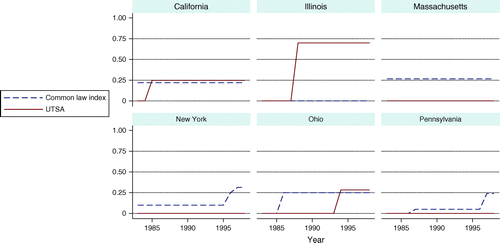
Notes. Figures depict the evolution of the state-level legal protection of trade secrets for the top six states in the sample. The broken graphs represent protection under common law (case precedents) and the solid graphs represent the increase in protection with the UTSA in effect. As of 1998, Massachusetts, New York, and Pennsylvania had not enacted the UTSA.
To the extent that the UTSA defines trade secrets and misappropriation more broadly and stipulates tougher penalties, it provides stronger legal protection of trade secrets. Further, codifying the law as such would reduce uncertainty. States enacting the UTSA would increase their stock of legal capital by gaining the use of case law of other UTSA states.4 Moreover, trade secrets legislation would draw attention to the legal protection of trade secrets, and not only among lawyers. Enactment of trade secrets statutes as reported in the general media might have influenced the broader business community.5 In terms of the model, the UTSA diminished the probability of reverse engineering, i.e., reduced λ, and therefore, increased the effectiveness of secrecy.
4. Empirical Strategy
The essence of my empirical strategy is to exploit differences in the timing of enactment of the UTSA among U.S. states and in the impact on companies with different geographical distribution of R&D. The outcome of interest is the number of patent applications Yjt by company j in year t, which is a non-negative integer. Following Hall and Ziedonis (2001), I model the production of patents using a Poisson regression as the estimated coefficients are consistent if the mean specification is correct and robust standard errors that are consistent even under misspecification of the distribution.
Formally, suppose that the mean of Yjt, conditional on company characteristics, is
The key issue is the relevant trade secrets law. To the extent that a company performs R&D in different locations across multiple states, the relevant trade secrets law is a basket of the laws of the various states in which the company carries out R&D. In the patent production function (10), the index UTSAjt−1, represents the change in the effective legal protection of company j’s trade secrets in year t − 1 due to the UTSA taking effect. As detailed in the Section 5, I construct the company-level index UTSAjt as an average of the state-level indexes described in the states where the company carried out R&D in the preceding year.
The empirical model (10) is specified by company and year. Since companies carry out R&D in multiple states, the effect of the UTSA is identified by variation in the legal protection of trade secrets provided by the UTSA across states as well as within states.
A major concern is that the UTSA being in effect might somehow be endogenous to patenting. To address this concern, I construct the effective UTSA index on the basis of the locations of R&D in the year before the UTSA took effect. Further, I estimate the patent production function using three other state-level uniform laws as instruments for the UTSA. The Uniform Determination of Death Act (UDDA), Uniform Federal Lien Registration Act (UFLRA), and Uniform Fraudulent Transfer Act (UFTA) were promulgated in 1978, 1978, and 1984 respectively to harmonize the definition of death, administration of employer liability liens, and regulation of fraudulent transfers (actions to avoid debt by transferring funds to other parties), respectively. These laws are unrelated to innovation or patenting. However, the UTSA is related to the three other uniform laws as all are statutes that efficiently harmonize state laws and were promulgated by the Uniform Law Commissioners for enactment by the states at around the same time (Ribstein and Kobayashi 1996).
The Xjt comprise company-level factors that vary over time and affect patenting. The most important control variable is company-level R&D expenditure. In principle, the depreciated stock of R&D seems to be most pertinent. However, Hall and Ziedonis (2001) show that contemporaneous R&D parsimoniously models the effect of R&D. In addition, the Xjt include an indicator of company-years with no reported R&D, as previous research shows substantial patenting by companies that do not report R&D Koh and Reeb (2015).
Further, the parameters β and μ are the coefficients of the change in effective legal protection and controls, respectively. The νj are fixed effects for company that account for non-time-varying heterogeneity among companies. (Since it is not possible to associate each company with one state, it does not make sense to include state fixed effects in the estimate.) The νt are year fixed effects which account for systematic changes in U.S. patent law and policy that equally affect all technologies, such as the establishment of the U.S. Court of Appeals for the Federal Circuit (Henry and Turner 2006). The year fixed effects also control for secular trends in technology. The errors in the regression model might be serially correlated, and so, I estimate standard errors that are robust to heteroskedasticity and clustered by company.
5. Data
For information on patents, I draw on the database of U.S. patents compiled by Kogan et al. (2017), supplemented by data on patent classes from the NBER Patent Database (Hall et al. 2001). Focusing on applications for patents (for brevity, “patents” rather than “patent applications”) with a single nongovernment assignee, I match the patent data by assignee (company) with financial information from Compustat. The financial information is number of employees, sales revenue, expenditure on property, plant, and equipment (PPE), R&D expenditure, and industry (4-digit SIC). Sales revenue is deflated by the U.S. GDP deflator, and R&D expenditure by the U.S. deflator for gross private domestic investment (the U.S. Bureau of Economic Analysis publishes state-level deflators only from 1987).
I limit the sample to company-years, for which the company financial information is complete, and employment, revenue, and PPE are positive, and R&D is non-negative. Also, the sample excludes companies that never patent or with only one observation throughout the period, as they are dropped from panel data regressions with company fixed effects.
The key explanatory variable is a measure of the change in the legal protection of the company’s trade secrets as a result of the UTSA taking effect. For each company j, the index of effective legal protection of trade secrets UTSAjt is constructed as an average of the state-level indexes described in Section 3, weighted by the number of facilities in the states where the company carried out R&D in the previous year. Formally,
I use other uniform laws enacted at around the same time (UDDA, UFLRA, and UFTA) as instruments for the UTSA. Likewise as with (11), the instruments are constructed by company and year. For example,
The challenge is to identify the locations of the company’s R&D facilities. I do so using a data set compiled from eight volumes of the R.R. Bowker directories (between the 16th edition (1979) and the final 32nd edition (1998)). Based on surveys, the directories report the organization name and locations of R&D facilities. Unfortunately, the Bowker directories ceased publication in 1998, and so, the period of study is limited to the years 1984–1999. The Bowker directories match 29.5% of companies in the matched patent-Compustat data set in the same period.6
Table 2 presents summary statistics of the sample. The average number of patents is 23.19 and the average increase in the company-level effective protection of trade secrets due to the UTSA taking effect is 0.199.
|
Table 2: Summary Statistics
| Variables | (a) Unit | (b) Mean | (c) Std | (d) Min | (e) max |
|---|---|---|---|---|---|
| Revenue | $’000 | 2,427 | 4,498 | 5.713 | 47,210 |
| Employees | ’000 | 11.26 | 18.91 | 0.038 | 141 |
| Property, plant and equity | $’000 | 1,612 | 3,804 | 1.673 | 46,193 |
| R&D expenditure | $’000 | 2,304 | 4,613 | 2.907 | 65,218 |
| No reported R&D | Indicator | 0.160 | 0.367 | 0 | 1 |
| No. of patent applications | Count | 23.19 | 74.49 | 0 | 1,562 |
| No. of patent classes | Count | 24.43 | 82.86 | 0 | 2,281 |
| R&D intensity | 0.046 | 0.073 | 0 | 2.389 | |
| Contribution margin | 0.366 | 0.157 | 0.001 | 0.987 | |
| Prior common law | 0.118 | 0.103 | 0 | 0.500 | |
| Effective UTSA | 0.199 | 0.213 | −0.100 | 0.767 | |
| Effective UDDA | 0.483 | 0.437 | 0 | 1 | |
| Effective UFTA | 0.538 | 0.452 | 0 | 1 | |
| Effective UFLRA | 0.625 | 0.424 | 0 | 1 | |
| CNC in 1991 | −0.390 | 1.237 | −3.594 | 1.701 | |
| Total observations | 7,291 | ||||
| Total companies | 793 | ||||
Notes. Unit of observation is company-year; Sample comprises companies listed in Compustat during 1984–1999; Limited to company-year with at least two observations, at least one patent application, matched to Bowker data set, and reporting positive employment, revenue, and PPE, and non-negative R&D expenditure. Due to missing R&D expenditure from Compustat, R&D expenditure and R&D intensity have 6,124 observations, and patent intensity has 6,122 observations; data set of patent classes from NBER Patent Database has 12,512 observations.
Figure 2 depicts the evolution of patent applications across all industries. Applications were flat until the late 1980s and then rose in the 1990s. Table 1 shows that the states’ enactment of the UTSA raised the legal protection of trade secrets over time in almost all states. Superficially, the trend of the raw patent data (Figure 2) appears to suggest that stronger trade secrets law increased patenting. However, the graph of the raw data does not control for confounds, in particular, changes in U.S. patent law and procedure causing an overall increase in patent applications (Henry and Turner 2006). I use multiple regression methods to account for these confounds and more precisely estimate the effect of stronger trade secrets law on patenting.
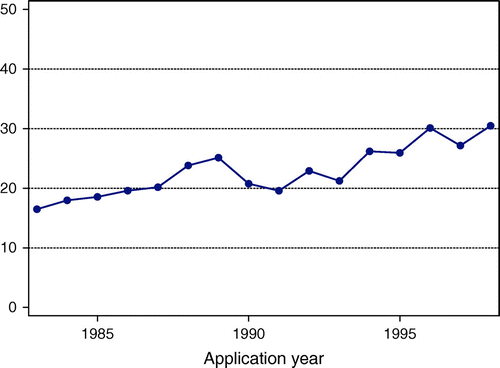
Note. The graph depicts the average number of patent applications per company as recorded in the Kogan et al. (2017) patent database.
6. Results
My theory of the choice between patents and secrecy assumes that technologies are arranged in ascending order of the probability of inventing around (Assumption 1). This implies that the marginal patent—on the internal margin of substitution between patent and secrecy—is the patent that will most likely be invented around. To the extent that, on the internal margin, stronger trade secrets law is associated with substitution of secrecy for patents, the probability of the inframarginal patents being invented around should be lower.
To validate Assumption 1, I estimate (10) with the dependent variable specified as the number of patent classes by company and year. During the process of patent examination, the U.S. Patent and Trademark Office assigns each patent to one or more International Patent Classification (IPC) class. Lerner (1995) justifies the number of IPC classes as a measure of the scope of the patent, which motivates it as representing the difficulty of inventing around the patent.
Table 3 presents the estimates. Table 3, column (a), reports an instrumental variables estimate by generalized method of moments (GMM) without controlling for the number of patents.7 The coefficient of effective UTSA is negative but not statistically significant. This negative coefficient combines two effects. One is the effect of the UTSA on the number of patents and the other is the effect of the UTSA on the number of IPC classes in each patent.
|
Table 3: UTSA and Patent Scope
| Variables | (a) Endog UTSA: GMM | (b) Control for number of patents |
|---|---|---|
| Employees | 0.847∗∗∗ (0.093) | 0.013 (0.011) |
| Revenue per employee | 0.192 (0.156) | −0.049∗∗ (0.021) |
| PPE per employee | 0.388∗∗ (0.185) | −0.014 (0.017) |
| R&D expense per employee | 0.404∗∗∗ (0.105) | 0.039∗∗ (0.016) |
| No reported R&D | 0.415∗ (0.212) | 0.031 (0.032) |
| Prior common law | −1.851∗ (1.062) | 0.230∗∗ (0.109) |
| Effective UTSA | −1.386 (1.175) | 0.210∗ (0.122) |
| No. of patents | 0.981∗∗∗ (0.007) | |
| Zero patent | −19.377∗∗∗ (4.446) | |
| Observations | 12,512 | 12,512 |
| Companies | 1,239 | 1,239 |
| Marg. effect | −0.214 | 0.037 |
| p-value | 0.238 | 0.086 |
| F statistic | 27.20 | 27.34 |
| Hausman stat | 1.44 | 4.71 |
| p-value | 0.230 | 0.030 |
| Hansen J stat | 4.04 | 0.09 |
| p-value | 0.044 | 0.763 |
Notes. Estimated by GMM Poisson regression using Stata routine, gmm ivxtp1 (Agrawal et al. 2014), with company fixed effects and year fixed effects and indicators of UDDA, UFTA, and UFLRA weighted by company R&D facilities as instruments for effective UTSA; Dependent variable: total number of patent IPC classes by company and year; Robust standard errors clustered by company in parentheses (∗∗∗p < 0.01, ∗∗p < 0.05, ∗p < 0.1). In the lower panel, marginal effect is the percentage change in dependent variable due to change in effective UTSA from zero to sample mean; Hausman test of UTSA endogeneity is a χ2(1) test that the coefficient of the residuals from the first stage regression in the second stage regression is different from zero Wooldridge (2010, p. 665); Over-identification test of exclusion conditions follows Wooldridge (2010, p. 424).
To distinguish these two effects, I carry out an estimate that controls for the number of patents. As column (b) of Table 3 reports, the coefficient of effective UTSA is positive and marginally significant. Conditional on the number of patents, the UTSA was associated with 0.037 (p = 0.086) more IPC classes per patent. This is consistent with the remaining patents being more difficult to invent around, and the patents being arranged in ascending order of the probability of inventing around. Subject to the proviso that the estimate is imprecise, it does help to validate Assumption 1.
Next, I turn to investigate the empirical effect of the UTSA on patenting, specifically, estimating the patent production function, (10) with the dependent variable specified as the number of patents by company and year. As a preliminary, Table 4, column (a), reports an estimate without instruments using the Stata routine, xtpoisson. The coefficient of R&D per employee 0.405 (s.e. 0.104) is positive and significant. The coefficient of effective UTSA −0.360 (s.e. 0.246) is negative but not precisely estimated.
|
Table 4: UTSA and Patenting
| Variables | (a) | (b) | (c) | (d) | (e) | (f) | (g) |
|---|---|---|---|---|---|---|---|
| Poisson F.E. | Endog UTSA: First stage | Endog UTSA: GMM | UTSA: 2 years lag | UTSA: 3 years lag | UTSA: 4 years lag | UTSA: 5 years lag | |
| Employees | 0.729∗∗∗ (0.150) | −0.008 0.008) | 0.710∗∗∗ (0.143) | 0.694∗∗∗ (0.147) | 0.698∗∗∗ (0.151) | 0.731∗∗∗ (0.149) | 0.746∗∗∗ (0.148) |
| Revenue per employee | 0.164 0.209) | −0.021∗ 0.011) | 0.132 (0.217) | 0.159 (0.221) | 0.204 (0.211) | 0.210 (0.202) | 0.171 (0.198) |
| PPE per employee | 0.251 (0.267) | −0.008 (0.013) | 0.215 (0.232) | 0.181 (0.243) | 0.205 (0.245) | 0.262 (0.247) | 0.320 (0.242) |
| R&D expense per employee | 0.405∗∗∗ (0.104) | −0.014 (0.009) | 0.382∗∗∗ (0.114) | 0.378∗∗∗ (0.122) | 0.381∗∗∗ (0.117) | 0.361∗∗∗ (0.107) | 0.340∗∗∗ (0.100) |
| No reported R&D | −0.355 (0.606) | −0.020 (0.024) | −0.447 (0.579) | −0.424 (0.593) | −0.339 (0.603) | −0.334 (0.612) | −0.376 (0.613) |
| Prior common law | −1.608∗∗ (0.762) | −0.551∗∗∗ (0.049) | −3.228∗∗∗ (1.197) | −2.732∗∗∗ (1.046) | −2.225∗∗ (0.924) | −1.662∗∗ (0.820) | −1.304∗ (0.740) |
| Effective UTSA | −0.360 (0.246) | −2.448∗∗ (1.224) | −2.154∗ (1.260) | −1.612 (1.174) | −0.886 (1.013) | −0.406 (0.821) | |
| Effective UDDA | 0.054∗∗∗ (0.017) | ||||||
| Effective UFTA | 0.060∗∗∗ (0.010) | ||||||
| Effective UFLRA | 0.085∗∗∗ (0.017) | ||||||
| Observations | 7,291 | 7,291 | 7,291 | 7,291 | 7,291 | 7,291 | 7,291 |
| Companies | 793 | 793 | 793 | 793 | 793 | 793 | 793 |
| Marg. effect | −0.069 | −0.386 | −0.333 | −0.246 | −0.133 | −0.058 | |
| p-value | 0.143 | 0.045 | 0.087 | 0.170 | 0.382 | 0.621 | |
| F statistic | 20.63 | ||||||
| Hausman stat | 3.82 | 3.82 | 1.66 | 0.79 | 0.76 | 0.71 | |
| p-value | 0.051 | 0.051 | 0.198 | 0.373 | 0.385 | 0.399 | |
| Hansen J stat | 2.81 | 2.20 | 2.81 | 2.93 | 3.55 | ||
| p-value | 0.094 | 0.138 | 0.094 | 0.087 | 0.060 | ||
Notes. Dependent variable: number of patent applications by company and year (except column (b)); All estimates control for company fixed effects and year fixed effects; Robust standard errors clustered by company in parentheses (∗∗∗p < 0.01, ∗∗p < 0.05, ∗p < 0.1); Lower panel reports marginal effects, Hausman test statistics, and over-identification test statistics with p-values. Column (a): Poisson conditional fixed-effect estimate using Stata routine, xtpoisson; Column (b): OLS first stage estimate of effective UTSA on indicators of UDDA, UFTA, and UFLRA weighted by company R&D facilities, using Stata routine, xtreg; Column (c): Reduced from Poisson GMM estimate using Stata routine, gmm ivxtp1, following the first stage estimate in column (b); Columns (d)–(g): Poisson GMM estimates using effective UTSA and instruments lagged by 2–5 years.
To address the concern of possible endogeneity, I apply instrumental variable methods. Table 4, column (b), reports the first-stage regression of the UTSA index on the company-level averages of the UDDA, UFTA, and UFLRA being in effect. Consistent with the UDDA, UFLRA, and UFTA being statutes that efficiently harmonize state laws and promulgated at around the same time as the UTSA, the coefficients of the instruments are positive and significant. The F-statistic of the (excluded) instruments is 20.63.
Table 4, column (c), reports the (second-stage) instrumental variable Poisson regression using a GMM procedure (Agrawal et al. 2014). The coefficient of effective UTSA −2.448 (s.e. 1.224) is negative and significant (p = 0.045). To check the endogeneity of UTSA, a Hausman test estimates the IV Poisson model including the residuals from the first stage regression (Table 4, column (b)) as an additional regressor (Wooldridge 2010, p. 665). The test statistic χ2(1) = 3.82 (p = 0.051) rejects the null hypothesis that the coefficient of the residuals is 0, suggesting that effective UTSA is not exogenous. To check over-identification of the exclusion conditions with the three instruments (Wooldridge 2010, p. 424), the Hansen J-test statistic is 2.81 (p = 0.094). This fails to reject the over-identifying restrictions, and suggests that all three instruments are exogenous and valid.
To appreciate the managerial significance of the estimate, I calculate the marginal effect. The average change in the effective UTSA index is associated with 38.6% fewer patents, which is quite substantial.8 To provide further perspective, Figure 3 graphs the marginal effect as a function of the company-level effective UTSA on the range between its minimum and maximum, [−0.100, 0.767]. As the empirical model is Poisson, the marginal effect is nonlinear in effective UTSA.
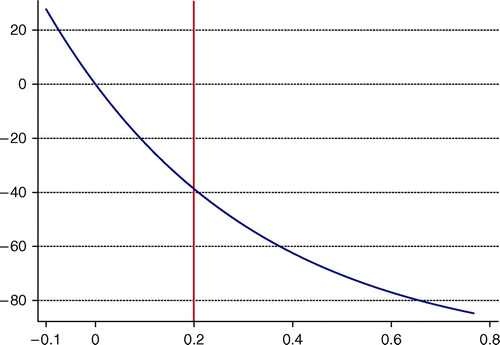
Note. Figure depicts predicted percent change in patent applications as function of the effective UTSA index over the range [−0.100, 0.767]; Curve is the graph of the equation in Endnote 8, with coefficient of effective UTSA from Table 4, column (c); Vertical line (red) represents the sample mean of effective UTSA.
The IV estimate with the UDDA, UFLRA, and UFTA as instruments is supported by the Hausman test rejecting exogeneity of UTSA and the Hansen J-statistic not rejecting over-identification. Interestingly, the IV estimate is an order of magnitude larger than the estimate without instruments (Table 4, column (a)).
The estimates with and without instruments differ for two possible reasons. One explanation is omitted variables. Enactment of the UTSA might be affected by unobserved state-specific, time-varying factors that also negatively affected company-level patenting. The instruments (shown to be valid) correct for such endogeneity.
The other reason is that the IV regression actually only estimates a local average treatment effect, specifically, the effect due to the variation in effective UTSA associated with variation in the instruments. By contrast, the regression without instruments estimates an average treatment effect over the entire variation in effective UTSA. The IV estimate focuses on companies with R&D facilities in states where the UDDA, UFLRA, and UFTA are closely aligned with the UTSA. Referring to Figure 4, in Illinois, both the UFLRA and UFTA were close in time to the UTSA, whereas in California, only the UFTA was close in time to the UTSA. Hence, the IV estimate places more weight on companies with R&D facilities in Illinois and less on companies with R&D facilities in California.
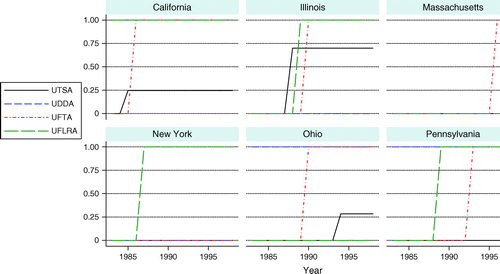
Note. Figure depicts the evolution of the state-level effective UTSA index, and the state-level adoption of the UDDA, UFTA, and UFLRA (=1 if effective) for the top six states in the sample.
The difference between the estimates with and without instruments is consistent with the UTSA being endogenous and the IV estimate characterizing a local average treatment effect rather than an average treatment effect. In the following, I prefer the regression with instruments as it provides a stronger causal interpretation.
Proposition 2 shows that stronger trade secrets law would lead to conflicting effects: on the internal margin, less patenting as secrecy substitutes for patents; and on the external margin, more patenting as more products are commercialized. Accordingly, the empirical relation between stronger trade secrets law and patenting depends on the balance of the two effects.
The estimate in Table 4, column (c), specifies effective UTSA with a lag of one year, to allow time for businesses to adjust to changes in the law. The negative coefficient of effective UTSA suggests that the negative effect on the internal margin outweighs the positive effect on the external margin.
The adjustment on the internal margin involves changing the appropriability mechanism for technologies in the pipeline, while the adjustment on the external margin involves changing the pipeline of technologies. It is reasonable to conjecture that the adjustment on the internal margin (substitution from patents to secrecy) would be relatively faster than the external margin (increase in product commercialization).
To investigate, Table 4, columns (d)–(g), report estimates with the effective UTSA lagged by 2, 3, 4, and 5 years respectively. The coefficient of effective UTSA is largest (most negative) in the preferred specification with a one-year lag, and is monotonically smaller in magnitude and less precise with longer lags. Importantly, the marginal effect of the UTSA, −0.386 (p = 0.045), is largest in the preferred specification and monotonically smaller in magnitude and less precise when effective UTSA is specified with longer lags.
This pattern—that the effect of the UTSA on patenting attenuates with time—is quite striking and consistent with the reasoning that substitution from patents to secrecy occurs faster than the increase in product commercialization. The pattern helps to validate the theoretical model of trade secrets law as negatively affecting patenting on the internal margin and positively on the external margin.
6.1. Robustness Tests
The online supplement (Table S6) reports multiple robustness checks of the negative relation between effective UTSA and patenting. The checks include constructing the company-level measure of the increase in the legal protection of trade secrets due to the UTSA in three different ways: (i) simple average of the UTSA indexes of the states in which the company performs R&D; (ii) average of the UTSA indexes weighted by the numbers of inventors as stated in patent applications assigned to the company; and (iii) simply as the UTSA index in the state of the company headquarters according to Compustat. The latter check is useful in comparing my findings with independent work by Dass et al. (2014) and Glaeser et al. (2017), who associate the UTSA with the state of the company headquarters. The estimated marginal effect is −60.9% (p = 0.149) is larger than the preferred estimate that accounts for the geographical distribution of R&D, but is not precise. The imprecision of this estimate is consistent with measurement error in simply associating trade secrets law with the headquarters state.
Another check constructs the company-level measure of the UTSA simply as an average of a binary indicator of the UTSA, weighted by the number of R&D facilities in each state. This estimate focuses on the UTSA as harmonizing the legal protection of trade secrets rather than increasing the protection.
Yet another robustness check addresses a concern that stronger legal protection of trade secrets might lead businesses to raise R&D (Png 2017), which would in turn lead to increased patenting. To address the possible endogeneity of R&D, this check excludes the R&D variables. Then the coefficient of effective UTSA combines the direct effect of stronger legal protection of trade secrets on patenting as well as the indirect effect through R&D. Provided that R&D does not depend on any other factor that affects patenting and is correlated with UTSA, the estimate of the coefficient of effective UTSA is unbiased.
The final robustness check limits the sample to companies that existed throughout the period of study. The balanced sample contains only 193 companies, which is less than a quarter of the main sample. The implied marginal effect is negative and 40% smaller than the preferred estimate, but not precisely estimated (p = 0.38), probably owing to the substantially reduced sample.
Importantly, for all but the variation with the balanced sample, the estimated marginal effect lies within a range of −25.7 and −60.9%, which brackets the preferred estimate of −38.6%.
6.2. Alternative Explanations
Increases in the legal protection of trade secrets, as represented by the UTSA coming into effect, were associated with less patenting. I interpret this negative relation as the outcome of the UTSA leading to substitution from patents to secrecy outweighing the increase in patenting due to increased commercialization of products.
The empirical analysis uses observational data, and so, is open to alternative explanations. One alternative is some state level policy to encourage innovation and patenting that is negatively correlated with enactment of the UTSA. To investigate such a correlation, the online supplement (Table S3) reports a Cox proportional hazard regression of state enactment of the UTSA. The estimate suggests that enactment is not correlated with either industry structure or patenting.
To further check the alternative explanation, the online supplement (Table S7) reports estimates that explicitly account for various state innovation policies— publication of a Science and Technology Strategic Plan, expenditure on cooperative technology programs, R&D tax credit, and science and technology programs. For each of these policies, I construct a company-level measure as an average of the policies (indicator of strategic plan (State Science and Technology Institute 1997), per capita spending on cooperative technology (State Science and Technology Institute 1996), indicator of R&D tax credit (Wilson 2009), or indicator of science and technology programs (Coburn and Berglund 1995)) weighted by the number of R&D facilities in the states in the preceding year. The negative relation between the UTSA and patenting is robust to inclusion of these state policies.
Another alternative explanation of the negative relation between the UTSA and patenting arises from the diffusion of software across all industries (Branstetter et al. 2015) and a U.S. Supreme Court decision in 1981 to allow patents for software.9 If the diffusion of software is somehow geographically correlated with enactment of the UTSA, the result would be a spurious correlation between patenting and the UTSA.
To investigate this alternative explanation, the online supplement (Table S7) reports estimates of the patent production function excluding software patents, using the alternative definitions of software patents by Bessen and Hunt (2007) and Hall and MacGarvie (2010). The estimated marginal effects are very close to the preferred estimate, which suggests that the negative relation between the UTSA and patenting is not due to the expansion of patenting to software.
Last, the period of study coincides with the rapid expansion of the U.S. defense budget in the 1980s followed by gradual contraction in the 1990s. Previous research has emphasized that the R&D policies of defense contractors differ from those of other businesses (Brown et al. 2009). If the growth of defense industries was somehow geographically correlated with enactment of the UTSA and the patenting strategies of defense contractors differed from other manufacturers, the result might be a spurious correlation between patenting and the UTSA.
To investigate, the online supplement (Table S7) reports an estimate excluding defense-related industries (SIC 372, 376, and 381). The estimated marginal effect is close to the preferred estimate for all industries including defense-related industries. Although the estimate is less precise, perhaps owing to the smaller sample, it does provide comfort that my finding is not due to changes in the U.S. defense budget and peculiarities in the innovation strategies of defense contractors.
7. Contingencies
Theoretically, stronger trade secrets law would reduce patenting on the internal margin (substitution within products between patents and secrecy) and increase patenting on the external margin (commercialization of more products). The balance between the two conflicting effects is an empirical question. The estimates in Table 4 and the robustness checks in the online supplement show that, across all industries, the net effect is negative, suggesting that the substitution of secrecy for patents outweighs the increase in commercialization.
However, does this balance vary with industry, and product, business, and labor market contingencies? Theoretically, these could amplify or attenuate the effect of stronger trade secrets law on patenting. Hence, the directions of the contingent effects are ambiguous, which should not be surprising since the direction of the main effect of stronger trade secrets law is also ambiguous. Clearly, the contingent effects are empirical issues. I investigate by comparing the effect of the UTSA by industry and functional contingencies.
7.1. Industries
Table 5 reports estimates of patent production function for the top five industries by number of observations in the sample, and pharmaceuticals. Strictly, the fourth largest industry by number of observations is SIC 283 Drugs. However, the GMM estimate for SIC 283 would not converge. Accordingly, I omit SIC 283 and report estimates for the sixth largest industry, and, also, given the particular interest in the industry, SIC 2834 Pharmaceuticals.
|
Table 5: UTSA and Patenting: Estimates by Industry
| Variables | (a) | (b) | (c) | (d) | (e) | (f) |
|---|---|---|---|---|---|---|
| SIC 382 Lab apparatus | SIC 367 Electronic accessories | SIC 384 Surgical and medical instruments | SIC 356 General industrial machinery | SIC 357 Computer and office equipment | SIC 2834 Pharmaceuticals | |
| Effective | −1.383∗ | −10.166∗∗∗ | 0.974 | −4.959∗∗∗ | −3.332 | 1.374∗∗ |
| UTSA | (0.726) | (2.793) | (0.743) | (1.900) | (2.124) | (0.619) |
| Observations | 590 | 586 | 361 | 340 | 321 | 272 |
| Companies | 60 | 64 | 44 | 44 | 47 | 28 |
| Marg. effect | −0.227 | −0.876 | 0.179 | −0.647 | −0.566 | 0.255 |
| p-value | 0.057 | 0.000 | 0.190 | 0.009 | 0.117 | 0.026 |
| Hausman stat | 0.78 | 21.46 | 0.03 | 12.03 | 4.09 | 0.62 |
| p-value | 0.378 | 0.000 | 0.872 | 0.001 | 0.043 | 0.431 |
| Hansen J stat | 2.38 | 3.59 | 3.18 | 3.93 | 2.20 | 2.40 |
| p-value | 0.123 | 0.058 | 0.075 | 0.047 | 0.138 | 0.121 |
Notes. Estimated by GMM Poisson regression using Stata routine, gmm xtivp1, with company fixed effects and year fixed effects and indicators of UDDA, UFTA, and UFLRA weighted by company R&D facilities as instruments for effective UTSA; Dependent variable: number of patent applications by company and year; All estimates control for Employees, Revenue per employee, PPE per employee, R&D expense per employee, No reported R&D, and Prior common law; Subsample comprises companies in top SIC3 industries by frequency in the sample and Pharmaceuticals; Robust standard errors clustered by company in parentheses (∗∗∗p < 0.01, ∗∗p < 0.05, ∗p < 0.1); Lower panel reports marginal effects, Hausman test statistics and Over-identification test statistics with p-values.
For brevity, Table 5 reports only the coefficients of effective UTSA. The coefficient of effective UTSA is negative in four of five industries, and the estimate is large and significant in two industries (SIC 367 Electronic accessories and SIC 356 General industrial machinery) and marginally significant in another (SIC 382 Laboratory apparatus). The coefficient of effective UTSA is positive and significant, in SIC 2834 Pharmaceuticals.
Broadly, the impression is that, in the majority of industries, the UTSA was associated with less patenting, which I interpret as the substitution of secrecy for patenting outweighing the increase in product commercialization. Reviewing the estimates by industry, there does not seem to be any general pattern, whether by complex/discrete technologies (Cohen et al. 2000) or low/high-technology (Hecker 1999).
The negative effect of the UTSA is strongest in SIC 367 Electronic accessories, which class includes the semiconductor industry. This industry has been highlighted for strategic patenting (Hall and Ziedonis 2001, Ziedonis 2004), which would suggest weak or no substitution between secrecy and patents. Yet, empirically, I find that the UTSA is associated with significantly less patenting.
Businesses also use patents to support licensing (Arora et al. 2001). Among the five industries covered in Table 5, the computer and electronics industries report relatively greater use of patents in licensing (Cohen et al. 2000, Tables 8 and 9). To the extent of their use to support licensing of technology, patenting should be less sensitive to the UTSA. However, the UTSA appears to have relatively large effects in these industries.
In the pharmaceutical industry, the UTSA was associated with more patenting, which I interpret as the increase in product commercialization outweighing the substitution of secrecy for patenting. This industry may be special in the difficulty of inventing around patented technologies and relative ease of reverse engineering through chemical analysis. Hence, there would be relatively less substitution of secrecy for patents as appropriability mechanisms for product technologies. To that extent, stronger trade secrets law would affect patenting mainly through increased commercialization, and so, raise the number of patents.
Besides industry, the effect of the UTSA on patenting might also vary with functional contingencies—product margin, technology leadership, business size, and worker mobility. The effect of these contingencies is an empirical issue as, theoretically, they could amplify or attenuate the effect of stronger trade secrets law on patenting. Each of these is an interesting strategic issue and I investigate them in turn.
7.2. Product Margin
How does the effect of stronger trade secrets law on patenting depend on the profitability of the product? Since Compustat does not report sales revenues and costs by individual product or even product line, I investigate using the overall company level margin, which should be correlated with the margins on the individual products.
Specifically, I use the contribution margin percentage (ratio of sales revenue less cost of goods sold to sales revenue). Table 6, columns (a) and (b), present estimates of the patent production function for companies whose contribution margin percentage is above or below the sample median. The coefficient of effective UTSA in low-margin companies is negative but not precisely estimated. By comparison, the coefficient of effective UTSA in more profitable companies, −3.332 (s.e. 1.631), is negative, significant, and an order of magnitude larger than the coefficient for small companies.10
|
Table 6: UTSA and Patenting: Contingencies
| Variables | (a) | (b) | (c) | (d) | (e) | (f) | (g) | (h) |
|---|---|---|---|---|---|---|---|---|
| Low margin | High margin | Low R&D intensity | High R&D intensity | Low revenue | High revenue | Weak CNC 91 | Strong CNC 91 | |
| Effective | −0.215 | −3.332∗∗ | −0.225 | −2.451∗∗ | −1.445 | −2.505∗ | −7.524∗∗∗ | −0.044 |
| UTSA | (1.370) | (1.631) | (1.029) | (1.233) | (0.929) | (1.363) | (2.558) | (0.473) |
| Observations | 3,645 | 3,646 | 3,062 | 3,062 | 3,645 | 3,646 | 3,527 | 3,764 |
| Companies | 484 | 501 | 405 | 440 | 492 | 409 | 441 | 455 |
| Marg. effect | −0.043 | −0.479 | −0.044 | −0.402 | −0.239 | −0.408 | −0.704 | −0.010 |
| p-value | 0.875 | 0.041 | 0.827 | 0.047 | 0.120 | 0.066 | 0.003 | 0.925 |
| Hausman stat | 0.04 | 4.80 | 0.46 | 1.49 | 0.72 | 3.39 | 9.63 | 0.04 |
| p-value | 0.833 | 0.029 | 0.496 | 0.223 | 0.395 | 0.066 | 0.002 | 0.845 |
| Hansen J stat | 2.75 | 4.62 | 0.90 | 3.11 | 0.74 | 2.62 | 0.28 | 0.63 |
| p-value | 0.097 | 0.032 | 0.342 | 0.078 | 0.388 | 0.105 | 0.594 | 0.427 |
Notes. Estimated by GMM Poisson regression using Stata routine, gmm xtivp1, with company fixed effects and year fixed effects and indicators of UDDA, UFTA, and UFLRA weighted by company R&D facilities as instruments for effective UTSA; Dependent variable: Number of patent applications by company and year; All estimates control for Employees, Revenue per employee, PPE per employee, R&D expense per employee, No reported R&D, and Prior common law; Robust standard errors clustered by company in parentheses (∗∗∗p < 0.01, ∗∗p < 0.05, ∗p < 0.1); Lower panel reports marginal effects, Hausman test statistics, and Over-identification test statistics with p-values. In each pair of split-sample regressions (below/above median margin, R&D intensity, revenue, and state enforcement of CNCs), the total number of companies may exceed the number of companies in the preferred estimate as companies shift from below to above the median and vice versa from year to year. Columns (a) and (b): Companies with below and above median contribution margin; Columns (c) and (d): Companies with below and above median ratio of R&D expenditure to revenue; Columns (e) and (f): Companies with below and above median revenue; Columns (g) and (h): Companies facing below and above median enforcement of covenants not to compete based on Starr (2017) CNC index for 1991.
The empirical results suggest that a larger margin amplifies the substitution of secrecy for patents relatively more than the increase in product commercialization. Accordingly, the negative effect of UTSA on patenting increases with the product margin.
7.3. Technology Leadership
Another interesting strategic issue is how the effect of stronger trade secrets law on patenting depends on the business’s leadership in technology. I define a company as a technology leader if its ratio of R&D to sales exceeds the median, and, technology laggard otherwise.
Table 6, columns (c) and (d), present estimates of the patent production function for technology laggards as compared with leaders, as defined by R&D intensity. All companies with high R&D intensity report R&D, so, the indicator of missing R&D is not identified. For a more symmetric comparison, I limit the analysis of low R&D intensity companies to those that report R&D. The coefficient of effective UTSA for technology laggards is not significant, while the coefficient for technology leaders, −2.451 (s.e. 1.233), is negative and significant, and an order of magnitude larger than the coefficient for laggards.
In a robustness check, I define a company to be a technology leader if its average forward citations within a three-year window are above the median. As the online supplement (Table S8) reports, the coefficient of effective UTSA is three times larger among companies with above-median citations than those with below-median citations. However, both estimates are insignificant.
The empirical results suggest that technology leadership amplifies the substitution of secrecy for patents relatively more than the increase in product commercialization. Accordingly, the negative effect of UTSA on patenting increases with technology leadership. However, this finding is sensitive to the definition of technology leadership.
7.4. Size
From a strategic viewpoint, it is also interesting to appreciate how businesses should choose appropriability mechanisms according to size. This is interesting as such and also to the extent that size is related to the relative cost of patenting. Lerner (1995) reasoned that the cost of legal services would be lower for larger businesses as they are more likely to employ in-house legal teams. The lower cost would apply to both patenting and maintaining secrecy.
Table 6, columns (e) and (f), present estimates of the patent production function for small vis-a-vis large companies, as defined by revenue t below or above the sample median. The coefficient of effective UTSA among small companies is not significant, while the coefficient among large companies, −2.505 (s.e. 1.363), is negative, marginally significant, and larger than the coefficient for small companies. The online supplement (Table S8) shows that the results are similar with business size being defined by assets and employment.
Subject to statistical imprecision, the empirical results suggest that business size amplifies the substitution of secrecy for patents relatively more than the increase in product commercialization. Accordingly, the negative effect of UTSA on patenting increases with size.
7.5. Worker Mobility
Finally, I investigate how the effect of stronger trade secrets law on patenting depends on laws regulating labor mobility. The covenant not to compete (CNC) is a provision by which an employee agrees not to work in a competing business for a specified time. It is fairly intuitive that CNCs and trade secrets laws might be substitute ways of increasing the appropriability of proprietary knowledge. What is less obvious is that CNCs and trade secrets laws might complement each other. Typically, courts will enforce CNCs only if they protect the employer’s legitimate business interests, of which a common one is to safeguard trade secrets (Gilson 1999).
In the United States, the degree to which businesses can enforce CNCs varies by state. For each company, I compile the effective enforcement of CNCs as an average of the Starr (2017) index of state enforcement of CNCs in 1991, weighted by the number of R&D facilities in the states in the preceding year.
Table 6, columns (g) and (h), report estimates of the patent production function for companies facing weak as compared with strong enforcement of CNCs, as defined by the CNC index being below or above the industry median. The coefficient of effective UTSA among companies facing weak enforcement of CNCs, −7.524 (s.e. 2.558), is negative and significant. The coefficient among companies facing strong enforcement of CNCs is two orders of magnitude smaller and not significant.
The estimates suggest that the UTSA had larger effect on companies facing weak enforcement of CNCs. Apparently, strong enforcement of CNC attenuates the substitution of secrecy for patents relatively more than the increase in product commercialization.
8. Discussion
Here, I model the choice of patents and secrecy for a product comprising multiple technologies that differ in the likelihood of inventing around and reverse engineering. The profit-maximizing strategy works on two margins. On the internal margin, the marginal patented technology balances the appropriability provided by patents (protection against inventing around), appropriability provided by secrecy (protection against reverse engineering), and the cost of patenting relative to secrecy. On the external margin, the marginal product yields a (weakly) positive expected profit.
If trade secrets law is stronger in the sense of reducing the likelihood of reverse engineering, then businesses should adjust their appropriability strategy in two ways. On the internal margin, they should substitute secrecy for patents, and on the external margin, commercialize more products, which would incorporate more patents.
To test these propositions, I exploit differences in the timing of enactment of the UTSA among the United States and its impact on manufacturers with different geographical distribution of R&D between 1984 and 1999. Overall, the UTSA was associated with 38.6% fewer patents. This suggests that the increase in the legal protection of trade secrets reduced patenting (as businesses substituted toward secrecy) by more than the increase in legal protection increased patenting through commercialization of more products. The net effect of the UTSA on patenting diminished over time, suggesting that the substitution from patents to secrecy was gradually outweighed by the effect of the increased commercialization on patenting. These findings are consistent with the theoretical propositions.
In independent work focusing on the effect of trade secrets protection on equity financing and disclosure, Dass et al. (2014) and Glaeser et al. (2017) also find that the UTSA is associated with less patenting among U.S. publicly-listed companies. However, their analyses are purely empirical and they do not provide any theoretical interpretation, and cannot account for heterogeneity in the relation between the UTSA and patenting.
By contrast, my theory shows that the balance in the effect of stronger trade secrets laws on patenting between substitution and increased commercialization is an empirical matter. In particular, it may vary by product, business, industry, and labor market conditions. Indeed, I show the negative relation between the UTSA and patenting is significant in two industries (Electronic accessories and General industrial machinery), among companies with higher profit margins or that are more R&D intensive, or in states that weakly enforce covenants not to compete. Moreover, I show that the UTSA was associated with more patenting in the pharmaceutical industry.
The estimates of heterogeneous effects are consistent with businesses considering the legal protection of trade secrets in deciding whether to protect inventions through patents or secrecy and commercialize products, and doing so in nuanced ways, depending on the characteristics of the product, business, and industry. The findings also accord with prior research that reveals substantial industry differences in the use of secrecy and patents (Cohen et al. 2000).
My theoretical analysis and empirical findings have clear implications for business. Secrecy matters. Stronger legal protection of trade secrets increases appropriability, and businesses should adjust in two ways. On the internal margin, they should balance the protection that patents provide against inventing around, the protection that secrecy provides against reverse engineering, with the cost of patenting relative to secrecy. On the external margin, they should increase commercialization until the marginal product yields zero profit. The net effect on patenting depends on the balance between the negative effect of substitution toward secrecy and the positive effect of increased commercialization.
Moreover, the extent of these adjustments varies by characteristics of product, firm, industry, and worker mobility. In theory, these contingencies may possibly amplify or attenuate the effect of stronger trade secrets laws. Empirically, the effect is stronger among companies with higher profit margins or that are more R&D intensive, or in states that weakly enforce covenants not to compete. This provides some guidance to businesses with regard to circumstances where secrecy might matter relatively more.
The empirical evidence of a relation between trade secrets laws and patenting has further implications for innovation strategy. Patents are widely used to measure innovation, at national, industry, and business levels (Lerner and Seru 2015). To the extent that patents and secrecy are substitutes, then using patents may under-count innovation. Policies and business strategies that shift the means of appropriation away from patents and toward secrecy may be wrongly inferred to reduce innovation. In particular, estimates of spillovers (the extent of which would be affected by trade secrets laws) such as Bloom et al. (2013) should be interpreted with caution.
My theory abstracts from several features of patents and secrecy. One is that patents are limited to 20 years while secrecy is not limited in duration. For the incumbent firm, this difference in duration would tilt it to prefer secrecy relatively more. Another issue is that the probabilities of inventing around and reverse engineering might depend on the contribution margin. If the product is more profitable, potential competitors would invest more in inventing around and reverse engineering. The effect on patenting strategy would depend on which is relatively more sensitive to the margin—the probability of inventing around or the probability of reverse engineering. The model also abstracts from the use of patents for strategic purposes (Cohen et al. 2000, Hall and Ziedonis 2001, Cotropia and Lemley 2008), technology licensing (Arora and Ceccagnoli 2006), raising finance, and providing access to federal courts.11
My findings must be interpreted in light of differences in the geographical scope of laws. In the United States, during the period of study, secrecy was a matter of state jurisdiction with protection in other states dependent on how courts interpreted conflicts in state laws. By contrast, patents confer a federal right that is effective in all states. To this extent, secrecy was a poorer substitute for patents, and the empirical estimates provide a conservative analysis of the effects of changes in the legal protection of trade secrets.
Further, I rely on Compustat for company financial data, which limits the analysis in two ways. The theoretical propositions apply to products but the empirical analysis uses company level data, which possibly gives rise to measurement error. However, to the extent that the error attenuates the estimated coefficients, the findings are conservative.12 Further, the analysis is limited to publicly-listed companies. The effects of the UTSA on private businesses, which are typically smaller, may differ. For instance, smaller businesses may be less aware of changes in trade secrets laws and less likely to enforce intellectual property rights. Accordingly, the empirical findings should be interpreted with caution.
This paper supersedes an earlier draft entitled, “Secrecy and Patents: Evidence from the Uniform Trade Secrets Act.” The author thanks the editor, Joanne Oxley, anonymous referees, Deepak Hegde, Stefan Wagner, Lasse Lien, Donald Hatfield, Pierre Azoulay, Tim Simcoe, Michael Risch, Mark Lemley, NUS colleagues, and participants at presentations at the University of Hong Kong, Cornell University, Carnegie Mellon University, and the APIC 2016 for advice and help, Joy Cheng for assistance with trade secrets law, Xi Xiong, Yige Duan, and Chun-beng Leow for superb research assistance.
1 For brevity, I stipulate “reverse engineering” to also encompass accidental disclosure and independent discovery.
2 In a study of litigation involving Massachusetts businesses between 1990 and 1994, Lerner (2001) finds that smaller businesses were more likely to litigate trade secrets as compared with patents. This is consistent with secrecy being less costly than patents.
3 South Carolina enacted the UTSA in 1992 and then, in a substantial revision, deviated from the UTSA in 1997 (Pooley 1997). Hence, for South Carolina, non-UTSA law prevailed before 1992 and after 1997. Strictly, (8) applies in years when the UTSA is not in effect, and (9) applies in years when the UTSA is in effect.
4 Almeling et al. (2009, 2010) noted an increasing trend of citing statutes rather than common law in trade secrets cases tried by federal district courts and state appellate courts.
5 For instance, New York Times, “Who Owns Ideas, and Papers, Is Issue in Company Lawsuits,” May 30, 1993, p. 1, and Crain’s Detroit Business, “Trade-Secret Law Boosts Penalties,” March 29, 1999, p. 21.
6 An alternative way to identify the locations of R&D uses the addresses from which inventors applied for patents assigned to the company. However, this method depends on the dependent variable, which might cause the explanatory variable to be endogenous. Moreover, it does not work for years in which the company did not apply for patents. Further, the inventor may work for a contractor rather than the company to which the patent is assigned (Ge et al. 2016). Among the 7,291 company-year observations in the combined data set of patents, Compustat, and Bowker R&D locations, the average rate of missing states is 53.5% (for each company-year, the ratio of number of states reported in the Bowker directories but not disclosed in patent applications to the number of states reported in the Bowker directories).
7 I explain the instrumental variables strategy and report the first-stage regression in Table 4.
8 Suppose that effective UTSA increased from zero to , and so, the marginal effect,
9 Diamond v. Diehr, 450 U.S. 175, 101 Supreme Court 1048 (1981).
10 The total number of companies with low and high margins exceeds the total number of companies as companies shift from below to above the median and vice versa from year to year. The same applies to other split-sample regressions reported in this paper.
11 In the United States, patents provide automatic access to federal courts, whereas owners of trade secrets can only sue in federal court if the misappropriator is resident in another state. Appeals of cases involving patents, even if the subject of the appeal is not patent-related, go to the Court of Appeals for the Federal Circuit, which is notably pro-inventor (Henry and Turner 2006).
12 Crass et al. (2016) study the relationship between patenting and secrecy in the context of businesses that report only a single innovation.
References
- (2014) How do tax credits affect R&D expenditures by small firms? Evidence from Canada. NBER Working Paper 20615, University of Toronto, Toronto, Ontario.Crossref, Google Scholar
- (2009) A statistical analysis of trade secret litigation in federal courts. Gonzaga Law Rev. 45(2):291–334.Google Scholar
- (2010) A statistical analysis of trade secret litigation in state courts. Gonzaga Law Rev. 46(1):57–101.Google Scholar
- (2004) Little patents and big secrets: Managing intellectual property. RAND J. Econom. 35(1):1–22.Crossref, Google Scholar
- (1997) Patents, licensing, and market structure in the chemical industry. Res. Policy 26(4–5):391–403.Crossref, Google Scholar
- (2006) Patent protection, complementary assets, and firms’ incentives for technology licensing. Management Sci. 52(2):293–308.Link, Google Scholar
- (2001) Markets for Technology: The Economics of Innovation and Corporate Strategy (MIT Press, Cambridge, MA).Crossref, Google Scholar
- (2001) The relative effectiveness of patents and secrecy for appropriation. Res. Policy 30(4):611–624.Crossref, Google Scholar
- (2013) Dynamic protection of innovations through patents and trade secrets. SSRN Working Paper 2537248, Université catholique de Louvain, CORE and Louvain School of Management, Louvain-la-Neuve, Belgium.Crossref, Google Scholar
- (2007) An empirical look at software patents. J. Econom. Management Strategy 16(1):157–189.Crossref, Google Scholar
- (2006) Patents vs. trade secrets: Knowledge licensing and spillover. J. Eur. Econom. Assoc. 4(6):1112–1147.Crossref, Google Scholar
- (2013) Identifying technology spillovers and product market rivalry. Econometrica 81(4):1347–1393.Crossref, Google Scholar
- (2015) Get with the program: Software-driven innovation in traditional manufacturing. NBER Working Paper 21752, Cambridge, MA.Crossref, Google Scholar
- (2009) Financing innovation and growth: Cash flow, external equity, and the 1990s R&D boom. J. Finance 64(1):151–185.Crossref, Google Scholar
- (2017) Money secrets: How does trade secret legal protection affect firm market value? Evidence from the uniform trade secret act. Strategic Management J. 38(4):834–853.Crossref, Google Scholar
- (2016) Appropriability strategies to capture value from innovation. Thursby MC, ed. Technological Innovation: Generating Economic Results (Emerald Group Publishing Limited, Bingley, UK), 3–31.Crossref, Google Scholar
- (1995) Partnerships: A Compendium of State and Federal Cooperative Technology Programs (Battelle Press, Columbus, OH).Google Scholar
- (2016) Patents and the global diffusion of new drugs. Amer. Econom. Rev. 106(1): 136–164.Crossref, Google Scholar
- (2000) Protecting their intellectual assets: Appropriability conditions and why US manufacturing firms patent (or not). NBER Working Paper 7552, Cambridge, MA.Crossref, Google Scholar
- (2016) Trade Secrets and Innovation: Evidence from the “Inevitable Disclosure” Doctrine (Wharton School, Philadelphia).Google Scholar
- (2008) Copying in patent law. North Carolina Law Rev. 87(5):1421–1466.Google Scholar
- (2016) Protecting innovation through patents and trade secrets: Determinants and performance impacts for firms with a single innovation. SSRN Working Paper 2844731, Center for European Economic Research (ZEW), Mannheim, Germany.Google Scholar
- (2014) Intellectual property protection and financial markets: Patenting vs. secrecy. SSRN Working Paper 2648770, Georgia Tech, Atlanta, GA.Google Scholar
- (2013) Complements and substitutes in profiting from innovation: A choice experimental approach. Res. Policy 42(2):326–339.Crossref, Google Scholar
- (2015) Patents and cumulative innovation: Causal evidence from the courts. Quart. J. Econom. 130(1): 317–369.Crossref, Google Scholar
- (2016) Engineer/Scientist careers: Patents, online profiles, and misclassification bias. Strategic Management J. 37(1):232–253.Crossref, Google Scholar
- (1999) The legal infrastructure of high-technology industrial districts: Silicon valley, route 128, and covenants not to compete. New York Univ. Law Rev. 74(3):575–629.Google Scholar
- (2017) Discretionary disclosure and manager horizon. Available at SSRN: http://dx.doi.org/10.2139/ssrn.2939852.Crossref, Google Scholar
- (2014) The choice between formal and informal intellectual property: A review. J. Econom. Literature 52(2):375–423.Crossref, Google Scholar
- (2010) The private value of software patents. Res. Policy 39(7):994–1009.Crossref, Google Scholar
- (2001) The patent paradox revisited: An empirical study of patenting in the US semiconductor industry, 1979–1995. RAND J. Econom. 32(1):101–128.Crossref, Google Scholar
- (2001) The NBER patent citation data file: Lessons, insights and methodological tools. NBER Working Paper 8498, Cambridge, MA.Crossref, Google Scholar
- (2005) Should I keep a secret? The effects of trade secret protection procedures on employees’ obligations to protect trade secrets. Organ. Sci. 16(1):71–84.Link, Google Scholar
- (1999) High-technology employment: A broader view. Monthly Labor Rev. 122(6):18.Google Scholar
- (2006) The court of appeals for the federal circuit’s impact on patent litigation. J. Legal Stud. 35(1):85–117.Crossref, Google Scholar
- (2009) Technological innovations and aggregate risk premiums. J. Financial Econom. 94(2):264–279.Crossref, Google Scholar
- (2009) Does patent strategy shape the long-run supply of public knowledge? Evidence from human genetics. Acad. Management J. 52(6):1193–1221.Crossref, Google Scholar
- (2017) Mobility and appropriability: Evidence from “inevitable disclosure.” Working paper, National University of Singapore, Singapore.Google Scholar
- (2009) Knowledge management: Does capture impede creation? Indust. Corporate Change 18(4):701–727.Crossref, Google Scholar
- (2017) Technological innovation, resource allocation, and growth. Quart. J. Econom. 132(2):665–712.Crossref, Google Scholar
- (2015) Missing R&D. J. Accounting Econom. 60(1):73–94.Crossref, Google Scholar
- (2008) The surprising virtues of treating trade secrets as IP rights. Stanford Law Rev. 61(2):311–353.Google Scholar
- (1995) Patenting in the shadow of competitors. J. Law Econom. 38(2):463–495.Crossref, Google Scholar
- (2001) The choice of intellectual property protection: Evidence from civil litigation. Working paper, Harvard University, Boston.Google Scholar
- (2015) The use and misuse of patent data: Issues for corporate finance and beyond. NBER Working paper, Cambridge, MA.Google Scholar
- (1997) Keeping organizational secrets: Protective institutional mechanisms and their costs. Indust. Corporate Change 6(3):623–663.Crossref, Google Scholar
- (2016) Intellectual property allocation and firm investments in innovation. Working paper, McCombs School of Business University of Texas at Austin, Austin, TX.Google Scholar
- (2012) Innovation without patents: Evidence from world’s fairs. J. Law Econom. 55(1):43–74.Crossref, Google Scholar
National Science Foundation (2008) Business R&D and innovation survey. National Center Sci. Engrg. Statist.Google Scholar- (2008) Patent-secret mix in complex product firms. Amer. Law Econom. Rev. 10(1):142–158.Crossref, Google Scholar
- (2017) Law and innovation: Evidence from state trade secrets laws. Rev. Econom. Statist. 99(1):167–179.Crossref, Google Scholar
- (1997) Trade Secrets (Law Journal Press, New York).Google Scholar
- (1996) An economic analysis of uniform state laws. J. Legal Stud. 25(1):131–199.Crossref, Google Scholar
- (2017) Empirical methods in trade secret research. Menell PS, Schwartz DL, eds. Research Handbook on the Economics of Intellectual Property Law: Vol. II—Analytical Methods (Edward Elgar Publishing, Northampton, MA). Forthcoming.Google Scholar
- (2012) Patent strategy and management: An integrative review and research agenda. J. Management 38(4):1084–1114.Crossref, Google Scholar
- (2017) Consider this: Training, wages, and the enforceability of covenants not to compete. SSRN Working Paper 2556669.Google Scholar
State Science and Technology Institute (1996) State Funding for Cooperative Technology Programs (State Science and Technology Institute, Columbus, OH).Google ScholarState Science and Technology Institute (1997) Science and Technology Strategic Planning (State Science and Technology Institute, Columbus, OH).Google Scholar- (1986) Profiting from technological innovation: Implications for integration, collaboration, licensing and public policy. Res. Policy 15(6):285–305.Crossref, Google Scholar
- (2009) Beggar thy neighbor? The in-state, out-of-state, and aggregate effects of R&D tax credits. Rev. Econom. Statist. 91(2):431–436.Crossref, Google Scholar
- (2010) Econometric Analysis of Cross Section and Panel Data (MIT Press, Cambridge, MA).Google Scholar
- (2004) Don’t fence me in: Fragmented markets for technology and the patent acquisition strategies of firms. Management Sci. 50(6):804–820.Link, Google Scholar
I. P. L. Png is a Distinguished Professor in the NUS Business School and Department of Economics at the National University of Singapore. His research focuses on the economics of innovation and productivity. He is the author of Managerial Economics, which has been published in multiple editions. He received the NUS-UCLA Executive MBA Teaching Excellence Award in 2008 and 2011. Dr. Png was a nominated MP (10th Parliament of Singapore), 2005–2006, and member of the Trustworthy Computing Academic Advisory Board, Microsoft Corporation, 2006–2010.