

Request Username
Can't sign in? Forgot your username?
Enter your email address below and we will send you your username

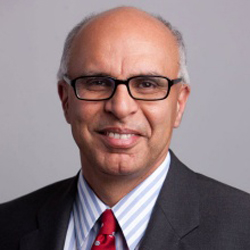
AUTHOR SPOTLIGHT
INFORMS member since 1982
Co-author with Yan Xia and Rakesh Nagi of
"Controlling a Fleet of Unmanned Aerial Vehicles to Collect Uncertain Information in a Threat Environment,"
in Operations Research
INFORMS: What inspired you to research this particular topic?
BATTA: I was part of a team of researchers working on a project on UAVs sponsored by the Office of Naval Research. The particular problem that we studied is an offshoot of the initial study that we had performed as part of this project.
INFORMS: Did any of your results surprise you?
BATTA: Yes, I was surprised by the fact that uncertainty in the search environment causes cooperation between UAVs to be relevant even when they cannot communicate during a mission.
INFORMS: What is the most important take-away you hope readers will learn from your paper?
BATTA: Search theory to me consists of lots of simple, elegant, relevant, and yet unsolved problems. Most of these problems are found in a military setting but increasingly they also occur in humanitarian settings such as search and rescue operations for survivors. I hope that more operations researchers work on these simply stated problems.
INFORMS: During the past month, you also published an article within Transportation Science, “School Bus Routing with Stochastic Demand and Duration Constraints.” What does the Venn diagram look like between unmanned aerial vehicles and school buses?
BATTA: The main commonality is that the school bus routing paper also started from a project that we were working on, this time for the Williamsville School District in western New York.
INFORMS: Tell us about the process of writing these papers, particularly simultaneously writing and submitting two papers for publication.
BATTA: Writing papers that related to two different projects at the same time was certainly challenging. What made it more challenging was not only were the applications different, but the methodology used and the analysis tools were very different too. What helped was the fact that they were related to projects and we had plenty of opportunity to interact with practitioners and seek realism checks related to both papers.
INFORMS: Why was it important for you to publish in Operations Research and Transportation Science?
BATTA: They are both highly respected journals and are very appropriate outlets for the work contained in the two papers. Papers in search theory have appeared frequently in Operations Research and many papers on school bus routing have appeared in Transportation Science.
INFORMS: How did you become an expert in urban operations research?
BATTA: I became an urban operations research expert through my training at MIT working with Dick Larson and Amedeo Odoni, and followed by teaching a doctorate-level class in urban operations research at Buffalo for many years. Many of my doctoral students have worked on dissertation topics that relate to urban operations research.
INFORMS: What is your least favorite mode of transportation? Can you apply a routing problem to make it better?
BATTA: My least favorite mode of transportation is winter driving. I believe that a phone app that allows drivers to determine the safest route under dangerous driving conditions would be very helpful. For instance, roads that have ditches on the side should be avoided in the winter as slipping into them can have catastrophic consequences.
INFORMS: How do you yourself keep up-to-date on the latest research in your field?
BATTA: I keep up-to-date by refereeing papers, working on projects that demand new approaches, and teaching advanced classes like urban operations research.
INFORMS: What about your career might surprise us?
BATTA: I have worked extensively with companies on practical projects that implement operations research techniques and through that have realized the huge gap that exists between the theory of O.R. (as reflected in INFORMS journals) and the practice of O.R.
INFORMS: Are you currently doing any research? If so, can you tell us a little bit about what you’re working on?
BATTA: I am working on a few topics that relate to urban and/or military operations research. These include routing of military convoys, scheduling road repairs, police patrolling schemes, and routing of delivery vehicles for drugs in a last-mile supply chain.
INFORMS: It looks like you are a member of several INFORMS communities, including the Military Applications Society, Section on Location Analysis, and Transportation Science and Logistics Society. Tell us which community you are most involved with and why.
BATTA: I am most involved in the Section of Location Analysis and the Military Applications Society. Both of these communities have many researchers that work on problems that I am interested in and I enjoy going to their meetings and sessions.
INFORMS: When you’re not using your OR superpowers to try to make the world a better place, what are some of the ways you like to spend your time?
BATTA: I enjoy watching sports of all types, especially football and soccer. I also enjoy playing golf with my friends.
INFORMS: Which INFORMS event do you most look forward to attending?
BATTA: I like the INFORMS International meetings a bit more than the Annual Meeting as the mix of researchers who come to the International Meeting tends to be a bit more diverse in their approach to problems that I like to work on.
INFORMS: What advice would you give to your younger self?
BATTA: Always strive to do work on projects and apply O.R. and in doing so one usually discovers many new and relevant problems that people haven’t worked on.
INFORMS: Tell us something that not many people know about you.
BATTA: I am very family and fun oriented and enjoy my downtime much more than working in the office, especially the opportunity to vacation with my wife and two sons.