

Request Username
Can't sign in? Forgot your username?
Enter your email address below and we will send you your username

A few years ago, we engaged the Transportation Science & Logistics community in a discussion of the future of the journal. We posed the following question: What topics / papers would like to see featured more in the journal? Responses showed a wide range of topics, including emerging modes of transportation, automation, and a focus on work with societal impact. Responses also showed a range in terms of the key contributions of a paper, including those promoting conceptual novelty, implementation in practice, as well as advances in methods and models. This call for a broader definition of “what makes a Transportation Science paper” is in line with the vision of our editorial board to publish research that combines innovative quantitative methodologies with important applications in the realm of transportation, logistics and related areas. This year, we have updated our review guidelines and updated our review templates. These changes will provide more guidance for referees to prompt them to think more broadly about a paper’s contributions. To assist with these efforts, we have welcomed a talented group of new Associate Editors to the journal and their research expertise and perspectives will help us expand the reach of Transportation Science. I look forward to featuring an even more comprehensive mix of innovative transportation research in the journal in the coming years.
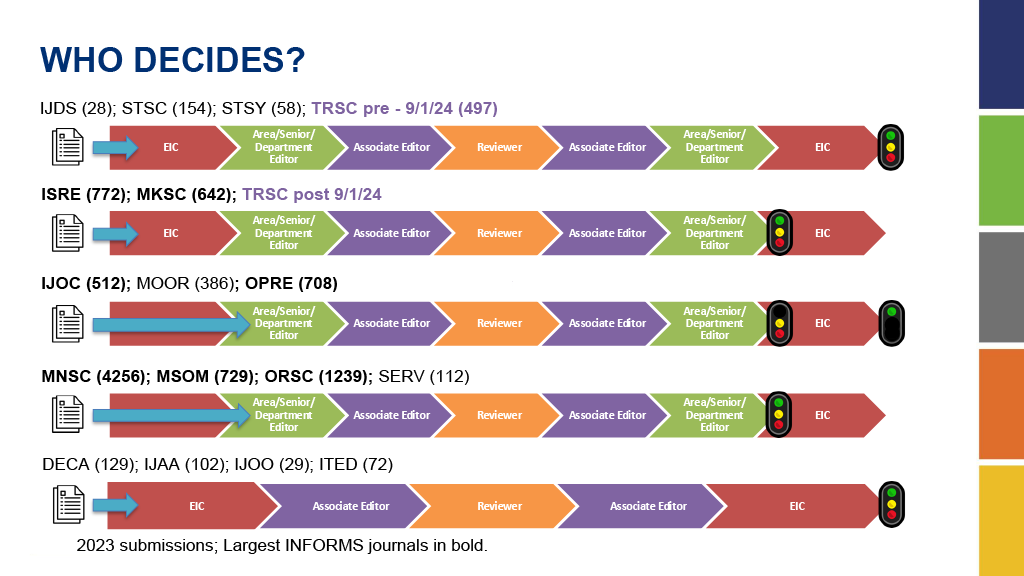
In January 2021, Transportation Science moved to an editorial structure with topical areas, each led by Area Editors. For the initial change, the practice of having the Editor-in-Chief (EIC) make all decisions was maintained, with a plan to transition to decisions by Area Editors over time. At over 500 submissions per year, the journal has reached that point. Within the INFORMS suite of publications, all journals with over 500 submissions (with the current exception of Transportation Science) have a process in which Area or Department Editors make final decisions (with some having the EIC make acceptance decisions), see the figure below. Starting on September 1st, Transportation Science will move to a model with decisions made by the Area Editors, who will directly communicate decisions to authors. Submissions will continue to be directed to the EIC, who will assign submissions to areas based on author selection and topical fit. Authors will be notified if their paper is sent to an area other than their initial selection. Appeals will continue to be handled by the EIC.
The new year will bring new changes to Transportation Science. One key recommendation from our triennial journal review was a move from single-anonymous review (where authors do not know names of reviewers, but reviewers know names of authors) to double-anonymous review (where neither authors nor reviewers are identified). Across the INFORMS suite of journals, there has been an increase in journals moving to double-anonymous review. The Transportation Science editorial board approved a move to soft double-anonymous review, beginning on January 1, 2024. Papers currently under review will be grand-parented (as well as all submissions for the Special Issue on Machine Learning Methods for Urban Passenger Mobility and ISTTT which have deadlines in 2024).
What is soft double-anonymous? In a soft double-anonymous review process, authors’ names are omitted from the submission, but authors may still post their work online. Our rationale for this choice is to acknowledge potential bias that exists with single-anonymous reviewing, while not overly burden authors and journal administrators in the process.
Decision Analysis was the most recent INFORMS journal to switch to double-anonymous and EIC Vicki Bier kindly shared her analysis. They considered three options: single-anonymous review, soft double-anonymous review, and hard double-anonymous review, on the basis of Quality (of submissions in number and degree, and of accepted articles); Fairness (of evaluation); Perception (of fairness of review process and accessibility of journal – which can in turn affect reputation and quality); Cost (of administering). Their analysis found a significant difference in perception of fairness for double-anonymous and a benefit in cost of choosing soft double-anonymous over hard double-anonymous, which is in line with our views at Transportation Science. We acknowledge that moving to a double-anonymous process does not remove all bias from the review process; we recognize that it can often be easy to determine a paper’s authors. Therefore, we will continue to actively pursue new initiatives that can substantively address bias.
Within the INFORMS publication suite, we have also been asked to consider adopting structured abstracts for submissions, as is currently done in Manufacturing & Service Operations Management. This blog by Chris Tang explains the benefits of structured abstracts as a means to make research more accessible to the general public. At Transportation Science, we agree that such structure can improve the accessibility of abstracts. Therefore, we have developed a recommended, but not required, structured abstract for TS submissions.
Problem definition
Methodology/results
Implications
We encourage authors to consider using these categories in their submissions.