Innovative Collaboration Between Industry and Academics: Meeting Industry’s Future Talent Requirements
Abstract
The Haslam College of Business at the University of Tennessee, Knoxville received the 2018 UPS George D. Smith Prize for our master of science in business analytics (MSBA) program, acknowledging our collaboration with industry in preparing our students to be effective practitioners of operations research/management science and analytics. In this paper, we share our experience in creating and maintaining the program. We created a new curriculum that combines content from statistics and management science. Key aspects of the program are its focus on real-world problems and its continuing interaction with industry clients. Students develop technical skills and business subject matter expertise together with the communication, teamwork, and leadership skills needed to impact decision making in an organizational environment. With ongoing influence from industry partners, the curriculum evolves to stay at the forefront of the rapidly changing field of analytics.
The INFORMS community leads the world in the development of tools for better decision making. The Smith Prize reminds us of the vital importance of the practical implementation of those tools. The values that this award represents have always been highly relevant but are even more so in the current era. These values are central to growth and competitiveness in the economic world order of today (Thiel and Masters 2014, Henke et al. 2016, The Economist 2017, Lee 2018). The Haslam College of Business at the University of Tennessee, Knoxville feels especially honored to be the 2018 recipient of the Smith Prize for our Master of Science in Business Analytics (MSBA) program.
In fall 2010, the business analytics and statistics faculty of the Haslam College of Business at the University of Tennessee launched its master’s program in business analytics, one of the first such programs housed in a college of business (Gorman and Klimberg 2014).
Our philosophy in creating the program can best be summarized by a quote from one of our MBA alums, Dave Clark, senior vice president of worldwide operations and customer service at Amazon.com (University of Tennessee 2010):
People who can do high level math are practically a commodity. People who can figure out which problem is the right one to solve and then apply high-level math are both expensive and elusive. Those who can communicate effectively the answer in such a way managers can understand, priceless.
This philosophy guides our admissions decisions, our curriculum development, and our engagement with industry. We cultivate in our students not only analytic and technical skills, but also an understanding of business and the soft skills of communications, teamwork, and leadership. Our students experience a relevant classroom curriculum, a capstone course providing in-depth industry experience, and extensive interaction with our industry partners.
Our MSBA program graduates approximately 35 MSBA students per class. In addition, we graduate between 5 and 10 students annually who earn the MSBA–MBA dual degree. To date, our MSBA students have been 100% employed within six months of graduation. Our graduates have been offered jobs in over 120 companies, ranging in size from that of Apple and Amazon to small start-up companies.
The program has roots in our management science and statistics programs. These programs have a long history of innovation, industry relevance, and collaboration with industry partners.
History of the Program
The University of Tennessee College of Business launched its statistics undergraduate program in 1942. It soon added its graduate programs, mostly centered on industrial statistics. Separately, in 1965, the college launched MS and PhD programs in management science. In 2005, the statistics and management science programs officially merged into a single department. This somewhat unusual, but fortunate, circumstance of having a statistics program and a management science program in a single department, housed in a college of business, played a critical role in the eventual creation of our MSBA program.
We leveraged our experience and industry connections to create the MSBA focused on industry relevance. We started from scratch in creating this program, discontinuing both our traditional master of science programs in statistics and management science (Noon and Gilbert 2015; Bowers and Gilbert 2017).
The outcome of our efforts is a program designed to train students to be great analytics practitioners who add value through organizational impact. We accomplish this through a unique combination of (1) a relevant curriculum, (2) direct links with industry, and (3) an extraordinary capstone experience.
Relevant Curriculum
The Haslam MSBA is a three-semester program that begins each fall. It requires a summer analytics internship with graduation following the second fall semester of study. The program comprises 38 required semester hours. All students must take a prescribed set of 26 hours of core courses during their first two semesters. In their final semester, students enroll in a capstone course and nine hours of electives, which allow them to “specialize” in supply chain analytics, marketing and consumer analytics, data science, or statistical modeling, or become an analytics generalist.
We designed our curriculum to challenge our students with real-world analytics problems in not only their final capstone project experience but also throughout their coursework. They understand how to start with an ill-defined problem, work with messy data, determine an appropriate methodology to transform data into actionable insight, and, most importantly, explain their recommendations in terms that any manager can understand. This learning process starts in their first semester of study—in the classroom—where we challenge them with several custom projects taken from hard, complex real-world problems using real-world data.
For example, in the first semester of the program, in our decision optimization class, an industry expert in sports scheduling delivers a class lecture on integer programming approaches to sports scheduling and presents an anonymized version of a real-world sports-scheduling problem as the third and final project in the course. Students must ask the right questions to gather the necessary information in order to understand and structure the problem. Course content then guides them through the problem statement, model formulation, model prototyping, testing, and delivery phases of the project. The project culminates with formal team presentations to our corporate partner, posing aggregately as the client from the sponsoring sports organization, league coaches, television network representatives, and business partners.
The students learn firsthand that the value does not lie simply in the solution of a math problem in the form of thousands of 0s and 1s. They learn that they must focus on the business aspects of the challenge and show the client their schedule. They must sell the client on their schedule by visually highlighting its advantages with respect to team travel, television schedule, and fairness. They also learn to respond to very difficult, nebulous questions posed from a real-world business perspective.
The sports-scheduling problem is not a textbook problem with a straightforward path to a feasible solution. It is a messy, hard problem complicated by a number of client-driven fuzzy issues encountered in the sports world. Equipping the students in their first semester with the skills necessary to solve such a problem requires a relevant curriculum that includes innovative analytics and technical content accompanied by a fundamental understanding of business and soft skills (Groer 2017).
Business Fundamentals
Because the Haslam MSBA program is housed in a college of business, students who enter the program with no business background may enroll in MBA courses to learn the fundamentals of business. This provides our students with the opportunity to gain experience working together on interdisciplinary teams with MBA students, concentrating in marketing, finance, and supply chain management, and simulating a real-world environment early on in the program. This basic and practical understanding of business, the environment where analytics is largely applied, is critical to the success of our graduates.
More specifically, students who have no business background are asked to enroll in the half-semester MBA operations management elective in their first semester, and may elect to enroll in managerial accounting, also a half-semester course. In their second semester, those interested in supply chain analytics have the opportunity to enroll in two half-semester MBA first-year core supply chain courses. Students who opt to enroll in these additional MBA electives in their first year of study often carry a semester course load of 14 credit hours, and rarely up to 16.5 credit hours, which can be very demanding. In their final semester of study, students interested in supply chain or consumer analytics may also take second-year MBA elective courses in either area.
Soft Skills Training
Because of the value our industry partners place on business soft skills training in the hiring process, the Haslam MSBA program emphasizes soft skills development as part of our formal curriculum. It starts with a ropes-course exercise that teaches creative thinking, cooperation, communication, trust, and teamwork. Then, during the first semester, our students enroll in business skills development, a course dedicated to developing soft skills, such as oral and written communication, the art of persuasion, storytelling, knowing one’s audience, group communication, interpersonal interaction, networking, interviewing, and career planning. These skills are rehearsed and reinforced with hands-on activities, such as mock interviews, elevator speeches, and a mock career fair and business dinner.
Students then practice these skills continuously throughout the program in hackathons, in our annual case competition, at our business analytics forum, and during their summer internships. In virtually every MSBA course in the program, students work in teams to complete class projects that culminate in an oral presentation and/or a written technical report. Some courses require two or three such projects. Then, to further the development of the students’ soft skills, the capstone course is accompanied by two instructional modules, a high-performing teams program and a project manager workshop specific to the capstone environment.
Analytics and Technical Content
The required core curriculum ensures that all students build a strong analytics and technical foundation. The analytics core curriculum includes training in basic statistical methods, visualization, regression, time series, data mining and machine learning, and operations research/decision sciences, as well as elective coursework in discrete-event simulation.
Technical training starts during the summer prior to entering the MSBA program. Students must earn a certificate in R by successfully completing an online R course or pass a custom R exam created and administered by an MSBA faculty member. This basic set of coding skills is strengthened with technical content in R, Python, VBA, database management, SAS, and big data technologies (Figure 1). By design, all students complete 24.5 hours of analytics and technical courses during their first year of study, so they are prepared for the required summer internship and ready to make an impact.
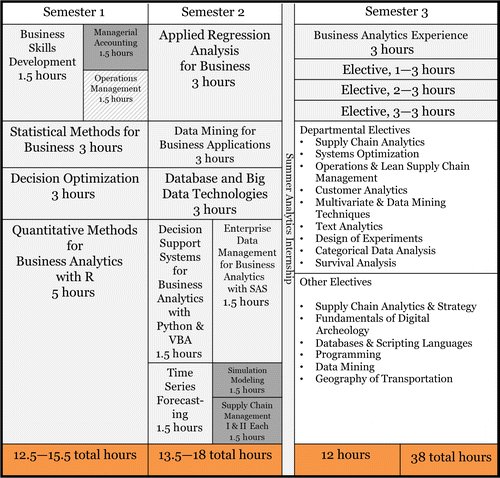
Note. Required courses are noted in light gray, electives are noted in dark gray, and an elective course taken by all nonbusiness majors is noted by light gray hash lines.
An Agile Curriculum
Our ability to graduate successful analytics practitioners with cutting-edge technical and analytics skill sets hinges on the agility of our curriculum. For example, in the past five years, deep learning has gone from being an academic niche to having mainstream relevance. In 2016, in response to our annual analytics benchmarking study and direct feedback from recruiters, forum members, and corporate partners, we added Python, a popular deep-learning platform, to the list of languages that our students must master. In addition, we increased the machine learning content of our data mining classes. In spring 2019, we added a half-semester course devoted to deep learning. Our business analytics faculty teach this course and deliver it in the context of business applications.
The Dual-Degree Offering: The MSBA–MBA
The dual MSBA–MBA includes four semesters of coursework plus a summer analytics internship. Thus, with one extra semester of coursework, the dual-degree students graduate with two master’s level degrees after 22 months. In their first year, the dual-degree students enroll in the MSBA core courses and take MBA courses as electives. During their second year of study, they enroll in the MSBA capstone course and the remainder of the MBA core curriculum and also take MSBA courses as electives.
The Capstone Experience
Purpose
The capstone creates a hands-on learning environment in which we require the students to develop an implementable data-driven solution to a difficult, real-world problem in real time. By design, the students engage in the required capstone course during their last semester of study.
Faculty Mentoring
We assign a faculty mentor to each capstone team. This counts as part of the faculty member’s teaching load; mentoring two teams is equivalent to teaching one course.
The role of the faculty mentor is similar to that of a senior partner in a consulting firm. The mentor meets with the team once each week to remain up to date on the progression of the project and attends weekly client meetings as an observer.
The faculty mentor does not drive the project but may ask probing and thought-provoking business questions in the background in the spirit of the client partner, a critical role served in a fashion similar to faculty in the University of Dayton’s operations management capstone project course (Gorman 2010). The students are responsible for managing all aspects of the project and for choosing the appropriate analytic tool(s) to solve the problem. The faculty mentor is available in a limited advisory role on technical issues and may help facilitate student soft skill development from time to time.
Planning
Planning for the capstone starts approximately 9 to 10 months in advance. Our capstone coordinator, a staff member, starts by interviewing potential client organizations to determine interest, possible project topics, availability of data, and internal organizational support for the project. Once the staff member compiles a list of possible companies and topics, the capstone coordinator and a full-time faculty member vet each project based on the analytics skill sets required, breadth and depth of knowledge needed, and time required.
The faculty and capstone coordinators then jointly engage in detailed conversation with the analytics point of contact within each client organization to explore the business case and the project details, and to establish the format and scope of available data to narrow the list to the most appropriate set of projects. For the 2018 fall semester, the capstone course included 10 projects.
Then, a formal statement of work (SOW) and nondisclosure agreement are created and agreed upon for each project. The SOW serves as an informal agreement between the MSBA program and the corporate partner. A typical SOW contains a brief background and summary of the project, start and end dates, MSBA and client contact information, objectives, data and documentation details, project milestones, and milestone dates, along with a schedule of deliverables, reporting practices, and a comprehensive tentative timeline.
Team Structure
Students work in capstone teams of four to five MSBA and MSBA–MBA dual students. Faculty carefully select student teams based on a number of factors. The first is student interest in the capstone topic. We send a short description of each capstone to all students and ask that they provide feedback on project preferences. We then consider student preferences, skill sets, and enrollments in specialty elective coursework to form teams to best meet each project’s requirements.
Faculty members assign the job of project manager to one student on each team. This role parallels that of a project manager in any corporate environment. The project manager is the project leader responsible for keeping the project on track, team communication, and scheduling, and also serves as the primary point of contact with the client. These students participate in a special project manager training session.
Execution
All students receive specialized capstone soft skills training as part of the capstone course curriculum. Beginning with the 2018 fall semester, the delivery mode for a portion of this soft skills training shifted to a workshop format delivered prior to the start of the capstone semester. A management department faculty member who specializes in executive leadership delivers a day-and-a-half-long workshop entitled High-Performing Teams.
The high-performing teams program targets both individual and team soft skills development. It includes an individual leadership assessment and delivers a set of skills necessary to navigate the soft side of project management. Sessions target high-performing team behaviors, feedback for improved performance, conflict management, and brainstorming for smart choices. The instructors also provide project management coaching and facilitate one meeting for each team. Based on their observations of individual and team interaction, they are available for one-on-one student coaching on request throughout the semester to help the students continue to improve their soft skills.
In addition, one of our alums provides project manager training to the project managers. This training is specific to the capstone experience. It includes strategies for managing the client, setting expectations, managing the team, dealing with an underperforming team member, effectively utilizing the faculty mentor, meeting deadlines, communicating, successfully managing a meeting, and making the best use of the client’s time.
Following this training, the project commences with a client site visit. Students and the faculty mentor meet with the client face-to-face to gain a firsthand understanding of the problem as well as the data provided. For process-oriented projects, students often take a tour of the service facility or manufacturing floor to gain context, perspective, and a practical understanding of the problem. Students come prepared and must ask the right questions to then solve the right problem. The student team owns all the communication and ongoing interaction with the client starting with this initial visit, during which the project manager leads a discussion to formulate and agree upon the rules of engagement governing future client interactions, deliverables to date, and the schedule for weekly client meetings.
The Classroom Team Experience
Following the site visits, the capstone students all come together for a class meeting held approximately every other week during the semester. One faculty instructor coordinates the activities for each of these class meetings and serves as a mentor to the whole group. After several faculty members attended the INFORMS workshop Essential Practice Skills for High-Impact Analytics Projects (INFORMS 2019), we imbedded many of the concepts from that course into the classroom curriculum. As the teams move through the semester, they complete assignments that support the natural progression of their analytics project through the phases that are consistent with the INFORMS course content.
During class, each team delivers a two-minute report using one or two slides that address their progression through six phases of the project. For example, the student briefings focus on (1) preparation for the initial site visit (project background, summary, and client research); (2) the problem definition; (3) data acquisition, cleaning, and formatting; (4) the project management timeline; (5) development of implementable recommendations; and (6) development of an effective presentation.
The faculty instructor leads a discussion on the week's assignment to facilitate student learning from all projects. The capstone faculty instructor also dedicates class time to technical writing instruction. The formal technical report is created in small, manageable sections as deliverables spaced across the semester that coincide with the writing classes.
Each team also delivers two milestone presentations of five minutes each during class to highlight the modeling and analysis phase and provide an overall summary of project status to date. These presentations describe the analytic methodology, testing, and prototyping along with any major issues and accomplishments. They are spaced evenly throughout the semester. All faculty mentors attend these two class meetings to offer advice, encouragement, and valuable feedback.
At the halfway point, students deliver a formal milestone presentation during one of the weekly scheduled client meetings to summarize the status of the project for the corporate sponsor. See Figure 2 for a summary of the capstone structure and flow.
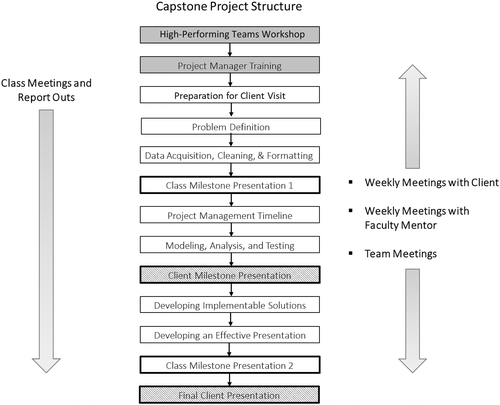
Note. Training sessions that occur prior to the start of the capstone semester are noted in gray and presentations to the client are noted by light gray hash lines.
The Final Deliverable
The capstone project concludes with a written report and a formal oral team presentation, hosted on campus, for executives and director-level partners from the client companies. The client partners ask hard, probing, relevant business and technical questions. They then provide general feedback on the project work and presentation as well as the capstone process itself.
Impact
Dr. Ben Martin, chief officer of advanced analytics and global planning of HanesBrands, who has sponsored multiple capstone projects, summarizes the practical relevance and organizational impact of the capstone experience: “Every capstone project has resulted in something we can use.” Synopses of some of these projects as well as a special student project completed for the University of Tennessee Provost Office follow.
Project: Improving Student Retention at the University of Tennessee, Knoxville (Curtsinger and Martin 2017, Noon et al. 2018) for the University of Tennessee, Knoxville Provost Office (Faculty Mentors, C. Noon and R. Mee)
For any university, the percentage of new first-year students who return for their sophomore year is becoming increasingly important. This metric, called first-year retention, plays a significant role in national rankings, and in the face of growing competition for student enrollments, improved retention offers a way to maintain student counts and tuition revenue. Despite various efforts, the first-year retention rate for the University of Tennessee, Knoxville had been around 85% for the last decade. When compared with peer institutions, however, there was reason to believe it could be much higher.
In May 2017, the University of Tennessee, Knoxville’s provost office initiated a project to use analytics to improve first-year retention. Two incoming MSBA students, both with business analytics undergraduate degrees from the Haslam College of Business, were hired for the summer. For fall 2017 and spring 2018, the Haslam College of Business and the provost office shared the cost of funding an MSBA graduate research assistant to continue the analysis. The work of the MSBA graduate students helped to establish a data-driven case for organizational change. The students presented their analyses to campus deans, directors, and department heads to gain buy-in from academic leadership, which laid the groundwork for the retention effort.
Throughout the 12-month period that began in May 2017, the administrators put a number of recommendations developed by our students into practice. For fall 2018, the first-to-second year retention was 1.2 percentage points higher than the previous year.
The first set of analyses confirmed that the probability of a student not being retained correlated highly with the number of freshman credit hours for which the student registered but did not earn. This was not a totally surprising result, given that a low first-year grade point average (GPA) can affect a student’s eligibility for the HOPE (Helping Outstanding Pupils Educationally) Scholarship and thereby make college financially out of reach.
An interesting finding, however, was that students who did poorly in the fall semester and then satisfactorily in the spring semester were more likely to return for their sophomore year compared with students whose performance was satisfactory in the fall and poor in the spring. This reinforced the notion that early identification and intervention with at-risk students could be a major driver of increased retention. The classic method involved taking an action only after a student’s GPA fell below 2.0; this was clearly too late.
The students’ analysis revealed several other important insights:
Six freshman courses generated a large majority of the credit hours not earned.
The probability of achieving a satisfactory first-year GPA for a student with a given incoming academic profile (i.e., GPA, standardized test scores) varied considerably by college (e.g., business, arts and science, engineering).
Students with lower incoming academic profiles performed disproportionately poorly in large-section classes compared with smaller-section classes.
The students’ recommendations for early detection and intervention were implemented during the fall 2017 semester in the form of midterm grade and attendance reporting, with special attention directed toward the six freshman courses we mention above. The department heads for the courses with high numbers of credit hours not earned were engaged to identify opportunities for early intervention and potential curricular change.
As a result of these initial efforts, the number of first-semester students on academic probation at the end of the fall semester dropped from 10.2% in 2016 to 8.4% in 2017. With that, the fall 2017 to spring 2018 retention rate was up 1 percentage point (from 95% to 96%). In spring 2018, a number of insights were shared with campus advising personnel to help direct at-risk students into academic experiences that would improve their likelihood of success. A 1.2% improvement in retention for fall 2018 was confirmation of the success of the new program, based on recommendations created by our students.
Project: Machine Complexity Analysis (Byrd et al. 2016) for Caterpillar Inc. (Faculty Mentor, P. Letizia)
The goal of the Caterpillar capstone project was to develop a systematic method to determine the complexity of part usage among Caterpillar machines. During the machine-design process, Caterpillar works to balance the trade-off between machine simplicity from a parts perspective and the design of highly complex, somewhat unique machine configurations.
To provide the tools necessary for Caterpillar to better understand the part complexities of its machines and their impact on inventory and production, the project team developed a visual dashboard using Excel, R, and Tableau to allow each product group to select primary offerings based on the advanced analytic metrics initially designed and prototyped by the capstone team. These new capabilities are enabling Caterpillar to reduce finished good inventory levels, improve manufacturing efficiencies, and increase machine sales.
To understand part interrelatedness among machines as well as machine part complexity, the students developed four unique metrics using descriptive statistics. The first measure, which they termed Coverage, describes how rare or common specific parts are for a given machine model type. The second, Simplicity, determines which machines are standard and composed largely of common parts and, conversely, which are highly customized using rare parts. Machines could then be classified as simple, average, or complex based on the Simplicity metric. The third, Complementarity, determines which sets of parts were frequently used together and, similarly, which sets of parts were rarely used together in the design and manufacture of a machine. The fourth, Similarity, determines the extent of similarity among machines of the same model type with respect to parts.
Project: Customer Retention (Caldwell et al. 2015) for Coca-Cola Refreshments (Faculty Mentor, R. Mee)
A University of Tennessee, Knoxville capstone team worked with Coca-Cola Refreshments (CCR) to find ways to improve retention of the business customers that use CCR as a beverage provider. The students developed a model based on customer service tickets to determine why customers churn and to predict when a customer will churn. For example, the study found that a customer with a service issue regarding pricing is 17 times more likely to churn compared with customers with other types of issues. Their findings prompted a major overhaul of Coca-Cola’s pricing model.
Project: Stock-Keeping Unit (SKU)-Level Service Issue Prediction (Alexiades et al. 2014) for HanesBrands (Faculty Mentor, M. Ballings)
HanesBrands, a manufacturer and marketer of basic apparel, sought to improve its supply chain performance through a focus on customer service. For one particular product group, our students developed an analytic model based on the environmental conditions of the supply chain itself to predict stockouts in time for corrective action. The implementation of this predictive model has increased service levels, increased revenues, and lowered air freight costs. The model was so successful that HanesBrands has scaled it for use across its entire business.
Project: Digital Advertising and Associated Sales Lift (Crumpton et al. 2014) for Proctor & Gamble (Faculty Mentor, W. Zhou)
A capstone team helped Proctor & Gamble create more effective advertising messaging and make better digital advertising purchases. The team discovered that certain brands perform better on certain platforms, as measured by level of traffic and duration of effect, over other brands. Campaigns with particular thematic messaging and/or endorsements performed well on certain platforms, but not on all. The team also determined the correlation between social media (e.g., Facebook, Twitter), performance metrics (e.g., views, engagements), and sales lift for a selection of brands.
The team performed association-rule text mining to identify which language features were associated with higher levels of engagement.
The Business Analytics Forum
The business analytics forum helps us keep our curriculum current, gives our faculty exposure to a range of real-world applications, and provides our students a rich industry-focused extracurricular experience.
This forum meets twice a year and brings practitioners from member companies together for several days of presentations, workgroups, analytics competitions, company field trips, recruiting activities, and social gatherings. Each forum meeting is organized around a particular theme, such as data visualization, digital governance, customer loyalty, the Internet of Things, analytics maturity within organizations, or artificial intelligence. Some notable speakers have included well-known authors (such as Tom Davenport and Steven Few) and industry thought leaders (such as Dell EMC’s chief technology officer Bill Schmarzo and Teradata’s Bill Franks).
The practitioners attending the forum learn about best practices and cutting-edge faculty research and have an opportunity to recruit analytics talent. Our faculty learns about the state of the practice and have a chance to connect with companies for research-worthy challenges and data sets. Our students get validation for what they are learning in the classroom, placement opportunities for internships and full-time employment, and a chance to demonstrate their skills.
The forums include a student competition involving targeted analysis or a broad analytics challenge. Examples of recent forum competitions are given below.
Predicting the Census Return Rate
This competition was held during the data visualization-themed forum with Stephen Few as the keynote speaker. Census workers must be deployed to interview households that do not return their census forms by mail. A model for predicting the mail return rate by area based on demographics is very helpful for resource planning. Students were provided with a 2010 census data set and were challenged to develop a model that would consider the changing demographics from 2010 to 2020. Teams of three or four students were given four hours to perform an analysis and produce a report and presentation that described their model, its results, and recommendations for future refinement.
Estimating Repurchase Customers
Compete Every Day is an online apparel retailer with the objective of helping individuals perform at the top of their abilities through inspirational garment messaging. Being a relatively new company in a niche market provides a challenge in forecasting customer repurchases and revenue. Several data sets containing information about customers, purchase history, and product characteristics were provided, and teams were tasked with creating presentations that summarized their analyses and recommendations around predicting revenue and customer repurchases.
A subset of the forum member-company executives also serve on our department’s advisory board and, in doing so, greatly influence our programs. The board members provide a firsthand understanding of the current needs of the users of analytics technologies and the managers of the analytics talent we produce.
Annual Spring Case Competition
Each spring, as the culminating event of the first year of study, the Haslam MSBA program partners with HanesBrands to provide a case competition for all students. HanesBrands provides a case write-up and supporting data describing a business problem currently challenging its analytics team.
For the competition, students choose their own teams, comprising approximately five students each. After the case and data are released to the students, the teams have 48 hours to clean and format the data, determine the analytics methodology best suited to address the given problem, perform the analysis, and prepare a formal presentation describing their recommendations. The students then present their recommendations to several members of the HanesBrands analytics team, who then challenge the students with difficult questions and delve deeply into both the business and technical aspects of their models and recommendations. Then, following the question and answer period, the team from HanesBrands also provides feedback for the students on their presentations and business soft skills. The entire experience has proven invaluable to our students as they then depart for their summer internships. They gain confidence not only in their analytic skills but also in their business soft skills. The students begin their summer internships having solved a real-world business problem in real time.
For example, for the spring 2016 HanesBrands case competition, student teams analyzed eight gigabytes of point-of-sale and inventory data from large retailers and HanesBrands outlet stores. The students were tasked with identifying differences in purchasing behaviors and selling profiles by geographic region and/or retail versus outlet sales. The teams were also asked to identify an ideal mix of products for sale in stores by geographic region. The students identified both high- and low-revenue-generating store locations, made recommendations for the elimination of poorly performing SKUs, and identified SKUs that frequently stocked out. The results affirmed some of HanesBrands’ hypotheses and provided new insights.
The Faculty’s Role in Selling a New Program
Launching a successful program is not a “build it and they will come” proposition, even in an area with as much current buzz and industry demand as business analytics. The faculty must clearly understand and steadfastly communicate the program’s value to recruits, students, industry partners, university administrators, alumni, donors, and fellow faculty members.
Although the recruiting and placement services within the university are true partners in this effort, it requires a very active engagement by the program faculty. In the early years of our program, the faculty was very actively involved in recruiting students, placing them in summer internships, and placing them in jobs when they graduated. For example, for the first two years, we used the popularity of the book Moneyball: The Art of Winning an Unfair Game (Lewis 2003) to create awareness of our program among undergraduate students. We invited the top University of Tennessee, Knoxville undergrads to attend a reception and panel discussion on sports recruiting. The panel consisted of the University of Tennessee’s head softball coach, the former head football coach, and assistant baseball and basketball coaches. This event attracted many students and gave the faculty an opportunity to tell them about our new program and follow up with more information.
As the success and the visibility of the program has grown, we have been able to transfer a larger share of this work to the support services of the college and the university. Now that we have developed greater industry awareness and have a 100% placement rate, these activities require less faculty time. This, in turn, allows us to shift faculty resources to incorporating cutting-edge analytics into our curriculum to ensure a successful evolution of the program.
Conclusion
The Smith Prize improves the overall quality of analytics education by encouraging the creators of innovative programs to share their approaches and best practices. The foundation of our success was having the specific goal of developing students with a rare but highly valuable combination of skills: technical expertise, business proficiency, and soft skills. Tactically, this translated into providing our students with a relevant curriculum, a meaningful capstone experience, and continuous interaction with industry.
The development and evolution of the Haslam MSBA program is attributed to the faculty and staff in the Business Analytics and Statistics Department. A special thank you goes to Dr. Robert Mee and Katie Williams for their support in the Smith Prize Application process and to our alumni, Vasha Bhatari and Bryan Noreen for their participation in the Smith Prize presentation at the spring 2018 INFORMS Business Analytics Conference.
References
- (2014) SKU-level service issue prediction for men’s underwear. Capstone Report, University of Tennessee, Knoxville.Google Scholar
- (2017) University of Tennessee’s MSBA program designed to fill analytics talent gap in the corporate world. OR/MS Today 44(6):16–18.Google Scholar
- (2016) University of Tennessee, Knoxville MSBA Capstone Report for Caterpillar, Inc. Capstone Report, University of Tennessee, Knoxville.Google Scholar
- (2015) Coca-Cola Refreshments. Fall 2015 capstone final report, University of Tennessee, Knoxville.Google Scholar
- (2014) Correlating sales and social media activity at P&G. Capstone Report, University of Tennessee, Knoxville.Google Scholar
- (2017) Improving first year retention. Presentation, August 11, University of Tennessee, Knoxville.Google Scholar
Economist, The (2017) Fuel of the future: Data are giving rise to a new economy (May 6), 22–36.Google Scholar- (2010) The University of Dayton operations management capstone course: Undergraduate student field consulting applies theory to practice. Interfaces 40(6):432–443.Link, Google Scholar
- (2014) Benchmarking academic programs in business analytics. Interfaces 44(3):329–341.Link, Google Scholar
- (2017) Why Haslam MSBA graduates get jobs: We teach students to be data scientists and communicators. Accessed August 14, 2019, https://haslam.utk.edu/testimonials/kpmg.Google Scholar
- (2016) The age of analytics: Competing in a data-driven world. Report, McKinsey & Company, New York.Google Scholar
INFORMS (2019) Essential practice skills for high-impact analytics projects. Accessed August 14, 2019, https://www.informs.org/Professional-Development/Continuing-Education/Essential-Practice-Skills-for-High-Impact-Analytics-Projects.Google Scholar- (2018) AI Superpowers: China, Silicon Valley and the New World Order (Houghton Mifflin, Boston).Google Scholar
- (2003) Moneyball: The Art of Winning an Unfair Game (W. W. Norton & Company, New York).Google Scholar
- (2015) How to build a college business analytics program: The UT experience. OR/MS Today 42(1):34–38.Google Scholar
- (2018) Business analytics and statistics in action. Presentation, April 6, University of Tennessee, Knoxville.Google Scholar
- (2014) Zero to One: Notes on Startups and How to Build the Future (Crown Business, New York).Google Scholar
University of Tennessee (2010) Business analytics undergraduate educational options. Brochure, Haslam College of Business, University of Tennessee, Knoxville.Google Scholar
Melissa R. Bowers is an associate professor in the Haslam College of Business, where she is the director of the MSBA program. Her research interests include scheduling, supply chain, and discrete optimization models. Dr. Bowers has worked with organizations such as Milliken, ALCOA, Air New Zealand, Embraer, Hanesbrands Inc., the U.S. Air Force, and many others. She has published in the MIT Sloan Management Review, INFORMS Journal on Applied Analytics, Decision Sciences, and numerous other academic journals.
Kenneth Gilbert is professor emeritus in the Business Analytics Program at the Haslam College of Business at the University of Tennessee (UT). He is currently Special Assistant in the UT Office of Research, Outreach and Economic Development. In that role, he works with the UT Research Park at Cherokee Farm to provide companies access to technical expertise, executive education, and the talent pipeline of the Haslam Business Analytics Programs. He teaches in the UT Business Analytics Programs and in Executive Education Programs at UT.
Charles Noon is the former head of UT’s Department of Business Analytics & Statistics and is currently a clinical professor of Graduate and Executive Education in the Haslam College of Business. His interests include healthcare operations and applied analytics. Dr. Noon has taught and applied improvement methods and optimization models to healthcare organizations worldwide. He has published in a variety of journals and is coauthor of a leading book on emergency department operational improvement.