


Minimum Earnings Regulation and the Stability of Marketplaces
Abstract
Problem definition: New York City and Seattle recently enacted minimum earnings regulations for ride-hailing providers that are based on their utilization rates. The regulations are intended to deliver minimum earnings while preserving the flexibility of the independent contractor model of work. Academic/practical relevance: This kind of regulation has the potential to impact marketplace stability, which we define as the ability of platforms to keep wages bounded while maintaining the current flexible (free-entry) work model. Methodology: We build a theoretical model to study the marketplace implications of this kind of regulation and identify precise conditions under which a utilization-based minimum earnings rule causes marketplace instability. We then calibrate our model using publicly available data, showing the extent to which the law can (or cannot) increase earnings while preserving both worker flexibility and marketplace stability. Results: For reasonable ranges of supply and demand elasticity, the law’s ability to increase earnings while maintaining the free-entry work model is quite limited, and even when earnings increases are achievable, they cause significant increases in driver idleness. Managerial implications: Given the law’s potential to cause instability, affected ride-hailing companies may need to respond to the law by reducing driver flexibility to limit supply.
Supplemental Material: The online appendix is available at https://doi.org/10.1287/msom.2022.1150.
1. Introduction
Over the last decade, we have witnessed the rise of sharing economy platforms that match consumers to service providers. Ride-hailing providers, such as Lyft and Uber, have been particularly prominent members of this new class of platform companies, significantly altering the transportation landscape in cities around the globe. The rise of ride hailing has been a boon to consumers, but the impact on drivers is more ambiguous. Drivers on ride-hailing platforms in the United States typically work as independent contractors, which affords them a great deal of flexibility, with drivers choosing when and where they want to work. Econometric evidence in the literature suggests that the flexibility afforded by platformed-mediated work is highly valuable for drivers, as noted by Chen et al. (2019, p. 2776): “Our abstraction of the Uber-style arrangement in which drivers can pick whatever hour, day, and week they choose to work generates a large surplus of about 40 percent of their total pay. Constraints on flexibility reduce surplus a great deal.” At the same time, some drivers report dissatisfaction with their earnings. This state of affairs has led several localities to introduce new labor protections for sharing economy workers, including the New York City Taxi and Limousine Commission (TLC) decision to impose a minimum rate card (payment per minute and per mile driven) on the largest ride-hailing providers in the city.
This paper examines the marketplace implications of introducing this kind of legislation. In particular, we study the consequences of the utilization-based minimum earnings regulation implemented in New York City’s ride-hailing market (New York City Taxi and Limousine Commission 2018). The formula introduced to determine the minimum payment in New York City to a driver for a standard ride given the distance and time traveled was the following:
This formula is based on a proposal by Parrott and Reich (2018). The rationale behind this formula is as follows: (1) $0.287 per minute translates to $17.22 per hour, which corresponds to New York City’s current minimum wage of $15 plus $2.22 to account for the lack of benefits, such as paid time off; (2) $0.631 per mile is the TLC’s estimate of vehicle costs (our analysis focuses on time costs and not on vehicle costs, and vehicle costs only appear in our work when we calibrate our model in Section 5); and (3) crucially, the division by the utilization rate attempts to compensate drivers for idle time. For example, if the utilization rate is 50%, drivers must be paid at least $34.44 per hour while transporting customers to ensure their hourly earnings are at least $17.22. The utilization rate is a number measured over six-month periods, and the utilization measured over a given six-month period determines the minimum payment in the next six-month period. New York City is not unique in considering legislation of this kind. In 2020, the Seattle City Council voted to enact a similar law, with an earnings target of $16.69, which is in effect in Seattle as of 2021.
Our focus is the potential impact of such regulations on marketplace stability, where stability is defined by a pair of weak conditions; wages must remain bounded and profits must remain nonnegative for almost all time periods. The reason that stability is not a given is that ride-hailing platforms, in their current form, do not have the same control over labor as traditional businesses. A traditional business can respond to an increase in the minimum wage by choosing to reduce the size of its workforce, but ride-hailing platforms operate marketplaces where drivers are allowed to enter and exit at will. Maintaining this flexibility is of great importance to drivers (Chen et al. 2019) and a primary reason for the TLC’s indirect, utilization-based regulatory scheme.
Figure 1 shows how instability could arise. Let us say the initial utilization is relatively low, which forces, via the regulation, the payment to drivers per minute and mile to be relatively high. This high pay attracts new drivers, leading to increased supply. At the same time, this high pay also forces the platform to raise prices in order to compensate drivers, leading to lower demand. Both increased supply and reduced demand lead to a reduction in utilization, potentially creating a positive feedback loop.

Notes. The regulation uses the utilization to set wages. If the utilization is low, the wages will be high. High wages will increase supply and if there are no subsidies, lead to higher prices and lower demand. In turn, the increased supply and the reduced demand will further lower utilization.
Our main theoretical findings are as follows. In a tight labor market, it is not feasible to raise earnings above the equilibrium wage (the equilibrium wage being the point where the demand and supply curves cross) without losing stability. A “tight” labor market is defined as one where the revenue-maximizing price is below or equal to the equilibrium wage; the market is “loose” otherwise. In a loose labor market, it is feasible to potentially raise earnings via regulation, but the maximum stable increase is limited by the supply that can be funded by the maximum revenue extractable from the market. Our findings are tight; we find precise necessary and sufficient conditions for a marketplace to be stable under a utilization-based minimum earnings rule.
We apply our model to estimate the maximum feasible earnings achievable in New York City’s ride-hailing market. We use data from the academic literature and the proposal of Parrott and Reich (2018) in order to provide a range of estimates for supply and demand elasticities and use these elasticities to calibrate parametric supply and demand models. For a wide range of parameters, our analysis shows that the maximum feasible gain in net earnings (gross earnings minus vehicle costs) is below the TLC regulation’s goal of raising earnings by 21%. For instance, using the central estimates of Cohen et al. (2016) and Hall et al. (2019), which are based on analyses of data from the ride-hailing industry, the maximum feasible gain in net earnings is about 3%. The key reason it is difficult to raise earnings is that the supply of drivers is highly elastic, so an increase in driver payments leads to a significant increase in supply (Hall et al. 2019). Moreover, achieving even the modest 3% increase in earnings produces a significant degradation in other marketplace outcomes. Prices increase by about 64%, reducing demand by 32%. At the same time, supply increases by 9% in response to higher earnings, causing utilization to fall by 38%. We emphasize that these results assume an open marketplace, where drivers face no constraints on their flexibility over whether, when, or where to work for the platform.
Faced with minimum earnings rules, we have seen ride-hailing platforms choose to either exit the market as Juno, a smaller ride-hailing platform in New York City, did (Gladstone 2019) or implement policies that restrict worker access to their platforms, as Lyft and Uber did (Bellon 2019). To analyze this response, we study in Section 6 how a platform might respond to legislation by imposing some form of supply control.
2. Related Literature
There is a long history of research on minimum wage policies, with the most prominent work focusing on the employment effect of minimum wage increases—the classical viewpoint being that minimum wage laws cause unemployment, as advocated by Stigler (1946); there is also a significant literature that originates from Card and Krueger (1993) arguing that modest minimum wage increases do not cause unemployment. In contrast, our paper is about a market failure that is quite different from a potential increase in the unemployment rate. If a high minimum wage is introduced in a labor market, firms can adjust by shedding workers and raising prices. Thus, no one would expect a market to fully unravel because of a minimum wage law. Prices might be higher, and fewer workers might be employed; however, such a market would still serve customers with willingness-to-pay above the new price. However, if we introduce an earnings regulation in an open-entry private marketplace, the marketplace does not have all the same margins of adjustment. Prices can still be raised, but an open-entry private marketplace cannot deliberately shed workers without losing its open-entry nature. The question that we study is under what conditions such a marketplace is stable (or can be stabilized) under a minimum earnings regulation.
What happens when one introduces minimum wage regulations into privately-run marketplaces that are part of a wider labor market is a relatively not-well understood problem. Horton (2018) tested the effect of introducing a minimum wage in an online labor platform and found that it drove employers to replace lower-wage/lower-productivity workers with higher-wage/higher-productivity ones. The wages in this experiment were set by the platform and did not involve the use of utilization to set future wages, therefore there was no question of marketplace stability.
Perhaps the most closely related work to ours is Hall et al. (2019), which studies how the ride-hailing marketplace reequilibrates following wage changes. Using data from Uber, they show that fare increases, although leading to drivers making more money per trip, also lead to an increase in driving hours. This increase in supply leads to a reduction in utilization that essentially cancels out the increase in earnings. Hsieh and Moretti (2003) find a similar effect in the real estate market, where brokers typically earned a fixed 6% commission and where higher house prices lead to an increase in labor supply rather than greater earnings per broker. Chen and Sheldon (2015) and Hall et al. (2016) also discuss how some of the earnings from surge pricing are suppressed via an increase in labor supply. Angrist et al. (2017) also find a positive supply elasticity among Uber drivers, contradicting a classic claim by Camerer et al. (1997) that taxi drivers target income levels rather than optimally balance their work and leisure. In recent work, Cachon et al. (2021) consider the problem of whether platforms or drivers should set prices in ride hailing, a question that is related to ours in that it also pertains to the optimal amount of flexibility that platforms should offer drivers.
3. The Model
We consider the problem faced by a ride-hailing platform setting prices and wages over time. Time is discrete, and periods are indexed by . These periods represent the measurement periods used in the regulation (e.g., the six-month period used by the New York City TLC regulation). The platform chooses a price level and a wage level . The price pt corresponds to the price it charges a rider per hour of driving. The wage corresponds to the drivers’ earnings per hour of driving riders. Drivers do not get paid for time they are idle. For simplicity, our model does not incorporate pickup times, so drivers are either idle or driving riders whenever they are on the platform. We also do not model shared rides or mileage cost/pricing, although we account for vehicle costs using estimates from Parrott and Reich (2018) when calibrating the model in Section 5. A platform’s policy can be represented by , where and . The set of feasible policies is denoted by .
The platform faces time-invariant demand and supply curves represented by and . The demand at period t is a function of the price pt, and corresponds to the driving hours demanded if the price is equal to pt. The supply at period t is a function of the expected hourly earnings a driver receives under a per-rider-hour wage wt and the demand . We denote the expected hourly earnings at time t by zt, which is characterized by an equilibrium condition we specify in Equation (3). The hourly wage wt is different from the hourly earnings zt because drivers might be idle (and thus, not receiving wages) for part of the time.
We assume the total quantity of ride hours produced by the ride-hailing platform at period t is
In reality, the quantity of ride hours produced given pt and zt would be less than what is given by Equation (1) because of inefficiencies, such as pickup times and spatiotemporal imbalances between supply and demand, which we ignore in our model. An important object in our model is the period t driver utilization, which corresponds to the fraction of hours that drivers spend ferrying passengers relative to their total working hours during that period: that is,
We can thus specify the drivers’ earnings equilibrium condition for any given period t by
For a given period, we denote the platform’s revenue and cost functions and by
Note that in the preceding equation, we suppress the subscript t to simplify notation. We do the same in other points of the paper where the subscript t is not necessary for comprehension.
The function is not the platform’s realized revenue in period t because it does not account for the supply available at period t. Instead, the function R corresponds to the supply-unconstrained revenue function, which is merely a bound on the true revenue. The platform’s single-period profit function is given by
Our goal is to understand conditions under which a regulated marketplace is stable, where stability is defined as follows.
We say the marketplace is stable if there exists some equilibrium-augmented policy such that the wage sequence is bounded and for all but finitely many .
3.1. Regularity Assumptions
We impose the following assumptions on the model primitives. We assume that the demand function D is strictly decreasing, continuous, and positive everywhere and that the supply function S is strictly increasing, differentiable, and positive everywhere with a possible exception at zero. We also assume that the revenue function R is unimodal, with a unique maximum at , and that the demand and supply functions cross at some value (i.e., ). (It is straightforward to see that the revenue function and the cost function will also coincide at .)
3.2. The Minimum Earnings
The minimum earnings regulation specifies that per-ride-hour wages must satisfy
A marketplace that satisfies Equation (5) is called an M minimum earnings marketplace.
The constant M is the target minimum hourly earnings level. This minimum earnings rule then uses the period t utilization as a proxy for period t + 1 utilization to try to ensure that drivers’ hourly earnings are at least M. By combining Equations (3) and (5), we can observe that
4. Marketplace Stability
Before we begin proving results about marketplace stability, we establish some properties of a function that will play a large role in our analysis: the inverse of the cost function C, which we denote by H. The function H represents the hourly earnings corresponding to a given level of labor expenditure. The proof of the next lemma follows from the definition of the cost function C and the fact that the supply function S is increasing. All proofs are postponed to the online appendix.
Let H be the inverse of the cost function C. Then, H is an increasing and differentiable function over the domain . Furthermore, the function is decreasing.
We now show that for any policy , the corresponding equilibrium-augmented policy in is unique. We also demonstrate that there exists a closed-form expression for determining the equilibrium earnings z given a price p and a wage w. The proof is based on a case by case analysis of Equation (1) for and combined with the use of Equations (2) and (3) to get a closed-form solution for the equilibrium earnings z as a function of w and p.
For any given price p and wage w, there exist unique equilibrium earnings z that satisfy Equation (3). This unique equilibrium earning z is equal to
Furthermore, the function defined in Equation (6) is continuous.
Lemma 2 establishes that searching for a stable policy over all possible equilibrium-augmented policies is equivalent to searching over policies because there exists a unique earnings zt for any given pt and wt. The next lemma further simplifies the problem of looking for a stable policy by establishing that it is sufficient to look for policies of the form . The proof is done by first showing that the stability of any policy results in the stability of the policy , where “” denotes the pairwise minimum. Then, it suffices to consider periods after T0, the first period after which all profits are nonnegative (i.e., for ).
Suppose an M minimum earnings marketplace is stable. Then, there exists a stable policy such that .
We next show that for policies of the form , the minimum earnings rule as given by Equation (5) can be described by a simplified expression.
Consider a policy of the form , and suppose that for some . Then, the minimum earnings constraint for period t + 1 as described by Equation (5) is equivalent to
Lemma 4 can be proved by noticing that for , we are in the regime of Lemma 2, and thus, we can plug Equation (3) into Equation (5).
In a competitive market, we would expect demand to equal supply in equilibrium. This would correspond to both wages and prices being equal to , the point where the demand and supply curves intersect (or equivalently, the point where the revenue and cost curves intersect). The utilization level would be 100%, and thus, driver earnings would also be equal to . Thus, any minimum earnings with a target earnings level are nonbinding in the sense that stability is achieved at the competitive equilibrium (such an earnings target could be binding if the industry is a monopoly or not fully competitive). The key question we want to address is whether stability can be achieved while generating driver earnings strictly above .
We are now ready to state our main result. At a high level, Theorem 1 states that in a world with scarce supply (mathematically, ), any attempt to get drivers paid more than would cause instability. Figure 2(a) shows the revenue and cost curves and the stable earnings region assuming . On the other hand, in a world with plentiful supply (), the determinant of maximum stable earnings is the total revenues extractable from the market. The maximum earnings in a stable market under are equal to , which is shown in Figure 2(b). That is, the market is stable if and only if the total cost of supply at earnings level M corresponds to some total revenue level that can be generated from riders, in which case the market can be stabilized by potentially transferring all earnings to drivers. We will explore the empirical implications of this theorem in Section 5.
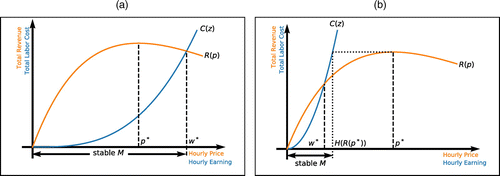
Notes. Under a tight labor supply, no earnings above the competitive equilibrium are stable. Under a loose labor supply, the highest achievable earnings are determined by how much money can be extracted from customers, , to pay drivers. (a) Under a tight labor supply (p* ≤ w*), the maximum stable earnings are w*. (b) Under a loose labor supply (p* > w*), the maximum stable earnings are H().
An M minimum earnings marketplace is stable if and only if , where
Figure 3 shows the dynamics for two instances of the model, one with an M below the stability threshold and one with an M above it. Both figures are calibrated according to Scenario II from Section 5, with the only difference between them being the differing values of M. Under the stable M, which corresponds to requiring gross wages to be at least (and vehicle costs equal to so that net driver earnings equal under full utilization; see Section 5 for details), utilization goes down slowly over time and converges to a stable positive point, whereas prices, wages, and earnings go up gently over time. Under the unstable M, which corresponds to a lower bound in gross wages, utilization goes down steeply, and wages and prices go up sharply, whereas earnings stay close to stable until they take a fairly sharp turn downward after period 13.
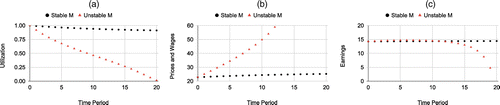
Notes. The first scenario is stable, whereas the second is unstable. (a) Utilization. (b) Prices and gross wages. (c) Earnings.
Although the terms tight and loose labor supply are often used by policy makers, the terms do not have commonly agreed on formal definitions, and their usage is context dependent (Brigden and Thomas 2003). In the context of our work, the relevant issue is whether the labor is sufficiently scarce as to significantly affect the platform’s operations. If the labor market is loose ( and the platform charges the revenue-maximizing price, then there are enough workers in the market so that the platform can fully satisfy demand. In contrast, if the labor market is tight , this is no longer true; if the platform charges the revenue-maximizing price, then it will be forced to ration service because of having too few workers or incur a loss by paying workers more than it gets paid from customers. To be clear, the revenue-maximizing price is not how much the platform would charge if it were a monopolist (it would charge the profit-maximizing price instead). The reason the revenue-maximizing price is relevant is that it is the price that extracts the most money from customers and therefore, the one that sustains the highest expenditure without causing instability.
4.1. Stability in the Presence of Utilization Shocks
Theorem 1 analyzes the stability of marketplaces assuming the system is deterministic. A natural question is then as follows. What happens in the presence of stochastic shocks? Although a full stochastic extension of the model is beyond the scope of this paper, as a proxy we provide an analysis of how one-time (impulse) shocks to utilization affect stability. Note that if the platform is able to subsidize the system, then it could easily restabilize the system after a negative utilization shock by setting prices low and wages high, thus bringing utilization up to 100%. The more interesting question is whether a platform that cannot subsidize the system (prices must be no less than wages) can also restabilize the system.
To analyze this question, we will assume a single shock occurs that causes utilization to go down in a period. After reindexing the periods and without loss of generality, suppose that the shock happens at period t = 0, and let u0 denote the associated (low) utilization from the shock. We are interested in finding necessary and sufficient conditions for an unsubsidized marketplace to remain stable when such a shock occurs. The following definition formalizes this notion.
An M minimum earnings marketplace is said to be able to absorb a u0 utilization shock if it is stable under some equilibrium-augmented policy with with for all .
In the same vein as the inverse cost function H, we need to define the inverse revenue function. Because the revenue function R is not monotonic but is unimodal, we define the inverse revenue function based on the decreasing part of R. More formally, let represent the price greater than or equal to corresponding to a given level of revenue (i.e., J(r) = p if and only if and R(p) = r). The following theorem provides a necessary and sufficient condition for the absorption of a utilization shock.
An M minimum earnings marketplace is able to absorb a u0 utilization shock if and only if .
The intuition is as follows. In order to sustain an earnings level of M, the platform needs to incur supply cost of C(M). The highest price that will allow it to extract this much from customers is . If the platform sets both prices and wages at , earnings will equilibrate at M, and the utilization will be ; see Figure 4. This is the minimum sustainable utilization level for earnings target M. Without subsidies, any lower utilization would trigger instability. We call the interval from 100% to this minimum sustainable utilization the absorption range.

Note. The value corresponds to the price that extracts C(M), the amount needed to compensate drivers, at earnings target M.
In particular, consider the special case of , where is the maximum marketplace stable earnings from Theorem 1. If the labor supply is tight, then , implying that any utilization below 100% would drive the system into instability. If the labor supply is loose, then and , implying that the utilization can be sustained as long as it is above or equal to .
Figure 5 shows the evolution of utilization, price/wage, and earnings for three scenarios: no utilization shock, a utilization shock within the absorption range, and a bigger utilization shock beyond the absorption range.
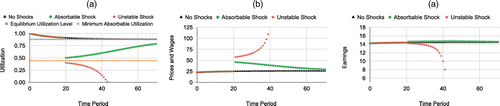
Notes. Earnings have vehicle costs of subtracted from them. The shock occurs at period 20. (a) Utilization. (b) Prices and gross wages. (c) Earnings.
4.2. Equivalence to a Static System
A potentially important characteristic of the utilization-based earnings regulation we study is that the minimum earnings in each period depend on utilization outcomes from the previous period. That is, Equation (5) forms a dynamic process that takes into account the utilization of period t to calculate a bound for wages in period t + 1. A natural question is whether these dynamics are critical in terms of stability. We next argue that this dynamic system has an equivalent static system in the sense that both have identical stability properties.
To do so, we first establish an equivalence between the (dynamic) stability of a marketplace and what we call its “static stability.” This allows us to provide an alternative proof for the bounds on stable earnings levels. We start by defining static stability.
For a given M, we say the marketplace is statically stable if and only if there exist and such that the following set of equations has a feasible solution:
The following theorem establishes the equivalence between the stability of a marketplace and its static stability.
A marketplace with given demand and supply functions and and a minimum hourly earnings target M is stable if and only if it is statically stable.
This theorem suggests that the lags in the utilization used in the regulation (as opposed to using a real-time utilization measurement) are not a key determinant of stability. That being said, if the period of utilization measurement was too short, this would lead to more randomness in the measured utilization, creating a potential path to instability through larger utilization shocks (see Section 4.1).
We can use the dynamic-static equivalence to provide an alternative proof of Theorem 1. The online appendix contains both the proof of Theorem 3 and the alternative proof of Theorem 1. Note that although this alternative proof is useful in creating a mapping from the dynamic system to a simpler static supply and demand one, it is not simpler than our original proof. In particular, it heavily relies on the same lemmas.
4.3. Stability with Spatial Friction
In practice, there are various sources of friction, which results in the production function Q corresponding to the quantity of rides being lower than what is described in Equation (1). In this subsection, we investigate the effect of matching friction on the stability of ride-hailing marketplaces under minimum earnings regulation. In particular, we will focus on spatial friction, which is likely the most important source of friction in a ride-hailing marketplace. Friction affects the market by making it more difficult for a platform to match supply and demand. In other words, a market with higher friction will produce a lower quantity of rides.
4.3.1. Production Function Assumption.
The production function is now allowed to be a generic function Q(p, z) rather than the minimum of supply and demand.
In order to understand the effect of friction on the stability of marketplaces, we will compare two markets where one has less friction and therefore, a superior production function to the other. For simplicity, we will work with the notion of static stability from Definition 4 here rather than dynamic stability.
Let denote the production function corresponding to platform with the same demand function D(p) and supply function S(z). Also, let for any given values of p and z. Finally, let and correspond to the highest statically stable earnings. We then have .
Theorem 4 shows that a superior production function can only result in higher achievable maximum stable earnings. In other words, higher friction in a ride-hailing platform never helps the maximum stable earnings. We return to the issue of spatial friction in Section 5.1, where we calibrate this model.
5. Model Calibration
A natural question is whether the New York City ride-hailing market, with the minimum earnings regulation currently in place, corresponds to a tight labor supply or a loose labor supply and if the latter is the case, what a good estimate is of the value of . We also would like to explore the demand and utilization implications of imposing an earnings target above . We now explore various supply and demand elasticity estimates from the literature to calibrate our model and thus, estimate the range of maximum possible net earnings within an open marketplace.
We start from the prelegislation earnings estimate from Parrott and Reich (2018), which is the report commissioned by the TLC on driver earnings in New York City. This report estimated median gross hourly earnings of $22.79, which are then separated into median net hourly earnings of $14.25 plus median hourly vehicle expenses equal to $8.54. We will use in our calibration and thus, assume that the supply curve S is a function of gross hourly earnings. It makes more sense to assume that S is a function of gross earnings (leading to ) than to assume that S is a function of net earnings (leading to ) because our prelegislation model is a competitive equilibrium where both wage w and price p are equal to . We will use gross earnings in all of our computations but always subtract $8.54 in vehicle costs to determine net earnings before discussing the results.
In order to compare and contrast two zero-profit scenarios, we will assume as well instead of using the empirical market per-ride-hour price because the latter includes other nonlabor variable costs, such as tolls, regulatory fees, insurance, payment processing, customer support, and web-hosting costs. This assumption is also consistent with the prediction from a standard competitive equilibrium model.
In order to calibrate our model, we make simplifying parametric assumptions on the form of the demand and supply curves. We then use demand and supply elasticity estimates from the existing ride-hailing literature to pin down specific demand and supply curves.
We start with demand. We assume the demand curve is exponential, , where C is a scaling parameter and a is a parameter to be calibrated. Under this parametric form, a corresponds to the revenue-maximizing price . This form also implies that the demand elasticity at a given price p is equal to . As discussed, we assume . Letting represent the price elasticity of demand, this implies that .
We also need to estimate supply elasticity with respect to earnings, which we denote by . Here, we assume the supply curve is the isoelastic curve , where C is the same scaling parameter we used for the demand curve and b and k are two parameters to be estimated. Using the isoelastic supply curve, we obtain that the parameter k is equal to σS,z, which is a value that we estimate from the literature. Moreover, the value of b will be set to ensure that . Note that this implies a utilization of 100%. Theorem 4 guarantees that for imperfect matching functions, where utilization is below 100%, the minimum earnings achievable are bounded from above by those achievable in the case of 100% utilization.
We consider different scenarios based on various relevant estimates that can be found in the literature for and .
For the demand elasticity with respect to the price, Parrott and Reich (2018) suggest a value of –1.2. Alternatively, Cohen et al. (2016) provide an estimate of –0.6084 based on Uber ride-hailing data in New York City. Note that the range provided by Cohen et al. (2016) is an estimate of short-term elasticity, which is a proxy for the term we are truly interested in: long-term demand elasticity.
For the supply elasticity with respect to earnings, Parrott and Reich (2018) suggest an estimate of 0.4. Another reference for such an estimate is the work of Hall et al. (2019), which provides an estimate of 0.07 for the earnings elasticity with respect to wages (namely, ) based on Uber ride-hailing data in New York City. From there, we can calculate the supply elasticity with respect to the earnings using (see Online Appendix B for details).
Based on these estimates from the literature, we consider five different scenarios. We then apply Theorem 1 to get bounds on the highest stable earnings in each scenario.
Scenario I. In this scenario, we use the estimates from Parrott and Reich (2018): and . Here, the maximum stable net earnings stay at the (current) equilibrium net earnings of . This is because of the fact that the demand elasticity of –1.2 provided by Parrott and Reich (2018) implies that we are in a tight labor market; hence, no increase in earnings could be achieved. Note that this observation holds as long as we use the demand elasticity estimation of Parrott and Reich (2018). Therefore, for the remaining scenarios, we focus on other estimates of demand elasticity.
Scenario II. Here, we use the central estimates from Cohen et al. (2016) and Hall et al. (2019): and . We get to . This results in maximum stable net earnings of , which is 3.23% higher than the current net earnings.
Scenario III. Because low supply elasticity leads to higher stable net earnings, we use the lowest that is consistent with the confidence intervals of Cohen et al. (2016) and Hall et al. (2019). Because , the lowest value of consistent with the papers is , attained by and . This combination leads to the maximum stable net earnings of , which is 4.98% higher than the current net earnings.
Scenario IV. We now directly maximize the stable net earnings while respecting the range of estimates from Cohen et al. (2016) and Hall et al. (2019). This maximizer happens at and (subsequently, ), leading to maximum stable net earnings of , which is 7.30% higher than the current net earnings.
Scenario V. Finally, in order to get the highest upper bound on the maximum stable net earnings consistent with the literature, we combine the estimate of from Parrott and Reich (2018) with the lowest (in magnitude) estimate in the literature for the demand elasticity from Cohen et al. (2016). This leads to an estimate of for the maximum stable net earnings, which is 17.10% higher than the current net earnings.
We note that in all these scenarios, the maximum stable earnings are below the regulation target of . Also, the increases in earnings come with significant negative marketplace impacts. For instance, in Scenario II, rider prices increase 64% from 22.79 to 37.46, which leads to a decrease in demand of 32%. Utilization also falls from 100% to 62.1%—a significant drop that goes against a second objective of the regulators of reducing traffic congestion.
In Tables 1 and 2, we test the sensitivity of earnings gains and utilization loss to the demand and supply elasticity estimates. The columns correspond to demand elasticity estimates with respect to prices from –0.5 to –1.0, which encompass the lowest ride-sharing price elasticity in the literature (i.e., the lower estimate of Cohen et al. 2016). Note that any demand elasticity higher than 1 in magnitude (such as the –1.2 estimate of Parrott and Reich 2018) would imply that we are in the tight labor supply, and hence, going beyond the equilibrium earnings is not stable. The rows correspond to supply elasticity estimates with respect to earnings from one to six. In Table 1, for each elasticity pair, we compute the maximum net earnings gain in a stable marketplace. The entry closest to the point estimate achieved by the central estimates of Cohen et al. (2016) and Hall et al. (2019) is for column –0.6 and row 4.
|

Table 1. Maximum Gain Attainable (Increase in Net Earnings) as a Function of Demand and Supply Elasticities
| Supply elasticity | Demand elasticity, % | |||||
|---|---|---|---|---|---|---|
| −0.5 | –0.6 | –0.7 | –0.8 | –0.9 | –1.0 | |
| 1 | 16.2 | 9.1 | 4.6 | 1.9 | 0.4 | 0.0 |
| 2 | 10.6 | 6.0 | 3.1 | 1.2 | 0.3 | 0.0 |
| 3 | 7.9 | 4.5 | 2.3 | 0.9 | 0.2 | 0.0 |
| 4 | 6.3 | 3.6 | 1.8 | 0.7 | 0.2 | 0.0 |
| 5 | 5.2 | 3.0 | 1.5 | 0.6 | 0.1 | 0.0 |
| 6 | 4.5 | 2.6 | 1.3 | 0.5 | 0.1 | 0.0 |
|
Table 2. Utilization Loss as a Function of Demand and Supply Elasticities
| Supply elasticity | Demand elasticity, % | |||||
|---|---|---|---|---|---|---|
| –0.5 | –0.6 | –0.7 | –0.8 | –0.9 | –1.0 | |
| 1 | 45 | 37 | 28 | 19 | 10 | 0 |
| 2 | 47 | 38 | 29 | 19 | 10 | 0 |
| 3 | 48 | 38 | 29 | 20 | 10 | 0 |
| 4 | 48 | 39 | 29 | 20 | 10 | 0 |
| 5 | 48 | 39 | 29 | 20 | 10 | 0 |
| 6 | 49 | 39 | 29 | 20 | 10 | 0 |
Table 2 shows the loss in utilization necessary to obtain the maximum earnings gain. Table 3 calculates, for each potential value of demand elasticity, the price (and wage) increase necessary to attain the maximum earnings gain and the associated demand loss. Overall, small changes in elasticities would lead to modest changes in our results.
|
Table 3. Price and Demand Impact as a Function of Demand Elasticity
| Demand elasticity, % | ||||||
|---|---|---|---|---|---|---|
| –0.5 | –0.6 | –0.7 | –0.8 | –0.9 | –1.0 | |
| Price impact | +100 | +67 | +43 | +25 | +11 | 0 |
| Demand impact | −39 | −33 | −26 | −18 | −10 | 0 |
5.1. Calibration with Spatial Friction
As shown in Section 4.3, no platform with imperfect matching production function can achieve higher minimum earnings than what are achievable under a frictionless system. Such imperfections are usually the effect of spatial frictions, and in order to observe the quantitative effects of such frictions, we study a particular spatial matching friction captured by the following production function for a given pickup radius :
This production function is inspired by an approximate bound on the size of a geometric maximum matching where the demand (the passengers) and the supply (the drivers) appear randomly on a uniform square and a matching can appear between a passenger and a driver only when their Euclidean distance is at most r. Under such circumstances, the probability that there are no drivers within a distance r for any given passenger is at least . Therefore, the probability that this passenger could be potentially matched with some driver is at most .
The production function described in Equation (9) is decreasing in r, and hence, the friction (in line with Theorem 4) increases when the value of r decreases. Note that the value corresponds to the frictionless case of Equation (1).
For our simulation, we consider a setting similar to Scenario II of Section 5. The demand function is defined as for C = 300 and . Similarly, the supply function is defined as , where C = 300, , and k = 4.22.
We investigate two related question. One is to study the minimum stable earnings achievable for different values of r. The other is the effect of the friction (through changing the values of r) on the stability given a fixed minimum hourly gross earnings target of . This is equivalent to net earnings of given the vehicle costs of . Our findings are presented in Figure 6.
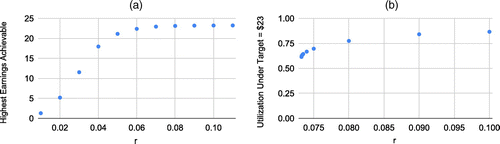
Notes. (a) Wages and prices. (b) Utilization.
As predicted by Theorem 4, the highest stable gross earnings achievable would decrease with higher friction (i.e., lower values of r). Note that in the frictionless case (when ), the highest stable gross earnings achievable in Scenario II are . Figure 6(a) suggests that when we increase the friction, this quantity starts to gradually drop until the values of r reach 0.06. Then, a sharp decline appears, and eventually, an extreme spatial friction (i.e., when r goes to zero) takes the highest stable gross earnings achievable to zero as well.
Now, let us fix a minimum gross earnings target of, for instance, (corresponding to a net earnings target of ). One can observe in Figure 6(a) that this target coincides with the highest stable gross earnings achievable for some value . In fact, simulation results suggest that for , the highest stable gross earnings achievable are . As we can see in Figure 6(b), the equilibrium utilization of the platform when aiming at this target in the low-friction cases is around 87%. It drops down eventually to around 61% in the case of . In other words, the market will have a lower utilization for the same earnings target under higher frictions. Once the radius drops below , the system is not stable with a gross earnings target of .
6. Stability via Supply Control
An important assumption underlying our model so far is free entry; workers are free to join the marketplace if they wish to do so, and thus, the supply is a function only of the equilibrium earnings. Theorem 1 shows that, depending on the value of the target minimum earnings level M, a stable marketplace with free entry might not be achievable. Suppose a regulator imposes a minimum earnings level of M beyond what is permitted by Theorem 1. What can platforms do? One response is that they can choose to impose some sort of supply control on labor.
In particular, any hourly earnings M is achievable in our model if the platform is allowed to cap its supply. Let us say the platform wants to target some earnings level . To do so, the platform can set a supply limit equal to D(M) (i.e., to set a “controlled” supply curve defined by ). The platform can then choose p = w = M and obtain 100% utilization and z = M. Obviously, in reality, a 100% utilization is not feasible given the spatiotemporal frictions present in this market, which are abstracted away in this paper.
Controlling supply might even be desirable in a setting where the marketplace stability would be possible without it. For example, assume , and consider the case . Theorem 1 says that this marketplace is stable with , and utilization . With supply control, we can have both demand and supply equal to and thus, are able to obtain 100% utilization.
It is important to note that although any hourly earnings level is achievable via supply control, the same is not true for total driver pay, which is bounded by revenues extractable from passengers. In particular, in a tight labor market, any supply control would reduce total driver pay. In a loose labor market, total driver pay might increase but by less than the hourly earnings.
6.1. Operationalizing Supply Controls
An important real-life consideration when implementing supply controls is that supply and demand curves are not stationary curves but instead, functions that vary over space and time. If one was to implement a static supply control, one would be forced to choose a supply limit that at times was too low (and thus, unnecessarily crimped the market at those times) and at other times was too high (thus, risking instability). In particular, the typical midday lull that occurs between the morning and evening rush hours poses a significant utilization risk to platforms under this kind of regulation. An effective supply controller needs to ensure that supply is kept lower during less busy hours. Therefore, any sort of reasonable supply control would need to be dynamic, in that it would need to respond to supply and demand conditions that vary over time and space.
Supply controls could have many different operational implementations, and Lyft and Uber have chosen to different mechanisms for controlling supply in New York City, with Lyft implementing an admission controller and Uber instituting a time slot scheduler for drivers. The design of an optimal supply control mechanism is an open topic for future research.
6.2. Welfare Implications
Without supply control, the welfare implications of a minimum earnings regulation are easy to understand, at least in directional terms. If an earnings target is established that is both below the stability threshold and binding, then riders are worse off because of higher prices, whereas drivers are better off because of higher earnings. If an earnings target is established that is beyond the stability threshold and supply control is not implemented, all the relevant stakeholders end up worse off if the market ceases to function because of instability.
With supply control, riders are still worse off with a minimum earnings regulation because of higher prices. Under the regulation, individual drivers clearly earn more per hour of work. However, the aggregate effect on drivers can go in both directions. In the case of tight labor supply, any increase in driver earnings can only come at the cost of aggregate driver pay, as the new equilibrium point will come at an earnings value where revenue is below . For the case of loose labor supply, both directions are feasible. An earnings target slightly above will lead to higher aggregate driver pay, but an earnings significantly above will lead the crossing between the demand curve and the capped supply curve to occur at a point where aggregate driver pay is below . Regardless of whether aggregate driver pay goes up or down, the impact of the regulation under supply control on a particular driver will depend on that driver’s need for flexibility, with drivers who desire more flexibility in when and where to work more likely to be negatively affected, whereas drivers who require less control over their schedules would be positively affected by earning more per hour of driving.
6.3. Supply Control Time Line in New York City
The earnings regulation in New York City was implemented over multiple steps. The first step took place in February 2019. At that point, a minimum earnings level was put in place that was uniform across the industry. The next step of the regulation implementation, which took place in July 2019, was the beginning of the measurement of firm-level utilization for use in future pay floor updates. That is, the first period in our model corresponds to July 2019 to December 2019, which was the first measurement period that was supposed to lead to future pay floors (the update that was supposed to take place in 2020 did not happen because of the onset of the coronavirus disease 2019 pandemic).
Koustas et al. (2020) is a study of the regulation’s impact that focuses on the particular period from February to June 2019, when only part of the regulation was in place; there was a pay floor in place, but there was no firm-level utilization measurement in place yet. Our model predicts that a pay floor (no matter how high it is) does not lead to instability. Instability potentially arises only once you introduce the utilization feedback dynamics. Therefore, our model predicts that the platforms would keep their marketplaces as free entry to drivers until June 2019 and switch to a supply-controlled framework around July 2019. This is exactly what happened, and it matches the data presented in Koustas et al. (2020). The pay floor introduced in February 2019 did not dramatically alter the marketplace through June 2019, but the introduction of firm-level utilization measurement in July 2019 did lead to the end of driver free entry and substantially higher prices in the third quarter of 2019.
7. Conclusions
Our analysis reveals an inherent tension between offering workers free entry and guaranteeing them a minimum earnings through a utilization-based regulation. We show that under such utilization-based regulation, platforms cannot sustain hourly driver earnings higher than a certain threshold while still allowing unlimited working flexibility for drivers. On the other hand, we show that platforms can offer higher levels of earnings if they limit the amount of supply in the market. Consequently, supply controls are a natural outcome of utilization-based minimum earnings regulations, despite the fact that drivers highly value the flexibility of the free-entry model (Chen et al. 2019). Indeed, we have already seen that the two largest platforms, Lyft and Uber, have responded to the regulation by instituting entry restrictions into their platforms (Bellon 2019), whereas a smaller platform, Juno, has chosen to exit the market altogether (Gladstone 2019).
The authors thank John Horton and seminar participants at Baruch College, Johns Hopkins, Institut Européen d’Administration des Affaires, University College London, London Business School, Massachusetts Institute of Technology, Toronto, and Wharton for helpful feedback. An earlier version of this work was completed while A. Asadpour and G. van Ryzin were research scientists at Lyft Marketplace Labs, now called Lyft Rideshare Labs. I. Lobel is a data science consultant for Lyft Rideshare Labs. This paper reflects the findings and viewpoints of the authors, not the views of Lyft, Inc.
References
- (2017) Uber vs. taxi: A driver’s eye view. NBER Working Paper No. 23891, National Bureau of Economic Research, Cambridge, MA.Google Scholar
- (2019) Uber to limit drivers’ app access to comply with NYC regulation. Reuters (September 16), https://www.reuters.com/article/us-uber-new-york/uber-to-limit-drivers-app-access-to-comply-with-nyc-regulation-idUSKBN1W12OV.Google Scholar
- (2003) What does economic theory tell us about labour market tightness? Working paper, Bank of England, London.Google Scholar
- (2021) Decentralized or centralized control of online service platforms: Who should set prices? Working paper, University of Pennsylvania, Philadelphia.Google Scholar
- (1997) Labor supply of New York City cabdrivers: One day at a time. Quart. J. Econom. 112(2):407–441.Crossref, Google Scholar
- (1993) Minimum wages and employment: A case study of the fast food industry in New Jersey and Pennsylvania. NBER Working Paper No. 4509, National Bureau of Economic Research, Cambridge, MA.Google Scholar
- (2015) Dynamic pricing in a labor market: Surge pricing and flexible work on the Uber platform. Working paper, University of California, Los Angeles.Google Scholar
- (2019) The value of flexible work: Evidence from Uber drivers. J. Political Econom. 127(6):2735–2794.Crossref, Google Scholar
- (2016) Using big data to estimate consumer surplus: The case of Uber. Working paper, University of Chicago, Chicago.Google Scholar
- (2019) Ride-hailing app Juno enters bankruptcy, blaming wage law. Wall Street Journal (November 20), https://www.wsj.com/articles/ride-hailing-app-juno-enters-bankruptcy-blaming-wage-law-11574270292.Google Scholar
- (2016) The effects of Uber’s surge pricing: A case study. Working paper, University of Chicago, Chicago.Google Scholar
- (2019) Pricing efficiently in designed markets evidence from Uber. Working paper, Massachusetts Institute of Technology, Cambridge, MA.Google Scholar
- (2018) Price floors and employer preferences: Evidence from a minimum wage experiment. Working paper, Massachusetts Institute of Technology, Cambridge, MA.Google Scholar
- (2003) Can free entry be inefficient? Fixed commissions and social waste in the real estate industry. J. Political Econom. 111(5):1076–1122.Crossref, Google Scholar
- (2020) New York City’s gig driver pay standard: Effects on drivers, passengers, and the companies. Working paper, The New School for Social Research, New York.Google Scholar
- (2018) An earnings standard for New York City’s App-based drivers: Economic analysis and policy assessment. Report for the New York City Taxi and Limousine Commission. Report, The Center for New York City Affairs at the New School and the Center on Wage and Employment Dynamics at the University of California, Berkeley, CA.Google Scholar
New York City Taxi and Limousine Commission (2018) Driver pay. Accessed August 12, 2021, https://www1.nyc.gov/site/tlc/about/driver-pay.page.Google Scholar- (1946) The economics of minimum wage legislation. Amer. Econom. Rev. 36(3):358–365.Google Scholar

