


Supplier Audit Information Sharing and Responsible Sourcing
Abstract
We develop a game-theoretic model to study the incentive for competing manufacturers to share supplier audit information. Based on the audit information, each manufacturer decides whether to source from a common supplier who has uncertain responsibility violation risk or to switch to a backup supplier who has no responsibility violation risk but charges a higher price. When supplier responsibility violation occurs, some consumers boycott the manufacturers involved. Audit information allows a manufacturer to reduce the uncertainty about the risk of the common supplier. We show that audit information sharing may make the manufacturers’ sourcing strategies more or less differentiated. As a result, the information-sharing decision is not monotone in the model parameters. We fully characterize the manufacturers’ equilibrium audit information-sharing and sourcing decisions and establish conditions under which audit information sharing induces the manufacturers to adopt more or less responsible sourcing strategies. We also show that a manufacturer could be better off when the cost premium of sourcing from the backup supplier or the risk of the common supplier becomes higher or the audit information becomes less accurate. We consider several extensions of the base model and demonstrate that the main insights remain mostly valid.
This paper was accepted by Charles Corbett, operations management.
Funding: A. Y. Hawas supported by the Wei Lun Foundation. W. Shang was supported by the Research Grants Council of Hong Kong [GRF Project LU 13501415]. Y. Wang was supported by National Natural Science Foundation of China [Grant 71901209].
Supplemental Material: The online appendix is available at https://doi.org/10.1287/mnsc.2022.4358.
1. Introduction
There have been numerous episodes of supplier social responsibility violations, such as the worker suicides at Foxconn (The Guardian 2014), the factory collapse in Bangladesh (Al-Mahmoud et al. 2013), and the child labor exploitation in cobalt mining (Groden 2016), which attracted much attention from the media and the general public. When these violations occur, socially conscious consumers may boycott the guilty brands and switch to other brands. For instance, companies such as Apple and Samsung faced loss of profit caused by consumer boycotts because their suppliers were involved in a child labor exploitation incident (Roberts 2016). A study of Cone Communications found that 55% of consumers have boycotted a product in the past year after they learn about a company’s socially irresponsible practice (Cone Communications 2013). Because of greater transparency in supply chains, consumers are increasingly making purchasing decisions based on ethical sourcing (McKinsey 2019). Brands that source responsibly can gain ground from those who are implicated in responsibility violations. For example, New Balance took advantage of the negative press centered around Nike’s responsibility violations in the late 1990s by advertising the responsibility of its supply chain. As a result, New Balance’s share of the athletic shoe market expanded from 3.7% in 1999 to 9.4% in 2000 (Business Wire 2000).
Besides the commonly used factors, such as cost and quality, social responsibility compliance has become another important factor used by many global companies in making sourcing decisions (McKinsey 2013, Bacardi 2014, Coca-Cola 2015, Diageo 2021, PepsiCo 2021). These companies turned to supplier audit to mitigate the supplier responsibility violation problem (Supply Chain Digest 2017). By providing information about suppliers’ responsibility risk and performance, supplier audit allows a buyer to make better sourcing and supplier management decisions. Companies such as Walmart use auditing as a screening mechanism to rate suppliers’ factory compliance in awarding production contracts (Chen et al. 2020b).
Many manufacturers have started to share the audit reports of their common suppliers via industry-based platforms though some of their competitors choose not to do so. For example, in the soda drink industry, Coca-Cola and PepsiCo are members of AIM-PROGRESS, but their competitor Dr Pepper is not. In the liquor drink industry, Diageo is a member of AIM-PROGRESS, whereas its competitor Bacardi was a member until 2018. Other examples of audit-sharing platforms are the Electronic Industry Citizenship Coalition (EICC) in the electronics industry, Together for Sustainability in the chemical industry, and the Sustainable Apparel Coalition in the apparel industry. The emergence of collaborative platforms such as the Supplier Ethical Data Exchange (Sedex) and EcoVadis allows firms to effectively share and manage data on responsible sourcing. Some of these audit-sharing platforms such as Sedex and AIM-PROGRESS explicitly state that they aim to promote responsible sourcing in supply chains (Ward 2016, AIM-PROGRESS 2021).
Responsible sourcing in supply chains receives a lot of attention in the recent operations management (OM) literature. Our paper is closely related to and partly motivated by Guo et al. (2016) and Fang and Cho (2020). Guo et al. (2016) study the fundamental cost–risk trade-off faced by a monopoly in making sourcing decisions, but they do not consider supplier audit. Fang and Cho (2020) consider both joint audit and audit sharing, but they assume that a buyer will not source from a supplier who fails in an audit regardless of whether responsibility violation is likely to be revealed to the consumers and the potential loss resulting from the violation compared with the additional cost of sourcing from a backup supplier. We add to the literature by examining how audit information sharing impacts the cost–risk trade-off faced by a buyer in making a sourcing decision under competition. Our paper attempts to address the following research questions. What is the incentive for competing manufacturers to share audit information when they utilize such information to make sourcing decisions? How would audit information sharing impact a manufacturer’s sourcing strategy? When would audit information sharing make a manufacturer choose a sourcing strategy that is more or less responsible? How do the answers to these questions depend on the business environment, such as the cost premium of sourcing from a less risky supplier, supplier responsibility risk, and audit information accuracy?
We develop a multistage game to study the audit information-sharing and sourcing decisions of two competing and identical manufacturers. The manufacturers first decide whether to sign an agreement to share their audits on a common supplier. Then, each manufacturer conducts an audit to obtain an independent and private signal about the supplier’s responsibility violation risk and updates its belief of the supplier’s risk based on the available signal(s). Finally, they decide whether to source from the common supplier, called the risky supplier, or to switch to a backup supplier, called the responsible supplier, who has zero responsibility violation risk but charges a higher price. Consumers in the market are either socially or nonsocially conscious. When there is no responsibility violation, the demand to each manufacturer is given by its existing market share. When a responsibility violation occurs, a nonsocially conscious consumer does not change the purchase decision. A socially conscious consumer no longer buys from the manufacturer whose supplier commits the violation. This consumer either switches to the rival, if it does not source from the violating supplier, or not purchase otherwise. Thus, a supplier responsibility violation leads to a demand loss to the associated manufacturer. Our model is stylized and not rich enough to fully represent how audit sharing works in practice. Nevertheless, it accounts for the effect of how audit sharing reduces the uncertainty about supplier responsibility risk and how this, in turn, impacts buyers’ sourcing decisions under competition. These are issues that have not been fully explored in the literature, and our analysis leads to the following novel managerial insights.
In making the sourcing decision without competition, a manufacturer faces the trade-off between a lower cost by sourcing from the risky supplier and a higher demand by sourcing from the responsible supplier. The demand effect is due to the potential demand loss by sourcing from the risky supplier. With competition, the demand effect becomes stronger because of the potential demand spillover from a rival that sources from the risky supplier. We identify two novel effects, the accuracy and competition effects, and show how they affect a manufacturer’s incentive to share audit information.
The manufacturers share audit information when the cost premium of the responsible supplier is either low or high, but do not share when it is intermediate. This can be explained by the accuracy and competition effects of audit information sharing. We also show that a similar nonmonotone equilibrium structure holds for other parameters, such as the proportion of socially conscious consumers and the riskiness of the risky supplier. Unlike the case of no competition, a manufacturer could be better off when the cost premium of the responsible supplier is higher, the risky supplier is more risky, or the audit is less accurate.
Audit information sharing makes the manufacturers choose sourcing strategies that are collectively less responsible if the cost premium of the responsible supplier is low and more responsible if it is high. It can make them choose sourcing strategies that are collectively more or less responsible when the cost premium has an intermediate value. Unlike the case of no competition, the manufacturers could choose sourcing strategies that are collectively more responsible when the cost premium of the responsible supplier is higher, the audit is more accurate, or the risky supplier is less risky if any of these changes induces a change in the audit information-sharing decision. We also derive conditions under which audit information sharing impacts social welfare and responsible sourcing in the same direction, which has implications on how a social planner should take actions to influence the practice.
The rest of the paper is organized as follows. In Section 2, we review the relevant literature. In Section 3, we present our modeling framework. In Sections 4 and 5, we present the equilibrium results when audit information is, respectively, not shared and shared by the manufacturers. In Section 6, by comparing the results of Sections 4 and 5, we derive the equilibrium audit information sharing decisions, conduct sensitivity analysis of the manufacturers’ profits and analyze the impact of audit information sharing on responsible sourcing and social welfare. In Section 7, we present the results of several extensions of the base model. In Section 8, we provide our concluding remarks. All the proofs of the formal results are given in the online appendix.
2. Literature Review
This paper is related to the literature on socially responsible supply chains. One stream of work in this literature studies sourcing decisions in socially responsible supply chains. Aral et al. (2021) study supplier selection using optimal procurement auctions when the level of responsibility of the supplier base is unknown and information accuracy can be improved by supplier audit. Chen and Slotnick (2015) investigate the interaction between supply disclosure and ethical sourcing. Guo et al. (2016) examine a buyer’s trade-off between a higher price of sourcing from a responsible supplier and a higher risk of responsibility violation of sourcing from a risky supplier. Agrawal and Lee (2019) analyze when and how buyers can use sourcing policies to influence their suppliers to adopt sustainable processes. Orsdemir et al. (2019) consider how vertical integration can be used as a strategy to ensure responsible practices in supply chains. See also Agrawal and Lee (2016) for a detailed review of the papers on responsible sourcing. None of these papers investigates the role of audit information sharing in a firm’s sourcing decision.
Another stream of work in the literature on socially responsible supply chains considers the role of the audit in supplier management. Porteous et al. (2015) conduct an empirical study to identify specific penalties and incentives that reduce supplier violations and buyer operating costs. Plambeck and Taylor (2016) investigate how a supplier’s evasion effort can negatively impact the effectiveness of a buyer’s audit efforts. Chen and Lee (2017) study how a firm can use different instruments, such as supplier certification, supplier audit, and contingency payment, to improve responsible sourcing. Caro et al. (2018) compare independent audit, joint audit, and audit sharing in a model with two buyers who do not compete. They do not consider sourcing in their model. Cho et al. (2019) show how a manufacturer can use a pricing and inspection (audit) policy to discourage a supplier from using child labor. Chen et al. (2020b) study supplier audit that is subject to collusion. Kraft et al. (2020) consider the issues of disclosing audit information and investment in supplier social responsibility capability. Fang and Cho (2020) investigate and compare the effectiveness of joint audit and audit sharing in incentivizing suppliers to exert efforts to improve responsibility performance. Levi et al. (2020) examine the impact of capabilities, such as tractability and testing, on quality adulteration in farming supply chains. Chen et al. (2020a) investigate the incentive for two buyers to form a coalition to jointly audit their suppliers, whereas Zhang et al. (2022) focus on a buyer’s problem of auditing suppliers within a network to ensure social responsibility compliance. With the exception of Fang and Cho (2020), none of these papers considers how audit sharing impacts a firm’s sourcing decision.
This paper is also closely related to the literature on horizontal information sharing. For the economics literature, see Vives (2001) for a review of the earlier work and Currarini and Feri (2018) for a review of the recent work. More recently, some work investigates how firms share information bilaterally via the formation of coalitions. In the OM literature, Chen and Tang (2015) study the provision of market information to competing farmers in developing economies. Liao et al. (2019) consider the case in which the farmers are price takers and heterogeneous in their preferences of crop types. Shamir and Shin (2018) investigate how the incentive for noncompeting retailers to share information depends on the information dissemination policy as well as whether the wholesale price is endogenous. Jiang and Hao (2016) examine both horizontal and vertical information sharing in a two-tier supply chain. Both the economics and OM literatures focus on the sharing of cost or demand information under Bertrand or Cournot competition. Our model, which considers sharing information about supplier responsibility risk and competition with sourcing decisions, is novel and its nonmonotone equilibrium structure does not follow from the existing literature.
Our paper is most related to Guo et al. (2016) and Fang and Cho (2020). Guo et al. (2016) consider the fundamental cost–risk trade-off faced by a monopoly in choosing from four sourcing and selling options. We extend Guo et al. (2016) by considering how audit information sharing impacts a firm’s sourcing decision under competition though we limit to only two sourcing options (i.e., buying from either but not both of the suppliers). Fang and Cho (2020) is different from our paper in the following ways. First, they employ a cooperative game approach, whereas we adopt a noncooperative one. The cooperative approach is appropriate when the manufacturers need to engage in negotiation about how the cost and benefit of audit sharing is allocated. The noncooperative approach is appropriate when the collaboration level is low and not much negotiation is needed. Second, they assume that a manufacturer will not source from a supplier who fails in an audit regardless of whether a responsibility violation is likely to be revealed to consumers and how the potential loss resulting from the violation is compared with the additional cost of sourcing from a backup supplier. Thus, a manufacturer’s sourcing decision neither fully accounts for the cost–risk trade-off nor reacts to the rival’s sourcing decision. We model explicitly how improved information resulting from audit sharing impacts the manufacturers’ sourcing decisions and how these decisions react to each other. Unlike Fang and Cho (2020), asymmetric sourcing equilibria exist in our model even when the two manufacturers are identical and they share audit information. Third, their analysis allows for more than two manufacturers as well as endogenous audit and responsibility effort decisions. Because of the different model setups, both our results and the parameters that characterize them are quite different from those of Fang and Cho (2020).
3. The Model
We consider a model with two identical manufacturers (indexed by 1 or 2) who source from a common supplier with uncertain responsibility violation risk. The supplier can be of H- or L-type with respective violation probabilities of ηH and ηL. An H-type supplier does not fully comply with the responsibility protocol in the industry (hence, high risk), whereas an L-type supplier does (hence, low risk). In the base model, we assume the responsibility protocol to be comprehensive enough such that an L-type supplier has a negligible risk of responsibility violation, that is, . (In Online Appendix C, we relax this assumption by allowing and illustrate using numerical examples that the equilibrium information-sharing structure remains valid.) Let Z be the supplier type, and Z = H or L.
Manufacturer i conducts an audit on the supplier to obtain a private signal where i = 1 or 2 and Yi = h if noncompliance is detected and Yi = l otherwise. The audit signals Y1 and Y2 are conditionally independent given the supplier type. If the supplier is of L-type, an audit cannot detect any noncompliance, and . If the supplier is of H-type, an audit can detect noncompliance with probability , where t is the audit accuracy and assumed to be the same for both manufacturers because they adopt a common audit protocol. The prior probability of the supplier to be of H-type is r. Before the audits are conducted, the manufacturers decide whether to enter into an agreement to share their audit signals. After the audits are completed, a manufacturer updates its belief of the supplier type based on the available audit signal(s). Without audit information sharing, manufacturer i’s updated belief is given by
With information sharing, manufacturer i’s updated belief is given by
More details on the probability calculation can be found in Online Appendix D.
When the manufacturers select suppliers for a new production order, they make the decisions based on their updated beliefs. Each manufacturer can either choose the existing common supplier or switch to a backup supplier who has zero responsibility risk but charges a premium of Δ over the unit cost of the common supplier. We may interpret the backup supplier as an in-house supplier with a higher cost and its responsibility management under full control of the manufacturer. Alternatively, the backup supplier could be external, operate in a location with strict labor and environmental laws (Guo et al. 2016), and have a proven record of complying with all responsibility protocol. The assumption that a more responsible supplier has zero risk is commonly adopted in the literature (Guo et al. 2016, Chen and Lee 2017, Fang and Cho 2020). Without loss of generality, we normalize the unit cost of sourcing from the common supplier to zero. For convenience, from now on, we refer to the common supplier as the risky supplier (denoted by NS) and the backup supplier as the responsible supplier (denoted by RS).
Our demand model follows closely the one in Guo et al. (2013). Consumers in the market are either socially or nonsocially conscious. When there is no responsibility violation, the demand to each manufacturer is given by its existing market share. When a supplier responsibility violation occurs, a nonsocially conscious consumer does not change the purchase decision. A socially conscious consumer no longer buys from the manufacturer whose supplier commits the violation. This consumer either switches to the rival, if it does not source from the violating supplier, or not purchase otherwise. Let θ () be the probability that a consumer is socially conscious, which is the same as the proportion of socially conscious consumers in the market. In Guo et al. (2016), socially conscious consumers are assumed to be willing to pay a premium for a responsibly sourced product, and a fraction of them exit the market or switch to the rival in the wake of a responsibility violation, whereas nonsocially conscious consumers are oblivious to responsible sourcing. In contrast, we assume that consumers are not willing to pay a premium for a responsibly sourced product, but they may differ in their reactions to responsibility violation. Obviously, the consumer model in Guo et al. (2016) is more general than ours. We assume that there is no price premium associated with a responsibly sourced product for the following reasons. In many industries, given the opaque nature of supply chains to consumers and the large number of suppliers involved, consumers cannot observe whether a product is responsibly sourced until a violation occurs. As observed by McAvoy (2016), though many consumers claim that they are willing to pay more for ethical sourcing, in fact they do not.
Without loss of generality, the market size is normalized to one. We assume that the market share is equally split between the two manufacturers when there is no responsibility violation. The demand for manufacturer i is given by
If manufacturer i sources from the responsible supplier, its profit is
Here, p is the selling price of the product, which is assumed to be exogenous. Chen and Slotnick (2015) and Plambeck and Taylor (2016) make the same assumption of an exogenous selling price. Moreover, , which can be interpreted as the relative cost premium of sourcing from the responsible supplier. To simplify our analysis, let the expected demand loss of sourcing from an H-type risky supplier be . Thus, captures the effect of both ηH and θ, where ηH can be interpreted as the riskiness of the risky supplier. We consider a multistage game with the following sequence of events.
The manufacturers decide whether to share audit information. The audit information-sharing decision A is given by SA if an agreement is reached and NA otherwise.
Each manufacturer receives an audit signal and shares it with the other manufacturer if there is an audit information-sharing agreement.
After observing the signal(s), the manufacturers make sourcing decisions independently and simultaneously. The sourcing decision of a manufacturer is RS if it sources from the responsible supplier and NS if it sources from the risky supplier.
Random responsibility violation, if any, occurs, and each manufacturer produces to meet its realized demand.
We assume that the audit information-sharing decision has a longer term than the sourcing decision. According to the mutual recognition member expectations of AIM-PROGRESS, its members have to commit to at least 50 reports in the next three years (AIM-PROGRESS 2013). In many industries, a sourcing decision for a product is usually made more than once a year to match the shrinking product life cycle. We assume that audit information sharing is truthful, and a manufacturer cannot share information selectively after an audit is conducted. This is reasonable because audits are usually conducted by third-party auditors whose names, together with the names of audited suppliers, are listed in a sharing platform, such as Sedex, for verification. AIM-PROGRESS requires its members to commit to a list of audited suppliers before audits are conducted, and auditors directly submit their reports without redaction. We assume that a manufacturer’s audit cost is fixed, and therefore, it is irrelevant to decision making and the audit accuracy is fixed too. These are reasonable because a manufacturer usually follows a standard protocol to audit suppliers based on its business needs and strategies. Moreover, some platforms, such as AIM-PROGRESS, require a member to commit to a protocol that has at least 85% commonality with those of other members. In order to focus on our research questions, we also assume that the common supplier’s responsibility risk is exogenous and does not depend on whether audit information is shared or not. When the manufacturers introduce new products in about the same time frame, they cannot observe the rival’s sourcing decision at the time when they make their own, thus supporting our assumption that sourcing decisions are made simultaneously.
Audit-sharing platforms, such as EICC and AIM-PROGRESS, have many members who sell to different product markets. Audit sharing may not only improve the overall information accuracy but also incentivize suppliers to exert effort to reduce responsibility risk. It is also possible that a manufacturer’s audit effort (and, thus, audit accuracy and cost) might depend on whether audit reports are shared or not. Our model with two identical manufacturers and exogenous audit accuracy and responsibility risk clearly does not fully represent how audit sharing works in practice. Nevertheless, by capturing its various salient features that are relevant to our research questions, our model aims to provide some novel understanding of how it impacts a firm’s sourcing decision under competition. In Section 7, we consider several extensions by relaxing some of the key assumptions and show that the main messages remain mostly intact. Our approach of focusing on a parsimonious model of two competing firms is quite common in the literature on socially responsible supply chains. For instance, see Caro et al. (2018), Orsdemir et al. (2019), and Chen et al. (2020a).
We solve the game backward by first solving for the sourcing subgame equilibria when audit information is either shared or not shared. The ex ante profits under the sourcing subgame equilibria are then used to solve for the equilibrium audit information-sharing decisions.
4. Sourcing Game Without Audit Information Sharing
In this section, we solve the sourcing subgame with A = NA, that is, no audit information-sharing agreement is established. In the base model, we restrict to the region with so that there is either a unique pair of asymmetric equilibria or a unique symmetric equilibrium, and the other region with is considered in Section 7.1.
Without audit information sharing, each manufacturer independently receives a signal, updates its belief about the supplier type and decides whether to source from the risky or the responsible supplier. The sourcing decision of manufacturer i is defined as , where or NS and Yi = h or l (i = 1 or 2). The sourcing strategy of manufacturer i is defined as . Each manufacturer has four possible sourcing strategies: , and . (1) Under strategy , and the manufacturer always sources from the responsible supplier. (2) Under strategy , and the manufacturer always sources from the risky supplier. (3) Under strategy , and the manufacturer sources from the responsible supplier if the signal is h and from the risky supplier if the signal is l. (4) Under strategy , and the manufacturer sources from the risky supplier if the signal is h and from the responsible supplier if the signal is l.
For a given sourcing strategy of manufacturer i, the probability of supplier responsibility violation is given by , where the sourcing decision Si depends on the sourcing strategy as well as the realized audit signal(s). When responsibility violation of manufacturer i occurs, a fixed portion () of the affected consumers buy from it, whereas the remaining portion either switch to the rival or exit the market. Suppose the social cost of the responsibility violation (e.g., pollution or poor labor conditions) is proportional to the production volume with a unit cost denoted by cv. Because each manufacturer has an initial demand of manufacturer i’s expected social cost of the responsibility violation is given by We say that manufacturer i adopts a more responsible sourcing strategy if the new strategy has a smaller SCVi than the previous strategy. Besides SCVi, it is equivalent to use to compare the responsibility performance of two sourcing strategies for the same set of parametric values. Obviously, strategy is more responsible than strategy , which, in turn, is more responsible than strategy Given the sourcing strategies of the two manufacturers, the total social cost of responsibility violation in the industry is given by . We say that the industry adopts a more responsible set of sourcing strategies if the new set of strategies has a smaller SCV than the previous set of strategies.
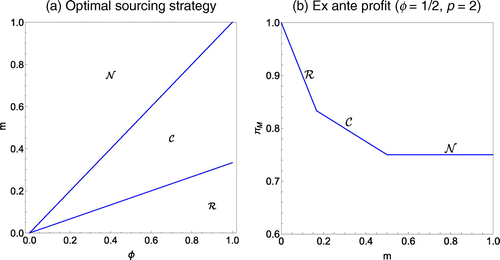
We first establish the monopoly case as a benchmark. The model setup is the same as that in Section 3 except the demand is if Xi = 1 and 1/2 if Xi = 0. Thus, there is no demand spillover when the rival’s supplier commits a responsibility violation, and our model reduces to the case of two independent monopolies. Denote each monopoly’s optimal strategy as and its ex ante profit as πM. Let .
(The Monopoly Case).
(a) (i) if , (ii) if , and (iii) otherwise. (b) If a larger m or t, or a smaller or r triggers a change in becomes less responsible. (c) πM is (weakly) decreasing in m, , and r, and increasing in t.
Figure 1 illustrates the results. Without competition, in making the sourcing decision, the manufacturer faces the trade-off between a lower cost by sourcing from the risky supplier and a higher demand by sourcing from the responsible supplier. The demand effect is due to the potential demand loss by sourcing from the risky supplier. Audit information reduces the uncertainty about the supplier type. When either the cost or demand effect dominates, the manufacturer chooses a signal-independent strategy (i.e., or ). Otherwise, the manufacturer’s strategy is signal-dependent (i.e., ). When the signal is h, there is a higher chance for the risky supplier to be of H-type, the demand effect is stronger, and the manufacturer sources from the responsible supplier. When the signal is l, the reverse is true, and the manufacturer sources from the risky supplier.
Now, we consider the effect of competition. A manufacturer who sources from the responsible supplier could benefit from demand spillover if the rival sources from the risky supplier. Such a demand spillover depends on the sourcing strategy as well as the private signal of the rival. The sourcing subgame is a game of incomplete information, and we use Bayesian Nash equilibrium as the solution concept. The equilibrium is supported by each manufacturer’s updated belief about the rival’s signal. The sourcing game can be represented in the normal form by Table 1. Let (i = 1 or 2) be the ex ante profit of manufacturer i given strategies and . The ex ante profits are derived from the demand functions and the manufacturers’ updated beliefs about the risky supplier given in Section 3, and the exact expressions are given in the proof of Lemma 2. It can be shown that strategy is dominated by either strategy or strategy and, therefore, cannot be an equilibrium strategy.
|

Table 1. Payoff Matrix for the Sourcing Game When A = NA
If the rival adopts strategy , a manufacturer faces the trade-off between a lower cost by sourcing from the risky supplier and a higher demand by sourcing from the responsible supplier. The demand effect is due to the potential demand loss by sourcing from the risky supplier. If the rival adopts either strategy or strategy , the demand effect becomes stronger because demand can now be higher because of not only no demand loss but also demand spillover. When either the cost or demand effect dominates, the manufacturer chooses a signal-independent strategy (i.e., or ). Otherwise, the manufacturer’s strategy is signal-dependent (i.e., ). When the signal is h, the potential demand effect is stronger, and the manufacturer sources from the responsible supplier. When the signal is l, the reverse is true, and the manufacturer sources from the risky supplier. The chance of demand spillover is higher when the rival manufacturer adopts strategy instead of strategy .
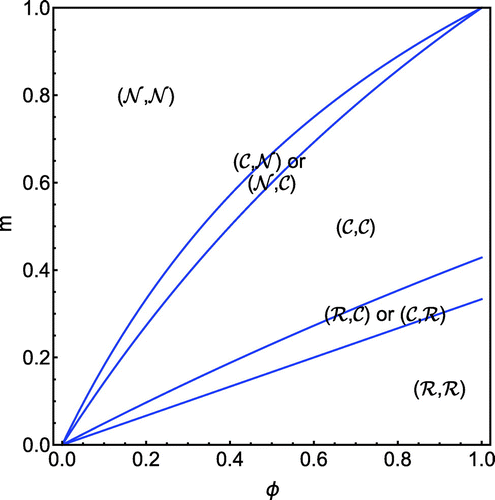
Let be the equilibrium of the sourcing subgame when there is no audit information sharing. Based on SCV, it is straightforward to show that the following sequence of strategy sets is in a descending order of responsibility performance: and Let and .
(a) (i) if , (ii) or if , (iii) if , (iv) or if , and (v) if . (b) If a larger m or t or a smaller or r triggers a change in becomes less responsible.
As illustrated in Figure 2, the structure of the sourcing subgame equilibrium here is consistent with the monopoly case. As m increases, so does the benefit of cost saving by sourcing from the risky supplier, and thus, the manufacturers adopt sourcing strategies that are less responsible. Similarly, as increases, both the expected demand loss by sourcing from the risky supplier and the magnitude of potential demand spillover by sourcing from the responsible supplier become larger, and thus, the manufacturers adopt sourcing strategies that are more responsible. Asymmetric sourcing equilibria could exist because differentiated sourcing strategies allow one manufacturer to benefit from a higher potential demand and the other to benefit from a lower sourcing cost.
5. Sourcing Game with Audit Information Sharing
In this section, we solve the sourcing subgame with A = SA, that is, an audit information-sharing agreement is reached. In the base model, we restrict to the region with so that there is either a unique pair of asymmetric equilibria or a unique symmetric equilibrium, and the other region with is considered in Section 7.1.
When the manufacturers share audit information, they make sourcing decisions independently after observing the common set of signals Y1 and Y2. As long as the risky supplier fails at least one of the audits, both manufacturers are certain that the supplier is of H-type. The sourcing decision of manufacturer i is defined as , where or NS, and or l (i = 1 or 2). The sourcing decision is the same when the signal set (Y1, Y2) is (h, h), (h, l), or (l, h) because all the three sets of signals lead to the same set of beliefs, that is, the risky supplier is of H-type. The sourcing strategy of manufacturer i can be defined as , where is (h, h), or (l, h). Each manufacturer has four possible sourcing strategies. (1) Under strategy , and the manufacturer always sources from the responsible supplier. (2) Under strategy , and the manufacturer always sources from the risky supplier. (3) Under strategy , and the manufacturer sources from the responsible supplier if the signal set is (h, h), (h, l), or (l, h) and from the risky supplier if the signal set is (l, l). (4) Under strategy , and the manufacturer sources from the risky supplier if the signal set is (h, h), (h, l), or (l, h) and from the responsible supplier if the signal set is (l, l).
The sourcing subgame is a game of complete information, and we use Nash equilibrium as the solution concept. The sourcing game with audit information sharing can be depicted by Table 2. Let be the ex ante profit of manufacturer i given strategies and . The exact expressions of the ex ante profits are given in the proof of Lemma 3.
|
Table 2. Payoff Matrix for the Sourcing Game When A = SA
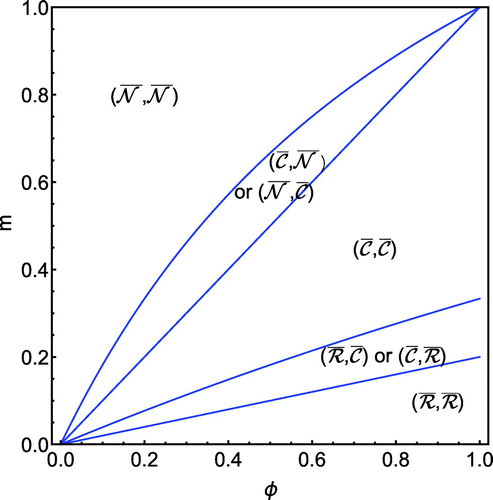
Given the rival’s sourcing strategy, the trade-off faced by a manufacturer in choosing a sourcing strategy is similar to that in Section 4 except that the information structure is different. Let be the equilibrium of the sourcing subgame when there is audit information sharing. Based on SCV, it is straightforward to show that the following sequence of strategy sets is in a descending order of responsibility performance: , and Let and .
(a) (i) if , (ii) or if , (iii) if , (iv) or if , and (v) if . (b) If a larger m or t or a smaller or r triggers a change in becomes less responsible.
As illustrated in Figure 3, the structure of the sourcing subgame equilibrium here is consistent with the previous two cases (monopoly and competition without audit information sharing). With audit information sharing, there is more information, the signal-dependent strategy becomes more attractive, and it is more likely for it to exist in an equilibrium (it can be shown that ). As m increases, so does the benefit of a lower cost by sourcing from the risky supplier, and thus, the manufacturers adopt sourcing strategies that are less responsible. Similarly, when increases, both the expected demand loss by sourcing from the risky supplier and the magnitude of potential demand spillover by sourcing from the responsible supplier become larger, and thus, the manufacturers adopt sourcing strategies that are more responsible.
6. Audit Information-Sharing Decision
In the first stage, the manufacturers decide whether to share audit information or not. In the base model, we focus on the intersection of the two subgame regions, that is, . This corresponds to the region in which the prior probability of the risky common supplier to be of H-type is low. The region with , which corresponds to the region in which this probability is high, is considered in Section 7.1.
6.1. Effects of Audit Information Sharing
We first consider the effect of audit information sharing on a manufacturer by comparing its ex ante profits in the two sourcing subgames (A = NA or SA). If asymmetric equilibria exist in both subgames, we assume that the manufacturers are consistent in their sourcing strategies. For example, if the sourcing equilibrium is or when A = NA, and or when A = SA, we assume that the same manufacturer adopts strategy when A = NA and strategy when A = SA. This assumption can be justified by the notion of a focal point (Kreps 1990) and the manufacturers’ sourcing preferences. Suppose manufacturer 1 has a stronger preference for the existing risky common supplier when compared with manufacturer 2, possibly because of noneconomic factors, such as a closer business relationship. Based on the manufacturers’ sourcing preferences, and are the focal points and chosen as the equilibrium outcomes for, respectively, the cases of A = NA and A = SA. Online Appendix E presents the results for the case of inconsistent sourcing strategies and shows that most of the structural results remain true.
Let and be manufacturer i’s expected profits under, respectively, the sourcing equilibria and . To isolate the effects of audit information sharing, we consider an intermediate scenario when there is no demand spillover. Without audit information sharing, the expected profit of a manufacturer, πM, is discussed in Section 4. With audit information sharing, the expected profit is similar except that information accuracy increases from t to . Define the value of audit information sharing to manufacturer i as
6.2. Equilibrium Audit Information Sharing and Sourcing Decisions
Let be the equilibrium audit information-sharing decision. or NA. Given , we can obtain the sourcing equilibrium from Sections 4 and 5. From Lemmas 2 and 3, both manufacturers source from RS if and from NS if regardless of the audit signal(s). So audit information sharing is not relevant in these regions. The following proposition characterizes the equilibrium audit information-sharing decision in other regions.
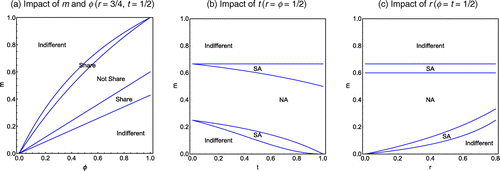
(a) (i) if , (ii) if , and (iii) if . (b) ma, mb, and mf are decreasing in t and increasing in . ma and mb are increasing in r.
Part (a) shows that the audit information-sharing decision is not monotone in m. In making the sourcing decision, as we explain earlier, a manufacturer faces the trade-off between a lower cost by sourcing from the risky supplier and a higher demand by sourcing from the responsible supplier. We say that the manufacturers’ sourcing strategies are more differentiated if there is a higher probability that they make different sourcing decisions, that is, one of them sources from the risky supplier, whereas the other one sources from the responsible supplier. When sourcing strategies are more differentiated, the demand spillover effect becomes more significant.
Refer to Table 3, which compares the sourcing equilibria with and without audit information sharing. When m is small (respectively, large) enough, that is, in region A (region H), the cost effect (the demand effect) dominates, and both manufacturers adopt a signal-independent strategy. From now on, we ignore the regions in which audit information sharing does not make any difference in the manufacturers’ sourcing strategies. When we say m is small (large), the interpretation is that it is small (large) but not too small (large) such that whether audit information is shared or not does not matter.
|
Table 3. Equilibrium Audit Information Sharing and Sourcing Decisions
| Region | Conditions on m | |||
|---|---|---|---|---|
| A | Indifferent | |||
| B | SA | or | ||
| C1 | SA | |||
| C2 | NA | or | or | |
| D | NA | or | ||
| E | NA | |||
| F | NA | or | ||
| G | SA | or | or | |
| H | Indifferent |
Suppose m is small (regions B and C1). Without audit information sharing, both manufacturers adopt . With audit information sharing, a signal-dependent strategy becomes more attractive because of the more accurate information. As a result, one (both) of the manufacturers is (are) induced to switch to , the differentiation of the sourcing strategies increases (remains the same), and the competition effect is positive (zero). Because the accuracy effect is positive, both manufacturers have an incentive to share audit information.
Suppose m has an intermediate value (regions C2, D, E, and F). Without audit information sharing, one of the manufacturers adopts , whereas the other one adopts either or . Because audit information sharing reduces the uncertainty of the risky supplier, it induces either at least one of them to switch to or one of them to switch from to . As a result, the sourcing strategies become less differentiated in the former case (because both manufacturers face the same set of signals and the probability of sourcing from the responsible supplier is higher under than ), and the switching manufacturer can no longer benefit from demand spillover in the latter case. The competition effect is negative and dominates the accuracy effect for at least one of the manufacturers, and no audit information sharing occurs.
Suppose m is large (region G). Audit information sharing induces the sourcing equilibrium to change from to . The manufacturer whose strategy changes from to now has a higher probability of sourcing from the responsible supplier. As a result, the sourcing strategies become more differentiated, the competition effect is either positive or zero, and both of the manufacturers have an incentive to share audit information.
By considering the appropriate inverse functions of ma, mb, and mf, we can show that the audit information-sharing decision is also not monotone in , t, and r. For instance, from Figure 4(a), by redefining regions B–G in terms of the thresholds of instead of m, we can show that audit information is shared when is either small or large but not when it has an intermediate value. Recall that , and therefore, the result holds for θ and ηH too. From Figure 4(b), a larger t may induce the manufacturers to either stop sharing audit information when m is small or start sharing audit information when m is large. From Figure 4(c), the impact of r on the audit information-sharing decision largely depends on the value of m.
Our results highlight the role of several drivers (cost premium of the responsible supplier m, proportion of socially conscious consumers θ, riskiness of the risky supplier ηH, and audit accuracy t) in our problem. Although our model is not rich enough for making a concrete prediction about firms’ behavior in practice, it provides useful insight about how these drivers impact firms’ incentive to share audit information, which, in turn, affects their sourcing decisions.
In the horizontal information-sharing literature, when firms compete on price or quantity, information sharing usually leads to more correlated decisions. In our model, however, audit information sharing could make the manufacturers’ sourcing decisions more or less differentiated, which gives rise to the nonmonotone equilibrium structure. This shows that the nature of competition in our model is fundamentally different from that in the literature.
6.3. Sensitivity Analysis of Manufacturers’ Profits
Without competition, Lemma 1 shows that a manufacturer’s profit is weakly decreasing in m, , and r and increasing in t. With competition, this may not be true because of the demand spillover effect. The following proposition provides the conditions under which it is not true.
(a) Suppose the sourcing equilibrium does not change. (i) When one manufacturer adopts () and the other manufacturer adopts (), a larger or r or a smaller t increases the profit of the manufacturer that adopts (). A smaller t increases the total profit. (ii) When both manufacturers adopt , a larger t decreases their profits if and increases them otherwise. (b) If a larger m or t or a smaller or r induces the manufacturers to stop sharing information, the profit of the manufacturer whose strategy switches to () increases (decreases). The total profit increases except when the change occurs from region C1 to region D and (c) If a larger m induces the manufacturers to start sharing information, the profit of the manufacturer whose strategy switches to as well as the total profit increase.
Refer to Table 3, which shows the conditions for different parametric regions. For part (a.i), when m is small (regions B, C2, and D), the sourcing equilibrium is such that one manufacturer adopts strategy () and the other manufacturer adopts strategy (). A larger or r or a smaller t benefits the former manufacturer because either demand spillover has a higher chance to occur or its magnitude becomes larger. Any of these parametric changes hurts the latter manufacturer, but a smaller t increases the total profit because the positive demand spillover effect dominates. For part (a.ii), when m has an intermediate value (regions E and F), both manufacturers adopt strategy A larger t reduces the uncertainty about the risk of the risky supplier, but it also lowers the chance for demand spillover to occur because the probability of sourcing from the responsible supplier is higher. The negative demand spillover effect dominates the positive accuracy effect when t is large, and the reverse is true otherwise. For part (b), it occurs when m is small and in the neighborhood of mb. The equilibrium decision changes from SA in region B to NA in region C2 or from SA in region C1 to NA in region D. The sourcing equilibrium changes from or or to or . It hurts the manufacturer whose strategy switches to (the profit has a discrete drop) because of less information available (one instead of two signals) and benefits the manufacturer whose strategy switches to (the profit has a discrete jump) because of a higher probability of demand spillover. For the total profit, the positive demand spillover effect dominates the negative effect of less information except under the conditions stated in the proposition. For part (c), it occurs when m is large and in the neighborhood of mf. The equilibrium decision changes from NA in region F to SA in region G. The sourcing equilibrium changes from to or . It benefits the manufacturer whose strategy switches to (the profit has a discrete jump) because information becomes more accurate and there is more demand spillover. The profit of the manufacturer whose strategy switches to is unaffected by the change in the sourcing equilibrium (the profit is continuous at mf) as long as the change in the parameter is negligible. Therefore, the total profit also increases because of the change in the equilibrium. Figure 5 illustrates some of the results.
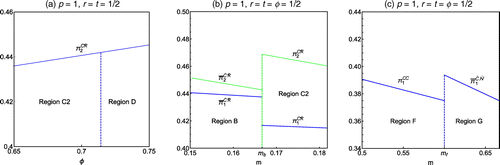
Proposition 2 shows that the manufacturers have to be cautious in making changes to their supplier responsibility management. For instance, if they work together to make the audit protocol more stringent (t becomes larger), this is not always beneficial to both of them even when cost is not an issue. They also have to be careful in educating consumers to promote responsible sourcing. When more consumers become socially conscious (θ and, hence, become larger), this may be beneficial under some conditions but damaging otherwise.
6.4. Responsible Sourcing and Social Welfare
We first consider the impact of audit information sharing on responsible sourcing. Let ARE be the information-sharing decision under which the industry adopts a more responsible set of sourcing strategies. For example, if the set of sourcing strategies under A = SA has a smaller SCV than the set of sourcing strategies under
(a) if or or . if or . When if and otherwise. (b) if (i) or (ii) and . (c) Suppose . If a larger m or t or a smaller or r induces the manufacturers to stop sharing information, the industry adopts a more responsible set of sourcing strategies when and a less responsible set otherwise.
Refer to Table 3, which shows the conditions for different parametric regions. Part (a) shows that if m is small (regions B and C1) and if m is large (region G). If m is small, without audit information sharing, both manufacturers source from the responsible supplier. Audit information sharing induces at least one of them to switch to a signal-dependent strategy, and hence, the industry adopts a less responsible set of sourcing strategies. If m is large, one manufacturer sources from the risky supplier, whereas the other adopts a signal-dependent strategy. When there is audit information sharing, the probability of sourcing from the risky supplier becomes smaller under a signal-dependent strategy because of more accurate information. So the industry adopts a more responsible set of sourcing strategies. Part (a) also shows that audit information sharing may induce the industry to adopt a less or more responsible set of sourcing strategies if m has an intermediate value. Because ma, mb, and mf are all increasing in by considering their inverse functions, we can show that audit information sharing induces the industry to adopt a more responsible set of sourcing strategies if is small and a less responsible set if it is large. It is indeterminate if has an intermediate value. Part (b) shows that, under the equilibrium audit information sharing decision, the industry adopts a less responsible set of sourcing strategies if m is small or intermediate and a more responsible set if m is large. The only exception is in region D the industry adopts a less responsible set of sourcing strategies if t > 1/2 and a more responsible set if Part (c) is in sharp contrast to Lemmas 1–3, which show that any of these parametric changes will induce the industry to adopt a less responsible set of sourcing strategies when there is no competition or no change in the audit information-sharing decision. Under the conditions of part (c), for the manufacturer who switches from to the sourcing strategy becomes more responsible. For the manufacturer that switches from to the sourcing strategy becomes less responsible. At the industry level, the set of sourcing strategies becomes more responsible when because the effect of switching from to dominates.
As discussed in Section 1, a common motivation for setting up audit information-sharing platforms, such as Sedex and AIM-PROGRESS, is to improve responsible sourcing. Sedex caters across multiple industries, whereas AIM-PROGRESS focuses on the consumer goods industry, which has many distinct segments (e.g., food, personal health products, alcohol-based beverages). Parts (a) and (b) show that a platform may want to promote or provide an incentive to facilitate audit information sharing in regions where it makes sourcing more responsible (), but not in regions where it makes sourcing less responsible (). For instance, a platform may want to promote its services to or accept members from industries or industry segments with a large cost difference between the responsible and risky suppliers or with a small proportion of socially conscious consumers (i.e., region G, where ). For industries or industry segments with a small cost difference or a large proportion of socially conscious consumers (i.e., regions B and C1, where and ), promoting audit information sharing could be counterproductive as far as improving responsible sourcing is concerned. One expects that practices such as making audit protocol more stringent (i.e., t becomes larger) and educating consumers to increase their social responsibility awareness (i.e., θ and, hence, become larger) improve responsible sourcing. Part (c) implies that this is not always true, so a platform needs to be cautious in adopting these practices. Here, we focus on how a parametric change impacts a manufacturer’s choice of a more or less responsible sourcing strategy. Given a sourcing strategy that may exist in equilibrium (, or ), from the proof of Proposition 3, it is easy to show that its responsibility performance improves (i.e., SCVi decreases) as t or θ increases or r or ηH decreases.
A social planner considers how audit information sharing impacts the social welfare, which is given by , where CW is the total consumer welfare, SC is the total sourcing cost, and SCV is the total social cost of responsibility violation. We assume that the consumer utility is V if the consumer buys from the preferred manufacturer, V – d if the consumer buys from the unpreferred manufacturer, and 0 if the consumer buys from neither manufacturer. Moreover, so that the consumer surplus of buying from the unpreferred manufacturer is positive. The sourcing cost of each manufacturer is the product of the probability of sourcing from the responsible supplier and the cost premium paid to that supplier.
(a) Audit information sharing decreases social welfare if (i) and or (ii) and . (b) Audit information sharing increases social welfare if and (i) or (ii) .
Propositions 3 and 4 together show the conditions under which audit information sharing impacts social welfare and responsible sourcing in the same direction. In regions B and C1, where audit information is shared in equilibrium, it decreases social welfare and induces the industry to adopt a less responsible set of sourcing strategies. In regions C2 and E, where audit information is not shared in equilibrium, it increases social welfare and induces the industry to adopt a more responsible set of sourcing strategies. There could be other cases. For instance, when cv is large enough such that SCV dominates CW – SC, it impacts social welfare and responsible sourcing in the same direction. There are also cases when it impacts social welfare and responsible sourcing in the opposite directions. Because all these cases do not yield much additional insight, details are omitted.
Proposition 4 provides guidance on when a social planner should work with a platform to either discourage the practice of audit information sharing when it is an equilibrium or to encourage it when it is not an equilibrium. For instance, the social planner could offer a subsidy to support the operations of the platform, work with the platform to promote the practice selectively to some targeted industries, or offer assistance via the platform to the manufacturers to facilitate the practice. The social planner could also use regulation to encourage or prohibit audit information sharing when the planner’s objective is not aligned with that of the platform, that is, when the practice impacts social welfare and responsible sourcing in the opposite directions.
7. Extensions
7.1. High Prior Probability of H-Type Supplier
In the base model, we focus on the region in which , that is, the prior probability of the risky common supplier to be of H-type is low. Here, we consider the remaining region in which , that is, this probability is high. We solve the game in the same way as in the base model. Details are omitted and can be found in Online Appendix B. The following proposition presents the equilibrium audit information sharing decision. Let .
(a) if or , (b) if or , and (c) or SA if .
The structure of the audit information-sharing equilibrium is similar to that in the base model given by Proposition 1, that is, the manufacturers share information when m is either small or large, but not when it has an intermediate value. The only exception is that both NA and SA can be an equilibrium in the region . In this region, the sourcing equilibrium is not unique in at least one of the sourcing subgames. Picking different combinations of the sourcing equilibria in the two subgames gives rise to different audit information-sharing equilibria. The equilibrium structure is consistent with the base model if we pick in that region.
The sourcing equilibria are consistent with those in the base model described in Table 3 except in the region in which both NA and SA can be an equilibrium. Consider the sourcing subgame equilibria with in this region. Different from the base case, or can be the sourcing equilibrium in which the manufacturers fully differentiate their sourcing decisions regardless of the signals. Next, we consider the sourcing subgame equilibria under the equilibrium in this region. Different from the base case, or can be the sourcing equilibrium in which manufacturers fully differentiate their sourcing decisions by reacting differently to the common set of signals.
Similar to the base model, we can show that audit information sharing generally makes the industry adopt a less responsible set of sourcing strategies if m is small and a more responsible set if m is large. The only exception is that, if m is large, it may induce a less responsible set of sourcing strategies if r is sufficiently large. For more details, see Online Appendix B.
7.2. Asymmetric Market Sizes
Here, we extend the base model by allowing the manufacturers to have different market sizes. Let αS and αL be their market sizes, where and . We can show that the main results for symmetric market sizes continue to hold. Specifically, the manufacturers share audit information with each other when m is small or large but not when it has an intermediate value (similar nonmonotone results hold for other parameters); audit information sharing makes the industry adopt a less responsible set of sourcing strategies if m is small and a more responsible set if m is large; a manufacturer can get worse off when m or t increases or or r decreases. Moreover, in the region in which there is a unique asymmetric sourcing equilibrium, we can show that the smaller manufacturer adopts a more responsible sourcing strategy. For instance, in the region in which , the sourcing equilibrium is under NA and under SA. This is true because the positive demand spillover effect is stronger for the smaller manufacturer (as it has more to earn from the rival’s responsibility violation). See Online Appendix F for the details of the analysis.
7.3. Endogenous Audit Accuracies
Here, we extend the base model by allowing each manufacturer to decide its audit accuracy. Let be the probability of detecting noncompliance in a standard audit trial and ce be the cost incurred for conducting the trial. When manufacturer i carries out an audit by conducting n conditionally independent trials with a total cost of nce, the probability of detecting noncompliance is , which can be interpreted as the audit accuracy of manufacturer i. Thus, the manufacturer can control n to change ti. To make the analysis tractable, we assume that ti can be treated as a continuous variable with a cost of . Furthermore, we assume for some to avoid the uninteresting case when the manufacturers do not conduct any audit (i.e., ti = 0). By defining , we can rewrite the audit cost as , where ti is audit accuracy and .
We consider the following sequence of events. The two manufacturers decide whether to share audit information. If they do not share audit information, they decide their audit accuracies, conduct the audits, and then make sourcing decisions based on their own audit information. If they agree to share audit information, they decide and commit to audit accuracies simultaneously. Then, they conduct the audits and make sourcing decisions based on the pooled audit information.
Although we can analytically characterize the equilibrium decisions and profits, we are not able to obtain any structural property of the equilibrium. Therefore, we have to resort to a numerical study to investigate the equilibrium structure. See Online Appendix G for the details of the analysis. We report a representative numerical example in Table 4 with and denoting, respectively, the equilibrium audit accuracies when A = NA and A = SA. In regions C to F, when A = NA, and . From Table 4, we can check that most of the qualitative results in Propositions 1 and 2 continue to hold (except for those that are no longer relevant with endogenous audit accuracy). Specifically, the manufacturers share audit information with each other if m is either small or large but not when it has an intermediate value (similar nonmonotone results hold for other parameters); audit information sharing makes the industry adopt a less responsible set of sourcing strategies if m is small and a more responsible set if m is large; a manufacturer can get worse off when m increases or or r decreases. We also observe that audit information sharing leads to lower signal accuracies in regions C, D, E, and F but has no impact in other regions. Interestingly, it does not lower signal accuracies in regions B and I, in which audit information sharing is an equilibrium.
|
Table 4. Equilibrium Audit Information Sharing, Audit Accuracy, and Sourcing Decisions ()
| Region | Condition on m | A = NA | A = SA | |||
|---|---|---|---|---|---|---|
| A | Indifferent | |||||
| B | SA | / | ||||
| C | NA | / | / | / | ||
| D | NA | / | / | / | ||
| E | NA | / | ||||
| F | NA | |||||
| G | NA | |||||
| H | NA | / | ||||
| I | SA | / | / | |||
| J | Indifferent | |||||
7.4. Three Manufacturers
Here, we extend the base model to the case of three identical manufacturers. There are three possible information-sharing structures: full information sharing (FIS), partial information sharing (PIS), and no information sharing (NIS). Under FIS, all three manufacturers agree to share audit information by forming a three-firm coalition; under PIS, only two of them agree, and there is one two-firm coalition and one single-firm coalition; under NIS, no information sharing agreement is reached, and there are three single-firm coalitions. We assume that a feasible deviation by a manufacturer in a given information-sharing structure is for it to either leave a coalition to become independent or join another coalition, provided that the receiving coalition becomes strictly more profitable after it joins. We adopt the notion of a Nash-stable coalition to analyze the stability of the information sharing structures (see Granot and Yin 2008 and Yin 2010 for more details). Based on this notion, the Nash-stable set of information-sharing structures consists of all the structures in which no manufacturer has a strictly profitable and feasible deviation. A coalition is formed for the purpose of information sharing only. Given an information-sharing structure as in the base model, the manufacturers compete with each other in making sourcing decisions regardless of whether they are in the same coalition or not.
Because the model is not analytically tractable, we resort to a numerical study. See Online Appendix H for more details. From the equilibrium results of a representative example in Table 7 in the online appendix, we observe that the information-sharing equilibrium structure is similar to that in the base model. The manufacturers are indifferent when m is very small or very large, information sharing (FIS and/or PIS) occurs when m is small or large, and no information is shared when m has an intermediate value. The two threshold values of the audit information-sharing decisions are higher than those in the base model. Consistent with the base model, audit information sharing generally makes the industry adopt a less responsible set of sourcing strategies if m is small and a more responsible set if m is large.
8. Conclusion
In this paper, we investigate the incentive for competing manufacturers to share the audit information of a common supplier and how this impacts their sourcing decisions. In making the sourcing decision, each manufacturer faces the trade-off between a lower cost by sourcing from a risky supplier who has a responsibility violation risk and a higher demand by sourcing from a responsible supplier who has no responsibility violation risk. Our analysis reveals two novel effects of audit information sharing. The accuracy effect allows a manufacturer to have more accurate information about the supplier type and, hence, to make a better sourcing decision. The competition effect makes the manufacturers’ sourcing decisions more or less differentiated, which affects how demand spills over to a manufacturer when the rival has a supplier responsibility violation. We show how these effects can be used to explain the following three main messages: (1) The manufacturers share audit information when the cost premium is low or high but not when it has an intermediate value. Such a nonmonotone structure holds for other parameters, such as the riskiness of the risky supplier and the audit accuracy. (2) Audit information sharing induces the two manufacturers to adopt sourcing strategies that are collectively less responsible when the cost premium is low and more responsible when it is high. (3) A manufacturer could get worse off when the cost premium of sourcing from the responsible supplier becomes lower, the risky supplier becomes less risky, or the audit becomes more accurate.
We assume that socially conscious consumers switch to the rival if their preferred manufacturer is implicated in a supplier responsibility violation and the rival is not. If only a portion of these consumers switch, demand spillover resulting from the responsibility violation becomes smaller, which makes the demand effect in the sourcing decision and the competition effect in the audit information-sharing decision less significant. Because the sets of drivers of these decisions do not change, though the magnitudes of some of them do, we expect the equilibrium structure to remain intact. Moreover, sourcing from the risky supplier becomes an equilibrium strategy in a larger parametric region, and so does the strategy of sharing audit information.
Our base model is limited by several assumptions, such as two identical manufacturers, endogenous responsibility risk, and endogenous audit accuracy (same as audit effort or cost). In Section 7, we consider several extensions by relaxing some of these assumptions and find that the equilibrium structure in each of these extensions becomes more complex because more factors are involved. Nevertheless, we also find that our three main messages remain mostly valid. This shows that the accuracy and competition effects of audit information sharing persist and continue to play a major role in determining the results in these extensions. Thus, even though our model does not fully represent how audit information sharing works in practice, it provides useful insight to managers and platform operators about how it should be managed.
To further study the problem, it would be useful to allow for more than two manufacturers and relax several key assumptions at the same time. In particular, it would be interesting to allow for endogenous supplier effort that reduces responsibility violation risk. In this case, audit information sharing and the sourcing strategy are two levers for a buyer to influence a supplier’s incentive in responsibility management. It would also be interesting to have a comprehensive analysis of the impact of audit information sharing on social welfare. A comprehensive and tractable modeling framework that can address these cases needs to be substantially different from the one that we adopt in this paper and is best left for future research.
The authors sincerely thank the editor in chief, the department editor, the associate editor, and three anonymous reviewers for their constructive comments and suggestions that helped improve the quality of the study.
References
- (2016)
Responsible sourcing . Atasu A, ed. Environmentally Responsible Supply Chains: Opportunities and Challenges (Springer, New York), 71–87.Crossref, Google Scholar - (2019) The effect of sourcing policies on suppliers’ sustainable practices. Production Oper. Management 28(4):767–787.Crossref, Google Scholar
AIM-PROGRESS (2013) Mutual recognition member expectations. Accessed December 18, 2021, aim-progress.com/files/22/aim-progress-mutual-recognition-member-expectations-11-2013-2-.pdf.Google ScholarAIM-PROGRESS (2021) Mutual recognition framework. Accessed December 18, 2021, aim-progress.com/storage/resources/aim-progress_mutual recognition framework Jan20201.pdf.Google Scholar- (2013) The global garment trail: From Bangladesh to a mall near you. The Wall Street Journal (May 3), https://www.wsj.com/articles/SB10001424127887324766604578460833869722240.Google Scholar
- (2021) Supplier sustainability assessments in total-cost auctions. Production Oper. Management 30(4):902–920.Google Scholar
Bacardi (2014) Corporate responsibility report. Accessed December 18, 2021, stage.bacardilimited.com/Content/uploads/corporate/responsible/pdf/2014_Responsible-Sourcing.pdf.Google ScholarBusiness Wire (2000) Athletic footwear market share report announced for first quarter of 2000 (April 7).Google Scholar- (2018) Improving supplier compliance through joint and shared audits with collective penalty. Manufacturing Service Oper. Management 20(2):363–380.Link, Google Scholar
- (2017) Sourcing under supplier responsibility risk: The effects of certification, audit, and contingency payment. Management Sci. 63(9):2795–2812.Link, Google Scholar
- (2015) Supply chain disclosure and ethical sourcing. Internat. J. Production Econom. 161:17–30.Crossref, Google Scholar
- (2015) The economic value of market information for farmers in developing economies. Production Oper. Management 24(9):1441–1452.Crossref, Google Scholar
- (2020a) Supplier centrality and auditing priority in socially responsible supply chains. Manufacturing Service Oper. Management 22(6):1199–1214.Link, Google Scholar
- (2020b) Responsible sourcing under supplier-auditor collusion. Manufacturing Service Oper. Management 22(6):1234–1250.Link, Google Scholar
- (2019) Combating child labor: Incentives and information disclosure in global supply chains. Manufacturing Service Oper. Management 21(3):692–711.Link, Google Scholar
Coca-Cola (2015) Coca-Cola Enterprises Inc. supplier guiding principles. Accessed December 18, 2021, www.cokecce.com/system/file_resources/353/SGP_ENG_CCE_FINAL_100715 5_.pdf.Google ScholarCone Communications (2013) Cone communications/Echo global CSR Study. Accessed May 28, 2022, https://conecomm.com/global-csr-study-insight/.Google Scholar- (2018) Information sharing in oligopoly. Corchón LC, Marini MA, eds. Handbook of Game Theory and Industrial Organization, vol. I (Edward Elgar Publishing, Cheltenham, UK), 520–536.Google Scholar
Diageo (2021) Responsible sourcing. Accessed December 18, 2021, www.diageo.com/en/society-2030/pioneer-grain-to-glass-sustainability/responsible-sourcing.Google Scholar- (2020) Cooperative approaches to managing social responsibility in a market with externalities. Manufacturing Service Oper. Management 22(6):1215–1233.Link, Google Scholar
- (2008) Competition and cooperation in decentralized push and pull assembly systems. Management Sci. 54(4):733–747.Link, Google Scholar
- (2016) Apple and Microsoft linked to child labor in cobalt supply chains. Accessed December 18, 2021, fortune.com/2016/01/19/apple-child-labor.Google Scholar
- (2013) The impact of supply chain structure on responsible sourcing. Working paper, Stanford University, Stanford, CA.Google Scholar
- (2016) Responsible sourcing in supply chains. Management Sci. 62(9):2722–2744.Link, Google Scholar
- (2016) Incentive-driven information dissemination in two-tier supply chains. Manufacturing Service Oper. Management 18(3):393–413.Link, Google Scholar
- (2020) Motivating supplier social responsibility under incomplete visibility. Manufacturing Service Oper. Management 22(6):1268–1286.Link, Google Scholar
- (1990) A Course in Microeconomics Theory (Princeton University Press, Princeton, NJ).Crossref, Google Scholar
- (2020) Economically motivated adulteration in farming supply chains. Management Sci. 66(1):209–226.Link, Google Scholar
- (2019) Information provision policies for improving farmer welfare in developing countries: Heterogeneous farmers and market selection. Manufacturing Service Oper. Management 21(2):254–270.Link, Google Scholar
- (2016) Ethical sourcing: Do consumers and companies really care? Spend Matters (February 15). Accessed December 18, 2021, spendmatters.com/2016/02/15/ethical-sourcing-do-consumers-and-companies-really-care.Google Scholar
McKinsey (2013) The global sourcing map—Balancing cost, compliance, and capacity. Accessed December 18, 2021, www.mckinsey.com/∼/media/mckinsey/dotcom/client_service/retail/articles/the_global_sourcing_map_balancing_cost_compliance_and_capacity.ashx.Google ScholarMcKinsey (2019) Shifting the dial in procurement. Accessed December 18, 2021, www.mckinsey.com/business-functions/operations/our-insights/shifting-the-dial-in-procurement.Google Scholar- (2019) Ensuring corporate social and environmental responsibility through vertical integration and horizontal sourcing. Manufacturing Service Oper. Management 21(2):417–434.Link, Google Scholar
PepsiCo (2021) What is PepsiCo’s approach to sustainable sourcing? Accessed December 18, 2021, contact.pepsico.com/pepsico/article/what-is-pepsico-s-approach-to-sustainable-sourcing.Google Scholar- (2016) Supplier evasion of a buyer’s audit: Implications for motivating supplier social and environmental responsibility. Manufacturing Service Oper. Management 18(2):184–197.Link, Google Scholar
- (2015) Carrots or sticks? Improving social and environmental compliance at suppliers through incentives and penalties. Production Oper. Management 24(9):1402–1413.Crossref, Google Scholar
- (2016) 7-year-old children mining cobalt for Apple, Microsoft, & Samsung products? Accessed December 18, 2021, www.collective-evolution.com/2016/02/02/watch-7-year-old-children-mining-cobalt-for-apple-microsoft-samsung-products.Google Scholar
- (2018) The perils of sharing information in a trade association under a strategic wholesale price. Production Oper. Management 27(11):1978–1995.Crossref, Google Scholar
Supply Chain Digest (2017) Supply chain news: New study from the University of Sheffield finds supply audits not getting job done in improving conditions at suppliers. Accessed December 18, 2021, www.scdigest.com/ONTARGET/17-01-24-1.PHP?cid=11838.Google ScholarThe Guardian (2014) Apple under fire again for working conditions at Chinese factories. Accessed December 18, 2021, www.theguardian.com/technology/2014/dec/19/apple-under-fire-again-for-working-conditions-at-chinese-factories.Google Scholar- (2001) Oligopoly Pricing: Old Ideas and New Tools (MIT Press, Cambridge, MA).Google Scholar
- (2016) Supply chain sustainability: Sedex shows the way. Accessed December 18, 2021, www.pioneerspost.com/news-views/20160203/supply-chain-sustainability-sedex-shows-the-way.Google Scholar
- (2010) Alliance formation among perfectly complementary suppliers in a price-sensitive assembly system. Manufacturing Service Oper. Management 12(3):527–544.Link, Google Scholar
- (2022) Social responsibility auditing in supply chain networks. Management Sci. 68(2):1058–1077.Link, Google Scholar

