


Right to Repair: Pricing, Welfare, and Environmental Implications
Abstract
The “right-to-repair” (RTR) movement calls for government legislation that requires manufacturers to provide repair information, tools, and parts so that consumers can independently repair their own products with more ease. The initiative has gained global traction in recent years. Repair advocates argue that such legislation would break manufacturers’ monopoly on the repair market and benefit consumers. They further contend that it would reduce the environmental impact by reducing e-waste and new production. Yet the RTR legislation may also trigger a price response in the product market as manufacturers try to mitigate the profit loss. This paper employs an analytical model to study the pricing, welfare, and environmental implications of RTR. We find that, as the RTR legislation continually lowers the independent repair cost, manufacturers may initially cut the new product price and then raise it. This nonmonotone price adjustment may further induce a nonmonotone change in consumer surplus, social welfare, and the environmental impact. Strikingly, the RTR legislation can potentially lead to a lose–lose–lose outcome that compromises manufacturer profit, reduces consumer surplus, and increases the environmental impact despite repair being made easier and more affordable.
This paper was accepted by Charles Corbett, operations management.
Funding: Chen Jin gratefully acknowledges the Singapore Ministry of Education Academic Research Fund [Tier 1, Grant R-253-000-144-133].
Supplemental Material: The online appendix is available at https://doi.org/10.1287/mnsc.2022.4401.
1. Introduction
From motor vehicles to consumer electronics to farm equipment, modern technology products are getting increasingly complex. Repairing them is difficult, if not impossible, for consumers or third-party service shops without the aid of manufacturers. Yet manufacturers often withhold repair information, proprietary repair tools, and spare parts, forcing consumers to either settle for a lofty repair price or forgo repair altogether.
The “right-to-repair” (RTR) movement is meant to change that. It calls for government legislation that requires manufacturers to share repair information (e.g., manuals, schematics, and documentation), provide diagnostic tools, and supply service parts to make it easy for consumers to repair their own products (either by themselves or through third-party independent service shops).
The initiative has gained global traction. In the United States, the Motor Vehicle Owners’ Right to Repair Act was passed in Massachusetts in 2012 and was effectively adopted at the national level starting from automotive year 2018 (Wiens 2014); the state law was later amended in 2020 to cover telematics systems (Robertson 2020). Many states have considered similar legislation for electronics more broadly (Schwartz 2019). Multiple 2020 Democratic presidential candidates proposed national right-to-repair laws that ensure farmers can fix their tractors and other farm equipment (Ekman 2019). Campaigns for the right-to-repair regulations are also seen in Canada, Australia, and the European Union (Reisinger 2019). In particular, the European Union has passed legislative rules regarding the supply of replacement parts (Harrabin 2019b) and mandatory labeling to indicate reparability (Gartenberg 2020). The right-to-repair initiative has garnered support from consumer advocacy groups and environmental organizations, such as the U.S. Public Interest Research Group, the Repair Association, and iFixit, to name a few.
Whereas the right-to-repair legislation is likely multifaceted, it is safe to say that, once enacted, it will make independent repair easier and less costly. For example, without the right-to-repair law, phones and tablet parts are often glued together, and devices can easily break when pried apart (Schwartz 2019), which “makes repairs costly” (Root 2019). Moreover, Apple’s proprietary pentalobe screws cannot be removed with common screwdrivers (Schwartz 2019). The lack of proper repair tools is not only an issue for cellphones but also tractors (Fitzpatrick 2017). In addition, manufacturers sometimes charge a high fee for access to repair manuals (Scher 2020) or refuse to sell replacement parts (Root 2019). As a result, those conducting independent repairs often have to rely on self-made tools, hunt for unauthorized manuals, and use refurbished or copied parts (The Economist 2017), all of which make independent repair difficult and costly (in terms of time, effort, and financial cost). By contrast, the right-to-repair law mandates an increase in the availability of repair tools, information, and parts, which may stimulate more competition to further drive down the cost of acquiring spare parts (Matchar 2016). All of these changes will make independent repair easier and less costly. Our paper focuses on this cost-reduction angle.
As a subject of constant legislative evolution and active policy debate, the right to repair is commonly believed to benefit consumers and the environment. At the heart of the advocacy for the right to repair lies the argument that it breaks manufacturers’ monopoly on the repair market and empowers consumers with more (affordable) repair choices, which should make them better off (Keck 2019, Root 2019). Repair advocates also contend that giving consumers the right to repair is environmentally favorable (The Economist 2017, Shaban 2018, Vaute 2018, Harrabin 2019a). The rationale is that insufficient repair causes product underutilization and generates too much e-waste (Sabbaghi and Behdad 2018); if repair is made easier, products will last longer and consumers will not buy as many new products or prematurely throw away as many old ones, which translates into less production and less e-waste, thereby reducing the environmental impact.
However, the right-to-repair legislation is often met with considerable resistance from manufacturers, many of whom lobbied or filed suit against it (Beres and Campbell 2016, Fitzpatrick 2017, Reuters 2020). Whereas manufacturers usually justify their pushback on privacy, cybersecurity, and safety grounds (Keck 2019, Reimer 2020), many believe the true motivation is an economic one. It is understandable that giving consumers the right to repair would hurt manufacturers’ bottom line by diminishing both repair profit and new product sales. However, it is less clear how the legislation would shape manufacturers’ pricing decisions in the product market as they try to mitigate the (inevitable) profit loss. Any assessment of the welfare and environmental implications is not complete without incorporating this pricing perspective, yet it is largely missing in today’s policy debate. Our paper fills this gap.
We employ an analytical model in which a profit-maximizing manufacturer makes a finitely durable product at a cost and sells it to consumers over an infinite horizon. Consumers can either buy new products from the manufacturer or buy used products from a secondary market. A new product may fail after use, in which case, consumers decide whether to throw it away (and buy a new one), seek manufacturer repair, or conduct independent repair. Both the manufacturer and consumers incur a cost for performing repair, but the manufacturer has a cost advantage. The manufacturer sets the prices of both the new product it sells and the repair service it provides if at all. Our model treats the right-to-repair legislation as an external force that reduces the cost of independent repair (which cannot fall below the manufacturer’s repair cost).
In general, providing repair service is a double-edged sword for the manufacturer. On the one hand, it strengthens consumers’ valuation of the product over its life cycle, which enables the manufacturer to price the new product higher (the value enhancement effect); on the other hand, it encourages consumers to use old products recovered from repair, which cannibalizes new product sales (the demand cannibalization effect). How much repair the manufacturer would like to offer depends on how costly it is to make new products. If new products are cheap to produce, then the manufacturer can easily churn out new products in volume and, thus, focuses on mitigating demand cannibalization by hampering repair. Specifically, it induces a “no-repair” equilibrium to the extent possible by charging an exorbitantly high repair price. By contrast, if the production cost is high, the manufacturer would like the product to last as long as possible and, hence, taps into the value enhancement effect by facilitating repair. Specifically, it provides repair for free, inducing a “full-repair” equilibrium. Nevertheless, if the production cost is intermediate, the manufacturer takes a balanced approach and charges an intermediate repair price that induces some consumers to repair, resulting in a “partial-repair” equilibrium.
In light of these results, a lower independent repair cost resulting from the right-to-repair legislation does not make a difference if the production cost is high (because manufacturer repair is always offered free of charge in this case), but it compels the manufacturer to rectify the pricing decision otherwise. Specifically, if the production cost is low, the manufacturer adopts a volume strategy by lowering the new product price. Doing so reduces the used product price in the secondary market, which disincentivizes repair and resale that would otherwise be spawned by easier independent repair. Hence, a lower new product price allows the manufacturer to maintain the desired no-repair equilibrium and counteract cannibalization.
If the production cost is intermediate, the manufacturer still follows the volume strategy initially, but as the independent repair cost continues to decline and falls below a certain point, the manufacturer switches to a margin strategy by raising the new product price and offering free repair, which gives rise to a full-repair equilibrium. In this case, should the manufacturer keep lowering the price to guard against repair, it would render the profit margin too thin. Because products are not cheap to make in the first place and repair is so hard to eliminate (because independent repair becomes sufficiently easy), the manufacturer might as well facilitate repair and prolong product life span. Doing so increases either the use value or resale value of a new product, which, in turn, enables the manufacturer to charge a price premium. This result implies that the right-to-repair legislation can trigger a nonmonotone, U-shaped price response in the product market.
This price response has welfare and environmental implications. When the production cost is low, both consumer surplus and social welfare improve as a result of the right-to-repair legislation, thanks to the manufacturer’s price cut. However, the volume strategy also causes consumers to buy more, thereby increasing the environmental impact. Altogether, the right-to-repair legislation would bring about a lose–win–lose outcome, hurting the manufacturer and the environment but benefiting consumers. When the production cost is intermediate, as the independent repair cost falls, consumer surplus first increases (along with a price drop) and then decreases (along with a price hike) and so does social welfare. The total environmental impact follows a similar trend if the production and disposal phases are responsible for most of the environmental impact. However, if the use phase is the main contributor, the per-unit use impact of old products is much higher because of degraded energy efficiency, and products deteriorate rapidly with use, so then the total environmental impact keeps increasing as the independent repair cost falls.
All told, our analysis suggests the right-to-repair legislation can lead to a win–lose, lose–win, or lose–lose outcome for consumers and the environment, depending on the market conditions. In particular, if the production cost is intermediate and the environmental impact is use phase–dominated, then a right-to-repair bill that results in a sharp reduction of the independent repair cost can create a lose–lose–lose situation that compromises manufacturer profit, reduces consumer surplus, and exacerbates the environmental impact.
These insights are robust when the manufacturer can adjust product durability in conjunction with the product price. We find that a decrease in the independent repair cost may also trigger a similar nonmonotone durability response: the manufacturer initially complements the price cut with a reduction in durability to further limit cannibalization, but when the independent repair cost falls below a certain point, the manufacturer raises the product price and improves durability at the same time to double down on enhancing consumer valuation. Alarmingly, in the former scenario, the right-to-repair legislation prompts manufacturers to produce less durable products.
The remainder of the paper is organized as follows. Section 2 provides a literature review. Section 3 introduces the general model. Sections 4 and 5 analyze two specific cases of the general model. Section 6 endogenizes product durability. Section 7 concludes the paper and discusses future research directions.
2. Related Literature
To the best of our knowledge, our paper is the first to analytically study the economic and environmental implications of the right to repair. As such, our work is primarily related to two streams of literature: after-sales service and sustainable operations.
In the literature on after-sales service, Cohen and Whang (1997) consider a manufacturer who is a monopolist in the product market but competes with an independent service shop for the after-sales service. The manufacturer sets the product price in the first stage, and then in the second stage, the manufacturer and the independent service shop set their respective service qualities and service prices. They show that the services of the two parties are maximally differentiated in both quality and price and that a large proportion of the manufacturer’s profit can come from service provision. Kim et al. (2007) study performance-based contracts in after-sales service supply chains using a principal–agent framework. Debo et al. (2008) examine the issue of service inducement that may arise in car repair. Guajardo et al. (2012) empirically investigate the impact of performance-based contracting on product reliability. Jain et al. (2013) derive the optimal performance-based contract for outsourcing of repair and restoration services. Guajardo et al. (2016) empirically examine the impact of service attributes, such as warranty length and after-sales service quality, on consumer demand in the U.S. automobile industry. Relatedly, various warranty issues are studied in the literature, such as those regarding the optimal protection period (Glickman and Berger 1976), oligopolistic competition (DeCroix 1999), strategic claim behavior (Gallego et al. 2014a), dynamic reliability learning (Gallego et al. 2014b), and supply chain implications (Heese 2012).
These papers on after-sales services either do not consider the cannibalization of the repair service on new product sales, do not study the extent to which manufacturers can control the repair market, or are silent on the environmental dimension. Our paper contributes to this stream of literature by explicitly incorporating these important elements.
Our work also builds on the literature of durable goods and sustainable operations and, in particular, those that focus on assessing the profit and/or environmental implications of innovative business strategies or emerging legislative initiatives in the circular economy (Agrawal et al. 2019), such as (trade-in) remanufacturing (Debo et al. 2005, Atasu et al. 2008, Zhang and Zhang 2018), relicensing (Oraiopoulos et al. 2012), leasing (Agrawal et al. 2012), peer-to-peer product sharing (Jiang and Tian 2018, Tian et al. 2021), servicization (Agrawal and Bellos 2017, Örsdemir et al. 2019), planned obsolescence (Agrawal et al. 2016), and extended producer responsibility including e-waste regulation and take-back legislation (Plambeck and Wang 2009, Atasu and Souza 2013, Gui et al. 2018, Huang et al. 2019). In particular, our paper builds on a workhorse model widely used in the durable goods literature (Hendel and Lizzeri 1999, Lizzeri and Hendel 1999, Huang et al. 2001, Waldman 2003) that is characterized by an infinite horizon, a finitely durable product that lasts two periods, and an active secondary market.
Most works in the sustainable operations and durable goods literature do not explicitly consider product failure or after-sales repair services. Several papers incorporate these issues to varying degrees. Mann (1992) and Kinokuni (1999) consider a setting in which consumers can conduct preventive maintenance to reduce the probability of product failure, but once a product fails, it can no longer be repaired and put back to use. Utaka (2006) allows a proprietary manufacturer repair service and studies the signaling role of warranties. Fu et al. (2022) study how product reliability affects the warranty length choice of a manufacturer that interferes with the secondary market. They assume that, if a product is not covered by warranty, then its expected valuation is reduced. As such, their model abstracts away from explicitly modeling product failure and repair. Our paper contributes to this stream of literature by explicitly investigating how increased ease of independent repair in the repair market influences the product market.
3. Model Framework
We consider a discrete-time, infinite-horizon, sequential game between a manufacturer and consumers. All players are forward-looking. The manufacturer sells a finitely durable product to consumers. Following the durable goods literature (Desai and Purohit 1998; Hendel and Lizzeri 1999; Huang et al. 2001; Agrawal et al. 2012, 2016; Alev et al. 2020), we assume that the product lasts for at most two periods. A product in the first period of its useful life is referred to as a new product. After one period of use, the product fails with probability but is repairable. If a failed product is not repaired, then it has no value to consumers and is scrapped. If it is repaired, then it can be used for a second period. A product in the second period of its useful life (either one that has not failed after one period of use or one that has failed but is repaired) is referred to as a functional used product. A product reaches end of life after two periods of use, at which point it has no value to consumers and is scrapped.
The market contains a continuum of consumers, and the total mass of consumers is normalized to one. Each consumer uses at most one product in any given period. Consumers are heterogeneous in their valuations of the product. A consumer of type θ derives a per-period gross utility θ from a new product and a per-period gross utility from a functional used product (possibly one that has failed but been repaired by the manufacturer). We assume that θ is uniformly distributed in and . As in the aforementioned durable goods literature, assuming captures the physical deterioration of the product after one period of use (Desai and Purohit 1999).
The manufacturer sets new product price pn and repair price pr (for consumers who seek manufacturer repair) to maximize its long-run average (per-period) profit. The manufacturer’s unit production cost is c, and its unit repair cost is cM. Manufacturer repair yields a functional used product that generates gross utility for consumer θ. If consumer θ performs independent repair (i.e., either repair on the consumer’s own or enlisting the help of a third-party service shop), the consumer incurs a cost cI with and obtains a functional used product with gross utility with . That is, independent repair yields a (weakly) lower quality product than manufacturer repair but is more costly.
In each period, consumers maximize their long-run average (per-period) utility by making purchasing and repair decisions. Moreover, consumers who have a functional used product (with one period of useful life left) may choose to keep it or (re)sell it on a secondary (resale) market. A used product that has never failed or has been recovered from manufacturer repair (a δ-quality product) can be sold at price (endogenously determined). Alternatively, a used product recovered from independent repair (a μ-quality product) can be sold at price (endogenously determined). Consumers who resell their products incur a transaction cost . Resale markets are commonly seen for durable goods (see, e.g., Makov et al. 2019). Transaction cost in resale may stem from the time and effort expended in the resale process or the commission charged by intermediaries. All model primitives are common knowledge except that each consumer is privately informed of the consumer’s own type θ.
Because the right-to-repair legislation is intended to facilitate independent repair, its effect is captured in our model by a reduction of the independent repair cost cI. As such, we assess the impact of the right to repair through the lens of investigating the comparative statics of various equilibrium metrics with respect to cI, that is, how the equilibrium outcomes change if independent repair is made less costly (to the extent that cI is no less than cM).
3.1. Demand Characterization
Given prices , consumers’ decision-making problem can be formulated as a Markov decision process. At the beginning of each period, a consumer may face three possible states: state 0, in which the consumer does not have a product that can be further used; state , in which the consumer has a functional used product of quality δ; and state , in which the consumer has a failed used product. Following the convention of average-cost dynamic programming (cf. Bertsekas 2012, chapter 5), we denote the optimal long-run average (per-period) utility by λ and let G(s) be the differential utility for state s, in which . Thus, the Bellman equations for consumer θ’s Markov decision process are
Equation (1a) specifies that, in state 0, a consumer can choose whether to buy a new product, buy a quality used product, buy a quality used product, or stay inactive. Equation (1b) specifies that, in state , a consumer can choose whether to keep using the δ-quality used product or part with it (by either selling it or scrapping it, whichever is more profitable); if the consumer parts with the product, the consumer further decides whether to buy a different unit (a new product or a quality used product) or stay inactive. Note that parting with the current δ-quality used product and buying back a used product of the same quality is trivially dominated by holding on to the consumer’s current product. Equation (1c) specifies that, in state , a consumer can choose whether to keep using the product after repair (either by the manufacturer or independently) or part with the product by either scrapping it or repairing it for resale, immediately after which, the consumer decides whether to buy a different unit (either new or used).
Given prices , we fully characterize the optimal long-run average (per-period) utility λ as a function of consumer type θ in Online Lemma G.1. The utility is a continuous, piecewise linear function of θ with up to eight pieces, corresponding to eight segments of consumers who differ in behavior. In general, higher-type consumers lean toward using new products, whereas lower-type consumers lean toward used products. In particular, there exist with that divide consumers into eight segments, each with the following distinct behavior:1
Segment I. Consumers with buy a new product every period:
If the product does not fail after one period of use (which occurs with probability ), then consumers choose between scrapping it (which gives zero utility) and selling it on the secondary market (which gives a net utility of ) before buying a new one. Let be the probability of reselling the product; thus, . That is, if and if .
If the product fails after one period of use (which occurs with probability f), then before buying a new one, consumers decide whether to scrap the current one, seek manufacturer repair and sell it on the secondary market (which gives a net utility of ), or perform independent repair and resell it (which gives a net utility of ). Let γ be the probability of consumers seeking manufacturer repair and β the probability of consumers performing independent repair; thus, .
Segment II. Consumers with buy a new product upon an end-of-life event. If a product does not fail after one period of use, they keep using it for a second period; otherwise, they buy a new one and either scrap the old one or resell it after repair.
Segment III. Consumers with buy a new product upon an end-of-life event. If a product does not fail after one period of use, they buy a new one and either scrap the old one or resell it; otherwise, they perform independent repair and hold on to the repaired product for one more period.
Segment IV. Consumers with buy a new product every other period and use it for two periods; if a product fails, they seek manufacturer repair.
Segment V. Consumers with buy a new product every other period and use it for two periods; if a product fails, they perform independent repair.
Segment VI. Consumers with buy a δ-quality used product from the secondary market every period.
Segment VII. Consumers with buy a μ-quality used product every period.
Segment VIII. Consumers with are inactive.
The thresholds are determined by the fact that is continuous in θ; that is, a threshold-type consumer is indifferent to the choices taken by the segments on the left and right of the threshold (to the extent that these segments exist). Yet some segments may be empty (e.g., we may have ).
In equilibrium, the used product prices and form endogenously to clear the δ- and μ-quality secondary markets. They are determined by equating demand and supply of their respective secondary market (to the extent that either market exists):
Note that and are all functions of the market-clearing prices ; we suppress this dependency for succinctness. The left-hand side of Equation (2) is the demand of the δ-quality secondary market (i.e., the size of consumers who buy from the market), and the right-hand side of Equation (2) is the supply of the δ-quality secondary market (i.e., the size of consumers who sell to the market). Likewise, the left-hand (right-hand) side of Equation (3) is the demand (supply) of the μ-quality secondary market.
3.2. The Manufacturer’s Pricing Problem
The manufacturer sets the new product and repair prices to maximize its per-period profit:
3.3. Discussion of Independent Repair
The independent repair option in our model has two interpretations: one is consumers performing self-repair; the other is consumers seeking repair from a third-party independent repair shop. In the first interpretation, consumers directly bear the exogenous independent repair cost cI (influenced by the right-to-repair legislation). In the second interpretation, it is the repair shops that directly bear cI, and in principle, they could charge consumers a repair fee higher than cI. However, a Bertrand-type price competition among the repair shops drives the equilibrium independent repair fee down to the marginal cost cI. Thus, in either interpretation, consumers effectively face an independent repair cost equal to cI.
3.4. Analysis Road Map
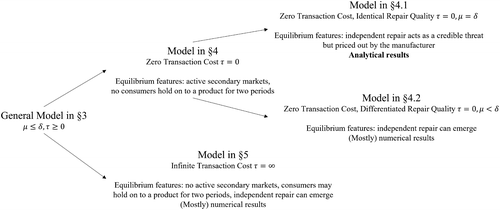
The general model formulated in this section captures a rich set of consumer behavior (as discussed) but is too complicated to be tractable.2 A key complication is that assuming a general transaction cost may create segments of consumers who both hold on to used products and trade used products on the secondary market. However, the fundamental economics of these two behaviors are similar. First, the (second period) use value of a product, as with the resale value of a product, essentially reinforces consumers’ willingness to pay for a new product up front (the value enhancement effect). Second, consumers who hold on to an existing product, similar to those who buy a used product from the secondary market, are essentially substituting a used product for a new product (the demand cannibalization effect). In light of these similarities, it may suffice for a model to capture only one of these behaviors. To that end, we analyze two extreme scenarios of transaction costs: in Section 4, we consider zero transaction cost, which can be shown to eliminate consumers’ incentives to hold on to a used product for a second period (in such a model, only segments I and VI–VIII from Section 3.1 may arise in equilibrium); in Section 5, we consider infinite transaction cost, which precludes resale in its entirety (in such a model, only segments I, II, IV, V, and VIII from Section 3.1 may arise in equilibrium). We show that these two cases generate qualitatively similar insights into how the right to repair affects prices, consumers, and the environment. Figure 1 illustrates the analysis road map and key equilibrium features of each case.
4. Zero Transaction Cost (τ = 0)
In this section, we set the transaction cost to zero, that is, τ = 0. We take a two-pronged approach. In Section 4.1, we consider a limiting case of manufacturer and independent repair having identical quality, that is, . This model admits explicit analytical solutions and, as a first cut, cleanly highlights the key consequences of the right to repair. (We caution that the special case considered in Section 4.1 gives rise to the result of independent repair acting as a credible threat but not exercised in equilibrium and immediate reselling of products after a repair. Whereas these outcomes may seem to contradict the usual premise of RTR, they are merely by-products of the conditions of this special case to allow for tractable analysis. They have limited impact on the key insights based on further analysis in Sections 4.2 and 5.) In Section 4.2, we consider a case of independent repair being inferior to manufacturer repair in quality, that is, , and numerically demonstrate the robustness of our insights.
4.1. Identical Repair Quality ()
When , the two secondary markets (one for each quality level) in the general model reduce to one, and we denote the used product price on the secondary market by pu, that is, . Moreover, because trading in the secondary market is frictionless (τ = 0), holding on to a functional used product for a second period use is equivalent to selling it and buying it back from the secondary market. Lemma 1 shows that doing so is never optimal for consumers as has been established in the literature (e.g., Hendel and Lizzeri 1999). Lemma 1 further shows that, when and τ = 0, only three consumer segments arise in equilibrium.
There exist with such that consumers with are inactive, and their per-period utility is ; consumers with buy a used product every period, and their per-period utility is ; consumers with buy a new product every period, and their per-period expected utility is .
For consumers with , if their product does not fail after one period of use (which occurs with probability ), then they sell it on the secondary market at price pu; if the product fails (which occurs with probability f), then they decide on their repair probability as follows.
If (i.e., the gain from selling a functional used product exceeds the cost of repair), consumers repair the failed product and sell it on the secondary market with probability α = 1 for a net profit . Because all consumers who experience a product failure seek repair in this case, we refer to it as full repair.
If , no consumers repair (i.e., α = 0). We refer to this case as no repair.
If , then consumers are indifferent to repair and play a mixed strategy by choosing to repair and resell with probability . In particular, if α = 0 (α = 1), then there is no repair (full repair); if , then only a fraction of consumers who experience a product failure seek repair and we refer to such a case as partial repair.
Thresholds θ1 and θ2 satisfy the indifference conditions: and . The market-clearing condition to determine pu is
Note that ; that is, the “buy used” segment is weakly smaller than the “buy new” segment; this is because those who buy new may not always sell their products after one period of use on the secondary market (as they may forgo repair in the event of a product failure).
The manufacturer’s pricing problem is
We impose the following assumptions in our subsequent analytical derivation.
(i) ; (ii) .
Assumption 1(i) requires that the manufacturer’s repair cost be lower than the maximum value of a repaired product; it rules out the uninteresting case in which repair is so costly that it is never provided by the manufacturer or performed independently by consumers. Assumption 1(ii) requires the production cost be not too high and, thus, ensures the manufacturer can make a profit.
4.1.1. Equilibrium.
We solve the manufacturer’s pricing problem and characterize the equilibrium outcomes in Proposition 1.
(Equilibrium). The manufacturer’s optimal new product price , repair price , the resulting used product price in the secondary market , and the consumers’ repair probability are summarized in Table 1.
|

Table 1. Equilibrium Prices and Repair Probability
| Conditions | |||||
|---|---|---|---|---|---|
| 0 | |||||
| 0 | 1 | ||||
| 0 | |||||
| cI | 0 | ||||
| cI | cI | ||||
| 0 | 1 |
Note. . are constant in cI and are increasing in cI.
Figure 2 illustrates Proposition 1, which, on the high level, shows that full repair arises when the production cost is high; partial repair arises when the production cost is intermediate; and no repair arises when the production cost is low. We explain the results in more detail as follows.
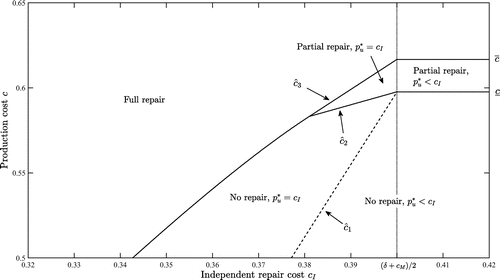
Note. f = 0.25, .
First consider the case of the independent repair cost being high enough () that it does not influence the manufacturer’s pricing decisions (i.e., because independent repair is such a costly option to consumers, the manufacturer can act as if it is unavailable).
When the production cost is low (), it is cheap to churn out new products, and thus, the new product price can be set relatively low to attract consumers. In this case, it is in the manufacturer’s best interest to sell new products but preclude repair. Repaired products increase the supply in the secondary market and put a downward pressure on the used product price, which, in turn, increases consumer demand for used products, cannibalizing new product sales. Hence, a manufacturer who can sell new products cost-effectively should eliminate repair altogether. One implementation of this strategy is to charge an exorbitantly high repair price that deters repair, which is indeed believed to be a common strategy used in practice (Keck 2019).
When the production cost is intermediate (), relying on new product sales only is not advisable because the manufacturer cannot set a product price as low as before to attract sufficient demand. Whereas offering an after-sales repair service cannibalizes some new product sales, doing so generates additional profit that supplements the otherwise insufficient profit from selling new products. The new product and repair prices should be set to induce an equilibrium in which the used product price is exactly equal to the repair price. Consumers are, thus, indifferent to repair and play a mixed repair strategy. Thus, a partial-repair equilibrium emerges.
When the production cost is high (), the new product price is inevitably high, causing low demand for new products. In this case, the manufacturer can offer the repair service as a means to strengthen consumers’ willingness to pay for the (high-priced) product and stimulate demand. It is optimal for the manufacturer to give out the repair service for free such that all consumers who experience a product failure seek repair from the manufacturer. A free repair service enhances the resale value of a product in the event of a product failure, enabling the manufacturer to charge a higher new product price up front that factors in the repair cost it may later incur in service provision. Thus, full repair emerges in equilibrium. Such a strategy can be interpreted as a (lifetime) warranty or a form of servicization that integrates service into product sales. In general, as new products become more expensive to produce, the manufacturer has a stronger incentive to make its product last longer and, thus, increasingly facilitates repair.
Next, we consider the case in which the independent repair cost is not too high () and can pose a threat to the manufacturer. Notably, when the production cost is intermediate, the threat of independent repair indeed kicks in, compelling the manufacturer to adjust prices.
Specifically, when the production cost is intermediately low (), a no-repair equilibrium arises, but the structure of the equilibrium is different than that of the previous no-repair equilibrium under . Here, in order to prevent consumers from seeking independent repair (which is now less expensive), the manufacturer must lower the new product price (relative to the one charged in the previous no-repair equilibrium) to induce a low enough used product price (such that consumers do not bother with repair, i.e., ). Failure to do so (i.e., ) triggers too much repair that cannibalizes new product sales. Likewise, when the production cost is intermediately high (), there is a new partial-repair equilibrium in which the manufacturer has to ensure not only that its repair price matches the independent repair cost to capture the repair profit, but also that it cuts the new product price (relative to the one charged in the previous partial-repair equilibrium under ) low enough to induce a sufficiently low used product price that discourages some consumers from seeking repair.
We also show in Proposition 1 (see Figure 2 for an illustration) that the cutoff values on the production cost are all weakly increasing in the independent repair cost cI. This implies that, as independent repair gets less costly, the no-repair equilibrium becomes harder to maintain, whereas the full-repair equilibrium becomes more widespread, which is intuitive.3
4.1.2. Impact of the Right to Repair.
Next, we build on the equilibrium characterization in Proposition 1 and study how a decrease in the independent repair cost cI because of the right-to-repair legislation affects the manufacturer’s profit, product prices, consumer surplus, social welfare, and the environmental impact.
Proposition 2 examines the manufacturer’s profit.
(Profit). As independent repair cost cI decreases because of the right-to-repair legislation, the manufacturer’s profit π weakly and continuously decreases.
Proposition 2 is intuitive: less costly independent repair undermines the manufacturer’s repair revenue and cannibalizes new product sales, which only hurts the manufacturer’s profit. This result helps explain why many manufacturers fiercely lobby against the right-to-repair bills. Whereas the profit implication is straightforward, how the manufacturer adjusts prices to mitigate the profit loss is more subtle as shown in Proposition 3.
(Prices). As independent repair cost cI decreases because of the right-to-repair legislation, the repair price (weakly) decreases, and there exists such that
If , then both and (weakly) decrease.
If , then both and first (weakly) decrease and then (weakly) increase; technically, there exists such that both and (weakly) decrease as cI decreases for ; ; both and are constant in cI for .
If , then both new product price and used product price are constant.
Proposition 3 first shows that, as independent repair cost falls, so does the manufacturer’s repair price. This result is consistent with the intuition that the right-to-repair legislation will regulate the repair market, not only making independent repair more accessible, but also manufacturer repair more affordable. Next, we turn to the comparative statics of the new and used product prices, which are illustrated by Figure 3.
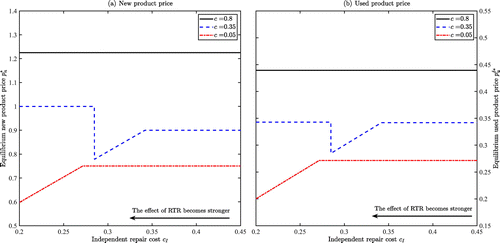
Note. f = 0.25, .
When the production cost is low (), a lower independent repair cost leads to lower new and used product prices. In this case, as shown by Proposition 1, a no-repair equilibrium arises if the independent repair cost is prohibitively high. However, as independent repair gets less costly, the threat of consumers turning to independent repair eventually kicks in, potentially ruining the no-repair equilibrium. To mitigate the cannibalization effect of repair on new product sales, the manufacturer adopts a volume strategy and cuts the new product price. Doing so prompts more consumers to buy new products, and this increased output of new products translates into more supply of used products in the secondary market, inducing a lower used product price, thereby disincentivizing repair. As a result, the manufacturer may manage to maintain the no-repair outcome in equilibrium or at least limit the volume of repair (as also pointed out in the explanation of Proposition 1).
The most intriguing price response occurs when the production cost is intermediate (), in which case, as independent repair gets cheaper, the new and used product prices initially decline and then jump up after the independent repair cost falls below a certain threshold. As in the case of a low production cost, the manufacturer initially responds to cheaper independent repair by lowering the new product price, but now producing new products becomes more expensive, and a lower price would further erode the already thin profit margin. Thus, price cutting can only do so much to guard against independent repair. As the cost of independent repair further declines, repair gets increasingly harder to prevent. At a certain point, instead of continuing the price cut to circumvent repair, the manufacturer is better off giving away repair for free. Doing so enhances the life-cycle value of a new product by insuring consumers against the risk of product failure. This effect, in turn, enables the manufacturer to raise the new product price and adopt a margin strategy. Whereas opening up repair potentially increases the supply of used products in the secondary market, a higher new product price implies fewer products produced in the first place, thereby counterbalancing the former effect and causing the used product price to rise as well. Hence, knowing repair is too hard to eliminate, the manufacturer switches from a volume strategy that stymies repair to a margin strategy that embraces repair.4
Finally, when the production cost is high (), recall from Proposition 1 that the manufacturer voluntarily offers full repair for free regardless of how costly it is to conduct independent repair. Therefore, in this case, the right-to-repair legislation has no impact on the product prices.
Building on the price response, we examine how the right to repair affects consumer surplus and social welfare. We define consumer surplus (per period) CS to be the sum of each individual’s expected utility: . We define social welfare (per period) SW to be the sum of the manufacturer’s profit and consumer surplus: . Note that, in social welfare, all the money transfers (the new and used product prices as well as the repair price) cancel out with each other; thus, social welfare encapsulates the total net value generated. Recall from Proposition 3 that, when , a change of cI trivially has no impact on the equilibrium outcomes. We hereby focus on Proposition 4 characterizes the impact of the right to repair on consumer surplus and social welfare.
(Consumer Surplus and Social Welfare). As independent repair cost cI decreases because of the right-to-repair legislation, there exists such that
If , then both CS and SW (weakly) increase.
If , then both CS and SW first (weakly) increase and then (weakly) decrease.
Figure 4 illustrates Proposition 4. The welfare implication of the right to repair is closely tied to the manufacturer’s price response (characterized in Proposition 3). In particular, when the production cost is low (), the right-to-repair legislation prompts the manufacturer to lower the new product price, which also induces a lower used product price. These price cuts translate into higher consumer surplus. In fact, the improvement in consumer surplus is substantial enough to make up for the manufacturer’s profit loss, causing social welfare to also increase. In this case, the right-to-repair legislation works exactly as intended (insofar as the economic impact is concerned).
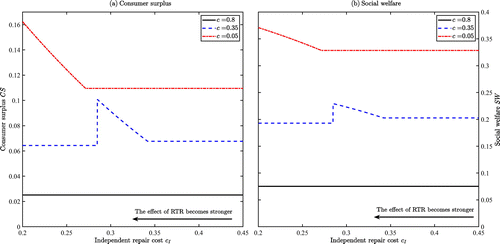
Note. f = 0.25, .
However, when the production cost is intermediate (), a decrease of the independent repair cost because of the right-to-repair legislation has a nonmonotone welfare effect. Similar to the earlier case, consumer surplus and social welfare initially increase, but when the independent repair cost falls below a certain point, both consumer surplus and social welfare decline as the manufacturer raises the new product price in a switch to the margin strategy (see the explanation of Proposition 3). Note that the manufacturer complements the product price adjustment with free repair; that is, the repair price drops to zero. Hence, if one looks at the repair market alone, it is tempting to conclude that consumers are better off, but this reasoning fails to account for the higher product prices consumers have to pay up front.
4.1.2.1. Environmental Impact.
Next, we investigate how the right to repair affects the environmental impact. We take a product life-cycle approach (Agrawal et al. 2012, Atasu and Souza 2013, Agrawal and Bellos 2017) to the environmental impact. We consider three life-cycle phases: production, use (which includes repair), and disposal. The total environmental impact is the sum of the environmental impact in each phase, which is further given by the volume of products in each phase times the per-unit impact in each phase, which we break down.
• Production. Let γp denote the per-unit impact resulting from production of a product. The per-period quantity of new products produced is . Thus, the production impact per period is .
• Use. Let and denote the per-unit, per-period impact resulting from using a new and an old product, respectively. As noted by Agrawal et al. (2012), a particularly relevant case is , which indicates that the use impact of an old product is higher than that of a new one because energy efficiency tends to degrade with use as observed in refrigerators and automobiles (Cooper and Gutowski 2017). The per-period quantity of new products in use is Q; the per-period quantity of old products in use is . Thus, the total use impact per period is .5
• Repair. Let γr denote the per-unit impact of repairing a product, including the energy and materials used in the repair process as well as any possible impact generated in transporting the product for repair. The per-period quantity of failed products that get repaired is . Thus, the repair impact per period is .
• Disposal. Let γd denote the per-unit impact resulting from disposal of an end-of-life product (e.g., e-waste). Thus, the disposal impact per period is .
The resulting total environmental impact per period is given by
For convenience, denote . Proposition 5 characterizes how the three components of the environmental impact, , and R, are affected by the right-to-repair legislation.
(Production, Use, and Repair Volume). As independent repair cost cI decreases because of the right-to-repair legislation, the repair volume R always (weakly) increases, and there exists such that
If , then both Q and Uu (weakly) increase.
If , then Q first (weakly) increases and then (weakly) decreases; if , then Uu (weakly) increases; if , then there exists such that Uu first (weakly) increases and then (weakly) decreases for all .
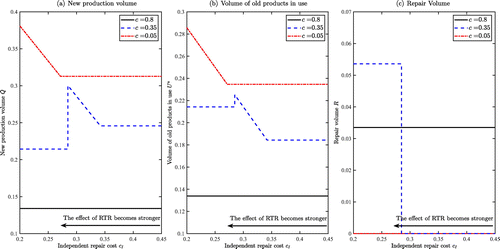
Figure 5 illustrates Proposition 5. Naturally, the right-to-repair legislation increases the repair volume and, thus, the repair impact. However, the changes of the new production volume and used product volume are more subtle and, again, closely tied to the manufacturer’s price response (characterized in Proposition 3). In particular, when the production cost is low (), the right-to-repair legislation lowers the product prices. Hence, consumers end up buying more, which increases both the new production volume and the volume of used products traded on the secondary market, and thus, the volume of old products in use also increases. In this case, the environmental impact in each phase increases, and the total environmental impact also unequivocally increases.
Note. f = 0.25, .
When the production cost is intermediate (), a decrease of the independent repair cost resulting from the right-to-repair legislation has a nonmonotone effect on the new production volume. It initially increases (as in the preceding case), but when the independent repair cost falls below a certain point, the manufacturer switches from the volume strategy to the margin strategy (see the explanation of Proposition 3), and therefore, the new production volume declines. As for the volume of old products in use, as with the new production volume, it initially increases, but when the manufacturer switches from the volume strategy to the margin strategy, the volume of old products in use decreases in some cases and keeps increasing in others. The manufacturer’s switch to a high-price/free-repair strategy imposes competing forces on the volume of used products: a downward pressure from a higher used product price versus an upward pressure from more repair (i.e., as more failed products are recovered from repair, more old products are in use instead of being scrapped prematurely). We identify a sufficient condition for the upward pressure to outweigh the downward pressure: δ being not too high. In such a case, a used product does not generate extremely high value, which limits the magnitude of the price hike, and therefore, the upward pressure from more repair becomes a dominant force, causing the used product volume to increase after the switch. However, the opposite is true if δ is high and failure rate f is low (which weakens the upward pressure from more repair because the product rarely fails in the first place).
Altogether, when the production cost is intermediate, if the production or disposal impact dominates a product’s life cycle, then the total environmental impact first increases and then decreases as the independent repair cost falls; if the use impact of the old products dominates and products deteriorate rapidly with use, then the total environmental impact monotonically increases in response to the right-to-repair legislation. Corollary 1 builds on Proposition 5 and summarizes the change of the total environmental impact in response to the right-to-repair legislation.
(Environmental Impact). As independent repair cost cI decreases because of the right-to-repair legislation, there exists such that
When , then (weakly) increases.
When , if γq is sufficiently high, then first (weakly) increases and then (weakly) decreases; if is sufficiently high, then (weakly) increases provided that , and first (weakly) increases and then (weakly) decreases provide that and .
Corollary 1 follows straightforwardly from Proposition 5, and hence, we do not repeat our explanation. Instead, we point out the following. Conventional wisdom may suggest that the right-to-repair legislation, by expanding the useful life of products, reduces production and disposal impacts. Yet the potential price response in the product market may instead drive higher production and disposal impacts. Therefore, the life span of a product is not necessarily an accurate indicator of the environmental impact in each phase of the product life cycle.
4.1.3. Summary.
The right-to-repair legislation is understandably not good news to the manufacturer (Proposition 2); our analysis further suggests that it may not necessarily benefit consumers or the environment either (Proposition 4 and Corollary 1). Whereas our analysis so far examines how consumer surplus and the environmental impact change with a continuous reduction of the independent repair cost cI (because of the right-to-repair legislation), policymakers may be particularly interested in comparing these metrics before and after the legislation is enforced (i.e., comparing them under two specific cI’s). Proposition 6 conducts such a comparison.
(Joint Effects on Consumers and the Environment).
If , then RTR (weakly) benefits consumers but harms the environment.
If , there exists such that
If after RTR, then RTR (weakly) benefits consumers but harms the environment.
If after RTR, then RTR (weakly) harms consumers; if γq is sufficiently high, then RTR (weakly) benefits the environment; if is sufficiently high, then RTR (weakly) harms the environment provided that .
Proposition 6 shows that the right-to-repair legislation can lead to a win–lose, a lose–win, or a lose–lose outcome for consumers and the environment, depending on the market conditions. When the production cost is low, the right to repair is a win–lose proposition, increasing consumer surplus and also increasing the environmental impact. This can be applicable to relatively low-cost products whose environmental impact is mostly generated in the production and disposal phases, such as cellphones (Kuehr et al. 2003) and LED monitors (Bhakar et al. 2015), or those whose environmental impact is dominated by the use phase, such as microwaves (Chen et al. 2017) or similar small kitchen appliances.
When the production cost is intermediate, the right to repair can still be a win–lose proposition provided that the independent repair cost after the right-to-repair legislation is not too low. Otherwise, consumers are worse off, and the directional change of the environmental impact potentially depends on which phase of the product life cycle is the main contributor to the environmental impact, among others. If the production and disposal phases dominate (e.g., high-end computers; Kuehr et al. 2003), then the right to repair reduces the environmental impact, leading to a lose–win outcome. Figure 6(a) illustrates this case. If the environmental impact is primarily generated in the use phase (e.g., automobiles, refrigerators, tractors; Lee et al. 2000, Cooper and Gutowski 2017) and products deteriorate rapidly with use, then the right to repair increases the environmental impact, leading to a lose–lose outcome; if products deteriorate modestly with use and are unlikely to fail, then the right to repair increases (decreases) the environmental impact if the independent repair cost before the right-to-repair legislation is high (already low) as illustrated by Figure 6(b).
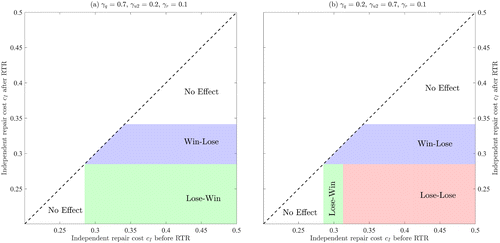
Notes. f = 0.25, , c = 0.35. “Win–Lose” means RTR benefits consumers but hurts the environment; “Lose–Win” means RTR hurts consumers but benefits the environment. “Lose–Lose” means RTR hurts both consumers and the environment.
To further illustrate how to put this result into context, consider the following example. In 2012, the Motor Vehicle Owners’ Right to Repair Act was passed in Massachusetts, but it did not cover telematics systems. In 2020, an amendment to the law addressed this issue and required an open-access data platform for cars sold in the state starting with the model year 2022 (Robertson 2020). In light of our analysis, one may argue that the initial bill in 2012 (which can be seen as reducing the independent repair cost to a moderate level) might have benefited consumers (albeit to the detriment of the manufacturer and the environment), but the amendment in 2020 (which can be seen as further reducing the independent repair cost) might have unintentionally created a lose–lose–lose outcome for all three parties.6
Because reducing cI can backfire, lawmakers may be interested in finding the optimal cI that balances economic and environmental interests, that is, finding a cI that maximizes the following aggregate metric: , where SW is social welfare (manufacturer profit plus consumer surplus), is the total environmental impact, and is the weight on social welfare. Our existing results can provide guidance for the selection of the optimal cI. When the production cost is low, if economic efficiency is the primary concern (i.e., if κ is close to one), then cI should be as low as possible (because a lower cI increases social welfare); as the emphasis shifts toward the environment (i.e., as κ decreases), the optimal cI increases accordingly. However, this is not always the case. When the production cost is intermediate and the environmental impact is primarily generated in the production and disposal phases, a growing focus on the environment reduces the optimal cI because the environmental impact is minimized when cI is minimized. In sum, whereas reducing cI is hardly welfare-improving and environmentally favorable at the same time, maximizing the aggregate metric nevertheless requires cI to be as low as possible in many cases, which points to the value of the right to repair despite the challenge of pleasing all stakeholders. Online Appendix E presents further numerical illustration of how the optimal cI varies with the model parameters.
We acknowledge that one limitation of this model is that independent repair only acts as a credible threat for the manufacturer but is never exercised by consumers in equilibrium. This is because the model is a limiting case that assumes away possible quality differentiation between manufacturer and independent repair. The model in the next section addresses this issue.7
4.2. Differentiated Repair Quality ()
In this section, we allow independent repair to be differentiated from (and, in particular, inferior to) manufacturer repair in quality, that is, . We relegate the technical details of this model to Online Appendix B but highlight that one palatable feature of this model is that independent repair can arise and may coexist with manufacturer repair in equilibrium as demonstrated by the numerical examples in Online Appendix B. Moreover, we present numerical evidence in Online Appendix B that our main insights derived in Section 4.1 are largely preserved.
Our findings may cast a different light on the manufacturers’ narrative that the right to repair can hurt consumers because independent repair produces subpar products relative to manufacturer repair (Keck 2019, Reimer 2020). As in the model with identical repair quality in Section 4.1, the model with differentiated repair quality also contains instances in which consumer surplus and social welfare are lower (and, in general, change nonmonotonically) as the independent repair cost falls. However, this inefficient outcome is less attributed to independent repair being inferior than it is to the manufacturer’s strategic price response (because, as shown in Section 4.1, even if independent repair is not inferior, consumers are still not insulated from the potential welfare loss, and as shown here, even if independent repair is inferior, consumer surplus can still increase as a result of the manufacturer’s price cut). Hence, manufacturers’ narrative may (intentionally or inadvertently) shift the blame away from the first order driving force.
5. Infinite Transaction Cost ()
In this section, we set the transaction cost to infinity, that is, . An infinitely high transaction cost shuts down the secondary market altogether. We relegate the technical details of this model to Online Appendix C but highlight some key features. Specifically, for a consumer who buys a new product, after one period of use, if the product does not fail, then the consumer must decide whether to keep using it for a second period or throw it away and buy a new one; if the product fails, then the consumer must decide whether to seek manufacturer repair, independent repair, or forgo repair and buy new. Desirable features of this model include (1) repair is for self-use rather than for resale, and (2) both independent repair and holding on to a functional used product can arise as equilibrium outcomes.
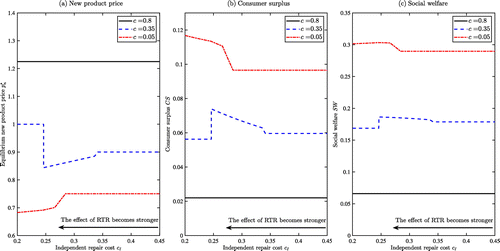
We numerically explore this model and present illustrative examples. Figure 7 shows how the new product price, consumer surplus, and social welfare change with the independent repair cost for different levels of production cost. We observe that the trends of these metrics are qualitatively consistent with those of their counterparts for the model in Section 4.1 (illustrated by Figures 3 and 4).
Note. f = 0.25, .
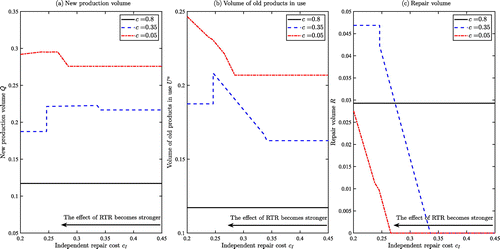
Figure 8 presents the trends of various components of the environmental impact (namely, new production volume, volume of old products in use, and repair volume). We find that the trends of these metrics are largely consistent with those of their counterparts for the model in Section 4.1 (illustrated by Figure 5). Interestingly, we observe from Figure 8(a) that, when the product cost is low (c = 0.05), a lower cI because of the RTR legislation may (mildly) reduce the new production volume despite the manufacturer’s price cut (as illustrated in Figure 7(a)). In such a case, the right to repair may benefit both consumers (as illustrated in Figure 8(b)) and the environment. However, numerically, the reduction of the new production volume is quite modest; further, in this case, the used product volume and repair volume both increase, which implies that the total environmental impact is unlikely to decrease much if at all.
Note. f = 0.25, .
6. Endogenizing Durability
In this section, we study an extension in which the manufacturer can determine the durability of the product by controlling both failure rate f and desirability of used products δ. A more durable product is less likely to fail (i.e., a lower f) and deteriorates less rapidly with use (a higher δ). Thus, we assume f and δ are linked through a decreasing function: . Further, a more durable product requires a higher unit cost of production. Hence, we assume the unit production cost is an increasing quadratic function of δ: , where and . Such a quadratic functional form reflects diminishing returns on durability and is commonly used in the literature (e.g., Agrawal et al. 2012, 2016; Huang et al. 2019).8
We conduct a numerical study to investigate how a lower independent repair cost cI (as a result of the right-to-repair legislation) influences the manufacturer’s durability choice based on the model in Section 4.1.9Figure 9(b) and Figure 9(c) illustrate our findings. We observe that, when c0 is relatively high, the manufacturer chooses low durability (a low δ and high f) to keep the production cost in check, and because production is not cheap, the manufacturer provides free repair to prevent the product from being scrapped prematurely. Thus, cI does not influence the durability choice. However, when c0 is intermediate, the manufacturer reduces product durability as cI falls; when c0 is low, the manufacturer initially reduces and then increases durability.
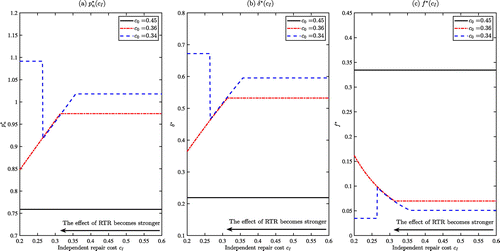
Note. , η = 5, .
We further observe from Figure 9(a) that the new product price changes with the independent repair cost in the same pattern as durability, suggesting that the manufacturer’s pricing strategy and durability strategy complement each other. Moreover, the trends observed resemble the price response in the base model in which durability is fixed. The rationale is indeed similar. Generally, in designing product durability, the manufacturer faces the trade-off between increasing consumer valuation of new products (which calls for a more durable product) and reducing cannibalization from old products (which calls for a less durable product). Specifically, the manufacturer responds to the reduction of the independent repair cost by first cutting the new product price and, when durability is endogenous, complements the lower price with lower durability to further limit cannibalization from used products. When the independent repair cost further declines and falls below a certain threshold, the manufacturer raises the new product price and, when durability is endogenous, complements the higher price with higher durability to further strengthen consumer valuation.
As both the product price and durability can change nonmonotonically with the independent repair cost, so can consumer surplus, social welfare, and the environmental impact. Online Appendix D reports the changes of these metrics and shows that the trends under endogenous durability are largely consistent with those under exogenous durability. One observation to note is that, even in cases in which product prices monotonically decrease as the independent repair cost falls (e.g., the case of in Figure 9), consumer surplus and social welfare may still decline (or, in general, change nonmonotonically) because the product also becomes less durable.
7. Conclusion
The right-to-repair movement calls for government legislation that requires manufacturers to provide more support and make it easier for consumers to repair their own products. The right-to-repair legislation would understandably hurt manufacturer profit, but it is less clear how manufacturers would adjust product prices (and redesign product durability) in an attempt to mitigate the (inevitable) profit loss once the bill is enacted and what the welfare and environmental implications are. Conventional wisdom suggests that giving consumers the right to repair benefits consumers, improves overall social efficiency (although to the detriment of manufacturers), and reduces the environmental impact. Our research challenges these intuitive predictions. We find that, when the unit production cost is on the low end (e.g., cellphones, microwaves), the right to repair benefits consumers but harms the environment. This continues to be the case for an intermediate production cost provided that the postlegislation independent repair cost is not too low. Otherwise, consumers are worse off, and the environmental impact decreases if it is mostly generated in the production and disposal phases (e.g., high-end computers), but can nevertheless increase if the use impact dominates (e.g., cars, tractors, refrigerators), leading to a lose–lose–lose outcome for manufacturers, consumers, and the environment. Our results tell a cautionary tale and urge legislative authorities to factor in the inextricable link between the repair and product markets in their assessment of the right to repair.
Whereas our life-cycle analysis of the environmental impact captures the first-order effect, it is certainly not meant to incorporate all the ramifications. For instance, one may argue that, if consumers opt to buy a new phone, they will fiddle with it more, potentially generating more use impact than if they buy a used one. This effect could be easily captured in our model by making an upward adjustment of the per-unit, per-period use impact of new products. On a different note, real-world used goods markets may include more refined segments than our model does. One example is refurbished products, which are likely to generate a higher consumption utility than nonrefurbished ones but also are sold at a higher equilibrium price (Oraiopoulos et al. 2012). Refurbishment also generates additional environmental impact.
The current analysis assumes the manufacturer is a monopolist in the product market. It approximates settings in which the manufacturer has sufficient market power, which most durable goods producers do (Waldman 2003). An interesting direction for future research is to study competing manufacturers and, specifically, whether the right to repair softens or stiffens competition in the product market. Relatedly, the focus of our paper is on the right to repair’s ability to make independent repair less costly, leaving open the possibility that the legislation may have other effects that are not captured through the independent repair cost. We hope our work can inspire more future research on the topic of the right to repair and more broadly on sustainable product-service systems.
The authors are grateful to Department Editor Charles Corbett, an anonymous associate editor, and three anonymous reviewers for their detailed comments in the review process that have greatly improved the paper. The authors also thank Vishal Agrawal for being a discussant of the paper at the 2020 Early Career Sustainable Operations Workshop and Baojun Jiang for being a discussant of the paper at the 16th annual Frank M. Bass Frontiers of Research in Marketing Science Conference in 2022. The paper was a finalist of the 2021 INFORMS Service Science Best Student Paper Award. The authors are listed in alphabetical order.
1 For ease of exposition, our presentation in the main paper restricts attention to the parameter condition , but we give a complete characterization of for all possible parameter conditions in the proof of Online Lemma G.1. The complication is that the ordering of segment III relative to the other segments is parameter-dependent.
2 Solving the manufacturer’s pricing problem to optimality in the general model is intractable even numerically because it is a highly nonconcave maximization problem in the (pn, pr) space, potentially with thousands of local optima.
3 Our numerical exploration further suggests that, as either δ or f increases, the no-repair region in the space shrinks and the full-repair region expands. This is because, as δ increases, the life-cycle value of a product increases; to take advantage of this, the manufacturer leans toward more repair. On the other hand, as f increases, the product is more likely to fail, and hence, it opens up more opportunities for repair, which the manufacturer capitalizes on to either generate additional profit or strengthen the life-cycle product valuation.
4 On a technical note, when , the volume strategy (which has ) yields exactly the same profit as the full-repair margin strategy (which would take over to be optimal if ). Thus, although there is a price jump at , the profit is still a continuous function of cI as pointed out in Proposition 2.
5 For clarity, we separate the repair impact from the use impact.
6 The illustration is merely to help the reader contextualize our theoretical results. It is not meant to calibrate actual outcomes in practice, which is beyond the scope of our paper.
7 A model with heterogeneous independent repair costs can also address this issue and is presented in Online Appendix F.
8 Our specification of is exactly the same as that in Agrawal et al. (2012) and slightly more general than that in Agrawal et al. (2016), who consider only the quadratic term but assume away the intercept. Huang et al. (2019) also incorporate an interaction term of durability and recyclability in addition to the intercept and quadratic term.
9 We also endogenize durability based on the model in Section 5 and present the results in Online Appendix D. We find that two key findings from this section continue to hold: (1) product durability may first decrease and then increase as cI declines, and (2) product price and durability complement each other.
References
- (2017) The potential of servicizing as a green business model. Management Sci. 63(5):1545–1562.Link, Google Scholar
- (2019) OM forum—New opportunities for operations management research in sustainability. Manufacturing Service Oper. Management 21(1):1–12.Link, Google Scholar
- (2016) The limits of planned obsolescence for conspicuous durable goods. Manufacturing Service Oper. Management 18(2):216–226.Link, Google Scholar
- (2012) Is leasing greener than selling? Management Sci. 58(3):523–533.Link, Google Scholar
- (2020) Extended producer responsibility for durable products. Manufacturing Service Oper. Management 22(2):364–382.Link, Google Scholar
- (2013) How does product recovery affect quality choice? Production Oper. Management 22(4):991–1010.Crossref, Google Scholar
- (2008) Remanufacturing as a marketing strategy. Management Sci. 54(10):1731–1746.Link, Google Scholar
- (2016) Apple is fighting a secret war to keep you from repairing your phone. Huffington Post Online (June 9), https://www.huffpost.com/entry/apple-right-to-repair_n_5755a6b4e4b0ed593f14fdea.Google Scholar
- (2012) Dynamic Programming and Optimal Control, vol. II, 4th ed. (Athena Scientific, Nashua, NH). Google Scholar
- (2015) Life cycle assessment of CRT, LCD and LED monitors. Procedia CIRP 29:432–437.Crossref, Google Scholar
- (2017) Product carbon footprint assessment supporting the green supply chain construction in household appliance manufacturers. IOP Conf. Ser. Earth Environ. Sci. 94:012142.Crossref, Google Scholar
- (1997) Competing in product and service: A product life-cycle model. Management Sci. 43(4):535–545. Link, Google Scholar
- (2017) The environmental impacts of reuse: A review. J. Indust. Ecology 21(1):38–56.Crossref, Google Scholar
- (2005) Market segmentation and product technology selection for remanufacturable products. Management Sci. 51(8):1193–1205.Link, Google Scholar
- (2008) Queuing for expert services. Management Sci. 54(8):1497–1512.Link, Google Scholar
- (1999) Optimal warranties, reliabilities and prices for durable goods in an oligopoly. Eur. J. Oper. Res. 112(3):554–569.Crossref, Google Scholar
- (1998) Leasing and selling: Optimal marketing strategies for a durable goods firm. Management Sci. 44(11):S19–S34.Link, Google Scholar
- (1999) Competition in durable goods markets: The strategic consequences of leasing and selling. Marketing Sci. 18(1):42–58.Link, Google Scholar
- (2019) Here’s one reason the U.S. military can’t fix its own equipment. The New York Times Online (November 20), https://www.nytimes.com/2019/11/20/opinion/military-right-to-repair.html.Google Scholar
- (2017) Hand me that wrench: Farmers and Apple fight over the toolbox. Time Online (June 22), https://time.com/4828099/farmers-and-apple-fight-over-the-toolbox/.Google Scholar
- (2022) Warranty length, product reliability, and secondary markets. Manufacturing Service Oper. Management, ePub ahead of print January 27, https://pubsonline.informs.org/doi/10.1287/msom.2021.1062.Link, Google Scholar
- (2014a) No claim? Your gain: Design of residual value extended warranties under risk aversion and strategic claim behavior. Manufacturing Service Oper. Management 17(1):87–100. Link, Google Scholar
- (2014b) Flexible duration extended warranties with dynamic reliability learning. Production Oper. Management 23(4):645–659.Crossref, Google Scholar
- (2020) European parliament vote takes another big step toward “right to repair” rules. The Verge Online (November 25), https://www.theverge.com/2020/11/25/21719701/european-parliament-right-to-repair-resolution-hardware-eu-commission-2021.Google Scholar
- (1976) Optimal price and protection period decisions for a product under warranty. Management Sci. 22(12):1381–1390.Link, Google Scholar
- (2016) Service competition and product quality in the U.S. automobile industry. Management Sci. 62(7):1860–1877.Link, Google Scholar
- (2012) Impact of performance-based contracting on product reliability: An empirical analysis. Management Sci. 58(5):961–979.Link, Google Scholar
- (2018) Design incentives under collective extended producer responsibility: A network perspective. Management Sci. 64(11):5083–5104.Link, Google Scholar
- (2019a) Climate change: “Right to repair” gathers force. BBC Online (January 9), https://www.bbc.com/news/science-environment-46797396.Google Scholar
- (2019b) EU brings in “right to repair” rules for appliances. BBC Online (October 1), https://www.bbc.com/news/business-49884827.Google Scholar
- (2012) Retail strategies for extended warranty sales and impact on manufacturer base warranties. Decision Sci. 43(2):341–367.Crossref, Google Scholar
- (1999) Interfering with secondary markets. RAND J. Econom. 30(1):1–21.Crossref, Google Scholar
- (2019) Design implications of extended producer responsibility for durable products. Management Sci. 65(6):2573–2590.Link, Google Scholar
- (2001) A theory of finitely durable goods monopoly with used-goods market and transaction costs. Management Sci. 47(11):1515–1532.Link, Google Scholar
- (2013) Optimal contracts for outsourcing of repair and restoration services. Oper. Res. 61(6):1295–1311.Link, Google Scholar
- (2018) Collaborative consumption: Strategic and economic implications of product sharing. Management Sci. 64(3):1171–1188.Link, Google Scholar
- (2019) Right to repair is less complicated and more important than you might think. Gizmodo Online (May 10), https://gizmodo.com/right-to-repair-is-less-complicated-and-more-important-1834672055.Google Scholar
- (2007) Performance contracting in after-sales service supply chains. Management Sci. 53(12):1843–1858.Link, Google Scholar
- (1999) Repair market structure, product durability, and monopoly. Australian Econom. Papers 38(4):343–353.Crossref, Google Scholar
- (2003) Computers and the Environment—An Introduction to Understanding and Managing their Impacts (Springer, Dordrecht, Netherlands).Crossref, Google Scholar
- (2000) Life cycle assessment of tractors. Internat. J. Life Cycle Assessment 5:205–208.Crossref, Google Scholar
- (1999) Adverse selection in durable goods markets. Amer. Econom. Rev. 89(5):1097–1115.Crossref, Google Scholar
- (2019) What affects the secondhand value of smartphones: Evidence from eBay. J. Indust. Ecology 23(3):549–559.Crossref, Google Scholar
- (1992) Durable goods monopoly and maintenance. Internat. J. Indust . Organ. 10(1):65–79.Crossref, Google Scholar
- (2016) The fight for the “right to repair.” Smithsonian Magazine Online (July 13), https://www.smithsonianmag.com/innovation/fight-right-repair-180959764/.Google Scholar
- (2012) Relicensing as a secondary market strategy. Management Sci. 58(5):1022–1037.Link, Google Scholar
- (2019) Is servicization a win-win strategy? Profitability and environmental implications of servicization. Manufacturing Service Oper. Management 21(3):674–691.Link, Google Scholar
- (2009) Effects of e-waste regulation on new product introduction. Management Sci. 55(3):333–347.Link, Google Scholar
- (2020) Right to repair or an automotive safety threat? Forbes Online (September 20), https://www.forbes.com/sites/bryanreimer/2020/09/20/right-to-repair-or-an-automotive-safety-threat/?sh=5f97ee5d7f94.Google Scholar
- (2019) Apple is hobbling iPhones with batteries replaced outside of authorized repair shops. Is that even legal? Fortune Online (August 9), https://fortune.com/2019/08/09/apple-iphone-battery-replacement-percentage-right-to-repair/.Google Scholar
Reuters (2020) Auto group sues to block Massachusetts “right to repair” ballot. (November 20), https://www.reuters.com/article/usa-election-automakers-massachusetts/auto-group-sues-to-block-massachusetts-right-to-repair-ballot-idUSL1N2I62ON.Google Scholar- (2020) Massachusetts passes “right to repair” law to open up car data. The Verge Online (November 4), https://www.theverge.com/2020/11/4/21549129/massachusetts-right-to-repair-question-1-wireless-car-data-passes.Google Scholar
- (2019) Apple effectively has a monopoly on fixing your iPhone. There’s now a fight to change that. Vox Online (July 3), https://www.vox.com/the-goods/2019/7/3/18761691/right-to-repair-computers-phones-car-mechanics-apple.Google Scholar
- (2018) Consumer decisions to repair mobile phones and manufacturer pricing policies: The concept of value leakage. Resources Conservation Recycling 133:101–111.Crossref, Google Scholar
- (2020) Ventilator manufacturers don’t let hospitals fix their own devices. Business Insider Online (June 3), https://www.businessinsider.com/ventilator-manufacturers-dont-let-hospitals-fix-coronavirus-right-to-repair-2020-5.Google Scholar
- (2019) Sidestepping apple: The third-party tinkerers fighting for your right to repair. The Guardian Online (May 8), https://www.theguardian.com/technology/2019/may/08/sidestepping-apple-the-third-party-tinkerers-fighting-for-your-right-to-repair.Google Scholar
- (2018) “Right-to-repair” advocates claim major victory in new smartphone copyright exemption. The Washington Post Online (October 26), https://www.washingtonpost.com/technology/2018/10/26/right-repair-advocates-claim-major-victory-new-smartphone-copyright-exemption/.Google Scholar
The Economist (2017) A “right to repair” movement tools up—If it’s broken, you can’t fix it. (September 30), https://www.economist.com/business/2017/09/30/a-right-to-repair-movement-tools-up.Google Scholar- (2021) Manufacturer’s entry in the product-sharing market. Manufacturing Service Oper. Management 23(3):553–568.Link, Google Scholar
- (2006) Durable-goods warranties and social welfare. J. Law Econom. Organ. 22(2):508–522.Crossref, Google Scholar
- (2018) Recycling is not the answer to the e-waste crisis. Forbes Online (October 29), https://www.forbes.com/sites/vianneyvaute/2018/10/29/recycling-is-not-the-answer-to-the-e-waste-crisis/#426a37ee7381.Google Scholar
- (2003) Durable goods theory for real world markets. J. Econom. Perspect. 17(1):131–154.Crossref, Google Scholar
- (2014) You gotta fight for your right to repair your car. The Atlantic Online (February 13), https://www.theatlantic.com/technology/archive/2014/02/you-gotta-fight-for-your-right-to-repair-your-car/283791/.Google Scholar
- (2018) Trade-in remanufacturing, customer purchasing behavior, and government policy. Manufacturing Service Oper. Management 20(4):601–616.Link, Google Scholar

