


Is Adopting Mass Customization a Path to Environmentally Sustainable Fashion?
Abstract
Problem definition: In high-product-variety businesses like fashion, mass production (MP) systems create environmental waste in the form of overproduction on a colossal scale. Mass customization (MC) has been proposed—without solid evidence—as a solution. In this paper, we analyze whether MC can indeed offer a win-win solution that helps both the bottom line and the environment. We also study the impact of three real policy options: promoting MC, charging a disposal fee for overproduction, and recycling. Academic/practical relevance: There is increasing interest in mass-customizing fashion goods, not only because consumers value customization, but also because MC is perceived to be environmentally friendly. Our paper puts this advocacy for MC to the test. We contribute to the literature, which has been largely silent on the issue, by uncovering when MC offers a win-win and relating such market outcomes to policy ideas. Methodology: We develop an analytical model of an MP firm adopting MC (going hybrid). The firm’s profit-maximizing variety, price, and inventory decisions then form the basis of our understanding the environmental impact of adopting MC and assessing various policy options. Results: Adopting MC can be a win-win, but it can also increase overproduction and hurt the environment. Our policy analyses reveal two kinds of insights. The first kind is about whether a policy expands win-win outcomes—encouraging sustainable adoption of MC. Among the policy ideas we explore, only promoting MC so as to increase consumers’ tolerance for waiting for mass-customized products can do that unambiguously. The second kind of insight is about whether a policy reduces the hybrid firm’s environmental impact. Only a disposal fee and costly recycling programs can do that unambiguously. Managerial implications: For MC adoption to be a win-win, policy makers must (1) work on convincing consumers to wait for bespoke fashion; (2) target MP firms with low cost of variety (high product-mix flexibility) with disposal fees or costly recycling programs; and (3) encourage those with relatively higher cost of variety to develop/acquire technology that would make recycling profitable.
History: This paper has been accepted for the Manufacturing & Service Operations Management Special Section on Responsible Research in Operations Management.
Supplemental Material: The online appendix is available at https://doi.org/10.1287/msom.2022.1088.
1. Introduction
Mass customization (MC) is an operations management paradigm that rivals mass production (MP). It aims to provide very high product variety on demand at affordable prices so that nearly every consumer can buy what they truly want or prefer, rather than settle for some standard product that an MP system delivers. It is often touted as an environmentally friendly way to supply products because it is predicated on making things that consumers actually want, as opposed to making things based on a forecast of what they want. The Ellen MacArthur Foundation (2017, pp. 85–86), for example, advocates for the following idea in a widely circulated white paper as a path for making the “textile economy” more sustainable: “Scale up services to provide increased personalisation of clothes at purchase.” They argue that “[adopting] clothing to individual body shapes and styles, allowing custom-made clothing to be delivered at scale” is technologically feasible and that this would “reduce brands’ need to discount or discard overproduced items.” Moreover, The Business of Fashion and McKinsey (2019, p. 85) predict that “rising take up of on-demand will lead to a spike in personalisation, and a new generation of customised clothing start-ups, creating a new definition of made-to-measure.” Finally, a well-researched popular book, Fashionopolis, devotes almost an entire chapter to three-dimensional (3-D) printing of apparel—one way to achieve MC in fashion (Thomas 2019). Thomas (2019, p. 217) argues that “The true test of 3-D printing has been to see if it could repudiate—and supplant—[mass production] model in a mechanized way” and illustrates the very possibility of this through the work of several high-fashion designers and entrepreneurs.
Such calls to action are consistent with fashion business trends. The fashion industry is increasingly interested in offering “bespoke” fashion—not only because consumers demand personalization and customization, but also because companies can and do market MC as an environmentally friendly, guilt-free way to consume fashion (Wilson 2017, Tosone 2018). To cite a few examples, Red Thread (https://redthreadcollection.com/) offers made-to-measure women’s clothing. J. Hilburn (https://jhilburn.com/) does the same for men. Ermenegildo Zegna, the Italian luxury fashion powerhouse, customizes any of its products (Made for You pages of https://www.zegna.com). Vans, a subsidiary of VF Corporation, sells both mass-produced and mass-customized skateboarding shoes and backpacks. Unmade mass-customizes knitwear to sell through several brands and online fashion platforms (e.g., Farfetch and Opening Ceremony) and licenses its technology to several other brands (Thomas 2019). They are clear-eyed about their sustainability focus; one of Unmade’s cofounders, Kirsty Emery explains: “We want to change the planet in a positive way. People aren’t going to stop buying clothes, so let’s make what people want and will wear” (Thomas 2019, p. 219).
Fashion has always been an inherently high-product-variety business, and this has been a major contributor to its perceived and real wastefulness. Almost a natural result of high product variety in an industry dominated by MP is overproduction, and fashion is no exception to this. Some aggregate industry statistics might help to establish the scale of the problem. FashionUnited, an international business-to-business fashion platform, estimates that 30% of apparel is never sold, and most of this unsold inventory eventually finds its way to a landfill or gets burned (van Elven 2018). McKinsey’s research shows that clothing produced each year equates to “nearly 14 items of clothing for every person on earth” (p. 3) and that “nearly three-fifths of all clothing produced ends up in incinerators or landfills within years of being made” (p. 5) (Remy et al. 2016). The extent of overproduction and mass disposal of fashion goods often create controversy. For example, H&M has been heavily criticized for burning 19 tonnes of new clothes—the equivalent to about 50,000 pairs of jeans—in the year 2016, and this appears to be quite a common and regular occurrence in fashion industry (Siegle 2018).
In contrast to the current enthusiasm that the fashion industry has for various perceived or projected sustainability benefits and implications of MC, the academic literature has been largely silent on the subject. Exceptions include case-study-based (e.g., Hankammer et al. 2016) and conceptual papers (e.g., Niinimäki and Hassi 2011). These papers discuss potential sustainability benefits of MC, including waste reduction (through less material use and less overproduction), efficient resource consumption, and longer product lifespan; some are based on real industry settings, but none offer empirical or theoretical evidence, with the sole exception of laboratory evidence that shows mass-customized products might be in use longer (Alptekinoğlu et al. 2021).
In this paper, we study whether and when adopting MC is environmentally friendly. We do this by developing an analytical model of a mass producer firm moving to a hybrid operation, which is designed to deliver products both via MP and MC. Our model endogenizes the firm’s product variety, price, and inventory decisions and allows us to assert when expanding into MC is a win-win for both the firm (higher profits) and the environment (less detrimental impact). Although the fashion industry provides an important motivation and backdrop for our paper, our model is broadly applicable to MP firms contemplating a hybrid future for themselves in some of their product lines (e.g., IKEA office furniture, Wilson baseball gloves, or Disney toys).
The essential elements of our model are consumer heterogeneity (represented by points on a unit line à la Hotelling), uncertain market size (high or low), an MP technology saddled by a fixed cost of product variety (as a function of the number of mass-produced products), and an MC technology saddled by a leadtime waiting cost (incurred by consumers who opt for a mass-customized product). There are two key operational differences: (1) The MP technology operates on a make-to-stock (MTS) basis, whereas the MC technology operates on a make-to-order (MTO) basis (we also treat an MTS-MTO model with partial postponement); and (2) the MP technology offers finite variety with no delay, whereas the MC technology offers infinite variety (it incurs zero cost for product variety and can deliver on demand any product on the unit line at the same marginal cost)—albeit after a leadtime. Very low or zero product variety cost and some degree of MTO operation are defining features of MC systems, as they often have very high levels of production flexibility, but must operate on demand to cater for custom specifications (Alptekinoğlu and Corbett 2008).
We analytically characterize a firm’s optimal product-variety, price, and inventory decisions both under a pure MP system (Section 3) and a hybrid system (Section 4), in which the firm has MP as well as MC capabilities. The pure MP system represents the firm’s current operation, and the hybrid system its potential future—if it adopts MC. Endogenizing mass-produced product variety and price endows the analysis with a demand model that is responsive to consumer preferences over multiple products and their price points. Higher mass-produced product variety, for example, leaves less of a need for MC. Building on the optimal solutions under pure MP and hybrid operations, we then analyze and compare the environmental impact of these two different market outcomes. Finally, we exercise the model to understand the effects of several different policy options that have been gaining currency: (1) promoting MC for sustainable fashion, as, for example, the Ellen MacArthur Foundation does; (2) imposing disposal fees for overproduction, as France is about to do (Karasz 2019, Templeton 2022); and (3) running recycling programs, as H&M and Eileen Fisher, for example, do.
Our analytical comparison of the environmental impact of the firm with and without adopting MC (Section 5), which is based on a product lifecycle analysis (LCA), reveals an interesting phenomenon. MC can increase overproduction, and this can lead to a worse outcome for the environment than pure MP. The firm’s operational risk calculus changes when it adopts MC—sometimes in a way to take more risk for the mass-produced products by producing them for the high market size, which results in an increase in overproduction, as well as market coverage. This tends to occur for moderate- and low-value products and when product variety is sufficiently costly.
The environmental impact comparison also leads us to several insights on when adopting MC is a win-win from both profitability and environmental sustainability standpoints. We provide an overview in Table 1 (notation to be introduced in more precision later). First, a win-win is more likely for moderate to high product value (reservation price normalized by unit cost, r/c), moderate to high fixed cost of product variety in MP (tracked by the parameter f), and sufficiently low disutility of waiting for the mass-customized product (w). All of these factors render adopting MC more attractive to the firm, and we characterize precisely when that does not come at the expense of the environment. Second, a moderate f favors a win-win more than a high f does, because the latter leads to less-than-full market coverage and possibly production for the low market size by a mass producer, which is harder to beat environmentally. A sufficiently low f leads to no need for MC; MP becomes just as effective in delivering variety economically.
|

Table 1. Whether Adopting MC Is a Win-Win Depends on Product Value and Fixed Cost of Product Variety in MP
| Product value | Variety cost | ||
|---|---|---|---|
| High | Moderate | Low | |
| High | Win-win if w is not too high | Win-win | — |
| Moderate | Win-win if w and f are not too high | Win-win | — |
| Low | Win-lose | Win-win if w is not too high | — |
Note. The win-win outcome is sometimes conditional on w, the disutility of waiting for the mass-customized product, or f, the variety cost parameter.
Certain policy interventions make sustainable adoption of MC more likely. We draw this insight from a series of results that characterize when a policy expands the set of parameters that lead to a win-win outcome (Section 6). Promoting MC to increase consumers’ tolerance for waiting for mass-customized products (lower w) always helps in this regard—our cleanest policy result. Imposing a disposal fee or recycling, when it is costly, expands the win-win outcomes only for firms with a relatively low f. Recycling, when it is profitable, does so only for firms with a moderate-to-high f.
For hybrid firms—those that have already adopted MC—promoting MC as a matter of advocacy or policy can actually backfire in the sense of making its environmental impact worse. This stems from the possibility that MC can increase overproduction. Imposing a disposal fee or running a costly recycling program always brings an improvement in a hybrid firm’s environmental impact, whereas running a profitable recycling program is a mixed bag. This implies that as long as recycling technologies are not at a point where recycling itself is profitable, promoting recycling is likely to reduce the environmental impact of hybrid fashion companies. So, our policy insights recommend caution to policy makers; a well-meaning intervention can backfire in some cases.
On the whole, these findings suggest that adopting MC can be a win-win for both the environment and the bottom line under certain circumstances and the right policy interventions. Our research essentially recommends cautious optimism on the questions of whether adopting MC offers a path to environmentally sustainable fashion and whether certain policy levers can nudge firms toward a win-win market outcome. The answer is a “qualified yes”—depending on product type and market conditions, which we analytically characterize in full.
The proofs (Online Appendix A) and model parameter estimates based on fashion industry data (Online Appendix B), which we use to generate plots illustrating our results, are available in an online appendix. We also provide two major extensions of our base model and analysis in appendices C and D, which are available in the SSRN version of the paper (Alptekinoğlu and Örsdemir 2022).
2. Literature Review
We put an analytical lens on the question of whether a mass producer’s adoption of MC—as many fashion companies consider these days—is necessarily good for the environment from a total product lifecycle perspective, which encompasses production, overproduction, use, and disposal. Thus, two streams of literature are related to our work: corporate, social, and environmental responsibility (CSER); and mass customization.
The first stream investigates a plethora of CSER issues. A significant portion of it focuses on the impact of government policies to stimulate CSER improvements. For example, Avci et al. (2015) study the adoption of electric vehicles (EVs) when consumers pay for the use of batteries that can be switched on demand rather than buying a battery and charging it themselves. Lim et al. (2015) study how range and resale anxieties impact mass adoption of EVs and investigate policies that are conducive to adoption.
Other papers in this stream focus on CSER problems associated with sourcing from emerging economies. Guo et al. (2016) study a firm’s sourcing decision choosing two types of suppliers: a responsible supplier, which adheres to all social and environmental responsibility standards, and a risky supplier, which may not. Using industry data, Caro et al. (2021) investigate prevalence and predictability of unauthorized subcontracting. Cho et al. (2019) investigate multinational firms’ inspection and pricing strategies to combat child labor in their supply chains. Kraft et al. (2018) and Buell and Kalkanci (2021) study CSER issues that arise from incomplete or imperfect visibility of supply chains. Örsdemir et al. (2019) study a firm’s decision to vertically integrate for CSER in the presence of demand externalities and violation-exposure possibility. Kalkanci et al. (2019) provide an excellent review of this research stream, and Lee and Tang (2018) and Netessine (2021) emphasize its importance to society.
Overproduction, and the resulting environmental waste, has been a major sustainability problem in various industries, including fashion (Ellen MacArthur Foundation 2017). As a result, the U.S. Environmental Protection Agency (EPA) has been promoting lean manufacturing principles to curb overproduction (EPA 2019). Yet, the academic literature has not paid enough attention to it; previous studies assume deterministic demand and, thus do not, capture the impact of overproduction. The only exception we are aware of, Raz et al. (2013), explores the link between product design and environmental impact and provides insights on how much of a role overproduction plays in that link. Different from almost all of the literature, but consistent with the current state of the fashion industry, our work captures the effect of overproduction on the environment. In fact, as our analysis demonstrates, overproduction is an important driver of our insights.
The second stream of literature related to our paper investigates MC. MC has been defined as “developing, producing, marketing and delivering affordable goods and services with enough variety and customization that nearly everyone finds exactly what they want” (Pine 1993, p. 44). As opposed to the limited or nonexistent product variety of MP, which puts the emphasis on production efficiency rather than choice. MC involves (1) customers choosing some aspects of product design (customization), and, by corollary, (2) it involves some degree of MTO at an industrial scale (mass), variously known as on-demand manufacturing or build-to-order. For example, Dell’s assemble-to-order PCs involve partial MTO because a portion of the process of making the product is executed on demand. By contrast, locate-to-order systems (like some car dealers are using) do not count as MC because the product has been made to stock with no individual customer’s involvement in specifying the product design.
Operations management views MC predominantly from a supply-side perspective. Paramount on the supply side are capacity/leadtime management and inventory-control issues (e.g., Jiang et al. 2006, Mendelson and Parlaktürk 2008, Xia and Rajagopalan 2009, Alptekinoğlu and Corbett 2010, and Cattani et al. 2010). This stream has also studied more strategic issues, such as competitive advantages and disadvantages of MC (e.g., Alptekinoğlu and Corbett 2008), supply chain design for MC (e.g., Duray et al. 2000), demand and preference learning via MC (Huang et al. 2018), return policies in MC (Esenduran et al. 2022), and the brand-dilution effect of MC (Çil and Pangburn 2017). However, with the exception of conceptual discussions (e.g., Medini et al. 2012) and qualitative analyses in a few case studies (e.g., Hankammer et al. 2016) and one behavioral paper (Alptekinoğlu et al. 2021), this literature has been largely silent on the sustainability implications of MC. Our paper is positioned precisely at that intersection: MC and sustainability.
Chen et al. (2021) explore three retail formats for deploying MC via a 3-D printing technology. One of their models (case 2) is closely related to our base model of hybrid firm operations in that they also use a demand model à la Hotelling and a supply model à la newsvendor. Their product and consumer locations are on a circle (versus our unit line); they assume the market size has a normal distribution (versus our two-point discrete distribution). The key difference between the two papers is on the core question. Profitability comparison of three retail formats is their central issue. As a by-product of their newsvendor analysis, they also offer some qualitative statements about environmental impact—assuming that the firm internalizes the environmental impact of its overproduction in the overage cost. Our core question is about the environmental impact of an MP firm adopting MC. Consistent with that focus, and unlike Chen et al. (2021), we (1) develop a product lifecycle analysis of environmental impact of a profit-maximizing firm that does not necessarily internalize its impact, which reflects the reality of fashion better; and (2) build several models to study policy-level implications.
We have one major overlap and one major difference with the MC literature. First, in our model of MC (Section 4.1), we employ a very common abstraction to represent the idea of MC satisfying the consumer’s true preference: a Hotelling line with (potentially) all points as mass-customized products (e.g., Alptekinoğlu and Corbett 2008). However, unlike most papers in the MC literature, our paper requires a model with random demand because we want to study overproduction. (Other MC papers with random demand include: Jiang et al. 2006, Alptekinoğlu and Corbett 2010, Cattani et al. 2010, Huang et al. 2018, and Chen et al. 2021.) Thus, our contribution does not lie in modeling firm operations, but rather in applying well-established modeling machinery in a novel domain (sustainability of fashion) to explore answers for novel questions (on MC being a win-win and policies to make that more likely).
The current discourse on MC in the business press and how MC is touted in actual business practice do highlight sustainability. In particular, MC is being promoted as a way to counter overproduction problems in various industries—most notably in fashion (Ellen MacArthur Foundation 2017, The Business of Fashion and McKinsey 2019, Thomas 2019). Therefore, it is timely, interesting, and important to understand how incorporating MC into existing operations, which are dominated by MP practices, impacts firms’ profitability and environmental footprint. To that end, we contribute to the CSER and MC literatures by evaluating the potential of MC as an environmentally sustainable and profitable business practice. Our paper is the first to study this.
3. The Mass-Producer Firm
In this section, we develop and analyze a model of a mass-producer firm, which we refer to as the MP firm for short. This is our benchmark model—representing the status quo. We later overlay an MC technology on this model (Section 4) to understand the impact of adopting MC.
3.1. MP Model
We consider a mass-producer firm, the MP firm, serving consumers who have heterogeneous tastes. To represent the consumers’ taste spectrum, as well as the product space, we use a unit Hotelling line . Products that the MP firm offers (a decision) can be anywhere in Θ. The ideal product of a given consumer can also be anywhere in Θ and is assumed to be uniformly distributed on Θ. The utility a consumer with ideal product derives from the product is
where r is the consumer’s reservation price for her ideal product, pMP is the product’s price (a decision), and t is the disutility that the consumer suffers per-unit distance between the product and her ideal product. We assume the consumers have an outside option with zero utility; that is, the consumer at θ prefers buying the product x to not buying it if the utility is nonnegative. And every consumer opts for the utility-maximizing choice among the products the MP firm offers and the outside option.
We assume that the market size (the number of consumers in the market), denoted by M, is uncertain and that it follows a two-point distribution. In particular, we let
There are several decisions that the MP firm makes. First, the MP firm decides its product variety—the number (n) and location of its products. The MP firm incurs a fixed cost that is quadratic in the number of product variants it sells on the market; the total product variety cost is . (This functional form allows a meaningful hybrid solution—developed in Section 4—that is appropriate in the fashion context, as there already are examples of hybrid firms, and a hybrid future appears far more plausible than a pure MC future.) Second, the MP firm sets a uniform price pMP for all its products. Third, the MP firm makes a stocking decision qMP—how much inventory of each product to carry—and incurs a production cost c for every unit it stocks (for simplicity, we assume this cost is independent of production volume). Because the MP firm operates on a make-to-stock basis, the stocking decisions occur before the realization of the market size M. That is, the MP firm can overstock or understock and needs to consider the attendant trade-off. Provided that consumer locations are uniformly distributed and the integrality of n is relaxed, as we do throughout the paper (a standard practice in the literature, e.g., Alptekinoğlu and Corbett 2008 and Xia and Rajagopalan 2009), uniform prices and uniform stocking quantities are optimal. To avoid trivial solutions, we assume that , which ensures the market is profitable.
Let λMP denote the market share of each product, which is also the length of the subinterval in , where consumers choose that product according to the consumer choice model detailed above (). The MP firm’s objective is to maximize its expected profit,
3.2. MP Analysis
In this section, we characterize the MP firm’s optimal decisions. This analysis combined with the analysis in the next section is helpful for understanding what drives the environmental impact of MP with and without the addition of MC capability. We first start with how consumers choose and how a product’s stocking quantity is related to its market share.
It is easy to see that in the optimal solution, the utility of the consumers who are indifferent between purchasing a particular product variant and not purchasing it must be zero. Hence, each product variant xi must be at the midpoint between two indifferent consumers, whose location θ0 satisfies the following equality:
The product variant xi is thus demanded by all the consumers located in between these two indifferent consumers, which implies that the market share of each product (the length of the subinterval in that it covers) is . From this, we have the following relationship:
There is a one-to-one correspondence between the price (pMP) and the market share (λMP) of a product. Henceforth, we assume that the firm sets the market share of each product variant rather than its price and first state the optimal stocking quantity of a product variant given its market share. Let be a threshold in market share. (All proofs are given in Online Appendix A.)
For a given market share per product, λMP, the MP firm’s optimal stocking quantity per product is if , or if .
This result shows that for a smaller market share λMP, the firm is more likely to stock for the high market size, and vice versa. In particular, if , the stocking quantity for each product is . As a result, if market-size realization turns out to be high, demand and supply will match; otherwise, they will not, and there will be overproduction. On the other hand, if , the stocking quantity for each product is . Thus, if the market-size realization turns out to be low, demand and supply will match; else, there will be underproduction. The intuition behind Lemma 1 is that a smaller market share () means a higher price pMP, which makes it more profitable to take higher risk by stocking for the high market size mH. (A similar dynamic occurs in the traditional system of Huang et al. 2018 because our demand model is similar to theirs; one major difference is that we endogenize the mass-produced product variety.) Overall, the lemma hints that a smaller market share per product (higher variety) tends to result in overproduction. This insight proves helpful for establishing the relationship between product variety and production quantity and eventually for understanding the environmental impact of MP and hybrid systems.
To solve the MP firm’s global problem, we first derive the optimal stocking quantity and market share for a given product variety n and then endogenize the product variety decision. To be able to state the overall solution, besides λt (defined right before Lemma 1), we need a few more notations: , and , where and . There are four types of solutions to the MP firm’s problem:
In the first two solution types, and , the firm stocks for the high market size; and, in the last two, and , for the low market size. The subscripts u and c indicate whether the market is not fully covered (u for uncovered) and fully covered (c for covered), respectively. We refer to the union of and as the outcome and to the union of and as the outcome .
We are now ready to state the overall solution. Henceforth, we refer to a product that has a sufficiently high cost-adjusted reservation price so that a high-value product; a product that has a sufficiently low cost-adjusted reservation price so that a low-value product; and all other products, which have , a moderate-value product. (The thresholds are all defined in the proof; furthermore, .)
The following cases characterize the optimal product variety, pricing, and stocking decisions of the MP firm.
For a high-value product (), the solution is
when , or
when .
For a moderate-value product (), the solution is
when ,
when ,
when , or
when .
For a low-value product (), the solution is
when ,
when , or
when .
Figure 1 depicts the result. (In this and all other figures, we use realistic model parameters drawn from the fashion industry, except for w and s; see Online Appendix B.) Although, there are several cases in the proposition, the essence of the result is that high product value (r/c) and low product variety cost (f) lead the firm to the solution —that is, stocking for the high market size. Noting that a lower f leads to a higher optimal product variety because it is cheaper to introduce more variety, it also follows that a high product value (r/c) and a high product variety (n) result in solution . Additionally, a low f increases the firm’s propensity to cover the market through increased product variety.
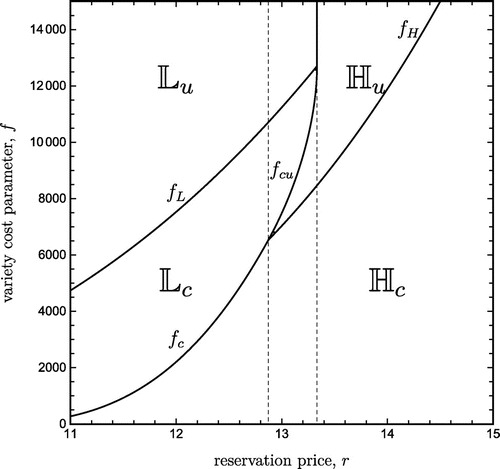
Note. , mH = 87,500, mL = 25,000, t = 16.87, c = 5.
For high-value products, the firm always stocks for the high market size, but covers the entire market only when the product variety cost is sufficiently small (). For moderate-value products, it stocks for the high market size (solution ) when the product variety cost is sufficiently small (); otherwise, it stocks for the low market size (solution ). In either case, it covers the entire market when the product variety cost is sufficiently small. Finally, the case of low-value products is similar to the moderate-value case, except that disappears. Essentially, as product value (r/c) decreases, stocking for the low market size becomes preferable and, thus, expands over , eventually replacing it completely for sufficiently low-value products (see Figure 1).
One of the main takeaways from this proposition is that a low product variety cost (f)—thus, high product variety (n)—plus a high product value (r/c) favor stocking for the high market size and, hence, may lead to overproduction. In fact, high product variety exacerbates the overproduction problem, which is endemic in the fashion industry. We, however, note that, although overproduction is certainly wasteful, it is not the only problem from an environmental perspective. To assess the environmental impact of a production system, one needs to consider the entire product lifecycle, including production, use, and disposal, which we do when we study the MP firm’s environmental impact (and compare it to that of the hybrid firm) in Section 5.
4. The Hybrid Firm
In this section, we augment our model of the MP firm (Section 3) with MC technology, as we are interested in whether adopting MC offers this firm a path to a more sustainable business. Adoption of MC has been advocated as a way for the fashion industry to move to a more sustainable future (Ellen MacArthur Foundation 2017, The Business of Fashion and McKinsey 2019); we want to put this advocacy to the test. We assume that the firm now possesses an MC technology and can potentially offer mass-customized products also—along with mass-produced products—although it does not have to (the adoption decision itself is endogenous). We call this “enhanced” firm the hybrid firm, which represents the future of the MP firm if and when it adopts MC. Our research design is consistent with the state of the fashion industry (and other industries where MC is taking root): MP is the status quo, there is considerable interest in MC, and it is unlikely that MC would fully replace MP anytime soon—if ever.
4.1. Hybrid Model
The MC technology makes it possible for the firm to produce any consumer’s ideal product on demand. Thus, the disutility that stems from the mismatch between a consumer’s ideal product and a mass-produced product vanishes if the consumer’s ideal product is offered via MC, and she opts to buy it. Moreover, no stocking decision is required for mass-customized products because their production happens on a make-to-order basis after the realization of the market size M. (In appendix C of the SSRN version of the paper, Alptekinoğlu and Örsdemir 2022, we extend our base model to an MTS-MTO model with postponement, where a stocking decision for generic units is made before M realizes, and customization of generic units occurs on demand after M realizes.) We note that some degree of MTO is considered a fundamental feature of MC, as reflected in existing analytical models (e.g., Mendelson and Parlaktürk 2008 and Alptekinoğlu and Corbett 2010) and refer the reader to a review paper on MTS-MTO hybrid production models (Peeters and van Ooijen 2020) for a broad overview.
The utility a consumer with ideal product θ derives from a mass-customized product θ (if available) priced at pMC is
In this augmented model, consumers can potentially choose from among mass-produced products with utility UMP (defined earlier) and mass-customized products with utility UMC (defined above), as well as the outside option. Demand uncertainty, which stems from the uncertain market size, still matters because the mass-produced products are still made to stock.
Besides the decisions the MP firm makes, the hybrid firm makes another pricing decision: a price pMC for mass-customized products. Which products to mass customize is also a decision, but a trivial one; it is optimal for the firm to offer mass-customized products in all portions of the product space not covered by the mass-produced products (we show this in Lemma 2).
Let λMP denote (as before) the market share of each mass-produced product and λMC the total market share of all mass-customized products. These market shares are driven by the consumer choice model detailed above, and they must satisfy . The hybrid firm’s objective is to maximize its expected profit,
4.2. Hybrid Analysis
In this section, we analyze the hybrid firm’s decisions. We assume that w is sufficiently high to eliminate a pure MC solution (i.e., ). When this condition is violated, the delay for mass-customized products is so low that MP does not make economic sense, and mass-customized products cover the entire market. We impose this condition because in the fashion industry, MP is the norm, and it is far more plausible that an MP firm would incorporate MC without completely abandoning MP. We also assume that w is not so high that MC is surely unprofitable (i.e., ).
We first present some preliminary analysis, which helps us to construct the hybrid firm’s solution (an analog of Proposition 1). The following lemma shows the firm’s optimal pricing and production policy for mass-customized products.
For any given market share per mass-produced product, λMP, it is optimal for the hybrid firm to cover the entire market and set the price and total production quantity of mass-customized products as follows:
The lemma reveals two features of the optimal solution: The hybrid firm charges the highest price possible for mass-customized products (hence, consumers receive zero utility from them) and produces the exact amount needed to satisfy the demand for them. Because these are true for any λMP, they are true for the hybrid firm’s globally optimal solution. Recall that the market is not necessarily fully covered in the optimal MP solution (as in and solutions). The hybrid firm, on the other hand, uses MC to fill in the “gaps” between the mass-produced products it chooses to offer in its optimal solution, which may be different from the ones the MP firm offers. This is because the firm can always produce via MC the ideal products of those consumers who happen to fall in these gaps (i.e., those who are located too far from a mass-produced product). That is, the firm can always charge a profitable price for a mass-customized product and leave no one unserved, a standard result in the literature (e.g., Alptekinoğlu and Corbett 2008 and Huang et al. 2018). This result also suggests that MC may increase overall production. Therefore, its environmental impact cannot be taken for granted and should be scrutinized, which we do in Section 5.
To be able to state the overall solution for the hybrid firm, we first define the following solution types, analogous to the ones defined for the MP firm. Let and , where .
We are now ready to state the solution to the hybrid firm’s problem. (The thresholds are all defined in the proof.)
The following cases characterize the optimal product variety, pricing, and stocking decisions of the hybrid firm.
For a high-value product (), the solution is
when ; or
when .
For a moderate-value product (), the solution is
when and ;
when and ;
when and , or and ; or
when .
For a low-value product (), the solution is
when and ;
when and , or and ;
when and , or and ; or
when and , or and .
Note that the thresholds on r/c that define the high-, moderate-, and low-value products are the same as in the MP firm’s solution (Section 3.2). There, we show that the solution depends on two factors: product value (r/c) and product variety cost (f). When the MP firm expands into MC, in addition to these factors, consumer waiting cost (w) also becomes crucial. Figure 2 depicts the hybrid solution for two distinct values of w. Now, along with high product value and low product variety cost, low waiting cost also leads the firm to stock for the high market size—that is, the solution .
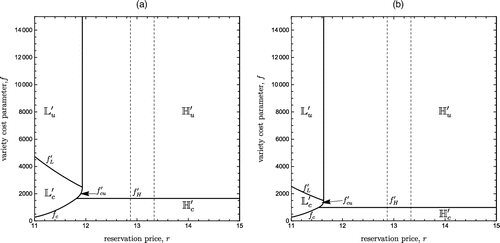
Note. , mH = 87,500, mL = 25,000, t = 16.87, c = 5.
The most interesting aspect of the hybrid solution occurs as w goes down—that is, as MC becomes more convenient. For sufficiently low w and sufficiently high f, the hybrid firm stocks mass-produced products for the high market size () regardless of product value (in all three parts of Proposition 2). This is not true in the MP solution because in that case, the firm stocks low- and moderate-value products for the low market size ( and ) when f is sufficiently high (see parts (2) and (3) of Proposition 1). That is, and can be replaced by when we allow MC (as is apparent from comparing Figure 1 with Figure 2), which leads to an increase in overproduction.
This reveals an intriguing phenomenon: Counter to common intuition, MC can increase expected overproduction, which we define as the leftover inventory after meeting the demand (the standard way to think about it). MC has been touted for its ability to perfectly match the demand and, thus, reduce overproduction. We show that this view overlooks how it affects the stocking quantity for mass-produced products in a hybrid system. In particular, MC decreases the total market the firm serves with MP—that is, goes down. With mass-produced products each capturing a smaller market share, the firm is able to charge more for them and take more risk by stocking for the high market size mH, increasing the expected overproduction for low- and moderate-value products in the process. We note, however, that higher overproduction may not directly imply higher total environmental impact. One still needs to consider the environmental impact of different product lifecycle phases (see Section 5). We also note in closing that this fundamental insight holds for varying levels of postponement too (see Appendix C.2 in the SSRN version of the paper, Alptekinoğlu and Örsdemir 2022, for details).
5. Environmental Impact Comparison
In this section, we compare the MP solution with the hybrid solution—which are both profit-maximizing solutions—in terms of their environmental impact. This analysis lets us identify when adopting MC leads to a win-win outcome—good for both profitability and sustainability. It also lets us explore the market conditions under which well-meaning MC initiatives can lead to worse environmental outcomes. The resulting insights, driven by the firm’s profit motive, feed into the policy analyses we conduct in the next section.
To model the environmental impact, we consider four different phases of the product lifecycle: production, use, disposal, and overproduction. We use ep, eu, ed, and eo to denote per-unit environmental impact (in ) of the four lifecycle phases, respectively. The previous literature mainly focuses on the first three lifecycle phases (Atasu and Souza 2013, Örsdemir et al. 2014), because demand is typically assumed to be deterministic. In our model, the market size, hence the demand, is random; thus, we need to account for overproduction as well. The overproduction coefficient eo is a parameter that captures the environmental impact of overproduced units—inventory in excess of demand—that can occur for mass-produced products in our MP and hybrid models. These may be burned, recycled, donated, etc. and can be a large component of the firm’s environmental footprint, as is the case for many fashion companies.
We define as the per-unit environmental impact of sold clothing and as the per-unit environmental impact of unsold or leftover clothing. The expected environmental impact by the MP firm for the four solution types defined in (2)–(5) can thus be expressed as , , , and . Similarly, the expected environmental impact by the hybrid firm for the four solution types defined in (6)–(9) can be expressed as , , , and .
We analytically compare the environmental impacts of the MP firm and the hybrid firm in the regions where hybrid production occurs (i.e., the hybrid firm offers both mass-produced and mass-customized products). Note that when hybrid production does not occur, the environmental impact is equivalent, hence uninteresting. It is also worth noting that in the regions of interest, the hybrid firm achieves higher profit than the MP firm, simply because the MP model is a special case of the hybrid model. This implies that the result below, by characterizing when the hybrid firm is environmentally superior, is also a precise statement of when adopting MC is a win-win affair. (The thresholds are all defined in the proof.)
The following cases fully characterize when adopting MC is a win-win outcome for both firm profitability and environmental impact.
The firm offers a high-value product, defined by , and
and , or
.
The firm offers a moderate-value product, defined by , and
and , or
.
The firm offers a low-value product, defined by , and and .
Roughly speaking, higher product value (r/c), higher product variety cost parameter (f), lower waiting cost (w), and higher environmental impact by leftover units relative to sold units () favor a win-win outcome. (Note that the threshold R is increasing in w, which implies that the condition is easier to meet with lower w.) To develop a more precise intuition on why, consider Figure 3, where we show the MP and hybrid solutions side-by-side and indicate when win-win outcomes occur (for a realistic set of parameters, all described in Online Appendix B).
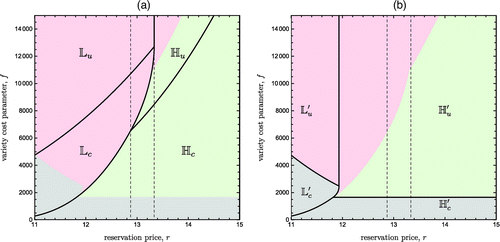
Notes. In gray regions, the MP and hybrid firms operate the same. Dashed lines separate low-, moderate-, and high-value product cases. , mH = 87,500, mL = 25,000, t = 16.87, c = 5, w = 6, , El = 4.
For a win-win outcome, it is necessary that , the hybrid production solution for the high market size, replace or , the MP firm’s solutions for the high market size (see Propositions 1 and 2 for analytical characterizations of these solution types). MC is considered environmentally superior due to its ability to eliminate overproduction via its MTO operation. Indeed, when it replaces MP at least partially in or , where overproduction is problematic, it can be environmentally superior. However, this is not a sufficient condition; as shown in Section 4.2, adopting MC can encourage production of mass-produced items for the high market size and may lead to overproduction and higher sales, both of which are captured by our environmental impact metric.
For high-value products, such as those produced by Ermenegildo Zegna, the conditions in 1(a) describe the region in which the solution is for the MP firm and for the hybrid firm. Recall that the market is not covered in , but it is in ; that is, going hybrid increases the total expected sales. But it also decreases overproduction because the portion of the market served with mass-produced products (i.e., ) shrinks. As long as the former negative effect is weaker than the latter positive effect, which happens when is sufficiently large, going hybrid improves (reduces) the environmental impact. The condition in 1(b) describes the region in which the solution is for the MP firm and for the hybrid firm. Therefore, both firms produce for the high market size and fully cover the market, yet the hybrid firm replaces some of the mass-produced products with mass-customized products and reduces the overproduction as a result.
The comparison for moderate-value products, such as those produced by Zara and H&M, is similar to high-value products, except that the hybrid firm can never be environmentally friendly when product variety cost is high (). That is, MC can backfire in that case. The reason is the MP firm producing for the low market size (solutions or ), which is the best outcome from an environmental point of view. In these regions, when the firm goes hybrid, the solution changes to either or , meaning an increase in expected sales. Not only that, overproduction also increases if the solution changes to . As a result, the hybrid firm becomes environmentally inferior for sure. In the remaining possibilities, the intuition is similar to the high-value-product case. In particular, the hybrid firm replaces with when , and with when , akin to parts (a) and (b) of the high-value-product case, respectively.
Finally, for low-value products, in order for the hybrid firm to be environmentally superior, the product variety cost parameter must be moderate () similar to moderate-value products. Additionally, the waiting cost w must be sufficiently small (). Essentially, in this region, the solution switches from under MP to under hybrid, reducing the overproduction and, along with it, the overall environmental impact. Note that, similar to the moderate-value-product case, beyond a certain product variety cost (i.e., if ) adopting MC again backfires: Hybrid becomes environmentally inferior to MP.
In sum, this section identifies win-win opportunities that adopting MC brings. Proposition 3 analytically characterizes when the hybrid firm is environmentally superior to and more profitable than the MP firm. It also teaches us when the firm worsens its environmental impact by going hybrid. The fact that MC may increase overproduction is particularly interesting because MC has been touted for its ability to match demand. Yet, its interaction with MP in the hybrid system produces this counterintuitive finding. In fact, the following result is a direct implication of Proposition 3:
If the hybrid firm has higher overproduction than the MP firm, then its environmental impact is also higher.
In its pure form, MC obviously eliminates overproduction altogether. But we find the hybrid system more germane to the conversation because a hybrid future appears more plausible than a pure MC future in industries where MC is taking hold.
6. Policy Insights
In this section, we investigate real policy ideas proposed or employed to curb the colossal negative environmental impact of the fashion industry and apply them to our MC context. In Section 6.1, we consider actions that promote MC over MP—as a matter of government policy or nongovernmental organization (NGO) consumer-awareness campaigns. In Section 6.2, we investigate an interventionist policy idea that is taking root these days: governments charging a disposal fee for unsold clothing. In Section 6.3, we analyze the impact of firms taking back and recycling used and unsold clothing, which is an emerging practice. With all these policy ideas, we are interested in two basic questions. First, what is the impact on win-win or win-lose outcomes? Win-win becoming more likely under a policy, in the sense of occurring for a larger set of model parameters, would render the adoption of MC more desirable for more firms, not only from a profitability perspective, but also from an environmental impact perspective. A shift toward more win-lose outcomes, on the other hand, would mean higher adoption of MC at the expense of the environment. Second, how does the environmental impact of a hybrid firm change due to a policy intervention? This is to understand, after the MC adoption occurs, how policy can influence the firm’s economic incentives and the resulting impact on the environment.
6.1. The Impact of Promoting Mass Customization
To help address fashion’s sustainability problem, several recent industry reports (Ellen MacArthur Foundation 2017, Boston Consulting Group 2019, The Business of Fashion and McKinsey 2019) and a popular book (Thomas 2019) promote MC. These publications increase consumer awareness about the notion that MC may provide an environmentally friendly way to consume fashion, which might increase consumers’ tolerance for waiting for a mass-customized fashion product (i.e., lower their waiting cost w).
We first answer the question of whether a policy that aims at reducing w expands the parameter region where win-win occurs, which we henceforth call the win-win region.
As w decreases as a result of promoting MC, the win-win region expands, and the win-lose region shrinks.
This is encouraging from a policy perspective because reducing w by increasing consumers’ tolerance for waiting for bespoke fashion unambiguously increases the chances of MC adoption and helps the environment in the process. See Figure 4 for an illustration of the result, where light green regions represent win-win for w = 5.5. In comparison with Figure 3, which assumes a higher waiting cost (w = 6), the win-win region expands, as indicated by green arrows.
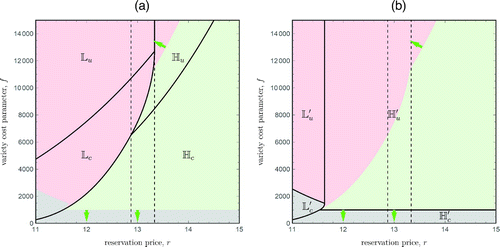
Notes. , mH = 87,500, mL = 25,000, t = 16.87, c = 5, w = 5.5, , El = 4. (a) MP firm. (b) Hybrid firm.
Expansion of the win-win region occurs in one of two ways: the hybrid firm’s solution replacing the MP firm’s solution for more low f values; or replacing for more high f values. In both cases, overproduction drops. In the latter case, sales increases, but its negative environmental effect is overtaken by the positive effect of the drop in overproduction. Note that the MP solutions separated by solid lines in Figure 4(a) do not change because w does not feature in them at all.
We now take up another interesting question: How would a lower w—as consumers grow more tolerant of waiting for mass-customized products—alter the environmental impact of the hybrid firm? (Thresholds w1 and w2 are given in the proof of Proposition 2, and ft is a piecewise function of w characterized in the proof of Proposition 5.)
As w decreases, the hybrid firm’s environmental impact changes as follows:
For high-value products, characterized by , the hybrid firm’s environmental impact decreases (strictly so in some cases).
For low- and moderate-value products, characterized by and , respectively, the hybrid firm’s environmental impact decreases (strictly so in some cases) if and only if , or and .
The proposition shows that it is not a given that consumers buying into the environmental friendliness of MC necessarily leads to an environmentally superior outcome for the hybrid firm. This does not contradict Proposition 4 because the expansion of win-win never encroaches on the region where the hybrid firm’s impact may increase (solutions and , discussed below).
For high-value products, we know that the solution can be either or . In these regions, as w decreases, overproduction may decrease because either (i) the solution is , and it stays with mass-customized products replacing some mass-produced products; or (ii) the solution is , and it changes to . So, for high-value products, promoting MC is always environmentally beneficial. The above is also true for moderate- and low-value products, as long as the solution is or . (The conditions in the proposition essentially characterize when the solution is one of these.) On the other hand, when the solution is either or , any reduction in w may be detrimental to the environment because it may increase the total production quantity and even the overproduction. This is because mass-customized products, whose expected production quantity is μ, would replace some mass-produced products, whose production quantity is mL (both quantities are in per-unit distance of the market covered by either type of product). Plus, the solution may also change from to , from producing the mass-produced products for the low market size to producing them for the high market size, which leads to overproduction and introduces a discontinuity in environmental impact. Both of these effects as w drops—gradual increase in production and the jump in production (hence, overproduction)—are shown in Figure 5 for a low-value product (the picture would be similar for a moderate-value product). The hybrid firm solution changing from to is also apparent in Figure 2.
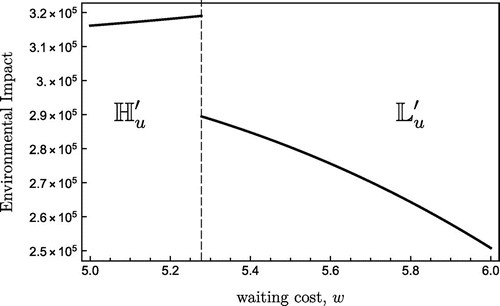
Note. , mH = 87,500, mL = 25,000, t = 16.87, c = 5, w = 6, f = 10,000, r = 11.5, El = 4, .
In sum, promoting MC to achieve a lower w leads to increased adoption of MC (higher profits for firms) accompanied with reduced environmental impact because it unambiguously expands the win-win region. Still, NGOs should take care in promoting MC as a sustainable alternative. It is possible that such actions may alter how a hybrid firm, capable of both MP and MC, designs its product line and sets its production quantity in a way that might eventually hurt the environment. Promoting MC always benefits the environment for high-value products; however, it is beneficial for moderate- and low-value products if either w is already small; or w is large, but f is small.
6.2. The Impact of Disposal Fee for Overproduction
In the wake of the Burberry controversy, the French and British governments have been on a path to implement a policy that would penalize dumping of unsold clothing (Karasz 2019, Moore 2019, Templeton 2022). In this subsection, we investigate possible outcomes of such policies. To do so, we assume that the government charges a disposal fee x for each unit of excess or unsold inventory. Note that the introduction of this policy does not alter the solution if the firm stocks mass-produced products for the low market size when the policy is not in place. That is, the policy penalizes only overproduction, which does not occur in solution types and .
The profit function for the MP and hybrid firms, respectively, under the disposal fee policy is
We first answer the question of whether a policy that directly and financially penalizes overproduction expands or shrinks the parameter region where win-win occurs.
Suppose there is a disposal fee x per unit of overproduction. As x increases, the win-win region expands to parameter values for which the hybrid firm’s solution replaces the MP firm’s solution, but shrinks from parameter values for which the hybrid firm’s solution replaces the MP firm’s or solutions.
This is mixed news from a policy perspective. See Figure 6 for an illustration of the result, where light green regions represent win-win for x = 0.26 (Online Appendix B.5 explains how we arrived at this estimate). In contrast with Figure 3, which assumes no penalty for overproduction (x = 0), the win-win region expands in certain areas (as indicated by green arrows) and shrinks in others (as indicated by red arrows). Increasing x further, the light red regions representing win-lose eventually take over the entire graph.
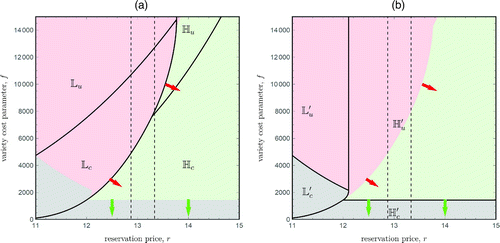
Notes. , mH = 87,500, mL = 25,000, t = 16.87, c = 5, w = 6, , El = 4, x = 0.26. (a) MP firm. (b) Hybrid firm.
The main reason for the expansion of win-win into low f values is that the hybrid firm has more economic incentive to use MC to avoid overproduction, which results in expanding to more parameter values for which it replaces . Yet, this also helps the environment, because results in the same expected sales, but higher overproduction compared with . On the other hand, the contraction of win-win occurs because for moderate-to-high f values, where the hybrid firm wants to use , the MP firm’s incentive to use or increases. But that hurts the environment because the hybrid firm sells more units in expectation and takes a calculated overproduction risk in the limited market segments that it serves using MP products.
Overall, the win-win region tends to shrink as x increases, which is intuitive. In fact, for a sufficiently high disposal fee, , adoption of MC can never lead to a win-win. In this case, both the hybrid firm and the MP firm produce for the low market size—to avoid overproduction altogether. For the hybrid firm though, completely replaces and partially takes over . Both changes are clearly detrimental to the environment as they increase sales.
We now take up the question: How would a disposal fee policy alter the environmental impact of the hybrid firm?
For the hybrid firm, a disposal fee policy always benefits the environment (strictly so in some cases).
Recall that the hybrid firm always covers the market. It can be shown that, as a result of a disposal fee policy, the hybrid firm’s and solutions shrink and are taken over by or . Expansion of or , in turn, decreases the expected sales, as well as overproduction, both of which benefit the environment.
In sum, a disposal fee policy expands the win-win region only when the mass-produced variety is sufficiently cheap (f is low). Otherwise, there are cases where it may result in a win-lose, which translates to increased MC adoption that would result in a higher environmental impact. An excessive penalty on disposal actually leads to no win-win. Governments should thus be cautious while enacting disposal fee laws directed at the fashion industry. For a firm that has already adopted MC, however, imposition of a disposal fee always helps reduce its environmental impact.
6.3. The Impact of Recycling
Recycling is an emerging practice in fashion industry. For example, H&M relaunched its “Bring it on!” campaign in 2017. Eileen Fisher launched its “Vision 2020” initiative, in which recycling has been a central element. In this section, we analyze how recycling changes the environmental outcomes. To that end, we assume that the firm recycles all of its unsold clothing—thus, the entire overproduction—and τ fraction of its sold clothing. The parameter, , represents the rate of take-back or recycling among consumers.
We also assume that for each recycled unit, the firm incurs an incremental financial cost or benefit s. We consider recycling to be costly if and profitable if s > 0, while imposing the condition , which puts a natural limit to the magnitude of its incremental financial impact. As is common in take-back literature, we use a single-period model (Atasu et al. 2009, Örsdemir et al. 2014, Esenduran et al. 2017). The single period can be interpreted as the products’ maturity stage, in which prices and quantities are steady.
The MP and hybrid firms’ profit functions under the recycling policy are:
We presume that recycling reduces the environmental impact of sold and leftover units. Akin to Section 5, we define the following environmental impact coefficients: and , and and . We assume that recycling does not affect use () and that it might reduce the impact of production () and reduces the impacts of disposal and overproduction ( and ), implying that and . Similar assumptions have been made in the literature (Atasu and Souza 2013, Örsdemir et al. 2014).
6.3.1. Profitable Recycling.
We first investigate the question of whether the win-win region expands or not in the case of profitable recycling with s > 0. Any economically viable way to reuse recycled fibers, such as turning them into washcloths, would be an example.
Suppose recycling is profitable for the firm (s > 0). As it becomes more profitable (as s > 0 increases), the win-win region expands to parameter values for which the hybrid firm’s solution replaces the MP firm’s or solutions, but shrinks from parameter values for which the hybrid firm’s solution replaces the MP firm’s solution.
See Figure 7 for an illustration of the result, where light green regions represent win-win for s = 0.5 and (Online Appendix B.5 explains how we arrived at these estimates). In comparison with Figure 3, which assumes no recycling, the win-win region expands in certain areas (as indicated by green arrows) and shrinks in others (as indicated by red arrows). Increasing s further, the light green regions representing win-win eventually take over the light red regions.
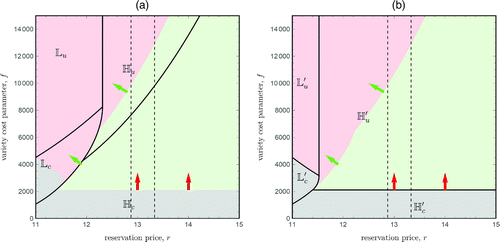
Notes. , mH = 87,500, mL = 25,000, t = 16.87, c = 5, w = 6, , s = 0.5. (a) MP firm. (b) Hybrid firm.
The win-win region expands for moderate-to-high f values because the hybrid firm is willing to use recycling as a way to deal with higher sales and overproduction generated by using over the MP firm’s and solutions for more parameter values. The contraction of the win-win region for low f values, on the other hand, occurs because profitable recycling gives incentive for the hybrid firm to use , which involves more recycling, rather than .
We now explore the impact of recycling for the hybrid firm. On the one hand, the hybrid firm financially benefits from more recycling and thus wants a higher production quantity, everything else equal, which is detrimental to the environment. On the other hand, recycling has a positive effect; it decreases the impact of sold units () and leftover units (). Hence, a trade-off arises that leads to the following proposition. We use and (Qs and Ql), respectively, to denote the total quantity of sold and leftover units when recycling is (is not) carried out.
Running a profitable recycling program (s > 0) decreases the hybrid firm’s environmental impact if and only if (i) the solution without recycling is ; or (ii) it is and ; or (iii) in all other cases.
For hybrid firm solutions where recycling does not change the total production quantity (hence, sold and unsold product quantities, as in or ), recycling improves the environmental impact because the environmental impact of these units decrease ( and ). The condition on s in part (ii) keeps the solution as . In all other regions, the trade-off is not as clear cut. This is because recycling increases the quantity of sold or unsold products, and sometimes both. Therefore, it can only be “good” if per-unit environmental impacts of sold and unsold products sufficiently decrease due to recycling, which is captured in part (iii) of the proposition. We can further simplify this inequality down to model primitives, but this would not provide any further insights, so we leave it as is.
6.3.2. Costly Recycling.
We now look at the case with , which implies that the firm has no economic incentive to recycle unless there is a government mandate to do so. Therefore, we assume that recycling is mandated by law. Given the increased scrutiny the fashion industry is receiving due its environmental impact, a government mandate may not be in a distant future (Zha 2019).
Suppose recycling is costly for the firm (). As it becomes more costly (as decreases), the win-win region expands to parameter values for which the hybrid firm’s solution replaces the MP firm’s solution, but shrinks from parameter values for which the hybrid firm’s solution replaces the MP firm’s or solutions.
See Figure 8 for an illustration of the result for . Comparing with Figure 3, which assumes no recycling, the win-win region expands in certain areas (as indicated by green arrows) and shrinks in others (as indicated by red arrows). The intuition is basically the opposite of what occurred in the case of profitable recycling. Overall, the win-win region tends to shrink as recycling becomes more costly, which is intuitive. In fact, for a sufficiently high recycling cost, , adoption of MC can never lead to a win-win. In this case, both the hybrid firm and the MP firm produce for the low market size—to counter high recycling costs. The intuition is similar to the case of high disposal fee: For the hybrid firm, completely replaces and partially takes over ; both changes are detrimental to the environment.
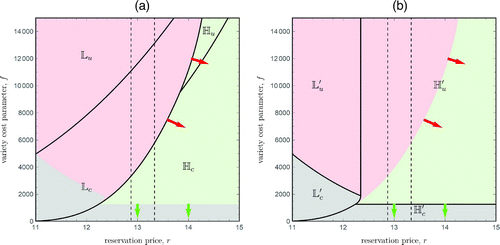
Notes. , mH = 87,500, mL = 25,000, t = 16.87, c = 5, w = 6, . (a) MP firm. (b) Hybrid firm.
Running a costly recycling program () always reduces the hybrid firm’s environmental impact.
Contrary to the profitable recycling case, when recycling is costly, imposing it on the firm is always beneficial for the environment. In essence, costly recycling never increases sold or unsold product quantities. So, combined with lower per-unit environmental impact for sold and unsold products—that is, and —recycling lowers the environmental impact for sure.
In closing, the impact of recycling policies on win-win is mixed, which recommends caution to policy makers. Judging based on where win-win becomes more likely, profitable recycling is more effective when f has moderate-to-high values, and costly recycling is more effective when f has low values. Furthermore, not too surprisingly, costly recycling induces more environmentally friendly incentives on the hybrid firm than profitable recycling. Even in the latter case though, recycling can reduce the hybrid firm’s environmental impact. Recall that we need and for our recycling-policy results to hold. One of the most plausible ways this may happen is a decline in per-unit environmental impact of disposal and overproduction ( and ) due to recycling or recovery actions. Our analysis is agnostic to how exactly this happens—via new business models, new technologies (e.g., Evrnu), or any other means.
7. Concluding Remarks
Our central research question in this paper is whether a firm’s move from a pure MP system to a hybrid system with MP and MC capabilities can be a win-win for both firm profitability and environmental sustainability. The fashion industry provides a great motivation and backdrop for this question: Not only are fashion companies making moves toward MC, but also they are making such moves with sustainability motives. We first build an analytical model to characterize the firm’s optimal variety, price, and inventory decisions under both MP and hybrid systems and study the firm’s environmental impact in those two scenarios. We then extend the analysis to understand the impact of various policy levers on profitability and sustainability.
One of our most fundamental insights, and one that drives many of our other results, is that MC can increase overproduction, complicating the calculus on environmental impact (captured by LCA). This stems from the interaction of mass-produced and mass-customized products; the firm’s optimal product-line design in the hybrid case may shift to a profit-maximizing solution that represents higher operational risk-taking (for mass-produced products).
We characterize when adopting MC is a win-win (Proposition 3). In our model, this means the firm going from MP to hybrid and increasing its profit while decreasing its environmental impact in the process. A win-win generally (not in all cases) requires the product variety cost not to be too low or too high, the environmental impact of sold units not to be too high relative to unsold units, and the waiting cost for mass-customized products not to be too high. A high product value also generally favors a win-win. In contrast, there are cases when going hybrid hurts the environment, but not the bottom line—most notably when the product variety cost is too high, especially for moderate- and low-value products. In such cases, not only expected sales, but also overproduction grows, which renders hybrid environmentally inferior.
Our policy results are also nuanced. Taking the perspective that expanding the win-win outcomes would imply a higher rate of sustainable MC adoption, we study how different policy options change the set of parameters that lead to a win-win. Promoting MC to lower the consumers’ disutility from waiting for mass-customized products always helps in this regard (Proposition 4), whereas imposing a disposal fee on overproduction and running a recycling program—whether it be costly or profitable—help only in certain scenarios (Propositions 6, 8, and 10). We also explore how the hybrid firm’s environmental impact changes under these policies, essentially to understand the post-MC-adoption incentives. Here, the disposal fee and costly recycling policies unambiguously help (Propositions 7 and 11), whereas the other two policy options are mixed bags (Propositions 5 and 9), so they need to be designed carefully to avoid unintended consequences.
We hope these insights regarding three real policy options will help advance the discussion on the environmental sustainability of MC in general and in the fashion business in particular. As a way of contributing to this discussion directly, we have shared our paper with the Ellen MacArthur Foundation (EMF), one of the NGOs that provided inspiration for our paper. Upon invitation by EMF’s Make Fashion Circular initiative (formerly known as The New Textile Economy initiative), which won the American Apparel and Footwear Association's 2022 American Image Award in the Eco-Steward of The Year category, we then had an opportunity to explain our policy findings and hold a broad discussion with them about MC and circularity in fashion.
We believe this is a fertile area for further research, as there are many unknowns on how MC would operate on a truly large scale and what that would mean for the environment. For example, it might be good to know whether our policy insights would hold for competing firms adopting MC. Another topic of broad value would be the economic cost and environmental impact of product variety. For example, in this paper, we assume that the fixed cost for mass-produced variety is quadratic in number of products, and the environmental impact is linear in quantity. Although they have precedence in theory work, both relationships should be put to empirical scrutiny.
The authors thank the special section editor, Serguei Netessine, the associate editor, and the review team for their constructive feedback that surely helped us improve the paper.
References
- (2008) Mass customization vs. mass production: Variety and price competition. Manufacturing Service Oper. Management 10(2):204–217.Link, Google Scholar
- (2010) Leadtime-variety tradeoff in product differentiation. Manufacturing Service Oper. Management 12(4):569–582.Link, Google Scholar
- (2022) Is adopting mass customization a path to environmentally sustainable fashion? Preprint, submitted February 2, https://dx.doi.org/10.2139/ssrn.3685235.Google Scholar
- (2021) Can mass customization slow fast fashion down? The impact on time to disposal and willingness-to-pay. Working paper, The Pennsylvania State University, University Park, PA.Google Scholar
- (2013) How does product recovery affect quality choice? Production Oper. Management 22(4):991–1010.Crossref, Google Scholar
- (2009) Efficient take-back legislation. Production Oper. Management 18(3):243–258.Crossref, Google Scholar
- (2015) Electric vehicles with a battery switching station: Adoption and environmental impact. Management Sci. 61(4):772–794.Link, Google Scholar
Boston Consulting Group (2019) Pulse of the fashion industry. Accessed February 27, 2022, http://media-publications.bcg.com/france/Pulse-of-the-Fashion-Industry2019.pdf.Google Scholar- (2021) How transparency into internal and external responsibility initiatives influences consumer choice. Management Sci. 67(2):932–950.Link, Google Scholar
- (2021) Can brands claim ignorance? Unauthorized subcontracting in apparel supply chains. Management Sci. 67(4):2010–2028.Link, Google Scholar
- (2010) Lowest cost may not lower total cost: Using “spackling” to smooth mass-customized production. Production Oper. Management 19(5):531–545.Crossref, Google Scholar
- (2017) Mass customization and guardrails: “you can not be all things to all people”. Production Oper. Management 26(9):1728–1745.Crossref, Google Scholar
- (2021) Retailing with 3D printing. Production Oper. Management 30(7):1986–2007.Google Scholar
- (2019) Combating child labor: Incentives and information disclosure in global supply chains. Manufacturing Service Oper. Management 21(3):692–711.Link, Google Scholar
- (2000) Approaches to mass customization: configurations and empirical validation. J. Oper. Management 18(6):605–625.Crossref, Google Scholar
Ellen MacArthur Foundation (2017) A new textiles economy: Redesigning fashion’s future. Accessed February 27, 2022, https://ellenmacarthurfoundation.org/a-new-textiles-economy.Google ScholarEPA (2019) Lean thinking and methods—JIT/Kanban. Accessed February 27, 2022, https://www.epa.gov/sustainability/lean-thinking-and-methods-jitkanban.Google Scholar- (2017) Impact of take-back regulation on the remanufacturing industry. Production Oper. Management 26(5):924–944. Crossref, Google Scholar
- (2022) Customization and returns. Management Sci. Forthcoming.Google Scholar
- (2016) Responsible sourcing in supply chains. Management Sci. 62(9):2722–2744. Link, Google Scholar
- (2016) From Phonebloks to Google Project Ara: A case study of the application of sustainable mass customization. Procedia CIRP 51:72–78.Crossref, Google Scholar
- (2018) The value of “bespoke”: Demand learning, preference learning, and customer behavior. Management Sci. 64(7):3129–3145.Link, Google Scholar
- (2006) Satisfying customer preferences via mass customization and mass production. IIE Trans. 38(1):25–38.Crossref, Google Scholar
- (2019) The role of inclusive innovation in promoting social sustainability. Production Oper. Management 28(12):2960–2982.Crossref, Google Scholar
- (2019) France to end disposal of $900 million in unsold goods each year. New York Times (June 5). Accessed February 27, 2022, https://www.nytimes.com/2019/06/05/world/europe/france-unsold-products.html.Google Scholar
- (2018) Supply chain visibility and social responsibility: Investigating consumers’ behaviors and motives. Manufacturing Service Oper. Management 20(4):617–636.Link, Google Scholar
- (2018) Socially and environmentally responsible value chain innovations: New operations management research opportunities. Management Sci. 64(3):983–996.Link, Google Scholar
- (2015) Toward mass adoption of electric vehicles: Impact of the range and resale anxieties. Manufacturing Service Oper. Management 17(1):101–119.Link, Google Scholar
- (2012) A sustainability and mass customization assessment framework. Proc. ASME 2012 11th Biennial Conf. Engrg. Systems Design Anal., ESDA2012, July 2–4, 2012, Nantes, France, vol. 3 (American Society of Mechanical Engineers, New York), 795–800. https://doi.org/10.1115/ESDA2012-82923.Google Scholar
- (2008) Product-line competition: Customization vs. proliferation. Management. Sci. 54(12):2039–2053. Link, Google Scholar
- (2019) Fast fashion is harming the planet, MPs say. BBC News (October 5). Accessed February 27, 2022, https://www.bbc.com/news/science-environment-45745242.Google Scholar
- (2021) A vision of responsible research in operations management. Preprint, submitted March 18, https://dx.doi.org/10.2139/ssrn.3802047.Google Scholar
- (2011) Emerging design strategies in sustainable production and consumption of textiles and clothing. J. Cleaner Production 19(16):1876–1883.Google Scholar
- (2019) Ensuring corporate social and environmental responsibility through vertical integration and horizontal sourcing. Manufacturing Service Oper. Management 21(2):417–434.Link, Google Scholar
- (2014) Competitive quality choice and remanufacturing. Production Oper. Management 23(1):48–64.Crossref, Google Scholar
- (2020) Hybrid make-to-stock and make-to-order systems: A taxonomic review. Internat. J. Production Res. 58(15):4659–4688.Crossref, Google Scholar
- Pine BJ (1993) Mass Customization: The New Frontier in Business Competition (Harvard Business School Press, Boston).Google Scholar
- (2013) Design for the environment: Life-cycle approach using a newsvendor model. Production Oper. Management 22(4):940–957.Crossref, Google Scholar
- (2016) Style that’s sustainable: A new fast-fashion formula. Accessed February 27, 2022, https://www.mckinsey.com/business-functions/sustainability/our-insights/style-thats-sustainable-a-new-fast-fashion-formula.Google Scholar
- (2018) Destroying unsold clothes is fashion’s dirty secret. And we’re complicit. HuffPost (September 29). Accessed February 27, 2022, https://www.huffpost.com/entry/burberry-burn-clothes-fashion-industry-waste_n_5bad1ef2e4b09d41eb9f7bb0. Google Scholar
- (2022) What to watch: France bans destruction of unsold clothes and adds eco score. WWD (January 5). Accessed February 27, 2022, https://wwd.com/sustainability/business/france-bans-destruction-unsold-clothes-stock-ecodesign-score-1235024506/.Google Scholar
The Business of Fashion and McKinsey (2019) The state of fashion 2019. Accessed February 27, 2022, https://www.mckinsey.com/~/media/mckinsey/industries/retail/our-insights/the-state-of-fashion-2019-a-year-of-awakening/the-state-of-fashion-2019-final.pdf.Google Scholar- (2019) Fashionopolis: Why What We Wear Matters (Penguin Books, London). Google Scholar
- (2018) Is made-to-measure clothing the future of fashion? Fashionista (December 21). Accessed February 27, 2022, https://fashionista.com/2018/12/made-to-measure-custom-clothing-brands.Google Scholar
- (2018) Infographic: The extent of overproduction in the fashion industry. Fashion United (December 12). Accessed February 27, 2022, https://fashionunited.uk/news/fashion/infographic-the-extent-of-overproduction-in-the-fashion-industry/2018121240500.Google Scholar
- (2017) These bespoke fashion companies prove that some things are worth waiting for. HuffPost (November 12). Accessed February 27, 2022, https://www.huffpost.com/entry/bespoke-fashion-companies-custom-made_n_6144328.Google Scholar
- (2009) Standard vs. custom products: Variety, lead time, and price competition. Marketing Sci. 28(5):887–900.Link, Google Scholar
- (2019) What does the EU’s green deal mean for the textile industry? Fashion United (December 13). Accessed February 27, 2022, https://fashionunited.uk/news/business/what-does-the-eu-s-green-deal-mean-for-the-textile-industry/2019121346647.Google Scholar

