


Case—The RealPro Customer Benefits Program: Rekindling Shopper Loyalty Through a Subscription Service
1. Introduction
It was a rainy mid-December day in 2018 when Dr. Gerald Schönbucher, chief executive officer (CEO) of Real Digital and head of customer information (both online and offline), stepped out of his car in front of the Düsseldorf headquarters of Real, a German hypermarket chain. He entered the building and headed straight for the elevator—dodging the large, richly decorated Christmas tree placed in the lobby. As the doors began to close, he glanced at the tree but quickly refocused on the meeting ahead.
Just like the cold and rainy weather, Real’s situation had been rather uncomfortable over the past years. As the fifth-largest grocery retailer in Germany and the second-largest hypermarket chain, Real faced intense competition from bigger competitors. There was once a time when Real could profit from its large assortment and sales area, which qualified its stores as a one-stop solution to shopping for groceries and nonfood items (e.g., consumer electronics). Yet consumer preferences were shifting toward smaller, local stores located closer to the customer. The more locally present competitors of Real could benefit from that shift, whereas Real’s market share and customer numbers continued to dwindle (see Exhibits 1 and 2). At the same time, costs at Real were not only higher than those at other retailers but were also increasing, with personnel and marketing costs among the main cost drivers. In this regard, Real faced unfavorable circumstances because of store workers’ union contracts that prohibited cashiers from stocking shelves when the store was not busy. Hence additional workers had to be hired to refill the shelves, which resulted in significantly higher personnel costs in comparison with competitors.
To thrive in the highly competitive German grocery retail sector, Real had developed an aggressive high–low pricing strategy with deep price discounts to attract price-sensitive customers. Real also cofounded Payback, the largest cross-company couponing and loyalty program in Germany. With more than 31 million active customers in Germany in 2019 alone, collecting Payback points through purchases from participating stores was close to being a national sport. At Real, more than 60% of all purchases are made in combination with a Payback card (see Exhibit 3). Customers can redeem their collected Payback points by using them to pay for subsequent purchases or by exchanging them for gifts and/or vouchers.
In response to decreasing customer counts, Real sought to turn the disadvantages associated with a large sales area into strengths by investing in four strategic business initiatives. First, Real catered to the increasing consumer focus on the freshness and quality of produce by introducing the “market hall” concept in four stores (see Exhibit 4). This initiative created a radically new shopping experience resembling that of a food market with integrated restaurants, much as in Wegmans food markets in the United States. The number of transactions increased by more than 20% in these new market halls. Second, many existing stores were refurbished to provide a more inviting shopping atmosphere and reduce the number of nonfood items offered. Alongside the introduction of fresh food stations, such as sushi bars, this initiative led to nearly 6% more transactions in the refurbished stores.
Beyond these changes in the store concept, Real introduced two other innovations to accommodate future shopping trends. The real.de website was established as an online shopping platform for customers to purchase goods from Real and many other sellers online (see Exhibit 5). In addition, Real set up “Emmas Enkel” (in English, “Emma’s Grandchild”) stores that combined a small in-store assortment with grocery order and pickup points for products delivered from larger Real stores or warehouses to couple local convenience store advantages (e.g., closeness to the customer) with the variety of products available through Real (see Exhibit 6). All four strategic initiatives delivered good results, with an increasing number of transactions throughout. However, a considerable investment of funds and time would be required to implement each one more fully, and Real’s management team knew that neither time nor money was currently a plentiful resource. They needed to do more: find a way to put Real back on the right track.
Walking to the end of a corridor at headquarters, Mr. Schönbucher arrived at his destination. He knocked on the door and entered the office of Dirk Königsfeld, chief marketing officer (CMO) at Real. Mr. Schönbucher, in his position as head of consumer insights and market research, had contacted Mr. Königsfeld for feedback on a new idea. Mr. Königsfeld, whom Mr. Schönbucher knew as an experienced and results-oriented colleague, seemed to be a natural fit for such an exercise. The meeting was a success, and a new initiative was born: the “RealPro customer benefits program.” The idea of RealPro was simple but powerful. Customers would pay a fixed annual fee to become a member of the RealPro subscription program, which would grant substantial and permanent discounts on most items available in Real stores.
To challenge their business case and garner further support for RealPro, Mr. Königsfeld and Mr. Schönbucher soon involved Marcel Uphues, Real’s finance director, in the process. As a team of three, they pushed the development of RealPro, completing the program’s internal approval process within two months. The preliminary program conditions (from a customer’s perspective) are illustrated in Figure 1. A complete list of all product categories and their discounts in the RealPro program, including all exceptions, is presented in Exhibit 7.
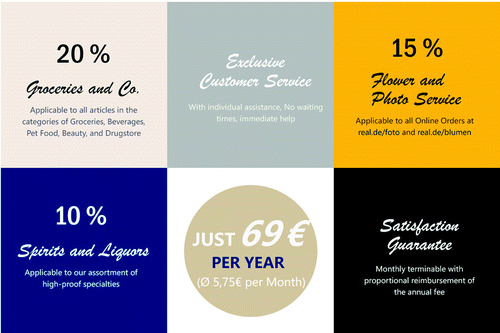
Note. English version of the German original.
For an annual fee of €69, to be paid up front, any customer can join the RealPro program. The membership can later be canceled, in which case a proportion of the annual fee is reimbursed. Customers who are members of RealPro receive a 20% discount on all the grocery, drug store, and pet food products they purchase in Real stores. The program also offers a 15% discount on online services for photos and flowers at real.de, as well as a 10% discount on liquors. The RealPro discounts do not apply to already discounted products and items purchased through the Real grocery delivery service. Another exception is products sold at the restaurants and sushi counters located in some (but not all) of the stores. A final caveat is that the points from Payback promotions (e.g., receiving 10 times the regular number of Payback points on a purchase) cannot be earned when making a RealPro purchase.
2. The German Food Retail Market
With an estimated size of €125 billion in 2019, the German grocery retail market is among the world’s largest (GfK 2020). It is characterized by strong competition (as measured by the number of stores per square kilometer), low prices, and high levels of retailer concentration. The five largest retail groups—Edeka, Schwarz Group (including Lidl), Rewe, Aldi, and Real (part of the Metro Group) —together account for more than 90% of the German grocery retail market. Real is among the largest retailers, but its market share (a mere 4%) is dwarfed by those of the other four groups, whose market shares range from about 17% (Aldi) to 28% (Edeka).
As the home and birthplace of global discounters Aldi and Lidl, the German grocery retail market is defined by strong price competition. High–low pricing retailers, which include Real, Edeka, and Rewe, attract customers by frequently offering steep price promotions. High–low pricing is a pricing strategy that involves lowering the price on a varying selection of brands from time to time. These price promotions vary in timing and the level of discount offered. In contrast, Aldi and Lidl follow the everyday low pricing (EDLP) strategy for most items. EDLP is a pricing strategy that, in its purest form, involves setting a constant, and often low, price for each brand in each category. Hence, a pure EDLP strategy does not involve the use of price promotions. The German grocery retail market can also be segmented in terms of stores’ average retail sales area. When the pricing strategy is considered, the result is three major segments: discounters, full-range food retailers, and hypermarkets. Discounters, with a 43% market share, have the highest total revenue, followed by full-range food retailers (33%) and hypermarkets (17%). The remaining 7% of market share is held by drug stores, which include some food items in their assortment.
The beneficiaries of this intense competition are German consumers, who seek good quality at low prices and often switch between retailers to get the best offer. Although price is still a major factor in consumers’ purchasing decisions, German shoppers have in recent years begun to shift their focus toward food quality and sustainability. Sales of fair trade and organic products are increasing, which reflects both the increased health consciousness of consumers and the rise in disposable income since the 2008 financial crisis. Both traditional high–low supermarkets and discounters have eagerly accommodated these trends by expanding their range of products. Another trend observed is the increasing preference among German shoppers for shopping locally. One result is retailers opening smaller store formats.
3. Real
Real is part of the Metro Group, which had a combined revenue of €27 billion in 2019. The largest holding of the Metro Group is the Metro Cash & Carry brand, a wholesaler whose customers include restaurants, hotels, and catering firms. In contrast, Real is the business-to-consumer part of Metro that caters directly to households. Real had revenue of about €7 billion in 2018. Real is unique in attracting customers through aggressive weekly price discounts on both food and nonfood items. Despite manufacturers covering some of the promotional costs, Real often makes little (or no) profit on the promoted items; its profits derive instead from the nonpromoted items that customers also purchase once they are in the store.
Real was founded in 1992 from the merger of six smaller supermarket chains. Through multiple acquisitions, including the German business of Walmart, Real grew to more than 340 stores in Germany by 2008. This number has fallen each year since then, leaving the firm with only 276 stores in 2019. In 2012, Real international was sold so that Real could focus exclusively on the German market. That sale included more than 100 stores in Eastern Europe and Turkey.
As a hypermarket chain, the average Real store has a significantly greater sales area (7,000 square meters (m2), on average) than the typical German supermarket (approximately 1,300 m2) or discounter (900 m2). This larger size translates into a greater number of items offered. Real offers as many as 80,000 stock-keeping units (SKUs) per store, versus some 12,000 SKUs in supermarkets and only 3,000 SKUs at discounters. A large selection of both food and nonfood items, including electronics and fashion, is part of Real’s strategy to be a one-stop shop, where customers can buy all of their food and many nonfood items in one place. This approach is reflected in its slogan “Einmal Hin. Alles Drin,” which can be (roughly) translated as “Once There. Got Everything.”
Because of its large size, the average Real store is located outside of town and so requires most of its customers to arrive by automobile. In contrast, most supermarkets and discounters in Germany are located in town. Some retail chains also have a separate line of city stores, with an even smaller sales area, that sell primarily convenience food items.
The year 2016 saw Real’s first adoption of the market hall concept, which addresses German consumers’ increasing focus on food quality. As the name suggests, market halls aim to recreate an exceptional shopping experience resembling that of a traditional food market. The focus is on fresh food articles, and a much smaller number of nonfood items are sold than in a standard Real store. Additional space is used to integrate restaurants directly into the store. The presentation of offered items is improved, and the freshly prepared food is more seasonally oriented. In the past few years, four market halls were opened throughout Germany. Despite their success, each store incurred extremely high refurbishment costs.
Along with this innovation in its physical stores, Real established an online business in 2010 that focused on nonfood items. In 2016, Real purchased Hitmeister.de (from its founder, Mr. Schönbucher), a German online marketplace that was fully integrated into the real.de online business in 2017. In 2018, real.de achieved revenues exceeding €600 million, an increase of almost 58% from the €380 million taken in during 2017. These figures position real.de as the third-largest marketplace in Germany (after Amazon and eBay). One driver of this development was the growing number of companies offering a greater assortment of products on real.de, which increased the number of SKUs from about 2 million to 15 million. Also in 2017, Real established a grocery delivery service that is available in most large German cities. As is usually the case for such services, costs for last mile logistics have become prohibitive.
4. The RealPro Program
During their first meeting, Mr. Königsfeld and Mr. Schönbucher quickly agreed that they needed to find a solution for Real that would immediately increase the frequency of customer visits and reduce costs in the medium-to-long term. A challenge in almost any context, this task was undertaken in a tough market environment with strong competition—and as consumer preferences were shifting toward local shopping and away from the hypermarket sales proposition of a one-stop-shopping solution.
For inspiration, the business concepts and initiatives of other national and international companies—and especially hypermarkets—were analyzed by Real during a 2018 management workshop. One concept that stood out was the members-only approach adopted by the U.S.-based Costco wholesale chain. Only customers who pay an annual fee of $60 or $120 (for the standard and the premium membership, respectively) are eligible to shop at Costco stores. With its revenues more than doubling since 2008 to $153 billion in 2019, Costco was clearly a benchmark.
To find out more about Costco’s business concept and to assess how suitable it would be for Real, in January 2019 Mr. Königsfeld, Mr. Schönbucher, and Patrick Müller-Sarmiento (Real’s CEO) visited Costco’s first French store in Paris. During a meeting and a tour of the store with its manager, discussion centered on Costco’s business concept and its applicability to the European market. The Real team realized the potential of Costco’s model, but they also knew that applying the exact same model at Real was impossible because of significant differences between the companies. Costco carries only about 3,000 SKUs per store, sells items primarily in bulk, and makes its profit solely on membership fees (Bell and Leamon 1998). That approach can work only with a large customer base that understands and values what the firm offers. Building such a customer base is a lengthy and difficult process—one that would, if implemented without changes, severely disrupt Real’s current operations.
Another business concept that Mr. Königsfeld and Mr. Schönbucher analyzed thoroughly was the Amazon Prime program. Even though Amazon is a completely different business, Real’s principals were intrigued by Amazon’s ability to create strong customer lock-in based on the value offered by its Prime ecosystem, including discounts on purchases at the retail chain Whole Foods. Yet how best to achieve a similar lock-in effect at Real was an entirely different question.
Given the insights gained from their discussions and analysis of the various business concepts, Mr. Königsfeld and Mr. Schönbucher began developing a first concept of RealPro in combination with a business case. For the latter, they enlisted the aid of Marcel Uphues, who reported directly to Henning Gieseke, Real’s co-CEO (see Exhibit 8). As the team developed and fine-tuned the program, they deliberately minimized the number of individuals who knew about RealPro in order to ensure a high speed of development and to preclude any premature opposition to the project.
After several weeks of developments, revisions, and intense financial analysis, the team reached what they considered to be a viable proof of concept for RealPro. In particular: for a fixed annual fee similar to Amazon Prime’s rate, customers could become a RealPro member and thus be entitled to permanent discounts on many products purchased in Real stores. A 15% discount would be given on all grocery, drug store, and pet food products; liquors would also be discounted. At real.de, only the online photo and flower services would receive a discount. All nonfood items (except for drug store products) would not be discounted. Also excluded from the price discount would be grocery deliveries and already discounted products, since giving price discounts on products that were already heavily discounted would lead to sharply reduced profits or even to losses. To dispel customer concerns about the up-front membership fee, Real decided that fees would be reimbursed (proportionally) to those who decided to cancel their membership. Another point on which the whole team agreed was that, at least during its initial years, RealPro would run in parallel with the firm’s regular business. Hence, access to its stores would not be limited to RealPro members; rather, the firm’s normal business with regular customers—and its high–low pricing strategy—would continue even in the presence of the RealPro program.
On these terms, the team envisioned multiple advantages for Real and also for its customers. The latter could obtain appreciable savings on their grocery shopping that would quickly exceed the annual membership fee. At the same time, they would still have access to Real’s wide product assortment, which includes high-end products as well as Real’s private brands. Even without the RealPro discount, prices for these Real-branded products already match Aldi and Lidl prices, which serve as the lowest benchmark prices for other retailers. The combination of a broad assortment of products and low prices should reduce customers’ search costs, since RealPro members could always go to Real to find the best overall deal. Real’s management team also planned to augment the program with new free services that would, upon future implementation, benefit the firm’s customers.
For Real, the main expected benefit from RealPro was an increased share of the “customer wallet.” A previous study by Real and the Payback loyalty program had revealed that Real held a lower share of wallet than expected, especially among its regular and top customers. The implication was that more revenue could be generated by enticing customers to fulfill more of their shopping needs at Real: either by shopping more frequently at Real stores or by increasing the average transaction value of each visit. With an increase in the number of RealPro purchases, the team also expected to lower the long-term costs associated with its high–low pricing strategy. Marketing costs could be reduced by cutting back on the number of price promotions offered as well as on the extent of advertising for each promotion. The plan was to reduce the number of pages in Real’s weekly promotion leaflets and to drop a separate flyer for drug store items. Personnel costs could also be reduced because price promotions made it necessary to restock products constantly. RealPro would also enable the firm to gather its own customer data, rather than relying on Payback, as a third-party provider. One downside of the new regime was that Real would have to forgo some hard-fought gains in terms of the marketing subsidies that manufacturers had agreed to grant.
Real’s co-CEOs Patrick Müller-Sarmiento (who had earlier tinkered with a similar idea) and Henning Gieseke recognized the potential of this RealPro concept. However, they believed that a discount of 20%—rather than 15%—would have more of an impact on customers and generate greater benefits for the firm. After adopting this revised formulation, Mr. Müller-Sarmiento convinced Real’s supervisory board and workers’ council of the program’s merits. The RealPro program was cleared for implementation without any pushback.
5. Test and Rollout
All of Real’s upper management team agreed on the potential benefits of RealPro. However, the entire concept and associated business cases rested on certain assumptions regarding both consumer acceptance of the program and consumer behavior after subscribing. Since no program with similar conditions had ever been implemented in the German retail grocery market, there was considerable uncertainty about the program in general and about its proposed terms. Namely: How high should the annual membership fee be? How much of a discount should be given? Which product categories and services should be discounted?
Hence the management team decided to implement a market test of RealPro in order to validate its underlying assumptions and to confirm its viability under realistic conditions. On February 28, 2019, RealPro was introduced in seven selected Real stores throughout Germany; thus only two months elapsed between the first concept and market testing. The chosen test sites were a representative sample of all Real stores, including different sales regions, store sizes, and market types (market halls and regular stores). To avoid the attention of competitors during this test, RealPro advertisements were limited to small marketing campaigns within the seven participating stores. Despite this limited advertising, a substantial number of customers signed up for the program within the first few weeks.
At first, some sales managers were skeptical because they believed that only weekly price promotions could be effective. Store managers, however, reacted favorably to the concept since it allowed them to interact directly with customers who registered in the stores. Customer feedback was largely positive, with many RealPro members emphasizing the significant savings they achieved on their shopping costs. Because most customers were familiar with the Payback program, RealPro was not viewed as a threat to privacy or to data protection.
In November 2019, the nine-month RealPro market test was concluded. Under the direction of Stephan Länge (Real’s department head of customer information management), the transaction data collected as part of the market test were extracted and prepared for further analysis (see Exhibit 9). When discussing the collected data, the potential presence of a self-selection bias in the data, which would reduce the quality of the subsequent analyses, was brought up. To address this bias, propensity score matching was applied to the data. This resulted in a reduced data set of 75,297 transactions following the exclusion of several control group customers.
Key variables, including the ID of the purchasing customer, the date of the purchase, and the total purchase amount, are recorded for each transaction. So that it could assess changes in the purchasing behavior of RealPro customers after joining the program, Real recorded transactions from the same time span of the previous year for all RealPro customers. The data set also contains transaction data for non-RealPro customers, who served as a control group. Mr. Länge also outlined a sensitivity matrix, along with additional information on costs and benefits, so as to map RealPro’s profitability under different discount levels and various consumer behavior scenarios (see Exhibit 10).
The Real management team agreed that the insights derived from its market test should form the basis of any further decisions concerning RealPro. At this point, several questions were still unanswered: Would the expected benefits of RealPro materialize? Should RealPro be introduced to all of the retailer’s stores? What conditions would maximize the program’s benefits, for Real and its customers, both now and in the future?
The team knew that the answers to these questions would determine the success not only of the RealPro program but also, perhaps, of Real itself.
Exhibit 1
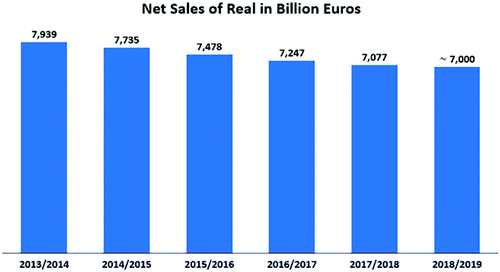
Exhibit 2
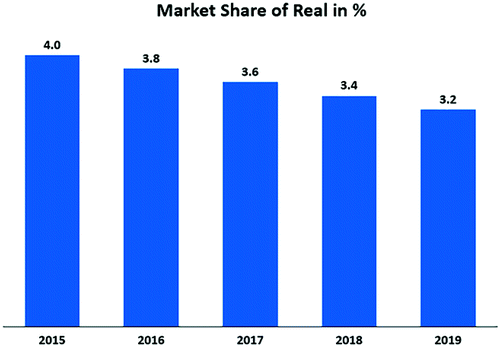
Notes. The displayed market shares are based on revenues from fast moving consumer goods (FMCG) only and do not include nonfood articles such as electronics. Since Real earns a comparably high share of its revenues from nonfood articles (compared with other grocery retailers), the market share figures displayed here are pessimistic when considered in absolute terms.
Exhibit 3
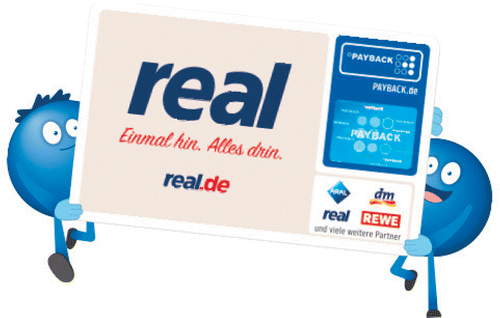
Exhibit 4
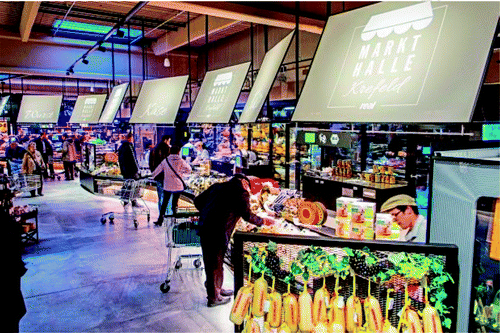
Exhibit 5
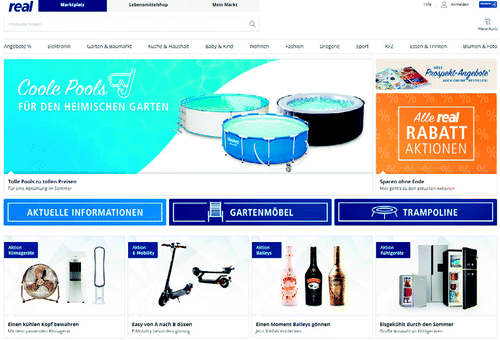
Exhibit 6
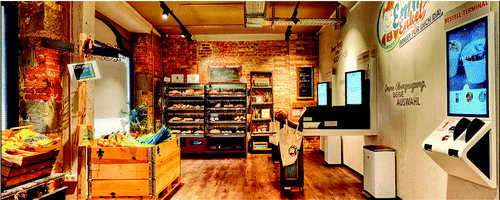
Exhibit 7
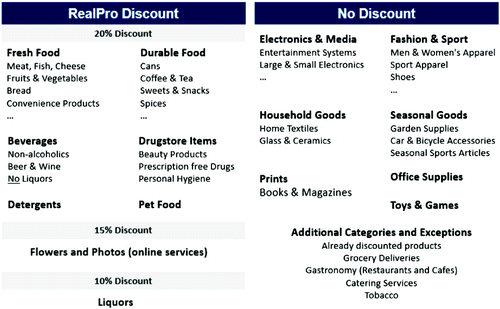
Exhibit 8
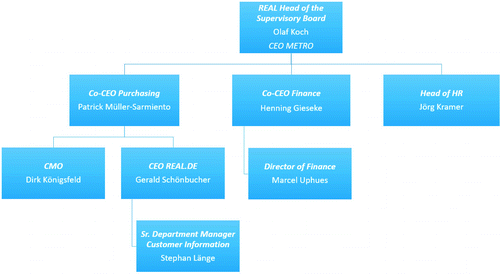
Exhibit 9
The data set contains recorded transactions from the RealPro market test. Each row contains a unique transaction, with the accompanying information recorded in the respective columns. Overall, the data set contains 75,297 transactions from 572 RealPro customers/households and—for the purpose of creating a control group—from 572 customers/households who have not joined the RealPro program. For both the RealPro group and the control group, transaction data are reported from May 1, 2018, through November 30, 2018, and also for the same time period in 2019. This approach allows one to examine changes in the purchasing behavior of RealPro customers after joining the program. The reported test market data are purposely limited to only seven months because, during the program’s first two months (i.e., March and April 2019), many customers were still in the process of joining the program; therefore, including these months in the data set would result in transaction histories of unequal length. Note also that only those RealPro customers who became members before April 1, 2019, are included. This restriction ensures less volatile demand patterns, since the initial analysis established that many customers increased their purchase volume abnormally in their first month of membership but exhibited a more level demand pattern in subsequent months.
Table 1 describes all features of the matched data set. For each transaction, which is given a unique ID, multiple features are reported. In this data set, the Customer_Group column indicates whether the customer/household is a RealPro member or part of the control group. To match all transactions to their respective customers/households, the customer ID is reported in each case. The store ID is similarly reported to enable identification of which transactions occurred at each of the seven stores used in the market test. The Date column reports the time of purchase (in yyyy-mm-dd format), and there are several other date-related columns. Revenue_Transaction gives the total amount spent by the customer/household on the respective transaction. Although the discount due to high–low promotions has already been deducted from the reported revenue figures, the RealPro discount has not been deducted. The Real team suggests that you do not deduct the RealPro discount when analyzing changes in or associated with the revenue, but only for calculations associated with the profitability of the program. The Num_Items variable captures the number of items purchased in the transaction. This number represents the sum of all items bought, not the number of unique products. In addition to the total revenue generated by each transaction, the data set reports the revenue from the purchase of products discounted under the RealPro program separately from that from products which were discounted as part of Real’s high–low pricing strategy. There is no overlap between these two revenue figures because, in the RealPro program, already promoted products do not receive an additional program discount.
|

Table 1. Data Set Description
| Feature | Description |
|---|---|
| Transaction_ID | The unique transaction ID associated with the purchase |
| Customer_Group | Indicates whether the customer/household has signed up for the RealPro program (“Pro”) or is part of the control group (“Control”) |
| Customer_ID | The ID associated with the given customer/household |
| Store_ID | The ID of the store where the purchase was made |
| Date | The date of the purchase (yyyy-mm-dd format) |
| Year | The year of the purchase |
| Month | The month of the purchase |
| Week | The week of the purchase |
| Day | The day of the week of the purchase |
| Revenue_Transaction | The revenue generated from the purchasea,b |
| Num_Items | The total number of items bought in the purchase |
| Revenue_Transaction_Pro | The revenue generated from the purchase of products discounted as part of RealProa |
| Revenue_Transaction_NonPro | The revenue generated from the purchase of products not discounted as part of RealProb |
| Revenue_Transaction_Promo | The revenue generated from the purchase of products that were price promoted as part of the high–low pricing strategyb |
a RealPro price discount has not been deducted.
b High–low price discount has been deducted.
Exhibit 10
The sensitivity matrix template (Figure 10) facilitates the examination of increases (or decreases)—at different discount and revenue levels—in gross profit per customer under RealPro in comparison with the corresponding gross profit during the previous year (i.e., without RealPro). The discount levels can be interpreted as the discount on the main group of discounted products (including grocery items) and is initially set at 20%. The calculation’s complexity is reduced by assuming, for the purposes of this exercise, that all RealPro products are discounted at this same 20% level. Note that this assumption only has minimal effects on the gross profit analysis. Liquors, which only account for a small share of Real’s total revenues, are the only RealPro products sold in stores that are not discounted at 20% (but at 10%). The percentage change in revenue, as shown on the horizontal axis of the matrix, is given in relation to the revenue achieved during the test market run. One must bear in mind that not all combinations of discount levels and revenue are plausible, which means that business sense must be applied when interpreting the matrix.
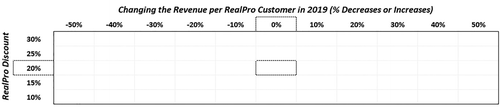
Note. Dashed lines indicate the results under the market test conditions, that is, a RealPro discount of 20% and no changes to the 2019 revenue per RealPro customer
In addition to the sensitivity matrix, the following information is provided:
At about 70% of total revenue, the cost of goods sold is the greatest expense for grocery retailers like Real.
The team estimates that implementing RealPro will reduce the annual combined marketing and personnel costs by €170 per RealPro customer. Note that these reductions in costs should be accounted for in the (adjusted) gross profit calculation.
Information on other costs (e.g., real estate expenses) are not given.
References
- (1998) Costco Companies, Inc. Harvard Business School Case 599-041:21. Revised July 1999.Google Scholar
GfK (2020) Consumer index total grocery 12/2019. Report, GfK Consumer Index, Nuernberg, Germany.Google Scholar

