Case Article—Optimizing Food Donation Delivery for the Nonprofit Company Logica&Co
Abstract
The article presents a case exercise that teaches students how to apply mathematical programming to a real-life context. The case deals with the management of the food donation supply chain. The case, using a project-based approach, proposes a realistic scenario that simulates the consulting interaction with a nonprofit company, Logica&Co, which acts as a two-sided platform connecting supply and demand. The objective is to define an effective strategy to collect and deliver food donations, using either bike or e-bike, from local businesses to soup kitchens, covering a semester-long timeframe. The form of the problem exhibits nonlinear characteristics, but the design allows for adjustable difficulty levels. Students can assess their performance during the class period thanks to an interactive offline tool, the SoS simulator, which is publicly available for download and can be customized by instructors. The case was proposed as a competitive group challenge for students of the bachelor’s or master’s program in management engineering at Sapienza University of Rome. However, given the embedded characteristics of flexibility, it can be easily adjusted for heterogeneous curricula of undergraduate- and graduate-level courses in engineering programs (this opportunity is extensively discussed in the Case Article and the Teaching Note). The students appreciated both the teaching methodology and the teamwork aspects and highlighted the utility of the SoS simulator tool.
Supplemental Material: The Teaching Note and its supplemental material are available at https://www.informs.org/Publications/Subscribe/Access-Restricted-Materials.
1. Introduction
“Optimizing food donation delivery for nonprofit company Logica&Co” is a structured teaching tool that provides students with an extensive case introducing the modelization for linear and nonlinear integer programming problems.
This case article aims to develop academic material that can be used for training managerial decision-making supported by operations research (OR) concepts. The case concerns a real-life issue, namely urban food and waste management. The tasks presented to the students involved multiple interdependent aspects, such as warehouse localization, vehicle routing, operational cost minimization, and managing supply, demand, and workforce. The topic was easy to grasp and familiar enough for students while at the same time economically, socially, and environmentally relevant.
Annually, the European Union (EU) produces an average of 58 million tonnes of food waste, resulting in an estimated loss of 132 billion euros. EU food waste significantly contributes to greenhouse gas emissions (approximately 16% of the overall food system emissions) and the use of scarce natural resources (European Commission 2022). The global rise of individuals subjected to food insecurity, exacerbated by the COVID-19 pandemic and soaring inflation rates, highlighted the amorality of massive food loss (Davis et al. 2014, Capodistrias et al. 2022).
In this context, food banks, soup kitchens, and homeless shelters1 play a critical role in assuring food and meal provision to socially isolated and poor people. Charitable and nonprofit organizations base their economic sustainability on surplus food redistribution from retailers or food companies (e.g., food not suitable for sale because of limited shelf life or packaging issues)2 and additional donations (whether monetary, in-kind, as voluntary labor; Ramani et al. 2023).
Defining public policies and management strategies devoted to this sector is a multifaceted challenge because achieving effectiveness requires coordinated actions throughout the supply chain (Chauhan et al. 2021, Akkerman et al. 2023). The uncertainty derived from irregularity in donations (i.e., by frequency, quantity, or basket composition) is definitely among the most relevant issues. Additional challenges are related to the dependence on voluntary labor (e.g., limited availability, diverse skills among volunteers) and the logistics (e.g., lack of coordination, environmental impact). Mahmoudi et al. (2022) provided a recent literature review of state-of-the-art decision support models for food collection and distribution that aim at equity, effectiveness, and efficiency.
Lately, EU member states have registered a rise in the yearly amount of food and monetary donations, thanks to growing social awareness and a series of focused public interventions (Chrisafis 2016). However, limitations in network design, resource allocation, and efficient collection and delivery planning constrain the supply chain’s capacity to effectively leverage the increased volumes.
Centralizing donations management has proven to be a promising strategy in addressing the main issues cited. Our case originates directly from this kind of approach, simulating a consultancy interaction with a nonprofit company serving as a two-sided platform, connecting supply (retailers) and demand (soup kitchens).
2. Literature Context
A survey of articles that appeared in the INFORMS Transactions on Education revealed the presence of extensive cases concerning the broader topic of logistics, vehicle routing, and supply chain management; however, limited works have specifically dealt with nonprofit organizations or food waste and food security. The case presented in Ramani et al. (2023) centered on nonprofit businesses and fund-raising operations, fulfilling the educational goal of providing an outline for nonprofit expenses structures and quantitative modeling for the decision-making process. On the same line, Narayanaswami and Narasimhan (2017) disclosed the managerial challenges faced by the Food Corporation of India in addressing food insecurity issues. The case allowed students to become familiar with cost-effective logistics plans (for food grain rice storage) and optimal delivery through road-based or rail-based solutions. In comparison, our case presents higher complexity (e.g., pickup and delivery, a higher number of locations) and additional tasks.
Pedagogical works using OR approaches to deal with broad distribution logistics problems include Drake et al. (2011), Manno et al. (2019a), and Wu (2022). Drake et al. (2011) explored the application of quantitative modeling in devising decision-making strategies for product distribution of an office supply firm, incorporating a discussion over ethical dilemmas within logistics network design. Manno et al. (2019b) presented an OR modeling case to optimize the production and distribution of a beach equipment company. Wu (2022) tackled the definition of logistic plans involving multiple modes of transportation and focused on designing a global supply network involving warehouse coordination. Following and further expanding these publications, our case integrates multiple tasks to present a complete challenge, including facility location, vehicle routing, workforce management, fleet composition, and fleet sizing for environmentally sustainable solutions.
This approach allows students to engage with the complexity deriving from the interdependence between different aspects of the problem articulation, as opposed to a tendency in the literature to prioritize training single sides separately.
This strategy has been applied in excellent previous works.
Chau and Benson (2025) proposed a case focused on location planning. Students experimented with identifying multiple selection criteria, collecting relevant data (both provided by the instructor and self-researched), and employing a decision-making framework and mathematical modeling to identify optimal locations. In contrast, our case includes a well-defined problem with a given set of potential locations for selection. Milburn et al. (2017), Wellington and Lewis (2021), Choudhari and Chandra (2022), and Li et al. (2025) all dealt with vehicle routing problems (VRP). Milburn et al. (2017) presented an interesting case based on the activities of a logistic company, including additional constraints due to delivery windows and job time regulations. Wellington and Lewis (2021) and Choudhari and Chandra (2022) displayed useful treatment of numerical considerations and heuristics in solving practical VRP formulations; in particular, the latter discussed last-mile delivery optimization on large-scale problems. Finally, Li et al. (2025) illustrated a strategic path answering the business question of whether to make or to outsource transportation operations through solving a sequence of VRPs of increasing complexity.
Concerning multimodal and sustainable perspectives, Chandra and Vatsa (2021) was related to the role of coastal shipping in logistics planning that integrates/competes with roadway solutions, whereas Dong and Boute (2020), focusing on decarbonization, presented a simulation game on the modal shift from road to rail. In our case, logistics is carried out solely with bikes and e-bikes, and students are challenged to minimize electric energy consumption.
From a managerial perspective, the Harvard Business Publishing website provides several cases focusing on soup kitchen management. Among these, Vestal et al. (2015) drew a parallel in supply chain operations between for-profit and nonprofit organizations. Their case revolved around supply and demand mismatch issues, emphasizing the critical role of cooperation along the food-donation supply chain. Vanajakumari et al. (2022) concerned equitable distribution and appropriate key performance indicators development to effectively manage a nonprofit supply chain, including considerations on the issues associated with food-donation increment in volume. Finally, Zhang et al. (2019) addressed the role of a private company acting as an intermediary within the food bank supply chain. This company gathered near-to-expiry, surplus, and unwanted food items from local businesses and redistributes them to nonprofit organizations. However, the case provided material for class discussion only and did not intend to illustrate either effective or ineffective handling of a managerial situation. Our case, in line with Zhang et al. (2019), depicts a double-sided platform operating in a city and connecting the demand for resources from soup kitchens and the offer of donations from local businesses.
A distinctive feature of our case is the high adaptability of the teaching materials. The project is designed to be easily scalable in size and complexity, providing instructors with control (to meet their specific pedagogical needs) while maintaining realism. The scenario is calibrated on (editable) real-world data. These characteristics align with the recommendations outlined in a recent review by Drake (2019), which examines best practices for using cases in operations research/management science (OR/MS) classrooms. The indications include i) flexibility, ii) breaking down complicated cases into several parts (or making them scalable), and iii) taking an active role in presenting the case and discussing potential solution approaches.
An additional valuable element of our case is the offline solution assessment software included in the teaching materials. Several case studies published in ITE supplied students with sample solutions or templates to solve the optimization problems, frequently using Excel spreadsheets (Keskin and Barbee 2021, Ramani et al. 2023) or Open Solver as a free alternative (Chau and Benson 2025). Notably, Vogiatzis and Kontou (2025) relied on real-world data for a network optimization problem dealing with law enforcement. They supplied students with a template Jupyter notebook dedicated to data wrangling, data visualization, and formulating the mathematical model using PuLP. The SoS tool included in our case is presented as an offline user-friendly app, offering multiple functions and a distinctive level of completeness and flexibility. The assessment tool presented by Manno et al. (2019a), which evaluates the feasibility of the submitted solutions and provides useful information to help students adjust their mathematical formulation, is the closest example to our tool. However, the SoS is also critical in helping visualize the problem context and the urban area serving as the location (see Section 4).
3. Case Overview
The case presents the managerial tasks faced by a (fictional) nonprofit company, Logica&Co. The company is structured as a double-sided platform, operating in a city and connecting the demand for resources from soup kitchens and the offer of donations from local businesses. In particular, bakers, greengrocers, and local markets cover the soup kitchens’ minimum daily requirements for bread, fruits and vegetables, and general goods. The case is inspired by FoodCloud,3 a real-world successful nonprofit company following a similar business model on a larger scale in Ireland.
The company is also responsible for the logistics. Any transport operation is performed only by paid riders driving green vehicles, namely bikes and e-bikes, which are allocated to warehouses for nighttime parking. The daily logistic activities for each rider include departing from an assigned warehouse, reaching a local business to collect the goods, delivering the load to a soup kitchen, and returning to the warehouse.
The company also receives monetary donations from private sponsors, which are fully allocated to cover warehouse rent and transportation costs, including fleet acquisition, energy consumption, and drivers’ salaries. Monetary donations are incentivized through a marketing reward system, where advertising patches featuring sponsors’ logos are applied to the vehicles. The number and size of these patches are calibrated based on the donation itself. Each sponsor’s investment decision is governed by a nonlinear function that considers the number and behavior of other sponsors.
The case requires a series of decisions to develop a suitable plan for the company activities over a semester-long timeframe. These decisions concern defining:
the warehouses’ number and locations;
the composition and size of each warehouse’s fleet (either bikes or e-bikes);
the logistic picking up and delivering flows of each rider;
the number of private sponsors and their donations.
The objective is to maximize soup kitchens’ savings, which are derived from in-kind and monetary donations, minus the logistics costs.
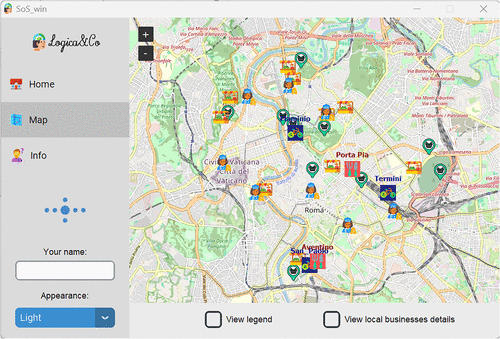
As anticipated, we offer an offline solution assessment software, the Solution Simulator (SoS),4 that students can use to validate the feasibility of a given solution and assess the decisions’ performance. This tool also contributes to problem visualization, adding a layer of realism to the case. As shown in Figure 1, the case presented is set in Rome, with soup kitchens, local businesses, and warehouses located in the city. However, the artificial data generation is fully adaptable to different scenarios (e.g., the city itself and the number and location of the points of interest). Guidelines for customization are provided in the Teaching Note.
For easy reference, we report in the appendix a list of the teaching resources for distribution to students and instructors.
4. Suggested Classroom Use
The case study is designed primarily for undergraduate students in both business and engineering schools. To effectively approach the assignment, students should have basic theoretical skills in managing OR problem modeling and basic knowledge of linear and/or nonlinear integer programming theory. Basic coding knowledge is desirable. The case is a scalable format. Thanks to its structure and flexibility, it can be tailored to the instructor’s needs, the students’ curricula and backgrounds, and the available class time. We present two full (ready-to-use) versions of the case, differentiated in difficulty level and suggested development timelines. The base version addresses a nonlinear management problem, whereas the simplified one includes only linear functions and can therefore be handled more easily by students less familiar with mathematical programming. The two versions can be further personalized (e.g., reducing the scope and changing the number of variables). The Teaching Note provides answers on both versions and extensively discusses how to customize the case (and the solution provided by the assessment tool SoS). To address the case, various alternative programming languages and solvers can be employed, including PuLP (Dunning et al. 2011), AMPL (Fourer et al. 2003), Pyomo (Bynum et al. 2021), and Google OR-Tools (Perron and Furnon 2023). Tools and solvers can be used without impacting the broader aspects of the case, offering flexibility in tool choice. The classroom experience was tested by adopting the AMPL tool, which is both flexible and user-friendly, making it suitable even for beginners. A free student version of AMPL is available with limited functionality; a maximum of 500 variables and 500 constraints are allowed.5 These limitations can be seen as an additional training component, encouraging students to make thoughtful modeling and managerial decisions by weighing alternative approaches. Analogous considerations could be drawn about the open-access toolkit PuLP. The Teaching Note includes a solver code implemented using PuLP, which is chosen to maximize accessibility for replicating our case study while maintaining its pedagogical value.
4.1. Teaching Suggestions
The case is designed as a group assignment and presented as a competitive challenge. In its original form, the case is dispensed as a stand-alone laboratory activity; however, it could also be used as an additional assessment for credit or nested as an in-class activity/final project assignment in a broader theoretical course. In the following, we present the use of the case as a laboratory taking place over 13 weeks. We suggest dividing the course lessons into four main sections summarized in Table 1:
theoretical lectures;
project assignment;
project development;
final meeting.
|

Table 1. Course Contents and Schedule
| Section | Lecture | Duration | Attendance | Contents |
|---|---|---|---|---|
| Lectures | 1 | 150 min | All students | Course contents and structure, modeling approach and basic modeling schemes |
| 2 | 150 min | All students | Fundamentals and syntax of the selected tool and solver, practical exercises | |
| 3 | 150 min | All students | Modeling tricks and linearization techniques | |
| Project assignment | 4 | 90 min | All students | Case description and discussion |
| Project Development | 5 | Per group | Group debriefing | |
| 6 | Per group | Group debriefing | ||
| 7 | Per group | Group debriefing | ||
| 8 | Per group | Group debriefing | ||
| Final meeting | 9 | All students | Presentation of final results, winners announcement |
The first section is devoted to theoretical lectures, consisting of three lessons, each lasting 150 minutes. These lectures focus on the fundamentals of OR modeling and the application of OR tools. Specifically:
The first lecture introduces the course content and structure, covering the modeling approach and key modeling schemes.
The second lecture explains the basic elements and syntax of the tool and solver that students will use, providing an opportunity for students to practice with short exercises.
The third lecture focuses on advanced modeling techniques, including tricks for handling nonlinear functions such as piecewise and stepwise functions.
The project assignment takes place in a single lesson of 90 minutes; students are presented with the case and, after reading the case description independently, discuss their doubts about the delivery.
The third phase is dedicated to competition among teams based on their performance in developing the project and the results achieved. The groups are formed independently by the students, with instructors intervening only when necessary. The competition lasts eight weeks, divided into four rounds, each lasting two weeks (see Table 1). It involves mainly autonomous work from students, along with coordination and collaboration among peers. To obtain a good performance, five hours per student per competition round (summing up to an overall workload of 20 hours) is a reasonable amount of time to dedicate to the project. Between rounds, instructors should maintain regular communication and provide ongoing support. At the end of each round, to ensure equitable access to support, teams must participate in mandatory meetings with the instructors. Meetings are private for each team and aligned with a deadline for submitting a (partial) solution. Each group must submit (via email) its most performative model and the best result (i.e., the profit values associated with their solution). Meetings provide an opportunity for students to explain their modeling choices and strategies, discuss mathematical and/or technical issues, present results, and plan future steps. Instructors offer comments and feedback to guide further improvements.
At the end of the course, during the last lesson, each group is given 15 minutes for their final presentation, followed by a question-and-answer session. Students are required to highlight their modeling choices (e.g., which features of the system they chose to model), the key characteristics of the model (e.g., classification based on the structure of the feasible region, objective function, and constraints; maximization or minimization; linearization techniques), and the results achieved.
The Teaching Note includes a possible format for the presentations that can be supplied and a set of thought-provoking questions (categorized from mild to challenging, equipped with their corresponding answers) for the original and simplified version of the problem. As an additional task, instructors may also ask the students to use the SoS tool to derive information about the problem structure and use it to run a sensitivity analysis.
4.2. Groups Dynamics and Assessment
The group setting strongly influences both intra-team cooperation and inter-team competition. We tested the case for an average of 25 teams per contest, a size that ensures a sufficient level of competitiveness, possibly segmented by closeness to the best optimal result. Considering the challenges presented by our case, we recommend teams of a minimum of three and a maximum of five members. Although we value allowing students the freedom to form groups without a strict limitation on team size, instructors should be mindful of the potential heterogeneity this may cause and take into account the greater pressure faced by smaller teams when evaluating performance. Because group projects with four or more students potentially lead to free-riding issues, we adopt strategies to limit this occurrence. The assessment process involves three dimensions: performance in managing the case (evaluated as a team), performance giving a presentation (evaluated as individual), and oral questions (evaluated as individual). Moreover, the recurrent meetings can test individual awareness about the case. As a consequence, each student receives his or her score.
We chose to incorporate specific elements that foster team building. Each team is asked to select a name and create a logo.6 The teams are listed on the course’s official website, which features a graphical competition dashboard updated weekly. This promotes friendly competition and enhances the overall gamification experience. During the first and second rounds, teams are informed of their ranking and the competitors’ results (i.e., value obtained from profit maximization). However, starting from the third round, the maximum revenue achieved by each group remains hidden. This ensures an incentive to keep being performative during the last round, because even those in the highest-ranking positions cannot be certain of having a solid advantage.
5. Pedagogical Goals
This case can be used to achieve several teaching objectives, including the following:
Enhance students’ awareness of the practical value of optimization techniques in real-world decision-making applications.
Enhance students’ awareness of the problem articulation complexity, for instance, understanding the interdependencies between vehicles’ routing, warehouses’ location and capacity, and operative costs (i.e., energy, rents, drivers’ salary).
Training on using optimization tools and solvers to model and solve a problem.
Exercise teamwork and organization skills. Train in communicating results and performing oral presentations.
Encourage continuous improvement. After obtaining an initial feasible solution, students are challenged to apply solution improvement techniques. As a result, the focus shifts from merely achieving feasibility to striving for optimality, promoting a competitive and goal-oriented mindset.
Specific OR concepts and mathematical techniques that can be taught through this case are as follows:
Model formulation: Developing objective functions and constraints to represent real-world problems.
Feasibility and optimization: Transitioning from finding feasible solutions to achieving optimal ones.
Linear programming: Addressing classical problems such as transportation, assignment, and mixing problems.
Activation binary variables: Using binary variables to model decision activation and logical constraints.
Nonlinear programming: Managing nonlinear functions, such as piecewise and stepwise functions.
Linearization techniques. Applying linearization methods such as function approximation, block separation of the problem, and multilevel resolution approaches.
A major challenge in teaching OR/MS courses, especially to students for whom OR is not their primary field of study, is to motivate them to acknowledge the critical role of mathematical tools in decision-making (Beliën et al. 2013).
The teaching cases have the potential to provide a useful bridge from classroom and theory to workplace and practice (Cochran and Belien 2021), enabling the contextual training of three core competencies (Drake 2019, Siebert et al. 2021): (1) conducting analysis, (2) managing process, and (3) understanding context.
With this teaching case, we intend to supply students with a real-world integrative example so that they may experience combining their hard and soft abilities for practical applications. Students are likely to be already familiar with the Logica&Co. context and business model (e.g., food donation, last-mile delivery) and can easily relate to the relevance of the case scenario. These elements let them focus on acquiring more value-added skills. The case is presented as a competition, which in educational literature is proven to be a full combination of competitive and cooperative learning and to favor students’ concentration and motivation (Biggs 1996, Sailer and Homner 2020, Oliveira et al. 2023). Performing a final presentation helps develop communication skills and public speaking while also encouraging constructive debate and stimulating critical thinking (Pachamanova 2015).
We aim for an all-around learning experience. Hence, the project has a flexible level of complexity and balances accessibility with an appropriate degree of challenge, stimulating students to be engaged and creative.
6. Classroom Experiences
The case has been used over the past three years in courses with different levels of knowledge on OR topics; in particular, it has been presented to students as a laboratory activity in the curriculum of management engineering at both the Bachelor’s and Master’s levels.
Overall, students reacted positively to the teaching approach and embraced the competition. In the first two academic years, feedback collected by Sapienza University of Rome through an anonymous quality survey showed that the course was on average appreciated by the students, who expressed a high level of satisfaction. They found the course “engaging,” “challenging,” and “stimulating” despite the “high workload.”
In the third academic year, we independently collected additional opinions from students. The students who followed the course between March 2024 and May 2024 were given a brief online survey, anonymous and voluntary. Although students were told that participation was optional, the response rate was around 65% (52 responses over 80 attendees). Table 2 displays the survey questions.
|
Table 2. Questions from Logica&Co Case Student Survey
| Skill and resources | |
|---|---|
| Q1 | Evaluate the importance of the following skills acquired through the Logica&Co case by assigning each a score from 1 to 5, where: |
| 1. Not important at all; 2. Not important; 3. Neutral; 4. Important; 5. Very important | |
| |
| Learning experience | |
| Q2 | How do you judge the SoS tool for the overall learning experience? |
| 1. Not important at all; 2. Not important; 3. Neutral; 4. Important; 5. Very important | |
| Q3 | How would you assess your learning in the Logica&Co case? |
| 1. Did not learn at all 2. Learned to a limited extent 3. Neutral 4. Learned significantly 5. Learned extensively | |
| Q4 | Are you satisfied with your performance in the Logica&Co case? |
| 1. Definitely not satisfied; 2. More dissatisfied than satisfied; 3. Neutral; 4. More satisfied than dissatisfied; 5. Definitely satisfied | |
| Q5 | Use this space for any additional comments you would like to make about the Logica&Co case exercise. |
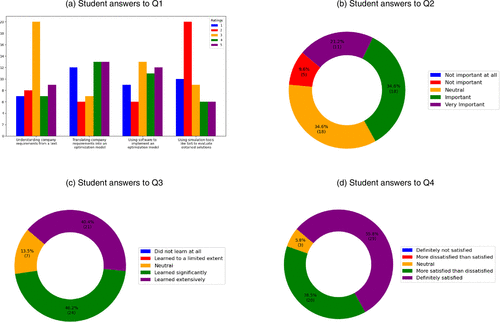
As expected, when asked to rank the most relevant skills assimilated during the course, most of the students showed a stronger interest in “translating company requirements into a mathematical optimization model” and “using software to implement a mathematical model,” which clearly could impact more their future professional activities (see Figure 2, Q1). However, when asked to determine the relevance of the SoS tool for the overall learning experience, most of the students recognized its critical role (see Figure 2, Q2). This is consistent with the experience reported in analogous teaching cases providing the students templates as solution assessment tools (see, e.g., Milburn et al. 2017, Keskin and Barbee 2021, and Choudhari and Chandra 2022).
Several students, in their responses to Table 2, Q5, emphasized the usefulness of the SoS tool in preparing for meetings and maximizing the value of one-on-one time with instructors. They also highlighted the critical role of the instructor in their overall training.
During the competition phase, the four rounds mark different attitudes of the students toward the case. After the first round, only a limited number of teams are capable of presenting feasible solutions, whereas the majority struggle to identify the correct way to model the problem. Indeed, most first attempts lack comprehensiveness in representing all aspects of the case; in particular, many teams resort to hard simplifications and/or violate restrictions on resource availability. In the following two rounds, an increasing number of teams obtain feasible solutions; however, the main focus is still on feasibility rather than on the search for optimality.
In intermediate meetings with teachers, students appear on average involved and proactive; they discuss their choices and exhibit an eagerness to comprehend the reasons behind the discrepancies between their best profit value and the optimal value given by the SoS.
At the end of the competitions, only a few highly performing groups succeed in modeling all aspects of the case. These groups manage a large number of variables and constraints, achieving solutions with objective values close to the optimal. To address nonlinear functions, teams are required to simplify certain case-related elements and provide a solvable model. Throughout this iterative modeling process, the SoS proves to be a valuable tool, enabling teams to assess the quality of their modeling choices effectively.
The students expressed high levels of satisfaction with both their performance in the course and their overall learning experience (see Figure 2, Q3, and Figure 2, Q4). These results indicate continuous improvements in the quality of the Case delivery, which is achieved through iterative refinements and lessons learned. This is particularly evident in analyzing how students’ appreciation increased compared with the feedback reported in the generic surveys conducted by Sapienza University of Rome.
As a closing remark, given the students’ strong interest in developing skills related to translating company requirements into an optimization model, the Case experience could be further enhanced by incorporating a real-life simulation involving interaction with a client (represented by an instructor or external expert). This could be structured as a seminar followed by a question-and-answer session, complementing the project assignment session (see Table 1).
7. Conclusions
The teaching case we propose aims to provide students with a deeper understanding of practical OR applications, contextually fostering the development of both hard and soft skills. It introduces a managerial problem that highlights the critical role of OR in supporting decision-making within real-world contexts. By focusing on the logistics of food donation, the case addresses a highly relevant research topic while presenting students with a familiar and relatable setting. This ensures that the problem’s significance is immediately clear and engaging for learners. The case is designed to be easily adapted to different student backgrounds and curricula as well as to alternative narratives and problem dimensions. The offline tool for performance assessment (SoS) stands out as an interactive and customizable feature, setting this case apart from previously published ones in terms of completeness and flexibility. The availability of the SoS tool, which serves as an always-accessible benchmark, has been particularly appreciated by the students. Overall, the case promotes student proactivity, engagement, and interest, making it a highly relevant and valuable experience for their academic education.
We thank two anonymous reviewers and the associate editor for the careful reading and constructive feedback that contributed to greatly improving this paper. We also thank the participants at the ODS2023 Conference and EURO2024 Conference for their meaningful comments on the work. The work of Anna Livia Croella is supported by the FAIR (Future Artificial Intelligence Research) project, funded by the NextGenerationEU program within the PNRR-PE-AI scheme (M4C2, investment 1.3, line on Artificial Intelligence).
The work of Martina Gregori has been carried out within the MOST– Sustainable Mobility National Research Center and received funding from the European Union Next-Generation EU (PIANO.NAZIONALEDIRIPRESAERESILIENZA(PNRR)–MISSIONE4.COMPONENTE 2, INVESTIMENTO 1.4– D.D. 1033 17/06/2022, CN00000023). This manuscript reflects only the authors’ views and opinions, neither the European Union nor the European Commission can be considered responsible for them.
Appendix. A List of Resources Provided with the Case
A.1. SoS Application
An offline application SoS is downloadable from https://annaliviacroella.site.uniroma1.it/publications/sos. The SoS include:
a data folder containing the original data file of the case Data.xlsx;
an input folder containing a set of .txt files used to run a proof simulation;
an empty output folder.
A.2. Teaching Note
The Teaching Note includes the following:
guidelines for customization of data;
a description of a simplified case;
a mixed integer linear programming (MILP) formulation for the problem;
a possible outline for the student presentations;
a set of thought-provoking questions for students and relative answers.
A.3. Supplementary Materials for Instructors
The accompanying supplementary materials available for instructors include the following:
a Python script utilizing an open-source library (PuLP) to solve the model;
a Python script generating customizable sets of data for scalable cases.
1 From this point forward, the term soup kitchen indicates any place (public or private) where free food is distributed to homeless and extremely low-income people. Sometimes the terms could also identify below-market price systems; however, in the case study, we adopted the first definition (for-free meals).
2 In 2022 only, food banks associated with FEBA (the European Food Banks Federation, active in 30 countries) repurposed around 870,000 tons of food, helping about 12.4 million people in need.
3 https://food.cloud/our-work/technology-for-retail-and-food-service-providers.
4 https://annaliviacroella.site.uniroma1.it/publications/sos.
6 Indeed, in various phases of the course (including the final presentation), students are encouraged to be creative and to promote their motivation.
References
- (2023) Dealing with donations: Supply chain management challenges for food banks. Internat. J. Production Econom. 262:108926.Crossref, Google Scholar
- (2013) Teaching integer programming starting from an energy supply game. INFORMS Trans. Ed. 13(3):129–137.Link, Google Scholar
- (1996) Enhancing teaching through constructive alignment. High. Educ. 32(3):347–364.Crossref, Google Scholar
- (2021) Pyomo–Optimization Modeling in Python, vol. 67, 3rd ed. (Springer Science & Business Media, New York).Crossref, Google Scholar
- (2022) European food banks and covid-19: Resilience and innovation in times of crisis. Socioecon. Plann. Sci. 82:101187.Crossref, Google Scholar
- (2021) Case article—Coastal shipping for automobile distribution. INFORMS Trans. Ed. 22(1):28–34.Link, Google Scholar
- (2025) Case article—Locating a truck terminal in texas. INFORMS Trans. Ed. 25(2):90–98.Google Scholar
- (2021) Food loss and waste in food supply chains. A systematic literature review and framework development approach. J. Clean. Prod. 295:126438.Crossref, Google Scholar
- (2022) Case article - Route planning at an animal husbandry department. INFORMS Trans. Ed. 23(1):35–40.Link, Google Scholar
- (2016) French law forbids food waste by supermarkets. The Guardian. Accessed May 3, 2024, https://www.theguardian.com/world/2016/feb/04/french-law-forbids-food-waste-by-supermarkets.Google Scholar
- (2021) The informs case competition and the case for cases. ORMS Today. 48(2):20–21.Google Scholar
- (2014) Scheduling food bank collections and deliveries to ensure food safety and improve access. Socio-Econom. Planning Sci. 48(3):175–188.Crossref, Google Scholar
- (2020) Game—The beer transportation game: How to decarbonize logistics by moving freight to sustainable transport modes. INFORMS Trans. Ed. 20(2):102–112.Link, Google Scholar
- (2019) Teaching or/ms with cases: A review and new suggestions. INFORMS Trans. Ed. 19(2):57–66.Link, Google Scholar
- (2011) Case article - Keeping logistics under wraps. ITE.. 11(2):57–62.Google Scholar
- (2011) Pulp: A linear programming toolkit for python. Accessed January 1, 2025, https://optimization-online.org/2011/09/3178/.Google Scholar
European Commission (2022) Food safety - Frequently asked questions: Reducing food waste in the EU. Accessed May 3, 2024, https://food.ec.europa.eu/safety/food-waste/eu-actions-against-food-waste/frequently-asked-questions-reducing-food-waste-eu_en.Google Scholar- Fourer R, Gay D, Kernighan B (2003) AMPL: A Modeling Language for Mathematical Programming, 2nd ed. (Duxbury Press, Belmont, CA).Google Scholar
- (2021) Case article - GreatDeal and NewChicken merger: Designing an omni-channel supply chain. INFORMS Trans. Ed. 22(1):42–47.Link, Google Scholar
- (2025) Case article—Prescriptive analytics for entrepreneurial growth: Data-driven strategic decision making at iparty bangkok co., ltd. INFORMS Trans. Ed. 25(2):169–174.Google Scholar
- (2022) Decision support models for managing food aid supply chains: A systematic literature review. Socio-Econom. Planning Sci. 82:101255.Crossref, Google Scholar
- (2019a) Case article - Production and distribution optimization of beach equipment for the Marinero company. INFORMS Trans. Ed. 19(3):152–154.Link, Google Scholar
- (2019b) Case-production and distribution optimization of beach equipment for the Marinero company. INFORMS Trans. Ed. 19(3):155–159.Link, Google Scholar
- (2017) Case article - Growing pains: A case study for large-scale vehicle routing. INFORMS Trans. Ed. 17(2):75–80.Link, Google Scholar
- (2017) Case article - Optimal movement plan of rice in the state of Andhra Pradesh. INFORMS Trans. Ed. 18(1):37–40.Link, Google Scholar
- (2023) Tailored gamification in education: A literature review and future agenda. Educ. Inf. Technol. 28(1):373–406.Crossref, Google Scholar
- (2015) Case article - Mapping business problems to analytics solutions: Surrogate experiential learning in an MBA introductory data science and business analytics course. INFORMS Trans. Ed. 16(1):15–22.Link, Google Scholar
- (2023) Or-tools. Accessed January 1, 2025, https://developers.google.com/optimization/.Google Scholar
- (2023) Case article - GAP: A humanitarian initiative of Ramakrishna Mission for underprivileged children. INFORMS Trans. Ed. 24(1):70–75.Link, Google Scholar
- (2020) The gamification of learning: A meta-analysis. Educ. Psychol. Rev. 32(1):77–112.Crossref, Google Scholar
- (2021) Effects of decision training on individuals’ decision-making proactivity. Eur. J. Oper. Res. 294(1):264–282.Crossref, Google Scholar
- (2022) Brazos Valley Food Bank: Is Equitable Distribution Truly Possible? (Harvard Business Publishing, Brighton, MA).Google Scholar
- (2015) Brazos Valley Food Bank: Fostering Partnership, Feeding Hope (Harvard Business Publishing, Brighton, MA).Google Scholar
- (2025) Case—Racial bias in automated traffic law enforcement and the price of unjustness. INFORMS Trans. Ed. 25(2):128–135.Google Scholar
- (2021) Getting beyond the first result of solving a vehicle routing problem. INFORMS Trans. Ed. 22(1):9–27.Link, Google Scholar
- (2022) Case article - Integrating network design models for a global supply network. INFORMS Trans. Ed. 22(3):172–175.Link, Google Scholar
- (2019) Foodxervices and Food Bank: A Call for Integration (Harvard Business Publishing, Brighton, MA).Google Scholar