Case Article—Humanitarian Supply Chains and Inventory Management: Planning Medical Supply at the International Committee of the Red Cross
Abstract
This case is based on an actual project with the International Committee of the Red Cross. The rich context allows instructors to cover important topics in inventory management, supply chain management, and humanitarian logistics at a level appropriate for different student backgrounds. At a foundational level, the case presents opportunities to practice concepts like cycle stock, safety stock, and service level. Technical audiences can appreciate applications of machine learning and optimization for inventory management. Practice-oriented audiences learn about the challenges of applying commercial operations metrics and heuristics like ABC analysis to humanitarian logistics. Realistic data and models are provided.
Funding: B. Thakur-Weigold acknowledges funding from the Engineering for Humanitarian Action initiative launched by the ICRC, ETH Zurich, and EPFL. International Committee of the Red Cross (ICRC), Eidgenössische Technische Hochschule (ETH) Zürich, and École Polytechnique Fédérale de Lausanne (EPFL).
Supplemental Material: Supplemental materials are available at https://www.informs.org/Publications/Subscribe/Access-Restricted-Materials.
1. Background
Inspired by a project with the International Committee of the Red Cross (ICRC), this case exposes students to humanitarian supply chain management and contrasts it with commercial practice. The facts and the data accompanying the case have been modified for teaching purposes and do not necessarily represent the current state of operations at the ICRC; however, the rich context, realistic data, and the resources provided with the case enable instructors to discuss real issues of importance in humanitarian logistics and inventory management, as well as machine learning applications.
Every supply chain manager must match supply and demand in their order fulfilment process. In a commercial setting, a stockout causes lost sales, which reduces profits and possibly loses customers in the future. Overstock is expensive. The challenges faced by a humanitarian logistician are similar but arguably more painful. In the worst case, the cost of stockouts can be death. On the other hand, an excess of medical items sent to the wrong place can result in expiries (which are morally reprehensible) and dead stock. Retrieving unused supplies from war zones is prohibitively expensive.
The case is presented from the point of view of Hannah Seydou, global supply chain coordinator for the ICRC in Geneva, Switzerland. A highly educated and accomplished woman born in a war-torn country, Hannah strives to make every Swiss Franc go further to reach patients in war zones. Her overall goals are to use data analytics to improve inventory management processes for medical supplies. A challenge that looms large in the case is also how to handle an expected reduction in the ICRC budget.
In contrast to commercial inventory management, the objective of organizations like the ICRC is not to maximize profit or margin. It is to relieve suffering. ICRC’s “customers” cannot wait for delivery of life-saving medical supply. The main concern is therefore about misallocating life-saving resources. Hannah’s task is to work with her health colleagues to set realistic expectations about the availability of stock while minimizing waste. The medical supply chain Hannah manages is effectively a multiechelon distribution system, with the global warehouse in Geneva supplying most of the standard item list to national warehouses in places like Congo and South Sudan. Unlike a commercial manager, Hannah does not always have the freedom to make the most cost-effective decisions for this configuration. As we illustrate in the teaching note, traditional inventory management procedures like Always, Better, Control (ABC) analysis, for example, do not apply.
There are three high-level themes in the case: (1) the importance of incorporating the uncertainty of demand and supply into the order fulfilment process; (2) implementing data analytics within an executable inventory management process; and (3) the importance of cross-functional coordination, in particular, in the context of humanitarian supply chains. The case allows instructors to cover a number of concepts and tools within these themes. Through the case, students could:
Encounter foundational inventory management concepts like lead time, cycle stock, safety stock, and service level in an interesting, realistic context;
Interpret important metrics from a managerial point of view;
Learn about heuristics for inventory management often used in practice, such as ABC analysis, VED (Vital, Essential, Desirable) analysis, and FNS (Fast, Normal, Slow) analysis;
Employ a disciplined approach to inventory management through optimization formulations;
Apply data visualization and machine learning techniques such as clustering to identify patterns in item groupings; and
Differentiate between the requirements of humanitarian logistics and commercial operations to run in a stable civilian environment.
The reality of humanitarian logistics in unstable countries is that demand is highly volatile, and material flows are erratic due to safety, infrastructure, and customs clearance issues. Although sophisticated models and simulation can be used to model demand and supply uncertainties, such models can be confusing to students encountering these concepts for the first time and are often met with skepticism and reluctance by humanitarians in the field (see Liu et al. (2013) and references therein). The case illustrates the benefit of applying even a basic logic for incorporating demand and supply uncertainty in inventory management and emphasizes its advantages for strategic decision support. In Hannah’s highly unpredictable operating environment, absolute precision is less useful than the practical interpretation of real-time system data. A well-designed data analytics approach can potentially deter ad hoc decision making in the stress of field operations and better serve her program objectives. An evidence-based planning process can also facilitate coordination with Hannah’s cross-functional stakeholders (like health representatives), whose forecasts are key inputs to inventory target calculations.
Supply chain and inventory management are well-researched topics. There are some excellent cases and classroom games that cover important concepts in these areas. The cases of Liu et al. (2013) and Umble and Umble (2013) illustrate the importance of simulation for inventory analysis. Drake and Mawhinney (2007) share an inventory control classroom exercise that simulates the inventory management process for a single product in a serial supply chain where shipments are subject to both transportation quality variability and product quality variability. The case of Hicklin et al. (2017) outlines a process for making optimal inventory decisions for automated dispensing cabinets located on each floor of a hospital. In-class competitions and games for teaching supply chain and inventory management concepts are described by Boute and Lambrecht (2009), Robb et al. (2010), Dobson and Shumsky (2006), Dhumal et al. (2008), Fetter and Shockley (2014), Wright (2015), and Dong and Boute (2020).
There are not nearly as many resources available for teaching humanitarian logistics. Yet, given the large differences between humanitarian and commercial operations and the important purpose humanitarian organizations serve, such resources are very much needed. Mullin and Milburn (2021) and Klein et al. (2022) propose games that allow students to learn about planning in disaster response decision environments. Thakur-Weigold et al. (2015) describe a humanitarian logistics adaptation of the classical Beer Game. The conceptual case of Schrage et al. (2021) outlines challenges in the delivery of humanitarian relief. Our case, however, fills an important gap. To the best of our knowledge, no humanitarian logistics cases enable instructors to cover the rare combination of concepts in this case and provide a comparable number of resources, including realistic data, Excel spreadsheet models, and R code. Using this case, instructors can choose to emphasize foundational technical concepts (cycle stock, safety stock, service level) and advanced analytical techniques (machine learning and optimization) whose presence in inventory management has been increasing (Liu 2022), as well as concepts from practice such as heuristics for item grouping (ABC analysis, VED analysis, FNS analysis). The setting of the case is also somewhat different from other humanitarian logistics cases that deal with disaster response management. Although humanitarian aid organizations like the ICRC have to respond to sudden onset emergencies, a large part of their operations are ongoing operations in war-torn zones around the world that require long-term attention, have different objectives from commercial supply chain management, and are often underfunded and considering cost-saving measures. This case illustrates one such context, in which medical supplies are distributed from the central warehouse in Geneva, Switzerland to storage locations in East and Central Africa (Figure 1).
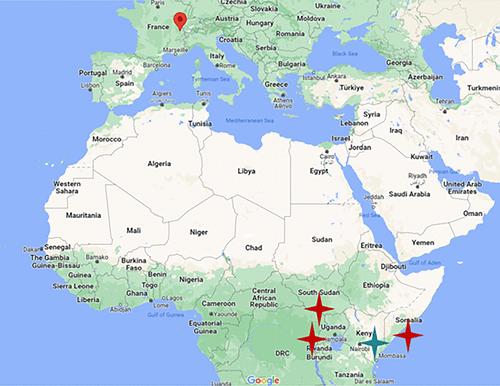
The rest of this case article describes in more detail the concepts covered by the case (Section 2) and reports on our teaching experiences and student reactions to the case (Section 3). Section 4 concludes. All sections, figures, and tables referenced in this article with “TN.” can be found in the teaching note enclosed with the case. For easy reference, the appendix in this case article contains a listing of the teaching resources (data, spreadsheet models, templates of the spreadsheet models that can be distributed to students, R code, and teaching plans and assignments) provided with the case.
2. Main Concepts and Flow of the Case
As mentioned earlier, Hannah’s overall goals are to use data analytics to improve her inventory management process. A question that looms large in the case is also how to handle a potential reduction in the ICRC budget. The teaching note walks instructors through Hannah’s thought process, and the models in the accompanying spreadsheet SafetyStockCalculations.xlsx, a partial screenshot of which is provided in Figure 2, use a 20% reduction in her safety stock budget as an example.
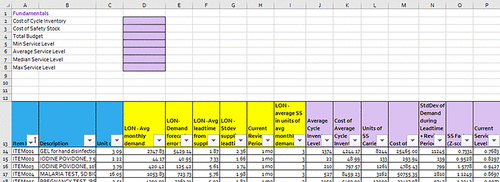
We encourage instructors to take advantage of the rich context of the case to prepare students for this question by understanding better the environment in which Hannah and her colleagues work. We suggest the following sequence of core topics when teaching with the case, listed as subsections below. Instructors can select a subset of these topics if desired, at a level of detail most appropriate for the student audience they teach. The various topics are color-coded differently in the solutions file SafetyStockCalculations.xlsx, so instructors can easily delete topics they would prefer to skip. A common thread through all these topics is the special circumstances of managing uncertainty in a humanitarian supply chain.
2.1. Incorporating Uncertainty in Demand and Supply into the Order Fulfilment Process
As the case explains, the ICRC does not currently incorporate measures of demand and supply uncertainty into their planning process. They supply three months’ worth of average demand for each item on Hannah’s list as safety stock. A first step in the class discussion could be the effect of this one-size-fits-all policy. Instructors can discuss briefly the cycle stock and Hannah’s cycle stock budget (Section TN.3.1, Questions 1 and 2). They can then discuss the logic of protecting against supply and demand uncertainty using the formula of Silver et al. (1998), which incorporates measures of demand and supply uncertainty through the standard deviation of demand forecast error and the standard deviation of supplier lead time (Section TN.3.1, Question 3). (Depending on the students’ background, instructors may want to discuss the assumptions behind the normal distribution and its limitations. Various approaches for dealing with nonnormal LTD distributions have been suggested in the literature; see, for example, Saldanha et al. (2023) and Gonçalves et al. (2020).) This leads to the calculation of the effective service level on each item (Section TN.3.1, Question 4). Students can therefore recognize how inconsistent the actual service levels are if demand and supply lead time variability are not taken into consideration when setting safety stock target levels (Section TN.3.1, Question 5). Students can also appreciate how high the investment in safety stock is when taken as a percentage of Hannah’s overall budget. Optimizing the safety stock settings for various stock keeping units (SKUs) is therefore an important lever in managing Hannah’s limited budget.
2.2. Implementing Data Analytics Within an Executable Inventory Management Process
In practice, very few logistics organizations manage individual SKUs. The material master is grouped to simplify policy setting. There are established practices in commercial inventory management for grouping items according to their importance in terms of cost/value or revenue potential. ABC analysis is one of them (Jenkins 2020, Gizaw and Jemal 2021). Section TN.3.2 contains observations on using ABC analysis in the humanitarian logistics context. We note that for Hannah, not only is revenue not being generated when an item is ordered by a health coordinator, but also all items on her list are categorized as “vital.” We suggest further discussion points for instructors in Sections TN.3.2–TN.3.4. There, we also illustrate how to categorize items on Hannah’s list using visualizations and/or a machine learning technique, clustering. These techniques support differentiated policy setting without increasing the workload for planners. Hannah comes up with a breakthrough idea to group items based on variability metrics that are particularly useful in her context. An example of the clusters of products that can be obtained with the R code provided in the teaching note is shown in Figure 3.
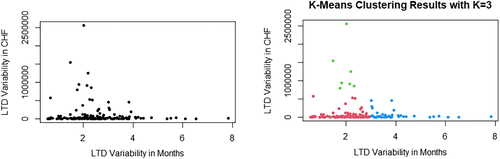
Note. See TN.3.4 and Appendix A in the teaching note.
Once the groupings of SKUs are determined, target service levels can be set for each group. An optimization model is shown (Section TN.3.5) that can be used to evaluate the best service level achievable for the third category of items given constraints on the service levels of the first two categories. Practical constraints and objectives are also discussed, including a more realistic constraint of volume shipped rather than service level.
2.3. Importance of Cross-Functional Coordination
The groupings of items reveal the effects of demand and supply uncertainty in the ICRC system. Besides helping to set stock levels to enable promised service levels, one of the uses of the categorization is to support collaboration with Hannah’s colleagues in the health department and on the ground. In Section TN.2.3, we discuss how Hannah can use this analysis to improve outcomes for both planners and those in war-torn zones who most need the supplies.
3. Student Background and Reactions
We have used this case in both technical operations management/modeling courses and in strategy-focused humanitarian logistics courses. This section summarizes some of our experiences, and Section TN.4 contains detailed assignments and teaching plans. The student audiences have included MBA students, MS and PhD students, and advanced undergraduate students. The feedback about the case has been overwhelmingly positive.
3.1. Humanitarian Logistics Course (MS and PhD Students)
We have used the case with graduate audiences in a humanitarian logistics course following the teaching plan in Section TN.4.2 and collected feedback from a section with 13 participants. On a five-point scale, where 1 was “Dissatisfied,” 2 was “Somewhat Dissatisfied,” and 3 was “Neutral,” 100% of the respondents to a voluntary survey administered at the end of the session indicated that they were either “Very Satisfied” (5) or “Satisfied” (4) with the case. Similarly, on a five-point scale, where 1 was “Did not learn at all,” 2 was “Did not learn much,” and 3 was “Neutral,” 100% of the respondents answered that they either “Learned a surprising amount” (5) or “Learned a great deal” (4). The comments indicated a strong appreciation for how real the scenario described in the case is.
3.2. Operations Management Course (MS Students)
We have used the case both for illustrating quantitative concepts in inventory management following the teaching plan in Section TN.4.1, as well as in higher-level discussions following the introduction of the popular Beer Game in introductory operations management courses. In the latter use case, the discussion incorporated points listed in the teaching plan in Section TN.4.2, and students appreciated the opportunity to contrast a simulated supply chain classroom exercise with the real supply chain described in the case along various aspects such as supply chain complexity, demand variability, information sharing, inventory management, and collaboration and coordination.
3.3. Modeling Courses (Advanced Undergraduate Students and MBA Students)
We have used parts of the case, specifically using visualization or machine learning techniques (clustering) to group items (Section TN.3.4), in advanced undergraduate and MBA courses on data visualization, data science, and machine learning. Other quantitative aspects of the case, such as the application described in Section TN.3.5, were used as exercises in optimization modeling courses. Students appreciated the ability to use a realistic setting to discuss the importance of informed inputs to machine learning or optimization algorithms, as well as using the output to make decisions within the constraints and considerations of a humanitarian logistics application. Business students taking data science, machine learning, and optimization electives at one of the coauthor’s institution have typically already had a core course in operations management and understand the context of the case. However, even if students do not have that background, the case can be used to explain the process of applying data visualization, machine learning, and optimization techniques in a new context with a little bit more time in the classroom.
4. Concluding Remarks
The case described in this article brings together themes from several fields and allows for both high-level and technical discussions of important concepts in humanitarian logistics, operations management, and data science. This makes the case appropriate for use in a variety of stand-alone courses, as well as multidisciplinary capstone projects at the masters, executive, and advanced undergraduate level. The case is based on an actual project that was successfully implemented at the ICRC, with measurable results in terms of cost savings and operational improvements. The case’s rich context supports the discussion of concepts like differences between humanitarian and commercial supply chains, cycle stock and safety stock, lead time demand variability, and grouping items in inventory management (while understanding the limitations in a humanitarian inventory management context). Should the background of the students permit, it is possible also to use machine learning techniques and optimization to estimate product classes and determine the maximum possible service level given constraints on the service level of some classes and the overall budget. Student engagement with and feedback about the experience with this case has been very positive. We hope that the resources provided with the case will inspire instructors to dedicate time in their classes to building student awareness of the complexities surrounding the design and use of analytical models in the context of humanitarian applications.
We thank Ruben Naval’s supply chain team at the ICRC for the collaboration that made this case study possible. We are grateful to the students in our classes who helped us test the case. This case was the winner of the 2023 Decision Sciences Institute Case Competition, and we appreciate helpful comments from the judges and the audience at the 2023 Decision Sciences Annual Conference in Atlanta, GA, USA. Last but not least, we thank the editor, associate editor, and two anonymous referees for their time and valuable feedback on earlier versions of this manuscript. Although the case is based on a project with the International Committee of the Red Cross, facts and data are modified for teaching purposes.
Appendix. Resources Provided with the Case
SafetyStockCalculations.xlsx: Contains worksheet Calculations supporting Sections TN.2–TN.4 in the teaching note; worksheet DataDictionary with definitions of the various column names in Calculations; and worksheet ClusteringData with additional information for each item that can be used in the discussion for item groupings (Section TN.3.4).
SafetyStockCalculations_Template.xlsx: Contains the same original data input information as SafetyStockCalculations.xlsx, but calculations are removed so it can be distributed to students for prework or in-class work.
ClusteringData.csv: Contains the same data as worksheet ClusteringData in the file SafetyStockCalculations.xlsx but can be used directly with the R code for clustering items.
ClusteredItems.xlsx: Contains output from k-means clustering assignments for three, four, and five clusters, including additional characteristics of each SKU for class discussion.
R Code for Clustering Items: See Appendix A in the teaching note.
References
- (2009) Exploring the bullwhip effect by means of spreadsheet simulation. INFORMS Trans. Ed. 10(1):1–9.Link, Google Scholar
- (2008) “Cola‐Game”: An innovative approach to teaching inventory management in a supply chain. Decision Sci. J. Innovative Ed. 6(2):265–285.Crossref, Google Scholar
- (2006) Web-based simulations for teaching queueing, Little’s Law, and inventory management. INFORMS Trans. Ed. 7(1):106–124.Link, Google Scholar
- (2020) The beer transportation game: How to decarbonize logistics by moving freight to sustainable transport modes. INFORMS Trans. Ed. 20(2):102–112.Link, Google Scholar
- (2007) Inventory control at Spiegel Grove. INFORMS Trans. Ed. 8(1):19–24.Link, Google Scholar
- (2014) Developing students’ understanding of co‐opetition and multilevel inventory management strategies in supply chains: An in‐class spreadsheet simulation exercise. Decision Sci. J. Innovative Ed. 12(2):79–89.Crossref, Google Scholar
- (2021) How is information from ABC–VED–FNS matrix analysis used to improve operational efficiency of pharmaceuticals inventory management? A cross-sectional case analysis. Integrative Pharmacy Res. Practice 10:65–73.Crossref, Google Scholar
- (2020) Operations research models and methods for safety stock determination: A review. Oper. Res. Perspective 7:100164.Crossref, Google Scholar
- (2017) A prescription for budget woes at Gracious University Hospital. INFORMS Trans. Ed. 17(3):110–115.Link, Google Scholar
- (2020) ABC analysis in inventory management: Benefits & best practices. Accessed May 31, 2023, https://www.netsuite.com/portal/resource/articles/inventory-management/abc-inventory-analysis.shtml.Google Scholar
- (2022) Teaching humanitarian logistics with the disaster response game. Decision Sci. J. Innovative Ed. 20(3):158–169.Crossref, Google Scholar
- (2022) Supply Chain Analytics: Concepts, Techniques and Applications (Springer Nature, Berlin).Crossref, Google Scholar
- (2013) Spreadsheet inventory simulation and optimization models and their application in a national pharmacy chain. INFORMS Trans. Ed. 14(1):13–25.Link, Google Scholar
- (2021) Game—Logistics to the rescue: An elementary introduction to planning in disaster response decision environments. INFORMS Trans. Ed. 21(3):152–159.Link, Google Scholar
- (2010) An in-class competition introducing inventory management concepts. INFORMS Trans. Ed. 10(3):122–125.Link, Google Scholar
- (2023) A non‐parametric approach for setting safety stock levels. Production Oper. Management 32(4):1150–1168.Crossref, Google Scholar
- (2021) Humanitarian supply chain & logistics aid management at global relief services. J. Bus. Entrepreneurship 31(2):1.Google Scholar
- (1998) Inventory Management and Production Planning and Scheduling, vol. 3 (Wiley, New York).Google Scholar
- (2015) Helping the helpers. Industry Engrg. 47(12):24–29.Google Scholar
- (2013) Utilizing a simulation exercise to illustrate critical inventory management concepts. Decision Sci. J. Innovative Ed. 11(1):13–21.Crossref, Google Scholar
- (2015) Game—The Zu Zitter game: A course-long tool for teaching operations management. INFORMS Trans. Ed. 15(3):240–253.Link, Google Scholar