Case—Greenleaf Polyclinic: The Doctor Will See You Now
As an intern embarking on her journey into the world of healthcare, Sarah found herself welcomed into the bustling environment of Greenleaf Polyclinic in Singapore. Assigned under the mentorship of Dr. Kervyn Lim, the head of operations, Sarah’s first task was to investigate the queuing dynamics and patient delays within the polyclinic. Dr. Kervyn Lim wanted Sarah to map the patient journey and determine the staffing needs for nurses and administrative personnel necessary to support the doctors in meeting patient demand within the mandated maximum total waiting time of 100 minutes. Such analysis would further enable her to evaluate the effectiveness of technology adoption, staff pooling, or upgrading to reduce waiting times as an alternative to hiring more staff.
Polyclinics in Singapore
Polyclinics provide a wide range of government-subsidized outpatient medical services under one roof and play a crucial role in primary healthcare delivery in Singapore. Polyclinics are staffed by general practitioners (GPs) who provide consultations for a variety of health concerns, ranging from acute illnesses to chronic conditions. These consultations may include diagnosis, treatment, medication prescriptions, and referrals to specialists if necessary. The polyclinics also offer diagnostic services, including laboratory tests (blood tests, urine tests, etc.), imaging services (X-rays, ultrasounds, etc.), and other diagnostic procedures. Patients with chronic conditions use the combination of GP and diagnostic services to better manage their chronic diseases such as diabetes, hypertension, asthma, and others. The clinics provide regular checkups, medication management, lifestyle counseling, and support services to help patients effectively manage their conditions and prevent complications.
First Week at the Polyclinic
As Sarah entered Greenleaf Polyclinic for her first day, she immediately noticed how quickly it filled up with patients waiting and moving through the facility. Dr. Kervyn Lim took Sarah on a detailed tour of the facility to illustrate the typical patient journey. Dr. Kervyn Lim emphasized that polyclinics must always strive to contain costs and maintain high utilization rates while achieving acceptable waiting times for the patients. He wanted Sarah to familiarize herself with the operations of the polyclinic to review its use of nurses and administrative assistants and recommend appropriate staffing levels to support the given demand, capacity of the doctors, and mandated limit on total wait time.
Sarah took the first week to immerse herself in the intricacies of the patient flow across various service areas, from registration to consultation, medication dispensing, and payment. She also collected detailed data to help with her future analysis.
The registration process proved quite straightforward. Sarah observed patients arriving at the clinic and witnessed the two-pronged approach to registration: automated kiosks for self-check-in and traditional counter registration with an administrative assistant. Roughly 85% of patients attempted to use the kiosks. A portion of those failed to register because of user error or outstanding medical bills, so ultimately, 35% of all patients used counter registration.
Sarah noted a clear distinction in patient flow post-registration. Although most patients proceeded directly to health monitoring—weight and blood pressure measurement—prior to waiting for doctor consultations, a quarter (25%) of the patients awaited laboratory services first; these were patients with chronic diseases who needed specific tests before their consultations with doctors. After the laboratory tests, these patients then proceeded to the health monitoring station, after which they waited for their consultation with the doctors.
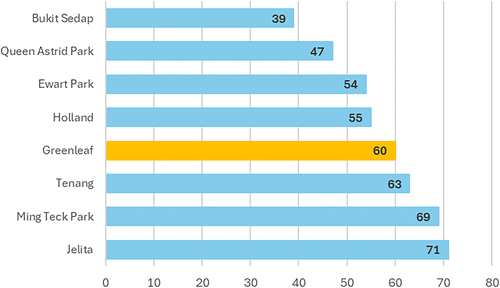
Sarah noted that the longest wait experienced by patients was to see the doctor. This wait time varied, depending on factors such as patient volume, time of the day, and the urgency of cases. A recent media report on the waiting times to see the doctor at different polyclinics in Singapore showed that Greenleaf Polycinic’s performance was situated in the bottom half (see Figure 1).
A further 15% of patients required the laboratory services after their consultation with the doctor to run tests confirming their initial diagnosis. Following the completion of these tests, these patients typically needed to wait for a second consultation with the doctor to discuss the test results and any subsequent treatment plans.
Finally, all patients proceeded to payment. Sarah observed that patients had multiple options for payment: online on the polyclinic’s mobile application, at the kiosk, or at the counter with an administrative assistant. Surprisingly, only 30% of patients opted to pay at the kiosk, with another 30% choosing to pay at the counter. The remaining 40% chose to pay on their phone outside of the polyclinic setting. Although patients using the self-serve payment options could choose to have their medications delivered to their homes instead of waiting for prescriptions at the clinic, most patients with a prescription proceeded to counter payment to collect their medications at the same time.
Data Analysis
Sarah mapped out the patient flow and collected information on the duration of each major process in the polyclinic: registration, laboratory services, health monitoring, doctor consultations (capturing both first and second consultations), and payment. The service time averages for each station can be found in Table 1.
|

Table 1. Service Time at Each Station
| Counter registration | Laboratory | Health monitoring | Doctor consultation | Payment |
|---|---|---|---|---|
| 2.0 minutes | 3.5 minutes | 2.0 minutes | 10 minutes | 1.5 minutes |
Over the next two weeks, Sarah analyzed Greenleaf Polyclinic’s patient flow and operations to understand how the doctors’ high utilization rates affected total patient waiting times. Based on the total volume of daily visits to the polyclinic, Sarah estimated that between 50 and 52 patients arrived per hour. Given the limitations of available demand data, she decided to ignore the potential variations in arrival times due to time-of-day effects or appointment scheduling. With 10 doctors working in the polyclinic and the government’s target total average waiting time of less than 100 minutes, Sarah could only adjust the deployment of the nondoctor resources in the polyclinic to meet patient demand while meeting the mandated total wait time limit. This included determining the staffing of nurses employed in health monitoring and laboratory and diagnostic equipment and administrative assistants for registration and payment.
Analysis
For her review meeting with Dr. Kervyn Lim nearly a month later, Sarah was asked to prepare a presentation mapping the current polyclinic process in detail and offer staffing recommendations together with estimated patient waiting times for different demand parameters based on a thorough quantitative analysis of the current situation.
If Dr. Kervyn Lim approved, then Sarah intended to use the baseline model to further explore how technology adoption rates, staff pooling, or other process changes could help the polyclinic serve its patients better during the remainder of her internship.