Decision Modeling in the Classroom: What Does Optimality Mean in Scheduling the Norwegian Women’s Bandy League?
Abstract
This paper presents a sports case based on the women’s bandy league organized by the Norwegian Bandy Federation. The case has been used in different formats during four consecutive years in a master’s course on decision modeling at a business school in Norway. These formats included first a structured problem-solving task, with clear instructions on how to model constraints and define the objective function. The case was later taught using the case teaching method, where certain criteria were deliberately presented ambiguously to encourage deeper student engagement and discussion. Students’ feedback indicates that incorporating realistic sports-based examples, such as the Bandy Case, enhances motivation and engagement with mathematical modeling. As part of their learning experience with this case, students also highlight that sports-related examples help them connect mathematical programming to real-world problems, deepen their understanding of optimization techniques, and improve their coding skills. Overall, our results support the conclusion that sports-based examples are an effective tool for fostering interest and deepening understanding in decision modeling education.
1. Introduction
Bandy, a precursor to ice hockey and sometimes colloquially described as “soccer on ice,” is a sport played in several countries across four continents. Although it shares some similarities with ice hockey, it differs notably in being played on a much larger ice rink with larger goals, a ball instead of a puck, and 11 rather than 6 players per team. This paper presents a teaching case based on a sports scheduling problem arising in the main women’s bandy league of Norway. This scheduling problem offers a suitable context for students to apply integer programming techniques and to discuss how the scheduling criteria should be incorporated in a model formulation.
Numerous studies have highlighted the importance of real-world applications in enhancing students’ engagement and understanding of quantitative methods. Real-world cases based on sports applications stand out as particularly compelling: they are broadly relatable and naturally structured around optimization challenges. Willoughby (2004) and Cochran (2004) are among the first to emphasize that enhanced student motivation and better learning outcomes are achieved when real-world contexts, particularly those anchored in recognizable and engaging areas such as sports, are incorporated into the Operations Research (OR)/Management Science curriculum. Sports scheduling, in particular, has proven to be a powerful instructional tool for teaching integer programming. Problems of this area are both accessible and relatable for students, while also being sufficiently complex to illustrate key concepts in operations research. This dual benefit has been emphasized by Trick (2004), one of the early advocates for incorporating sports scheduling into operations research education. This perspective is echoed in more recent work, such as Goossens and Beliën (2023), who use the scheduling of a Belgian soccer league as a case study to teach integer programming. A distinctive feature of our work is that it exposes students to the ill-defined nature of many real-life decision problems. Unlike textbook formulations, where objectives and constraints are typically predetermined, the case requires students to discuss which scheduling criteria should be imposed as constraints and which should be treated as objective functions. In this sense, our article contributes to existing sports teaching cases by emphasizing the modeling decisions that precede the formulation itself.
The teaching case discussed in this paper focuses on the game schedule for the Norwegian National Women’s Bandy League. The schedule must satisfy both general and league-specific requirements that are easy for students to relate to and understand. At the same time, the resulting problem also poses students with challenges suitable for being modeled by integer programming techniques. The case is introduced through a step-by-step educational approach, allowing students to tackle one challenge at a time until a complete problem formulation is developed. Two instructional methods are examined: one involves a structured problem-solving task with explicit instructions on elements to model as constraints versus those forming the objective function. The other employs the case teaching method (Christensen et al. 1991), where certain criteria are intentionally left ambiguous to foster discussion and engagement, in line with active learning principles that emphasize student interaction and participation in quantitative courses (Cochran 2005). This method can support active learning by encouraging students to articulate opinions and justify choices, although it also requires careful facilitation from the instructor to ensure that the discussion remains focused and that students’ opinions and choices can be captured by the modeling techniques under study. A questionnaire assessing students’ experiences is reported to discuss the effects of teaching with this case in terms of improving coding skills, increasing awareness of applications of mathematical programming in real-life problems, engagement in learning, and understanding of methodologies.
The rest of the paper is organized as follows. Section 2 reviews literature on teaching sports in the classroom. Section 3 provides an overview on the Norwegian bandy league and its main scheduling requirements, and it introduces the case. Section 4 describes how the case has been used in teaching. Section 5 reports results from surveys where students reflect on their learning experience. The paper concludes with final remarks in Section 6.
2. Related Literature on Teaching Sports in the Classroom
Incorporating practical cases into operations research education has long been recognized as an effective strategy to enhance student engagement and comprehension. Among real-world contexts, sports stand out as particularly compelling. They are broadly relatable and naturally structured around optimization challenges. For example, Willoughby (2004) presents sports as a central theme in teaching quantitative methods, describing an undergraduate course that integrates statistical and operations research concepts using sports as the sole application context. He contends, similar to Cochran (2004), that demonstrating a principle within an application context that students find relatable and clear can enhance their understanding and retention of the concept. Cochran’s (2004) paper serves as an introductory note to the special issue titled “SpORts in the OR Classroom” in the journal INFORMS Transactions on Education. This issue highlights several examples of classroom projects and case studies that have successfully utilized sports to teach complex quantitative methods, with notable increases in student motivation and improved learning outcomes. Cochran (2004) emphasizes that the articles demonstrate how sports-related problems inherently encompass optimization, fairness, and resource allocation, which are fundamental themes in operations research. The authors of these studies also report that even students who are not knowledgeable about or interested in sports enjoy sports examples in quantitative methods courses if the context is carefully explained.
Succeeding studies include Chlond (2011), which shows how integer programming can be employed to reconstruct match outcomes from league table data, offering a puzzle-based approach that highlights both the analytical and educational value of integer programming in sports. Chan et al. (2024) provide a case study on optimizing wheelchair rugby lineups. To solve the case, students must conduct data analysis, regression, and optimization modeling in a sequential manner. Data analysis feeds into regression, and regression outputs are used as parameters in the optimization model.
Sports scheduling, in particular, has emerged as an effective tool for teaching integer programming, because the structure of sports leagues naturally introduces constraints and objectives that mirror real-world optimization problems. Trick (2004) argues that sports scheduling problems are not only important in practice, but also intuitive enough for students to grasp immediately, rich enough to illustrate key concepts in integer programming, and ideal for introducing advanced operations research concepts in an accessible and motivating way. He illustrates this through a case involving the scheduling of the Atlantic Coast Conference basketball league. Similarly, Birge (2004) presents a case study based on Major League Soccer, demonstrating how a complex scheduling problem can be simplified into a step-by-step optimization process using spreadsheet tools, with the goal of minimizing total travel distance for teams while ensuring a fair schedule.
An implementation in practice of sports scheduling with outreach in education is reported in Alarcón et al. (2017). This work applies OR to schedule several football leagues from Chile and South America. Educational activities with content of those applications have reached thousands of high school and university students in Argentina, Chile, Norway, and the United States.
One of the most recent contributions supporting the use of sports scheduling as a pedagogical tool for teaching decision modeling and operations research is by Goossens and Beliën (2023). Building on the work by Goossens and Spieksma (2009), they present a pedagogical approach to teach integer programming through a real-world case on scheduling the postseason stage of the main Belgian soccer league. Two teaching approaches are examined: a practical computer workshop for limited group sizes and an engaging lecture format for bigger audiences where the instructor displays the modeling technique. Both formats begin with an interactive overview, then progress through four sequential modeling exercises, each introducing a new challenge while building on the previous solution. The authors highlight that integrating real-world complexities into the curriculum greatly boosts student participation and understanding.
Not only sports, but also a broader spectrum of contexts relating to students’ free time or hobbies can also be efficient to trigger students to practice and learn mathematical modeling. For example, Beliën et al. (2025) developed an educational team game to help students practice linear programming modeling skills through a Game of Thrones-themed context. Student feedback indicates increased interest in operations research, regardless of familiarity with the theme. Beliën et al. (2013) developed an online energy supply game. Experimental results show that the game format significantly enhances student motivation to engage with integer-programming modeling, driven more by game mechanics than the energy theme. Beliën et al. (2011) present an application of a popular cycling game. The authors report that the competitive component of the game has effectively stimulated students’ interest, which becomes visible during classes and in students’ answers to the questionnaires.
The above studies affirm that sports scheduling is not only a compelling real-world application, but also a robust framework for teaching decision modeling and operations research. Its blend of familiarity, complexity, and practical relevance makes it an ideal vehicle for engaging students in quantitative reasoning. In this paper, we introduce a teaching case centered around the game schedule for the Norwegian Women’s Bandy League. In addition to developing a new case in the intersection of OR with sports, our paper contributes with testing two approaches for teaching mathematical programming in the classroom. The first approach presents the students with very clear instructions on what should be modeled as constraints and what as the objective function. In the second approach, the criteria to be modeled are intentionally presented with ambiguity to encourage deeper engagement and active classroom discussion. This open-ended framing invites students to take ownership of the process—not only modeling and coding the problem, but also defining what the problem truly is.
3. The Women’s Bandy League in Norway
Bandy is a winter team sport played on an ice rink roughly the size of a soccer field. Each team consists of 11 players, including a goalkeeper. The game is played with skates, curved sticks, and a small ball. Bandy is often described as soccer on ice because its rules, playing field, and game structure are similar to soccer. At the same time, the use of skates and sticks gives it similarities to ice hockey. Historically, bandy is considered a precursor to ice hockey, and the two sports developed into distinct forms from the early 20th century onward. Bandy is also related to sports such as floorball and field hockey. When it comes to registered players, bandy ranks as the second largest winter sport globally, with only ice hockey having more participants. According to the International Bandy Federation, they have national member associations in four continents: Africa (Somalia), Asia (Afghanistan, Armenia, India, China, Japan, Kazakhstan, and Mongolia), Europe (Belarus, Czech Republic, Estonia, Finland, Germany, Great Britain, Hungary, Italy, Latvia, Lithuania, Netherlands, Norway, Russia, Switzerland, Slovakia, Sweden, and Ukraine), and the Americas (Canada, the United States, and Colombia).
In Norway, the women’s national bandy league operates at an amateur level, with players balancing their sports activities alongside professional or educational responsibilities. Our study focuses on the process of scheduling games within the Norwegian Women’s National Bandy League. The league is composed of seven teams: Drammen Bandy, Høvik, Ready, Solberg, Stabæk, Ullevål IL, and NTNUI. Each team is part of a larger bandy club, and every club has its own designated home venue or bandy field. These venues are shared resources, used for training sessions and matches across various teams within the club. In addition, each venue allocates fixed time slots for public use—typically on Sundays. These public sessions are valued as a community service and also contribute to the recruitment strategy for the sport. In the season, most venues are fully booked, hosting training sessions and matches for the various teams in the bandy club. Scheduling the league must carefully consider the availability of each team’s home venue (ice field). This high level of utilization makes it very difficult to reschedule games if that becomes necessary due to unforeseen events.
3.1. Length of the Competitive Season
Every team in the Women’s National League hosts their home games on an outdoor bandy field, similar to most bandy teams in Norway. The outdoor bandy fields need a low outdoor temperature to get good quality on the ice. If the outdoor temperature is too high, the ice will melt. The bandy leagues are therefore scheduled in the winter months. More specifically, the season of the Women’s National League, as well as all other bandy leagues in Norway, spans 12 active weeks from mid-November to mid-February. The timeline is often affected by a Christmas break and by international competitions. Ideally, most or all teams would have a week free from matches around Christmas Eve. As for the international competitions, the most important one is the Women’s Bandy World Championship, which might disrupt about 10 days of Norway’s national league.
3.2. Geographical Distribution of the Teams
The majority of the teams are based in Eastern Norway, near Oslo. The team NTNUI, composed of students from the Norwegian University of Science and Technology, is an exception. This team is based and plays its home games in Trondheim, a city located a relatively long and costly traveling distance from Oslo. On occasion, the league has also included a team from Bergen, a city located in the west side of the country, which also implies high travel costs to and from the other teams in the league. Because of the significant travel time and cost between Trondheim and the Oslo region, specific scheduling rules apply to NTNUI’s home and away matches. Many of these also apply to the team from Bergen when it plays in the league.
NTNUI’s home games are typically scheduled on weekends. This is because teams from the Oslo area cannot reasonably combine weekday travel to Trondheim with their academic or professional commitments. Because most NTNUI players are students, they also prefer weekend games, because their weekdays are occupied with lectures and academic responsibilities. From mid-November to mid-December, Trondheim experiences uncertain temperatures that can cause the ice at the venue to melt. To avoid costly rescheduling, only a limited number of home games should be scheduled during this period. If games are canceled, visiting teams risk financial losses due to nonrefundable travel and accommodation bookings—typically made in advance to keep costs down. Moreover, because Trondheim has only one bandy club, referees must be brought in from the Oslo region for all NTNUI home games. To reduce travel and accommodation expenses of the referees, usually two matches should be scheduled at the Trondheim venue whenever it is in use.
NTNUI’s away games are also scheduled on weekends, because the long travel time to the Oslo region is incompatible with students’ weekday academic schedules. To minimize their travel expenses, NTNUI is required to play multiple games each weekend they travel to Oslo—that is, they require to face several teams during each trip to the Oslo region. During the Christmas break, when many players travel to Oslo to visit family, NTNUI strongly prefers to schedule two to three away games. This reduces both travel time and costs. Because of the academic calendar, NTNUI requests a reduced number of home games and no away games during exam periods.
3.3. Sports Scheduling Criteria
In addition to the specific challenges for NTNUI described in the previous section, the schedule should also adhere to other criteria typically applied in sports scheduling (see, e.g., a classification of objectives and constraints in Van Bulck et al. 2020 or an online repository by Knust 2026). These criteria are outlined below.
A double round-robin format: Each team should play every other team twice during the season—once at home and once away. This is a common feature in sports tournaments, as reflected in a survey dedicated to round-robin scheduling by Rasmussen and Trick (2008).
Available days: Games should be scheduled on Tuesdays or weekends, with a preference for Saturdays. This condition simplifies the scheduling process and helps to avoid conflicts with other leagues under the bandy federation, which typically play on different weekdays. On each Tuesday, every team can play at most one match, except for NTNUI, which cannot play any match on Tuesdays. To allow adequate rest, every team can play at most one match per weekend, except for NTNUI, which can play at most two matches (as mentioned earlier, this team prefers to play more than one game on the same weekend). However, if NTNUI is scheduled for two matches on the same weekend, both matches have to be either at home or away. Overall, the league season consists of more days than the number of games per team, which relates to a tournament format known as time-relaxed in the literature (see, e.g., Van Bulck and Goossens 2020).
Balancing home and away games and separation constraints: Ideally, teams should have a balanced distribution of home and away games across the days of the season. For this purpose, different alternatives could be used, such as securing a minimum number of home matches on a given amount of time or, as captured in the well-known Traveling Tournament Problem (Easton et al. 2001), setting lower and upper bounds on the number of games played away consecutively. Furthermore, teams should not face each other in close succession. Adequate spacing between the two encounters of the same teams should be considered, which is known in the literature as separation constraints (Van Bulck et al. 2020).
Balanced match count: After each month, the cumulative number of matches played by each team should remain approximately equal. This helps maintain ranking balance throughout the season, which is often perceived as a signal of fairness (see, e.g., works by Goossens and Spieksma 2012, Suksompong 2016, Yi and Goossens 2023, who study balancedness indexes on the difference between the number of (home) games played by teams up to any point of the season).
To illustrate conflict between different objectives and to foster discussion in the classroom, we define two concepts below.
Tough Weeks: If a team, except NTNUI, has two matches during a week, it has a Tough Week. Teams do not like to have a Tough Week, because the players get too tired and are exposed to a higher risk of injuries.
Super Weeks: From the perspective of the league organizers, it is advantageous to sustain activity in the middle of the week while ensuring a reasonable number of games are played weekly. Based on this, we define a Super Week as a week containing at least two matches on Tuesday and two matches of NTNUI during the weekend.
The game schedule of the league is crucial for the teams, and it is essential that they perceive the schedule as fair and reasonable. Should the teams deem the schedule unfair or unsuitable to their requirements, they are likely to voice complaints.
3.4. A Mathematical Programming Approach
The Norwegian Bandy Federation faces resource constraints in planning the league’s games. The scheduling software currently in use is a generic tool for sports leagues and does not support the specific requirements of the women’s bandy league discussed in Sections 3.2 and 3.3. For example, the tool cannot directly encode NTNUI’s constraints that they can only play at weekends and, when they do, prefer multiple games per weekend. Such requirements cannot be represented explicitly and must be handled through manual workarounds in the system. This, in turn, often leads to schedules that fail to accommodate other team-specific constraints or that become unbalanced—for instance, with insufficient balance between home and away games, prolonged bye periods for one or more teams, or teams starting/ending the season too early or too late. Consequently, the software frequently fails to produce a feasible schedule and requires extensive manual adjustments. These adjustments are challenging and time-consuming because many criteria must be considered simultaneously, affecting both timing and overall schedule quality. Beyond preseason planning, the schedule must also be manually updated during the season to address unforeseen events, further increasing the scheduler’s workload. Given the number of constraints, concerns, and team requests, the scheduler circulates a preliminary schedule to all teams well in advance of the season to identify major issues. At this stage, however, only well-justified concerns are typically accommodated, because even small changes can jeopardize the feasibility of the overall schedule.
Recognizing the challenges faced by the league scheduler, we proactively contacted the Norwegian Bandy Federation in 2022 to conduct a pilot project. In several meetings with the scheduler and other federation managers, we presented how mathematical programming could help generate efficient game schedules that meet league requirements and accommodate team requests. Using practical examples, we demonstrated how such models can support both initial planning and midseason rescheduling. We emphasized that mathematical programming enables the integration of multiple criteria and allows many constraints to be taken into account. Acknowledging the relevance of the problem in practice and that some of the difficulties outlined above are motivated by a team of students (NTNUI), we identified potential pedagogical value for a course on mathematical programming. Besides sport being a familiar context for many people, the fact that the difficulties related to NTNUI are triggered by students could help our own students to feel like protagonists of the problem. This prompted us to develop a teaching case, which is described in the following section.
3.5. The Teaching Case Material
The teaching cases derived from the bandy problem focus on the key challenges faced by the game scheduler of the Norwegian Women’s Bandy League. Although the actual scheduling scenario is highly complex, we have adapted it into a simplified version suitable for instructional use. This adaptation is specifically designed for a master’s-level decision programming course at a business school. The simplified scenario serves as a practical vehicle for exposing students to integer programming. It is intentionally crafted to be relatable and engaging, while still retaining sufficient complexity to challenge students in key areas of mathematical modeling. The case has been implemented in two distinct educational settings to explore different pedagogical approaches.
The primary objective in both formats is to teach students the fundamentals of integer programming through a real-world problem that is easy to understand, relatable, and engaging. The aim is to inspire students to see the relevance of integer programming in solving practical, real-life challenges. Besides the mathematical formulation of the models, students are asked to code and solve the model in a mathematical programming language. The course has for many years used the AMPL language (Fourer et al. 1990), which offers free license for courses, including main solvers such as Gurobi and CPLEX. Although many other languages could also be used, AMPL allows users to type equations, constraints, and variables in a way that resembles how models are written mathematically on a board, which helps to keep focus on modeling rather than in complex coding.
In the first approach (version A of the case), students receive explicit guidance regarding the formulation of the model, including which elements should be treated as constraints and which should constitute the objective function. In contrast, the second approach (version B of the case) introduces the modeling criteria with deliberate ambiguity. This open-ended format is designed to foster deeper cognitive engagement, stimulate classroom discussion, and encourage students to take ownership of the modeling process—not only in terms of technical formulation and coding, but also in interpreting and defining the problem itself. In turn, this encourages critical thinking about objectives, constraints, and data handling, including how to translate criteria into precise mathematical formulations.
The difference between the two versions is eloquent from the main case questions, which are summarized below.
The Bandy Case (Version A)
Q1: Formulate an integer linear model to schedule the league, maximizing the number of Super Weeks as an optimization criterion. Implement and solve the model in AMPL, using the solver Gurobi. How many Super Weeks are obtained? Outline the optimal schedule that you found, either graphically, as a table, commented in words, or through some other type of output that can be readable for an external person. Imagine you are communicating the solution to the league organizers, who are not necessarily familiar with mathematical programming, so they want to observe the final schedule instead of a raw display with the optimal value of your variables.
Q2: Formulate an integer linear model to schedule the league, using minimizing Tough Weeks as the optimization criterion. Implement and solve the model in AMPL, using the solver Gurobi. How many Tough Weeks are scheduled in total? How many Tough Weeks are scheduled for each team? Outline the optimal schedule that you found (using the same readable format that you used in task 1).
Q3: Can you find a schedule that fulfills the optimal number of Super Weeks that you obtained in task 1 and also the optimal number of Tough Weeks that you obtained in task 2? If yes, outline such a schedule. If not, what is the minimum number of Tough Weeks that you can schedule while fulfilling the optimal number of Super Weeks that you obtained in task 1? And what is the maximum number of Super Weeks that you can schedule while fulfilling the optimal number of Tough Weeks that you obtained in task 2?
The Bandy Case (Version B)
Q: Formulate an integer linear model to help the organizers schedule the league. Implement and solve the model in AMPL, using the solver Gurobi.
The full case descriptions for versions A and B of the case are provided in the online appendix. Both versions are derived from the primary challenges identified in the real-world sports scheduling scenario. Other than the way in which the questions are presented, the features of the problem are exactly the same. These features include a league with seven teams, a season that spans from mid-November until mid-February, matches to be played on Tuesdays and weekends, and a game schedule that considers most of the criteria stipulated earlier in this section. Venue availability and the dates on which matches can be played are provided in calendar form, offering students a realistic representation of how practitioners would share such data.
4. Teaching Experience
The Bandy Case material was initially introduced to students in 2021 as an assignment for a course on decision modeling in the Business Analytics master track of a business school in Norway. The following year, in 2022, this material was incorporated into a lecture for the same course. This lecture is scheduled approximately midway through the semester, by which time students have already covered a significant portion of modeling with linear programming and integer programming. Regarding sports scheduling, they have been previously exposed to an integer programming application to the South American qualifiers for the FIFA World Cup (Durán et al. 2017). In 2022, the Bandy Case content was delivered precisely as it appeared in the 2021 assignment, including a fully informative statement, with an explicit distinction between what should be considered as constraints and what as an objective function (Version A of the case in the online appendix).
Version B of the case was prepared in 2023, presenting some of the criteria explicitly as constraints of the problem, just like the previous year. In contrast, other material was presented in a more ambiguous form. As we mentioned in the previous section, this was a deliberate choice to encourage discussion in the classroom. Specifically, the criteria regarding Venue availability, Super Weeks, and Tough Weeks were identified as factors “to take into account,” without specifying if they should be treated as constraints or objectives. Then, the lecture was conducted from a more participant-centered learning perspective, based on the case teaching method (Christensen et al. 1991).
Up to this point in the course, the students have been well trained in mathematical modeling and coding, but they are used to getting very precise problem definitions, including explicit specifications of constraints and a single objective function. With the more ambiguous statement, they are called to complete the definition of what is the decision problem to model before formulating any mathematical expression or computer code. After the students have read the statement, to open the discussion, we use a simple question like “Do you miss something in this statement?” Progressively, some voices start to be heard in the auditorium mentioning that the objective function is missing. Then, a natural follow-up question is what would they consider as the objective function. Some students may raise their hands to say that maximizing Super Weeks should be the objective function, because this criterion appears important for the organization of the league. Other students may point out that a much more important concern is the health of the players; thus, the objective function should be to minimize the number of Tough Weeks. Some might even base this choice on their personal experience, arguing that they play some sport competitively and that they know from experience that a concentrated set of matches heightens the likelihood of injuries. “What about venue availability? Shouldn’t this also be considered?” are other follow-up questions. Some students may react quickly to state that these should be constraints of the model, because obviously, if a venue is not available on a given date, it would be impossible to play there. One student debated this choice, arguing that if we use this criterion as a constraint, we may make the overall model infeasible. This is an interesting observation, which in turn prompts further discussion, because students may emphasize that, by all means, a solution must be delivered to the league; thus, infeasibility should rather be avoided. The discussion may conclude with an overall agreement on which criteria should be used as objective function. Here, it can be useful to run a quick survey asking students to raise their hands to go for one or another alternative as objective function. The discussion may also lead to mention, for example, how a weighted objective function combining all or some of these criteria could be implemented. Another alternative would be to leave it up to students to select an objective and allow them to address the problem according to their own selection. The way we implement it, though, is to use the ambiguous version of the case only for discussion, while the mathematical modeling exercise then follows the more guided version. Thus, after the discussion has taken place, we unveil Version A of the case, showing students the exact problem-solving form in which it was presented to students in the assessment of 2021. The lecture continues with a mathematical model formulation and a computational code to implement the model. An interesting aspect to elaborate on in this part of the lecture is about how to organize in a useful way the data given in the calendar provided as a figure in both versions A and B of the case. Although information contained in the calendar is needed to formulate a model and it is structured to some extent, it is not directly given as an input file to a model. Different model formulations may use this information in different ways. For example, students may debate whether a model formulation needs to consider the weeks and weekends where there cannot be matches. Then, the instructor may stress that although practitioners can provide data to a real-world problem, it is unlikely that these data will come in a format ready to be used by a model and that part of the task of the analyst is to capture such data in a way that can be used by a model.
In 2024, we proceeded with the teaching session in the same way as in 2023, starting with a case discussion first based on Version B and then moving to the well-defined problem in Version A. In addition, we included a similar sports scheduling problem (based on the Union of European Football Associations’ football tournament EURO 2024) as a main part of the assessment of the integer programming part of the course. In contrast, in 2023, the assessment did not include any sport-related questions, and its main part was devoted to a routing problem in humanitarian logistics. As we will see from the results in the next section, the inclusion of a sports scheduling question in 2024 might have proved a positive choice based on the assessment of the students.
5. Results
To measure the effectiveness of using sports contexts, we have included specific questions about the Bandy Case in an anonymous survey answered by the students at the end of the course (after their final submissions and before they receive their final grades). Considering the contents and the learning goals of the course, we attempt to measure four effects. These correspond to how students assess the case teaching activity in terms of helping them to improve their coding skills; to increase their awareness about the application of mathematical programming in real-life problems; to engage themselves in learning; and to understand better the methodologies of the course. Table 1 outlines the content of the survey, which is presented to students as a set of multiple-choice questions. For each question, students choose from five options indicating their level of agreement with the statement in the question. The possible choices are “strongly agree,” “agree,” “neutral,” “disagree,” and “strongly disagree,” which for quantitative analysis we convert to 5, 4, 3, 2, and 1, respectively. In addition, the survey includes an open-ended question where the students are provided with a textbox to share additional feedback about the inclusion of examples on sports analytics used in this course.
|

Table 1. Survey to Measure the Effect of Teaching with the Bandy Case
| Effect | Question |
|---|---|
| Improving coding skills | Using sports contexts in teaching like The Bandy Case has helped me improve my computer coding skills to implement a decision model in a mathematical programming language. |
| Increasing awareness of applications | Using sports contexts in teaching like The Bandy Case increases my awareness about how mathematical programming can be applied to solve real-life problems. |
| Engagement in learning | Using examples about sports motivates engagement of students in learning. |
| Better understanding of methodologies | The Bandy Case has helped me to better understand the methodology to formulate decision models. |
Table 2 summarizes how the case has been used over the years and provides general statistics on course enrollment and survey response rates by year. Across all years, we received responses from approximately 150 students, corresponding to an overall response rate of 44%.
|
Table 2. Overview on Utilization of the Case and Survey Across Years 2021–2024
| Feature | 2021 | 2022 | 2023 | 2024 |
|---|---|---|---|---|
| Activity | Assignment | Lecture | Lecture (active) | Lecture (active) |
| Version of the case used | A | A | A and B | A and B |
| No. students in the course | 114 | 118 | 125 | 93 |
| No. responses | No survey | 65 | 52 | 34 |
| Response rate | — | 55% | 42% | 37% |
Table 3 presents the average response for each question over the years it appeared in the survey, along with the overall averages. Whereas Table 3 reports average Likert-scale scores and is primarily descriptive, we complement this analysis with formal statistical testing based on the response distributions shown in Table 4. Specifically, we define a positive effect as a majority of positive responses (“agree” + “strongly agree” ) and conduct one-sample binomial tests using the aggregated response frequencies across all years. The results show that teaching with the Bandy Case has a positive effect, with the proportion of positive responses exceeding 50% at a statistically significant level for three out of four outcomes: improving coding skills (58.3%, ), awareness of applications (72.5%, ), and understanding of methodologies (60.9%, ). For engagement in learning, although the majority of responses are positive (55.0%), the proportion does not exceed 50% at a statistically significant level (). All tests are computed from the aggregated frequencies reported in Table 3. For the 2024 cohort, one-sample binomial tests indicate that the share of positive responses (“agree” + “strongly agree”) is significantly greater than 50% for all four learning outcomes.
|
Table 3. Scores on the Effect Perceived by Students on Each Teaching Year
| Effect | 2022 | 2023 | 2024 | Average |
|---|---|---|---|---|
| Improving coding skills | 3.57 | 3.54 | 3.88 | 3.66 |
| Increasing awareness of applications | 3.89 | 3.94 | 4.21 | 4.01 |
| Engagement in learning | 3.45 | 3.33 | 4.12 | 3.63 |
| Better understanding of methodologies | 3.72 | 3.88 | 3.80 |
|
Table 4. Frequency and Percentage of Each Response on Each Question across All Years
| 2022 | 2023 | 2024 | Total for all years | ||||||
|---|---|---|---|---|---|---|---|---|---|
| Response option | Weight | Frequency | Percent | Frequency | Percent | Frequency | Percent | Frequency | Percent |
| Coding skills | |||||||||
| Strongly agree | 5 | 10 | 15.4 | 10 | 19.2% | 12 | 35.3 | 32 | 21 |
| Agree | 4 | 27 | 41.5 | 16 | 30.8% | 13 | 38.2 | 56 | 37 |
| Neutral | 3 | 19 | 29.2 | 19 | 36.5% | 5 | 14.7 | 43 | 28 |
| Disagree | 2 | 8 | 12.3 | 6 | 11.5% | 1 | 2.9 | 15 | 10 |
| Strongly disagree | 1 | 1 | 1.5 | 1 | 1.9% | 3 | 8.8 | 5 | 3 |
| Total | 65 | 100.0 | 52 | 100.0% | 34 | 100.0 | 151 | 100 | |
| Application awareness | |||||||||
| Strongly agree | 5 | 22 | 34.4 | 14 | 27.5 | 16 | 47.1 | 52 | 35 |
| Agree | 4 | 22 | 34.4 | 21 | 41.2 | 13 | 38.2 | 56 | 38 |
| Neutral | 3 | 13 | 20.3 | 15 | 29.4 | 3 | 8.8 | 31 | 21 |
| Disagree | 2 | 5 | 7.8 | 1 | 2.0 | 0 | 0.0 | 6 | 4 |
| Strongly disagree | 1 | 2 | 3.1 | 0 | 0.0 | 2 | 5.9 | 4 | 3 |
| Total | 64 | 100.0 | 51 | 100.0 | 34 | 100.0 | 149 | 100 | |
| Learning engagement | |||||||||
| Strongly agree | 5 | 15 | 23.1 | 12 | 23.1 | 16 | 47.1 | 43 | 28 |
| Agree | 4 | 21 | 32.3 | 9 | 17.3 | 10 | 29.4 | 40 | 26 |
| Neutral | 3 | 13 | 20.0 | 18 | 34.6 | 6 | 17.6 | 37 | 25 |
| Disagree | 2 | 10 | 15.4 | 10 | 19.2 | 0 | 0.0 | 20 | 13 |
| Strongly disagree | 1 | 6 | 9.2 | 3 | 5.8 | 2 | 5.9 | 11 | 7 |
| Total | 65 | 100.0 | 52 | 100.0 | 34 | 100.0 | 151 | 100 | |
| Understanding of methodologies | |||||||||
| Strongly agree | 5 | 14 | 26.4 | 13 | 38.2 | 27 | 31 | ||
| Agree | 4 | 15 | 28.3 | 11 | 32.4 | 26 | 30 | ||
| Neutral | 3 | 20 | 37.7 | 5 | 14.7 | 25 | 29 | ||
| Disagree | 2 | 3 | 5.7 | 3 | 8.8 | 6 | 7 | ||
| Strongly disagree | 1 | 1 | 1.9 | 2 | 5.9 | 3 | 3 | ||
| Total | 53 | 100.0 | 34 | 100.0 | 87 | 100 | |||
It should be noted that the first three questions were part of the survey every year that the case study was conducted, whereas the fourth question was included only during the last two years. Each year, the highest average is achieved for the awareness of applications, and, given that the cumulative proportion of positive responses exceeds 50% at a statistically significant level (72.5%, ), we can reasonably conclude that students value the teaching case for its practical illustration of the course material. The average responses for each question were quite similar in 2022 and 2023; however, in 2024, a noticeable increase in the average is observed compared with the earlier two years. Consistent with this pattern, we find strong statistical support for an increase in perceived engagement in learning in 2024 (Welch t-test, p = 0,009) compared with earlier years. For the other categories, the evidence of an increase is weaker, or no statistically reliable change is observed. On one hand, this upward trend in 2024 might be related to an improvement in how we performed the teaching, because by the third year, we had more experience with it. Another plausible explanation could be that in 2024, we not only included a sport context in our teaching, but also incorporated a sport-based problem in the assessment process. Additionally, as we mentioned in the previous section, the sport selected for the assessment was football, which is arguably more popular than bandy, and this might have enhanced students’ perceptions as well.
A detailed overview of the frequency of the different responses disaggregated by choice and by year is presented in Table 4. The last column of the table shows the aggregated results over the years, which are plotted as pie charts in Figure 1.
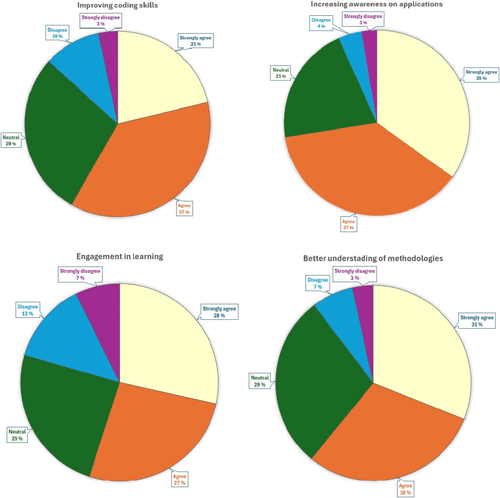
The results show that the majority of students choose the options “strongly agree” and “agree” in their responses to the questions. Adding up the shares of these two choices shows that 55% of students positively assess the effect of the case in their learning engagement, 58% in their coding skills, 61% in their understanding of methodologies, and 72% in their awareness about applications. The positive assessment is also reflected in some of the comments provided by the students as responses to the open-ended question. Although rather anecdotal, some of the comments highlight the advantage of learning with a sports case in comparison with a more traditional production planning problem and that they feel the topic is more familiar:
I absolutely liked this. It was very clear and it was easy to understand what the problems are and how to tackle them. It is easier to understand the real-world implications than in examples from production planning.
As sports is an area where most of us has some experience in, it feels closer and like something I could have used when planning schedules earlier.
Even some students who appear to be less keen on sports acknowledge the positive effect of the case when it comes to understanding the application of the contents of the course to solve real-life problems:
The Bandy Case is a good example showing how integer linear programming relates to real life cases. I am not a big fan of sports games, but I think it is a very practical case that make me learning how the methodology we are learning can be applied to solve real life cases.
I personally do not think it would be useful only because it includes sport,…but helped me understand better the application of mathematical modeling in a real problem with a story, not because it was sport.
The two answers above may also help us understand why the most positive effect quantified in Table 4 goes for the increased awareness of applications rather than to learning engagement.
6. Concluding Remarks
This paper has presented how the Bandy Case has been used to teach decision modeling in a master’s course of a Business Analytics program. The case accounts for several criteria and limitations inspired by the scheduling problem of the Norwegian Women’s Bandy League. The educational material and teaching approaches discussed in this paper have been used to make students identify what should be the appropriate objective and constraints of the problem and to support classroom discussion on how such requirements can be represented in an integer-programming formulation.
Initially implemented in 2021 for assessment purposes, this case later served as teaching material over the years 2022–2024. During 2022, it was taught as a problem-solving exercise, with explicit guidelines provided to students on which criteria should be framed as constraints and which ones should be addressed as the objective function. In 2023 and 2024, we shifted our strategy to the case teaching method, where part of the criteria of the problem was deliberately presented in a more ambiguous form to the students. This facilitated active discussion in the classroom, with some students advocating for some criteria to be more appropriate to use as an objective and other criteria as constraints. It also triggered active discussion about concepts such as feasibility and multiobjective optimization. Throughout the discussion, several arguments made by the students drew on earlier course sessions and insights presented in the case study. Alternatively, some of them argued from their own experience as sports athletes, which we believe reflects well that the familiarity of sports may help students to adopt a positive attitude toward learning.
We have presented results of a survey where students were asked about their learning experience, collecting answers from about 150 students over three years. The aggregated results are positive for all four effects considered: improving coding skills, increasing awareness of applications of mathematical programming in real-life problems, engagement in learning, and understanding of course methodologies. Here, a positive effect is defined as a majority of positive responses to the corresponding question—that is, “agree” and “strongly agree” exceeding 50%. A statistical test showed significance for three of the four effects, with engagement in learning being the only exception. Although positive responses for the latter also constitute a majority, the corresponding test is not statistically significant. Among the four effects, increasing awareness of applications is the one most strongly reflected in the students’ responses. We interpret these results as evidence of students’ reported perceptions of the case teaching, rather than as causal evidence that the sports context itself improves learning outcomes.
Future research could incorporate additional complexities of the actual decision-making problem, such as uncertainty about weather, which in turn affects venue availability. This might help students to understand concepts of stochastic programming. The formulation of more objectives, such as spreading bye weeks across the season or balancing the number of bye weeks across the different teams, could be added to the objectives already included in the case. Furthermore, the survey instrument could be refined to collect information about students’ prior interest in sports, compare sports-based and non-sports-based examples used in the course (e.g., logistics and production planning), and distinguish more clearly between modeling and coding skills. Such additions could help clarify whether the observed effects are driven by the sports context itself or by the use of realistic case-based teaching more generally, while providing deeper insight into the specific learning outcomes affected. Overall, our research contributes to the growing body of literature on using real-world cases or sports cases to teach decision modeling and mathematical programming. Based on the teaching experience reported in this article, when seeking to foster discussion in the classroom, we would encourage lecturers in mathematical programming to experiment with presenting problems to students in an ambiguous way. This can motivate students to take an active role not only in modeling and coding, but also in defining what is precisely the problem to model. Ultimately, departing from the traditional problem-solving approach to a case with less clear instructions may better reflect to students the real-life experience of optimization professionals.
The authors would like to express their sincere gratitude to Norges Bandyforbund for multiple meetings and input about the problem studied in this paper. The authors are also thankful to all the students who participated in the lectures and answered the survey of the BAN402 course at NHH Norwegian School of Economics.
References
- (2017) Operations research transforms the scheduling of Chilean soccer leagues and South American world cup qualifiers. Interfaces 47(1):52–69.Link, Google Scholar
- (2011) Using mixed integer programming to win a cycling game. INFORMS Trans. Ed. 11(3):93–99.Link, Google Scholar
- (2013) Teaching integer programming starting from an energy supply game. INFORMS Trans. Ed. 13(3):129–137.Link, Google Scholar
- (2025) The Game of Thrones quest for optimality: A role playing game for teaching the art of linear programming. INFORMS Trans. Ed. 25(3):250–256.Link, Google Scholar
- (2004) Scheduling a professional sports league in Microsoft® Excel: Showing students the value of good modeling and solution techniques. INFORMS Trans. Ed. 5(1):56–66.Link, Google Scholar
- (2024) Case article—Moneyball for murderball: Using analytics to construct lineups in wheelchair rugby. INFORMS Trans. Ed. 24(2):175–181.Link, Google Scholar
- (2011) Puzzle—Integer programming and league table puzzles. INFORMS Trans. Ed. 11(3):138–140.Link, Google Scholar
- (2004) Introduction to the special issue: SpORts in the OR classroom. INFORMS Trans. Ed. 5(1):1–1.Link, Google Scholar
- (2005) Active Learning for Quantitative Courses, INFORMS TutORials in Operations Research (INFORMS, Catonsville, MD), 237–256.Link, Google Scholar
- (1991) Education for Judgment: The Artistry of Discussion Leadership (Harvard Business School Press, Boston).Google Scholar
- (2017) Scheduling the South American qualifiers to the 2018 FIFA World Cup by integer programming. Eur. J. Oper. Res. 262(3):1109–1115.Crossref, Google Scholar
- (2001) The traveling tournament problem description and benchmarks. Internat. Conf. Principles Pract. Constraint Program. CP 2001 (Springer, Berlin, Heidelberg), 580–584.Google Scholar
- (1990) AMPL: A mathematical programming language. Management Sci. 36(5):519–554.Link, Google Scholar
- (2023) Teaching integer programming by scheduling the Belgian Soccer League. INFORMS Trans. Ed. 23(3):164–172.Link, Google Scholar
- (2009) Scheduling the Belgian soccer league. Interfaces 39(2):109–118.Link, Google Scholar
- (2012) Soccer schedules in Europe: An overview. J. Scheduling 15(5):641–651.Crossref, Google Scholar
- (2026) Classification of literature on sports scheduling. Accessed June 24, 2026, http://www2.inf.uos.de/knust/sportssched/sportlit_class/.Google Scholar
- (2008) Round robin scheduling—A survey. Eur. J. Oper. Res. 188(3):617–636.Crossref, Google Scholar
- (2016) Scheduling asynchronous round-robin tournaments. Oper. Res. Lett. 44(1):96–100.Crossref, Google Scholar
- (2004) Using sports scheduling to teach integer programming. INFORMS Trans. Ed. 5(1):10–17.Link, Google Scholar
- (2020) Handling fairness issues in time-relaxed tournaments with availability constraints. Comput. Oper. Res. 115:104856.Crossref, Google Scholar
- (2020) RobinX: A three-field classification and unified data format for round-robin sports timetabling. Eur. J. Oper. Res. 280(2):568–580.Crossref, Google Scholar
- (2004) The science of sports: Combining quantitative analysis and sports applications in an undergraduate course. INFORMS Trans. Ed. 5(1):88–99.Link, Google Scholar
- (2023) Strategies for dealing with uncertainty in time-relaxed sports timetabling. Ann. Oper. Res. 320(1):473–492.Crossref, Google Scholar