


Case—Using Moneyball to Introduce Students to Data Analytics: Illustrating the Data Analytics Life Cycle
Every sports team that is trying to determine the future value of a potential player would like a crystal ball. Relying on scouting reports in Major League Baseball (MLB) to identify players to select is how the sport selected players for decades. These scouting reports, which can be viewed in the National Baseball Hall of Fame (see https://collection.baseballhall.org to find historical scouting reports), contain subjective evaluations of players from talent scouts from different teams and include limited objective data. These scouting reports focus on different characteristics of the player (i.e., hitting ability, power, running speed) but with no objective measures of these abilities, only subjective measures from observations. Talent scouts relied on their years of observations, resulting in evaluations stemming from their tacit knowledge, which make them difficult to methodically analyze. However, with data analytical tools, we can investigate and model other player data when making player selections. A data warehouse of baseball statistics resides in the Society for American Baseball Research, which contains outcome measures for baseball—objective performance data. The modeling of data in this data warehouse is intriguing to consider, especially if it can lead to more wins.
The movie Moneyball, released in 2011, is based on the events that occurred within the Oakland Athletics (nicknamed the A’s) baseball operations in the early 2000s. It specifically pertains to the scouting approach in MLB. Please watch the movie, which can be rented on many streaming services, and answer the following questions.
See Figure 1 for an illustration of the data analytics life cycle. Stages of the life cycle that pertain to specific questions are included in parentheses.
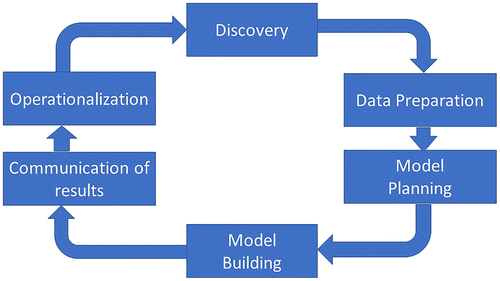
Note. Based on materials from EMC Education Services (2015).
What is the issue the Oakland A’s are facing in the movie? (“Discovery”: framing the problem)
The movie Moneyball is based on Michael Lewis’ book of the same name, with the subtitle “The Art of Winning an Unfair Game.” Explain what that means and how it can be applied to a business situation.
Compare and contrast Billy Beane’s system for picking players versus the baseball scouts. (“Discovery”: understanding your data) List one advantage and one disadvantage of each system and provide examples in business when each method would be preferred.
Explain (with examples) how Moneyball illustrated the following concepts of the data analytics life cycle:
The need to look at the big picture and ask the right question (“Discovery”: framing the problem)
The use of data analysis to answer the right question and the importance of subject matter expertise in guiding that analysis (“Discovery”: framing the problem)
The need to communicate the results in language that nontechnical listeners can understand (“Communication of Results,” in understandable terms)
The movie was released in 2011. Comment on the person who Peter Brand’s character is based on and Billy Beane’s impact on the game of baseball and the use of analytics. What has happened to them and the team since 2005?
Add some new information: Search the internet and find something to add to this assignment. Be prepared to discuss what you found in class.
Reference
EMC Education Services (2015) Data Science and Big Data Analytics (John Wiley & Sons, Indianapolis).Crossref, Google Scholar

