Case—Locating a Truck Terminal in Texas
Introduction
Sarah Woods walked quickly across the university’s graduation stage to receive her diploma. As she was walking, thoughts quickly came as she remembered how hard she had worked during the past four years to accomplish something that had never been done in her family: Sarah was about to be handed her college diploma. Tears welled up in her eyes as she reached out to receive the piece of paper that confirmed her accomplishment of reaching her goal set four years ago, of the reality that it was now official; she was the first in her family to graduate from a four-year college. As Sarah continued her march down the steps from the stage and back to her seat, she was excited to get started with the next chapter in her life, which included moving to a new community, leasing a new apartment, buying a new “used” car, meeting new friends, and learning new job responsibilities as a logistics specialist with CBT Logistics!
Beyond the Degree: Navigating the Road to Success
Immediately following graduation, Sarah accepted a position as a logistics specialist at CBT. In this position, Sarah had been assigned the primary responsibility of developing strong working relationships with new and existing CBT customers in the southeast region of the United States (Florida, Georgia, Mississippi, Alabama, Louisiana, and Arkansas) and CBT truck drivers that hauled freight in the area. In addition to building relationships, Sarah was expected to resolve customer account issues, understand customer-specific expectations of their freight haulers, create accurate and timely shipping documents, make certain all business transactions met government regulations, and find ways to improve the region’s operational efficiency and productivity.
The responsibilities seemed so overwhelming at the time. Sarah recollected how in the beginning she felt so inadequate to meet the requirements of her new position. During the first six months, Sarah found the working hours to be long, and the learning curve to be incredibly steep. Nevertheless, her hard work paid off because, within 12 months, Sarah was promoted to the position of logistics analyst for CBT’s southwest region of the United States (Texas, Arizona, New Mexico, Utah, Nevada, and southern Colorado).
As a logistics analyst for the southwest region, Sarah became responsible for developing in-depth market knowledge of the region, creating innovative strategies to capture more of the region’s freight market, improving the region profitability, coordinating full truckload pickups from the largest 20 customers in the region, and resolving business issues that could not be resolved by the region’s logistics specialists. Sarah once again began her learning curve, but this time, she embraced it wholeheartedly, gaining new skills and developing capabilities needed to successfully carry out her new responsibilities. After nearly 12 months of personal determination and persistence, Sarah felt comfortable in the position and started to develop a sense of contribution to the success of the company.
As Sarah pondered all that had happened during the four years following graduation, she still found it hard to believe that CBT senior management promoted her to her current position as a member of the company’s strategic planning team (SPT). Afterall, it was a senior planning level position within the company. SPT required members to perform competitive analysis, conduct business scenario planning, organize the company’s annual strategy meeting, and make recommendations to the senior management team about strategic business opportunities. Typically, this position was not offered to someone without at least 10 years of experience with the company, but Sarah’s performance during the past four years had convinced the company’s decision makers that she was ready for this level of responsibility. Sarah looked at the time only to see that it was 6:30 p.m. on Friday; it had been an exciting and challenging week. Sarah cleared her work area, picked up her purse, and headed for home.
Texas Situation
Monday morning arrived too quickly for Sarah. It seemed to her that she had just left her office for the weekend a few hours ago, but somehow, she now found herself back at her desk working on the strategic challenge that had been taking up most of the SPT members’ time and effort. Although the entire SPT had been working long hours on this project, it did not seem like much progress was being made. The “challenge” was to identify and recommend a location in Texas for a second CBT truck terminal.
CBT already had a terminal in the Dallas area (Wilmer, TX) that provided needed services to more than 700 of their drivers. The terminal was the largest facility in the company’s terminal network. Typically, a CBT terminal provided services to approximately 350 drivers. However, with its continued growth in the number of drivers and customers in the Texas market, CBT had determined it is time to re-evaluate its terminal operations in the state of Texas and seriously consider opening a second terminal location in the Lone Star state.
CBT Terminal Network
CBT was a multidivision (dry van, refrigerated, and flatbed) freight transporter with annual revenue in excess of $1 billion. With more than 5,000 tractors and more than 13,000 trailers, CBT was one of the largest privately owned trucking companies that could provide freight service to any location within the continental United States. CBT’s corporate headquarters was in Lincoln, Nebraska, with company freight terminals located throughout the United States (see the map of CBT terminal network in Figure 1).
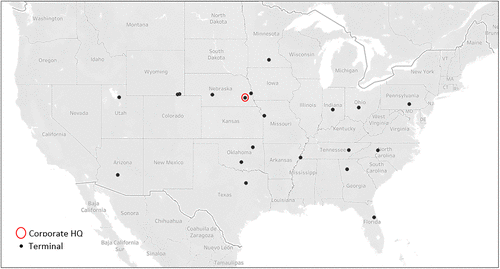
In truckload operations such as those at CBT, a driver typically hauls a load of freight from its pick-up point (origin) to its end point (destination) without any intermediate material handling. Therefore, the primary function of terminals is to provide fuel, maintenance, and load dispatch services. In other words, terminals are designed primarily to accommodate drivers and equipment, but not freight.
CBT considered its truck terminals to be essential operational assets that provided needed services on company equipment (e.g., maintenance on tractors and trailers, truck fueling, and equipment washing), amenities for company drivers (e.g., coffee, showers, laundry, and Wi-Fi), and a “base location” where drivers could have “downtime” to take care of things that could not be handled while traveling on the road. At some CBT terminal locations, drivers could shoot a few hoops, pick up needed personal supplies, and even play ping-pong. In addition to truck and driver services, terminal facilities may be used to provide driver training and coaching, as well as split cargo loads for productivity purposes.
Where to Start
The company assigned the entire SPT with the responsibility of considering the pros and cons of different site locations in Texas and developing a second terminal site proposal. With little noticeable progress being made on this project, CBT senior management decided to form a smaller SPT subcommittee to continue working on the project. The subcommittee was to be made up of the four members of the SPT that had recently worked together to develop a successful solution to a complex customer’s nationwide “last-mile” service requirement.
During the past two weeks, Sarah and the other three subcommittee members, David Smith, John Dority, and Mary Brooke, were busy interviewing internal CBT stakeholders, including several senior executives, terminal managers, operations managers, and safety managers from other CBT truck terminal locations, to identify important considerations for the evaluation of the second terminal in Texas. After consolidating the information, the team finalized a list of 12 criteria to be considered in their search for the new location.
With their “List of 12 Critical Location Criteria” identified in Table 1, the team met to decide how they would use this list to analyze, prioritize, and prepare their proposal to the senior management group. David started the meeting by displaying the criteria on a big screen for all to see and stated, “From our conversations with the stakeholders, it is unclear to me how these criteria are to be measured and what standard should be used to evaluate if a location is good enough based on any of the criteria. I think we need to decide how to quantify them and then gather relevant data on each so we can evaluate potential locations.”
|

Table 1. List of 12 Critical Location Criteria
| 1. Freight lanes and volumes |
| 2. Accessibility to primary roads (interstate and main highways) |
| 3. Distance to shippers’ locations |
| 4. Distance to the consignees’ (shipment receivers’) locations |
| 5. Distance to drivers’ homes |
| 6. Distance to Freightliner dealerships (used when tractor warranty work is needed) |
| 7. Traffic congestion |
| 8. Driver safety (area crime rate) |
| 9. Proximity to skilled workforce (for the facility) |
| 10. Land cost to build the terminal (approximately 7 acres) |
| 11. Taxes, utilities, and other costs of ownership |
| 12. Legal climate toward trucking companies by the local jurisdiction |
Mary replied, “That’s a great idea! I believe we can develop the measurement metrics for most of these criteria. For example, while it seems obvious to me that distance can be measured in miles from the desired location, the location’s whereabouts remain unclear. We can certainly start with the different counties in Texas, but I am not sure that provides us with the information needed to make a decision.”
Checking on his laptop, John declared, “There are 254 counties in Texas, which ones do you think we should start with?” A deafening silence followed John’s announcement.
After a few uncomfortable moments with the team staring at the big screen, Sarah spoke in a near whisper to the group, “Do you think the use of zip codes would be useful? We always have them entered in our customer and driver databases.”
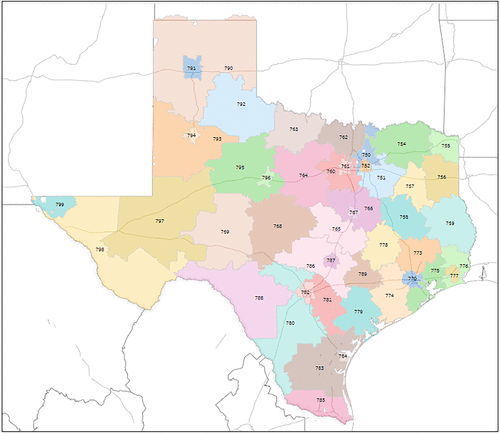
Energized with Sarah’s suggestion, the team proceeded to divide the Texas market into smaller areas for screening purposes using the three-digit zip codes. Figure 2 showed how the team laid out these areas using the first three digits of the U.S. Postal Service (USPS) zip codes, including primary highways. Once the layout of Texas was completed by the team, their next action included the use of CBT’s internal databases (such as freight flows, locations of shippers, consignees, and drivers) to narrow the number of potential areas down to a more manageable number so they could conduct more in-depth research on specific sites within these potential areas.
It was getting late, and the team realized that getting access to different databases to gather needed information required the assistance from Nate Peterson, CBT’s Director of Operations. Sarah had worked with Nate in the past, so she volunteered to contact him tomorrow to request his assistance. With that settled, everyone agreed the team should schedule to meet again in two days and it was time to “call it a day.”
Data Collection
The next day Sarah contacted Nate Peterson and asked for access to the company’s databases. Nate replied that he could not give her the access she requested; however, he would be able to generate a report that included the information that she needed. Sarah accepted Nate’s offer and proceeded to explain what information was needed by the team. After some additional “back and forth” clarification of what and how the information was going to be used, Nate provided the data reports for the last 12 months. Sarah now felt confident that she was ready for tomorrow’s team meeting. Little did Sarah realize how difficult the next steps of the project would be for the team.
The next day, all four team members arrived in the meeting room on time. Sarah explained how she had met with Nate the day before and how he had provided her with the data that she had requested. The team began looking at the reports and soon realized what they thought would be a relatively quick and easy data review step was far from being quick or easy. The first information meeting turned into a series of meetings that took place over weeks with Sarah making several additional trips to Nate’s office requesting additional data.
Because it is very expensive to open or close a terminal, the team realized it needed to answer numerous questions regarding the specification of internal data used for the analysis before they would be able to develop a proposal that would meet the expectations of the senior management group. Examples of the more difficult decisions that needed to be worked out by the team during its information gathering phase included:
Is data gathered from the most recent 12 months sufficient for this project? Should the team consider a longer time horizon?
Is past data an accurate reflection of future freight movements and driver’s locations? Are there additional measures that would provide a more accurate depiction of future freight and driver information?
What kind of data adjustments are necessary to create business level projections that accurately represent the CBT freight movement patterns in the next three to five years? What are the sources of business forecast uncertainty?
After lengthy discussion and additional talks with other managers, the team developed a better understanding of future CBT freight demand and driver availability in Texas. From this understanding, the team created three key data tables used for the evaluation process, as shown in Tables 2–4 (these can also be found in the provided Excel file):
Table 2 displayed the volume mix of the company’s inbound vs. outbound shipments in Texas. The amount of freight volume moved within Texas was the largest, accounting for nearly 28% of total volume; the next highest level of freight volume is in Oklahoma (a border state to Texas) where the company already had two terminals.
Table 3 displayed the distribution of freight volume across Texas as defined by the three-digit zip codes. Freight tended to concentrate around the Dallas area; the heaviest three-digit zip code 751 was indeed linked to the current terminal location in Wilmer, TX. The top ten three-digit zip codes accounted for about 80% of the total volume.
Table 4 described the distribution of drivers’ home locations by the three-digit zip codes. Again, the code 751 (where the current terminal was located) had the highest number of drivers.
|
Table 2. Texas Freight Flow: Inbound vs. Outbound Shipments
| State | Total volume | Percentage | Outbound (from TX) | Inbound (to TX) | |||
|---|---|---|---|---|---|---|---|
| Volume | Percentage | Volume | Percentage | ||||
| 1 | TX | 3,840 | 27.87% | 1,920 | 50% | 1,920 | 50% |
| 2 | OK | 2,431 | 17.65% | 1,418 | 58% | 1,013 | 42% |
| 3 | LA | 799 | 5.80% | 476 | 60% | 323 | 40% |
| 4 | AR | 592 | 4.30% | 306 | 52% | 286 | 48% |
| 5 | OH | 573 | 4.16% | 173 | 30% | 400 | 70% |
| 6 | IL | 539 | 3.91% | 134 | 25% | 405 | 75% |
| 7 | MO | 532 | 3.86% | 143 | 27% | 389 | 73% |
| 8 | GA | 418 | 3.03% | 267 | 64% | 151 | 36% |
| 9 | NE | 380 | 2.76% | 228 | 60% | 152 | 40% |
| 10 | CO | 368 | 2.67% | 278 | 76% | 90 | 24% |
| 11 | UT | 288 | 2.09% | 122 | 42% | 166 | 58% |
| 12 | KS | 254 | 1.84% | 199 | 78% | 55 | 22% |
| 13 | MS | 240 | 1.74% | 102 | 43% | 138 | 58% |
| 14 | AZ | 235 | 1.71% | 95 | 40% | 140 | 60% |
| 15 | IN | 225 | 1.63% | 139 | 62% | 86 | 38% |
| 16 | TN | 201 | 1.46% | 108 | 54% | 93 | 46% |
| 17 | CA | 190 | 1.38% | 61 | 32% | 129 | 68% |
| 18 | AL | 181 | 1.31% | 126 | 70% | 55 | 30% |
| 19 | KY | 164 | 1.19% | 16 | 10% | 148 | 90% |
| 20 | NM | 150 | 1.09% | 42 | 28% | 108 | 72% |
| 21 | FL | 148 | 1.07% | 94 | 64% | 54 | 36% |
| 22 | WA | 117 | 0.85% | 41 | 35% | 76 | 65% |
| 23 | IA | 112 | 0.81% | 57 | 51% | 55 | 49% |
| 24 | PA | 102 | 0.74% | 69 | 68% | 33 | 32% |
| 25 | SC | 94 | 0.68% | 49 | 52% | 45 | 48% |
| 26 | WI | 91 | 0.66% | 72 | 79% | 19 | 21% |
| 27 | WY | 90 | 0.65% | 86 | 96% | 4 | 4% |
| 28 | MN | 88 | 0.64% | 13 | 15% | 75 | 85% |
| 29 | MI | 67 | 0.49% | 31 | 46% | 36 | 54% |
| 30 | VA | 56 | 0.41% | 30 | 54% | 26 | 46% |
| 31 | NC | 55 | 0.40% | 49 | 89% | 6 | 11% |
| 32 | ID | 40 | 0.29% | 4 | 10% | 36 | 90% |
| 33 | OR | 33 | 0.24% | 18 | 55% | 15 | 45% |
| 34 | NJ | 18 | 0.13% | 14 | 78% | 4 | 22% |
| 35 | NY | 17 | 0.12% | 3 | 18% | 14 | 82% |
| 36 | ND | 12 | 0.09% | 12 | 100% | 0% | |
| 37 | MA | 10 | 0.07% | 9 | 90% | 1 | 10% |
| 38 | MT | 6 | 0.04% | 2 | 33% | 4 | 67% |
| 39 | NV | 6 | 0.04% | 3 | 50% | 3 | 50% |
| 40 | WV | 4 | 0.03% | 4 | 100% | 0% | |
| 41 | NH | 3 | 0.02% | 2 | 67% | 1 | 33% |
| 42 | MD | 3 | 0.02% | 3 | 100% | 0% | |
| 43 | CT | 2 | 0.01% | 0% | 2 | 100% | |
| 44 | RI | 1 | 0.01% | 0% | 1 | 100% | |
| 45 | DE | 1 | 0.01% | 1 | 100% | 0% | |
| 46 | ME | 1 | 0.01% | 1 | 100% | 0% | |
| Total | 13,777 | 100.00% | 7,020 | 51% | 6,757 | 49% | |
|
Table 3. Freight Volume by Three-Digit Zip Codes
| TXZip3 | Total volume | Percentage | Cumulative percentage | Outbound (from TX) | Inbound (to TX) | |||
|---|---|---|---|---|---|---|---|---|
| Volume | Percentage | Volume | Percentage | |||||
| 1 | 751 | 2,791 | 20.26% | 20.26% | 1,307 | 47% | 1,484 | 53% |
| 2 | 750 | 2,157 | 15.66% | 35.91% | 851 | 39% | 1,306 | 61% |
| 3 | 762 | 1,298 | 9.42% | 45.34% | 790 | 61% | 508 | 39% |
| 4 | 752 | 1,254 | 9.10% | 54.44% | 419 | 33% | 835 | 67% |
| 5 | 754 | 1,082 | 7.85% | 62.29% | 482 | 45% | 600 | 55% |
| 6 | 761 | 679 | 4.93% | 67.22% | 381 | 56% | 298 | 44% |
| 7 | 760 | 491 | 3.56% | 70.78% | 383 | 78% | 108 | 22% |
| 8 | 770 | 437 | 3.17% | 73.96% | 298 | 68% | 139 | 32% |
| 9 | 765 | 436 | 3.16% | 77.12% | 155 | 36% | 281 | 64% |
| 10 | 775 | 429 | 3.11% | 80.24% | 136 | 32% | 293 | 68% |
| 11 | 790 | 302 | 2.19% | 82.43% | 275 | 91% | 27 | 9% |
| 12 | 773 | 293 | 2.13% | 84.55% | 288 | 98% | 5 | 2% |
| 13 | 774 | 291 | 2.11% | 86.67% | 138 | 47% | 153 | 53% |
| 14 | 757 | 285 | 2.07% | 88.73% | 69 | 24% | 216 | 76% |
| 15 | 791 | 225 | 1.63% | 90.37% | 79 | 35% | 146 | 65% |
| 16 | 794 | 225 | 1.63% | 92.00% | 100 | 44% | 125 | 56% |
| 17 | 799 | 133 | 0.97% | 92.97% | 61 | 46% | 72 | 54% |
| 18 | 776 | 126 | 0.91% | 93.88% | 2 | 2% | 124 | 98% |
| 19 | 782 | 119 | 0.86% | 94.74% | 89 | 75% | 30 | 25% |
| 20 | 780 | 108 | 0.78% | 95.53% | 42 | 39% | 66 | 61% |
| 21 | 781 | 86 | 0.62% | 96.15% | 70 | 81% | 16 | 19% |
| 22 | 758 | 84 | 0.61% | 96.76% | 84 | 100% | 0% | |
| 23 | 767 | 81 | 0.59% | 97.35% | 35 | 43% | 46 | 57% |
| 24 | 763 | 79 | 0.57% | 97.92% | 40 | 51% | 39 | 49% |
| 25 | 787 | 59 | 0.43% | 98.35% | 25 | 42% | 34 | 58% |
| 26 | 756 | 35 | 0.25% | 98.61% | 35 | 100% | 0% | |
| 27 | 786 | 28 | 0.20% | 98.81% | 24 | 86% | 4 | 14% |
| 28 | 797 | 28 | 0.20% | 99.01% | 21 | 75% | 7 | 25% |
| 29 | 778 | 27 | 0.20% | 99.21% | 22 | 81% | 5 | 19% |
| 30 | 779 | 22 | 0.16% | 99.37% | 1 | 5% | 21 | 95% |
| 31 | 755 | 20 | 0.15% | 99.51% | 20 | 100% | 0% | |
| 32 | 777 | 19 | 0.14% | 99.65% | 7 | 37% | 12 | 63% |
| 33 | 759 | 10 | 0.07% | 99.72% | 9 | 90% | 1 | 10% |
| 34 | 795 | 10 | 0.07% | 99.80% | 0% | 10 | 100% | |
| 35 | 792 | 6 | 0.04% | 99.84% | 5 | 83% | 1 | 17% |
| 36 | 785 | 5 | 0.04% | 99.88% | 5 | 100% | 0% | |
| 37 | 788 | 4 | 0.03% | 99.91% | 0% | 4 | 100% | |
| 38 | 789 | 4 | 0.03% | 99.93% | 0% | 4 | 100% | |
| 39 | 768 | 3 | 0.02% | 99.96% | 3 | 100% | 0% | |
| 40 | 793 | 2 | 0.01% | 99.97% | 2 | 100% | 0% | |
| 41 | 796 | 2 | 0.01% | 99.99% | 2 | 100% | 0% | |
| 42 | 769 | 2 | 0.01% | 100.00% | 2 | 100% | 0% | |
| Total | 13,777 | 100.00% | 6,757 | 49% | 7,020 | 51% | ||
|
Table 4. Distribution of Driver Home by Three-Digit Zip Codes
| TXZip3 | Number of drivers | Percentage | Cumulative percentage | |
|---|---|---|---|---|
| 1 | 751 | 93 | 13.03% | 13.03% |
| 2 | 750 | 49 | 6.86% | 19.89% |
| 3 | 760 | 47 | 6.58% | 26.47% |
| 4 | 773 | 45 | 6.30% | 32.77% |
| 5 | 752 | 45 | 6.30% | 39.08% |
| 6 | 770 | 42 | 5.88% | 44.96% |
| 7 | 765 | 30 | 4.20% | 49.16% |
| 8 | 761 | 30 | 4.20% | 53.36% |
| 9 | 756 | 23 | 3.22% | 56.58% |
| 10 | 782 | 22 | 3.08% | 59.66% |
| 11 | 774 | 22 | 3.08% | 62.75% |
| 12 | 775 | 21 | 2.94% | 65.69% |
| 13 | 799 | 20 | 2.80% | 68.49% |
| 14 | 762 | 18 | 2.52% | 71.01% |
| 15 | 754 | 18 | 2.52% | 73.53% |
| 16 | 786 | 15 | 2.10% | 75.63% |
| 17 | 757 | 15 | 2.10% | 77.73% |
| 18 | 781 | 12 | 1.68% | 79.41% |
| 19 | 778 | 11 | 1.54% | 80.95% |
| 20 | 787 | 11 | 1.54% | 82.49% |
| 21 | 763 | 11 | 1.54% | 84.03% |
| 22 | 755 | 9 | 1.26% | 85.29% |
| 23 | 794 | 9 | 1.26% | 86.55% |
| 24 | 766 | 9 | 1.26% | 87.82% |
| 25 | 776 | 8 | 1.12% | 88.94% |
| 26 | 780 | 8 | 1.12% | 90.06% |
| 27 | 790 | 7 | 0.98% | 91.04% |
| 28 | 758 | 6 | 0.84% | 91.88% |
| 29 | 785 | 6 | 0.84% | 92.72% |
| 30 | 791 | 5 | 0.70% | 93.42% |
| 31 | 764 | 5 | 0.70% | 94.12% |
| 32 | 795 | 4 | 0.56% | 94.68% |
| 33 | 796 | 4 | 0.56% | 95.24% |
| 34 | 779 | 4 | 0.56% | 95.80% |
| 35 | 759 | 4 | 0.56% | 96.36% |
| 36 | 767 | 3 | 0.42% | 96.78% |
| 37 | 798 | 3 | 0.42% | 97.20% |
| 38 | 769 | 3 | 0.42% | 97.62% |
| 39 | 784 | 3 | 0.42% | 98.04% |
| 40 | 797 | 2 | 0.28% | 98.32% |
| 41 | 768 | 2 | 0.28% | 98.60% |
| 42 | 772 | 2 | 0.28% | 98.88% |
| 43 | 793 | 2 | 0.28% | 99.16% |
| 44 | 777 | 2 | 0.28% | 99.44% |
| 45 | 789 | 1 | 0.14% | 99.58% |
| 46 | 783 | 1 | 0.14% | 99.72% |
| 47 | 792 | 1 | 0.14% | 99.86% |
| 48 | 788 | 1 | 0.14% | 100.00% |
| Total | 714 | 100.00% | ||
The Debate Keeps Rolling
Given the freight data compiled by the team, the difficult question challenging the team members was whether they should recommend expanding the current terminal in the Dallas area, or if there was sufficient strategic benefit in recommending a location in a different Texas region. Additionally, was the team neglecting other site selection criteria that needed to be considered? At the most recent meeting, Sarah started by asking the team:
If the team agrees with the company’s fundamental assertion that our drivers are the company’s most important resource, and maintaining driver satisfaction is a critical provision in the selection of a second Texas terminal location, then shouldn’t we focus only on the areas with high density of drivers’ homes?
John nodded his head in agreement with Sarah and added:
Many of the executives that we interviewed emphasized that a strategically located, well run terminal should increase labor productivity and reduce driver turnover. Since there is a nationwide driver shortage in excess of 80,000 drivers coupled with a relatively small number of available drivers in Texas, it is essential that our recommendation takes into account its impact on the company’s ability to recruit from the available Texas truck driver labor pool.
Mary hesitated for a moment following John’s comment, but then she reminded the team:
Erika from HR has repeatedly talked about not only the importance, but also the difficulty of recruiting qualified personnel to work at the truck terminals, particularly experienced mechanics and technicians to repair trucks at the shop. Without skilled employees to repair and/or maintain equipment, how can we provide our drivers with the support needed to meet their work-related expectations?
After a deep exhale, David suggested:
I think we all need to take a step back and in a systematic manner revisit the task that was given to us, review the “List of 12 Critical Location Criteria” that we created, examine the collected data, and then trust our collective ability to develop the recommended site location, realizing there is no single, perfect “right answer.”
With that said, the team agreed it was time to prioritize and use these indicators to construct their recommendation.
Assignment
At today’s project meeting, SPT members were informed that the CBT senior management team expected the subcommittee members to present their recommendation for a second Texas terminal location two weeks from today.
Your team has been assigned to assume the role of the SPT subcommittee along with all the information, data tables, and location criteria presented in the case. Your assignment is to analyze, develop, and present your recommendation for the location of the second truck terminal in Texas.