


Case Article—GAP: A Humanitarian Initiative of Ramakrishna Mission for Underprivileged Children
Abstract
Conventional textbook models of profit-maximizing firms are generally unsuitable for understanding and modeling the objectives of a nonprofit organization. Closing this gap is especially important as nonprofits, regarded as the third pillar of the society, are increasingly prevalent along with the government and the for-profit businesses. GAP, a humanitarian project undertaken by Ramakrishna Mission (RKM), a large nonprofit organization in India, has been highlighted in our case. Our case serves three pedagogical objectives: (i) understanding the cost structure that is specific to the GAP project, (ii) applying break-even analysis, and (iii) quantitative modeling of the nonprofit’s decision-making problem using a simple spreadsheet modeling approach. The case has been tested across a diverse set of courses across different MBA programs at two public business schools in India. In all those courses, students found the case challenging but were appreciative of the hands-on experience gained by working on a real-life decision-making problem.
1. Introduction and Motivation
Nonprofit organizations (NPOs) are drawing the attention of academia and policymakers across the globe. In the prologue to the special issue on Not-for-Profit Operations Management, Berenguer et al. (2017) mention that within the operations management community, there has been an increase in the attention paid by scholars to nonprofit operations and organizations. NPOs differ from for-profit organizations (FPOs) as the former operate on goals that differ from those of FPOs. Although an FPO attaches weight toward generating profit for its shareholders, an NPO maximizes the provision of goods and services for its stakeholders, who are predominantly the marginalized section of the society (Hansmann 1979, Shen and Berenguer 2020).
A key activity of any nonprofit organization is fundraising. NPOs obtain funding from corporations, philanthropists, individuals, and the government (Devalkar et al. 2017, Sharma et al. 2021). The primary ways to raise funds include seeking donations, winning grants, employing volunteers, and interests on accruing investments (Steinberg and Richard 2006). Foster et al. (2009) classify fundraising models into three different categories based on the donor types: (i) donors are many individuals, (ii) donor is a single person or foundation/government, and (iii) donors are a mix of funders.
Although by complementing governments and for-profit businesses, NPOs have evolved as the third pillar of the society, teaching resources are scarce for instructional purposes in a graduate MBA degree curriculum. The conventional models in economics as taught in a first course in Microeconomics primarily focus on profit-maximizing firms in a market system (Cobb 2011, Baye and Prince 2017). In the context of a developing country, a few studies focusing on public sector organizations exist. For example, Singbal et al. (2020) study a problem related to automated storage and retrieval systems faced by the Indian Railways, whereas Narayanaswami and Narasimhan (2017) discuss a cost minimizing problem regarding transportation of food grains faced by Food Corporation of India, a public sector organization. However, as observed by Shen and Berenguer (2020) and Oster (1995), public sector organizations and NPOs differ in their operating styles. An immediate difference lies in their sources of funding. Although for the public sector, it is the taxes, it is primarily donations for a NPO. Because fundraising activities are costly, understanding an NPO’s efforts toward this activity is critical.
Furthermore, although NPOs are prevalent in the developing countries, very little pedagogical materials exist that analyze the nonprofit operations in those countries’ ecosystems. Philp et al. (2018) discuss an NPO that refines its strategies for increasing its reach for individual donors and achieving a higher level of funding. Apart from this work, the authors could not find any instructional resource to highlight the nonprofit operations that could be readily adapted for use in an MBA program’s first-year curriculum. In this context, our work makes a meaningful contribution by considering various tradeoffs that a large nonprofit organization has faced with regard to fundraising to support its humanitarian endeavors. An additional contribution of the case lies in its applicability across diverse MBA courses, particularly the first courses in microeconomics and quantitative techniques (QT)/operations research (OR). The case problem also gives the students an exposure to model building via Excel spreadsheets.
Quantitative analyses and basic spreadsheet modeling have become important components of an MBA curriculum. In particular, Powell (2001) mentions Excel skills as critical, and Markham and Palocsay (2006) highlight the importance of the break-even and sensitivity analyses using spreadsheets. However, as stated by Grossman (2006), and further reinforced by Leong and Cheong (2008), a relevant context is extremely critical for learning the spreadsheet skills. Our present work contributes significantly to this aspect by presenting a real-world decision-making problem faced by a large NPO in India.
2. Case Overview
RKM is one of India’s most respected philanthropic organizations “engaged in various forms of humanitarian, social service activities for more than a century” (https://belurmath.org/). Established in 1897 by Swami Vivekananda, one of the foremost thinkers and molders of the modern age, RKM has been involved in various humanitarian and social service activities in educational services, medical services, relief and rehabilitation, and services in rural and tribal areas. The organization runs various projects across different parts of the country. One of those projects is the “Gadadhar Abhyudaya Prakalpa” (GAP). “Gadadhar” is the childhood name of Sri Ramakrishna (who is Swami Vivekananda’s spiritual teacher or “guru” and regarded by millions of people as the Prophet of the Modern Age); a close translation of the word “Abhyudaya” is “prosperity” or “rise” or “flourishing,” or in other words, “the external development of a person”; and the word “Prakalpa” means “project.”
GAP is a pan-India project undertaken and implemented by RKM. The program, aiming for the holistic (i.e., physical, intellectual, and mental) development of children from economically marginalized sections of the society who live in city slums and various poverty-prone areas across the country (Ramakrishna Mission 2015), was launched in October 2010 as a part of the four-year-long 150th birth anniversary celebration of Swami Vivekananda. The GAP project was initially supported for four years with financial assistance from the Ministry of Culture, Government of India. However, the positive impact of the program created a strong demand for its continuation among the beneficiaries. Numerous requests from the parents of the children supported by GAP convinced RKM to continue the project even after government support stopped with effect from October 2014. Since then, the program has been running with small individual donations from the public and devotees and financial support from corporate houses. The GAP units are primarily operated at the premises of the regional RKM offices. Since its inception in 2010, the GAP project has been running through about 170 GAP units across India.
Fundraising from corporations is a massive task in itself because of various challenges associated with it. Merely sending appeals to companies (potential donors) may not yield the desired results. Several uncertainties are associated with donations, for example, (a) the timing, when a donor decides to contribute may not coincide with the project’s schedule; (b) the monetary value of the donations, this can vary from a few hundred thousand to a few million Indian Rupees a year; and (c) the funding decision itself, a company funding some GAP units in the current financial year can fully or partially withdraw its support in the next year. In the appeal to the donors, RKM seeks complete funding for the GAP Project for three years. Expenses in a GAP unit are incurred in eight areas that are classified as budget heads. The companies are requested to sponsor several GAP units in totality, i.e., for the 12 distinct areas of spending defined as “Particulars” (under the eight budget heads: establishment expenses, educational expenses, etc.) and represented by individual rows in the table. We refer to these 12 distinct areas as 12 expenditure items.
According to the GAP head (who is the person-in-charge of the project), a major challenge in soliciting funding is that some donors refuse to fund all 12 expenditure items under which GAP seeks funding. An instance of a large public sector undertaking (PSU) in India, which RKM approached for funding, is particularly illustrative.
The PSU representative has clearly stated that they would not provide funding for some of those 12 expenditure items. This decision of the PSU leads to an additional cost to GAP in the form of an overhead cost as there is a need to maintain precise records for the subset of expenditure items that the PSU is sponsoring. This overhead cost may be as high as 10% of the total budget allocation for those expenditure items being earmarked for by the PSU. The second type of additional cost that GAP incurs is in the form of fundraising cost for the remaining expenditure items, which the PSU does not sponsor. This cost could be about 20% of the total budget allocation for those expenditure items that the PSU leaves out. Furthermore, as RKM does not have a sophisticated enterprise resource planning (ERP) system for managing the GAP project, these costs amount to a significant additional burden. A secondary challenge is that, if multiple donors fund the same GAP unit, any of them may suspect RKM for dishonesty, thinking that RKM is getting funds from multiple funders for the same activity, and therefore, RKM avoids coexistence of multiple donors for the same GAP unit.
2.1. Decision Problem
Keeping in mind the additional overhead and fundraising costs, the GAP head has requested the PSU to reconsider its earmarking decision and fund in totality a certain number of GAP units instead. The PSU’s representative, in response, has offered two alternatives. First, if they provide funds for all the 12 expenditure items, they would get internal approval for funding only one GAP unit. Their second alternative states that they would sponsor multiple GAP units, except for four specific expenditure items. The case explores evaluating the merits of the PSU’s two proposals objectively, using the concept of break-even analysis.
The following documents are accompanying the case article: (i) the case document, (ii) teaching note and, (iii) Excel spreadsheet with a sample solution.
3. Pedagogical Goals
The primary objective of the case study is to help students in understanding decision-making problems for an NPO by presenting various notions of fundraising structures, cost concepts in a real-life setting, and exposure to quantitative techniques through the use of Excel.
3.1. Teaching Objectives
We highlight the following teaching objectives through the use of the case:
Understanding various cost concepts (e.g., fixed and variable costs), in particular, the notion of overheads and fundraising costs in the context of an NPO’s operations.
Understanding the concept of break-even analysis and applying the same. The case also helps the students understand how earmarking (or not earmarking) of donations impacts the NPO.
Developing a quantitative approach for decision making in a nonprofit setting.
Developing a spreadsheet model through a hands-on exercise that complements the theoretical underpinnings of quantitative techniques by solving a real-life decision-making problem.
The case involves four assignment questions (Q1–Q4) and an optional question (Q5) that are aligned with these teaching objectives. Question 1 encourages the student to think about the various cost concepts and relate them to their understanding of cost functions, addressing objective 1. Both Question 1 and Question 2 address objectives 2 and 4. Question 3 addresses objective 3, and Question 4 is an exercise that encourages the student to go beyond the boundaries of the case and address the issues that a nonprofit organization may face when it comes to earmarked donations. Optional Question 5 addresses teaching objectives 2 and 3. The accompanying case has all the questions.
3.2. Teaching Suggestions
The case can be used in the MBA curriculum across multiple courses: (i) microeconomics, (ii) quantitative techniques/OR, and (iii) spreadsheet modeling. The case overview and discussion of the assignment questions can be completed in approximately 45 minutes to an hour depending on the particular class. In the microeconomics class, we recommend that the case be used after a thorough discussion of various cost concepts, cost functions and cost curves, and after a discussion of profit-maximizing firms. These are topics that are typically covered in the second part of a 10- to 12-week course in an MBA curriculum. The case then naturally blends toward helping students appreciate how objectives of the organization change when it focuses on welfare, that is, moves away from profit maximization.
In a quantitative techniques/OR class, we recommend that the case be used to introduce or illustrate the concept of break-even analysis and evaluation of alternatives, which are generally covered at the very beginning of a quantitative course in an MBA curriculum. As an instructor of an OR course in the MBA curriculum, one of the authors of this paper reviewed the introductory break-even analysis concept from Anderson et al. (2018). Depending on the prior technical background of the participants, this case may be given as a spreadsheet modeling assignment.
4. Classroom Experience
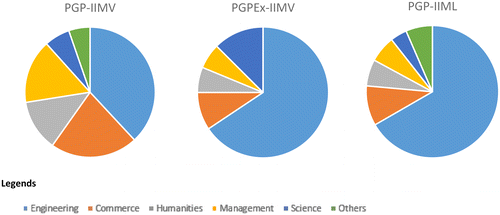
The case has been used in two public business schools in India, namely, Indian Institute of Management Visakhapatnam (IIMV) and Indian Institute of Management Lucknow (IIML), across two programs and two courses. PGP (postgraduate program) represents the regular two-year MBA curriculum and PGPEx (postgraduate program for experienced professionals) represents the two-year executive MBA curriculum where students have at least five years of work experience. The case has been used in the microeconomics course as a nongraded assignment for 189 students enrolled in the PGP course of the IIMV. Also, the case has been administered as a take home assignment in the microeconomics course to 32 students of PGPEx at IIMV and to 123 students enrolled in the OR course of PGP at IIML. Figure 1 represents the student diversity in a snapshot.
The case and the assignment questions were circulated two days before the submission deadline in all three classes. Students were asked to read the case and submit their responses to the assignment problems. The students submitted an Excel output, clearly specifying the model analysis and a document answering the descriptive questions. After evaluating the student submissions, the instructors discussed the case in one session, where the emphasis was given to discussing the tradeoffs faced by the decision maker. In particular, substantial time was spent explaining why the organization incurred the overhead costs for the expenditure items that were being sponsored by the donor. A few students required handholding in building the quantitative model in Excel.
The instructors also requested feedback from all the students. The feedback questions were divided into two groups: directed/quantitative questions and open-ended/qualitative questions. Specifically, the directed questions included the following:
Q1. How was your overall experience with the assignment?
Response to this question was obtained on a five-point Likert scale with 1 = very poor to 5 = excellent.
Q2. What is your prior exposure in quantitative techniques in school/college (mathematics, statistics, OR, analytics, or any other related subject)?
Response to this question was also obtained through a five-point Likert scale with 1 = very low to 5 = very high.
A summary of the responses across the three courses is shown in Table 1.
To complement the directed questions, the instructors also solicited feedback from the students in the form of open-ended/descriptive questions. Specifically, the students were asked the following three descriptive feedback questions:
Q3. Do you think this assignment did any value addition toward a better understanding of the subject? If yes, indicate how.
Q4. What are your key takeaways from this assignment?
Q5. What did you like least in the assignment?
|

Table 1. Student Responses to Q1 and Q2
| Microeconomics | Operations research | ||
|---|---|---|---|
| PGP (IIMV) | PGPEx (IIMV) | PGP (IIML) | |
| Q1: Overall experience | 3.83 | 3.77 | 4.11 |
| Q2: Quantitative exposure | 3.31 | 2.83 | 3.33 |
The response to Q3 was overwhelmingly positive, particularly considering the diversity in the disciplines of the students and their prior exposure to quantitative techniques (Figure 1; Table 1). After the submission of the assignment, in an email communication with the instructor, a student enthusiastically mentioned that the case made him/her aware of the humanitarian initiatives like GAP and expressed his/her willingness to donate to the noble cause.
The feedback to Q3 further supports the participants’ positive response. Students mentioned that the assignment questions contributed toward a richer understanding and appreciation of the concepts taught in class. Several students mentioned that the case, while being challenging, helped them relate the theory with practice. The case helped in boosting their confidence by providing an early exposure to a practical decision-making problem. Here, we present a sample set of responses to Q3 that have been received across the three courses:
“This project helped me understand more real-world problems and application of economics in the same. I learned how to tackle them logically and effectively.”
“It did a value addition as it was a bit challenging as I have never encountered such a case before. Some concepts were a bit tricky and took time to understand. However, understanding it by yourself was a fun learning process in itself. It makes me use the concepts in a real case.”
“Yes, it was indeed a value addition and not just from subject perspective but from experience perspective too as we will be encountering such situations in live scenario as well. Looking forward to class discussion on this case.”
“Yes, I was able to apply my knowledge and understanding of the break-even analysis to a real life case. I feel happy to do so as it directly gave me a sense of understanding on how to apply the knowledge in practicality.”
Students also mentioned significant takeaways from the assignment substantiating the response to Q4. In particular, they were appreciative of the real-life problem scenario that they were working on. Some representative student responses related to this question are presented here:
“Assignment was based on real life organization [RKM], and organization may face these situations in real life scenario for donations.”
“I got to learn about a real case scenario, how difficult it is for these kind of organizations to maintain fund. I have been to Belur Math before several time but didn’t know so much was going on behind it.”
Finally, students also mentioned about being challenged by the assignment questions. The challenges were mainly along two dimensions: (i) concepts of the types of funding and (ii) proficiency in using spreadsheet. One of the key difficulties that students faced lied in connecting the overhead cost to the expenditure items that are sponsored by the donor under their earmarked donation plan. Furthermore, because of the diversity of the class, basic proficiency in Excel varied among the students. A comment from one student is reproduced verbatim here:
“I was not aware of a few concepts like vertical integration, pooling, etc. due to which it was bit challenging for me. There was a little confusion about the cost incurred as the funding had to be calculated for 3 years and the 20% cost incurred seemed like a one time cost. But I wasn’t sure how to incorporate that in the calculations. Using Excel initially to formulate a model was a bit difficult.”
From this experience, in the teaching note, we suggest that (if possible in the orientation program for the next batch) students be given training in basic spreadsheet operations. Specifically, for developing and solving the spreadsheet model asked in the case questions, a student has to properly organize numerical data on various operating expenses from one of the exhibits of the case, conduct some Excel-based basic arithmetic, and may use a few basic mathematical functions of Excel such as SUM(), SUMPRODUCT(), ROUNDUP(), and so on. Beyond this, any advanced level Excel proficiency is not required for this case.
5. Conclusion
The case is an exciting application of the break-even analysis concept taught in microeconomics and operations research courses. It considers actual data, which gives insight into the various costs involved in a particular expenditure item and allows participants to analyze various strategies for fundraising, namely, vertical and pooled line-item funding. It helps the students work on a real-life problem that involves analyzing tradeoffs and requires them to take a decision. Additionally, the case presents a simple example of how real-life data can be effectively used in constructing a quantitative spreadsheet model.
The authors thank the editor-in-chief, associate editor, and anonymous referees for valuable suggestions for improvement on the initial versions of the case article and the case. The authors acknowledge the support of Swami Bodhasarananda, Assistant General Secretary of Ramakrishna Math & Ramakrishna Mission, Belur Math, West Bengal, India. The help of Dr. Jagadish Ghosh in this academic effort is gratefully acknowledged.
References
- (2018) An Introduction to Management Science: Quantitative Approach(Cengage, Boston).Google Scholar
- (2017) Managerial Economics and Business Strategy, 8th ed. (McGraw Hill Education, New York).Google Scholar
- (2017) A prologue to the special issue on not-for-profit operations management. Production Oper. Management 26(6):973–975.Crossref, Google Scholar
- (2011) Graphical models for economic profit maximization. INFORMS Trans. Edu. 11(2):43–56.Link, Google Scholar
- (2017) Ex-post funding: How should a resource-constrained non-profit organization allocate its funds? Production Oper. Management 26(6):1035–1055.Crossref, Google Scholar
- (2009) Ten nonprofit funding models. Stanford Soc. Innovation Rev. 7(2):32–39.Google Scholar
- (2006) Integrating spreadsheet engineering in a management science course: A hierarchical approach. INFORMS Trans. Edu. 7(1):18–36.Link, Google Scholar
- (1979) The role of nonprofit enterprise. Yale Law J. 89:835.Crossref, Google Scholar
- (2008) Teaching business modeling using spreadsheets. INFORMS Trans. Edu. 9(1):20–34.Link, Google Scholar
- (2006) Scenario analysis in spreadsheets with Excel’s scenario tool. INFORMS Trans. Edu. 6(2):23–31.Link, Google Scholar
- (2017) Case-optimal movement plan of rice in the State of Andhra Pradesh in India. INFORMS Trans. Edu. 18(1):41–47.Link, Google Scholar
- (1995) Strategic Management for Nonprofit Organizations: Theory and Cases (Oxford University Press, Oxford, UK).Google Scholar
- (2018) Art with Impact: Non-Profit Fundraising. Accessed September 8, 2022, https://hbsp.harvard.edu/product/W18220-PDF-ENG.Google Scholar
- (2001) Teaching modeling in management science. INFORMS Trans. Edu. 1(2):62–67.Link, Google Scholar
Ramakrishna Mission (2015) Commemorating Vivekananda: A comprehensive report of the projects implemented in commemoration of Swami Vivekananda’s 150th birth anniversary during 2010-2014 with the Central Government Fund. Advaita Ashrama, Belur Math, Howrah, India.Google Scholar- (2021) Payment for results: Funding non-profit operations. Production Oper. Management 30(6):1686–1702.Crossref, Google Scholar
- (2020) Challenges and strategies in managing nonprofit operations: An operations management perspective. Manufacturing Service Oper. Management, 22(5):888–905.Link, Google Scholar
- (2020) Case-forward-reserve storage design: A case of carriage repair workshop, Indian Railways. INFORMS Trans. Edu. 21(1):39–44.Link, Google Scholar
- (2006) The Nonprofit Sector: A Research Handbook (Yale University Press, New Haven, CT).Google Scholar

