Case—Budding with ERP: Information and Operations Management Challenges in a Nascent Industry
1. Background
It was a crisp winter morning in 2022. Justin Kendall, the chief operating officer (COO) of Budding-SK Inc., was on his way to the company’s facility near Saskatoon, Saskatchewan: Canada’s agricultural hub. Disengaged from the scenic views of prairie fields, Justin contemplated the state of Budding-SK’s information management and its complexities. The cannabis producer, licensed by Health Canada, used spreadsheets for information management but was simultaneously implementing a specialized Enterprise Resource Planning (ERP) system from a tech startup. The ERP system was developed for cannabis growers and offered a high degree of customizability. At Budding-SK, the system required extensive modifications to capture organizational processes adequately. Because of the regulators’ strict and extensive stock reporting requirements, Budding-SK had to maintain a full-scale use of spreadsheets in parallel with the prolonged ERP implementation. This was straining the resources. Justin was contemplating whether to revert to solely using spreadsheets, put more effort and resources into adapting the current ERP system, or drop the existing ERP system and adopt a mainstream ERP product. The management team expected a quick and firm decision from Justin due to a rapid expansion in operations and strict regulatory requirements.
2. Industry
Budding-SK Inc. operated in the cannabis production industry of Canada. The industry was dominated by three producers: Canopy Growth, Aurora Cannabis, and Tilray & Aphria, which were established as medical cannabis producers and later expanded into retail cannabis after its legalization in 2018. Almost two-thirds of the cannabis production was held by small craft cannabis startups. The industry was growing at an explosive rate, with projections showing more than 10% annual growth for the next five years.1 Potential ventures into international markets also provided strong long-term growth prospects for Canadian producers.
Despite the growth potential, the industry was marred by significant challenges. The government had substantial restrictions on licensing the cultivation, processing, and sale of cannabis products for commercial purposes. Securing a license approval from the government required a long time and substantial investment. After approvals, cannabis companies were required to submit detailed monthly reports to Health Canada and the Canada Revenue Agency (CRA) to track inventories, potencies, and sales. Maintenance of extensive documentation was required for audits. Accurately tracking and storing this information was a major struggle for many companies. However, even with the strict regulations, cannabis legalization attracted significant interest from businesspeople, enthusiasts, and investors, resulting in the propagation of producers.
The overcrowded market created intense competition in securing both supplies and orders. Customer preferences were changing fast from dried cannabis products to cannabis oil and concentrate-based products. Market dynamics combined with strict regulatory standards, which varied between provinces, caused a survival struggle for new entrants. Many companies were headed by enthusiasts who lacked a general management background. The strongest companies rose to dominate in this environment while the weak fell. Profitability was yet to be reached by a vast majority of Canadian cannabis producers, including two of the big three. Justin believed that most companies not becoming profitable in the next one to two years were likely to go out of business, leaving a gap in the market for those who remained.
“It is like being on a roller coaster. There are always new changes and challenges that await.”—Justin.
3. Budding-SK Inc.
Budding-SK was founded by Justin and his close friend Seth Martin, the chief executive officer (CEO). Justin was a supply chain management graduate with a professional retail, agriculture, and real estate background. Justin and Seth developed an acquaintance in the real estate business and decided to venture into the cannabis industry. The construction of Budding-SK’s production facility started in 2018 with a plan to focus on medical cannabis. However, recreational cannabis became legal before the facility was operationalized, which led the duo into a strategic shift to establish Budding-SK as a recreational cannabis producer.
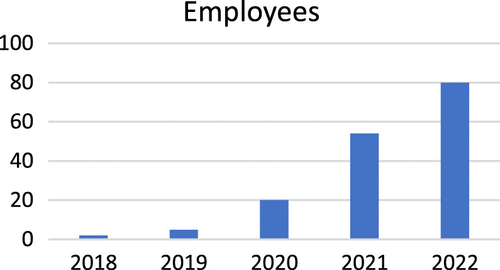
Budding-SK saw remarkable growth after its inception; it started with two employees in 2018 and had around 80 in 2022 (Figure 1). This phase overlapped with the COVID-19 pandemic years, which saw an increase in cannabis consumption.2 Budding-SK’s large land parcel and infrastructure (Figure 2) also played a crucial role in facilitating the expansion. The foresight on infrastructure flexibility came naturally from the founders’ real estate contract work background. Another important growth factor was the increasing demand that Budding-SK attracted by offering high-quality and high-tetrahydrocannabinol (THC)3 products developed by their expert growers and product development team. The main constraining factors in Budding-SK’s further expansion were the cost of wages, the complexity of planning operations, and the challenges in meeting the reporting regulations with fast-growing data.

Justin felt that Budding-SK was at a tipping point where strategic decisions could either elevate it to be a major player in the industry or lead to a downfall like several other startups were experiencing. Budding-SK was one of the very few profitable companies in the country and aimed to continue decreasing costs while increasing throughput. Its management had worked tirelessly to achieve this major benchmark and needed to sustain it (Figure 3). The management constantly redefined processes and workforce deployment for efficiency. Employees were being released from mundane production and administrative tasks through automation. Paperwork was being consolidated into shorter documents, and excess reporting was curtailed. For the longer term, the goals were to expand the product range, reach across Canada, target international markets, and give back to the community by creating jobs and offering safe and high-quality cannabis products.
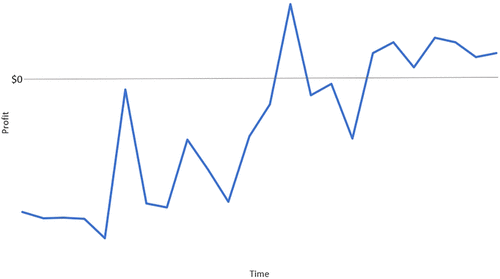
Note. Generalization of the company’s financial data.
There were three important dimensions to manage. The first was understanding and responding to government policies. It was critical to track inventories and rigorously maintain documentation. Weaknesses on this front could result in a significant setback in the form of an audit failure. The second was responsiveness to the market. Adaptability was essential to remain in the industry that showed major shifts even in its nascency. The industry was moving away from dried cannabis products, for example, cannabis flower buds and prerolls,4 to products based on cannabis oils and concentrates, for example, vape cartridges.5 Competing on responsiveness to the marker required continuous product development and improvements. The third dimension was reliable and growing profitability. The lack of profitability could result in an inability to compete with the more established players and an eventual business failure.
4. Products and Production Process
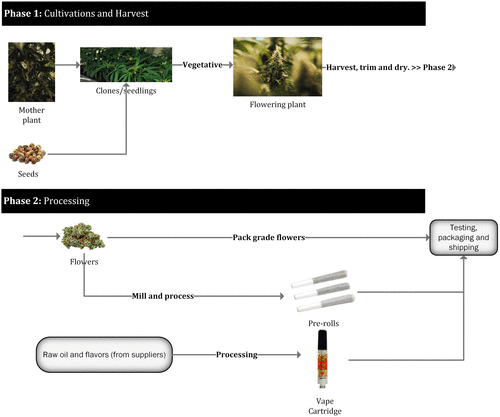
Budding-SK’s main products included cannabis flower buds, prerolls, and vape cartridges. These products were outputs from different stages of the same production process (Figure 4). At the upstream of the process, plant clones were created using mother cannabis plants and seeds. The clones were raised to the flowering stage, at which flower buds were harvested. A portion of the harvest was directly sold, whereas the rest was milled and processed to produce prerolls. Selling the output from different stages of the production process increased the sales volume through market diversification. Budding-SK also produced vape cartridges through essentially an assembly operation for which cartridge components and substances were sourced externally.
Prerolls were Budding-SK’s main product and generated around 50% of the total sales volume, followed by flower buds, which generated approximately 35%. Budding-SK desired to acquire analytical capabilities and information to determine the precise margins generated by these products. The production process was disconnected, and the information-gathering points did not capture the overall input-output transformation. Also, the same inputs provided different batch yields. Production quantities were based on the growth and harvest of live plants, which could be affected by many factors. The actual intake of the nutrients provided to plants and the exact staff time utilized at different production phases were unknown. Tracking staff time manually through physical records was cumbersome and inaccurate.
Vape cartridges generated the lowest volume (15%) and, presumably, the highest margin. Estimating costs and margins in vape cartridge production was easier as it was an assembly and blending process with negligible variability in inputs and outputs. However, the comparative analysis on product margins was anecdotal as the required information on prerolls and flower buds was imprecise.
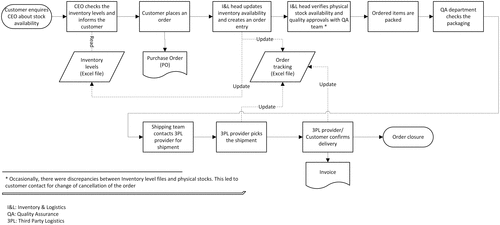
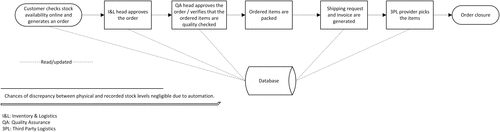
Budding-SK followed a make-to-stock6 production scheme in which lower stock levels triggered production. Customer orders were directly satisfied from the finished goods inventory (Figure 5). High demand resulted in quick inventory turnovers, diminishing stock-quality deterioration risk. The products were mainly sold to wholesalers, with Seth’s direct involvement in sales. Retailers offered a higher profit margin than wholesalers, but their orders were smaller and more frequent, making them difficult to manage.
5. Organizational Structure and Processes
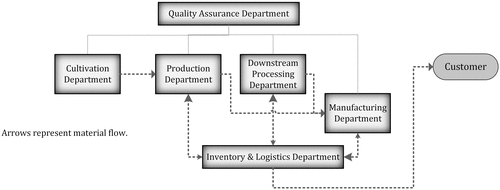
Operations at Budding-SK were organized into six departments (Figure 6). The cultivation department was responsible for growing cannabis plants, which the production department harvested to prepare cannabis buds and concentrates. The downstream processing department blended cannabis oils, terpenes, and flavors to produce high-quality concentrates. The manufacturing department packaged the prepared cannabis buds and concentrates into finished products. The inventory and shipping department tracked inventories and shipped packaged products to customers. The quality assurance department ensured that the products met quality and safety standards.
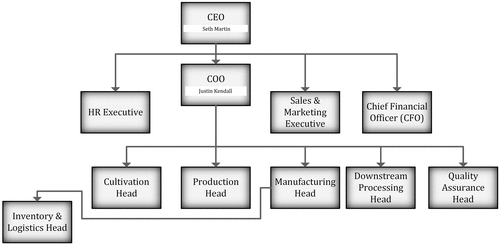
The final go-ahead on all strategic decisions came mutually from Justin and Seth, although Seth, mainly focused on acquiring clients and orders, had minimal operational oversight. The decisions were coordinated with management team members (Figure 7) who were highly experienced in their areas and had a good knowledge of basic information technology for management purposes. However, some members had no prior experience with an ERP system.
There was no centralized information technology (IT) team for maintaining IT infrastructure and resolving software issues. Support for most IT systems was outsourced to the suppliers. To organize ERP implementation efforts internally, train staff, and coordinate with the ERP developer, Budding-SK hired a temporary part-time staff member with specialized skills in information systems.
6. Information Management and Reporting
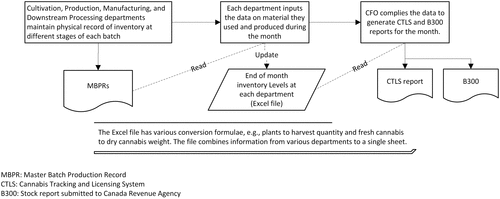
Budding-SK had a rudimentary IT setup comprising personal computers running on Microsoft (MS) Windows and connected through a local area network. Budding-SK also used two standalone software for human resources (HR) (payroll) management and tax filing. The HR management software and the ERP system used providers’ servers. Spreadsheets were used for managing nearly all inventory and production-related data. This included recording all in-process inventories for government reporting, sales, and purchases (Figure 5), lot allocation to orders, and raw materials. Master batch production records (MBPRs) were filled by hand to track the information for a batch being produced. These cumbersome records (Figure 8) were used to populate spreadsheets, which were set up to perform various calculations and conversions, for example, converting fresh cannabis weight to dry cannabis weight (see Figure 9 for inventory tracking and reporting process).

Note. Each binder in the picture tracked one lot at a specific point in its production process.
There were no interactive controls on spreadsheet inputs. Users could accidentally input a wrong value and impact a chain of cells in multiple spreadsheets. Sometimes, the spreadsheet formulae were inaccurate, and users often did not understand the calculations and conversions well. Procedures for data input and use were mostly followed without verification. This led to misinterpretation and errors in electronic records, wasting significant time in corrections and reconciliation with physical records and stocks. The scale of inaccuracies in the data came to light during the ERP implementation efforts. The ERP test reports based on past data and the corresponding spreadsheet output had a significant mismatch. During the ERP implementation, errors accumulated over long periods and multiple spreadsheets were spotted two to four times a month.
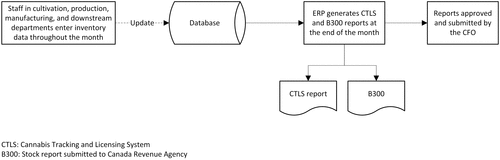
Each month, Budding-SK had to submit the Cannabis Tracking and Licensing System (CTLS) and B300 reports. The CTLS report (Figure 10), submitted to Health Canada, consumed around 48 hours of management time and was prepared through manual entries. The B300 report,7 submitted to the Canada Revenue Agency, included critical information on the calculations for monthly excise duties. This report consumed around 40 hours of different staff members.

Notes. Each report had multiple sheets and 2,500+ cells for reporting. An ERP system could automatically generate this report.
Besides addressing the risk of information errors through input controls, an ERP system could bring efficiency to main processes like order fulfillment (compare Figures 5 and 11) and inventory tracking and reporting (compare Figures 9 and 12). Automating invoicing could save around 24 hours of accounting time per month. Approximately 48 administrative hours per month could be saved due to the automation of the reorders of supplies, such as fertilizers and packaging material. Another area where an ERP system could bring major benefits was sales operations. Through sales automation, an ERP system could significantly increase the efficiency of the sales operation. Nevertheless, the condition was to robustly map the internal processes and information over ERP modules to implement an ERP system successfully. For example, the automation of the sales operation could significantly simplify most of the sales activities, but it required frequently changing inventory and sales prices to be perfectly tracked and incorporated into the system.
An ERP system could also track input materials, worker hours, and other variable production costs. Based on this information, Budding-SK could better understand the costs and margins of different products and decide the optimal product mix. Tracking inputs and yield could help understand the variability in output and provide valuable insights into the factors that increased productivity.
7. ERP Implementation
Budding-SK’s efforts to streamline its information management started in April 2021 with an attempt to implement planning-and-reporting software. However, the attempt only lasted for six months. The system lacked customization and did not align with the production processes and desired reports. Budding-SK switched to implementing an ERP product specialized for cannabis growth and production. The product was offered by a tech startup focused on ERP system development for the cannabis industry.
Justin realized the risks of adopting a system by a startup but saw various advantages and a significant mutual stake. The system cost was much lower than mainstream ERP products—The licenses of mainstream ERP systems could cost five to six times more. Additionally, many mainstream ERP providers charged for every support instance and customization job. The startup offered a high level of customization, product support, and close coordination for changes without additional charges. For the startup, a successful implementation at Buddin-SK was critical to have its ERP product recognized in the market.
However, the implementation of the system was proving difficult. Many employees found it difficult to explain the required customization and specifications. The provider was responsive to customization requests, but often the customizations were unworkable due to misalignments with the requirements. Employees were experiencing a long learning curve, resulting in an improper use of the system and significant “junk data.” Another challenge was the delays in routine customer service requests. Sometimes, it took a long wait to get support for fixing minor errors. The provider was a small tech company with limited resources. The company was in a phase of developing and debugging some of the essential modules.
Justin pondered whether Budding-SK should go for a more mainstream and proven ERP product rather than taking chances with the system being implemented. On the one hand, putting more resources into a relatively untested system while still lacking stable profits was risky. On the other hand, changing an information management system twice in a short period could give the management team wrong signals. A mainstream ERP product could also cost substantially more, and there was no guarantee that the implementation would be smoother. The situation led Justin to think about reverting to solely using spreadsheets. Maybe it was too early for Budding-SK to adopt an ERP system. Reinforcing the use of spreadsheets might be a more practical approach at this stage.
“Being in the cannabis industry, you never really know what to expect or how your decisions will impact things moving forward. Right now, our biggest decision is figuring out how to manage our growth. Having so many more employees and high product variety and volume, we need to build a firm strategy on how to manage this data and we need to make this decision soon.”—Justin.
1 BNN Bloomberg, Cannabis Canada Weekly: https://www.bnnbloomberg.ca/cannabis-canada-weekly-market-expected-to-double-by-2027-pot-stocks-up-on-u-s-legalization-hopes-1.1743189#:∼:text=Brightfield%20said%20it%20expects%20Canada’s,in%20edibles%20and%20vape%20products.
2 Statistics Canada, Cannabis in Canada: https://www150.statcan.gc.ca/n1/pub/11-631-x/11-631-x2023006-eng.htm.
3 THC is the principal psychoactive constituent of cannabis. The higher the THC is in cannabis, the higher is the brain and body response to it.
4 Rolled cannabis cigarettes.
5 Smoking cartridges containing cannabis oil and synthetic concentrates (flavors).
6 Make-to-stock policy is focused on building ending inventory to a certain level, regardless of the demand. It contrasts with make-to-order, in which customer orders trigger production.
7 See https://www.canada.ca/en/revenue-agency/services/forms-publications/forms/b300.html.