Case Article—Optimizing Transportation and Equity in a District Zoning Problem for ORville Public Schools
Abstract
This case asks students to solve a multiobjective optimization decision problem applied to school district zoning. In the case, residential areas in a school district must be assigned to middle schools having capacity limits. The operational considerations on the decision are the weighted distances traveled between students’ residences and their assigned middle school campuses. The ethical considerations pertain to equity in education and are measured using the numbers of economically disadvantaged students assigned to each middle school. This problem, including its two objectives, is motivated by a real zoning problem faced by a school district. Publicly available data from the school district and its rezoning efforts are used to populate the case. To complete the case, students model and solve an optimization problem both with and without the ethical considerations included. In doing so, they observe how ethical considerations can change the outputs generated by the optimization model. Evidence is provided from student surveys to indicate how completion of the case impacts perceptions of the importance of and understanding of how to include ethical considerations in optimization modeling. Results indicate statistically significant increases in those perceptions.
History: This paper has been accepted for the INFORMS Transactions on Education Special Issue on Diversity, Equity and Inclusion in OR/MS Classrooms.
Supplemental Material: The Teaching Note and DataAndMetricsDemo Excel workbook are available at https://www.informs.org/Publications/Subscribe/Access-Restricted-Materials.
1. Introduction
“Optimizing transportation and equity in a district zoning problem for ORville public schools” is a case developed to expose students to an optimization decision problem with ethical considerations incorporated. Specifically, students are asked to solve a school district zoning problem in which all residential addresses in a school district must be assigned to middle schools having capacity limits on the numbers of students that they can accommodate. The operational considerations on the decision are the weighted distances traveled between students’ residences and their assigned middle school campuses. The ethical considerations pertain to equity in education and are measured using the numbers of economically disadvantaged students assigned to each middle school. This problem, including its two objectives, is motivated by a real zoning problem faced by a school district in the authors’ locale. Publicly available data from this school district and its rezoning efforts are used to populate the case.
To complete the case, students model and solve an optimization problem both with and without the ethical considerations included. In doing so, they observe how ethical considerations can change the outputs generated by the optimization model. They are asked to apply a seven-step process for ethical decision making to compare alternative solutions on the basis of both operational and ethical considerations and justify their recommendation (Davis 2023). We provide evidence from student surveys to indicate how completion of the case impacts perceptions of the importance of and understanding how to include ethical considerations in optimization modeling. Results indicate statistically significant increases in those perceptions.
The ethical considerations in the case pertain to equity in education: a complex construct that is difficult to describe. The literature provides a number of definitions to compare and contrast the concepts of equality and equity in education, including equality as “[connoting] sameness in treatment” and equity as “associated with fairness or justice in the provision of education or other benefits” and “[taking] individual circumstances into consideration” (Corson 2001; Espinoza 2007, p. 345). In other words, equality may be conceptualized as equal allocation of resources, whereas equity may require unequal allocation resources in pursuit of equal outcomes (Jurado de Los Santos 2020). In fact, 1 of the 10 steps to equity in education promoted in Field et al. (2007) is to “direct resources to students and regions with the greatest needs” (Field et al. 2007, p. 9). The assessment of equity involves weighing quantitative metrics along with one’s own subjective evaluations of fairness and justice and thus, can differ from person to person (Espinoza 2007). In this case, differences in how students perceive this assessment and the trade-offs between travel and equity are expected. The requirement to use the seven-step process for ethical decision making is intended to guide students through the blended quantitative and qualitative assessment in a structured way.
Only a few case studies for the quantitative modeling of ethical considerations in optimization problems exist in the literature. We review those of which we aware. In “Case article—keeping logistics under wraps” by Drake et al. (2011), students use optimization to design a service network in which a number of facilities must be located and demand sites must be assigned to them. The optimal network is then compared with the status quo (i.e., the existing service network), and students are asked to make a recommendation between the optimal network and the status quo. An ethical dilemma is embedded as the optimal network saves money but requires engaging in deceptive business practices. The case requires students to apply an ethical decision-making framework to recommend a solution. Like “Case article—keeping logistics under wraps,” our case focuses on a service network design variant (although with a public sector application) and asks students to apply a seven-step process for ethical decision making (Davis 2023). In contrast to “Case article—keeping logistics under wraps,” our case requires solving a biobjective model in which the ethical dilemma is modeled explicitly as one of the two objectives. Further, the ethical dilemmas differ as our case examines equity in education.
Davis and Riley (2008) suggest the use of microinsertions, in which traditional optimization problems are reformulated to include ethical components, as an approach for embedding ethics training in engineering education without increasing curricular requirements (i.e., adding new courses). Salado (2017) builds upon this idea, presenting facility location assignments with and without ethical considerations and providing evidence of student performance on these assignments before and after receiving in-class instruction on ethical issues. The assignments in Salado (2017) are similar to the case in Drake et al. (2011) in that the ethical considerations are not embedded directly into the optimization formulations but instead, are considered alongside financial metrics of alternative solutions. For example, the facility with the lowest financial metric might be located in a country that permits child labor or might require firing a number of employees.
A number of additional cases in the literature incorporate equity or ethics in optimization or other prescriptive analytics techniques. “Case article—pediatrician scheduling at British Columbia women’s hospital” by Shechter (2023) is a case focused on the development of a staff scheduling solution that meets a number of hard and soft constraints. One of the soft constraints is equity of pediatrician workload; essentially, no single provider should be working more night shifts than others. The case asks students to reflect this and other soft constraints in a weighted-sum-of-objectives formulation. Another healthcare application case that includes ethical considerations, although focused on machine learning rather than optimization, is “Case article—machine learning, ethics, and change management: A data-driven approach to improving hospital observation unit operations” by Pachamanova et al. (2021). In it, students can observe how an algorithm for medical decisions tuned using historical health data can lead to decisions that appear to be biased according to sociodemographic determinants of health. In a nonhealthcare application, Birge (2004) describes a professional sports league scheduling problem where equity arises in how the schedule impacts each team.
The remainder of this article is organized as follows. Section 2 relates the case to the real-world scenario on which it is based, and Section 3 introduces the teaching objectives of the case. Section 4 provides our suggestions for using the case, including what types of courses we recommend using it in, and it provides details regarding the in-class time and the out-of-class time required to complete it. Finally, Section 5 documents our experiences with using the case from both student and instructor perspectives.
2. Case Background
This case was inspired by a real problem that a public school district in the authors’ local area faced when opening a new middle school campus to serve students in the district. The opening of the new middle school campus was necessitated by the closing of an old one. Specifically, one school campus in the district had previously been serving as a combined elementary and middle school, enrolling students in kindergarten (K) through grade 6. Growing enrollments led to a need to allocate the full capacity of that campus to elementary students in kindergarten through grade 4 alone. Closing the middle school portion of the campus generated a need for a new middle school campus to replace the lost capacity for grades 5 and 6. Although simply moving the middle school demand that was previously assigned to the combined school campus to the new middle school campus solves the problem of accommodating those students, the district was simultaneously facing large growth in other portions of its geography. The capacity of another of its middle schools was strained. Thus, the school district sought a zoning solution that would both determine who would attend the new middle school and also relieve capacity on the existing middle school campus with the largest enrollment. In the subsections below, we discuss the key elements of the optimization problem in this case, the origins of the data in the case, and the ways in which this case simplifies reality. A sampling of possible solutions to the case is included separately in the Teaching Note.
2.1. Optimization Problem Elements
A solution to this zoning problem requires assigning all residential addresses in the district to one of three middle schools without violating those schools’ capacity limits. The district school board stated three priorities for considering alternative zoning solutions, stated here in no particular order: continuity, proximity, and equity. Continuity is achieved when students who go to elementary school together stay together when they matriculate to middle school. Proximity is achieved when students do not travel farther than necessary between their residence and assigned middle school campus. Equity in education is a multifaceted concept about which much can be written. In this case, the public school district’s Board of Education used two metrics to quantify the equity of a zoning solution: the percentage of racial and ethnic minorities making up each middle school campus and the percentage of economically disadvantaged students making up each middle school campus.
In this case, students are asked to model this multiobjective optimization problem. The key decisions of the model include assigning all residential addresses in the school district to one of three middle schools without violating the capacity limits of those schools. Middle school demand is aggregated at the elementary zone level. That is, residential addresses in the school district are already aggregated into zones that determine what elementary school a student will attend. The size of the middle school cohort originating from each elementary zone, bi, is measured in the number of middle school students residing within elementary zone i and is assumed to be known. In this aggregation, all bi students in zone i are placed at the population-weighted centroid of i. Distances hij between elementary zone i and middle school campus j are provided, and the proximity objective is measured as the total demand-weighted distance between elementary zones and their assigned middle school campuses; this metric is denoted enrollment-weighted distance (EWD) and is to be minimized. The number of economically disadvantaged students ci in the middle school cohort originating from elementary zone i is assumed to be known and is used to compute an equity objective. Specifically, the objective is to minimize the difference between the maximum number of economically disadvantaged students assigned to any one middle school and the minimum number of economically disadvantaged students assigned to any one middle school. This objective is denoted Range#ED.
2.2. Case Data Origins
Data for the case are from publicly available sources. Middle school demand bi for each elementary zone i is estimated as the sum of third- and fourth-grade enrollments at elementary i in academic year 2021–2022 (Arkansas Department of Education 2021). This method of estimation is selected because middle schools in this district serve fifth- and sixth-grade students, and third- and fourth-grade students represent a two-year cohort that will matriculate to middle school soon. The number of economically disadvantaged students ci in elementary zone i is estimated by multiplying middle school demand bi with the percentage of economically disadvantaged students in elementary zone i, published in a public document outlining the district’s rezoning conversations (Fayetteville Public Schools 2022a). Middle school capacities uj are from the same document (Fayetteville Public Schools 2022a). The population-weighted centroid for an elementary zone is approximated by visually inspecting a map of student density within the zone (Fayetteville Public Schools 2022b). Then, Google Maps is crossreferenced to identify the nearest valid street address to the manually identified population-weighted centroid. The demand of the elementary zone is aggregated to this street address. The driving distance hij from the population-weighted centroid address of zone i to the street address of middle school j is obtained from Google Maps.
2.3. Simplifications of Reality
One way in which this case simplifies reality is that it requires students to model only a single measure of equity in education. In the real situation inspiring the case, the Board of Education expressed interest in two dimensions of equity: the percentage of racial and ethnic minorities making up each middle school campus and the percentage of economically disadvantaged students making up each middle school campus. Asking students to model either of these objectives as a percentage of students assigned to a school rather than as a number of students assigned to a school would require a nonlinear formulation, so we chose the latter. Requiring students to model both racial and economic composition would result in a three-objective model with a three-dimensional efficient frontier. We opted for a problem statement that permits a biobjective formulation, and we selected the economically disadvantaged composition instead of the racial and ethnic composition. We did so in part because the analysis of several alternative zoning plans presented to the public revealed that only very minor changes in racial and ethnic composition could be achieved without more drastic changes to prior zoning plans (Fayetteville Public Schools 2022a). This is perhaps unsurprising given the relationship between neighborhood segregation and diversity in schools in the United States (Rothstein 2019). When neighborhoods are racially segregated and school zones are based on neighborhoods, the racial composition of the schools reflects the racial composition of the neighborhood zones (Frankenburg and Siegel-Hawley 2009, Rothstein 2019).
Aggregation of middle school demand at the elementary zone level is another way in which this case is simplified. The question of how to aggregate demand is complex, with lower levels of aggregations (e.g., specific addresses or blocks of streets) yielding larger numbers of decision variables and more precise estimates of distance traveled between demand points and middle school campuses. On the other hand, higher levels of aggregation (e.g., entire elementary zones) generate fewer decision variables and less precise estimates of distance traveled. Despite this lack of precision, we use elementary zones to aggregate demand for two primary reasons. The first is that using the elementary level of aggregation ensures that the stated priority of the Board of Education for continuity will be met. That is, with this level of aggregation, continuity becomes a constraint rather than an objective. This avoids the need to ask students to model a third objective. The second reason is to keep the number of decisions manageable enough for students to easily comprehend solutions and consider alternatives. We note also that this case does not consider continuity beyond the middle school level. A comprehensive zoning plan for a school district that prioritizes cohort continuity for the full K–12 experience requires a multiechelon allocation formulation considering how residences are assigned to junior high schools and high schools as well.
Another way this case simplifies reality is that a location decision for the new middle school is not required. Ideally, where to locate a new school and how to zone students to it would be considered simultaneously. Modeling the combined problem requires a location-allocation formulation with two objectives. We chose to focus instead on the allocation-only generalized assignment formulation for two primary reasons. The first is that the selected level of complexity better enables the students to focus more effort on solving the biobjective assignment problem and evaluating the trade-offs among alternative solutions. The second is that the allocation-only problem more closely resembles the real situation inspiring the case. The middle school zoning process only began and garnered widespread public attention after the new middle school was already under construction in a fixed location.
3. Teaching Objectives
The first teaching objective is to give students practice modeling and solving an integer program with two objectives. Example problems in introductory operations research (OR) courses often focus on a single objective function. However, many decision problems in personal, public, and business applications have multiple objectives to consider. In this case, students are first required to model and solve a single-objective model with the EWD metric. Students are not explicitly required to optimize the second metric, Range#ED, in a single-objective model, although many do, as they are required to develop at least one more solution via optimization. Students are also required to develop at least three more alternative solutions (for five total), either through optimization or through other methods. Many students used either -constraint or weighted-sum-of-objectives methods to do so. For all alternative solutions developed, students must evaluate them via both the EWD and Range#ED metrics. This enables students to observe how multiple objectives can conflict, with solutions performing well on one metric performing poorly on another.
The second teaching objective is for students to incorporate ethical considerations into an optimization model. Here, the ethical considerations pertain to equity in education. Students are required to conduct background research on equity in education before beginning the optimization modeling. They are asked to research the importance of equity in education and how other communities have handled decisions similar to the zoning scenario described in the case. They are prescribed how to quantify equity (with the Range#ED metric). This gives students the opportunity to observe how ethical considerations can be represented in metrics and how they can influence solutions to optimization models based on those metrics. In their background research, many students also come to understand that the question of how to quantify equity is in itself a complex issue, and some recommend alternative metrics to Range#ED in their analysis and discussions.
The third and final objective is for students to use an ethical decision-making process to recommend a decision considering both operational and ethical factors and communicate their justification for the decision. Before beginning the case, students are assigned to read the “Seven-step method for ethical decision-making” (Davis 2023) and the “Engineering code of ethics” (Institute of Industrial & Systems Engineers 2023). From this background reading, students learn to gather relevant facts and identify stakeholders and at least five solutions when making a decision. Before recommending a solution, the method specifies testing the alternative solutions according to criteria, such as do they do harm and are they defensible. In completing the case, the students integrate the operational and ethical considerations (EWD and Range#ED) in this step-by-step decision-making process.
4. Suggested Classroom Use
The case is envisioned for use in an undergraduate course that introduces students to modeling and solving optimization problems. In this setting, we have used the case to introduce the topic of multiobjective optimization while reinforcing students’ abilities to model optimization problems with equity considerations. Furthermore, the case is used as an opportunity for students to combine ethical reasoning skills with their optimization analysis to select and justify a solution among a nondominated frontier that captures the trade-off between equity and operational metrics. For Accreditation Board for Engineering and Technology, Inc. (ABET)-accredited engineering programs, the case may be used as an opportunity to introduce or assess skills related to ABET Student Outcome (4): “an ability to recognize ethical and professional responsibilities in engineering situations and make informed judgments, which must consider the impact of engineering solutions in global, economic, environmental, and societal contexts” (Accreditation Board for Engineering and Technology, Inc. 2022). The case could also be appropriate for teaching multiobjective optimization in an introductory graduate-level optimization course or perhaps, in a graduate or undergraduate elective course that focuses on public sector applications of OR. A number of case extensions are suggested in the Teaching Note.
We recommend using the case as an individual assignment. Our rationale for this recommendation is that students are likely to differ dramatically on their perception of the issues. Because of this, we think that it is important to give students the space (and responsibility!) to generate their own recommendations. We also recognize that students can gain perspective from their peers and therefore, encourage building in opportunities for interaction among students in the class.
We suggest assigning elements of the case in stages by first asking students to solve a single-objective model to optimize the EWD metric and then providing feedback to students on their work. Optionally, this portion of the case can be completed as an in-class or laboratory activity, provided that students have access to optimization software at the time of the activity. We estimate that this requires approximately 30 minutes if conducted in class. After this stage, the second metric (Range#ED) can be revealed in an approximately 20- to 30-minute in-class introduction to the biobjective problem and demonstration of the Excel workbook DataAndMetricsDemo.xlsx. If instructors wish to ask students to solve the biobjective problem using optimization, we suggest devoting approximately 50 minutes of class time to teaching the weighted-sum-of-objectives method and/or the -constraint method for multiobjective optimization. Instructors may wish to allocate an additional 20 minutes to in-class work on the second metric and/or the biobjective optimization techniques. Finally, we suggest allowing two weeks for students to complete the development of alternative solutions, synthesize their analysis, and determine a recommendation. Students submit a Word document describing their solutions and also, any supporting optimization materials (e.g., model files).
5. Classroom Experiences
To document our classroom experiences with the case, we provide the results of student feedback in Section 5.1 and a summary of instructor experiences and recommendations in Section 5.2.
5.1. Student Feedback
Student perceptions regarding the importance of and understanding how to incorporate ethical considerations in optimization modeling were measured with a three-item survey administered before (denoted Pre) and after (Post) case completion. The three survey items are as follows.
Item 1. I have an understanding of how ethical considerations can be included in optimization models.
Item 2. I have an understanding of how ethical considerations can change the recommendations generated by optimization models.
Item 3. I think it is important to include ethical considerations in optimization models.
Students were asked to rate their agreement with each of the three items on a five-point Likert scale, with 1 = strongly disagree, 2 = disagree, 3 = neutral, 4 = agree, 5 = strongly agree.
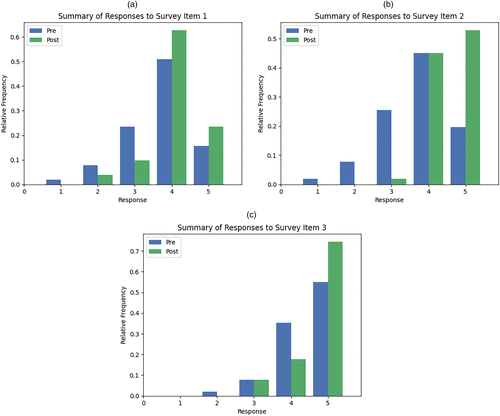
The Pre and Post response frequencies for each survey item are depicted in Figure 1. Summary statistics for both surveys are in Table 1. In Figure 1, it can be observed that the frequency distributions for the Post responses skew to the right more than for the Pre responses. In Table 1, it can be observed that median and mode Post responses to all survey items are no lower than the median and mode Pre responses as there is no change in these statistics for Items 1 and 3 and as there is an increase in these statistics for Item 2. Together, Figure 1 and Table 1 suggest an increase in the perceptions of the importance and understanding of including ethical considerations in optimization modeling.
|

Table 1. Summary Statistics for Pre and Post Survey Responses
| Survey item | |||
|---|---|---|---|
| 1 | 2 | 3 | |
| Count (Pre) | 57 | 57 | 57 |
| Count (Post) | 58 | 58 | 58 |
| Median (Pre) | 4 | 4 | 5 |
| Median (Post) | 4 | 5 | 5 |
| Mode (Pre) | 4 | 4 | 5 |
| Mode (Post) | 4 | 5 | 5 |
| Mean (Pre) | 3.63 | 3.67 | 4.40 |
| Mean (Post) | 4.03 | 4.5 | 4.64 |
To understand whether Pre and Post responses to survey items are significantly different, we use paired Pre and Post responses from 51 respondents and compute diffm,n as the Post response to survey item m from response pair n minus the Pre response to survey item m from response pair n. We define as the mean difference for survey item m. Then, we test the hypotheses against and against using Wilcoxon signed-rank tests. The p-values for the tests are reported in Table 2. At the 0.05 level of significance, the null hypotheses are rejected in favor of the alternatives in all tests. For all survey items, we conclude that the difference between Pre and Post responses is not zero, indicating changes in student perceptions after completion of the case. Further, we conclude that the difference is positive, indicating that student perceptions of the importance and understanding of including ethical considerations in optimization modeling increase.
|
Table 2. Results of Hypothesis Tests on Mean Differences in Pre and Post Responses
| Survey item | |||
|---|---|---|---|
| 1 | 2 | 3 | |
| Number of paired responses | 51 | 51 | 51 |
| p-value (two-sided test) | 0.0281 | 7.284 × 10‒6 | 0.0286 |
| p-value (one-sided test) | 0.0140 | 3.642 × 10‒6 | 0.0143 |
5.2. Instructor Experiences and Recommendations
We used the case in an undergraduate-level introductory OR course during the fall 2022 and spring 2023 semesters. Based on our experiences, we believe that the case provides an effective introduction to multiobjective optimization and modeling equity considerations in the context of an application that is relatable to first- or second-year undergraduate students. Students applied established multiobjective scalarization methods (e.g., -constraint and weighted sum of objectives) and a variety of ad hoc methods to generate alternative solutions. Students then drew upon their analysis, background research, and ethical reasoning to recommend and justify a solution. Students varied in their recommendations, but the results suggest that a majority of students placed at least some value on the equity metric.
In addition to providing out-of-class support related to optimization concepts, instructors and graders should expect to engage in communication helping students to navigate the open-ended nature of the problem. Specifically, instructors should expect students to be somewhat uncomfortable in recommending a decision, especially because students may disagree about how to prioritize the metrics or even about whether the prescribed metrics are even the best choice for the application. In our opinion, given this ambiguity, the crux of the case is not which alternative students recommend but rather, how students use analysis to bring clarity to key trade-offs among different alternatives. Instructors are advised to coach students that there is no single “correct” solution and that students may disagree with their peers’ analysis or recommendations.
References
Accreditation Board for Engineering and Technology, Inc . (2022) Criteria for accrediting engineering programs, 2022–2023. Retrieved July 16, 2023, https://www.abet.org/accreditation/accreditation-criteria/criteria-for-accrediting-engineering-programs-2022-2023/.Google ScholarArkansas Department of Education (2021) Enrollment by grade by school, 2021–2022 (Data set). Arkansas Department of Education Data Center. Retrieved September 20, 2022, https://adedata.arkansas.gov/statewide/ReportList/Schools/EnrollmentByGrade.aspx.Google Scholar- (2004) Scheduling a professional sports league in Microsoft® Excel: Showing students the value of good modeling and solution techniques. INFORMS Trans. Ed. 5(1):56–66.Link, Google Scholar
- (2001) Ontario students as a means to a government’s ends. Our Schools/Our Selves 10(4):55–77.Google Scholar
- (2023) Seven-step method for ethical decision-making. Online Ethics Center for Engineering and Science. Retrieved July 17, 2023, https://onlineethics.org/cases/seven-step-method-ethical-decision-making.Google Scholar
- (2008) Ethics across the graduate engineering curriculum: An experiment in teaching and assessment. Teaching Ethics 9(1):25–42.Crossref, Google Scholar
- (2011) Case article—Keeping logistics under wraps. INFORMS Trans. Ed. 11(2):57–62.Link, Google Scholar
- (2007) Solving the equity–equality conceptual dilemma: A new model for analysis of the educational process. Ed. Res. 49(4):343–363.Crossref, Google Scholar
Fayetteville Public Schools (2022a) Fayetteville public schools attendance zone planning, June 28, 2022. Retrieved June 6, 2022, https://go.boarddocs.com/ar/fayar/Board.nsf/files/CFNLJ255F50C/$file/Fayetteville%20PS%20Attendaonce%20Zone%20Planning%20June%2023_2022.pdf.Google ScholarFayetteville Public Schools (2022b) Fayetteville public schools spring 2021/22 demographic report. Retrieved June 6, 2022, https://go.boarddocs.com/ar/fayar/Board.nsf/files/CEQP4961C525/$file/Fayetteville%20PS%202022%20Spring%20Report.pdf.Google Scholar- (2007) Education and Training Policy. No More Failures: Ten Steps to Equity in Education (OECD Publishing, Paris).Crossref, Google Scholar
- (2009) Equity overlooked: Charter schools and civil rights policy. The Civil Rights Project. Retrieved July 16, 2023, https://civilrightsproject.ucla.edu/research/k-12-education/integration-and-diversity/equity-overlooked-charter-schools-and-civil-rights-policy/frankenberg-equity-overlooked-report-2009.pdf.Google Scholar
Institute of Industrial & Systems Engineers (2023) Engineering code of ethics. Retrieved July 16, 2023, https://www.iise.org/details.aspx?id=299.Google Scholar- (2020) The term equity in education: A literature review with scientific mapping in web of science. Internat. J. Environ. Res. Public Health 17(10):3526.Crossref, Google Scholar
- (2022) Case article—Machine learning, ethics, and change management: A data-driven approach to improving hospital observation unit operations. INFORMS Trans. Ed. 22(3):178–187.Link, Google Scholar
- (2019) The myth of de facto segregation. Phi Delta Kappan 100(5):35–38.Crossref, Google Scholar
- (2017) Industrial engineering beyond numbers: Optimization under ethics. Paper presented 2017 ASEE Annual Conf. Exposition (Columbus, Ohio).Google Scholar
- (2023) Case article—Pediatrician scheduling at British Columbia women’s hospital. INFORMS Trans. Ed. 24(1):35–39.Google Scholar