Case—Optimizing Transportation and Equity in a District Zoning Problem for ORville Public Schools
Abstract
History: This paper has been accepted for the INFORMS Transactions on Education Special Issue on Diversity, Equity and Inclusion in OR/MS Classrooms.
1. Case Background
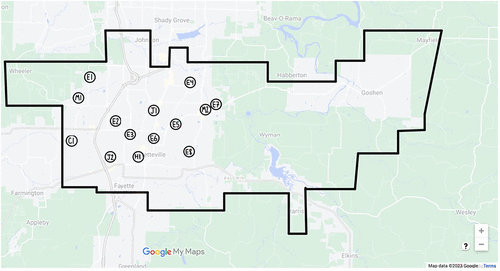
ORville is a thriving community that has seen tremendous growth in the last decade because of its strong local economy and reputation as a great place to live. ORville Public School District (ORPS) provides K–12 public education to ORville residents. The ORPS district is composed of eight elementary schools for grades kindergarten (K) to 4 (denoted E1–E8), two middle schools for grades 5 and 6 (denoted M1 and M2), one combined elementary/middle school for grades K–6 (denoted C1), two junior highs for grades 7 and 8 (denoted J1 and J2), and one high school for grades 9–12 (denoted H1). These 14 campuses serve over 10,000 students each academic year. Figure 1 depicts the boundaries of the ORPS district and the locations of its 14 campuses.
ORPS is highly regarded in the ORville community for providing a quality education that inspires and equips all students to achieve success in their learning and life endeavors. Population growth in the region and strong demand for an ORPS education have led to growing student enrollments. Accommodating this growth is a challenge for ORPS. When new campuses are needed, the process of acquiring land and building a new school takes years. The district must continually anticipate where in town enrollments will grow and monitor existing capacities against projected enrollments to ensure that capacity is in the right locations and at the right grade levels to meet demand.
Recently, ORPS required new capacity at the elementary and middle school levels. The district decided on a two-pronged approach for addressing this. The elementary capacity would be generated by converting the combined K–6 campus (C1) to an elementary school only (E9). This would create additional seats for students in grades K–4 on the west side of town near the converted E9. Simultaneously, ORPS would construct a new middle school on the west side of town (M3) near the location of the combined school (C1) where middle school seats would be removed. After these changes, ORPS would have nine elementary (E1–E9) and three middle (M1–M3) schools, with no configuration updates at the junior high and high school levels.
Construction on the new middle school is nearing completion. It will open in 12 months at the beginning of the next academic year. The conversion of the combined K–6 campus to K–4 only (from C1 to E9) will become effective at the same time. With these changes forthcoming, ORPS must revisit its school district zoning plan. Like in many public school districts, which campus a student attends in ORPS is determined by their grade level and residential address. Each residential address in the district is zoned for one school campus at each level (one elementary school, one middle school, one junior high school, and one high school). Generally speaking, residences in a neighborhood are zoned for the same school so that students living in a neighborhood together attend school together. Additionally, neighborhoods are zoned for nearby campuses. For example, the elementary school that a neighborhood is zoned for is often the elementary campus nearest to it.
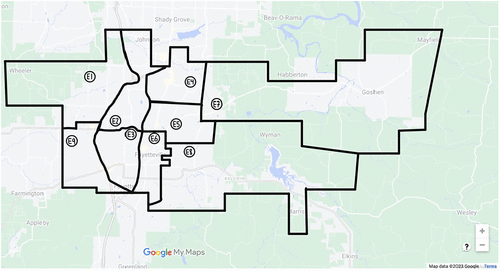
ORPS just finished working with a consulting firm on the elementary zoning plan depicted in Figure 2. Compared with the prior zoning plan, this revision reflects only small adjustments to zone boundaries for elementary schools in the western portion of the district, shifting a few neighborhoods out of zones for nearby elementary schools E1–E3 that are approaching capacity into the zone for the newly converted K–4 campus, E9. This plan is expected to receive enough positive votes from ORPS Board of Education members to be approved.
A new middle school zoning plan must still be determined. The three middle schools have the capacity to accommodate 800 students each. Pressures are rising to reduce enrollment at M2, which served 780 students in grades 5 and 6 in the last academic year compared with 500 students at M1 and 400 students at C1. Figure 3 depicts the locations of the three middle schools (M1–M3); the location of the prior combined school (C1); and the prior zoning plan for M1, M2, and the middle school portion of C1. The public has expressed a desire for changes to this zoning to be minimal. Clearly, neighborhoods previously zoned for C1 must be accommodated at one of the three current middle schools in the district, and one option would be to simply match the zone for M3 to the prior zone for C1. However, this zoning change by itself is not adequate to address the middle school capacity challenges district wide.
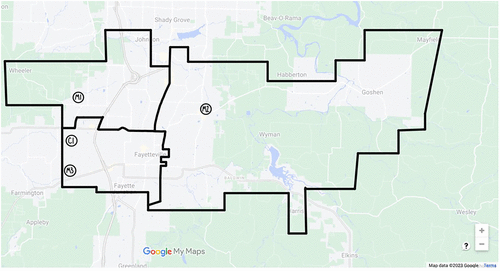
Note. The location of M3 is also shown.
2. Required Analysis
As a consultant for ORPS, your task is to create a recommendation for a middle school zoning plan. A solution to this zoning problem requires assigning all residential addresses in the district to one of three middle schools without violating those schools’ capacity limits uj. School capacity is measured in the number of students that the school can accommodate (uj = 800 students for j = 1, 2, 3). The three primary objectives are (1) continuity, (2) proximity, and (3) equity.
Because the ORPS Board of Education prioritizes cohort continuity so that students who attend elementary school together will stay together when they matriculate to middle school, middle school demand is aggregated at the elementary zone level. In a feasible zoning plan, all students from an elementary school must be assigned to the same middle school campus. Residential addresses in ORPS are already aggregated into zones that determine what elementary school a student will attend (see Figure 1). The size of the middle school cohort originating from each elementary zone, bi, is measured in the number of middle school students residing within elementary zone i and is given in Table 1.
|

Table 1. Sizes of Middle School Cohorts and Numbers of Economically Disadvantaged Students in the Middle School Cohort per Elementary Zone
| i | Elementary zone | Size of the middle school cohort originating from i (bi, no. of students) | Number of economically disadvantaged students in the middle school cohort originating from i (ci, no. of students) |
|---|---|---|---|
| 1 | E1 | 252 | 80 |
| 2 | E2 | 124 | 97 |
| 3 | E3 | 108 | 67 |
| 4 | E4 | 205 | 90 |
| 5 | E5 | 183 | 31 |
| 6 | E6 | 110 | 56 |
| 7 | E7 | 258 | 21 |
| 8 | E8 | 198 | 82 |
| 9 | E9 | 228 | 137 |
In addition to continuity, the ORPS Board of Education stated two additional priorities, proximity and equity, for considering alternative zoning solutions. Further details for these priorities are described below.
Proximity is achieved when students do not travel farther than necessary between their residence and the assigned middle school. The board measures proximity as the total enrollment-weighted distance (EWD) between elementary zones and their assigned middle schools. Using the elementary zone level of aggregation, all students in zone i are assumed to be located at the population-weighted centroid of i. Road distances hij between the population-weighted centroid for elementary zone i and middle school j are provided in Table 2.
|
Table 2. Distances hij Between Elementary Zone Population-Weighted Centroids and Middle Schools (Miles)
| i | Elementary zone | M1 (j = 1) | M2 (j = 2) | M3 (j = 3) |
|---|---|---|---|---|
| 1 | E1 | 0.2 | 7.4 | 3.7 |
| 2 | E2 | 3.1 | 4.8 | 6.3 |
| 3 | E3 | 4.9 | 6.3 | 2.5 |
| 4 | E4 | 6.3 | 3 | 9.5 |
| 5 | E5 | 5.8 | 1.4 | 6.7 |
| 6 | E6 | 5.6 | 3.9 | 4.1 |
| 7 | E7 | 10.7 | 2.9 | 11.2 |
| 8 | E8 | 12 | 4.5 | 7.4 |
| 9 | E9 | 2.7 | 7.7 | 1 |
Letting xij denote whether elementary i is assigned to middle school j (one if yes and zero if no), EWD is computed as
Equity in education is a multifaceted concept. In this case, the board chose to use the number of economically disadvantaged (ED) students assigned to each middle school to quantify the equity of a zoning solution. Specifically, the board wishes to minimize the difference between the maximum number of economically disadvantaged students assigned to any one middle school and the minimum number of economically disadvantaged students assigned to any one middle school. This measure is denoted Range#ED. The number of economically disadvantaged students in the middle school cohort originating from elementary zone i (out of bi) is denoted ci and is given in Table 1. Range#ED is computed as
Zoning plans with lower values of EWD and Range#ED are preferred. Your recommended solution should describe how the zoning plan you prescribe addresses these priorities.
3. Sample Feasible Solution
A feasible solution assigns each elementary zone to a middle school without exceeding the capacity of any middle school. The xij values in Table 3 indicate a feasible solution. The number of students assigned to each middle school and the number of economically disadvantaged students at each middle school are indicated in the bottom two rows in Table 3. The values of EWD and Range#ED for this solution are 8,996.2 miles and 230 students, respectively.
|
Table 3. Sample Feasible Solution (xij Values in Cells; One If i Is Assigned to j and Zero Otherwise)
| i | Elementary zone | M1 (j = 1) | M2 (j = 2) | M3 (j = 3) |
|---|---|---|---|---|
| 1 | E1 | 0 | 1 | 0 |
| 2 | E2 | 0 | 1 | 0 |
| 3 | E3 | 1 | 0 | 0 |
| 4 | E4 | 0 | 1 | 0 |
| 5 | E5 | 1 | 0 | 0 |
| 6 | E6 | 0 | 0 | 1 |
| 7 | E7 | 1 | 0 | 0 |
| 8 | E8 | 0 | 1 | 0 |
| 9 | E9 | 0 | 0 | 1 |
| Total no. of students assigned | 549 | 779 | 338 | |
| No. of ED students assigned | 119 | 349 | 193 | |