Case—Locating Fulfillment Centers for AmazingDeal.com
Introduction
It is the first day of a two-month summer internship in 2014 at AmazingDeal.com’s Bangalore office for Ratnesh Kumar. He is equally excited and nervous about the challenges that lie ahead in his first corporate experience. Ratnesh, a first-year MBA student at the Indian Institute of Management Ahmedabad (IIMA) in India, accepted the internship offer from AmazingDeal, preferring it to some of the bigger brands in the retail industry, to be a part of the phenomenal growth story of one of India’s fastest growing companies. He has been asked to report to Pallavi Palkar, an associate director (AD), who is currently in a meeting with the vice president (VP) of operations.
“Hello, I am Pallavi, welcome to AmazingDeal—India’s largest and fastest growing e-retailer,” greeted a lady in her early 30s. “You have joined AmazingDeal at an exciting moment. We have recently crossed $1 billion in sales by GMV (gross merchandise value) and now aim to achieve $10 billion by 2020. To achieve this, we have to provide an expansion plan for our fulfilment centers. Moreover, as competition is getting more intense, we need to expand our next day delivery (NDD) and same day delivery (SDD) services to more cities. Our marketing team has already done extensive research on the demand potential of various cities, based on various factors like internet penetration, mobile usage, credit card usage, population, literacy, and so on. They have finally listed 486 cities, which have been classified as Metros, Tier 1, Tier 2, and Tier 3 based on their demand potential and population. In such cities, the saving in transportation cost from opening a fulfillment center is greater than its operations cost. But we do not want to open a fulfillment center in each of these cities. We have budget constraints, and we want to cover these cities with the minimum number of fulfillment centers. You will assist me in this project, which needs to be completed and presented to the VP within two months. So, let us get started. Please collect all the information about this project that you need from our marketing and operations teams and let us meet again tomorrow.”
About the Company
AmazingDeal, a brainchild of Mr. Bhushan Yadav and Kulbhushan Yadav,1 revolutionized the shopping behavior of Indians and successfully shifted millions of users from brick-and-mortar stores to online shopping, which heralded the beginning of a whole new industry. It started in 2007 as an online portal to sell books with an initial investment of 500,000 Indian Rupees (INR). Soon, the company expanded its presence in a wide range of categories including electronics, appliances, furnishing, stationery, sports and fitness, fashion and apparel, and personal care. Growing at an unprecedented rate, the company reached $1 billion in sales (GMV) in 2014, less than seven years since its inception (Figure 1). This phenomenal growth helped AmazingDeal attract funds from various venture capitalists like Accel Partners, Tiger Global, Naspers, Iconiq Capital, and Morgan Stanley Wealth Management, among others. These funds also helped AmazingDeal make several significant acquisitions.
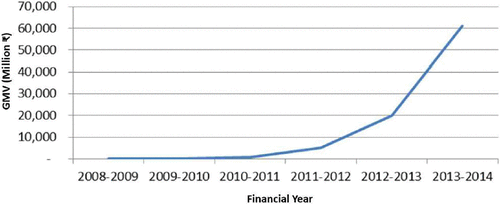
Notes. One U.S. dollar ($) ≈ 60 Indian Rupees (₹). Financial year (India): April 1 of a year to March 31 of the following year.
E-Commerce in India
E-commerce, although still nascent in the Indian market, is rapidly changing the competition. Internet penetration is increasing at an ever-growing rate in Tier II and Tier III cities, which is expected to give a boost to the e-commerce business. As per a recent report by Accel Partners, e-commerce in India is expected to reach from $2 billion in sales in 2013 to $8.5 billion in 2016, at a compound annual growth rate of 63%. In the same period, the number of online shoppers and the average order value are both expected to double, from 20 million and 1,800 INR to 40 million and 3,600 INR, respectively. This has prompted several traditional retailers like Croma, Future Group, and Arvind Group to expand into e-retailing to establish themselves in the e-commerce space. Flipkart is currently holding the top spot in the e-commerce market in India. However, it is facing intense competition from Amazon, which has recently made an investment of $2 billion in Indian operations, and Snapdeal, which has recently raised nearly $1 billion, largely from Japan’s Softbank.
AmazingDeal’s Business Model
AmazingDeal, like many other e-commerce sites in India, traditionally started as a pure e-retailer, with its own fulfillment centers from which products were shipped to the retail customers. Currently, AmazingDeal has four big fulfillment centers in Delhi, Mumbai, Kolkata, and Bangalore. All orders are processed by the nearest fulfillment center and sent to customers by road or air based on the type of delivery needed: standard delivery, NDD, and SDD (Table 1). NDD and SDD options earn AmazingDeal good premiums over the standard delivery. At the same time, they often require fulfillment by air mode, which is very expensive. Yet, NDD and SDD services allow AmazingDeal to carry perishable items in its catalog besides charging a premium for the expedited delivery.
|

Table 1. Typical Timelines in NDD and SDD
| Service | Delivery promise | Transport time |
|---|---|---|
| Standard delivery | 3–10 days (based on location) | 2–8 days |
| NDD | Maximum 24 hr | 8 hr |
| SDD | Maximum 12 hr | 3 hr |
Notes. Transport time left after different operations carried out for inbound and outbound activities. Speed of transportation is assumed to be 50 km/hr for NDD and 30–35 km/hr for SDD (because intracity traffic is considered in SDD as opposed to intercity traffic in NDD).
Most of the e-commerce sites in India, in an attempt to expand their product catalogs and reduce costs of operation, have gradually shifted to the “market place” model, allowing third-party business partners to list their products on their websites. AmazingDeal also joined the bandwagon with the announcement of its own marketplace in 2013. It currently has 50 sellers on board. The third-party sellers need to stock their products in AmazingDeal warehouses before the orders are placed to ensure quick deliveries, and the economy of scale of AmazingDeal can be utilized in term of packing and transporting shipments.
AmazingDeal’s Proposed Future Delivery Model
AmazingDeal’s vision is to achieve $10 billion in sales by 2020. As a part of this vision, it is planning to expand its NDD and SDD services beyond Metros and Tier 1 cities. In this model, the four main supply hubs (Delhi, Mumbai, Kolkata, and Bangalore), called “BIG FCs,” would procure all the goods. The goods procured would then be supplied to their respective forward fulfillment centers (FFCs), which would hold the inventory needed to cover their respective regions under SDD and NDD. This is in line with the global players like Amazon (United States) and JD (China), which have already decentralized their bigger warehouses into smaller warehouses to move closer to the customers. Amazon has around 65 FFCs in the United States, which are located in places with very high population and internet penetration. Similarly, JD has around 84 FFCs in China. This also enables them to provide expedited delivery for a premium. Moreover, moving closer to the customers has enabled them to add perishable items such as fruits and vegetable to their offerings.
AmazingDeal has identified the top 486 potential cities, based on factors like internet penetration, mobile usage, credit card, population, literacy, and so on, for expansion of its NDD and SDD services. It would like to locate its FFCs such that these cities are served under NDD and SDD options by road as opposed to the more expensive air mode. The document titled “Case Data” provides the list of cities along with their classifications and their demands or market potentials in the first sheet (“Cities, type, and demand pot.”).
Next Morning
Armed with the required background information about AmazingDeal and its current and proposed delivery models, Ratnesh met Pallavi. He also brought with him a spreadsheet (refer to the second sheet in the document titled “Case Data”) containing the distances for each pair of the 486 cities. These distances, which he had computed using the latitudes and longitudes of the cities available from Google Maps, were assumed to serve as proxies for the actual road distances.
“Good!” said Pallavi, “let us begin our analysis of the data and plan for the following:
Where should we locate six FFCs to capture the maximum market potential using (a) NDD service and (b) SDD service?
What is the minimum number of FFCs to be located and their locations so that we have NDD coverage for all the cities?
What is the minimum number of FFCs to be located so that AmazingDeal has NDD coverage for all the 486 cities + SDD coverage for the top 80% Metros, top 75% Tier 1 cities, and top 70% Tier 2 cities?
What is the minimum number of FFCs to be located so that AmazingDeal has NDD coverage for all the 486 cities + SDD coverage for 80% Metros, 75% Tier 1 cities, and 70% Tier 2 cities?
Assuming a transportation cost of 1 INR per unit demand per kilometer of distance between an FFC and a city, where should six FFCs be located so that the total transportation cost of serving all cities is minimized?
Note that NDD to a city is possible only from an FFC within eight hours by road (Table 1). Based on the average speed of 50 km/hr on intercity highways, this translates to a distance of 400 km. Similarly, SDD to a city is possible only from an FFC within three hours by road (100 km).”
1 The case is based on an actual situation but with company and founders’ names altered for confidentiality.