A Proposed Mathematical Optimization Approach for Undergraduate Teaching Assistant Selection and Tutorial Scheduling
Abstract
Many university courses, especially in science, technology, engineering, and mathematics (STEM) fields, include weekly tutorial sessions, offering students a more interactive and hands-on learning experience. They are taught by teaching assistants, with an increasing trend to consider undergraduate teaching assistants (UTAs). However, challenges hinder tutorial effectiveness. First, UTAs, who are also students, can only apply for teaching tutorials that fit their course schedules. The reduced list of courses that they can apply for may leave the best candidates aside, affecting the effectiveness of the tutorials. Second, as tutorials are not led by professors, they are often scheduled at inconvenient times, potentially increasing absenteeism. To enhance the learning experience of students in tutorial sessions, we propose an administrative framework for the course enrollment and UTA selection processes along with a mathematical optimization model for UTA assignment and tutorial scheduling. This framework allows prospective UTAs to apply for all courses that they want, streamlining the selection process, and the optimization model produces an optimal tutorial schedule that promotes student attendance. We tested our proposed approach on a real case study, resulting in significant improvements over the existing methods. The number of UTA applications increased by 35%, better UTAs were selected, and an improved tutorial schedule was obtained.
1. Introduction
Student engagement is fundamental for academic success as engaged students demonstrate better performance, higher retention rates, and greater satisfaction with their education (Deslauriers et al. 2011, Watkins and Mazur 2013, Freeman et al. 2014). Among the various active learning strategies employed to foster engagement, the use of teaching assistants (TAs) or peer teaching, where a student instructs one or more peers, stands out as a key methodology that has been in practice for decades (Evans and Cuffe 2009). In this approach, the participants, whether teachers or students, may occupy different educational levels—for instance, graduate students instructing undergraduates—or they may operate at the same level, such as more experienced students teaching less experienced ones who are studying the same curriculum. The latter scenario is commonly known as near-peer teaching, considered highly effective because the proximity between the knowledge possessed by the TAs and the information to be learned by the students is optimal for stimulating active questioning (Ten Cate and Durning 2007). It is noteworthy that near-peer teaching is also beneficial for peers acting as instructors, triggering a high level of information processing during both the preparation and delivery of the instructional material (Ten Cate and Durning 2007). Although near-peer teaching can informally take place outside the university setting, our focus is on formal TAs—students who formally instruct their peers as a mandatory component of a course, typically in a weekly session called a tutorial session. Despite that the majority of studies about peer teaching concentrate on graduate teaching assistants (GTAs), some research underscores that undergraduate teaching assistants (UTAs) might make an even more significant contribution to the learning process because of greater cognitive and social congruence (Ten Cate and Durning 2007). Additionally, the use of UTAs has been proposed as a solution to accommodate the increasing number of students enrolled in undergraduate programs (Wheeler et al. 2017). In certain cases, UTAs are the sole option for university departments lacking graduate programs.
However, the practical challenge facing the use of UTAs lies in their status as full-time students who must attend their own courses within a typically tight schedule. The stringent and sometimes limited availability of time for students aspiring to become UTAs results in restricted opportunities to apply for such positions. In our institution and in some others as well, course lectures and tutorials are scheduled each term before students enroll. This schedule must adhere to various institutional requirements and consider the preferences of professors and students, but it cannot account for the time slot availability of potential UTAs. In the authors’ department, 34% of students who applied for a UTA position during 2019 faced availability conflicts preventing them from applying as TAs for courses that they excelled in and wished to teach. This may impact the overall quality of the UTAs selection. Because of the relative inexperience of most UTAs (Guadagni et al. 2018), their personal motivation and content knowledge become crucial for an effective near-peer teaching experience. Therefore, any efforts to alleviate obstacles hindering their application for preferred tutorial positions are desirable.
Although tutorial sessions are integral to students’ learning processes, at least in our institution, they are often scheduled in less desirable time slots, such as very early or late in the day. This scheduling issue arises because tutorials are conducted by students, and as such, no consideration is given to time preferences when scheduling. Poorly scheduled tutorials may lead to high rates of student nonattendance, posing a threat to the effectiveness of active learning strategies (Arulampalam et al. 2012, Desalegn et al. 2014, López-Bonilla and López-Bonilla 2015).
In this study, we aim to improve the effectiveness of the near-peer teaching strategy commonly utilized by universities when employing UTAs to lead tutorial sessions. We address two key issues outlined previously: schedule conflicts that deter potential UTAs from applying for teaching positions in their desired courses and deficiencies in the scheduling of tutorial sessions, which may contribute to higher rates of student absenteeism. Our study poses two primary research questions. (i) How can we encourage the participation and selection of top candidates in the UTA application process? (ii) How can we enhance student attendance at tutorial sessions? To address these inquiries, we employed both qualitative and quantitative approaches. We propose a new administrative framework allowing prospective UTAs to apply for all desired teaching positions, and we developed a decision-making methodology to facilitate the assignment of the most suitable UTAs to each course while optimizing the tutorial session schedule. Although not formally implemented, we evaluated our proposed approach by comparing it with the current practices prevalent in most universities through a real case study, outlining both the advantages and challenges associated with adopting the proposed framework.
Although our study focuses on administrative processes rather than classroom activities, we believe that it offers meaningful insights for operations research and management science (ORMS) educators. By improving the way that UTAs are selected and tutorials are scheduled, the proposed approach helps create better conditions for student learning. This is especially relevant in STEM fields, where tutorials often play an important role in keeping students engaged. We encourage educators to look beyond what happens inside the classroom and consider how institutional decisions can also support better teaching and learning. This perspective may inspire instructors to bring real challenges from their own universities into ORMS courses, helping students connect models with familiar problems. Notably, this study started after observing student frustration with tutorial scheduling and UTA selection processes. What began as a course project where students built an initial version of the model evolved into a much more comprehensive study. This experience demonstrated that real institutional problems effectively help students learn operations research concepts.
2. Literature Review
2.1. Enhancing the Effectivity of Teaching Assistants
The substantial evidence supporting the advantages of employing TAs (Evans and Cuffe 2009, Hall et al. 2014, Nguyen et al. 2021) has prompted numerous studies aimed at enhancing their pedagogical application. Many of these studies have explored training programs aimed at equipping TAs with pedagogical skills for effective teaching (Gardner and Jones 2011, Philipp et al. 2016, Fong et al. 2019). However, most research focuses on GTAs as teaching is often part of their academic training (Judson and Leingang 2016). In contrast, there is little research on training for UTAs, despite their growing role in higher education (Hogan et al. 2007, Filz and Gurung 2012).
Another less explored avenue of research concerns the selection of TAs and their assignment to specific courses. These decisions are pivotal for improving the quality of the teaching and learning experience in tutorial sessions. Prospective TAs apply for the courses that they want to teach, and a selection mechanism can be required to allocate a TA to each course. In our institution, UTA candidates apply through a centralized selection system that ensures a standardized process. Although the problem of matching TA candidates with courses may appear straightforward, this type of assignment problem is recognized to be challenging when aiming for a high-quality solution (Caselli et al. 2022). Despite the crucial role that this stage plays in shaping the overall near-peer experience, it is predominantly carried out manually (da Cunha and de Souza 2018, Caselli et al. 2022), often disregarding the difficulties associated with finding the optimal assignment. To address these difficulties, tools have been employed to assist in the process of assigning TAs to courses (Lim et al. 2004, Güler et al. 2015, Qu et al. 2017). These tools predominantly consist of mixed integer programming models aiming to determine the best TAs’ appointments based on one or multiple criteria.
Derived from the extensively explored faculty-course assignment problem in the literature, the TA assignment problem has received less attention and presents slight variations. Typically, it involves ensuring a relatively equitable distribution of academic and administrative responsibilities among TAs, accommodating professors’ preferences for specific TAs, and facilitating the rotation of graduate students acting as TAs across various courses over time (Güler et al. 2015). In the TAs assignment problem, where teaching assistant candidates must be allocated to one or more prescheduled tutorial sessions, decision models consider the qualifications and preferences of candidates, aiming to identify the best TA-course combinations while accounting for candidates’ availability and TA workload (Güler et al. 2015, Qu et al. 2017). Given that a single objective is difficult to identify, decision-making tools often integrate various planning objectives within a multiobjective framework. Apart from TA preferences, ensuring a balanced workload and minimizing income deviations among TAs are commonly pursued objectives (Lim et al. 2004, Güler et al. 2015, Qu et al. 2017).
Although existing research on decision-making tools for TA selection predominantly concentrates on GTAs, the assignment of UTAs presents unique considerations deserving attention. Although graduate students may work as TAs for various reasons, including fulfilling academic training requirements, financial support, or at the request of their advisors, undergraduate students can have different motivations. In our experience, many UTAs apply because they enjoy a subject that they performed well in and want to deepen their understanding of it, suggesting that personal motivation may play a more significant role in their decision, although they may also be motivated by other factors, such as gaining teaching experience or financial reasons. Although some GTAs also attend courses while working as TAs, this is a universal constraint for UTAs as all of them must balance their teaching responsibilities with their own academic schedules. Many of their courses include tutorial sessions, meaning that they cannot be assigned to teach a tutorial at the same time as one of their lectures or tutorials. The fact that most undergraduate students typically have demanding schedules may significantly diminish the likelihood of selecting strong UTA candidates for the most suitable tutorial sessions that they can teach, undermining the effectivity of these sessions and consequently, the quality of the students’ learning experience. Therefore, the scheduling of tutorial sessions represents another administrative issue that can impact the effectiveness of employing UTAs as a pedagogical approach.
2.2. Promoting Student Attendance
Student attendance is a fundamental aspect of the university experience, and it has shown to be positively and significantly related to academic performance (Wadesango and Severino 2011, Lukkarinen et al. 2016, Khan 2022). Attending lectures and tutorial sessions not only facilitates learning but also fosters engagement, collaboration, and critical thinking among students. However, despite its significance, student attendance remains a persistent challenge in higher education institutions (Massingham and Herrington 2006).
Several factors contribute to student absenteeism, ranging from personal reasons to systemic issues within the university. Within the latter, the quality, style, and format of lectures; the lack of mandatory attendance or grading for attendance; and inconvenient class timing for lectures are the most common reasons for nonattendance (Moores et al. 2019, Sloan et al. 2019). The scheduling of lectures and tutorial sessions at inconvenient times has been mentioned as a potential factor for students not attending classes. For example, considering that other factors are also involved, attendance to a class in the early afternoon was 70% but only 7% at 6.30 p.m. on the same day, with Thursday evenings and Friday afternoons identified as particularly unpopular times (Massingham and Herrington 2006, Swanepoel et al. 2021). The presence of time windows or gaps between lectures or activities may also influence attendance behavior. According to Kirby-Hawkins (2018), whereas around 20% of students feel that the gap between activities does not impact their attendance, nearly 80% of them exhibit varying thresholds of gap tolerance that do impact their attendance.
Although personal reasons for absenteeism may lie beyond the control of institutions, implementing attendance policies, fostering interactive lectures, incorporating graded in-class activities, and carefully planning timetables have been proposed measures to promote attendance (Alija 2013, Moores et al. 2019, Sloan et al. 2019, Swanepoel et al. 2021). The administrative task of timetabling is complex, and decision-making tools have been developed to address it. Although these tools may vary based on specific educational institution, they typically address issues such as timetable compactness, course conflicts for students, and preferences of both students and professors. Common minimal requirements for resulting timetables include limitations imposed by room availability, weekly hours required for each course, and avoidance of time conflicts among courses and professors (Birbas et al. 2009). Additional considerations, such as symmetry in the time slots across different days, lecture frequency, and balance in course section enrollment, have also been explored (Palma and Bornhardt 2020). The utility of these models has been extensively documented as they produce suitable and convenient schedules that are difficult to design manually.
3. Methods
3.1. Context and Problem Description
The study was conducted at a campus of the faculty of engineering of a private university with about 600 undergraduate students and no graduate programs. In our institution, like in other universities employing the near-peer teaching model, some courses feature a weekly tutorial session led by a UTA. Prior to student enrollment, all course lectures and tutorial sessions are scheduled, following practices similar to those reported in other institutions across different countries (Lindahl et al. 2018, Palma and Bornhardt 2020, Colajanni and Daniele 2021). Following enrollment, prospective UTAs are allotted certain free time slots to apply for TA positions in courses of their interest. Unfortunately, they often find themselves restricted to applying for courses where their availability aligns with the scheduled tutorial sessions. From the data collected for this study, approximately one third of prospective UTAs are unable to apply for courses in which they excel because of time conflicts, potentially excluding top candidates from the selection process.
Similar application processes are found at other institutions. For instance, in some departments at the University of Minnesota, applicants provide their grades, provide available schedules, and specify preferences when applying for multiple UTA positions, whereas at George Mason University, applicants submit their grades and available schedules for UTA selection (George Mason University Department of Computer Science 2024, University of Minnesota 2025). In our institution, applicants for teaching assistantships provide their grades in the course that they are applying for and if applying for multiple positions, also specify their preferences for each course. An academic coordinator manually assigns UTAs to tutorials based on these applications, sometimes needing to adhere to administrative regulations. For instance, our department stipulates that no UTA may be assigned to more than two tutorials unless unavoidable. However, because of time conflicts and a reduced number of applications received, some UTAs have been assigned more than two tutorials in certain terms.
3.2. Proposed Approach
We identified several issues within the UTA application and selection process and the tutorial session scheduling. First, tutorials are scheduled prior to prospective UTAs registering for their courses, limiting their ability to apply for teaching positions based on their expertise and preferences rather than solely on availability. Second, given that tutorials are conducted by UTAs rather than professors, no time requirements are considered when scheduled, potentially resulting in higher rates of absenteeism. Third, the manual assignment of UTAs to tutorials overlooks the inherent complexity of optimizing this process. Our proposed approach addresses these challenges as described in the subsequent sections.
3.2.1. Overview of the Proposed Approach.
In formulating a plan to address the problem, we drew upon ideas from the frame analysis approach originally suggested by Goffman (1974) as a methodological means to structure the understanding and interpretation of reality. Although primarily utilized in sociology, this approach has also found applications in areas such as policymaking, education, and management (Coburn 2006, Cornelissen and Werner 2014). The framing process involves selecting and focusing on certain aspects of the problems while omitting others, thereby simplifying them and facilitating the solution generation. Two types of problem frames, diagnostic and prognostic, have been identified and extensively used (Benford and Snow 2000, Coburn 2006), and they represent an organized way to tackle a problem. Diagnostic framing entails defining problems and attributing blame, focusing attention on specific aspects of the problem. Conversely, prognostic framing involves articulating proposed solutions to the problem, setting particular goals, and suggesting tactics for achieving those goals. Table 1 shows the results of the diagnostic and prognostic frames together, considering the relationship between problems and solutions and jointly examining the detected problems and the corresponding proposed solutions and methods to attain them.
|

Table 1. Diagnostic and Prognostic Frames for Evaluating the Use of UTAs
| Diagnostic framing (problems) | Prognostic framing (solutions) |
|---|---|
| 1. Prospective UTAs only apply for teaching in tutorials scheduled in their free time after enrollment in courses as students | 1. Schedule tutorials after UTAs have enrolled in their courses, allowing prospective UTAs to apply for teaching in all tutorials that they want |
| 2. Tutorials may be poorly scheduled, leading to potentially increased absent rates | 2. Use the postenrollment information to schedule tutorials in a manner that encourages student attendance |
| 3. Despite the acknowledged complexity of the task, UTA selection is carried out manually | 3. Use an objective and effective mechanism for selecting UTAs |
Our proposed framework addresses the three problems presented in Table 1. Figure 1 shows a comparison between a traditional framework and the proposed framework for the UTA selection process. The star symbol in Figure 1 highlights the differences between both approaches.
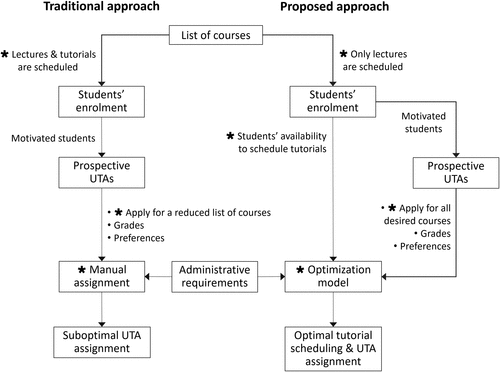
In contrast to traditional approaches, where both lectures and tutorial sessions are scheduled before prospective UTAs apply for teaching positions, our approach involves scheduling only lectures, leaving tutorials without assigned day/time slots. In this setup, prospective UTAs are able to apply for teaching positions across all tutorials without encountering time conflicts. Given that tutorials are scheduled within the time slots designated for the coursework, students enrolling in a class are aware of the time frame in which tutorials can be scheduled, ensuring that the approach does not create unexpected scheduling conflicts for them.
3.2.2. Use of Postenrollment Information to Schedule Tutorials.
Traditionally, there are no preferences to schedule tutorial sessions in convenient time slots because they are not taught by instructors or professors. It is, therefore, common that tutorials are scheduled early in the morning or very late in the day, becoming one of the factors that lead to higher absence rates than those observed in lectures (Kirby and McElroy 2003, Kottasz 2005).
Because in the proposed framework, tutorials are scheduled after the students have enrolled in their courses, we may use the postenrollment information to schedule tutorial sessions in a way that favors student attendance. For doing so, we proposed a quantitative indicator that allows us to compare the convenience of allocating each tutorial to different time slots in the week.
Based on the enrollment in each course and on the list of courses in which each student is registered, we know the number of students attending any lecture at any time. As an example, Table 2 shows the number of students enrolled in one of the courses, Linear Algebra–S2 (Section 2), who are in a lecture at any time during the week.
|
Table 2. The Number of Students Enrolled in Linear Algebra–S2 Who Are Attending a Lecture Allows Us to Identify Those Time Slots When More Students Are Expected to Be on Campus
| Time slot | Day of the week | ||||
|---|---|---|---|---|---|
| Monday | Tuesday | Wednesday | Thursday | Friday | |
| H1 | 44 | 6 | 5 | 5 | 7 |
| H2 | 36 | 44 | 0 | 34 | 15 |
| H3 | 10 | 6 | 44 | 8 | 10 |
| H4 | 29 | 0 | 0 | 0 | 0 |
| H5 | 35 | 26 | 27 | 17 | 7 |
| H6 | 24 | 21 | 22 | 6 | 25 |
| H7 | 11 | 6 | 2 | 2 | 0 |
| H8 | 13 | 4 | 2 | 2 | 0 |
| H9 | 0 | 0 | 0 | 0 | 0 |
Each day is divided into nine 80-minute time slots separated by 10-minute breaks. The first block (H1) starts at 8:00, and the last one finishes at 21:20 (H9). On Mondays, Tuesdays, and Wednesdays at H1, H2, and H3, respectively, 44 students are having a lecture. These lectures correspond to the course under analysis (Linear Algebra–S2), so 44 students are enrolled in it. Thirty-six of these students are also having a lecture, of other courses, on Monday at H2 and so on. No students are in class Tuesday through Friday at H4 because those time slots are blocked for interdisciplinary university activities.
The information in Table 2 can be used to calculate the number of students enrolled in a course (in this example, Linear Algebra–S2) who are in a lecture before and after a given time slot. We used this number as an indicator of the convenience of scheduling a tutorial in each time slot. For example, although Friday H7 and Friday H8 are both available to schedule the tutorial of Linear Algebra–S2 because none of the enrolled students have time conflict with another course, H7 should be preferred because 25 students of Linear Algebra–S2 are in other classes in H6 and should be on campus. Scheduling the tutorial in H8 would produce a free time spot (H7) that may induce students to leave the campus (as an anecdotal fact, the tutorial session for this course was originally scheduled in H8). Another good option to schedule the Linear Algebra–S2 tutorial would be Wednesday at H2 because all of the students need to be on campus because of the lecture in H3. This indicator must be calculated for all time slots and courses, and it can then be utilized to schedule tutorials in a manner that encourages student attendance. The higher the value of this indicator, the more favorable it is to schedule the tutorial session in a particular time slot.
3.2.3. Use of an Objective and Effective Mechanism for Selecting UTAs.
To effectively use the information obtained from the student enrollment and UTA application stages as per the suggested approach, we formulated an optimization model as an objective and efficient tool to support the decision-making process and ensure optimal utilization of UTAs. Such a model should concurrently schedule tutorial sessions and select their corresponding UTAs while adhering to all practical requirements.
We represented the problem as a linear optimization model with binary decision variables. The UTA applicants are identified with index i, whereas the courses and time slots are represented by j and t, respectively. The main decision variable, , will take a value of one if the applicant i is assigned to teach the tutorial of course j in time slot t. It will take a value of zero otherwise. It is important to note that this decision variable not only schedules the tutorials but also assigns a UTA to each of them. We will use an additional variable to account for the number of tutorials assigned to applicant i over a predefined threshold to limit the UTAs workload. To consider the room availability, we will refer to the room types as r and to the different room sizes as s. The following is the set of constraints that define the model.
Each course j must be assigned a UTA:
A UTA can only be assigned to a course j during a time slot t if both the UTA and the students enrolled in the course are available. To enforce this constraint, we defined the binary parameter to a value of one if applicant i and students of the course j are available during time slot t and zero otherwise:
The tutorials of courses j and cannot be scheduled at the same time when they have students in common. To implement this relationship, we defined the binary parameter to a value of one if the tutorials of courses j and cannot be scheduled at the same time slot and zero otherwise. These constraints, therefore, apply only to pairs of courses where , avoiding that both assignment variables take a value of one simultaneously at the same time slot:
In any given time slot, a UTA cannot be allocated to teach a tutorial if they are required to attend a tutorial as a student simultaneously. If represents the set of courses that UTA applicant i must attend as student and represents the set of courses that applicant i is applying to be the TA for, we formulated the following constraint:
It is important to consider the availability of rooms for the proposed schedule. Rooms were classified by type (e.g., standard classroom or computation laboratory) and size. The following constraint restricts the number of tutorials that can be assigned in a time slot t to the number of available classrooms of type r and size s. Room availability depends on the lectures scheduled at each time; thus, we defined as the number of rooms of type r and size s available at time slot t. The type and size of the room required for the tutorial of course j are represented by and , respectively. It is assumed in this constraint that a tutorial can utilize a room larger than the minimum size required:
To account for the number of tutorials assigned to a UTA applicant i over a threshold , we use the following equation. Based on our department policy, we use , which means that any excess over two in the number of tutorials assigned to a UTA will be stored in variable :
Finally, the nature of the decision variables is set:
The proposed model takes into account the following four objectives or criteria to determine the optimal decision.
3.2.3.1. Quality of the Tutorial Scheduling.
We considered the quality of a time slot for scheduling a tutorial as the total number of students who have lectures immediately before and/or after that time slot. That is, if a student has lectures both before and after the time slot, they are counted twice, and if they have a lecture only before or only after, they are counted once. However, the calculation considers only the total number of students in these adjacent time slots without tracking individual enrollments. We defined as the number of students of course j who have classes in the time slots t − 1 and t + 1. For example, for Linear Algebra–S2 (Table 2), the value of F for H2 on Wednesday is 49. For H7 and H8 on Friday, the values of F are 25 and 0, respectively. The higher F is, the higher the quality is of using a time slot to schedule a tutorial. The total quality of the final scheduling can be computed as
3.2.3.2. UTA Preferences for Teaching a Tutorial.
This objective considers that UTA applicants might prefer to teach certain courses over others. In our institution, when applicants apply for a position, they also rank up to four courses in order of priority. For this study, the course ranked highest was assigned a preference value of 1, the second was assigned a preference value of 0.75, the third was assigned a preference value of 0.5, and the fourth was assigned a preference value of 0.25. With this approach, the closer a preference value is to one, the better the alignment is between the assignment and the applicant’s preferences. When represents the preference of applicant i to teach the tutorial of course j, we computed the total preference of all UTA assignments () as
3.2.3.3. Average Grade of the UTA Assigned to Each Tutorial.
This objective aims to assign UTAs with the best-possible grades to the tutorials. When is the grade that applicant i obtained in course j, the total grade of all UTAs assignments () is computed as
3.2.3.4. Number of Tutorials Assigned to a UTA Above a Threshold.
In our department, the maximum workload allocated to a UTA is two tutorials. This policy has been consistently applied over the past years, with exceptional cases resulting in more tutorials being assigned to the same UTA. Typically, this occurs because of insufficient applicants for certain tutorials or conflicts between the assigned tutorial time slot and the availability of UTAs willing to teach them. The total number of tutorials assigned beyond the threshold () is computed as follows using the decision variable as previously described:
We combined the four objectives previously described using a weighted sum of normalized objectives, a widely used approach because of its simplicity and computational efficiency (Jiao et al. 2014, Nagy et al. 2020, Palma and Bornhardt 2020). Although methods such as the epsilon-constrained approach can generate the Pareto frontier, which may not be necessary in this type of problem, they require solving multiple optimization problems and become increasingly complex as the number of objectives grows. The weighted sum method addresses this by running the model once for a selected set of weights after determining the ideal and nadir values of each objective through separate optimizations. Besides the possibility of varying the importance of the different objectives, this method prevents issues that come up with the different magnitudes and measure units of the objectives. When and represent the best and worst values observed of objective , respectively, with both obtained from a payoff matrix and is the preference of objective k, the combined objective was
4. Results and Discussion
We compared the traditional and proposed approaches using data from the second semester of 2019, during which 46 tutorials were scheduled and their respective UTAs were selected. The scheduling considered 45 time slots across the week and five types of rooms suitable for tutorials. For our study, students who applied for UTA positions were asked which other courses they would have applied to, assuming no schedule conflicts, as allowed by the proposed approach. This resulted in 65 applications, whereas under the traditional approach, only 49 of these would have been viable because of time conflicts. In other words, the same semester was planned using both approaches and the same application process, leading to a full set of applicant-course combinations under the proposed approach and a restricted subset of combinations under the traditional approach. From a mathematical standpoint, the model comprised 101,528 variables (mostly binaries) and 197,059 constraints.
To implement the objective function (Equation (13)), each of the four objectives was optimized independently to determine the maximum (ideal solution) and minimum (nadir solution) achievable levels for each objective (Table 3). For instance, when only the schedule’s quality was optimized, the schedule of tutorials scored 1,297 (its maximum value as it was maximized), whereas the scores for other objectives were not the best possible. The score for UTA preferences was 0.89, although its maximum possible value was 0.99 (when preferences are maximized). As for the quality of the schedule, we obtained from Table 3 that and .
|
Table 3. The Ideal and Nadir Solutions for Each Objective Were Identified After Optimizing Each Objective Independently
| Objective optimized | Level of objective | |||
|---|---|---|---|---|
| Quality of schedule | UTA preferences | UTA grades | UTA workload | |
| Quality of schedule | 1,297 | 0.89 | 5.5 | 0 |
| TA preferences | 1,275 | 0.99 | 5.4 | 0 |
| TA grades | 1,225 | 0.89 | 5.6 | 4 |
| TA workload | 1,297 | 0.89 | 5.5 | 0 |
The full model was solved using optimization software, assuming without loss of generality that all objectives were equally important: that is, as a practical simplification. Although solutions can vary depending on the weights, this flexibility aligns with the purpose of prioritizing objectives, whereas the framework itself remains functional and adaptable. To compare our approach, the manual solution generated by an academic coordinator using the traditional framework after extensive hours of work was utilized (Table 4). We note that the values of the weighted sums of the objectives are not reported in Table 4 as their numerical values lack intrinsic meaning. Instead, we report on the individual levels achieved for each objective, which better demonstrate the benefits of the proposed approach. Apart from the workload of the selected UTAs, for which no excessive workload was observed in either the traditional or proposed approaches, the later demonstrated superior performance compared with the current method of UTA selection.
|
Table 4. The Proposed Approach to Schedule Tutorials and Select UTAs Outperformed the Traditional Approach
| Approach | Level of objective | |||
|---|---|---|---|---|
| Quality of schedule | UTA preferences | UTA grades | UTA workload | |
| Traditional | 353 | 0.83 | 5.6 | 0 |
| Proposed | 1,274 | 0.95 | 5.7 | 0 |
The major improvement was observed in the quality of the schedule of tutorials. Although the time slot indicator reported a total value of 353 units for the traditional approach, the value of the indicator obtained by the proposed approach was 1,274.
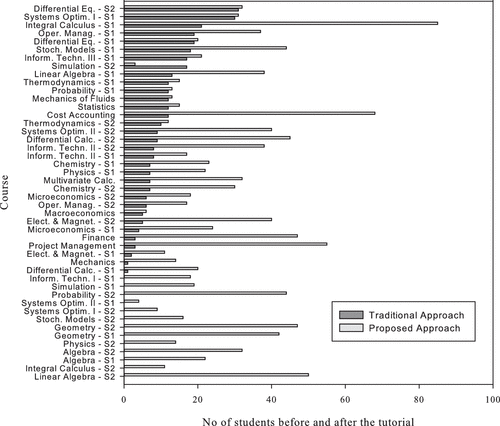
Figure 2 illustrates the total number of students attending classes before and after the tutorial for each course scheduled using both the traditional and proposed approaches. It is noteworthy that under the traditional approach, in 13 courses, no students had classes immediately before or after the scheduled tutorial, creating time windows that may affect attendance behavior. However, with the exception of one course (Simulation–S2), our approach significantly enhanced what we consider the quality of tutorial scheduling. The 260% improvement in this indicator can be attributed to the fact that the pre-enrollment scheduling of tutorials in the traditional approach does not account for student registrations in each course, resulting in uncertainty regarding the scheduling implications. Moreover, because there are no specific requirements for tutorial scheduling, they are often allocated to undesirable time slots, which may favor student absenteeism. In our approach, we introduced a simple yet effective indicator to assess the suitability of time slots for more convenient scheduling, which we utilized during the search for an optimal solution. As reported in other studies (Birbas et al. 2009, Strichman 2017), the use of an optimization model resulted in a markedly improved schedule.
Although the preferences and grades of UTAs assigned to each tutorial are the primary criteria in the traditional approach, the proposed method managed to enhance both indicators. On a preference scale from zero to one, the average UTA-tutorial assignment preference increased from 0.83 to 0.95 (a 14% improvement), which can be potentially linked to the selection of more intrinsically motivated UTAs. This higher level of motivation among UTAs can lead to more effective feedback for students (Rodgers et al. 2014), thereby enhancing the overall learning experience. In addition, the average grade of selected UTAs rose from 5.6 to 5.7 (on a 1–7 scale) with the proposed approach. The improvement in these indicators stems from the fact that the traditional process is done manually, disregarding the challenge of solving assignment and scheduling problems efficiently simultaneously (Sørensen and Dahms 2014, Caselli et al. 2022). The increase in UTA preferences for different tutorials aligns with findings in the existing literature (Caselli et al. 2022), underscoring the recommendation to employ mathematical models to tackle such problems.
None of the approaches ultimately allocated more than two tutorials to any single UTA. In our analyzed case study, the number of applications received in the traditional selection process (49) adequately filled the UTA positions without necessitating more than two tutorials per applicant. However, in other semesters, meeting this criterion may be more challenging. The optimization model includes built-in flexibility to assign more than two tutorials to UTAs when necessary through a soft constraint that minimizes but allows workload beyond a threshold. In cases where additional measures are needed because of insufficient UTA applications or severe scheduling conflicts, some recourse strategies can be followed, such as issuing additional calls for UTA applications, including targeted invitations to high-performing students from previous semesters, or rescheduling lectures to create more favorable time slots for tutorial scheduling. These recourse options may help in finding a workable solution even when initial constraints cannot be met.
To better understand the impact of the optimization model versus the expanded pool of applications, we also applied the model to the original pool of 49 applications. Applying the optimization model alone significantly improved the quality of the schedule from the original 353 to 1,025, showing that the remaining increase to 1,274 is because of the increased number of applications. Similarly, the UTA preferences increased from 0.83 to 0.91 by the sole application of the model. Both UTA grades and workload remain the same as in the traditional approach, suggesting that their improvement may be mainly because of the expanded possibility of applications. These results suggest that the optimization model is the main factor driving improvements in scheduling quality, but a larger applicant pool also plays a role by allowing better matches between UTAs and tutorials. Although these findings are specific to the analyzed semester, they provide insight into the relative impact of each component of the proposed approach.
The incorporation of a decision-making tool in the proposed approach enables us to make significantly better decisions compared with those derived from a traditional process. Furthermore, scheduling tutorials after enrollment offers the advantage of attracting more UTA applications by eliminating the time conflicts faced by prospective UTAs when tutorials are already scheduled. In our case study, the proposed approach elicited 65 applications, whereas the traditional approach only yielded 49. This aspect of the proposed process, regardless of the decision-making model’s usage, expands the available options for making a superior UTA selection and facilitates compliance with all requirements. The decision-making tool also allows for flexibility in adjusting the importance of each objective or even eliminating certain objectives by modifying the objective weights. Weight usage enables decision makers to assess various potential solutions before implementing the final decision.
5. Conclusions
To promote better selection and maximize the effectiveness of UTAs in tutorial sessions, we addressed two research questions. (i) How can we encourage the participation and selection of top candidates in the UTA application process? (ii) How can we enhance student attendance at tutorial sessions? First, we proposed an approach where tutorial sessions are scheduled after students enroll in their courses, allowing prospective UTAs to apply for teaching across all courses of interest rather than being restricted to those aligning with their availability as in the traditional approach. This change enables the participation of the best candidates in the UTA selection process. In our case, the number of applications increased by 35%. Second, the enrollment process under the proposed approach provides valuable insights for scheduling tutorials in a manner that encourages attendance. To achieve this, we introduced a novel indicator assessing the convenience of scheduling tutorials at specific time slots, using it to optimize tutorial scheduling. Compared with the traditional (manual) approach, this indicator improved by 260% with the proposed method. In addition to proposing a new administrative framework for tutorial enrollment, we proposed an objective and effective tool to help in finding the best-possible selection of UTAs. Given our proposed approach, this tool allowed us to simultaneously schedule the tutorials to promote student attendance. The solutions derived from our proposed approach consistently outperformed those obtained using the traditional method, aligning with findings from other studies applying decision-making tools in educational administration (MirHassani 2006, Birbas et al. 2009, Palma and Bornhardt 2020). Our approach offers academic planners a broader pool of applicants for selecting UTAs and the flexibility to schedule tutorials according to various requirements.
To address the complexity of scheduling tutorials and achieve optimal solutions, we introduced a multiobjective optimization model, an approach commonly used in educational contexts. We defined four objectives: minimizing UTA workload excess, maximizing UTA preferences and grades, and enhancing tutorial scheduling quality. Although workload, grades, and preferences are established objectives in the literature (Lim et al. 2004), we introduced a novel indicator for scheduling quality: the number of students attending classes before and after a tutorial’s time slot. Incorporated into our model’s objective function, this indicator promotes more efficient scheduling by reducing gaps between tutorials.
Our findings underline the value of this work for ORMS educators. It shows how strategic decisions about resource allocation and scheduling can improve student learning environments, which is often an overlooked aspect of educational quality. Although the model was not created specifically for teaching, it can be used in the classroom to introduce topics such as multiobjective optimization, constraint modeling, and trade-off analysis, all in a context that students already know well. This makes the study both a useful tool for improving institutional practices and a relatable example for teaching core ORMS ideas.
The proposed approach can be adaptable to other educational institutions where the selection of teaching assistants and the scheduling of tutorials are necessary. However, it faces two important limitations. First, it requires scheduling tutorial sessions after students have enrolled in their courses, which differs from the common practice of scheduling tutorials prior to enrollment. Implementing such a change may require substantial administrative adjustments that vary in complexity across institutions. Second, our approach assumes a centralized system for selecting UTAs as used in our institution, where candidates apply through a unified process rather than being independently selected by the professors as is common in some universities. As institutions increasingly seek standardized, more transparent, and streamlined administrative processes, centralized selection systems may gain broader adoption and make our approach more applicable. Despite these limitations, the potential benefits of our approach may encourage institutions to reconsider some traditional practices and explore new ways to improve the effectiveness of tutorials.
For institutions interested in applying this approach, having a centralized application system for UTAs is essential. A single platform where candidates can apply to multiple courses helps gather consistent information on preferences, availability, and academic background, and it makes it easier to coordinate the selection process. Another important aspect is how tutorial times are handled during course enrollment. If tutorials are not scheduled yet, students should be clearly informed that some time blocks are reserved for sessions that will be assigned later. This helps set expectations and avoids scheduling conflicts. Most of the data needed to run the model can be collected automatically through the same application system, which reduces the administrative workload.
Because the proposed approach has not yet been implemented in practice, future research should focus on evaluating its actual impact, particularly in terms of student attendance and tutorial quality. This type of evaluation is not straightforward as both scheduling approaches cannot be applied simultaneously. Designing an appropriate study to compare their effects would be a key challenge. In addition, future research should investigate additional indicators for assessing the quality of tutorial scheduling and explore the possibility of consolidating students from different sections of a course into shared practical sessions. This approach could offer greater flexibility in scheduling practical sessions and assigning UTAs, potentially improving the overall efficiency of the system.
We thank the two reviewers and the associate editor for their thoughtful and detailed feedback. Their insights helped us see aspects that we had not considered and led to meaningful improvements in both the analysis and clarity of the manuscript.
References
- (2013) How attendance affects the general success of the student. Internat. J. Acad. Res. Bus. Soc. Sci. 3(1):286–301.Google Scholar
- (2012) Am I missing something? The effects of absence from class on student performance. Econom. Ed. Rev. 31(4):363–375.Crossref, Google Scholar
- (2000) Framing processes and social movements: An overview and assessment. Annual Rev. Sociol. 26(1):611–639.Crossref, Google Scholar
- (2009) School timetabling for quality student and teacher schedules. J. Scheduling 12(2):177–197.Crossref, Google Scholar
- (2022) Integer linear programming for the tutor allocation problem: A practical case in a British university. Expert Systems Appl. 187:115967.Crossref, Google Scholar
- (2006) Framing the problem of reading instruction: Using frame analysis to uncover the microprocesses of policy implementation. Amer. Educational Res. J. 43(3):343–349.Crossref, Google Scholar
- (2021) A new model for curriculum-based university course timetabling. Optim. Lett. 15(5):1601–1616.Crossref, Google Scholar
- (2014) Putting framing in perspective: A review of framing and frame analysis across the management and organizational literature. Acad. Management Ann. 8(1):181–235.Crossref, Google Scholar
- (2018) A linearized model for academic staff assignment in a Brazilian university focusing on performance gain in quality indicators. Internat. J. Production Econom. 197:43–51.Crossref, Google Scholar
- (2014) Absenteeism among medical and health science undergraduate students at Hawassa University, Ethiopia. BMC Medical Ed. 14(1):81.Crossref, Google Scholar
- (2011) Improved learning in a large-enrollment physics class. Science 332(6031):862–864.Crossref, Google Scholar
- (2009) Near-peer teaching in anatomy: An approach for deeper learning. Anatomical Sci. Ed. 2(5):227–233.Crossref, Google Scholar
- (2012) Student perceptions of undergraduate teaching assistants. Teaching Psych. 40(1):48–51.Crossref, Google Scholar
- (2019) Examining the impact of four teaching development programmes for engineering teaching assistants. J. Further Higher Ed. 43(3):363–380.Crossref, Google Scholar
- (2014) Active learning increases student performance in science, engineering, and mathematics. Proc. Natl. Acad. Sci. USA 111(23):8410–8415.Crossref, Google Scholar
- (2011) Pedagogical preparation of the science graduate teaching assistant: Challenges and implications. Sci. Educator 20(2):31–41.Google Scholar
George Mason University Department of Computer Science (2024) Undergraduate teaching assistantships. Accessed July 7, 2025, https://cs.gmu.edu/employment-opportunities/undergraduate-teaching-assistants/.Google Scholar- (1974) Frame Analysis: An Essay on the Organization of Experience (Harvard University Press, Cambridge, MA).Google Scholar
- (2018) The benefit of training undergraduate teaching assistants. 2018 ASEE Annual Conf. Exposition (American Society for Engineering Education, Salt Lake City, Utah).Google Scholar
- (2015) On teaching assistant-task assignment problem: A case study. Comput. Indust. Engrg. 79:18–26.Crossref, Google Scholar
- (2014) Perceptions of junior doctors and undergraduate medical students as anatomy teachers: Investigating distance along the near-peer teaching spectrum. Anatomical Sci. Ed. 7(3):242–247.Crossref, Google Scholar
- (2007) Working with and training undergraduates as teaching assistants. Teaching Psych. 34(3):187–190.Crossref, Google Scholar
- (2014) A modified objective function method with feasible-guiding strategy to solve constrained multi-objective optimization problems. Appl. Soft Comput. 14:363–380.Crossref, Google Scholar
- (2016) The development of pedagogical content knowledge in first-year graduate teaching assistants. J. STEM Ed. 17(1):37–43.Google Scholar
- (2022) Attendance matters: Student performance and attitudes. Internat. J. Innovation Sci. Math. Ed. 30(4):2200–4270.Google Scholar
- (2003) The effect of attendance on grade for first year economics students in University College Cork. Econom. Soc. Rev. 34(3):311–326.Google Scholar
- Kirby-Hawkins H (2018) What time is good for you: To what extent do student perceptions of the time of their activities motivate their attendance behaviours? Soc. Res. Higher Ed. https://srhe.ac.uk/arc/18/0621.pdf.Google Scholar
- (2005) Reasons for student non-attendance at lectures and tutorials: An analysis. Investigations Univ. Teaching Learn. 2(2):5–16.Google Scholar
- (2004) A constraint-based system for hiring and managing graduate teaching assistants. Wallace M, ed. Principles Practice Constraint Programming – CP 2004, Proc. 10th Internat. Conf., Lecture Notes in Computer Science, vol. 3258 (Springer, Berlin), 817–821.Google Scholar
- (2018) A fix-and-optimize matheuristic for university timetabling. J. Heuristics 24(4):645–665.Crossref, Google Scholar
- (2015) The multidimensional structure of university absenteeism: An exploratory study. Innovations Ed. Teaching Internat. 52(2):185–195.Crossref, Google Scholar
- (2016) Relationship between class attendance and student performance. Procedia Soc. Behav. Sci. 228:341–347.Crossref, Google Scholar
- (2006) Does attendance matter? An examination of student attitudes, participation, performance and attendance. J. Univ. Teaching Learn. Practice 3(2):20–42.Crossref, Google Scholar
- (2006) A computational approach to enhancing course timetabling with integer programming. Appl. Math. Comput. 175(1):814–822.Crossref, Google Scholar
- (2019) Determinants of university students’ attendance. Educational Res. 61(4):371–387.Crossref, Google Scholar
- (2020) Multi-objective optimization methods as a decision making strategy. Internat. J. Engrg. Res. Tech. 9(3):516–522.Google Scholar
- (2021) A qualitative investigation of the interactions of students with graduate and undergraduate TAs in general chemistry laboratories. Ed. Sci. 11(10):655.Google Scholar
- (2020) Considering section balance in an integer optimization model for the curriculum-based course timetabling problem. Mathematics 8(10):1763.Crossref, Google Scholar
- (2016) Development of undergraduate teaching assistants as effective instructors in STEM courses. J. College Sci. Teaching 45(3):74–82.Crossref, Google Scholar
- (2017) Mixed-integer linear programming models for teaching assistant assignment and extensions. Sci. Programming 2017:9057947.Google Scholar
- (2014) Influence of teaching assistants’ motivation on student learning. Proc. 2014 IEEE Frontiers Ed. Conf. (FIE) (IEEE, Piscataway, NJ), 1–8.Google Scholar
- (2019) Factors influencing student non-attendance at formal teaching sessions. Stud. Higher Ed. 45(11):2203–2216.Crossref, Google Scholar
- (2014) A two-stage decomposition of high school timetabling applied to cases in Denmark. Comput. Oper. Res. 43:36–49.Crossref, Google Scholar
- (2017) Near-optimal course scheduling at the Technion. Interfaces 47(6):537–554.Link, Google Scholar
- (2021) Investigating factors influencing class attendance and performance of first-year economics students. South African J. Higher Ed. 35(4):272–294.Google Scholar
- (2007) Dimensions and psychology of peer teaching in medical education. Medical Teacher 29(6):546–552.Crossref, Google Scholar
University of Minnesota (2025) Undergraduate teaching assistantships. Accessed July 4, 2025, https://cla.umn.edu/sociology/undergraduate/internships-real-world-experience/undergraduate-teaching-assistantships.Google Scholar- (2011) Causes and structural effects of student absenteeism: A case study of three South African universities. J. Soc. Sci. 26(2):89–97.Google Scholar
- (2013) Retaining students in science, technology, engineering, and mathematics (STEM) majors. J. College Sci. Teaching 42(5):36–41.Google Scholar
- (2017) Do teaching assistants matter? Investigating relationships between teaching assistants and student outcomes in undergraduate science laboratory classes. J. Res. Sci. Teaching 54(4):463–492.Crossref, Google Scholar