Consumer Demand with Social Influences: Evidence from an E-Commerce Platform
Abstract
For some types of goods, rarity itself is valued: items considered “fashionable” are demanded in part because they are unique. In this paper, we explore the economics of rare goods using auctions of limited-edition shoes held by an e-commerce platform. We model endogenous entry and bidding in multiunit auctions and construct demand curves from realized bids. We find that doubling inventory reduces willingness to pay by 8%–15%. From the monopolist’s perspective, ignoring the value of rarity leads to substantial overproduction: Auctioned quantities are 88% above the profit-maximizing level. From the consumers’ perspective, however, the negative spillovers from quantity restriction more than offset the benefits of rarer goods.
This paper was accepted by Omar Besbes, revenue management and market analytics.
Supplemental Material: The online appendices and data files are available at https://doi.org/10.1287/mnsc.2024.04995.
1. Introduction
Researchers have long recognized the fact that, for some goods, demand does not depend solely on price and the functional properties of the item but is also subject to “social influences” (Pigou 1913, Leibenstein 1950, Becker 1991, Krueger 2013). Examples include fashionable clothing, jewelry, artwork, collectibles, concert and event tickets, cars, and restaurants. For these types of goods, the conjectured primary social influence is the (unmet) demand of others, which increases individual valuation—consumers gain utility from obtaining a good that few others also consume or possess because it signals high social status. Sociologists of fashion have characterized this as a taste for distinction (Simmel 1957), whereas economists describe it as conspicuous consumption (Veblen 1899). Here, we call products with these characteristics “fashion” goods. Despite the many theoretical contributions studying social influences in demand, there is little empirical evidence measuring their importance in practice and the related implications for firm strategy and consumer welfare.
To make progress on an empirical investigation of social influences on demand, in this paper, we consider a firm selling substitutable fashion goods whose consumers derive utility both from consuming these goods and from their rarity. For each good taken in isolation, unlike a firm offering a conventional good, the firm faces a demand curve that depends on the total quantity produced. Increasing quantity causes movement along the demand curve, but it also shifts the latter downward as consumers’ valuations for the good decrease. Although rarity directly increases consumer valuation for a fashion good, it also makes it harder to purchase the good. The risk of rationing shifts consumers toward alternative fashion substitutes that are relatively more widely available, thus decreasing demand for the rarer good. We explore how these two opposing forces jointly affect the optimal inventory choices of this profit-maximizing firm.
To this end, we exploit the sale of specific customized outdoor shoes (known as “slides”) shown in the Online Appendix, Figure E.1. Although the slides were manufactured by Straye, they were personalized by Ben Baller, a celebrity jeweler particularly popular in the hip hop community. The slides bear the expression “Ben Baller did the chain” printed across the upper strap, a lyric from A$AP Ferg who rapped “Ferg is the name, Ben Baller did the chain” on the track “Plain Jane.”1 In the song, these words convey exclusivity.
The product was offered in two color choices (red and black) that consumers perceived as substitutes and available in nine different adult shoe sizes, thus creating nine distinct markets. To sell the slides, Mr. Baller partnered with StockX, an e-commerce platform for branded shoes, handbags, and watches. The slides were sold directly to customers during an event that StockX called “IPO,” the same acronym as that used for “initial public offering.” The IPO was effectively a series of sealed-bid uniform price auctions with a $50 reserve price. The total quantities available for each color and size combination were determined ex ante, and the auctions for each color-size combination were run contemporaneously. Customers could submit at most one bid in each auction. Independently for each auction, the slides were allocated to the highest bidders until inventory ran out, and the lowest winning bid determined the clearing price for all winning bidders.
The red slide was considerably rarer than the black slide, despite being functionally equivalent. This was not due to any perceived or anticipated difference in demand or difference in production costs for red versus black, which both cost $30 to manufacture. In fact, Mr. Baller reportedly did not know beforehand which color would prove more popular. The product had never been sold before, and the IPO was also one of the first that StockX had planned, making it unlikely that inventory levels by shoe size and color were optimized.
Access to the full collection of bids and (anonymous) bidder identifiers allows us to generate stylized facts. One strong piece of evidence for rarity directly influencing consumer valuation is the fact that bids for the red slides were 3.9% higher on average. Although rarity and redness are confounded, we do (a) have variation in relative inventory by size and (b) observe that many bidders bid on both the red and black slides in the same size. Once the effect of color is controlled for, we find that doubling the total quantity offered reduces bids—and hence shifts the demand curve downward—by 8%.
We use these descriptive facts to motivate a structural model of entry and bidding in multiunit auctions of substitutable products. The IPO rules and the large number of entrants make bidding truthfully an approximately optimal strategy, conditional on entering an auction. To rationalize heterogeneity in entry, we allow for two types of consumers: Global bidders who, given their shoe size, bid on any color for which their valuation exceeds the reserve price; and local bidders, for whom the two colors are substitutes and hence bid on the color that maximizes their expected utility. This setup allows us to back out the distributions of bidder types and willingness to pay as a function of color and available inventory.
Using the estimated model, we investigate the role of rarity in determining the firm’s optimal inventory levels across an assortment of substitutable products. Increasing inventory of red slides not only reduces valuations (“rarity”) but also affects bidders’ entry choices (“substitution”). Rarity and substitution have countervailing effects on firm profits. On one hand, making the red slides more widely available increases the winning probability when entering the red slide auction, inducing some bidders to substitute away from the black slide auction. On the other hand, it reduces valuations upon winning, which depresses bids in the red slide auction. Overall, we find that ignoring the role of rarity in demand leads to substantial over-production, even when substitution effects are accounted for. Holding black slides inventory constant, inventory levels for red slides are 88% above the profit-maximizing levels if they are set without considering rarity. We show that substantial overproduction also holds true when considering the optimal joint inventory of black and red slides.
Our paper provides empirical evidence that firms should consider social influences and substitution among fashion goods when choosing inventory levels. Given just how many goods are subject to social influences, understanding this feature of firm decision making is certainly important, both to improve production planning and to optimally introduce scarcity in product offerings. As our analysis showcases, valuable insights for these decisions can be garnered from auctions of limited edition goods.
This study is related to the literature on conspicuous consumption (Robinson 1961, Bernheim 1994, Bagwell and Bernheim 1996), in which consumer utility is a function of both consumption of a product and status signaled by that product. When status is taken into account, demand curves can exhibit positive slopes (Corneo and Jeanne 1997) and even perfect competition can give rise to positive mark-ups (Pesendorfer 1995). In our setup, status comes from the rarity of an item, which is measured by the quantity supplied. The marketing literature has long recognized social needs of uniqueness and exclusivity, which limited edition products can fulfill (Lynn 1991; Amaldoss and Jain 2005a, b, 2008, 2010; Balachander and Stock 2009), especially those that are consumed publicly such as cars and clothing (Chao and Schor 1998).
The goods sold on StockX tend to be fashion goods, with an active secondary market where resale prices often exceed retail prices. Manufacturers of these goods may underprice their products in the primary market due to fairness constraints (Kahneman et al. 1986). Given underpricing, other mechanisms, like waiting in line, help allocate the goods to consumers (Nichols and Zeckhauser 1982, Alatas et al. 2012). However, underpricing leads to demand rationing and often induces inefficient rent-seeking behavior by brokers and scalpers (Leslie and Sorensen 2014). Budish and Bhave (2023) study how introducing auctions to sell otherwise underpriced items helps reduce the arbitrage profits enjoyed by such brokers.
Anecdotal evidence, such as the stock-outs of the Xbox and the lines at Apple stores preceding iPhone launches,2 suggests that scarcity may be an intentional strategy to induce willingness to pay and increase sales (DeGraba 1995, Debo and van Ryzin 2011). Balachander et al. (2009) and Koford and Tschoegl (1998) provide rare empirical evidence on the value of rarity for cars and coins, respectively. It may, however, be hard for firms to commit to production strategies that constrain inventory to increase scarcity, even if the latter could increase profits (Tereyağoğlu and Veeraraghavan 2012).
The lack of empirical evidence on how social interactions shape consumer preferences is largely due to the difficulty of disentangling socially induced preferences from other drivers of consumption (Manski 2000). Thanks to two features, our context offers a rare opportunity to explore the effect of rarity on consumer preferences. First, rather than solely information on market equilibrium price and quantities, we also have data on consumer bidding in multiple auctions, which means we can fully trace demand curves under different inventory levels. Second, the inventory levels selected across products were not a direct consequence of anticipated differences in demand. This exogenous variation in supply allows us to understand how product rarity changes willingness to pay.
Our main contribution to the existing literature is estimating how demand is affected by inventory levels in a way that allows for counterfactual analyses of optimal inventory choices. Following Koford and Tschoegl (1998) and Balachander et al. (2009), we directly include inventory levels into consumers’ utility function. However, unlike them, we leverage a more direct measure of consumers’ willingness to pay (i.e., submitted bids), which permits the study of how firms should set inventory levels to sell a portfolio of substitutable fashion goods. With the exception of Tereyağoğlu and Veeraraghavan (2012), the link between the value of rarity and production decisions has not been greatly explored. Our findings empirically confirm that firms tend to overproduce when they do not take into account the effect of scarcity on consumer demand. In contrast to the previous literature, our setting does not require the separation of consumers into leaders and followers (Amaldoss and Jain 2005a, Tereyağoğlu and Veeraraghavan 2012).
In building and estimating the model of bidders’ entry into auctions, we contribute to the empirical literature on simultaneous multiobject auctions by allowing for selective entry. A strand of this body of work examines the role of package bidding in combinatorial auctions (Cantillon and Pesendorfer 2007, Olivares et al. 2012, Kim et al. 2014). A second strand, closer to ours, explores the role of synergies in simultaneous auctions where package bids are not allowed (Arsenault-Morin et al. 2022, Gentry et al. 2023). The existing literature either assumes exogenous entry or focuses on “nonselective” entry as in Levin and Smith (1994): That is, bidders do not have any private information about their valuations when choosing which set of products to bid on. We relax this assumption by allowing a bidder’s entry choices to depend on the (multidimensional) vector of valuations drawn. Although equilibrium characterization is in this case more complicated, we retain tractability by showing that entry strategies take the form of a cutoff rule (Proposition 1). The model remains tractable thanks to modeling restrictions that fit our empirical context. In particular, we allow for two exogenous types of bidders: a set of bidders whose utility is additive in the two products and who can thus bid in multiple auctions (global bidders) and a set of bidders who enter at most one auction, namely the one for the product with the highest expected payoff (local bidders).3
Although bid data are key for identifying the effect of rarity in our context, the insight that firms overproduce when consumers care about product scarcity generalizes to many other goods, from clothing to watches and cars. The challenge firms face is quantifying just how much their customers care about rarity, which directly affects their production strategies. When auctions are not available, conjoint surveys can help fill this knowledge gap.
The remainder of the paper is organized as follows. Section 2 introduces our empirical context and provides simple stylized facts that motivate our structural model. Section 3 presents our model and Section 4 its estimation. Section 5 describes the counterfactual analyses, and Section 6 concludes.
2. Empirical Context and Stylized Facts
The products we consider were sold on StockX.com, an online marketplace founded in 2015 for the resale of handbags, watches, high-end sneakers, and streetwear.4 For the latter two categories, the items bought and sold must be new: StockX verifies that they are unused, authentic and defect free.5 The marketplace guarantees product quality by having sellers mail tentatively sold items to a StockX authentication center, where each item is physically inspected. If the good fails inspection, it is sent back to the seller and the transaction is canceled, otherwise it is shipped to the buyer.
Direct authentication takes time and effort, but the fact that StockX is popular despite such delays reflects the limitations of the nonintermediated secondary market for luxury goods. Indeed, the quality of counterfeits is often high, and only the best-trained individuals can spot a fake. Additionally, many of these goods are extremely rare and valuable, making the extra cost of authentication small compared to its benefits.
Because the platform verifies that all goods sold are of the same high quality, StockX can sell them by aggregating products of the same type—for example, Air Jordan 1 Nike shoes—into a single product page. Separately for each shoe size, StockX uses a continuous double auction similar to the stock market. Buyers and sellers submit time-limited bids and asks, and can observe all outstanding bids and asks, as well as the past transaction history. A transaction occurs whenever the highest outstanding bid is higher than the lowest ask.
Just like StockX mimics the stock market for the resale of shoes, the initial sale of the Ben Baller slides mimicked an initial public offering. This was a novel sale mechanism that StockX was experimenting with at the time, in the hope that major brands would eventually release their products to the market on StockX (Farronato et al. 2020). Prior to this sale, StockX had only run one similar release in 2017. Specifically, it partnered with Nike to sell a rerelease of LeBron James’ first retro sneakers, packaged in boxes made from the baseball court of the Cleveland Cavaliers, who had won the 2016 NBA Finals.6
A similar approach was used for the sale of the slides, with the difference that Ben Baller had never sold shoes before. A limited number of red and black slides were made available for sale in sealed-bid uniform price auctions with a $50 reserve price. The auctions were run independently and concurrently for each size and color combination, with the same start and end times. Each bidder was allowed to place at most one bid per auction, even if they could bid across multiple auctions. At the end of the auction, all the available pairs of shoes were allocated to the highest bidders, and the market clearing price was defined by the lowest winning bid.7 When placing a bid, a bidder could observe the available inventory for that particular shoe-size combination,8 but not the total inventory or the value of other bids previously submitted.
We use internal company data on the bids that were placed during the Ben Baller auctions, with anonymous identifiers for each individual user. We also have access to the inventory available by shoe color and size, allowing us to derive market clearing prices, and to determine the winners and losers of each auction. We focus specifically on the Ben Baller auctions because StockX was the exclusive channel through which they were released.9
The chosen production quantities by color and size are shown in the top panel of Figure 1. The relative rarity of the red slides is apparent, although we also see substantial variation in inventory across shoe sizes. In part, different inventories reflect the distribution of shoe sizes in the population. According to publicly available information from StockX, “when working with Ben Baller and Straye, the manufacturer of the slides, we purposely kept our supply of the red slides smaller to create scarcity; we also varied our supply for each size to a more traditional retail footwear allotment — meaning we had more supply in popular sizes like 9, 10, 11, and 12, and less supply of sizes like 5 or 13.” They also add: “despite the smaller supply of red slides, there was no reason to think that demand would be significantly lower. Indeed, given the similarities between the slides, we expected the demand […] to be roughly equivalent for each colorway.”10
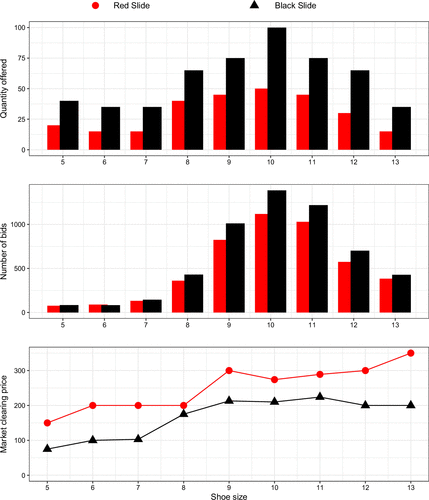
Note. The figures show the quantity of shoes auctioned (top), the number of bids received (middle), and the market clearing price (bottom) by color-size combination.
A total of 10,075 bids were submitted by 6,936 distinct bidders.11 Over a third of the bidders (37.5%) placed bids in multiple auctions, accounting for 56.9% of the bids, and almost all these multiauction bidders (85.9%) chose to bid twice: on the red and black slide of the same size.
The total number of bids submitted by color-size combination are shown in the middle panel of Figure 1 and the market clearing prices in the bottom panel. Despite the fact that black slides received on average more bids than red slides of the same size, market clearing prices are higher for red slides. In the next section, we argue that these differences reflect both direct and indirect effects of lower inventory levels for red slides. The indirect effects derive from the fact that the rarer red slides were more valuable to consumers but were also expected to have a higher clearing price, making entry less attractive for red slides compared with black slides.
To evaluate the reduced-form relationship between rarity and bidding behavior, we run regressions of the form
Before presenting the regression results, we note two nonstandard aspects of the bids. First, there is a small number of outliers: in many auctions, the top few bids are in the range of one million dollars, much higher than all other bids. These are unlikely to reflect bidders’ true willingness to pay. Because the presence of outliers can bias or distort estimates of interest, we handle outliers via trimming. Specifically, in each auction, we trim the top 5% of bids (411 bids in total). We provide robustness checks for this choice in the Online Appendix, Table E.1.
Second, there is a large mass of bidders (3,166 bids) at the reserve price.13 Discussions with StockX executives revealed that these bidders likely anticipated that StockX might still reward losing bidders. In the past, StockX had, in fact, rewarded participants with discounts like free shipping on future orders. We accordingly view the mass of bids right at the reserve price as reflecting factors other than true willingness to pay for the slides and remove them in the analysis below.14 After these two adjustments, the final sample comprises 6,467 bids.
Results are presented in Table 1. Specifications (1)‒(4) present the estimates based on ordinary least squares (OLS) regressions. We progressively add controls to show that the stylized facts align with StockX’s assumption that there are no differences in consumer preferences for black versus red shoes. Additionally, we confirm that preferences for rarity remain constant after controlling for shoe and bidder characteristics.
|

Table 1. Effect of Rarity on Bids
| Dependent variable: Bid (log) | ||||||||
|---|---|---|---|---|---|---|---|---|
| (1) | (2) | (3) | (4) | (5) | (6) | (7) | (8) | |
| Constant | 4.577 | 4.785 | 4.744 | 4.282 | 4.672 | 4.593 | ||
| (0.008) | (0.047) | (0.068) | (0.023) | (0.088) | (0.128) | |||
| Red (indicator) | 0.039 | 0.013 | 0.012 | 0.073 | 0.025 | 0.020 | ||
| (0.011) | (0.016) | (0.018) | (0.022) | (0.029) | (0.034) | |||
| Quantity (log) | −0.048 | −0.039 | −0.045 | −0.090 | −0.073 | −0.080 | ||
| (0.012) | (0.016) | (0.022) | (0.022) | (0.030) | (0.041) | |||
| Bidder controls | No | No | No | Yes | No | No | No | Yes |
| Shoe size FE | No | No | No | Yes | No | No | No | Yes |
| Model | OLS | OLS | OLS | OLS | MLE | MLE | MLE | MLE |
| /log-likelihood | 0.002 | 0.003 | 0.003 | 0.070 | −3,341.6 | −3,338.9 | −3,338.6 | −3,326.8 |
| Adjusted | 0.002 | 0.002 | 0.002 | 0.033 | ||||
| Observations | 6,467 | 6,467 | 6,467 | 6,467 | 6,467 | 6,467 | 6,467 | 6,467 |
Notes. Standard errors are in parentheses. Shoe size fixed effects are dummies for three size categories: small (5–7), medium (8–10), and large (11–13). Bidder controls include the total number of past orders, the number of past orders on products of color red and of color black, respectively, placed by the bidder on the platform. MLE gives the maximum likelihood estimator assuming log-normally distributed bids and accounts for truncation at the reserve price.
Column only contains a constant and the dummy variable for red slides. On average, the rarer red slides receive bids that are 3.9% higher than black slides. Column (2) replaces the red dummy with the log of the inventory available for the shoe size-color combination corresponding to the bid. The estimated elasticity of bids to inventory levels is −4.8: Doubling inventory levels reduces bids by 4.8% on average. Column (3) includes both the red dummy and the log of the inventory. Now, the coefficient on the red dummy is quantitatively small and statistically indistinguishable from zero (and remains so after additional controls), providing support for similar demand preferences across colors. The inventory level continues to remain an important explanatory variable of bid amounts. Indeed, the elasticity of bids to inventory remains similar when we control for color (column (3)) and fixed effects for the small, medium, and large shoe sizes and bidder-level characteristics (column (4)).15
The OLS estimates do not account for truncation of bids at the reserve price. They should accordingly be interpreted as the effect on the mean bid conditional on the valuation being greater than the reserve price. We account for truncation using a maximum likelihood estimator (MLE), in which bids are assumed to be distributed according to a log-normal distribution truncated at the reserve price of $50. Specifications (5)–(8) in Table 1 present the MLE results, which confirm the basic pattern of an absence of color preference and support an even larger elasticity than the OLS estimates. Indeed, the coefficient on quantity in column (8) implies that doubling inventory is associated with an 8% reduction in the bid amount.
What does the value of rarity imply for the seller’s optimal inventory choices? In what follows, we investigate this question by estimating a structural model and conducting counterfactual analyses. The patterns identified in this section help to understand the assumptions and estimates of the structural model. In particular, the model leverages variation in inventory levels both across shoe sizes and colors. As suggested by the results in Table 1, the addition or removal of controls such as color or size will not make a large difference to the estimates and counterfactuals.
3. Model of Entry and Bidding Behavior
This section presents a model of entry and bidding behavior motivated by the descriptive evidence above. We first introduce the model and then discuss its assumptions in Section 3.1.
Each shoe size is considered its own separate market, where two products are available: B (black) and R (red) with inventory levels denoted by and , respectively. The products are sold via two simultaneous multiunit uniform price auctions with a public reserve price .
Each bidder privately draws a pair of valuations . We assume that the latter is drawn from a joint distribution , continuous in both arguments, with support , and with marginal densities strictly positive on the interior of the support. The reserve price is binding, that is, and . Valuations are independent and identically distributed across bidders. We allow for the joint distribution to depend on the inventory levels to capture the effect of rarity on valuations.
After observing their valuations, bidders simultaneously make their entry decisions. In this sense, entry is “selective” as in Samuelson (1985). We assume heterogeneity in entry decisions: a share of bidders are global bidders, who can bid on both products; the rest are local bidders, who can bid at most on a single product. There are no costs to bidding in an auction. Outcomes are determined by the rules of the auction mechanism: The available inventory is sold to the highest bidders, and the clearing price is determined by the lowest winning bid.
We seek to characterize a Bayesian Nash equilibrium of the entry-bidding game. At the bidding stage, the fact that bidders cannot place more than one bid per auction greatly simplifies the analysis because unit-demand limits their ability to influence clearing prices via demand reduction or bid shading strategies (Vickrey 1961). There is, however, a chance that a bidder affects the price they pay, which happens when their bid is exactly the -highest bid in auction R or the -highest bid in auction B. Given that both the probability that this occurs and bid-shading incentives decrease in N, we assume for simplicity that all participants have a dominant strategy of bidding their valuation if they enter the auction.16
When choosing whether to enter, global bidders enter any auction for which their valuation is above the reserve price. There are four possible cases: if and , the global bidder enters both auctions; if and , they enter auction B only; if and , they enter auction R; and if and they do not enter any auction.
Local bidders enter at most a single auction, as long as their valuation is above the reserve price. If and , then the local bidder enters auction B only. Similarly, if and , then the local bidder enters auction R only. In the case where and , a local bidder enters the auction with the highest expected payoff. In what follows, we focus on characterizing the entry equilibrium for local bidders when and .
Let us consider, temporarily, cutoff entry strategies of the following type: A local bidder enters auction R if and only if for some endogenous function . They enter auction B otherwise. We show below that any entry equilibrium of this game has a payoff-equivalent representation in cutoff entry strategies. Let and denote bidder i’s expected payoffs if they enter auction R and B respectively, when all local bidders follow the entry cutoff strategy . Local bidder i enters auction R if and only if , so the optimal cutoff rule must satisfy the following indifference condition:
The next proposition proves the existence of an equilibrium in cutoff strategies.
There exists a symmetric equilibrium of the entry stage in cutoff strategies , such that local bidder i, with valuations and , enters auction R if and only if , and auction B otherwise. The function is increasing on , takes values in , and satisfies the boundary condition . Additionally, any pure strategy equilibrium of the entry stage has a payoff-equivalent representation in cutoff strategies.
Available in Online Appendix A.
Note that, although at least one such equilibrium exists, there may be multiple equilibria in cutoff strategies. We verify the uniqueness of the equilibrium numerically within the estimation routine.
3.1. Motivating the Model Assumptions
In this section, we discuss the two main assumptions of our model: the independent private value assumption and the existence of local and global bidders. A third assumption, namely that valuations have the same distribution for local and global bidders, has testable implications that we address in Section 4.
We start by motivating the independent private value assumption. This assumption rules out (1) affiliation in values across players (within an auction) and (2) a common value component to the auction. The latter may arise because the goods sold in the auction can be subsequently traded in the secondary market on StockX. A bidder’s valuation for the product can therefore depend on the private signals of other bidders, as such signals are informative about the profits in the secondary market (Haile 2001, 2003).17 We discuss these two alternatives below and show that the independent private value framework is more appropriate given patterns in the data and the institutional context under study.
Although the auctioned products can be subsequently resold on the platform, there are three pieces of evidence against a common value assumption. First, the secondary market for the slides was thin. Based on data collected on all secondary market transactions during the 12 months following the auctions (January 2019 to January 2020),18 we observe just 54 transactions in the secondary market of the 800 slides auctioned in the primary market. This figure is an upper bound on the number of unique slides resold because the same pair may have been traded several times in the secondary market. Moreover, the vast majority of resellers extracted either null or negative rents (defined as the difference between the secondary and primary market price): the first quartile, median, third quartile, and the average rents were −$110.15, −$63.20, −$29.17, and −$70.70, respectively.19 These statistics suggest that arbitrage was not an important determinant of participation and that few bidders were driven by speculative motives. Budish and Bhave (2023) likewise show that the introduction of auctions for event tickets on Ticketmaster eliminated arbitrage profits in the secondary market.
Second, there was little uncertainty about the characteristics of the product. The slides were new and sold directly by the manufacturer, and several pictures of the product were provided to the bidders. This contrasts with online auctions of other collectibles, such as stamps or coins, which cannot be inspected in advance and feature a common value component (e.g., eBay coin auctions analyzed by Bajari et al. (2003)).
Third, we implement the “winner’s curse” test, as suggested by Milgrom and Weber (1982) and implemented in Bajari et al. (2003). In a common-value auction, bidders will rationally lower their bids as the number of opponents increases. The empirical prediction here is that the average bid in a second-price (or in our case, a uniform price) auction should be negatively correlated with the number of bidders. But in a private value second-price auction, the average bid should not depend on the number of bidders, because it is optimal for each bidder to bid their valuation. After controlling for quantity, color, and shoe size fixed effects (as these may shift valuations for reasons unrelated to the winner’s curse), we compute the correlation between the average bid in each of the 18 auctions and the number of participants. We find that the average bid is positively correlated with the number of participants, but the effect is not statistically significant at the 95% confidence level. An additional bidder increases the average bid by 3 cents, the p-value for the test of zero correlation equals 0.48, so that the null of zero correlation cannot be rejected. More broadly, the above three pieces of evidence support our private value assumption against common values.
We now turn to interdependence in values. Conditional on observed auction heterogeneity (i.e., color, shoe size, and inventory), the idiosyncratic component of bidders’ valuations may still be correlated. A direct test would consist of computing the correlation between two randomly chosen bids (or valuations) across auctions—after controlling for observed auction heterogeneity (De Castro and Paarsch 2010, Jun et al. 2010). In our setting, however, the number of bidders per auction is large but the number of auctions is small. To implement a test that retains the spirit of the direct approach, we proceed as follows: For each auction, we randomly partition bidders into k groups, compute within-group average bids, and calculate the correlation in the average bid between groups within the different auctions.
Figure 2 shows the results for the average bid (left) and average residual bid (right), where k equals four. Although bids are positively correlated across bidders within an auction (left panel), once we control for observed auction heterogeneity (right panel), we do not find a statistically significant correlation between bidders’ idiosyncratic values (the correlation coefficient is 0.046 with a p-value of 0.80).
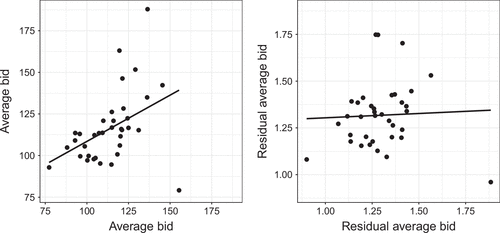
Notes. The figures display the average bid (left) and average residual bid per group for each auction. Groups are formed by partitioning bids in each auction into four groups. We plot the average bid in group 1 against group 2, and the average bid of group 3 against group 4 (two observations per auction). Residual bids (right) are computed by controlling for observed auction heterogeneity (quantity, color, and shoe size).
Finally, we discuss our modeling choice of allowing for both global and local bidders. The theoretical model must account for three patterns in the data: (1) some bidders bid in both auctions (R and B) whereas other bidders only participate in one of the two auctions; (2) there are more entrants into auction B than into auction R (middle panel in Figure 1); and (3) bidders do not display a strong preference for one color over the other (the coefficient estimate for the red dummy in columns 3, 4, 7, and 8 in Table 1). Although the binding reserve price can explain the first pattern, it cannot explain the last two patterns jointly (i.e., more bids in the black auction without a strong preference for black slides). Indeed, with the same binding reserve price across black and red slides, there would only be more entrants into auction B if bidders drew, in expectation, higher valuations for B than R. The presence of “local” bidders allows us to account for these two patterns in the data. Indeed, “local” bidders choose to enter the auction with the highest expected payoff. Because inventory is higher in auction B, bidders expect lower market clearing prices and thus are more likely to enter auction B than R, even if, in expectation, their valuations for B and R are similar.20
4. Estimation
For each shoe size, we observe the bid, or pair of bids, submitted by each entrant, and the quantities sold in red and black. The primitives to recover are the distribution of valuations , the share of local bidders p, and the number of potential entrants N. The main identification challenge is that bidder types are not directly observed. Because of the binding reserve price, it is not possible to distinguish between, on the one hand, a global bidder who only bid in auction R because their valuation for the black shoes was below the reserve price and, on the other hand, a local bidder whose valuations were both above the reserve price, but who chose to bid in the auction R to maximize their payoff.
Here, we provide an intuitive description of the identification argument, whereas Online Appendix C shows more thoroughly how the model primitives can be identified nonparametrically if one had access to a large number of pairs of black and red auctions with varying inventory levels. First, the joint distribution of valuations, conditional on both valuations being greater than the reserve price, can be identified from bidders who enter both black and red auctions. Next, let , , and be the (observed) number of bidders who entered both auctions of a given size, the black auction only, and the red auction only, respectively. These variables follow a multinomial distribution with number of trials equal to N and event probabilities that are functions of the share of local bidders p and the distribution of valuations. We can thus build moments from the multinomial distribution to match with the observed number of bidders across the two auctions. This allows us to pin down p and N for each pair of auctions of the same shoe size. Finally, with these identified objects, we can use the (observed) distribution of bids submitted by bidders who entered only one auction to recover the distribution of valuations when one of the valuations is below the reserve price.21
Because of our limited sample size, we impose parametric restrictions on the distribution of valuations . Specifically, pairs of valuation are assumed to be drawn from a bivariate log-normal distribution with means that depend on the color and the inventory:
The parameters , , and denote the standard deviations of , , and the correlation coefficient between these two variables, respectively.
Our estimation proceeds in two steps. First, we note that global bidders can be identified in the data when they enter both auctions. Therefore, as in the identification argument above, we estimate the joint distribution of valuations conditional on and using bids submitted by global bidders who bid in both auctions. When constructing the likelihood, we account for the fact that bids are truncated at the reserve price . The parameter is identified from cross-sectional variation in inventory across auctions, whereas the parameter is identified from the average difference in (log) bids submitted in auction R relative to auction B by bidders who entered both auctions. The parameter is identified from the correlation between the two bids submitted by the same bidder.
Second, we derive the total number of potential entrants N and the share of local bidders p to match moments given by the entry rates in the data. For each pair of auctions (i.e., each shoe size), N is set such that the share of entrants equals the probability that a given bidder enters:
Similarly, p is set such that the share of bidders who enter both auctions equals the probability that a bidder is global and draws both valuations above the reserve price:
Note that the functional form assumption on the distribution of valuations facilitates estimation in that we do not need to identify local bidders’ entry strategies to derive the model primitives. Online Appendix C describes identification when we do not make any assumptions on . The intuition remains, however, the same. We take advantage of the multinomial distribution of the number of bidders across auctions of the same shoe size to match empirical moments with their theoretical counterparts (Equations (4) and (5)).
Throughout, we assume that the distributions of valuations are the same across global and local bidders. This is arguably a strong assumption, motivated by the fact that one cannot identify the full distribution for local bidders because they never bid on both products.22 Nonetheless, we can use the distribution of bids submitted by bidders who entered only one auction to show that the data are consistent with the symmetry assumption (see “Model Fit” below). In Online Appendix D, we extend the estimation strategy to allow for asymmetric distributions across local and global bidders (McFadden 1989, Pakes and Pollard 1989), which leads to a more complex estimation strategy but produces very similar results.
Data on individual bids as inventory levels vary provide a unique opportunity to separate the direct effect of inventory on the equilibrium price (lower inventory levels lead to higher market clearing prices) from the indirect rarity effect (lower inventory levels lead to higher willingness to pay, which further increases market clearing prices). Indeed, access only to inventory levels and market clearing prices would normally not allow to distinguish whether prices increase due to supply scarcity or because such scarcity induces a change in buyers’ willingness to pay, or a combination of both. However, with this data on individual bids, we can fully trace demand curves, one for each inventory level. If the demand curve shifts upward as inventory levels decrease, we attribute this effect to rarity.
Before turning to the results, it is worth discussing the main assumptions that (1) rarity is defined conditional on size and (2) the inventory levels for each shoe size-color combination are exogenous to willingness to pay. Our description of the auction rules and inventory choices in Section 2 provide some justification for both assumptions. It is true that consumers generally care about the overall rarity of a fashion item, as opposed to its availability in their specific size. In this setting, however, bidders directly observe the available inventory in their size before bidding (for example, red and black shoes in size 10), and can only observe the inventory of other sizes by switching product page.23 Effectively, by using size-specific inventory, we are assuming that a bidder infers overall rarity from the observed rarity of their own size24: for example, a bidder on red shoes in size 5 will expect lower overall inventory of red shoes than a bidder on size-10 shoes because the size-5 inventory is smaller than the size-10 inventory. To allow for the possibility that users do not only observe the inventory of the shoes in their exact size but take into account the inventory of shoes of similar sizes, we can estimate the rarity effect as a function of average inventory for small, medium, and large shoe sizes. This robustness check, which leads to similar results, is presented in the Online Appendix, Table E.3.
The assumption of exogeneity of inventory levels to willingness to pay is supported by public information about the auction that is available on StockX.com. As described in Section 2, StockX restricted the inventory of the red shoes in order to create scarcity, but not because they thought there were any differences in demand across black and red shoes. They also varied inventory across shoe sizes to match a traditional retail footwear distribution rather than anticipated demand differences. To control for potential demand differences across colors, the distribution of valuations (Equation (3)) includes , which allows for differences in log valuations between black and red shoes. Following the reduced form results (Table 1), our baseline specification controls for inventory and color to keep the model parsimonious and we show that this model fits the data well. We also test alternative specifications, that is, controlling for size fixed effects as well, and find that the estimates and counterfactual predictions remain quantitatively similar (see the Online Appendix, Table E.4).25
4.1. Results
Table 2 shows MLE results of the parameters governing the distribution of valuations. The estimate for indicates that valuations for B and R are highly correlated within bidders. The quantity auctioned in a given color negatively impacts valuations for that color ( is negative and statistically significant), confirming that bidders exhibit a preference for rarity. Finally, we do not find any significant ex ante differences in valuations across colors, given that is indistinguishable from zero.
|
Table 2. MLE Estimates
| Estimate | Standard error | t-value | |
|---|---|---|---|
| 4.254 | 0.036 | 118.511 | |
| 0.032 | |||
| 0.007 | |||
| 1.127 | 0.042 | 26.665 | |
| 1.136 | 0.023 | 50.176 | |
| 0.971 | 0.002 | 425.272 | |
| Observations | 3,542 | ||
| −Log-likelihood | 1,340 |
Note. MLE estimates of the model primitives contained in Equation (3).
The share of local bidders p is similar across sizes and close to 58%. The distribution of the number of potential entrants mirrors the distribution of the number of bids received (middle panel in Figure 1), with medium sizes having the largest populations of potential entrants. For completeness, we include the estimates of the number of potential entrants N (Equation (4)) and the share of local bidders p (Equation (5)) in the Online Appendix, Figure E.3.
Model Fit. Before using these estimates for counterfactuals, we examine how well the estimated model fits the data. To this end, we solve for the Bayesian Nash equilibrium for each shoe size separately. Specifically, we find local bidders’ equilibrium entry strategy , simulate auction outcomes and compare these to the data. We solve the game by searching for a fixed point of the best-response mapping, exploiting the fact that this mapping has a closed-form expression given the distribution of market clearing prices.26 This allows us to solve for the equilibrium entry strategy without imposing any functional form restrictions.
Our approach consists of iterating between two steps: a given iteration starts by updating local bidders’ best-response entry strategy given the distribution of market clearing prices, and then these best-response entry strategies are used to update the distribution of market clearing prices. The algorithm iterates until the entry strategy and distribution of market clearing prices converge, up to a predefined tolerance level.
In iteration k, we denote the entry strategy and the distributions of market clearing prices in auction B and R as and . We iterate over the following steps.
Update the entry strategy using the best-response mapping. For any , we have
(6)where the interim payoff functions are given by(7)(8)The function is invertible because is continuous and strictly increasing over the support of valuations.27
Update the distribution of market clearing prices and by simulating 10,000 auctions and computing entry decisions into each auction using strategy .28
If the maximum absolute difference between and and between and is less than the tolerance level (), stop the procedure. If not, return to step 1 using and .
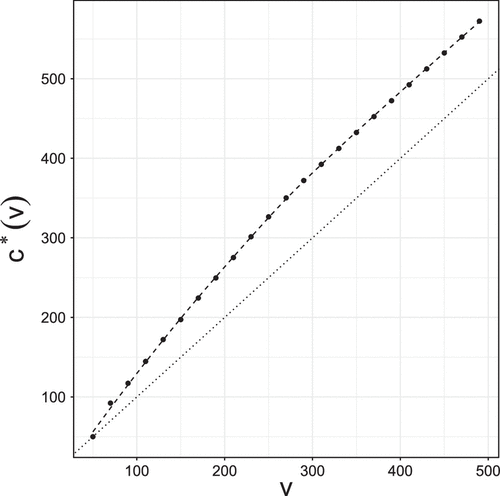
We initialize the algorithm at several starting values for and (e.g., log-normal with different starting values for mean and variance) and verify that the algorithm converges to the same equilibrium . Figure 3 shows the equilibrium entry strategy for size-10 auctions. As expected, the function lies above the 45° line. Bidders expect higher market clearing prices and a lower probability of winning in auction R compared with auction B; therefore, a bidder with equal valuations will prefer to enter auction B.
Given the equilibrium entry strategies found above, we simulate 10,000 auctions of red and black slides for each shoe size. We compare the average simulated numbers of entrants into the R auction, B auction, and both auctions to the observed entry levels. Similarly, we compare the average simulated prices to the observed market clearing prices.
The first three panels of Figure 4 compare the realized number of entrants with the results of model simulations, confirming that the model performs well. Importantly, the model replicates the feature that there are fewer entrants into auction R relative to auction B because inventory levels are lower for R auctions compared with B auctions.
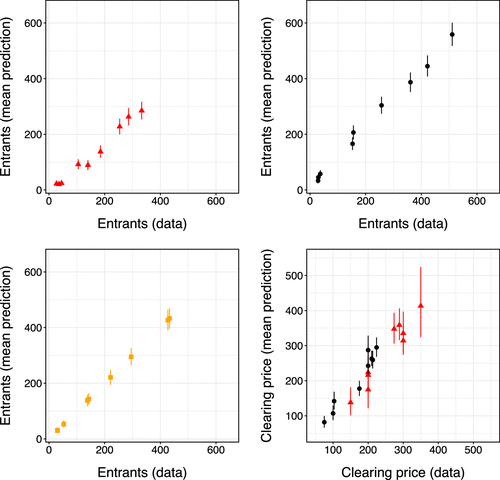
Notes. The figures display the simulated and observed number of bidders who enter auction R only (top left), auction B only (top right), and both auctions (bottom left). Each dot corresponds to a shoe size. The bottom right panel displays the simulated and observed market clearing prices, with each dot corresponding to a shoe size-color combination (triangles for R auctions, circles for B auctions). The simulated values are averages computed from 10,000 simulations, 95% confidence intervals are shown as vertical bars.
The bottom right panel of Figure 4 compares the 18 realized market clearing prices by color and size to the mean simulated prices of our model. Although the model slightly overpredicts prices at the top, the predictions of market clearing prices are quite close to the data given the restrictions imposed by our parametric assumptions.29 Overall, the model captures the heterogeneity in prices and entry rates across sizes and colors quite well.
Next, we turn to the assumption of symmetry in valuations across global and local bidders. This assumption has testable implications for the distribution of bids submitted by bidders who entered only a single auction. The distribution of single bids comes from a combination of local and global bidders: For example, in auction B, local bidders who chose to enter auction B rather than R because and , and global and local bidders who could only enter auction B due to the binding reserve price (i.e., and ).
With knowledge of the distribution of valuations , the proportion of local bidders p, and the equilibrium entry strategy of local bidders, we can construct the distribution of single bids predicted by the model. Our approach consists of comparing this predicted distribution to the empirical distribution in the data. For a derivation of the predicted distribution, see Equation (21) in Online Appendix C.
Figure 5 shows density estimates of bids submitted by bidders who entered auction B only (in the data) to the bid density predicted by our model, across shoe sizes.30 We find that the distributions predicted by the model closely match the empirical distributions in the data, especially for medium and large sizes (where sample sizes are larger). Quartiles of the two distributions differ by between and (roughly $10).31 We find quantitatively similar results for R auctions. We consider these results to be consistent with symmetry in valuations across local and global bidders. In Online Appendix D, we extend our estimation strategy to allow for asymmetries in the distributions of valuations across local and global bidders. Here too the results are consistent with our baseline assumption, since we find that differences in valuations across bidder types are not significant.
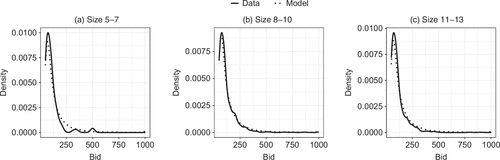
Notes. These figures show kernel density estimates of bid distributions for bids submitted by bidders who entered auction B only. Each figure compares bid distributions in the data to bids simulated using model estimates for separate shoe sizes (right-hand side in Equation (21) in Online Appendix C).
5. Counterfactual Analysis
5.1. Impact of Rarity and Substitution
In this section, we investigate how preferences for rarity and substitution patterns across colors affect the optimal quantity sold by the auctioneer. To implement our counterfactuals, we use the estimated model and vary the inventory of red slides, which are scarcer than black slides for all shoe sizes. The auction outcomes of interest include bidders’ entry rates, market clearing prices, seller’s profits, and consumer surplus.
Counterfactuals allow us to explore a major tradeoff. On one hand, increasing inventory of red slides will make it more attractive for bidders to switch from the black to the red auction (substitution) because the probability of winning a pair of red slides increases. On the other hand, increasing red inventory will also reduce the willingness to pay for red slides (rarity). Our estimates allow us to quantify each of the two effects, separately and jointly.
In order to disentangle the rarity and substitution effects, we first hold inventory of black shoes constant and consider alternative inventory levels , where is the baseline inventory of red shoes and is a multiplier between 0.5 and 10. For each and shoe size, we compute outcomes under four counterfactual scenarios:
No rarity, no substitution. In this counterfactual, we assume that valuations and local bidders’ entry decisions (the cut-off function ) do not vary with inventory levels and are kept fixed at their baseline.
Rarity, no substitution. This counterfactual allows valuations to depend on inventory levels but entry decisions remain fixed at their baseline.
No rarity, substitution. Valuations do not vary with inventory levels but local bidders reoptimize their entry decisions.
Rarity, substitution. In this counterfactual, valuations depend on auctioned inventory levels and bidders make optimal entry decisions.
Scenarios 3 and 4 require us to recompute the equilibrium entry strategies for each new inventory multiplier .32
We present results for size-10 shoes, which received the highest number of bids. Each panel in Figure 6 presents the counterfactual outcomes—number of bids, market clearing prices, profits, and consumer surplus—as a function of the multiplier . Each row corresponds to one of the four counterfactual scenarios. In scenario 1 (no rarity, no substitution), the number of bids in each auction (top panel in Figure 6(a)) does not change because valuations are constant and entry decisions are kept fixed. The market clearing price (Figure 6(b)) for red shoes decreases with inventory, as the auctioneer goes down the demand curve. However, revenues monotonically increase with because the price reduction is more than offset by more units sold. To compute profits (Figure 6(c)), we use a constant marginal cost of $30, confirmed by StockX as the production cost.33 The profit-maximizing inventory level is denoted with a dotted vertical line in Figure 6(c). Holding constant the quantity of black slides, profits across both black and red slides are maximized with an inventory of red slides equal to 5.2 times the baseline inventory.
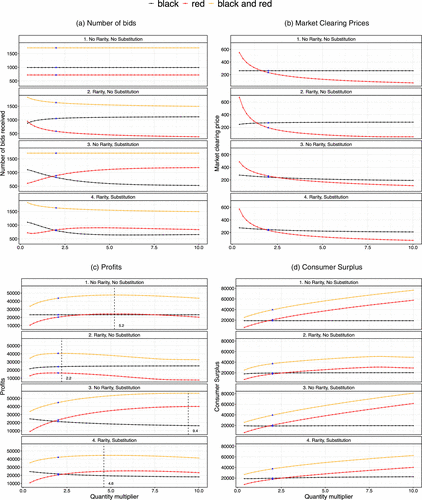
Notes. The figures plot four outcomes (number of bids in (a), market clearing prices in (b), profits in (c), and consumer surplus in (d)) under the four different counterfactual scenarios described in Section 5. The triangles mark the value of where quantities auctioned in red and black are equal. The dotted vertical lines in (c) denote the profit-maximizing inventory levels under the four different counterfactuals.
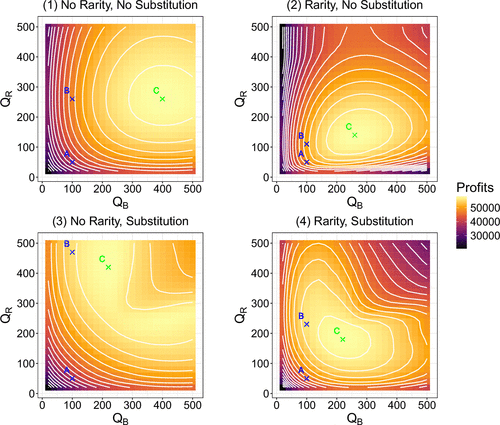
Notes. The figures show contour plots of total profits as a function of for size-10 auctions. Point A corresponds to the baseline inventory choice in the data (100, 50). Point B corresponds to the profit-maximizing inventory choice when is held at its baseline level (100) and only varies, as in Figure 6. Point C corresponds to the joint inventory choice that maximizes total profits. In the first and third scenarios (No Rarity), valuations do not vary with inventory and are conditional on the baseline quantities . In the first and second scenarios (No Substitution), entry decisions follow the baseline equilibrium strategy represented in Figure 3.
In scenario 2 (rarity, no substitution), willingness to pay decreases with , which translates into a smaller number of bidders entering auction R, because they either prefer entering auction B instead or staying out altogether due to the binding reserve price. Note that, although bidders are not allowed to reoptimize their entry decisions, some bidders still substitute from R to B based on the baseline entry equilibrium whenever . The lower number of entrants into auction R leads to a sharper drop in the market clearing price for R (relative to scenario 1), whereas the clearing price for B increases slightly with . Revenues increase less than in scenario 1, which translates into a profit-maximizing inventory that is 2.2 times the baseline level, lower than in scenario 1. As expected, preferences for rarity lead the seller to contract inventory levels to keep valuations, and thus prices, high.
Scenario 3 (no rarity, substitution) has the opposite effect on the number of bids compared with scenario 2. As increases, the expected payoff from entering auction R increases, which draws bidders away from B toward R. This shift in entry rates dampens the reduction in the market clearing price in auction R, although it leads to reduced revenues in auction B. The substitution from auction B to R has a much smaller (negative) effect on revenues in B than the (positive) effect on R, so a profit-maximizing monopolist would in fact expand inventory to 9.4 times the baseline, a larger increase than in scenario 1.
Finally, in scenario 4, the two forces (rarity and substitution) somewhat compensate each other: The first reduces participation in auction R, whereas the second increases participation in auction R. Overall, the total number of entrants in B and R decreases because with lower valuations a fraction of bidders no longer meets the reserve price. Both prices monotonically decrease, but revenues only decrease for B whereas they increase for R, at least initially. The resulting profit-maximizing inventory is between the two extreme scenarios (i.e., scenarios 2 and 3), at 4.6 times the baseline level.
From the seller’s perspective, there are two main implications. The first is that preference for rarity leads to substantially lower profit-maximizing inventory levels. This is true whether substitution is shut down (scenario 1 versus 2) or accounted for (scenario 3 versus 4). Ignoring the effect of rarity (i.e., comparing the optimal inventory in scenarios 3 versus 4) leads to quantity choices that are approximately 104% above the theoretical optimum. Although Figure 6 focuses on shoe size 10, our main prediction is robust across sizes: If preferences for rarity are ignored, the quantity chosen is on average 88% higher than the optimum.
The second implication is that when the auctioneer accounts for the substitution between black and red shoes (scenario 3 versus 1 or scenario 4 versus 2), the profit-maximizing quantity is higher. Ignoring the effect of substitution (i.e., comparing the optimal inventory in scenarios 2 versus 4) leads to inventory levels that are 47% lower than the optimal levels. Once again, this is true across all shoe sizes. This finding contrasts economic intuition for a multiproduct monopolist. In general, when accounting for cannibalization across products, a monopolist should reduce the quantity produced relative to a scenario where cannibalization is ignored. For these simultaneous auctions with endogenous entry, however, raising the quantity in one auction changes the residual demand curve (and, consequently, the marginal revenue curve) by affecting bidders’ entry decisions across auctions B and R.
To gain intuition, we consider the profit function of a multiproduct monopolist who needs to optimally set . Without substitution (scenario 1), the monopolist’s first order condition is simply
With substitution (scenario 3), the first order condition becomes34
Whenever a bidder switching from B to R leads to higher revenue gains in R than revenue losses in B, the term is positive.35 In this case, the monopolist would set higher inventory levels when considering substitution compared with when substitution is ignored.
Although the rarity and substitution effects somewhat compensate each other, the rarity effect dominates. Indeed, ignoring both rarity and substitution (i.e., comparing scenario 1 versus 4) leads to production that is 13% above the optimal level.
In all scenarios, consumer surplus in the red slide auction and in aggregate increases with inventory levels, reflecting the fact that for most of the range of inventory levels considered (i.e., for ), the reduction in valuations due to greater product availability is more than compensated by consumer gains from lower market clearing prices (infra-marginal consumers) and larger quantities sold (marginal consumers). This result emphasizes the fact that even with fashion goods, the negative spillovers of restricting quantity more than offset the individual consumer benefits of rarer goods.
5.2. Optimal Joint Inventory Choice
This section considers the optimal joint inventory decision problem from the perspective of the seller. For every combination of , we solve for the corresponding equilibrium of the auction game and examine the impact of rarity and substitution effects on the profit-maximizing joint inventory. As in the previous section, and to keep computation tractable, we focus on size-10 auctions.
Figure 7 shows contour plots of total profits (the sum of profits in auctions B and R) for different values of . Each panel corresponds to one of the four scenarios described in the previous section. In each panel, point A represents the baseline inventory choice in the data ; point B represents the optimal inventory choice when is fixed at its baseline level (100), whereas is allowed to vary (as in Figure 6); point C corresponds to the profit-maximizing inventory choice.
Two important features are worth noting. First, in scenarios 1 and 3 (no rarity), we assume that the distribution of valuations depends on the baseline inventory choice . In these two scenarios, valuations for product R are higher (in expectation) than for product B because .36 Second, in scenarios 1 and 2 (no substitution), entry decisions follow the baseline equilibrium strategy represented in Figure 3.
To interpret the outcomes in Figure 7, recall the following intuition: the marginal revenue from increasing the quantity sold in an auction (either B or R) is higher the more bidders there are in the auction.37
In scenario 1 (no rarity, no substitution), auctions B and R are independent. Therefore, the seller chooses the quantities independently by equating marginal revenue to the marginal cost in each auction. Points B and C on the plot feature the same level , because the first-order condition for is independent of the choice of . The optimal inventory choice (point C) is such that . This reflects the fact that, in the baseline, more bidders enter auction B than R and the marginal revenue curve is higher in auction B than R, despite valuations for R being higher on average.
In scenario 2 (rarity, no substitution), the rarity effect reduces the marginal revenue from increasing quantities sold in both auctions, hence, the profit-maximizing quantities are lower than in scenario 1.
In scenario 3 (no rarity, substitution), iso-profit curves become U-shaped and there are two local maxima featuring either or . Substitution effects lead the seller to making one product substantially rarer than the other. Indeed, an increase in the quantity of one color, say , draws bidders from auction B to auction R (substitution effect). Fewer bidders in auction B translates into lower marginal revenue in this auction. Therefore, if the firm increases , it must reduce (and vice versa) to remain on the same iso-profit curve. The global maximum is point C where because under “no rarity,” valuations for R are on average higher, leading to a higher marginal revenue curve in auction R compared with auction B.38
Finally, scenario 4 (rarity, substitution) combines the effects described in the previous two scenarios. The profit-maximizing inventory selects approximately identical quantities and because baseline valuations are similar for both colors.39 Comparing the profit-maximizing inventory in scenarios 3 and 4 indicates that ignoring the value of rarity can lead to substantial overproduction, even when considering the joint inventory decision. In this particular setting, the profit-maximizing choice for in scenario 3, ignoring rarity, is 133% above the optimal choice when accounting for rarity effects.
6. Conclusion
In this paper, we examine how rarity impacts consumers’ valuations for products. Using auction data from the sale of limited edition fashion goods on StockX, an e-commerce marketplace, we find that limiting the number of shoes available for sale increases consumers’ bids. This increase translates into higher sale prices, not just because of the lower available supply, but also because rarity induces higher bidder valuations.
We use these stylized facts to estimate a structural model of consumer entry and bidding behavior in the auctions. Variation in inventory levels across shoe sizes and entry patterns across auctions allow us to estimate how consumer valuations change with the rarity of the products, as well as how consumers substitute between similar products.
We use our estimates to disentangle the effects of rarity and substitution on auction outcomes, which directly affect firms’ inventory choices and consumer surplus. The counterfactual analyses allow us to draw two main conclusions. First, ignoring the value that consumers place on rarity leads to substantial overproduction, with inventory levels that are almost twice as large as optimal levels. Second, ignoring substitution between similar products leads multiproduct firms to underproduce. Our estimates suggest that firms may produce as little as 50% the optimal level.
Preferences for rarity and substitution have opposite effects on firms’ inventory choices. Although preferences for rarity push profit-maximizing firms to constrain inventory levels to keep valuations high, preferences for substitution push them to increase inventory. On net, rarity dominates. When focusing on consumer surplus, we find that although the directions of the effects are similar, consumers’ higher utility from rarer goods is not enough to counterbalance the negative effects of higher prices and fewer purchases arising from a reduction in inventory levels.
Broadly, we provide empirical evidence that when choosing inventory levels, firms should consider the value of rarity. Failing to do so can lead to substantial overproduction. Many goods are, in fact, characterized by properties that make this “rarity” consideration consequential, from branded clothing to luxury cars and trading cards. In such cases, it is important for firms to take into account the impact of rarity and exclusivity on consumers’ preferences when setting production quantities.
Of course, not all similar products are affected by rarity. In the shoe market, for example, some transactions satisfy a basic need for foot wear (e.g., store-brand trainers), whereas others meet a preference for luxury or conspicuous consumption (e.g., Christian Louboutin shoes). Some transactions may even generate utility from the simple act of owning an item rather than using it. Rarity is unlikely to affect the first kind of transactions, but it can change how users perceive the value of luxury alternatives. As in our model, rarity may even lead to a subset of consumers wanting two units of the same product with only minor differences, much like some owners of Hermès Birkin bags.
Although our insight that ignoring rarity can lead to overproduction is quite general, the ability to quantify by how much a firm overproduces is context specific. In particular, firms need to be able to evaluate how consumer choices change when faced with different production levels and not just different prices. This is true for both single- and multiproduct firms. For single-product firms, if price changes are not accompanied by changes in consumer perception about the rarity of a product, firms will tend to optimize production assuming that consumers are more price elastic than in reality, and will overproduce as a result. For multiproduct firms, as in our example, the problem is further complicated by the need to also consider the effect of substitution across products, and whether rarity or substitution effects dominate.
As our analysis showcases, the use of auctions to sell limited edition goods can provide valuable insights for firms’ inventory decisions. These can be particularly beneficial for the many manufacturers and designers who lose track of their end customers when their products are bought by brokers who then resell them on the secondary market. Despite the broader heterogeneity of manufacturers and limited edition goods, our analysis highlights the salient role that an intermediary platform like StockX can play in informing the production strategies of sellers on the platform. Notably, by aggregating information across many sellers and products, the platform can provide crucial data or insights needed to identify profit-maximizing quantities for sellers as a function of buyers’ behavior on the platform. Given recent regulation like the Digital Markets Act,40 which requires intermediary platforms to share data with third-party sellers, this would seem to be an especially important use of such data.
Our study is based on one of the first attempts to sell limited edition goods directly to users via an auction mechanism. Participants might eventually change their bidding behavior should this type of auctions become more common, and they gain greater experience with the selling mechanism (Garratt et al. 2012). However, auctions remain one of the few pricing mechanisms that allow sellers to estimate their entire demand curve. Because auctions currently have limited use both offline and online (Einav et al. 2018), sellers of fashion goods have a few alternative means of quantifying how much their customers value rarity. To this regard, conjoint surveys are a widely employed approach to measure how much value consumers place on product characteristics, one of which is rarity. Experiments where consumers are randomly exposed to different inventory levels can also help identify how consumers respond to product rarity.
Although we focus here on limited edition shoes where the firm had to make a one-shot selling decision, for most fashion products, sellers must make production and selling decisions on a rolling basis. In such cases, although the intuition that rarity should constrain optimal production levels still holds true, the firm has an additional commitment problem. In particular, consumers will base their purchase decisions on their expectations about product rarity in the long term, but the firm may be tempted to increase inventory levels after the consumers who value rarity have already purchased. Dynamic inventory choices and their effect on consumers’ willingness to pay thus represent important aspects to explore in future research.
Our paper has a number of limitations, any of which might be taken up for additional exploration. In our context, what we call rarity or social influence can also be seen as the urgency to buy a product available in limited quantities, possibly due to a fear of missing out. If this urgency led to a temporary increase in valuations, the subsequent purchase regret would result in a high number of listings in the secondary market. Our data do not support this. That said, if the urgency instead caused a permanent increase in valuations, we would be unable to distinguish its effects from the effects of rarity. Broadly, product scarcity can increase the product’s value due to social influences, but can also evoke emotions in consumers that affect their buying decisions and are unrelated to the social context (DeGraba 1995).
Although the model is generally applicable to multiproduct firms, our estimates are based on a set of shoes sold on a single e-commerce platform. Obviously, consumer valuations do not necessarily increase with rarity for all fashion goods or for all levels of rarity. Understanding when and for which products rarity has the effect we describe is critical for firms’ product strategy. This may require approaches different than ours, which relied on an auction mechanism with fixed inventory levels to infer buyers’ valuations. For example, in a traditional retail setting where prices are posted and inventory varies over time, one might need to leverage survey or experimental strategies to infer demand under different price regimes and inventory schedules.
Similarly, in our context, the rarity effect (which would push firms to constrain production) dominates the substitution effect (which would instead lead to an expansion of production). For other commodity-type products, rarity may not be as important a feature, in which case firms failing to recognize substitution effects may end up producing less than the profit-maximizing level. Identifying for which type of products this is likely to arise remains an open question.
Although the focus here is on the inventory choices of firms whose products benefit from rarity, the latter may affect many other choices, from the assortment of products (e.g., how many colors) to selling channels (e.g., StockX versus Foot Locker) to marketing strategies. More research is needed to shed light on the bigger picture of supply side choices for fashion goods.
In the case under consideration here, disclosing the inventory levels provided consumers with a signal of rarity. However, in many other contexts, where production quantities are uncertain or can change over time, it is unclear how consumers form expectations about how rare a product really is. In traditional retail, companies have adopted launch strategies that signal scarcity, such as those for Apple iPhones or video game consoles like Xbox and PlayStation. In these settings, the problem of committing to a given inventory schedule is an additional factor influencing consumers’ perception of rarity. A useful extension to our work would consist of identifying how companies and e-commerce websites can optimize information provision to effectively signal exclusivity when inventory levels are not available. Finally, although here we look at a multiproduct monopolist, future research might explore how rarity affects consumer valuations in the presence of competition.
1 See https://genius.com/12495999, accessed September 2024.
2 See https://www.inc.com/business-insider/massive-lines-iphone-x-apple-store-people-queue-days-tim-cook.html and https://money.cnn.com/2013/12/24/technology/xbox-playstation-supply-shortages/, accessed September 2024.
3 “Global/local” has been used previously in the theoretical literature on simultaneous multiobject auctions. Krishna and Roesenthal (1996), for example, study second-price auctions where global bidders benefit from positive synergies from winning multiple items and local bidders can only bid on a specific item, whereas Engelbrecht-Wiggans and Weber (1979) and Lang and Rosenthal (1991) study the case with negative synergies.
4 Since our data were collected, the platform has expanded to include trading cards, electronics, collectibles, and nonfungible tokens (NFTs).
5 Used handbags and watches can still be sold but must be in excellent condition.
6 See https://stockx.com/news/cavs-championship-court-spo/, accessed September 2024.
7 The auction rules are available here: https://stockx.com/news/Ben-baller-ipo-official-rules/, accessed September 2024.
8 Users could view the available inventory of other colors and sizes by switching product page, as per the auction rules at https://stockx.com/news/Ben-baller-ipo-official-rules/, accessed September 2024.
9 Luxury products are often sold across multiple channels, making the analysis of any single sales channel partial.
10 The analysis of the results of the auctions are available here: https://web.archive.org/web/20190207202827/https://stockx.com/news/ben-baller-ipo-results/, accessed September 2024.
11 The raw data contain all actions related to Ben Baller slides taken by customers over a period of 12 months from the start of the IPO. We keep only bids submitted during the auctions, removing observations where a customer cancels their bid or the bid is removed by the platform. This happens, for example, when the customer’s payment method is declined.
12 Separate fixed effects for each shoe size tend to absorb a lot of variation and make it harder to identify the effect of quantity.
13 See the Online Appendix, Table E.2.
14 We can rule out two alternative explanations for these bids. First, it is unlikely that the bunching at the reserve price is due to bid shading by low-valuation bidders. Indeed, given the inventory sold relative to the number of entrants, bids at the reserve price have virtually zero probability of winning. Second, using bidders’ past purchase history on StockX, we verify that first-time users of the marketplace are less likely to bid at the reserve price. This test supports the rationale that it was bidders who were more familiar with StockX’s past rewards that submitted bids at the reserve price.
15 The in the OLS specifications indicates that a large proportion of the variation in bids is due to bidder-specific idiosyncratic preferences. The inclusion of controls for bidders’ past purchase behavior (column (4)) allows us to explain some of this variation, but there remains important unobserved bidder-specific heterogeneity. This provides further support for the value of an auction mechanism in eliciting bidders’ private valuations.
16 In a multiunit auction where k items are sold to n bidders at the lowest winning bid, the equilibrium bidding strategy takes the form
In our application, the second (bid-shading) term will be close to zero, as the number of bidders per auction relative to inventory () is on average equal to 515 and ranges from 57 to 1,286. Recall from Section 2 that StockX had in the past rewarded participants with discounts like free shipping on future orders, so a concern might be that an expectation of future rewards induces bid-shading. Because these are not a function of the bid amount, the dominant strategy of a user optimizing for future rewards is to bid the reserve price (any bid above the reserve price would not change the probability of the reward but would increase the risk of winning the item and having to pay for it). As previously described, we accordingly remove bids at the reserve price. Any bidder above the reserve price must thus be a bidder who cares about winning the shoes. If they win, they obtain their valuation for the shoes minus the price paid; if they lose, they obtain the potential future reward, valued at some u. Although we cannot estimate u, it shifts all true valuations downward by a fixed constant, without affecting the role of rarity or substitution. Our valuations should thus be interpreted as net of expected future rewards.
17 Importantly, a common value component provides an alternative explanation for the main descriptive results used to motivate our model: a positive correlation between rarity and bids may occur because bidders anticipate that a rarer good will have a higher resale value or trade higher after IPO.
18 There are a number of competing websites where Ben Baller slides could be resold, such as GOAT, Grailed, or eBay. Although we do not have data from these platforms dating back to the period after the auctions, only a handful of listings had appeared as of January 2024 (see the Online Appendix, Figure E.2). Additionally, StockX guarantees both authenticity and unused condition, which competing sites tend not to ensure and may thus experience lower transaction volumes and prices due to information asymmetries.
19 In contrast, the resale price for most fashion goods resold on StockX exceeds the primary market retail price. StockX itself expected an active secondary market, as mentioned in the blog post published shortly after the IPO (https://web.archive.org/web/20190207202827/https://stockx.com/news/ben-baller-ipo-results/, accessed September 2024). For most goods, however, the primary market relies on posted prices, rather than an auction, which leads to random rationing.
20 In Online Appendix B, we provide a rationalization for the existence of two bidder types based on heterogeneity in preferences for the bundle of products.
21 This strategy does not identify the distribution of valuations when both values are below the reserve price. Given that we do not have variation in reserve prices, only stronger distributional assumptions—which we impose in Equation (3)—would allow for such identification. Nevertheless, since our counterfactuals do not change the reserve price, we do not need to know this portion of the distribution of valuations.
22 For local bidders, the correlation between and is not identified. Moreover, because of selective entry (i.e., a local bidder enters auction B if ), the distribution of valuations can only be identified on an endogenous interval determined by the actual equilibrium strategy .
23 See auction rules available here: https://stockx.com/news/Ben-baller-ipo-official-rules/, accessed September 2024.
24 The descriptive facts from Section 2 imply that 37.5% of bidders placed more than one bid, but only 5% of them bid on multiple shoe sizes. The model assumptions reflect these empirical facts: we allow for individual bidders to observe the inventory levels of their size, both in black and red, while ignoring the fact that an individual bidder can bid across different shoe sizes, given how infrequent such behavior is in practice.
25 Note that the maximum likelihood routine is more involved with these additional parameters, as forming the likelihood requires numerical integration to express the density of truncated bivariate log-normal variables. The estimation results with these additional size controls are similar to our baseline estimates. We observe, however, a larger negative effect for the color red (), which is countered by a larger rarity effect (). As a result, counterfactual analyses remain similar.
26 Another approach for finding an equilibrium of the game would be to directly solve the functional equation (Equation (2)) for . This can be implemented by minimizing a loss function, e.g., over c in a space of basis functions, using methods such as least squares, Garlekin projections, or Chebyshev collocation. The best-response iteration approach has some advantages compared to using projections methods to solve the functional equation: For example, we have a closed-form expression for the best-response mapping and therefore do not need to impose functional form restrictions on the shape of c. In addition, the algorithm converges in a small number of iterations, thus making it more amenable to our counterfactual analysis where a large number of equilibria need to be computed.
27 This is a consequence of the regularity assumptions satisfied by the distribution of valuations and the fact that the market clearing prices are order statistics of the distribution of valuations.
28 When iterating over the algorithm, we use the same valuation draws across iterations (but different draws across simulations).
29 The realized market clearing price for size 13 in red was the highest ($350). Our model-predicted clearing price has a higher variance for this particular color-size combination relative to others. This is because inventory (15) relative to the number of bidders (439) was particularly low for this color-size combination. In this case, the market clearing price, an order statistic, takes more extreme values.
30 A gaussian kernel is used and the bandwidth is selected using the cross-validation approach (Scott and Terrell 1987).
31 We perform multiple tests of equality of the cumulative distribution functions, for example, Anderson-Darling and Kolmogorov-Smirnov. We cannot reject the null of equality at the 1% confidence level for the majority of sizes.
32 In the extreme case where the inventory multiplier is high enough for the inventory level to be higher than the number of entrants, we assume that the auctioneer sells to all entrants at the reserve price .
33 We conduct robustness checks with respect to the assumption of constant marginal cost. Our counterfactual predictions remain qualitatively similar when using alternative specifications of the cost function. Even under concave and convex total cost functions, we find that ignoring the role of rarity leads to substantial overproduction. See the Online Appendix, Figures E.4 and E.5.
34 The equation shown comes from the fact that the first order condition is , and that the total number of bidders is fixed so .
35 Revenue per auction is concave in the number of bidders, which implies that the revenue loss from losing the 100th bidder in auction B is less in absolute value than the revenue gain from the 50th bidder joining auction R.
36 From Table 2, the difference in the expected log valuation between R and B is , which is positive.
37 To illustrate this result, consider the case of a single auction where Q units are sold to N bidders (with ) at an (expected) market clearing price given by the Qth largest bid. The marginal revenue from increasing the quantity sold is . If , then and . The latter condition, which follows from being the expectation of an order statistic, states that increasing the quantity sold leads to a larger drop in the expected market clearing price when there are fewer bidders in the auction. Therefore, the marginal revenue under is higher than under .
38 If, instead, valuations for B and R were drawn from identical distributions, the two local maximum points would also be global.
39 The optimal quantities are such that is slightly lower than . This is because, in the distribution of valuations, the coefficient for the color red, denoted in Table 2, is slightly negative, although statistically indistinguishable from zero. The expected valuations for R are thus 3% lower than the expected valuation for B, when . This translates into lower marginal revenue curves in auction R than auction B.
40 See https://www.theverge.com/2022/3/24/22994234/eu-antitrust-legislation-dma-digital-markets-act-details, accessed September 2024.
References
- (2012) Targeting the poor: Evidence from a field experiment in Indonesia. Amer. Econom. Rev. 102(4):1206–1240.Crossref, Google Scholar
- (2005a) Conspicuous consumption and sophisticated thinking. Management Sci. 51(10):1449–1466.Link, Google Scholar
- (2005b) Pricing of conspicuous goods: A competitive analysis of social effects. J. Marketing Res. 42(1):30–42.Crossref, Google Scholar
- (2008) Trading up: A strategic analysis of reference group effects. Marketing Sci. 27(5):932–942.Link, Google Scholar
- (2010) Reference groups and product line decisions: An experimental investigation of limited editions and product proliferation. Management Sci. 56(4):621–644.Link, Google Scholar
- (2022) On the timing of auctions: The effects of complementarities on bidding, participation, and welfare. Preprint, submitted December 9, http://dx.doi.org/10.2139/ssrn.4275991.Google Scholar
- (1996) Veblen effects in a theory of conspicuous consumption. Amer. Econom. Rev. 86(3):349–373.Google Scholar
- (2003) The winner’s curse, reserve prices, and endogenous entry: Empirical insights from eBay auctions. RAND J. Econom. 34(2):329–355.Crossref, Google Scholar
- (2009) Limited edition products: When and when not to offer them. Marketing Sci. 28(2):336–355.Link, Google Scholar
- (2009) An empirical analysis of scarcity strategies in the automobile industry. Management Sci. 55(10):1623–1637.Link, Google Scholar
- (1991) A note on restaurant pricing and other examples of social influences on price. J. Political Econom. 99(5):1109–1116.Crossref, Google Scholar
- (1994) A theory of conformity. J. Political Econom. 102(5):841–877.Crossref, Google Scholar
- (2023) Primary-market auctions for event tickets: Eliminating the rents of “bob the broker”? Amer. Econom. J. Microeconom. 15(1):142–170.Crossref, Google Scholar
- (2007) Combination bidding in multi-unit auctions. Preprint, submitted January 24, https://doi.org/10.2139/ssrn.958730.Google Scholar
- (1998) Empirical tests of status consumption: Evidence from women’s cosmetics. J. Econom. Psych. 19(1):107–131.Crossref, Google Scholar
- (1997) Conspicuous consumption, snobbism and conformism. J. Public Econom. 66(1):55–71.Crossref, Google Scholar
- (2010) Testing affiliation in private-values models of first-price auctions using grid distributions. Ann. Appl. Statist. 4(4):2073–2098.Crossref, Google Scholar
- (2011) Creating sales with stock-outs. Preprint, submitted September 8, https://doi.org/10.2139/ssrn.1430979.Google Scholar
- (1995) Buying frenzies and seller-induced excess demand. RAND J. Econom. 26(2):331.Crossref, Google Scholar
- (2018) Auctions versus posted prices in online markets. J. Political Econom. 126(1):178–215.Crossref, Google Scholar
- (1979) An example of a multi-object auction game. Management Sci. 25(12):1272–1277.Link, Google Scholar
- (2020) StockX: The stock market of things. Harvard Business School Case 620-062, Harvard Business School, Cambridge, MA.Google Scholar
- (2012) Behavior in second-price auctions by highly experienced ebay buyers and sellers. Experiment. Econom. 15(1):44–57.Crossref, Google Scholar
- (2023) Preferences and performance in simultaneous first-price auctions: A structural analysis. Rev. Econom. Stud. 90(2):852–878.Crossref, Google Scholar
- (2001) Auctions with resale markets: An application to U.S. Forest service timber sales. Amer. Econom. Rev. 91(3):399–427.Crossref, Google Scholar
- (2003) Auctions with private uncertainty and resale opportunities. J. Econom. Theory 108(1):72–110.Crossref, Google Scholar
- (2010) A consistent nonparametric test of affiliation in auction models. J. Econometrics 159(1):46–54.Crossref, Google Scholar
- (1986) Fairness as a constraint on profit seeking: Entitlements in the market. Amer. Econom. Rev. 76(4):527–270.Google Scholar
- (2014) Measuring the performance of large-scale combinatorial auctions: A structural estimation approach. Management Sci. 60(5):1180–1201.Link, Google Scholar
- (1998) The market value of rarity. J. Econom. Behav. Organ. 34(3):445–457.Crossref, Google Scholar
- (1996) Simultaneous auctions with synergies and common values. Games Econom. Behav. 17(1):32–55.Crossref, Google Scholar
- (2013) Land of hope and dreams: Rock and roll, economics and rebuilding the middle class. Archives.gov, Prepared remarks at the Rock and Roll Hall of Fame and Museum, June 2013, https://obamawhitehouse.archives.gov/blog/2013/06/12/rock-and-roll-economics-and-rebuilding-middle-class.Google Scholar
- (1991) The contractors’ game. RAND J. Econom. 22(3):329–338.Crossref, Google Scholar
- (1950) Bandwagon, snob, and veblen effects in the theory of consumers’ demand. Quart. J. Econom. 64(2):183–207.Crossref, Google Scholar
- (2014) Resale and rent-seeking: An application to ticket markets. Rev. Econom. Stud. 81(1):266–300.Crossref, Google Scholar
- (1994) Equilibrium in auctions with entry. Amer. Econom. Rev. 84(3):585–599. Google Scholar
- (1991) Scarcity effects on value: A quantitative review of the commodity theory literature. Psych. Marketing 8(1):43–57.Crossref, Google Scholar
- (2000) Economic analysis of social interactions. J. Econom. Perspective 14(3):115–136.Crossref, Google Scholar
- (1989) A method of simulated moments for estimation of discrete response models without numerical integration. Econometrica 57(5):995–1026.Crossref, Google Scholar
- (1982) A theory of auctions and competitive bidding. Econometrica 50(5):1089.Crossref, Google Scholar
- (1982) Targeting transfers through restrictions on recipients. Amer. Econom. Rev. 72(2):372–377.Google Scholar
- (2012) Combinatorial auctions for procurement: An empirical study of the Chilean school meals auction. Management Sci. 58(8):1458–1461.Link, Google Scholar
- (1989) Simulation and the asymptotics of optimization estimators. Econometrica 57(5):1027–1057.Crossref, Google Scholar
- (1995) Design innovation and fashion cycles. Amer. Econom. Rev. 85(4):771–792.Google Scholar
- (1913) The interdependence of different sources of demand and supply in a market. Econom. J. 23(89):19–24.Google Scholar
- (1961) The economics of fashion demand. Quart. J. Econom. 75(3):376–398.Crossref, Google Scholar
- (1985) Competitive bidding with entry costs. Econom. Lett. 17(1–2):53–57. Crossref, Google Scholar
- (1987) Biased and unbiased cross-validation in density estimation. J. Amer. Statist. Assoc. 82(400):1131–1146.Crossref, Google Scholar
- (1957) Fashion. Amer. J. Sociol. 62(6):541–558.Crossref, Google Scholar
- (2012) Selling to conspicuous consumers: Pricing, production, and sourcing decisions. Management Sci. 58(12):2168–2189.Link, Google Scholar
- (1899) The Theory of the Leisure Class: An Economic Study of Institutions (Unwin Books, London).Google Scholar
- (1961) Counterspeculation, auctions, and competitive sealed tenders. J. Finance 16(1):8–37.Crossref, Google Scholar