


Case—ReCellular Inc: Managing Demand Uncertainty in Closed-Loop Remanufacturing
The Curse of Technology
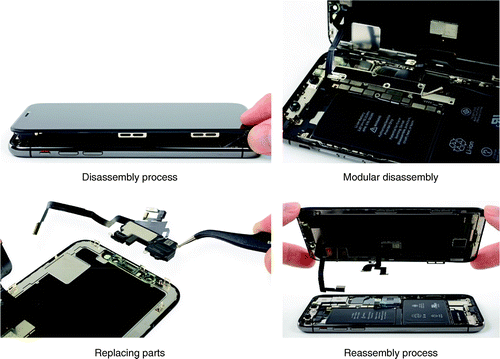
“We don’t want to end up with a pile of trash!” Chuck said to Alan, his new operations manager, as he sipped his coffee in his Ann Arbor, Michigan, office. Charles (Chuck) Newman founded ReCellular as a company specializing in trading of used and remanufactured cellphones in 1991. His remanufacturing operations converted returned and used cellphones into “like-new” condition for resale. The process included disassembling the used phone, replacing or repairing worn and broken components such as the screen or camera, reassembly, and reselling the phone as a remanufactured unit. There was a vibrant market for remanufactured cellphones. Many individuals would treat cellphones as accessories and replace their phones as soon as their carrier would permit, many times even sooner when newer models were released. They would typically return their phones to providers in exchange for a rebate on the new phone. The carriers would offer these trade-ins, partially, to keep the customer with them for the future but also because the used phones had a market. Firms like ReCellular would buy the phones, remanufacture them, and then sell them to large firms that provide company phones to their employees (Figure 1). In this way, remanufacturing operations extended the useful life of the phone, helping in environmental sustainability. When done right, they were also profitable for supply chain partners.
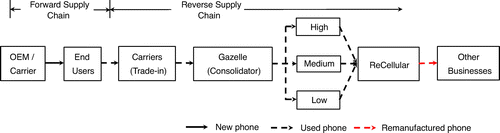
Chuck’s operations had three main activities: acquisition of used cellphones, remanufacturing them, and selling the remanufactured cellphones. Over the several years of dealing with used cellphones, Chuck realized that he should buy used cellphones only if there was a high possibility of selling them after remanufacturing. As a result, Chuck actively managed the sales and customer side of the business. The information Chuck gained from talking to his customers helped him in his acquisition decisions.
Lately, the life cycle of cellphones was getting shorter—on average, a consumer used a cellphone for about 18 months before replacing it with a newer, better device. This rate of technology evolution made Chuck realize something else—don’t end up with a pile of used cellphones that no one wants. Chuck was observing the growing inventory at ReCellular and it made him nervous. This was one of the reasons for hiring Alan as the operations manager. Chuck was simply too busy in collecting information from customers and suppliers. He wanted Alan to manage the in-house remanufacturing operations. “What is cutting-edge today, becomes obsolete tomorrow. Even companies do not want to give really old phones to their employees. We need to stay nimble,” Chuck explained to Alan.
The Quality Conundrum
“It’s interesting,” Chuck started explaining to Alan, “over the years of buying used phones, I have seen a great deal of variety in their condition.”
“What do you mean?” Alan enquired.
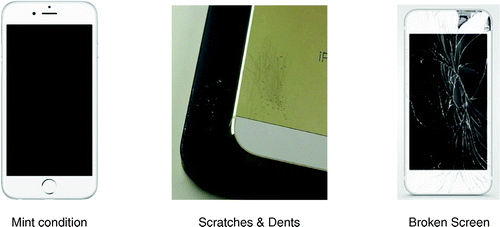
“You see, Alan,” Chuck continued, “some used phones are in mint condition. People take good care of them. Some used phones have normal wear and tear—dings and dents on the edges, like what you’d expect with normal usage.”
“Like my phone,” said Alan. “The phone works great, but the last time I dropped it, it got a dent around this edge,” Alan smiled as he showed his phone.
“Yes, like that,” Chuck confirmed.
“Then, there are some that are in pretty bad condition,” Chuck continued.
“Like the broken screen ones?” interrupted Alan.
“Absolutely,” said Chuck. “People can still make calls with them, but it’s hard to read a text message or see an image on them,” explained Chuck as he finished his coffee.
Quality and Cost Trade-off
“Well, the good thing is, as long as a phone is in working condition, we can remanufacture it to a like-new condition. It doesn’t matter whether it had dents or it had a broken screen; I can fix it on the line,” said Alan as he tried to offer his perspective from the remanufacturing line.
“I know, but it does matter in terms of costs!” Chuck exclaimed.
“A mint condition phone doesn’t cost us much labor and material to fix, but a phone with a broken screen is very expensive to fix. The cost of the parts itself is high and then the labor to disassemble and reassemble the phone—that’s not cheap either.”
“What about the acquisition cost?” asked Alan curiously. “How do the costs compare there?”
“They are the opposite,” Chuck replied as he helped himself to another cup of coffee. “The mint condition phones are expensive to buy. High quality commands a high price.”
“And by that logic, the broken phones could be bought very cheaply,” interrupted Alan.
“Yes,” nodded Chuck.
“So, we pay for it either way, right?” asked Alan. “We either spend more on acquisition and less on remanufacturing or we buy very cheap and spend more on remanufacturing.”
“Not really,” Chuck replied. “I don’t know what the demand is. We buy the phones in advance, but we remanufacture them only after I get an order.”
“If only I knew exactly how many remanufactured phones my customers want, I would buy exactly that many mint condition phones and turn them over very quickly to the customers,” Chuck exclaimed.
ReCellular acquired used phones in different quality conditions from large consolidators, such as Gazelle Inc, who bought the phones from cellphone carriers (Figure 1). Typically, the consolidators would classify the used phones into three quality levels: high, medium, and low. High-quality phones were phones that were lightly used and required very little remanufacturing effort—labor and replacement parts. As a result, they commanded a high acquisition cost. On the other hand, low-quality phones were phones that were extremely worn out and often times had broken parts. Although such phones were very cheap to acquire, remanufacturing them would be expensive. The acquisition cost and remanufacturing cost for medium-quality phones was in between the high- and low-quality ones, respectively (Figure 2 and Table 1). From a remanufacturing operations perspective, all used cellphones were remanufactured to the same specification, and customers couldn’t tell if the remanufactured cellphone was of high, medium, or low quality before remanufacturing (Figure 3).
|

Table 1. Acquisition and Remanufacturing Costs for Different Quality Levels
| Quality level | Acquisition cost | Remanufacturing cost | Selling price |
|---|---|---|---|
| High | $50 | $30 | $120 |
| Medium | $35 | $50 | |
| Low | $5 | $85 |
Planning for Flexibility
“What is it from a profit perspective—do we make the same profit on each type of used phone?” Alan enquired.
“No,” replied Chuck. “The mint condition phones typically have the highest profit margin, and the broken phones have very little margin.”
“Well, why don’t you buy only the mint condition ones and keep in stock?” asked Alan.
“Let’s say I do that,” Chuck explained as he took another sip of his coffee. “What if I buy too many and the customer places an order for very few? There is no guarantee that I’ll get another order for them again. I would have spent a lot of money in buying high-quality trash!” replied Chuck.
“In that case, what if you buy only the broken ones?” asked Alan again. “In that case, you would have not invested too much.”
“Well, that’s only part of the picture,” Chuck began to explain. “If the customer wants a lot of remanufactured phones and all we have are the broken ones, then we would have to spend a lot of money in fixing them. We’d make very little profit then! There would be so much more money left on the table!” Chuck replied, expressing his frustration.
“What if you hedge your risk by buying only the dented ones? Not too expensive to buy and not too expensive to fix,” suggested Alan.
“Interesting,” pondered Chuck. “But I don’t think that would be the best option.”
“Why so?” asked Alan.
“I know that the customer will want at least some remanufactured phones. So I think we should buy that many mint condition ones,” Chuck explained. “We would make more money at least on that quantity than otherwise!”
“If only we knew what the customer wants,” said Chuck and Alan in unison.
“So, what should we do?” asked Alan.
Assignment Questions
Draw a timeline for the decisions to be made by Alan and the cash flows associated with these decisions. Which grade is most profitable? Which is least profitable?
For the data provided in Table 1, what inventory positions would you recommend for ReCellular? Why? What is the corresponding expected profit? Consider that demand for remanufactured cellphones follows a normal distribution with a mean of 1,000 and standard deviation of 250 units.

