Case—Bayer New Drug Development Decision Making
Abstract
History: This paper has been accepted for the INFORMS Transactions on Education Special Section on Cases Based on Real-World Projects from the INFORMS Journal on Applied Analytics.
1. Decision Context
The biological products leadership committee (BPLC) composed of the senior managers within Bayer Biological Products (BP), a business unit of the worldwide Bayer Group, a $27 billion international healthcare and chemicals group based in Leverkusen, Germany, made its newly formed strategic planning department responsible for the commercial evaluation of a new blood-clot-busting drug. This drug, BAY 57-9602 (also called “Plasmin”), has reached decision point 1 (DP 1): Bayer must decide whether to begin preclinical development. BP anticipates that Plasmin will offer a new paradigm in thrombolytic drug therapy of peripheral arterial occlusion (PAO) by directly dissolving blood clots in legs, resulting in potentially safer, more-effective treatment than currently available. Current thrombolytic drugs are only moderately effective in dissolving blood clots in legs and have frequent mild/moderate bleeding complications and occasional major bleeding complications. To ensure that it makes the best new product development decisions, Bayer Pharmaceuticals (Pharma) uses a structured process based on the principles of decision analysis to evaluate the technical feasibility and market potential of its new drugs.
Even though Bayer Pharma’s use of decision analysis began in the late 1980s, the commercial evaluation of Plasmin is BP’s first decision analysis project. Previously, BP had analyzed a few business cases for review by Pharma. This project needs to be completed in three weeks so the BPLC can present recommendations to a board member of the Bayer Group. With help from the BPLC, a cross-functional project team of BP employees who have decision-relevant technical and marketing expertise was created. The project team consists of four research scientists, a clinician, a regulator, a production engineer, an industrial engineer, a marketer, and decision consultants from the strategic planning department. With the team’s input, we created the following project mission statement by asking three questions:
Why are we doing this?
• We want to improve the less invasive standard-of-care thrombolytic drug therapy for acute peripheral arterial occlusion.
• We want to identify market opportunities for Bayer.
• We want to create value for Bayer.
• We want to increase Bayer’s presence in the thrombolytic drug market.
• We want to expand Bayer’s portfolio of products.
We want to strengthen Bayer’s biological products business.
What are we going to do?
• We will conduct a worldwide Decision Point 1 commercial evaluation of Plasmin using the decision analysis cycle (basis development, deterministic structuring, probabilistic evaluation, and basis appraisal) to define the project frame, collect and integrate all decision-relevant information, create a decision-focused model, evaluate the results and generate insights, and provide a recommendation to senior management in time for DP 1.
How will we know if we are successful?
• We will consider our work successful when our evaluation is delivered on time and backed by full consensus in both the project team and the steering committee (i.e., senior management who sponsored this project) and if senior management will consider our recommendations as relevant to their decision making.
2. The Product Development Process
Product development in the biotechnology/pharmaceutical industry is time consuming, resource intensive, risky, and heavily regulated. On average, it takes nearly 15 years to research and develop a drug with a cost of approximately $1 billion. Even though the results from preclinical development are imperfect predictors of clinical (human) responses, laboratory animals remain the best practical experimental models for predicting whether a drug is safe enough to be clinically tested in humans. If the results of preclinical animal studies are favorable, a drug company can file an investigational new drug application with the Food and Drug Administration (FDA). If the FDA is satisfied with the application, then the company can choose to begin clinical development. Only half of the drugs tested in animals make it to human testing. Clinical development generally consists of three phases of human testing to determine whether a drug is safe and efficacious. In Phase 1, the company tests the safety of the drug. In Phase 2, the company gets the first indication of the drug’s clinical efficacy in its proposed use and determines the optimum dose of the drug. In Phase 3, the company confirms and expands upon the safety and efficacy data obtained from the first two phases, and the resulting data often serve as the primary basis for the FDA’s approval of the drug. In parallel with its preclinical and clinical development efforts, the company develops the production process for the drug. The company starts with a supply of material from early development and scales up the process so it can meet commercial demand for the new drug in terms of quality and quantity. Based on the data it has obtained during development, the company can choose to file a biological license application (BLA) with the FDA for permission to manufacture and market its drug in the United States. Approximately one in four of the drugs tested in humans receive approval from the FDA. Once its drug is approved, the company is free to launch the drug in the marketplace.
3. Commercial Evaluation Methodology and Process
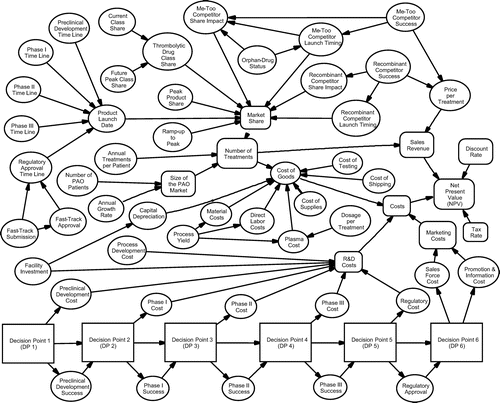
Prior to the first meeting of the project team, team members were informed of their responsibilities and the project schedule and deliverables. Within Bayer, decision consultants are responsible for managing the decision analysis cycle, facilitating the framing of the project, collecting data from the technical and marketing experts assigned to the project team, constructing the financial model, and presenting evaluation results and recommendations to senior managers. Members of project teams are responsible for keeping their functional departments informed, providing the fundamental assumptions underlying their data inputs, and defending these inputs to the highest-level decision makers. Project teams performing commercial evaluations are essential for building support committed for improving the quality of decisions within the organization. Financial data are in constant dollars. The study period is standardized at 15 years after market launch, and the risk-free discount rate is 8%. The tax rate is 21%. There is no tax credit. Bayer does not allocate corporate overhead costs in its decision analyses of new drug development projects because assigning part of existing overhead to each new project inflates the cost estimates of that project and deflates its estimated profit contribution. Bayer uses net present value as its decision-making criterion (Figure 1). The time horizon for the Plasmin evaluation is 2020–2045. Bayer makes its project portfolio decisions based on expected net present value (including whether development succeeds or fails) and expected net present value assuming development success.
4. Product Target Profile
Central to data collection is the product target profile (PTP). The PTP forms the underlying state of knowledge for assessing the technical feasibility and market potential of a new drug (Table 1). If the PTP changes, Bayer requires collecting of new data from the functional experts. The PTP must offer at least one major competitive advantage from a patient or physician perspective. Bayer requires that each PTP must specify how efficacious the drug will be in treating the disease, how safe the drug will be to patients taking the drug, and how convenient it will be to administer the drug to these patients. Drug administration includes the method of delivering the drug (e.g., orally, intravenous injection), its dose and frequency, and the site (e.g., an intensive care unit). Bayer terminates a new drug development project if the threshold of achievement for any attribute in the PTP is not attained.
|

Table 1. Product Target Profile of BAY 57-9602 (Plasmin)
| Efficacy | Equal rate of blood-clot dissolution at 24 hours when compared with thrombolytic drugs Equal rate of amputation at six months when compared with thrombolytic drugs |
| Safety | Decreased major bleeding complications from 10% to 5% when compared with thrombolytic drugs Reduced febrile reactions when compared with thrombolytic drugs Reduced allergic reactions when compared with thrombolytic drugs |
| Convenience | Delivered intra-arterially via catheter with an infusion time <12 hours Lyophilized vial stable at room temperature for 24 months Four hours stability at room temperature when reconstituted |
5. Clinical Development
Bayer scrutinizes clinical development closely because investigational drugs are first introduced into humans at this stage, and clinical development is the most expensive stage of drug development. Phase 1 is designed to test the safety of Plasmin. Phase 2 is designed to identify the optimal dose of Plasmin to use in Phase 3. The objective or the clinical endpoint of the Phase 2 study is to demonstrate that the rate of dissolving the blood clot 24 hours after taking Plasmin is equal to the rate of dissolving the blood clot 24 hours after taking thrombolytic drugs. Phase 3 is a statistically designed study for proving either an efficacy clinical endpoint or a safety clinical endpoint of Plasmin. To establish the efficacy clinical endpoint, one must demonstrate that the rate of amputation in patients six months after taking Plasmin is equal to the rate of amputation in patients six months after taking thrombolytic drugs. To establish the safety clinical end point, one must demonstrate that the rate of major bleeding complications in patients taking Plasmin is lower than the rate of major bleeding complications in patients taking thrombolytic drugs. For each stage of development, costs, timelines, and probabilities of success are required.
Fast-track review of the BLA for Plasmin is possible because the need for safer and more effective thrombolytic drugs in PAO. The U.S. government passed fast-track legislation to facilitate development and expedite review of drugs that demonstrate the potential to address unmet medical needs in the treatment of serious or life-threatening conditions.
Plasmin could also be eligible for orphan-drug status. The U.S. government passed orphan-drug legislation to encourage development of drugs to treat serious or life-threatening diseases that affect fewer than 200,000 patients and have no effective cure or treatment. FDA-approved orphan drugs receive a 7-year period of market exclusivity in the United States (10 years in Europe) guaranteeing that no other drug may be approved for the disease unless it demonstrably provides better efficacy or safety.
6. Market Conditions
Launching a new drug in the marketplace with the goal of achieving maximum penetration and exposure is an expensive advertising and public relations effort. It requires making sales visits to physicians, hosting medical advisory meetings, sending representatives to symposia, providing press releases, and conducting postmarketing studies. Estimating the cost of such efforts depends largely on estimating the number of physicians who would administer the drug. For example, Bayer estimates that the marketing cost for Plasmin would be less than the marketing cost for an asthma drug because fewer physicians treat PAO than treat asthma. Interventional radiologists and vascular surgeons and some general radiologists would likely administer Plasmin to treat PAO. As is standard in most Pharma DP 1 commercial evaluations, it was assumed Plasmin would be launched in eight countries: the United States, Canada, France, Germany, Italy, Spain, the United Kingdom, and Japan.
In the United States, about 110,000 patients were hospitalized for PAO. There are two classes of treatment for PAO: thrombolytic drugs and surgery. Currently, more than half of PAO patients in the United States receive thrombolytic drug therapy instead of the surgical procedures (e.g., thrombectomy, angioplasty, bypass graft, mechanical reperfusion, or leg amputation), whereas fewer than half of PAO patients in Europe and Japan receive thrombolytic drug therapy. If the thrombolytic drug therapy is ineffective, surgery is performed. As better thrombolytic drugs become available, use of thrombolytic drug therapy should increase, particularly in Europe and Japan. The products in the thrombolytic drug class that are marketed for treating PAO are called plasminogen activators. All plasminogen activators work by the same mechanism and thus have the same limitations in efficacy and complications of bleeding. Plasmin works by a different mechanism and is expected to lack these limitations, giving it a sustainable competitive advantage over plasminogen activators.
Treating PAO is expensive. Current thrombolytic drug therapy takes approximately 24 hours and requires several trips to the radiology suite for x-rays and a stay in a critical-care unit. In the United States, the cost for thrombolytic drug therapy for PAO is approximately $2,000–$4,000, whereas the cost for PAO surgery is approximately $22,000.
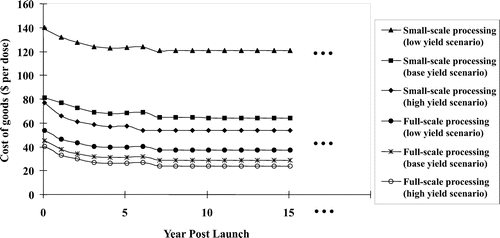
As a biologic manufacturer, BP is concerned about the cost of goods (COGS) for Plasmin. As shown in Figure 1, COGS depends on capital depreciation, material costs, direct labor costs, plasma cost, cost of supplies, shipping costs, cost of testing, and the number of treatments. In addition, direct labor costs, material costs, and plasma cost depend on the yield of the production process; higher yield results in lower costs. The industrial engineer assigned to the project team created six scenarios to estimate the COGS for Plasmin based on the scale of the production process and its yield (Figure 2).