


Game—FloraPark (the Flower Game): A Supply Chain Contract and Collaboration Simulation
Abstract
Intensive competition among supply chains often forces trading partners to collaborate despite their conflict of interests. Supply chain contracts and collaboration theory is well established in the academic literature to align the interests but much less conveyed to students and industry professionals for a practical impact. Although the Beer Game captures the bullwhip effect and the value of information sharing, it ignores the conflict of interests, that is, price and quantity bargaining, among the trading partners. We describe a new online teaching game, the FloraPark simulation (“the flower game” at https://flower.gamespots.net/), based on real-life events in the international fresh-cut flower supply chains, for students to learn supply chain collaboration via contracts in a setting of multiple supply chains competing in the same market. Students play trading partners in the flower supply chains and experiment with the push, pull, and advanced purchasing discount contracts by negotiating wholesale prices and quantities to achieve the conflicting objectives of (1) collaboration to beat other supply chains, and (2) bargaining to protect their own interests from their trading partners.
Supplemental Material: The e-companion is available at https://doi.org/10.1287/ited.2022.0035.
1. Introduction
Abundant literature on supply chain collaboration via contracts accumulates enormous knowledge on interest alignment in collaborations but one question remains, how to convey the ideas to students? The theory and underlying mathematics (even in the simplest form) quickly overwhelm the students. In reality, trading partners are self-interested organizations that must confront price and quantity bargaining (“back-stabbing”) before coordination (“hand-shaking”). There are hardly any instructional games or simulations covering both “back-stabbing” and “hand-shaking” in the supply chain management curricula.
Trading partners in one supply chain often find themselves in a paradox: on one hand, fierce competition from other supply chains forces them to collaborate and synchronize their operations to increase the total pie for them all; on the other hand, the inherent conflict of interests among trading partners may induce them to seek self-interested actions in order to increase their own share of the pie. For instance, in a typical wholesaler supplying retailer example, the wholesaler would always like to increase its selling price (the wholesale price) and receive a stable and increasing order quantity from the retailer for a better revenue while the retailer would always prefer a lower wholesale price and more flexible order quantity to control its cost. Without the threat of competing supply chains, the trading partners may engage in “back-stabbing” actions such as throat-cutting price and quantity bargaining and concealing critical information from each other. With the threat of competing supply chains, however, the trading partners must learn to strike a balance between “hand-shaking” and “back-stabbing” via supply chain contracts.
FloraPark simulation is designed for students (e.g., undergrads, masters, and executives) to learn how to strike the balance between “hand-shaking” and “back-stabbing” in supply chain collaboration, through two ways: (1) with multiple supply chains competing in the same market, the trading partners in each supply chain must collaborate (“hand-shaking”) to grab a bigger pie for their supply chain. (2) The conflict of interests, as introduced by the price and quantity bargaining (“back-stabbing”), forces them to fight against each other to get a better share for themselves. The simulation puts the trading partners in this paradox and forces them to come up, together, with a supply chain contract that can do both, that is, winning the competition against other supply chains, and defending their interests against their partners.
Student teams, playing the trading partners, can experiment with various supply chain contracts such as pull, push, and advanced purchasing discount contracts (Cachon 2004, Dong and Zhu 2007) in price and quantity negotiations. Through this game, they can figure out the coordinating contracts by themselves, and learn an important life lesson on how to collaborate with their trading partners to win the competition against other supply chains while simultaneously defending their interests against their trading partners, who could be their “worst” enemy. Instructors can hold interactive plenary sessions in between game rounds to guide students to achieve supply chain coordination via contracts and help them build skills in strategic thinking from the C-suite team’s perspective, supply chain competition, supply chain marketing interfaces, negotiation and teamwork.
In what follows, we first review the literature by showing how the flower game complements and contributes to the literature of supply chain related teaching games. Then we discuss the flower game in depth by explaining the teaching objectives, topics covered, game background and setup, pedagogical design, and assignment and grading. Finally, we show the impact and learning outcomes of the game by student feedback and assessments.
2. Literature Review
Business schools equip students not only with theoretical knowledge but also practical skills. Simulations grounded in Kolb’s Experimental Learning Theory (ELT) bridge practical skills and theoretical knowledge (Ben-Zvi and Carton 2007, Griffin 2007, Wood 2007), increasing learner engagement in the short term (Vos and Brennan 2010) and students’ employability (Halfhill and Nielsen 2007) in long term.
It is challenging to convey the fundamental knowledge of supply chain contracts and collaboration to students by merely lecturing the theories. As an alternative teaching strategy, role-playing games and simulations can be effective. For instance, one of the most popular supply chain games, the “Beer Distribution (Beer) Game” (Sterman 1984), is used to teach supply chain coordination and the value of information. The beer game allows students to control different segments of a supply chain where they receive orders from their immediate downstream and place orders to their immediate upstream. The beer game can effectively demonstrate the bullwhip effect and how the bullwhip effect may be mitigated by information sharing. The FloraPark simulation (flower game) complements the beer game in two ways (Figure 1): (1) The beer game focuses on order quantity coordination but ignores price bargaining—the main cause for the conflict of interests among the supply chain partners, which is captured by the flower game; (2) The supply chains in the beer game do not compete but rather serve different markets. However, the supply chains in the flower game are competing against one another in the same market, meaning that one supply chain’s gain in the market share can only come from others’ losses.
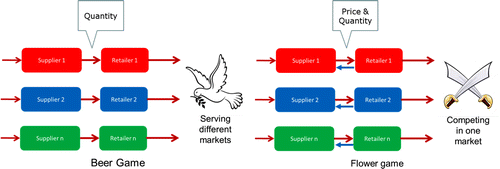
The FloraPark simulation includes both the order quantity and price bargains in the trade between the supply chain partners in a setting of multiple competing supply chains. Thus, the game effectively plants the seed of conflict in their minds when they compete (as one) against other supply chains. The partners in the same supply chain must collaborate with and fight against each other at the same time. The goal of FloraPark simulation is to bring two parties (trading partners) with conflicting interests into one team to fight against common threats—the other competing supply chains. By experimenting with various price-quantity contracts, students learn two key lessons: (1) If you fight your partner, your supply chain cannot win, that is, “live as one or die as two.” (2) Even if your supply chain wins, you may not; ultimately, they must guard their own interests to avoid sacrificing themselves for their partners’ success.
Among recent developments in supply chain games, several simulations establish supply chain collaboration and/or competition as the core learning objective. The “Lean Leap Logistics Game” developed by Holweg and Bicheno (2002) aims to foster collaboration among activities in the manufacturing process for the steel industry. Arunachalam and Sadeh (2005) created the “Supply Chain Management Trading Agent” game to make supply chain bidding, sourcing, and procurement decisions. Wood (2007) summarizes the learning outcomes of multiple online games. D’Amours and Rönnqvist (2010) provides a collaborative logistics game based on the forest industry to teach transportation collaboration such as negotiation, profit sharing, and coalition-building. Fetter and Shockley (2014) presents a spreadsheet simulation that models multitier supply chains with competing products for students to learn the benefits of strategic supplier collaborations in inventory management. Wright (2015) presents the “Zu Zitter Game” in which student teams practice process development through activities such as the process design and layout, capacity planning, inventory management, process improvement, and quality control. The “Wood Supply Game” (D’Amours et al. 2017) extends the Beer Game to the forest industry by considering one point of divergence and demand for two products. This game provides a more realistic context relevant to divergent industries for students to experience the bullwhip effect and see the positive effect of collaboration strategies such as relocating inventory. The “Forest Logistics Game” (Abasian et al. 2020) allows students to engage in collaborative hierarchical planning; students are tasked with achieving the best purchasing and best transportation costs in one forest supply chain with multiple companies.
Horizontal logistics collaborations may generate substantial cost savings. However, such collaborations may end due to mistrust about the fairness of gainsharing. Barbarino and Boute (2021) provides an exercise to understand the challenges in collaborative gainsharing. Feng et al. (2020) develops an activity-based “Reality Game” which includes a case method, and the role plays by students and stakeholders in a classroom setting. In this setting, students apply the supply chain management knowledge learned in class to develop proposals for new business development, new supply chain designs, or business improvements. The flower game is complementary to previous work, as it simulates multiple competing supply chains within each company must negotiate a price-quantity contract to coordinate their efforts in matching demand with supply while defending their own interests.
Jaureguiberry and Tappata (2015) describes a pricing game in the travel booking industry where players assume the role of hotel managers in charge of pricing strategies for transparent and opaque selling channels in both peak and off-peak seasons. The simulation provides a learning approach to the economic principles that govern pricing in opaque markets. In contrast, wholesale prices (and quantities) in the flower game are the outcome of negotiations between companies in the same supply chain as they attempt to maximize their share of the total supply chain profit. Song et al. (2021) describes a shortage game to simulate panic orders, hoarding, and price inflation in a supply chain with one distributor serving multiple retailers. The retailers serve independent markets and compete for a limited supply.
Table 1 summarizes the literature by applications, learning objectives, supply chain or product structure and contract type. The FloraPark simulation complements the literature with a new game setup and learning objective. It is the first game that combines competing supply chains (in the same market) with price-quantity contracts, with the learning objective of striking the balance between two conflicting objectives in supply chain collaboration: (1) collaboration to beat other competing supply chains, and (2) bargaining to defend their own interests from their trading partners.
|

Table 1. Literature Review Summary
| Authors (year) | Application | Teaching objective | Supply chain/product structure | Contract type | Format |
|---|---|---|---|---|---|
| Holweg and Bicheno (2002) | Supply chain coordination for steel in automotive industry | To demonstrate supply chain dynamics, collaborations and to model possible improvements to an entire supply chain | A multicompany supply chain: one manufacturer, two distributers, six buyers | Quality, quantity, inventory, cost | Online |
| D’Amours and Rönnqvist (2010) | Logistics optimization in forest industry | To teach negotiation, coalition building, and cost/profit sharing in various information scenarios | One stage, multiple one tire players | Cost and quantity | Online |
| Fetter and Shockley (2014) | Inventory optimization through co-opetition | To teach bullwhip effect, supply chain co-opetition, and product substitutability within a multilevel supply chain | Up to six manufacturers (products) through five supply chain stages from customer, to manufacturers | Quantity only | Excel based |
| Jaureguiberry and Tappata (2015) | The hotel game: Revenue optimization | To teach pricing, revenue management, marketing, and strategy under price asymmetry | Multiple hotels are competing in the marketplace of two segments | Price and quantity | Online |
| Wright (2015) | Production process optimization | To teach production process design and layout, scheduling, product mix, quality control, and material ordering | Two-level supply chain | Price, quantity, shipping cost | Online |
| D’Amours et al. (2017) | The wood supply game: Wood production and distribution | To teach product-mix planning under supply chain constraints through forecasting and risk management | One supplier serves two buyers by allocating raw materials among two products | Quantity only | Online |
| Abasian et al. (2020) | The transportation game in the forest industry | To teach resource planning and allocation in purchasing and transportation | Three buyers procure two products through three supply chain stages | Quantity discount | Online |
| Feng et al. (2020) | Supply chain coordination | To teach supply chain management issues in a real-life business environment | Supply chain members and various stakeholders | N/A | Online, Offline |
| Barbarino and Boute (2021) | Cargo allocation | To demonstrate a benefit of collaboration based on volume-based allocation rule | One stage, multiple one tire players | Price | Paper based |
| Song et al. (2021) | The Hunger Chain for shortage gaming | To teach panic orders and hoarding and prisoners’ dilemma under supply shortage | One supplier with a limited supply serves multiple retailers | Quantity only | Online |
| Beergame.org (2022) | Beer Game: Beer production and distribution | To teach the bullwhip effect and value of information sharing | Four-stage supply chain with one retailer, one wholesaler, one distributor, and one factory | Quantity only | Online |
| This paper | Flower Game: Supply chain collaboration & competition | To teach supply chain coordination via contracts, strategic thinking, competitive strategies, and negotiation | Multiple supply chains of wholesalers and retailers competing in one market | Price and quantity | Online |
3. Game-Based Learning Approach
The FloraPark simulation is a supply chain strategy game designed for students to learn how to strike the balance between “hand-shaking” and “back-stabbing” in supply chain collaboration by three features: (1) Multiple supply chains are competing in the same market; (2) It is a total business game that provides students with the C-suite team perspective where students make decisions on product portfolio, pricing and marketing, and supply chain contracting; (3) Students can experiment with various price-quantity contracts, such as push, pull, and advanced purchasing discount contracts, to coordinate the supply chain.
Playing the roles of supply chain trading partners, students can answer the following question from playing the FloraPark simulation: How to collaborate to win the competition against other supply chains while defending their own interests against their trading partner? In other words, how to manage the trading partner conflict (“back-stabbing”) in a supply chain to achieve coordination (“hand-shaking” or “win-win”) outcome? The FloraPark simulation can be used to cover a wide range of topics from strategic thinking, competitive strategies, marketing and pricing, to supply chain collaboration via contract, teamwork and negotiation.
3.1. Game Background Story
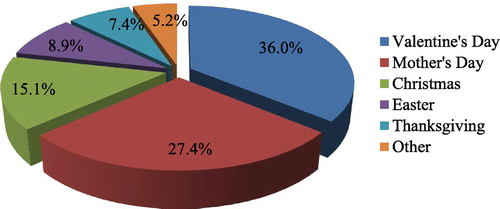
FloraPark (the flower game) simulates the international fresh-cut flower supply chain, which is one of the most challenging industries for international supply chain management (Zhao 2012). Fresh-cut flowers are perishable items; for instance, roses only have a shelf life of 14 days. The lead time is relatively long (2–13 days by airfreight), and the yield loss in logistics is huge, on average 35% spoilage during importing and wholesaling. The demand is highly seasonal and unpredictable; for instance, Valentine’s Day accounts for 36% of all holiday sales in the United States (Figure 2). The market competition is intensive: on Valentine’s Day, every shop is selling flowers, even gas stations. This is a business that relates to everyone.
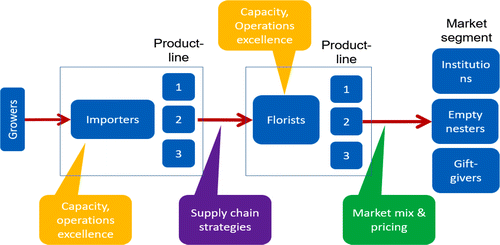
The international fresh-cut flower supply chain between flower growers and end consumers typically consists of two trading partners: importers (wholesalers) and florists (retailers), with each playing an indispensable and distinguished role. Importers buy the flowers from growers and are responsible for the brokerage, customs clearance, storage, and shipping. Florists take care of decoration and storage before selling the flowers to consumers. A total of 60% of the fresh-cut flowers sold in the United States come from major exporting countries such as the Netherlands, Colombia, Ecuador, and Israel (Zhao 2012).
3.2. Game Setup
FloraPark simulation is set up in a competitive environment where multiple fresh-cut flower supply chains are competing for a share of one market. Each flower supply chain consists of two student teams one playing the importer and one playing the florist where the importer secures supplies and the florist generates demand. Changing trading partners during the game is not allowed, so students must learn how to collaborate with their trading partner.
In the FloraPark simulation, the florist and importer play an indispensable role with related decision-making responsibilities (Figure 3). The florists provide three product lines (baseline, feature, exotic) from low-end to high-end to various market segments such as institutional buyers (e.g., weddings, funeral homes, hotels, restaurants, conferences, etc.), empty nesters (e.g., parents with kids grown up and leaving their homes), and gift-givers (e.g., lovers during Valentine’s Days). A florist makes decisions on its retail pricing, marketing mix, sales and operations planning such as production capacity and operations excellence (OE, referring to spending on quality control, process improvement, and technologies, etc. to improve operational efficiency), and supply chain contract negotiation with the importers (Figure 3). The importers manage their corresponding product lines, negotiate supply contracts with the florists, and make decisions on the supply (e.g., how much to buy from outside growers), production capacity, and OE.
Based on industry data (Zhao 2012), the benchmark prices along the fresh-cut flower supply chain are illustrated in Table 2. As we can see, the prices increase significantly (∼100 times) as we move downstream the supply chain. Except for the growers’ prices (which are fixed in the game), the wholesale prices are determined by the importer and florist upon negotiation, and the retail price is the florist’s decision.
|
Table 2. Product-Lines and Prices
| Baseline (low end) | Feature (medium) | Exotic (high end) | |
|---|---|---|---|
| Grower | $0.01/stem | $0.04 | $0.1 |
| Wholesale | $0.05 | $0.3 | $0.9 |
| Retail | $0.25 | $2 | $8 |
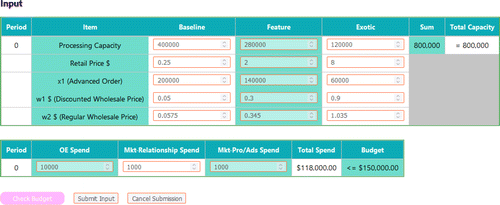
In each season (round), students can use input tables to make their decisions. Figure 4 showcases a florist’s input table; the importers’ input table is illustrated in Figure 5, which is similar and simpler. For florists, the sum of the production capacities of all product lines (baseline, feature, exotic) is fixed at 800,000. However, florists can change the capacity allocation, for instance, shift a part of the baseline capacity to feature subject to a cost and delay of one round to be effective. Florists can set their retail prices (for all product lines), OE spending, and marketing spending for both relationship and promotion/advertising. To determine ×1 (or ), w1 () and w2 (), the florist must negotiate with their importer. These numbers must match the corresponding number of the importer to be accepted by the system because they must be agreed upon by both florist and importer and binding to both partners. A florist’ total spending is the sum of the florist’s advanced-purchasing cost (procurement cost associated with ×1), operations excellence (OE) spending, and marketing spending on both Relationship and Promotion/Ads. To ensure a fair competition, no florist can spend more than a budget, that is, a florist’s total spending in each round must be less than or equal to the budget, which is the same for all florists. Each florist should check if the budget is exceeded before submitting its decisions.
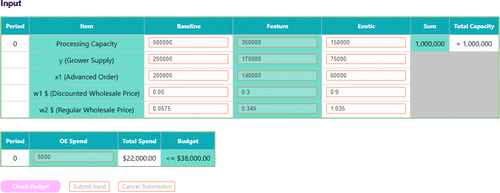
For importers, the sum of the production capacities of all product lines is fixed at 1,000,000. Importers can make decisions on their production capacity allocation, acquisitions (y or ) from the growers, and OE spending. ×1 (or ), w1 (), and w2 () must be negotiated with the florist (Figure 5). An importer’s total spending is the sum of the importer’s purchasing cost and operations excellence (OE) spending. To ensure fair competition, no importer can spend more than a budget, that is, an importer’s total spending in each round must be less than or equal to the budget, which is the same for all importers. Each importer should check if the budget is exceeded before submitting its decisions.
3.3. Game Events and Supply Chain Contracts
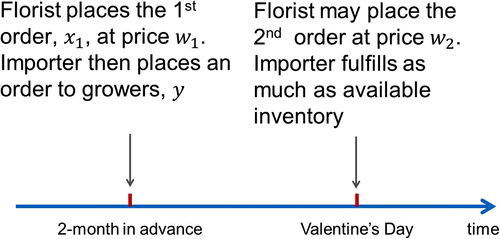
The flower game is played for multiple (e.g., six) seasons (rounds) for students to learn by trial and error. In each season, the following sequence of events takes place (Figure 6): Before the selling season, the florist places the first order, units (stems of flowers), at the unit price , which is the regular wholesale price. The importer then orders units from the growers (note that the prices from the growers are fixed). During the selling season, the florist (facing an unusually high demand) can place the second order at an emergency wholesale price . The importer fulfills the second order as much as available inventory. Note that students only make decisions regarding , , and . The second order is automatically determined by the demand surplus and the importer’s available inventory—thus, it is not a decision.
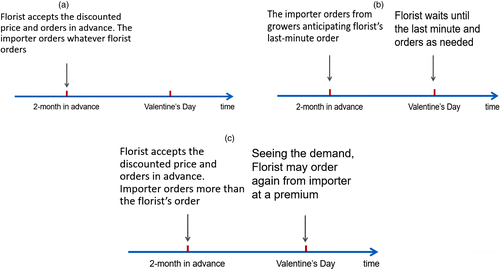
The FloraPark game embeds three price and quantity supply contracts that are well known in the literature (Cachon 2004, Dong and Zhu 2007) and popular in practice: (1) Advanced order, the push contract (Figure 7(a)); where the florist (retailer) orders and holds all the inventory in advance and waits for demand. This contract is achieved by the importer ordering just enough to fulfill at without carrying extra inventory to sell to the florist at in the season); (2) Last-minute order, the pull contract (Figure 7(b)); where the florist orders no inventory in advance () but only orders as needed in the season, thus effectively pushing all the inventory to the importer (supplier).
For the florist, the push contract has the benefit of a price discount and a guaranteed supply but with a high inventory risk and a high up-front budget requirement (Table 3). The pull contract can reduce the inventory risk and up-front budget for the florist, but she may suffer a short supply and a higher acquisition cost. From a risk perspective, the florist takes all the risk while the importer is risk free in the push contract; in the pull contract, the importer takes all the risk while the florist is risk free.
|
Table 3. Supply Contracts’ Pros and Cons for Florist (Retailer)
| Advanced order (push) | Last-minute order (pull) | |
|---|---|---|
| Pros | Price discount & guaranteed supply | Less budget required No inventory risk |
| Cons | High budget requirement High inventory risk | Short supply & higher cost |
Students can try a hybrid strategy by mixing the push and pull contracts to the so-called advanced purchasing discount contract (Figure 7(c)), where the florist can buy a safe amount in advance before the selling season and can encourage the importer to hold the extra inventory for her just in case by paying a higher in-season emergency wholesale price (). Effectively, the florist and importer share the risk and return in the hybrid strategy (advanced purchasing discount contract).
From what we observed in actual games, students usually start with the push contract because it is simple and intuitive. Soon, they may find the benefit of raising emergency wholesale price () because it can motivate the importer to carry more inventory and share the demand risk, which is the hybrid strategy and the win-win strategy. Thus, students can renegotiate the type of contracts during the game in addition to the contract terms. The instructor can guide students in this direction by showing them the benefits of the hybrid contract (teaching slides are provided via links in the appendix).
3.4. Pedagogical Design
Before the game, instructors should debrief the class about the game and put students into an even number of teams. Instructors assign each team to a role of either the importer or florist and pair them up into supply chains. The flower game typically runs for six seasons (rounds), with each round taking 45 minutes to one hour for students to analyze the results and negotiate the supply contracts. Before making decisions in each round, each team needs to get a sense of the demand it faces. An importer’s demand is its florist’s orders which depend on the supply contract. A florist’s demand depends on many factors including its past demand, its retail price and the retail prices of all competing florists, all florists’ product quality (depending on their OE spending), and their marketing spending (on relationship and promotion). In the first three rounds, florists only know their own past demand; however, the total demand (sum of demand across all florists for each product line) is made available to the florists so they can calculate their market shares. Starting in the fourth round, completed information (including all florists’ demand history, wholesale prices and quantities, and their OE and marketing spending) is made available to all teams, simulating the situation of transparent competitive information.
Teams submit their decisions for each round and receive the outcome and feedback from the instructor on the financial performance of all firms and supply chains. The students then proceed to prepare for their decisions in the next round. To achieve the best learning outcome, the instructor can hold interactive plenary sessions between the rounds to (1) publish the game’s financial results (to create a sense of competition and urgency), providing feedback to the students, and (2) blend various lectures with the game to provide hints and theory on how to improve the game’s outcome. Through multiple iterations of results, lectures, and interactive student discussion sessions, students can first play, then learn from their own experience and play better for the next round (Table 4).
|
Table 4. Screen Play (6–9 Hours, In or Out of Class)
| Lecture/plenary sessions | Before game round |
|---|---|
| Supply chain challenges & key lessons | First |
| Strategic thinking, integrating supply chain/marketing decisions | Second |
| Effective teamwork and group decisions | Third |
| Coordinate supply chain via price & quantity contracts | Fourth |
| Competitive supply chain strategies | Fifth |
| Negotiation | Sixth |
| Game trajectory: Reflections – From Game to Practice | Reality-show |
The simulation was originally designed for one-day and half executive programs, later it was used for MBA and undergraduate students as a capstone project which allows them integrate learnings from various business disciplines such as marketing, operations, and management strategies. The simulation (with supporting instructional modules and feedback/discussion sessions) can take 6–9 hours in total with the negotiation of the price-quantity supply chain contracts taking the most time. Instructors can run it over a few weeks, either completely in class or in a combination of students using time outside of class to negotiate and make decisions, and instructors using in-class time for lectures and interactive discussion sessions.
The simulation can cover a rich range of topics from strategic thinking, competitive strategies, marketing and pricing, to supply chain collaboration via contract, teamwork and negotiation (see Table 4). We would suggest the following screenplay for the game: before the first round, the instructor can introduce the game to get students prepared. After the first but before the second round, the instructor can lecture on strategic thinking from the C-suite team’s perspective to help students set up their mission and vision for their firms. The instructor can also help students understand the key trade-offs between supply chain and marketing decisions; that is, with a limited budget, where do you spend? On marketing to generate demand or on the supply chain to secure the supply? A firm must carefully balance its spending to avoid situations such as when a significant demand is generated, but there is not enough supply, or when a large amount of supply is secured, but there is very little demand. Both situations are disastrous and likely to happen in the real life.
Before the third round, the instructor can discuss teamwork and group decisions. This is important in the game because it is not only data heavy (three product lines and three market segments) but also negotiation and confrontation intensive, as the supply chain contract needs to be agreed upon by both trading partners. Before the fourth round, the instructor can talk about supply chain coordination using price and quantity contracts. At this point, most students have already tried the pull or push contracts, so the instructor can give students a hint about the hybrid (advanced purchasing discount) contract, which may lead them out of the throat-cut bargaining to a win-win outcome. Before the fourth round, students can only see the retail price and financial outcomes of their competing supply chains. During the fourth round, students can see the competitive information—details of their competitors’ actions such as production capacity, supply contracts, and their spending on marketing and OE. Before the fifth round, the instructor can talk about competitive supply chain strategies such as how to utilize competitive information. The instructor may talk about negotiation before the last round.
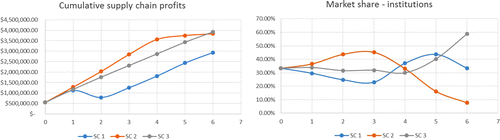
After the game is over, it is beneficial to show the game trajectory (on profitability and the market share, etc.) so that students can visualize their gaming experience to reinforce their learning. Figure 8 shows an example trajectory: we can observe that SC (Supply Chain) 3 initially lagged behind but eventually overtook the leading SC 2 and won the game at the end using the advanced purchasing discount contract. Thus, the results can be dramatic, and all kinds of events such as cheating, deceiving, and back-stabbing can happen between trading partners. Although the winning (and most profitable) florist and the winning (and most profitable) importer may not be in the same supply chain, better performers are more likely to come from better synchronized supply chains. The worst performers often come from distrusting supply chains that engage heavily in back-stabbing. Winning teams also tend to have a more balanced approach toward demand generation and securing supply.
To wrap up the learning experience, the instructor may call for a reality show where students can share their experiences and learning, and tell their stories. This is when students learn the most: all competing supply chains in the same market get together and share their strategies, the results can be inspiring. The instructor can ask each team to share the answers to the homework assignment (Section 3.5), such as their most compelling sights, as well as their learnings on collaboration, competition, strategic thinking, and negotiation. The instructor can also ask each team how they collaborated (which supply contract(s) were used) while watching out for their own interests, what they plan to change next time, what suggestions they may have for their partners, etc.
3.5. Homework Assignment and Grading
The simulation has the following requirements:
Participation: students are expected to attend all sessions, do their assigned readings, participate actively in team discussions, decision-making, negotiation and plenary discussions, and play the spokesperson or supporting roles for team presentations.
A reflection paper: Student are asked to analyze their gaming experience and provide their most compelling insights from the game as well as key learnings/take-aways on these topics:
∘ Supply chain collaboration
∘ Supply chain competition
∘ Strategic thinking
∘ Negotiation
∘ Teamwork
Students are also asked to provide explicit answers to the following questions:
∘ How did you collaborate with your trading partner while defending your own interest?
∘ What would you do differently next time?
∘ What suggestions do you have for your trading partner?
Student grades will be based on
Participation and contribution to the game, including plenary discussions and presentations (40%).
The reflection paper (60%), by concrete examples and evidence.
4. Impact and Learning Outcomes
4.1. Student Feedback Text Mining Analysis
As of January 9, 2022, the FloraPark simulation (“the flower game”) has been used by 20 plus instructors from half a dozen universities in the United States, Singapore, Hong Kong, and China, with about 300 student teams. We assess the students’ feedback with their answers to the two questions in the assignment: (1) Identify and discuss the most compelling insights that you learned from the game, (2) your key learnings/take-aways on supply chain collaboration, supply chain competition, strategic thinking, negotiation and teamwork. We collected 52 reports from a supply chain MBA course in the 2018 Spring semester (see Table 5 for sample student feedback). To examine students’ feedback regarding the game, a descriptive analysis was used through text mining, which helps identify students’ perceptions and understanding of the game. We began the analysis with the text preprocessing, which includes (but is not limited to) the removal of stop words and special characters using Python (Song et al. 2021). After the corpora were cleaned, we applied the N-gram text-mining method, which includes: (1) a word cloud analysis, (2) an N-gram analysis, and (3) a sentiment analysis.
|
Table 5. Sample Student Feedback
| The supply chain strategy games [FloraPark] … were exceptional learning experience. |
| The most compelling learning was the conflicting motivations between the firms in the supply chain. There must be a careful balance between self-interested actions to capture the maximum amount of value from the supply chain and collaboration to compete against the other supply chains. |
| Part of our supply chain strategy was for the importer to carry most of the inventory risk. Since we were carrying this risk, we were able to negotiate better ×2 prices in order to be compensated for the risk. This was beneficial for the entire supply chain as it allowed the retailer to invest more in marketing. Their investment in marketing allowed them to obtain a significant percentage of the market share and to become extremely profitable. Since our retailer was profitable, there were able to pass on some of the profitability to us for holding their inventory. We were critical to each other’s success and our strategy would not work if both of us didn’t participate. Our combined strategy was greater than any individual strategies we could have. |
| We noticed other supply chains tried to profit at the expense of their partners by raising prices. This affected their ability to collaborate as groups. |
| I realized that supply chain visibility is very important and as we shared our demand forecasts with the importer, he was able to plan better and cater to our demand. |
| I also learned that strong communication, effective collaboration, and transparency were critical. This included communication amongst the importer team members as well as communication with our retailer colleagues. |
| This shows the need to not only have a strategy, but to do market research and see what your competition is doing. |
| The most compelling lesson that I learned after participating in this experiment was that the key to success was communication throughout the supply chain. |
| Thus, although we wanted to be Price Leaders but it was no longer feasible since the importers increased their price drastically, we were left with no choice but to soar our prices high. |
| To find the reason behind it, the OE expense was double folded, but it failed. |
| Unfortunately, the consumers were not aware of the lowest price florist 3 was offering since we were spending very little money on marketing, promotions and relationships. |
| We also should have asked each of our members for their opinion, before negotiating, as that could have given us different viewpoints on how to tackle the problem. |
An N-gram analysis is one of the most popular descriptive techniques used in text mining (Nadkarni et al. 2011, Sidorov et al. 2014), which facilitates an evaluation of the learning effect. According to Brysbaert et al. (2018), the frequency effect overlaps with the decelerating learning curve observed in repeated tasks. Therefore, unigram, bigram and five-gram tokens were used. The semantic diversity based on an N-gram analysis helps evaluate students’ lexicon in the supply chain field after playing the game.
4.1.1. Word Cloud.
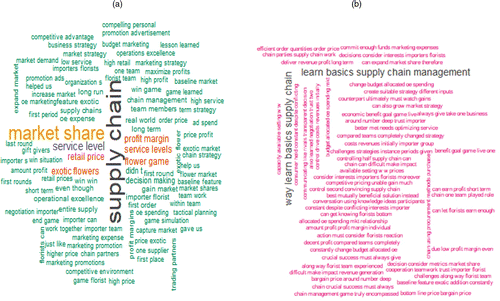
A word cloud is utilized to visualize the game’s relevance to the specific class content, such as supply chain management and competition, from which one can conclude if the game has correctly conveyed its purpose (Kuo et al. 2007, Burch et al. 2014). The word cloud of bigrams (Figure 9(a)) shows that the phrase “supply chain” and “market share” were detected as the primary bigrams, reflecting the theme of the FloraPark simulation and its competitive nature. The word cloud of five-grams (Figure 9(b)) shows that the game is suitable for learning the basics of supply chain management, given that the most common five-grams include “earn basics supply chain management” and “way learn basics supply chain.”
4.1.2. N-gram Analysis.
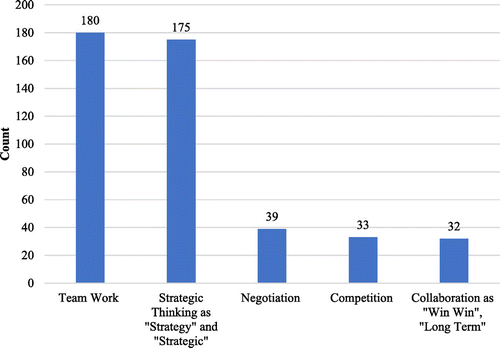
Accessing students’ feedback with the N-gram technique, we first searched for word co-occurrences that reflect the five objectives of the game: “Collaboration,” “Strategic Thinking,” “Negotiation,” “Competition,” and “Team Work.” According to Figure 10, students explicitly mentioned four out of the five game objectives, including Competition (33 times), Strategic Thinking as “Strategy” (150) and “Strategic” (25), Negotiation (39), and Teamwork as a “Team” (180). We noticed that the “Win-Win” word combination is one of the most frequent bigrams in our corpora and was mentioned 16 times, which reflects the main goal of supply chain collaboration, that is, to reach mutual benefits (a win-win outcome) for all partners. In addition, successful collaborative practices in the supply chain are characterized by long-term planning (Ramanathan and Gunasekaran 2014). Based on the bigram analysis, the word co-occurrence of “Long Term” happened 16 times, and the trigram analysis shows the occurrence of “Long Term Strategy” six times. Therefore, all five game objectives are reflected by the students’ comments. According to our analysis, the simulation significantly impacted students’ understanding of two essential metrics that contribute to supply chain success: strategic thinking and teamwork. Both are crucial factors since they allow business professionals to manage uncertainty better (Essex et al. 2016).
4.1.3. Sentiment Analysis.
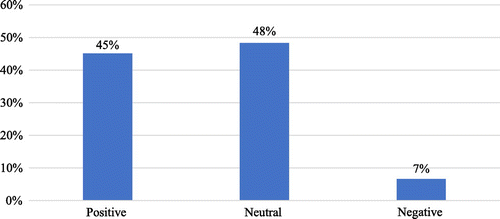
Sentiment analysis (SA), known as opinion mining, was performed using VADER (Valence Aware Dictionary and Sentiment Reasoner), one of Hutto and Gilbert’s (2014) most popular SA libraries in 2014. To compute the sentiment score, VADER scans a text for known sentiment features, modifies the intensity and polarity according to built-in rules, adds the scores for the identified features, and normalizes the final score. While processing students’ reports, we noticed that all feedback returned a positive sentiment score. A completely positive sentiment indicates that the players had an overall positive experience with the game. However, the students’ feedback is written in a complex form that describes multiple sides of the game. On average, each piece of feedback accounts for approximately 22 sentences. We split each piece of feedback into sentences, resulting in an increased sample, from 52 reviews to 1,189 sentences. We used VADER to assign a sentiment score to each sentence. Figure 11 indicates that 48% of the sentences are characterized as neutral, 45% of the sample size contains positive sentences, and only 7% of the sentences have a negative sentiment. In summary, the findings show that FloraPark game-based learning provides a pragmatic experience, as they have a positive feeling toward the game when learning the supply chain.
4.2. Teaching Effectiveness
To assess the teaching effectiveness, an online survey was administered in three supply chain-related courses where the FloraPark simulation was adopted. The questionnaire was developed based on Jaureguiberry and Tappata (2015). After playing the game, we collected the survey from 82 students through voluntary participation. Seven responses did not respond to certain questions. Therefore, we considered 75 total samples for the teaching evaluation. The survey result indicates that the game improved students’ understanding about supply chain collaboration and contracts, supply chain competition, supply chain marketing interfaces, communication, negotiation and teamwork. Overall, the students’ understanding of real-life supply chain collaboration issues improved after playing the FloraPark simulation (see Table 6).
|
Table 6. The FloraPark Game Evaluation Questionnaire
| Scores (avg) | SD | |
|---|---|---|
| 1. The FloraPark game has increased my understanding in supply chain collaboration and contracts. | 4.01 | 1.06 |
| 2. The FloraPark game has improved my understanding in supply chain competition. | 3.92 | 1.07 |
| 3. The FloraPark game has improved my understanding of teamwork, communication, and negotiation. | 4.08 | 1.08 |
| 4. The FloraPark game has improved my understanding in the integration of marketing and supply chain decisions. | 3.97 | 1.11 |
| 5. Thanks to the FloraPark game, I’m more convinced that real-life problems can be modeled and studied with educational games. | 4.01 | 1.08 |
| 6. Understanding and playing the FloraPark game in one lecture was | 3.96 | 0.92 |
Note. avg, average; SD, standard deviation.
5. Conclusions
This paper describes the FloraPark simulation (the flower game) for teaching supply chain contracts and coordination, supply chain marketing interfaces, and strategic thinking as the C-suite team. Simulations are effective ways of instruction that are widely used in management education at all levels. FloraPark is a supply chain strategy and total business game that allows students to experiment various supply chain contracts to learn how to collaborate with their trading partners to win the competition against other supply chains while simultaneously defend their own interests against their trading partners. Students’ feedback demonstrates that this simulation exercise is an effective and powerful way to learn, leading to improved students’ understanding about supply chain collaboration and contracts, supply chain competition, supply chain marketing interfaces, negotiation and teamwork.
We thank Dr. Stefan Creemers, the anonymous associate editor, and two referees for their constructive comments and helpful suggestions that helped us significantly improve this article.
References
- (2020) Game—The transportation game. INFORMS Trans. Ed. 21(1):1–12.Google Scholar
- (2005) The supply chain trading agent competition. Electron. Commerce Res. Appl. 4(1):66–84.Crossref, Google Scholar
- (2021) How to share the gains of collaboration? INFORMS Trans. Ed. 23(2):1–7.Google Scholar
Beergame.org (2022) Versions. Retrieved February 2023, https://beergame.org/.Google Scholar- (2007) From rhetoric to reality: Business games as educational tools. INFORMS Trans. Ed. 8(1):10–18.Link, Google Scholar
- (2018) The word frequency effect in word processing: An updated review. Curr. Dir. Psych. Sci. 27(1):45–50.Crossref, Google Scholar
- (2014) Radcloud: Visualizing multiple texts with merged word clouds. Proc. 18th Internat. Conf. Inform. Visualisation (IEEE, Piscataway, NJ), 108–113.Google Scholar
- (2004) The allocation of inventory risk in a supply chain: Push, pull, and advance-purchase discount contracts. Management Sci. 50(2):222–238.Link, Google Scholar
- (2010) An educational game in collaborative logistics. Working Conf. Virtual Enterprises (Springer, Berlin, Heidelberg), 755–764.Google Scholar
- (2017) Game—The online wood supply game. INFORMS Trans. Ed. 18(1):71–87.Link, Google Scholar
- (2007) Two-wholesale-price contracts: Push, pull, and advance-purchase discount contracts. Manufacturing Service Oper. Management 9(3):291–311.Link, Google Scholar
- (2016) The relationship between supply chain manager capabilities and performance: Empirical evidence. Production Plann. Control 27(3):198–211.Crossref, Google Scholar
- (2020) An educational game with dragons’ den experiences for supply chain management training. INFORMS Trans. Ed. 21(1):1–17.Link, Google Scholar
- (2014) Developing students’ understanding of co‐opetition and multilevel inventory management strategies in supply chains: An in‐class spreadsheet simulation exercise. Decision Sci. J. Innovative Ed. 12(2):79–89.Crossref, Google Scholar
- (2007) The use of classroom games in management science and operations research. INFORMS Trans. Ed. 8(1):1–2.Link, Google Scholar
- (2007) Quantifying the “softer side” of management education: An example using teamwork competencies. J. Management Ed. 31(1):64–80.Google Scholar
- (2002) Supply chain simulation–a tool for education, enhancement and endeavour. Internat. J. Production Econom. 78(2):163–175.Crossref, Google Scholar
- (2014) Vader: A parsimonious rule-based model for sentiment analysis of social media text. Proc. Internat. AAAI Conf. Web Social Media, 8(1):216–225.Google Scholar
- (2015) Game—The hotel game: Pricing simulations with opaque and transparent channels. INFORMS Trans. Ed. 16(1):24–38.Link, Google Scholar
- (2007) Tag clouds for summarizing web search results. Proc. 16th Internat. Conf. World Wide Web (ACM, New York), 1203–1204.Google Scholar
- (2011) Natural language processing: An introduction. J. Amer. Med. Inform. Assoc. 18:544–551.Crossref, Google Scholar
- (2014) Supply chain collaboration: Impact of success in long-term partnerships. Internat. J. Production Econom. 147:252–259.Crossref, Google Scholar
- (2014) Syntactic N-grams as machine learning features for natural language processing. Expert Syst. Appl. 41:853–860.Crossref, Google Scholar
- (2021) The Hunger Chain: A competitive simulation for teaching supply chain management. Decision Sci. J. Innovative Ed. 19(3):204–213.Crossref, Google Scholar
- (1984) Instructions for Running the Beer Distribution Game.
D-3679, System Dynamics Group, E60-383 (MIT, Cambridge, MA).Google Scholar - (2010) Marketing simulation games: Student and lecturer perspectives. Marketing Intell. Plann. 28(7):882–897.Crossref, Google Scholar
- (2007) Online games to teach operations. INFORMS Trans. Ed. 8(1):3–9.Link, Google Scholar
- (2015) Game—The Zu Zitter game: A course-long tool for teaching operations management. INFORMS Trans. Ed. 15(3):240–253.Link, Google Scholar
- (2012) Valentine’s Roses—Supply Chain Strategies. Case study of Rutgers Business School, Newark and New Brunswick, NJ.Google Scholar

