


Engaging Students in Optimization Modeling: Gaining Business Disruption Insights
Abstract
How can students prepare for potential business disruptions? The approach shown in this paper uses optimization modeling with parametric sensitivity analysis and further broadens the search for insights with structural sensitivity analysis in a series of contextual exercises. The exercises prompt students to identify critical resources for business impact analysis by extending production planning to include scenario analyses and contingency considerations. During virtual office hours, one participant described the exercises in terms of a “mystery” to solve. For an open-ended contingency planning question, some participants even proposed new product design decisions. Upon conclusion of the study, 25 of the 28 participants recommended the exercises for future semesters.
Funding: Graduate assistant support for P. E. Billings and N. C. Belford was provided by the College of Business at the University of West Florida.
Supplemental Material: The supplemental material is available at https://doi.org/10.1287/ited.2022.0279.
1. Introduction
Where in management curriculum are students learning how to prepare for potential business disruptions? At our university, contingency planning is introduced during a one-week infrastructure module in a core undergraduate information technology course. Our information technology module expands on the privacy, computer security, disaster recovery, and business continuity aspects in the course text (Baltzan 2021). We identified a management science curriculum opportunity to include personnel, materials, and manufacturing factors related to business impact analysis, the first step of contingency planning. Planning for a minor disruption may include evaluating production plan sensitivity to a single parameter change such as a modest effective capacity reduction. Planning for a significant disruption may include analyzing production plan sensitivity to a structural change such as an unexpected, severe material shortage. In this paper, we use optimization modeling with parametric sensitivity analysis and further broaden the search for insights with structural sensitivity analysis in a series of production planning exercises to help students identify critical resources for business impact analysis.
Contextual exercises help students understand the value of management science. To enhance undergraduate student learning of sensitivity analysis, Paul and MacDonald (2015) created a linear programming teaching supplement that used simple resource examples that were relevant to students. A series of assignments with a common theme were shown to engage students in management science (Grinde and Kammermeyer 2003). Since disruptions make headlines, a contingency planning context may interest students.
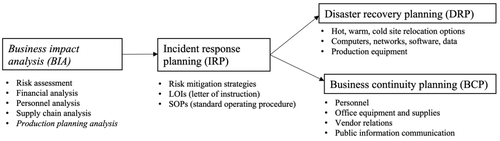
Contingency planning is the umbrella term used to describe the capability development and maintenance of responding to adverse events (Federal Emergency Management Agency 2018). Broadly speaking, contingency planning is composed of four components. The first component is business impact analysis (BIA), where the critical resources are identified, mapped to the value-stream processes, and placed into rank order by the magnitude of their influence on the organization. The second component is incident response planning (IRP), where a problem is identified and handled if the incident will not impact the long-term viability of the organization. If the incident is of such a magnitude that the long-term viability of the organization may be impacted, then the third component, disaster recovery planning (DRP), and the fourth component, business continuity planning (BCP), will be activated (Whitman and Mattord 2021). The DRP tends to focus on the technical features, computers, networks, software, data, and if required, an alternate site for business operations. The BCP is comprised of nontechnical issues such as managing personnel and contracts, as well as interfacing with the business’s vendors, and if necessary, law enforcement and news gathering organizations.
Ideally, all the components are developed prior to the incident or disaster to allow the organization to respond in a proactive way. Business impact plans include analyzing the product mix, subject to disruptions from absenteeism and resource shortages (Countryman et al. 2020, Furtado et al. 2020). One of the key outputs is guidance for response actions and locating resources. For example, automotive manufacturers conduct supply chain analyses to identify disruption risks and develop contingency plans (Thun et al. 2011, Simchi-Levi et al. 2015). Although contingency planning, as shown in Figure 1, is carried out by publicly traded companies, it should be carried out by all organizations. Contingency planning for small businesses can be difficult because small business leaders assume multiple roles and have limited time to think tactically about BCP (Baxter 2021). Small businesses are encouraged to engage in contingency planning and maintain emergency cash reserves and insurance (Childs and Dietrich 2002, Goodwin 2005, Scarinci 2014, Middle East Insurance Review 2015, Slocum 2017, Florida Chamber Foundation et al. 2020, United Way of Greater Newark 2020). For pedagogical exercises, small businesses can provide realistic contexts for student novices to evaluate.
2. Integrating Sensitivity Analysis with Business Impact Analysis
In this paper, we demonstrate how we incorporate both parametric and structural sensitivity analyses into production planning exercises that introduce BIA elements for a small business. We describe our approach in general terms, the fictitious business story of the exercises, and our experience implementing them.
2.1. Integration Overview
Our approach guides students through defining the problem, formulating a production planning model as a linear program (LP), solving the LP, identifying patterns, performing parametric sensitivity analysis, and then extending the scope to include structural sensitivity analysis as shown in Figure 2. Wallace (2000) noted the danger in depending solely on sensitivity analysis over parametric ranges to evaluate constraint or objective uncertainty. Additional approaches may include identification of patterns and insights in the linear programming solution (Baker 2000), evaluation of modeling assumptions (Caulkins 2001), identification of omitted factors (Caulkins 2001), scenario analysis (Wallace 2000), worst-case analysis (Wallace 2000), and alternate models (Higle and Wallace 2003). By structural sensitivity analysis, we refer to model changes beyond a key parameter to changes such as the addition or removal of decision variables or constraints as described by Caulkins (2001).
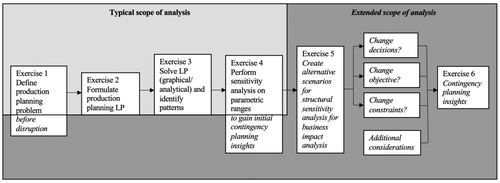
Our approach integrates professional communication, a fictitious company story, and modeling components to engage students. The exercises shown in Figure 2 begin with professional communication from fictitious employees. The fictitious professional communication is followed by highly structured questions to engage students in the exercises shown in Figure 2. In the predisruption production planning problem shown in Exercise 1 in Figure 2, students are asked questions such as the number of decisions, the number of minimum requirements, and the number of limited resources. Next, questions focus on specific details about the decisions, objective, minimum requirements, and limited resources. For Exercise 2 in Figure 2, to formulate the problem, students are asked to complete fill-in-the-blanks for the objective function coefficients, constraint coefficients, and the constraint right-hand side values. For Exercise 3 in Figure 2, to solve the problem, students are given graphical analysis multiple choice questions about the decisions labeled on the axes, isoprofit lines, constraints, feasible region, optimal solution, and objective function value. In the optimal solution for the fictitious story, the production time limit and one of the minimum requirements are binding.
Once students complete these questions, they are provided with the fictitious operations manager’s example of a response memorandum to the general manager with the initial production plan and its impact on the objective, minimum requirements, and limited resources. In our fictitious story, we introduce students to Exercise 4 in Figure 2 to perform parametric sensitivity analysis by asking them questions regarding the sensitivity of the profit to single-parameter changes in a profit coefficient, the processing time available, or a minimum production quantity.
For the extended analysis in Exercise 5 in Figure 2, we query students on more severe production time limitations and unexpected raw material supply limitations. Additional structural modeling changes to decisions and the objective function extend the insights of the original production planning model. Exercise 6 prompts students to consider additional internal and external resource requirements.
2.2. Description of the Business Context for the Exercises
We include professional communication in the form of voicemails, emails, a memorandum, and meeting slides to introduce various elements of a fictitious small business manufacturer of small ornate and large plain bronze belt buckles which are provided in the supplemental material. The graphical solution, spreadsheet solution, and sensitivity report are also included in the supplemental material.
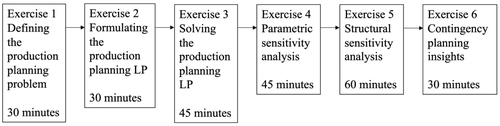
Our exercise sequence is summarized in Figure 3. Our questions are grouped into graded exercises in our electronic learning management system with the time limits shown at the bottom of each exercise box. Exercises 1, 2, 3, and 4 reinforce defining a practical problem, formulating a corresponding linear program, solving it using both graphical analysis and a spreadsheet, and performing traditional parametric sensitivity analysis, whereas Exercises 5 and 6 introduce structural sensitivity analysis and contingency planning. All six exercises are provided in the supplemental material.
2.3. Description of Typical Scope of Analysis in Exercises 1–4
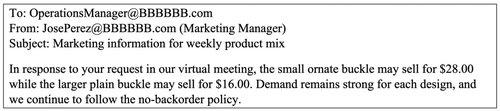
Students first listen to a voicemail from the general manager in the learning management system. The text for the general manager’s voicemail requesting the initial production plan is shown in Figure 4. Students then read three emails from other employees as shown in Figures 5, 6, and 7.

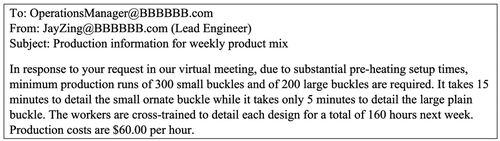
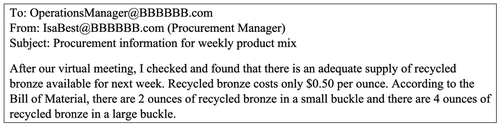
The student role plays the operations manager as they are guided through model development with highly structured questions (e.g., multiple choice and fill-in-the-blank) in Exercises 1 and 2. Initially, the operations manager defines and formulates the production planning problem based on the production capacity and the minimum production run requirement for each of the two products. The initial linear programming (LP) model formulation is as follows:
The student continues to role play the operations manager as they are guided through both graphical and spreadsheet solution approaches with highly structured questions in Exercise 3. The operations manager analyzes the optimal production plan including the number of different product designs to produce, the quantity of each design to produce, the total profit, the processing time to use, and the bronze supply to consume as shown in the memorandum in the beginning of Exercise 4 in the supplemental material. The solution pattern is to produce enough small ornate product to meet the minimum requirement with the remaining processing time to be used to produce the large plain product as detailed in the memorandum and memorandum attachment at the beginning of the Exercise 4 in the supplemental material. Parametric sensitivity analyses include typical questions about a change in an objective coefficient for profit or a change in a right-hand side value for the production labor capacity with the latter illustrated in the graphs shown in questions 5 and 7 in Exercise 4 in the supplemental material. Significant employee absences may exceed the allowable range for parametric sensitivity analysis that may be extended with structural sensitivity analysis as discussed next.
2.4. Description of Extended Scope of Analysis in Exercises 5 and 6
Exercises 5 and 6 extend the scope of analysis to include structural sensitivity analysis and contingency planning insights. Our Exercise 5 provides a BIA context in the email correspondence from the owner to both the general manager and the operations manager as shown in Figure 8. In this correspondence, the owner requests production planning insights, scenario analyses, and contingency plan recommendations.
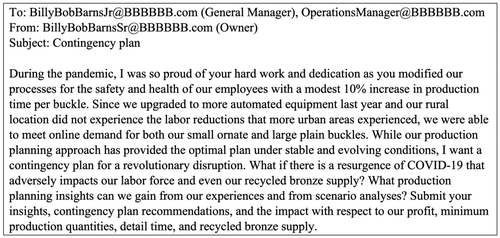
In Exercise 5, structural sensitivity analysis is conducted in the form of a processing time penalty for new regulatory requirements, changing the minimum production requirements, and adding new decision variables. The 10 scenarios we introduce to students are summarized in Table 1.
|

Table 1. Structural Sensitivity Analysis with Alternative Scenarios that Support Contingency Planning.
| Scenario | ||||||||||
|---|---|---|---|---|---|---|---|---|---|---|
| 1 | 2 | 3 | 4 | 5 | 6 | 7 | 8 | 9 | 10 | |
| Model attributes | ||||||||||
| Small ornate buckle requirement | ≥ 300 | ≥ 300 | ≥ 300 | ≥ 300 | ≥ 300 | = 0 | = 0 | = 0 | = 0 | = 0 |
| Large plain buckle requirement | ≥ 200 | ≥ 200 | ≥ 200 | ≥ 200 | ≥ 200 | ≥ 200 | ≥ 200 | ≥ 200 | ≥ 200 | = 0 |
| Small plain buckle requirement | NA | NA | NA | NA | NA | NA | NA | NA | ≥ 150 | ≥ 150 |
| Regular processing time available (minutes) | 9,600 | 9,600 | 7,200 | 4,800 | 4,800 | 4,800 | 4,800 | 2,400 | 2,400 | 2,400 |
| Overtime processing available (minutes) | 0 | 0 | 0 | 0 | 1,250 | 0 | 0 | 0 | 0 | 0 |
| Labor force (%) | 100% | 100% | 75% | 50% | 63% | 50% | 50% | 25% | 25% | 25% |
| Processing time disruption penalty (%) | NA | 10% | 10% | 10% | 10% | 10% | 10% | 10% | 10% | 10% |
| Bronze available (ounces) | 4,800 | 4,800 | 4,800 | 4,800 | 4,800 | 4,800 | 2,500 | 1,250 | 1,250 | 1,250 |
| Solution attributes | ||||||||||
| Number small ornate buckles, regular time | 300 | 300 | 300 | Infeasible | 224.2 | 0 | 0 | 0 | 0 | 0 |
| Number large plain buckles, regular time | 1,020 | 845.5 | 409.1 | Infeasible | 200 | 872.7 | 625 | 312.5 | 200 | 0 |
| Number small ornate buckles, overtime | NA | NA | NA | NA | 75.8 | NA | NA | NA | NA | NA |
| Number large plain buckles, overtime | NA | NA | NA | NA | 0 | NA | NA | NA | NA | NA |
| Number small plain buckles, regular time | NA | NA | NA | NA | NA | NA | NA | NA | 225 | 625 |
| Total profit ($) | 12,780 | 10,336 | 6,627 | Infeasible | 4,224 | 7,417 | 5,312 | 2,656 | 3,162 | 4,062 |
| Processing time used (minutes) | 9,600 | 9,600 | 7,200 | Infeasible | 6,050 | 4,800 | 3,438 | 1,719 | 1,888 | 2,188 |
| Processing time unutilized (minutes) | 0 | 0 | 0 | Infeasible | 0 | 0 | 1,362 | 681 | 512 | 212 |
| Bronze used (ounces) | 4,680 | 3,982 | 2,236 | Infeasible | 1,400 | 3,491 | 2,500 | 1,250 | 1,250 | 1,250 |
| Supplemental Material Exercise 5 table | 5.1 | 5.2 | 5.3 | 5.4 | 5.5 | 5.6 | 5.7, 5.8 | 5.8 | 5.8 | |
| Supplemental Material Exercise 5 questions | 2-5 | 6-7 | 8-9 | 10-11 | 12-13 | 14-15 | 16-17, 19 | 19 | 19 | |
Notes. NA, not applicable. Scenario 1 is the original scenario. Scenarios 2 to 10 include a processing time disruption penalty. Scenarios 3 to 10 have less processing time available. Scenario 5 includes processing overtime. Scenarios 6 to 10 drop the small ornate buckle requirement. Scenarios 7 to 10 have lower bronze supply. Scenarios 9 and 10 include a new small plain buckle. Scenario 10 drops the large plain buckle requirement.
Exercise 5 asks students to compare the original scenario to nine alternative scenarios with changes beyond objective coefficient or constraint parameter ranges from situations real companies faced. For example, in a study of Florida businesses with less than 100 employees, close to 60% of business leaders reported adding expenses for safety precautions (Florida Chamber Foundation et al. 2020). Similarly, in Scenarios 2 through 10 in Table 1, each processing time increases 10% for pandemic safety adjustments to comply with new regulatory requirements. This processing time penalty not only increases the processing time coefficients in the time available constraint (e.g., from 15X1 + 5X2 to 16.5X1 + 5.5X2) but also the processing costs causing the profit calculations to decrease for the objective coefficients (e.g., from 12X1 + 9X2 to 10.5X1 + 8.5X2), which is emphasized in Exercise 5 Table 5.1 and question 2 in the supplemental material. Exercise 5, question 3, queries students on the impact of the processing time penalty on the optimal solution, the objective, and the resources. Exercise 5, questions 4 and 5, guides students through evaluating the sensitivity of the objective to changes in the production time parameter.
In the same way that significant missed work by sick employees was reported by 13% of small businesses in New Jersey (United Way of Greater Newark 2020), Scenarios 3 through 10 reduce processing time dramatically because of employee absences. In Scenario 3 in Table 1 and Exercise 5, Table 5.2, the labor force is reduced by 25% and a feasible production plan is shown. Exercise 5, questions 6 and 7, focuses on the impacts of this initial labor force reduction.
When the labor force is reduced by 50% for Scenario 4 in Table 1 and Exercise 5, Table 5.3, there is no feasible production plan. Students are asked to consider what changed and which constraints contributed to the infeasible result in Exercise 5, questions 8 and 9, respectively.
Scenario 5 in Table 1 and Exercise 5, Table 5.4, adds 1,250 minutes of overtime to restore feasibility when only half of the labor force is available. Variables for small ornate and large plain buckles with overtime (X1OT and X2OT) are added to the legend and previous constraints and are also used in a new overtime available constraint. In addition, a 50% higher processing time cost for overtime lowers the profit per buckle produced with overtime (e.g., 2.25X1OT and 5.75X2OT are added to the objective function). In Exercise 5, questions 10 and 11, students consider the impacts of these changes to the model.
Because overtime for the remaining labor force is not sustainable long term, Scenarios 6 through 10 in Table 1 introduce more significant changes. The labor-intensive small ornate buckle requirement is dropped as labor force reductions persist, and the production plan for the large plain buckle is evaluated. Specifically, in Scenario 6 in Table 1 and Exercise 5, Table 5.5, students are asked to consider what changed, the production plan for only large plain buckles, and the impact on the profit, production time utilization, and bronze utilization in Exercise 5, questions 12 and 13.
Although bronze is initially viewed as a plentiful resource that can be procured as needed, Scenarios 7 through 10 help students examine the impact of potential supply chain disruptions to obtain bronze. In Scenarios 7 and 8 in Table 1, Exercise 5, Tables 5.6 and 5.7, and Exercise 5, questions 14 through 17, students are prompted to consider the infeasibility of small ornate buckle production with a bronze shortage and the minimum production requirements. Exercise 5, question 18, asks students to consider what changes to the model will be required if a new product is introduced.
The marketing and production staff develop a new small plain buckle with two ounces of bronze that requires only 3.5 minutes of processing time with the safety precautions. Recent studies reported that businesses changed their product offerings for the pandemic disruption in 2020 (Florida Chamber Foundation et al. 2020). In Scenarios 9 and 10 in Table 1, the new small plain buckle design (variable X3) is added to the model (3.5X3 is added to the processing time available constraint, 2X3 is added to the bronze available constraint, and 6.5X3 is added to the objective function). In Scenario 10, the large plain buckle requirement is also dropped so that only the small plain buckle design is considered. For Scenarios 8, 9, and 10, Exercise 5, question 19, asks students to contrast profit, capacity, and bronze supply utilization. Exercise 5, question 20, engages students in describing at least one new scenario. Exercise 5 concludes with question 21 asking students to consider the value of the modeling process.
At the beginning of Exercise 6, students listen to a new voicemail request from the general manager in the learning management system. The text for the voicemail is shown in Figure 9.

Exercise 6 encourages students to consider contingency planning. Students are asked about a design strategy to prepare for severe losses to critical resources such as bronze and processing time. Students are also asked to consider other resources such as equipment spare parts, machine lubricants, energy, and packaging. Students then reflect on their experience by describing the contingency planning insights they gained.
3. Implementation Experience
We used the six exercises for three semesters in an introductory undergraduate management science course focused on prescriptive analytics in our regional comprehensive university’s accredited program by the Association to Advance Collegiate Schools of Business (AACSB) International. Our course is required for the Management and Management Information Systems majors. We added the six exercises for individual completion beginning the second week of the 16-week semester with the lecture topics shown in Table 2.
|
Table 2. Relationship Between Lecture Topics and the Six Exercises
| Week | Lecture topics | Corresponding exercise | |
|---|---|---|---|
| 1 | Introduction to linear programming (LP) with two-decision production planning problems | ||
| 2 | LP formulation and the art of modeling with spreadsheets | → | Exercise 1 |
| 3 | LP formulation and applications with three-or-more decision variables | → | Exercise 2 |
| 4 | Introduction to parametric sensitivity analysis (SA) for LP | → | Exercise 3 |
| 5 | Examples of parametric and structural SA for LP | → | Exercise 4 |
| 6 | Contingency planning insights from parametric and structural SA for LP | → | Exercise 5 |
| 7 | Review of parametric and structural SA for LP | → | Exercise 6 |
Our study to evaluate the six exercises was approved by our university’s Institutional Review Board (IRB) before administration, and only the responses of the students who agreed to the informed consent are included in the analysis. The informed consent percentages were 61% for the Fall 2020 course, 60% for the Spring 2021 course, and 61% for the Fall 2021 course. When we define a participant as a student who voluntarily consented and completed all six exercises, our total participant count for the three semesters was 28. Of the 28 total participants, 16 were management-related majors (which included four participants majoring in general business, human resource management, or supply chain management), seven were management information systems majors, and one was an economics major. Ten of the participants were juniors (undergraduates with 60–89 semester hours), whereas 18 of the participants were seniors (undergraduates with 90 or more semester hours).
3.1. Student Performance
All three classes were taught online asynchronously. Although the two instructors and their lecture videos and most proctored assessments were different, the same custom textbook (Hillier and Hillier 2015), the same instructor-developed, 10-question open-book textbook quizzes, and the same homework format were used. We allocated 10% of the course grade to the six exercises shown in the supplemental material, with the remaining 90% allocated to the open-book textbook quizzes, homework assignments, and other assessments.
Nonparametric and descriptive statistics for the six exercises are summarized in Table 3. Because of the small sample sizes in each semester (Fall 2020 (n = 10), Spring 2021 (n = 9), and Fall 2021 (n = 9)), we performed the Kruskal-Wallis test for each exercise. Because the critical chi-square value at α = 0.05 for the three groups, = 5.9915, is greater than each of the Kruskal-Wallis K statistics in the second column of Table 3, we accept each of the six null hypotheses that the exercise scores are the same for each semester. Thus, we combined the results for the descriptive statistics in Table 3.
|
Table 3. Summary of Nonparametric and Descriptive Statistics by Exercise
| Exercise | Kruskal-Wallis test statistic (K) | Descriptive statistics (n = 28) | ||||
|---|---|---|---|---|---|---|
| Mean | Median | Standard deviation | Minimum | Maximum | ||
| Exercise 1 | 0.4586 | 86.4% | 91.6% | 0.151 | 40.0% | 100.0% |
| Exercise 2 | 2.3309 | 74.1% | 71.7% | 0.207 | 40.8% | 100.0% |
| Exercise 3 | 4.8089 | 86.7% | 89.2% | 0.110 | 60.2% | 100.0% |
| Exercise 4 | 0.1206 | 74.9% | 71.4% | 0.201 | 29.3% | 100.0% |
| Exercise 5 | 5.0737 | 91.7% | 93.3% | 0.063 | 72.9% | 99.0% |
| Exercise 6 | 1.9564 | 89.3% | 89.5% | 0.079 | 71.4% | 100.0% |
The data indicate that participants tended to struggle more with the Exercise 2 formulation and less with the Exercise 1 problem definition, a result that is consistent with the findings of Murphy and Panchanadam (1999), Stevens and Palocsay (2004), and Williams et al. (2016). We found that our participants had the lowest means on Exercise 2, questions 4 and 5, which indicated a more frequent struggle with constraint formulation. Surprisingly, 50% of the participants misidentified at least one constraint as fixed in Exercise 2, question 4. For the minimum buckle production requirement constraints, 64% of participants entered a number other than the understood 1 in Exercise 2, questions 5a and 5c. The data also indicate participants found the Exercise 4 parametric sensitivity analysis challenging, similar to the student performance results reported in Paul and MacDonald (2015). For an objective coefficient change in our Exercise 4, question 1, 50% of the participants did not recognize the change was outside the allowable decrease range. For the constraint right-hand side changes in our Exercise 4, questions 3 and 6, 29% and 18% of the participants, respectively, erroneously indicated that the change was outside the range, whereas a few other participants picked other distractors.
Average participant scores were higher for the Exercise 1 problem definition, Exercise 3 solution components, Exercise 5 structural sensitivity analysis impact, and Exercise 6 contingency planning insights. We explore the strong performance that student participants exhibited in Exercises 5 and 6 by considering their reflections in the next section.
3.2. Student Participant Reflections
Free-response reflection is included in the extended scope of the last two exercises. In open-ended question 20 of Exercise 5, students are asked to describe a scenario different from those already considered in Table 1. In Exercise 6, questions 2 and 3, students are asked to articulate risk mitigation recommendations and contingency planning insights, respectively. Participant perceptions were that our multimodal active learning exercises are helpful. When participants were asked whether they recommend the exercise for future semesters, 25 of the 28 participants (89%) responded “Yes.” When grading the subjective responses, we sensed that participants gained an appreciation of the relevance of the methods for realistic scenarios. The following examples of participant reflections in their own words from Exercise 6, question 3, demonstrate that the exercise was effective in encouraging them to consider contingency planning.
Even when raw resources are short there is another workaround to keep people working.
Insights into contingency planning and how to mitigate scenarios and look into production resources given an emergency situation such as a pandemic. I also earned more practice reading and analyzing content within sensitivity reports to utilize for contingency planning.
This exercise taught me that contingency plans should be developed not only thinking about internal operations, but external as well. There should be a plan B not only for absent employees, but for suppliers who may not be able to meet demand, or if there is a natural disaster and the plant is without energy. After this exercise, I will consider many outside elements that could lead us to need a contingency plan, not only inside ones.
I think the key takeaway is that the best contingency is having high flexibility by having preparations made for multiple scenarios at a time. For example, storing extra stock and using multiple suppliers to mitigate supply chain issues, and having new product mix designs available to use available resources if some cant [sic] be obtained.
This exercise taught me that every detail that impacts production (whether minor or major) needs a contingency plan.
I gained the knowledge that no matter how successful everything is going that you need to prepare for a time when things are not as good. Having a contingency plan in place will help deal with these changes as they occur. Not only should you have 1 plan but multiple plans is always a good thing.
I learned that it is important to look at all of the variables of the production plan to see where adjustments in product mix would allow for production to continue while outside constraints may limit demand or resources. You may also look at your product mix and adjust production to maximize profit according to the resources that you have on hand. If you have less labor, then produce a product that requires less production time. I [sic] you have less raw materials, then produce a product that utilizes less raw materials.
One of the characteristics of applied learning impact exercises is student involvement. Participants found the sequence of exercises that extended the problem both interesting and engaging. During virtual office hours, one participant described the exercises in terms of a “mystery” to solve. Because the COVID-19 pandemic was spreading as participants navigated the exercises during Fall 2020, Spring 2021, and Fall 2021, they were motivated to consider the evolving disruption constraints.
An example of student engagement is the following innovative scenario that a participant described (Exercise 5, question 20). “With the resurgence of COVID-19, the demand for belt buckles plummets, and we are forced to change the product line drastically or face closing down permanently. A product that uses our recycled bronze resource that we can attempt to switch over to would be the safety keychains that have a hook and pointer to allow consumers to press buttons and open doors without directly touching objects that could spread germs. Demand for such products during the current events is high and we can temporarily postpone the production of belt buckles and only produce safety keychains.”
3.3. Limitations and Future Enhancements
We recognize that the results presented were subject to limitations. We created highly structured exercises with predominantly multiple-choice and fill-in-the-blank questions. We showed students only nine alternative production planning scenarios. Because of class size and response rate, our sample size was small, yet trends were evident, and anecdotal evidence indicated that participants enjoyed the exercise and valued the learning experience.
There are multiple approaches to enhancing the exercises in the future. The exercises could be adapted to in-person or hybrid learning environments as well as modified appropriately for students at different levels. The exercises could also be enhanced for different business scenarios.
Examples of learning environment adaptations include the following:
Engage students in synchronous discussions about each exercise.
Add a ratio constraint to show the difficulty of this type of constraint formulation.
Ask students to create their own initial formulation after introducing the professional communication in Figures 4, 5, 6, and 7.
Ask students individually or in groups to solve the formulation on their own before Exercise 3.
Add a percentage constraint to show the difficulty of using right-hand side analysis.
Ask students to develop and implement a spreadsheet model to generate the original sensitivity report prior to Exercise 4.
Examples of specific possible enhancements include the following:
Add a nonbinding resource constraint with 4,800 ounces of bronze (current maximum usage is 4,680 ounces) to introduce the concept of a zero-shadow price beginning in Exercise 1. Currently, bronze is considered plentiful until a supply disruption occurs with Scenario 7 in Exercise 5.
To provide practice for identifying relevant formulation data, add to the initial email from Lead Engineer Jay Zing in Figure 6 the unnecessary statement “The bronze alloy melts at a temperature of 1,030°C.”
Demonstrate the use of Solver Tables to analyze the contributions of values within and outside the small ornate buckle production minimum range by adding more parts to question 3 of Exercise 4. The additional parts could include a Solver Table showing the effect of varying the small ornate buckle production minimum on the production quantities of each type of buckle and the total profit.
Demonstrate the use of the 100% Rule for Simultaneous Changes in Objective Function Coefficients by adding a new multipart question to the parametric sensitivity analysis in Exercise 4 that requires simultaneous changes to both the price of the small ornate buckle and the price of the large plain buckle. If one of the sets of price changes is dramatic and the sum of the percentage changes exceeds 100%, then the final question component could coach the student to consider the value of structural sensitivity analysis.
Demonstrate the use of the 100% Rule for Simultaneous Changes in Constraint Right-Hand Sides by adding a new multipart question to the parametric sensitivity analysis in Exercise 4 that requires simultaneous changes to both the minimum production quantity for small ornate buckles and the minimum production quantity for large plain buckles. If one of the sets of minimum production quantity changes is dramatic and the sum of the percentage changes exceeds 100%, then the final question component could coach the student to consider the value of structural sensitivity analysis.
Add a question in Exercise 5 to motivate interest in integer programming by introducing a gold belt buckle design. Because of the cost of gold, partial buckle production is unacceptable.
The preceding list is nonexhaustive and demonstrates a series of additional opportunities to extend the exercise.
4. Conclusions and Teaching Implications
In this paper, we demonstrate adding structural sensitivity analysis and business impact analysis to traditional production planning. Although our approach was motivated by a global pandemic, our exercise introduces concepts that are relevant for preparing students for a variety of minor and major disruptions. In one participant’s response to a reflection question regarding the insights gained (Exercise 6, question 3), “This exercise has really put into perspective how much thought managers and employers put into contingency (planning) and the time and effort they commit to their businesses.” Our approach was well received; 25 of the 28 participants recommended the exercise be continued in future semesters.
Instructors can use our exercises in their current format with varying levels of emphasis or could use the Figure 2 template to create a series of exercises to define, model, solve, conduct parametric sensitivity analysis, conduct structural sensitivity analysis, and identify contingency planning insights in various disciplines and programs. For use of our exercises in operations management or MBA classes, instructors can place less emphasis on linear programming and more focus on business processes. Although this paper uses a production planning analysis through linear programming to aid in critical resource identification, alternative decision tools could be used to develop similar exercises for other disciplines. For example, a supply chain management instructor could substitute a transportation model (Neidigh and Langella 2020) or an engineering instructor could substitute an optimization model to allocate intelligent manufacturing resources (Li et al. 2020).
The use of emails, a memorandum, voicemails, and presentation slides to introduce and facilitate the exercises provides students with professional communication examples of analytical work. The wide range of professional communication modalities made the exercise more relatable and engaged students, even in an asynchronous online learning environment. The professional communication, business story, and management science tools not only help students consider local business impacts but also broader supply chain impacts in contingency planning. The use of reflective writing encourages participants to articulate important insights into business impact analysis that demonstrated success in introducing contingency planning.
The insights demonstrated in our exercises include key strategies for structural sensitivity analysis and translating insights into recommendations. The structural sensitivity analysis demonstrates the importance of evaluating multiple scenarios. The uncertainty introduced by a disruption underscores the importance of testing a range of possibilities to gain insights. Instructors can help students practice evaluating a range of scenarios along with identifying patterns, new decisions, modified objectives, critical minimum requirements, and key resources. In conclusion, integrating a running business story with contingency planning challenges and methodological concepts can excite students while providing insights they can take into their careers.
We thank three anonymous reviewers and the associate editor for helpful suggestions.
References
- (2000) Gaining insight in linear programming from patterns in optimal solutions. INFORMS Trans. Edu. 1(1):4–17.Link, Google Scholar
- (2021) Business Driven Information Systems, 7th ed. (McGraw Hill, New York).Google Scholar
- (2021) Survival when you are small: Business continuity and resilience. ISACA J. 3:6–11.Google Scholar
- (2001) When parametric sensitivity analysis isn’t enough: Part I: Conjectures concerning why structural sensitivity analysis might be neglected. INFORMS Trans. Edu. 1(3):88–91.Link, Google Scholar
- (2002) Contingency Planning and Disaster Recovery: A Small Business Guide (Wiley, New York).Google Scholar
- (2020) COVID-19: Adapting manufacturing operations to new normal. Accenture (April 18), accessed March 12, 2021, https://www.accenture.com/us-en/insights/consulting/coronavirus-supply-chain-manufacturing-operations.Google Scholar
Federal Emergency Management Agency (2018) Continuity guidance circular. U.S. Department of Homeland Security. Accessed March 11, 2021, https://www.fema.gov/sites/default/files/2020-07/Continuity-Guidance-Circular_031218.pdf.Google ScholarFlorida Chamber Foundation, Florida Small Business Development Center (SBDC), University of West Florida Haas Center (2020) The impact of the COVID-19 pandemic on Florida’s small businesses. Accessed March 2, 2021, http://www.floridasbdc.org/Reports/Publications/COVID%20Impact%20Survey_October.pdf.Google Scholar- (2020) Managing a manufacturing plant through the Coronavirus crisis. McKinsey & Company (April 23), accessed March 2, 2021, https://www.mckinsey.com/business-functions/operations/our-insights/managing-a-manufacturing-plant-through-the-coronavirus-crisis.Google Scholar
- (2005) SMEs failing to plan for business continuity risks, survey shows. Computer Weekly (October 4), accessed March 30, 2021, https://www.computerweekly.com/news/2240075355/SMEs-failing-to-plan-for-business-continuity-risks-survey-shows.Google Scholar
- (2003) Experiences using thematic assignments in an undergraduate management science course. INFORMS Trans. Edu. 4(1):23–36.Link, Google Scholar
- (2003) Sensitivity analysis and uncertainty in linear programming. Interfaces 33(4):53–60.Link, Google Scholar
- (2015) Introduction to Management Science: A Modeling and Case Studies Approach with Spreadsheets, 5th ed excerpts in Custom Edition (McGraw-Hill Education Create).Google Scholar
- (2020) Intelligent manufacturing systems in COVID-19 pandemic and beyond: framework and impact assessment. Chinese J. Mechanical Engrg. 33(58):1–5.Google Scholar
Middle East Insurance Review (2015) UAE: Majority of SMEs overlook key business risks: Survey. (January), 10.Google Scholar- (1999) Using analytical reasoning and schema formation to improve the success in formulating linear programming models. Oper. Res. 47(5):663–674.Link, Google Scholar
- (2020) Teaching students supply chain risk using a linear programming model of the fictitious online retailer Elbe. J. Edu. Bus. 95(3):148–158.Crossref, Google Scholar
- (2015) A teaching supplement on sensitivity analysis for linear programming in undergraduate business programs. INFORMS Trans Edu. 16(1):6–14.Link, Google Scholar
- (2014) Contingency planning and disaster recovery after Hurricane Sandy: Surveys of Staten Island accounting firms and small businesses. CPA J. 84(6):60–63.Google Scholar
- (2015) Identifying risks and mitigating disruptions in the automotive supply chain. Interfaces 45(5):375–390.Link, Google Scholar
- (2017) The way forward for middle-market companies, The Secured Lender (October 13–15), accessed March 30, 2021, https://www.capitalone.com/commercial/decomm/media/doc/commercial/the-secured-lender-october-2017-mike-slocum-ADA5.pdf.Google Scholar
- (2004) A translation approach to teaching linear program formulation. INFORMS Trans. Edu. 4(3):38–54.Link, Google Scholar
- (2011) Managing uncertainty: An empirical analysis of supply chain risk management in small and medium-sized enterprises. Internat. J. Production Res. 49(18):5511–5525.Crossref, Google Scholar
United Way of Greater Newark (2020) COVID-19 emergency small business grants program. Accessed March 2, 2021, https://uwnewark.org/wp-content/uploads/Smallbusinessgrantreport-1.pdf.Google Scholar- (2000) Decision making under uncertainty: Is sensitivity analysis of any use? Oper. Res. 48(1):20–25.Link, Google Scholar
- (2021) Principles of Incident Response and Disaster Recovery, 3rd ed. (Cengage, Boston).Google Scholar
- (2016) Beyond model formulation: Assessment of novices graphing, interpreting, and writing about their model and solution. INFORMS Trans. Edu. 17(1):13–19.Link, Google Scholar

