Case Article—Budding with ERP: Information and Operations Management Challenges in a Nascent Industry
Abstract
The role of analytics in operations and supply chain management (OSCM) has gained significant importance due to the decision-making complexities in the current business environment. The effectiveness of most analytical approaches, in turn, relies on access to timely and accurate data and information. Hence, it is essential for OSCM students to understand the underlying processes and dynamics of information management, for which enterprise resource planning (ERP) systems have become a standard. This case study can be a useful resource for introducing the critical interface between OSCM and information systems. The case study aims to facilitate learning on (1) the limitations of a rudimentary and disconnected information system, (2) the benefits and challenges of ERP implementation, and (3) the important steps to ensure a successful implementation of an ERP system. It provides an interesting context of a fast-growing agribusiness producing regulated products in Canada. The case study has been used in OSCM and management information systems (MIS) courses in two Canadian public Universities.
Funding: This work was supported by Mitacs [Grants IT28747 and IT32722].
Supplemental Material: The Teaching Note and data files are available at https://www.informs.org/Publications/Subscribe/Access-Restricted-Materials.
1. Introduction
Operations and supply chain management (OSCM) is a broad domain encompassing several related activities spanning from supply acquisition to demand fulfillment. Effective management of these activities is based on modeling and analysis techniques adapted from the operations research (OR) toolkit. Over the last two decades, the trajectory of the OSCM field toward analytics has gained significant momentum (Gorman and Klimberg 2014). This can be linked to the realization that the complexities and challenges in the field require sophisticated data-harnessing approaches beyond the conventional OR techniques (Kalaitzi and Tsolakis 2022). However, such approaches rely on the capability to have instantaneous access to large amounts of data through an information system. This signifies the importance of understanding the main issues in information system use and implementation for OSCM learners. In pursuit of developing this understanding, many analytics-focused programs provide strong coverage of management information systems (MIS) blended with modern techniques of OR and statistics (Gorman and Klimberg 2014).
ERP systems epitomize contemporary information management. These systems integrate a firm’s business functions around a common database and provide overall visibility through firm-wide real-time information with interfaces to suppliers and customers (Jacobs and Chase 2019). Nonetheless, many organizations rely on spreadsheets for managing and using the information as ERP systems are resource extensive. Academic programs on analytics have also traditionally focused on spreadsheet modeling (Grossman 2006, Leong and Cheong 2008, Ramani et al. 2023). It is, however, essential for OSCM learners to know the limitations of spreadsheets and the advantages of ERP systems for operations planning.
Despite the advantages, there are several challenges and pitfalls in adopting, implementing, and using an ERP system. Tenhiälä and Helkiö (2015) highlight that, although ERP systems have provided a breakthrough in information management and that the information-processing capabilities of these systems are crucial in dynamic markets, they need sizeable investment and impose inflexibilities. ERP systems can impede changes to business processes (Tenhiälä and Helkiö 2015). The impedance can lead managers to revert to traditional applications (Prouty and Castellina 2011), or worse, force subordinates to circumvent ERP use (Christiansen et al. 2012). Besides, the decisions on selecting, adopting, and adapting an ERP product require careful planning to avoid implementation failures and substantial financial losses (Rajagopal 2002, Forslund and Jonsson 2010, Ahmad and Cuenca 2013). An organization’s internal and external contexts influence these decisions (Nandhakumar et al. 2005). The criticality and complexity of the selection and adoption decisions often lead resourceful organizations to hire specialized consultants for the preimplementation phase (Tsai et al. 2012). For a smaller and less resourceful organization in a nascent setting, the complexity of these decisions can become far greater.
The subject case study reports the information management woes of a company in a nascent industry and highlights the interconnectedness of the information management approach, analytical capabilities, and operational efficiency. The study can be used to explore the limitations of spreadsheet-based information management, the advantages of ERP systems for managing information and streamlining operations planning, and the steps, challenges, and risks involved in ERP implementation. It also highlights the influence of an organization’s internal and external contexts on its ERP adoption and adaptation. This article discusses the development and use of the case study as follows. Section 2 provides an overview of the case study and information collection. Section 3 states the case study’s pedagogical objectives. Section 4 briefs the learning opportunities offered by the case. Section 5 details the authors’ and students’ experience of learning with the case study. The article concludes in Section 6.
2. Case Overview
Based on a fast-growing agribusiness in Canada, the case study is a product of serial industrial collaboration projects funded by Mitacs (https://www.mitacs.ca/en: “Mathematics of Information Technology and Complex Systems”). The projects were focused on strategic evaluation, reconfiguration, expansion, and improvement of the information system at the case organization to attain operational efficiency. Please see Section 2.1 for further details on the project and field research.
The case company, referred to as Budding-SK instead of its legal name, is involved in controlled environment agriculture and chemical processing to produce cannabis products under a license from Health Canada.1 At the time of the case development, the cannabis sector was an emerging sector with strict regulations, providing significant growth opportunities for the existing producers. Cannabis was legalized in Canada with the enforcement of the Cannabis Act (C-45) in October 2018. Besides controlling underage cannabis use and protecting public health and safety, the act aims to prevent criminals from making drug profits. It provides a mechanism for strictly regulating the production, distribution, sale, import and export, and possession of cannabis. Statistics Canada (2023) offers comprehensive insights into the history and evolution of Canada’s cannabis sector. Budding-SK rapidly grew its workforce and geographical market reach after its inception in 2018, the year cannabis was legalized in Canada. The number of employees had quadrupled in the last two years, and the company had added three provinces to its sales area in the previous six months. The rapid growth resulted in various challenges, including information management complexities, whereas the financial performance remained unstable. The case reports how a deficient information management system can impede OSCM and scalability.
To overcome its information management woes, Budding-SK attempted to adopt multiple software systems. The case study captures the company’s challenges in adopting a new, comparatively low-cost, and highly customizable ERP solution offered by a tech startup. The case study questions whether the company should (1) continue its efforts in implementing the solution, (2) revert to the use of spreadsheets for information management, or (3) adopt a more mainstream ERP product. To analyze the decision alternatives, discussants can rely on the information on the case company’s technical capabilities, financial stability, ambitions, market pressures, and operational and reporting inefficiencies linked to information management. Discussants can also weigh the customization and cost benefits of the ERP system under implementation against the risks due to the lack of its demonstrability.
The case study is set in an interesting context and presents a critical juncture requiring an urgent decision. The decision choice could have significant long-term implications for the company’s competitiveness.
2.1. Field Research
The case study was developed during the course of two six-month industrial collaboration projects funded by Mitacs, a Canadian research funding organization focused on linking private sector and postsecondary academic institutions. Mitacs provides a platform for developing projects to solve organizational challenges and enhance national innovation capacity. The funding program associated with this case study required a student intern to work directly with a partner organization and an academic supervisor (principal investigator (PI)) to design and execute projects linked to the organization’s innovative activities. The Mitacs funded projects at the case company were focused on advancing the company’s knowledgebase for ERP implementation and data analytics to improve information system and process coordination. The projects ran from December 2021 to December 2022. The partner organization (the case company) was informed at the onset of the projects about the intention to develop a case study and was briefed about how this can be a significant service to academia. The company agreed to the support in this regard and assisted with the information to develop the case study over the year. The intern, who, along with the PI, is also one of the authors of this work, spent two days a week at the organization to execute the projects over the year. This provided an in-depth understanding of the organization’s processes. On average, the intern met once every two weeks with the organization’s focal person (the chief operating officer) and the PI. The case study development was discussed in these meetings. The final draft of the case study was shared with the partner organization in December 2022 to verify the included information.
3. Objectives
Primarily, the case has been developed for coverage in OSCM courses to highlight the role of information management in operational efficiency and scalability. It aims to cover the interface between OSCM and information management. From this standpoint, the case can enable participants to recognize and discuss the following:
The limitations of spreadsheet-based information management,
The OSCM linked benefits of adopting an ERP system,
The pros and cons of adopting different types of ERP systems,
The challenges in implementing an ERP system, and
Important steps in adopting and implementing an ERP system.
3.1. Required Background
Students are expected to understand the overall sales and operations planning process and the basic functionality of ERP systems. The case should ideally be covered after a topic explaining aggregate planning, master scheduling, and materials planning.
4. Target Courses and Adaptability
The case study can be pitched as fourth-year (specialized) and second-year (introductory) courses on OSCM and information systems. Examples of target course titles include Select Topics in Supply Chain Management (fourth year), Purchasing and Supply Chain Management (third/fourth year), Introduction to Supply Chain Management (SCM) (second/third year), Introduction to Operations Management (second year), and Management Information Systems (MIS) (second/third year).
The case is primarily being used in the capstone course of an undergraduate supply chain major in a Canadian public university. The course is offered in the final year of a four-year undergraduate business degree program. The students at this stage have covered introductory courses on SCM and information systems domains and are well positioned to discuss different facets of supply chain and information management covered in the case. The case study has also been covered in an MBA program’s SCM course and an introductory MIS course in a four-year undergraduate business degree program. The accompanying teaching note (TN) provides a comparison of the case discussions in these different courses. For initial testing, the authors successfully used the case study as a written assignment in the Introduction to Operations Management course offered in the second year of a four-year undergraduate program. The students performed well in the assignment tasks, as detailed in the accompanying TN.
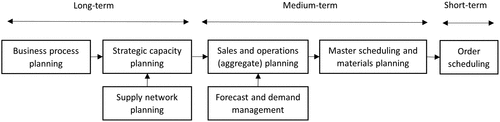
In the SCM capstone course, the case is discussed in an 80-minute session after a topic covering aggregate planning, master production scheduling, and materials planning (see the appendix for the positioning of the case study in the course). The topic looks at the calculations in the hierarchical production planning process (Figure 1) and stresses that the manual or spreadsheet-based management of this process can be cumbersome, disconnected, inefficient, and error prone. The topic also briefly discusses the use of ERP systems in capturing the production planning process and some frameworks for ERP adoption and implementation.
4.1. Utility
Most OSCM textbooks present information management as a critical factor in supply chain integration and performance. However, the textbooks generally lack any substantial discussion on information management apart from a cursory coverage of ERP systems. Conversely, information systems texts provide a substantial focus on information technology and management, whereas the connection with OSCM issues is generally lacking. This case study can fill the stated gap in OSCM and information systems courses by explicitly highlighting the interfaces between the two domains. It also highlights the challenges in implementing ERP systems that smaller and less resourceful organizations and organizations in emerging sectors can face. ERP implementation is a well-researched information systems area with extensive knowledge in the form of frameworks published in academic journals. However, the coverage of these frameworks in textbooks is minimal. Hence, business students do not directly benefit from the available body of knowledge. Covering the published frameworks in lectures can lack a meaningful practical context. This case study provides an opportunity for OSCM and information systems instructors to introduce ERP implementation frameworks to their students with a detailed example. Finally, the agribusiness context of this case study can have particular relevance for agribusiness-focused programs offered by a number of universities in the vast prairie regions of the United States and Canada.
Broadly, the case study allows discussions on the following:
The motivations for implementing an ERP system (including streamlining processes, acquiring analytical capability, and scalability),
Interfaces between operational efficiency and information management,
ERP implementation in the agribusiness context,
Challenges in implementing an ERP system, specifically in small organizations,
Antecedents of an ERP system adoption,
Process mapping,
Implementation of an ERP system in a nascent industry (early adoption challenges),
Comparison between mainstream and unconventional ERP options, and
ERP life cycle and implementation phases.
4.2. Potential in Other Courses
The case can also be used in the operations planning module of an MBA OSCM course. The discussion theme can remain the same, but the discussion can be enriched by bringing in students’ experiences of information management systems. In MIS courses, discussion can focus less on operational efficiency issues and more on the project management aspect of implementing an ERP system, reporting efficiency, and ERP product comparisons. Although the authors have not examined and developed this case study from an entrepreneurship standpoint, there may also be opportunities for using the case in entrepreneurship courses to highlight the importance and challenges of information management in fast-growing startups.
5. Student Experience
5.1. Initial Testing of the Case Study
For a trial, the case study was used as a written assignment for students enrolled in three sections of a second-year undergraduate course titled Introduction to Operations Management. The total enrolment in these sections was around 150. Although some students had management-level experience, most (roughly 90%) were in the undergraduate program straight from high school. The intention of using the case study as an assignment was to verify that the case is comprehensible and provides sufficient information for students to capture the main decision dynamics. The authors wanted to ensure that students can evaluate the decision alternatives, choose a decision alternative, and understand the pros and cons of the selection. The students were given two questions:
Which one of the following options do you suggest Budding-SK should adopt for its information management?
Revert to solely using spreadsheets.
Put more effort and resources into adopting the current ERP system.
Drop the existing ERP system and adopt a mainstream ERP product.
What will be the advantages and potential risks if Budding-SK follows your suggestion?
A summary of the responses from a subset of students is provided in the TN. The students were able to capture the central dynamics in the case study. Also, there were no critical comments or queries on the comprehension of the case study. Although we did not specifically survey student experience, as the students’ responses to the assignment questions were to be used to assess the case study, we found the following comment in the course evaluation survey.
“All of our assignments gave us ample opportunity to demonstrate what skills we had learned, especially the case study [the subject case study] we had in our last assignment. These allowed us to demonstrate both mathematical and analytical skills….”
The case study is primarily developed for class discussions. If instructors want to use the case study as a written assignment, assigning some of the questions in the next section (Section 5.2) will allow a more comprehensive analysis. The students will be able to analyze the contexts of the case company and the advantages and risks of each decision choice before selecting one. Question 7 can be modified to require an evaluation of the current ERP product, its vendor, and the implementation process. The following question can also be added to the assignment:
(3) Analyze the reports in Figure 10 of the case study and identify the discrepancies. How do you think an ERP system can prevent the issues in the reports?
5.2. Class Discussion
As stated in Section 4, the case was discussed in an 80-minute session in the fourth-year SCM capstone course. The total enrolment in the class was 40. Most of the participants were international students with a high concentration from India. A significant proportion of the students had work experience. Students had professional backgrounds in retail, automotive manufacturing and distribution, and logistics, enriching the overall discussion.
The technology-organization-environment (TOE) framework was used to organize the discussion on the case context. Instructors can also use basic frameworks like Strengths, Weaknesses, Opportunities, and Threats (SWOT), but the TOE framework is specific to technology adoption and offers high flexibility in strategic-level discussions (Jat et al. 2024). Specific ERP selection, adoption, and implementation frameworks were used to analyze the decision alternatives. These frameworks, published in top-tier research journals, suggest ERP product and vendor selection criteria and prescribe ERP implementation steps. The following questions were used to guide the discussion as detailed in the TN:
Q1: Which one of the following will be your suggestion to Justin [the protagonist]:
(a) Revert to using spreadsheets.
(b) Commit to the ERP system being implemented.
(c) Switch to a mainstream ERP system.
Q2: What are Budding-SK’s goals? What is the company’s current trajectory?
Q3: What are the key features of Budding-SK’s business environment?
Q4: What are the key features of Budding-SK’s organizational structure and technological capabilities?
Q5: What benefits can Budding-SK gain by implementing an ERP system?
Q6: What challenges was Budding-SK facing in implementing the existing ERP system? What are the causes of these challenges?
Q7: Is this the right time for Justin to push for a commitment to an ERP system? Should he propose a switch to a mainstream ERP system? Why (not)?
Students were engaged and actively participated throughout the session. The anonymous student experience survey, filled voluntarily, suggests a positive experience with the case study (Table 1).
|

Table 1. Student Experience Survey Result
| Item | Response scale | Average score | ||||||
|---|---|---|---|---|---|---|---|---|
| The case context was: | Not interesting | 1 | 2 | 3 | 4 | 5 | Very interesting | 4.73 |
| In understanding the link between information management and operations and supply chain efficiency, the case was: | Not useful | 1 | 2 | 3 | 4 | 5 | Very useful | 4.67 |
| In understating the dynamics of an ERP implementation and use, the case was: | Not useful | 1 | 2 | 3 | 4 | 5 | Very useful | 4.67 |
| The discussion questions and the information in the case study were: | Not aligned | 1 | 2 | 3 | 4 | 5 | Completely aligned | 4.53 |
| Understanding the decision-making context was: | Not challenging | 1 | 2 | 3 | 4 | 5 | Very Challenging | 4.13 |
| Selecting a decision alternative was: | Not challenging | 1 | 2 | 3 | 4 | 5 | Very Challenging | 4 |
| I found the case: | Not engaging | 1 | 2 | 3 | 4 | 5 | Very Engaging | 4.93 |
| n = 15 | ||||||||
Comments:
| ||||||||
A quiz was conducted after the case discussion in a lower-level MIS course to gather more objective evidence of achieving the intended learning outcomes (Section 3). The students attending this course had less prior exposure to MIS and OSCM concepts and the case method compared with the students in higher-level OSCM courses. Hence, measuring the student learning against the case study’s intended learning outcomes in this course offered a stricter analysis of the case study’s effectiveness. The vast majority of the class students were in the second year of a Bachelor of Business Administration program. Around 6% of the students were enrolled in a Computer Science program. Prior to the case study discussion, students attended lectures briefly covering the production planning process (Figure 1), SCM and information systems, and ERP implementation frameworks. The students were asked to support their answers with specific references to the case to ensure that their learning from the case, rather than the general understanding of ERP, is captured. A small participation score was assigned to quiz performance. The observations from the quiz are presented in Table 2.
|
Table 2. Observations from a Case-Based Quiz
| Question | Intended learning outcomes | Observation | |
|---|---|---|---|
| (Q1) What are the limitations of spreadsheet-based information management? | 1 | The proportion of students identifying multiple limitations: 76.92% |  |
| (Q2) How can an ERP system make business processes more efficient? | 2 | The proportion of students stating multiple ways in which ERP can improve efficiency: 80.77% |  |
| (Q3) What are the challenges in implementing an ERP system? | 4 | The proportion of students stating multiple challenges, including an indication of resource commitments: 76.92% |  |
| (Q4) What are some of the pros and cons of adopting a tailor-made and an industry standard ERP system? | 3 | The proportion of students stating multiple pros and cons: 76.92% |  |
| (Q5) Reflect on Budding-SK’s standing (performance) on each of the ERP implementation steps outlined in the following table. | 5 | The proportion of students providing a detailed assessment of Budding-SK’s ERP implementation performance: 65.38% |  |
Note. n = 26.
Q5 (Table 2) is the most challenging question, requiring a detailed analysis and response. This question can be more appropriate in a specialized senior-level course covering ERP systems in detail.
6. Concluding Remarks
With data and information playing a crucial part in OSCM decision making, it is important for business students to view OSCM and information management as interconnected domains. This case study can be a good resource for introducing information management issues and ERP systems to OSCM students. The case study highlights that inefficient information management can hinder operational efficiency and growth, while the induction of a sophisticated information system in the form of an ERP system can be a complex matter.
We thank the associate editor, three anonymous reviewers, and Dr. Trent Tucker (Thompson Rivers University) for valuable feedback, enabling significant improvements in the case study package.
Appendix. Case Positioning in a Fourth-Year Supply Chain Management Course
|
| Week of | Course Schedule |
|---|---|
| SCMN 4390—Select Topics in Supply Chain Management—Winter 23 | |
| Topic | |
| Jan 2 | Course and Group Introduction Topic 1: Supply Chain Management: A Brief [Recalling the basics; What do we know about SCM?] |
| Jan 9 | Topic 2: Basic Predictive Analytics for Demand Forecasting |
| Jan 16 | Topic 3: Strategic Capacity Planning and Bottleneck Analysis [simulation] |
| Jan 23 | Topic 4: Inventory Modeling |
| Jan 30 | Topic 5: Network Design and Optimization [Prescriptive Analytics] Finalization of groups and submission of group member names on Moodle by the end of Sunday 5th Feb. |
| Feb 6 | Topic 5: Network Design and Optimization (continued) Topic 6: Stock Positioning in a Distribution Network: Exploring the Transportation-Inventory Trade-off [Descriptive Analytics] Acquisition of supply chain simulation access (individual) and registration of teams for the simulation by the end of Sunday 12th Feb. |
| Feb 13 | Midterm Review and Midterm Test (15th Feb) Release of simulation data for strategizing. |
| Feb 20 | No classes |
| Feb 27 | Simulation – 1st Round begins on Monday 27th Feb. Topic 7: Demand and Capacity Planning [Case Study: Budding with ERP: … Coverage: Information management for sourcing, production, and sales; technology adoption; product development. …] |
| Mar 6 | Topic 8: Quality and Process Improvement Case Study Presentations and Assignments [Case Study 1. Coverage: Economic forecasting; product design; strategic alliance; SC optimization; inventory management] Simulation Report 1 due by the end of Sunday 12th March. |
| Mar 13 | Case Study Presentations and Assignments [Case Study 2. Coverage: Disruptive innovation; packaging and logistics technology; fresh-produce supply chains. Case Study 3. Coverage: Sustainability; manufacturing processes; reverse logistics] |
| Mar 20 | Simulation – 2nd Round begins on Monday 20th Mar. Special Topic Presentations and Assignments Simulation Report 2 due by the end of Sunday 5th April. |
| Mar 27 | |
| Apr 3 |
1 A federal institution responsible for ensuring the accessibility of health services and the control of health risks.
References
- (2013) Critical success factors for ERP implementation in SMEs. Robotics Comput. Integrated Manufacturing 29(3):104–111.Crossref, Google Scholar
- (2012) Working in the shadows: Understanding ERP usage as complex responsive processes of conversations in the daily practices of a Special Operations Force. Scandinavian J. Management 28(2):173–184.Crossref, Google Scholar
- (2010) Selection, implementation and use of ERP systems for supply chain performance management. Industry Management Data Systems 110(8):1159–1175.Crossref, Google Scholar
- (2014) Benchmarking academic programs in business analytics. Interfaces 44(3):329–341.Link, Google Scholar
- (2006) Integrating spreadsheet engineering in a management science course: A hierarchical approach. INFORMS Trans. Ed. 7(1):18–36.Link, Google Scholar
- (2019) Operations and Supply Chain Management: The Core, 5th ed. (McGraw Hill, New York).Google Scholar
- (2024) Manufacturer’s contexts, supply chain risk management, and agility performance. IEEE Trans. Engrg. Management 71:4175–4187.Crossref, Google Scholar
- (2022) Supply chain analytics adoption: Determinants and impacts on organisational performance and competitive advantage. Internat. J. Production Econom. 248(1):1–12.Google Scholar
- (2008) Teaching business modeling using spreadsheets. INFORMS Trans. Ed. 9(1):20–34.Link, Google Scholar
- (2005) The dynamics of contextual forces of ERP implementation. J. Strategic Inform. Systems 14(2):221–242.Crossref, Google Scholar
- (2011) To ERP or not to ERP: In manufacturing, it isn’t even a question. Accessed April 25, 2023, https://bautomation.com/content/uploads/2013/02/dynerp_erpvsnoerp_whitepaper.pdf.Google Scholar
- (2002) An innovation—Diffusion view of implementation of enterprise resource planning (ERP) systems and development of a research model. Inform. Management 40(2):87–114.Crossref, Google Scholar
- (2023) Case article—GAP: A humanitarian initiative of Ramakrishna mission for underprivileged children. INFORMS Trans. Ed. 24(1):70–75.Google Scholar
Statistics Canada (2023) Research to Insights: Cannabis in Canada. Accessed January 20, 2024, https://www150.statcan.gc.ca/n1/pub/11-631-x/11-631-x2023006-eng.htm.Google Scholar- (2015) Performance effects of using an ERP system for manufacturing planning and control under dynamic market requirements. J. Oper. Management 36(1):147–164.Crossref, Google Scholar
- (2012) A comprehensive study of the relationship between enterprise resource planning selection criteria and enterprise resource planning system success. Inform. Management 49(1):36–46.Crossref, Google Scholar