Case—Chick-fil-A Drive-Through: Managing Congestion with Discrete Event Simulation
1. Introduction
Scott Williams operates a fast-food restaurant, Chick-fil-A, at the large Marketplace Mall shopping center in Williamsburg, Virginia. The restaurant operates six days a week (closed on Sundays) and attracts many customers throughout the day because of its convenient location and outstanding product quality. However, starting in 2022, Scott received numerous complaints from customers and neighboring businesses. While browsing customers’ reviews on the business’s Google page, Scott noticed that most complaints are issues with drive-through services. Some example reviews1 are as follows.
“Be prepared to wait a while, especially if doing drive through.”
“I waited 30 mins in the drive thru line just to get to the window & they STILL don’t have my order ready and asked me to park & wait even longer.”
“Their drive through line is a disaster and it backs into the street every single time. The car in front of us hit another car because the line is so disorganized and tight.”
“The system that they had at the drive-through for this particular store was atrocious.”
The managers at Publix (supermarket) and Target (department store) in the same shopping center also complained to Scott that the drive-through car line often extended to the main street of the Marketplace Mall, blocking the traffic to their businesses. In light of all of the above complaints, in 2023, Scott obtained a loan to purchase the adjacent lot and rebuild the entire facility. Scott led the renovation project, after which the Marketplace Mall Chick-fil-A reopened with expanded drive-through lanes and a new design for the drive-through flow. Surprisingly, Scott heard from several local customers that their waiting time in the drive-through did not improve after the renovation. Some recent Google reviews also mentioned the following.
“The new remodel isn’t great, and you end up with a pretty long wait in the drive-through.”
“There is a few people working in your drive through line I would terminate immediately. Also why build a new building if the drive through lane is actually less efficient and more congested than at the previous?”
Puzzled, Scott knows that he will have to dive deeper into the congestion problem. To better understand the impact of the expansion project on drive-through services, he brings in Colonial Consulting. Mark Serena, an operations analyst with the firm, takes the lead on the case, meeting regularly with Scott and the Chick-fil-A team to gather information and share progress updates.
2. Chick-fil-A
Chick-fil-A is a fast-food restaurant chain specializing in chicken sandwiches and related products. Originating in the United States, Chick-fil-A operates over 3,000 restaurants across 48 states and is frequently voted to be the country’s favorite fast-food chain. Chick-fil-A’s success relies on its efficient operational design. Although the restaurant offers sit-down and in-store pickup services, a majority of Chick-fil-A revenue (60% according to Business Insider 2024) is from drive-through customers who drive their cars along prespecified lanes to place and pick up orders. The main challenge in Chick-fil-A’s daily operations is to manage the drive-through congestion associated with slow service and long car lines. Service delays potentially lead to customer dissatisfaction and even declining sales. The car-line congestion has been causing severe traffic problems, including collisions and pedestrian injuries. The massive car lines were also reported to stretch into streets and parking lots regularly, blocking entrances to neighboring businesses.
3. Analysis
Scott first provides Mark with sketches of the drive-through system before and after the renovation (Figure 1). Specifically, before the renovation, a customer arrives at the Chick-fil-A drive-through from the main road and decides to join one of the two lanes with a shorter queue to place an order. Solid circles in Figure 1 represent Chick-fil-A workers (i.e., cashiers) who will take orders from this drive-through customer. After the order is placed and if there is space in the pickup lane, the vehicle will merge into a single-car lane. While in the pickup lane, the customer waits in the car for the order to be prepared by another set of workers (i.e., cooks) depicted as dashed circles in Figure 1. After picking up the order, the vehicle leaves the facility. The key difference after the renovation was the design of the pickup lane. Because of the expansion to the adjacent lot, Chick-fil-A can now accommodate two pickup lanes after the ordering station. Moreover, each pickup lane is extended from the corresponding ordering lane; that is, customers cannot choose the pickup lane once they have joined a specific ordering lane.
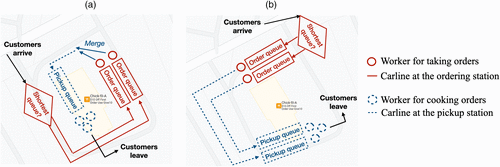
Notes. (a) Before renovation. (b) After renovation.
Scott mentions that the most congested times of the day (referred to as rush hours) are between 11 a.m. and 1 p.m. and between 5 p.m. and 7 p.m. There is generally no congestion (i.e., long wait or long car line) at other times of the day. Using newly developed drone technology to capture aerial traffic footage (Wall Street Journal 2025), the Chick-fil-A traffic analysis team estimates that during rush hours, cars arrive at a rate of 0.8 customers per minute. Upon arrival, the car enters the shortest ordering lane. Two cashiers who take the order are shared by two ordering lanes. These two cashiers can move along the lane to take orders. The service rate of one cashier is 0.8 orders per minute. After placing the order, the car proceeds to the pickup lane. However, the car will have to wait in the ordering lane if there is no car space in the pickup lane. According to the drive-through design, in the old facility, the single pickup lane can hold at most six cars. In the new facility, each of the two pickup lanes can hold at most 10 cars. Once the car enters the pickup lane, its order is sent to the cooking station. Three cooks prepare the meals. On average, an order takes one cook 3.5 minutes to prepare. After the order is ready, the car picks it up and leaves the facility immediately. The kitchen processes orders by following the first-come, first-served discipline.
According to the sketches and customer flows, Mark builds two simulators for the drive-through: one before and one after the renovation. He demonstrates to Scott that these simulators can simulate the drive-through evolution over time, accounting for all possible system events, including customer arrivals, order completions, and so on. Aggregated system performances can then be computed according to the simulated events. Scott tells Mark that he is particularly interested in the quantities related to the complaints that he has received, including customer wait times and the length of car lines. In response, Mark introduces three relevant metrics generated by the simulator. The first is flow time, which records the total time that a customer spends at Chick-fil-A. The second is the car line of a service station, the occupied length of the corresponding drive-through lanes, which measures the spatial stretch of the drive-through queue. For example, in Figure 2(a), the car line of the ordering station is two because the longer queue among the two ordering lanes is two, and the car line of the pickup station is three. In Figure 2(b), the car line of the ordering station is one, whereas the car line of the pickup station is two, which is the longer queue length among the two pickup lanes. The third quantity is the system car line, the sum of the car lines at the ordering and pickup stations. For example, the system car lines in panels (a) and (b) in Figure 2 are five and three, respectively. A large system car line leads to a higher chance of causing traffic problems. Mark computes the flow time and system car line before and after renovation and discusses his findings with Scott.
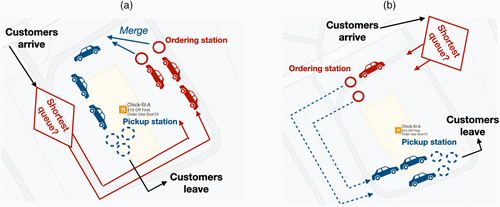
Notes. (a) Before renovation. (b) After renovation.
Scott’s top priority when designing the Chick-fil-A drive-through is to keep customers’ flow time and system car line within a reasonable range, ensuring satisfactory consumer experiences and minimizing traffic problems during rush hours. A survey of local customers suggests that a waiting time of 13 minutes is acceptable (similar to the stats reported in QSR Magazine 2022). Moreover, a system car line of eight or fewer can keep the cars a sufficient distance from the main road. Scott then meets with Mark to discuss how to find out the optimal drive-through design, including appropriate staffing levels during rush hours (i.e., from 11 a.m. to 1 p.m. and from 5 p.m. to 7 p.m.) and the potential implementation of large-scale renovation projects. Scott believes that these discussions will provide valuable insights to help the Chick-fil-A team make more informed future investment decisions.
1 Google reviews in this case are extracted from the actual business page, so there may be mild grammar errors.
References
Business Insider (2024) How Chick-fil-A makes such high sales. Accessed August 31, 2024, https://www.businessinsider.com/how-chick-fil-a-makes-such-high-sales-drive-thru-2024-4.Google ScholarQSR Magazine (2022) The 2022 QSR® drive-thru report. Accessed August 31, 2024, https://www.qsrmagazine.com/reports/2022-qsr-drive-thru-report/.Google ScholarWall Street Journal (2025) Drone and “game film”: Inside Chick-fil-A’s quest to make fast food faster. Accessed May 8, 2025, https://www.wsj.com/business/hospitality/chick-fil-a-drive-through-service-fast-food-innovation-ed5e2288?st=ApoMpQ&reflink=desktopwebshare_permalink.Google Scholar