Game—The Freight Transportation Game: Operational Challenges for Carriers in Online Spot Market Platforms
Abstract
In the freight transport spot market, carriers face several challenges, including handling small-sized loads, managing short lead times, and dealing with uncertainties that can disrupt their existing networks and capacity. In this context, auction platforms assist carriers in developing strategies to maintain productivity and service levels. This paper introduces the freight transportation game, an online auction-based platform specifically designed for the freight spot market. The game equips players, acting as carriers, with tools to develop transportation strategies, optimize routes, and propose competitive rates to maximize profits. Players engage in decision making and competition, with key performance indicators evaluating their decisions. The game includes two scenarios; the first helps students understand the operational challenges that carriers face in spot market auctions, whereas the second encourages cooperation to enhance performance and overcome obstacles. Designed for a three-hour session, the game can be integrated into courses on supply chain management or transportation systems. The practical learnings for students from the game include understanding the complexity of constructing transport plans, recognizing the challenges of using online auction-based platforms, and experiencing the difficulties of managing spot market requests despite their benefits.
Funding: This work was supported by the Physical Internet Chair at Mines Paris, PSL University funded through an “Appel à Manifestation d’Intérêt” titled “Skills and Jobs of the Future” launched by la Caisse des Dépôts.
Supplemental Material: Supplemental materials are available at https://doi.org/10.1287/ited.2024.0091.
1. Introduction
1.1. Freight Transportation Market
The road trucking industry is a fiercely competitive, rapidly evolving sector characterized by low entry barriers, constant returns to scale, and low business margins. Within this landscape, carriers are confronted with a multitude of operational challenges. The limited information and short notice regarding shipment origins and destinations, often within a two-day window, are a significant challenge. Acquiring information about available loads and effectively coordinating load assignments across their fleet present other hurdles. Furthermore, strong motivation to achieve economies of scope (i.e., exchange of requests or lanes) adds layers of complexity to carrier operations (Caplice 1996, Özener et al. 2011). Therefore, carriers must permanently and strategically construct efficient and effective freight transportation plans that must conform to new challenges and objectives, such as cost efficiency, eco-friendliness, and social responsibility. These plans must enable their trucks to secure subsequent loads without resorting to empty hauls or enduring protracted waiting periods.
In light of these challenges, both carriers and shippers have to devise a multifaceted strategy to maintain productivity and service level as well as address shifting market dynamics. This strategy combines two distinct modes: contract rate and spot rate (Lafkihi et al. 2019). The first mode involves establishing direct contracts between carriers and shippers to ensure guaranteed volumes and provide load volume forecasts. In return, carriers commit to offering a fixed line-haul rate, typically with a one-year or multiyear term. The second mode leverages the dynamic world of the spot market. Carriers access individual loads through brokers or via online load boards, such as those maintained by DAT Freight and Analytics (https://www.dat.com/), to obtain loads that are priced on a one-time basis or through auction platforms, like those used in private electronic marketplaces, in which carriers place binding bids (Li et al. 2022). Here, they tap into the potential for higher line-haul rates, the so-called spot rate. Spot markets play a critical role for carriers seeking to optimize their operations in response to fluctuating demand. Unlike contract-based freight transportation, which is characterized by long-term agreements, spot markets offer carriers the flexibility to engage in short-term, often one-off transactions. This flexibility is particularly valuable in dynamic environments where demand and supply conditions can change rapidly. For carriers, they provide an essential avenue to fill capacity, reduce empty miles, and respond to sudden spikes in demand. Additionally, spot markets allow smaller carriers to compete alongside larger firms by providing access to a broader range of freight opportunities.
In the real world, carriers typically balance long-term direct contracts with spot market opportunities to optimize their load factors and overall profitability. However, in this work, we focus exclusively on the spot market to manage complexity and align with the game’s educational objectives. By excluding direct contracts, we aim to highlight the unique challenges and strategies inherent to the spot market. This approach enables players to concentrate on the mechanics and decision-making processes specific to the spot market without the additional complexity that direct contracts would introduce.
Spot loads come with a trade-off, despite their benefits. These loads are characterized by small sizes, uncertainty, and short lead times, which may not easily and seamlessly align with a carrier’s current network and capacity. Carriers thus face a perpetual challenge: find the delicate equilibrium between freight transportation plan efficiency and securing favorable line-haul rates.
Recent research highlights the effectiveness of auction platforms in addressing the complexities of spot market dynamics, such as demand uncertainty and the need for rapid decision making. These platforms facilitate the matching of carriers and shippers by enabling real-time bidding processes, where carriers compete to offer the most competitive rates for specific shipments. The use of combinatorial auctions, in particular, has been shown to improve efficiency by allowing carriers to bid on bundles of shipments, thereby optimizing their routes and reducing costs. uShip.com and anyvan.com are examples of such auction platforms.
1.2. Motivation to Create a Freight Transportation Serious Game
We have created a freight transportation serious game that functions as an online auction platform tailored for the freight spot market. By mimicking the highly dynamic freight spot market in which players are carriers, it provides players with the tools to help them construct their transportation strategies, optimize their routes, and propose competitive rates with the goal of maximizing their profits. Within the game, players assume the role of carriers, engaging in decision making and competition in the dynamic world of freight transportation spot markets.
The game is designed with the following educational objectives.
Demonstrate the complexity of constructing transport plans for carriers. It helps players understand the intricate challenges that carriers face when planning routes, managing freight, and optimizing resources.
Emphasize the complexity of using online auction-based (as a matching mechanism) platforms despite the advantages described in the literature. It highlights the real-world obstacles and challenges that carriers encounter when using auction platforms to find loads, especially the uncertainty related to the bidding process.
Illustrate the difficulty of exchanging spot market requests despite the benefits for carriers. Cooperation with other carriers is desirable but challenging to implement.
2. Brief Literature Review
Our research lies at the intersection of two academic domains: (1) the use of gaming as a pedagogical tool for supply chain management (SCM), with a specific focus on freight transport service procurement, and (2) the advantages and challenges associated with auction-based platforms for managing freight transport services within spot markets.
Gaming has been widely recognized as an effective pedagogical tool in the teaching of SCM. The use of simulation games in SCM education allows students to engage in experiential learning, where they can apply theoretical concepts in a simulated, risk-free environment. This approach has been shown to enhance understanding, foster critical thinking, and improve decision-making skills (Zantow et al. 2005). One of the key benefits of using gaming in SCM education is its ability to replicate the complexities and dynamics of real-world supply chains. Through these simulations, students are exposed to the challenges of managing supply chain operations, such as balancing demand and supply, managing inventory, coordinating logistics, and responding to market fluctuations. For instance, the well-known “beer game,” developed by the Massachusetts Institute of Technology in the 1960s, has been used extensively to demonstrate the bullwhip effect (Sterman 1988).
More recently, gaming has been tailored specifically for freight transport education within SCM. These games simulate the intricacies of freight logistics, including the complexities of route optimization, load consolidation, and the bidding processes involved in securing transport contracts. Such simulations provide students with a deeper understanding of the operational and strategic challenges faced by logistics professionals (Katsaliaki and Mustafee 2012). Despite the use of serious games in freight transport and the widespread adoption of auction-based platforms in spot markets, there is a notable gap in the availability of serious games that focus specifically on these auction mechanisms within the context of freight transport procurement. To our knowledge, except for the freight transportation game, there are no serious games dedicated to auction-based platforms for managing freight services. Serious games have been developed for other auction-based environments—such as the one by Üsfekes et al. (2019), which utilizes an auction-based reward mechanism to improve bug tracking in software development. Additionally, platforms, like e-Game, facilitate the design and execution of market simulations emulating real-world auction scenarios. This gap underscores the need for more targeted serious games in the freight transport industry, particularly those that incorporate auction-based platforms. Such games could significantly enhance understanding of the strategic and operational aspects of freight transport procurement, providing valuable educational tools for both students and professionals in the field.
Auction-based platforms are increasingly recognized as essential tools for the efficient functioning of freight transport spot markets, providing a transparent and competitive mechanism for matching shippers with carriers. These platforms play a pivotal role in enabling carriers to quickly respond to fluctuating demand, optimize truckload utilization, and minimize empty miles—factors that are critical in the highly dynamic logistics industry. In the literature on spot markets for freight transport, auctions emerge as the predominant mechanism for addressing freight service procurement (see the survey of auction mechanisms in freight transportation by Lafkihi et al. 2019). Various auction mechanisms have been extensively explored, each offering distinct advantages depending on the specific requirements of the freight market. For example, sealed-bid auctions, where carriers submit bids without knowledge of their competitors’ offers, promote fairness and reduce the likelihood of collusion (Caplice and Sheffi 2003). Combinatorial auctions, where carriers can bid on combinations or bundles of shipments rather than individual loads, allow carriers to optimize their routing and achieve economies of scale by minimizing deadhead miles and consolidating loads (Ledyard et al. 2002). The flexibility to create optimal bundles is especially beneficial for carriers operating in markets with highly variable demand as it enables them to maximize revenue while minimizing operational costs. Dynamic auctions and double auctions have also been widely studied for their ability to balance supply and demand in real time. These auctions involve iterative bidding processes where prices are adjusted based on the bids received, allowing for more accurate market pricing and enabling carriers to adjust their bids as new information becomes available. Double auctions, which involve simultaneous bidding from both carriers and shippers, result in a market-clearing price that reflects the equilibrium between supply and demand. These auction types are particularly useful in highly volatile markets, where prices can fluctuate significantly over short periods. Additionally, the role of auction platforms in facilitating collaboration among carriers has gained attention in the literature. By enabling carriers to share loads and coordinate their routes, these platforms can help improve resource utilization and increase profitability. Guajardo and Rönnqvist (2015) discuss how auction-based platforms can be used to form coalitions among carriers, allowing them to pool their resources and collectively optimize their operations. This collaborative approach is particularly beneficial in spot markets, where individual carriers may struggle to achieve optimal load factors on their own.
3. Overview of the Freight Transportation Game
In this section, we provide an overview of the game. A more detailed version, specifically the instructions for players, is included in the supplemental material, and it can be given to the students (i.e., players) ahead of the class. Before starting the game, students can read a tutorial that provides an introduction to the rules and gameplay. Then, the lecturer (i.e., game moderator) dedicates around five minutes to briefly introduce the game. For students who may not have the background in SCM, the lecturer can allocate an additional 10 minutes to review essential concepts, such as the freight service procurement problem and auction mechanisms, although this supplementary review is not mandatory.
3.1. Game Description
The freight transportation game operates as an online auction platform specifically designed for the freight spot market. Players assume the roles of carriers, making decisions and competing to optimize their truck journeys. The transportation network for the spot market consists of nine European cities (Figure 1), with Zurich serving as the central hub where carriers can exchange their on-hand requests—acting as an in-transit hub. Trucks can only travel between cities connected by the displayed routes. For example, traveling from Paris to Vienna requires passing through Zurich or Rotterdam because of the assumed lack of direct service connecting the two cities in the game.
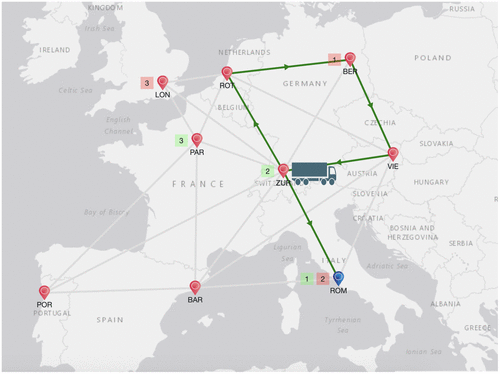
Note. BAR, Barcelona; BER, Berlin; LON, London; PAR, Paris; POR, Porto; ROM, Rome; ROT, Rotterdam; VIE, Vienna; ZUR, Zurich.
The game consists of multiple rounds, with three new requests generated randomly at the start of each round (Figure 2). Players suggest routes and prices for transporting these requests from their origins to their destinations, considering volumes and lead times—the number of rounds within which the request must be delivered. Each late delivery incurs a penalty of $5 per round for the carrier. Requests appear on the map at their origins and destinations. For each request, players can identify its pickup and delivery points. The maximum capacity of a truck is four volume units. The current on-hand loads, reserved loads (those secured but not yet picked up), and remaining capacity are depicted in the truck on the map. Each move of the truck between neighboring nodes takes one period (i.e., round), with the distance between these nodes defined as one unit. At the end of each round, the truck is located at one of the neighboring nodes of its previous location. Consequently, with each round, the lead time of transported requests decreases by one period.
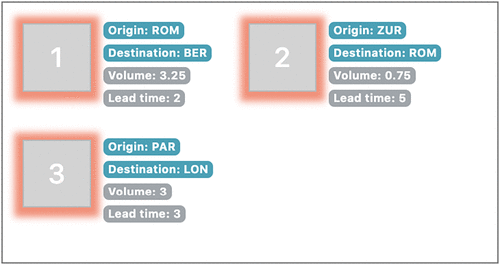
Note. BER, Berlin; LON, London; PAR, Paris; ROM, Rome; ZUR, Zurich.
In the game, up to four players can be connected to a platform, competing in the same spot market. The platform uses a combinatorial reverse auction mechanism to obtain freight services. In this system, carriers submit their prices (i.e., bids) for shipments, and the platform selects the winning bid by minimizing the overall transportation cost for those shipments during a specific time frame (referred to as a round). Players can select individual requests or bundles of requests to transport, allowing them to achieve economies of scope by combining shipments that share similar routes. The auction process begins when all players have finished submitting bids. Players can submit multiple proposals, but only one proposal per player will be selected as the winning bid. The objective of each player (i.e., carrier) is to submit the best prices, secure shipments for transport, and maximize their profits. The winner of the game is the player with the highest profit at the end of the game. This process is repeated for several rounds.
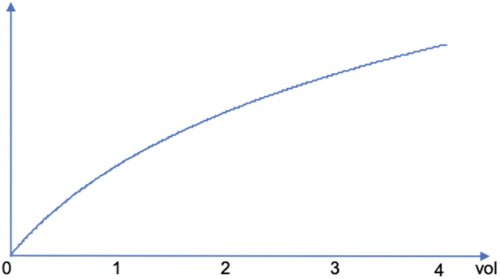
In each round, players plan a route for their truck by considering the requests’ information. They then select the requests or bundles of requests that they wish to transport along the route, ensuring that the details align with the fleet’s capabilities and operational constraints. Next, players decide on their pricing strategy for the trip, taking into account various factors, such as transportation costs, penalties for delays, potential detours, the urgency of the shipment, and any prior commitments. A player’s profit is calculated as the difference between the proposed price (for each transportation request successfully secured) and the total transportation cost. The cost is determined by the distance traveled and the volume transported, calculated using a concave nonlinear function of volume per unit distance (i.e., dollars per volume-kilometer) (Figure 3). The nonlinearity arises from transport synergies or economies of scale generated by bundling shipments. The transportation cost may also include penalties for delays when the delivery time exceeds the lead time.
Players then submit their proposals to the platform, with the option to submit as many proposals as they wish before the end of the round. Once all proposals are submitted, the platform uses an optimization model to allocate shipments to carriers by minimizing the total transportation cost based on all submitted bids. The platform informs players whether they have won a shipment or not. At the end of each round, the platform generates a general ranking of all players based on their profit margins. The player with the highest profit margin is the winner. This ranking allows players to gauge their position in the market relative to their competitors. Players can adjust their strategies based on the results, and if they do not win, they can modify their approach to increase their chances of winning in subsequent rounds (Table 1).
|

Table 1. Player Proposals in a Round in Progress
| Players | Request bundles | Routes | Costs, $ | Proposed price, $ |
|---|---|---|---|---|
| Player 1 | Request 1 | VIE | 4 | 5.5 |
| {Request 1, request 2} | ROM → VIE | 6.25 | 7 | |
| Player 2 | Request 3 | 2.5 | 4.5 | |
| {Request 1, request 3} | LON → ZUR → ROM | 8.5 | 9 | |
| Player 3 | Request 2 | 1.25 | 1.5 | |
| {Request 2, request 3} | ROM → ZUR → PAR | 9 | 10.5 | |
| Player 4 | Request 3 | 2.5 | 4 |
Note. BER, Berlin; LON, London; PAR, Paris; ROM, Rome; VIE, Vienna; ZUR, Zurich.
3.2. Illustrative Example of a Round in Progress
In this example, four players engaged in a competitive auction where three shipment requests were generated: request 1 (Rome to Berlin, 3.75 units, two rounds lead time), request 2 (Zurich to Rome, 0.75 units, five rounds lead time), and request 3 (Paris to Londin, 3 units, three round lead time) (see Figure 2). Each player strategically submitted multiple proposals, with some focusing on individual requests and others combining multiple requests to exploit potential synergies in their transportation routes. For instance, player 1 submitted two proposals. The first proposal was a stand-alone bid of $5.5 for request 1, intending to transport the shipment from Rome to Berlin. The second proposal combined requests 1 and 2, bidding $7 to cover a route from Zurich to Rome and then, onward to Berlin. By combining these requests, player 1 aimed to achieve economies of scale through a more efficient route. Player 2 also made two proposals. The first was a stand-alone bid of $4.5 for request 3, covering the route from Paris to London. The second proposal bundled requests 1 and 3, offering a bid of $9 to cover the combined route from Rome to Berlin and then, from Paris to London. Player 2’s strategy sought to spread transportation costs across two requests, potentially increasing overall profitability. Player 3 submitted a low bid of $1.5 for request 2, aiming to transport the shipment from Zurich to Rome. Additionally, player 3 combined requests 2 and 3 into a single proposal, offering $10.5 to cover a route from Zurich to Rome and then, from Paris to London. This strategy was designed to leverage the shorter route of request 2 with the longer route of request 3, optimizing costs through bundling. Player 4 focused solely on request 3, submitting a competitive stand-alone bid of $4 for the Paris to London route. Player 4 opted for simplicity, aiming to secure a win with a direct and competitive bid (Figure 4).
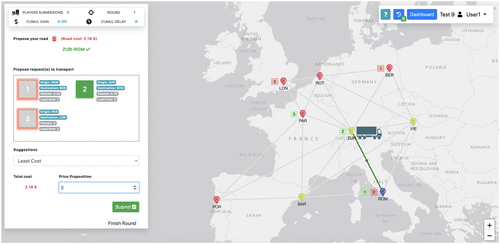
Note. BAR, Barcelona; BER, Berlin; LON, London; PAR, Paris; POR, Porto; ROM, Rome; ROT, Rotterdam; VIE, Vienna; ZUR, Zurich.
By submitting all of their proposals to the platform, which aims to minimize the total transportation cost of all requests (i.e., the total price proposed by the carriers for all requests assigned), the auction winners will be player 2 with his proposal for transporting requests 1 and 3 and player 3 for transporting request 2, with a total price of $10.5. After evaluating all other combinations, the lowest total price for the three requests is indeed $10.5. Consequently, player 2 will be ranked first with a profit of $0.5 (the difference between the proposed price and the transportation cost), player 3 will be ranked second with a profit of $0.25, and players 1 and 4 will be ranked last with a profit of $0 because they did not win any bids in this round.
This example underscores the importance of decision making in spot markets, where players must carefully balance the trade-offs between cost, route efficiency, and the potential for synergies. The competitive nature of the game forces players to continuously adapt their strategies based on market conditions, their competitors’ actions, and the platform’s optimization criteria. The outcome of this round demonstrates that players who can effectively combine requests and optimize their routes stand to gain the most, whereas those who cannot adapt may struggle to win bids and achieve profitability.
3.3. The Combinatorial Reverse Auction Mechanism: Resource Allocation Model
In the context of the game, the allocation model operates on the principles of a combinatorial auction, which are crucial for ensuring that each carrier efficiently handles their assigned requests. According to the game rules, once a carrier wins a request, they are responsible for delivering it all the way to its final destination. Given that carriers have limited capacity, the allocation process must ensure that no more than one feasible request bundle (including individual requests) is allocated to each carrier and that this bundle is the one that maximizes volume, thereby minimizing the unit cost. This is achieved through the exclusive OR (ⴲ) (XOR) bidding language as defined by Lehmann et al. (2006). In this framework, carriers submit bids on multiple bundles, indicating that they are only interested in winning one of these bundles. Although carriers may bid on multiple bundles during the auction, they can ultimately win only one.
To determine the winning bids, a winner determination program is employed. In the game, we utilize the allocation model described by Lafkihi et al. (2020). This model integrates a well-established winner determination formulation, which is extensively used in freight transport service procurement because of its effectiveness in achieving economies of scope and scale, thereby reducing total transportation costs. The formulation is adapted from the work of Lehmann et al. (2006). Additionally, the model incorporates rules that allow for the reassignment or reallocation of requests, further enhancing the benefits of economies of scope and scale (Özener et al. 2011).
The allocation and reallocation model is defined by several key constraints; the objective function minimizes the total cost of allocating all request bundles, whereas the first constraint ensures that each carrier transports at most one bundle. The second constraint guarantees that each request is allocated only once on a single route, and the third constraint stipulates that an in-transit request can only be reallocated if it results in a lower unit cost or price. This final constraint is crucial in preventing scenarios where the overall optimal solution would impose a higher unit price on an in-transit request, thus maintaining cost efficiency throughout the allocation process. For more detailed information, please refer to the model in Lafkihi et al. (2020).
3.4. Game Scenarios
In the game, all information on the platform, such as requests and rankings, is public to all players. However, players are not permitted to share private information with others, including details like their actual position, fill rate, or bids, and vice versa. Although some platforms offer messaging tools for carriers to interact with shippers—facilitating inquiries, providing clarifications, and demonstrating their commitment to reliable service—it is important to note that in this game, the role and decisions of the shipper are not included. It is assumed that shippers automatically accept the optimal bid proposed by the platform along with any associated penalties in the event of delays. The game is composed of two scenarios.
3.4.1. Scenario 1: No Carrier Cooperation.
In this scenario, students play the role of carriers to simulate the classic freight transportation spot market. Players face two primary decisions: (1) evaluating information to identify feasible request bundles based on their route compatibility and capacity and (2) bidding on these feasible request bundles with competitive prices that will maximize their expected profits. The auction mechanism selects the best bids. This scenario represents the classic version of the game described in Section 3.1.
3.4.2. Scenario 2: Hub-Based Carrier Cooperation.
In this scenario, a novel dimension unfolds as carriers have the opportunity to engage in the exchange of shipments with fellow carriers at the central node. This cooperation may increase the potential for economies of scope (meaning that they can reallocate shipments to other players) and economies of scale (extra requests to increase truck fill rate and reduce unit cost). In this scenario, when a player reaches the central hub (i.e., Zurich), they can propose the reallocation of their on-hand shipments. These are referred to as reallocated shipments and are visible to other carriers who can bid on them.
As players review these in-transit requests (i.e., requests in reallocation), they have the option of offering a price to take over these requests (one or several), and they will do so only if they have enough capacity and the interest. If the proposed price is lower than the original residual cost of a reallocated shipment, the original player benefits not only from the price difference as extra profit but also, time savings and capacity releasing for upcoming requests, whereas the subcontracted player who takes over and secures the shipment will also earn a profit (otherwise, they would have no incentive to bid). However, if all prices submitted are higher than the original residual cost, there is no reallocation. Reallocation, therefore, only occurs in situations that are mutually beneficial for both the original and subcontracting players. If there is no taker for an in-transit request, the original player must complete the delivery. Consequently, players should strategically plan their routes through the central node (i.e., Zurich) to increase their chances of winning in this reallocation scenario of the game. Reallocation is possible even if the original carrier does not secure a new request. In this case, the original carrier’s gain is the difference between the cost of the reallocated request and the price proposed by the new carrier. When the new carrier submits a bid to transport a reallocated request, it includes any applicable late delivery penalties in the proposed price.
4. Teaching Experiences and Results
Now, we present some results and findings from our teaching experiences of the game. The data presented were gathered from the logistics management course for master’s students from engineering schools or other similar programs. The game unfolds across a three-hour class session. The lecturer instructs the students to form groups, each consisting of four players. Each set of four players collectively embodies a freight transport spot market, with the players taking on the roles of competing carriers participating in the same online platform. They operate in an environment with random transportation requests (Table 2). The lecturer organizes the lesson according to the two described scenarios, each offering a different learning experience. Students participate in the first scenario for 45 minutes and play several rounds of the game. Afterward, the lecturer leads a 30-minute discussion to review student experiences. Following a 15-minute break, the class moves on to scenario 2. The lecturer outlines for almost five minutes the conditions and rules governing the resource exchange allowed by the reallocation, ensuring that students are well prepared to embrace the complexities and opportunities that it offers. Then, a 45-minute gameplay session ensues followed by another 30-minute debriefing session to review student experiences.
|
Table 2. Example of Shipper Shipments
| Shipment | Origin | Destination | Volume | Lead time |
|---|---|---|---|---|
| Request 1 | ROM | BER | 1 | 2 |
| Request 2 | ZUR | ROM | 2.5 | 6 |
| Request 3 | PAR | LON | 2 | 5 |
| Request 4 | ZUR | POR | 3 | 4 |
| Request 5 | BAR | VIE | 4 | 3 |
| Request 6 | ROT | BAR | 1.5 | 2 |
| Request 7 | LON | ROM | 0.5 | 7 |
| Request 8 | PAR | BER | 2 | 4 |
| Request 9 | ZUR | PAR | 3 | 3 |
| Request 10 | VIE | ROT | 1.5 | 6 |
Note. BAR, Barcelona; BER, Berlin; LON, London; PAR, Paris; POR, Porto; ROM, Rome; ROT, Rotterdam; VIE, Vienna; ZUR, Zurich.
At the conclusion of the gaming session, each group initiates an assessment of players’ performance, focusing on their efficiency, effectiveness, and sustainability. Seven key performance indicators (KPIs) are presented for each group. These KPIs are evaluated at both the carrier level (see Table 3) and the market level (see Table 4).
|
Table 3. Carrier-Level KPIs for a Group of Students in a Game Session
| KPI | Description | |
|---|---|---|
| Efficiency | Carrier’s profit, $ | The total profit earned by a carrier during the game session |
| Carrier’s mean filling rate, % | The average percentage of vehicle capacity used by the carrier | |
| Carrier’s transport, tonne-km | The sum of the volumes transported by the carrier’s vehicle measured in tonne-kilometers | |
| Effectiveness | Carrier’s number of delays | The total number of delays experienced by the carrier |
| Sustainability | Carrier’s distance of empty runs, % | The distance traveled by the carrier’s vehicle when it is empty expressed as a percentage of the total distance traveled |
|
Table 4. Market-Level KPIs for a Group of Students in a Game Session
| KPI | Description | No. | |
|---|---|---|---|
| Efficiency | Total transport cost, $ | The sum of the transport costs of a group of players over all of the rounds played | 139.20 |
| Total carrier profit, $ | The total profit of a group of players; it reflects both the objective of each carrier to maximize their overall profit and the overall profitability of the group | 15.22 | |
| Mean filling rate, % | The average load-to-total truck freight capacity ratio excluding empty runs | 35.42 | |
| Total transport, tonne-km | The sum of the volumes transported by the vehicles | 17 | |
| Effectiveness | Total number of delays | The amount of order shipments delivered to customers on time, indicating how effectively a carrier meets the deadlines agreed with the shipper | 13 |
| Number of unallocated requests | The unfulfilled requests because of factors such as short lead time, long distances, or shortage of capacity in the spot market | 7 | |
| Sustainability | Distance of empty runs, % | The distance traveled when the vehicle is empty; it is crucial for assessing the environmental impact | 10.71 |
At the carrier level, the goal is to assess the performance of each individual carrier within the group and analyze the strategies employed by each player in their pursuit of winning. The outcomes naturally depended on their strategies, such as prioritizing pricing over minimizing delays or incorporating sustainability into their decision making.
At the market level, the KPIs are used to evaluate the overall performance of the market for the group of players as well as to compare the performance of the spot market with and without resource exchange. Generally, market performance with reallocation is better than without reallocation.
These KPIs provide a basis for facilitating discussions on the effectiveness of different strategies and the dynamics of the market.
4.1. Scenario 1: Debriefing and Connection with Recent Research
Based on the KPIs, at the end of the first scenario, the lecturer initiates a discussion with the students about their performance and the strategies that they used to maximize their profits. The lecturer begins by analyzing and discussing the individual KPIs for each carrier, exploring whether the winning carrier indeed has the best performance indicators or if that is not necessarily the case. The discussion also focuses on whether changing strategies throughout the game leads to better outcomes.
Through this analysis, it becomes evident to many that despite the advantages of online platforms, there are still significant challenges in achieving optimal performance. The complexity involved in utilizing them still presents a significant hurdle. These discussions also highlighted the various factors influencing students’ decision making and tactical choices during both the market analysis and bidding process phases.
4.1.1. Factor 1.
The primary factor mentioned was the comprehension of the rules translated by the number of rounds played in the game. Students who demonstrated a better understanding of the rules tended to have engaged in a greater number of rounds compared with those who found the rules more intricate. It mirrors the players’ familiarity with online auction-based platform rules and the bidding process. As gameplay progressed, players developed their skills and understanding, making it easier to identify and submit feasible bundles. Consequently, in real life, newcomers to the market may encounter more challenges in securing orders compared with actors well versed in freight spot markets (i.e., reference prices, potential competitors, and other key factors). This observation clearly reflects the reality of some local markets that could have special operating models or local regulations.
4.1.2. Factor 2.
The second crucial factor mentioned was the challenge of identifying a feasible bid gauged by the number of submissions made during each period. It was observed that the greater the complexity of the task, the fewer the number of submissions. Players often found the intricate process of combining a request bundle and determining a viable route difficult, particularly when multiple requests (including on-hand and market requests) had to be considered simultaneously (i.e., in a freight spot market, there are numerous shipments and a multitude of potential combinations to contend with). Notably, this attribute of complexity exerts the most pronounced influence on bidding behavior.
To confirm the students’ statements, the lecturer initiates the computation of the theoretical optimal solution that picked the best allocation and route planning determined by a central optimization model. Based on this optimal solution, the price is calculated by adding a 3% margin to the total transportation cost, reflecting the average margin of carriers in the freight transport spot markets. The deviation of students’ results from the optimal results (i.e., decentralized versus centralized decision) serves as an indicator of the complexity involved in making choices. A more substantial deviation from the optimal solution highlighted the intricate nature of decision making within this spot market. It could be plausible that players experience too many options to find and oversee them all or too few options to be able to catch them. All of the information regarding routing, load size, start and end times, requests to be exchanged, etc. can logically not be processed by a human. This typical symptom of bounded rationality of carriers weakens the position of an independent carrier. This highlights the need for added decision-making tools.
According to Table 5, those who participated in more rounds and submitted a higher number of proposals displayed a better understanding of the rules, came closer to the optimal solution, and thus, exhibited improved performance indicators for the same set of shipments. This could be seen as the learning curve.
|
Table 5. Example of Results per Group for a Game Session
| Rounds, no. | Total submissions, no. | Deviation from optimal solution, % | |
|---|---|---|---|
| Group 1 | 5 | 7 | 60 |
| Group 2 | 15 | 34 | 30 |
| Group 3 | 28 | 85 | 13 |
4.1.3. Factor 3.
A third crucial factor mentioned is the complexity of the bidding process. For a feasible alternative, players need to choose to bid or choose not to bid. To make this choice, players think about the possibility of determining competitive prices; the lower the total transportation cost, the more attractive the alternative to bid on becomes. Players can place more competitive bids and secure a higher margin when the total transportation cost is low. Although players can place as many bids as they want, they may think bidding is useless when total transportation costs are high, which impacts the competitiveness of the market. Players are presumably trying to prevent delays as much as possible using the penalty costs as their main indicator. The higher the penalty cost that a player has to pay when bidding on the corresponding request bundle, the less likely they will be to bid on it. Moreover, for the choice of bidding or not, players consider the profit already won by selecting their on-hand loads, which represent the requests already won in previous periods that a carrier has to transport to their destinations. According to van Duin et al. (2007), the on-hand loads attribute mentions the effect that a player whose truck is far from full will be more eager to attract new requests as their current earnings can be increased. Conversely, when a player’s truck capacity is almost fully utilized, they will be less eager to place a bid as earnings are already being made, and it could bring extra restrictions for the next rounds in which better bids could potentially be won.
Following these discussions, the lecturer can wrap up the first scenario of the game by emphasizing the crucial role of electronic platforms in auction-based markets. As a result, the key takeaway is the importance of developing a decision support system or an information service tailored to carriers, helping them navigate the complexities of online auction platforms in the freight spot market. These platforms offer services before, during, and after the transportation of goods, which are instrumental in simplifying decision making and assisting market participants. Collignon (2016) underscores that an increased offering of services within an electronic auction platform is positively linked to the adoption, usage, and success of auction-based freight transportation markets. Additionally, Collignon (2016) demonstrates that features aimed at reducing uncertainty and risk can have a positive influence on the outcomes of the freight transportation spot market.
4.2. Scenario 2: Debriefing and Connection with Recent Research
During the debriefing, the students generally realized that the inclusion of request exchanges increases the complexity of the market analysis and the bidding process. The greater the number of requests that need to be considered and bundled, the longer the feasible route is, and the more difficult it is to find feasible, optimal bundles.
To validate the students’ statements, the lecturer compared the number of submissions and the time taken by the same group of students in scenario 1 (i.e., without the reallocation option) and in scenario 2 (i.e., with the reallocation option). The results revealed that within the same 45-minute class period, participants engaged in fewer rounds or submitted fewer proposals in scenario 2. Despite their familiarity with the platform and its rules, they faced challenges in selecting suitable routes and requesting bundles when reallocation requests were involved given the high number of possibilities. Additionally, students struggled to grasp the rules of reallocation and the concept of a win-win situation. Intuitively, they found it difficult to understand that sharing a request with competitors could improve their overall profit and competitive standing in the game. The idea of a win-win situation was not immediately clear to them as they were hesitant about giving their competitors gains.
Furthermore, the lecturer emphasized that reallocation enables significant economies of scope, resulting in improved KPIs overall. When comparing KPIs from scenario 1 and scenario 2 for the same group and with the same request input data, the results indicate that students performed better in the scenario with reallocation than in the scenario without reallocation (see Table 6).
|
Table 6. Example of KPIs for Sc.1 and Sc.2 for the Same Group of Students and with the Same Requests
| KPI | Sc.1 | Sc.2 | |
|---|---|---|---|
| Efficiency | Total transport cost, $ | 139.20 | 126.1 |
| Total carrier profit, $ | 15.22 | 17.34 | |
| Mean filling rate, % | 35.42 | 42.25 | |
| Total transport, tonne-km | 17 | 14 | |
| Effectiveness | Total number of delays | 13 | 10 |
| Number of unallocated requests | 7 | 4 | |
| Sustainability | Distance of empty runs, % | 10.71 | 8.52 |
Therefore, despite the increased complexity in carrier operations because of the exchange of shipments, the savings and performance were notably enhanced. The key takeaway is that auction-based platforms can facilitate carrier cooperation in the spot market, leading to improved performance. However, decision-making tools are crucial to mitigate complexity and promote the widespread success of auction-based platforms for spot markets, especially dealing with decision bias on horizontal cooperation. This underscores the importance of increased digitalization to boost overall performance. The potential of new generative artificial intelligence tools to tackle these challenges is promising, even though there are some concerns about their adoption. This highlights a significant direction for future research and development in this field.
Moreover, because time in the game is currently deterministic, a valuable extension could be to incorporate stochastic disturbances, such as congestion, on certain lanes. This would add realism to travel times between nodes and address a current limitation of the deterministic setup.
5. Takeaways and Classroom Experience
5.1. Key Takeaways
The game sessions showed that the complexity of the bidding process in an auction-based online platform for a spot market negatively impacts carrier willingness to bid and thus, to cooperate. This provides quantitative support for earlier findings from qualitative research (Collignon 2016), and stresses the significance of the freight transport service procurement problem for spot markets. The students’ experiences in the game revealed that providing carriers with information and services that reduce the complexity of bids could have a strong impact on their willingness to exchange shipments and profit from economies of scope and scale.
Moreover, carriers in real life could have incentives or perspectives other than making a profit. They may also care about the region in which they conduct their transport or the length of their routes. In this case, the decision support systems should be adjustable to cope with a variety of carrier preferences. For example, it should steer the carrier toward proposing optimal bids based on their preference for low cost, service region, route length, etc. We also note in this respect that request reallocation adds significant complexity to the bidding process as exchanging requests requires profit sharing and transaction costs to be considered. This added complexity could be studied further, including its mitigation through information or gain-sharing measures.
The students acknowledge that this experience allowed them to better understand the barriers to coordination encountered in auction-based freight transportation spot markets. Auctions will become more important in the future as electronic freight platforms mature and the pressure on carrier markets increases. Consequently, insights into how to manage the complexity are important to support sustainable growth of the freight transport system. Consider, for example, the physical internet transportation network (Ballot et al. 2014) that advocates the use of auctions for the management of transport resource sharing between carriers (Lafkihi et al. 2020). Understanding the factors that impact carrier behavior and their willingness to collaborate is critical for the design of targeted mechanisms that will be required for collaborations to come to fruition in such a freight spot market.
5.2. Classroom Experience
The game has been successfully played with diverse groups of international master’s and PhD students hailing from various academic backgrounds, including engineering and business/management majors. To ensure fluidity, it is recommended to limit the number of groups to around 15–20 with at least four students per group (up to eight if teamed up), thus ensuring effective debriefing and discussions.
Students have embraced the game with great enthusiasm, enjoying the opportunity for active participation and the sense of realism that it offers. They have been notably surprised by the challenges that carriers face, despite the presence of tools designed to support decision making when planning transport routes and setting freight service prices. This “wow” factor even resonated with senior doctoral students specializing in logistics and freight transportation. In the second scenario of the game, students perceived the exchange of transport resources between one another as a new “out-of-the-box” strategy, motivating them to develop their own approaches to achieve economies of scope and scale.
Nonetheless, students generally acknowledged that in most real-world freight transportation companies, cost considerations take precedence over all other performance metrics.
From the lecturers’ perspective, the game is easy to introduce and effectively sheds light on a vital practical issue within the realm of freight transportation systems. Its minimal requirements—merely computers or smart mobile devices with a good internet connection—facilitate its accessibility. Even students lacking prior knowledge in logistics and SCM can engage in the game, although a brief review of fundamental concepts, such as freight service procurement mechanisms and total transportation costs, may be beneficial in these cases.
References
- (2014) The Physical Internet: The Network of Logistics Networks (La Documentation Française, Paris).Google Scholar
- (2003) Optimization-based procurement for transportation services. J. Bus. Logist. 24(2):109–128.Crossref, Google Scholar
- (1996) An optimization based bidding process: A new framework for shipper-carrier relationships. PhD thesis, Massachusetts Institute of Technology, Cambridge.Google Scholar
- (2016) Exploratory and empirical analysis of e-marketplaces for truck transportation services procurement. PhD thesis, Virginia Tech, Blacksburg.Google Scholar
- (2015) Operations research models for coalition structure in collaborative logistics. Eur. J. Oper. Res. 240(1):147–159.Crossref, Google Scholar
- (2012) A survey of serious games on sustainable development. Proc. 2012 Winter Simulation Conf. (WSC) (IEEE, Piscataway, NJ), 1–13.Google Scholar
- (2019) Freight transportation service procurement: A literature review and future research opportunities in omnichannel e-commerce. Transportation Res. Part E Logist. Transportation Rev. 125:348–365.Crossref, Google Scholar
- (2020) Rule-based incentive mechanism design for a decentralised collaborative transport network. Internat. J. Production Res. 58(24):7382–7398.Crossref, Google Scholar
- (2002) The first use of a combined-value auction for transportation services. Interfaces 32(5):4–12.Link, Google Scholar
- (2006)
The winner determination problem . Cramton P, Shoham Y, Steinberg R, eds. Combinatorial Auctions (MIT Press, Cambridge, MA), 297–318.Google Scholar - (2022) Antecedents of spot and contract freight mix in the truckload sector. Transportation J. 61(4):331–368.Crossref, Google Scholar
- (2011) Lane-exchange mechanisms for truckload carrier collaboration. Transportation Sci. 45(1):1–17.Link, Google Scholar
- (1988) Deterministic chaos in models of human behavior: Methodological issues and experimental results. System Dynam. Rev. 4(1–2):148–178.Crossref, Google Scholar
- (2019) Auction-based serious game for bug tracking. IET Software 13(5):386–392.Crossref, Google Scholar
- (2007) Real time simulation of auctioning and re-scheduling processes in hybrid freight markets. Transportation Res. Part B Methodological 41(9):1050–1066.Crossref, Google Scholar
- (2005) More than fun and games: Reconsidering the virtues of strategic management simulations. Acad. Management Learn. Ed. 4(4):451–458.Crossref, Google Scholar