Game—The Competitive Car Production Game: Teaching Theory of Constraints and Linear Programming
Abstract
Having observed many students struggling with the topics of theory of constraints (TOC) and modeling optimization problems, we developed the competitive car production game. It is a tangible interactive in-class educational game, in which student teams compete for the highest profit by managing their own production line of (toy) cars. The objective of the game is to teach topics such as TOC, linear programming (LP), production scheduling, and game theory. Our game is flexible in its application: Students can play a basic version (Module 1) and/or an extended version (Module 2). In both modules, students determine the optimal product mix, deciding how many of each type of car to manufacture while considering production and demand constraints. In Module 2, students also have the opportunity to bid in an auction event for extra capacity and must compete for total market demand. Since September 2023, this game has been successfully implemented in various operations management–related courses taught to Bachelor, Master, and MBA students. Our positive experience with teaching the game, combined with students’ evaluations, confirms its value.
Supplemental Material: Additional material for Modules 1 and 2 is available at https://doi.org/10.1287/ited.2024.0125. The Teaching Note is available at https://www.informs.org/Publications/Subscribe/Access-Restricted-Materials.
1. Introduction
Today’s business environments are shaped by various constraints, such as supply, capacity, and demand, and are characterized by intense competition and increasing complexities. To make decisions in such a context, future (operations) managers should understand how to deal with constraints in production and have the skills to mathematically model and solve such problems to support their decisions. Unfortunately, teaching students theory of constraints (TOC), to enrich their understanding of how to deal with constraints, and mathematical modeling is challenging, especially at the Bachelor level.
In most cases, even when students are offered many exercises and homework to practice TOC and optimization modeling, their motivation to practice many of these similar exercises is low. We also observe that some students perform the steps of TOC learned in class (see the foundational book by Goldratt and Cox (1984)), without really understanding bottlenecks and their implications in real-life applications. Moreover, literature shows that TOC is closely linked to linear programming (LP) and that both TOC and LP can determine the optimal product mix (Luebbe and Finch 1992, Coman and Ronen 2000). However, TOC does not necessarily guarantee optimal results, especially for larger or more complex problems, but it provides insight on how to manage bottlenecks (Linhares 2009, de Souza et al. 2013). Therefore, we wanted students, as future managers, to understand the impact of constraints in production processes and to develop skills in optimization modeling and solving larger problem instances using Excel Solver. This led to the development of an interactive and tangible classroom game.
Despite already existing games on TOC and capacity management (Goldratt and Cox 1984, Luo and Munson 2022), as well as optimization and LP (Beliën et al. 2024), most addressed these topics separately, and none fully met the specific needs of our students in their current form. Our main objective was to develop a tangible game that visualizes a production process with multiple sequential workstations, allowing students to experience the challenges of deciding which products to make and how to expand their capacity. In addition, the game is designed to help students experience the implications of a bottleneck, demonstrate the need for optimization-supported decision making, and encourage collaborative decision making within a team.
As companies do not operate in isolation, their decisions are influenced by those of other companies in the same market. Therefore, we simulate this competitive environment in the game. In particular, in addition to allowing students to compete for achieving maximum profit at the end of a game, in an extension of the game (i.e., referred to as Module 2), we incorporate competition for acquiring extra capacity, as well as competition for overall market demand. The competition for acquiring extra capacity (through the purchase of an extra parallel machine or a better machine as replacement of an old machine) is introduced via auction events. In particular, before the production and selling period starts, the companies/teams have the choice to acquire additional production capacity on the auction events, for which they have to determine their bidding price. Competing for overall market demand creates extra dynamics in the game. Teams may need to adjust their production decisions based on the potential product offerings of other teams. To the best of our knowledge, this is the first game to illustrate the impact of competition (for capacity and demand) in a production environment on company’s production and capacity decisions.
The overall goal of integrating this game in our classes is to reap the benefits of active learning and gamification in terms of learning, motivation and engagement (Michael 2006, Caponetto et al. 2014). Moreover, the collaborative and competitive aspects of the game stimulate cognitive and motivational learning outcomes (Sailer and Homner 2020).
Because games should not be too difficult to avoid students disengaging and should be challenging enough to stimulate learning (Lomas et al. 2017), we developed a “modular” game that has very simple rules. Module 1 of the game is simple and designed to teach the fundamentals of product mix decisions in the context of producing different toy cars under capacity and demand constraints, using the TOC and LP optimization and extending it to a linear integer programming (IP) by requiring decision variables to take integer values. In particular, the process consists of a sequential production line with five different workstations, where four different types of toy cars—each with unique profit margins and processing times—are manufactured. Module 2 of the game extends Module 1 by incorporating auction-based capacity investment decisions and competition for overall market demand. It aims to teach extensions of the LP model to support decision making and to enhance students’ understanding of how competition influences their decisions and introduce them to the concept of game theory. Having different “game modules” also allows for customization in use, based on the learning objectives, skills of students, and teaching time constraints.
Despite increased digitization, incorporating hardware and tangible items in courses, as in our game, enhances learning outcomes, motivation, engagement, social interaction, and fun (Naik 2014, Shodhan 2017, Petri et al. 2018). This is in line with many other physical educational games, such as the beer game (although online versions exist), the dressing change game (Tucker and Lefton 2015), the Zu Zitter Game (Wright 2015), and assembly-line, production control, and constraint management games (Fish 2005, Klotz 2011, Grandzol and Grandzol 2018, Wilson 2018, Thürer et al. 2020). Our game provides students with visual and tactile experience of production systems, enabling them to gain real-life experience in managing production lines “manually” and understand the consequences of their decisions quickly.
This game has been played since September 2023 with more than 500 Bachelor, Master, and MBA students at IESEG School of Management (Lille and Paris Campus, France) and has successfully increased students’ learning, engagement, and interest related to operations management concepts.
Our paper advances the operations management game literature by presenting a physical educational game that is flexible in use, simultaneously covering both TOC and optimization. In what follows, we position our game in relation to other existing games (Section 2), provide a detailed overview of our game’s setup (Section 3), discuss our classroom experience with the game (Section 4), and conclude with final remarks (Section 5).
2. Literature Review
2.1. TOC Games
TOC was first introduced in the foundational book “The Goal” (Goldratt and Cox 1984). It is a methodology that includes different steps to identify and optimize the use of a “system constraint” (i.e., bottleneck) and improve the overall system performance. A widely used game to illustrate TOC is the dice game. The game dates back to the work of Goldratt and Cox (1984) and has since then been widely applied and commercialized, with a wide range of (simulation-based) game variants (Johnson and Drougas 2002, Umble and Umble 2005, Lambrecht et al. 2012). The dice game includes a production line of different workstations with variable processing times, with the latter determined by a dice role. Workstations with a low dice role limit throughput and become bottlenecks. The main learning objective relates to showing the detrimental effect of processing time fluctuations on throughput and idle time and understanding the connection between variation in process times and work-in-progress (WIP) inventory (Goldratt and Cox 1984). Note that there also exist case studies, rather than games, that aim to illustrate TOC and its link with WIP inventory and changeover times in a production line (Orchard 2019). The dice game focuses on a fixed process flow through the workstations, whereas some other games also look at flow shop environments (such as the job shop game by Holt (2002)).
Luo and Munson (2022) extended the traditional dice game by developing an Excel-based simulation that allows students to explore several possibilities to improve the production process such as buying/selling capacity, decreasing/increasing processing time variance, adding/reducing the number of workstations, or adding beginning inventory. In particular, in the game by Luo and Munson (2022), each team selects one improvement option on a printed sheet of paper, after which the instructor enters their decisions and runs the simulation to show the resulting changes in throughput and revenue. Although this simulation illustrates how process improvements can enhance throughput, it remains static, offering students limited real-life experience in managing a production line or understanding how competition impacts production and capacity decisions.
The games and simulations described above focus on capacity management under uncertain processing times, which is why they do not add the complexity of multiple product types, but only look at one type of product. In contrast, the purpose of our game is to determine the optimal production of different types of products to maximize the profit while identifying the bottleneck workstation. Teaching students how to apply both TOC and LP for optimal decision making for such problems cannot be effectively achieved in environments with only one product type or where bottlenecks constantly shift due to fluctuating processing times. Moreover, adding the complexity of constraints in raw material supply (Chakravorty and Verhoeven 1996) would also over-complicate the problem for our learning objectives.
Research articles on education and learning that focus on the application of TOC to determine the ideal product mix are rather limited. Hays (2008) developed a web-based interactive exercise that focuses on a profit maximization problem of an assembly line with two product types to encourage students to use the TOC in a real environment. However, the TOC may not guarantee optimal solutions in more complex production systems with multiple constraints and more than two products (de Souza et al. 2013). Our game is different to Hays (2008) because it focuses on more complex settings. First, our game considers a production system that produces more than two products. This requires students to complement the basic TOC steps with LP to find optimal solutions. Second, in Module 2 of our game, teams can increase their production capacity (i.e., buying an extra machine to use in parallel or a machine to replace an old one). To make a sound decision on their maximum willingness to pay for this extra capacity, students can use again LP, further advancing their mathematical programming skills. Third, our game includes two forms of competition in its Module 2: competing for obtaining an (extra or replacement) machine to increase their capacity and competition for overall demand. This helps students understand the challenge of competition on decision making. As such, our game represents a solid basis for introducing students to TOC and mathematical programming, as well as decision making under competition and game theory.
Contrary to previous TOC games that mostly focus on maximizing throughput, our board game focuses on product mix and capacity extension decisions with the aim to maximize profit. These questions have not been addressed yet by previous TOC games, especially not under the competition for capacity extension and total market that we consider. Moreover, despite multiple games on optimization (Beliën et al. 2024), none of them have focused on addressing the problems and decisions we focus on; we are the first to combine TOC and mathematical programming learning in a tangible game in a competitive setting.
2.2. Operations Management Games That Incorporate Competitive Elements
In our proposed game, we introduce competitive elements where teams compete to achieve the highest profit but also to acquire new capacity and capture a limited market demand for different types of toy cars. Previous studies highlighted the benefits of competition in learning, noting that it enhances active participation, engages students with traditional operations management topics and stimulates curiosity (Wood 2007, Thrasher 2008, Beliën et al. 2024).
Related to games that include competition, Arunachalam and Sadeh (2005) developed a multiagent simulation platform to coordinate sourcing, procurement, production, and customer bidding decisions of supply chain trading agents operating under supply and demand uncertainty. Agents compete for customer orders and components and plan production on a single machine that produces different product types. The production problem for their setup, under deterministic conditions, represents the single machine total weighted tardiness scheduling problem. However, our game simulates the production problem of determining the optimal product mix within a production system consisting of multiple workstations, taking into account capacity and demand constraints.
Abasian et al. (2020) developed an online transportation game in a simulated forest supply chain. The game players, as competing companies, are making simultaneous decisions on the available resources. Zhao et al. (2023) developed a supply chain contract and collaboration simulation, in which multiple supply chains that sell fresh-cut flowers compete on the same market. Supply chain members collaborate to beat other supply chains and increase the total supply chain profit, but at the same time bargain to protect their own interests from other members belonging to the same supply chain. Within each supply chain, ordering quantities, wholesale and retail prices, and the marketing mix are determined, and production capacity allocation and operation decisions are made. In contrast to Abasian et al. (2020), Zhao et al. (2023) who focused on supply chain coordination, in our production game, the teams (i.e., manufacturers) compete for acquiring scarce capacity resources via auction events and for capturing overall market demand.
Games developed to simulate competitions with auctions have mainly focused on sourcing. The BucknellAuto game by Chen and Bailey (2018), a spreadsheet-based bidding game, focused on a reverse auction for supply chain sourcing. Students have the role of a seller and compete for demand with the automated competitors. The objective is to learn bidding competitiveness. Teich et al. (2005) developed the bread-flour-grain trading game for e-procurement, in which students take the role of both a supplier and a buyer, and design online auction events via a web-based auction system.
The competitive car production game presented in this article enables students to understand how competition affects production and investment decisions, by comparing scenarios with and without competition. Thus, this approach provides a solid introduction to decision making in competitive environments, game theory, auctions, in addition to TOC and mathematical programming.
3. Game Description
In the competitive car production game, we simulate a setting of producing toy cars. While playing the game (i.e., managing the production line), students should be able to (1) identify the bottleneck workstation; (2) understand the importance of using appropriate methods, such as TOC and mathematical programming, to determine the optimal product mix; (3) learn how to plan and schedule production; and (4) make production and capacity decisions in a competitive environment. The game consists of two modules. Module 1 is the base game of the product mix problem without competition. Module 2 is an extension to Module 1 of the game with competition.
3.1. Module 1
At the beginning of the game session, we provide students with the learning objectives of the competitive car production games (Module 1) and describe the problem.
3.1.1. Learning Objectives.
The learning objectives are as follows: (i) understand how to manage production processes; (ii) understand the production limitations caused by a bottleneck in the process; (iii) identify and optimize the use of a bottleneck and improve the overall system performance; (iv) understand the concepts of TOC and LP; (v) develop skills to mathematically model and solve production problems; and (vi) recognize the need for improved production scheduling.
3.1.2. Problem Description.
The company produces and sells four types of toy cars: blue racing cars, green city cars, pink convertible cars, and yellow sports cars. The toys are manufactured in a production system consisting of five workstations in sequence: mold dye, plastic injection molding, painting, assembly, and packaging. The company would like to determine the optimal product mix in order to maximize its profit considering demand and capacity constraints.
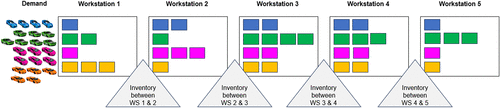
To better understand the production process of the company, we show to students a video such as “hot wheels” or Pixar car’s “Lightening McQueen Die-Cast Car” production (Comedy Never Sleeps 2015, Old Man Diecast 2021, Pixar Cars 2024). This increases students’ immersion in the game and also stimulates their interest in real-life operational production environments. We then provide more details about the production system and game rules as discussed below. We refer the reader to Figure 1 for a visualization of the game setup and Table 1 on the pedagogical design of the game.
|

Table 1. Pedagogical Design of the Game: Module 1
| Game stage | Setup | Decisions by students | Length | Collaboration/competition aspect | Material needed | Learning |
|---|---|---|---|---|---|---|
| Introduction to Module 1 | Explain the game setting and rules | NA | ±15 min | NA | Slides and videos to explain the context/theory. | Understanding the rules of the game and its learning objectives, including how it is played and the specific skills/knowledge it aims to develop. |
| Module 1 | Each student team manages 1 production line with 5 WSs. There are 4 different toy cars that can be produced and sold. Each toy car type has different processing times per WS and unit margins. Demand is known. | Determine the production level of each toy car type, while considering capacity and demand constraints to maximize the profit. Manage the production line. | Strategy discussion per team (±15 min) Game Play (±15 min). Total: ±30 min | Students collaborate in a team, but compete with other teams for the highest profit. | The number of material sets = ±Total number of students/5 assembly lines. The set includes: the board (5 workstations and 4 buffer locations) and toy cars as visualized in Figure 1. | Increase interest in OM. Understand production limitations caused by bottlenecks, and that producing high margin products are not always the most strategic choice. Recognize the need for improved production scheduling. |
| Debrief | Debrief with the teams. Explain the Product Mix problem with TOC and LP, and Gantt chart for production scheduling. | NA | Debrief (±15 min) Explanation of concepts (±60 min). Total: ±75 min | NA | Slides and videos to explain the context/theory | Develop an understanding of TOC and LP to determine the optimal product mix under constraints. Apply production scheduling techniques using Gantt charts to visualize and manage production. |
Note. NA, not applicable.
3.1.3. Product Types.
The toy car company produces and sells four types of toy cars: (1) blue racing cars, (2) green city cars, (3) pink convertible cars, and (4) yellow sports cars. In our further explanation, we denote the type of car by i, with a blue, green, pink, and yellow car represented by i equal to 1, 2, 3, and 4, respectively.
3.1.4. Workstations and the Manufacturing Process.
The production line to produce these toy cars consists of five sequential workstations (with a specific workstation (WS) denoted by j): (1) the mold dye, (2) plastic injection molding, (3) painting, (4) assembly, and (5) packaging, represented by j equal to 1, 2, 3, 4, and 5, respectively. Note that a machine in a WS can process only one toy car at a time but is able to produce different types of cars. Production is carried out in sequence (i.e., each toy car should be produced first on the mold dye machine, then it requires plastic injection molding, afterward painting, assembly, and finally packaging). Between two workstations, there is a buffer/WIP of cars that are waiting to be processed on the next workstation in case this machine is still occupied by the production of another car. The processing of a product type i on a specific workstation j requires a certain amount of time, denoted by . In Figure 1, the number of squares of a certain color on a machine represents the processing time for toy cars of that color on that machine. For instance, a green toy car requires two periods (or rounds) of processing time on WS 1, so that .
3.1.5. Forming Teams.
A team of ideally five students manages the production system, with each student within a team being responsible for a specific workstation. Note that the size of a team can be decreased or increased depending on the needs. For instance, the instructor can assign two workstations to one student or, alternatively, assign two students to one workstation.
3.1.6. Demand and Unit Margin.
Demand of each product type i during a certain planning horizon T for each team is known and denoted by . If the company sells a product of type i, it generates unit margin . At the start of the game, the instructor should place the required number of toy car pieces of each color in front of WS 1, matching the customer demand for each car type (as shown in Figure 1). Particularly, as illustrated, the demand of toy car type i equal to 1, 2, 3, and 4 is four, seven, six, and five units, respectively.
3.1.7. Decisions in Module 1.
Each team must decide how many units of each toy car to produce to maximize the company’s profit during a given planning horizon T. Teams are also responsible for managing the production line, including determining the production schedule (i.e., the order of producing products).
3.1.8. Additional Information.
The planning period T, defined as a series of rounds, is set by the instructor. Information on production times, demand, unit margins, and the number of rounds is provided in the teaching note of this article. The instructor can further explain that teams are competing to achieve the highest profit to engage more actively students by introducing a competitive aspect in the game (Sailer and Homner 2020).
3.1.9. Sequence of Movements.
Figure 2 illustrates the movement of cars from the end of one round to the start of the next. The main rules governing the sequence of movements are as follows:
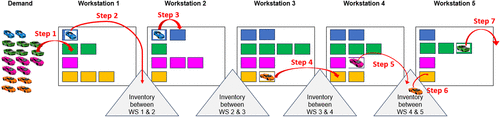
A toy car advances by one square on a machine each round from left to right (see Step 3 in Figure 2, where the blue car moves from the first square to the second square of WS 2).
If a machine on a WS is available, a toy car should be taken either from the inventory (see Step 1 in Figure 2 where a green car is taken to be produced on WS 1; and Step 6, where the yellow car is moved from the buffer between WS 4 and 5 to WS 5), or from a machine on the preceding WS if that station has completed its operation (see Step 4 where the yellow car moves from WS 3 to WS 4).
If a machine on a WS is available, and several toy cars are waiting in front of it (e.g., the pink and yellow cars before WS 5), the manager of that WS decides which car to process next (in Step 6, the yellow car is selected).
If a machine has completed its operation on a toy car, the car can either (i) be placed directly on the first square of the same color on the machine of the successor WS, provided that the WS is available (see Step 4), or (ii) moved to the inventory between these two WSs if the successor WS is occupied (see Step 2 where the blue car is moved from WS 1 to the inventory between WS 1 and WS 2) or if the manager of that WS decides to process a different toy car from the buffer (as in Step 6).
Once a car completes the final production step at WS 5, it exits the production system and is considered a finished product (see Step 7 where the green car exits the production system).
To keep track of the decisions per team, the instructor can give each team a paper sheet containing two tables: “Schedule of production,” and “Quantity Produced and Profit Table” (in “Paper Sheet of Module 1” in the Online Appendix). At the end of each round, the student in charge of WS 5 should register the color of the toy car that exited the system (if any) in the table “Schedule of production.” At the end of the game, the team should count the number of each car type produced, calculate the total profit, and record these values in the “Quantity Produced and Profit Table.” The instructor then collects paper sheets of all teams and announces the winner.
3.1.10. Debrief and Learning of Module 1.
Upon completing Module 1, students can be asked to identify the bottleneck workstation in the production system and discuss why not all demand can be met. Following this game, the instructor can teach the product mix problem using TOC and show how LP modeling and the Excel solver can help to determine optimal production quantities. Because TOC and LP are closely related and each has its own advantages, we believe it is important for students to learn about both (Rahman 1998). Although LP is a powerful tool for solving (large) TOC-related problems (Balakrishnan and Cheng 2000), TOC provides students with a framework for deeper operational insights into managing constraints and continuously improving a system (Rahman 1998, Finch and Luebbe 2000). In our problem solutions, we address both a “pure” LP problem, without integrality constraints on decision variables, and a linear IP problem, where decision variables are restricted to integers. In the further discussion, we refer to both as LP models. For the LP model without integrality constraints, students can also be asked to generate a sensitivity report using the Excel Solver and to interpret shadow prices. Given the production quantity decisions, students can create a Gantt chart to visualize the optimal production schedule.
The instructor has the flexibility to structure the classes following three different approaches, dependent on the preferred teaching strategy, learning outcomes, and available time. The first approach is to use the game as an introductory experience to the problem before explaining TOC and LP (Introductory Experience). The second approach is to first teach TOC and LP, allowing students to find optimal solutions before using the game as an illustration or hands-on exercise (Concept-First Approach). Last, the instructor can begin by explaining TOC to help students understand how to identify bottlenecks and continuously improve a system with constraints. Afterward, the game can be played to apply it to a more realistic setting, before introducing LP as a broader, more systematic problem-solving method (Progressive Learning).
3.2. Module 2
We refer the reader to Figure 1 for a visualization of the game setup and Table 2 on the pedagogical design of the game.
|
Table 2. Pedagogical Design of the Game: Module 2
| Setup | Decisions by students | Length | Collaboration/competition aspect | Material needed | Learning | |
|---|---|---|---|---|---|---|
| Introduction to Module 2 | Explain the game setting and rules. | NA | ±15 min | NA | Slides and videos to explain the context and game setting. | Understand the rules of the Module and its learning objectives, including how it is played and the specific skills/knowledge it aims to develop. |
| Module 2 | Extended version of Module 1. Introduces competition among teams for capacity and market demand. Teams participate in auction events to purchase a new capacity. Upon auction events, the teams manage their production lines, taking into account that the overall demand is shared across all teams. | Teams decide whether to purchase a new capacity, and the bidding price. Upon auctions, teams decide the optimal number of products to produce while considering demand competition and capacity constraints. | Strategy discussion per team and Solving the optimal product mix problems considering capacity options (±30 min). Auction (±15 min) Game Play (±15 min ) Total: ±60 min | Team members collaborate to determine bidding strategies on the auction, and engage in bidding competitions against other teams. Team members collaborate to determine the product mix to meet demand under competition. | Set for Module 1 and additional boards for new machines to replace old ones. | Understand how to increase capacity by focusing on bottlenecks. Gain the ability to compute potential profit increases when expanding capacity and align machine investments with these gains. Understand how solutions evolve when competing for limited resources and market demand. |
| Debrief and concepts | Make a debrief. Explain concepts like (1) Decision making under competition (2) Game theory (3) Supply chain collaboration (4) Dynamics of auctions. | NA | Debrief (±15 min) Explanation of concepts (±30 min) Total: ±45 min | NA | Slides and videos to explain the context/theory | Understand how competitive dynamics influence production strategies and capacity choices. Comprehend the interdependencies between company’s decisions and those made by other market participants. Modeling more complex problems. |
3.2.1. Learning Objectives of Module 2.
Module 2 is an extended version of Module 1 of the game. The instructor can decide to play Module 2 after having played Module 1 or immediately start playing Module 2 (skipping Module 1) upon introducing TOC and LP. The objective of Module 2 is to (i) evaluate different options to increase capacity and determine the willingness to pay for these options; (ii) evaluate the impact of competition for limited additional capacity and the overall market demand on the profit and the production decisions; (iii) learn how to dynamically adjust operational decisions depending on competitors’ decisions; and (iv) encourage collaborative decisions within a team.
3.2.2. Problem Description of Module 2.
We start Module 2 with capacity investment options under competition. In particular, teams have the choice to acquire additional capacity to improve their performance. Several options for additional capacity are available: adding a new parallel machine or replacing old machines with faster ones (i.e., processing times of certain types of toy cars are speeded up).
To foster competition, the number of options is limited (fewer than the number of teams), and companies must compete to acquire additional capacity. Therefore, we introduce auction events with bidding for additional limited capacity. The instructor may not reveal ahead how many capacity options are available to create a higher competition among teams and a more exciting learning process. The instructor plays the role of the auction owner (i.e., seller) and sets forward auction events in which capacity options are offered to the teams as potential buyers. In such auction events, a starting selling price of an option is announced to teams. For our game, we conducted English auctions,1 but implementing sealed-bid events would also be possible.2
Figure 3 illustrates different capacity extension options available in the auction, each with a different capacity configuration (i.e., the processing times of the new machines and the number of workstations vary) and starting purchase price.
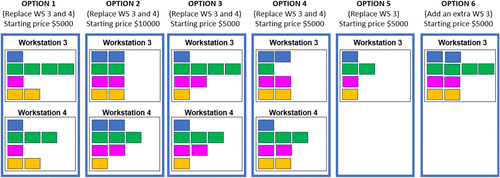
Before bidding on the auction event, the teams can discuss their bidding strategy and calculate their maximum willingness to pay for each capacity option, developing LP models (if needed with support by the instructor). Next, the instructor initiates and conducts the auction event and gives to each team that acquired a capacity option a printed board of the new WS (WSs) to be added in their board.
Finally, the game of Module 2 can be run similarly to Module 1. However, different to Module 1, the instructor announces that teams now compete for a shared market demand (where the total demand can be less than or equal to the sum of demands over all teams in Module 1). This implies that teams should now carefully consider the competition aspect when deciding how many toy cars of each color to produce. Note that, in a competitive environment, not all produced cars may be sold if production exceeds demand, resulting in unsold items. These unsold items will be discarded as demand is fulfilled on a first-in-first-out basis. The paper sheet for recording the schedule and the total profit of Module 2 is provided in “Paper Sheet of Module 2” in the Online Appendix. Upon finishing playing Module 2, the profits of each team are compared, and the winning team is announced.
3.2.3. Debrief and Concepts.
The instructor facilitates a debrief to discuss challenges faced in a competitive setting, comparing the decisions teams made with and without competition. As such, Module 2 enables students to understand how competitive dynamics influence production and capacity decisions. This game also serves as a practical introduction to noncooperative game theory, illustrating that failing to properly consider competitors’ decisions and their impact on profitability can lead to suboptimal solutions.
The instructor may also explain the concept of horizontal supply collaboration among competitors, providing practical examples with competitors sharing their scarce resources. The benefits of such collaboration can be demonstrated with a centralized setting, where a single decision maker maximizes the total profit of all companies and allocates production quantities across supply chain actors. The instructor can ask students to develop an LP model for the centralized case. However, the allocation of gains among participants poses its own challenges, introducing students to cooperative game theory and the broader topic of supply chain coordination. Additionally, Module 2 may also serve as an introduction to the topic of auction dynamics.
4. Classroom Experience
The competitive car production game (base format: Module 1) was developed in 2023 to teach TOC principles and mathematical modeling in an introductory operations management course for second-year undergraduate business students at IESEG School of Management, France. Previous experience teaching the course showed that many students struggled to understand these concepts and found the material not engaging, prompting the development of an interactive game to improve learning. Since its introduction, the competitive car production game has been expanded with an additional module (Module 2) to broaden its learning scope and make it suitable for Master and MBA students. During the 2023–2024 and 2024–2025 academic years, the game has been utilized by multiple professors and engaged more than 500 students across Bachelor, Master, and MBA programs at IESEG’s Lille and Paris campuses. The content and estimated times needed for Modules 1 and 2 of the game are given in Tables 1 and 2, respectively.
In the fall semester of the 2024–2025 academic year, we assessed three diverse student groups’ satisfaction with the game using a formal questionnaire (see results in Table 3). The three student groups who assessed the game were from the second year Bachelor in International Business (BIB), second year Bachelor in Program Grande Ecole (PGE), and first year Master Apprenticeship in Operations and Supply Chain Management from PGE at IESEG. Note that all students who evaluated the game experienced the game as part of an obligatory (i.e., nonelective) course with a group size of maximum 40 students. The statements used in the questionnaire are similar to those in previous game articles (Luo and Munson 2022, Beliën et al. 2024). The statements aimed to evaluate (a) learning and awareness of operational topics, (b) perceptions of the game’s competitive, collaborative, and tangible aspects, and (c) recommendations for future use. Open-ended questions were also included to gather qualitative insights on learning and overall game experience (see appendix).
Table 3 shows that students highly appreciate the game (with average scores over the groups between 4.19 and 4.33) and recommend it for use in future semesters. Overall, students agree that the game increases their interest and understanding of operations management concepts, and students like the collaborative, competitive, and tangible aspects of the game. The open feedback from the students (see appendix) further supports these findings. In particular, related to enhanced learning, some students stated “It made it easier to understand the TOC exercise after. I hope to see this kind of exercise again” (Bachelor BIB) and “We emerged in a real-life production dilemma, which is interesting for the learning experience” (Master PGE). Students also appreciated the interactive and tangible aspects of the game, as well as its entertaining factor. For examples, students stated “Love the idea, was fun, very interactive. The game was a wonderful way to visualize the idea. While having fun, I learn a lot, a ton.” (Bachelor BIB); “I like this game!! To be fair, I am not good at dealing with numbers, but this game exactly increases my passion to continue to study this subject” (Bachelor BIB); and “I really loved it, the fact that it was tangible and visible made it clearer for me. When I encounter the same type of exercise again, I will remember this game and it will make it easier” (Bachelor PGE). The open feedback also includes constructive remarks to be considered by instructors of this game. Instructors should clearly explain how to play the game (comment by students: “Maybe the rules could have been explained better” (Bachelor PGE)). In Bachelor (BIB and PGE), some students suggested giving more explanation about TOC before playing the game (student comment: “I thought the game was interesting. However, the only thing I would change is doing the game after we have gone more into depth of the bottleneck constraints” (Bachelor BIB). However, by extending the rules and theory explanation to address these students’ concerns, instructors should also be careful not to make the game session too long (student comment: “It was interesting, but maybe a bit too long. I prefer to play the game.” (Master PGE)). Note that in the Master course, students had a very diverse background, with some students already having knowledge about TOC, whereas others not, explaining why some students might have wanted extra/less theory before playing the game. Some students would appreciate more rounds to better understand the logic. As we were constrained by the session durations (i.e., two hours in Bachelor courses and four hours in the Master course), we limited the number of rounds to 40. However, the instructor could easily adjust the number of rounds to more than 40 or play the same module twice before and after introducing the concepts of bottleneck analysis, TOC, mathematical programming, and production scheduling.
5. Conclusion
This article introduces the competitive car production game, an educational board game designed to determine the optimal product mix under demand and capacity constraints in a competitive environment. In Module 1, each team of students decides how many units of each type of toy car to produce on their sequential production line and competes with other teams to maximize profit. This hands-on, competitive setting engages students and introduces operations management concepts such as TOC, mathematical programming, and production scheduling. Module 2 builds on Module 1 by adding auction events to purchase extra capacity and a competition for total market demand, expanding the learning scope to include auctions, game theory, and supply chain collaboration.
The game’s modular design and diverse learning outcomes offer flexibility, allowing instructors to tailor it to their teaching time, student skills, and objectives. Based on both experience and student evaluations, we find that the game boosts motivation and interest, helps students connect theory to real-world operational settings, and enhances collaboration through team-based decision making. Since September 2023, the game has successfully engaged more than 500 students across MBA, Master, and postgraduate courses in operations management and supply chain management.
For the future, the game could be expanded to include outsourcing decisions, renting capacity from other teams, collaboration on production capacity, and managing uncertainties. For outsourcing, a contract manufacturer could sell limited quantities of products to competing teams through reverse auctions, allowing teams to decide between acquiring new machines or outsourcing production. Teams with extra capacity could rent it to competitors via auction events. Instructors could guide collaboration on capacity sharing and allocation, especially in supply chain coordination courses, such as those in our Postgraduate International Negotiation program. Adding uncertainties, like machine failures or product quality issues, could introduce concepts such as maintenance management and total quality management. In this version of the game, student teams cannot impact demand. Modeling demand as sensitive to price, advertising, or other demand-stimulating strategies would increase the complexity of the game and would likely require the development of an online version.
|
Table 3. Game Evaluations by Various Student Groups at IESEG School of Management
| Questionnaire results | Strongly disagree (1) | Disagree (2) | Neutral (3) | Agree (4) | Strongly agree (5) | Average score |
|---|---|---|---|---|---|---|
| Bachelor 2 BIB students (total average score: 4.33; number of students: 20) | ||||||
| The competitive car production game has increased my interest in operations management | 0 | 0 | 3 | 4 | 13 | 4.5 |
| The game has increased my understanding of production processes optimization, bottlenecks/constraints and TOC | 0 | 0 | 3 | 9 | 8 | 4.25 |
| I would recommend that the game continues to be played in future semesters | 0 | 0 | 0 | 11 | 9 | 4.45 |
| I like that the game is tangible | 0 | 0 | 3 | 7 | 10 | 3.9 |
| I like that the collaboration aspects of the game | 0 | 0 | 4 | 4 | 12 | 4.4 |
| I like the competitive aspects of the game | 0 | 0 | 1 | 5 | 14 | 4.5 |
| Bachelor 2 PGE students (total average score: 4.33; number of students: 25) | ||||||
| The competitive car production game has increased my interest in operations management | 0 | 0 | 4 | 12 | 9 | 4.2 |
| The game has increased my understanding of production processes optimization, bottlenecks/constraints and TOC | 0 | 2 | 5 | 4 | 14 | 4.2 |
| I would recommend that the game continues to be played in future semesters | 0 | 0 | 3 | 6 | 16 | 4.52 |
| I like that the game is tangible | 0 | 0 | 2 | 11 | 12 | 4.4 |
| I like that the collaboration aspects of the game | 0 | 1 | 2 | 12 | 10 | 4.24 |
| I like the competitive aspects of the game | 1 | 0 | 1 | 8 | 15 | 4.44 |
| Master Apprenticeship PGE in O&SCM (total average score: 4.19; number of students: 29) | ||||||
| The competitive car production game has increased my interest in operations management | 0 | 2 | 6 | 14 | 7 | 3.90 |
| The game has increased my understanding of production processes optimization, bottlenecks/constraints and TOC | 0 | 2 | 3 | 16 | 8 | 4.03 |
| I would recommend that the game continues to be played in future semesters | 0 | 1 | 3 | 15 | 10 | 4.17 |
| I like that the game is tangible | 0 | 0 | 4 | 10 | 15 | 4.38 |
| I like that the collaboration aspects of the game | 0 | 0 | 2 | 14 | 13 | 4.38 |
| I like the competitive aspects of the game | 0 | 1 | 5 | 8 | 14 | 4.25 |
Notes. The game has been played with many groups, but these results represent the groups where we asked for official evaluations of the game. O&SCM, operations and supply chain management.
The authors gratefully acknowledge the editors and anonymous referees for their insightful comments and constructive suggestions on this article. The authors also thank our colleague Linda Zhang for her assistance in testing and delivering the game, as well as for her valuable feedback.
Appendix. Open Feedback by Different Student Groups
The open feedback from different student groups at IESEG School of Management (France) is provided in Tables A.1–A.3. Note that as we did not want to change any answers; this implies some typos still remain in the feedback by students.
|
Table A.1. Open Feedback by Bachelor BIB Students at IESEG
| Qualitative feedback related to learning experience |
| Enhanced learning |
|
| Qualitative feedback related to the game experience |
| Interactive and tangible |
| Very interactive so helps to put theory into practice. I liked the interactive side. |
| Entertaining |
|
| Rules and explanation |
|
| Game playing conditions |
|
|
Table A.2. Open Feedback by Bachelor PGE Students at IESEG
| Qualitative feedback related to learning experience |
| Enhanced learning |
|
| Enhances understanding of specific concepts (e.g., bottlenecks) |
|
| Qualitative feedback related to the game experience |
| Interactive and tangible |
|
| Entertaining |
|
| Rules and explanation |
|
| Game playing conditions |
|
|
Table A.3. Open Feedback by Master Students at IESEG
| Qualitative feedback related to learning experience |
| Enhanced learning |
|
| Qualitative feedback related to the game experience |
| Interactive and tangible |
|
| Entertaining |
|
| Rules and explanation |
|
| Game playing conditions |
|
1 An English auction is a public, ascending auction where the auctioneer sets a starting price and bid increments. Bidders place progressively higher bids until only one remains, winning the product at the highest bid price (Talluri and Van Ryzin 2006, p. 245).
2 In a sealed-bid, first-price auction, all bidders submit sealed bids to the auctioneer without knowing bids of other participants (Talluri and Van Ryzin 2006, p. 245). The bidder with the highest bid wins the auction and pays the amount of its bid.
References
- (2020) Game—The transportation game. INFORMS Trans. Ed. 21(1):52–63.Link, Google Scholar
- (2005) The supply chain trading agent competition. Electronic Commerce Res. Appl. 4(1):66–84.Crossref, Google Scholar
- (2000) Discussion: Theory of constraints and linear programming: A re-examination. Internat. J. Production Res. 38(6):1459–1463.Crossref, Google Scholar
- Beliën J, De Boeck L, Goossens D, Quttineh NH, Vermeir J (2024) The game of thrones quest for optimality: A role playing game for teaching the art of linear programming. INFORMS Trans. Ed. 25(3):250–256.Google Scholar
- Caponetto I, Earp J, Ott M (2014) Gamification and education: A literature review. Busch C, ed. Proc. 8th Eur. Conf. Games Based Learn., vol. 1 (Academic Conferences Ltd., Reading, UK), 50–57.Google Scholar
- (1996) Learning the theory of constraints with a simulation game. Simulation Gaming 27(2):223–237.Crossref, Google Scholar
- (2018) Game—Introduction to reverse auctions: The BucknellAuto game. INFORMS Trans. Ed. 18(2):116–126.Link, Google Scholar
- (2000) Production outsourcing: A linear programming model for the theory-of-constraints. Internat. J. Production Res. 38(7):1631–1639.Crossref, Google Scholar
Comedy Never Sleeps (2015) How hot wheels are made. Accessed October 25, 2024, https://www.youtube.com/watch?v=PwsUXL_bXUgandt=158s.Google Scholar- (2013) When less is better: Insights from the product mix dilemma from the theory of constraints perspective. Internat. J. Production Res. 51(19):5839–5852.Crossref, Google Scholar
- (2000) Response to theory of constraints and linear programming: A re-examination. Internat. J. Production Res. 38(6):1465–1466.Crossref, Google Scholar
- (2005) Teaching assembly line balancing: A mini-demonstration with duplo® blocks or “the running of the dogs”. Decision Sci. J. Innovative Ed. 3(1):169–176.Google Scholar
- Goldratt E, Cox J (1984) The Goal: A Process of Ongoing Improvement (Gower Publishing, Aldershot, UK).Google Scholar
- (2018) Chantey castings: A hands-on simulation to teach constraint management and demand-driven supply chain approaches. Decision Sci. J. Innovative Ed. 16(1):6–22.Crossref, Google Scholar
- Hays JM (2008) Trikes, cars, and the theory of constraints (TOC). Decision Sci. J. Innovative Ed. 6(2):349–354.Google Scholar
- (2002) The job shop game, a theory of constraints game. Accessed December 19, 2024, https://www.scienceofbusiness.com/theory-of-constraints-games.Google Scholar
- (2002) Using Goldratt’s game to introduce simulation in the introductory operations management course. INFORMS Trans. Ed. 3(1):20–33.Link, Google Scholar
- (2011) The bicycle assembly line game. Decision Sci. J. Innovative Ed. 9(3):371–377.Crossref, Google Scholar
- (2012) Extending the production dice game. Internat. J. Oper. Production Management 32(12):1460–1472.Crossref, Google Scholar
- (2009) Theory of constraints and the combinatorial complexity of the product-mix decision. Internat. J. Production Econom. 121(1):121–129.Crossref, Google Scholar
- Lomas JD, Koedinger K, Patel N, Shodhan S, Poonwala N, Forlizzi JL (2017) Is difficulty overrated? The effects of choice, novelty and suspense on intrinsic motivation in educational games. Proc. CHI Conf. Human Factors Comput. Systems (Association for Computing Machinery, New York), 1028–1039.Google Scholar
- (1992) Theory of constraints and linear programming: A comparison. Internat. J. Production Res. 30(6):1471–1478.Crossref, Google Scholar
- (2022) Game—Playing Goldratt’s dice game in large classes. INFORMS Trans. Ed. 22(3):195–215.Link, Google Scholar
- Michael J (2006) Where’s the evidence that active learning works? Adv. Physiology Ed. 30(4):159–167.Google Scholar
- Naik N (2014) Non-digital game-based learning in the teaching of mathematics in higher education. Busch C, ed. Proc. 8th Eur. Conf. Games Based Learn., vol. 2 (Academic Conferences Ltd., Reading, UK), 431–436.Google Scholar
Old Man Diecast (2021) Ever wonder how hot wheels are made? Let’s take a look. Accessed October 25, 2024, https://www.youtube.com/watch?v=Sm0SI-fF33Iandlist=PPSV.Google Scholar- (2019) Using homemade, short, fictional cases for teaching the theory of constraints. INFORMS Trans. Ed. 19(2):81–88.Link, Google Scholar
- (2018) Games for teaching software project management: An analysis of the benefits of digital and non-digital games. J. University Comput. Sci. 24(10):1424–1451.Google Scholar
Pixar Cars (2024) How a lightning McQueen die-cast car is made! Accessed October 25, 2024, https://www.youtube.com/watch?v=y03fUYpDL8Aandlist=PPSV.Google Scholar- (1998) Theory of constraints: A review of the philosophy and its applications. Internat. J. Oper. Production Management 18(4):336–355.Crossref, Google Scholar
- (2020) The gamification of learning: A meta-analysis. Ed. Psych. Rev. 32(1):77–112.Crossref, Google Scholar
- Shodhan S (2017) Educational games: Balance between learning and engagement. Accessed October 25, 2024, https://medium.com/@SharanShodhan/educationalgames-balance-between-learning-and-engagement-3437b2efb9f.Google Scholar
- Talluri KT, Van Ryzin GJ (2006) The Theory and Practice of Revenue Management, vol. 68 (Springer Science and Business Media, Inc., New York).Google Scholar
- (2005) The bread/flour/grain trading game: Bidding in and designing auction events. INFORMS Trans. Ed. 5(3):42–54.Link, Google Scholar
- Thrasher TN (2008) The benefits of mathematics competitions. Alabama J. Math. 33:59–63.Google Scholar
- (2020) Classroom simulations for teaching production control in nonrepetitive contexts: Insights for theory and practice. Decision Sci. J. Innovative Ed. 18(4):568–588.Crossref, Google Scholar
- (2015) Game—The dressing change game. INFORMS Trans. Ed. 15(2):188–196.Link, Google Scholar
- (2005) The production dice game: An active learning classroom exercise and spreadsheet simulation. Oper. Management Ed. Rev. 1(1):105–122.Google Scholar
- (2018) Understanding bottlenecks: An operations management experiential learning exercise. Decision Sci. J. Innovative Ed. 16(3):166–184.Crossref, Google Scholar
- (2007) Online games to teach operations. INFORMS Trans. Ed. 8(1):3–9.Link, Google Scholar
- (2015) Game—The Zu Zitter game: A course-long tool for teaching operations management. INFORMS Trans. Ed. 15(3):240–253.Link, Google Scholar
- (2023) Game—FloraPark (the flower game): A supply chain contract and collaboration simulation. INFORMS Trans. Ed. 24(1):105–117.Link, Google Scholar