


Motivated Procrastination
Abstract
This study provides a rigorous empirical test for motivated memory as a cause for procrastination. In a longitudinal experiment over four weeks, individuals had to complete a cumbersome task of unknown length and receive noisy signals about their assigned workload. Varying scope for motivated memory results in more optimistic beliefs among workers who receive negative signals but not among those who receive positive ones. This suppression of negative news through motivated memory causes individuals to defer more work to the future.
This paper was accepted by Marie Claire Villeval, behavioral economics and decision analysis.
Funding: Financial support from the Deutsche Forschungsgemeinschaft [Grant CRC TRR 190 (project number 280092119)] is gratefully acknowledged.
Supplemental Material: The online appendix and data files are available at https://doi.org/10.1287/mnsc.2025.05353.
1. Introduction
Motivated beliefs play a central role in economic decision making (Bénabou and Tirole 2002, 2016). Under uncertainty, agents often engage in wishful thinking, updating their beliefs asymmetrically in response to positive versus negative news (see, e.g., Eil and Rao 2011 and Möbius et al. 2022). To maintain these optimistic beliefs, agents may avoid information (Golman et al. 2017) or selectively suppress information received in the past (Amelio and Zimmermann 2023). Driven by self-serving motives, such “rosy memory” serves as a key mechanism for sustaining optimism. Motivated memory has been documented across diverse contexts, including intelligence (see Chew et al. 2020 and Zimmermann 2020), financial decision making (see Gödker et al. 2025), education (see Roy-Chowdhury 2022), and fertility (see Müller 2022). In managerial settings, motivated memories can sustain overconfidence (Huffman et al. 2022) and amplify favoritism in hiring decisions (Cordes 2025). Yet, the relevance of motivated memory in the context of work organization remains largely unexplored. Motivated memory may crucially shape how individuals allocate effort over time. Specifically, it may allow agents to maintain optimistic beliefs about future effort costs that eventually cause a systematic delay of work, even when task experience or other informative signals would permit more accurate belief formation.
This project studies the role of motivated memory as a key driver of procrastinatory behavior and shows that motivated memory can foster optimistic beliefs in work contexts characterized by uncertainty about the agent’s future effort costs (despite the exposure to informative signals). Although definitions for procrastination “tend to be almost as plentiful as the people researching this topic” (Steel 2007, p. 6), we follow the literature that understands procrastinatory behavior broadly as a situation in which an otherwise “intended” course of action is delayed (see also Sabini and Silver 1981, Milgram 1991, Ferrari 1993, Beswick and Mann 1994, and Lay and Silverman 1996). More specifically and akin to the idea of O’Donoghue and Rabin (1999), who define procrastination as the deviation from the benchmark action of a rational agent with standard exponential preferences, we study procrastination based on motivated memory as the systematic deviation of work organization relative to the benchmark of how agents would allocate their effort absent any scope of forgetting. The main idea is that when given scope to forget informative signals, agents would rather suppress negative news and remember positive news. Such memory patterns can arise when wishful thinkers derive utility from optimistic beliefs about their future effort costs and, ultimately, result in optimistic and biased beliefs. Conditional on their potentially biased estimate of total effort costs, agents rationally allocate work across time but ultimately end up working more than planned in the future (because of an underestimation of their actual total effort costs).
In practice, managers often attribute workers’ delayed effort to present bias or insufficient self-control. With motivated memory, systematic work delays can occur even among agents who do not suffer from present bias. Here, the failure to exert effort earlier is not a problem of preferences but a rational response to distorted beliefs. Thus, standard interventions, such as commitment devices, that ignore beliefs as the source of procrastination are likely to fail. Hence, understanding the role of motivated memory in work contexts is not only of interest from a theoretical perspective, but it is also crucial for practitioners seeking to design effective organizational policies.
The core contribution of this project is to provide clean causal identification of the proposed link between motivated memory, optimistic beliefs, and the delay of work. Although theoretically compelling, it remains an important empirical question whether procrastination driven by motivated memory indeed arises in work environments. First, work environments often expose agents to informative signals (e.g., through experience), which may compel them to form accurate and persistent beliefs. Second, uncertainty about effort costs resolves naturally in work environments, limiting the scope for wishful thinking (for recent evidence from an ego-relevant setting, see Drobner 2022). Third, even if beliefs at the point of elicitation are motivated, agents may act on a debiased belief when being confronted with the actual work choice and its economic consequences.
We address our research question with a longitudinal experiment spanning four weeks, which allows us to track belief dynamics and work allocation across time. The experimental design features three sessions and four key elements that jointly allow us to isolate the causal effect of motivated memory on procrastination. First, we randomly assign how much total effort is required to complete a cumbersome transcription task (see, e.g., Benndorf et al. 2019) by the end of the third session to receive any payment from the experiment. This provides room for participants to enjoy anticipatory utility by holding motivated, optimistic beliefs about the total effort required to complete the unpleasant task. Second, at the end of the first session, we exogenously vary participants’ beliefs by sending participants noisy but informative signals about the randomly assigned total effort required to complete the task. Third, two weeks later but before we elicit posterior beliefs (in Session 2), we introduce exogenous variation in the scope for motivated memory. Although participants across treatments hold the same information and face the same incentives, those assigned to our LowScope condition are reminded of the signal that they received two weeks before (in Session 1), whereas those in the HighScope condition are not reminded. That is, HighScope participants can suppress negative news from the past, whereas LowScope participants cannot. Fourth, after eliciting participants’ posteriors in Session 2, we give participants the opportunity to complete some of their work on the day of Session 2 instead of providing all required effort two weeks later in Session 3. This effort allocation decision allows us to study the relevance of optimistic beliefs for the allocation of work. It was previously unannounced in order to avoid that elicited beliefs were biased by an anticipated allocation decision or that beliefs would bias the latter.1 We thereby exclude potential biases that may have affected important early studies in psychology exploring the idea that procrastination is belief driven (Konečni and Ebbesen 1976; Buehler et al. 1994, 1997; Byram 1997; Ariely and Wertenbroch 2002; Roy et al. 2005).
Our findings provide robust evidence for motivated beliefs in a work environment with informative signals and (natural) uncertainty resolution. Specifically, we document that motivated memory allows agents to distort their beliefs about future effort costs, and these distorted beliefs result in a systematic delay of work. Participants who receive negative news hold substantially more optimistic beliefs in Session 2 when being randomly assigned to the HighScope condition as compared with the LowScope condition. In HighScope, they consider it on average 10 percentage points (24%) more likely that the total effort required to complete the task is low (i.e., in the bottom half of the possible number of transcription sequences that can be assigned) than in LowScope, conditional on being provided with the same signal in Session 1. For positive news instead, being assigned to the HighScope condition does not significantly alter beliefs in Session 2. Consequently, the effects of positive news about future workload persist, whereas negative news affects posteriors much less when participants are given time to “forget.” Hence, even though participants receive informative signals and know that uncertainty about the total required effort will be resolved in Session 3, motivated memory allows them to uphold optimistic beliefs about the total effort required to complete the task.
In a next step, we provide evidence that these belief distortions result in the systematic delay of work. We establish a causal relationship between beliefs and effort provided in Session 2 by leveraging the exogenous variation in signal valence and treatment conditions that systematically alter beliefs. Exploiting the exogenous variation to instrument posterior beliefs, we find that a 10-percentage-point increase in the subjective posterior probability of low total required effort leads to completing 7% fewer sequences in Session 2 and reduces the likelihood of completing the maximum possible number of sequences in Session 2 by 18%.2 We term this belief-based delay of work “motivated procrastination” as it results only from motivated beliefs about the total effort that agents expect to exert and convex effort costs. Motivated procrastination does not require any suboptimal allocation decision conditional on the agents’ (incorrect) beliefs. Intuitively, participants with more optimistic beliefs exert less effort in Session 2 and, presumably, also expect to exert less effort in Session 3. However, because participants’ beliefs are systematically biased, they eventually have to exert more effort than expected in Session 3. That is, they systematically delay work as compared with participants holding more accurate beliefs, providing clean evidence for motivated procrastination.
Our results demonstrate that the prospect of a potentially low workload in a tedious task gives rise to optimistic beliefs via the suppression of negative news resulting in a systematic delay of work. To rule out that these findings are driven by a general optimism bias in memory (that is, by a “nonmotivated” tendency to recall negative signals less than positive ones), we conduct an additional preregistered Observer experiment that follows the same logic as the main experiment. In the Observer experiment, participants form beliefs about the workload of a randomly matched participant in the main experiment. Observers also complete three online sessions spread 14 days apart, and they are informed about the transcription task using the same procedures as the main experiment. They receive the same signal as their matched participant and, depending on the treatment, a reminder of that signal in Session 2. In the same manner as in the original experiment, we elicit observers’ prior beliefs in Session 1, and we elicit their posterior beliefs 14 days later in Session 2 and 28 days later in Session 3. However, observers are not required to complete the workload that was assigned to their matched participant. Thus, by design, our observers have no incentive to form optimistic beliefs. In the Observer experiment, posterior beliefs are neither more optimistic in HighScope than in LowScope, nor do we observe an asymmetric scope effect after positive news as compared with negative news. Hence, we conclude that it is the expectation of having to complete a high workload in the tedious task that constitutes the underlying source of biased belief formation through motivated memory in our main experiment.
This project contributes to several strands of the literature and provides important implications for theory, management practice, and policy. In particular, our work establishes a direct link between the literature on potential sources of procrastination and the literature on motivated beliefs. First, we contribute to a novel literature that studies how alternative (contextual) factors may lead to procrastinatory behavior and thereby complements the traditional view of procrastination as a result of time-inconsistent preferences (for a detailed review, see Ericson and Laibson 2019).3 For example, the presence of an excuse is a contextual factor that can induce procrastinatory behavior by fostering present bias or by reducing the emotional costs of postponing work (Drucker and Kaufmann 2022, Lepper 2024).4 In a related vein, Breig et al. (2023) provide an extension of a standard preference-based framework of procrastination that allows individuals to interpret their own past procrastination in different ways, thereby giving rise to a distinct form of belief-based procrastination. Specifically, they propose that individuals may interpret own past procrastination behavior either as a result of high past opportunity costs of time (belief based) or as evidence of low self-control (preference based), which should create a demand for commitment. Using a clever experimental design, the authors find evidence consistent with both preference- and belief-based procrastination. However, they neither explicitly model nor measure the underlying source of incorrect beliefs and instead focus on their behavioral implications.
Our work instead examines a form of belief-based procrastination that is not excuse driven and provides causal evidence on the underlying mechanism—motivated memory—that distorts beliefs about effort costs, even in the presence of informative signals. Thereby, our findings also provide a jigsaw piece to the puzzle of why we continuously observe procrastination, although workers have plenty of possibilities to learn from past behavior and improve their work organization. For example, Le Yaouanq and Schwardmann (2022) show that participants do learn from their past behavior in a real-effort task and become more sophisticated over time. The workload that participants faced in their study, however, was deterministic. Uncertainty about the actual effort required to complete a task—which is a realistic assumption in most real-life settings—and the resulting motivated beliefs about the latter may explain why we still often observe procrastination despite potential room for such learning processes.
More broadly, the emerging economics literature on contextual drivers of procrastinatory behavior—including our own—relates to the psychological literature on the planning fallacy (Kahneman and Tversky 1979, 1982), which documents individuals’ tendency to underestimate the time required to complete tasks, even in the face of repeated past failures. This literature emphasizes the distinction between inside and outside views of task prediction (Kahneman and Lovallo 1993), where the inside view treats a task as unique, whereas the outside view anchors forecasts on a broader class of similar experiences (see also Buehler et al. 2010). In contrast to this framework, our approach examines a setting in which the task is clearly defined, a prior signal is unambiguously informative, and the relevance of this information is known and cannot plausibly be denied. Thereby, we can isolate whether motivated memory alone (i.e., absent ambiguity of past signals or task uniqueness) can generate optimistic beliefs and, consequently, cause a systematic delay of work.
Second, we contribute to the literature on motivated belief formation. Specifically, our longitudinal study of motivated reasoning in a work context complements the literature on the dynamics of motivated reasoning and memory errors in other environments. Zimmermann (2020) finds that people form motivated beliefs by suppressing negative news about their performance in an intelligence quotient (IQ) - related test over the course of roughly a month, and Chew et al. (2020) show that individuals are significantly more likely to forget past failures in IQ-related questions than past successes and that false memory results both from delusion and from confabulation. Further, Hagenbach et al. (2025) observe that individuals self-servingly recall the informativeness of a signal about their intelligence. Huffman et al. (2022) provide evidence on managers’ memory biases, Roy-Chowdhury (2022) provide evidence on memory biases in school grades, and Müller (2022) shows that memory biases also exist for past fertility desires. Gödker et al. (2025) document memory biases in the financial domain. Our results complement and advance this literature in the context of the intertemporal allocation of effort. When workers worry about high effort costs (as they do in our unpleasant transcription task), they wish to ignore negative news about the total effort required to complete the task. Hence, we provide clean and robust evidence that scope for motivated memory increases the suppression of negative news in work environments. Further, we causally connect motivated beliefs to how work is organized, extending the importance of motivated memory for economic decisions beyond the financial decision-making domain studied in Gödker et al. (2025). We show that distorted beliefs induce a systematic delay of real effort and, thereby, identify motivated memory as an important source for procrastinatory behavior.5
From a methodological perspective, our approach demonstrates how memory as an underlying mechanism of motivated reasoning can be exogenously controlled by varying whether participants are reminded of informative signals received earlier. In contrast to other approaches, which have varied the observed extent of motivated beliefs through the associated costs and benefits by, for example, manipulating the strength of perceived ego relevance (Drobner and Goerg 2024), the resolution of uncertainty (Drobner 2022), responsibility (Bosch-Rosa et al. 2025), anxiety motives (Engelmann et al. 2024), or incentives (Zimmermann 2020, Gödker et al. 2025), we manipulate the scope for holding motivated beliefs by varying whether participants are reminded of signals that they received two weeks earlier. This approach holds information, risk, anxiety, and incentives constant while isolating memory as a mechanism of motivated reasoning. Moreover, beliefs in the LowScope and HighScope conditions are elicited at the exact same point in time, thereby ensuring that belief elicitation is not confounded by differences in time preferences.6 Importantly, even with reminders, motivated reasoning may still shape beliefs through other channels, most notably through asymmetric updating. However, these channels operate in both treatments. Thus, although beliefs in both HighScope and LowScope may be motivated, only in HighScope can they be influenced by motivated memory.
From a policy perspective, our results provide an important input into the ongoing debate about the welfare costs of procrastination. In preference-based models, policy interventions that reduce procrastination and impose time consistency are viewed as welfare improving from the individual perspective. In contrast, if procrastination is driven by wishful thinking, such as we demonstrate, procrastination may be optimal from an individual welfare point of view. Specifically, agents may rationally trade off the increased aggregate effort costs of back-loading work tasks with the increased savoring and better psychological well-being of being hopeful about future workload. This perspective also offers additional positive predictions. For example, an agent whose procrastination and apparent naiveté are an optimizing response that trades off psychological and material incentives may be reluctant to commit their future self to a more front-loaded work schedule. Thus, motivated procrastination can explain low uptake of commitment, but it may also change how we think about its welfare effects. Most importantly, although policies involving commitment may constitute Pareto improvements when procrastination causes negative externalities and is preference driven (e.g., in case of present bias), these may not be feasible when procrastination results from motivated reasoning because such policies would harm an individual’s belief-based utility.7
The rest of the paper is structured as follows. We present the details of our experimental design in Section 2. In Section 3, we derive our main predictions based on a simple theoretical framework. Section 4 presents our main results regarding motivated memory, negative news suppression, and procrastination. In Section 5, we present additional findings on belief dynamics and exploratory analyses relating to heterogeneous treatment effects. In Section 6, we discuss important methodological aspects of our approach and suggest interesting avenues for future research. Section 7 highlights the broader implications of our findings and concludes.
2. Experimental Design
2.1. Overview
To study the dynamics of motivated beliefs about effort costs and their implications for procrastination, we conduct a longitudinal experiment (n = 367) over four weeks. The experiment consists of three online sessions two weeks apart, and it has four key features. First, we create a common prior about the effort required to complete a cumbersome task by randomly assigning required workloads from a set of possible values. Second, we induce exogenous variation in participants’ expectations about the effort that they are required to exert by giving them imperfectly informative signals in Session 1. Third, we manipulate participants’ scope to hold motivated beliefs about how much work needs to be completed by reminding or not reminding them of these signals in Session 2 (i.e., two weeks later).8 Fourth, we include a belief-dependent work decision that allows us to study whether motivated beliefs result in the systematic delay of work. Figure 1 illustrates the timeline of the experiment and the main contents of the three consecutive sessions that the participants must complete to receive payment.
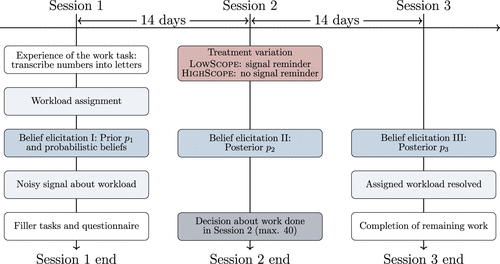
In Session 1, participants are informed that by the end of Session 3, they must have completed a transcription task. We chose this task as it is unpleasant and causes real-effort costs (see, e.g., Benndorf et al. 2019). Each sequence of the transcription task consists of six numbers to be transcribed to letters with the help of a coding key (see Figure F.1 in Online Appendix F). Once a participant has entered the six associated letters of a sequence correctly, she is prompted with a new sequence of numbers to be transcribed using a new coding key until she has completed the total number of sequences assigned to her. To familiarize participants with the task, they need to complete 10 practice sequences in Session 1. We thereby ensure that participants are aware of the fact that the task is unpleasant and involves real-effort costs. The practice sequences also provide individuals with an estimate of the time necessary to complete the task. The median time that participants needed to solve these 10 practice sequences was 3 minutes and 10 seconds.9
The total number of sequences is randomly assigned and ex ante unknown to participants. Specifically, participants learn that they must solve 40 sequences plus additional sequences to complete the entire experiment and receive payment, where . It is common knowledge that each possible value of is equally likely to be assigned to a participant, but the actual realization (and thus, the total number of sequences to be completed) remains unknown to participants until Session 3. Therefore, rational priors allocate a 50% probability to facing a high workload () and equal chance to any particular workload . In order to address concerns that diverging individual priors may influence the analysis, we explicitly elicit participants’ prior beliefs regarding the additional workload in Session 1 in two steps. First, participants have to state their subjective probability of having to solve at most 40 additional tasks (). Second, we ask participants how likely they consider each additional workload of the 10 possible workloads (8, 16, … 80), enforcing consistency of these beliefs with the participant’s belief in the first step as in Zimmermann (2020). We incentivize the belief elicitation using the binarized scoring rule, with a prize of €6 paid for one randomly chosen belief elicitation (Hossain and Okui 2013).10
After the elicitation of priors, we provide participants with a noisy but unbiased signal of their assigned workload (). We apply the signal structure used in Zimmermann (2020). That is, participants are informed about how many of three randomly chosen possible workloads that have not been assigned to them are higher (lower) than their assigned workload.11 Using the signal received and the elicited prior belief, we can derive the corresponding Bayesian posterior for each participant. Finally, participants complete a series of additional (filler) tasks, which obscure the purpose of the experiment and provide additional insights for our analyses.12
In Session 2, participants state their subjective posterior probability of having to solve at most 40 additional tasks (). We decided not to elicit posteriors already in Session 1 to avoid additional preferences for consistency to affect elicited posteriors in Session 2. Afterward and unexpectedly, we offer them the opportunity to complete up to 40 sequences already in Session 2. We impose the limit of 40 sequences to ensure that participants would have to complete at least some tasks in Session 3 and prevent them from working on more tasks than they were assigned to. They commit to the number of sequences that they want to solve and have to complete them by the end of the day of Session 2. Because of heterogeneous opportunity costs of time, participants may commit to very different numbers of sequences to be solved in Session 2. Yet, the fact that the work decision was not announced beforehand allows us to study how exogenous shifts in beliefs because of the exogenous variation in the scope for motivated beliefs and in the signals that participants received alter participants work allocation across time (see Section 2.2).13 Specifically, this design feature excludes the possibilities that (i) participants bias their beliefs to use them as a commitment for working more in Session 2 (as they do not know that they will have the opportunity to work in Session 2 when reporting their belief) and that (ii) having to allocate work between now and later biases the beliefs that we elicit (i.e., optimism in reported beliefs cannot result from a participant’s decision not to work in Session 2), both of which would make identification fail. Session 2 ends once participants have completed the number of sequences that they committed to.
At the beginning of Session 3, we again elicit participants’ posterior subjective probability of having to solve at most 40 additional tasks (). Then, participants complete several questionnaires. These include questionnaires on emotion regulation (Gross and John 2003) and irrational procrastination (Steel 2010) as well as questions regarding general preferences for information revelation (Ho et al. 2021).14 Finally, participants learn how many additional sequences were assigned to them and complete the remaining ones, taking into account the number of sequences completed already in Session 2. After they have completed their total workload, participants are informed about their payments. No payment is made if a participant does not complete this last session. That is, participants forfeit any payment if they fail to solve all of the sequences that they have been assigned, even if they have completed all of the questionnaires (which is common knowledge).
2.2. Exogenous Variation
To study the causal role of motivated beliefs for procrastination, we exogenously manipulate the scope for motivated reasoning and the signals that participants receive. In Session 1, each participant receives a noisy but informative signal about the total workload that they need to complete. These signals create exogenous variation in the beliefs that participants hold. The signal informs each participant about how many of three possible workloads that have not been assigned to them are higher (lower) than their assigned workload. Thus, the signal ranges from very positive—all of the three nonassigned workloads are higher than the workload assigned to the participant—to very negative—all of the three nonassigned workloads are lower than the workload assigned to the participant. To ensure that signals were seen by participants, all participants had to manually re-enter the signal shown to them on their screen. As the workloads are assigned randomly with equal probability, we can cleanly study whether participants react asymmetrically to signal valence.
To vary the scope for memory, participants either receive a reminder of the noisy signal about their assigned workload (LowScope) or not (HighScope) at the beginning of Session 2 before they report their posterior belief. To mitigate potential experimenter demand effects, the reminder is embedded in a natural review of prior procedures. We first remind all participants—independent of treatment condition—of the transcription task assigned 14 days earlier and of the random assignment procedure used to determine individual workload. Only subsequently do the treatments diverge; participants in LowScope are shown the same signal as in Session 1 and then report their posterior belief, whereas participants in HighScope are directly asked to report their posterior. Further, because of the random assignment of workload and signals in Session 1, our experimental procedures ensure that in LowScope, participants are equally likely to be reminded of positive and negative news as well as that positive news and negative news are presented in an identical manner. Thus, the reminder in LowScope may increase the salience of the news relative to HighScope but not asymmetrically so for positive news versus negative news. Moreover and consistent with the procedures in Session 1, participants in LowScope were required to re-enter the signal that they were reminded of, which rules out differential attentional responses to positive and negative news. Hence, imperfect memory and biased updating may lead to distorted beliefs in the HighScope condition, whereas in the LowScope condition, any bias in signal perception can only be because of biased updating. Consequently, the differences between the two scope conditions reveal the causal effect of memory on beliefs, and motivated memory can be identified if participants suppress negative news more than positive news in the HighScope but do not do so in the LowScope condition.
2.3. Procedures and Payments
The longitudinal online experiment was programmed in oTREE (Chen et al. 2016). We obtained institutional review board approval from the ethics committee at Ludwig-Maximilians-Universität München (LMU Munich, Project 2022-05), and the project was preregistered at https://aspredicted.org/SHS_XD6. Online Appendix C details the preregistered hypotheses and our deviations from the planned analyses. To ensure that we would be able to achieve our preregistered sample size, we recruited participants via the Online Recruitment System for Economic Experiments (ORSEE, Greiner 2015) in parallel from the student subject pools of the Munich Experimental Laboratory of Economic and Social Sciences (MELESSA) and the laboratory of Technische Universität Berlin and the Berlin Social Science Center (TU-WZB laboratory) in Berlin in two waves (Wave 1: June to July 2022, Wave 2: October to November 2022).15
In the morning of the session day, each participant received an individual link to the online interface of the experiment. All tasks that had to be completed within a given session were explained there. To remain in the study and qualify for final payment, participants had to complete a session by 10 p.m. of the day that they received the link. They were informed about this requirement and the exact dates of all three sessions at the recruitment stage. Randomization of signal provision was determined by random variables within the system during the first session, and the scope variation was assigned randomly only for those who completed Session 1. The randomization along both dimensions was successful (see Online Appendix B.6.1).
Participants received €14 for the completion of all sessions. In addition, they could earn another €6 depending on the accuracy of their beliefs. This incentive structure rendered attrition relatively low. Of 517 participants who completed the first session, 403 participants completed the third session, leaving us with a sample of n = 367 after applying our exclusion criteria.16 The median participant spent 103 minutes on the three sessions in total, and participants earned on average €17.06.17
3. Predictions
We derive predictions regarding belief formation and work allocation based on a simple theoretical model. The core purpose of this model is to formulate plausible and testable predictions regarding the causal effects of scope for motivated memory on negative news suppression in our experiment and to illustrate how optimistic beliefs may affect participants’ work allocation decisions. We deliberately abstract from additional complexities, such as uncertainty about future opportunity costs, which are orthogonal to our experimental treatment variation and signal exposure.
3.1. Setting
Consider an agent who has to complete a job consisting of tasks on date , where a task is equivalent to one sequence of the transcription task in the experiment. It is , and the random variable x is distributed according to some known distribution function with . To simplify notation and in line with our experimental design, we categorize workloads from as either low or high, where low refers to all workloads in the set and high refers to all workloads above the median.
Suppose the agent initially holds a prior belief , which is her subjective probability of being required to exert relatively low effort . For a rational agent, this prior belief corresponds to , but the analysis also applies to behavioral agents with a different (nondegenerate) prior.
The agent receives a noisy but informative signal regarding the realization of x at date . The signal can be negative () or positive ().18 A negative signal tells the agent that it is more likely than chance that she has been assigned a high workload (), whereas a positive signal suggests that a relatively low workload () is more likely.
The agent uses this noisy signal to form a posterior belief , which is elicited in in the experiment. We will compare belief updating from to across two situations that mirror our two treatments. First, we consider the case where agents always remember the signal that they have received when they form their posterior beliefs (LowScope). Second, we allow for imperfect memory so that agents may not take into account a previously received signal when they form their posterior beliefs (HighScope). Having stated a posterior belief, the agent learns that she can complete some of her work the same day (i.e., still in ) and is reminded that all remaining work will have to be completed on date .
When our experimental participants form and state their beliefs in the experiment, they are unaware of the work allocation decision to be made in Session 2. Therefore, we model the belief formation and the work decision as two separate problems.19 We first model the belief formation process in Section 3.2. Then, we model the work allocation decision—taking the belief as given—in Section 3.3.
3.2. Belief Formation
Consider an agent who starts with a prior of and receives a signal about her assigned workload. We are interested in the posterior belief that this agent forms about the likelihood that the workload is low having received signal s. A Bayesian agent with perfect memory will fully acknowledge the signal and use Bayes’ rule to obtain a posterior belief from her prior belief and the signal. This Bayesian posterior is uniquely defined for any combination of prior belief and signal received. However, an agent’s posterior belief may differ from the rational Bayesian benchmark for two reasons. First, an agent may update her beliefs in a non-Bayesian way: for example, because of cognitive limitations (see Ortoleva 2022 for an overview) or for affective reasons (Bracha and Brown 2012). In our model, we allow for such non-Bayesian updating and only require minimal structure on the updating process in the absence of memory imperfections. In particular, we assume that a positive signal moves beliefs upward by the same amount as a negative signal moves beliefs downward.20 We formalize this structure in the following assumption.
Agents update symmetrically in the direction of the signal: .
As a second deviation from the Bayesian benchmark, agents may suffer from imperfect memory when they are not reminded of their signal so that they may not recall the signal when forming their posterior belief. This channel of belief distortion is muted in the LowScope condition, where participants are reminded of the signal about their future workload. In contrast, in the HighScope condition, participants’ beliefs are based on their imperfect memory of their signal, which we assume favors the recall of positive news. This assumption is justified by ample evidence of motivated memories in different domains and can be microfounded with a dual-self model (see Online Appendix A.3).
In our model, signals are either recalled correctly or forgotten so that agents form posterior beliefs from their memory . Whenever the agent does not recall her signal (), her posterior belief coincides with her prior. We assume that agents suffer from asymmetric memory imperfections in that they recall positive news with a higher likelihood than negative news. Denoting by the probability that a signal s is correctly recalled, we formalize this assumption as follows.
Memory is imperfect, and positive news is recalled with a higher likelihood than negative news: .
Suppose half of the population receives positive signals and half of the population receives negative signals.21 Then, on average, the posterior belief of participants in LowScope is
The average posterior belief of participants in HighScope is
Thus, beliefs in HighScope are more optimistic than those in LowScope if and only if the expression in (2) is larger than the expression in (1), which can be rearranged to
By Assumption 1, agents update symmetrically around the prior so that the right-hand side of (3) equals one. By Assumption 2, agents are more likely to forget negative signals so that the left-hand side is always strictly greater than one.22
Thus, under Assumptions 1 and 2, we obtain the following prediction.
Average beliefs about total workload are more optimistic in the HighScope condition than in the LowScope condition.
We test Prediction 1 by testing whether (i) the posterior beliefs and (ii) the distance of the participants’ posteriors from the Bayesian benchmark (i.e., overoptimism relative to a benchmark) are larger in HighScope than in LowScope.
More optimistic beliefs in the HighScope treatment could alternatively be explained by a general tendency to distort beliefs toward more optimism if there is scope to do so (see, e.g., Brunnermeier and Parker 2005 and Brunnermeier et al. 2017). Our framework instead predicts a selective memory distortion that does not arise from a general shift toward more optimism in the HighScope treatment but is driven by those who received negative signals.
The treatment difference in average beliefs is more pronounced for negative signals than for positive signals.
To see this, recall that agents who forget the signal retain their prior, and note that the treatment difference in posterior beliefs for signal is
By Assumption 1, agents update symmetrically around the prior, shifting their belief by . Thus, the absolute difference between prior and posterior will only depend on the likelihood that the signal is recalled, . By Assumption 2, positive news is more likely to be recalled, , so that the treatment difference in posteriors is more pronounced (i.e., the absolute value in (4) is larger) after negative news.
3.3. Work Decision
Akin to our experimental setting, we assume that after learning the signal and forming her (potentially motivated) belief, the agent learns that she can split her work between two dates (today and a later date). From now on, we take the agent’s subjective posterior as given and denote it by to make clear that this posterior depends on the agent’s memory m. Given this posterior, the agent now maximizes her expected utility by allocating tasks of the expected total workload across the two possible working dates. We denote work allocated to the first date by (in the experiment, equals the number of transcription sequences completed in Session 2). The remaining work () needs to be completed by the agent at the second date (in the experiment, is completed two weeks later in Session 3). We assume that the agent incurs convex effort costs from working and discounts the future with a discount factor . Thus, when deciding how much to work on the first date, an agent with the subjective belief (regarding the probability that her workload is low) solves the following cost minimization problem:
From the assumption that effort costs are convex in the number of tasks w, it follows that the right-hand side (the discounted expected marginal cost of future effort) decreases when (the subjective belief that workload is low) increases. Hence, for the equation to hold, increases in must result in a decrease of marginal effort cost today (left-hand side): that is, in a decrease of the workload allocated to the first date, , (because of the convexity of effort costs). Intuitively, an agent who does not discount the future (i.e., ) and faces the same convex effort cost function in both periods will evenly spread her expected total work between the two work dates. Therefore, if the agent expects total effort to be lower, she expects to work less at both dates and ends up working less at the first date (but likely needs to work more than expected at the second date if her belief is optimistic). Similarly, agents who discount the future with and plan with an asymmetric split of work across the two dates will decrease their expected effort at both dates in response to an increase in . Thus, shifts in change the decision of how much work to defer to the future in an intuitive way.
An exogenous shift toward more optimistic beliefs results in the completion of fewer tasks in Session 2.
To test Prediction 3, we exploit the exogenous variation in signals and scope for motivated reasoning to instrument beliefs and study the role of instrumented beliefs on the number of tasks completed in Session 2.
4. Main Results
For our main analyses, we code signals into a binary variable Neg. News that only distinguishes between negative and positive news, thereby following the empirical approach of Zimmermann (2020). Neg. News is an indicator variable that takes the value of one for participant i when at least two of the three drawn possible values of x are smaller than the one actually assigned to participant i, . Vice versa, Neg. News is zero and indicates positive news when at least two of the drawn values of x are larger than the one assigned, .23
4.1. Negative News, Scope for Motivated Memory, and Beliefs
A prerequisite for the subsequent analyses is that people meaningfully respond to the news that they receive when they have little scope for motivated updating. Indeed, in LowScope, posteriors after positive news are significantly higher than after negative news (see Figure 2) (t-test, after positive news, after negative news, ). Unless stated differently, all reported p-values are based on two-sided t-tests.
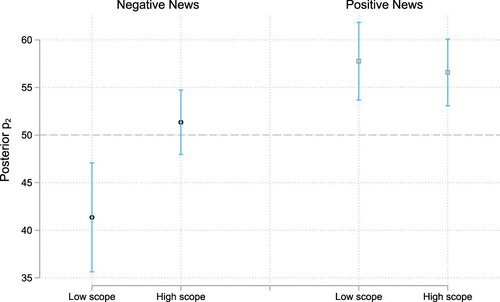
Notes. The figure shows participants’ posterior beliefs in Session 2 () across treatment conditions and news (positive versus negative) received. The bars indicate 95% confidence intervals.
First, we analyze participants’ subjective posteriors regarding the probability of having to solve at most 40 additional tasks, which we elicited in Session 2, two weeks after the signal was initially received. Participants in HighScope on average state a belief of , whereas participants in LowScope on average state a belief of (t-test, ). Next, we compute the distance between participants’ elicited posterior and their Bayesian posterior based on each participant’s elicited prior and the signal received (). Doing so allows us to judge whether beliefs are optimistic (or pessimistic).24 We also find that this optimism measure is higher in HighScope than in LowScope (9.02 versus 0.88, t-test, ). Note that this result is not driven by a general “optimism bias” in participants’ memory (i.e., by some general tendency to memorize signals that convey a low likelihood for the event of interest differently). Two pieces of evidence support this interpretation. First, we do not observe such an asymmetry in a task that involves no wishful thinking (the dot-spot task); see Online Appendix B.9. Second, we conduct a preregistered additional experiment in which uninvolved observers form beliefs about the number of tasks to be completed by a matched participant from the main study. The design mirrors our main experiment in structure and timing; it consists of three sessions over four weeks, and observers receive the same signal about total effort requirements as their matched participant. However, observers have no personal stakes (as they do not have to complete the assigned number of tasks) and thus no reason to form motivated beliefs. The observer data were collected from a new sample drawn from the same subject pools and consist of 359 observers (for details, see Online Appendix E). We find that neither observers’ posterior beliefs nor their optimism differ between the HighScope and LowScope conditions (t-tests, p and p ). Hence, we conclude that the belief patterns observed in the main experiment reflect motivated memory.
We summarize these findings, which align with Prediction 1, in Result 1.
Scope for motivated memory results in optimism about total effort costs.
In a next step, we investigate whether negative news suppression is the driver of this optimism as posited in Prediction 2. Figure 2 shows the average of the posterior beliefs split up by negative news versus positive news across our two treatment conditions. The horizontal dashed line in Figure 2 marks the rational prior probability of 50%, which corresponds to the modal response in the elicitation of prior beliefs in Session 1 of our experiment. Figure 2 reveals a striking effect of our variation in scope for motivated reasoning. When participants received negative news (the left side of Figure 2) and have HighScope for motivated reasoning, participants hold beliefs close to 50% and thus, appear to ignore the signal received. In contrast, when they are reminded of the signal before stating their belief in LowScope, their posterior belief of facing low workload is substantially lower (t-test, ). With positive news (the right side of Figure 2), instead, we observe very similar posteriors in HighScope and LowScope (t-test, ).
Figure 3 shows that accounting for individual differences in prior beliefs by comparing participants’ optimism by news across treatments yields results mirroring our previous findings. Participants who received negative news (the left side of Figure 3) are substantially more optimistic when assigned to the HighScope condition than when assigned to the LowScope condition (t-test, ). In HighScope, the distance between an individual’s stated posteriors and the Bayesian posterior computed from their individual prior and signal is on average 16 percentage points larger than in LowScope. For positive news in contrast (the right side of Figure 3), the scope for motivated reasoning does not substantially alter participants’ pessimism (t-test, ). Moreover, Figure 3 illustrates that, on average, participants update conservatively in all cases. Compared with the Bayesian benchmark, they are optimistic after negative news and pessimistic after positive news.25
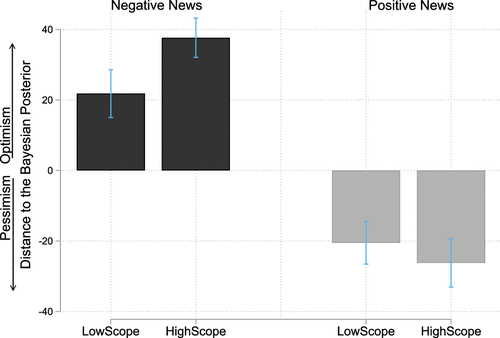
Notes. The figure shows participants’ optimism in Session 2 () across treatment conditions and news (positive versus negative) received. The bars indicate 95% confidence intervals.
These findings are confirmed by the regression analyses presented in Table 1. In column (1) in panel A of Table 1, we regress a participant’s posterior belief on our treatment indicator HighScope, a dummy for negative news (Neg. News), and their interaction. We subsequently add standardized control variables in columns (2)–(7) in panel A of Table 1, showing that the effect of our exogenous scope variation on beliefs is robust to controlling for variation in participants’ time preferences, emotion regulation strategies, and information preferences. In panel B of Table 1, we repeat this approach focusing on participants’ optimism given by as the dependent variable. In column (2) in panel B of Table 1, we control for an aggregate measure Patience derived from two submeasures: (i) hypothetical choices between money now or later and (ii) the answer to a question (How willing are you to give up something that is beneficial for you today in order to benefit more from that in the future?) on a scale from 0 to 10.26 In column (3) in panel B of Table 1, we include a measure for the tendency to procrastinate (Steel 2010). In columns (4) and (5) in panel B of Table 1, we include the two factors derived from answers on the emotion regulation scale (Gross and John 2003): Suppression factor and Reappraisal factor. In column (6) in panel B of Table 1, we include a measure of preferences for information using the scale by Ho et al. (2021). The specification in column (7) in panel B of Table 1 includes all of these control variables.
|

Table 1. Regression Results: Effects on Posterior Beliefs and Optimism
| (1) | (2) | (3) | (4) | (5) | (6) | (7) | |
|---|---|---|---|---|---|---|---|
| Panel A: Posterior beliefs | |||||||
| HighScope | −1.173 | −1.286 | −1.144 | −1.239 | −1.235 | −1.128 | −1.360 |
| (2.71) | (2.73) | (2.71) | (2.72) | (2.71) | (2.73) | (2.77) | |
| Neg. News | −16.403*** | −16.328*** | −16.382*** | −16.482*** | −16.500*** | −16.454*** | −16.609*** |
| (3.54) | (3.54) | (3.54) | (3.54) | (3.57) | (3.53) | (3.54) | |
| HighScope × Neg. News | 11.165*** | 11.310*** | 11.105** | 11.177*** | 11.214*** | 11.127** | 11.332*** |
| (4.31) | (4.32) | (4.31) | (4.31) | (4.32) | (4.33) | (4.35) | |
| Patience | 0.821 | 0.824 | |||||
| (1.01) | (1.02) | ||||||
| Procrastination scale | −0.256 | 0.086 | |||||
| (1.19) | (1.23) | ||||||
| Suppression factor | −1.050 | −1.177 | |||||
| (1.08) | (1.09) | ||||||
| Reappraisal factor | 0.463 | 0.481 | |||||
| (1.12) | (1.13) | ||||||
| Pref. for Information | −0.329 | −0.554 | |||||
| (1.12) | (1.13) | ||||||
| Constant | 57.758*** | 57.735*** | 57.749*** | 57.830*** | 57.827*** | 57.773*** | 57.914*** |
| (2.05) | (2.06) | (2.06) | (2.06) | (2.07) | (2.06) | (2.09) | |
| Marginal effects of HighScope after positive news | −1.173 | −1.286 | −1.144 | −1.239 | −1.235 | −1.128 | −1.360 |
| (2.71) | (2.73) | (2.71) | (2.72) | (2.71) | (2.73) | (2.77) | |
| Marginal effects of HighScope after negative news | 9.992** | 10.02** | 9.961** | 9.937** | 9.979** | 9.999** | 9.972** |
| (3.35) | (3.34) | (3.35) | (3.35) | (3.35) | (3.35) | (3.34) | |
| Marginal effects after positive news = marginal effects after negative news | 0.010 | 0.009 | 0.010 | 0.010 | 0.010 | 0.011 | 0.010 |
| N | 367 | 367 | 367 | 367 | 367 | 367 | 367 |
| Panel B: Optimism () | |||||||
| HighScope | −5.709 | −5.476 | −5.457 | −5.697 | −5.995 | −5.538 | −5.375 |
| (4.61) | (4.62) | (4.62) | (4.64) | (4.60) | (4.65) | (4.69) | |
| Neg. News | 42.295*** | 42.140*** | 42.486*** | 42.309*** | 41.855*** | 42.103*** | 41.741*** |
| (4.58) | (4.61) | (4.56) | (4.61) | (4.67) | (4.56) | (4.70) | |
| HighScope × Neg. News | 21.530*** | 21.231*** | 21.011*** | 21.528*** | 21.756*** | 21.388*** | 20.863*** |
| (6.39) | (6.40) | (6.39) | (6.40) | (6.37) | (6.44) | (6.45) | |
| Patience | −1.691 | −1.923 | |||||
| (1.65) | (1.68) | ||||||
| Procrastination scale | −2.232 | −1.944 | |||||
| (1.55) | (1.65) | ||||||
| Suppression factor | 0.187 | 0.245 | |||||
| (1.57) | (1.62) | ||||||
| Reappraisal factor | 2.119 | 2.084 | |||||
| (2.13) | (2.16) | ||||||
| Pref. for Information | −1.248 | −0.835 | |||||
| (1.77) | (1.79) | ||||||
| Constant | −20.501*** | −20.452*** | −20.584*** | −20.513*** | −20.188*** | −20.445*** | −20.190*** |
| (3.05) | (3.06) | (3.05) | (3.07) | (3.08) | (3.06) | (3.13) | |
| Marginal effects of HighScope after positive news | −5.709 | −5.476 | −5.457 | −5.697 | −5.995 | −5.538 | −5.375 |
| (4.61) | (4.62) | (4.62) | (4.64) | (4.60) | (4.65) | (4.69) | |
| Marginal effects of HighScope after negative news | 15.82*** | 15.76*** | 15.55*** | 15.83*** | 15.76*** | 15.85*** | 15.49*** |
| (4.42) | (4.43) | (4.41) | (4.42) | (4.43) | (4.42) | (4.41) | |
| Marginal effects after positive news = marginal effects after negative news | 0.001 | 0.001 | 0.001 | 0.001 | 0.001 | 0.001 | 0.001 |
| N | 367 | 367 | 367 | 367 | 367 | 367 | 367 |
Notes. The table shows results from ordinary least squares (OLS) regressions. The dependent variable in panel A is participants’ posterior belief about the probability to face low workload (). The dependent variable in panel B is participants’ optimism (). The main explanatory variables are the treatment dummy HighScope, a dummy for negative news (Neg. News), and their interaction. The control variables are standardized continuous measures resulting from the respective questionnaires. The marginal effect of HighScope after positive news corresponds to the coefficient of HighScope. The marginal effects of HighScope after negative news corresponds to the coefficient of HighScope plus the coefficient on the interaction term. Robust standard errors clustered at the day level are reported in parentheses.
*p < 0.1; **p 0.05; ***p 0.01.
As can be seen from Table 1, our results indicate strong reactions to HighScope when participants received negative news. The effect of our exogenous scope variation on beliefs does not change when controlling for variation in participants’ time preferences, emotion regulation strategies, or information preferences.27 Consistent with our theoretical framework, which predicts stronger effects for more negative news, additional analyses in Online Appendix B.3 reveal that the difference between LowScope and HighScope after negative news is driven by participants who received very negative news (i.e., participants for whom none of the drawn nonassigned numbers are larger than the assigned number). In summary, all of these analyses support Prediction 2.
Optimism about total effort costs is driven by the suppression of negative news.
4.2. The Causal Effect of Beliefs on the Allocation of Work
Finally, we provide evidence on the relevance of beliefs for work organization. We show that more optimistic beliefs eventually result in the systematic delay of work. To identify the causal role of beliefs for procrastination, we exploit the exogenous variation in beliefs induced by the news and scope condition that a participant was randomly assigned to. This variation is by design orthogonal to participants’ opportunity costs of time and time preferences, and thus, it is suitable for an instrumental variables (IV) approach.28
Table 2 reports the second-stage results of the IV approach using instrumented beliefs to explain participants’ work decisions. The corresponding first-stage regressions are shown in columns (1)–(7) in panel A of Table 1. The exclusion restriction of this approach relies on the assumption that signal valence and HighScope do not affect work decisions other than through beliefs, which is plausible in our setting.
|
Table 2. Regression Results: Effect of Beliefs on the Work Decision
| (1) | (2) | (3) | (4) | (5) | (6) | (7) | |
|---|---|---|---|---|---|---|---|
| Panel A: No. of tasks that participants complete in Session 2 | |||||||
| Posterior (instrumented) | −0.232** | −0.230** | −0.232** | −0.232** | −0.225** | −0.231** | −0.222** |
| (0.10) | (0.10) | (0.10) | (0.10) | (0.10) | (0.10) | (0.10) | |
| Patience | −0.056 | −0.126 | |||||
| (0.65) | (0.65) | ||||||
| Procrastination scale | −0.247 | −0.150 | |||||
| (0.71) | (0.74) | ||||||
| Suppression factor | −0.023 | −0.036 | |||||
| (0.64) | (0.65) | ||||||
| Reappraisal factor | 0.654 | 0.652 | |||||
| (0.71) | (0.72) | ||||||
| Pref. for Information | −0.109 | −0.094 | |||||
| (0.70) | (0.71) | ||||||
| Constant | 41.650*** | 41.534*** | 41.677*** | 41.643*** | 41.301*** | 41.623*** | 41.139*** |
| (5.36) | (5.45) | (5.36) | (5.34) | (5.32) | (5.31) | (5.32) | |
| Mean dependent variable | 29.67 | 29.67 | 29.67 | 29.67 | 29.67 | 29.67 | 29.67 |
| N | 367 | 367 | 367 | 367 | 367 | 367 | 367 |
| Panel B: Probability to solve the maximum no. of tasks (40) in Session 2 | |||||||
| Posterior (instrumented) | −0.008* | −0.008* | −0.008* | −0.007* | −0.008* | −0.008* | −0.007* |
| (0.00) | (0.00) | (0.00) | (0.00) | (0.00) | (0.00) | (0.00) | |
| Patience | −0.002 | −0.003 | |||||
| (0.03) | (0.03) | ||||||
| Procrastination scale | −0.007 | −0.002 | |||||
| (0.03) | (0.03) | ||||||
| Suppression factor | −0.034 | −0.034 | |||||
| (0.03) | (0.03) | ||||||
| Reappraisal factor | 0.008 | 0.009 | |||||
| (0.03) | (0.03) | ||||||
| Pref. for Information | 0.009 | 0.005 | |||||
| (0.03) | (0.03) | ||||||
| Constant | 0.836*** | 0.836*** | 0.837*** | 0.829*** | 0.831*** | 0.844*** | 0.826*** |
| (0.21) | (0.22) | (0.21) | (0.21) | (0.21) | (0.21) | (0.21) | |
| Mean dependent variable | 0.44 | 0.44 | 0.44 | 0.44 | 0.44 | 0.44 | 0.44 |
| N | 367 | 367 | 367 | 367 | 367 | 367 | 367 |
Notes. The table shows results from IV regressions using the general method of moments estimator. The posterior belief measured on a scale from 0 to 100 () about facing low workload is instrumented with the treatment dummy for HighScope, a dummy for negative news, and the interaction of both. The dependent variable in panel A is the number of tasks that participants complete in Session 2. The dependent variable in panel B is the probability to solve the maximum number of tasks (40) in Session 2. The control variables are standardized continuous measures resulting from the respective questionnaires. Robust standard errors are in parentheses.
*p 0.1; **p 0.05; ***p 0.01.
In panel A of Table 2, we study how the instrumented posterior affects the number of tasks completed in Session 2. In panel B of Table 2, we shed light on how the posterior affects participants’ likelihood of completing the maximally possible number of 40 tasks in Session 2. The results in panel A of Table 2 reveal that a 10-percentage-point increase in (instrumented) posteriors (i.e., an increase in optimism about future workload) causes participants to solve 2.32 (7%) fewer tasks (see column (1) in panel A of Table 2) and reduces the likelihood of completing the maximum possible number of tasks in Session 2 by 8 percentage points or 18% (see column (1) in panel B of Table 2). Similar to Table 1, the additional specifications in columns (2)–(7) in panel A of Table 2 include standardized control variables related to time preferences, the tendency to procrastinate, emotion regulation, and information preferences. Again, our point estimates are robust to including these control variables.
To study the robustness of our findings, we complement the IV approach with additional analyses using a propensity score matching approach. Specifically, we match participants based on their priors () and on whether they received positive or negative news. Thus, we compare individuals in HighScope and LowScope with similar prior and signal valence using a nonparametric matching strategy. Table 3 presents the results of this analysis and reports the average treatment effects of HighScope on the number of sequences completed in Session 2 in panel A of Table 3. In columns (1) and (2) in panel A of Table 3, propensity scores are estimated using a logit model. In columns (3) and (4) in panel A of Table 3, we present the results obtained when estimating propensity scores with a probit model. For both modeling approaches, the findings indicate that being in the HighScope condition lowers the number of tasks completed in Session 2 by around 2.3–2.4. Panel B of Table 3 shows the effect of HighScope on the probability to complete the maximum number of tasks. HighScope reduces the latter by 11.9–12.5 percentage points.
|
Table 3. Average Treatment Effects (ATEs) of HighScope on the Work Decision
| Logit | Probit | |||
|---|---|---|---|---|
| 1 neighbor | 2 neighbors | 1 neighbor | 2 neighbors | |
| (1) | (2) | (3) | (4) | |
| Panel A: The no. of tasks that participants complete in Session 2 | ||||
| HighScope | −2.351** | −2.317** | −2.351** | −2.317** |
| (1.20) | (1.16) | (1.20) | (1.16) | |
| N | 367 | 367 | 367 | 367 |
| Panel B: The probability to solve the maximum no. of tasks (40) in Session 2 | ||||
| HighScope | −0.119** | −0.125** | −0.119** | −0.125** |
| (0.05) | (0.05) | (0.05) | (0.05) | |
| N | 367 | 367 | 367 | 367 |
Notes. The table shows average treatment effects (ATEs) resulting from propensity score matching. The analysis matches individuals on priors () and signal valence (Neg. News) using nearest-neighbor matching with replacement when there is more than one neighbor. The dependent variable in panel A is the number of tasks that participants complete in Session 2. The dependent variable in panel B is the probability to solve the maximum number of tasks (40) in Session 2. Columns (1) and (3) use one neighbor, whereas columns (2) and (4) uses two neighbors. Columns (1) and (2) use logit to estimate propensity scores, whereas columns (3) and (4) use probit to estimate propensity scores. Abadie–Imbens robust standard errors clustered at the day level are reported in parentheses.
*p < 0.1; **p < 0.05; ***p < 0.01.
In summary, the results from both approaches are in line with Prediction 3.
More optimistic beliefs cause a systematic delay of work.
To quantify the effect of motivated procrastination, we use the coefficient estimates from the IV regression (column (1) in panels A and B of Table 2) to predict the number of tasks to be solved in Session 2 based on subjective beliefs () and based on Bayesian beliefs () for the HighScope and LowScope conditions. Figure 4 shows that given participants’ subjective beliefs in HighScope, they are predicted to solve on average 29.2 tasks in Session 2, whereas they are predicted to solve on average 31.3 tasks—7% more—if they held Bayesian beliefs (t-test, ). Instead, in LowScope, there is no significant difference between the predicted number of tasks with subjective beliefs as compared with Bayesian beliefs (t-test, ).
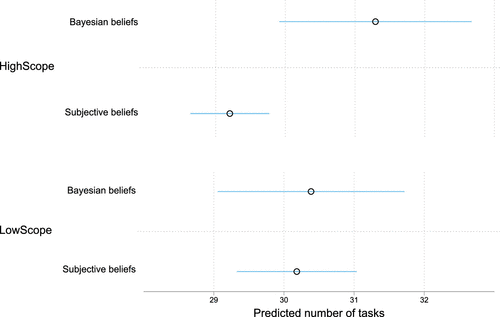
Notes. The figure shows the predicted number of tasks solved in Session 2 (from the IV regression) based on Bayesian beliefs and subjective beliefs split by scope. The bars indicate 95% confidence intervals.
5. Additional Results
5.1. Dynamics of Belief Distortions
One may expect that a wishful thinker states optimistic beliefs in Session 2 to enjoy belief-based utility from being optimistic about the effort level required to complete the task in Session 3. At the same time, one may also expect her to revise these beliefs downward in Session 3 when she is incentivized to report an accurate belief because there is little additional anticipatory utility to be enjoyed in Session 3 before the realized task number is resolved. This reasoning would suggest that posteriors become more realistic from Session 2 to Session 3. However, it also appears plausible that forming and stating an optimistic belief increase a decision maker’s adjustment costs (see also Falk and Zimmermann 2018), particularly when she based her effort decision on this explicitly stated belief in Session 2. Consequently, we may see little adjustment in optimism from Session 2 to Session 3, even though the relevance of anticipatory utility likely vanishes close to the end of the experiment.
Figure 5 illustrates optimism in Session 2 and Session 3 across treatment and signal valence. Figure 5 highlights that, indeed, participants’ optimism () hardly changes from Session 2 to Session 3 (mean in Session 2: 4.95, mean in Session 3: 5.94, , t-test).29 This result is not explained by participants who repeatedly report 50 as a focal number as it is robust to excluding participants who state (mean in Session 2: 9.34, mean in Session 3: 10.73, , t-test).
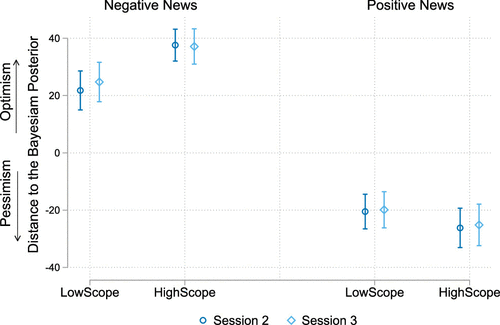
Notes. The figure shows participants’ optimism in Session 2 () and Session 3 () across treatment conditions and news (positive versus negative) received. The bars indicate 95% confidence intervals.
Furthermore, we find that of our participants exhibit “sticky beliefs.” They state exactly the same expectations in Session 2 and Session 3 (). This stickiness may have several plausible explanations.30 First, participants may encounter adjustment costs or exhibit a preference for consistency (see also Falk and Zimmermann 2018). Second, participants may use their actions in Session 2 to ex post (in Session 3) impute the beliefs that they must have held when allocating work (see also Heidhues et al. 2023). Third, stickiness may reflect the idea that most forgetting occurs right after information was learned (Ebbinghaus 1885, Wixted and Ebbesen 1991, Kahana et al. 2024).
Irrespective of the exact underlying causes, these findings underline that optimism about future effort costs may have lasting consequences, even in work environments in which uncertainty about total effort costs is eventually resolved. Thereby, we meaningfully complement recent work on motivated beliefs and uncertainty resolution in ego-relevant environments. Specifically, Drobner (2022) has shown that individuals do not form motivated beliefs when uncertainty is resolved immediately, with the underlying intuition being that the costs of distorting beliefs may outweigh the short-lived utility benefits derived from optimism. However, he has not studied situations with delayed uncertainty resolution. Our findings indicate that such a delay can foster the development of motivated beliefs, even when the uncertainty is later resolved. Given sufficient time to derive anticipatory utility from their optimistic beliefs (as seen over the two-week period from Session 1 to Session 2), workers suppress negative news and continue to hold optimistic beliefs, even close to the moment of uncertainty resolution (in Session 3).
5.2. Heterogeneous Treatment Effects
Our treatment variation was designed such that causal shifts in motivated beliefs stem from the interaction of exogenously assigned negative news and exogenously assigned scope for motivated memory. Thereby, we induce variation in beliefs orthogonal to participants’ time preferences, their emotion regulation strategies, and their general tendency to avoid receiving information that may reveal negative news. Our regression analyses confirm the robustness of the observed treatment effect; the inclusion of these additional control variables (patience, suppression, reappraisal, and information preferences) neither substantially alters the effect of HighScope on motivated reasoning after negative news (see Table 1) nor the impact of the exogenous variation in beliefs on the allocation of work (see Table 2).
As time preferences, emotion regulation, and information preferences may nevertheless moderate the observed treatment effect, we provide additional exploratory analyses for different subgroups of participants using median splits with respect to these variables. We focus on optimism () as the outcome variable for these analyses because doing so avoids potential biases because of imbalances in priors and signals across different subgroups of smaller size.
5.2.1. Time Preferences.
Preference-based explanations have been put forward as a core reason for why people procrastinate. For example, models with present-biased individuals suggest that these individuals wish to allocate more work to the future than nonpresent-biased individuals because they substantially underestimate their true disutility from effort provision in the future when choosing in the present. In consequence, present bias may mitigate the belief-based delay of work that we identified. However, it may well be that impatient individuals also tend to be wishful thinkers regarding how much work needs to be done. We thus deem it interesting to also explore how motivated beliefs through the suppression of negative news interact with participants’ time preferences. To do so, we first present results from a median split with respect to participants’ patience, which, based on the idea in Falk et al. (2023), is measured using a combination of hypothetical choices between money now or later and responses to whether participants are willing to give up something that is beneficial for them today in order to benefit more from that in the future. Second, we present results using a median split with respect to participants’ scores on the irrational procrastination scale (Steel 2010), which considers participants self-stated tendency to procrastinate more generally.
We report the results of these exploratory analyses in Table 4 and show that neither time preferences nor the tendency to procrastinate are strong moderators of overoptimism resulting from motivated memory. Column (1) in Table 4 shows our original specification for optimism (see also column (1) in panel A of Table 1) as a benchmark. Columns (2) and (3) in Table 4 show that both impatient participants and more patient participants (median split) tend to suppress negative news when given scope to do so, and the point estimates of the interaction term are very similar to the one from the full sample in column (1) in Table 4 for both subgroups. A Wald test in the fully interacted model does not reject the null hypothesis that the interaction effect is the same across both subsamples (). Hence, our data suggest that time preferences do not moderate the belief adjustments induced by scope for negative news suppression. This finding aligns with Chew et al. (2020), who show that positive amnesia (forgetting a past negative event) does not relate to present bias. Columns (4) and (5) in Table 4 show that the effect is also robust when splitting the sample by the participants’ tendencies to procrastinate. The coefficients on the interaction term for both subgroups and the full sample are again almost identical (Wald test, ). Hence, in line with the idea that motivated reasoners may not fully appreciate that they tend to procrastinate, self-stated procrastinatory tendencies elicited with the irrational procrastination scale (Steel 2010) play a minor role for the extent of negative news suppression.31
|
Table 4. Regression Results: Heterogeneity in Optimism with Respect to Time Preferences
| (1) | (2) | (3) | (4) | (5) | |
|---|---|---|---|---|---|
| Full sample | High patience | Low patience | High procrastination | Low procrastination | |
| HighScope | −5.709 | −7.826 | −2.028 | −2.713 | −8.554 |
| (4.61) | (5.69) | (7.92) | (6.43) | (6.64) | |
| Neg. News | 42.295*** | 44.075*** | 40.765*** | 38.510*** | 44.930*** |
| (4.58) | (6.39) | (6.57) | (6.82) | (6.20) | |
| HighScope × Neg. News | 21.530*** | 19.685** | 21.133** | 21.854** | 21.892** |
| (6.39) | (8.45) | (10.09) | (9.57) | (8.63) | |
| Constant | −20.501*** | −20.513*** | −20.490*** | −22.869*** | −18.283*** |
| (3.05) | (4.11) | (4.49) | (4.22) | (4.42) | |
| Marginal effects of HighScope after positive news | −5.709 | −7.826 | −2.028 | −2.713 | −8.554 |
| (4.61) | (5.69) | (7.92) | (6.43) | (6.64) | |
| Marginal effects of HighScope after negative news | 15.821*** | 11.859 | 19.104** | 19.141** | 13.338* |
| (4.42) | (6.24) | (6.26) | (7.09) | (5.52) | |
| Marginal effects after positive news − marginal effects after negative news | 0.001 | 0.021 | 0.038 | 0.024 | 0.012 |
| N | 367 | 182 | 185 | 172 | 195 |
Notes. All regressions are estimated using ordinary least squares (OLS). The dependent variable is participants’ optimism (). The explanatory variables are the treatment dummy HighScope, a dummy for negative news (Neg. News), and their interaction. Column (1) uses the full sample. Columns (2) and (3) use the subsamples of high- and low-patience individuals, respectively, determined by a median split of our measure for patience, an aggregate measure derived from hypothetical choices between money now or later and the stated willingness to give up something that is beneficial today in order to benefit in the future (Falk et al. 2023). Columns (4) and (5) use the samples of procrastinators and nonprocrastinators, respectively, based on a median split of our measure for the tendency to procrastinate (Steel 2010). The marginal effects of HighScope after negative news correspond to the coefficient of HighScope plus the coefficient on the interaction term. Robust standard errors are in parentheses.
*p 0.1; **p 0.05; ***p 0.01.
5.2.2. Emotion Regulation.
The inclination to distort beliefs about the likelihood of unpleasant events may depend on an individual’s ability and strategies to cope with negative emotions (see, e.g., Engelmann et al. 2024), and psychologists have proposed emotion regulation as a potential cause for the systematic delay of work (see Pychyl and Sirois 2016). To speak to this idea, we study heterogeneous treatment effects in terms of two ways of regulating emotion, suppression and reappraisal, using the respective scales by Gross and John (2003). Suppression measures to what extent people inhibit their emotion-expressive behavior. Reappraisal measures whether individuals deal with negative emotions by redirecting their thoughts to a positive situation. Both strategies may help participants to cope with negative news and thereby, affect participants’ need to bias their beliefs.
Table 5 reports the results of these additional exploratory analyses, again including the benchmark specification in column (1). We find that individuals with an above-median tendency to inhibit their emotion-expressive behavior (suppression) become only insignificantly more optimistic after negative news in the HighScope treatment (column (2) in Table 5) and that those who are less likely to suppress emotion-expressive behavior become significantly more optimistic (column (3) in Table 5). This is in line with the idea that people who are more likely to express their emotions are also more likely to form biased beliefs based on motivated memory. However, a Wald test in the fully interacted model shows that the difference between the two coefficients fails to be statistically significant at conventional levels (). Notably, as shown in column (3) in Table 5, participants who are less likely to suppress emotion-expressive behavior are also more pessimistic when not being reminded of positive news in HighScope (as compared with when they are reminded). The HighScope coefficient for positive news is significantly negative for individuals with a below-median tendency to suppress emotion expression and indistinguishable from zero for those with an above-median tendency to suppress emotion expression (Wald test, ). Thus, people who are less likely to suppress emotions seem to forget signals in general and are more likely to hold posterior beliefs close to their priors. In contrast, we find no apparent heterogeneity when we split the sample based on participants’ reappraisal strategies (see columns (4) and (5) in Table 5) (Wald test, ).
|
Table 5. Regression Results: Heterogeneity in Optimism with Respect to Emotion Regulation
| (1) | (2) | (3) | (4) | (5) | |
|---|---|---|---|---|---|
| Full sample | High suppression | Low suppression | High reappraisal | Low reappraisal | |
| HighScope | −5.709 | 3.367 | −14.768** | −1.315 | −8.737 |
| (4.61) | (6.76) | (6.04) | (7.52) | (5.86) | |
| Neg. News | 42.295*** | 48.125*** | 36.967*** | 41.804*** | 43.576*** |
| (4.58) | (6.61) | (6.43) | (6.40) | (6.60) | |
| HighScope × Neg. News | 21.530*** | 11.158 | 31.640*** | 20.107** | 21.265** |
| (6.39) | (9.48) | (8.54) | (9.52) | (8.91) | |
| Constant | −20.501*** | −24.638*** | −16.627*** | −22.091*** | −19.360*** |
| (3.05) | (3.66) | (4.79) | (4.41) | (4.21) | |
| Marginal effects of HighScope after positive news | −5.709 | 3.367 | −14.768* | −1.315 | −8.737 |
| (4.61) | (6.76) | (6.04) | (7.52) | (5.86) | |
| Marginal effects of HighScope after negative news | 15.821*** | 14.525* | 16.872** | 18.792** | 12.528 |
| (4.42) | (6.65) | (6.04) | (5.84) | (6.71) | |
| Marginal effects after positive news − marginal effects after negative news | 0.001 | 0.241 | 0.000 | 0.036 | 0.018 |
| N | 367 | 180 | 187 | 171 | 196 |
Notes. All regressions are estimated using ordinary least squares (OLS). The dependent variable is participants’ optimism (). The explanatory variables are the treatment dummy HighScope, a dummy for negative news (Neg. News), and their interaction. Column (1) uses the full sample, whereas columns (2)–(5) use sample splits according to the two dimensions of emotion regulation: suppression and reappraisal (Gross and John 2003). Column (2) uses the subsample of individuals who score above the median on the suppression factor, whereas column (3) uses the subsample of individuals who score at or below the median on the suppression factor. Column (4) uses the subsample of individuals who score above the median on the reappraisal factor, whereas column (5) uses the subsample of individuals who score at or below the median on the reappraisal factor. The marginal effects of HighScope after negative news correspond to the coefficient of HighScope plus the coefficient on the interaction term. Robust standard errors are in parentheses.
*p 0.1; **p 0.05; ***p 0.01.
5.2.3. Information Preferences.
Apart from participants’ time preferences and their general strategies to cope with negative news, their tendency to acquire or avoid potentially unpleasant information could affect how they react to variation in the scope for negative news suppression. On the one hand, those who tend to avoid information may be more willing or able to suppress or forget negative news as both information avoidance and motivated memory require a willingness to ignore information that is in principle accessible. On the other hand, those who tend to avoid information may exactly do so because they have a hard time suppressing negative news once they received it. If so, “information avoiders” may react less to scope for negative news suppression. To study whether preferences for information shape the impact of scope for motivated reasoning, we use participants’ preferences for the revelation of (unpleasant) information, which we elicited following Ho et al. (2021).
Table 6 reports this analysis, including the benchmark specification in column (1) and a median split with respect to the strength of information preferences in columns (2) and (3). We find that information preferences appear indeed relevant for motivated memory. For participants with a strong preference for information revelation (column (2) in Table 6), there is a weak and statistically insignificant interaction effect of HighScope and negative news (11.82). Instead, participants with weaker preferences for information revelation are substantially (27 percentage points) more likely to be more optimistic in HighScope than in LowScope after receiving negative news (column (3) in Table 6). These findings suggest that participants who generally tend to avoid information are also more likely to form optimistic beliefs based on negative news suppression, although we fail to statistically reject the equality of the estimated coefficients for the interaction term across the two subsamples (Wald test, ).
|
Table 6. Regression Results: Heterogeneity with Respect to Information Preferences
| (1) | (2) | (3) | |
|---|---|---|---|
| Full sample | High information preference | Low information preference | |
| HighScope | −5.709 | −7.140 | −3.794 |
| (4.61) | (5.89) | (7.16) | |
| Neg. News | 42.295*** | 46.158*** | 39.926*** |
| (4.58) | (6.26) | (6.44) | |
| HighScope × Neg. News | 21.530*** | 11.823 | 27.113*** |
| (6.39) | (8.91) | (9.15) | |
| Constant | −20.501*** | −21.191*** | −19.959*** |
| (3.05) | (4.10) | (4.43) | |
| Marginal effects of HighScope after positive news | −5.709 | −7.140 | −3.794 |
| (4.61) | (5.89) | (7.16) | |
| Marginal effects of HighScope after negative news | 15.821*** | 4.683 | 23.319*** |
| (4.42) | (6.68) | (5.70) | |
| Marginal effects after positive news − marginal effects after negative news | 0.001 | 0.186 | 0.003 |
| N | 367 | 160 | 207 |
Notes. All regressions are estimated using ordinary least squares (OLS). The dependent variable is participants’ optimism (). The explanatory variables are the treatment dummy HighScope, a dummy for negative news (Neg. News), and their interaction. Column (1) uses the full sample, whereas columns (2) and (3) use sample splits according to information preferences (Ho et al. 2021). Column (2) uses the subsample of individuals who score above the median on the information preference scale, whereas column (3) uses the subsample of individuals who score at or below the median on the information preference scale. The marginal effects of HighScope after negative news corresponds to the coefficient of HighScope plus the coefficient on the interaction term. Robust standard errors are in parentheses.
*p < 0.1; **p < 0.05; ***p < 0.01.
6. Discussion
Our findings in Section 4 reveal a causal link from scope for motivated reasoning (through motivated memory) to optimistic beliefs about workload and document the relevance of beliefs for the allocation of work across time. Given the opportunity to smooth their assigned workload over two dates, individuals with optimistic beliefs decide to work less in the present than individuals with less optimistic beliefs. As optimism about total workload in our experiment results from an exogenous change in the scope for motivated memory about negative news, we provide direct evidence for the systematic delay of work based on motivated and optimistic beliefs, which we term “motivated procrastination.” In this section, we discuss important design choices that allow us to empirically identify motivated procrastination and briefly comment on interesting avenues for future research.
To allow for the clean identification of the causal relationships of interest, we included a crucial experimental design feature that merits some further discussion. In the experiment, we did not inform individuals up front about the possibility to allocate their expected workload across the two work dates. Instead, only after eliciting their posterior beliefs in Session 2, we announced the possibility to complete some of the assigned work immediately at the end of Session 2. Doing so, we minimize two potential biases in the elicited beliefs that would hinder the clean identification of motivated beliefs: pessimistic beliefs that serve as a commitment32 and optimistic beliefs that serve as a justification for procrastinating.33 This important element of our experimental design thus ensures that we can identify the direct effect of scope for motivated reasoning on motivated beliefs and document the relevance of the exogenous variation in beliefs for the allocation of work over time.
Technically speaking, this feature forces us to derive insights on motivated procrastination based on a decision to complete work “earlier than expected” (as participants were up front only informed that they had to have completed the task by the end of Session 3) rather than “later than planned” (the typical way in which preference-based procrastination decisions have been studied in within-subject designs). Importantly, our conclusions still speak to motivated procrastination in the sense of the systematic delay of work based on optimistic beliefs because we compare participants’ work allocations across exogenously assigned treatment conditions. Specifically, we compare work allocations across virtually identical groups of individuals who have been randomly assigned a particular workload and have been randomly reminded (or not) of an informative signal regarding their total workload. Hence, if beliefs of individuals who have been randomly assigned to the HighScope condition are systematically more optimistic after negative news than those of individuals assigned to the LowScope condition, the resulting optimistic beliefs are because of motivated memory.34 As a consequence, if the exogenous variation in beliefs about the total workload causally affects the number of tasks completed in Session 2, then motivated memory is the underlying reason for the systematic delay of work. In other words, it is the comparison of work allocation decisions for different, exogenously manipulated beliefs that allows us to learn about motivated procrastination.35 In the spirit of O’Donoghue and Rabin (1999), we study motivated procrastination as the deviation from a benchmark, which here is given empirically through the behavior of agents in the LowScope treatment.
Further, we intentionally used a parsimonious experimental environment that focuses on motivated reasoning in a single dimension (namely, in beliefs about the total workload that a decision maker expects to encounter). Although this approach allows us to cleanly identify the role of motivated memory for the belief-based systematic delay of work, many work environments may allow decision makers to form motivated beliefs in multiple dimensions. Apart from forming motivated beliefs about the total workload, decision makers may, for example, form motivated beliefs about their ability, potential future distractions, or other factors that matter for the allocation of work across time. We explicitly abstract from such additional factors and purposefully designed our experiment to limit motivated reasoning in additional dimensions. As an extension of our work, future research may study motivated procrastination in multidimensional settings: for example, by exogenously varying both the scope for motivated memory and another relevant dimension, such as the perception of the difficulty of the task. Such a study could reveal whether the systematic delay of work becomes even more prevalent in more complex decision environments, thereby deepening our understanding of motivated procrastination.
7. Conclusion
For individuals and society at large, procrastination may have negative consequences, including poor savings, neglected exercise plans, and mismanaged workload. Although often attributed to inconsistent time preferences or present bias, more recent theories proposed that procrastination may be caused by motivated, optimistic beliefs. This study provides the first direct evidence of the underlying cause of such beliefs. We find that motivated memory (i.e., the suppression of negative news when given the scope to forget) appears to be a key source of optimistic beliefs about future effort costs, resulting in the systematic delay of work.
Our results advance the understanding of belief-based procrastination and provide important insights for individuals, organizations, and policymakers. In particular, they provide a basis for reminders as targeted interventions that correct individuals’ beliefs regarding the effort required to complete the task and consequently, curb procrastination. Thus, we add to the broader literature on reminders as an effective tool for behavioral change and provide an additional rationale for the efficacy of reminders.36 Apart from the idea that reminders may help forgetful individuals to remember the task itself (for a discussion, see also Ericson 2017 and Altmann et al. 2022), our findings stress the importance of reminders with respect to the expected effort costs of a task, which can reduce motivated memory regarding informative signals observed in the past. The latter idea also links to the efficacy of precise planning tools in improving information retrieval (see, e.g., Augenblick et al. 2023).
These insights have direct implications for management practice. In particular, they suggest that the design of organizational information flows can play a central role in addressing project delays. When information flows are designed to limit the scope for news suppression, organizations can reduce belief distortions and thereby, the belief-based component of procrastination. Targeting this belief-based component will complement measures that effectively target preference-based procrastination (see, e.g., Kaur et al. 2015), generating tangible efficiency gains. For example, institutionalized reminder systems that periodically restate past completion times for similar projects can help anchor beliefs in historical experience. Likewise, high-frequency status updates, such as daily stand ups or agile sprints, may serve a dual purpose; they facilitate coordination while also functioning as unavoidable reminders of actual work progress, thereby disciplining belief formation. Such organizational practices may facilitate a smoother intertemporal allocation of effort without generally restricting worker flexibility.
Beyond these managerial implications, our findings also speak to a broader class of economic decisions characterized by uncertainty about future costs. When it comes to preventive healthcare, individuals who are reluctant to learn negative news about their future health may be more likely to ignore past negative news about their health. This could lead to them delaying costly actions (e.g., adopting a healthier lifestyle) that could prevent more severe health outcomes in the future.37 Similarly, our findings could apply to insurance or savings contexts, where people may suppress negative past news about potential future outcomes, which may, in turn, prevent them from taking action early on (i.e., buying disability insurance or starting saving earlier). Moreover, motivated procrastination may also be at play when it comes to the adoption of energy-saving technology: for instance, in the context of residential heating and insulation. Our exploratory analyses show that the causal chain from scope for motivated memory to procrastination is particularly prevalent among individuals who are generally hesitant to acquire possibly unpleasant information. Hence, we identify a group of participants who appear particularly susceptible to motivated procrastination and who are, thus, highly relevant to be considered when designing policies or considering welfare effects.
Finally, although a straightforward implication of our results is that limiting the scope for motivated cognition by providing (unavoidable) reminders could lead to strong behavioral changes and improved outcomes, their overall welfare implications are ambiguous. This ambiguity arises because of the anticipatory utility that agents enjoy, which is difficult to quantify. Future research may seek to address this and intriguing additional research questions. For example, we observed that beliefs are rather sticky once posteriors have been formed. Consequently, it appears crucial to study further to what extent people choose when they form their beliefs and to what extent these chosen beliefs react to later changes in the environment or the available information. Further, it appears important to better understand how quickly individuals can suppress negative news after they have perceived it. Effective interventions supposed to mitigate motivated cognition and its potentially adverse consequences need to reach individuals after having received negative news but before they engage in its cognitive suppression. Possible interventions may also benefit from a better understanding of whether “memory errors” in work environments result solely from negative news suppression in the sense of positive amnesia (forgetting a past negative event) or additionally, stem from positive delusion (fabricating a positive event that did not actually happen) or positive confabulation (morphing the memory of a past negative event into a positive memory) as discussed for ego-relevant environments in Chew et al. (2020). Exploring these and related questions will help to develop a comprehensive understanding of the role of motivated memory for the systematic delay of effort, which is pertinent to analyzing the ensuing welfare consequences.
The authors thank Andrea Amelio, Peter Andre, Kai Barron, Michèle Belot, Valeria Burdea, Alexander Coutts, Simon Dato, Christoph Drobner, Urs Fischbacher, Tilman Fries, Katrin Gödker, Sebastian Goerg, Pedro Gonzalez Fernandez, Thomas Graeber, Hans-Peter Grüner, Martin Haas, David Huffman, Boon Han Koh, Orestis Kopsacheilis, Spencer Kwon, Giacomo Lanzani, Johannes Maier, Ulrike Malmendier, Pierfrancesco Mei, Friederike Mengel, Zahra Murad, Takeshi Murooka, Frieder Neunhoeffer, Timm Opitz, Davide Pace, Cameron Peng, Marcel Quint, Peter Schwardmann, Frederik Schwerter, Sonja Settele, Alice Soldà, Justin Sydnor, Michael Thaler, Heidi Thysen, Joël van der Weele, Johannes Wohlfart, Yves Le Yaouanq, Sili Zhang, and Florian Zimmermann for helpful comments and suggestions. They are grateful for helpful suggestions from participants of the Kiel-Centre for Economic Policy Research Workshop Behavioral Economics; the Early-Career Behavioral Economics Conference 2025; the Center of Economic Studies (CESifo) Area Conference on Behavioral Economics 2024; the 16th Nordic Conference in Behavioral and Experimental Economics in Copenhagen; the 2024 Meeting of the German Economic Association (Verein für Socialpolitik in Berlin); the 14th International Conference of the French Association of Experimental Economics (ASFEE) in Grenoble 2024; the 16th Maastricht Behavioral and Experimental Economics Symposium in Maastricht 2024; the 39th Annual Meeting of the European Economic Association (EEA) and the 76th European Meeting of the Econometric Society (ESEM) 2024; the 8th International Meeting series on Experimental and Behavioural Economics (IMEBESS) in Riga 2024; the 2023 Economic Science Association (ESA) World Meeting in Lyon; the Society for the Advancement of Behavioral Economics and International Association for Research in Economic Psychology (SABE-IAREP) Conference 2023 in Nice; the Workshop on Narratives, Beliefs, and Memory in Herrsching; the Copenhagen Summer School on Beliefs; and the Interdisciplinary Workshop on Motivated Beliefs in Raitenhaslach. They are also grateful for helpful suggestions from participants of the seminars at Vienna University of Economics and Business, Aarhus University, the University of Amsterdam, the University of Innsbruck, the University of Mannheim, and the University of Paderborn. The authors thank Lara Fernandez Brudny, Haoyan Li, and Paul Pöhlmann for their valuable research assistance. The project was preregistered at https://aspredicted.org/SHS_XD6. Jana Friedrichsen is a Deutsches Institut für Wirtschaftsforschung (DIW) Berlin Fellow and Center for Economic Studies (CESifo) Research Network Fellow. Simeon Schudy is a Germany and Center for Economic Studies (CESifo) Research Network Fellow.
1 As this opportunity is unannounced, workers can neither use beliefs as commitment (and thus, bias them downward) nor be tempted to bias their beliefs upward as a consequence of the opportunity to delay work to the future (see also Bénabou and Tirole 2016, Brunnermeier et al. 2017, and Bönisch et al. 2026).
2 We obtain qualitatively similar results when using propensity score matching to study whether participants in HighScope complete fewer tasks in Session 2 than participants in LowScope given the same prior and signal valence (see Section 4).
3 Acknowledging these alternative factors provides possible explanations for repeated procrastination and can challenge the revealed preference approach of measuring intertemporal preferences. Additional factors that complicate the identification of time preferences from procrastinatory behavior can arise through time-varying costs (Heidhues and Strack 2021), projective misperceptions (Zhang 2025), and complex environments, in which choice behavior may arise that can be confused with time-inconsistent behavior (Enke et al. 2025). Noor and Takeoka (2022) highlight another factor that may affect patience, namely empathy of an agent’s current self with her future selves.
4 In particular, these excuses could be the possibility of not having to do any work in the future (Drucker and Kaufmann 2022) or the ability to remain willfully ignorant about information regarding future workloads (Lepper 2024).
5 This result of “motivated procrastination” aligns with findings on overconfidence in the future efficiency of pursuing costly activities (Della Vigna and Malmendier 2006) and recent evidence on rosy memory in gym attendance. Sial et al. (2024) document biased recall of attendance histories; people appear to recall virtually all of the days that they attend the gym, but they remember only about 80% of the days that they did not attend. In their data, forgetfulness of nonattendance systematically relates to overly optimistic forecasts of future attendance, and individuals with stronger recall bias also perceive a smaller gap between their expected future attendance and their attendance goal.
6 This approach was inspired by work documenting the suppression of negative news through “motivated memory” in nonwork-related decision environments (see, e.g., Zimmermann 2020 and Gödker et al. 2021), which exogenously varied the role of memory by varying the length of delay. The reminder approach has recently and independently also been used in the work by Hagenbach et al. (2025), who study whether people motivatedly forget the informativeness of a signal about their intelligence, as well as in the work by Gödker et al. (2025, experiment 3).
7 This argument relies on the presumption that psychological utility is relevant for welfare judgments. Although a prominent approach to behavioral welfare economics argues in favor of “purifying” preferences for welfare analyses, how to do behavioral welfare economics is still subject to debate (see, e.g., Bernheim 2016 and Infante et al. 2016). For example, Allcott and Kessler (2019) use a revealed preference approach to estimate consumer welfare that takes psychological utility into account.
8 Apart from the reminder in Session 2, the LowScope and HighScope condition were identical. There was no up-front announcement of the reminder that could have potentially led to different attention or different use of memory-enhancing tools across treatments.
9 Note that a majority of our participants (66%) consider the task very unpleasant (34.6%) or somewhat unpleasant (31.5%). Because of a technical problem in Session 1 of Wave 1, a subset of participants learned about the nature of the task (i.e., they saw the instructions for the task as intended) but unfortunately, did not have to complete the 10 practice tasks. As beliefs and belief dynamics did not differ significantly for these participants, we included them in our final data set. We obtain qualitatively similar results when excluding these participants (see Online Appendix B.6.3).
10 Following the recent discussion in Danz et al. (2022), who show that not providing information on the quantitative aspects of the binarized scoring rule appears superior to providing full information, we did not provide a quantitative description of the mechanism up front. Instead, on the main screen, we instructed participants that “for each guess [they] make, [they] maximize the chances of winning the additional six euro, if [they] simply state [their] true expectation.” In addition, to be transparent and allow mathematically more inclined participants to be informed on the mechanism’s quantitative incentives, we provided participants the opportunity to learn more about the mechanism by clicking a button to reveal further details. These included a description of the mechanism in simpler language following Wilson and Vespa (2018).
11 In Zimmermann (2020), individuals receive signals about how they rank in terms of their own IQ within a group of 10. They are informed how many of three randomly chosen group members have a lower (higher) IQ than them. Similarly and to ease understanding, participants in our design were randomly assigned to a group of 10, in which each group member was assigned exactly 1 of the 10 unique workloads. Participants were then informed how many of three randomly chosen group members had to complete more or fewer tasks than themselves.
12 The filler tasks included (i) a dot-spot task in which participants saw a graph of 400 red and blue dots for eight seconds and had to estimate the percentage of blue or red dots, for which we randomized whether participants saw more red dots (65%) or more blue dots as well as whether we asked for the percentage of red or blue dots; (ii) measures for risk and time preferences; (iii) status preferences; (iv) fairness and redistribution preferences (these measures were elicited using a spectator design vignette, where the more productive of two workers received a bonus; participants assessed fairness and could decide to redistribute the bonus); (v) the 10-item version of the Big5 personality questionnaire; and (vi) basic demographics.
13 Because of high setup costs, a decision maker may also choose not to complete any task in Session 2, and such behavior might be misunderstood as “procrastination” from an ex post perspective. However, setup costs (by design) do not differ across our treatment conditions. Further, in both the HighScope condition and the LowScope condition, less than of our participants complete zero tasks in Session 2, suggesting that potential setup costs play only a minor role in our setting.
14 We also include a questionnaire on attitudes toward competition (Helmreich and Spence 1978 as cited in Chang et al. 1997). Further, in the second wave of data collection, we additionally include a psychological questionnaire on defensive pessimism (Norem and Cantor 1986).
15 The data collection and preregistration included an additional experiment run in parallel (with different participants) on the dynamics of motivated reasoning in an ego-relevant environment (akin to the work by Zimmermann 2020), which is discussed in Cordes et al. (2025).
16 As preregistered, we excluded participants who stated that they have only a poor level of understanding of English, which was the experimental language; participants who rushed through the first screens with explanations about the belief elicitation; and participants who failed at least one of two basic attention checks. To avoid potential biases in our main outcome variables related to attrition, we further exclude participants who dropped out after the elicitation of the main variables in Session 2: that is, participants who did not complete the experiment. Importantly, we show that our main results are robust to using more lenient exclusion criteria (including the preregistered one). Further, we do not observe selective attrition based on negative news or scope (see Online Appendix D).
17 The median completion time across the three sessions appears relatively high. However, session links were distributed at 8 a.m., and participants had until 10 p.m. on the same day to complete each session. As a result, the recorded time includes the total duration from initial log-in to final submission, capturing any breaks taken throughout the day.
18 The model’s predictions hold for a more nuanced signal structure; see Online Appendix A.1.
19 In principle, both parts could be integrated, which would allow to model feedback effects between action and beliefs (such as in Brunnermeier et al. 2017). As the latter is excluded by design in our experiment, we consider it appropriate to abstain from this more general modeling approach when deriving our predictions.
20 This assumption holds in the data from our experiment. Among participants who are reminded of the signal (LowScope treatment), the absolute change in beliefs between Session 1 and Session 2 does not differ significantly between those who received negative news and those who received positive news ( after negative news, after positive news, in a two-sided t-test).
21 This is the case in the experiment where the probabilities of receiving a positive or negative signal both equal . In Online Appendix A.2, we show how the model can be adapted to the nonuniform case.
22 The inequality in (3) illustrates that we could replace Assumption 1 with a direct assumption on the relationship between updating and forgetting. Our experimental data are supportive of symmetric updating, so we stick with Assumption 1 as the simplest model version.
23 In Online Appendix B.3, we present qualitatively similar results from analyses using nonsimplified feedback.
24 The mean of the elicited priors is statistically indistinguishable from the rational prior of 50 (). We provide a brief analysis of elicited prior beliefs in Online Appendix B.1. In Online Appendix B.6.2, we present an analysis based on the homogeneous rational prior instead of the elicited subjective priors, which confirms the robustness of our results.
25 This finding of conservative updating is in line with earlier results obtained in laboratory experiments (see, for example, Coutts 2019 and Möbius et al. 2022), but it may hinge on the informativeness of the signals (Augenblick et al. 2025). Akin to the findings in Barron (2021) and Thaler (2026), in LowScope, we do not observe motivated reasoning in updating.
26 Our patience measure is the average of both normalized submeasures and takes a value between zero and one, akin to the approach for Time discounting in the Global Preferences Survey (GPS) module described in Falk et al. (2023).
27 In the Online Appendix, we report robustness checks that control for additional personal characteristics (Online Appendix B.6.5) as well as wave and subject pool effects (Online Appendix B.6.4), and we confirm our findings.
28 In line with the idea that time preferences and opportunity costs of time in Sessions 2 and 3 may differ across participants, there is substantial variation in how many tasks participants complete in Session 2 (mean , standard deviation ). The median participant chose to complete 30 tasks. Only nine participants () chose not to solve any task in Session 2. The modal choice was 40 tasks, with of participants choosing it. Although we observe meaningful adjustments in the raw data (i.e., in the number of tasks) because of signal valence and scope (see Online Appendix B.5), the IV approach allows us to isolate the effect of beliefs by abstracting from variation in work allocation driven by other potentially endogenous factors, such as differences in participants’ opportunity costs of time or other unobserved characteristics.
29 As priors are by definition fixed in Session 1, this result is driven by the absence of a meaningful change in mean posteriors (mean in Session 2: 52.58, mean in Session 3: 51.57), and it is also reflected in the similar pattern of the belief distributions from Sessions 2 and 3 (see Figure B.2 in Online Appendix B). The result holds for participants who received negative news in LowScope (for which the difference in optimism appears visually slightly larger, t-test, ) as well as for participants who received negative news in HighScope (t-test, ) and also, for those who received positive news ( in HighScope, in LowScope).
30 In Online Appendix B.4, we provide a more detailed discussion of the (absence) of belief adjustments in Session 3.
31 Procrastinatory tendencies could also be manifested by starting sessions later in the session day. However, our data do not support such a mechanism (see Online Appendix B.8).
32 Pessimistic beliefs would have allowed for a sophisticated preference-based procrastinator to complete more tasks early on than otherwise ceteris paribus. This two-way dependency between beliefs and actions is clearly spelled out in Brunnermeier et al. (2017).
33 If participants had known about the work allocation decision, preference-based procrastinators might have reported optimistic beliefs to justify the systematic delay of work.
34 Recall that we do not observe such an asymmetry in the additional experiment in which uninvolved observers form beliefs about the number of tasks (see Online Appendix E) nor in a task in which decision makers have no reason to form motivated beliefs (the dot-spot task) (see Online Appendix B.9).
35 Although some of our findings could, in principle, be interpreted through a plausible alternative mechanism involving sophisticated present-biased individuals facing setup costs at each session, our empirical evidence does not support this explanation. Specifically, one might argue that present-biased participants who receive highly negative news in Session 2 strategically maintain optimistic beliefs to commit their future selves to return for Session 3, despite otherwise preferring to avoid the immediate setup cost. Thus, optimistic beliefs could serve an instrumental commitment purpose of sophisticated preference-based procrastinators. However, this interpretation would predict selective attrition among participants in the LowScope condition who are reminded of negative news, which we do not observe (see column (4) in Table D.1 in Online Appendix D). Further, we find that the posterior belief () does not predict dropout after Session 2, rendering it unlikely that these beliefs serve as commitment. We thank an anonymous referee for highlighting this aspect.
36 Reminders have been shown to be effective in various (but not all) domains. They can increase savings (Karlan et al. 2016, Gars et al. 2025) and tax compliance (Antinyan and Asatryan 2025), foster goal achievement of employees (Cadena et al. 2011), or increase completion of a follow-up survey (Bronchetti et al. 2023). In the health domain, reminders have been shown to increase exercising frequency (Calzolari and Nardotto 2017, Habla and Muller 2021), vaccine uptake (Dai et al. 2021, Milkman et al. 2024), or the propensity of scheduling checkup appointments (Altmann and Traxler 2014). However, reminders to sign up for examinations did not affect participation and grades of university students (Himmler et al. 2019).
37 Relatedly, Roth et al. (2024) show that misperceptions in the form of pessimism about the effectiveness of therapy cause low take-up.
References
- (2019) The welfare effects of nudges: A case study of energy use social comparisons. Amer. Econom. J. Appl. Econom. 11(1):236–276.Crossref, Google Scholar
- (2014) Nudges at the dentist. Eur. Econom. Rev. 72:19–38.Crossref, Google Scholar
- (2022) Deadlines and memory limitations. Management Sci. 68(9):6733–6750.Link, Google Scholar
- (2023) Motivated memory in economics: A review. Games 14(1):15.Crossref, Google Scholar
- (2025) Nudging for tax compliance: A meta-analysis. Econom. J. 135(668):1033–1068.Google Scholar
- (2002) Procrastination, deadlines, and performance: Self-control by precommitment. Psych. Sci. 13(3):219–224.Crossref, Google Scholar
- (2025) Overinference from weak signals and underinference from strong signals. Quart. J. Econom. 140(1):335–401.Crossref, Google Scholar
- (2023) Retrieval failures and consumption smoothing: A field experiment on seasonal poverty. NBER Working Paper 35430, National Bureau of Economic Research, Cambridge, MA.Google Scholar
- (2021) Belief updating: Does the ‘good-news, bad-news’ asymmetry extend to purely financial domains? Experiment. Econom. 24(1):31–58.Crossref, Google Scholar
- (2002) Self-confidence and personal motivation. Quart. J. Econom. 117(3):871–915.Crossref, Google Scholar
- (2016) Mindful economics: The production, consumption, and value of beliefs. J. Econom. Perspect. 30(3):141–164.Crossref, Google Scholar
- (2019) Minimizing learning in repeated real-effort tasks. J. Behav. Experiment. Finance 22:239–248.Crossref, Google Scholar
- (2016) The good, the bad, and the ugly: A unified approach to behavioral welfare economics. J. Benefit-Cost Anal. 7(1):12–68.Crossref, Google Scholar
- (1994)
State orientation and procrastination . Kuhl J, Beckmann J, eds. Volition and Personality: Action Versus State Orientation (Hogrefe & Huber, Göttingen, Germany), 391–396.Google Scholar - (2026) Beliefs as a means of self-control? Evidence from a dynamic student survey. J. Econom. Dynam. Control 184:105279.Crossref, Google Scholar
- (2025) Risk taking under limited liability and moral hazard: Quantifying the role of motivated beliefs. Management Sci. 71(2):976–991.Link, Google Scholar
- (2012) Affective decision making: A theory of optimism bias. Games Econom. Behav. 75(1):67–80.Crossref, Google Scholar
- (2023) Why do we procrastinate? Present bias and optimism. Working paper, The University of Queensland, Brisbane, Australia.Google Scholar
- (2023) Is attention produced optimally? Econometrica 91(2):669–707.Crossref, Google Scholar
- (2005) Optimal expectations. Amer. Econom. Rev. 95(4):1092–1118.Crossref, Google Scholar
- (2017) Optimal time-inconsistent beliefs: Misplanning, procrastination, and commitment. Management Sci. 63(5):1318–1340.Link, Google Scholar
- (1997) The role of motivated reasoning in optimistic time predictions. Personality Soc. Psych. Bull. 23(3):238–247.Crossref, Google Scholar
- (2010)
The planning fallacy: Cognitive, motivational, and social origins . Zanna MP, Olson JM, eds. Advances in Experimental Social Psychology, vol. 43 (Academic Press, San Diego), 1–62.Google Scholar - (1994) Exploring the “planning fallacy”: Why people underestimate their task completion times. J. Personality Soc. Psych. 67(3):366–381.Crossref, Google Scholar
- (1997) Cognitive and motivational factors influencing time prediction. J. Experiment. Psych. Appl 3(3):216–239.Crossref, Google Scholar
- (2011) Fighting procrastination in the workplace: An experiment. NBER Working Paper 16944, National Bureau of Economic Research, Cambridge, MA.Google Scholar
- (2017) Effective reminders. Management Sci. 63(9):2915–2932.Link, Google Scholar
- (1997) The motivation to achieve in Singapore: In search of a core construct. Personality Individual Differences 23(5):885–895.Crossref, Google Scholar
- (2016) oTree: An open-source platform for laboratory, online, and field experiments. J. Behav. Experiment. Finance 9:88–97.Crossref, Google Scholar
- (2020) Motivated false memory. J. Political Econom. 128(10):3913–3939.Crossref, Google Scholar
- (2025) Motivated memory and favoritism. Working Paper, LMU Munich, Munich, Germany, http://dx.doi.org/10.2139/ssrn.5604430.Google Scholar
- (2025) Motivated beliefs under delayed uncertainty resolution. CESifo Working Paper No. 12286, CESifo, Munich, Germany.Google Scholar
- (2019) Good news and bad news are still news: Experimental evidence on belief updating. Experiment. Econom. 22(2):369–395.Crossref, Google Scholar
- (2021) Behavioural nudges increase COVID-19 vaccinations. Nature 597(7876):404–409.Crossref, Google Scholar
- (2022) Belief elicitation and behavioral incentive compatibility. Amer. Econom. Rev. 112(9):2851–2883.Crossref, Google Scholar
- (2006) Paying not to go to the gym. Amer. Econom. Rev. 96(3):694–719.Crossref, Google Scholar
- (2022) Motivated beliefs and anticipation of uncertainty resolution. Amer. Econom. Rev. Insights 4(1):89–105.Crossref, Google Scholar
- (2024) Motivated belief updating and rationalization of information. Management Sci. 70(7):4583–4592.Link, Google Scholar
- (2022) Excuse-driven present bias. mimeo, Central European University, Vienna, Austria.Google Scholar
- (1885) Über Das Gedächtnis: Untersuchungen Zur Experimentellen Psychologie (Duncker & Humblot, Berlin).Google Scholar
- (2011) The good news-bad news effect: Asymmetric processing of objective information about yourself. Amer. Econom. J. Microeconomics 3(2):114–138.Crossref, Google Scholar
- (2024) Anticipatory anxiety and wishful thinking. Amer. Econom. Rev. 114(4):926–960.Crossref, Google Scholar
- (2025) Complexity and time. J. Eur. Econom. Assoc. 23(5):1838–1867.Crossref, Google Scholar
- (2017) On the interaction of memory and procrastination: Implications for reminders, deadlines, and empirical estimation. J. Eur. Econom. Assoc. 15(3):692–719.Crossref, Google Scholar
- (2019)
Intertemporal choice . Bernheim BD, DellaVigna S, Laibson D, eds. Handbook of Behavioral Economics: Applications and Foundations 1, vol. 2 (Elsevier, Amsterdam), 1–67.Crossref, Google Scholar - (2018) Information processing and commitment. Econom. J. 128(613):1983–2002.Google Scholar
- (2023) The preference survey module: A validated instrument for measuring risk, time, and social preferences. Management Sci. 69(4):1935–1950.Link, Google Scholar
- (1993) Christmas and procrastination: Explaining lack of diligence at a “real-world” task deadline. Personality Individual Differences 14(1):25–33.Crossref, Google Scholar
- (2025) Personalized reminders: Evidence from a field experiment with voluntary retirement savings in Colombia. J. Behav. Experiment. Finance 48:101112.Crossref, Google Scholar
- (2021) Investor memory. Working paper, Bocconi University, Milan, Italy.Google Scholar
- (2025) Investor memory. Rev. Financial Stud. 38(6):1595–1640.Crossref, Google Scholar
- (2017) Information avoidance. J. Econom. Literature 55(1):96–135.Crossref, Google Scholar
- (2015) Subject pool recruitment procedures: Organizing experiments with ORSEE. J. Econom. Sci. Assoc. 1(1):114–125.Crossref, Google Scholar
- (2003) Individual differences in two emotion regulation processes: Implications for affect, relationships, and well-being. J. Personality Soc. Psych. 85(2):348–362.Crossref, Google Scholar
- (2021) Experimental evidence of limited attention at the gym. Experiment. Econom. 24(4):1156–1184.Crossref, Google Scholar
- (2025) The motivated memory of noise. Games Econom. Behav. 152:257–275.Crossref, Google Scholar
- (2021) Identifying present bias from the timing of choices. Amer. Econom. Rev. 111(8):2594–2622.Crossref, Google Scholar
- (2023) Misinterpreting yourself. Working paper, DICE, University of Düsseldorf, Düsseldorf, Germany.Google Scholar
- (1978) The work and family orientation questionnaire: An objective instrument to assess components of achievement motivation and attitudes towards family and career. JSAS Catalog Selected Documents Psych. 8:35.Google Scholar
- (2019) Soft commitments, reminders, and academic performance. Amer. Econom. J. Appl. Econom. 11(2):114–142.Crossref, Google Scholar
- (2021) Measuring information preferences. Management Sci. 67(1):126–145.Link, Google Scholar
- (2013) The binarized scoring rule. Rev. Econom. Stud. 80(3):984–1001.Crossref, Google Scholar
- (2022) Persistent overconfidence and biased memory: Evidence from managers. Amer. Econom. Rev. 112(10):3141–3175.Crossref, Google Scholar
- (2016) Preference purification and the inner rational agent: A critique of the conventional wisdom of behavioural welfare economics. J. Econom. Methodology 23(1):1–25.Crossref, Google Scholar
- (2024)
Laws of human memory . Kahana MJ, Wagner AD, eds. The Oxford Handbook of Human Memory, Two Volume Pack: Foundations and Applications (Oxford Academic, Oxford, UK), 29–63.Crossref, Google Scholar - (1993) Timid choices and bold forecasts: A cognitive perspective on risk taking. Management Sci. 39(1):17–31.Link, Google Scholar
- (1979) Intuituve prediction: Biases and corrective procedures. TIMS Stud. Management Sci. 12:313–327.Google Scholar
- (1982)
Intuitive prediction: Biases and corrective procedures . Kahneman D, Slovic P, Tversky A, eds. Judgment Under Uncertainty: Heuristics and Biases (Cambridge University Press, Cambridge, UK), 414–421.Crossref, Google Scholar - (2016) Getting to the top of mind: How reminders increase saving. Management Sci. 62(12):3393–3411.Link, Google Scholar
- (2015) Self-control at work. J. Political Econom. 123(6):1227–1277.Crossref, Google Scholar
- (1976) Distortions of estimates of numerousness and waiting time. J. Soc. Psych. 100(1):45–50.Crossref, Google Scholar
- (1996) Trait procrastination, anxiety, and dilatory behavior. Personality Individual Differences 21(1):61–67.Crossref, Google Scholar
- (2022) Learning about one’s self. J. Eur. Econom. Assoc. 20(5):1791–1828.Crossref, Google Scholar
- (2024) Excuse-based procrastination. Working paper, Texas A&M University, College Station, TX. Google Scholar
- (1991)
Procrastination . Dulbecco R, ed. Encyclopedia of Human Biology, vol. 6 (Academic Press, New York), 149–155.Google Scholar - (2024) Megastudy shows that reminders boost vaccination but adding free rides does not. Nature 631(8019):179–188.Crossref, Google Scholar
- (2022) Managing self-confidence: Theory and experimental evidence. Management Sci. 68(11):7793–7817.Link, Google Scholar
- (2022) Selective memory around big life decisions. Working paper, University of California, Berkeley, CA.Google Scholar
- (2022) Optimal discounting. Econometrica 90(2):585–623.Crossref, Google Scholar
- (1986) Defensive pessimism: Harnessing anxiety as motivation. J. Personality Soc. Psych. 51(6):1208–1217.Crossref, Google Scholar
- (1999) Doing it now or later. Amer. Econom. Rev. 89(1):103–124.Crossref, Google Scholar
- (2022) Alternatives to Bayesian updating. Annual Rev. Econom. 15:1–28.Google Scholar
- (2016)
Procrastination, emotion regulation, and well-being . Sirois FM, Pychyl TA, eds. Procrastination, Health, and Well-Being (Academic Press, San Diego), 163–188.Crossref, Google Scholar - (2024) Misperceived effectiveness and the demand for psychotherapy. J. Public Econom. 240:105254.Crossref, Google Scholar
- (2005) Underestimating the duration of future events: Memory incorrectly used or memory bias? Psych. Bull. 131(5):738–756.Crossref, Google Scholar
- (2022) Self-confidence and motivated memory loss: Evidence from schools. Cambridge Working Papers in Economics No. 2213, Cambridge University, Cambridge, UK.Google Scholar
- (1981) Procrastinating. J. Theory Soc. Behav. 11(2):207–221.Crossref, Google Scholar
- (2024) Biased memory and perceptions of self-control. NBER Working Paper 30825, National Bureau of Economic Research, Cambridge, MA.Google Scholar
- (2007) The nature of procrastination: A meta-analytic and theoretical review of quintessential self-regulatory failure. Psych. Bull. 133(1):65–94.Crossref, Google Scholar
- (2010) Arousal, avoidant and decisional procrastinators: Do they exist? Personality Individual Differences 48(8):926–934.Crossref, Google Scholar
- (2026) Good news is not a sufficient condition for motivated reasoning. Rev. Econom. Statist., ePub ahead of print February 4, https://doi.org/10.1162/REST.a.1702.Crossref, Google Scholar
- (2018) Paired-uniform scoring: Implementing a binarized scoring rule with non-mathematical language. Working paper, University of Pittsburgh, Pittsburgh, PA.Google Scholar
- (1991) On the form of forgetting. Psych. Sci. 2(6):409–415.Crossref, Google Scholar
- (2025) Projection, experience, and intertemporal choice. Working paper, LMU Munich, Munich, Germany.Google Scholar
- (2020) The dynamics of motivated beliefs. Amer. Econom. Rev. 110(2):337–361.Crossref, Google Scholar

