Why Are Corporate Investment Horizons Shrinking? Uncovering the Spillover Effects of Shareholder Litigation
Abstract
Existing research shows that shareholder pressures can shorten firms’ investment horizons. Yet studies have so far been limited to the actions shareholders take directly toward a focal firm. Considering that shareholder pressures may spill over between organizations, we argue that firms shorten their investment horizons following shareholder-initiated lawsuits against their peers in an effort to boost their short-run performance and preempt being sued themselves. We further posit that the negative relationship between this form of litigation threat and a firm’s investment horizon is weakened among firms with more long-term shareholders or future-focused CEOs, both of which guard against managers becoming overly short-term oriented. An examination of 18 years of shareholder litigation data supports our theory. This study highlights shareholder litigation as a distinct form of shareholder voice and one that is sufficiently potent to create spillover effects between firms.
1. Introduction
There is growing concern that companies are forgoing investments in long term projects in favor of investments that pay off more quickly (Marginson and McAulay 2008, DesJardine and Bansal 2019, Qian et al. 2022, Souder and Badwaik 2022, Sampson and Shi 2023). Survey evidence suggests that almost 80% of managers are willing to forgo capital investments to meet shareholders’ short-term earnings targets (Graham et al. 2005), resulting in lower spending in areas such as corporate social responsibility (DesJardine and Durand 2020) and new capital (Souder and Bromiley 2012). Because overly short investment horizons can undermine firm competitiveness and societal health (Souder and Shaver 2010, Reilly et al. 2016), identifying what causes firms to forgo investments in long-term initiatives is a central concern among strategic management scholars (Shi and Hoskisson 2021).
We address this concern by examining an understudied dimension of shareholder influence: litigation. Researchers have found that shareholders can have considerable sway over firms’ investment horizons, for instance, by launching activism campaigns (DesJardine et al. 2022) or espousing short horizons themselves (Connelly et al. 2010). Sampson and Shi (2023), for instance, found that shareholders are increasingly discounting firms’ expected future cash flows, leading managers to shorten their investment horizons market-wide. Litigation enables shareholders to discipline executives and directors and has been deemed an integral component of healthy corporate governance systems (see, e.g., Roychowdhury and Srinivasan 2019). Despite the benefits that shareholder litigation may provide, there is limited understanding of whether the freedom to sue companies has exacerbated the shortening of corporate investment horizons.
We investigate how firms adjust their investment horizons in response to changes in the threat of shareholder litigation based on the frequency of lawsuits filed against their industry peers. We use this approach for two reasons. First, managers are believed to observe their industry peers when assessing their own risk of being sued (Francis et al. 1994, Johnson et al. 2001, Field et al. 2005). Second, although prior studies have shown the direct influence of shareholder litigation on a target firm (Arena and Julio 2015), it remains unclear whether managers who observe lawsuits against their peers alter their own decision-making priorities. If they do, the power that shareholder litigation has to impact firms’ investment horizons will be far greater than it would be if managers adjust their investments only once their own firm is directly sued.
We extend our framework by considering two factors that moderate the negative association between the threat of litigation and corporate investment horizons. First, we argue that managers find shareholder litigation against their industry peer firms less threatening when their own shareholders espouse long investment horizons because such shareholders tend to be forgiving of short-term missteps (Connelly et al. 2010) and may not as readily sue firms when such missteps occur. Accordingly, firms with more long-term shareholders should shorten their investment horizons in response to an elevated threat of being sued. Second, because CEOs who exhibit a strong future temporal focus tend to overlook immediate pressures and can help their organizations focus on the distant future (DesJardine and Shi 2021), we argue that firms with more future-focused CEOs will also shorten their investment horizons less in response to the threat of litigation.
Taking care to account for various forms of endogeneity in our empirical design, we find strong support for our theory. We also document that industry peer litigation can predict whether a focal firm becomes the target of shareholder litigation and whether firms with lower financial performance are targeted with more lawsuits from short-term shareholders. Furthermore, in an attempt to offer a comprehensive look at the wide-reaching effects of shareholder litigation on organizational affairs, we provide a series of supplemental tests that reveal that a heightened threat of litigation leads firms to (a) reduce their investments in stakeholder-related activities, (b) increase their dividend payments, (c) manage their reported earnings to expedite accounting returns, and (d) realize higher stock price returns in the short run.
Our study makes several contributions to existing research. For management scholars interested in intertemporal decision making in organizations (Reilly et al. 2016, Crilly 2017), we provide a more holistic picture of how shareholders can shape firms’ investment horizons, namely, through the use of lawsuits. We also build on research on interorganizational spillovers (Shi et al. 2020) by documenting that spillover effects between peers can be triggered by shareholder litigation. Our supplementary analyses show that these spillover effects can impact an array of corporate investments and outcomes, including those associated with stakeholder-related activities, which adds to work at the intersection of shareholder pressures and stakeholder welfare (DesJardine et al. 2023b).
Our study advances corporate governance research by providing a more balanced view of the merits of shareholder legal freedom. Because lawsuits are “praised for providing a single shareholder with a vehicle for focusing management to compensate the injured” (Kinney 1994, p. 172), shareholder legal freedom is widely seen as a necessary standard of corporate governance. Yet this conclusion is based narrowly on finance and legal studies that show that shareholder lawsuits enhance shareholder returns and empower shareholders (Cheng et al. 2010). Our findings call this paradigm into question by revealing how shareholder litigation can exacerbate the shortening of corporate investment horizons.
2. Theoretical Background
2.1. Corporate Investment Horizons
The investments firms make in different initiatives have varying horizons. By definition, all investments incur immediate costs to produce benefits later; however, investments differ in how quickly those benefits are realized (Souder and Shaver 2010, Souder and Bromiley 2012). On the one hand, firms can choose to forgo profits today to invest in strategies that build future competitive advantages, such as innovation or corporate social responsibility. On the other hand, firms can opt to maximize short-term profits by investing in incremental projects that produce smaller but faster returns.
Over time, managers choose investments with different horizons, depending on their goals (Souder and Badwaik 2022). Firms’ investment decisions are not based solely on merits; they also are influenced by managers’ personal priorities and pressures experienced in the broader environment (Reilly et al. 2016). Prioritizing short-term goals and objectives can result in managers favoring exploitative investments with faster payoffs (Sengul and Obloj 2017, Sampson and Shi 2023). Souder and Shaver (2010), for instance, argued that managers with more exercisable stock options try to boost their firms’ share prices in the short-term by investing less in long-term capital. At the extreme, overly short investment horizons can give rise to managerial short-termism, defined as “decisions and outcomes that pursue a course of action that is best for the short term but suboptimal over the long run” (Laverty 1996, p. 826).
Much research suggests that shareholders can influence firms’ spending in various areas related to their investment horizons, including R & D (Bushee 1998), employees (Qian et al. 2022), and corporate social responsibility (DesJardine and Durand 2020). As Qian et al. (2022, p. 358) explained, the pressures shareholders exert can sometimes cause firms to “shift attention to short-term stock performance and neglect critical investments that pay off in the long run.” Surprisingly, among the studies related to this topic, there is no empirical evidence on whether litigation can shape corporate investment horizons.
2.2. Shareholder Litigation
A central corporate governance challenge involves ensuring that managers act in the best interests of corporations and their shareholders (Dalton et al. 2007, Goranova and Ryan 2021). Shareholders can intervene in corporate affairs by using their voice, that is, directly communicating dissatisfaction with organizational performance to managers in dialogues aimed “at changing the practices, policies, and outputs of the firm” (Hirschman 1970, p. 30).
The two forms of shareholder voice most studied in management are shareholder proposals and ownership activism. Shareholder proposals outline issues on which other shareholders vote; ownership activism occurs when shareholders invest in a firm with the goal of intervening in managerial decision making. By aligning managerial decision making with the interests of intervening shareholders, both shareholder proposals and ownership activism have been shown to shape a variety of governance and strategic outcomes (David et al. 2007, Chen and Feldman 2018, DesJardine and Durand 2020, Chuah et al. 2024). Although it is less studied by management scholars, litigation can also be seen as a distinct form of voice that shareholders use to communicate their sentiments to managers.
2.2.1. Shareholder Class Action Litigation vs. Derivative Litigation.
There are two major forms of shareholder litigation: securities class action (SCA) litigation and derivative litigation. Although both SCA litigation and derivative litigation are mechanisms through which shareholders can hold corporate directors, officers, and even corporations accountable for alleged misconduct, they address different kinds of harm and have distinct procedures and goals. SCA litigation occurs when a lead plaintiff (often a large institutional investor) claiming to act on behalf of the entire shareholder class sues a firm, alleging that its managers and directors have violated federal securities laws (Cox et al. 2006). Because of the corporate legal structure, managers and directors of corporations in the United States cannot be personally sued, so shareholders must sue corporate entities. Because any recovery is distributed directly to the corporation’s shareholders, SCA litigation is typically motivated by a plaintiff shareholder seeking personal financial compensation for losses caused by stock price declines (Erickson 2009). Although most other forms of shareholder voice are used by shareholders when they hold shares of a firm, SCA litigation is often used after shareholders divest their ownership (Donelson and Hopkins 2016).
In contrast to SCA litigation, derivative litigation is used to claim that managers and directors have breached their fiduciary duties to a corporation. Although corporations are technically the plaintiffs, derivative lawsuits are filed by shareholders acting on behalf of corporations. Shareholders are given this right because managers and directors, who normally decide whether corporations should file lawsuits, are often implicated in the alleged wrongdoing and therefore cannot be trusted to make unbiased decisions regarding the merits of such lawsuits (Erickson 2009). Unlike in SCA litigation, where plaintiff shareholders seek financial compensation for their alleged losses, plaintiffs in derivative litigation seek various nonfinancial outcomes (e.g., governance reforms). Equally important is that any recovery in a derivative suit goes to the corporation, not to the individual shareholders.
Against this backdrop, we focus only on SCA litigation for two reasons. First, SCA litigation is typically triggered by stock price declines, even if the drop is not driven by managerial misdeeds or missteps (Johnson et al. 2001). Indeed, as we later show, firms are more likely to be sued when their market performance decreases. As a result, we expect that the threat of SCA litigation prompts managers to focus more on near-term stock prices, which could have important implications for their firms’ investment horizons. By comparison, derivative litigation tends to include a much wider set of claims, which can include environmental and social issues. Second, because our theory pertains to the spillover effect of shareholder litigation, it is fitting to focus on the most potent and visible form of litigation. Because legal experts consider derivative litigation to have relatively low potency and visibility in comparison with SCA litigation (Choi et al. 2017, Erickson 2017), managers are unlikely to be as aware of and feel as threatened by derivative lawsuits against peer firms.
It is worth noting that the use of SCA litigation has increased gradually over the past two decades. According to the Stanford Law School, which tracks SCA lawsuits, shareholders launched 110 SCA lawsuits in 1996, the first year for which data are available.1 The number of SCA lawsuits filed annually gradually rose to about 400 per year prior to 2020; when investment dynamics changed because of COVID-19, this number was cut in half. Since 1996, 2,860 SCA filings have been settled for a total of approximately $114 billion. Thus, SCA litigation (hereafter, litigation) is a formidable form of shareholder voice that warrants close examination by corporate governance academics and others.
2.2.2. Litigation as a Form of Shareholder Voice.
Like other forms of shareholder voice, litigation could have considerable impacts on firms and the careers, reputations, and personal finances of their managers. Research suggests that litigation can lead to turnover and lower compensation for managers who are involved in lawsuits (Humphery-Jenner 2012). Therefore, in attempts to placate shareholders and avoid being sued, managers may alter their strategic decisions, such as those related to their firms’ disclosure policies (Beatty et al. 2008, Bourveau et al. 2018).
For three reasons, the conditions that give rise to litigation may differ from those that cause shareholders to use other forms of voice. First, litigation may be used by a wider array of shareholders because filing a lawsuit does not require a certain ownership threshold to be crossed, and a shareholder’s level of ownership may not influence the potency of a lawsuit. With ownership and proposal activism, the power of shareholders to gain support from other shareholders and stakeholders seems to depend more heavily on significant ownership in the firm, which may limit the types of shareholders that engage firms through these two alternate channels.
Second, compared with when they want to “change” firms, litigation should be more likely when shareholders are merely seeking financial compensation for losses they attribute to mismanagement. Shareholder proposals are designed to rally fellow shareholders to vote on issues that concern them, and specific shareholders who engage in ownership activism meet directly with managers to communicate their concerns (Bebchuk et al. 2020). When using these more traditional forms of voice, shareholders attempt to shape managers’ decisions in ways they believe can improve a firm’s prospects. Yet with litigation, the primary motive for shareholders is to obtain financial compensation for an alleged loss, which requires extracting capital from the firm.
Third, litigation should be more common when shareholders want to enforce a nonnegotiable threat on management. Both proposals and ownership-based activism campaigns involve considerable dialogue between shareholders and managers. Proposals are often withdrawn when shareholders have convinced managers to adopt some of their demands, and ownership-based activism campaigns typically begin with a conversation between dissident shareholders and managers. Litigation, by contrast, is less negotiable from the outset because the costs of organizing a lawsuit have already been incurred; it is also far more confrontational and likely to attract negative attention to firms and their leaders (Collins et al. 2008, Liu et al. 2016). Legal scholars have often commented on the “legal stigma” that can result from being sued, because defendants may be marginalized and stigmatized regardless of judicial verdicts. In line with the description by Hirschman (1970, p. 16) of the shareholder voice being “messy,” in that it requires the articulation of critical opinions, litigation appears to be among the messiest forms.
3. Theoretical Development
3.1. The Impact of Shareholder Litigation Threat on Investment Horizons
We expect that a heightened threat of being sued prompts managers to place additional emphasis on increasing their firms’ immediate returns to shareholders. Like other forms of shareholder pressure, the threat of litigation can signal to managers that shareholders are disgruntled and likely to seek retribution if managers fail to respond by adjusting their actions. Because the actions of disgruntled shareholders can have considerable negative repercussions that threaten managers’ compensation, reputations, and career security (Cheng et al. 2010), managers have been found to closely attend to shareholders’ expectations (Graham et al. 2005, Westphal and Bednar 2008). As noted above, shareholders pursue litigation primarily to obtain financial compensation for their alleged financial losses, which makes bolstering a firm’s performance to improve shareholder returns a central defense against litigation (McTier and Wald 2011, LaCroix 2020).
Managers can improve their firms’ short-term financial performance by selecting investments with shorter horizons (Reilly et al. 2016). Scholars have remarked that long-term capital investments are sometimes viewed as a cost that incurs additional risk in the short term because returns may or may not materialize in the future, which can attract investor scrutiny (Souder and Badwaik 2022). To circumvent this scrutiny, managers often have the flexibility to change their firms’ investment horizons (Bromiley 1986, Souder and Shaver 2010, Crilly 2017) by continuing to use current equipment and facilities (i.e., delaying replacement), purchasing new equipment that is less substantial (i.e., making incremental investments), or forgoing new purchases altogether. For example, an airliner that is considering replacing its fleet could temporarily reduce its expenditures and increase its short-term performance by delaying or forgoing the purchase of new aircraft, leasing new aircraft, or refurbishing its existing aircraft.
Rather than waiting until they are sued by shareholders, managers may preemptively look to improve their firms’ financial performance by shortening their investment horizons when they perceive a heightened threat of being sued by shareholders. When shareholder pressure evolves incrementally (e.g., through annual shareholder votes), managers can gradually account for shareholder preferences in corporate decision making as those preferences are expressed and revealed (Marti et al. 2024). Lawsuits differ, however, in that once they are initiated, much of the damage (e.g., reputational taint) occurs nearly immediately. Keen to prevent such damage before it occurs, we suspect that managers might respond to a growing litigation threat by shortening their own investment horizons, with the intention of boosting their firms’ financial performance and reducing the threat that their own companies are subsequently sued.
As the threat of shareholder litigation increases, managers shorten their firms’ investment horizons.
Our logic suggests that managers shorten their firms’ investment horizons when they become more concerned about being sued by shareholders. Yet the strength of the negative relationship between the threat of litigation and a firm’s investment horizon likely hinges on the extent to which managers are motivated to respond. We expect that managers’ motivations depend on the relevance of the litigation threat to their own firms and the willingness of managers to respond to this threat. We explore these factors using the characteristics of shareholders and managers.
3.2. The Moderating Effect of Shareholders’ Investment Horizons
We expect managers to be especially sensitive to the threat of being sued when their shareholders have short investment horizons (i.e., the total length of time that a shareholder is expected to hold a security). First, when firms are owned by more short-term shareholders, managers go to greater lengths to deliver better short-term returns to avoid recourse from those shareholders (Keum 2021). Compared with long-term shareholders, short-term shareholders place added emphasis on short-term returns and exhibit little forgiveness of managers who miss their earnings expectations (DesJardine et al. 2023b). Hence, when short-term shareholders’ expectations go unmet, they may do more to penalize managers for their perceived underperformance. In turn, managers protect themselves against those potential penalties by doing more to deliver short-term returns.
Second, when they observe an organizational problem, short-term shareholders find litigation a more attractive form of shareholder voice than long-term shareholders. As noted above, litigation is not a tool for addressing business problems in a way that constructively resolves those issues; rather, it is a tool for shareholders to extract compensation to make up for what they perceive as managers’ malfeasance. Because short-term shareholders are less willing to hold shares for long periods of time, they are not concerned with the distant future of the firm, thereby making litigation an attractive tool to achieve their aim. Indeed, even though lawsuits can harm the long-run fundamentals of a firm, they provide a way for departing (or departed) shareholders to profit in the short run.
Given short-term shareholders’ increased sensitivity to short-term performance and their willingness to litigate when they become disgruntled with management, managers should be especially inclined to shorten their firms’ investment horizons. Managers perceive a greater risk of short-term shareholders (versus long-term shareholders) voicing their concerns if long-term investments do not pay off as expected—or quickly enough. Moreover, managers expect short-term shareholders to be more likely to voice their concerns through litigation than long-term shareholders. Together, greater ownership by short-term shareholders should cause managers to scale back even more on long-term investments after observing their industry peers being sued.
The negative association between the threat of being sued and corporate investment horizons is stronger (weaker) among firms with more short-term (long-term) shareholders.
3.3. The Moderating Effect of CEOs’ Temporal Focus
In addition to short-term shareholders making a litigation threat more relevant to a focal firm’s managers, we expect some management teams to be more sensitive to that threat than others. That is, not all managers are willing to adjust their firms’ investments in attempts to prevent the litigation they observe at peer firms, and managers with certain characteristics may not even observe that threat in the first place. Research on temporal orientation and strategic decision making suggests that a CEO’s temporal focus may play a central role in shaping a firm’s tendency to maintain a stable investment horizon amid legal pressures from shareholders. Temporal focus is a subdimension of temporal orientation that refers to the allocation of attention to the past, present, and future (Bluedorn and Denhardt 1988, Nadkarni and Chen 2014), which is widely considered a stable tendency among individuals (see e.g., Shipp et al. 2009).
Individuals with a strong future focus tend to make decisions that steadfastly align with long-term priorities. Extant research in psychology shows that future-focused people tend to adhere to a long-term course of action even in the wake of short-term pressures or adverse events, such as the death of a loved one or traumatic health event (Waller et al. 2001, Shipp et al. 2009). Applied to business, CEOs with a strong future focus have been found to favor long-term results over near-term returns (DesJardine and Shi 2021) and to be more open to taking risks in environments with short-term pressures (Nadkarni and Chen 2014).
We expect that firms led by CEOs with a strong future focus are not as responsive to the threat of shareholder litigation. First, compared with their less future-focused counterparts, CEOs with a strong future focus are likely to continue to follow their prior course of action when the threat of litigation presents itself. When threatened, future-focused individuals tend to maintain strong commitment to their prior decisions. Hence, when a litigation threat arises, future-focused CEOs likely are less willing to adjust their established investment decisions, thereby restricting the degree of change in their firms’ investment horizons.
Second, compared with CEOs with a weak future focus, CEOs with a strong future focus likely are not as aware of litigation against their peers, limiting their ability to respond. With their attention focused far into the future, future-focused CEOs spend less time scanning the immediate environment and developments among their peers (Shipp et al. 2009). This makes them less aware of lawsuits at peer firms when they do occur and less sensitive to threats, if they exist. As such, future-focused CEOs likely are less willing and able to adjust their firms’ investment horizons, even as peer firms face litigation.
The negative association between the threat of being sued and corporate investment horizons is weaker among firms with more future-focused CEOs.
4. Research Methods
4.1. Sample
Our focus is on understanding how managers alter their firms’ investment horizons in response to litigation against industry peers. When selecting our sample, we began with all public firms covered by Compustat and identified SCA lawsuits filed against firms using the Institutional Shareholder Service (ISS) Securities Class Action Litigation database. We collected firm financial data from Compustat, earnings call transcripts from Thomson Reuters Street Events, institutional ownership data from Thomson Reuters 13F Holdings, shareholder proposal activism data from ISS Voting Analytics, shareholder ownership activism data from the Audit Analytics shareholder activism database, director data from BoardEx, and analyst coverage data from I/B/E/S.
As we explain below, we used the measure of asset durability developed by Souder and Bromiley (2012) to capture firms’ investment horizons. After merging all data sets and excluding firms in the financial services industry (SIC codes 6000–6999) because of idiosyncratic reporting requirements, as well as firms with missing capital expenditure data needed to calculate asset durability, our sample includes 26,093 firm-year observations for 3,289 unique firms between 2000 and 2018. We ended the study period in 2018 to avoid including years after the onset of COVID-19, which shifted firms’ investments and prompted some idiosyncratic behaviors in the investment industry.
4.2. Dependent Variable
We followed the process outlined by Souder and Bromiley (2012) to capture the horizons of firms’ new capital investments each year (i.e., the expected life of only newly purchased capital) by calculating
Using asset durability to capture investment horizons offers several advantages. First, the measure of asset durability “isolates the temporal orientation of a firm’s investment decisions by estimating the durability of its capital investments from annual accounting data” and is comparable across different industries (Souder and Bromiley 2012, p. 551). In contrast, other proxies of investment horizons, such as R & D spending, may be more idiosyncratic and less comparable across industries. Second, compared with R & D (for which low expenditures do not need to be reported), data on capital expenditures are more widely available. Third, although executives’ language can reflect a firm’s time horizon, words are better suited for capturing their cognition, whereas physical investments are better suited for capturing their behaviors (DesJardine and Bansal 2019). Given these advantages, asset durability has been adopted in existing studies to measure firms’ investment horizons (see, e.g., Nadkarni and Chen 2014, Martin et al. 2016, DesJardine and Bansal 2019).
4.3. Independent Variable
Our goal is to study the threat of shareholder litigation that arises from lawsuits levied against industry peers, which requires us to identify industry peers and the lawsuits against these firms. We identified industry peers based on fixed industry classification (FIC) identifiers (Hoberg and Phillips 2010, 2016), in line with recent research (see, e.g., He and Huang 2017, Child et al. 2021). In developing the FIC, Hoberg and Phillips (2010, 2016) identified pairs of competitors using a firm-by-firm product similarity score derived from a textual analysis of firms’ product descriptions in 10-K filings. Based on the product similarity score in 1997, they used a clustering algorithm to generate sets of 25, 50, 100, 200, 300, 400, and 500 industry classifications to maximize the overall product similarity score within each industry.
Compared with other industry classifications, such as the Standard Industrial Classification (SIC) and the North American Industry Classification System (NAICS), the FIC has two main advantages in identifying industry peers. First, because the FIC is based on product descriptions, it considers each firm’s level of business diversification. This is important in identifying which firms are most likely to be viewed as peers by the managers of diversified firms. By comparison, because other industry classifications force firms into a single industry without considering their broader business portfolios, these classifications can overlook relevant peers. For example, The Walt Disney Company’s SIC industry is “Motion Picture and Video Tape Production,” even though the firm also competes in theme parks and resorts, which encompass relevant peers (e.g., Six Flags Entertainment Corporation) that Disney’s managers are likely to monitor and take notice of when sued. Second, because boundedly rational executives are unlikely to update who they see as their most relevant peers annually based on changes that firms make to their product descriptions in 10-K filings, it is important to categorize peers with some continuity, as the FIC does. That is, because the FIC does not change over time, it accounts for managers’ cognitive constraints, allowing for a more realistic classification of peers than what a time-variant industry classification might provide. We use the set of 200 fixed industry classifications (FIC-200) because coarser FIC classifications (i.e., FIC-25, FIC-50, and FIC-100) may identify too many peers and thus not accurately capture a firm’s major industry peers used to assess their litigation threat, whereas stricter FIC classifications (i.e., FIC-300, FIC-400, and FIC-500) may identify too few peers and thus overlook important cases of peer litigation.
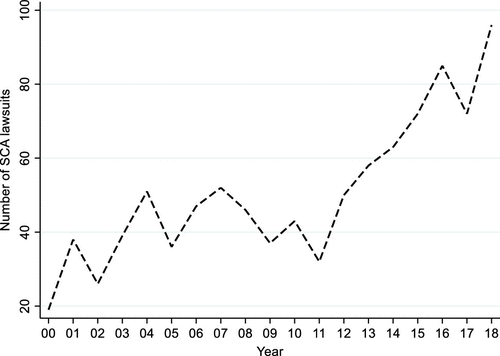
After identifying industry peers and the lawsuits filed against firms, we computed each firm’s industry peer litigation as the ratio of the number of industry peers sued in SCA litigation in the prior three years over the total number of industry peers (based on the FIC-200 industry classification). We used a three-year period because managers’ assessment of their litigation risk is likely to extend beyond one year (Hutton et al. 2014); notably, our results remain similar when using a one- or two-year period to calculate this variable. Figure 1 graphs the total number of SCA lawsuits against firms in our sample from 2000 to 2018, showing an increasing trend during this window.
4.4. Moderators
To test H2, we measured investors’ horizons based on their portfolio churn ratio, which captures how frequently an investor reshuffles its portfolio (Qian et al. 2022). Our approach to using the churn ratio to capture investors’ horizons comes from a large body of business research that follows this method (Gaspar et al. 2005, Cella et al. 2013, Kamara et al. 2016, Harford et al. 2018). Investors who hold stocks for relatively short (long) periods of time and thus “churn” their portfolios quickly (slowly) are seen as having short (long) investment horizons. To measure this moderator, we first calculated the investor-level churn ratio using the following formula:
To test H3, we evaluated each CEO’s future focus. Research suggests that executives’ language use can reflect their temporal preferences (Crilly et al. 2016) and orientations (Nadkarni and Chen 2014). Following this work, we measured CEO future focus by first extracting CEOs’ words from earnings call transcripts obtained from Thomson Reuters Street Events. Earnings call transcripts include prepared remarks and question and answer (Q & A) sections. Consistent with DesJardine and Shi (2021), we used CEOs’ language in the Q & A sections to measure CEO future focus because CEOs’ language in the prepared remarks section is more easily subject to impression management. CEO future focus is measured as the number of future focus words included in the Linguistic Inquiry and Word Count (LIWC) future focus dictionary, scaled by the total number of words in the Q & A sections of earnings call transcripts.
4.5. Control Variables
Starting at the firm level, we included several variables that could affect firms’ investment horizons. We first controlled for firm size using the natural logarithm of total assets, because larger firms tend to employ more formal capital budgeting processes, which could affect the malleability of their investment horizons. We controlled for firm performance because higher-performing firms likely have more leeway to manage toward long-term goals (Chang and Jo 2019). Because shareholders tend to benchmark a firm’s financial performance with its industry peers (DesJardine et al. 2023a), we controlled for industry-adjusted market performance and accounting performance. We used the market-to-book (MTB) ratio (measured as the ratio of common shares outstanding multiplied by stock price to total assets) and return-on-assets (ROA) (measured as net income divided by total assets) to capture market performance and accounting performance, respectively, which we adjusted by industry. Specifically, industry-adjusted MTB (ROA) is measured as the difference between a firm’s MTB (ROA) and its industry peers’ MTB (ROA). We included cash holdings, defined as cash and cash equivalents divided by total assets, because firms with larger cash holdings likely have more financial resources to pursue long-term investment projects. Similarly, we controlled for leverage, measured as total liabilities divided by total assets, because highly leveraged firms may lack the attentional bandwidth to consider long-term investments (Bae et al. 2011).
We also included various corporate governance variables. We controlled for analyst coverage, measured as the logarithm of 1 plus the number of analysts following a firm, because analyst coverage can influence firms’ investment horizons (Qian et al. 2019). We also included female director ratio, measured as the ratio of the number of female directors to board size, because female directors and male directors exhibit different investment horizons (Bauweraerts et al. 2022). We controlled for the percentage of shares owned by institutional investors, defined as institutional ownership, to capture the distinct influences that different types of investors might have on a firm’s investment horizons (Cobb 2015).
We controlled for the number of lawsuits, measured as the number of SCA lawsuits filed against a firm in the prior three years, to capture the direct effect of being sued on a firm’s investment horizon. Activist shareholders can play an important governance role and may shape firms’ investment horizons (DesJardine and Durand 2020). Existing research suggests that activist shareholders can seek to influence firms by acquiring large ownership stakes (and filing a Schedule 13D with the SEC) or filing shareholder proposals (Goranova and Ryan 2014). We thus controlled for both types of activism. Shareholder ownership activism equals 1 if a firm was the subject of a Schedule 13D filing in the prior three years and 0 otherwise. We included only Schedule 13D filings with disclosed objectives pertaining to “concern,” “discuss,” “dispute,” and “control” (DesJardine and Shi 2022). Shareholder proposal activism takes a value of 1 if a firm received a shareholder proposal in the prior three years and 0 otherwise.
We included industry-level control variables as well. To alleviate the concern that a firm’s investment horizon could be driven by the spillover effect of shareholder ownership activism and proposal activism between peer firms, we controlled for both types of activism within industries. Industry shareholder ownership activism equals the ratio of the number of industry peers that were the subject of a Schedule 13D filing in the prior three years to the number of industry peers. Likewise, we measured industry shareholder proposal activism as the number of industry peers that received at least one shareholder proposal in the prior three years divided by the number of industry peers. We also controlled for industry concentration, measured by the Herfindahl-Hirschman Index (HHI) of market shares of firms belonging to the same FIC-200 industry, because firms’ investment horizons can be affected by industry-based competitive pressures (Aghion et al. 2005). Lastly, we controlled for the influence of universal-demand (UD) laws because the adoption of these laws has weakened the ability of shareholders to pursue derivative litigation (Erickson 2009). UD law takes a value of 1 if a firm is headquartered in a state with an active UD law and 0 otherwise.
4.6. Estimation
Defined as Equation (1), we ran the following OLS regression to test our hypotheses:
5. Results
5.1. Main Results
Table 1 reports descriptive statistics and correlations for all variables. Combined with an average variance inflation factor of 4.35, the low correlations between the main variables of interest and each control variable indicate that multicollinearity likely is not a concern.
|

Table 1. Descriptive Statistics and Correlations
| Variable | Obs | Mean | SD | 1 | 2 | 3 | 4 | 5 | 6 | 7 | 8 | 9 | 10 | 11 | 12 | 13 | 14 | 15 | 16 | 17 | 18 | |
|---|---|---|---|---|---|---|---|---|---|---|---|---|---|---|---|---|---|---|---|---|---|---|
| 1 | Asset durability | 26,093 | 6.73 | 10.24 | ||||||||||||||||||
| 2 | Industry peer litigation | 26,093 | 0.09 | 0.13 | −0.06 | |||||||||||||||||
| 3 | Investor horizon | 23,971 | −0.21 | 0.05 | 0.06 | 0.00 | ||||||||||||||||
| 4 | CEO future focus | 18,320 | 0.02 | 0.01 | 0.02 | −0.01 | −0.04 | |||||||||||||||
| 5 | Firm size | 26,093 | 6.72 | 1.80 | 0.16 | 0.02 | 0.25 | −0.04 | ||||||||||||||
| 6 | Industry-adjusted MTB | 26,093 | 0.03 | 1.73 | 0.07 | 0.01 | 0.03 | −0.02 | −0.08 | |||||||||||||
| 7 | Industry-adjusted ROA | 26,093 | 0.08 | 0.24 | 0.01 | 0.03 | 0.00 | 0.00 | 0.11 | −0.13 | ||||||||||||
| 8 | Cash holdings | 26,093 | 0.22 | 0.23 | −0.12 | 0.09 | −0.23 | 0.03 | −0.43 | 0.16 | 0.14 | |||||||||||
| 9 | Leverage | 26,093 | 0.20 | 0.22 | 0.02 | −0.02 | 0.00 | 0.00 | 0.30 | −0.02 | −0.09 | −0.29 | ||||||||||
| 10 | Analyst coverage | 26,093 | 1.98 | 0.76 | 0.13 | 0.07 | 0.10 | −0.04 | 0.65 | 0.16 | 0.14 | −0.05 | 0.09 | |||||||||
| 11 | Female director ratio | 26,093 | 0.11 | 0.11 | 0.06 | 0.05 | 0.17 | −0.05 | 0.32 | 0.01 | 0.06 | −0.09 | 0.08 | 0.24 | ||||||||
| 12 | Institutional ownership | 26,093 | 0.55 | 0.27 | 0.04 | 0.00 | 0.04 | −0.03 | 0.29 | 0.03 | 0.13 | −0.12 | 0.06 | 0.29 | 0.12 | |||||||
| 13 | Number of lawsuits | 26,093 | 0.10 | 0.36 | −0.02 | 0.08 | −0.03 | 0.00 | 0.07 | −0.02 | 0.01 | 0.06 | 0.03 | 0.09 | 0.03 | −0.01 | ||||||
| 14 | Shareholder ownership activism | 26,093 | 0.12 | 0.33 | −0.03 | 0.02 | −0.08 | −0.01 | −0.08 | −0.06 | −0.07 | −0.03 | 0.06 | −0.14 | −0.01 | −0.07 | 0.06 | |||||
| 15 | Shareholder proposal activism | 26,093 | 0.18 | 0.38 | 0.11 | 0.01 | 0.15 | −0.01 | 0.54 | 0.02 | 0.06 | −0.17 | 0.10 | 0.42 | 0.23 | 0.09 | 0.07 | −0.01 | ||||
| 16 | Industry shareholder ownership activism | 26,093 | 0.13 | 0.15 | 0.00 | 0.06 | −0.06 | −0.01 | −0.02 | −0.01 | 0.02 | −0.02 | 0.03 | 0.00 | 0.04 | −0.03 | 0.01 | 0.05 | −0.01 | |||
| 17 | Industry shareholder proposal activism | 26,093 | 0.16 | 0.20 | 0.10 | 0.03 | 0.14 | −0.02 | 0.35 | −0.02 | −0.08 | −0.27 | 0.12 | 0.17 | 0.12 | 0.08 | −0.02 | 0.00 | 0.25 | −0.03 | ||
| 18 | Industry concentration | 26,093 | 0.16 | 0.15 | −0.03 | −0.02 | 0.10 | 0.00 | 0.00 | 0.01 | −0.05 | −0.10 | −0.04 | −0.07 | −0.02 | 0.00 | −0.02 | −0.03 | −0.02 | 0.00 | 0.03 | |
| 19 | UD law | 26,093 | 0.40 | 0.49 | 0.03 | −0.04 | 0.04 | 0.01 | 0.02 | −0.03 | −0.02 | −0.10 | 0.03 | −0.02 | −0.01 | 0.03 | −0.04 | 0.00 | −0.01 | 0.00 | −0.01 | 0.03 |
Notes. Several correlations are of interest. First, asset durability and CEO future focus are correlated at 0.02. This could be because a CEO’s future focus is often relatively stable over time (DesJardine and Shi 2020), whereas a firm’s asset durability can change based on various firm-level and environment-level factors (Souder and Bromiley 2012). Moreover, although CEO future focus captures a CEO’s tendency to focus on the future, it does not capture how long into the future, whereas asset durability is a continuous measure that does capture this dimension. Second, industry peer litigation has a correlation of 0.06 with industry shareholder ownership activism and a correlation of 0.03 with industry shareholder proposal activism. These relatively low correlations arise partially from the fact that shareholders who initiate litigation tend not to be the same shareholders who file Schedule 13D forms and sponsor shareholder proposals. For example, among the 321 institutional investors that sued portfolio firms, only 10 of them had filed a Schedule 13D in the same firms. Third, the correlation between investor horizon and institutional ownership is 0.04. Whereas institutional ownership captures ownership by a firm’s institutional investors (at the firm level), churn ratios used to measure investor horizon capture institutional investors’ reshuffling of their portfolios (at the investor level). These two variables are therefore calculated at different levels. To give an example of why this divergence may occur, consider a firm with very high ownership by hedge funds; such a firm would have high institutional ownership but likely low investor horizons.
Model 1 of Table 2 presents the results estimated from Equation (1) with only the set of control variables. Hypothesis 1 suggests that a firm’s investment horizon is negatively associated with its litigation threat, as indicated by lawsuits against industry peers. In support of this hypothesis, the coefficient in Model 2 for industry peer litigation is −2.022 (p < 0.01). When industry peer litigation increases from 0 to its mean plus one standard deviation, asset durability decreases by 6.3% of its mean. As shown in Model 3, when both of our moderators (investor horizon and CEO future focus) are added as control variables, the coefficient for industry peer litigation remains statistically significant (β = −2.528, p < 0.01).
|
Table 2. Associations Between the Treat of Shareholder Litigation and Firm Investment Horizons
| Model 1 | Model 2 | Model 3 | Model 4 | Model 5 | Model 6 | |
|---|---|---|---|---|---|---|
| Variable | Asset durability | |||||
| Industry peer litigation | −2.022*** | −2.528*** | 2.143 | −5.078*** | −0.759 | |
| (0.544) | (0.604) | (1.927) | (1.221) | (2.506) | ||
| Industry peer litigation × investor horizon | 21.763** | 22.882** | ||||
| (9.129) | (11.423) | |||||
| Industry peer litigation × CEO future focus | 134.043** | 140.081** | ||||
| (57.423) | (57.170) | |||||
| Investor horizon | 0.921 | 0.025 | −0.995 | |||
| (2.429) | (2.081) | (2.767) | ||||
| CEO future focus | 12.661 | 4.859 | 2.317 | |||
| (7.960) | (9.481) | (9.287) | ||||
| Firm size | 0.254 | 0.258 | 0.117 | 0.210 | 0.098 | 0.114 |
| (0.202) | (0.202) | (0.248) | (0.206) | (0.250) | (0.248) | |
| Industry-adjusted MTB | 0.350*** | 0.350*** | 0.452*** | 0.397*** | 0.386*** | 0.452*** |
| (0.068) | (0.068) | (0.081) | (0.062) | (0.089) | (0.080) | |
| Industry-adjusted ROA | 1.476*** | 1.496*** | 2.003*** | 1.397*** | 2.335*** | 2.019*** |
| (0.324) | (0.324) | (0.434) | (0.310) | (0.475) | (0.433) | |
| Cash holdings | 2.842*** | 2.844*** | 2.142*** | 2.760*** | 2.488*** | 2.127*** |
| (0.680) | (0.680) | (0.792) | (0.706) | (0.783) | (0.791) | |
| Leverage | −3.079*** | −3.066*** | −3.122*** | −3.076*** | −3.069*** | −3.144*** |
| (0.564) | (0.563) | (0.726) | (0.583) | (0.730) | (0.727) | |
| Analyst coverage | 0.693*** | 0.699*** | 0.856*** | 0.715*** | 0.897*** | 0.858*** |
| (0.223) | (0.223) | (0.274) | (0.227) | (0.271) | (0.274) | |
| Female director ratio | 0.575 | 0.580 | 0.829 | 0.419 | 0.713 | 0.830 |
| (1.244) | (1.243) | (1.481) | (1.300) | (1.474) | (1.478) | |
| Institutional ownership | 0.081 | 0.065 | 0.326 | 0.056 | 0.156 | 0.326 |
| (0.387) | (0.387) | (0.484) | (0.416) | (0.467) | (0.484) | |
| Number of lawsuits | −0.258 | −0.240 | −0.086 | −0.249 | −0.169 | −0.089 |
| (0.194) | (0.194) | (0.228) | (0.207) | (0.225) | (0.228) | |
| Shareholder ownership activism | 0.032 | 0.033 | 0.239 | 0.109 | 0.261 | 0.250 |
| (0.239) | (0.239) | (0.278) | (0.245) | (0.269) | (0.278) | |
| Shareholder proposal activism | −0.201 | −0.214 | −0.305 | −0.104 | −0.276 | −0.299 |
| (0.257) | (0.257) | (0.305) | (0.264) | (0.303) | (0.306) | |
| Industry shareholder ownership activism | −0.218 | −0.155 | 0.046 | −0.267 | 0.054 | 0.055 |
| (0.509) | (0.508) | (0.609) | (0.529) | (0.603) | (0.610) | |
| Industry shareholder proposal activism | 0.433 | 0.527 | 0.665 | 0.771* | 0.378 | 0.662 |
| (0.454) | (0.456) | (0.511) | (0.466) | (0.515) | (0.511) | |
| Industry concentration | −0.060 | −0.057 | 0.303 | −0.249 | 0.438 | 0.307 |
| (0.701) | (0.699) | (0.833) | (0.718) | (0.838) | (0.833) | |
| UD law | −0.155 | −0.159 | 0.286 | −0.085 | −0.021 | 0.273 |
| (0.517) | (0.517) | (0.761) | (0.528) | (0.819) | (0.762) | |
| Constant | 3.466*** | 3.582*** | 3.550** | 3.814*** | 3.863** | 3.396* |
| (1.314) | (1.314) | (1.791) | (1.408) | (1.732) | (1.791) | |
| Firm FE | Yes | Yes | Yes | Yes | Yes | Yes |
| Year FE | Yes | Yes | Yes | Yes | Yes | Yes |
| Observations | 26,093 | 26,093 | 17,362 | 23,971 | 18,320 | 17,362 |
| Adjusted R2 | 0.178 | 0.178 | 0.183 | 0.183 | 0.185 | 0.183 |
Notes. Standard errors are clustered by firm and reported in parentheses. Two-tailed tests.
***p < 0.01; **p < 0.05; *p < 0.1.
Model 4 is used to test Hypothesis 2, which suggests that the negative association between industry peer litigation and a firm’s investment horizon is weaker (stronger) for firms with more long-term (short-term) shareholders. As expected, Model 4 shows that the coefficient for industry peer litigation × investor horizon is 21.763 (p < 0.05). Economically, when investor horizon takes a low value (mean minus one standard deviation), asset durability decreases by 11.7% of its mean as industry peer litigation increases from 0 to its mean plus one standard deviation. However, when investor horizon takes a high value (mean plus one standard deviation), asset durability decreases by 4.1% of its mean for the same increase in industry peer litigation.
Hypothesis 3 posits that the negative association between industry peer litigation and a firm’s investment horizon is weaker among firms led by CEOs who are more future focused. In Model 5, the coefficient for industry peer litigation × CEO future focus is 134.043 (p < 0.05). Interpreting this result, when CEO future focus takes a low value (mean minus one standard deviation), asset durability decreases by 12.9% of its mean as industry peer litigation increases from 0 to its mean plus one standard deviation. In contrast, when CEO future focus takes a high value (mean plus one standard deviation), asset durability decreases by 3.2% of its mean for the same increase in industry peer litigation.
We note that the coefficient for industry peer litigation is statistically not significant in Model 4, which is used to test the moderating effect of investor horizon, but is statistically significant in Model 5, which is used to test the moderating effect of CEO future focus. One possible reason for this is that investor horizon spans both negative and positive values, whereas CEO future focus assumes only positive values. Continuing in the table, Model 6 is a fully specified model with all interaction terms included, and the results continue to support our hypotheses and the prior findings.
5.2. Supplementary Analyses
5.2.1. Does the Spillover Effect of Litigation Depend on the Similarity of Industry Peers?
Because managers are likely to pay more attention to their closest industry peers, the spillover effect of shareholder litigation should be strongest among peers with higher product similarity. To test this idea, we took advantage of product similarity scores provided by the Hoberg-Philipp industry classification and calculated two independent variables based on the scores. Specifically, high (Low) similarity industry peer litigation captures the ratio of the number of SCA lawsuits targeted at industry peers with high (low) product similarity in the prior three years to the number of industry peers. The median value of a firm’s product similarity scores with all its industry peers is used as the cutoff to identify high/low product similarity. In un-tabulated results, we found that the coefficient for high similarity industry peer litigation is larger (β = −2.309, p < 0.05) than that of low similarity industry peer litigation (β = −1.913, p < 0.01); however, the difference between the two is not statistically significant.
5.2.2. Does Industry Peer Litigation Predict a Focal Firm Being Sued?
Our theory suggests that managers shorten their firms’ investment horizons when they sense a growing threat of being sued after observing lawsuits against their industry peers. This assumes that litigation against industry peers can predict a focal firm’s likelihood of being sued. To test this assumption, we ran a firm fixed-effects OLS regression to assess whether industry peer litigation can predict the likelihood of a firm being sued. To do so, we created a dummy variable indicating whether a firm was sued in a year (1) or not (0), and, following Equation (1), we lagged this variable by one year. We did not use probit or logistic regressions because including firm fixed effects would have excluded firms that had never been sued during our sample period. As shown in Model 1 of Table 3, the coefficient for industry peer litigation is positive and statistically significant (β = 0.069, p < 0.01), suggesting that firms are more likely to be sued after more of their industry peers are sued.
|
Table 3. Results from Supplementary Analyses
| Model 1 | Model 2 | Model 3 | Model 4 | Model 5 | |
|---|---|---|---|---|---|
| Variable | Litigation | Litigation by short-term investors | Litigation by long-term investors | Asset durability | |
| Industry peer litigation | 0.069*** | −3.089*** | |||
| (0.021) | (0.678) | ||||
| Post litigation | −0.922** | ||||
| (0.456) | |||||
| Industry peer litigations × Investor horizon difference | 53.321*** | ||||
| (18.493) | |||||
| Investor horizon difference | −7.548** | ||||
| (3.384) | |||||
| Firm size | 0.036*** | 0.019 | 0.023* | 0.108 | 0.265 |
| (0.008) | (0.016) | (0.014) | (0.229) | (0.202) | |
| Industry-adjusted MTB | −0.004* | −0.011** | −0.005 | 0.301*** | 0.350*** |
| (0.002) | (0.005) | (0.004) | (0.061) | (0.068) | |
| Industry-adjusted ROA | −0.023* | 0.083 | −0.039 | 1.849*** | 1.485*** |
| (0.013) | (0.068) | (0.048) | (0.360) | (0.325) | |
| Cash holdings | 0.018 | 0.033 | −0.007 | 3.260*** | 2.830*** |
| (0.031) | (0.068) | (0.047) | (0.833) | (0.680) | |
| Leverage | 0.039 | 0.075 | −0.044 | −3.169*** | −3.066*** |
| (0.025) | (0.056) | (0.063) | (0.688) | (0.562) | |
| Analyst coverage | −0.015** | 0.002 | 0.005 | 1.005*** | 0.701*** |
| (0.007) | (0.022) | (0.028) | (0.244) | (0.223) | |
| Female director ratio | −0.007 | −0.073 | 0.107 | 0.104 | 0.586 |
| (0.047) | (0.109) | (0.182) | (1.475) | (1.241) | |
| Institutional ownership | −0.033*** | −0.037 | −0.015 | −0.364 | 0.068 |
| (0.011) | (0.056) | (0.041) | (0.440) | (0.387) | |
| Number of lawsuits | −0.245 | ||||
| (0.194) | |||||
| Shareholder ownership activism | 0.048*** | −0.001 | −0.046*** | 0.179 | 0.033 |
| (0.010) | (0.036) | (0.016) | (0.269) | (0.239) | |
| Shareholder proposal activism | 0.022** | 0.062 | 0.027 | 0.035 | −0.216 |
| (0.010) | (0.061) | (0.048) | (0.311) | (0.257) | |
| Industry shareholder ownership activism | −0.014 | 0.062 | −0.021 | −0.469 | −0.153 |
| (0.015) | (0.103) | (0.042) | (0.581) | (0.508) | |
| Industry shareholder proposal activism | −0.008 | −0.117** | −0.088 | 0.111 | 0.540 |
| (0.013) | (0.056) | (0.057) | (0.476) | (0.457) | |
| Industry concentration | −0.006 | −0.052 | −0.012 | −0.095 | −0.069 |
| (0.022) | (0.037) | (0.077) | (0.723) | (0.699) | |
| UD law | −0.009 | 0.004 | −0.016 | −0.307 | −0.141 |
| (0.021) | (0.025) | (0.028) | (0.612) | (0.517) | |
| Constant | −0.120** | −0.089 | −0.083 | 4.492*** | 3.585*** |
| (0.054) | (0.083) | (0.066) | (1.463) | (1.313) | |
| Firm FE | Yes | Yes | Yes | Yes | Yes |
| Year FE | Yes | Yes | Yes | Yes | Yes |
| Observations | 26,093 | 26,093 | 26,093 | 22,021 | 26,093 |
| Adjusted R2 | 0.264 | 0.001 | 0.001 | 0.173 | 0.178 |
Notes. Standard errors are clustered by firm and reported in parentheses. Two-tailed tests.
***p < 0.01; **p < 0.05; *p < 0.1.
5.2.3. Do Short-Term Shareholders Sue Firms More Readily Than Long-Term Shareholders?
Following Hypothesis 2, we further assume that firms that perform poorly are more likely to be sued by short-term shareholders than by long-term shareholders. To test this assumption, we first classified SCA litigation by institutional investors into two groups based on their churn ratios. For the first group, litigation by short-term investors receives a value of 1 if a firm is subject to SCA litigation initiated by an institutional investor with a high churn ratio (i.e., institutional investors whose churn ratios are above the median churn ratio for all plaintiff institutional investors) in a year and 0 otherwise. Similarly, for the second group, litigation by long-term investors receives a value of 1 if a firm is subject to SCA litigation initiated by an institutional investor with a low churn ratio in a year and 0 otherwise. Following Equation (1), we ran two separate firm fixed-effects OLS regressions with each variable as the dependent variable. As shown in Models 2 and 3 of Table 3, the coefficient for industry-adjusted MTB is negative and only statistically significant when litigation by short-term investors is the dependent variable. This finding aligns with the idea that market underperformance can increase SCA litigation (Wu et al. 2020) and suggests that short-term shareholders tend to sue firms when market performance is lagging.
5.2.4. Does the First Case of Litigation Affect a Firm’s Investment Horizon?
In our main results in Table 2, we controlled for the number of lawsuits; the coefficient for this variable is negative and not statistically significant. One explanation for this finding is that firms do not respond to repeated instances of litigation because they learn how to prepare for and respond to lawsuits after initially being sued. To further probe this idea and the implications of repeated lawsuits, we examined whether firms also shortened their investment horizons after being sued for the first time during our sample period. For this test, we created the variable postlitigation, which receives a value of 1 for the three years after the first time a firm was directly subjected to SCA litigation and 0 for the years before this first case. As shown in Model 4 of Table 3, the coefficient for postlitigation is negative and statistically significant (β = −0.922, p < 0.05), suggesting that a firm shortens its investment horizon by 14% of its mean after being sued for the first time. This effect size is more than twice that associated with industry peer litigation, increasing from 0 to its mean plus one standard deviation (i.e., 6.3%). Our results are similar if we define postlitigation using a two- or four-year period after the first instance of litigation.
5.2.5. Do Differences in the Horizons of Peer Firms’ Shareholders Matter?
The analyses related to Hypothesis 2 do not consider the investment horizons of shareholders of litigated industry peers. Yet if a focal firm’s shareholders have investment horizons similar to those of litigated industry peers, its managers may perceive the threat of being sued as more salient. Therefore, we might expect that a larger difference between the investor horizons of a firm and its peers should weaken the main effect of industry peer litigation on asset durability. To test this idea, we created a variable for investor horizon difference, defined as the absolute difference between the churn ratio of a focal firm’s investors and the average churn ratios of litigated industry peers’ investors. Using Equation (1), we tested whether investor horizon difference can moderate the relationship between industry peer litigation and asset durability. As displayed in Model 5 of Table 3, the coefficient for the interaction term is 53.321 (p < 0.01), indicating that similarity between the shareholders of a firm and shareholders of industry peers amplifies the negative association between industry peer litigation and a firm’s investment horizon.
5.2.6. How Else Do Firms React to the Threat of Litigation?
Our results so far suggest that managers who are concerned about being sued by shareholders begin to forgo investments in long-term initiatives in favor of delivering more immediate financial returns to shareholders. If this is the case, then we should expect to see various other changes in corporate outcomes beyond changes in capital investments. We thus tested how the threat of litigation affects a firm’s (1) investments in stakeholder-related activities, (2) dividend payments, (3) earnings management practices, (4) short-term market returns, and (5) long-term market returns.
Because they typically involve long investment horizons, we expect that managers reduce investments in stakeholder-related activities after observing their peers being sued. Following Flammer and Bansal (2017), we measured a firm’s investment in stakeholder-related activities by focusing on the employees, customers, natural environment, and community dimensions captured by KLD. For each dimension, KLD reports both strengths and concerns. Consistent with prior studies we calculated the average difference between the number of strengths and concerns related to the aforementioned dimensions to measure stakeholder investment. Because coverage of a given dimension varies over time, we divided the maximum number of strengths (concerns) available for each dimension of interest in a year. As reported in Model 1 of Table 4, the coefficient for industry peer litigation is −0.015 (p < 0.05), consistent with our expectations. When industry peer litigation increases from 0 to its mean plus one standard deviation, stakeholder investment decreases by 38%.
|
Table 4. Associations Between the Threat of Shareholder Litigation and Other Firm Outcomes
| Model 1 | Model 2 | Model 3 | Model 4 | Model 5 | |
|---|---|---|---|---|---|
| Variable | Stakeholder investment | Dividend payout | Earnings management | Short-term market returns | Long-term market returns |
| Industry peer litigation | −0.015** | 0.002* | 0.005* | 0.112** | −0.010 |
| (0.006) | (0.001) | (0.003) | (0.056) | (0.071) | |
| Firm size | −0.015*** | 0.001* | -0.019*** | 0.238*** | 0.149** |
| (0.003) | (0.000) | (0.001) | (0.023) | (0.061) | |
| Industry-adjusted MTB | −0.001*** | −0.000*** | 0.002*** | 0.083*** | 0.049*** |
| (0.001) | (0.000) | (0.001) | (0.016) | (0.014) | |
| Industry-adjusted ROA | 0.003 | 0.000 | −0.017*** | 0.089 | −0.018 |
| (0.005) | (0.000) | (0.004) | (0.062) | (0.065) | |
| Cash holdings | 0.008 | 0.005*** | −0.005 | −0.049 | −0.077 |
| (0.009) | (0.001) | (0.005) | (0.074) | (0.138) | |
| Leverage | 0.016** | −0.003** | −0.009** | −0.005 | 0.392 |
| (0.007) | (0.001) | (0.004) | (0.095) | (0.281) | |
| Analyst coverage | 0.013*** | −0.001** | 0.002* | 0.081*** | −0.051 |
| (0.002) | (0.000) | (0.001) | (0.026) | (0.066) | |
| Female director ratio | −0.001 | 0.000 | −0.007 | −0.035 | −0.123 |
| (0.018) | (0.002) | (0.006) | (0.124) | (0.157) | |
| Institutional ownership | 0.003 | −0.000 | 0.003 | −0.017 | −0.114 |
| (0.003) | (0.001) | (0.002) | (0.043) | (0.120) | |
| Number of lawsuits | −0.009*** | 0.000 | 0.001 | 0.006 | −0.024 |
| (0.003) | (0.000) | (0.001) | (0.024) | (0.023) | |
| Shareholder ownership activism | −0.001 | −0.000 | −0.001 | 0.015 | 0.031 |
| (0.002) | (0.000) | (0.001) | (0.031) | (0.071) | |
| Shareholder proposal activism | 0.002 | 0.000 | 0.002 | −0.064*** | −0.102*** |
| (0.003) | (0.000) | (0.001) | (0.021) | (0.038) | |
| Industry shareholder ownership activism | 0.011** | 0.000 | 0.002 | 0.044 | 0.093 |
| (0.005) | (0.001) | (0.002) | (0.050) | (0.106) | |
| Industry shareholder proposal activism | 0.001 | −0.001 | 0.002 | −0.008 | −0.061 |
| (0.005) | (0.001) | (0.002) | (0.033) | (0.085) | |
| Industry concentration | −0.002 | 0.002* | −0.011** | 0.120** | 0.163 |
| (0.007) | (0.001) | (0.004) | (0.061) | (0.120) | |
| UD law | 0.003 | −0.001** | 0.003 | 0.043 | 0.063 |
| (0.007) | (0.001) | (0.003) | (0.068) | (0.125) | |
| Constant | 0.083*** | 0.006** | 0.175*** | −0.590*** | 0.348 |
| (0.020) | (0.003) | (0.009) | (0.142) | (0.308) | |
| Firm FE | Yes | Yes | Yes | Yes | Yes |
| Year FE | Yes | Yes | Yes | Yes | Yes |
| Observations | 19,713 | 25,178 | 29,872 | 25,178 | 25,178 |
| Adjusted R2 | 0.441 | 0.605 | 0.292 | 0.251 | 0.492 |
Notes. Standard errors are clustered by firm and reported in parentheses. Two-tailed tests.
***p < 0.01; **p < 0.05; *p < 0.1.
Next, we investigated the influence of the threat of litigation on dividend payout, measured as the total dividends issued in a year scaled by total sales. As shown in Model 2 of Table 4, the coefficient for industry peer litigation is 0.002 (p < 0.1), suggesting that managers issue more dividends when they face a greater threat of being sued, arguably to placate their shareholders.
Managers who feel threatened by industry peer litigation may also resort to discretionary accruals to manage their firms’ short-term earnings (Dechow et al. 1995). To test this possibility, we investigated the influence of the threat of litigation on earnings management, measured as discretionary accruals calculated by the Jones (1991) model.2 This measure reflects managers’ deliberate use of accounting techniques to improve their firms’ accounting performance. In Model 3, the coefficient for industry peer litigation is 0.005 (p < 0.1), implying that managers more closely manage the earnings they report to shareholders when they perceive a greater threat of being sued.
We also examined whether the collective changes implemented by managers effectively improved the returns their firms delivered to shareholders over different horizons. First, we measured short-term market returns as a firm’s net-dividend stock price change in the current year scaled by its stock price at the end of the prior year (Nyberg et al. 2010). Then, we measured long-term market returns for a focal year as the average shareholder returns in the following three years. As shown in Model 4, the coefficient for industry peer litigation is 0.112 (p < 0.05) when short-term market returns is the dependent variable; in contrast, the coefficient is negative but not statistically significant at conventional thresholds when long-term market returns is the dependent variable. Collectively, these results suggest that managers do more to boost immediate returns to shareholders when they perceive a threat of being sued, but those actions have limited impact on their firms’ long-term returns.
5.3. Robustness Checks
We conducted a series of additional tests to further probe the robustness of the main results.
5.3.1. Industry-Year Fixed Effects Analyses.
In our main analyses, we accounted for firm fixed effects to mitigate the influence of time-invariant firm heterogeneity on firms’ investment horizons. Yet industry trends may drive both the amount of industry litigation and changes in firms’ investment horizons, creating an omitted variable bias. To alleviate this concern, we accounted for industry × year fixed effects by creating a dummy variable for each industry-year combination. As shown in Model 1 of Table 5, the coefficient for industry peer litigation is negative and statistically significant (β = −1.189, p < 0.05), suggesting that our findings are robust to changes in industry trends.
|
Table 5. Results from Robustness Checks
| Model 1 | Model 2 | Model 3 | |
|---|---|---|---|
| Industry-year fixed-effects | Gaussian copula | Alternative litigation measure | |
| Variable | Asset durability | ||
| Industry peer litigation | −1.189** | −2.071** | |
| (0.566) | (0.927) | ||
| Industry peer litigation intensity | −1.004** | ||
| (0.413) | |||
| Firm size | 0.481*** | 0.258 | 0.256 |
| (0.093) | (0.162) | (0.202) | |
| Industry-adjusted MTB | 0.376*** | 0.350*** | 0.350*** |
| (0.052) | (0.059) | (0.068) | |
| Industry-adjusted ROA | 1.670*** | 1.496*** | 1.486*** |
| (0.276) | (0.304) | (0.324) | |
| Cash holdings | 0.400 | 2.844*** | 2.847*** |
| (0.445) | (0.585) | (0.680) | |
| Leverage | −2.168*** | −3.066*** | −3.071*** |
| (0.415) | (0.577) | (0.563) | |
| Analyst coverage | 0.546*** | 0.699*** | 0.695*** |
| (0.170) | (0.218) | (0.223) | |
| Female director ratio | 0.966 | 0.581 | 0.571 |
| (0.842) | (1.096) | (1.243) | |
| Institutional ownership | −0.650* | 0.065 | 0.073 |
| (0.370) | (0.422) | (0.387) | |
| Number of lawsuits | −0.511*** | −0.240 | −0.249 |
| (0.179) | (0.187) | (0.194) | |
| Shareholder ownership activism | −0.321 | 0.033 | 0.031 |
| (0.218) | (0.232) | (0.239) | |
| Shareholder proposal activism | 0.208 | −0.214 | −0.205 |
| (0.257) | (0.258) | (0.257) | |
| Industry shareholder ownership activism | 0.145 | −0.156 | −0.169 |
| (0.523) | (0.445) | (0.510) | |
| Industry shareholder proposal activism | 0.413 | 0.528 | 0.492 |
| (0.483) | (0.392) | (0.455) | |
| Industry concentration | −1.250 | −0.056 | −0.054 |
| (2.263) | (0.677) | (0.699) | |
| UD law | 0.168 | −0.159 | −0.163 |
| (0.182) | (0.503) | (0.517) | |
| Constant | 2.998*** | 3.587*** | 3.543*** |
| (0.579) | (1.078) | (1.314) | |
| Firm FE | No | Yes | Yes |
| Year FE | No | Yes | Yes |
| Industry-year FE | Yes | No | No |
| Observations | 26,093 | 26,093 | 26,093 |
| Adjusted R2 | 0.107 | 0.178 | |
Notes. Standard errors are clustered by firm and reported in parentheses. Two-tailed tests.
***p < 0.01; **p < 0.05; *p < 0.1.
5.3.2. Gaussian Copula Regression.
To further mitigate endogeneity concerns, we adopted a Gaussian copula regression method. The Gaussian copula method is an instrumental variable (IV) free method that directly controls for the joint distribution of the potentially endogenous variable and the error term through a copula correction term (Park and Gupta 2012). This method provides a parsimonious way to handle endogenous regressors (Tran and Tsionas 2015). Model 2 of Table 5 reports results from the Gaussian copula regression using the same predictors as those in Equation (1). After controlling for the copula correction term, the coefficient for industry peer litigation remains negative and statistically significant (β = −2.071, p < 0.05).
5.3.3. Alternative Independent Variable.
We constructed our main measure of industry peer litigation based on whether an industry peer was subject to an SCA lawsuit in the prior three years. Although around 90% of firms that were sued were subject to only one SCA lawsuit in the prior three years, some were subject to up to five lawsuits. To account for the difference in the number of lawsuits targeting industry peers, we calculated an alternative measure of industry peer litigation using industry peer litigation intensity, equal to the ratio of the number of SCA lawsuits that a firm’s industry peers were subject to in the past three years to the number of industry peers. Model 3 of Table 5 shows that the coefficient of industry peer litigation intensity is −1.004 (p < 0.05), consistent with our theory.
6. Discussion
We examined how shareholder lawsuits against industry peers can influence managers’ investment decisions. Our results imply that managers respond to the threat of litigation by reducing their investments in long-term capital, suggesting that managers who perceive a threat of being sued can become oriented toward the short term. In support of our theory, the findings reveal that the negative relationship between a firm’s threat of being sued and its investment horizon is stronger for firms with more short-term shareholders and weaker for firms led by future-focused CEOs. These findings have several implications for theory and practice.
6.1. Research Implications
Whereas being sued by shareholders has been shown to influence a focal firm’s decision priorities (Arena and Julio 2015), it is unknown whether firms respond to litigation against their industry peers. This is surprising, because existing studies have shown that other forms of influence by shareholders, such as ownership-based activism, can create spillover effects by posing threats to peer firms in an industry (Gantchev et al. 2019, Shi et al. 2020, Chuah et al. 2024). By documenting that litigation among industry peers can affect a focal firm’s investment horizon as well as a host of related outcomes, including its investments in stakeholder-related activities and monetary returns to shareholders, our study sheds light on additional potential consequences of shareholder litigation on organizational life and extends research on interorganizational governance (Connelly et al. 2020).
Our study also identifies important theoretical boundary conditions to the presence of spillover effects. Some prior studies have implied that all firms experience spillovers in similar ways (Shi et al. 2022b). However, we have found evidence that suggests this is not the case. Results from our main analyses reveal that firms with more short-term shareholders are more likely to change their investment horizons in response to their peers being sued, and our supplemental tests show that these shareholders are the most likely to sue firms that underperform the market. Our supplemental analyses also show that firms are more responsive to the threat of being sued when their shareholders are more similar to the shareholders litigating against their industry peers and when firms share greater product overlaps with those peers. Together, these findings suggest that for a focal firm to respond to a major event at another firm (e.g., a lawsuit) substantially enough for a spillover effect to occur, managers may need to believe that a similar event could occur at their own firm, which is contingent on the similarity between the firm and its peers. As research on industry spillovers continues to grow, it is important for scholars to account for the similarity among peers across an array of dimensions, especially in areas most relevant to the nature of the spillover event under question.
Our study informs research on shareholder voice and how shareholders’ legal rights and freedoms shape corporate priorities and practices. Many studies have considered how traditional forms of shareholder voice, such as shareholder proposals and shareholder activism, can affect corporate practices and policies (see, e.g., Marti et al. 2024). Much less work has focused on shareholder litigation, which differs in important ways from other forms of voice, including how “messy” it is (Hirschman 1970, p. 16). Even in models in which we controlled for other forms of shareholder voice, we found a persistent effect of the threat of litigation on various types of corporate actions and outcomes, including in areas as diverse as stakeholder-related activities, dividend payouts, and earnings management. Given that litigation is a sufficiently potent threat to cause these types of multifaceted spillover effects among firms, there is a great need to study this type of shareholder voice more fully.
Our findings can advance research on corporate investment horizons and intertemporal choice. Existing studies suggest that shareholders can play a central role in shortening managers’ time horizons (DesJardine and Bansal 2019) and investment horizons (Marginson and McAulay 2008, Sampson and Shi 2023). For example, pressures from institutional investors can lead managers to forgo long-term strategic decisions (Zhang and Gimeno 2016) and investments in workplace safety (Shi et al. 2022a). Whereas these studies have focused on the direct effects of shareholders on the firms they own, our study shows how shareholders at other firms can impact the investment horizons of a focal firm. Moreover, whereas prior studies have focused on different forms of shareholder voice and exit, we have added litigation to the mix.
Our findings not only identify the threat of being sued by shareholders as an important driver of corporate investment horizons but also present an intriguing conundrum for the study of managerial short-termism, which arises when managers’ investment horizons become so short that they harm long-run value (Keum 2021). Litigation is a tool that shareholders use to seek compensation for damages they allege were caused by mismanagement (Shi et al. 2016). Although suing a firm can achieve that objective in a focal lawsuit, suing one firm seems to cause other firms to shorten their horizons and make decisions that could be detrimental to their own performance in the distant future, potentially creating a culture of managerial short-termism and increasing their own risk of being sued. From this perspective, shareholder litigation could create a self-reinforcing cycle of legal woes, where shareholders sue firms for purported losses that lead to further losses at other firms.
6.2. Practical Implications
Over the past few decades, scholars, practitioners, and policymakers have actively debated the merits of relaxing legal constraints on shareholders. Much popular thinking suggests that by giving them more legal power to sue firms, shareholders can help discipline wayward managers, especially when other governance mechanisms fail to do so. By providing evidence that litigation threats can shorten firms’ investment horizons, our study highlights the practical need for lawmakers to more broadly consider the various consequences that come with shareholder legal freedoms.
Our research can also help managers better navigate some of the pressures that manifest in their constellations of shareholders. When shareholders are afforded extensive legal freedoms, managers need to be especially conscious about shortening their investment horizons. Keeping this in mind, when under the threat of litigation, managers should consider seeking out more long-term investors and implementing additional checks and balances (e.g., long-term strategic reviews) to ensure that their decisions account for a broad set of interests over a balanced timeframe. Laying out the strategies managers can use to attract such shareholders, DesJardine and Shi (2024) explained that this can be accomplished by developing effective investor relations programs that target specific shareholders.
6.3. Limitations and Avenues for Future Research
Our study is not without limitations, which offers opportunities for further investigation. Because SCA litigation is typically triggered by deteriorating firm performance, the threat of such a lawsuit is likely most influential in altering managers’ investment decisions. For this reason, we studied the threat of litigation posed by SCA lawsuits, although shareholders can also sue firms with derivative lawsuits. With rising attention to firms’ environmental and social commitments, it is worth exploring whether the threat of a derivative lawsuit causes similar or other types of changes in managerial decision making and firm outcomes. For instance, we could imagine that a heightened threat of derivative litigation on environmental and social issues might cause managers to scale back on their commitments to those issues.
Although asset durability was designed specifically for the purpose of capturing corporate investment horizons (Souder and Bromiley 2012) and has been used in several studies for this purpose (see, e.g., Nadkarni and Chen 2014, Martin et al. 2016, DesJardine and Bansal 2019), the measure does not come without limitations. Managers have some discretion over how new capital is classified and thus which depreciation standards are applied and the resultant measure of asset durability. Other measures of investment horizons, such as R & D spending and long-term debt, could address the classification capital issue, but not without introducing their own sets of concerns. Surveys offer another method to measure corporate investment horizons that can overcome many of the concerns of using archival-based measures but also present their own challenges, including self-reporting bias. Given the limitations of each approach, scholars could measure firms’ investment horizons by triangulating the output of several measures.
The authors thank the senior editor, Tomasz Obloj, and the team of reviewers for their insightful guidance in the review process. M. R. DesJardine gratefully acknowledges support from the Wharton ESG Initiative that contributed to the development of this study.
1 For data on SCA lawsuits, see https://securities.stanford.edu/stats.html.
2 The Jones model discretionary accrual is estimated by performing the following regression model: , where is change in sales scaled by lagged total assets (), and is net property, plant, and equipment scaled by . The model is estimated by using all firm years with the same two-digit SIC code. We use a two-digit SIC code as the industry classification because an increased granularity of the industry classification may largely reduce the sample size. The estimation of the Jones model relies on the number of observations in the same year and same industry classification; a more detailed industry classification results in a smaller data pool for estimation. Once the number of observations is less than 20, we are not able to estimate the discretionary accrual using the Jones model. The sample size will be reduced by about 20% if we use the FIC as the industry classification. Therefore, to maintain consistency with prior accounting research, we use two-digit SIC codes in measuring earnings management.
References
- (2005) Competition and innovation: An inverted-U relationship. Quart. J. Econom. 120(2):701–728.Google Scholar
- (2015) The effects of securities class action litigation on corporate liquidity and investment policy. J. Financ. Quant. Anal. 50(1–2):251–275.Crossref, Google Scholar
- (2011) Employee treatment and firm leverage: A test of the stakeholder theory of capital structure. J. Financial Econom. 100(1):130–153.Crossref, Google Scholar
- (2022) Are family female directors catalysts of innovation in family small and medium enterprises? Strategic Entrep. J. 16(2):314–354.Crossref, Google Scholar
- (2008) Conservatism and debt. J. Accounting Econom. 45(2–3):154–174.Crossref, Google Scholar
- (2020) Dancing with activists. J. Financial Econom. 137:1–41.Crossref, Google Scholar
- (1988) Time and organizations. J. Management 14(2):299–320.Google Scholar
- (2018) Shareholder litigation and corporate disclosure: Evidence from derivative lawsuits. J. Accounting Res. 56(3):797–842.Crossref, Google Scholar
- (1986) Corporate planning and capital investment. J. Econom. Behav. Organ. 7(2):147–170.Crossref, Google Scholar
- (1998) Investors on myopic R&D investment behavior. Accounting Rev. 73(3):305–333.Google Scholar
- (2013) Investors’ horizons and the amplification of market shocks. Rev. Financial Stud. 26(7):1607–1648.Crossref, Google Scholar
- (2019) Employee‐friendly practices, product market competition and firm value. J. Bus. Finance Accounting 46(1–2):200–224.Crossref, Google Scholar
- (2018) Activist‐impelled divestitures and shareholder value. Strategic Management J. 39(10):2726–2744.Crossref, Google Scholar
- (2010) Institutional monitoring through shareholder litigation. J. Financial Econom. 95(3):356–383.Crossref, Google Scholar
- (2021) Surprise election for Trump connections. J. Financial. Econom. 140(2):676–697.Crossref, Google Scholar
- (2017) Piling on? An empirical study of parallel derivative suits. J. Empir. Leg. Stud. 14(4):653–682.Crossref, Google Scholar
- (2024) Shareholder activism research: A system-level view. Acad. Management Ann. 18(1):82–120.Crossref, Google Scholar
- (2015) Risky business: The decline of defined benefit pensions and firms’ shifting of risk. Organ. Sci. 26(5):1332–1350.Link, Google Scholar
- (2008) The impact of accounting restatements on CFO turnover and bonus compensation: Does securities litigation matter? Adv. Accounting 24(2):162–171.Crossref, Google Scholar
- (2010) Ownership as a form of corporate governance. J. Management Stud. 47(8):1561–1589.Crossref, Google Scholar
- (2020) CEO dismissal: Consequences for the strategic risk taking of competitor CEOs. Strategic Management J. 41(11):2092–2125.Crossref, Google Scholar
- (2006) Does the plaintiff matter? An empirical analysis of lead plaintiffs in securities class actions. Columbia Law Rev. 106(7):1587–1640.Google Scholar
- (2017) Time and space in strategy discourse: Implications for intertemporal choice. Strategic Management J. 38(12):2370–2389.Crossref, Google Scholar
- (2016) The grammar of decoupling: A cognitive-linguistic perspective on firms’ sustainability claims and stakeholders’ interpretation. Acad. Management J. 59(2):705–729.Crossref, Google Scholar
- (2007) The fundamental agency problem and its mitigation: Independence, equity, and the market for corporate control. Acad. Management Ann. 1:1–64.Crossref, Google Scholar
- (2007) Investor activism, managerial responsiveness, and corporate social performance. Strategic Manage. J. 28(1):91–100.Crossref, Google Scholar
- (1995) Detecting earnings management. Accounting Rev. 70(2):193–225.Crossref, Google Scholar
- (2019) One step forward, two steps back: How external evaluations can shorten orgnizational time horizons. Organ. Sci. 30(4):761–780.Link, Google Scholar
- (2020) Disentangling the effects of hedge fund activism on firm financial and social performance. Strategic Management J. 41(6):1054–1082.Crossref, Google Scholar
- (2021) How temporal focus shapes the influence of executive compensation on risk taking. Acad. Management J. 64(1):265–292.Crossref, Google Scholar
- (2022) The downside of displaying agentic values: Evidence from shareholder activism. Organ. Sci. 34(4):1577–1601.Link, Google Scholar
- (2024) How to attract the right shareholders. Harvard Bus. Rev. Forthcoming.Google Scholar
- (2023a) The corporate opportunity structure for shareholder activism: How activist hedge funds exploit board demographic diversity. Organ. Sci., ePub ahead of print May 2, https://doi.org/10.1287/orsc.2023.1679.Link, Google Scholar
- (2022) Different horizons: The effects of hedge fund activism vs. corporate shareholder activism on strategic actions. J. Management 48(7):1858–1887.Crossref, Google Scholar
- (2023b) How shareholders impact stakeholder interests: A review and map for future research. J. Management 49(1):400–429.Crossref, Google Scholar
- (2016) Large market declines and securities litigation: Implications for disclosing adverse earnings news. Management Sci. 62(11):3183–3198.Link, Google Scholar
- (2009) Corporate governance in the courtroom: An empirical analysis. William Mary Law Rev. 51(5):1749–1832.Google Scholar
- (2017) The gatekeepers of shareholder litigation. Oklahoma Law Rev. 70:237–280.Google Scholar
- (2005) Does disclosure deter or trigger litigation? J. Accounting Econ. 39(3):487–507.Crossref, Google Scholar
Flammer C, Bansal P (2017) Does a long-term orientation create value? Evidence from a regression discontinuity. Strategic Management J. 38(9):1827–1847 .Google Scholar- (1994) Shareholder litigation and corporate disclosures. J. Accounting Res. 32(2):137–164.Crossref, Google Scholar
- (2019) Governance under the gun: Spillover effects of hedge fund activism. Rev. Finance. 23(6):1031–1068.Crossref, Google Scholar
- (2005) Shareholder investment horizons and the market for corporate control. J. Financial Econom. 76(1):135–165.Crossref, Google Scholar
- (2014) Shareholder activism: A multidisciplinary review. J. Management 40(5):1230–1268.Crossref, Google Scholar
- (2021) The corporate objective revisited: The shareholder perspective. J. Management Stud. 59(2):526–554.Crossref, Google Scholar
- (2005) The economic implications of corporate financial reporting. J. Accountin Econom. 40(1):3–73.Crossref, Google Scholar
- (2018) Do long-term investors improve corporate decision making? J. Corp. Finance. 50:424–452.Crossref, Google Scholar
- (2017) Product market competition in a world of cross-ownership: Evidence from institutional blockholdings. Rev. Financial Stud. 30(8):2674–2718.Crossref, Google Scholar
- (1970) Exit, Voice, and Loyalty: Responses to Decline in Firms, Organizations, and States (Harvard University Press Cambridge, MA).Google Scholar
- (2010) Product market synergies and competition in mergers and acquisitions: A text-based analysis. Rev. Financial Stud. 23(10):3773–3811.Crossref, Google Scholar
- (2016) Text-based network industries and endogenous product differentiation. J. Political Econom. 124(5):1423–1465.Crossref, Google Scholar
- (2012) Internal and external discipline following securities class actions. J. Financial Intermed. 21(1):151–179.Crossref, Google Scholar
- (2014) The effect of securities litigation on external financing. J. Corp. Finance 27:231–250.Crossref, Google Scholar
- (2001) The impact of securities litigation reform on the disclosure of forward‐looking information by high technology firms. J. Accounting Res. 39(2):297–327.Crossref, Google Scholar
Jones JJ (1991) Earnings management during import relief investigations. J. Accounting Res. 29(2):193–228 .Google Scholar- (2016) Horizon pricing. J. Financial Quant. Anal. 51(6):1769–1793.Crossref, Google Scholar
- (2021) Innovation, short‐termism, and the cost of strong corporate governance. Strateg. Management J. 42(1):3–29.Crossref, Google Scholar
- (1994) Stockholder derivative suits: Demand and futility where the board fails to stop wrongdoers. Marquette Law Rev. 78:172–189.Google Scholar
- (2020) Guest post: “stock drop” lawsuits. The D&O Diary.Google Scholar
Laverty, Kevin J (1996) Economic “short-termism”: The debate, the unresolved issues, and the implications for management practice and research. Acad. Management Rev. 21(3):825–860 .Google Scholar- (2016) Corporate litigation and changes in CEO reputation: Guidance from US Federal Court lawsuits. J. Contemp. Accounting Econom. 12(1):15–34.Crossref, Google Scholar
- (2008) Exploring the debate on short‐termism: A theoretical and empirical analysis. Strategic Management J. 29(3):273–292.Crossref, Google Scholar
- (2024) The impact of sustainable investing: A multidisciplinary review. J. Management Stud. Forthcoming.Crossref, Google Scholar
- (2016) Going short‐term or long‐term? CEO stock options and temporal orientation in the presence of slack. Strategic Management J. 37:2463–2480.Crossref, Google Scholar
- (2011) The causes and consequences of securities class action litigation. J. Corp. Finance 17(3):649–665.Crossref, Google Scholar
- (2014) Bridging yesterday, today, and tomorrow: CEO temporal focus, environmental dynamism, and rate of new product introduction. Acad. Management J. 57(6):1810–1833.Crossref, Google Scholar
- (2010) Agency theory revisited: CEO return and shareholder interest alignment. Acad. Management J. 53(5):1029–1049.Crossref, Google Scholar
- (2012) Handling endogenous regressors by joint estimation using copulas. Marketing Sci. 31(4):567–586.Link, Google Scholar
- (2019) Financial analyst coverage and corporate social performance: Evidence from natural experiments. Strategic Management J. 40(13):2271–2286.Crossref, Google Scholar
- (2022) Short-selling pressure and workplace safety: Curbing short-termism through stakeholder interdependencies. Organ. Sci. 34(1):358–379.Link, Google Scholar
- (2016) Time horizon of investments in the resource allocation process: Review and framework for next steps. J. Management 42(5):1169–1194.Crossref, Google Scholar
- (2019) The role of gatekeepers in capital markets. J. Accounting Res. 57(2):295–322.Crossref, Google Scholar
- (2023) Are US firms becoming more short‐term oriented? Evidence of shifting firm time horizons from implied discount rates, 1980–2013. Strategic Management J. 44(1):231–263.Crossref, Google Scholar
- (2017) Better safe than sorry: Subsidiary performance feedback and internal governance in multiunit firms. J. Management 43(8):2526–2554.Crossref, Google Scholar
- (2021) Understanding and Managing Strategic Governance (Wiley, Hoboken, NJ).Google Scholar
- (2016) Buying bad behavior: Tournament incentives and securities class action lawsuits. Strategic Management J. 37(7):1354–1378.Crossref, Google Scholar
- (2022a) Institutional investor activism and employee safety: The role of activist and board political ideology. Organ. Sci. 33(6):2404–2420.Link, Google Scholar
- (2022b) Interorganizational spillover: A review and a proposal for future research. J. Management 48(1):185–210.Crossref, Google Scholar
- (2020) Portfolio spillover of institutional investor activism: An awareness-motivation-capability perspective. Acad. Management J. 63(6):1865–1892.Crossref, Google Scholar
- (2009) Conceptualization and measurement of temporal focus: The subjective experience of the past, present, and future. Organ. Behav. Human Decision Processes 110(1):1–22.Crossref, Google Scholar
- (2022) Designing long-term incentives that promote innovation instead of value capture. Oxf. Rev. Econom. Policy 38(2):322–337.Crossref, Google Scholar
- (2012) Explaining temporal orientation: Evidence from the durability of firms’ capital investments. Strategic Management J. 33(5):550–569.Crossref, Google Scholar
- (2010) Constraints and incentives for making long horizon corporate investments. Strategic Management J. 31(12):1316–1336.Crossref, Google Scholar
- (2015) Endogeneity in stochastic frontier models: Copula approach without external instruments. Econom. Lett. 133:85–88.Crossref, Google Scholar
- (2001) The effect of individual perceptions of deadlines on team performance. Acad. Management Rev. 26(4):586–600.Crossref, Google Scholar
- (2008) The pacification of institutional investors. Admin. Sci. Quart. 53(1):29–72.Crossref, Google Scholar
- (2020) Litigation risk and firm performance: The effect of internal and external corporate governance. Corp. Gov. 28(4):210–239.Crossref, Google Scholar
- (2016) Earnings pressure and long-term corporate governance: Can long-term-oriented investors and managers reduce the quarterly earnings obsession? Organ. Sci. 27(2):354–372.Link, Google Scholar
Mark R. DesJardine is an associate professor of strategy and the Daniel R. Revers T’89 Faculty Fellow at Dartmouth College and a senior fellow at the Wharton ESG Initiative.
Wei Shi is a professor of management and Cesarano Faculty Scholar at Miami Herbert Business School, University of Miami.
Yin Cheng is an assistant professor of accounting at the School of Economics and Management, Tsinghua University.