


Reassessing Constraint’s Meaning: A Framework for Reinterpreting Structural Holes’ Findings
Abstract
Structural holes’ vast empirical literature has ostensibly advanced our knowledge of strategic behavior, outcomes, and dynamics. But this empirical research predominantly relies on Burt’s opaque and misunderstood constraint index. This paper shows that empirical research using constraint does not reliably support structural holes theory but does support simpler insights related to available alternatives, exchange partner diversity, and concentration. Using formal, computational, and empirical methods, this paper reveals that network constraint almost exclusively operationalizes dyadic constructs and not the broader structural network constructs with which constraint is associated. The paper provides a path for reinterpreting extant constraint-based research and for guiding future network research.
Supplemental Material: The online appendix is available at https://doi.org/10.1287/stsc.2024.0297.
Introduction
Structural holes theory (Burt 1992) has profoundly influenced network research across a number of disciplines, including strategic management (Gulati 1998, Gulati et al. 2000, Zhang et al. 2024). The bulk of structural holes theory’s empirical work relies on the constraint measure, which Burt introduced contemporaneously with his theory (Burt 1992). Complementing recent work demonstrating constraint’s opacity (Everett and Borgatti 2020), we show that constraint is a poor operationalization of structural holes. It does not reliably operationalize the triadic constructs with which the theory is associated, but instead reliably operationalizes simpler dyadic mechanisms.
Structural holes theory is a structural theory of actor1 performance. “Players with networks optimized for structural holes…enjoy higher rates of return” (Burt 1992, p. 49), where holes are a “separation between nonredundant contacts” (Burt 1992, p. 18). “[T]wo contacts are redundant to the extent that they are connected by [an increasingly] strong relationship” (Burt 1992, p. 18), constituting triadic closure. Burt’s emphasis on redundancy represented a novel perspective on bridging. “A bridge is at once two things. It is a chasm spanned and the span itself.” “[T]he structural hole argument is about the chasm spanned” (Burt 1992, p. 28). Burt’s concepts of redundancy and bridging are logical opposites but both defined by triadic structure. A node’s alters are redundant when they are connected; a node bridges between alters when the alters are not connected. In the theory, an actor’s position improves in the number of alters with whom the actor has ties: The actor may span more chasms. But as the actor’s alters connect, they become redundant; chasms close and bridges, from the actor’s perspective, disappear.
Structural holes’ emphasis on redundancy and bridging has been theoretically fruitful. Actors with networks rich in structural holes create and capture value from opportunities to broker (Burt 1992, 2000, 2004; Burt et al. 2000; Obstfeld 2005; Quintane and Carnabuci 2016), facilitate information and knowledge flows (Hargadon and Sutton 1997), control exchange participation and terms (Burt 1988, 1992, 2008), enhance exchange legitimacy (Khurana 2002), perform delegated monitoring functions (Diamond 1984), and clear exchanges between multiple interdependent actors (Sasson 2008).
To operationalize structural holes, Burt (1992) proposed a widely adopted network measure: constraint. Extensive constraint-based empirical research explores benefits accruing to actors with networks rich in structural holes, including innovation and patenting (Burt 2004); information diversity (Aral and Van Alstyne 2011); promotion, evaluation, and remuneration (Burt et al. 2000); job security (Goldberg et al. 2016); capital raised (Podolny 2001, Hillmann and Aven 2011); team, firm, and industry performance (Burt 1988, 2008; Soda et al. 2004; Zaheer and Bell 2005; Lee 2010); interfirm coordination (Kleinbaum and Stuart 2014); and status and reputation (Pollock et al. 2015). This large and diverse empirical research literature relies on constraint operationalizing structural properties of redundancy and bridging.2
But consistent with structural holes’ emphasis on structurally mitigated size, constraint intentionally combined dyadic and broader structural network properties (Burt 1992, pp. 57–62). Burt intended constraint as a measure of an actor’s opportunities, which are driven by network size, mitigated by structural redundancy. This created a measurement risk: If constraint’s meaning is determined by its strictly dyadic components, then it will not operationalize the triadic structural properties Burt envisioned: It will not capture redundancy or bridging. Structural holes’ theoretical combination of dyadic and broader structural mechanisms, together with constraint’s aggregation of these components, creates risks of misinterpreting purely dyadic measures in support of structural holes’ theory of structure-mitigated size.
This paper shows that constraint operationalizes well-understood dyadic concepts, including (a) size, the number of alternative exchange partners (Emerson 1962, Freeman 1978, Ahuja 2000, Baum et al. 2000); (b) tie heterogeneity, the relative importance of exchange partners (Emerson 1962, Gulati 1995, Gulati et al. 2000); and (c) their combined effects (Whinston 2006), as in work on power/dependence (Pfeffer and Salancik 1978, Porter 1980). Triadic structural properties, necessary to capture structural holes’ structural arguments, are empirically invisible and even suppress constraint’s dyadic terms.
To demonstrate constraint’s failure to operationalize structural mechanisms, we combine analytical, computational, and empirical methods. We first briefly reprise structural holes’ location relative to other theoretical work, specifically identifying Burt’s structural extension of dyadic research traditions. Then we formally decompose constraint into underlying properties, isolating constraint’s dyadic and structural (triadic and quadratic) terms. The decomposition anticipates constraint’s dependence on its dyadic terms: Every term in the decomposed constraint has an ego network size factor (1/N). Applying our decomposition to two illustrative networks reveals that constraint does not capture the structural properties with which it is associated. We then simulate more than 80,000 empirically plausible social networks, isolating constraint’s underlying terms in each. In every simulated graph, we assess constraint’s meaning via its terms’ covariance structure. Evaluating this large sample of graphs reveals that constraint’s variance overwhelmingly depends on its dyadic terms, implying that constraint’s empirical meaning is generally determined by its dyadic properties (Edwards 2011). Finally, we replicate two empirical studies confirming the simulation’s implication that constraint-based findings are attributable to constraint’s dyadic terms.
Constraint’s inability to operationalize the triadic structural constructs with which it is associated demands both reinterpreting an extensive existing literature3 and reorienting future research. The paper’s formal and computational insights regarding constraint’s underlying properties facilitate those endeavors. The discussion explores several implications of constraint not operationalizing triadic constructs, offers direction for reinterpreting existing work, and offers a path for prudently conducting network strategy research beyond dyads. The paper takes no position on the validity of Burt’s structural holes theory. We assess constraint’s empirical meaning, using that analysis to facilitate reinterpretation of the extant literature’s findings and provide a framework for reorienting future research.
Structural Holes’ Novelty
Research demonstrates that ego’s performance grows as ego gains alternative exchange partners: Ego’s performance increases in ego’s degree (Emerson 1962, Freeman 1978, Ahuja 2000, Baum et al. 2000). Meanwhile tie heterogeneity, variance in the relative importance of exchange partners, is known to reduce performance (Emerson 1962, Gulati 1995, Gulati et al. 2000). The combination of ego’s degree and tie heterogeneity also affects performance (Whinston 2006). Frequently utilizing the Herfindahl index (Adelman 1951, Stigler 1964, Acar and Sankaran 1999, Whinston 2006), research explores the effects of actors’ dyadic power/dependence on market behavior, competition, and performance (Pfeffer and Salancik 1978, Porter 1980, Boyd 1990) and diversity (Zahavi and Lavie 2013). Recognizing that market concentration (Adelman 1951, Bain 1951, Porter 1980) affects organization behavior and performance, research incorporates the degree to which the concentration of activities in, for example, supplying industries constrains the actions of focal actors utilizing a weighted Herfindahl index (Burt 1982, 1983; Casciaro and Piskorski 2005; Piskorski and Casciaro 2006; Xia and Li 2013). Table 1 summarizes major dyadic and triadic conceptual developments and their associated measures.
|

Table 1. Construct Mapping
| Concept | Performance implications | Literature | Measurement | ||
|---|---|---|---|---|---|
| Size/alternatives/degree |  | Economics, resource dependence, strategic management, structural sociology (Emerson 1962, Ahuja 2000, Baum et al. 2000) | Herfindahl index (competition/diversity index) (Acar and Sankaran 1999, Whinston 2006) | Weighted Herfindahl index (Burt 1982, 1983; Casciaro and Piskorski 2005, Piskorski and Casciaro 2006) | Constraint index (structural holes) (Burt 1992, 1998) |
| Tie heterogeneity |  | Economics, resource dependence, strategic management, structural sociology (Gulati 1995, Gulati et al. 2000) | |||
| Concentration |  | Economics, resource dependence, strategic management, structural sociology (Adelman 1951, Bain 1951, Porter 1980) | |||
| Triadic closure |  | Applied psychology, Strategic management, structural sociology (Burt 1992, 2004, 2005, 2008) | |||
Notes. Performance implications are from actor A’s perspective. The literature column provides a sample of disciplines using each concept. References are only to seminal contributions. Shaded areas illustrate which concepts listed in the left column each measure purports to operationalize. The weighted competition index (the first 3 terms of Equation 4 or the first term of Equation 3) only applies in the unique case where concentration, Oj, != 1. If Oj = 1, as in almost all empirical structural holes research, the Weighted Herfindahl index is identical to the Herfindahl index.
Structural holes’ theoretical novelty rests on the idea that triadic structure mitigates benefits of simple dyadic structure. Burt argues that triadic connections among ego’s alters hamper benefits otherwise associated with size and diversity. Other contributions argue that ego is best off when increasing network size and diversifying exchange. Burt extends that dyadic argument, arguing that ego’s network structure also needs to be optimized around structural holes. This theory of actor performance is applicable across many types of strategic actors (e.g., managers, teams, divisions, firms, alliance partners, industries, and countries) and is widely used by strategy scholars (Gulati 1998, Ahuja 2000, Gulati et al. 2000, Zaheer and Bell 2005, Vissa and Chacar 2009, Shipilov et al. 2023).
Decomposing Constraint
To operationalize triadic redundancy, Burt introduced network constraint, which is misunderstood and misused (Everett and Borgatti 2020). Burt (1992, 1997, 1998) specifies network constraint as an unweighted index of several properties. This index has been validated by exception (Burt 1992, Everett and Borgatti 2020) but not by evaluating the index’s variance structure. That is dangerous because, if a subset of an index’s terms dominate the index’s variance, then those terms dominate the index’s empirical meaning (Edwards 2011, p. 374). Without decomposing constraint and evaluating its terms’ contributions to its aggregate variance, we cannot know if constraint measures the theoretically novel propositions Burt intended. To understand constraint’s meaning, we unpack the index into its underlying properties.
Burt (1992, p. 64) specifies constraint as in Equation (1):
The term Ni is the set of i’s alters, and Oj is a “measure of the organization of players around contact j such that it would be difficult to replace j, or threaten him with being replaced, by some other player in the cluster.”4 (Burt 1992, p. 62). Where zij is i’s outbound activity with j, pij is the percentage of i’s total activity involving j directly (Burt 1992, p. 51) as in Equation (2):
Equation (2)’s numerator sums i’s directed activity with j and j’s directed activity with i. The denominator sums i’s total outbound and inbound activity.5 For example, in Burt’s industry performance studies (1992, 2008), the numerator sums industry i’s total sales to and purchases from industry j. The denominator sums industry i’s total sales and total purchases. In empirical settings utilizing email exchanges, the denominator sums all emails sent and received by actor i (Kleinbaum 2012).
After evaluating alternative measures, Burt concludes that Equation (1) best operationalizes structural holes, observing that “it decreases with network size and increases with density” (Burt 1992, p. 277). Burt’s initial decomposition (Burt 1992, pp. 57–60), captured in Burt’s figure 2.3, understood constraint as a combination of size and density effects. The size effect was inverse degree: one divided by the count of ego’s alters. The density effect was everything else: constraint – (size effect).
This decomposition is dangerously misleading for several reasons. First, Burt’s size effect is constant in ego’s degree: for degree N, size effect is always 1/N. But Burt’s density effect was the difference between maximum attainable constraint and the degree effect. Illustrating the density effect based on maximum possible constraint overrepresents a node’s likely density effect.
This anticipates another issue in Burt’s original decomposition: The size and density effects are typically interdependent. Most network research studies nodes in graphs.6 An empirical study might explore trading relations between industries in the economy (Burt 2008) or investment banks’ coinvestments (Shipilov and Li 2008). In such research, every node in the graph becomes a row in a linear regression, and node-level performance is regressed on node-level constraint. Constraint’s meaning is determined across the nodes and not by a theoretical node-level maximum constraint.
Burt elaborates on the 1992 decomposition (Burt 1998, p. 42) specifically to explore hierarchy within structural holes, as in Equation (3):
Expanding Equation (1)’s square, Burt decomposes constraint into three terms, which Burt calls size, density, and hierarchy, respectively.7Equation (3)’s first term “is a Herfindahl index measuring the extent to which…i’s relations are concentrated in a single contact. The second [term] increases with the extent to which…i’s strongest relations are with contacts strongly related to other contacts. The third [term] measures the extent to which…i’s contacts concentrate their relations in one central contact” (Burt 1998, pp. 35–39).
Expanding Equation (1)’s square to Equation (3)’s terms, Burt proposes constraint as an unweighted index of several network properties. But this highlights a measurement risk (Edwards 2011, p. 370) when linking constraint to structural holes: Constraint’s validity as a structural holes operationalization minimally requires that Equation (3)’s second term affect constraint’s variance. For construct validity, constraint must increase as ego’s alters become increasingly connected (Tatarynowicz et al. 2016). In Equation (3), if the first term’s variance is large relative to constraint’s total variance, that purely dyadic term will dominate constraint’s empirical meaning, and constraint will not operationalize structural holes’ theoretically novel mechanisms (Edwards 2011, p. 374).
Starting from the decomposition of Burt (1997), Everett and Borgatti (2020) “[unpack] Burt’s constraint measure.” Focused on unweighted, symmetric graphs, Everett and Borgatti do not isolate structural properties beyond Burt’s original work. Rather, their work explores constraint’s maximum potential value and that maximum’s relationship with the third term in the decomposition of Burt (1997). Contrary to the widely held perception that ego’s constraint maximizes when all of her alters are connected, Everett and Borgatti (2020) demonstrate that constraint in symmetric, unweighted graphs maximizes when ego’s relations have a “shadow ego” form. This illustrates popular misunderstanding surrounding the constraint measure. Summarizing, Everett and Borgatti show that figure 2.3 of Burt (1992) was misleading: maximum constraint occurs above the bound Burt anticipated. But as with Burt’s original work, exploring constraint’s maximum potential value does not reveal what constraint means empirically.
To isolate constraint’s embedded properties, Equation (4)’s rows unpack Equation (3)’s terms (see Online Appendix 4 for a detailed decomposition)8:
Equation (4)’s first three terms correspond to Equation (3)’s “size” term, which is actually the sum of (a) a function of ego’s degree centrality, (b) a function of ego’s tie heterogeneity, and (c) ego’s degree centrality multiplied by a covariance term. Equation (4)’s fourth term corresponds to Equation (3)’s “density” term. Equation (4)’s last three terms correspond to Equation (3)’s “hierarchy” term. The fifth term is another triadic property, but the sixth and seventh terms are quadratic properties indexed over every ordered (j, q, k) triple of ego’s alters.
Studies using constraint to operationalize structural holes presume that Equation (4) is an index of both dyadic and structural terms. Via simulation, with Equation (4)’s decomposition, we can test whether Equation (4)’s structural terms, terms 4–7, meaningfully contribute to constraint’s variance across a large universe of empirically plausible graphs. If Equation (4)’s structural terms are not visible in constraint, then structural holes’ novel theoretical insights lack empirical support. To begin isolating constraint-based research’s actual findings, Table 2 catalogs each of Equation (4)’s terms and visualizes each term’s implied performance implication as an element of network constraint. Term names are for efficient communication and not intended to attribute any theoretical meaning.
|
Table 2. Constraint’s Embedded Properties’ Performance Implications
| Property | Formula | Performance implications |
|---|---|---|
| Inverse degree |  | |
| Tie heterogeneity |  | |
| Cov(TS&C) tie strength and concentration covariance |  | |
| Balanced triadic closure |  | |
| Indirect triadic closure |  | |
| Shadow ego closure |  | |
| Weighted quadriad closure |  |
Notes. In the Formula column, pij is tie strength between actor i and actor j. Oj is j’s concentration ratio (e.g., in an industry network that could be the concentration of the four-largest firms). For simplicity, Oj is only depicted in row 3 of the Performance implications column. Circles B and C represent groups of actors (e.g., firms within a single industry). With four nodes, group B is less concentrated that group C. Line weights in the Performance implications column represent three tie strengths. Thin lines indicate weak ties. Medium lines indicate moderate ties. Thick lines indicate strong ties. Performance implications are from actor A’s perspective. As the terms in “Formula” increase, performance should theoretically decrease. Illustrating cases that isolate the quadratic terms’ effects requires including a fourth alter.
Inverse degree falls as the count of ego’s alters, ego degree, increases. In applications that do not use Oj, inverse degree is one divided by ego’s degree. Inverse degree achieves its maximum, 1.0, when ego has only one alter. In that case, constraint is equal to inverse degree. As an element of constraint, inverse degree operationalizes the idea that ego’s performance improves as ego has more connections. This is Table 1’s size argument and not novel to structural holes.
Tie heterogeneity measures the variance of ego’s tie strengths multiplied by the sum of ego’s alters’ concentrations. Tie heterogeneity approaches its maximum, 0.5, when ego overwhelmingly invests in one of several alters. In constraint, tie heterogeneity operationalizes the idea that ego’s performance improves as ego balances interactions equally across alters. This clearly corresponds to Table 1’s tie heterogeneity mechanism and is also not unique to structural holes. When Oj values all equal one, as is typical in most structural holes’ empirical work, the sum of tie heterogeneity and inverse degree equals the Herfindahl index, as summarized in Table 1.
When Oj values are not 1.0, constraint’s Cov(TS&C) argues that ego’s performance will improve if ego disproportionately interacts with groups consisting of many alternative actors. Cov(TS&C) can range from (−0.5, 0.5), with the maximum occurring when ego connects to two unconnected groups, one group that is very concentrated and one with many alternatives, and invests heavily in the concentrated group. In that case, inverse degree and tie heterogeneity both approach 0.25, for a total constraint value of approximately 1.0. In contrast, Cov(TS&C) approaches its minimum when ego invests heavily in the sparse alter group. In that case, inverse degree and tie heterogeneity remain almost 0.25, but Cov(TS&C) approaches −0.5, for total constraint almost equal to 0. Cov(TS&C) is the only constraint term that can be negative. When Oj values do not equal one, as is typical in the resource dependence work, the sum of tie heterogeneity and inverse degree and Cov(TS&C) equals the weighted Herfindahl index, as summarized in Table 1.
Balanced triadic closure, Equation (3)’s “density” term, increases in two dimensions. As an element of constraint, balanced triadic closure argues that ego is best off when alters are unconnected. When two of ego’s alters are connected, ego is best off when ego concentrates interaction in one of the two alters. Ego is worst off when ego is in a triad with equal ties to two alters. In this case, if the BC tie is extremely strong relative to equal AB and AC ties, constraint can approach 2.0, its maximum. Inverse degree will be 0.5, balanced triadic closure will approach 1.0, and indirect triadic closure (discussed below) will approach 0.5. Importantly, as Table 2 highlights, balanced triadic closure and tie heterogeneity can negatively covary. In the simple example where ego is one member of a closed triad and the tie between alters is fixed, tie heterogeneity approaches its minimum and balanced triadic closure approaches its maximum as ego’s ties equalize.
Inside Burt’s “hierarchy” term, indirect triadic closure is a second triadic measure. Like balanced triadic closure, this term argues that ego is best off when alters are not connected and grows strictly worse off as ties between alters grow stronger. But in contrast to balanced triadic closure, indirect triadic closure can grow or fall in balance, depending on BC’s tie strength relative to AB and AC. Relative BC strength mediates whether AB/AC balance improves or hurts performance. Indirect triadic closure approaches its maximum, 1.0, when ego is very heavily invested in an alter, B, and B is very heavily invested in another alter of ego’s, C, to whom ego has a vanishingly weak tie. This corresponds to another of constraint’s maximizing cases: inverse degree equals 0.5, tie heterogeneity approaches 0.5, balanced triadic closure approaches 0.0, and indirect triadic closure approaches 1.0.
Because it is doubled and includes the product of three rather than four probabilities, we expect balanced triadic closure will generally be larger than indirect triadic closure. Because indirect triadic closure is also weakly less than the sum of constraint’s strictly dyadic terms (inverse degree and tie heterogeneity), we expect indirect triadic closure’s overall constraint impact to be relatively minor.
Shadow ego closure is nonzero when pairs of ego’s closed triads share exactly one edge. As an element of constraint, shadow ego closure argues that ego is worse off when ego’s closed triads share an edge.9 Because it is structurally less common than the previous properties and involves multiplying four probabilities, we expect this term will exert limited general influence on constraint. This contrasts with the suggestion of Everett and Borgatti (2020) that this term can drive constraint’s meaning,
Weighted quadriad closure isolates the structure in which ego is one member of a four-node clique. This is identical to shadow ego closure, except that it distinguishes the case where the quadriad is completely closed, distinguishing it from the shadow ego network concept proposed by Everett and Borgatti (2020).
Treating the sum of constraint’s seven properties as an index risks conflating distinct properties, and constraint-based studies thus cannot ensure that they measure triadic structure or operationalize the theoretical mechanisms associated with triadic structures. In one graph, constraint might operationalize inverse degree, which is strictly a function of ego’s degree centrality. In another graph, constraint might operationalize the sum of inverse degree and tie heterogeneity, a common operationalization of power (Emerson 1962). In a third graph, because tie heterogeneity and balanced triadic closure can negatively covary, constraint might operationalize dyadic dependence (Pfeffer and Salancik 1978) mitigated by triadic dependence, perversely penalizing ego’s network size by bridging rather than penalizing size by redundancy! Without isolating constraint’s terms’ variances and covariances, we cannot be sure what extant constraint-based research has studied.
Structural holes has been widely employed in the study of unweighted, symmetric networks (Soda et al. 2004). In such cases, Equation (4) simplifies to Equation (5), as in Online Appendix 4’s Equation A4.8:
Beyond emphasizing degree’s central role in constraint, Equation (5) clearly reveals inverse degree’s pivotal role in all terms and offers some intuition into interdependencies between constraint’s terms. Equation (5)’s first term obviously falls in degree, Ni. Equation (5)’s second, third, and fourth terms all share the same factor, 1/Ni ̂ 2, which falls in degree centrality. But Equation (5)’s second, third, and fourth terms all grow in their summation factors. At least for low-degree actors, these can only grow in Ni (an actor can only experience triadic closure if Ni ≥ 2), and the actor can only experience quadratic closure if Ni ≥ 3. Constraint’s structural terms consist of two factors; one determined by inverse degree and the other potentially negatively correlated with degree. Potential negative covariance between the dyadic and broader structural terms raises serious concerns about constraint’s validity as a structural holes operationalization.
Illustrating and Simulating Constraint
Constraint is an index across terms of different scale, some of which may potentially negatively covary. To understand what constraint likely has meant in extant empirical research, we simulate many synthetic small-world/scale-free graphs, each representing a potential empirical research context. For every node in every simulated graph, we compute constraint and constraint’s distinct terms. Within each graph, we decompose constraint’s variance, allowing us to isolate what constraint means in a particular graph. Across simulated graphs, patterns in constraint’s variance structure reveal that constraint’s empirical meaning is typically inconsistent with structural holes’ theoretical novelty. To illustrate this, we assess one of Burt’s recurring examples (Burt 1992, p. 9; 1997, p. 341; 1998, p. 9), showing that even in Burt’s exemplars, constraint did not operationalize structural holes.
Illustrative Networks
Across multiple publications (Burt 1992, p. 9; 1997, p. 341; 1998, p. 9), Burt illustrates structural holes theory via a comparison of two graphs. Burt compares a before (James) and an after (Robert) graph, as reproduced in Figure 1. From the perspective of actor #50, Burt argues that cutting ties to actors (1, 2, 5) allows developing new connections with actors (20, 30, 40). This reconfiguration represents “[o]ptimizing for structural holes” (Burt 1992, p. 22). Indeed, from this reallocation, actor #50’s constraint falls from 0.33 to 0.2.
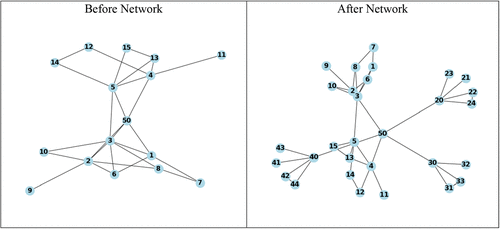
Notes. Across multiple publications, Burt uses these graphs to illustrate constraint’s intuition (Burt 1992, p. 9; 1997, p. 341; 1998, p. 9). Node 50 is Burt’s focal actor. Burt refers to the graph on the left as either before or James and to the graph on the right as after or Robert.
But this comparison is a conceptual trap, distracting from what constraint really means in either network and similar to the exception-based validation Burt (1992) relied on to validate constraint via maximum potential density. A change in node 50’s constraint does not tell us what constraint means across nodes in the same graph: It does not tell us what constraint means in the way that researchers conduct empirical studies. Constraint’s meaning across all nodes in a graph is what matters.
In the before graph of Figure 1, the dyadic terms (Equation (4)’s first three terms) contribute 132% of constraint’s total variance. The triadic terms (Equation (4)’s fourth and fifth terms) contribute 16%. The covariance of dyadic and triadic terms contributes −42% of constraint’s total variance. The other terms are marginal. In the after graph in Figure 1, which increases graph size from 16 to 30, the dyadic terms contribute 104% of constraint’s variance. The triadic terms constitute 32%, and the covariance of dyadic and triadic terms contributes −34%. In both networks, originally used to illustrate the intuition behind constraint, the dyadic terms account for more than 100% of constraint’s variance. The triadic terms’ contributions are completely canceled by negative covariance with the dyadic terms. In both graphs, constraint contains no triadic structural signal: constraint’s meaning is determined by its dyadic terms. Had researchers used either graph in an empirical study, constraint would have told them nothing beyond inverse degree. The theoretical novelty proposed in Table 1 is untestable.10
Simulating Networks
So is constraint’s meaning in Burt’s illustrative graphs indicative of an endemic issue throughout empirical research using constraint? Or are Burt’s illustrative networks isolated instances of the measure failing to capture structural properties? To test constraint’s general capacity to capture structural properties, we simulated 70,284 graphs with weighted ties and 13,796 unweighted graphs. Graph size (i.e., the number of nodes or actors in the entire network) was Unif(5, 400). For every simulated graph, we computed Burt’s constraint for every node and decomposed every node’s network constraint into constraint’s seven terms. For every graph, we then computed constraint’s total variance, every term’s variance, and pairwise covariances between terms. We then computed the percent of constraint’s variance attributable to each term, revealing the extent to which constraint’s meaning depends on each term in each graph.11
Consistent with research demonstrating that networks regularly exhibit small-world (Watts and Strogatz 1998) and scale-free properties (Barabási and Albert 1999), we simulated a broad universe of synthetic graphs characterized by well-understood density, clustering, and degree distribution properties. Each simulation represents what constraint would have measured in an empirically plausible graph. This contrasts with the validation-by-exception approach previously used to validate (Burt 1992) or critique (Everett and Borgatti 2020) constraint.
Decomposing constraint in these synthetic graphs tries to explore the universe of constraint’s potential meaning across the empirical literature. This provides general insight, disentangling constraint’s dependence on its individual terms, and can guide future reassessment of extant constraint-based research. We use a grid search–like strategy to explore whether constraint can reliably operationalize the concepts with which it is associated. To generate a universe of potential social networks, we simulate 84,080 synthetic small-world/scale-free social networks varying in size, structure, tie strength distribution, and tie symmetry.12 Because actual social networks are characterized by both the small-world property (Watts and Strogatz 1998) and skewed degree distributions (Barabási and Albert 1999), we generate synthetic graphs using the Holme and Kim (2002) and Herrera and Zufiria (2011) algorithms.13
Although most contemporary empirical research studies graphs larger than classroom sizes (Kleinbaum et al. 2015), we included small graph counterfactuals. Hence, our simulator chose network size ∼Unif(5, 400). For both network generators, we randomly initialized a linkAdd parameter, or the number of links to add per node, as max(1, (netSize − 1) × netDensity)). Strictly for use in the linkAdd parameter, both network generators have a netDensity parameter ∼Unif(0, 1).14 Each Holme-Kim network uses a probability of triad formation ∼Unif(0, 0.3). Each Herrera-Zufiria network uses a one-step probability ∼Unif(0, 1.0) and random walk length ∼Unif(1, 15).
To ensure that our simulations capture a wide range of potential tie strength configurations, we explore six different tie strength distributions. After graph generation, the simulation conducts a random walk for every node, logging the number of times that each edge is traversed. The simulation then uniformly randomly selects one of six graph-level tie strength assignment methods. The first method assigns a universal edge weight of one. The second method randomly assigns each edge tie strength ∼Unif(0, 1). The third tie strength method is identical to the second, except tie strengths are squared to right-skew the tie strength distribution. The fourth method first executes the third method, and then subtracts the results from 1.0 to left-skew the tie strength distribution. The fifth method sets tie strengths based on the network generation procedure’s random walk frequencies. This creates stronger ties within cliques, as random walks cycle within a clique. The final method follows the fifth method and then squares tie strengths, right-skewing the tie strength distribution.
Thus parameterized, the network generation routine yields a broad universe of potential networks, each with small-world and scale-free characteristics. Sampling from such a large universe of potential networks allows us to ask: “can constraint reliably operationalize the structural properties underlying the theories with which it is associated?” If the answer is “no” and constraint’s structural terms rarely contribute to its variance, then we need to reassign extant constraint-based research to alternative theoretical mechanisms.
For each simulated graph, the simulation calculates ego constraint and each of constraint’s properties from Equation (4). For each graph, the simulation computes the covariance matrix across constraint’s properties. Across the simulated graphs, the covariance matrices reveal what constraint likely measures.
Constraint’s Composition.
Across 2,809,467 nodes in 13,796 unweighted simulated networks and 14,191,194 nodes in 70,284 weighted simulated networks, Figures 2 and 3 present the share of constraint’s variance attributable to constraint’s terms by graph size. To make the graph more easily interpretable, we report a 10-observation moving average of each term’s contribution to constraint’s variance by graph size. The data point for inverse degree at graph size = 14, for example, is inverse degree’s average contribution to constraint’s total variance averaged by graph size and then smoothed across graphs of size [5, 14]. This illustrates our simulation’s findings regarding constraint’s likely underlying meaning in existing empirical work by weighted ties (Figure 2) and unweighted ties (Figure 3). To ease communication, we separately aggregate the triadic terms and the quadratic terms.15
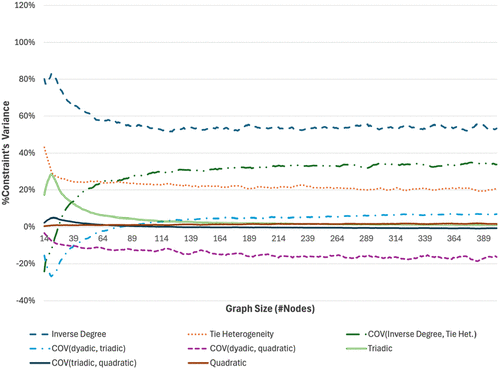
Notes. The figure reports the share of constraint’s variance (y axis) attributable to constraint’s terms and by graph size (the number of actors/nodes in the x axis). There are 14,191,194 nodes in 70,284 weighted simulated graphs. We report a 10-observation moving average of each term’s contribution. To ease communication, we separately aggregate the triadic terms and the quadratic terms.
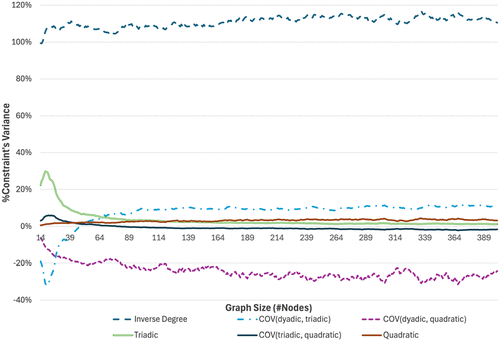
Notes. The figure reports the share of constraint’s variance (y axis) attributable to constraint’s terms and by graph size (the number of actors/nodes in the x axis). There are 2,809,467 nodes in 13,796 unweighted simulated graphs. We report a 10-observation moving average of each term’s contribution. To ease communication, we separately aggregate the triadic terms and the quadratic terms.
In both weighted and unweighted graphs, the dyadic terms (inverse degree and/or tie heterogeneity) dominate constraint’s variance. This is perhaps most visible in Figure 3’s unweighted graphs of size more than 100 nodes. Inverse degree averages about 110% of constraint’s variance. The covariance of inverse size and the triadic elements is approximately 11%. The covariance of inverse degree and the quadratic terms is approximately −26%. To the extent that structural properties are visible in constraint, they are visible via their covariance with the dyadic properties. Constraint was proposed as a measure of structure-mitigated size. In fact, constraint’s empirical meaning is size net a predictable size-driven penalty. Far from capturing brokerage, closure, bridging, redundancy, or any other structural construct, constraint’s meaning is driven by size.
The same pattern is visible in the weighted graphs in Figure 2. For graphs of more than about 70 nodes, constraint’s variance is primarily driven by inverse degree’s variance, its covariance with tie heterogeneity, and tie heterogeneity’s variance: the three pieces of the Herfindahl index. The covariance of the dyadic and triadic terms trivially contributes. Like unweighted graphs, the negative covariance between the dyadic and quadratic terms suppresses constraint’s variance. In our simulated weighted graphs, constraint’s meaning is a Herfindahl index predictably muted by that index’s covariance with quadratic structural properties. When all’s said and done, the structural properties associated with structural holes’ theoretical novelty are invisible.
Across weighted and unweighted networks, inverse degree and the quadratic terms are consistently negatively correlated, suggesting that the quadratic terms predictably grow in degree. Reflecting on Equation 5’s binary and unweighted representation, the quadratic term is a function of squared inverse degree and a summation. For the quadratic term to grow in degree, the summation must grow faster than squared inverse degree falls: The summation must be >O(|Ni| ̂ 2). This predictably occurs for three reasons. First, the number of terms in the summation is O(|Ni| ̂ 2). Second, the denominator in each summed term is a product of two values, both independent of |Ni| and thus constant in |Ni|. Third, the numerator in each term is the count of elements in the intersection of Ni, Nq, and Nk, which weakly grows in Ni. Thus, constraint’s quadratic terms trivially grow as degree increases. This is attributable to a combinatorial accumulation of potential shared structure as ego’s degree increases. Positive correlation between degree and quadratic structure is exacerbated, but not determined, by the simple fact that all nodes with degree less than three have no quadratic structure: Constraint’s quadratic terms are zero when degree is less than three.
In both weighted and unweighted graphs, constraint behaves differently in graphs with fewer than 70 nodes. In these smaller graphs, constraint’s triadic terms do contribute to constraint’s total variance. But this is canceled by the triadic terms’ negative covariance with the Herfindahl index. Thus, the triadic terms’ net effect on constraint is negligible. The authors wonder if this is a source of enduring misunderstanding about constraint. For an individual graph, such as Burt’s examples discussed above, triadic structure might look like it matters; however, it just negatively covaries with simpler dyadic measures.
Replicating Constraint
To illustrate and test the implications of our simulation, we replicate two previous studies. First, we replicate the study of Burt (2008) of structural holes and industry performance using quinquennial U.S. input-output tables. Second, we replicate a study of structural holes and market performance (Shipilov and Li 2008) using U.S. public securities offerings (Shipilov et al. 2011). The U.S. industry networks vary in density from 2.9% to 30.3% depending on filtering (Burt 2008). The public securities offerings networks are relatively sparse with average density of 3.2%.
Data and Methods
For the industry performance study, we use the U.S. Department of Commerce’s Bureau of Economic Analysis’s (BEA) quinquennial U.S. input-output tables aggregating commodity production and consumption by industry (http://www.bea.gov/industry). We follow the data processing of Burt (2008). For each of the 1987 and 1992 quinquennial data sets, we use the Use Table as in Burt (2008), excluding government expenditures and final demand, to generate industry-by-industry input-output tables. Each resulting table element (e.g., 1992ij) represents the annual dollar value of goods and services sold by organizations in industry i to those in industry j over the five-year period leading up to and including the reporting year (e.g., the 1992 table covers 1988–1992). See zij in Equation (2).
Consistent with the methodology of Burt (2008), our regression analyses include 632 manufacturing industry-year observations with nonnegative price-cost margins. We also replicate Burt’s use of STATA’s clustered error option at the industry level. Price-cost margin (PCM) is a standard industry performance measure (Collins and Preston 1968; Domowitz et al. 1986; Burt 1992, 2008; Piskorski and Casciaro 2006). For each industry-year, we calculate PCM as the ratio of net income to total sales (Collins and Preston 1968). For each industry, this is the industry’s net income divided by the industry’s business volume. Mean PCM is 16.92 (Burt reports 16.89) with a standard deviation of 9.39 (versus 9.46 reported by Burt).
From Equation (4), we isolate constraint’s seven properties. We operationalize Oj as the extent to which each industry is “coordinated so as to eliminate…secondary structural holes” (Burt 1992, p. 62) measured by the industry’s four-firm concentration ratio: the percent of total industry output produced by the industry’s four largest firms. Industry concentration measures the level of oligopoly (Bain 1959, p. 86) and is publicly available from the U.S. Census Bureau (http://www.census.gov/econ/concentration.html). “[H]igher concentration is presumed to indicate more coordination, less rivalry, so producers can price for higher profit margins” Burt (2008, p. 333). Consistent with prior research (Burt 1992, 2008), our analyses exclude industries for which the Census Bureau does not report concentration ratios. The natural logarithm of concentration has a mean of 4.00 (Burt reported 3.99) and standard deviation of 0.50 (Burt reported 0.50). To simplify interpretation, all variables are multiplied by 100.
For the public securities offerings study, we utilize data on public securities offerings on all U.S. stock exchanges between 1979 and 2001 (Shipilov et al. 2011). In this network, the actors are investments banks, and the ties are underwriting syndicate comemberships among lead and colead banks (Shipilov et al. 2011). Annual graph size ranges from 85 investment banks in 1979 to 394 banks in 1997, yielding 5,540 investment bank-year observations.16 Using annual comembership matrices, we compute constraint and its components according to Equation (4). The performance metric is each bank’s annual market share in public securities offerings (Shipilov 2009), defined as the focal bank’s total public offering volume as lead, colead, and solo underwriter divided by total annual public offering volume (adapted from Jensen (2003)).17
Results
Table 3 presents descriptive statistics and correlation coefficients for both the industry network of Burt’s (2008) industry network and Shipilov et al. (2011) public securities offerings network. The correlations support the simulation results depicted in Figures 1 and 2: Constraint is almost perfectly correlated with the Herfindahl index (0.940 for industry and 0.992 for public securities offerings).
|
Table 3. Descriptive Statistics and Correlations
| Industry network | Mean | Standard deviation | 1 | 2 | 3 | 4 | 5 | 6 | 7 | 8 | 9 | 10 | |
|---|---|---|---|---|---|---|---|---|---|---|---|---|---|
| 1 | Performance | 16.92 | 9.398 | ||||||||||
| 2 | Constraint (ln) | 2.435 | 0.519 | −0.091 | |||||||||
| 3 | Weighted Herfindahl index (ln) | 2.056 | 0.641 | −0.085 | 0.940 | ||||||||
| 4 | Balanced Triadic Closure | 2.487 | 1.775 | −0.099 | 0.385 | 0.128 | |||||||
| 5 | Indirect Triadic Closure | 0.521 | 1.023 | −0.092 | 0.429 | 0.257 | 0.534 | ||||||
| 6 | Shadow Ego Closure | 0.326 | 0.313 | −0.003 | −0.102 | −0.327 | 0.366 | 0.226 | |||||
| 7 | Weighted Quadriad Closure | 0.137 | 0.200 | −0.031 | 0.101 | −0.094 | 0.432 | 0.245 | 0.440 | ||||
| 8 | Concentration | 4.004 | 0.498 | −0.264 | −0.087 | −0.106 | 0.030 | −0.007 | 0.053 | 0.005 | |||
| 9 | Inverse Degree | 4.839 | 2.629 | −0.066 | 0.721 | 0.750 | 0.071 | 0.185 | −0.256 | −0.099 | −0.061 | ||
| 10 | Tie Heterogeneity | 5.000 | 4.817 | −0.021 | 0.744 | 0.796 | 0.008 | 0.223 | −0.333 | −0.125 | −0.003 | 0.650 | |
| 11 | Cov(TS&C) | −0.127 | 3.913 | −0.099 | 0.227 | 0.212 | 0.120 | 0.051 | 0.079 | 0.030 | −0.171 | −0.064 | −0.260 |
| Public securities offerings network | Mean | Standard deviation | 1 | 2 | 3 | 4 | 5 | 6 | 7 | 8 | 9 | |
|---|---|---|---|---|---|---|---|---|---|---|---|---|
| 1 | Market Share | 0.407 | 1.556 | |||||||||
| 2 | Constraint | 57.236 | 35.965 | −0.282 | ||||||||
| 3 | Herfindahl index | 53.236 | 38.595 | −0.293 | 0.992 | |||||||
| 4 | Balanced Triadic Closure | 2.892 | 4.461 | 0.172 | −0.404 | −0.518 | ||||||
| 5 | Indirect Triadic Closure | 0.205 | 0.785 | 0.022 | −0.050 | −0.164 | 0.814 | |||||
| 6 | Shadow Ego Closure | 0.147 | 0.424 | 0.286 | −0.368 | −0.397 | 0.293 | 0.151 | ||||
| 7 | Weighted Quadriad Closure | 0.286 | 0.549 | 0.432 | −0.560 | −0.594 | 0.444 | 0.071 | 0.420 | |||
| 8 | Inverse Degree | 52.486 | 39.508 | −0.295 | 0.989 | 0.998 | −0.520 | −0.165 | −0.394 | −0.596 | ||
| 9 | Tie Heterogeneity | 1.217 | 2.788 | 0.136 | −0.285 | −0.295 | 0.204 | 0.070 | 0.083 | 0.240 | −0.359 | |
| 10 | Constraint net of Herfindahl | 0.353 | 0.055 | 0.207 | −0.418 | −0.523 | 0.992 | 0.820 | 0.378 | 0.501 | −0.534 | 0.205 |
Source. Industry network from the U.S. Input Output Tables, n = 632.
Notes. Public security offerings network in the United States, n = 5,540. Correlation matrices including year dummies are available upon request. Consistent with Burt (2008), variables are multiplied by 100.
The means and standard deviations reported in Table 3 further corroborate the simulation’s finding that the Herfindahl index arithmetically dominates aggregate constraint. In the industry network data, the mean of the weighted Herfindahl index is 2.056 with a standard deviation of 0.641 compared with a mean of 2.435 and with standard deviation of 0.519 for constraint. Constraint’s largest terms are tie heterogeneity, inverse degree, and concentration. In contrast, the fourth largest term—balanced triad closure—has a substantially lower mean of 2.487 and a standard deviation of just 1.775. In the public securities offerings network, the Herfindahl index has a mean of 53.236 and a standard deviation of 38.595, nearly identical to those of constraint (57.236 and 35.965, respectively). Again, inverse degree dominates constraint (mean 52.486). The second largest term—balanced weighted triad closure—has a much smaller mean value of 2.892, amounting to only 5.3% of the Herfindahl index. Notably, in the public securities offerings network, both triadic properties—balanced triadic closure and indirect triadic closure—are negatively correlated with constraint, indicating that constraint grows in brokerage opportunities in this data set! Overall, the Herfindahl index is extremely highly correlated with constraint, swamping any potential signal from constraint’s other properties. Inverse degree dominates constraint in both networks (correlations are 0.721 and 0.989). In the industry network, tie heterogeneity plays a similarly dominating role (correlation is 0.744).
If constraint can operationalize one of several dyadic constructs, what theory did Burt’s (1988, 1992, 2008) multiple studies of U.S. input-output data actually test? We first verify the viability of the replication study. Table 4’s Model 2 regresses industry performance on industry concentration, year dummies, and constraint. The results confirm the consistent findings of Burt (1992, 2008) that constraint is negatively correlated with industry performance. Moreover, the results in Model 2 closely replicate those reported by Burt (2008), which are presented in Table 4’s Model 1.
|
Table 4. Replicating Performance Determinants: Industry Performance
| Variable | Model 1 | Model 2 | Model 3 | Model 4 | Model 5 | Model 6 | Model 7 | Model 8 |
|---|---|---|---|---|---|---|---|---|
| Concentration | −5.60** (1.45) | −5.242** (1.442) | −5.661** (1.460) | −5.276** (1.438) | −5.661** (1.460) | −5.680** (1.457) | −5.230** (1.444) | 5.585** (1.492) |
| Year (1987 = 1) | 2.33** (0.40) | 2.183** (0.391) | 2.322** (0.398) | 2.208** (0.397) | 2.322** (0.398) | 2.314** (0.411) | 2.289** (0.388) | 2.806** (0.569) |
| Constraint | −2.03** (0.56) | −1.943* (0.869) | −0.741 (2.196) | −1.152 (0.722) | ||||
| Weighted Herfindahl index | −1.602* (0.704) | −1.038 (1.770) | ||||||
| Inverse Degree | −1.265 (1.195) | −0.282* (0.168) | 0.819 (1.701) | |||||
| Tie Heterogeneity | −0.283 (0.586) | 0.045 (0.114) | 0.054 (0.123) | |||||
| Cov(TS&C) | −39.531** (10.895) | −0.360** (0.109) | −0.356* (0.139) | |||||
| Balanced Triadic Closure | −0.196 (0.281) | −14.903** (0.558) | ||||||
| Indirect Triadic Closure | −0.582 (0.571) | −1.560 (0.963) | ||||||
| Shadow Ego Closure | 1.377 (1.385) | −14.489** (3.870) | ||||||
| Weighted Quadriad Closure | −0.430 (2.982) | 10.316** (3.500) | ||||||
| Constant | 40.29 (NA) | 41.556** (6.012) | 32.900** (6.539) | 36.109 (11.563) | 33.438** (7.062) | 40.008** (6.168) | 38.868** (6.006) | 36.570 (6.717) |
| Observations | 632 | 632 | 632 | 632 | 632 | 632 | 632 | 632 |
| R2 | 0.12 | 0.097 | 0.097 | 0.097 | 0.115 | 0.123 | 0.091 | 0.149 |
| Adjusted R2 | NA | 0.092 | 0.093 | 0.091 | 0.108 | 0.110 | 0.086 | 0.137 |
| df | 3 | 3 | 3 | 4 | 5 | 9 | 3 | 9 |
| F | NA | 19.79 | 20.04 | 15.00 | 14.52 | 9.09 | 18.24 | 9.91 |
| p | NA | p < 0.001 | p < 0.001 | p < 0.001 | p < 0.001 | p < 0.001 | p < 0.001 | p < 0.001 |
Notes. Regressions with industry-level cluster robust standard errors (in parentheses). n = 632. Model 1 is from Burt (2008). Burt reports coefficients to two digits and does not report summary statistics other than R2. Models 1–6 use the 2% threshold of business transaction volume criterion. Models 7 and 8 use the entire industry-to-industry network of transactions. The density of the networks analyzed in Models 1–6 is 2.9% and in Models 7 and 8 is 30.3%.
*p < 0.05; **p < 0.01; ***p < 0.001.
However, Table 3’s summary statistics suggest that the weighted Herfindahl index, particularly its inverse degree and tie heterogeneity components, constitutes most of constraint’s variance. In fact, 81% of constraint’s variance is attributable to the Herfindahl index, whereas only 10% is attributable to constraint’s triadic and quadriad structural terms. This suggests that constraint’s meaning is largely driven by its dyadic properties.
To identify the sources of the constraint index’s relationship with performance, Model 3 isolates the weighted Herfindahl index’s effect on industry performance, finding a significant negative relationship between the weighted Herfindahl index and industry performance. Model 4 adds Burt’s constraint index, revealing that the effects from the weighted Herfindahl index and Burt’s constraint index are almost identical. Because constraint is the sum of a Herfindahl index (Equation (4)’s first three terms) and nondyadic structural terms (Equation (4)’s last four terms), we subtract the Herfindahl index from constraint to isolate constraint’s nondyadic, structural component. In an exploratory regression containing those two variables, we find that the Herfindahl index is negative and significant (β = −1.561, standard error (s.e.) = 0.715) corroborating Model 3, whereas constraint net of the Herfindahl index is negative but insignificant (β = −0.279, s.e. = 0.565). Hence, only the Herfindahl index matters. The sum of the nondyadic structural terms is inconsequential for performance.
Models 5 and 6 explore which of Equation (4)’s seven terms are responsible for constraint’s effect on performance (Model 2). Starting with the properties of the Herfindahl index, Model 5 reveals that performance outcomes are primarily driven by the covariance between the concentration ratios of buyer and supplier industries and the dependence of focal industries on those trading partners. The average magnitudes of the inverse degree and Cov(TS&C) coefficients are similar (−6.121 versus −5.020), whereas the influence of tie heterogeneity is moderate (1.415). Table 4’s Model 6 re-estimates the baseline specification from Model 2, replacing constraint with its seven constituent components. This reveals that only inverse degree and Cov(TS&C) are statistically significant predictors of industry performance. Industries perform poorly when they intensely interact with highly coordinated industries, a decades-old insight from industrial economics (Adelman 1951, Porter 1980). Also, industries perform poorly when they interact with few other industries, an equally old insight from structural sociology (Pfeffer and Salancik 1978). Performance is driven by constraint’s dyadic terms, and we cannot conclude anything about Burt’s novel redundancy-driven arguments.
Models 7 and 8 extend the analysis by incorporating all edges in the Use Table (i.e., not applying the filtering of Burt (2008)). Using all data results in a much denser network: ∼30% density. If Burt (2008) had included all transactions in the network, the results (Model 7) would have shown no significant relationship between structural holes and industry performance! Model 8 presents constraint’s terms using the complete Use Table data and again highlights the critical role of Cov(TS&C) and inverse degree. Surprisingly, Burt’s original study uncovers no triadic or quadriad effects (Model 6). However, had Burt included all transactions, the results would have uncovered triadic and inconsistent quadriad effects. Models 6 and 8 indicate that triadic and quadradic structural effects can be sensitive to network definition and that structural terms can contradict one another in a single model.
In Table 5, Models 1–5 report the structural determinants of investment banks’ public securities offerings market share, including year dummies. We employ regression with bank-level cluster robust standard errors.18Table 5’s Model 1 corroborates prior studies’ negative and significant relationship between constraint and performance. Reverse-coding constraint, Shipilov and Li (2008) report direct positive effects on both status accumulation and market performance, and Shipilov et al. (2023) report direct positive effects on bank performance. However, those models mask constraint’s dependence on its dyadic terms. Consistent with our illustrative network decompositions, the simulations, and Burt’s industry data, constraint’s dyadic terms again dominate its variance structure. The Herfindahl index constitutes 115% of constraint’s total variance, whereas the Herfindahl’s covariance with the nondyadic terms constitutes −17%. The nondyadic terms alone constitute only about 2% of constraint’s total variance. In the public securities offerings data, structure is again invisible in constraint.
|
Table 5. Replicating Performance Determinants: Investment Bank Market Share
| Variable | Model 1 | Model 2 | Model 3 | Model 4 | Model 5 | Model 6 |
|---|---|---|---|---|---|---|
| Constraint | −0.013*** (0.002) | 0.025*** (0.007) | ||||
| Herfindahl index | −0.012*** (0.000) | −0.035*** (0.008) | −0.010*** (0.001) | |||
| Constraint net of Herfindahl | 2.491** (0.739) | |||||
| Inverse Degree | −0.012*** (0.002) | −0.002** (0.001) | ||||
| Tie Heterogeneity | 0.014 (0.008) | 0.012 (0.007) | ||||
| Balanced Triadic Closure | −0.035** (0.010) | |||||
| Indirect Triadic Closure | 0.114** (0.039) | |||||
| Shadow Ego Closure | 0.412* (0.170) | |||||
| Weighted Quadriad Closure | 1.172*** (0.202) | |||||
| Observations | 5,540 | 5,540 | 5,540 | 5,540 | 5,540 | 5,540 |
| Year dummies | Included | Included | Included | Included | Included | Included |
| R2 | 0.098 | 0.105 | 0.110 | 0.110 | 0.107 | 0.231 |
| Adjusted R2 | 0.094 | 0.101 | 0.106 | 0.106 | 0.103 | 0.228 |
| df | 23 | 23 | 24 | 24 | 24 | 28 |
| F | 4.69 | 4.77 | 4.61 | 4.61 | 4.59 | 5.82 |
| p | p < 0.001 | p < 0.001 | p < 0.001 | p < 0.001 | p < 0.001 | p < 0.001 |
Notes. Regressions with bank-level cluster robust standard errors (in parentheses). n = 5,540. All models include year dummies. Network density is 3.2%. Findings are consistent using firm fixed effects and the natural log transformation of both constraint and the Herfindahl index.
*p < 0.05; **p < 0.01; ***p < 0.001.
Model 2 highlights the effects of constraint’s aggregation of different terms, presenting almost identical results using only the Herfindahl index. Model 3 uses both constraint and the Herfindahl index in the same model. After controlling for the Herfindahl index, constraint is positively related to performance! To address Model 3’s multicollinearity (Kalnins 2018), we isolate the common factor by subtracting the Herfindahl index, the first three elements of Equation (4), from constraint. Table 5’s Model 4 supports the conclusion from Model 3: Constraint net of the Herfindahl index (i.e., the sum of constraint’s nondyadic effects) positively, not negatively, affects performance. This is consistent with the simulation’s finding that constraint’s dyadic terms consistently explain more than 100% of its variance, thus hiding the structural terms’ true effects within constraint’s summation.
As in Burt’s industry performance study, aggregate constraint’s combination of dissimilar mechanisms suppresses some of constraint’s embedded components’ explanatory power. Model 5 reports constraint’s largest terms, revealing that Model 1’s constraint effect is a consequence of its embedded inverse degree property. Model 6 implements fully decomposed constraint from Equation (4). Isolating constraint’s triadic and quadratic properties substantially increases adjusted R2 from 0.094 in Model 1 to 0.228 in Model 5. If the nondyadic terms are just noisy transformations of network size, then Model 5 is a better fit model of a dyadic theory. If the nondyadic terms are something other than noisy transformations of network size, rather than facilitating structural insight, constraint obscured structural insight by conflating dyadic, triadic, and quadratic measures. In either case, constraint is misleading.
Comparing the three fully decomposed models (Table 4’s Models 6 and 8 and Table 5’s Model 5) reveals inconsistent behavior of the triadic and quadratic terms. Other than balanced triadic closure, all nondyadic terms’ coefficients’ significance levels and signs are unstable. Constraint’s interpretation is unstable across empirical applications.
In summary, replicating Burt (2008) shows that, had Burt isolated constraint’s properties, Burt would have concluded that Cov(TS&C) improved performance. Furthermore, had Burt not filtered the industry network and decomposed constraint as we outline in Equation (4), Burt could have discovered the theory’s triadic effects. The results for the public securities offerings network rely on inverse degree: one divided by degree centrality. Both replications corroborate the simulation’s implication that constraint-based research studies dyadic mechanisms commonly associated with I/O economics (Bain 1951), resource dependence theory (Pfeffer and Salancik 1978, Casciaro and Piskorski 2005), and strategic management (Porter 1980), but not triadic properties. Despite its widespread use and common interpretation, triadic structural properties seem invisible in constraint, rendering it invalid as a structural holes operationalization.
Discussion
By decomposing constraint, assessing patterns of constraint’s meaning across exemplar networks and empirically plausible simulated networks, and empirically testing decomposed constraint, we conclude that extant constraint-based research generally tests dyadic properties rather than the triadic properties required for structural holes’ theoretical novelty. Burt’s theoretically novel propositions, summarized in Table 1, are untestable with constraint. Constraint-based empirical research has instead only tested those parts of structural holes theory that overlap with simpler dyadic theories.
This insight helps reinterpret prior findings. Out of the amalgam of options including performance differences among individuals (Xiao and Tsui 2007), firms (Zaheer and Bell 2005), and industries (Burt 1992), we merely touch on a number of literature streams including structural holes’ contingency literature (Seibert et al. 2001, Xiao and Tsui 2007), secondhand brokerage (Burt 2007), and psychological antecedents of networking behavior (Mehra et al. 2001, Sasovova et al. 2010, Fang et al. 2015, Kleinbaum et al. 2015).
Because constraint is a dyadic rather than triadic measure, the burgeoning contingency literature explores dyadic contingencies and not structural holes contingencies. The relationship between network constraint and remuneration possibly exemplifies such a case and illustrates the implications when we reconceive constraint-based results as dyadic rather than triadic. At the individual level, extant research proposes a negative relationship (Burt 1997, Burt et al. 2000), a positive relationship (Xiao and Tsui 2007), or no relationship (Seibert et al. 2001) between network constraint and remuneration. Xiao and Tsui (2007) argue that the conflicting findings point to culturally dependent structural holes benefits: Brokers thrive in individualistic communities, whereas integrators thrive in collectivist communities. Recognizing constraint as an operationalization of dyadic constructs, reinterpretation would suggest that individualistic communities reward actors with many weak ties, whereas collectivist communities reward actors with a few strong ties. This still supports the conclusion that remuneration is culturally contingent, but culture operates through actors’ distributions of dyadic relationships and not through their position vis-à-vis structural holes. We know that “collectivists tend to have few but intimate relationships, and individualists have many relationships of low intimacy” (Triandis 1995, p. 110). Because deviating from social norms comes at a cost (Coleman 1990), individuals perform well in individualistic societies, whereas collectivists perform well in collectivist societies. The apparent paradox and consequent need for triadic contingency theories disappears once we realize that constraint does not measure structural holes.
Because “[S]econdhand brokerage—moving information between people to whom one is only connected indirectly—often has little or no value,” Burt (2007, p. 119) calls for egocentric research focusing on direct contacts. But our constraint decomposition suggests an alternate interpretation of Burt’s secondhand brokerage results. Burt operationalizes ego’s secondhand brokerage as the arithmetic average of the alters’ network constraints (Burt 2007, p. 126). Recognizing that constraint is a noisy Herfindahl index, Burt’s secondhand brokerage measure is an average of size and tie diversity across ego’s alters. Although this is one step removed from ego, and hence “secondhand,” the measure is as far from secondhand brokerage as constraint is from ego’s brokerage. If ego’s alters’ networks are large, dense cliques, the Herfindahl index’s dominance of aggregate constraint will incorrectly suggest large secondhand brokerage opportunities.
Our findings have important implications for the emerging integration between psychological and network perspectives of self-monitoring (Mehra et al. 2001, Sasovova et al. 2010, Burt 2012, Fang et al. 2015, Kleinbaum et al. 2015). Self-monitoring theory suggests that high self-monitors prefer to live in highly partitioned, differential, segmented social worlds, whereas low self-monitors prefer to interact with the same partner for multiple activities (Snyder et al. 1983, p. 1062). In the context of MBA students, Kleinbaum et al. (2015) support earlier findings (Mehra et al. 2001, Sasovova et al. 2010) showing that self-monitoring negatively and significantly impacts network constraint. Reinterpreting those findings recognizing that network constraint in unweighted networks is really inverse degree, that finding becomes tautological: People who prefer to interact with few alters…have few alters. There are no triadic implications.
Similarly, assertions that structural holes may yield firm benefits indirectly by enhancing the value of internal capabilities (Zaheer and Bell 2005), that structural holes amplify the effects of firm status on collaboration performance (Arya and Lin 2007), or that current structural holes rather than past structural holes impact project performance (Soda et al. 2004) should all be reinterpreted as inverse degree and/or tie heterogeneity findings.
Beyond demonstrating the need for reinterpretation, our simulation and replication results offer preliminary guidance for reinterpreting existing constraint-based research. Although constraint is generally Equation (3)’s Herfindahl index, the Herfindahl also risks muddying different dyadic theories. Implementing Equation (4)’s terms in our replications, we see that different Herfindahl properties are relevant in different settings. In the public securities offerings network, the Herfindahl’s inverse degree term is the significant predictor. But in Burt’s industry network, the Herfindahl’s covariance term is crucial.
Isolating constraint’s distinct structural properties demonstrates that extant structural holes research studies dyadic constructs, helps reconcile perceived empirical inconsistencies, challenges the basis of the structural holes contingency perspective, and suggests that recent structural holes extensions may be symptoms of constraint’s incongruity with structural holes’ verbal theory.
The Way Forward: Reinterpretation and Future Network Research
We propose reinterpreting existing knowledge claims tying apparent triadic network structure and performance. First, decades of structural holes literature will benefit from reinterpretation, likely discovering that previous findings supported dyadic rather than triadic mechanisms. To facilitate reinterpretation, we provide a decomposition web app.19 This web app ingests an edgelist and returns: node-level constraint; constraint’s seven node-level terms; and constraint’s covariance matrix. With constraint thus decomposed, researchers can examine regression coefficients, their magnitude and significance, and constraint’s variance structure.
Focused on constraint, our work is an instance of a broader discussion of the extent to which graphs’ structures relate to basic dyadic properties (Holland and Lelnhardt 1979, Faust 2007, Chatterjee et al. 2011, Mohamadichamgavi et al. 2024). In that vein, this paper shows that constraint-based findings previously attributed to triadic constructs are likely attributable to simple dyadic constructs. This is consistent with other research exploring relationships between dyadic measures and measures perceived to be structural. Eigenvector centrality, for example, has long been understood as measuring global centrality measure while degree measures local centrality (Borgatti 2005, Hanneman and Riddle 2005, Noori 2011). However, network physics research shows that there is no regime in which eigenvector centrality both succeeds as a network measure and is distinct from degree (Chung et al. 2003; Martin et al. 2014; Pastor-Satorras and Castellano 2016, 2020), explaining why eigenvector centrality and degree correlate at ∼0.92 (Bonacich et al. 1998, He and Meghanathan 2016, Mohamadichamgavi et al. 2024).
Partly from their dependence on degree, constraint and eigenvector centrality cannot reliably operationalize the structural nuance they are understood to capture. Other structural measures are similarly strongly related to degree and may be similarly vulnerable (Faust 1997, Masterton and Olsson 2018). To mitigate empirical research’s risk of attributing dyadic constructs to broader structure, we recommend that empirical research explicitly control for dyadic properties such as size (degree centrality), its inverse, and the tie strength variance (for weighted or asymmetric networks) in regressions. If structural measures add explanatory power, then empirical work has likely identified structural explanations beyond mere dyadic ones.
Our analytical work reveals that constraint (Burt 1992, p. 62; 1998, p. 42) conflates dyadic, triadic, and quadradic network properties. Our simulations and replications show that constraint’s variance, and thus its empirical meaning, is dominated by its dyadic terms. Thus, constraint cannot reliably operationalize structural holes, the construct with which the measure is associated. Most constraint-based research has likely studied dyadic constructs, not structural holes. Our findings illuminate extensive opportunities for reinterpreting constraint-based findings using dyadic theories. Finally, we encourage future triadic research to carefully address dyadic measures before making structural claims.
The authors thank participants at seminars and conferences hosted by Aarhus University, AOM, ASA, BI Norwegian Business School, DRUID, the Naval Postgraduate School, SCANCOR, SMS, and Sunbelt for valuable feedback on earlier versions of this paper; Mark Granovetter, Øystein Fjeldstad, and Exequiel Hernandez for insightful comments and suggestions; Stan Xiao Li and Andrew V. Shipilov for generously sharing the public securities data used in our analysis; Professor Daniel Elfenbein, Strategy Science senior editor; and Professor Phebo Wibbens and two anonymous reviewers for constructive guidance that significantly improved this paper.
1 We appreciate that the network terminology used by the community of scholars may not be widely accessible to a wider audience. For this purpose, we concisely define the terms used (ego, alter, dyad, triad, quadraid, node, edge, network size, and graph) in Online Appendix 1.
2 Although Burt (1992) explicitly advocates network constraint as the preferred structural holes operationalization, some research does use alternate measures, many of which were also introduced by Burt (1992). See Online Appendix 2 for discussions of additional structural holes measures and their inability to operationalize structural holes.
3 As of June 2025, Burt (1992) has received 37,857 citations on Google scholar. Burt’s 10 most cited structural holes studies have received 74,771 such citations.
4 Although most constraint applications implicitly set all Oj values to one, we retain the term to ensure that our formal decomposition can be reconciled with multilevel applications employing the technique.
5 When applying Equation (2) to Equation (1), the pqj denominator is calculated in two different ways: based on the whole network or based just on i’s ego network. Our equations, simulations, and empirical replications all use the “whole network” method. Online Appendix 3 shows that Burt originally used the whole network method, argues that it is the only method consistent with structural holes theory, and shows how the ego network method exacerbates constraint’s measurement shortcomings.
6 Even in survey studies (Burt et al. 2000, Gargiulo and Benassi 2000, Kalish and Robins 2006), one is sampling from the degree distribution. The underlying degree distribution is still determining the maximum density effect.
7 Because the terms “size,” “density,” and “hierarchy” are used differently elsewhere, Burt alternatively also called these “C-size,” “C-density,” and “C-hierarchy.”
8 Leveraging the decomposition of Burt (1997), Everett and Borgatti (2020) offer an alternative specification specific to undirected binary graphs. Their formulation does not isolate constraint’s different dyadic terms, nor does it decompose Burt’s “hierarchy” into its triadic and quadratic terms. Their formulation also does not preserve Burt’s original inclusion of the concentration ratio, O. When a graph includes self-loops, Equation (4) must be slightly altered. (1/N ̂ 2) in the first term becomes ((1-pii)/N ̂ 2), where pii is ego’s proportional interaction with himself. This is relevant, for example, in the industry network data of Burt (2008).
9 This term precisely operationalizes the concept of Everett and Borgatti (2020) of the shadow ego network. Their decomposition does not decouple this term from indirect triadic closure and weighted quadriad closure, as the sum of all three constitutes their term 3.
10 In our simulations, provided below, of unweighted graphs of size 16 (the before graph’s size), dyadic, triadic, and covariance(dyadic, triadic) terms constituted an average of 101%, 26%, and −23% of constraint’s variance, respectively. For graphs of size 30 (the after graph’s size), our simulations found average contributions of 106%, 16%, and −10%, respectively. These results are similar to Burt’s networks and emphasize that constraint’s meaning is driven by its dyadic terms. Node 50’s constraint change from before to after, visually persuasive and conceptually interesting as it may be, is not what constraint measures across either graph.
11 Simulation code is available as .py scripts at https://github.com/jchandlerj/constraintSims.
12 The number of simulation graphs was time constrained and affected by software update interruptions. The simulations ran for several weeks and were interrupted on several occasions by software updates.
13 We also simulated 116,507 purely random (Erdôs and Rényi 1960), small world (Watts and Strogatz 1998), and scale-free (Barabási and Albert 1999) networks. Across network generators, constraint consistently failed to operationalize structure. We implemented the Herrera/Zufiria algorithm in Python. Other networks were generated using the erdos_renyi_graph, barabasi_albert_graph, connected_watts_strogatz_graph, and powerlaw_cluster_graph functions in Python’s NetworkX module (Hagberg et al. 2008).
14 Because both network generators ensure skewed degree distributions and small world-ness, high network densities are not observed. Synthetic Holme-Kim networks exhibited maximum density of ∼0.51, whereas Herrera-Zufiria networks exhibited maximum density ∼0.4. Creating a uniformly distributed netDensity parameter forces a uniformly distributed linkAdd parameter, which satisfies the gridsearch objective of broadly searching across a universe of potential graphs.
15 Figures with the individual triadic and quadratic terms isolated are available upon request. The findings are consistent.
16 The public securities offerings data was graciously shared by Shipilov and Li to study decomposed constraint’s relationship with performance measures. We do not have their control variables, nor do we have their observation selection criteria. Hence, our findings are directionally consistent with their work, but coefficient values differ.
17 Using alternative performance measures such as the natural log of deal revenue (Shipilov et al. 2023) or status accumulation (Shipilov and Li 2008) yield results consistent with those in Table 5.
18 Firm fixed effects models produce similar results.
19 See bam.bi.no/decomposeConstraint.
References
- (1999) The myth of the unique decomposability: Specializing the Herfindahl and entropy measures? Strategic Management J. 20(10):969–975.Crossref, Google Scholar
- (1951) The measurement of industrial concentration. Rev. Econom. Statist. 33(4):269–296.Crossref, Google Scholar
- (2000) Collaboration networks, structural holes and innovation: A longitudinal study. Admin. Sci. Quart. 45(3):425–455.Crossref, Google Scholar
- (2011) The diversity-bandwidth trade-off. Amer. J. Sociol. 117(1):90–171.Crossref, Google Scholar
- (2007) Understanding collaboration outcomes from an extended resource-based view perspective: The roles of organizational characteristics, partner attributes, and network structures. J. Management 33(5):697–723.Crossref, Google Scholar
- (1951) Relation of profit rate to industry concentration: American manufacturing, 1936-1940. Quart. J. Econom. 65(3):293–324.Crossref, Google Scholar
- (1959) Industrial Organization (John Wiley & Sons, New York).Google Scholar
- (1999) Emergence of scaling in random networks. Science (1979) 286(5439):509–512.Google Scholar
- (2000) Don’t go it alone: Alliance network composition and startups’ performance in Canadian biotechnology. Strategic Management J. 21(3):267–294.Crossref, Google Scholar
- (1998) Controlling for size in centrality scores. Soc. Networks 20(2):135–141.Crossref, Google Scholar
- (2005) Centrality and network flow. Soc. Networks 27(1):55–71.Crossref, Google Scholar
- (1990) Corporate linkages and organizational environment: A test of the resource dependence model. Strategic Management J. 11(6):419–430.Crossref, Google Scholar
- (1982) Toward a Structural Theory of Action: Network Models of Social Structure, Perception, and Action (Academic Press, New York).Crossref, Google Scholar
- (1983) Corporate Profits and Cooptation: Networks of Market Constraints and Directorate Ties in the American Economy (Academic Press, New York).Google Scholar
- (1988) The stability of American markets. Amer. J. Sociol. 94(2):356–395.Crossref, Google Scholar
- (1992) Structural Holes (Harvard University Press, Cambridge, MA).Crossref, Google Scholar
- (1997) The contingent value of social capital. Admin. Sci. Quart. 42(2):339–365.Crossref, Google Scholar
- (1998) The gender of social capital. Rational Soc. 10(1):5–46.Crossref, Google Scholar
- (2000)
The network structure of social capital . Staw BM, Sutton RI, eds. Research in Organizational Behavior, vol. 22 (JAI Press, Greenwich, CT), 345–423.Crossref, Google Scholar - (2004) Structural holes and good ideas. Amer. J. Sociol. 110(2):349–399.Crossref, Google Scholar
- (2005) Brokerage and Closure (Oxford University Press, Oxford, NY).Crossref, Google Scholar
- (2007) Secondhand brokerage: Evidence of the importance of local structure for managers, bankers, and analysts. Acad. Management J. 50(1):119–148.Crossref, Google Scholar
- (2008)
Industry performance and indirect access to structural holes . Baum JAC, Rowley TJ, eds. Advances in Strategic Management, vol. 25 (JAI Press, Hartford, CT), 315–360.Google Scholar - (2012) Network-related personality and the agency question: Multirole evidence from a virtual world. Amer. J. Sociol. 118(3):543–591.Crossref, Google Scholar
- (2000) The social capital of French and American managers. Organ. Sci. 11(2):123–147.Link, Google Scholar
- (2005) Power imbalance, mutual dependence, and constraint absorption: A closer look at resource dependence theory. Admin. Sci. Quart. 50(2):167–199.Crossref, Google Scholar
- (2011) Random graphs with a given degree sequence. Ann. Appl. Probability 21(4):1400–1435.Crossref, Google Scholar
- (2003) Eigenvalues of random power law graphs. Ann. Combinatorial 7(1):21–33.Crossref, Google Scholar
- (1990) Foundations of Social Theory (Harvard University Press, Cambridge, MA).Google Scholar
- (1968) Concentration and Price-Cost Margins in Manufacturing Industries (University of California Press, Berkeley).Crossref, Google Scholar
- (1984) Financial intermediation and delegated monitoring. Rev. Econom. Stud. 51(3):93–414.Crossref, Google Scholar
- (1986) Business cycles and the relationship between concentration and price-cost margins. RAND J. Econom. 17(1):1–17.Crossref, Google Scholar
- (2011) The fallacy of formative measurement. Organ. Res. Methods 14(2):370–388.Crossref, Google Scholar
- (1962) Power dependence relations. Amer. Sociol. Rev. 27(1):31–40.Crossref, Google Scholar
- (1960) On the evolution of random graphs. Math. Inst. Hungarian Acad. Sci. 5(1–2):17–61.Google Scholar
- (2020) Unpacking Burt’s constraint measure. Soc. Networks 62:50–57.Crossref, Google Scholar
- (2015) Integrating personality and social networks: A meta-analysis of personality, network position, and work outcomes in organizations. Organ. Sci. 26(4):1243–1260.Link, Google Scholar
- (1997) Centrality in affiliation networks. Soc. Networks 19(2):157–191.Crossref, Google Scholar
- (2007) Very local structure in social networks. Sociol. Methodology 37(1):209–256.Crossref, Google Scholar
- (1978) Centrality in social networks conceptual clarification. Soc. Networks 1(3):215–239.Crossref, Google Scholar
- (2000) Trapped in your own net? Network cohesion, structural holes, and the adaptation of social capital. Organ. Sci. 11(2):183–196.Link, Google Scholar
- (2016) Fitting in or standing out? The tradeoffs of structural and cultural embeddedness. Amer. Sociol. Rev. 81(6):1190–1222.Crossref, Google Scholar
- (1995) Does familiarity breed trust? The implications of repeated ties for contractual choice in alliances. Acad. Management J. 38(1):85–112.Crossref, Google Scholar
- (1998) Alliances and networks. Strategic Management J. 19(4):293–317.Crossref, Google Scholar
- (2000) Strategic networks. Strategic Management J. 21(Special Issue):203–215.Crossref, Google Scholar
- (2008) Exploring network structure, dynamics, and function using NetworkX. Varoquaux G, Vaught T, Millman J, eds. Proc. 7th Python Sci. Conf. (Los Alamos National Laboratory, Los Alamos, NM), 11–15.Google Scholar
- (2005) Introduction to Social Network Methods (University of California Riverside, Riverside).Google Scholar
- (1997) Technology brokering and innovation in a product development firm. Admin. Sci. Quart. 42(4):716–749.Crossref, Google Scholar
- (2016) Correlation of eigenvector centrality to other centrality measures randomsmall-world and real-world networks. Meghanathan N, Zizka J eds. Proc. 8th Internat. Conf. Networks Comm.(NeCoM 2016) and Comput. Sci. Inform. Tech. Conf. (AIRCC Publishing Corporation, Chennai, India).Google Scholar
- (2011) Generating scale-free networks with adjustable clustering coefficient via random walks. Proc. 2011 IEEE Network Sci. Workshop (IEEE, Piscataway, NJ), 167–172 Google Scholar
- (2011) Fragmented networks and entrepreneurship in late imperial Russia. Amer. J. Sociol. 117(2):484–538.Crossref, Google Scholar
- (1979)
Structural sociometry . Holland PW, Lelnhardt S, eds. Perspectives on Social Network Research (Academic Press, New York), 63–83.Crossref, Google Scholar - (2002) Growing scale-free networks with tunable clustering. Phys. Rev. E 65(2):026107.Crossref, Google Scholar
- (2003) The role of network resources in market entry: Commercial banks’ entry into investment banking, 1991-1997. Admin. Sci. Quart. 48(3):466–497.Crossref, Google Scholar
- (2006) Psychological predispositions and network structure: The relationship between individual predispositions, structural holes and network closure. Soc. Networks 28(1):56–84.Crossref, Google Scholar
- (2018) Multicollinearity: How common factors cause Type 1 errors in multivariate regression. Strategic Management J. 39(8):2362–2385.Crossref, Google Scholar
- (2002) Market triads. A theoretical and empirical analysis of market intermediation. J. Theory Soc. Behav. 32(2):239–262.Crossref, Google Scholar
- (2012) Organizational misfits and the origins of brokerage in intrafirm networks. Admin. Sci. Quart. 57(3):407–452.Crossref, Google Scholar
- (2014) Inside the black box of the corporate staff: Social networks and the implementation of corporate strategy. Strategic Management J. 35(1):24–47.Crossref, Google Scholar
- (2015) An altercentric perspective on the origins of brokerage in social networks: How perceived empathy moderates the self-monitoring effect. Organ. Sci. 26(4):1226–1242.Link, Google Scholar
- (2010) Heterogeneity, brokerage, and innovative performance: Endogenous formation of collaborative inventor networks. Organ. Sci. 21(4):804–822.Link, Google Scholar
- (2014) Localization and centrality in networks. Phys. Rev. E 90(5):052808.Crossref, Google Scholar
- (2018) PageRank’s ability to track webpage quality: Reconciling Google’s wisdom-of-crowds justification with the scale-free structure of the web. Heliyon 4(11):e00978.Crossref, Google Scholar
- (2001) The social networks of high and low self-monitors: Implications for workplace performance. Admin. Sci. Quart. 46(1):121.Crossref, Google Scholar
- (2024) An analysis of correlation and comparisons between centrality measures in network models. J. Soc. Structure 25(1):1–21.Google Scholar
- (2011) On the relation between centrality measures and consensus algorithms. Proc. Internat. Conf. High Performance Comput. Simulation (IEEE, Piscataway, NJ), 225–232.Google Scholar
- (2005) Social networks, the tertius iungens orientation, and involvement in innovation. Admin. Sci. Quart. 50(1):100–130.Crossref, Google Scholar
- (2016) Distinct types of eigenvector localization in networks. Sci. Rep. 6(1):18847.Crossref, Google Scholar
- (2020) The localization of non-backtracking centrality in networks and its physical consequences. Sci. Rep. 10(1):21639.Crossref, Google Scholar
- (1978) The External Control of Organizations (Harper & Row, Publishers, New York).Google Scholar
- (2006) When more power makes you worse off: Turning a profit in the American economy. Soc. Forces 85(2):1011–1034.Crossref, Google Scholar
- (2001) Networks as the pipes and prisms of the market. Amer. J. Sociol. 107(1):33–60.Crossref, Google Scholar
- (2015) (Un)Tangled: Exploring the asymmetric coevolution of new venture capital firms’ reputation and status. Admin. Sci. Quart. 60(3):482–517.Crossref, Google Scholar
- (1980) Competitive Strategy: Techniques for Analyzing Industries and Competitors (The Free Press, New York).Google Scholar
- (2016) How do brokers broker? Tertius gaudens, tertius iungens, and the temporality of structural holes. Organ. Sci. 27(6):1343–1360.Link, Google Scholar
- (2010) Network churn: The effects of self-monitoring personality on brokerage dynamics. Admin. Sci. Quart. 55(4):639–670.Crossref, Google Scholar
- (2008) Exploring mediators: Effects of the composition of organizational affiliation on organization survival and mediator performance. Organ. Sci. 19(6):891–906.Link, Google Scholar
- (2001) A social capital theory of career success. Acad. Management J. 44(2):219–237.Crossref, Google Scholar
- (2009) Firm scope experience, historic multimarket contact with partners, centrality, and the relationship between structural holes and performance. Organ. Sci. 20(1):85–106.Link, Google Scholar
- (2008) Can you have your cake and eat it, too? Structural holes’ influence on status accumulation and market performance in collaborative networks. Admin. Sci. Quart. 53(1):73–108.Crossref, Google Scholar
- (2011) The prince and the pauper: Search and brokerage in the initiation of status-heterophilous ties. Organ. Sci. 22(6):1418–1434.Link, Google Scholar
- (2023) Network advantage: Uncontested structural holes and organizational performance in market crises. Strategic Management J. 44(13):3122–3154.Crossref, Google Scholar
- (1983) Choosing friends as activity partners: The role of self-monitoring. J. Personality Soc. Psych. 45(5):1061.Crossref, Google Scholar
- (2004) Network memory: The influence of past and current networks on performance. Acad. Management J. 47(6):893–906.Crossref, Google Scholar
- (1964) A theory of oligopoly. J. Political Econom. 72(1):44–61.Crossref, Google Scholar
- (2016) Environmental demands and the emergence of social structure: Technological dynamism and interorganizational network forms. Admin. Sci. Quart. 61(1):52–86.Crossref, Google Scholar
- (1995) Individualism & Collectivism (Westview Press, Boulder, CO).Google Scholar
- (2009) Leveraging ties: The contingent value of entrepreneurial teams’ external advice networks on Indian software venture performance. Strategic Management J. 30(11):1179–1191.Crossref, Google Scholar
- (1998) Collective dynamics of ‘small-world’ networks. Nature 393(6684):440–442.Crossref, Google Scholar
- (2006) Lectures on Antitrust Economics (MIT Press, Cambridge, MA).Crossref, Google Scholar
- (2013) The divestiture of acquired subunits: A resource dependence approach. Strategic Management J. 34(2):131–148.Crossref, Google Scholar
- (2007) When brokers may not work: The cultural contingency of social capital in Chinese high-tech firms. Admin. Sci. Quart. 52(1):1–31.Crossref, Google Scholar
- (2013) Intra-industry diversification and firm performance. Strategic Management J. 34(8):978–998.Crossref, Google Scholar
- (2005) Benefiting from network position: Firm capabilities, structural holes, and performance. Strategic Management J. 26(9):809–825.Crossref, Google Scholar
- (2024) License to broker: How mobility eliminates gender gaps in network advantage. Admin. Sci. Quart. 69(2):227–270.Crossref, Google Scholar
John Chandler Johnson is an associate professor at BI Norwegian Business School. His current research models knowledge propagation during endogenous network evolution. He received his PhD in sociology from Stanford University. He previously served as the chief scientific officer for a Chicago supply chain software firm.
Amir Sasson is a professor at BI Norwegian Business School. He was a lecturer at University College Dublin and visiting scholar at Stanford University and The Technion. He has published in top journals in the fields of network theory, interorganizational relations, entrepreneurship, business models, and industrial competitiveness. He co-headed a large national research project on the competitiveness of Norwegian industries, Knowledge-Based Norway, and contributes to innovations in public policy.

