


Build, Borrow, Buy … or Bail: Divestiture Following Merger and Acquisition Deal Termination
Abstract
The relationship between divestitures and acquisitions is generally presented in three ways: to free up resources for future acquisitions, to remove redundant parts of a previously acquired firm, or due to underperformance of the combined firm. We propose an additional relationship: if an announced acquisition fails to close, the bidder may pivot to divest resources related to the target firm, particularly when the bidder lacks keystone resources—critical assets that are essential to unlock the value of other resources held by the bidder—that would have been gained through the acquisition. To test this relationship, we augment previous methodological approaches with a novel method: matching successful and unsuccessful bids using the perceived risk of deal failure by using arbitrage spreads between the announced and spot prices of the target. Consistent with this argument, we find that bidding firms are more likely to make divestitures in sectors related to the target after a failed bid, and this effect is amplified under specific conditions: when the target’s resources are highly complementary to the bidder’s, when the target initiates the termination, when the bidder’s stranded assets have a high opportunity cost, and when the focal business is distant from the bidder’s core operations.
Supplemental Material: The online appendix is available at https://doi.org/10.1287/stsc.2024.0320.
A key area of study in corporate strategy is resource reconfiguration; specifically, a firm developing or accessing additional resources or conversely diverting or divesting the resources it already controls (Helfat and Eisenhardt 2004, Karim and Mitchell 2004, Karim 2006, Vidal and Mitchell 2015, Feldman 2020). For resource growth, a useful framework for the modes by which a firm brings in additional resources is the build, borrow, or buy (BBB) framework, which explores the circumstances under which a firm should choose between internal development, strategic partnerships, or mergers and acquisitions (M&As; Capron and Mitchell 2009, 2012). For resource position reduction, scholars have also explored the methods and motivations for how firms handle resources that are redundant, unnecessary, or no longer sufficiently valuable, whether by redeploying those resources to more productive uses within the firm or divesting them through a sell-off or spin-off (Feldman and McGrath 2016, Feldman and Sakhartov 2022).
Resource reconfiguration represents an iterative process through which firms adapt to changing competitive conditions (Karim 2006, Vidal and Mitchell 2015). Although scholars increasingly recognize the importance of integrating divestiture with growth strategies (Vidal and Mitchell 2015, 2018; Bennett and Feldman 2017), the specific linkage between BBB and divestiture decisions remains undertheorized. Extant literature has largely treated these as independent choices, often conceptualizing them as two-staged decisions. In this view, a firm first chooses a strategy of either growth or exit, and only then selects a specific transaction mode. Consequently, research based on the BBB framework offers prescriptions for firms choosing a mode of entry after deciding to grow (Borah and Tellis 2014, Capron 2016, Moeen and Mitchell 2020), whereas corresponding frameworks analyze the choice between redeployment or divestiture for firms that have already committed to exit (Feldman and Sakhartov 2022).
Although each stream recognizes an implicit two-stage logic, most studies examine only one side (growth or exit) or treat the stages as sequential rather than integrated. Research on resource reconfigurations shows that growth moves often beget contraction moves (acquisition and then divestiture) and vice versa (divestiture and then acquisition) as firms search for equilibrium (Karim and Capron 2016). The former views contraction as a byproduct of growth (Capron et al. 2001), whereas the latter views divestiture as an ex ante preparatory move—a deliberate shedding of assets to unlock cash and managerial bandwidth for the next acquisition (Hayward and Shimizu 2006, Bennett and Feldman 2017). This sequential framework assumes growth or contraction decisions are distinct and linear, overlooking the iterative and simultaneous nature of these strategic responses (Karim 2006, Vidal and Mitchell 2015). Furthermore, one move is treated as auxiliary to the other—either cleanup after growth or setup before it—rather than as part of a single, integrated choice set. This perspective obscures contexts in which managers weigh growth and exit as alternatives, and potentially substitutes, for realigning strategy and resources.
To address the gaps in existing literature, we propose a theoretical framework that views resource reconfiguration as an integrated, dynamic process where firms weigh growth and exit options to realign their resource portfolios. We explore this dynamic by examining how firms adapt when their intended strategic paths are disrupted, a context that has received less attention than deliberate strategic choices. Specifically, we focus on M&A—a high-stakes mode of resource growth with substantial implications for a firm’s resource portfolio—by studying announced deals that ultimately do not close (about 10% of large announced M&A deals; Bahreini et al. 2019). When a firm experiences the termination of an intended acquisition, it is intuitive that the firm may pivot to an alternative mode of resource growth (Byun and Lim 2022), as there is demonstrated willingness to increase the firm’s resource position in that particular industry or product market—indeed, this response would be predicted by the two-stage decision models described above. We argue that if a focal firm’s motivation for the failed M&A deal was to fill a strategic gap where it already has invested resources, the firm might choose to exit the current resource position (strategy level) rather than pursue another mode of growth (transaction level).
Building on the resource-based view, which emphasizes that superior performance derives from heterogeneous bundles of valuable resources and the capability to reconfigure them over time (Barney 1991, Helfat et al. 2009), we theorize that resource complementarity creates interdependencies that fundamentally alter strategic responses to acquisition failures. When a focal firm’s existing resources require specific complementary assets to generate value—what we term keystone resources—the failure to acquire these critical complements can render the firm’s current resource position suboptimal or even value destroying. In such contexts, the traditional assumption that firms will simply pivot to alternative growth modes following acquisition failure becomes questionable. Instead, we argue that firms may choose divestiture of their existing complementary assets when these resources cannot create sufficient standalone value or justify their opportunity costs without the intended keystone resource. This perspective reveals acquisition failure not merely as a growth setback requiring adjustment, but as a strategic inflection point that can trigger fundamental resource portfolio reconfiguration, including exit from previously targeted domains.1
We test this theoretical prediction using a sample of terminated and completed M&A deals among U.S. public firms between 1984 and 2019. We compare the divestiture activity of firms with a terminated acquisition deal to that of three control groups: (i) the previous divestiture activity of the focal firm, (ii) the postdeal divestiture activity of firms that successfully completed similar acquisitions, and (iii) the divestiture activity of firms in the focal firm’s industry that had a comparable propensity to enter an M&A transaction but did not. In addition to propensity score matching and coarsened exact matching (CEM) procedures used by other scholars in this research area, we introduce an additional measure of deal arbitrage risk (DAR) to match firms with terminated versus completed deals. This measure calculates the relative gap between the offer price for the target’s shares and the spot market price in the time after deal announcement but before termination/completion. By comparing deals with similar risk of termination, our study leverages quasi-random variation to isolate firm response to deal failure.
We find that, following terminated acquisitions, the bidder is more likely to divest units in industries related to the intended target. This increased propensity to divest target-related units after deal failure exceeds that of firms that completed a similar transaction as well as comparable firms not engaged in an M&A deal. The concentration of such divestitures in industries related to the intended acquisition target is consistent with a mechanism of a firm choosing to “bail” after a failed attempt to “buy” the resources of a target firm to address a strategic gap. Further analysis examines testable implications related to the main finding about keystone resources the bidder lacks: we find that the aforementioned effect is stronger when the target firm’s resources have a higher degree of complementarity to the bidder’s resources, when the target firm is making the decision to terminate the deal, when the bidder has a high opportunity cost for the focal business’s resources, and when the focal business is more distant from the bidder’s core business.
Our study makes three key contributions. First, we present an integrated framework linking the BBB and divestiture decisions. Rather than viewing contraction as a byproduct of growth (Bergh 1997, Capron et al. 2001, Brauer 2006) or divestiture as a preparatory move for subsequent acquisition (Bennett and Feldman 2017), our framework proposes that managers weigh growth and exit simultaneously as alternative, and potentially substitutive, routes to realign strategy and resources. Second, we advance the BBB framework by theorizing how heterogeneity in resource gaps determines the direction of the acquisition-divestiture relationship. We focus on heterogeneity in the firm’s existing resource bundle (when complementary assets’ value depends on acquiring target resources) and the target resources. This represents a novel type of resource gap not previously considered in BBB research, where the strategic value of existing resources depends critically on securing specific complementary assets (Capron and Mitchell 2009). Third, we identify a novel antecedent to divestiture—resource complementarity—where the failure to secure specific complementary resources can lead to divestiture. Unlike existing determinants that focus on restructuring-related reasons, we introduce this resource-level trigger for divestiture. This resource-level mechanism expands the understanding of divestiture motives, highlighting how resource complementarity drives the dynamic interplay between growth and exit decisions. These contributions provide insight and evidence regarding the sequencing of resource reconfiguration and address a theoretical and empirical gap regarding how firms respond after a failed M&A—an area where existing scholarship has largely concentrated on the effects of completed transactions.
Theory and Hypotheses
Resources and capabilities are key to value creation and having a superior bundle of heterogeneous resources to that of competing firms can be a source of competitive advantage (Penrose 1959, Wernerfelt 1984). Moreover, to the extent that a firm can maintain, grow, and manage differentiated and valuable resource positions, it can sustain this advantage (Barney 1991). In a dynamic competitive environment, firms often need to reorganize or reallocate existing resources, as well as develop or acquire new resources and capabilities to maintain advantage (Eisenhardt and Martin 2000). This process may be triggered by the recognition of a new opportunity, but also is commonly the result of a salient capability gap (Capron and Mitchell 2009). In this section, we begin by offering a summary of the build, borrow, or buy framework and resource position exit strategies, which include resource redeployment and divestitures. We synthesize these concepts into a unified resource reconfiguration framework to predict the relationship between terminated acquisitions and subsequent divestiture.
Build, Borrow, Buy …
Capron and Mitchell (2012) argue that to sustain growth, a firm needs to add to its available resources; depending on factors including whether the resource is rare and hard to imitate, whether the resource is tradable and there is a functioning market for it, and the incentive alignment of potential partners, a firm may choose to internally develop the resource (build), form a strategic partnership or licensing agreement with another firm that already has access to the resource (borrow), or purchase the resource or acquire a firm that has access (buy). The focal firm chooses an approach from the BBB generally based on resources available within the firm; the degree of control needed over the new strategic resource; the availability of counterparties with whom to contract, partner, or acquire; and the extent of incentive alignment/conflict between the focal firm and the counterparty (Capron and Mitchell 2009, 2012). Although the BBB framework applies in general to attempts to grow the resources of a firm, the BBB decision is especially crucial when there is a strategic gap or a critical complementary resource the focal firm lacks to unlock the value of its other assets.
If we consider a given noncore business within a firm, the BBB framework would be used to choose the mode of growth conditional on the existence or potential existence of a resource that can fill the identified gap (Capron and Mitchell 2009). Capron and Mitchell (2012) presented this calculation as a decision tree that evaluated in sequence the feasibility of internal development, contracting/licensing, strategic alliance, and acquisition. Such sequencing is sensible because in conditions favorable to all three modes, generally internal development, partnerships, and acquisitions have increasing levels of overall risk. Thus, a well-managed firm choosing to pursue an acquisition may well have done so because it did not have strong resource and capability alignment for internal development (or such resources are allocated to better opportunities within the firm), there was friction or failure in the strategic factor market to contract for or license the targeted resource, forming an alliance would not give the focal firm sufficient control over the targeted resource, or alliances would have significant counterparty risk because of a misalignment of incentives.
If by the end of the decision tree the conditions are also deemed poor for an acquisition, Capron and Mitchell (2012) suggest revisiting the analysis of earlier modes or revising the firm’s overall strategy. This recognizes that even though the BBB framework is often depicted as finding the mode of transaction conditional on filling the resource gap, entering, or growing, a fourth option is available to a firm facing a misalignment of resources to the current competitive environment. A firm can choose to “bail,” that is, to reallocate or divest itself of the resources whose value is contingent on the missing resource constituting the capabilities gap.
…or Bail
Resource redeployment and divestitures are also key tools in managing a firm’s resource portfolio (Feldman and Sakhartov 2022). A firm can choose to reduce resources allocated to a given business within the portfolio by either reallocating them to other businesses (redeployment), selling them to another entity (sell-off divestiture), or exiting by establishing the business as a stand-alone firm (spin-off divestiture). Early scholarship viewed both divestitures and resource reallocation as responses to business failure or to principal/agent concerns such as empire building (Hoskisson et al. 1994, Feldman and McGrath 2016). However, strategic management scholars have long recognized business exit as a key tool in an overall portfolio strategy, whether as part of an iterative search for optimal resource/environment fit (Matsusaka 2001), a reactive or proactive move based on changing opportunities and threats from technological innovation (Kaul 2012) or from financial constraints (Lang et al. 1995, Zhou et al. 2011), to take advantage of high trading multiples of pure-play competitors to the spun-off business (Khorana et al. 2011), or to redefine corporate scope before a subsequent acquisition (Bennett and Feldman 2017). Although the literature streams of resource redeployment and divestitures have historically been examined separately, recent scholarship has begun to bridge these perspectives by analyzing the trade-offs between redeploying resources within a firm and divesting them as alternative approaches to exiting a business (Feldman and Sakhartov 2022).
Corporate reconfiguration is widely described as a sequential process—“a series of acquisitions and divestitures used to assemble a new resource configuration” (Karim and Capron 2016, p. 6). A growing body of work shows a positive association between the two moves: acquisitions are often followed by divestitures that shed redundant assets (Kaplan and Weisbach 1992, Capron et al. 2001, Brauer 2006), and divestitures can precede acquisitions by releasing capital and management attention for new growth (Bennett and Feldman 2017). Although this literature examines both M&A and divestiture, it generally adopts an implicit two-stage logic, treating growth and exit decisions as separate or strictly sequential.
Although useful, the dual stage depiction conceals three important realities. First, growth and exit initiatives rarely unfold linearly; firms often add, redeploy, and shed resources in overlapping cycles as they search for strategic fit (Karim 2006, Vidal and Mitchell 2015). Second, it treats growth and exit as distinct processes rather than interconnected responses to strategic challenges, missing the holistic nature of resource reconfiguration (Vidal 2021). Third, the model is silent on how firms respond when their chosen mode fails to materialize—a nontrivial omission given that roughly 10% of announced large acquisitions collapse before closing.
To address these limitations, we propose a bail framework that complements the BBB framework by conceptualizing resource exit as a parallel rather than sequential decision process. We theorize that firms can simultaneously consider the full spectrum of resource reconfiguration options, both growth and contraction, allowing them to pivot directly from an attempted growth move to a strategic exit. Building on the insight from Capron and Mitchell (2009) that managers must evaluate capability gaps—assessing the distance and strength differences between needed and existing resources—before selecting appropriate sourcing modes, we theorize that specific variations within these gaps provide a critical link connecting the BBB framework for growth with the bail framework. While the BBB literature primarily guides the choice between internal development and external sourcing based on the general size or nature of the capability gap, understanding the heterogeneity within these gaps allows us to explain why firms might pivot directly from growth attempts to exit actions. We identify a particular type of resource gap: situations where a firm possesses valuable, nonfungible complementary assets whose strategic utility is critically dependent on securing specific external resources, often via acquisition (buy) or potentially alliances (borrow). This gap differs from simply lacking a needed capability; it involves an interdependence where existing assets are potentially devalued if the external complement cannot be obtained.
Central to this framework are keystone resources—critical assets whose presence is essential to unlock the value of other resources and whose presence or absence fundamentally determines whether other resources can generate competitive advantage. Keystone resources share two defining features. First, they are complementary to a firm’s existing assets. Their primary role is that of an enabler; the firm’s existing assets depend critically on the keystone for value creation (Milgrom and Roberts 1995, Tanriverdi and Venkatraman 2005). Second, keystone resources are scarce and difficult to substitute, meaning only a narrow set of resources can fill the gap. As a result, acquirers often depend far more on the target’s keystone resource than the target depends on the acquirer’s assets. This creates a power imbalance where the acquirer needs the target more than the target needs the acquirer. This limits the acquirer’s alternative sourcing options and gives the target greater bargaining power and autonomy in deal negotiation.
When a firm attempts to acquire a keystone resource, its own complementary investments in manufacturing, research and development (R&D), or market relationships become hostage to securing that specific asset. Consider a firm that has invested in advanced manufacturing capabilities, specialized R&D talent, and market relationships within a particular technology domain. If competitive success in this domain requires access to a patented core technology (the keystone resource), the firm’s complementary investments become hostage to securing that critical patent. Without the keystone resource, the complementary resources not only fail to generate returns but also represent sunk costs that prevent resource allocation to more promising opportunities.
Divestiture After Failed Acquisition
When a firm identifies a keystone gap, the resource’s uniqueness often makes an acquisition the most viable path forward, as internal development may be too slow or complex, and partnerships may not offer sufficient control. The failure of such an acquisition is a critical information shock; it may confirm that the keystone resource is inaccessible, triggering a fundamental reevaluation of the strategic worth of the firm’s dependent complementary assets. This reevaluation is driven by two key considerations: opportunity cost and core/noncore status of the focal business.
First, complementary assets tied to keystone resource gaps consume capital and managerial attention that could be deployed more productively elsewhere. As the probability of securing the keystone resource diminishes following deal termination, these opportunity costs compound dramatically. Capital and managerial attention devoted to sustaining operations dependent on the inaccessible keystone resource could be redeployed to other divisions or used to shore up core operations with higher growth prospects than the keystone-dependent assets (Levinthal and Wu 2010, Wu 2013).
Second, the pressure to divest is most acute when the stranded complementary assets reside within a noncore business. Firms are more likely to tolerate strategic setbacks in core operations due to historical interdependencies aligned with the firm’s overall strategy (Feldman 2014), but noncore units can be judged more instrumentally. A failed acquisition provides a clear rationale to divest a noncore business that, without the addition of the missing keystone resource, is no longer sufficiently valuable to justify the resources it consumes (Chang 1996, Berger and Ofek 1999). If we think of resources within a noncore business of the bidder (the focal business) that has potential synergy with the core business of the target, industry relatedness between the focal business and the target’s core business serves as a proxy for the relative likelihood that the focal business was to be the beneficiary of the intended incoming target resources (as opposed to the bidder’s core business or the bidder’s other noncore businesses that are not the focal business; Tanriverdi and Venkatraman 2005). This is important because our theory is not that a bidder with a terminated acquisition will be more likely to divest resources across the entire organization, but rather will focus divestitures on exiting the focal business specifically.
Following a termination of an announced acquisition, the bidder will be more likely to divest units in industries/sectors related to the intended target firm.
Moderators to the Baseline Hypothesis
Hypothesis 1 establishes the baseline bailout effect predicted by keystone resource theory. If this effect truly arises from keystone resource logic rather than generic disappointment or generalized pressure toward action, it should be amplified when the defining features of a keystone resource—high complementarity, asymmetric dependence, and high opportunity cost in a noncore domain—are more pronounced. We develop those moderating hypotheses below.
The strength of the divestiture response depends critically on the degree of complementarity between the firm’s existing assets and the target’s resources (Tanriverdi and Venkatraman 2005, Wang and Zajac 2007). When complementarity is high, the firm’s assets are more dependent on the target’s keystone resources for value creation. Failed acquisition thus creates greater value destruction, intensifying the divestiture imperative.
The positive relationship between a terminated acquisition and the likelihood of divesting related units is stronger when the target’s resources are more complementary to the bidder’s existing resources.
The asymmetry dependence creates a power imbalance where the acquirer needs the target more than the target needs the acquirer, giving the target greater bargaining power and autonomy in deal negotiations (Ahern 2012). When resource dependence is truly asymmetric, targets are more likely to reject acquisition offers because they have viable standalone alternatives and do not critically need the acquirer’s complementary assets for value creation. Target shareholder rejection thus serves as a revealed preference indicator of asymmetric dependence—it signals that the target’s keystone resources were not dependent on combination with the acquirer’s assets for value creation.
This asymmetry intensifies the acquirer’s strategic vulnerability when the deal fails. Because the acquirer’s complementary assets were designed around accessing the target’s keystone resources, deal failure triggered by target rejection leaves the acquirer with assets that do not generate competitive returns independently (Chang et al. 2022). In contrast, symmetric dependence situations (where targets also needed the acquirer’s resources) would be less likely to result in target rejection and would provide the acquirer with stronger fallback options for value creation.
The positive relationship between a terminated acquisition and the likelihood of divesting related units is stronger when the deal termination was caused by target rejection.
Even when an acquisition failure impairs a business unit, a firm will not necessarily divest it. The decision also hinges on the opportunity cost of the resources tied up in that unit. If the firm’s existing complementary assets have low opportunity costs—meaning they cannot be easily or profitably redeployed elsewhere in the organization—the firm might tolerate the underperformance.
However, if those assets have high opportunity costs, they shape firms’ diversification and divestiture choices (Levinthal and Wu 2010, Wu 2013). These resources could be shifted to higher-growth areas, or the capital they represent could be unlocked for more promising ventures. The failure to acquire the keystone resource crystallizes the suboptimal use of these high-value assets, magnifying the pressure to divest the business to free them for more productive uses (Wu 2013). The firm is less likely to let valuable, fungible resources languish in a business whose strategic path is now blocked.
The positive relationship between a terminated acquisition and the likelihood of divesting related units is stronger when the bidder’s existing complementary resources have higher opportunity costs.
The strategic importance of the focal business within the acquirer’s corporate portfolio is another critical factor (Maritan and Lee 2017). Firms are often more committed to their core businesses, which are central to their identity, competitive advantage, and long-term strategy (Hamel and Prahalad 1990). Following a setback in a core area, a firm may be more patient and willing to invest in developing alternative internal capabilities or seeking substitute partnerships. In contrast, noncore businesses are often held for more instrumental reasons and are subject to stricter performance evaluations. This reflects broader portfolio rationalization logic—noncore businesses must continuously justify their existence through performance, whereas core businesses benefit from strategic persistent and resource commitment. If a noncore unit, which already has a weaker link to the firm’s central strategy, faces a major strategic failure—like the inability to acquire a necessary keystone resource—the rationale for keeping it diminishes rapidly. The failure provides a clear trigger for managers to rationalize the corporate portfolio by divesting the now-impaired, nonessential business unit.
The positive relationship between a terminated acquisition and the likelihood of divesting related units is stronger when the focal business is more distant from the bidder’s primary business.
Methods
Data
Our sample is drawn from U.S. public firms undertaking an M&A transaction between 1984 and 2019, as well as other U.S. public firms operating in the same period (for the formation of the control group of firms that did not undertake a transaction but were similarly “at risk” to do so). Our sample period begins in 1984, with deal terminations observed through 2019. The post-window observation period extends through 2023 to ensure adequate time to capture subsequent divestiture outcomes.2 Firm accounting and stock information is drawn from the CRSP/Compustat merged data set available from the Wharton Research Data Service (WRDS). Information on M&A and divestiture transactions is drawn from the Thomson/Refinitiv SDC Mergers and Acquisitions data set. Strategic alliance information is drawn from the SDC Joint Ventures and Alliances data set. The source for the reasons for deal termination and transaction details is Factiva.
The sample is an imbalanced panel where firms enter when first listed in Compustat and exit upon delisting or at the end of the sample period. All continuous variables are winsorized at the 1st and 99th percentiles. The observation level is the firm-year. Our final sample consists of 2,733 acquisition bids announced between 1984 and 2019 where both the bidder and target were publicly traded companies.3 Of these bids, 446 were terminated, and the remaining 2,287 resulted in completed acquisitions. After restricting the sample to firms involved in at least one of these transactions and omitting observations with missing data, 9,581 firm-year observations remain for the first-difference models used below; 18,402 firm-year observations remain for the difference-in-differences (diff-in-diff) models comparing firms with successful M&As; and 16,690 firm-year observations remain in the models comparing a matched pseudo sample of firms not undertaking M&As. Descriptive statistics can be found in the Online Appendix (Tables A2–A4).
Identification Strategy
The study’s primary challenge to causal inference stems from endogeneity in the decisions to pursue an acquisition and to later divest related assets, creating a risk of selection and omitted variable biases. We begin with an assumption that a vast majority of firms do not announce an acquisition deal with the intention of the deal being terminated (Boone and Mulherin 2007). Not only are deals that reach completion approximately five times more prevalent than terminated deals in our sample period, but there are also significant costs, reputational risks, and legal restrictions that make entering an agreement in bad faith unappealing. There are sunk costs of time and money from the search for a target, the due diligence process, and negotiations (Officer 2003), as well as potentially substantial breakup fees. Even if bidders expect deal completion when entering agreements, treating deal failure as exogenous is problematic. Unobserved firm characteristics can systematically affect both the likelihood of a transaction failing and subsequent divestiture patterns. Selection bias could arise because a firm that would put forward bids more likely to be terminated may also be more likely to engage in divestitures due to factors unrelated to the focal deal’s termination. Although we control for observable bidder, target, and industry characteristics (sales growth, profitability, capital intensity, leverage, diversification) and include transaction and year fixed effects, this approach remains vulnerable to unobservable confounding effects.
To address this, we employ a novel empirical technique. We utilize a coarsened exact matching model (Iacus et al. 2012) using DAR as a matching factor. DAR is based on the relationship between the announced deal price per share of the target’s stock and the spot price in the secondary equity market for those same shares. When an acquisition transaction is announced, the bid price exceeds the market price for the target company shares, representing the bid premium offered to current investors. Between a deal announcement and the closing date of the transactions, the target company shares can be traded on the secondary equity market. During this period, other investors who believe the transaction will close successfully may be interested in buying the stock in anticipation of receiving the bid price at the closing date. As the spot price increases from this bid pressure, current shareholders who expect the deal might be terminated are more inclined to sell their shares. The spot price of the target shares usually gets closer to the bid price but will not reach all the way to that level because of the risk of termination. The marginal investors in these periods are often short-term investors with a strategy of deal-risk arbitrage. They will buy or short sell according to whether they believe the spread between the offer price is too large or small relative to the risk that the deal will be terminated. The DAR is the ratio of the spread at a given point in time over the original spot price of the target stock just before the deal was announced.
Such arbitrage markets usually have enough trading volume to support the assumption that they are relatively efficient. Assuming these arbitrage specialists have adequate capital and are highly motivated to make an accurate prediction, this should be a direct measure of deal risk that incorporates not only publicly available information, but also the private information it is possible and worth such specialists acquiring.
To capture other heterogeneous characteristics beyond those captured by the DAR, following Feldman (2016), we incorporate total assets, total sales, net income, and market capitalization as additional matching criteria alongside DAR when comparing terminated and completed deals. Tables A5 and A6 in the Online Appendix show that the means and standard deviations (SDs) of these matching variables are balanced after applying the CEM technique. Our assumption is that when a CEM model includes DAR as well as these major observables, terminated deals are matched with completed deals that had similar riskiness of termination ex ante.
We do not argue that the termination of an M&A transaction is exogenous in all cases—bidders can in some circumstances choose to terminate a deal directly or take actions that result in termination. The argument above is that bidders overwhelmingly do not enter the transaction with the intention of terminating the transaction. It is the changes in circumstances during the transaction period that either cause the deal to fail outright (e.g., financing issues or regulatory disapproval) or provide the bidder with new information and an opportunity to exit (e.g., a material breach of the agreement by the target). By matching firms on major observables and DAR, we are trying to isolate exogenous shocks to the cost or feasibility of an acquisition. We are assuming that a firm would not willingly choose to increase its cost to get the same benefit (owning the target company) after an agreement has been reached; therefore, any increase in the acquisition cost or feasibility should be predicated by an exogenous change in external circumstances or the actions of another entity. Additionally, we include the reasons for deal failure as control variables to account for unobservable factors arising from such endogeneity.
The empirical approach described above seeks to compare a firm that experiences deal termination to an otherwise similar firm with a completed but otherwise similar deal. However, an alternative explanation still remains: what if firms that pursue M&A in a given period have a lower propensity to make divestitures compared with firms that are not pursuing M&A at the time? If this is true, then perhaps firms with a terminated deal are simply “returning to baseline” rates that they would have had if they had not engaged in a transaction at all. We address this alternative explanation by using propensity matching to synthesize a control group of firms that are equally “at risk” of announcing an M&A deal as the focal firm was, but which did not announce such transactions. To ensure a clean comparison, we impose strict eligibility criteria for the pseudo sample: firms must not have engaged in any M&A transactions, been targeted for acquisition, or experienced deal termination during the previous zero to five years from the focal year. Our results remain robust when using alternative time window selections for these eligibility criteria, including zero years, zero to one year, and other various time windows. This pseudo sample is used as a proxy for the unobserved counterfactual if the focal firm with a terminated deal had not entered the deal in the first place.
Estimation Method
Our main models use conditional fixed effects logit estimation for several reasons. First, our outcome variable is binary—whether firms undertake target-related divestitures following deal termination—and logit models are designed for binary outcomes. This approach follows prior literature examining corporate divestiture or refocus decisions (Chatterjee et al. 2003, Bergh and Lim 2008, Zhou et al. 2011). Second, conditional logit effectively controls for unobserved heterogeneity by differencing out time-invariant firm characteristics that could confound our estimates of post-termination divestiture behavior. Third, this approach eliminates potential confounders that are constant within firms while preserving variation in time-varying covariates that drive divestiture decisions. Finally, the conditional likelihood estimation provides consistent parameter estimates for binary panel data models (Chamberlain 2010).4
We initially take a first-difference model to capture the main effect and the moderating effects. For each moderating variable, we estimate separate models as shown in Equation (1):
The second approach uses diff-in-diff models to compare the treatment group to a control group of firms whose acquisition transactions were successfully completed. Equation (2) presents the base diff-in-diff model:
We acknowledge that the varying timing of M&A deal terminations in our sample may lead to heterogeneous treatment effects. To address this concern and ensure robustness, we employ several advanced difference-in-differences estimators. First, we implement the Sun and Abraham (2021) estimator that accounts for multiple timing variations and provides unbiased estimates in the presence of heterogeneous treatment effects (Online Appendix, Table A13). Second, we utilize the de Chaisemartin and D’Haultfoeuille (2024) estimator to address potential contamination bias in staggered treatment settings. This approach resolves contamination bias where traditional two-way fixed effects coefficients can be contaminated by treatment effects from other periods and provides more interpretable estimates under treatment effects heterogeneity by computing event-study effects that avoid contamination from treatment effects heterogeneity across adoption cohorts. Additionally, this estimator allows us to test for placebo effects by examining pretreatment periods and our analysis confirms that the likelihood of target-related divestitures shows no statistically significant effects prior to deal termination (Online Appendix, Table A14). Finally, we use the Goodman-Bacon (2021) decomposition to examine the weights attributed to each comparison group, enhancing our interpretation of treatment effects across different data segments (Online Appendix, Table A15). The results indicate that our findings are primarily driven by comparisons with never-treated or not-yet-treated groups, which are considered appropriate comparison groups. Our results remain robust across all these alternative specifications.
Variables
The variables used in this study are detailed below and summarized in Table A1 of the Online Appendix.
Outcome Variable.
Target-Related Business Divestitures.
Our primary outcome variable is whether the focal firm undertakes divestitures in a given year in industries/sectors related to the intended target firm. Relatedness is measured by the two-digit Standard Industrial Classification (SIC) code. The use of two-digit SIC codes to define relatedness between two firms or within segments of a firm is well established in the (un)related diversification and divestiture literature, as it strikes a balance between capturing meaningful industry distinctions and maintaining interpretability. This approach has been widely adopted in diversification studies (Daley et al. 1997, Berger and Ofek 1999) and corporate refocusing research examining divestiture of peripheral segments outside the parent firm (Zhou et al. 2011). For example, if the intended target firm operates in four-digit SIC code 2833 (medicinal chemicals), then this measure captures the number of divestitures the focal firm makes of businesses with the broader two-digit SIC code of 28 (chemicals and allied products) after deal termination. Divestitures include sell-offs and spin-offs (Bergh et al. 2008, Feldman et al. 2016).
For robustness, we conduct several additional analyses. We examine overall annual divestitures of the focal firm and test our results using one-, three-, or four-digit SIC codes (Online Appendix, Table A8). We also test our main results using continuous measures of target-related divestitures (Online Appendix, Table A9). Recognizing that SIC-based measures may not fully capture the potential relatedness of the divested business relative to the intended target, we also employ alternative relatedness measures. For example, oil refining (SIC 29) and chemical (SIC 28) businesses are classified as unrelated according to the two-digit SIC code classification, when in fact they are related (Fan and Goyal 2006). To address this limitation, we utilize the 1997 Bureau of Economic Analysis (BEA) capital flow table for measuring tangible asset-based relatedness and the Bureau of Labor Statistics (BLS) occupational profile table for human capital–based relatedness, which have been widely used to measure resource similarity between industries (Chang 1996, Dickler and Folta 2020). They allow us to compare resource relatedness across all possible pairs of three-digit SIC codes. We then calculate the relatedness between the divested business and potential target firms across all three-digit SIC codes. We classify divestitures as Highly Target-Related Business Divestiture if the relatedness level exceeds the median of all possible SIC pair combinations in the comprehensive M&A market, and as Lowly Target-Related Business Divestiture otherwise.5 Our results remain consistent across these alternative measures of target relatedness.
Explanatory Variables.
Post-Termination.
This variable captures the temporal shift in divestiture behavior following deal termination, allowing us to test whether firms change their portfolio composition after experiencing acquisition failure. We define the post-termination period starting from the year following deal termination (t + 1). In the first-difference model, this binary variable equals one from t + 1 onward, enabling within-firm comparisons of divestiture activity before and after the termination event. In the difference-in-differences model, it represents the interaction between the post-termination period and treatment group for terminated deals, equaling one only when both conditions are met: the firm experienced deal termination and the observation is from the post-termination period. This allows us to isolate the causal effect of deal termination by comparing changes in terminated deal firms relative to control groups of successful acquisitions or matched pseudo-sample firms. The variable equals zero otherwise.
Moderator Variables.
Resource Complementarity Motive.
This is a binary variable that equals one if the deal is motivated by leveraging complementarity between the bidder’s existing resources and the target’s resources, and zero otherwise. This variable captures deals where the target’s resources are expected to enhance the value of the bidder’s existing assets through operational synergies, innovation synergies, or explicit complementary asset acquisition. We distinguish three types of complementarity motives: (1) economies of scale or scope, where the target’s resources enable cost efficiencies by leveraging shared infrastructure, supply chains, or operational capabilities with the bidder’s existing assets; (2) innovation and new product development, where the target’s technological capabilities or R&D assets complement the bidder’s existing innovation capabilities to create enhanced products or services; and (3) explicit mentions of complementary assets, where deal descriptions directly reference the target’s assets as complementary to the bidder’s existing resource base.6
Target Rejection.
This is a binary variable that equals one if the bidder firm was unable to complete the acquisition due to target-related resistance, and zero otherwise. We manually identify target rejection by conducting systematic reviews of documentation released on or around the deal termination date. Specifically, we examine Securities and Exchange Commission (SEC) filings, newspaper databases, Refinitiv Mergers and Acquisitions Synopsis data, and press releases around the termination announcement. We code cases as target rejection when the target firm was directly involved in terminating the deal, including instances of (i) target management or board rejection, (ii) target shareholder rejection, (iii) disagreement on transaction price, or (iv) inability to agree on management terms. We cross-reference multiple data sources to verify termination reasons, as companies may provide varying levels of detail in different communications.
Target Firm Uniqueness.
As an alternative measure for our asymmetric dependence argument, we measure target firm uniqueness as the Euclidean distance between the target’s sales distribution across three-digit SIC segments and the industry centroid of its primary SIC industry in the year prior to deal announcement, adapting Litov et al. (2012). Higher values indicate greater deviation from typical industry diversification patterns. The theoretical foundation for using this measure to test Hypothesis 3 draws from resource-based theory, which posits that “it is firm resources (rather than market factors) that limit the potential growth and the choice of businesses for a firm” (Wan et al. 2011, p. 1338). Because corporate diversification strategy fundamentally reflects a firm’s underlying resource endowments and capabilities (Barney 1991, Wan et al. 2011), firms with unique corporate scope configurations should possess distinctive resource bundles that differentiate them from industry peers. More unique targets should therefore intensify asymmetric dependence by reducing the pool of alternative targets available to bidders, as the target’s distinctive resource configuration becomes harder to replicate or substitute. This provides a complementary test of asymmetric dependence that supplements our main analysis of target rejection, allowing us to examine whether asymmetric dependence effects hold across different indicators of target–bidder power imbalances.
Relative Market Demand.
This variable captures the opportunity costs of resources tied to target-related businesses by measuring the relative growth differential between acquirer and target markets, following Wu (2013). To avoid spurious growth effects due to year-to-year random fluctuations, we calculate this as the difference between three-year moving averages of primary market growth rates (McGahan and Silverman 2001). Specifically, we first compute yearly growth rates (YGt) for each primary market using WRDS Compustat sales data, then calculate the three-year moving average growth trend (Gt) as (YGt−1 + YGt + YGt+1)/3. The final measure represents the acquirer’s primary market growth rate minus the target’s primary market growth rate, where higher values indicate greater opportunity costs for resources devoted to target-related activities. Primary markets are defined using industry classifications from the Refinitiv data set.
Distance to Acquisition Target.
To assess the distance between the previous target business and the acquirer firm’s primary business, we construct three resource distance measures. Distance to Acquisition Target (Technological Asset-Based) is calculated as one minus cosine similarity of two companies’ patent portfolios, based on patents filed during the five years before deal announcement, adapting Schildt et al. (2012). Distance to Acquisition Target (Tangible Asset-Based) is calculated as one minus cosine similarity of tangible resources between bidder and target primary businesses, using the 1997 BEA capital flow table. Distance to Acquisition Target (Human Capital-Based) is calculated as one minus cosine similarity of human capital used between bidder and target primary businesses, using the BLS occupational profile table.
Controls
This study uses a variety of controls, including Business Size, Profitability, Capital Expenditures, Financial Leverage, Diversification, Bankruptcy Risk, Acquisition Experience of Focal Firm, Divestiture Experience of Focal Firm, and Industry Growth. Please see Table A1 of the Online Appendix for a description of how these controls are calculated. We include fixed effects for the acquisition deal and year, and standard errors are clustered at the acquisition deal level.
Deal Arbitrage Risk.
Matching on the riskiness of the acquisition deal is designed to account for the nonrandomness of M&A terminations. Prior literature in finance argues that once a deal is announced, merger arbitrageurs attempt to predict the probability of the deal being approved and how long it will take to finalize the deal, by engaging in costly information acquisition (Larcker and Lys 1987). The calculation of the DAR is , where Cash is the amount of cash offered as part of the purchase price, ER is the deal exchange ratio (i.e., the number of shares of the bidder’s common stock offered to the target’s shareholders for one share of the target’s common stock), and t is the time at which the DAR is measured. Note that for all cash deals, the value of ER becomes zero and for all stock deals, the value of Cash becomes zero. For matching models, we only include deals that are either all cash, all stock, or a combination of cash and stock. Deals using other types of consideration are omitted. Although different time periods after deal announcement but before deal termination/close could be used as the value for t, our main specifications use one day after deal announcement. Our results are robust to the use of DAR measured at several different times (e.g., one month after announcement, six months after announcement, or the median time between announcement and resolution). Figures 1 and 2 compare the average deal risk spread of completed versus terminated firms. These figures show that the DAR is quite useful as a proxy for the risk that a deal will be terminated before completion. Additionally, we present the validation of DAR in Table A16 of the Online Appendix. Table A16 provides the results of an ordinary least squares (OLS) specification illustrating the relationship between DAR and the probability of M&A deal termination. Tables A5 and A6 of the Online Appendix compare the pre- and postmatched samples, in relation to their DAR and other variables.
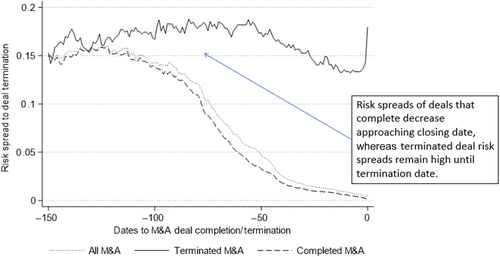
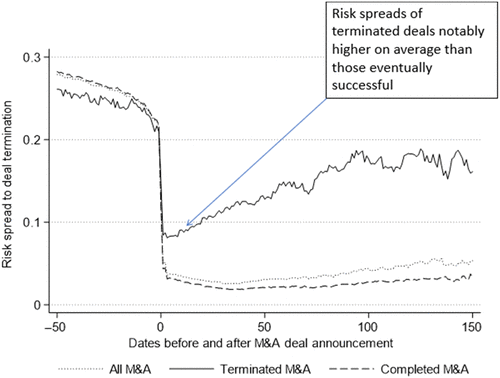
There are three different samples representing the three different control populations (focal firm pretermination, other firms with successful M&A, and pseudo-sample control firms). Summary statistics and cross-correlation tables for each sample are included in the Online Appendix (Tables A2–A4).
Results
This study analyzes the relationship between M&A deal termination and subsequent divestiture activity using conditional fixed effects logit estimation as our primary specification. We test our hypotheses using two complementary approaches: first-difference models that examine within-firm changes before and after deal termination, and difference-in-differences models that compare terminated deals with matched control groups of completed deals and pseudo-sample firms.
Hypothesis 1 predicted that following termination of an announced acquisition, bidders will be more likely to divest units in industries/sectors related to the intended target firm. This hypothesis is strongly supported across all model specifications. In the first-difference model shown in Table 1, column (1), we find a positive and statistically significant coefficient of β = 0.499 (p < 0.001) for Post-Termination on target-related business divestitures. This indicates that deal termination leads to a significant increase in the likelihood of target-related divestitures, representing approximately a 65% increase relative to the baseline rate.
|

Table 1. Deal Termination and Target-Related Business Divestitures
| Dependent variables (dummies) | ||||||
|---|---|---|---|---|---|---|
| Sample: | Termination sample only (first-difference model) | CEM firms with successful M&A (diff-in-diff model) | CEM pseudo sample (diff-in-diff model) | |||
| Dependent variable | Target-Related Business Divest. | Target-Unrelated Business Divest. | Target-Related Business Divest. | Target-Unrelated Business Divest. | Target-Related Business Divest. | Target-Unrelated Business Divest. |
| (1) | (2) | (3) | (4) | (5) | (6) | |
| Post-Termination (H1) | 0.499*** | 0.063 | 0.585*** | 0.067 | 0.511*** | 0.020 |
| (0.173) | (0.146) | (0.154) | (0.127) | (0.167) | (0.137) | |
| Business Size | 0.326** | 0.148* | 0.270*** | 0.153** | 0.250** | 0.097 |
| (0.139) | (0.089) | (0.077) | (0.060) | (0.116) | (0.079) | |
| Profitability | 0.132 | −0.383** | −0.228* | −0.140 | −0.007 | −0.069** |
| (0.363) | (0.191) | (0.131) | (0.124) | (0.051) | (0.027) | |
| Capital Expenditures | −0.548 | −0.638 | −0.381 | −0.436 | −0.278 | −0.115 |
| (0.612) | (0.778) | (0.399) | (0.535) | (0.462) | (0.348) | |
| Financial Leverage | −0.021 | −0.027 | −0.045* | −0.006 | −0.012 | −0.016 |
| (0.032) | (0.022) | (0.024) | (0.019) | (0.025) | (0.018) | |
| Diversification | 0.506** | 0.497*** | 0.430** | 0.257** | 0.351 | 0.477*** |
| (0.248) | (0.175) | (0.168) | (0.124) | (0.225) | (0.160) | |
| Acquisition Experience of Focal Firm | 0.292*** | 0.558*** | 0.207*** | 0.440*** | 0.283*** | 0.565*** |
| (0.095) | (0.092) | (0.060) | (0.056) | (0.087) | (0.084) | |
| Alliance Experience of Focal Firm | 0.122 | 0.136* | 0.193*** | 0.181*** | 0.162 | 0.184** |
| (0.115) | (0.079) | (0.071) | (0.056) | (0.109) | (0.077) | |
| Divestiture Experience of Focal Firm | 0.006 | 0.168* | 0.088 | 0.156** | −0.003 | 0.159* |
| (0.107) | (0.088) | (0.066) | (0.064) | (0.100) | (0.082) | |
| Bankruptcy Risk | 0.142 | 0.114 | 0.146 | 0.293*** | 0.317** | 0.257** |
| (0.149) | (0.149) | (0.102) | (0.098) | (0.133) | (0.128) | |
| Industry Growth (Bidder) | 0.138 | −0.068 | 0.460 | 0.428 | −0.043 | 0.254 |
| (0.508) | (0.481) | (0.382) | (0.379) | (0.514) | (0.403) | |
| Industry Growth (Target) | −0.046 | −0.574 | −0.056 | −0.421 | 0.192 | −1.101*** |
| (0.522) | (0.423) | (0.392) | (0.267) | (0.474) | (0.376) | |
| Deal FEs | Yes | Yes | Yes | Yes | Yes | Yes |
| Year FEs | Yes | Yes | Yes | Yes | Yes | Yes |
| Pseudo R2 | 0.168 | 0.149 | 0.117 | 0.125 | 0.153 | 0.140 |
| Observations | 5,465 | 6,428 | 11,378 | 12,615 | 7,005 | 8,987 |
Notes. Bold text represents explanatory variables of interest. Robust standard errors are in parentheses. Standard errors are clustered by acquisition deal. We use Stata’s conditional logit (clogit) as our main estimation method to measure the likelihood of divestiture outcomes. Robustness tests using alternative estimators (Poisson, OLS, complementary log–log) are reported in the Online Appendix. Target-related business divestitures are defined based on the target firm’s primary two-digit SIC code. Post-Termination is our main variable of interest. In the first-difference model (columns (1) and (2)), it takes the value one from the year following deal termination onward. In the difference-in-differences model (columns (3)–(6)), it represents the interaction between the post-termination period and treatment group. Columns (1) and (2) analyze the termination sample only. Columns (3) and (4) compare terminated deals with completed deals matched on DAR, total assets, total sales, net income, and market value, where the interaction term takes the value one for terminated deals in post-termination years. Columns (5) and (6) compare with a pseudo sample of nonmerging firms matched on total assets, total sales, net income, and market value, where the interaction term takes the value one for treatment firms in post periods. Following Low (2009), noninteracted variables are omitted because the specification includes deal and year fixed effects (FEs). Stata’s clogit command may exclude observations with uniform outcomes, which can result in different numbers of observations across dependent variables. H, Hypothesis.
***, **, and * indicate statistical significance based on two-sided tests at the 1%, 5%, and 10% levels, respectively.
The difference-in-differences models provide additional confirmation of Hypothesis 1. When comparing terminated deals to matched successful M&A firms in Table 1, column (3), the Post-Termination coefficient is β = 0.585 (p < 0.001). Similarly, when comparing to the CEM pseudo sample in Table 1, column (5), the coefficient is β = 0.511 (p < 0.001). These effects are economically meaningful, indicating that firms experiencing deal termination show approximately 60%–80% higher likelihood of target-related divestitures compared with control groups.
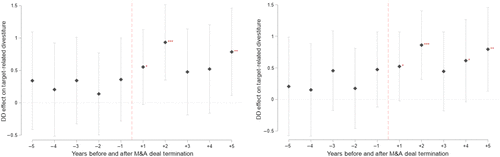
Importantly, we find no substantial effects on target-unrelated divestitures across any specifications, as shown in Table 1, columns (2), (4), and (6), where coefficients range from β = 0.020 to β = 0.067 and lack statistical significance. This pattern supports the targeted nature of post-termination divestiture behavior and confirms that firms are responding strategically rather than engaging in generalized restructuring activity. Figure 3 provides a graphical illustration of these difference-in-differences results, clearly showing the divergent patterns for target-related versus target-unrelated divestitures.
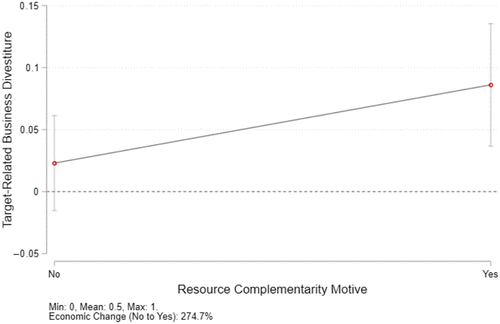
Hypothesis 2 predicted that the positive relationship between terminated acquisition and target-related divestitures would be stronger when the target’s resources are more complementary to the bidder’s existing resources. We find a strong support for this hypothesis. In Table 2, column (1), the interaction term Post-Termination × Resource Complementarity Motive shows a positive coefficient of β = 0.590 (p < 0.05). This supports our theoretical prediction that deals motivated by acquiring resources that are complementary to existing resources create binding constraints that intensify divestiture pressure when acquisitions fail. To illustrate the economic significance of this moderating effect, we present marginal effects plots in Figure 4. Because conditional logit models do not allow for straightforward margins calculations, we use complementary log–log (cloglog) estimation for these graphical analyses. The figure shows that when deals are motivated by resource complementarity compared with other motives, the marginal effect of deal termination on target-related divestiture likelihood increases meaningfully, with an economic change of 274.7% from No to Yes categories, demonstrating the substantial practical importance of this moderating relationship.
|
Table 2. Moderation Effects on Target-Related Business Divestitures
| Dependent variable (dummy) | |||||||
|---|---|---|---|---|---|---|---|
| Target-Related Business Divest. | |||||||
| (1) | (2) | (3) | (4) | (5) | (6) | (7) | |
| Post-Termination (or Post) | 0.247 | 0.271 | 0.362** | 0.503*** | −0.494 | 0.095 | 0.299 |
| (0.218) | (0.216) | (0.184) | (0.173) | (0.390) | (0.236) | (0.244) | |
| Post × Resource Complementarity Motive (H2) | 0.590** | ||||||
| (0.271) | |||||||
| Post × Target Rejection (H3) | 0.598** | ||||||
| (0.290) | |||||||
| Post × Target Firm Uniqueness (H3) | 1.806** | ||||||
| (0.785) | |||||||
| Post × Relative Market Demand (H4) | 2.034* | ||||||
| (Acquirer Market Growth − Target Market Growth) | (1.113) | ||||||
| Post × Distance to Acquisition Target (H5) | 1.279*** | ||||||
| (Technological Asset-Based) | (0.466) | ||||||
| Post × Distance to Acquisition Target (H5) | 1.507*** | ||||||
| (Tangible Asset-Based Measure) | (0.541) | ||||||
| Post × Distance to Acquisition Target (H5) | 0.489 | ||||||
| (Human Capital-Based Measure) | (0.466) | ||||||
| Relative Market Demand | −2.279** | ||||||
| (Acquirer Market Growth − Target Market Growth) | (0.899) | ||||||
| Deal FEs | Yes | Yes | Yes | Yes | Yes | Yes | Yes |
| Year FEs | Yes | Yes | Yes | Yes | Yes | Yes | Yes |
| Controls | Yes | Yes | Yes | Yes | Yes | Yes | Yes |
| Pseudo R2 | 0.170 | 0.170 | 0.169 | 0.171 | 0.171 | 0.170 | 0.168 |
| Observations | 5,465 | 5,465 | 5,465 | 5,465 | 5,465 | 5,465 | 5,465 |
Notes. Robust standard errors are in parentheses. Standard errors are clustered by acquisition deal. Bold text represents explanatory variables of interest. This analysis uses Stata’s conditional logit (clogit) for within-sample analysis of the deal termination sample only. Stata’s clogit command may exclude observations with uniform outcomes. Resource Complementarity Motive equals one for deals where the acquirer explicitly seeks to achieve operational synergies through economies of scale or scope, acquire target’s technological assets or innovation capabilities, or obtain complementary resources that amplify the value of the acquirer’s existing strategic assets. Target Rejection equals one for cases where bidder firms were unable to complete the acquisition because of target-related resistance, including target management or board rejection, target shareholder rejection, disagreement on transaction price, or inability to agree on management terms. Target Firm Uniqueness adapts Litov et al. (2012), measuring target firm uniqueness as the distance between the target’s sales distribution across three-digit SIC segments and the industry centroid of its primary SIC industry in the year prior to deal announcement. Relative Market Demand follows Wu (2013), calculated as a three-year moving average growth rate differentials between acquirer and target markets (acquirer minus target). Distance to Acquisition Target measures are constructed as one minus technological similarity based on patent portfolio overlap and one minus resource-based similarity using BEA capital flow and BLS occupational profile data, with higher values indicating greater distance from acquirer’s primary business. All variables except time-varying Relative Market Demand use preannouncement values and are absorbed by fixed effects (FEs). H, Hypothesis.
***, **, and * indicate statistical significance based on two-sided tests at the 1%, 5%, and 10% levels, respectively.
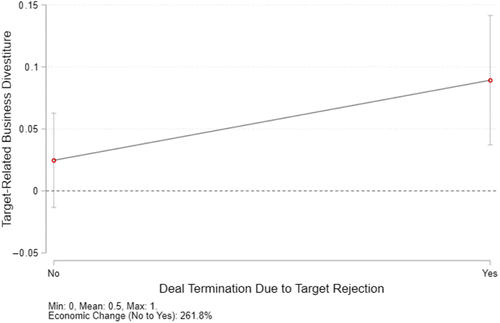
Hypothesis 3 predicted that the positive relationship between terminated acquisition and target-related divestitures would be stronger when deal termination was caused by target rejection. The results provide support this hypothesis. In Table 2, column (2), the interaction term Post-Termination × Target Rejection yields a positive and statistically significant coefficient of β = 0.598 (p < 0.05). This finding is consistent with our theory that target rejection serves as a revealed preference indicator of asymmetric dependence, where acquirers needed targets more than targets needed acquirers, leading to more severe stranded asset problems when deals fail. Figure 5 presents the marginal effects plot using cloglog estimation, illustrating that deals terminated due to target rejection compared with other termination reasons show notably higher divestiture probabilities, with a substantial economic change of 261.8% from No to Yes categories.
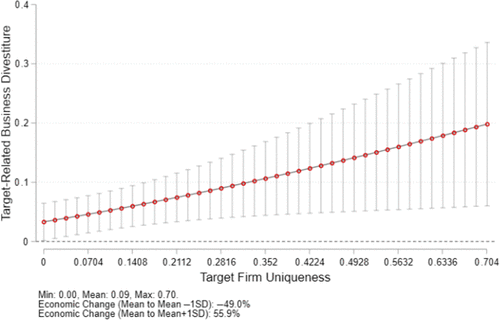
In addition, we examine whether target firm uniqueness amplifies this asymmetric dependence effect. We conjecture that when target firms are more unique within their market, asymmetric dependence would likely intensify because fewer alternative targets exist for the bidder, increasing the bidder’s reliance on the specific target’s resources. In Table 2, column (3), the interaction term Post-Termination × Target Firm Uniqueness shows a positive and statistically significant coefficient of β = 1.806 (p < 0.05). The marginal effects plot in Figure 6, estimated using cloglog, demonstrates that as target firm uniqueness increases by one standard deviation (SD), the marginal effect of deal termination on target-related divestiture likelihood increases (decreases) by 55.9% (49.0%) when moving from mean to mean plus one SD (mean minus one SD). Together, these findings suggest that asymmetric dependence plays a crucial role in driving stronger target-related divestiture responses following deal termination.
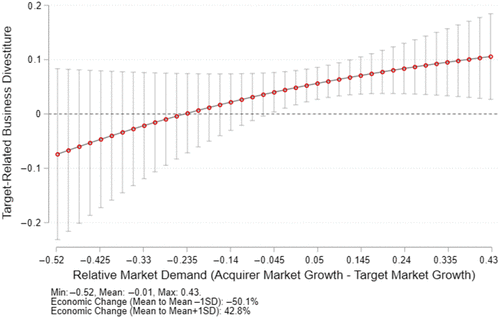
Hypothesis 4 predicted that the positive relationship between terminated acquisition and target-related divestitures would be stronger when bidders’ existing complementary resources had higher opportunity costs. This hypothesis receives support. In Table 2, column (4), the interaction term Post-Termination × Relative Market Demand (Acquirer Market Growth − Target Market Growth) shows a positive coefficient of β = 2.034 (p < 0.10). This large effect size demonstrates that when acquirer markets are growing faster relative to target markets, indicating higher opportunity costs for resources tied up in target-related businesses, deal termination produces markedly stronger divestiture responses. Figure 7 illustrates this relationship using cloglog marginal effects, showing that as relative market demand increases by one standard deviation, the marginal effect of deal termination on divestiture likelihood increases (decreases) by 42.8% (50.1%) when moving from mean to mean + 1 SD (mean − 1 SD), demonstrating the meaningful economic impact of opportunity costs on restructuring decisions.
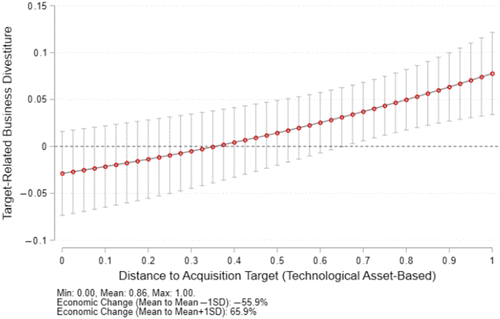
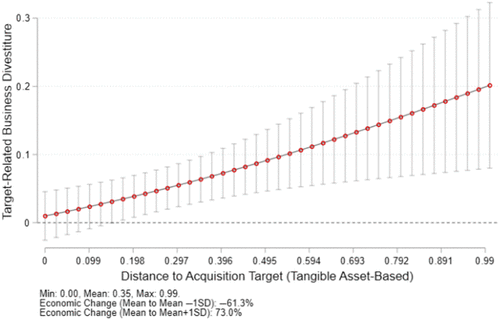
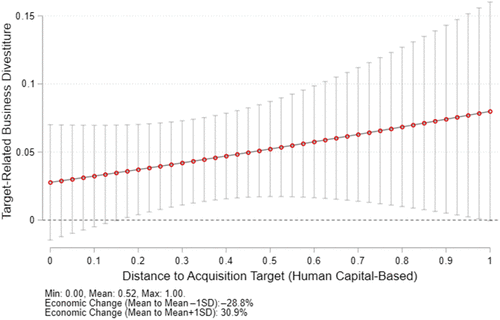
Hypothesis 5 predicted stronger divestiture effects when target-related businesses were more distant from the bidder’s core operations. We test this prediction using three different distance measures, with mixed but generally supportive results. For technological asset-based distance shown in Table 2, column (5), the interaction term Post-Termination × Distance to Acquisition Target (Technological Asset-Based) yields a positive and statistically significant coefficient of β = 1.279 (p < 0.001). Similarly, for tangible asset-based distance in Table 2, column (6), the coefficient is β = 1.507 (p < 0.001). Both measures strongly support Hypothesis 5. However, the human capital-based distance measure in Table 2, column (7), shows a positive but nonsignificant coefficient of β = 0.489, providing weaker support for this dimension of distance.
The marginal effects plots using cloglog estimation illustrate these relationships clearly. Figure 8 shows that as technological asset-based distance increases by one standard deviation, the marginal effect of deal termination on divestiture likelihood increases (decreases) by 65.9% (55.9%) when moving from mean to mean + 1 SD (mean − 1 SD). Figure 9 demonstrates a similar but even stronger pattern for tangible asset-based distance, with the effect increasing (decreasing) by 73.0% (61.3%) when moving from mean to mean + 1 SD (mean − 1 SD), representing the largest economic magnitude among our distance measures. Figure 10 shows the relationship for human capital-based distance, where although the overall coefficient lacks statistical significance, the margins plot reveals that the effect becomes statistically significant in certain ranges of the moderator, with the effect increasing (decreasing) by 30.9% (28.8%) when moving from mean to mean + 1 SD (mean − 1 SD), suggesting that human capital distance does matter for divestiture decisions in specific contexts as well.
The empirical results as a whole provide strong support for our theoretical framework. Hypothesis 1 receives robust support across all specifications, with Post-Termination coefficients ranging from β = 0.499 to β = 0.585 (all p < 0.001) for target-related divestitures, while showing no significant effects for target-unrelated divestitures. This confirms that deal termination leads to strategically targeted rather than generalized divestiture activity. The moderating hypotheses (Hypotheses 2–5) receive varying but generally strong support. These findings collectively support our predictions about strategic responses to M&A deal termination and demonstrate the systematic nature of post-termination portfolio rationalization.
Robustness Tests
Our main findings demonstrate consistency across multiple robustness checks. Alternative estimation methods including complementary log–log (β = 0.457 to β = 0.519), Poisson (β = 0.495 to β = 0.512), and OLS (β = 0.021 to β = 0.022) specifications yield consistent results (Online Appendix, Table A7). Tests using alternative SIC-based relatedness measures also confirm consistent findings across one-, two-, three-, and four-digit classifications (Online Appendix, Table A8). To address potential limitations of SIC-based classifications, we employ alternative measures using BEA capital flow and BLS occupational profile data to calculate tangible asset-based and human capital-based relatedness. Results remain consistent when classifying divestitures as highly versus lowly target related based on whether relatedness exceeds the comprehensive market median (Online Appendix, Table A9).
To ensure our results reflect genuine target-specific effects rather than systematic correlation arising from industry overlap, we examined acquirer-related divestitures. The results show no significant effects for acquirer-related divestitures, although one specification shows significant positive effects for acquirer-unrelated divestitures, confirming that effects are target specific rather than an artifact of industry classification (Online Appendix, Table A10). To ensure effects are not driven by preexisting divestiture plans or broader strategic repositioning around deal announcement, various time window specifications around deal announcement and termination maintain consistent effects, demonstrating that target-related divestiture effects occur after termination rather than before (Online Appendix, Table A11). To verify our theoretical prediction that effects should be concentrated among firms with multiple business units, we find effects are stronger for diversified firms (β = 0.600, p < 0.05) compared with nondiversified firms (β = 0.446, not significant; Online Appendix, Table A12).
Advanced difference-in-differences estimators address potential heterogeneous treatment effects: the Sun and Abraham (2021) estimator yields β = 0.021 (p < 0.05) for target-related divestitures (Online Appendix, Table A13), whereas the de Chaisemartin and D’Haultfoeuille (2024) estimator shows average total effects of β = 0.04 to β = 0.05 (both p < 0.05; Online Appendix, Table A14). Placebo tests show no significant pretreatment effects (p > 0.40), supporting parallel trends assumptions. Comprehensive specification curve analyses across 120 combinations of model types, control groups, relatedness definitions, and time periods demonstrate robust results across methodological variations (Online Appendix, Figure A1, a–d). Results remain consistent when using alternative matching covariates and when controlling for strategic alternatives in target industries.
Discussion
How firms reconfigure their resource portfolios is a central question in corporate strategy, with distinct literatures examining modes of resource growth (e.g., Capron and Mitchell 2012) and modes of resource exit (e.g., Feldman and Sakhartov 2022). Although the sequencing of these moves has received attention, the literature has not yet answered a critical question: what does a firm do when its chosen path for resource growth is blocked? Our study addresses this gap by investigating divestiture activity following terminated M&A deals. We find that when an acquisition fails, bidders are significantly more likely to divest units related to the intended target. This is a counterintuitive finding that a failed growth attempt precipitates not only a pivot to other growth modes (Byun and Lim 2022) or a return to status quo, but rather to a strategic exit. This suggests a more integrated and dynamic relationship between acquisitions and divestitures than has been previously understood.
Our study demonstrates that when an announced M&A deal is terminated, the bidding firm is significantly more likely to divest business units related to the intended target. This bail effect is stronger than the divestiture activity observed in firms that completed similar acquisitions and in comparable firms not involved in M&A. Further supporting our keystone resource theory, we find this effect is amplified under specific conditions: when the target’s resources are highly complementary to the bidder’s, when the target initiates the termination, when the bidder’s stranded assets have a high opportunity cost, and when the focal business is distant from the bidder’s core operations.
Our primary theoretical contribution is to the literature on resource reconfiguration, specifically the build, borrow, or buy framework (Capron and Mitchell 2009, 2012). The prevailing view often conceptualizes this process as distinct, two-stage decisions with an initial strategic-level decision of growth or exit followed by a transaction-level decision of the particular mode of growth/exit. We extend this work by theorizing and providing evidence that resource exit is not merely a response to a failed outcome, but a deliberate strategic pivot from a failed acquisition attempt to a targeted divestiture.
We introduce the concept of keystone resources to explain the mechanism driving this pivot. We argue that many acquisitions are pursued not simply to add resources, but to acquire a specific keystone resource upon which the value of the acquirer’s existing complementary assets depend. When the acquisition of this keystone resource fails, the firm’s complementary assets can become stranded, unable to generate sufficient value on their own and consuming capital and managerial attention that could be better deployed elsewhere. This novel type of resource gap defined by interdependency rather than a simple deficiency explains why a failed acquisition can trigger a strategic exit rather than a pivot to another growth mode (e.g., internal development, strategic partnership, or another acquisition attempt).
We also contribute to the literature on divestitures by identifying a novel antecedent: deal termination. Prior research has largely viewed divestiture as a response to poor performance (Shimizu 2007), a way to shed redundant assets after acquisition (Capron et al. 2001), or a proactive move to free up resources for future growth (Bennett and Feldman 2017). Our findings show that the failure to acquire can be as powerful a trigger for divestiture as a successful acquisition. In fact, our results suggest that the propensity to divest target-related units is even greater after a terminated deal than after a completed one. This is noteworthy because it has been well established that after completing an M&A deal, a firm tends to engage in more divestiture activity (Moschieri and Mair 2008). This finding is sharpened by our moderation analysis, which provides evidence consistent with our keystone resource theory. For instance, the pressure to bail is stronger when there is high complementarity between the target and bidder’s resources, when there is asymmetric dependence in favor of the target, when there is high opportunity cost for retaining the stranded resources, and when the focal business to be divested is more distant from the bidder’s core operations.
Methodologically, this study offers a novel approach to addressing some of the endogeneity inherent in M&A research. Identifying a credible counterfactual for a terminated deal is difficult, as deals that fail likely have systematic differences from those that succeed. We introduce the use of deal arbitrage risk (the spread between the offer price and the target’s spot price) as a key matching variable in a CEM design. Because this spread reflects the collective, real-time judgment of sophisticated market actors about a deal’s likelihood of failure, it can help identify a comparable control group of successful deals that faced similar ex ante risk of termination. This approach allows for a more robust causal interpretation of a firm’s actions in the wake of deal termination.
Our research aims to integrate resource position exit strategies, such as divestitures or resource redeployment, with the build, borrow, or buy framework, thereby responding to the call for a more holistic resource reconfiguration framework (Villalonga and McGahan 2005, Vidal 2021). By thinking of resource reconfiguration as a menu of options simultaneously considered and prioritized, we aim to better match a framework with how corporate leaders can view long-term resource planning. Although this distinction may not be meaningful in analysis of one-off transactions, it introduces new theoretical insights into the dynamics of resource reconfiguration over multiple time periods. As scholars respond to the call for more research on the strategic use of resource redeployment and divestitures (Feldman and McGrath 2016), our goal is to promote even more explicit connections between all the forms of resource reconfiguration as an integrated phenomenon.
The authors thank Senior Editor Evan Rawley and anonymous reviewers for their constructive comments and guidance throughout the review process. We thank Brendan O’Leary for a practitioner’s insight on the theoretical core of the paper. We also thank our colleagues and the participants of the Academy of Management Annual Meeting, Strategic Management Society Annual Conference, and the Wharton Corporate Strategy and Innovation Conference for their helpful feedback on earlier versions of this manuscript. Any remaining errors are our own.
1 The response of a firm with a terminated deal to pivot to divestitures may be particularly strong if the missing keystone resource is a bottleneck resource (Chang et al. 2022) for the industry. In such cases, the firm may have fewer options for alternative growth, making an exit from its current market position more attractive.
2 This cutoff also avoids the COVID-19 period. As a robustness check, extending the sample to 2020 adds only nine terminated deals that meet our data requirements, and including these observations does not alter our main findings.
3 Our sample includes only transactions between publicly listed U.S. firms, with payment methods limited to cash, stock, or cash–stock combinations, as DAR calculations require these specific transaction types for our identification strategy. We confirm that our sample is not limited to specific industries or industry combinations. See Online Appendix A for more details on sample construction.
4 We cluster standard errors by deal to account for potential correlation in error terms within deal. Our findings are robust to complementary log–log models that account for the asymmetric probability distribution of rare events, OLS with binary dependent variables, and Poisson specifications for count-based divestiture analysis (Online Appendix, Table A7).
5 To ensure our results are driven by target-related considerations rather than acquirer-related factors, we test whether divestitures occur within the same two-digit SIC code as the acquirer’s primary business. The results confirm that our findings are indeed target specific rather than acquirer related, with acquirer-related divestitures showing no statistically significant effects. We rather find partial evidence of stronger effects for acquirer-unrelated divestitures, which is consistent with the interpretation that the divestiture behavior is driven by target characteristics (Online Appendix, Table A10).
6 Following Rabier (2017), we manually analyze SEC filings, newspapers, and press releases to identify acquisitions motivated by resource complementarity. For economies of scale or scope, we look for keywords such as “economies of scale (scope),” “shared resources,” “supply chain efficiencies,” “facility consolidation,” and “eliminating duplicative functions.” For innovation motives, we identify mentions of “research and development,” “innovative products,” “new product development,” “enhanced R&D capabilities,” and “technological synergies.” For explicit complementary assets, we identify mentions of “complementary assets” or “asset complementarity,” as well as specific mentions of acquiring assets that complement, enhance, or strengthen the bidder’s existing capabilities. We exclude deals motivated by market power synergies, new market diversification, or financial motives, as these do not reflect resource complementarity.
References
- (2012) Bargaining power and industry dependence in mergers. J. Financial Econom. 103(3):530–550.Crossref, Google Scholar
- (2019) Done deal? Why many large transactions fail to cross the finish line. McKinsey Finance (72):13–18.Google Scholar
- (1991) Firm resources and sustained competitive advantage. J. Management 17(1):99–120.Crossref, Google Scholar
- (2017) Make room! Make room! A note on sequential spinoffs and acquisitions. Strategy Sci. 2(2):100–110.Link, Google Scholar
- (1999) Causes and effects of corporate refocusing programs. Rev. Financial Stud. 12(2):311–345.Crossref, Google Scholar
- (1997) Predicting divestiture of unrelated acquisitions: An integrative model of ex ante conditions. Strategic Management J. 18(9):715–731.Crossref, Google Scholar
- (2008) Restructuring through spin-off or sell-off: Transforming information asymmetries into financial gain. Strategic Management J. 29(2):133–148.Crossref, Google Scholar
- (2008) Learning how to restructure: Absorptive capacity and improvisational views of restructuring actions and performance. Strategic Management J. 29(6):593–616. Crossref, Google Scholar
- (2007) How are firms sold? J. Finance 62(2):847–875.Crossref, Google Scholar
- (2014) Make, buy, or ally? Choice of and payoff from announcements of alternate strategies for innovations. Marketing Sci. 33(1):114–133.Link, Google Scholar
- (2006) What have we acquired and what should we acquire in divestiture research? A review and research agenda. J. Management 32(6):751–785.Crossref, Google Scholar
- (2022) When M&A attempts fail: M&A deal termination and subsequent corporate strategy transactions. Acad. Management Proc. 2022(1):17507.Crossref, Google Scholar
- (2016) Strategies for M&As: When is acquisition the right mode to grow? Accounting Bus. Res. 46(5):453–462.Crossref, Google Scholar
- (2009) Selection capability: How capability gaps and internal social frictions affect internal and external strategic renewal. Organ. Sci. 20(2):294–312.Link, Google Scholar
- (2012) Build, Borrow, or Buy: Solving the Growth Dilemma (Harvard Business Press, Boston).Google Scholar
- (2001) Asset divestiture following horizontal acquisitions: A dynamic view. Strategic Management J. 22(9):817–844.Crossref, Google Scholar
- (2010) Binary response models for panel data: Identification and information. Econometrica 78(1):159–168.Crossref, Google Scholar
- (1996) An evolutionary perspective on diversification and corporate restructuring: Entry, exit, and economic performance during 1981-89. Strategic Management J. 17(8):587–611.Crossref, Google Scholar
- (2022) Bottleneck resources, market relatedness, and the dynamics of organizational growth. Organ. Sci. 33(3):1049–1067.Link, Google Scholar
- (2003) Failed takeover attempts, corporate governance and refocusing. Strategic Management J. 24(1):87–96. Crossref, Google Scholar
- (1997) Corporate focus and value creation evidence from spinoffs. J. Financial Econom. 45(2):257–281.Crossref, Google Scholar
- (2024) Difference-in-differences estimators of intertemporal treatment effects. Rev. Econom. Statist., 1–45.Crossref, Google Scholar
- (2020) Identifying internal markets for resource redeployment. Strategic Management J. 41(13):2341–2371.Crossref, Google Scholar
- (2000) Dynamic capabilities: What are they? Strategic Management J. 21(10–11):1105–1121.Crossref, Google Scholar
- (2006) On the patterns and wealth effects of vertical mergers. J. Bus. 79(2):877–902.Crossref, Google Scholar
- (2014) Legacy divestitures: Motives and implications. Organ. Sci. 25(3):815–832.Link, Google Scholar
- (2016) Corporate spin-offs and capital allocation decisions. Strategy Sci. 1(4):256–271.Link, Google Scholar
- (2020) Corporate strategy: Past, present, and future. Strategic Management Rev. 1(1):179–206.Crossref, Google Scholar
- (2016) Divestitures. J. Organ. Design 5(1):2.Crossref, Google Scholar
- (2022) Resource redeployment and divestiture as strategic alternatives. Organ. Sci. 33(3):926–945.Link, Google Scholar
- (2016) Corporate divestitures and family control: Corporate divestitures and family control. Strategic Management J. 37(3):429–446.Crossref, Google Scholar
- (2021) Difference-in-differences with variation in treatment timing. J. Econom. 225(2):254–277.Crossref, Google Scholar
- (2006) De-commitment to losing strategic action: Evidence from the divestiture of poorly performing acquisitions. Strategic Management J. 27(6):541–557.Crossref, Google Scholar
- (1990) The core competence of the corporation. Harvard Bus. Rev. 68:79–91.Google Scholar
- (2004) Inter‐temporal economies of scope, organizational modularity, and the dynamics of diversification. Strategic Management J. 25(13):1217–1232.Crossref, Google Scholar
- (2009) Dynamic Capabilities: Understanding Strategic Change in Organizations (John Wiley & Sons, New York).Google Scholar
- (1994) Corporate divestiture intensity in restructuring firms: Effects of governance, strategy, and performance. Acad. Management J. 37(5):1207–1251.Crossref, Google Scholar
- (2012) Causal inference without balance checking: Coarsened exact matching. Political Anal. 20(1):1–24.Crossref, Google Scholar
- (1992) The success of acquisitions: Evidence from divestitures. J. Finance 47(1):107–138.Crossref, Google Scholar
- (2006) Modularity in organizational structure: The reconfiguration of internally developed and acquired business units. Strategic Management J. 27(9):799–823.Crossref, Google Scholar
- (2016) Reconfiguration: Adding, redeploying, recombining, and divesting resources and business units. Strategic Management J. 37(13):E54–E62.Crossref, Google Scholar
- (2004) Innovating through acquisition and internal development: A quarter-century of boundary evolution at Johnson & Johnson. Long Range Planning 37(6):525–547.Crossref, Google Scholar
- (2012) Technology and corporate scope: Firm and rival innovation as antecedents of corporate transactions. Strategic Management J. 33(4):347–367.Crossref, Google Scholar
- (2011) Spin‐offs: Tackling the conglomerate discount. J. Appl. Corporate Finance 23(4):90–101.Crossref, Google Scholar
- (1995) Asset sales, firm performance, and the agency costs of managerial discretion. J. Financial Econom. 37(1):3–37.Crossref, Google Scholar
- (1987) An empirical analysis of the incentives to engage in costly information acquisition: The case of risk arbitrage. J. Financial Econom. 18(1):111–126.Crossref, Google Scholar
- (2010) Opportunity costs and non‐scale free capabilities: Profit maximization, corporate scope, and profit margins. Strategic Management J. 31(7):780–801.Crossref, Google Scholar
- (2012) Corporate strategy, analyst coverage, and the uniqueness paradox. Management Sci. 58(10):1797–1815.Link, Google Scholar
- (2009) Managerial risk-taking behavior and equity-based compensation. J. Financial Econom. 92(3):470–490.Crossref, Google Scholar
- (2017) Resource allocation and strategy. J. Management 43(8):2411–2420.Crossref, Google Scholar
- (2001) Corporate diversification, value maximization, and organizational capabilities. The J. Bus. 74(3):409–431.Crossref, Google Scholar
- (2001) How does innovative activity change as industries mature? Internat. J. Indust. Organ. 19(7):1141–1160.Crossref, Google Scholar
- (1995) Complementarities and fit strategy, structure, and organizational change in manufacturing. J. Accounting Econom. 19(2–3):179–208.Crossref, Google Scholar
- (2020) How do pre‐entrants to the industry incubation stage choose between alliances and acquisitions for technical capabilities and specialized complementary assets? Strategic Management J. 41(8):1450–1489.Crossref, Google Scholar
- (2008) Research on corporate divestitures: A synthesis. J. Management Organ. 14(4):399–422.Crossref, Google Scholar
- (2003) Termination fees in mergers and acquisitions. J. Financial Econom. 69(3):431–467.Crossref, Google Scholar
- (1959) The Theory of the Growth of the Firm (John Wiley & Sons, New York).Google Scholar
- (2017) Acquisition motives and the distribution of acquisition performance. Strategic Management J. 38(13):2666–2681.Crossref, Google Scholar
- (2012) The temporal effects of relative and firm-level absorptive capacity on interorganizational learning. Strategic Management J. 33(10):1154–1173.Crossref, Google Scholar
- (2007) Prospect theory, behavioral theory, and the threat-rigidity thesis: Combinative effects on organizational decisions to divest formerly acquired units. Acad. Management J. 50(6):1495–1514.Crossref, Google Scholar
- (2021) Estimating dynamic treatment effects in event studies with heterogeneous treatment effects. J. Econom. 225(2):175–199.Crossref, Google Scholar
- (2005) Knowledge relatedness and the performance of multibusiness firms. Strategic Management J. 26(2):97–119.Crossref, Google Scholar
- (2021) Divestitures, value creation, and corporate scope. Strategic Management Rev. 2(2):413–436.Crossref, Google Scholar
- (2015) Adding by subtracting: The relationship between performance feedback and resource reconfiguration through divestitures. Organ. Sci. 26(4):1101–1118.Link, Google Scholar
- (2018) Virtuous or vicious cycles? The role of divestitures as a complementary Penrose effect within resource‐based theory. Strategic Management J. 39(1):131–154.Crossref, Google Scholar
- (2005) The choice among acquisitions, alliances, and divestitures. Strategic Management J. 26(13):1183–1208.Crossref, Google Scholar
- (2011) Resource-based theory and corporate diversification: Accomplishments and opportunities. J. Management 37(5):1335–1368.Google Scholar
- (2007) Alliance or acquisition? A dyadic perspective on interfirm resource combinations. Strategic Management J. 28(13):1291–1317.Crossref, Google Scholar
- (1984) A resource-based view of the firm. Strategic Management J. 5(2):171–180.Crossref, Google Scholar
- (2013) Opportunity costs, industry dynamics, and corporate diversification: Evidence from the cardiovascular medical device industry, 1976–2004. Strategic Management J. 34(11):1265–1287.Crossref, Google Scholar
- (2011) Subsidiary divestiture and acquisition in a financial crisis: Operational focus, financial constraints, and ownership. J. Corporate Finance 17(2):272–287.Crossref, Google Scholar
Anthony Gibbs is an assistant professor of Strategic Management at the Mitchell E. Daniels, Jr. School of Business, Purdue University. His research interests are in corporate strategy, research methods, behavioral strategy, strategic change, earnings management, financial manipulation, and business ethics. He received a PhD in Strategy and Entrepreneurship, as well as MBA and MFin degrees from the Robert H. Smith School of Business at the University of Maryland. He worked more than 16 years in industry, with a background in pharmaceuticals and U.S. federal government contracting.
Heejung Byun is an assistant professor of management in the Strategy Area at the Mitch Daniels School of Business, Purdue University. He received his PhD from the University of Maryland, College Park. Heejung’s research interests encompass strategic human capital, entrepreneurship, corporate strategy, and their intersection. His recent research focuses on human capital issues in mergers and acquisitions.
Koungjin Lim is an assistant professor of Strategic Management at the Michael J. Coles College of Business, Kennesaw State University. His research lies at the intersection of corporate strategy, strategic human capital, and entrepreneurship. His recent work examines how human capital acquisition and deployment drive competitive advantage in mergers and acquisitions. He received his PhD from Purdue University.

