Request Username
Can't sign in? Forgot your username?
Enter your email address below and we will send you your username

October 5, 2026
To: INFORMS Board
Re: Annual Report for Operations Research (OPRE) Journal
From: Amy R. Ward, Editor-in-Chief (EiC)
Date: October 5, 2026
The Operations Research (OPRE) journal is a flagship journal for the INFORMS community. Its mission is to be the leading platform for innovative and impactful research in the field of Operations Research. My first priority as Editor-in-Chief (EiC) is to preserve and enhance this standing.
My first term as EiC began January 1, 2024 and will end Dec 31, 2026. I will continue for a second (and final) term as EiC, and that term will begin January 1, 2027 and will end Dec 31, 2029. This is the 3rd Annual Report I am writing.
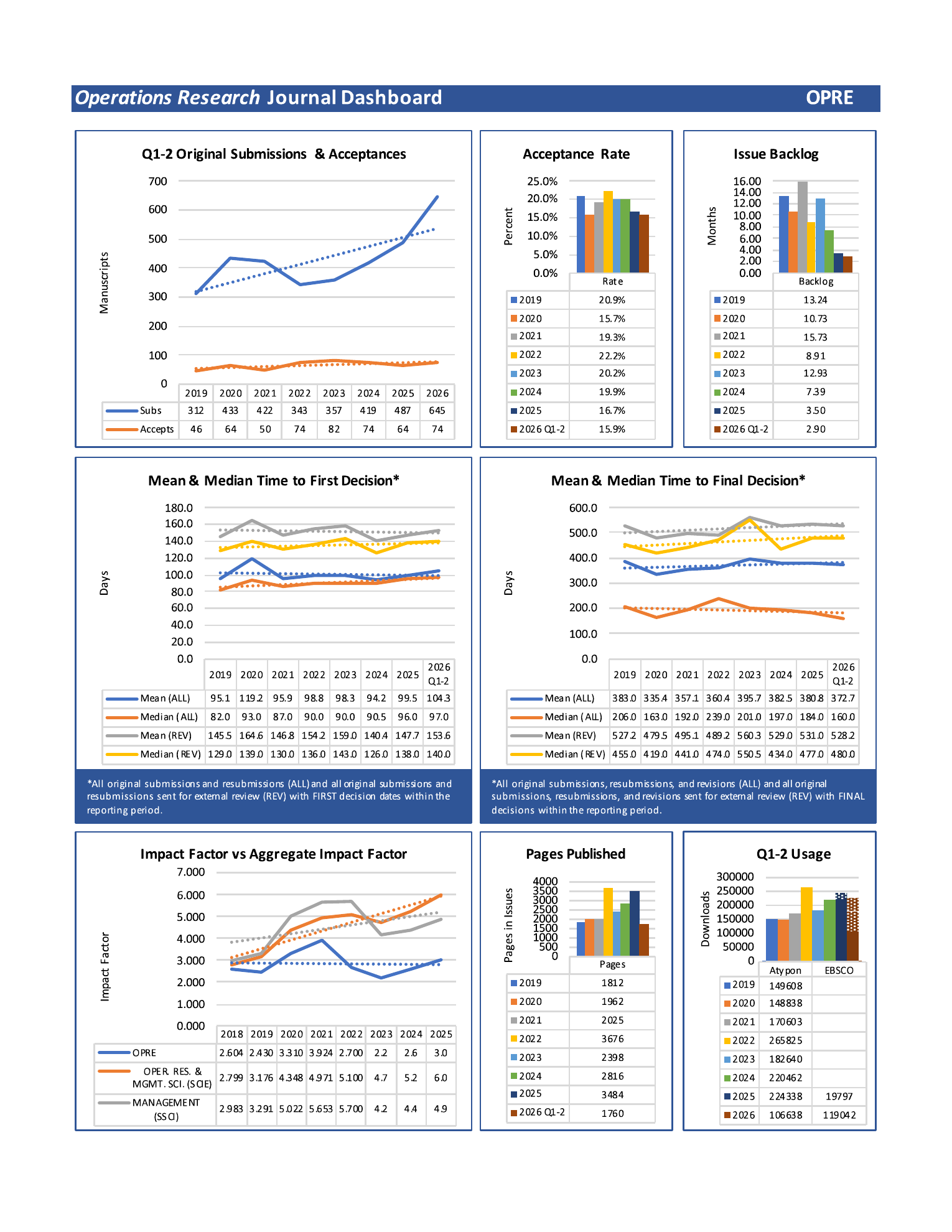
In accordance with INFORMS policy, a review committee was appointed, which consisted of Alper Atamtürk, Xiuli Chao, Tava Olsen (Chair), Jamol Pender, Greys Sošić, and Matthew Walls (Director, Publications, INFORMS), and a stakeholder survey was conducted. I am deeply grateful to the review committee for their thoughtful report. In the following, I share the review committee’s assessment of my leadership, their recommendations, their thoughts on strategic challenges for the journal, and my responses. Following that, I provide the Journal Dashboard, which provides some statistics for the journal
The committee found Professor Ward’s self-review to be thoughtful, reflective, and forward-looking. They did not see a need for a zoom call with her given the information provided in the review and by the survey. Note that Professor Ward provided some input for the survey, most notably the question around methodological review (question 21) and AI use (questions 22 & 23).
Professor Ward has demonstrated a strong commitment to maintaining the journal’s standards while introducing carefully targeted innovations. Her leadership has been characterized by professionalism, transparency, intellectual seriousness, and a clear commitment to serving the OR/MS community.
The committee was particularly impressed by her attention to review quality, reproducibility, editorial consistency, and community engagement. Her creation of the Data and Code Review Area represents a significant contribution to the journal and to the discipline more broadly.
Importantly, the committee believes that the principal concerns raised in the stakeholder survey reflect strategic challenges facing the journal and the field rather than deficiencies in current editorial leadership.
The committee has full confidence in Professor Ward’s ability to address these challenges during a second term.
This is encouraging to have the committee’s full confidence. I am committed to the journal and to serving the OR/MS community. I am deeply thankful for the dedication of the Editorial Board and the individuals that review for the journal. This is appropriate to highlight Ted Ralphs, the person leading the Data and Code Review Area.
The committee encourages continued renewal of the editorial board and broad representation across research areas, methodologies, institutions, career stages, and geographic regions.
The editorial board is functioning well. The conscientiousness and care I see from the AreaEds and AEs inspires and motivates me. Despite wanting all my AreaEds to continue to serve another 3-year term, we agreed that any AreaEd that had served 6 years (i.e., was ending a 2nd term) should step down. This led to the following changes:
Separately, Cong Shi replaced Xi Chen as Area Ed for the Machine Learning & Data Science Area, after Xi Chen made his own decision to step down earlier in the summer.
Over the summer, I met separately with the AreaEds for each Area to review the AE appointments. The AE workload is non-trivial, and I would like to recognize all the AEs for their excellent work. In thinking about the next 3 years, the AreaEds and I discussed some of the above considerations suggested by the review committee regarding AE appointments.
The committee also encourages exploration of mechanisms that make editorial appointments and expectations more transparent to the community.
The general criteria to become an AE for the journal are: Associate Professor or above, and to be a recognized expert in a subject area of interest to the journal. The most promising way to become an AE is to review for the journal. The journal is giving yearly meritorious service awards to reviewers, meaning that AreaEds are aware of reviewers regularly doing high quality work for the journal.
The committee encourages the Editor-in-Chief to continue exploring mechanisms that increase the visibility and influence of OR research. Potential approaches include invited review articles, synthesis papers, and other formats capable of generating broad scholarly engagement.
The introduction of a Data, Software, & Computation Area at the beginning of my 1st term is one way to increase the visibility and influence of OR research. I strongly suspect that papers with posted code (for example, in a github repo) have a higher likelihood for increased visibility than those with no posted code. We have developed instruction for authors, to suggest some standard ways to organize code and data files, in the interest of making those files easy to understand (see https://orjournal.github.io/InstructionsForAuthors.html). We are also in the process of building a page of examples of papers that have well-organized code and data files, made better for having gone through a replication study.
My reason for not doing invited review articles, synthesis papers, etc, is that I have struggled to determine a good review process. Invited articles that go outside the regular review process have the potential to be criticized for favoritism. The closest I have come here is with the context-and-challenge paper category, for which I have constructed a separate set of review guidelines.
I have thought about having a social media manager. However, I am not sure that this is the type of publicity that will increase the scholarly reputation of the journal. I also hesitate to put the journal in the potential center of social media backlash and controversy.
I also welcome help. There are papers that come through the journal that have potential interest to the mainstream media; however, I have no such contacts.
The Impact Factor for the journal, as shown on the Journal Dashboard, is rising, albeit slowly. My current efforts are focused on ensuring good review processes, under the assumption that metrics follow when the underlying processes are strong.
The committee also encourages continue attention to research that combines methodological innovation with meaningful operational insight and practical relevance.
I agree. I would also love to see more papers submitted to the Real-World OR Innovations Area, which focuses on papers with practical relevance. The journal benefits from recognizing research that is innovative and impactful, whether from the methodological perspective or from the practical perspective.
Impact and Connection to Practice
I am open to continued discussion on what concrete steps the community would like to see the journal take in this regard. My current approach is to have an editorial board that consists of both individuals more connected to the methodological side and individuals more connected to the applied side.
Manuscript Length and Readability
I share the review committee’s concern that increasing manuscript length, including writing aimed to more narrowly handle reviewer comments than to improve the overall paper flow, can affect readability negatively. I also speculate that shorter and carefully written manuscripts are even more likely to stand out positively in the age of AI, when this is easy to have AI write a lot of stuff. This is also true that longer manuscripts place more burden on the reviewers. I am open to reducing the allowed length of regular manuscripts; however, I am not ready to move forward on that at this moment.
Artificial Intelligence and Scholarly Publishing
This is on everyone’s mind. This is clear from the stakeholder survey that there are strong and differing opinions. The submissions to the journal are increasing, as can be seen from the Journal Dashboard. Although the journal is not experiencing the overwhelming order-of-magnitude type increase that some of the CS conferences are experiencing, I am worried that that could be coming. Already, there is strain on the reviewing process capacity.
What I learned from making a first draft attempt to write journal policy to address the role of AI was that the issue is larger than me (and larger than the journal). Hence I convened a committee consisting of AreaEds from the journal (David Brown, Rene Caldentey, Dan Iancu, Rouba Ibrahim, Raman Randhawa (chair), and Cong Shi) to study the issue and make recommendations regarding what the journal should be doing. Please see my Open Forum post “Statement from the Operations Research Journal EiC Regarding LLM Use” (link) for the journal’s current thinking.
For more on this topic, please consider attending the panel on Monday, Nov 2, from 11am-12:15pm at the INFORMS National Meeting, “OR/MS Research and Publishing in the Age of AI: Ethics, Integrity, and Human Judgement”, organized by Esra Buyuktahtakin Toy, taking place in Moscone South-303 (Level 3). The panelists are: Chris Loch, Chris Tang, and Amy Ward (me).