


Economically Efficient Standards to Protect the Netherlands Against Flooding
Abstract
In the Netherlands, flood protection is a matter of national survival. In 2008, the Second Delta Committee recommended increasing legal flood protection standards at least tenfold to compensate for population and economic growth since 1953; this recommendation would have required dike improvement investments estimated at 11.5 billion euro. Our research group was charged with developing efficient flood protection standards in a more objective way. We used cost-benefit analysis and mixed-integer nonlinear programming to demonstrate the efficiency of increasing the legal standards in three critical regions only. Monte Carlo analysis confirms the robustness of this recommendation. In 2012, the state secretary of the Ministry of Infrastructure and the Environment accepted our results as a basis for legislation. Compared to the earlier recommendation, this successful application of operations research yields both a highly significant increase in protection for these regions (in which two-thirds of the benefits of the proposed improvements accrue) and approximately 7.8 billion euro in cost savings. Our methods can also be used in decision making for other flood-prone areas worldwide.
Over the centuries, the geography, landscape, and culture of the Netherlands have been characterized, if not literally shaped, by water. The country is noted for its continual vigilance and innovative solutions in water management—reclaiming, protecting, and developing land below sea level, and managing rivers flowing into the country to protect its people and their economic interests. As Figure 1 shows, 55 percent of the land area faces flood risk; this puts two-thirds of the population and 70 percent of the gross domestic product (GDP) at risk.
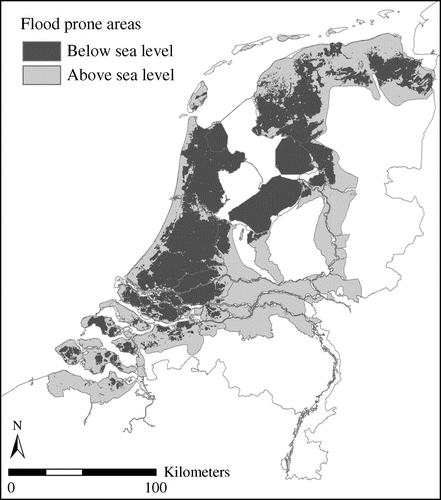
In the west and north, the country borders the North Sea. Many regions near the coast are below average sea level, including the most densely populated area, Holland, which includes cities such as Amsterdam, Rotterdam, and The Hague. On the eastern border, the Rhine River enters the country from Germany, splitting into three branches toward the sea. One of these branches, the River IJssel, discharges into Lake IJssel, which is separated from the North Sea by a 32 kilometer (km)-long dam. At the southeast corner, the Meuse River enters the country from Belgium.
A flood-prone area that is surrounded by a closed ring of water defenses or high grounds is called a dike-ring area or polder. For all 53 large dike-ring areas in the Netherlands, the Water Act determines flood protection standards (i.e., yearly probability of flooding) (Ministry of Transport, Public Works and Water Management 2010). These standards are still the same as, or loosely related to, the original 1958 figures in the Delta Act (Baker 1997); these figures are based on 1953 data. The law also sets out a periodic test procedure to check whether the dikes still meet the standards, because of general degradation, soil subsidence, climate change, and better knowledge. Dikes that fail the test must be reinforced. Each year, the Dutch government and the water boards (regional water authorities) spend approximately 1.5 billion euro on flood protection by maintaining and improving approximately 3,500 km of primary dikes and 250 km of dunes.
This paper summarizes a unique and multidisciplinary project to determine new economically efficient flood protection standards for the Netherlands. The purpose of the project is to provide policymakers (e.g., government, Parliament) with a scientific basis for updating the flood protection standards in the Water Act by 2017. Brekelmans et al. (2012), Kind (2013), and Eijgenraam et al. (2013) and the references therein, provide more details on modeling and results.
History: Legal Flood Protection Standards and Operations Research in the Netherlands
In 1953, a massive flood disaster occurred in the southwestern part of the country. More than 1,800 people died, and the economic damage (10 percent of GDP) was enormous. This catastrophe was the last time a disaster of this scale occurred in the Netherlands. Worldwide, however, similar flood disasters occur several times each year.
After the 1953 disaster, a high-level state committee, the Delta Committee, was commissioned to recommend actions for flood protection. This committee proposed the closure of several sea arms (inlets) in the southwestern delta with structures now known as the Delta Works. The committee also asked D. Van Dantzig to solve the economic decision problem concerning the optimal height of dikes. His pioneering analysis and formula (Van Dantzig 1956) is considered to be the start of operations research in the Netherlands. Van Dantzig developed a cost-benefit analysis (CBA) in which the (marginal) societal costs of investing in water defenses are balanced against the (marginal) societal benefit of avoiding flood damage. However, because nonmaterial issues are involved in societal costs and benefits, the choice of flood protection standards is ultimately a political decision. In 1958, following the advice of the Delta Committee, the Delta Act first included flood protection standards for the coastal dike-ring areas.
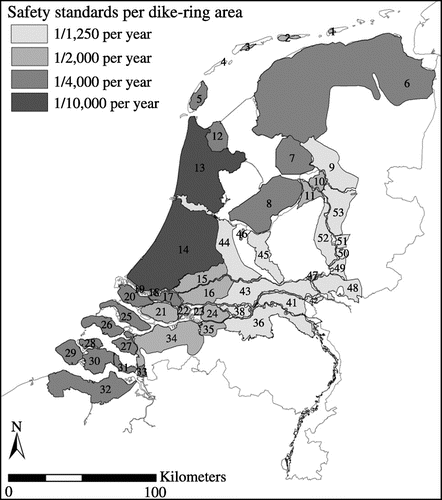
The Water Act now determines flood protection standards for all dike-ring areas in the Netherlands (see Figure 2). The standards range from an admissible flood probability of 1/1,250 per year for dike-ring areas along the upper part of the Rhine and Meuse Rivers, to 1/10,000 per year for the most important dike-ring areas along the coast. Although some of the standards date back 60 years, they are still the highest protection standards in the world (Galloway et al. 2006)—much higher than the well-known U.S. standard of 1/100 per year and exceeding the standard of 1/500 per year, which Galloway et al. (2006) recommend for densely populated or vulnerable areas. Because a scientific basis for standards in other parts of the world is not available, our analysis and models can also be of great value for other flood-prone areas.
In 1993 and 1995, high discharges of the Rhine and Meuse Rivers led to critical situations in the Netherlands; in 1995, more than 250,000 people were evacuated as a prevention measure, because of fear the levees would break. The water reached the crest of the levees; luckily, no flood occurred. At that time, the river defense system did not conform to the legal standards in some places. The government started a crash project to upgrade the water defenses to meet the legal standards. However, the high discharges also led to the notion that the frequency of extreme discharges was higher than previously believed; therefore, the extreme-discharge probability distribution for the Rhine River that the test procedure used needed to change; see Equation (1) in the appendix. Therefore, in 2002, the government started a project, called Room for the River, which it estimated would cost 2.2 billion euro, and several other (smaller) projects to adapt the water defense system along the rivers to cope with higher discharges. As of this writing, these projects are still under development.
In 2002, the legal protection standards were not yet under debate; however, the Ministry of Transport, Public Works and Water Management (V&W) decided to do not only a CBA on the project, but also a CBA on flood protection standards, because a solid underlying calculation for the standards in the river areas did not exist. During this process, Eijgenraam discovered that the solution presented in Van Dantzig (1956) for determining optimal dike heights was incorrect, and that his analysis was incomplete with respect to the timing of investments (Eijgenraam et al. 2013). The CBA of the Room for the River project (Eijgenraam 2005) is the first study that uses a correct general optimization model and solution to determine the optimal size and timing of dike upgrades. Results from this study indicate that, from an economic point of view, the legal protection levels for half of the dike rings in the river area are probably (far) too low.
This result strengthened a growing consensus that the 1958 protection standards had become outdated; since 1953, the population of the Netherlands had almost doubled and GDP had increased fivefold. The question thus assumed an air of urgency: were the new big-river projects being guided by the correct legal standards? In combination with the disquieting reports of the Intergovernmental Panel on Climate Change (2001) on climate change and rising sea levels, as discussed, this led to two actions.
First, in 2006, the state secretary of the Ministry of V&W (now the Ministry of Infrastructure and the Environment (I&M)) launched a project, Flood Protection in the 21st Century (WV21). The WV21 project aims to update the legal standards for flood protection in the Water Act by 2017; these revised standards should be valid to steer all flood protection actions through 2050. To obtain a scientific basis for the political decision making, the state secretary, Melanie Schultz van Haegen, requested a CBA for flood protection standards for all dike-ring areas. This was the birth of our project.
Second, in 2007, the government installed a Second Delta Committee to advise the government on strategies for integrated flood risk management and freshwater supply until 2100. The committee advised increasing the protection standards of all dike-ring areas tenfold, primarily because of the growth of the population and economy since 1953 (Delta Committee 2008). This would mean, for example, that a standard of 1/2,000 per year would become 1/20,000 per year, necessitating a large investment program. One reassurance the committee could provide was that, even under the most unfavorable climate scenario that it could construct, the current technical knowledge would suffice for centuries to lead to appropriate and efficient measures. The committee also convinced politicians of the urgency for action. Therefore, the government initiated the Delta Programme, chaired by the Delta Commissioner, to foster protection against high water and to keep the freshwater supply up to standard (Delta Commissioner 2010).
Process and Organization of the Project
In 2007, the Ministry of I&M decided to broaden the CBA model used in the Room for the River study with the help of specialists in nonlinear optimization. It awarded the model project to a team from Tilburg University, Delft University of Technology, and HKV Consultants; the award amount was about 0.5 million euro. The team constructed the new optimization model from 2007 to 2010. In 2009, an organizational shift occurred, and the newly appointed Delta Commissioner assumed responsibility for the WV21 project, including the analysis and proposal of new flood protection standards, policies, and measures.
Between 2008 and 2011, the Ministry of I&M awarded to Deltares (an independent Dutch institute for applied research in the field of water, subsurface, and infrastructure) several contracts with an estimated value of 4 million euro (including the 0.5 million euro contract we mention previously) to analyze and report on economically efficient flood protection standards. The water boards and provinces were asked to provide Deltares with basic information on dikes and inundation scenarios. The Ministry of I&M also organized many meetings and conferences with stakeholders to discuss flood protection policies and standards. We estimate that all these other organizations spent an additional several million euro on the project.
Operations Research Approach
We developed two cost-benefit models to derive the optimal strategy for upgrading the dikes protecting flood-prone areas, one for simple and one for more complicated cases. Taking into account the dynamic effects of climate change and socioeconomic growth, the models minimize the total long-term societal costs, which consist of the investment costs for upgrading dikes and the expected loss from flooding. The higher the dikes, the lower the expected loss by flooding, and the more it costs to realize and maintain these dikes. Decision variables are the timing, height, and location of dike upgrades over a planning horizon of at least 300 years. Our models differ from most maintenance or inventory management models in one important way: in our models, the investment costs of heightening a dike increase as the height of the existing dike rises, making each subsequent heightening more expensive than the previous one.
Model Assumptions
In Eijgenraam et al. (2013), we extensively justify crucial model assumptions (e.g., investment-cost function, discounting, economic growth, water-level rise), and discuss why a CBA is appropriate for this societal problem. Our model is based on research addressing which type of specification is suitable for each phenomenon; for example, Van Noortwijk et al. (2002) study the best practical specification of the extreme discharge distribution of the Rhine River. To provide a brief glimpse of the vast knowledge base used to specify a phenomenon, we summarize here the background for the exponential formulation of the flood probabilities along the coast.
A flooding incident occurs when the load on a dike is greater than the strength of that dike, resulting in a breach. In the hydraulic models that describe this process, the flood probability is the outcome of the comparison of two stochastic variables: hydraulic load and strength. Load factors are (or depend on) water level, wave height, and wave period. Along the coast, the joint probability distributions for these conditions depend on properties of the wind field (direction, force, duration), the astronomic tide, and the basin geometry both offshore and near the shore. Examples of variables indicating the strength of the dike are crest height, seaside slope, and thickness of the stone revetment. The confrontation of loads and strength leads to the occurrence of failures, such as overtopping or piping (i.e., the retrograde internal erosion in sandy layers underneath clay dikes). The occurrence of failures leads to the quantification of the overall failure probability of a dike ring (i.e., flood probability). The uncertainties with respect to the loads are much greater than the uncertainties about the strength. Therefore, in our model we summarize both the hydraulic loads and the quality of the dike by the foremost important indicator (height), provided that the dike meets the engineering standards. Studies by Rijkswaterstaat, the engineering agency of the Ministry of I&M, confirm that under this condition, overtopping or overflow will be the determining failure mechanism (i.e., water flowing over the dike never causes a flood except through heavy overflow, which causes a breach); the weakest segment will fully determine the flood probability of the dike ring; Brekelmans et al. (2012) provide references. In all, the exponential formulation of the flood probability in our model is a local approximation of the outcome of these more complicated processes that we consider fully in constructing the actual data and parameters. In addition, studies show that the flood probability of a dike ring is not, or is only negligibly, dependent on the flooding of other dike-ring areas. Therefore, we treat each dike-ring area separately.
Modeling and Solution Methods
We define a segment of a dike ring as the part of a dike ring for which the same set of parameters and coefficients can be used. Some dike rings can be modeled as homogeneous (i.e., having only one segment). Other dike rings consist of multiple segments, each with its own set of parameters. For homogeneous dike rings, we describe the model in the text that follows Equation (5) in the appendix. A discretized version of this model can be solved by using dynamic programming (DP). For a specific class of investment-cost functions, the so-called exponential-cost functions, we analytically find a periodic solution that satisfies the first-order optimality conditions—only one periodic solution exists and it is optimal; Eijgenraam et al. (2013) provide details. The analytical solution makes possible a deeper understanding of each parameter’s quantitative influence on the outcomes. Therefore, this solution helps to explain the outcomes of more complicated models.
For nonhomogeneous dike rings, the DP approach works only if the number of segments is small (e.g., up to three). For many dike rings, however, the number of segments is larger (e.g., up to 10). Then, the number of possible states in the DP approach explodes. Because of these cases, the Tilburg University team developed a mixed-integer nonlinear programming (MINLP) model. The time frames in the planning horizon are discretized, and binary variables indicate whether an upgrade should occur at these times. The upgrade heights are continuous variables. Investment costs and expected damage costs depend nonlinearly on both the upgrades and their timing; therefore, we are left with a large-scale MINLP model, as Equation (6) in the appendix describes. Many accompanying constraints are nonlinear. It is well-known that solving such a problem may be hard, especially if some of the functions in the model are nonconvex, as they are in our model. After performing many experiments with existing MINLP solvers, we decided to proceed with the outer-approximation algorithm of Duran and Grossmann (1986). This algorithm runs under AIMMS and uses general-purpose nonlinear programming (NLP) and MIP solvers for solving subproblems. We use CONOPT for the NLP subproblems and CPLEX for the MIP subproblems. Because of the limited time available to generate the final CBA, the task is to rapidly find the optimal solution, allowing the user to run multiple scenarios for all 53 dike rings within a reasonable time. Therefore, we use some heuristic approaches, as Brekelmans et al. (2012) describe, to solve the MINLP. Nonetheless, the outcomes of the final model are the same for all instances in which we could find a solution technique that guarantees a global optimum (Brekelmans et al. 2012). Outcomes also concur with the outcomes of comparable DP calculations, whenever possible.
The optimization problem can also be modeled as an impulse control problem, which may be solved by any of several methods. According to Chahim et al. (2013), this approach is suitable for homogeneous dike-ring areas, but not for nonhomogeneous dike-ring areas. Therefore, we did not pursue this approach, nor did we use DP, except to confirm the quality of the solutions that our decision support software generated.
Data Gathering
All (main) reports about data gathering and results are available in Dutch at the Deltares website (http://www.deltares.nl/en/publications). To illustrate the detail with which Deltares gathered all data, we focus on the investment costs. It constructed investment costs for upgrading all primary dikes in the Netherlands, divided into 652 sections with an average length of five km. For each section, Deltares investigated the lowest costs (investment plus maintenance until the next upgrade) for a range of 20 heightenings, up to at least two meters (m) higher than the existing height. It checked all dike sections for special problems (e.g., buildings on the inward slope or road crossings) at locations 1 m from each other and along 200 m inward from the foot of the dike; if necessary, it applied special constructions or solutions. It then combined values for sections to create investment-cost functions for segments.
In the CBA, Deltares gave particular attention to the number of casualties and the valuation of nonmaterial losses. A team from the Free University in Amsterdam conducted a survey among people in dike-ring areas to determine the value of a statistical life (VOSL) in case of flooding (Bočkarjova et al. 2012). The flooding VOSL estimate was about 6 million euro compared to 2.5 million euro for a road-safety VOSL. These empirical results clearly show that people are very risk averse toward flood risk in comparison to other risks; they have no direct control over flood protection and feel strongly that flood protection is a public good and therefore a government responsibility. We also considered risk aversion in the valuation of damage of irreplaceable items, such as personal belongings that have emotional value.
Decision Support System
Finally, HKV Consultants implemented the optimization model in a user-friendly software package, OptimaliseRing (Duits 2011). This package consists of a database for all dike-ring areas, a user interface, the MINLP optimization algorithm (including the heuristics), and a postprocessing module that transforms the output into the desired format, such as tables, graphs, and maps. In the user interface, the user must select the particular dike-ring areas for which calculations are made, and decide on values for key parameters (e.g., socioeconomic and climate change scenarios, discount rate, and monetary values for types of nonmaterial damages, such as casualties). Hence, it is fairly easy to carry out a sensitivity analysis for these parameters. In less than one day, the model can produce results for all 53 dike-ring areas.
Character of the Solution and Definition of the Standard
Because fixed costs are involved in each investment action, upgrades have a discontinuous character. The protection level is high (i.e., low flood probability) just after an investment, which results in a low expected yearly loss. However, expected loss gradually increases afterward as the combined result of economic growth, climate change, and soil subsidence. When a high level of expected loss is reached, a new investment action becomes profitable and is executed. Dividing the values for the expected loss in the optimal strategy by the corresponding values for the potential damage yields the values for the flood probability.
Figure 3 shows the flood probabilities of the optimal strategy for dike-ring 20 Voorne-Putten, which has three segments and is situated southwest of Rotterdam along the coast. The current legal flood protection standard is 0.00025 or 1/4,000 per year. In our model, the first upgrade on the optimal investment path takes place at the first possible time, which is 2020, lowering the flood probability to approximately 0.00005 or 1/20,000 per year, the optimal design probability.

Comparing the flood probabilities immediately prior to two consecutive optimal investment moments in Figure 3, we see that the latter flood probability is much lower than the former; this also holds for the two optimal design probabilities (i.e., the optimal probability immediately after an investment). This long-term decline in optimal flood probabilities neutralizes the upward effect of economic growth on the expected loss. This effect of economic growth on optimal flood probabilities is an important difference between our solution and that of Van Dantzig (1956), in which design flood probabilities are kept constant over time (as in many countries).
We use the optimal investment strategy to define an economically efficient flood protection standard. Legal standards work as test standards: when the standard is exceeded, an action for improvement must start. Therefore, its numerical value needs to be set much lower than the top of the optimal band, just before the completion of a heightening, at a level that provides ample time for two reasons: first, to find out that the standard has been passed, and second, to ensure enough time for the entire process of decision making and construction of an upgrade (i.e., lead time). We must consider lead times of 15–25 years for large projects (such as Room for the River), and choose design probabilities that are much lower than the test standard. The result is that the legal standard acts as a central value of an interval of actual flood probabilities. Therefore, we recommend setting the legal standard as a central value of the expected damage immediately before and after the investment, divided by the damage in the event of a flood. The difference in probability between the central value and the top of the optimal band corresponds roughly (see Figure 3) to the lead times encountered in practice. Equation (7) in the appendix and Eijgenraam (2007) provide details on the calculation of the recommended legal standard. We can prove that this standard is very robust; for example, its value does not depend on the climate scenario used (Kind 2011). This is a great advantage of this definition, because future climate change is uncertain. Choosing the value of the efficient standard in some future year (e.g., 2050) as the legal standard yields a stable flood protection policy for decades ahead; policymakers can thus be confident that this will result in both an economically efficient level of flood protection overall and in efficient implementation methods on a local scale. We advise improving the legal standard for dike-ring 20 in Figure 3 more than twofold, from the current 1/4,000 per year to 1/10,000 or 0.0001 per year.
Sensitivity Analysis
We calculated the main results in a generally agreed base-case scenario for economic growth and climate change. However, many parameters are highly uncertain, partly because floods seldom occur; the 1953 flood was the last major flood in the Netherlands. We assessed the combined effect of these uncertainties on the flood protection standard in the base-case scenario through a Monte Carlo analysis (Gauderis et al. 2013). For a Monte Carlo analysis with thousands of scenarios, OptimaliseRing is unsuitable because of the length of its calculation time. Therefore, we directly calculated the uncertainty around the flood protection standards, thus also circumventing model uncertainties. For the flood protection standard, we used an explicit approximation, based on formulas in Eijgenraam (2007), which appears to have a high correlation with the standards based on the optimal investment strategy. The high correlation implies that if uncertainties in costs and flood damages are quantified sufficiently, the uncertainty of the economically efficient flood protection standard is also quantified. Within the CBA WV21, we thus identified probability distributions of all parameters in the investment costs and of all factors contributing to the total flood damages, and quantified them together with a few correlation coefficients between some of the parameters. We then used the data of 10,000 draws of 13 probability distributions to determine confidence intervals around the economically efficient flood protection standards for 2050 in the base-case scenario.
Challenges
Recognizing that flood protection is of crucial importance for the Netherlands, we accepted the necessity of developing a realistic model and validating all types of formulations used. The scientific challenge was that a highly nonlinear large-scale optimization model, which includes many binary variables, emerged. However, because we had to calculate many scenarios, we had to limit the run time.
This multidisciplinary project brings together the expertise of many other parties, including Rijkswaterstaat and the Royal Netherlands Meteorological Institute (KNMI) (Katsman et al. 2008). Its managerial complexity is considerable, with many organizations, such as water boards and provinces, providing input data.
The decision on new protection standards is sensitive in the Netherlands, because it involves a massive trade-off between efficiency and equity, which affects the protection of about two-thirds of the population. At times, some argued (e.g., Delta Committee 2008) that the new protection standards should not rely heavily on technical calculations (as in the CBA report), or that casualty risk indicators should be the prominent indicator and underpinning of new standards. Gradually, it became clear that the economically efficient flood protection standards are much more robust than the casualty risk indicators, and that they are the only way to link societal benefits to investment costs in a transparent way. Therefore, these standards, based on CBA principles, became recognized as the best way to provide an objective and scientific basis for new legal standards. The Dutch government’s recognition of CBA as an official tool for investment planning was of considerable help.
New protection standards may have several characteristics: at what level they should be determined (scale issues: one standard for a group of dike-ring areas, for one dike ring, or different standards for parts of one dike ring?), or the length of time for which they should be valid. The desired scale in turn determines the detail of information needed. Opinions differ about the characteristics and hence about the quality and detail of the data. Changing opinions on these and related issues, combined with the very cautious attitude of the Ministry of I&M during the execution of the studies, created a managerial challenge; this implied that after completing the studies, one of our challenges would be to get the results accepted.
A major hurdle then involved gaining the support of several engineering and political authorities. Therefore, we spent time thoroughly explaining and justifying the underlying assumptions to them. Several members of our team (Eijgenraam, Kind, and Vermeer) put substantial effort into explaining the results until the engineering and political authorities widely accepted them. We gave numerous presentations for organizations involved in the preparation of actual flood protection policy, including the Ministry of I&M, Rijkswaterstaat, the Water Advisory Committee, staff from the Room for the River project, water boards, and various other water advisory bodies and research institutes.
Results
The most relevant policy results are the economically efficient flood protection standards per dike-ring area for the year 2050 in the base-case scenario. For dike-ring areas along the central part of the Rhine and Meuse Rivers, which today have a legal standard of 1/1,250 per year, efficient protection standards are predominantly between 1/2,000 and 1/4,000 per year; outliers are even lower than 1/40,000 (i.e., more than 10 times lower than the legal standard). Along the River IJssel and the upstream part of the Meuse River, the efficient protection standards tend to be slightly lower (i.e., higher optimal probabilities); they are around the current legal standards of 1/1,250 per year. In the tidal river areas and in the central part of Holland along the coast, efficient protection standards are generally between 1/4,000 and 1/10,000 per year; they are now 1/2,000, 1/4,000, and 1/10,000 per year. For polders around Lake IJssel (now 1/4,000), the efficient protection standard is highest (lowest flood probability) for the southwestern part of dike-ring area 8 Flevoland (about 1/10,000 per year). For the remaining dike-ring areas around Lake IJssel, efficient standards do not indicate a higher protection level than the current legal standard. This also holds for the coastal dike rings in the north and southwest, with the most stringent economically efficient flood protection standards, which are equal to the current legal standard of 1/4,000 per year in these areas.
The pattern of the economically efficient flood protection standards is significantly different from the current pattern of the legal flood protection standards (see Figure 2). The legal standards are currently highest along the coast and lowest along the Rhine and Meuse Rivers; however, our study finds roughly an opposite pattern—the highest standards are along the rivers and the lowest are along the coast. We found two explanations for the differences: (1) our new methodology to determine efficient flood protection standards replaces a weak basis under the current legal standards; and (2) our study provides improved insights, which point to relatively high potential damage along the rivers compared to along the coast.
This last point was not generally identified before the start of this project because flood damage was thought to be related to the level of the land in comparison to the average sea level. Therefore, the current legal flood protection standards in Figure 2 show a close resemblance to the height of the land compared to average sea level, as Figure 1 shows. Our research demonstrates that flood risk is the highest in areas in which the maximum flood depth is highest, as Figure 4 shows.
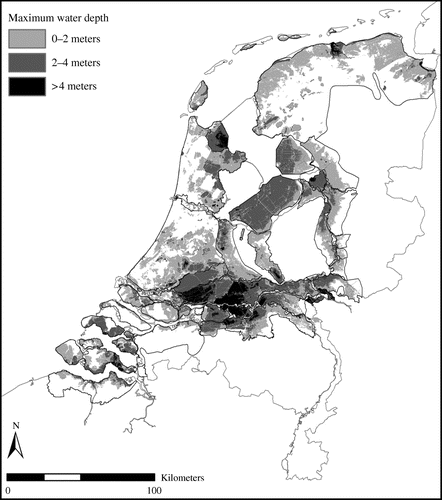
The difference between the height of the land and the water level in case of a flood turns out to be much higher along the rivers than along the sea, although the absolute height of the land along the coast is lower. Therefore, economically efficient flood protection standards correlate highly with flood depth.
Sensitivity analyses for single parameters (e.g., other scenarios for economic growth and climate change) and the Monte Carlo analysis show that the uncertainty around the economically efficient flood protection standards is considerable. In the Monte Carlo analysis for the 80 percent confidence interval, the ratio between the upper- and lower-bound estimate for the efficient protection standard is on average 5. This means that if we calculate an efficient standard of 1/2,000 per year in the base-case scenario, the 80 percent confidence interval can range from 1/5,000 to 1/1,000 per year. For the 90 percent confidence interval, this ratio increases from 5 to 10. The most important source of uncertainty appears to relate to the potential flood damage in 2050. In this value, uncertainties in economic growth, inundation scenarios, damage functions, evacuation fractions, mortality functions, and economic valuation all accumulate. Yet the mutual proportions of the economically efficient flood protection standard remain robust across the dike-ring areas, even when we consider those large uncertainties.
Based on these results, increasing the legal protection standards of all dike-ring areas tenfold, as the Second Delta Committee recommended, is unnecessary. The current protection standards are (more than) appropriate, except for three regions: a part of the dike rings along the Rhine and Meuse Rivers (i.e., part of the areas that now have a standard of 1/2,000 or 1/1,250 per year), the southern part of dike-ring 8 Flevoland (comprising the large, rapidly growing city of Almere), and some dike rings (e.g., 20) near Rotterdam.
Costs and Benefits
The investment costs needed to implement the advice of the Second Delta Committee to increase the protection standards for all dike-ring areas tenfold were estimated to be 11.5 billion euro (Kind 2011). Our results lead to investment costs estimated at 3.7 billion euro, which implies a reduction in investment costs for the Dutch government of approximately 7.8 billion euro. Upgrades based on our efficient standards lower the expected loss, such that all investments have at least a real first-year rate of return (FYRR) of 5.5 percent. The investments in all other areas, as the Second Delta Committee advised, currently have a FYRR of one percent on average; therefore, we suggest postponing them.
We have not previously documented the economic benefits of our proposal. To do so, we use a simple approximation. Assuming that actual flood probabilities would remain equal to the current legal standards, expected flood damage costs in the Netherlands will be about 300 million euro per year in 2017, and will increase to some 600 million euro in 2050; this is the base-case scenario with average economic growth. If we increase flood protection standards in dike-ring areas in which we have shown that it is efficient (and allow flood protection to remain unchanged in the other dike-ring areas), then we can reduce the expected flood damage to about 100 million euro in 2017; this would increase to about 200 million in 2050 (using the same base-case scenario). Hence, the benefits of higher flood protection standards increase from about 200 (i.e., 300–100) million euro per year in 2017 to about 400 (i.e., 600–200) million euro per year in 2050. During a period of 33 years, the total benefits of decreased flood risk are about 10 billion euro, and would rise further still in later years. We estimate the investment costs to implement the improved standards in the three regions at 3.7 billion euro, a very high return on investment.
Political Decision-Making Process
After the start of the WV21 project in the beginning of 2006, new coalition governments were elected in 2006, 2010, and 2012. All governments, including the present one, have supported continuation of the WV21 project.
The Water Advisory Committee, chaired by Crown Prince Willem-Alexander, discussed the final report of the CBA WV21 (Kind 2011) and endorsed our results in a letter dated March 9, 2012. The House of Parliament discussed the report on December 5, 2011 and April 4, 2012. In an unanimous motion on April 17, 2012, parliament asked the government to present a concrete proposal for new legal standards in 2014, explicitly referring to the three regions named in Kind (2011) and under the condition that improvements are justified by a CBA. The state secretary of I&M followed the report’s results and stated the following in a letter dated May 7, 2012:
A tenfold increase in protection standards for all dike-ring areas is not needed.
Only the protection standards in the three regions named in the report need improvement.
The state secretary therefore instructed the Delta Commissioner to adapt, as necessary, the protection standards derived for these areas (Kind 2011) according to local situations, and to ensure that a minimal protection level is guaranteed everywhere in a dike-ring area. On April 26, 2013, the Minister of I&M, Melanie Schultz van Haegen, confirmed these conclusions and time schedule in a policy letter to parliament. The Delta Commissioner has announced that his proposal for new flood protection standards will closely follow the main conclusions of this project, which have already been recognized in discussions with the water boards and the provinces. In 2014, the cabinet will take a decision on these proposals. In 2015, the final decision on the improvement of these protection standards will be taken in parliament, such that new standards—after approval of the law in parliament—will be legally effective by 2017. Finally, in a letter dated November 27, 2012, the chairman of the Second Delta Committee agreed with these conclusions, which clearly deviate from the committee’s earlier advice.
Portability and Future Research
Flooding is becoming an increasing problem for many deltas in the world. Close to half a billion people live on or near deltas, often in megacities, and 85 percent of these deltas have experienced severe flooding in the past decade (Syvitski et al. 2009). The model and techniques developed in this project are almost directly applicable to these deltas. We have given more than 50 presentations on this project to academic or international audiences. In 2008, we presented the method and tentative results at the Fourth International Conference of Flood Management in Toronto, and in 2011, we presented our final results in Tokyo (Kind 2013). Recently, members of our team were asked to advise on flood protection standards in China (Eijgenraam 2012) and France. Moreover, an adapted version of our model and methods could be used for other important environmental investment decisions, if they are characterized by rising investment costs per unit, such as protection against snow avalanches from the mountains or freshwater supply.
Future research is ongoing at the CPB Netherlands Bureau for Economic Policy Analysis for a multilayer water defense system (in the Netherlands, this is the dam between the North Sea and Lake IJssel combined with the dike rings around the polders in Lake IJssel). The data for the WV21 project have also pointed out another related topic: the location of a breach appears to make a huge difference in flood damage in a dike-ring area. Gaining insight into this question requires models in which segments of the dike ring are coupled to different amounts of damage.
Appendix
In this appendix, we consider one dike-ring area or each part of a dike ring that borders one water system. The dike ring under consideration consists of L segments. If L = 1, the dike ring is homogeneous, otherwise, it is nonhomogeneous. The objective is to minimize the sum of the expected damage costs (because of flooding) and the investment costs (for upgrading the dike segments) in a finite planning period [0, T). Brekelmans et al. (2012) and Eijgenraam et al. (2013) provide additional details on the model described next, including a justification for the model assumptions, an implementation of the model, and computational results.
The set of dike segments is denoted as ℒ. For each l ∈ ℒ, Hlt denotes the height of segment l at time t ≥ 0 and , where is the segment height just before the planning period. The vector t represents the time moments tk of possible segment upgrades, where , for some K. An investment plan is a pair (U, t) with and t = (t0, t1, …, tk). The lth row of matrix U contains the segment heightenings ul0, …, ulk, of segment l at the successive moments tk. Of course, ulk ≥ 0 for each k. Also, hl0 = ul0 and hltk = hltk−1 + ulk for k = 1, …, K.
The probability of failure of segment l at time t, resulting in a complete breach of the dike, is given by
When a flood occurs, the damage costs are given by
We take into account the period after the planning horizon T, assuming that the expected damage and hence the segment heights no longer change. Thus, the discounted expected damage after the planning horizon is . Under the same assumption, arg maxlPlt does not change after T; hence, this expression becomes
The investment costs for a heightening ulk are given by
The objective is to minimize the sum of the investment costs and expected damage costs; therefore, the resulting optimization model can be formulated as
The objective function is clearly highly nonlinear, and discontinuous as a result of Equation (4) (because cl is positive in all practical situations).
The positive news is that in the case of a homogeneous dike and T = ∞, the previously mentioned model can be solved analytically. A far-from-trivial analysis yielded a globally optimal solution. This solution is periodic in the sense that starting from t = t1, the dike has to be updated regularly with the same amount of increase in height. This amount does not depend on the initial status of the dike, nor does the period between two consecutive upgrades. Only if the initial status is bad, the first upgrade takes place at t0 = 0, and the amount of the heightening is then larger than the regular amount. Otherwise, there is no upgrade at t0 = 0, and the first upgrade starts the periodic solution at t = t1.
However, many dikes are nonhomogeneous. For these cases, we could not derive an analytical solution. We therefore developed a MINLP model for solving Equation (5). We assume that a fine enough discretization scheme, t = (t0, …, tK+1) with t0 = 0 < t1 < … < tK < tK+1 = T, has been predetermined, as well as a sufficiently large upper bound M for the values ulk. The MINLP model follows:
The objective function includes the investment costs with the fixed-cost component cl multiplied by a binary variable ylk. These binary variables ensure that either ulk = 0 and the related investment costs in the objective function are zero, or ulk > 0 and the investment costs are equal to ℐlk(U). Because we are minimizing, the first two constraints ensure that Ak and R represent the approximations of the expected damage in [tk, tk+1), which is given by Equation (2), and the expected damage after the planning horizon, which is given by Equation (3), respectively. The number of these binary variables equals L(K + 1), whereas the number of continuous variables in the model equals (3L + 1)(K + 1) + 1. The number of constraints is given by 5L(K + 1) + L. If L = 10, which is the maximum number of segments in practice, and we take K = 60, then we have 610 binary variables, 1,892 continuous variables, and 3,060 constraints, among these 620 nonlinear constraints.
The project’s main goal was to support decision making with respect to setting new flood protection standards for all dike rings in the Netherlands. The formula for the legal standard probability ( ) proposed in this paper is the quotient of an efficient level of expected damage and the current potential loss:
The only variable remaining on the right side is the unit costs for an optimal investment. However, unit costs are almost the same for a broad range of reasonable heightenings. The consequence is that is hardly sensitive to a parameter such as the speed of the change in the water level (η); see Kind (2011) for an empirical proof. A faster change in water levels would require more frequent investments and has, therefore, an enormous effect on investment costs. The last expression also provides insight as to why in the Monte Carlo analysis, the uncertainty in the potential damage V2050 is by far the most important cause of the uncertainty in .
References
- Baker R, ed. (1997) Environmental Law and Policy in the European Union and the United States (Praeger, Westport, CT).Google Scholar
- (2012) Composite valuation of immaterial damage in flooding: Value of statistical life, value of statistical evacuation and value of statistical injury. Accessed September 24, 2013, http://papers.tinbergen.nl/12047.pdf.Google Scholar
- (2012) Safe dike heights at minimal costs: The nonhomogeneous case. Oper. Res. 60(6):1342–1355.Link, Google Scholar
- (2013) An impulse control approach to dike height optimization. Optim. Methods Software 28(3):458–477.Crossref, Google Scholar
Delta Commissioner (2010) Working on the delta. Investing in a safe and attractive Netherlands, now and in the future. Accessed September 24, 2013, http://www.deltacommissaris.nl/english/news/videos/workingonthedelta.aspx.Google ScholarDelta Committee (2008) Working together with water: A living land builds for its future; Findings of the Deltacommissie 2008. Summary and conclusions. Accessed September 24, 2013, http://www.deltacommissie.com/doc/deltareport_summary.pdf.Google Scholar- (2011) OptimaliseRing: User guide of a numerical model for the economic optimization of flood risks of dike ring areas, V2.3. Report PR2136, HKV Consultants, Lelystad, the Netherlands.Google Scholar
- (1986) An outer-approximation algorithm for a class of mixed-integer nonlinear programs. Math. Programming 36(3):307–339.Crossref, Google Scholar
- (2005) Protection against flooding; Cost-benefit analysis for room for the river, part I. CPB Netherlands Bureau for Economic Policy Analysis, The Hague, the Netherlands.Google Scholar
- (2007) From optimal to practical safety standards for dike-ring areas. Water Sci. Tech. 56(4):113–124.Crossref, Google Scholar
- (2012) Efficient safety standards for dike-ring areas. Technical report 072, Ministry of Water Resources and Ministry of Environmental Protection, EU—China River Basin Management Programme, Beijing.Google Scholar
- (2013) Flood prevention by optimal dike heightening. Accessed September 24, http://feweb.uvt.nl/pdf/TICOPT/flood-prevention.pdf.Google Scholar
- (2006) Assessing the adequacy of the national flood insurance program’s 1 percent flood standard. Report, American Institutes for Research, Washington, DC.Google Scholar
- (2013) Robustness of economically efficient flood protection standards: Monte Carlo analysis on top of cost-benefit analysis. Klijn F, Schweckendiek T, eds. Comprehensive Flood Risk Management (Taylor & Francis Group, London), 851–858.Google Scholar
Intergovernmental Panel on Climate Change (IPCC) (2001) Climate Change 2001: The Scientific Basis. Houghton JT, Ding Y, Griggs DJ, Noguer M, van der Linden P, Dai X, Maskell K, Johnson CA, eds. Contribution of Working Group I to the Third Assessment Report (Cambridge University Press, Cambridge, UK).Google Scholar- (2008) Climate scenarios of sea level rise for the northeast Atlantic Ocean: A study including the effects of ocean dynamics and gravity changes induced by ice melt. Climatic Change 91(3–4):351–374.Crossref, Google Scholar
- (2011) Cost-benefit analysis for flood protection in the 21st century. Report, Deltares, Delft, the Netherlands.Google Scholar
- (2013) Economically efficient flood protection standards for the Netherlands. J. Flood Risk Management, ePub ahead of print January 21, http://dx.doi.org/10.1111/jfr3.12026.Google Scholar
Ministry of Transport, Public Works and Water Management (2010) Water act. Accessed September 24, 2013, http://www.helpdeskwater.nl/publish/pages/24783/wateract_total.pdf.Google Scholar- (2009) Sinking deltas due to human activities. Nature Geoscience 2(10):681–686.Crossref, Google Scholar
- (1956) Economic decision problems for flood prevention. Econometrica 24(3):276–287.Crossref, Google Scholar
- (2002) Bayesian statistics for flood prevention. Technical report, HKV Consultants and RIZA, Lelystad, the Netherlands.Google Scholar
Carel Eijgenraam worked until his retirement in 2011 at CPB Netherlands Bureau for Economic Policy Analysis. Since then he is adviser at CPB and works as a consultant. He received his MSc degree in econometrics at the University of Amsterdam in 1972. From December 1975 on he was head of various units or programmes at CPB. He is co-author of the official government guidelines for the evaluation of infrastructural projects in the Netherlands (guidelines for cost-benefit analysis). From 2003 to 2005 he was project leader of the CBA for the project Room for the River on improving flood protection along the Rhine River. He is member of two advisory bodies to the Dutch government on flood risk management.
Jarl Kind obtained his MSc in economics at the University of Amsterdam in 1996. Until 2000 he worked as a natural resource economist in various countries in Africa and Asia. From 2001 to 2008 he worked as senior economist at the Dutch Ministry of Transport, Public Works and Water Management, especially in the field of cost-benefit and cost-effectiveness analysis of climate change adaptation projects (flood risk management and water scarcity). He continued this line of research at Deltares as a senior economist. In 2011 he finalized the cost-benefit analysis to determine economically efficient flood protection standards for the entire Netherlands (CBA WV21).
Carlijn Bak obtained her MSc in applied mathematics at Free University in Amsterdam in 1987. In 1990, she started at Dutch Ministry of Transport, Public Works and Water Management. She worked on optimizing water quality models and calibrating dynamic flow models for wind driven water systems; the output of flow models are required to determine height and strength of water defenses. Furthermore she checked the correctness of the assessment applications used for periodic assessment of primary dikes. In 2008, she joined Deltares, and continued contributing to the WV21 project.
Ruud Brekelmans is assistant professor at the Department of Econometrics and Operations Research of Tilburg University, where he received his PhD in 2000. He is director of Tilburg Center for Optimization (Ticopt). His research interests are inventory management and optimization and he is especially interested in applied research.
Dick den Hertog is a professor of operations research at Tilburg University. His research interests cover various fields in linear and nonlinear optimization, e.g., robust optimization and simulation-based optimization. He is also active in applying operations research theory in real-life applications. He obtained his PhD degree in 1992 at Delft University of Technology. From 1992–1999 he worked as an OR consultant for CQM in Eindhoven. In 2000 he received the EURO Best Applied Paper Award, together with Peter Stehouwer (CQM). He was associate editor for Operations Research Letters and Journal of Industrial and Management Optimization, and is currently associate editor for both Management Science and Operations Research (area: optimization).
Matthijs Duits is senior adviser risk analysis and safety at HKV Consultants. He earned his MSc in applied mathematics in the field of operations research at Delft University of Technology with an optimization study of dredging activities for a single river bend with a case study of the Dutch Waal River. Over the years, he has gained much experience in the following areas: optimization, risk, uncertainty and reliability analysis, especially in the calculation of probabilities of dike failure and inundation. Because of his expertise with water-flow models, mathematical calculation tools, and programming languages, he is an adviser with a broad knowledge in the field of risk analysis and safety.
Kees Roos was professor in optimization technology at Delft University of Technology until 2006, when he retired. From 1998 to 2002 he was a part-time professor at Leiden University. For the past 25 years his research focused on interior-point methods for linear and convex optimization. He is the EUROPT Fellow 2008. In 2001 he received a Best Theoretical Paper Award (with A. Ben-Tal and A. Nemirovski) and in 2011 the Khachiyan Prize 2011 of the INFORMS Optimization Society (with Jean-Philippe Vial). He was elected member of the Council of the Mathematical Programming Society, associate editor for Operations Research Letters, and editorial board member of several journals such as SIAM Journals on Optimization, Optimization and Engineering, Advanced Modeling and Optimization, and the International Journal of Mathematical Algorithms.
Pieter Vermeer is a senior economist at the Ministry of Infrastructure and the Environment. He is involved in water management issues, e.g., as project manager of the cost-benefit analysis Flood Protection in the 21st Century (CBA WV21). He received his MSc in economics at the University of Amsterdam. After positions at the Netherlands Federation of Employers in the Building Industry (1975–1978) and the Treasury (1978–1985) he became the general secretary and director of the Council for Small- and Medium-sized Enterprises (1985–1999), an advisory board for the national government and the European Union. Later, he was a senior economist at a foundation oriented toward a sustainable economy, after which he became a senior economist at the Ministry of Infrastructure and the Environment (2001–2013). He is co-author of several publications in the field of financing of small- and medium-sized enterprises in the Netherlands.
Wim Kuijken is Delta Programme Commissioner. In 1978 he obtained a MSc in economics at the Free University in Amsterdam (specializing in spatial economics/transport economics). He has held several positions at different ministries: head of the Secretary-General’s Office at the Ministry of the Interior (1985–1988), secretary-general of the Ministry of the Interior and Kingdom Relations (1995–2000), secretary-general of the Ministry of General Affairs (2000–2007), and secretary-general of the Ministry of Transport, Public Works and Water Management (2007–2009). Since 2006 he has also been chair of the Secretaries General Council. He is also chair of the working group that advises the cabinet on more efficient water management and chair of the Mobility and Water Innovation Council.
This article appears in INFORMS Analytics Collections Vol. 15: 25 Years of INFORMS.
Visit this collection for free access to more articles showcasing the evolution of INFORMS over the past 25 years.

