Matching Supply and Demand: Delayed Two-Phase Distribution at Yedioth Group—Models, Algorithms, and Information Technology
Abstract
This paper details collaboration between the distribution organization within the Yedioth Group, the largest media group in Israel, Technion—Israel Institute of Technology in Haifa, Israel, and the Massachusetts Institute of Technology in Cambridge, Massachusetts. This collaboration has led to fundamental changes in how Yedioth distributes print magazines and newspapers. In our work, we developed and implemented decision support tools that are based on new models and algorithms, which were enabled through an electronic data interchange system, and in the future will be enabled with a specialized radio-frequency identification technological solution. The underlying concept is to use real-time information about the sales at the retail outlets to enable pooling of inventory in the network. In particular, we leverage this information to implement an additional redistribution period during the week, delaying the distribution of some magazines until after we receive partial sales data. We model the system as a two-stage stochastic optimization problem. Moreover, we show that the resulting cost is jointly convex in the decision variables. This approach gives rise to a multidimensional dynamic program. By formulating the second-stage subproblem as a linear program, we develop an innovative stochastic gradient-based optimization algorithm that finds the optimal solution in a matter of seconds. The changes resulting from this collaboration generated substantial cost savings at Yedioth—from both a reduction in magazine production levels and a reduction in the return levels. These savings were achieved while maintaining the same sales levels.
This paper describes collaborative work between the distribution organization of the Yedioth Group (we use the terms Yedioth Group and Yedioth interchangeably), the largest media group in Israel, Technion—Israel Institute of Technology in Haifa, Israel, and the Massachusetts Institute of Technology (MIT) in Cambridge, Massachusetts. This work is part of the PhD dissertation of the first author, who did his doctoral work at Technion during the period in which he held a senior leadership position at Yedioth as the CEO of the group’s technology company. This effort was also supported by the owner of the group who provided both financial support and extended periods of dedicated time for the first author to work on his research, including a three-month visit to MIT to work with the third author. The first author’s dissertation focused on several major operational challenges that Yedioth Group is currently facing. As we discuss in detail next, like many other major players in the print and electronic media, Yedioth is facing major challenges to sustain its various business lines, particularly the traditional core activities in the area of print magazines and newspaper. Cost reduction is a major goal across the entire group, and is particularly important in this product line. Yedioth constantly seeks to identify opportunities for efficiencies through process innovation, technology innovation, and sophisticated business analytics. The focus of this paper is on the distribution system of newspaper and magazines, which significantly impacts the overall operational cost of the group; savings in this area will have major ramifications for the company. As we discuss next, changing the process caused some significant cultural challenges, because the print industry is very traditional and somewhat conservative.
The work led to fundamental changes in how Yedioth distributes print magazines and newspapers. These changes include the reorganization of the sales agents’ responsibilities and schedules such that they now visit the retailers on Thursdays instead of Wednesdays. The changes generated major cost savings—in particular, a nine percent reduction in magazine production levels and a 35 percent reduction in the return levels. It is important to note that these savings were achieved while maintaining the same sales levels.
The implementation of the work included intensive analysis of sales data, the development of the new concept of two-phase distribution, the development and implementation of a decision support tool based on new models and algorithms, installation of a new information technology (IT) infrastructure, and significant changes in related business practices. Moreover, the models and algorithms that were developed are directly applicable to fundamental and widespread problems in the global print industry and other industries. We believe that this work will have a longstanding impact on the use of operations research (OR) methodologies within Yedioth and potentially more broadly in the print industry.
The practical problem addressed in this paper, though general in nature, is faced by Yedioth on an ongoing basis. The Yedioth Group, founded in 1939 and currently the largest media group in Israel, owns and operates, among others, the country’s major daily newspaper, its most popular news website, many print magazines, several television channels, and other online content services. Yedioth is also a visible player in the global print and media industry and provides IT and technological solutions to content providers around the world.
In recent years, the print industry has been facing constant and increasing competition from the double onslaught of the Internet and the proliferation of television channels. Nevertheless, it has maintained its leading role in the advertising publicity market and retains “eyeballs” worldwide. This competition has forced printing companies to become more operationally efficient, driving them to relentlessly improve their systems to maintain company profits.
Print products are usually distributed by publishers through networks of retailers. Retailer stock is typically replenished once at the beginning of the sales cycle (i.e., period); returns are collected at the end of the period. The length of the period is product dependent (e.g., day, week, or month). A key cost element in the industry is the mismatch between supply and demand. Supply-demand matching is particularly challenging in the print industry because each retailer often faces low-level, but highly variable demand. Publishers are unwilling to lose potential readers and also eyeballs for advertising (the lost-sales penalty cost in the industry is perceived as very high), and hence tend to oversupply retailers to ensure that lost sales are unlikely. This situation leads to high levels of unused supply that are returned and scrapped. The INCA-FIEJ Research Association (IFRA), an international publishing organization with more than 3,000 members, reports that return levels in the print industry are about 25 percent of total production.
The first phase of our work focused on the distribution of La’Isha, the most popular weekly women’s magazine in Israel. Similar to most other companies in the print industry, Yedioth distributes and sells magazines through a network of about 8,000 retailers. Prior to our work, Yedioth made production and distribution decisions in two stages. First, it decided how many magazines to print. Second, it determined the number of copies to supply to each retailer at the beginning of the week. Yedioth collected unsold magazines the following week and gave retailers a full refund. Retailers did not share information among each other or conduct inventory pooling or sharing. Moreover, given that most retail outlets are small mom-and-pop operations, they are not connected to an IT system that would enable easy data collection. This situation meant that determining the quantity to be delivered to each retailer involved the trade-off between overordering and underordering, which is captured by the well-known newsvendor model. Although the magazines are “sold” to retailers, because the retailers are given full refunds for returns, a special research team at Yedioth predetermines the quantities to be delivered. The quantities distributed to the various retailers were based on forecasted demand that was based on historical weekly sales reports. The actual delivery to each retailer is handled by a team of Yedioth sales agents, each covering a number of retailers in a geographical region.
In our work, we developed and implemented decision support tools that are based on new models and algorithms, which are enabled today through an electronic data interchange (EDI) system, and in the future will be supported by a specialized radio-frequency identification (RFID) technological solution. The underlying concept was to use real-time information about the sales at the retail outlets to enable pooling of inventory in the network through delayed distribution. In particular, we wanted to leverage this information to implement an additional resupply decision point during the week, delaying the distribution of some magazines until after partial sales data are obtained. We call this method of supply and resupply two-phase delayed distribution.
The sales agents usually handle the resupply; each holds pooled inventory and is responsible for appropriately resupplying his or her retailers. This situation imposes several operational constraints; for example, the number of retailers that can be grouped together for two-phase distribution has a limit; this limit is dictated by the effective resupply capacity of a single sales agent and ranges from around 80 to 100. In addition to the operational and business challenges involved with changing the distribution practices, the new concept required significant investments in new IT infrastructure and made the decisions about how to replenish each retailer dependent on each other. As a result, we needed to build a decision support tool to allow strategic cost-benefit analyses of the new concept, and to support for production and distribution decisions.
Taking these goals and constraints into account, we developed a new model that supports the following decisions.
What should the initial aggregated quantity that is produced for each group of retailers be? Production decisions must be made before any demand information becomes available, because producing additional quantities during the week is prohibitively expensive and effectively infeasible.
What should be the quantity supplied to each retailer in the group assigned to each agent at the beginning of the week and the quantity to be held by the sales agent?
Based on the demand information from the first part of the week, and given the quantity available, what should be the quantity resupplied to each retailer in the group during the week?
Our model can be viewed as a two-stage stochastic optimization problem with recourse. We showed that the resulting expected cost is jointly convex in the total quantity produced and the quantities distributed to each retailer. Arriving at this result, however, requires a multidimensional dynamic program. By formulating the second-stage subproblem as a linear program (LP), we developed a stochastic subgradient-based optimization algorithm that finds the optimal solution (specifically, how much to produce and how much to distribute to each retailer at the beginning of the week) in a matter of seconds. In particular, the subgradients are generated from the dual program of the second-stage LP.
After an initial and successful five-week implementation covering 50 retailers, Yedioth implemented the decision support tool we previously describe at more retailers for more magazines. Today, the Yedioth team uses it to supply 400 large retailers (mostly chains) that are connected through an EDI system that Yedioth has installed. In addition, the tool is being used to formulate distribution plans for all the group’s magazines, not only the one initially tested; for example, it now generates plans for magazines that focus on men, television, health, fashion, children, and teenagers. The results have been dramatic—a nine percent reduction in production levels while maintaining the same level of sales, and a corresponding 35 percent reduction in returns levels. The savings from printing costs alone amount to more than $250,000 a year, and this does not include the savings from reduced returns (the costs of excess inventory are strictly positive and are approximately $100,000 per year) and the savings from increased production capacity.
Extrapolating to the full 8,000 retailers (some of whom differ qualitatively from those in the initial implementation), Yedioth anticipates annual savings of $1,000,000 in printing costs. To realize these savings, it is currently piloting an RFID-based solution that will enable it to apply the new distribution concept to the rest of its retail network, including the mom-and-pop operations. As a result of its unbridled success with the distribution of weekly and monthly magazines, Yedioth is also piloting the new distribution concept on the shorter sales cycle of its weekend newspaper; if successful (as we predict it will be), the printing cost savings will be an additional $1,000,000 per year.
Yedioth has a distribution network that is typical of publishers in the print industry; therefore, we believe that the two-phase distribution concept could have a major impact beyond Yedioth. Other industries have similar distribution challenges and would likely benefit from implementing this concept. For example, an Israeli bread manufacturer and distributer is currently implementing the models and algorithms described in this paper to manage its specialty-bread distribution system. Finally, many interesting research and practical questions emerge from implementing this concept, as we describe throughout this paper.
We organized the remainder of this paper as follows: In the Literature Review section, we review the relevant literature. In the Business Problem Modeling section, we present our model of the business problem. In the Modeling and Solution Approach section, we describe, in general terms, both our model and the approach we take to solve it. In the Implementation at Yedioth section, we discuss both the initial and expanded implementation at Yedioth. Finally, we present our summary. In Appendix A: Mathematical Model, we provide mathematical details of both our model and the solution algorithm.
Literature Review
The fact that information has value in the management of supply chains is well accepted. It is a fundamental truth with many facets, some of which both academics and practitioners have studied. In particular, some aspects of information in supply chain management have been quantified. Lee et al. (2004) explored the impact of RFID technology on a generic supply chain. They developed a simulation model that showed the impact of RFID technology on the manufacturer–retailer supply chain. Lee and Özer (2007) studied whether RFID technology could affect generic supply chains. They surveyed previous research related to RFID technology and investigated the effect that RFID technology has had on each part of the supply chain. Liu and Miao (2006) proposed employing RFID technology as a production control tool in a discrete manufacturing system. Pramatari and Doukidis (2005) presented a case study involving customers, retailers, and suppliers. They compared the total costs of these systems before and after applying RFID technology, and reported a 10–20 percent reduction in total inventory. Atali et al. (2006) presented models that estimate the value of additional information as it relates to the discrepancy between the inventory record and physical stock. Lee et al. (2000) presented analytical models that explore the value of sharing information between retailers and their upstream suppliers. Gaukler et al. (2007), considering a supply chain with one manufacturer and one retailer, presented analytic models of the benefits of item-level RFID to both supply chain partners.
The literature notwithstanding, several aspects of information within supply chains have not yet been adequately explored and quantified. As we explain previously, our work focuses on distribution systems that are based on networks of retailers. Our goal is to explore and quantify the value of additional information in these systems. In particular, we explore the value of being able to more frequently review the state of the system, and make an additional supplementary distribution during the week (period). The concept of splitting the period into two subperiods is not entirely new. It goes back as far as Allen (1958), who presented an algorithm to allow redistribution when a review is made.
The literature is also replete with studies concerning risk-pooling methodologies in one-warehouse, multiple-retailer systems that resemble the Yedioth distribution setting. This literature is relevant because the system we offer allows a certain application of risk-pooling strategy. Eppen and Schrage (1981) and Federgruen and Zipkin (1984) investigated the one-warehouse, multiple-retailer (risk-pooling) system, and solved the problem using two complementary methods: relaxation (Federgruen and Zipkin) and restriction (Eppen and Schrage). Others, including Jackson (1988) and Jackson and Muckstadt (1989), made contributions to solving this problem.
McGavin et al. (1993) explored a system of multiple identical retailers. They constructed a model for determining warehouse inventory-allocation policies that minimize system-wide lost-sales per retailer between system allocations. They showed that in the case of two allocations, available stock in each interval should be divided to balance retailer inventories. McGavin et al. (1997) showed that for multiple identical retailers, balancing allocations minimizes expected lost sales and backorders over multiple independent intervals (in our case, subperiods). They also demonstrated that balancing is not necessarily optimal for nonidentical retailers. In both of these works, the authors presented heuristics for the location of the timing of the allocation.
Our work is also related to the concept of delayed differentiation (see Swaminathan and Lee 2003), in which one attempts to postpone the specialization step of a product. In our model, we postpone the decision of where inventory should be distributed.
Business Problem Modeling
Business Problem
Before describing the formal mathematical formulation of the model, we discuss some business aspects of the problem, particularly why Yedioth was interested in a solution to this problem. The description reflects the new distribution approach that we modeled and implemented and also provides a general background to the business challenge. Although various retailers buy the magazine from Yedioth each week, Yedioth buys any leftover stock back from the retailers at end of each period (week) and refunds them the price it charged them at the beginning of the week. Clearly, in this situation, if the retailers were left to determine their own order quantities, all retailers would buy many more copies than they would ever sell to ensure that they would not lose sales. As a result, the agreement between Yedioth and the retailers is that Yedioth controls and manages the order quantities.
Note that although Yedioth controls the replenishment policies, it does not own the retailers. The retailers are independent entities; thus, various strategies that have been investigated in the literature, such as physical pooling of inventories and transshipments, are not acceptable to them. Therefore, these strategies are not feasible in practice.
Weekly magazines cannot be held from week to week. Thus, each week is treated as independent of all other weeks. At the beginning of the week, Yedioth must determine how many magazines to produce. This quantity must be based on demand forecasts—not on actual demand. In particular, production is completed before deliveries are sent to the retailers. Moreover, even if demand in a particular week exceeds forecasts (by even a great amount), the fixed cost of a production batch is so high that Yedioth never makes a second production run. Therefore, the initial quantity produced at the beginning of the week—and only this quantity—can be used to satisfy the entire demand over the week.
Before Yedioth implemented the new distribution approach, it made only one delivery to each retailer at the beginning of the distribution cycle (i.e., on Sunday). In the two-phase distribution model, it distributes the magazines in two phases: one at the beginning of the week (Sunday) and another during the week (Wednesday). It splits the period (week) into two subperiods, Sunday–Tuesday and Wednesday–Friday. Note that the work week in Israel begins on Sunday and ends on Thursday or Friday; businesses generally are closed on Saturday. The Sunday distribution coincides with the traditional beginning of the distribution cycle that was in force before the implementation of the new model. In addition, we chose Wednesday for the second distribution for several reasons. The first is that Wednesday is in the middle of the week; this was the timing suggested by the heuristic of McGavin et al. (1993). Moreover, and most importantly for ease of adoption, Yedioth’s sales agents were already regularly visiting the retailers on Wednesday. Thus, adding the second distribution would not require changes to the distribution costs or practices. We numerically examined other days, as we describe in the Implementation section. Moreover, after both the initial and expanded implementations, Yedioth decided to reorganize the responsibilities of the sales agents to make their supplementary distributions on Thursday.
Using our two-phase distribution model, Yedioth must determine the initial quantity to be delivered to each retailer each week and the quantity to hold back and not distribute until the supplementary distribution in the second subperiod. Note that these two decisions also dictate the initial quantity produced. The sales agent, who is responsible for several retailers, holds the quantity kept for the supplementary distribution. After the initial quantities are delivered to each retailer, demand in subperiod 1 occurs. Unmet demand is lost and incurs a lost-sales penalty cost. This penalty cost includes the lost revenue from the sale; more importantly, it also includes the lost-advertising revenue. In this industry, the perceived lost-sales penalty is generally very high. If any magazines are left, they are held until subperiod 2. Holding inventory throughout the week incurs no cost.
At the end of subperiod 1 (Tuesday evening), Yedioth obtains inventory information from its retailers. It may gather this information via physical counts (as in our initial implementation), an EDI system (as in the current implementation at 400 of 8,000 retailers), or an RFID system (as in the planned future implementation). Physical counts are appropriate only for the initial implementation, EDI systems for relatively large retailers, and RFID systems for the smallest retailers. The Implementation section gives details on the RFID implementation.
Using this information, Yedioth determines the distribution quantities for subperiod 2 to be added to each retailer’s inventory (if any) left from subperiod 1. After this second distribution, the demand over subperiod 2 occurs. Unmet demand is lost, as in subperiod 1, because Yedioth does not differentiate between customers in the subperiods. If any magazines are left, they must be collected, shredded, and recycled, which implies a significant disposal cost at the end of subperiod 2. In particular, the company believes that it cannot allow retailers to throw out (or recycle) magazines, because a significant number of copies will end up in waiting rooms (e.g., in medical offices), effectively cannibalizing demand. This cost is identical for both the copies left with the retailers and those left undistributed. To implement the new distribution concept, Yedioth needed a new model to support its production and distribution decisions. Moreover, it had to determine whether the IT investments and business practice changes were worthwhile.
Modeling and Solution Approach
In this section, we provide a high-level overview of the modeling and solution approaches we used to solve the business problem described in the Business Problem Modeling section. For the interested reader, we provide a technically rigorous and detailed discussion of our approach in Appendix A: Mathematical Model. This problem can be classified as a two-stage stochastic program with recourse (see Birge and Louveaux 1997), a class of problems in which we make decisions in two stages. The first stage involves making decisions in the face of a specified uncertainty. After the uncertainty is resolved, second-stage decisions are made in response (recourse). In our problem, the first-stage decisions are the total production level, the initial shipment to each retailer, and the quantity left with the sales agent to be used for the supplementary distribution during the week. We make these decisions in the face of uncertain demand at each retailer in the first subperiod. Clearly, the total production level must equal the total amount shipped to the retailers plus the quantity kept with the sales agent. We construct the demand distributions for each day (and thus for each subperiod) using historical data collected daily over several weeks. The second-stage decisions are made after the sales at each retailer during the first subperiod are known; these decisions specify how the sales agents are to distribute to the retailers the quantity kept back. The second-stage decisions are also made in the face of uncertain demand. Our model’s goal is to minimize the total cost of the system, including linear production costs, linear scrapping costs of the unused supply at the end of the second subperiod, and linear lost-sales costs in both subperiods.
Note that we make the first-stage decisions under the assumption that the second-stage decisions (i.e., the supplementary distribution decisions) will be made to minimize the expected cost with respect to the uncertain demands in the second stage. Thus, the first-stage decisions are made to minimize the immediate and explicit costs of production and expected lost sales in the first subperiod plus the implicit expected cost that results from the optimal second-stage decisions. (The second stage expected cost is implicit because it is the result of another optimization problem; however, it is affected by the first-stage decisions.) The first theoretical question regarding the model is whether the objective function considered in the first stage is convex. This is important because convexity ensures that no local optimal solutions exist and allows the design of algorithms that are based on first-order information (i.e., subgradient information), as Boyd and Mutapcic (2007) discuss. We answer this question positively in Theorem 1 in Appendix A: Mathematical Model. We iteratively prove this by first showing that the second-stage optimization subproblem is convex.
The fact that the model is convex does not guarantee that it can be solved for large instances. The challenge arises because of the high-dimensional state space. In particular, consider a solution approach based on a dynamic programming algorithm that first computes the second-stage optimal value for each possible second-subperiod beginning inventory and then uses these values to solve the first-stage problem. The challenge is that the number of second-stage subproblems that the algorithm must solve increases exponentially as the number of retailers increases; thus, it quickly becomes computationally intractable. Instead, we exploit the convexity of the problem to develop a stochastic subgradient descent algorithm.
Subgradient descent algorithms are designed to work iteratively. Specifically, in each iteration, the algorithm generates a subgradient of the objective function at the current point and then moves to a new point by following this subgradient and using an appropriately chosen step length. This algorithm (provided that the step lengths are chosen appropriately) converges to a local optimum, which in the case of a convex objective function is guaranteed to be a globally optimal point (see Boyd and Mutapcic 2007). In stochastic gradient descent algorithms, the same logic applies; however, instead of generating a subgradient, the algorithm generates a stochastic unbiased estimator of the subgradient at the current point. Similar convergence results have been obtained (see Boyd and Mutapcic 2007).
Considering the first-stage objective function, the main challenge is to generate a subgradient of the implicit expected cost of the second stage, which is dependent on the optimization of the supplementary distribution decisions. To address this challenge for Yedioth, we use two properties. First, the subgradient of the expected cost is equal to the expected subgradient. This allows us to focus on finding the subgradient for a given realization of the demands during the first subperiod and then take the expectation. Second, for a given realization of the demands during the first subperiod, the demand distributions are discrete; therefore, we can formulate the second-stage problem as a LP that is unimodular (i.e., the solution is guaranteed to be integral). We then use known results to show that the optimal dual solution of this LP is the subgradient we require.
As a result, for each point of the first-stage decision variables (i.e., total production level, initial shipments to retailer, and quantity left with the sales agent), we sample from the demand distribution for the first subperiod and then consider the resulting second-stage recourse problem. We solve the corresponding LP and its dual, and use the average of the dual solution over repeated samples of the first subperiod demand as the stochastic subgradient estimator. We then employ an appropriate step in this direction to the next point. Yedioth coded and implemented this algorithm that provided optimal first-stage decisions in a matter of seconds. The supplementary distribution decisions during the week were computed using the aforementioned LP. We note that the second-stage problem is closely related to the well-known multiple-item newsvendor problem.
Implementation at Yedioth
Initial Implementation at Yedioth
As previously mentioned, in conjunction with Yedioth, we investigated the possibility of using lateral transshipments, as Krishnan and Rao (1965) and Herer et al. (2006) discuss; however, we ultimately abandoned this idea because of retailer opposition. The retailers were unwilling to part with inventory that was intended to assist their competitors—the other retailers. We also examined the possibility of using full risk pooling (i.e., placing the inventory of several locations in one place), but also found this to be infeasible. Although retailers are in close proximity to each other, each retailer is an independent entity and maintains its own stock. Sharing is not practical from organizational and logistical points of view. After extensive consultations with Yedioth and the retailers, we settled on the model analyzed in this paper.
Implementation of the two-phase distribution concept was initially impossible at most retailers, because it requires information, which was unavailable, about the sales during the week. Only a few retailers had EDI systems that enable the collection of sales information through scanning of barcodes at the point of sale and reporting this information to the information system. When the initial implementation began, we knew that existing RFID technology could be used to implement the model. Before developing the RFID solution, however, Yedioth examined an initial implementation to determine if installing such technology would be worthwhile.
Yedioth’s initial implementation included only one weekly magazine. In the expanded implementation described next, more weekly magazines were included easily because they are delivered to the same retailers at the same time by the same sales agents.
We compared two systems. The first is the traditional system: each retailer is independent, deliveries are made once a week, and demand information is obtained on a weekly basis. The second is our proposed two-phased delayed distribution system—mid-week information on the inventory level at each retailer is available and used to make a supplementary distribution. In practice, the inventory-level information could be gathered via reports from the sales agents (as in the initial implementation), by an EDI system (as done for the larger retailers), by an RFID system (as is now in an initial implementation stage at the smaller retailers), or by any other means. We note that the actual method of gathering the information is not germane to this study.
Yedioth has good weekly demand information, which it needs for its current system; however, it had never gathered the additional information needed to run our two-phase distribution system. Thus, the company began its initial implementation by gathering this information. In particular, it gathered data about the inventory levels at the retailers on a daily basis—not merely in the middle of the week as required by the algorithm. Yedioth wanted this information for reasons not connected with this research. Note, however, we used this data, which Yedioth gathered over five consecutive weeks, to perform a sensitivity analysis; see Table 2.
Using these data, we evaluated the added value of this information in augmenting our ability to improve order quantities and implement risk-pooling strategies. After both the gathering and evaluation stages, we implemented the two-phase distribution policy discussed previously.
Using historical data, Yedioth identified 10 groups of five retailers (i.e., 50 retailers); each group was handled by the same sales agent and its members (retailers) were geographically close to each other (at most a mile or two apart). Yedioth managers explained to the sales agents, who explained to the retailers, what information they needed to gather.
We recorded and analyzed the inventory level at each of the 50 retailers four times a week for five weeks. In analyzing this information, we discovered numerous opportunities for risk pooling (e.g., points in time when one retailer in a group of five had a stockout and another retailer had a surplus). This situation existed although the system as a whole had too much inventory, including a large number of end-of-period returns and only a small number of stockouts.
Our initial implementation tested the two-phase distribution algorithm at these 50 retailers for five weeks. We maintained close contact with Yedioth’s distribution department, which we found made manual adjustments to our model’s recommendation (e.g., it added copies for safety). Results for the five weeks were impressive (see Table 1).
|

Table 1 After implementing our model, system performance improved greatly.
| Total | Before model implementation | After model implementation |
|---|---|---|
| Order quantity | 7,438 | 6,764 |
| Returns | 1,908 | 1,174 |
| Sales | 5,530 | 5,590 |
| Stockouts | 62 | 35 |
The second column in Table 1 reflects the total quantities for five weeks before implementing our model; the third column reflects the total quantities for five weeks after implementing our model. These two columns, which describe the situation for the same period across different years, are comparable. We verified that (1) the demand for this magazine was stable across years, and (2) no special events fell within either five-week period.
We see from Table 1 that our model (after additions from Yedioth’s distribution department) reduced the production quantity for the five weeks from 7,438 to 6,764 copies (a nine percent reduction). As a result, the total returns decreased from 1,908 to 1,174 copies (a 38 percent reduction). Sales increased from 5,530 to 5,590 copies. Moreover, in 35 of 250 cases (i.e., 50 retailers for five weeks), the retailers did not return any copies; that is, they sold all copies and might have sold additional magazines if they had them. This compares to 62 returned copies before the initial implementation. One factor that might contribute to this stockout reduction is that the distribution department sometimes added copies to the model’s recommendation. We note that all the stockouts occurred at the end of the week; there were no midweek stockouts. We performed a sign test to compare the performance of the system using our model to the system prior to implementing the model. The model performed better (i.e., resulted in lower costs) in 206 of 250 cases; the resulting p value of the sign test was less than 0.01.
The process of changing the structure of the distribution chain was a delicate one; therefore, we implemented it with the appropriate sensitivity necessitated by the conservative nature of the organization. One main obstacle that we had to overcome was convincing the Yedioth employees at various levels in the organization that they could print less, while maintaining service and sales levels. Because sales agent compensation is based on sales, these agents were especially hard to convince. This was one of the reasons that Yedioth made manual changes to our model’s solution in the pilot tests. The successful completion of the pilot gave employees confidence in the new distribution structure, our model, and its associated solution.
Expanded Implementation at Yedioth
After the success of the initial implementation (i.e., the pilot), Yedioth decided to expand the implementation of the two-phase distribution model. The first question addressed was whether to continue the supplemental distributions on Wednesdays, when they could be carried out without additional cost, or change them to another day and incur additional costs. To address this problem, we carried out a sensitivity analysis; that is, we examined how changing the distribution day would affect the cost savings. Using the daily demand information that Yedioth gathered, we calculated the cost savings predicted by our model for each possible supplementary distribution day; see Table 2. Recall that the initial distribution day is Sunday and the last day of sales is Friday. For technical reasons, a supplementary distribution cannot be performed on Friday and sales information is not collected.
|
Table 2 The timing of the supplementary distribution has a significant effect.
| Supplementary distribution day | Total production quantity suggested by our model | Cost savings (%) obtained from implementing our model |
|---|---|---|
| Monday | 6,990 | 4.4 |
| Tuesday | 6,900 | 6.6 |
| Wednesday | 6,700 | 9.4 |
| Thursday | 6,650 | 9.8 |
As Table 2 shows, doing the supplementary distribution on Thursday results in the greatest savings; however, the savings from a Wednesday distribution are almost as high. Because the supplementary distribution can be made on Wednesdays without additional costs, Yedioth decided to use this day in the expanded implementation. However, after Yedioth saw the results of the expanded implementation and was convinced of the model’s reliability, it reorganized the sales agent responsibilities to move the supplementary distribution to Thursdays.
For the large-scale implementation of the model, Yedioth decided to include its entire magazine-distribution division for retailers that have the necessary technology. This division includes approximately eight magazine titles. For each title, Yedioth realized the savings achieved in the initial implementation for a single title. The company rapidly implemented the model in more than 400 (of the larger) retailers by using an EDI system that was installed specifically to allow the implementation of our algorithm. This new EDI system enables visibility of inventory levels and sales once each day. The implementations of the EDI system at these 400 retailers were straightforward because each retailer was EDI ready (i.e., all required hardware was in place and we needed only to hook the retailer up to the appropriate information system). Results in this large-scale implementation were similar to the results of our initial implementation; the number of copies produced decreased by nine percent without any negative effect on sales.
In its expanded implementation, Yedioth did not include the approximately 7,000 retailers who did not have an EDI system. To realize the benefits of the two-phased delayed distribution system, Yedioth developed and is currently testing a RFID technology solution to obtain the necessary information. In this solution, it places RFID chips on the wrapper of each magazine (see Figure 1) and integrates RFID readers into the magazine stands of retailers without EDI capability (see Figure 2).

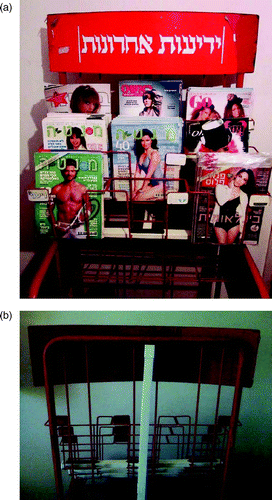
In addition to the continuing implementation for its magazines, Yedioth is performing a pilot of our algorithm on its weekend newspaper. In this implementation, it divides the period (i.e., a single day) into two subperiods, and does the initial distribution at 5:00 am and the supplementary distribution at 11:00 am on the same day.
Using our work, Yedioth implemented a limited risk-pooling method in both time (one supplementary distribution) and space (five retailers pooled using a single sales agent). In the future, the company will likely increase the number of retailers pooled by one sales agent, thereby increasing the risk-pooling effect. As discussed previously, the limitation on the number of retailers being pooled resulted from Yedioth operational and organizational issues; algorithmically, the model can include many more retailers.
Implementation in Another Industry
Following the success of our implementation, an Israeli bread manufacturer and distributer, together with 3ID (a provider of RFID solutions to the retail industry in Israel), implemented the RFID system described above and our algorithms to control its bread distribution chain. In particular, this company is evaluating the system for its specialty breads whose shelf life is several days. Currently the system is operational, and we anticipate that the results will be similar to those achieved by Yedioth.
Summary
In this paper, we describe a large-scale implementation of a new distribution concept of two-phase delayed distribution within the print industry—specifically, the distribution of weekly and monthly print magazines by Yedioth, the largest media group in Israel. The major underlying concept is the addition of a resupply point during the week and the use of real-time sales data to delay the distribution of some magazines and effectively pool inventory among several retailers. The new distribution concept required the development of new models to optimize the distribution and shipment decisions within Yedioth’s distribution network. We analyzed the model and showed analytically that it is convex. Moreover, we developed novel stochastic gradient-based algorithms to solve the resulting optimization model. We implemented the algorithms as decision support tools at Yedioth and they are currently using them to guide the distribution decisions of all its weekly and monthly magazines. The implementation of the new concept included the installation of new IT infrastructure and EDI systems, and in the future will include RFID systems. The models developed were used to assess the cost and benefits of these technologies. The results of the implementation are dramatic. Yedioth achieved major reductions in its production and return levels, whereas sales levels remained the same as they were prior to the implementation.
The models discussed in this paper are relevant to other companies in the print industry and other application domains. Therefore, we believe that our work can lead to additional practical applications. In addition, this work raises interesting theoretical questions with practical importance. For example, for various operational constraints, we added the resupply point in the middle of the distribution cycle. However, computational experiments suggest that this is not necessarily optimal. A study that focuses on the optimal location of an additional resupply point would be interesting. Moreover, the value of additional multiple resupply points is an intriguing issue for future exploration.
The work of the first two authors was supported by The Israel Science Foundation [Grant 1630.10]. The work of the third author is partially supported by National Science Foundation [Grant CMMI-0846554] (CAREER Award) and Air Force Office of Scientific Research [Award FA9550-11-1-0150].
Appendix A. Mathematical Model
In this appendix, we provide a mathematical formulation of the problem using dynamic programming. The formulation uses somewhat nonstandard cost accounting that will turn out to be useful in the analysis of the model, specifically, in showing that the resulting optimization problem is convex. (More natural formulations do not readily exhibit convexity.) We start with a notation list, and then define the problem recursively in three steps, including subproblem 0 that captures the production decisions, subproblem 1 that captures the initial distribution decisions, and subproblem 2, which captures the supplemental distribution decisions after the sales data from the first period of sales are received. In the mathematical model, we assume one sales agent who can supplement each retailer. In particular, and because sales agents do not interact, we solve this model for each sales agent.
We will use the following notation:
c Production cost per unit.
n Number of retailers.
h Holding (disposal) cost per unit unsold at the end of subperiod 2.
b Penalty cost per unit of demand not satisfied (lost-sales cost), including the marginal profit of a lost sale.
Q0 Total production (order) quantity to be used for the two subperiods.
Qt Total number of units left undistributed after subperiod t; t = 1, 2.
The quantity that is delivered to retailer i in subperiod 2.
The on-hand inventory at retailer i after distribution in subperiod t; i = 1, …, n, t = 1, 2.
Li Lost-sales at retailer i at the end of subperiod 1; i = 1, …, n.
Random variable for demand at retailer i in subperiod t; i = 1, …, n, t = 1, 2.
Demand realization at retailer i in subperiod t; i = 1, …, n, t = 1, 2.
xi The net inventory (positive or negative) at retailer i at the end of subperiod 1; i = 1, …, n.
As we mention previously, the formulation we construct uses a nonstandard cost accounting method. Specifically, the lost-sales incurred in subperiod 1 are not charged in subperiod 1, but are charged in subperiod 2. In addition, each xi can receive positive and negative values. Whereas positive values correspond to the amount of physical inventory left at retailer i at the end of subperiod 1, negative values capture the respective lost sales incurred at retailer i during subperiod 1. From an inventory point of view, the formulation uses the fact that xi is negative to set the level of inventory at the beginning of subperiod 2 to zero. We next describe the formulations of the three subperiods, starting with the formulation for subperiod 2.
Subperiod 2 Problem Formulation:
The objective function in Equation (A1) includes two terms. The first term includes two parts. The first part captures the expected subperiod 2 lost-sales and disposal costs. The expected value is taken over the random variable of demand. The second part of the first term is bLi and it captures the lost-sales cost from subperiod 1. Theorem 1 shows that at the optimal solution Li takes on the value corresponding to its descriptive definition. The second term is the disposal cost of the units not distributed to the retailers (i.e., those left with the sales agent at the end of subperiod 2). We can see from Equation (A3) that the quantity that is undistributed in subperiod 2 is equal to the quantity that the sales agent had at the end of subperiod 1 less the quantities that agent delivered to the retailers in subperiod 2. That Li is equal to the lost sales incurred in subperiod 1 implies that if xi is negative, then constraint (A2) is tight and the sum xi + Li in constraint (A4) is equal to zero, which implies that the starting inventory of retailer i is exactly equal to the quantity shipped to that retailer at the beginning of subperiod 2 (i.e., no inventory remains from subperiod 1).
Equations (A5), (A6), and (A7), respectively, ensure that the quantities determined to be short in subperiod 1, and distributed and left at the sales agent at the end of subperiod 2, are nonnegative. There clearly exists an optimal solution in which Q2 is equal to zero (i.e., all the magazines will be distributed to the retailers). This follows from two facts: (1) The magazine might be sold if it is distributed to the retailer, and (2) even if it is not sold, the disposal cost is the same for magazines left unsold, regardless of their location.
The formulation of subperiod 1 captures the decisions on the initial quantities to be delivered to each retailer.
Subperiod 1 Problem Formulation:
The objective in Equation (A8) contains the expected cost to go for subperiod 2. (Observe that we see no holding or disposal costs for inventory kept between subperiods 1 and 2, and that the lost sales are accounted for in the problem of subperiod 2.) Equation (A9) captures the constraint that the quantity left with the sales agent at the end of subperiod 1 will be the initial quantity ordered less the quantities delivered to each retailer at the beginning of the distribution cycle. Equation (A10) ensures that the quantity delivered to each retailer in subperiod 1 will be nonnegative. Equation (A11) ensures that the quantity left undistributed is nonnegative. Note that the total production level Q0 is an input.
Finally, P0 captures the initial production decision.
Subperiod 0 Problem Formulation:
The objective in Equation (A12) consists of the sum of the cost to go (assuming optimal distribution) and the production cost.
In Theorem 1, we show that Li takes on the value corresponding to its descriptive definition. Note that the lost-sales information at retailer i in subperiod 1 is passed to the subperiod 2 formulation through xi. In particular, if there are lost sales, then xi < 0, and −xi is the quantity of lost sales. If there are no lost sales, then xi ≥ 0. In this way, the quantity of lost sales is max(0, −xi).
There exists an optimal solution to P2such that: Li = max(0, −xi) for all i.
We prove Theorem 1 by contradiction. Assume that there does not exist an optimal solution such that for all i. Thus, there exists a problem instance such that for every optimal solution, there exists an i such that . Note that because of constraints (A2) and (A5), it is impossible for ; therefore, . We fix such a problem instance and an optimal solution. For all retailers i for which , modify the solution by simultaneously reducing and by . Denote the new values of these decision variables as and . We note the following:
for all i.
The new solution is feasible. Constraints (A2) and (A5) hold by construction. Constraint (A3) is unaffected. Equality in constraint (A4) is maintained because and both decrease by the same amount.
The objective function does not increase. For each unit decrease in , the objective function is decreased by b, whereas for each corresponding unit decrease in , the objective function is increased by at most b. If the demand distribution has an infinite tail, the objective function is strictly decreased.
Because this new solution is both feasible and has an objective function value that is no more than the optimal solution, we obtain a contradiction to our assumption and the proof of Theorem 1 is completed.
We note that the proof of Theorem 1 will hold under period-specific lost-sales penalty costs whenever b1 ≥ b2. However, if b2 > b1, the theorem no longer holds.
Here, we prove the convexity of the objective functions of our mathematical programming formulations. We use convexity in Appendix B: Solution Algorithm to develop our solution algorithm. The proof of convexity relies on the following lemma (Beck 2010):
Let g(s) = minr{f(r, s): Ar ≤ s}. If f(r, s) is jointly convex in r and s, then g(s) is convex in s.
The function P2 is jointly convex in Q1, x1, …, xn.
It is readily verified that the objective function in the formulation of P2 (Equation A1) is jointly convex in the variables Q2, , and Li. Recall that convexity is preserved under expectation. Now constraints (A2)–(A5) can be written in the form Ar ≤ s, where, and s = (Q1, x1, …, xn). By Lemma 1 it follows that P2 is jointly convex in (Q1, x1, …, xn).
The function P1 is convex in Q0.
It is readily verified from Equation (A8) that the objective function in P1 is convex, because it is the expectation of a convex function, P2 (see Lemma 2). Finally, constraints (A9)–(A11) can be written in the form of Ar ≤ s, where, and s = (Q0, 0, …, 0). Lemma 3 follows from Lemma 1.
The objective function of P0 is convex in Q0.
We prove this theorem by again applying Lemma 1. Examining the objective function of P0, we see from Lemma 3 that it is convex in the decision variable Q0. Examining the constraint, we see that it can be presented easily in the form of Ar ≤ s, where r = Q0 and the vector s is empty. Applying Lemma 1 completes the proof.
Appendix B. Solution Algorithm
Outline of the Algorithm
Before we describe the details of our solution algorithm, we first introduce a mathematical program that combines the problems in subperiods 0 and 1 into a single problem. We denote this problem as P01 and obtain it by simply merging P0 and P1. Note that this is straightforward because no stochastic event is between stages 0 and 1. Moreover, because the total quantity produced is equal to the total quantity delivered to the retailers in subperiod 1 plus the quantity left undistributed (see constraint (A9)), the decision variable Q0 can be removed from the model.
Our goal is to find the optimal value of Yedioth’s decision variables Q1 and . Because the only constraints are nonnegativity and the objective function is convex, we only need to specify the derivative of the objective with respect to the decision variables to build a standard subgradient optimization procedure (see Boyd and Mutapcic 2007). The procedure runs iteratively, where iteration k is as follows:
Start with the current feasible point
and generate a subgradient g(k) at x(k).The next point x(k+1) is found by stepping in the direction of steepest descent, that is, x(k+1) = x(k) − αkg(k), where αk is the chosen step size.
If x(k+1) is infeasible (i.e., has a negative component), we project back to the feasible region. In our case, the projection is relatively simple: and Q1 = max(Q1, 0).
We repeat these steps until the solution converges. It is well known that for suitably chosen values of , such that and , the sequence is guaranteed to converge to a global optimal solution.
Unfortunately, the objective function of P01 (Equation B1) contains the expected optimal value of an optimization problem. There is currently no known method for obtaining explicit expressions of subgradients in this situation. Fortunately, Boyd and Mutapcic (2007) showed that using an unbiased estimator of the subgradient ( such that ) in the previous algorithm is sufficient to guarantee that the algorithm converges to a global optimum with probability 1. We terminate the search when the two-norm of the subgradient is less than 0.01.
Unbiased Estimators of Subgradients
It is left to show how to obtain unbiased estimators of subgradients to the objective function, Equation (B1). The objective function in Equation (B1) includes the expectation of a complex function over the demand of subperiod 1’s (because the first term is linear, subgradients are obtained trivially). However, in some cases, instead of computing the subgradient of the expectation, it is sufficient to compute the expectation of the subgradient (Glasserman 1991). This yields an unbiased estimator if the expectation part of the objective function in Equation (B1) is Lipschitz. This is the case for our problem, because the function is continuous and the partial derivatives are bounded (in absolute value) between b (the most that increasing production by a unit can save) and h (the most that increasing production by a unit can cost). Because the objective function is both convex and Lipschitz, it is sufficient to show how to compute the subgradient of with respect to the decision variables. Recall that is a particular realization of the demands in subperiod 1. More specifically, the estimation procedure is as follows:
Sample from the demand distribution of subperiod 1.
Compute the subgradient of P2 for each sample.
Average these subgradients to obtain an unbiased estimator of the subgradient of the second term of the objective function of P01.
The approach described previously (i.e., using simulation to obtain an unbiased estimator of the subgradient) is not new. In particular, it has been applied to supply chain problems; examples include Fu (1994), Glasserman and Tayur (1995), and Herer et al. (2006).
To carry out our calculations and express P2 as a LP, we use the fact that the demands and inventory levels are discrete. Moreover, the dual of this LP will provide the desired subgradients.
Let m be the number of possible distinct demand realizations at each retailer, denote the jth possible demand value at retailer i as , and denote the probability of its occurrence as . We can then rewrite Equation (A1) as follows:
To write P2 as a LP, we need to linearize the objective function; thus, we denote as and as . The notation can be interpreted as the lost-sales quantity at location i when demand is , and similarly, as the surplus. We add the corresponding standard constraint to the LP (constraint (B4) next). Noting that both b and h are nonnegative, constraint (B4) coupled with the objective function ensures that and will not be simultaneously greater than zero; moreover, they will have the proper meaning in an optimal solution.
We now present the complete LP formulation of P2. We simultaneously present the dual variables for the constraints to facilitate our presentation of the dual problem.
Note that this LP is totally unimodular because it has at most one +1 and one −1 in each column (Hoffman and Gale 1956). Thus, when units are discrete ( , Q1, and xi are all integral), the optimal values of the decision variables will also be integral. As previously mentioned, the dual of the aforementioned LP, which we now present, will be used to generate unbiased estimators for the subgradient of P01 for optimizing the values of Q1 and . To do this, we use the fact, as shown in Ho (2000), which is based on Murty (1983), that the solution for the dual problem can be used to build a subgradient estimator. To aid the reader, the primal variables that correspond to the dual constraints are shown in parentheses:
Examining Equation (B12), we see that λ is the subgradient of Q1 and ti − ki is the subgradient for xi.
The aforementioned analysis provides the subgradient of the second term of the objective function in Equation (B1). Combining this with the gradient information from first term, we see that the subgradient of Q1 is λ + c and the subgradient of is ti − ki + c.
References
- (1958) Redistribution of total stock over several user locations. Naval Res. Logist. Quart. 5(4):337–345.Crossref, Google Scholar
- (2006) If the inventory manager knew: Value of visibility and RFID under imperfect inventory information. Working paper, Stanford University, Stanford, CA.Google Scholar
- (2010) Technion—Israel Institute of Technology, Haifa, Israel. Personal communication with Avrahami and Herer.Google Scholar
- (1997) Introduction to Stochastic Programming (Springer-Verlag, New York).Google Scholar
- (2007) Stochastic subgradient methods. Accessed March 31, 2014, http://see.stanford.edu/materials/lsocoee364b/04-stoch_subgrad_notes.pdf.Google Scholar
- (1981) Centralized ordering policies in a multi-warehouse system with lead times and random demands. Schwarz L, ed. Multi-Level Production/Inventory Control Systems: Theory and Practice (North-Holland, Amsterdam), 51–69.Google Scholar
- (1984) Approximations of dynamic, multilocation production and inventory problems. Management Sci. 30(1):69–84.Link, Google Scholar
- (1994) Sample path derivatives for (s, S) inventory systems. Oper. Res. 42(2):351–364.Link, Google Scholar
- (2007) Item-level RFID in the retail supply chain. Production Oper. Management 16(1):65–76.Crossref, Google Scholar
- (1991) Gradient Estimation via Perturbation Analysis (Kluwer, Norwell, MA).Google Scholar
- (1995) Sensitivity analysis for base-stock levels in multiechelon production-inventory systems. Management Sci. 41(2):263–281.Link, Google Scholar
- (2006) The multilocation transshipment problem. IIE Trans. 38(3):185–200.Crossref, Google Scholar
- (2000) Computing true shadow prices in linear programming. Informatica 11(4):421–434.Google Scholar
- (1956) Appendix to Heller I, Tompkins CB (1956), An extension of a theorem of Dantzig. Kuhn HW, Tucker AW, eds. Linear Inequalities and Related Systems (Princeton University Press, Princeton, NJ), 247–254.Google Scholar
- (1988) Stock allocation in a two-echelon distribution system or “what to do until your ship comes in”. Management Sci. 34(7):880–895.Link, Google Scholar
- (1989) Risk pooling in a two-period, two-echelon inventory stocking problem. Naval Res. Logist. 36(1):1–26.Crossref, Google Scholar
- (1965) Inventory control in N warehouses. J. Indust. Engrg. 16(3):212–215.Google Scholar
- (2007) Unlocking the value of RFID. Production Oper. Management 16(1):40–64.Crossref, Google Scholar
- (2000) The value of information sharing in two-level supply chain. Management Sci. 46(5):626–643.Link, Google Scholar
- (2004) Exploring the impact of RFID on supply chain dynamics. Ingalls RG, Rossetti MD, Smith JS, Peters BA, eds. Proc. 2004 Winter Simulation Conf. (IEEE, Washington, DC), 1145–1152.Crossref, Google Scholar
- (2006) The application of RFID technology in production control in the discrete manufacturing industry. Proc. 2006 IEEE Internat. Conf. Video Signal Based Surveillance (IEEE, Washington, DC), 68.Crossref, Google Scholar
- (1993) Two-interval inventory-allocation policies in a one-warehouse N-identical-retailer distribution system. Management Sci. 39(9):1092–1107.Link, Google Scholar
- (1997) Balancing retailer inventories. Oper. Res. 45(6):820–830.Link, Google Scholar
- (1983) Linear Programming (John Wiley & Sons, New York).Google Scholar
- (2005) New forms of collaboration and information sharing in grocery retailing: The PCSO pilot at Veropoulos. J. Cases Inform. Tech. 7(4):64–79.Crossref, Google Scholar
- (2003) Design for postponement. de Kok AG, Graves SC, eds. Handbooks in Operations Research and Management Science, Volume 11: Supply Chain Management: Design, Coordination and Operation (Elsevier, Boston), 199–226.Crossref, Google Scholar
Assaf Avrahami holds a BSc in mechanical and electrical engineering and an MBA in technological management and marketing from Technion. He holds a PhD degree in the area of industrial management. Avrahami is VP technology and operation at Yedioth group—the company is also running the e-vrit project. Earlier in his career, Avrahami served as a major in the Israeli Navy, CEO of Yedioth communication press (the printing company of Yedioth group), and was the CEO of Yedioth information technology.
Yale T. Herer, BS (1986), MS (1990), PhD (1990), Cornell University, Department of Operations Research and Industrial Engineering. Herer is an associate professor in the Faculty of Industrial Engineering and Management at Technion—Israel Institute of Technology and is serving as head of the industrial engineering area. Herer joined Technion in 1990 immediately after the completion of his graduate studies. In 1997, he moved to the Department of Industrial Engineering at Tel-Aviv University and in 2001 he returned to the Technion. During the 2004–2005 academic year he spent a sabbatical at Northwestern University in the Department of Industrial Engineering and Management Sciences. During the 2011–2012 academic year he spent the fall semester on sabbatical at INSEAD in the Technology and Operations Management Area. Herer also briefly visited Cornell University in the Department of Operations Research and Industrial Engineering in the summer of 2000. He has worked for several industrial concerns, both as a consultant and as an advisor to project groups. Herer is a member of INFORMS, the Institute of Industrial Engineers (IIE), and the Operations Research Society of Israel (ORSIS). He currently serves as treasurer of ORSIS. He also serves as an associate editor for Naval Research Logistics and has served on the editorial staff of IIE Transactions and Operations Research Letters. Herer’s research interest can be broadly defined as covering production planning and control. He has won various prizes including a 1996 IIE Transactions Best Paper Award, the 2002 Michener Award in Quality Sciences and Quality Management, a 2008 IBM Faculty Award, and most recently INFORM’s 2013 Daniel H. Wagner Prize for Excellence in Operations Research Practice.
Retsef Levi is the J. Spencer Standish (1945) Professor of Management, professor of operations management at the Sloan School of Management, MIT. He is a member of the Operations Management Group at Sloan and affiliated with the Operations Research Center and the Computation for Design and Optimization Program. Before coming to MIT, he spent a year in the Department of Mathematical Sciences at the IBM T.J. Watson Research Center as the holder of the Goldstine Postdoctoral Fellowship. He received a bachelor’s degree in mathematics from Tel-Aviv University (Israel) in 2001, and a PhD in operations research from Cornell University in 2005. Levi spent more than 11 years in the Israeli Defense Forces as an officer in the Intelligence Wing. After leaving the military, Levi joined and emerging new Israeli hi-tech company as a business development consultant. Levi’s current research is focused on the design and performance analysis of efficient algorithms for fundamental stochastic and deterministic optimization models, arising in the context of supply chains and inventory, revenue management, logistics and healthcare management. Levi has special interest in cost-balancing techniques, data-driven (sampling-based) algorithms, and modern linear-programming-based approximation techniques. Levi is leading several collaborative research efforts with some of the major academic hospitals in the Boston area, such as Massachusetts General Hospital (MGH) and Beth Israel Deaconess Medical Center (BIDMC). Levi received the NSF Faculty Early Career Development award, the 2008 INFORMS Optimization Prize for Young Researchers, and the 2013 Daniel H. Wagner Prize.
This article appears in INFORMS Analytics Collections Vol. 15: 25 Years of INFORMS.
Visit this collection for free access to more articles showcasing the evolution of INFORMS over the past 25 years.