

Request Username
Can't sign in? Forgot your username?
Enter your email address below and we will send you your username
INFORMS disseminates accepted articles through multiple publication stages, including Just Accepted, Articles in Advance, and final issue publication. Just Accepted articles are preliminary, unedited versions posted shortly after acceptance and are not considered the final version of record. The copyedited, typeset version of an article becomes the version of record once disseminated through Articles in Advance and/or issue publication. Once articles have been released online ahead of print, they can only be removed from Articles in Advance by assigning them to an issue. If an error in a published version of record is discovered, a correction, erratum, or retraction may be published.
A correction is appropriate for small errors or oversights that can be easily incorporated into the online version of record and would not affect the editorial integrity of the article. Examples include minor typographical errors, minor mathematical notation errors (such as mis-formatted exponents), misspelling of a co-author’s name, or adding inadvertently omitted funders. Any correction applied to a published article must, without exception, be accompanied by a correction box, generally inserted on the final page of the article, notifying the readers of the change(s) made to the article since it was originally published; if the correction is the result of notification by a third party, the correction should recognize the contribution of the researcher(s) who raised the issue. The first page of the corrected article will be revised to carry notice along the top margin that this is now a corrected version of record and to see the final page for details about what has changed.
An erratum (sometimes referred to in scholarly publishing as a corrigendum) is a separately published notice documenting significant errors identified in a previously published article, along with their corrections. Because an erratum may impact the editorial conclusions reported in the original article, all errata must be approved by the journal’s editor-in-chief. Once approved, an erratum will be published in the next available issue and will be linked to the original article as technology allows.
A retraction carries a stronger connotation than the terms correction and erratum. An alteration that changes the main point of the original statement is generally referred to as a retraction whereas an alteration that leaves the main point of a statement intact is usually referred to as a correction or erratum. In scholarly publishing, a retraction indicates that the original article should not have been published and that its findings or conclusions should not be relied upon as part of the foundation for future research. Common reasons for retraction include research misconduct, serious error, ethical violations, compromised peer review, or other circumstances that materially undermine the reliability or integrity of the published work.
Corrections and errata are generally initiated by the authors of the published paper. Retractions may be initiated by the authors or by the publisher.
If a party other than the original author(s) identifies an error in a published article, that party is encouraged, where appropriate, to first notify the author(s) of the perceived error. (If all original authors are deceased, the party may directly notify the editor-in-chief, editorial office, or publisher.) At the original authors’ discretion, they may initiate a correction, erratum, or retraction (as appropriate) by contacting the journal editor-in-chief, editorial office, or publisher. If, after notification, the original authors are non-responsive or choose not to pursue a correction, erratum, or retraction, the party may pursue publication of a comment detailing the perceived error. A comment must be submitted to the journal via its submission system and will be peer-reviewed for acceptance or rejection, and the authors of the original publication will be offered the opportunity to publish a response alongside the comment. See Comments and Responses for additional information.
A comment is a short article whose primary purpose is to identify or analyze a non-trivial issue in another author(s)’ previously published work. A comment should have evidence or data to support the claims and must not contain defamatory, harassing, or otherwise inappropriate content. A comment must apply to an article previously published within the same journal; comments may not be pursued regarding articles published by another journal. A comment may only be pursued in instances where the original authors are unwilling or unable to respond to the proposed correction.1 Comments must be submitted to the journal via its submission system, along with a cover letter detailing the commenting author’s communication with the original author and disclosing any potential conflicts of interest. Comments will be peer-reviewed for acceptance or rejection. Whenever appropriate, the editor may invite one or more of the original article's authors to provide input during the evaluation process. Once a comment has been accepted, the original article’s authors will be given the opportunity to publish a response alongside the comment.2
A response (sometimes referred to as a rejoinder) is a short article acknowledging or rebutting the perceived error. The response must be submitted to the journal via its submission system and will be peer-reviewed for acceptance or rejection. At the editor’s discretion, the commenting author may be presented the opportunity to submit a reply, to be published alongside the comment and response. In all instances, the authors will be provided a reasonable deadline to respond and be notified that if they do not provide a response, the critique will be published regardless. In most instances, comments, responses, and replies will be published simultaneously under separate DOIs and will be linked to one another and the original article via the “Related” tab on each item’s article details page.
Submitted comments deemed to be ethically suspect (for example, frivolous, libelous, or resulting from a personal vendetta) may be subject to investigation and sanction as a violation of publishing ethics.
In determining the appropriate post-publication action, the journal will consider:
A change will be considered minor if it does not affect the editorial integrity of the article or significantly impact the current typesetting of the article (for example, adding or removing figures or multiple lines of text). In these instances, the changes will be made to the online version and will be detailed in a correction box at the end of the paper. A notice will be added within the top margin of the first page of the article to notify readers of the change, and an “updated” date will be added to the history of the paper (see Article Update Notices below). A published erratum is generally not warranted for a minor change.
A change will be considered major if it may impact the conclusions of the article or cannot be easily incorporated into the current typesetting of the article. In these instances, the changes will not be made to the online version, but instead be detailed in an erratum to be published in the next available issue (for example, see http://doi.org/10.1287/moor.2015.0750). If an erratum is published, both the article and erratum will be linked to one another via the “Related” tab on each item’s article details page.
If an editor-in-chief concludes that an error meets the qualifications for a retraction, the editor will provide a retraction statement. (In instances in which the retraction originates from the authors, the editor may collaborate with the authors on the retraction statement.) The retraction statement will replace the article online and be published with the original article’s DOI. The original authors and title will remain part of the retraction’s metadata. Any links to the retracted article will lead readers to the retraction statement. Additionally, the retraction statement will be published in the next available issue.
When an article is updated following online publication, the following text will be added to the top of the title page in bold type:
CORRECTED VERSION OF RECORD; SEE LAST PAGE OF ARTICLE
A correction box detailing all changes made to the article will be added after the article's reference section.
For corrections that will not be followed by an erratum, the correction box shall be worded similar to the example below:

For corrections that will be followed by an erratum, the correction box shall be worded similar to the example below:

Should any correction be made following publication as an Article in Advance, all online publication dates will be displayed in the final published version of record as follows:
Published online in Articles in Advance February 18, 2009, and updated May 1, 2009
For articles with major changes which cannot be corrected in the online version and for which an erratum has been issued, the following text will be added to the top of the title page in bold type:
AN ERRATUM EXISTS FOR THIS ARTICLE, SEE http://doi.org /10.1287/moor.2015.0750
Both the article and erratum will be linked to one another via the “Related” tab on each item’s article details page:
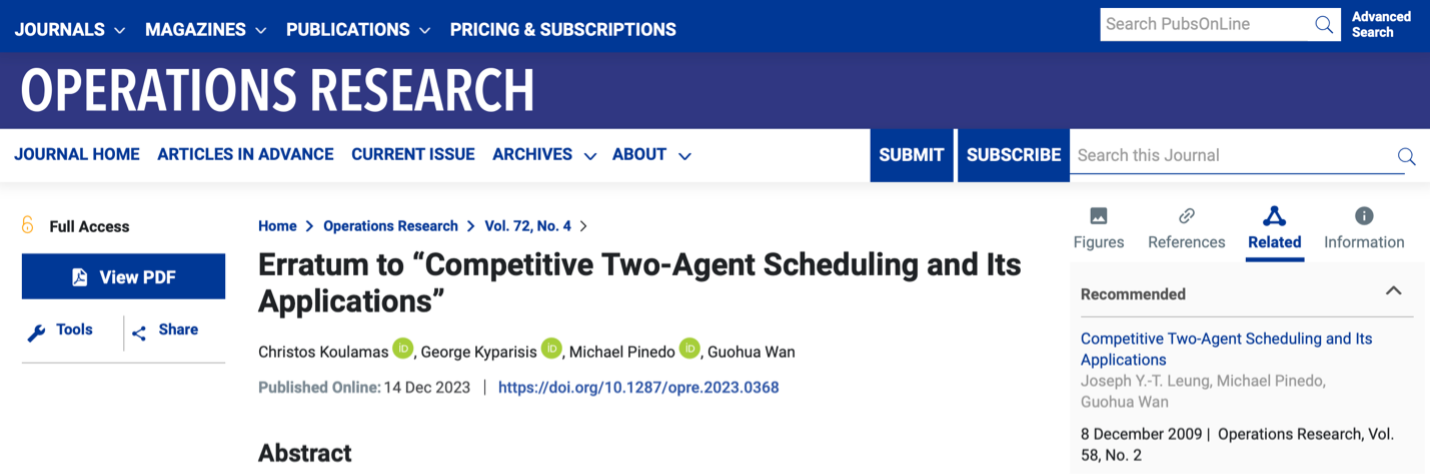
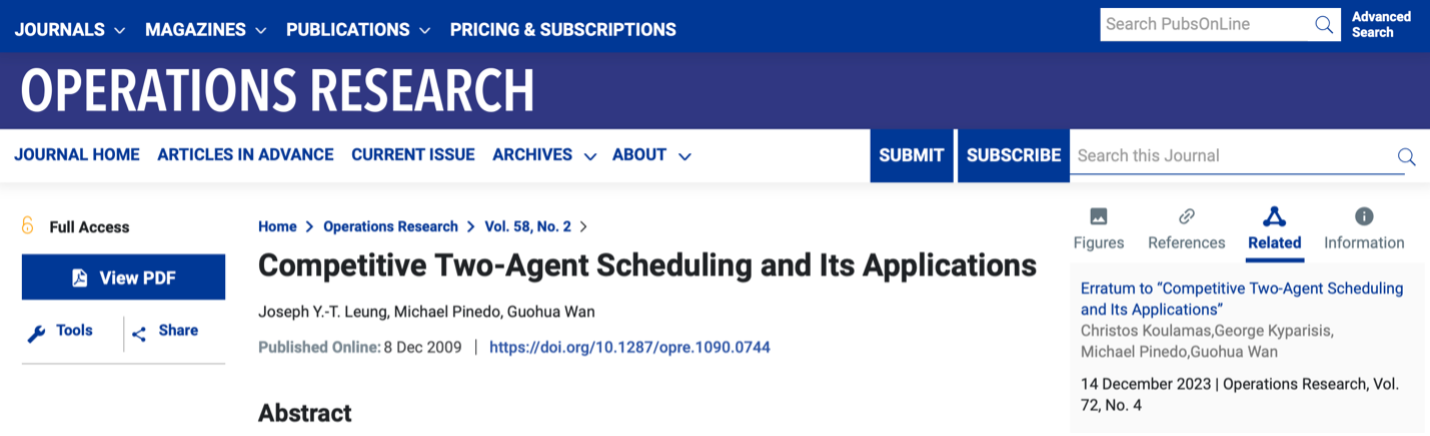
The title of an erratum should be formatted as follows:
Erratum to “Article Title”
If the erratum is being published in a different journal than the original article (such as in multi-journal collaborations or cross-publication corrections), or if multiple versions of the article exist in the publication record, the format should be extended to:
Erratum to “Article Title” (Journal Title, Year, Volume #, Issue #)
The title of a comment should be formatted as follows:
Comment on “Article Title”
The title of a response should be formatted as follows:
Response to “Comment on ‘Article Title’”
In all cases, the full citation (author names, article title, journal title, year of publication, volume, issue, and page range) must appear somewhere within the erratum, comment, or response text.
1 An author may be deemed non-responsive only after a reasonable attempt at communication has failed.
2 If the original authors choose not to prepare a response, the editor may, at his or her discretion, publish an editor’s note alongside the comment explaining the absence of a response.
Updated July 18, 2026.