Case—Digitizing Spare Parts Supply Chain via 3D Printing: An Operational Cost Analysis
1. Introduction
Specialty Electronics Company (SE) is a global original equipment manufacturer (OEM) with headquarters in Munich (Germany), San Jose (CA), Shanghai (China), and Tokyo. One of its divisions, SE Energy, is headquartered in San Jose, and specializes in energy-related products and services. Among the long-standing product lines of SE Energy is its high-voltage equipment, including transformers, circuit breakers, switches, and other components used in power transmission and distribution systems. SE Energy’s customer base includes utilities, power generation companies, industrial plants, and other organizations that require high-voltage equipment to operate their facilities.
You have just accepted a rotational internship at SE, where your first role is an intern analyst in the after-sales service department of SE Energy. The division head has approached you for assistance in analyzing a pressing sourcing problem as described in Section 2.
2. The Sourcing Problem
SE Energy is preparing to enter the emerging market of Budostan in South America with a focus on serving utility firms. However, the absence of existing manufacturing facilities in Budostan presents a significant challenge for its after-sales service department. Specifically, the division must determine how to supply service parts following equipment installations, as failure to do so in a timely manner can result in costly equipment outages for the utility firms with potential fines from the local government. The equipment used in this market typically consists of numerous parts, with one type of transformer requiring up to 36 molded parts. As these parts wear out over time, prompt replacement is critical to avoid disruptions in service. Providing high-quality after-sales service for spare parts is therefore a crucial element of SE Energy’s marketing strategy in Budostan, as it seeks to gain a competitive edge in this emerging market.
SE Energy has identified three potential solutions to its sourcing challenge:
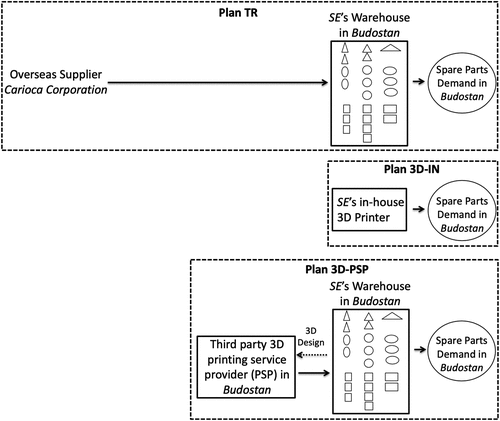
Plan TR—to order spare parts from its long-term supplier Carioca Corporation, which is located overseas in Asia and possesses traditional manufacturing capabilities, and stock spare parts at SE Energy’s local warehouse in Budostan.
The production time of traditional manufacturing technologies, such as injection molding, is typically long. The geographic distance between Carioca Corporation and Budostan only exacerbates this challenge, with cargo transportation times adding several weeks to order lead times. Expedited shipping (such as by air) is not feasible because of the high costs and order size restrictions. Moreover, traditional manufacturing incurs high setup costs, which, coupled with the long order lead times, results in high inventory holding costs. SE Energy currently stocks a vast number of different parts to offer part replacement service for its numerous equipment models, resulting in a significant inventory investment, especially when accounting for high scrapping rates.
Plan 3D-IN—to set up an in-house three-dimensional printer (3DP) at Budostan that prints spare parts on demand.
Three-dimensional printing, also known as additive manufacturing, has gained widespread popularity as a manufacturing method. Originally designed and used for rapid prototyping and tooling, it has more recently been used for the production of functional parts. According to Research and Markets (2022), the 3DP market is expected to expand at a compound annual growth rate 20.8% from 2022 to 2030 and reach a global market size of $76.17 billion by 2030. Unlike traditional manufacturing (also known as subtractive manufacturing), 3DP builds parts layer by layer based on 3D computer-aided design (CAD) files without the need for mold tooling, jigs, fixtures, or cutting tools. Because of its flexibility in small-scale production and high customization capabilities, 3DP has the potential to shift supply chains from global networks that rely on centralized mass production with traditional manufacturing technologies to mainly digital networks with distributed, customized, small-series 3DP.
The flexibility of 3DP, because of its minimal setup cost, enables the economic viability of printing only the parts that are needed. By deploying a 3DP locally in Budostan, SE Energy can print spare parts on demand, eliminating the need for physical inventory storage. However, SE Energy’s team has raised concerns about the variable cost and speed of 3DP. The unit production cost of a part using 3DP technology can be higher than that of traditional manufacturing because of the latter’s economies of scale. The printing time of a part (varying from hours to a couple of days) can also be a limiting factor in the trade-off between immediate availability from spare parts inventory and waiting for 3DP.
The answers to these concerns depend on the criticality of the part and its inherent heterogeneity. Waiting for the printing of a critical part that causes equipment underperformance or complete outage can be more costly than waiting for a noncritical part. The waiting time for a printed part also varies based on how long it takes to complete the printing process. Additionally, when multiple parts are sourced from the in-house 3DP, their waiting times are interdependent. As the printer becomes congested, waiting times for subsequent orders increase.
Plan 3D-PSP—to order from a nearby third-party 3D printing service provider (PSP) and stock spare parts locally at Budostan.
Plan 3D-PSP is feasible with the emergence of 3DP platform services offered by companies such as Dassault Systèmes, SAP, Siemens (Supply Chain Research Team 2018), and Fieldmade Digital Inventory (Fieldmade 2020). By leveraging the services of a local or nearby PSP, SE Energy can adopt 3DP without the need to own expensive printing equipment. Moreover, capacity is no longer an issue compared with Plan 3D-IN as most PSPs have multiple printers and serve numerous customers, meaning SE Energy’s orders do not significantly add to the PSP’s workload. Consequently, lead times for orders are usually constant, regardless of order size. For example, the lead times quoted for 1, 10, and 100 parts from various suppliers on the Marketplace of 3DEXPERIENCE (Dassault Systèmes 2020) are identical.
However, the pricing of PSPs affects SE Energy’s cost formula. The unit printing price may vary depending on the part being printed, and is driven by the cost of 3DP. For each order, a fixed ordering cost is paid to cover order processing and shipping. This fixed cost is generally lower than that of Plan-TR, owing to the negligible setup cost of 3DP and the proximity of the local PSP. Consequently, SE Energy’s order size from the PSP will be smaller than when ordering from Carioca Corporation, leading to a lower level of spare parts inventory held locally in SE Energy’s warehouse.
Figure 1 summarizes the three sourcing plans being considered.
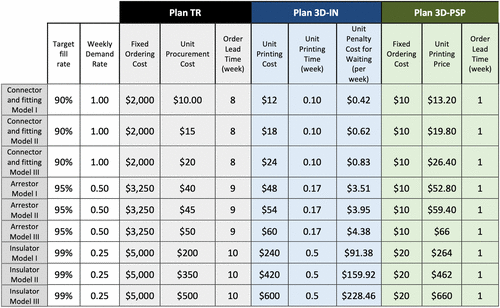
SE Energy’s after-sales team has conducted a thorough investigation of the status quo of 3DP technology and screened the technical specifications of all parts used in their products. Through this process, the team has identified candidate parts that are suitable for 3DP using currently available technologies. The printed version of these parts possesses sufficient quality to pass functionality testing with the desired strength and technical properties. The identified parts fall into three categories: connectors and fittings, arrestors, and insulators. Within each category, the after-sales team has further classified the parts with similar cost and printing parameters to streamline the selection process.
As a result, all candidate parts have been organized into nine groups. Within each group, the parts can be considered identical. The details of part specifications and cost parameters for each of the three sourcing plans are listed in Figure 2. Each plan has its own set of advantages and disadvantages. Therefore, it is necessary to assess each plan and provide sourcing recommendations for the nine groups of parts. For each group, only one sourcing plan can be chosen, and multiple sourcing plans cannot be selected for the same group. However, plans for different groups can differ.
As an intern analyst, what sourcing plans would you recommend for these nine groups of parts and why?
3. The Manufacturing Problem
SE Environment is another division of SE that specializes in environmental sectors. In recent years, SE Environment has ventured into the burgeoning market of environmental monitoring systems and is currently developing a new water monitoring system. The system is designed to monitor and analyze water quality to ensure compliance with environmental regulations. Following your successful completion of tasks in SE Energy, you will take on the role of product manager in the manufacturing group of SE Environment.
As the product manager, you will be responsible for deciding the manufacturing strategy for the new water monitoring system, which consists of electrical components and a plastic casing designed to keep them dry. The electrical components must be manufactured in-house using proprietary technology. Traditionally, the plastic casing would be produced using plastic injection molding (PIM). Recently, SE Environment’s global research center has offered to transfer an industrial 3DP using fused deposition modeling to the manufacturing group, which meets the technical requirements for the plastic casing.
3DP has lower ordering and tooling costs than PIM, but the unit production costs are typically higher. In particular, the manufacturing group has estimated that the total upfront costs for 3DP and PIM are $500 and $5,500, respectively, and the unit production costs are $15/unit for 3DP and $5/unit for PIM. For each production order, 3DP incurs a fixed cost of $10 and has a lead time of 3.5 days. In contrast, PIM incurs a fixed cost of $200 per order and has a lead time of 30 days. Moreover, PIM dictates an annual maintenance cost of $200, whereas that cost is negligible for 3DP.
As the product manager, your responsibility is to determine the most cost-effective manufacturing method. Specifically, you need to assess whether PIM or 3DP is the better option if the expected production volume is 125 units per year for five years, resulting in a total of 625 parts. A target service level of 95% has been set by the manufacturing group. Moreover, inventory holding costs are estimated to be $1.85/(unit⋅year) for 3D-printed casings, and $0.95/(unit⋅year) for injection-molded casings. To evaluate the cost-effectiveness of each method, a total cost metric has been adopted that takes into account costs throughout the entire life cycle of the part. Your decision will have a significant impact on the overall cost of manufacturing the new water monitoring system and ultimately its success in the market.
The daily demand for the part is characterized by a Poisson process with a mean demand rate of λ units per day. The lead time demand can be approximated reasonably by a normally distributed random variable with mean λL and standard deviation . The division head needs your help in analyzing whether to use 3DP or PIM to produce the plastic casing. The analysis will have a significant impact on the efficiency of the manufacturing process and the ability to meet customer demand.
References
Dassault Systèmes (2020) 3DEXPERIENCE Make: On-demand manufacturing. Accessed April 14, 2020, http://make.3dexperience.3ds.com.Google ScholarFieldmade (2020) Fieldmade digital inventory. Accessed August 4, 2020, https://fieldmade.no/digital-inventory.Google Scholar- Research and Markets (2022) 3D printing market size, share & trends analysis report by component (hardware, software, services), by printer type, by technology, by software, by application, by vertical, by region, and segment forecasts, 2022-2030. https://www.researchandmarkets.com/reports/4375433/3d-printing-market-size-share-and-trends-analysis.Google Scholar
- Supply Chain Research Team (2018) From cd to 3d: Why ship atoms when you can transmit bits? Gartner (October 26) https://www.gartner.com/en/supply-chain/insights/beyond-supply-chain-blog/cd-3d-ship-atoms-can-transmit-bits.Google Scholar