Case Article—Digitizing Spare Parts Supply Chain via 3D Printing: An Operational Cost Analysis
Abstract
The case presents a sourcing problem and a manufacturing problem faced by an original equipment manufacturer, seeking recommendations for sourcing a diverse range of parts for high-voltage equipment, as well as making decisions on the manufacturing strategy for a component used in a water monitoring system. The case provides an opportunity to explore the qualitative and quantitative aspects of three-dimensional (3D) printing versus traditional manufacturing, specifically in terms of operational cost. Furthermore, this case facilitates discussions on the potential impact of 3D printing on supply chains. It is suitable for use in graduate and undergraduate courses, as it introduces key concepts such as manufacturing and inventory policies, queueing theory, and life cycle analysis. Ultimately, the case is designed to promote a deeper understanding of the challenges and opportunities that manufacturers face in today’s rapidly evolving technological landscape.
Supplemental Material: The Teaching Note and supplemental data are available at https://www.informs.org/Publications/Subscribe/Access-Restricted-Materials.
1. Introduction
The invention of the internet and subsequent digitization have substantially transformed many industries. In the manufacturing sector, we are currently experiencing an industrial revolution known as Industry 4.0. This revolution involves the digitization of production through the use of three-dimensional (3D) printing, artificial intelligence, and the internet of things. As a result, physical inventory is being replaced by digital inventory, and there is a shift from centralized mass-manufacturing to distributed, customized, small-series production (Newman 2017, Yin et al. 2018, Olsen and Tomlin 2020, Sertoglu 2021). Although these concepts can be introduced through lectures, problem-solving within context offers a potentially richer learning experience. Successful problem-solving involves making decisions that take into account the problem context and the underlying trade-offs. The trade-offs and solutions may vary depending on the product type and the phase of its life cycle. Consequently, there is no unified answer, and decisions must be made based on an analysis of problem data.
This case study centers on the impact of 3D printing on the spare parts industry. It is derived from the authors’ interaction with industry partners and their related research work (Song and Zhang 2020, Song et al. 2021, Song and McCall 2022, Zhang et al. 2022). The case study aims to simulate the problem-solving experience of analysts and managers in the face of emerging technologies, and is designed to help build the skill set needed to understand the underlying trade-offs and guide the decision-making process. The emphasis is on analyzing operational costs, and the scope and depth of the analysis can be adjusted to range from qualitative to quantitative and suit different student backgrounds, teaching methods, and time constraints.
This case study is ideal for both undergraduate and graduate students, including those pursuing a Master of Business Administration (MBA) or a specialty master, and is intended to foster classroom discussions on operations strategy and the impact of advanced technologies, such as 3D printing, on the future of supply chains. Additionally, it can be used to teach a general trade-off analysis framework that can be applied in various contexts beyond 3D printing. This case is flexible enough to be tailored to different program levels in business, economics, mathematics, or engineering, including operations research and management science. It provides an introductory education on fundamental concepts in operations management, such as product life cycle, centralized/decentralized manufacturing, make-to-stock (MTS), make-to-order (MTO), inventory costs, economic order quantity (EOQ), reorder-point, order-quantity (r, Q) policy, and queueing theory.
2. Overview of the Case
The case study is designed to simulate a rotational internship at a fictitious global original equipment manufacturer called Specialty Electronics Company (SE). The company has a division, SE Energy, which focuses on energy-related products and services, and another division, SE Environment, which focuses on environmental sectors. The case study consists of two problems: the Sourcing Problem and the Manufacturing Problem.
The Sourcing Problem takes place in SE Energy’s after-sales service department and requires sourcing recommendations for a variety of parts used in high-voltage equipment. The problem is accompanied by an interactive spreadsheet with all calculations already built in, and more involved contents are provided as supplemental material. The instructor can choose whether to provide any of these materials, depending on the students’ technical background.
The Manufacturing Problem takes place in SE Environment’s manufacturing group and looks at the decision on the manufacturing strategy for a single component used in a water monitoring system. This problem comes with a spreadsheet that allows students to gain hands-on experience with break-even cost analysis. It is best suited for students with a basic understanding of inventory-related cost assessment.
The authors were motivated to create the Sourcing Problem based on their consulting experience with a global original equipment manufacturer. The total cost framework used in the Manufacturing Problem has been implemented in a digital manufacturing software, providing total cost of ownership analysis for 3D printing customers. The data for this case were created based on disguised data under similar contexts from academic literature and industry reports.
3. Teaching Objectives
The teaching objectives include the following:
understanding of the fundamental difference between 3D printing and traditional manufacturing, for example, fixed and variable costs, flexibility in order quantity, capacity constraint, etc.;
understanding of product life cycle and the characteristics of different phases in a life cycle, and conducting total cost analysis using the formula and spreadsheet provided;
(optional) introduction and/or in-depth learning of the more involved concepts such as MTS, MTO, inventory policy and cost assessments, queueing theory (expected waiting time, multiclass queue, priority rules, etc.), and derivation of total cost analysis—the supplemental material in the case can be used to fulfill the optional objectives.
4. Teaching Suggestions
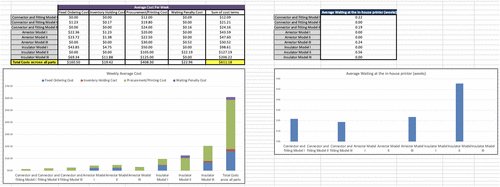
The case can be used either as an after-class assignment or as an in-class activity. Prior to the case being assigned, students are expected to have a basic understanding of concepts such as EOQ, inventory costs, Poisson distributions, (r, Q) policy, and queueing. This knowledge could have been acquired through a prerequisite course or earlier classes in the current course. When used as an assignment, the case can serve as either individual assignments or group assignments. When used as an in-class activity, we suggest devoting at least one class session (60–75 minutes) to each problem of the case. Although the two problems are framed in the story of a rotational internship, they are not necessarily taught in the sequence as appeared in the case. The sequence can be tailored to suit the instructor’s course content. The two problems are not necessarily taught together, either. The instructor can teach and/or assign them separately, depending on the time allowed. For students with little background on multiclass queue, we suggest providing them with the spreadsheet for the Sourcing Problem. The students can input their choice of sourcing plan in the spreadsheet as shown in Figure 1, and the spreadsheet will automatically generate performance metrics resulting from the student’s choice, displayed in both tables and histograms as shown in Figure 2.

4.1. Preparing for In-Class Use
If the case is used as an in-class activity, we recommend posting the case study along with fact-checking questions before class and requiring students to prepare short answers in advance. This way, they are better prepared to participate, which will ensure a minimal level of familiarity with the problems, and enable a more fruitful discussion in class. For example, for the Sourcing Problem, students can be asked to discuss the advantages and disadvantages of the three sourcing plans, and how these factors can affect their recommendation for the variety of parts under consideration as a preclass activity; for the Manufacturing Problem, students can be asked to discuss the advantages and disadvantages of the two manufacturing technologies as the component goes through different phases of its life cycle.
When students work in teams, the instructor can specify in advance one of the two problems for each team to present in class with their analysis and results. This can help foster students’ participation and learning from the others. Leveraging online discussions or other collaborative technologies may also facilitate higher student engagement, for example, by requiring students to post their sourcing recommendation (for the Sourcing Problem) and their choice of manufacturing technology (for the Manufacturing Problem), or to discuss relevant insights gleaned from their problem-solving experience.
5. Classroom Experience
The case was utilized in an undergraduate core course for students majoring in supply chain management. Prior to assigning the case, the class delved into an in-depth coverage of diverse inventory models, including EOQ, Newsvendor, and multiperiod models with random demand for approximately four weeks. The case was assigned as a team project with access to spreadsheets and supplemental material, and the instructor provided an instructional video (about 20 minutes) to introduce the case and its requirements. The broad applicability of the case was identified as a strength by the instructor, providing an opportunity for students to navigate the entire problem-solving process from identifying trade-offs to reaching optimal recommendations. The case’s strengths also include a variety of concepts in operations management for students to explore and gain experience in analyzing practice-based problems.
The students were given about six weeks to work on the case, and the deliverable was a report that included their recommendations, justifications, and feedbacks. They appreciated the exposure to 3D printing technology and enjoyed actively thinking through the problems by putting on the hats of intern analyst and product manager to make decisions. Most of them thought the sourcing problem to be straightforward and found it interesting that a small change in the sourcing plan may lead to significant cost increase. Some found the manufacturing problem to be a bit challenging in breaking down the various types of costs, and many were interested in the changes resulting from the simulated phases of the product’s life cycle. Overall, they enjoyed seeing how the basic inventory models they had learned in previous classes could be applied to guide important sourcing and manufacturing decisions.
An earlier version of the Manufacturing Problem was incorporated into a one-hour session for master’s-level business students after they had learned about three basic inventory models: EOQ, Newsvendor, and the r, Q model with a constant lead time. Prior to the session, the case and spreadsheet were posted online, and students were asked to submit their answers to questions (a) and (b) for the Manufacturing Problem. (The suggested questions are provided in the teaching note for the case.) The session was divided into three parts. In the first part (10 minutes), the potential impact of 3D printing on spare parts supply was discussed. The second part (35 minutes) reviewed the students’ analyses, followed by the instructor’s presentation of the analysis for questions (c) and (d). In the third part (15 minutes), the instructor led discussions on why the conclusions for different stages of the product life cycle differ followed by an open discussion on question (e) in terms of other issues not considered in the model, such as environmental impact.
The authors thank the Editor-in-Chief, Stefan Creemers, and the review team for their constructive feedback for the case study. The authors also thank the participants at the 2022 INFORMS Case Competition for helpful discussions on the subject.
References
- (2017) Top 5 digital transformation trends in manufacturing. Forbes (August 8), https://www.forbes.com/sites/danielnewman/2017/08/08/top-5-digital-transformation-trends-in-manufacturing.Google Scholar
- (2020) Industry 4.0: Opportunities and challenges for operations management. Manufacturing Service Oper. Management 22(1):113–122.Link, Google Scholar
- (2021) 3YOURMIND joins project DIAMOnD to advance distributed 3D printing technology. 3D Printing Indust. (April 30), https://3dprintingindustry.com/news/3yourmind-joins-project-diamond-to-advance-distributed-3d-printing-technology-189374/.Google Scholar
- (2022) 3D printing spare parts. A scalable total cost framework for sourcing decisions. Supply Chain Management Rev. (March 6), https://www.scmr.com/article/3d_printing_spare_parts.Google Scholar
- (2020) Stock or print? Impact of 3D printing on spare parts logistics. Management Sci. 66(9):3860–3878.Link, Google Scholar
- (2021) Building a total cost framework for 3D printed parts. Supply Chain Management Rev. (November 11), https://www.scmr.com/article/building_a_total_cost_framework_for_3d_printed_parts.Google Scholar
- (2018) The evolution of production systems from industry 2.0 through industry 4.0. Internat. J. Production Res. 56(1–2):848–861.Crossref, Google Scholar
- (2022) Distributed 3D printing of spare parts via IP licensing. Manufacturing Service Oper. Management 24(5):2685–2702.Link, Google Scholar