Case Article—Prescriptive Analytics for Entrepreneurial Growth: Data-Driven Strategic Decision Making at iParty Bangkok Co., Ltd.
Abstract
This case centers around the dilemma faced by the female owner of a balloon decoration business: whether to outsource transportation of balloon arrangements to third-party providers or handle the transportation of some orders in house. The case illustrates a path to answering the strategic business question through solving a sequence of vehicle routing problems (VRPs) of increasing complexity. The focus of the case is not only on solving VRPs, but also on teaching a practical framework for (1) framing a business problem as a prescriptive analytics problem; (2) researching appropriate concepts, prior publications, and tools; (3) setting up an optimization problem formulation, estimating the necessary inputs, and obtaining a solution; (4) deciding on the appropriate level of formulation complexity needed; and (5) mapping the results from the models to a response to the original business question. Realistic data and Excel models and are provided. The case is appropriate for use in courses in optimization, operations research, and business analytics at either the advanced undergraduate or master’s/MBA level.
Supplemental Material: The Teaching Note and supplemental data are available at https://www.informs.org/Publications/Subscribe/Access-Restricted-Materials.
1. Introduction
Numerous studies emphasize the importance of project-based learning in analytics education (Armacost and Lowe 2003, Behara and Davis 2010, Hillon et al. 2012, Pilotte et al. 2012, Aserkar 2013, Dobson and Tilson 2016, Gorman 2018, Konrad et al. 2018, Sanders Jones et al. 2021, Pachamanova et al. 2022). One of the main benefits to students is learning how to scope, frame, and solve ill-defined problems (Armacost and Lowe 2003). At the same time, there is a cost to experiential project-based learning in particular: industry projects can be too ill-defined for students to gain the intended experience, necessary data access can be problematic, student backgrounds may not be sufficient to solve the problem they ultimately identify, and faculty advisor expertise can be difficult to match to industry projects (Konrad et al. 2018). Surrogate experiential learning, in which students experience the process of framing, scoping, and solving a problem in a controlled environment, can be a lower cost solution to attain specific learning goals in an analytics course in which students are still building foundational problem-solving skills and learning about analytical techniques (Hoover and Whitehead 1975, Gentry 1990, Joshi et al. 2005, Pachamanova 2015). A project-based experience can be simulated by specifying a business problem in an open way and letting students discover necessary information by actively asking questions; researching on their own; and incorporating feedback from their peers, instructor, and possibly a broader audience along the way (Duch et al. 1998, Erzurumlu and Rollag 2013, Pachamanova 2015).
The case accompanying this article takes a surrogate experiential learning approach to teaching optimization formulations, prescriptive analytics, and data-driven decision making. It is based on an existing small business, iParty Bangkok Co., Ltd. (iPB), that is currently grappling exactly with the questions posed in the case. The core of the business is building customized balloon arrangements for customers’ parties to celebrate life events such as birthdays, weddings, and anniversaries. Ever since owner Mint Sirich acquired the business, she has focused on improving operations and customer relations, and iPB now enjoys a strong reputation for service quality and reliability. iPB’s significant business growth in recent years presents both challenges and opportunities. Mint is looking to address iPB’s operational challenges using data and sound analytical tools. Her current dilemma is whether to use third parties for customer deliveries or execute at least some deliveries with the company van. Mint has the feeling that the van should be used but is not sure how to assess the benefits of the options available to her.
The case can be used for project-based learning; however, it is structured so that it can be integrated with foundational, advanced optimization, and operations research courses in business and engineering schools. The answer to the underlying business problem can be represented through versions of the vehicle routing problem (VRP), a classic problem in logistics and transportation (see, for example, Goel and Gruhn 2008, Feillet 2010). Although the VRP problem is well-studied, it is NP-hard, and heuristics are typically used in realistic instances. This case provides a good setting for a small example to show how to formulate and solve the VRP to optimality and also emphasizes the need for practical interpretation of solutions as increasingly complex real considerations need to be incorporated in the problem formulation. The case introduces three versions of the VRP: the classic VRP (noncapacitated VRP without time windows), the noncapacitated VRP with time windows, and the multitrip capacitated VRP with time windows.
Excellent previous cases on VRP applications include Milburn et al. (2017), Wellington and Lewis (2021), and Choudhari and Chandra (2022). However, their focus is different from ours. In particular, Wellington and Lewis (2021) present a useful treatment of numerical considerations and heuristics in solving practical VRP formulations, whereas Milburn et al. (2017) and Choudhari and Chandra (2022) discuss important issues related to specific large-scale VRP formulations. Management science and prescriptive analytics have been very successful at bringing value to large corporations. One of the goals of our case is to show that the same techniques can be helpful for establishing a rigorous analytical decision-making approach and disciplined thinking at smaller businesses as well.
Importantly, our case’s learning goals go beyond showcasing versions of the VRP. Our setting is that of an entrepreneur who is looking to apply predictive and prescriptive analytics to sort through strategic business questions. Students learn about each step of a prescriptive modeling process that an entrepreneur would follow in practice: gathering the necessary data and preprocessing it with Google Maps tools, formulating and solving increasingly complex optimization problems with Microsoft Excel Solver (or the open-source OpenSolver) to obtain solutions, teasing apart the useful insights from these solutions to come up with practical recommendations, and thinking ahead as daily conditions change and the business grows. These are themes that resonate strongly with the student population at our institution and similar programs, in which many students are interested in starting a business after graduation.
A summary listing of the student learning competencies that can be taught through the case is as follows:
A process for framing a business problem as a prescriptive analytics problem and adding complexity incrementally until a useful solution is reached.
Formulating and solving several different versions of the VRP.
Identifying necessary inputs to optimization formulations, data needed for their estimation, and tools to obtain the inputs.
Turning an infeasible optimization problem into a feasible optimization problem by identifying appropriate levers and adjusting data in the context of existing service-level agreements.
Reading an academic paper, extracting core useful concepts, and identifying misspecifications or misalignment with the problem to be solved.
Translating the solutions obtained from optimization formulations into practical recommendations aligned with the original business question.
The case is modular and can be covered at a more or less granular level depending on available time and instructor objectives. The rest of this article describes in more detail the specific concepts covered by the case (Section 2) and reports on our teaching experiences and student reactions to the case (Section 3). Section 4 concludes. All sections, figures, or tables referenced in this article with “TN” can be found in the teaching note enclosed with the case.
2. Main Ideas, Concepts, and Tools Covered in the Case
The situation in this case is presented from the point of view of the owner of iPB, and the students take on the role of consultants. This section contains a brief summary of concepts and tools covered in the teaching note. Specific suggestions for covering these tools as well as answers to questions posed here can be found in corresponding sections in the teaching note. For easy reference, the appendix in this case article also contains a listing of the teaching resources (data, spreadsheet models, shells of the spreadsheet models that can be distributed to students, and teaching plans and assignments) provided with the case.
2.1. Setting up the Case Discussion
The main question business owner Mint Sirich wants to answer is how to take advantage of a van iPB already owns. Mint has identified a potential opportunity to make money on the deliveries of balloon arrangements (instead of relying on third-party transportation) as well as improve reliability of deliveries by using the business’s own mode of transportation.
The case discussion can follow a general framework for prescriptive analytics that we outline in Figure 1. There is a reason the framework is presented as a cycle: there can be increasing layers of complexity within each iteration, but the analysis should always target the original business question and end when a sufficiently informative answer is obtained.
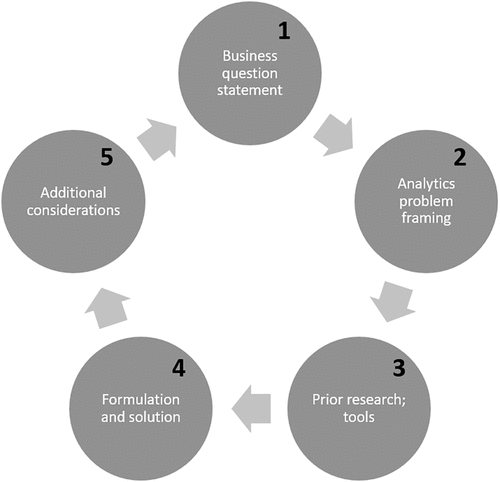
The instructor can start the case discussion by asking students to describe the problem and propose analytical techniques to address it. The discussion can then be steered toward identifying a particular type of optimization problem—the vehicle routing problem—that can be used to evaluate the maximum savings and the delivery limitations the business owner can realize with a single van. Spreadsheet InputData in the file 1. InputData.xlsx, also shown in Table 1 in the case, contains a typical daily order schedule that the instructor can use to discuss possible heuristics with the students. The students can be prompted to study the literature for approaches to solving the analytics problem and include additional considerations as needed. Maps, illustrations, and further suggestions for discussion are included in teaching note Section TN.2.1.
|

Table 1. Wording of Questions from Student Survey
|
2.2. Classic VRP (Noncapacitated VRP Without Time Windows)
The simplest formulation of the VRP is as follows: given a set of orders and a hub, a vehicle will serve each order location exactly once with the goal of minimizing total cost, starting from and ending at the hub. It is included in the teaching note and can be either derived together with the students or provided to them. We also provide a spreadsheet model (worksheet ClassicVRP in the file 2. ClassicVRP_Complete.xlsx).
2.3. Noncapacitated VRP with Time Windows (VRPTW)
The case setup is such that the instructor can guide the students in building models of ever-increasing complexity and also expose students to academic writing. Because deliveries have to happen during prespecified time windows, in practice, one needs to use the more complex (VRPTW) formulation. We find Feillet (2010) to be a useful reference that advanced undergraduate and master’s students can still read to understand the formulation of the problem. We also provide an implementation of the model in spreadsheet VRPTW_0.5 of the file 3. VRPTW_Complete.xlsx.
2.4. Creating Inputs (Distance and Time Matrices) with Google Maps and Google Script
The instructor can bring up the issue of estimating the necessary inputs for the formulation. In practice, the business owner would have to go through this process because the distance and time matrices are not simply provided to the decision maker. Section TN.2.4 in the teaching note shows how to estimate these inputs from the order coordinates. We create the distance and time matrices with Google Sheets, the embedded Google Script Editor, and Google Maps, which are all accessible from a (free) Google account.
2.5. Capacitated VRP with Time Windows (CVRPTW)
The setting of the case allows for discussion of the capacitated VRP with time windows if the instructor wants to teach it. However, the problem in the case requires a particular approach, and ultimately, a multitrip VRP can be considered as a practical solution.
2.6. Multitrip Capacitated VRP with Time Windows (MT-CVRPTW)
MT-CVRPTW is an extension of CVRPTW in which the van is allowed to visit the hub multiple times. We show the implementation in worksheet MT-CVRPTW of file 4. MT_CVRPTW_Complete.xlsx. The instructor can use the solution and walk through the interpretation with the students.
2.7. Discussion
There is value in learning how to fit a business situation into an optimization formulation. However, iPB’s ultimate goal is to determine what to do next. What should be the recommendation to iPB based on the insights from the optimization models? Should iPB use its van or continue to hire third-party carriers? In the teaching note, we outline one possible way to lead this discussion and note that there are rich opportunities to modify the discussion (and conclusions) based on how students choose to think about the results. The instructor (or students) can role-play the business owner for these discussions. We have also brought the business owner to participate in the final discussions in the past. Students in our classes have greatly enjoyed the opportunity to share their views and past experiences, often as business owners themselves.
3. Student Background, Reactions, and Learning Outcomes
This case has been used in a master’s-level elective course in optimization modeling taken by part-time MBA, full-time MBA, MS in business analytics, and MS in finance students as well as in an advanced undergraduate elective course in optimization modeling taken primarily by sophomores, juniors, and seniors in a business undergraduate program. Typically, this is the students’ first course in optimization modeling. We have used the case in the last third of the semester after students covered standard topics in linear programming, integer programming, network flows, nonlinear programming, and combinatorial optimization and had seen the traveling salesman problem. The case was covered in one and a half 150-minute sessions in the graduate course and in three 90-minute sessions in the undergraduate course. Students have access to Excel and use their own laptops during class. The teaching plans for these two courses are summarized in Section TN.3 in the teaching note. Student reactions to the case have been very positive. We present summaries of student opinion survey results for one section of the advanced undergraduate optimization modeling course and one section of graduate optimization modeling elective. Institutional research board (IRB) approval was obtained for this project.
Students were given brief online surveys that were anonymous and voluntary in accordance with IRB guidelines. The survey questions are shown in Table 1.
Although students were told that participation was optional, the response rate was high. For the undergraduate section, there were 17 responses out of 21 attendees (81% response rate). For the MBA section, there were 27 responses out of 32 attendees (84% response rate).
Figure 2 summarizes the students’ answers to question 1 from Table 1. Both graduate and undergraduate students ranked the first two learning competencies, “a process for framing a problem and adding complexity incrementally to reach a relevant solution” and “translating the solution of an optimization algorithm into recommendations for a business,” as their top takeaways from the case with undergraduates appreciating these aspects of the case more than the graduate students, possibly because of fewer opportunities than graduate students to focus on such concepts at this point in their career.
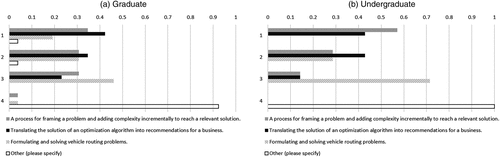
Notes. The vertical axis shows the ranking given to each option. Tabulated as a percentage of responders who gave a particular ranking. (a) Graduate course. (b) Undergraduate course.
Overall, students were very satisfied with their learning and experience with the case: 100% and 93% of graduate respondents answered “1” or “2” to questions 2 and 3 in Table 1, respectively, and 95% of undergraduate respondents answered “1” or “2” to questions 2 and 3, respectively. A sample of comments from the anonymous student evaluations is provided:
“Very interesting and helpful to see a real-world problem and challenges that it brings.”
“Very realistic problem that was helpful in seeing real-world application. Thank you!”
“I can [see] places where I could apply this myself, which I liked. I was thinking of for landscaping where there are similar situations.”
“It was a great learning experience in terms of relating class concepts to a real-life problem. Great work professors!”
“The case was very relatable and genuine, and this can be solved by a PROJECT MANAGEMENT DASHBOARD with CRM and Logistical Route Map options.”
“If anything, maybe make it a bit longer. I enjoyed the case!”
Anecdotally, we also had the following impressions from the students’ reactions to the case: One of the most engaging exercises in the case was the Google Map exercise (Section TN.2.4). Students greatly enjoyed the opportunity to play with real data and learn about writing scripts in Google Sheets. They felt this was an exercise that could be applied in many other contexts as well. For instructors interested in doing more with calculating distances in a spreadsheet, Huggins (2019) describes an application using Excel and a database of U.S.-based ZIP codes to calculate distances. Although this approach would not have worked with our case because our coordinates are in overseas locations and Thai zip codes are not in the database referenced in Huggins (2019), it can be a good reference to provide to interested students.
Students faced the most challenges when doing the subtour identification and elimination exercise (Section TN.2.2). It was difficult for students to map the optimal solution from the Excel spreadsheet into a new concept—subtours—and suggest further formulation enhancements. Although they had heard about subtours in the context of the traveling salesman problem in a previous lecture, this exercise really made them put this concept into action. They also struggled with reading the academic paper (Section TN.2.3)—undergraduate students more than graduate students because of their inexperience dealing with challenging readings—but all groups of students admitted it was a good way for them to learn about academic resources and research available for solving prescriptive analytics problems in practice.
Overall, students in undergraduate classes enjoyed the process of problem solving and model development. Students in graduate classes, in contrast, had animated discussions on future improvements and the final recommendations to the venture.
4. Concluding Remarks
The case described in this article presents an opportunity to show how to formulate and solve VRPs in a setting that is seldom used in the operations research literature: strategic decision making for a small business. Based on a real-world analytics project, the case emphasizes the need for practical interpretation of the solution of optimization models as increasingly complex real considerations need to be incorporated in the problem formulation and the importance of relating model solutions to the original question posed by the business owner. The case allows for teaching additional skills, such as identifying ways to turn an infeasible solution into business recommendations, consulting academic research literature, and utilizing Google Maps and code to estimate inputs for the optimization models. Student feedback about the experience with this case has been very positive, and we hope that other instructors will also find that the case provides helpful context for teaching successful identification and implementation of prescriptive analytics projects across a range of practical applications.
We thank the iParty Bangkok Co. staff, as well as the students who helped us test the case in the classroom and provided useful feedback. We are also very grateful to the editor, associate editor, and reviewers, for helpful suggestions on previous versions of the manuscript. We all contributed to this work, and our names are listed in alphabetical order.
Appendix. List of Resources Provided with the Case
A.1. Data Files
1. InputData.xlsx: Contains original data for the case, including distance matrix.
A.2. Teaching Note
Contains discussion of the topics introduced in this case article.
A.3. Excel Model Files
2. ClassicVRP_Shell.xlsx: A spreadsheet template of the classic VRP model (see Section TN.2.2).
2. ClassicVRP_Complete.xlsx: Contains spreadsheet models of the classic VRP (see Section TN.2.2), including the process of eliminating subtours.
3. VRPTW_Shell.xlsx: A template of the VRP spreadsheet model with time window (see Section TN.2.3).
3. VRPTW_Complete.xlsx: Contains spreadsheet models of VRP with time windows (see Section TN.2.3) with 30 minutes and 15 minutes of service time.
4. MT-CVRPTW_Shell.xlsx: A spreadsheet template of the multitrip capacitated VRP model with time window (see Section TN.2.5).
4. MT-CVRPTW_Complete.xlsx: Contains the multitrip capacitated VRP spreadsheet models with time windows (see Section TN.2.5). All constraints are incorporated in the first spreadsheet. Redundant constraints are dropped in the second spreadsheet.
A.4. Sample Teaching Plans and Assignments
Section TN.3.1: Contains a possible lesson plan for an undergraduate elective course.
Section TN.3.2: Contains a possible lesson plan for a graduate (master’s level) elective course.
References
- (2003) Operations research capstone course: A project-based process of discovery and application. INFORMS Trans. Ed. 3(2):1–25.Link, Google Scholar
- (2013) Learning through industry interface projects. INFORMS Trans. Ed. 13(2):93–101.Link, Google Scholar
- (2010) Active learning projects in service operations management. INFORMS Trans. Ed. 11(1):20–28.Link, Google Scholar
- (2022) Case article—Route planning at an animal husbandry department. INFORMS Trans. Ed. 23(1):35–40.Link, Google Scholar
- (2016) Case article—Medication waste reduction in an in-hospital pharmacy: A case that bridges problem solving between a traditional case and an industry project. INFORMS Trans. Ed. 16(2):68–70.Link, Google Scholar
- (1998) PBL: Preparing students to succeed in the 21st century. PBL Insight 1(2):3–4.Crossref, Google Scholar
- (2013) Increasing student interest and engagement with business cases by turning them into consulting exercises. Decision Sci. J. Innovative Ed. 11(4):359–381.Crossref, Google Scholar
- (2010) A tutorial on column generation and branch-and-price for vehicle routing problems. 4OR 8(4):407–424.Crossref, Google Scholar
- (1990) What is experiential learning? Chapter 2. Guide to Business Gaming and Experiential Learning (Nichols Pub Co., Asbury, IA), 9–20.Google Scholar
- (2008) A general vehicle routing problem. Eur. J. Oper. Res. 191(3):650–660.Crossref, Google Scholar
- (2018) A survey of research in field-based education: A summary of process, best practices, and lessons learned. INFORMS Trans. Ed. 18(3):145–161.Link, Google Scholar
- (2012) A brief guide to student projects with industry. INFORMS Trans. Ed. 13(1):10–16.Link, Google Scholar
- (1975) An experiential‐cognitive methodology in the first course in management: Some preliminary results. Simulation Games Experiential Learn. Action 2:23–25.Google Scholar
- (2019) Case article: Converting zip code data into distances: A case study for teaching business analytics case. INFORMS Trans. Ed. 19(2):105–107.Link, Google Scholar
- (2005) Experiential learning process: Exploring teaching and learning strategic management framework through the winter survival exercise. J. Management Ed. 29(5):672–695.Google Scholar
- (2018) Are our students prepared? The impact of capstone design pedagogical approaches on student skill development during industry-sponsored fieldwork. INFORMS Trans. Ed. 18(3):183–193.Link, Google Scholar
- (2017) Case article—Growing pains: A case study for large-scale vehicle routing. INFORMS Trans. Ed. 17(2):75–80.Link, Google Scholar
- (2015) Case article—Mapping business problems to analytics solutions: Surrogate experiential learning in an MBA introductory data science and business analytics course. INFORMS Trans. Ed. 16(1):15–22.Link, Google Scholar
- (2022) Case article—Machine learning, ethics, and change management: A data-driven approach to improving hospital observation unit operations. INFORMS Trans. Ed. 22(3):178–187.Link, Google Scholar
- (2012) Global experiential projects with a manufacturer in India: Insights from five years of experience. INFORMS Trans. Ed. 13(1):31–43.Link, Google Scholar
- (2021) Kaizen events at the University of St. Thomas: Experiential learning for students. INFORMS Trans. Ed. 21(3):115–129.Link, Google Scholar
- (2021) Getting beyond the first result of solving a vehicle routing problem. INFORMS Trans. Ed. 22(1):9–27.Link, Google Scholar