Case Article—Racial Bias in Automated Traffic Law Enforcement and the Price of Unjustness
Abstract
This case study has been developed for students to practice their data analysis and optimization skills in a contemporary societal issue: that of injustice in automated traffic law enforcement. Specifically, this case study is for students of modern data analysis and statistical modeling courses that focus on hypothesis testing; it also has a component for students in optimization and mathematical modeling courses that focus on linear and network optimization. The case study has been used since Spring 2023 in a combination of two courses from the Industrial Engineering (Analysis of Data, an introduction to probability and statistics) and Civil Engineering (Transportation Systems, an introduction to mathematical modeling and optimization for civil engineers with a focus on transportation) curricula.
History: This paper has been accepted for the INFORMS Transactions on Education Special Issue on DEI in ORMS Classrooms.
Supplemental Material: The Teaching Note and data files are available at https://www.informs.org/Publications/Subscribe/Access-Restricted-Materials.
1. Introduction and Motivation
This manuscript presents a novel, culturally relevant case study for students who are being introduced to data analysis and operations research, and instructors engaged in teaching undergraduate courses in these fields. We begin the manuscript with a brief introduction in Section 1; we then present the set of learning objectives in Section 3. A brief description of the classroom experience over Spring 2023 is provided in Section 4, before we conclude in Section 5.
1.1. Motivation
The development of this case study is motivated by observed and perceived disparities in traffic law enforcement and the issue of racial profiling. Traffic law enforcement through traffic stops has been shown to target minorities more often than not, even though minority stops yield fewer arrests and less contraband discovery compared with majority stops (Engel and Calnon 2004, Baumgartner et al. 2017). Automated traffic enforcement, including the use of technology like red-light or speed cameras, is often presented as a solution to minimizing racial profiling and increasing road safety, and it has been posed as such by proponents of automated systems for traffic enforcement (Morain et al. 2016, Woods 2021). As an example, traffic enforcement could be removed from the authority of police and delegated to other traffic monitors who would then use automated traffic law enforcement systems (Woods 2021).
In this case study, we present data from the city of Chicago, IL (one of the U.S. cities with the biggest density of automated cameras to monitor red-light and speeding violations), and ask students to show that, despite the argument that automation cannot induce more inequity, majority black neighborhoods and zip codes are still receiving more tickets from these automated systems. To bring operations research and the management sciences more firmly in the discussion, we also ask students to use the provided data to derive a “price of unjustness” for drivers who wish to avoid these cameras in order to minimize financial burden and anxiety from a possible violation and the ticket (Livingston and Ross 2022). In their book, Livingston and Ross (2022) state that “some drivers … went to great lengths to avoid them [referring to “red zones”], carefully mapping out and adding time to their journeys.”
Although this is by no means the first time that racial profiling in traffic stops and the term of driving while Black (DWB) are studied in the form of teaching materials (see, for instance, the excellent probabilities and statistics classroom material in Greenberg et al. (2021) at the collection of cases in “Mathematics for Social Justice: Focusing on Quantitative Reasoning and Statistics” by Karaali and Khadjavi (2021)), we are presenting for the first time a supplementary network optimization problem, aligned with real-life experiences of minority drivers.
We proceed to offer an overview of the case study, before presenting the pedagogical goals associated with it. We finish by describing the classroom experience for the case study, as it was offered to students during the Spring 2023 semester at University of Illinois Urbana-Champaign.
2. Case Overview
The case study is largely motivated by a recent ProPublica article that made a daring claim: Chicago’s supposedly “race-neutral traffic law enforcement cameras disproportionately ticket Black and Latino motorists” (Hopkins and Sanchez 2022). Automated law enforcement in the form of cameras that monitor speed or red-light crossings is very common in the city of Chicago. Actually, Chicago boasts the most automated traffic enforcement cameras in the United States (Illinois Policy 2019). In general, cameras are installed in certain intersections to automatically monitor for traffic safety law infringements, including not fully stopping at a red light, turning right at a red light when it is disallowed, and/or speeding. Cameras and other automated law enforcement mechanisms are supposed to be especially preferred in locations where traffic stops are difficult to perform (Goodwin et al. 2015, Centers for Disease Control and Prevention 2022).
Chicago is not alone in its use of such cameras for traffic law enforcement. As of October 2023, there are 336 communities across 23 states (22 states plus the state of Texas, which has disallowed the practice since 2019) and the District of Columbia that employ cameras as a law enforcement tool (Insurance Institute for Highway Safety (IIHS) 2023). In this case study, we will use data from Chicago, IL, and its surrounding areas. Figure 1 shows a map of the United States with all states that are using traffic cameras for traffic law enforcement.
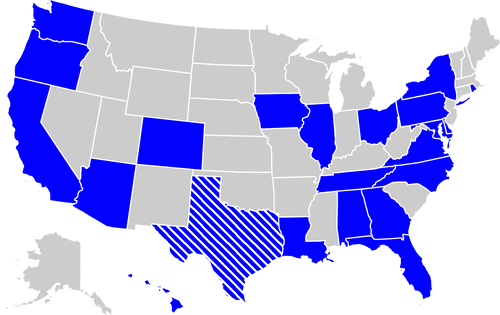
Note. Texas (shown in striped blue) has had a state law disallowing the use of red-light cameras since June 2019; however, it also has communities that are permitted their use because of preexisting contracts in place.
In the case study, students are asked to perform two main tasks. First, they are asked to use statistical hypothesis testing to check whether communities that are majority-minority (with a focus on Black and Latino communities) are indeed more commonly on the receiving end of tickets issued by these automated traffic law enforcement systems. To do that, students are provided with all of the data on the number of tickets issued by vehicle registration community, as well as the most up-to-date information on demographics per community.
Assuming that the statement is true, and indeed Black and Latino drivers are more commonly issued tickets by automated traffic law enforcement systems, then it would come as no surprise that some of them will be prone to avoiding certain areas and intersections altogether, as evidenced in Livingston and Ross (2022). This will lead to such drivers’ rerouting from the shortest path to a destination avoiding red-light and speed cameras, delays, and missing out on opportunities, because of potentially being exposed to a violation and the financial burden of ticketing. We then provide students with a new side-constrained shortest-path problem, one where vehicle drivers want to identify a shortest path in the city while avoiding most (or all) intersections with an automated traffic law enforcement system. Students are provided with an up-to-date transportation network for the city of Chicago, IL, obtained using OSMnx (Boeing 2017), as well as all camera locations in the network.
This last optimization problem comes with a new and socially interesting definition: the price of unjustness. The price of unjustness is defined as the difference (in units of time) between the actual shortest path and the side-constrained shortest path while avoiding many or all of the automated law enforcement zones. We call these “red zones” (Livingston and Ross 2022) and provide their locations in the city of Chicago in red. We show the full transportation network and the “red zones” in Figure 2. Indicatively, we also show the solution to the unrestricted shortest path, the shortest path while passing through at most 10 “red zones,” and the shortest path while avoiding all “red zones” in Figure 3.

Notes. The road transportation network of Chicago, IL, obtained using OSMnx is shown on the left. On the right, we present the same network with the “red zones” (nodes in red) identified using the locations of all traffic cameras.
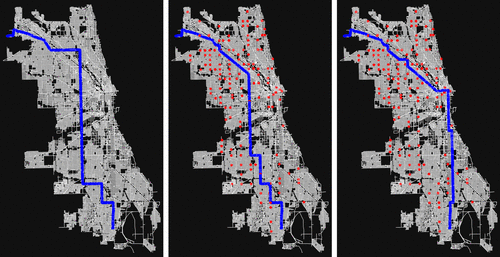
Note. The shortest path when allowed to pass through any “red zone” (left, with a total travel time of 52.32 minutes), through no more than 10 “red zones” (center, with a total travel time of 57.89 minutes), or through no “red zones” at all (right, with a total travel time of 60.25 minutes).
We also present a brief explanation on why we are observing these undue and disproportionate burdens to specific drivers alone. Automated traffic law enforcement (in the form of red-light cameras or speed radars) is meant to improve on safety outcomes, while being race neutral. However, some of the decision-making processes for selecting intersections to install these mechanisms have been less than transparent in the state of Illinois (Illinois Policy 2020a, b). Indicatively, we point to an investigation that showed that more than 50% of the installed red-light cameras were placed in intersections deemed to be among the safest in Chicago per the Illinois Department of Transportation (Mahr and Walberg 2017). Hence, one possible explanation for the unfair targeting of specific drivers is that the locations where these automated mechanisms are installed do not always follow “safety first” outcomes, and instead their selection is based on other, unclear criteria.
3. Pedagogical Goals
In this section we present the teaching objectives of the case study. We also describe the situations under which the case study was used in our institution and present other use cases in the academic curriculum of operations research, analytics, and the management sciences.
3.1. Teaching Objectives
First, we introduce a timely societal issue that combines notions from transportation engineering, law enforcement, and racial injustice. Then, students are asked to formulate a suitable statistical hypothesis to see whether a specific automated law enforcement tool can, in fact, be unjust for part of the population. At this step, students use real-world data and the Python pandas package to collect the necessary information and use it in the context of hypothesis testing. Students are also asked to rethink how shortest-path problems need to be formulated to capture side-constraints emerging from automated traffic law enforcement system biases. Finally, after this case study, students have a better understanding of how numerous policies have unintended consequences, and discuss as a group ways to employ data analysis and network optimization to improve policy outcomes. Specifically, the objectives of Case Study 3 are to
O1. Read data using the pandas package and visualize summary statistics using matplotlib.
O2. Estimate probabilities and conditional probabilities using real-world data.
O3. Formulate relevant statistical hypotheses and devise a plan to collect and use data to reject or fail to reject them.
O4. Derive meaningful analyses from our statistical hypotheses and report useful information such as P-values and errors.
O5. Mathematically model problems on networks, such as the shortest-path problem and the constrained shortest-path problem, inspired by contemporary issues in urban traffic law enforcement.
O6. Use linear optimization and open-source optimization solvers (such as PuLP) to solve unconstrained and constrained shortest-path problems on networks.
O7. Critically analyze the results from linear optimization as a tool to evaluate and critique disparities and injustice.
3.2. Teaching Suggestions
This case study includes and tests materials on several traditional industrial engineering, operations research, and analytics topics. Specifically, in this case study we present topics from (i) data analytics, such as data preprocessing and filtering and data visualization; (ii) probabilities and statistics, in the form of formulating hypothesis tests and performing tests to reach conclusions; and (iii) operations research and quantitative modeling in the form of formulating and solving shortest-path problems, as well as shortest paths with side-constraints.
The case study has been tested in two classes for second-year (sophomore) students: an introductory Industrial Engineering course on Probabilities and Statistics, and an early Civil Engineering course on Systems Engineering and Economics that also teaches operations research techniques. The case study can also be supplemented to reach graduate student audiences by introducing more advanced large-scale integer programming approaches or graduate students in Urban Planning, Transportation Engineering, and Geospatial Informatics. Specifically for that last point, during Fall 2023, part of the case study was adapted to an in-class activity for graduate students. Using the real-life data from the transportation network of the city of Chicago, graduate students in a Network Analytics class used Lagrangian optimization to obtain an optimal solution to the side-constrained shortest path shown in Figure 3.
Finally, we note the topic areas that are present in the case study using A1–A4. We have the following areas that are covered:
A1. Statistics and data analytics.
A2. Operations research.
A3. Transportation engineering and systems.
A4. Justice and law enforcement.
The case study is meant to expose engineering students to topics of social justice and law enforcement. That said, not every area is equally present in each of the questions of the case study. Hence, for convenience, we mark each question with the appropriate areas that are being covered so that instructors can make their own choices for their courses.
4. Classroom Experience
The case study has been broken into two parts and used in two classes:
Industrial Engineering course on Probabilities and Statistics covering outcomes O1–O4.
Civil and Environmental Engineering course on Optimization covering outcomes O5–O7.
All students were in engineering.
Students in both classes were given two weeks to submit their work, ideally using Python (the programming language of choice in both courses) and Jupyter notebooks. The students were provided template Jupyter notebooks for data wrangling and data visualization, as well as notebooks formulating network optimization problems using PuLP (Mitchell et al. 2011). In both classes, students are asked to form groups to tackle the case studies and produce two deliverables: (i) their code and (ii) their report, which includes the answers to the case study questions.
One of the main challenges that students faced was related to computing and the programming part of the case study. A number of students felt uncomfortable with the data wrangling portion of the project (associated with outcomes O1 and O2). Our recommendation is that students are introduced to or reminded of some of the pandas functionality (or similar in other programming languages) prior to the case study announcement. We provide some indicative notebooks that introduce these ideas in the teaching note that is associated with this article.
Similarly, outcome O6 requires students to work with a mathematical programming and optimization suite within a programming language. Coupled with the large size of the Chicago, IL, transportation network, this can be a frustrating experience for students. We recommend that students are provided with smaller (either conceptual or real) networks as benchmark instances that they can test their optimization framework on prior to testing it on the larger-scale network of Chicago (or another similarly sized city). We also provide indicative examples in the teaching note, as well as a Jupyter notebook for students to train on prior to moving to the Chicago road transportation network.
Finally, we found that it is important for students to have guided discussions among themselves about what the results show and what are the caveats of their analyses. For example, after identifying the shortest paths with and without “red zone” avoidance, we asked the students to discuss the difficulties associated with following each of the two shortest paths. We found that without guidance, this can be a very open-ended discussion. Hence, we recommend that students discuss what it means for the time spent driving, the difficulty of adhering to the path (e.g., number of turns that a driver must make in each of the two paths), or number of higher-speed streets with higher capacities that a driver needs to select in each of the cases. For this last part, it may be important to visualize different-speed streets in different ways, or provide students with the necessary tools to find the residential areas, the downtown areas, or the highway locations in the road transportation network provided.
5. Conclusion
More and more higher education institutions are recognizing that socially and culturally relevant case studies enhance their students’ learning experiences and improve inclusion outcomes of underrepresented minorities in the classroom (National Academy of Engineering 2005, Drazan et al. 2016). Especially in Engineering (broadly defined), students hear about the policy implications of the tools they learn about, such as the tools in this case study which include hypothesis testing and linear programming. That said, they lack the necessary examples and practical applications that showcase the impact of their policy decisions. We believe this to be an exciting application of hypothesis testing and linear optimization, one that firsthand shows the cost of social unjustness in the form of automated traffic law enforcement.
Our case study uses data obtained from a variety of sources (journalistic, census, transport network topology and characteristics) all combined to teach hypothesis testing and linear programming in a context that is also addressing pressing societal challenges. It also requires basic computing and programming skills, which can serve as a way for students to practice and perfect their data analytics and modeling tools. Finally, it asks students to pause and consider the potential consequences that policy decisions can have when racial justice is not explicitly considered.
References
- (2017) Targeting young men of color for search and arrest during traffic stops: Evidence from North Carolina, 2002–2013. Politics Groups Identities 5(1):107–131.Crossref, Google Scholar
- (2017) OSMnx: New methods for acquiring, constructing, analyzing, and visualizing complex street networks. Comput. Environ. Urban Systems 65:126–139.Crossref, Google Scholar
Centers for Disease Control and Prevention (2022) Automated red light camera enforcement. Accessed March 1, 2023, https://www.cdc.gov/transportationsafety/calculator/factsheet/redlight.html.Google Scholar- (2016) Harmonious integration: Tuning STEM education with generative justice. 2016 IEEE Integrated STEM Ed. Conf. (ISEC) (IEEE, Piscataway, NJ), 58–64.Google Scholar
- (2004) Examining the influence of drivers’ characteristics during traffic stops with police: Results from a national survey. Justice Quart. 21(1):49–90.Crossref, Google Scholar
- (2015) Countermeasures That Work: A Highway Safety Countermeasure Guide for State Highway Safety Offices, 8th ed. (National Highway Traffic Safety Administration, Washington, DC).Google Scholar
- (2021)
Policing and the issue of racial profiling . Karaali G, Khadjavi LS, eds. Mathematics for Social Justice: Focusing on Quantitative Reasoning and Statistics (MAA Press, Washington, DC), 137–146.Google Scholar - (2022) Chicago’s “race-neutral” traffic cameras ticket Black and Latino drivers the most. ProPublica (January 11), https://www.propublica.org/article/chicagos-race-neutral-traffic-cameras-ticket-black-and-latino-drivers-the-most.Google Scholar
Illinois Policy (2019) Chicago dominates competition for most red-light cameras. Illinois Policy (October 18), https://www.illinoispolicy.org/chicago-dominates-competition-for-most-red-light-cameras/.Google ScholarIllinois Policy (2020a) Illinois house committee passes bill to ban red-light cameras statewide. Illinois Policy (March 12), https://www.illinoispolicy.org/illinois-house-committee-passes-bill-to-ban-red-light-cameras-statewide/.Google ScholarIllinois Policy (2020b) Oakbrook Terrace mayor resigns amid red-light camera probe. Illinois Policy (January 23), https://www.illinoispolicy.org/oakbrook-terrace-mayor-resigns-amid-red-light-camera-probe/.Google ScholarInsurance Institute for Highway Safety (IIHS) (2023) Red light running: Red light camera communities. Accessed October 1, https://www.iihs.org/topics/red-light-running/red-light-camera-communities.Google Scholar- Karaali G, Khadjavi LS, eds. (2021) Mathematics for Social Justice: Focusing on Quantitative Reasoning and Statistics (MAA Press, Washington, DC).Crossref, Google Scholar
- (2022) Cars and Jails: Freedom Dreams, Debt, and Carcerality (OR Books, New York).Google Scholar
- (2017) Tribune investigation: IDOT approves red light cameras for already safe intersections. Chicago Tribune (September 23), https://www.chicagotribune.com/investigations/ct-idot-red-light-cameras-met-20170921-story.html.Google Scholar
- (2011) PuLP: A linear programming toolkit for Python. Technical report. Department of Engineering, University of Auckland, Auckland, New Zealand.Google Scholar
- (2016) Automated speed enforcement systems to reduce traffic-related injuries: Closing the policy implementation gap. Injury Prevention 22(1):79–83.Crossref, Google Scholar
National Academy of Engineering (2005) Educating the Engineer of 2020: Adapting Engineering Education to the New Century (National Academies Press, Washington, DC).Google Scholar- (2021) Traffic without the police. Stanford Law Rev. 73(6):1471–1549.Google Scholar